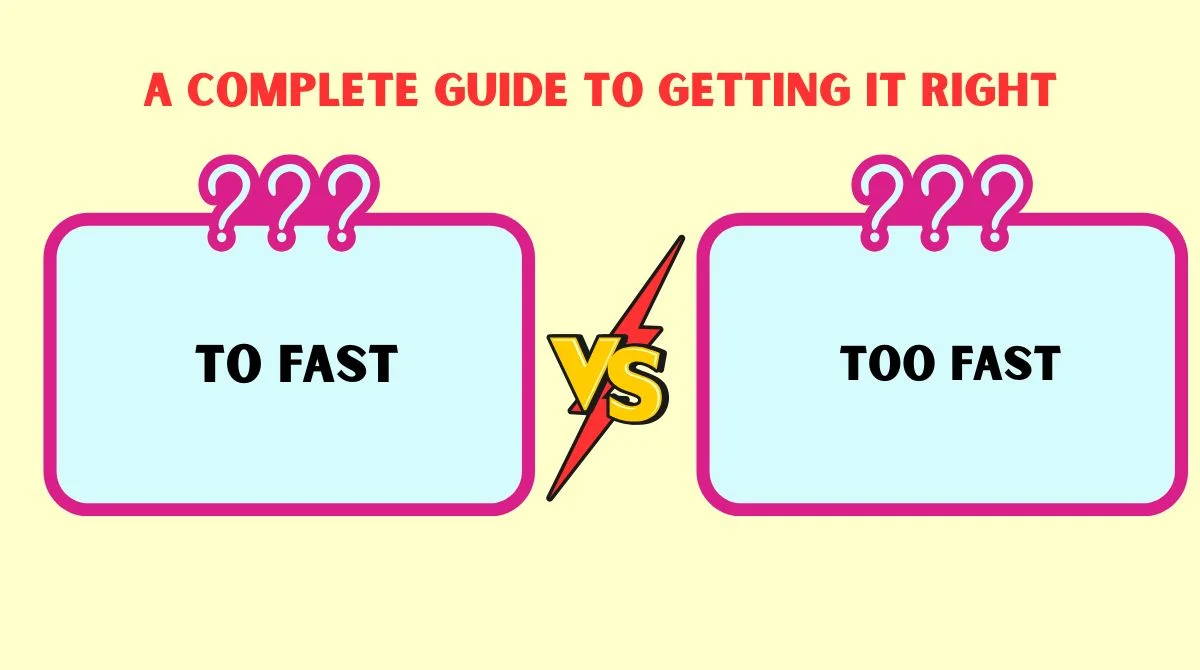
English can be tricky, especially when two phrases look almost the same but mean completely different things. “To fast” and “too fast” are perfect examples.
At first glance, you might think they’re just spelling variations. But the truth is, each carries a very different meaning—and using the wrong one can confuse your reader.
This guide clears up the confusion once and for all. We’ll explore the difference between “to” and “too”, the multiple meanings of “fast”, and how context makes or breaks these phrases.
Along the way, you’ll see examples, a case study on fasting, real-world applications, a quick-reference table, and even a short quiz to test your skills.
Let’s start by breaking down the basics.
The Real Difference Between “To” and “Too”

Before tackling “to fast” and “too fast,” you need to understand how “to” and “too” work individually. They sound alike but play very different roles in English.
What Does “To” Mean?
“To” is one of the most versatile words in English. It’s used in countless ways, but the two most important roles are:
- As a preposition – It shows direction, recipient, or relationship.
- I’m going to the store.
- She gave the book to her friend.
- As part of an infinitive verb – It links with a verb to express action.
- I want to learn Spanish.
- He decided to run.
So when you see “to fast,” it falls under this second role: the infinitive form of the verb fast (meaning to abstain from food).
What Does “Too” Mean?
Unlike “to,” the word “too” usually works as an adverb. It has two main meanings:
- Also / in addition
- I want to come too.
- She likes coffee, and I do too.
- Excessively / more than necessary
- He’s driving too fast.
- This coffee is too hot.
When you see “too fast,” it’s always about something happening more quickly than is appropriate or safe.
What Does “Fast” Mean in Grammar?
Now, let’s clear up the other half of the confusion. The word “fast” is unique because it can serve as an adjective, an adverb, or even a verb.
- As an adjective – It describes something that moves quickly.
- A fast train, a fast car.
- As an adverb – It tells you how an action is done.
- He runs fast.
- The colors won’t wash out—they’re fast.
- As a verb – It means abstaining from food or drink, often for religious or health reasons.
- Many people fast during Ramadan.
- She plans to fast for 24 hours.
👉 This third meaning is where “to fast” comes into play.
When “To Fast” is Correct
“To fast” is grammatically correct when it functions as an infinitive verb phrase. It usually appears in sentences about religion, health, or lifestyle choices.
- I want to fast tomorrow for health reasons.
- She decided to fast during Lent.
- Doctors sometimes ask patients to fast before surgery.
Case Study: Intermittent Fasting
In recent years, intermittent fasting has become a global health trend. Millions practice it as a way to manage weight and improve metabolism.
Example sentences:
- He chooses to fast for 16 hours a day and eat during an 8-hour window.
- Athletes sometimes decide to fast to improve discipline and body control.
Notice how “to fast” always links an action (abstaining from food) with a purpose.
When “Too Fast” is Correct
On the other hand, “too fast” is not about eating habits at all—it’s about speed or excessiveness. It means something is happening quicker than it should.
- She was speaking too fast for me to understand.
- The driver was going too fast and got a ticket.
- Don’t eat too fast—you’ll get a stomachache.
Real-World Application: Traffic Laws
Governments often warn drivers about going too fast. Speed limits are set to keep roads safe. For example:
- Exceeding 80 mph is driving too fast for most highways.
- Cameras catch drivers going too fast in school zones.
“Too fast” always relates to excess, overdoing it, or unsafe quickness.
Common Mistakes and How to Avoid Them
Because “to” and “too” sound identical, many learners confuse them in writing.
Common Errors
- Writing to fast when they mean too fast.
- Writing too eat instead of to eat.
- Using to instead of too in “me too.”
Why the Confusion Happens
The root cause is phonetics. Both words are pronounced the same, so writers often rely on sound rather than meaning.
Tips to Catch Mistakes
- If you mean excessive → choose too.
- If you mean direction or infinitive → choose to.
- Double-check by swapping with “also.” If the sentence works, use too.
Quick Reference Tools
Simple Trick to Remember
- Too has an extra “o” → think of it as “extra, more than needed.”
- To is the standard, basic form → direction, recipient, or infinitive.
Comparison Table
| Phrase | Meaning | Example |
|---|---|---|
| To fast | Infinitive verb = abstain from food/drink | She wants to fast during Ramadan. |
| Too fast | Excessive speed / over-quick | He drives too fast on highways. |
Mini Quiz
Fill in the blanks with either to fast or too fast:
- The car was moving ____ for me to catch the number plate.
- Muslims choose ____ during Ramadan as a form of worship.
- You eat way ____ and it upsets your stomach.
- He decided ____ before his medical check-up.
Answers:
- Too fast
- To fast
- Too fast
- To fast
Advanced Usage: When Both Appear in the Same Sentence
Sometimes, both phrases show up together.
- She decided to fast because she was gaining weight too fast.
- He wants to fast, but he breaks his fast too fast.
This creates a clever play on meanings—one about not eating and the other about excessive speed.
Related Confusing Word Pairs
“To fast” vs. “too fast” isn’t the only trap. Here are a few other pairs that confuse learners:
- To / Too / Two
- I’m going to the park.
- I’m going too.
- I have two dogs.
- Their / There / They’re
- Their house is big.
- The book is over there.
- They’re going to the party.
- So / Sow / Sew
- So what?
- Farmers sow seeds in spring.
- She can sew a dress.
FAQs
When should I use “to fast” and “too fast”?
Use to fast when referring to the verb meaning abstaining from food. Use too fast when describing excessive speed.
What does “fast” mean in grammar?
It can be an adjective (quick), an adverb (quickly), or a verb (abstain from food).
Is “to fast” ever wrong?
Yes, if you use it to describe speed. For speed, always use “too fast.”
Which is correct: “I love you to” or “I love you too”?
The correct form is I love you too (meaning “also”).
Can I use “fast” to describe not eating?
Yes. As a verb, “fast” means abstaining from food or drink.
Conclusion
The difference between “to fast” and “too fast” boils down to purpose vs. excess.
- To fast → the act of abstaining from food (verb phrase).
- Too fast → more speed or intensity than needed (adverb phrase).
With examples, tricks, and practice, this confusion disappears. Just remember: if it’s about not eating, it’s to fast. If it’s about speed, it’s too fast.

Leave a Reply