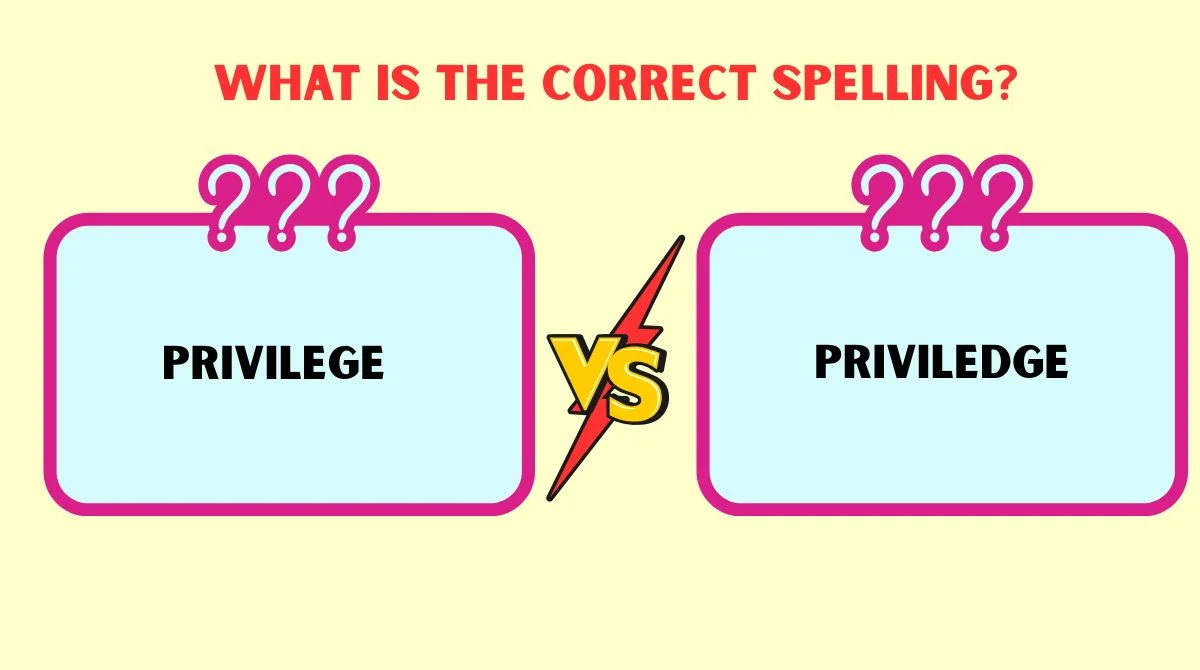
Choosing the right word can shape how people perceive your writing. A single letter often separates correct spelling from a glaring mistake. One of the most common examples is the mix-up between “privilege” and “priviledge.”
This article digs deep into the confusion. You’ll learn why “privilege” is the only correct spelling, why “priviledge” persists as a mistake, and how to avoid it in your writing.
✅ Quick Answer: Privilege Is Correct
The word “privilege” (with no ‘d’ before the ‘g’) is the correct spelling.
The misspelled form “priviledge” doesn’t exist in standard English dictionaries.
Quote: “Correct spelling reflects attention to detail — a privilege few take lightly.”
Here’s a quick overview:
| Word | Correct/Incorrect | Meaning |
|---|---|---|
| Privilege | ✅ Correct | A special right, advantage, or immunity granted to a person or group. |
| Priviledge | ❌ Incorrect | Common misspelling, not accepted in standard English. |
You’ll often see “priviledge” in casual online writing or social posts, but in professional, academic, or legal contexts, it’s always wrong.
🔎 Understanding the Confusion: Privilege vs. Priviledge
English spelling can be tricky because words are not always spelled the way they sound.
When people pronounce “privilege,” the middle syllable sounds soft, almost like “pri-vi-lij.”
That soft “i” sound makes some writers mistakenly insert a “d,” producing “priviledge.”
This is known as phonetic confusion — when spelling choices are guided by how a word sounds rather than how it’s historically written.
📚 Definition and Correct Usage of “Privilege”
The word “privilege” dates back to Middle English from Old French privilege, which came from Latin privilegium (a law for an individual).
Today, it serves both as a noun and a verb:
- As a noun:
“A special right, advantage, or immunity granted to a particular person or group.”
Example: “Access to clean water is a basic privilege in many countries.” - As a verb:
“To grant a special right or advantage to someone.”
Example: “The law privileges local producers over foreign competitors.”
It’s also used in common phrases like:
- Legal privilege: attorney–client privilege
- Social privilege: such as socioeconomic advantages
- Digital privilege: admin privileges in software
✍️ Breaking Down Common Variants
🟢 How to Spell “Privileged” Correctly
The adjective and past participle form is “privileged.”
- Rule: Drop the final “e” in “privilege” before adding the suffix –ed.
- Example:
- Correct: “She felt privileged to be part of the team.”
- Incorrect: “She felt priviledged to be part of the team.”
Tip: There’s no extra ‘d’ in the root word, so there’s no ‘d’ in its derivatives.
🟢 How to Spell “Privileges” Correctly
The plural form is “privileges.”
- Example:
- Correct: “Students enjoy many privileges in the library.”
- Incorrect: “Students enjoy many priviledges in the library.”
🚫 What Does “Priviledge” Mean? (Spoiler: Nothing)
The form “priviledge” does not appear in any reputable English dictionary like Merriam-Webster, Oxford, or Cambridge.
It is purely a spelling mistake.
Many people assume it’s acceptable because of its frequent appearance online, but relying on that misconception can hurt the credibility of your writing.
Fact: Microsoft Word and Grammarly flag “priviledge” as a misspelling.
🤔 Why “Priviledge” Became a Common Misspelling
The persistence of “priviledge” can be traced to several factors:
📌 Phonetic Confusion
The pronunciation /ˈprɪv.ə.lɪdʒ/ tempts writers to include a “d.”
📌 Influence of Similar Words
Words like “knowledge,” “college,” “allege” end with a –ledge pattern, misleading writers to mimic it.
📌 Historical Spelling Variants
Early English sometimes had inconsistent spellings.
For example, in 17th-century texts, you might find archaic forms that no longer apply today.
Modern English has standardized the spelling as “privilege.”
📌 Typing Habits & Auto-correct Errors
Misspellings spread quickly online.
When enough people use the wrong form, it looks “normal,” perpetuating the mistake.
📊 Side-by-Side Comparison Chart
| Aspect | Privilege (✅ Correct) | Priviledge (❌ Incorrect) |
|---|---|---|
| Dictionary Status | Recognized worldwide | Not recognized |
| Origin | From Latin privilegium | None |
| Accepted in Academic & Legal Writing | Yes | No |
| Example Sentence | “Education is a privilege.” | – |
| Pronunciation | /ˈprɪv.ə.lɪdʒ/ | – |
🧠 How to Avoid the Spelling Mistake
💡 Memorization Tips
- Mnemonic: “There’s no ‘ledge’ in privilege.”
- Break it into syllables: pri-vi-lege.
- Visualize the correct ending: –lege, not –ledge.
🔎 Proofreading & Editing Strategies
- Use trusted writing tools (Grammarly, ProWritingAid).
- Read your text aloud to catch phonetic traps.
- Keep a personal list of commonly misspelled words.
🌍 Tips for Non-Native English Writers
- Understand that English often defies phonetic rules.
- Practice spelling with flashcards or spaced-repetition apps.
- Review sentences in context rather than in isolation.
📝 Practical Examples in Sentences
✅ Correct Usage of “Privilege”
- “Voting is a privilege and a responsibility.”
- “She felt privileged to attend the ceremony.”
- “The attorney claimed client-attorney privilege.”
❌ Common Mistakes with “Priviledge”
- Wrong: “It was a priviledge to meet you.”
- Right: “It was a privilege to meet you.”
❓ Frequently Asked Questions About Privilege vs. Priviledge
Why is “Priviledge” so common in writing?
Because the word’s pronunciation sounds as though it has a “d,” many writers rely on phonetics instead of memorizing the correct spelling.
Is “Priviledge” ever acceptable in informal or dialect writing?
No. It has never been a recognized variant in standard English. Even informal writing benefits from correct spelling.
How can I correct my spelling habits?
By practicing the word in context, using memory aids, and relying on spellcheck tools.
Also, consciously proofread emails and posts before sending or publishing.
Does autocorrect always catch this error?
Usually yes, but not always. Some apps miss the error if the word has been saved in a personal dictionary or if it appears in older texts.
Is “Privilege” used differently in legal and everyday contexts?
Yes. In law, it refers to specific protected rights (like attorney–client privilege).
In everyday usage, it means an advantage or special opportunity.
🏁 Final Thoughts: Mastering “Privilege” Once and for All
“Privilege” is the only correct spelling.
Its misspelled twin, “priviledge,” is a linguistic pitfall that undermines writing quality.
Attention to detail in spelling builds trust. Whether you’re drafting an email, a report, or an academic essay, use the correct form.
Remember the simple rule: there’s no ‘d’ in privilege.

Leave a Reply