Blog

  • Rend or Rent? Learn the Key Differences with Examples! 📖

    Rend or Rent? Learn the Key Differences with Examples! 📖

    Understanding the differences between “rend” and “rent” is crucial for effective communication.

    These words may seem similar, but their meanings and usages are distinct.

    “Rend” vs. “Rent” – What’s the difference? 🤔 “Rend” means to tear apart violently, while “rent” can mean a lease payment or a tear. Learn the key distinctions with examples!

    This article will delve into the definitions, common confusions, practical examples, and tips to remember when to use “rend” or “rent.”

    Understanding the Meaning of “Rend”

    Rend or Rent

    Definition of “Rend”

    “Rend” is a verb that means to tear something into pieces with force or violence. It can also imply causing great emotional distress or splitting something apart.

    The word “rend” originates from Old English “rendan,” which carries the same meaning of tearing or splitting.

    Usage of “Rend” in Sentences

    “Rend” is often used in literary and dramatic contexts. Here are some examples to illustrate its usage:

    • The fierce storm rent the sails of the ship, leaving it adrift.
    • Her heart was rended by the tragic news of his passing.
    • The sound of the explosion rent the air, causing everyone to duck for cover.

    These sentences show “rend” in different tenses, demonstrating its versatility.

    Understanding the Meaning of “Rent”

    Definition of “Rent”

    “Rent” is a noun and a verb with multiple meanings. As a noun, it refers to a regular payment made for the use of property, land, or a service. As a verb, it means to lease property or cause a tear or split in something. The term “rent” comes from the Latin word “redditus,” meaning a return or payment.

    Usage of “Rent” in Sentences

    “Rent” is commonly used in real estate and physical damage contexts. Here are some examples:

    • Noun: The monthly rent for the apartment is due on the first of each month.
    • Verb: We decided to rent a car for our vacation.
    • Verb: The fabric was rent by the sharp edge of the table.

    These examples highlight the different uses of “rent” as both a noun and a verb.

    Rend vs. Rent: Differences and Common Confusions

    Key Differences

    Understanding the key differences between “rend” and “rent” helps to avoid confusion. Here’s a breakdown:

    AspectRendRent
    Part of SpeechVerbNoun and Verb
    DefinitionTear apart, split violentlyPayment for property (noun); lease, tear (verb)
    Usage ContextDramatic, emotional, violentReal estate, agreements, physical damage
    EtymologyOld English “rendan”Latin “redditus”

    Common Confusions

    People often confuse “rend” and “rent” due to their similar spellings and the overlap in the meaning of “tear” for both words. However, their usage contexts are quite different:

    • Rend is used in more dramatic or violent contexts.
    • Rent is used in everyday situations like leasing property or describing physical damage.

    Practical Examples to Clarify Usage

    Examples Showing Correct Usage of “Rend”

    • Literature: “He rent his clothes in sorrow.” – This shows a dramatic expression of grief.
    • Modern Usage: “The earthquake rent the ground open, creating a massive fissure.”

    Examples Showing Correct Usage of “Rent”

    • Real Estate: “We signed a lease to rent the office space downtown.”
    • Physical Damage: “The curtain was rent apart by the cat’s claws.”

    Tips for Remembering When to Use “Rend” or “Rent”

    Memory Aids and Mnemonics

    Here are some simple tricks to remember the difference:

    • Rend: Think of “rend” as rip and end – it involves tearing something apart.
    • Rent: Remember “rent” as a regular payment or a lease – it involves an ongoing agreement or a physical tear.

    Practice Exercises

    Try these exercises to reinforce your understanding:

    1. Fill in the blanks with “rend” or “rent”:
      • The lion’s roar ___ the silence of the night.
      • They decided to ___ out their beach house for the summer.
    2. Match the word with its correct context:
      • Rend: a) Lease a car, b) Tear apart in anger
      • Rent: a) Lease a car, b) Tear apart in anger

    Answers:

    1. rend, rent
    2. b, a

    Examples from Literature and News Reports

    Literary Examples

    • Rend: “To rend one’s garments was a common expression of sorrow in ancient times.”
    • Rent: “The rent in the fabric of society was evident in the rising inequalities.”

    News Reports

    • Rend: “The explosion rent the air, causing widespread panic in the city.”
    • Rent: “The monthly rent for commercial properties has increased by 5% this year.”

    🧐 FAQs

    1. What does “rend” mean?

    “Rend” means to tear apart violently or cause emotional distress. Example: The explosion rent the air with a deafening sound.

    2. How is “rent” used as a noun and verb?

    As a noun, “rent” means a payment for using property (The rent is due tomorrow). As a verb, it can mean to lease something or tear apart (The fabric was rent by the sharp edge).

    3. Can “rent” and “rend” be used interchangeably?

    No. “Rend” always means to tear forcefully, while “rent” is mainly used for leasing or physical damage.

    4. What are common mistakes with “rend” and “rent”?

    ❌ Wrong: He rent his clothes in grief.
    ✅ Correct: He rent his apartment to a tenant.
    ✅ Correct: He rent his clothes in grief. (past tense of rend)

    5. Is “rent” the past tense of “rend”?

    Yes! “Rent” is both the past tense and past participle of “rend”. Example: She rent her dress in anger.

    6. How can I easily remember “rend” vs. “rent”?

    Think of “rend” = rip and end (it destroys something). “Rent” = recurring payment (like renting a house).

    Conclusion

    Understanding the differences between “rend” and “rent” is essential for clear communication.

    “Rend” is used in contexts involving tearing or splitting with force, often conveying dramatic or emotional undertones. “Rent,” on the other hand, primarily refers to leasing property or physical damage but can also mean causing a tear.

    By remembering the definitions, usage contexts, and practical examples provided, you can confidently use these words correctly.

    Additional Resources

    By referring to these resources, you can further enhance your understanding and application of “rend” and “rent.”
  • Where vs In Which vs Wherein – What’s the Difference? (With Examples) 📍

    Where vs In Which vs Wherein – What’s the Difference? (With Examples) 📍

    Mastering English grammar can be challenging, especially when it comes to understanding subtle differences between words that seem similar.

    One common area of confusion is the use of “where,” “in which,” and “wherein.” While these terms may appear interchangeable, each has distinct uses and connotations.

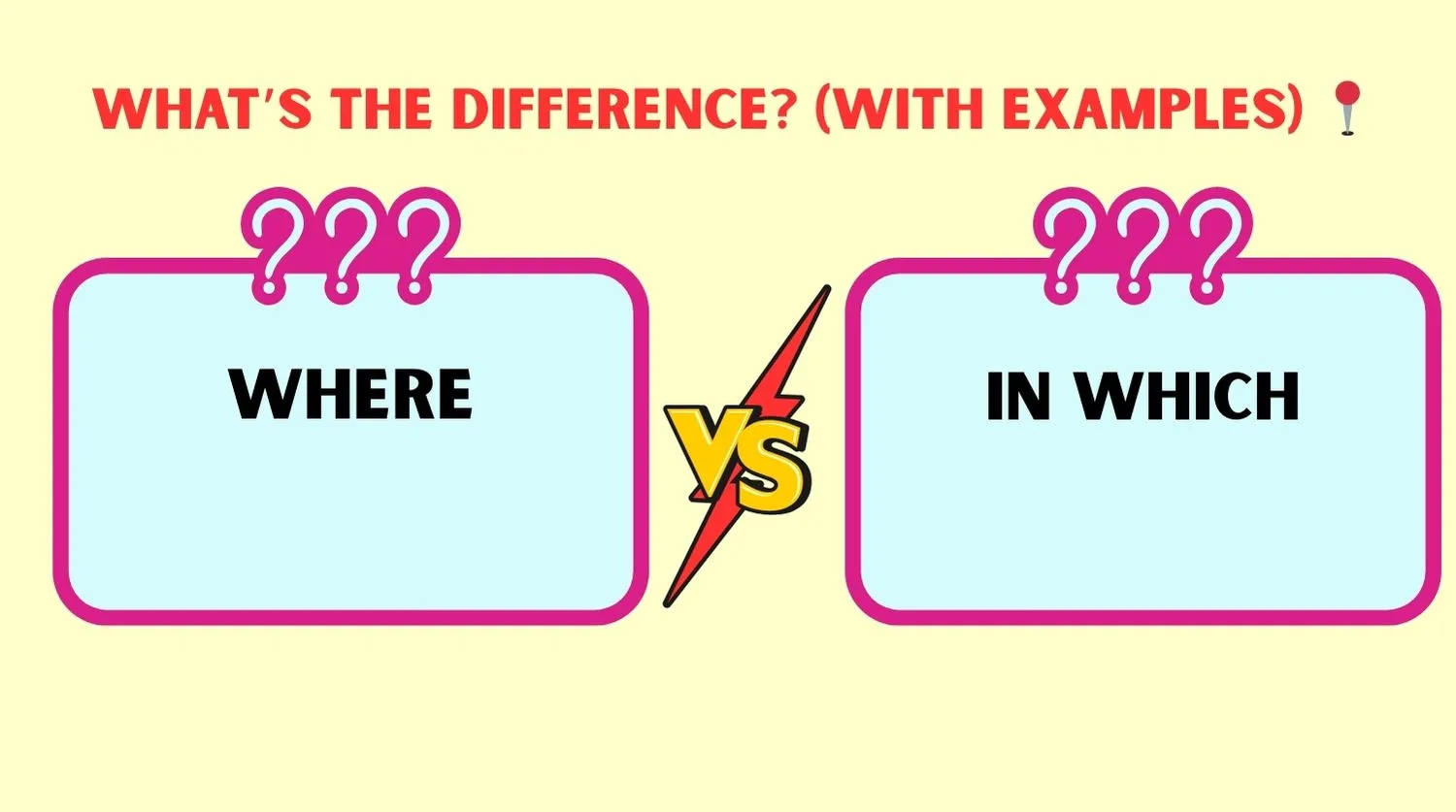
    “Where” vs. “In which” vs. “Wherein”—which one should you use? 🤔 “Where” is for places and situations, “in which” is for formal writing, and “wherein” is for legal or academic contexts. Learn when to use each with easy examples!

    In this article, we’ll dive into the definitions, proper usage, and contexts for these terms, providing clear examples and practical advice to help you master them.

    Understanding the Definitions and Uses of “Where”

    Where vs In Which vs Wherein

    The word “where” is a versatile term in English grammar, serving as both an adverb and a conjunction.

    Its primary function is to indicate a place or location. However, it can also refer to situations and conditions.

    Using “Where” as an Adverb and Conjunction

    Adverb Use: “Where” as an adverb typically answers the question “at what place?” For example:

    • “Where did you go on vacation?”
    • “This is the place where we first met.”

    Conjunction Use: As a conjunction, “where” introduces clauses that provide more information about a location or situation:

    • “He moved to a city where the cost of living is lower.”
    • “I remember a time where life was simpler.”

    When “Where” Applies to Situations and Circumstances

    “Where” can also refer to abstract situations or conditions, not just physical locations. For example:

    • “There are moments where you feel completely lost.”
    • “We reached a point where we had no choice but to continue.”

    In these examples, “where” links to broader circumstances, making it a versatile and powerful word in the English language.

    Demystifying “In Which” as a Relative Pronoun

    “In which” is a relative pronoun phrase used to introduce a clause that adds information about a noun. It is often used in more formal writing and can replace “where” in certain contexts for clarity and precision.

    How “In Which” Connects Clauses and Provides Additional Information

    “In which” typically follows a preposition and is used to add detail to the noun it modifies:

    • “This is the book in which I found the answer.”
    • “The house in which they lived was old and charming.”

    By using “in which,” the writer specifies the relationship between the noun and the additional information, making the sentence clearer.

    Comparative Analysis with “Where”

    While “where” can be more casual and straightforward, “in which” provides a level of formality and precision. Compare these sentences:

    • “This is the library where I study.” (Casual)
    • “This is the library in which I study.” (Formal)

    Both sentences are correct, but the choice depends on the desired tone and clarity.

    Exploring “Wherein” in Modern English Usage

    “Wherein” is a somewhat archaic term that combines “where” and “in,” meaning “in which” or “within which.” It’s less common in everyday speech but still appears in legal, academic, and historical texts.

    Evolution of “Wherein” from Historical to Modern Usage

    Historically, “wherein” was more commonly used in formal and legal documents. Today, its usage is rare outside of specific contexts. Here are some examples:

    • Historical: “The contract specifies the terms wherein the parties agree.”
    • Modern: “The paper discusses the methodology wherein the results were obtained.”

    Differences Between “Wherein” and “Where” or “In Which”

    “Wherein” provides a formal tone and is often used in contexts requiring precision and clarity. In contrast, “where” and “in which” are more flexible and widely used.

    The Historical and Legal Context of “Wherein”

    “Wherein” holds particular significance in legal and historical texts. Its precision makes it ideal for legal documents where exact language is crucial.

    Examples from Legal Documents and Historical Writings

    • Legal: “The clause specifies the conditions wherein the contract may be terminated.”
    • Historical: “The decree outlined the territories wherein the laws would apply.”

    These examples highlight the specificity and formality of “wherein,” making it suitable for legal and historical contexts.

    Why “Wherein” is Rarely Used in Everyday Conversation

    In everyday conversation, “wherein” is often replaced by simpler terms like “where” or “in which.” Its formality can make it sound out of place in casual dialogue.

    Contexts Where “Wherein” Might Still Be Appropriate

    While rare, “wherein” can still be appropriate in certain formal contexts, such as academic writing, legal documents, or historical discussions. For example:

    • Academic: “The study explores the framework wherein these theories are applied.”
    • Legal: “The agreement details the circumstances wherein the tenant may terminate the lease.”

    Real-Life Examples to Illustrate “Where” vs. “In Which” vs. “Wherein”

    Examples of “Where” Usage

    1. “This is the park where we play soccer every weekend.”
    2. “I can’t remember where I put my keys.”

    Examples of “In Which” Usage

    1. “The office in which she works is located downtown.”
    2. “The chapter in which the author discusses this topic is particularly enlightening.”

    Examples of “Wherein” Usage

    1. “The treaty outlines the conditions wherein peace shall be maintained.”
    2. “The report details the scenarios wherein the policy will be effective.”

    Choosing Between “Where” and “In Which” for Clarity and Precision

    Guidelines for Selecting the Right Term Based on Context

    1. Formality: Use “in which” or “wherein” for more formal contexts.
    2. Clarity: “In which” can provide clarity by explicitly linking the clause to the noun.
    3. Simplicity: “Where” is often simpler and more conversational.

    Importance of Clarity in Writing

    Choosing the right connector can enhance the readability and professionalism of your writing. Clear communication is key to effective writing.

    Examples Demonstrating Improved Sentence Structure

    1. Casual: “This is the museum where you can see the exhibit.”
    2. Formal: “This is the museum in which the exhibit is displayed.”

    Improving Writing Style by Selecting the Appropriate Connector

    How the Right Choice Between “Where,” “In Which,” and “Wherein” Enhances Readability

    The appropriate connector can make sentences flow better and improve understanding. For instance:

    • “The city where I grew up has changed a lot.” (Casual, conversational)
    • “The city in which I grew up has changed significantly.” (Formal, precise)

    Tips for Identifying the Most Suitable Connector

    1. Audience: Consider your audience’s familiarity with formal language.
    2. Purpose: Match the connector to the purpose of your writing.
    3. Tone: Ensure the tone of your writing is consistent.

    Common Pitfalls and How to Avoid Them

    1. Overuse of Formal Terms: Avoid overusing “in which” or “wherein” in casual writing.
    2. Misplacement: Ensure connectors are placed correctly to maintain clarity.
    3. Redundancy: Avoid redundant phrases like “where at” or “in which at.”

    Tips to Avoid Common Mistakes with “Where” and “In Which”

    List of Frequent Errors and Misconceptions

    1. Incorrect Substitution: Using “where” when “in which” is needed for clarity.
    2. Misleading Context: Misusing “wherein” in casual contexts.
    3. Over-Formality: Making writing sound overly formal by overusing “in which.”

    Strategies for Proofreading and Self-Editing

    1. Read Aloud: Reading your writing aloud helps catch awkward phrasing.
    2. Peer Review: Have someone else review your work for clarity.
    3. Use Tools: Utilize grammar check tools to identify potential issues.

    Practice Exercises for Reinforcement

    1. Rewrite sentences replacing “where” with “in which” where appropriate.
    2. Identify the correct usage of “where,” “in which,” and “wherein” in given sentences.

    “Wherein”: Is It Ever the Right Choice?

    Scenarios Where “Wherein” Might Be Preferable

    “Wherein” might be the best choice in contexts requiring formality and precision. For example:

    • Legal Writing: “The agreement specifies the conditions wherein the contract is valid.”
    • Academic Papers: “The study examines the process wherein the phenomenon occurs.”

    Balancing Formality and Readability

    While “wherein” adds formality, it’s essential to balance it with readability. Overusing formal terms can make writing cumbersome.

    Final Thoughts on Using “Wherein” Effectively

    Use “wherein” sparingly and only when it enhances clarity and formality. In most cases, “where” or “in which” will suffice.

    FAQs

    1. What is the difference between “where” and “in which”?

    “Where” is more casual and often used in everyday speech, while “in which” is more formal and precise, typically used in academic or professional writing.

    2. When should I use “wherein”?

    “Wherein” is an older, formal term often found in legal, academic, or historical texts. It means “in which” or “within which” but is rarely used in everyday language.

    3. Can “where” and “in which” be used interchangeably?

    Yes, but “in which” is preferred in formal writing. For example:
    ✅ “This is the house where I grew up.” (Casual)
    ✅ “This is the house in which I grew up.” (Formal)

    4. Is “wherein” outdated?

    Yes, “wherein” is not common in modern speech but still appears in legal contracts, research papers, and historical documents.

    5. Which is correct: “the situation where” or “the situation in which”?

    “The situation in which” is grammatically correct and more precise, especially in formal writing.

    6. How can I remember the difference?

    Use this simple trick:
    📍 Where = Everyday places & situations
    📍 In Which = Formal, written English
    📍 Wherein = Legal & academic texts

    Conclusion

    Mastering the use of “where,” “in which,” and “wherein” can significantly enhance your writing clarity and precision.

    By understanding the distinct roles and appropriate contexts for each term, you can improve your communication and make your writing more effective.

    Remember to consider the formality, clarity, and tone of your writing when choosing between these connectors. Practice and review are key to mastering these subtleties in English grammar.

    Additional Resources

    • Books: “The Elements of Style” by Strunk and White, “Eats, Shoots & Leaves” by Lynne Truss.
    • Websites: Grammarly, Purdue OWL.
    • Tools: Grammar check tools like Grammarly and Hemingway App.

    By following these guidelines and practicing regularly, you’ll be well on your way to mastering the use of “where,” “in which,” and “wherein.” Happy writing!

  • Expiry vs Expiration: 🚨 What’s the Real Difference?

    Expiry vs Expiration: 🚨 What’s the Real Difference?

    Understanding the terms expiry and expiration can often be confusing.

    While they might seem interchangeable, they have distinct meanings and implications for product safety and consumer behavior.

    Expiry vs. Expiration—What’s the difference? 🤔 While both refer to product safety, expiry is for perishable goods, and expiration applies to long-term effectiveness. Learn more now!

    This article delves into the nuances of these terms, examining their origins, legal definitions, global practices, and their impact on consumer decisions.

    Introduction to Expiry and Expiration Dates

    Expiry vs Expiration

    Expiry and expiration dates are crucial for ensuring the safety and effectiveness of products we use daily.

    The difference between these terms might appear subtle, but understanding them can help you make more informed choices about the products you consume and use.

    Expiry Date: Often used for perishable items, such as food and medicine, indicating the last date on which the product is safe to use or consume.

    Expiration Date: Generally applied to non-perishable items, including certain medications and cosmetics, marking the end of the period during which the product is guaranteed to be effective or safe.

    Purpose of Date Labels

    Date labels serve several important functions:

    • Safety: Prevents consumption of spoiled or degraded products.
    • Quality: Ensures that products perform as intended.
    • Regulation: Complies with legal requirements for product safety.

    Origins and Evolution of Expiry and Expiration

    The terms expiry and expiration have evolved over time, influenced by historical practices and regulatory developments.

    Historical Background:

    • Early Practices: Initially, expiry dates were more about food preservation methods rather than strict labeling.
    • Modern Regulations: With advances in food safety and medicine, regulations now mandate clear date labeling to protect consumer health.

    Key Milestones:

    • 1930s: Early food safety regulations began in the U.S., leading to the introduction of date labeling.
    • 1960s: The FDA and other agencies started formalizing expiration date regulations for pharmaceuticals.
    • 2000s: Increased global standardization of date labeling practices to enhance international trade and consumer safety.

    Legal Definitions and Usage

    The legal definitions of expiry and expiration dates vary by jurisdiction, affecting how they are applied and enforced.

    Legal Definitions

    Expiry Date:

    • Food Safety: In many countries, expiry dates are legally required for perishable food items. For instance, the European Union mandates expiry dates for products that may pose health risks if consumed after the date.

    Expiration Date:

    • Pharmaceuticals and Cosmetics: These dates are crucial for ensuring that medications and cosmetic products are effective and safe. In the U.S., the FDA requires expiration dates on prescription and over-the-counter drugs.

    Case Studies

    Case Study 1: Food Safety Regulation

    • Country: France
    • Detail: France mandates expiry dates on perishable foods like dairy products to ensure consumer safety. Failure to comply can result in significant fines and product recalls.

    Case Study 2: Pharmaceutical Expiration

    • Country: United States
    • Detail: The FDA’s expiration date regulations for medications are stringent. A well-known case involved the recall of a popular over-the-counter drug due to expiration date mismanagement, highlighting the importance of strict compliance.

    Global Differences in Date Labeling Practices

    Date labeling practices differ significantly around the world, influencing international trade and consumer perception.

    Overview of Date Labeling Practices

    United States:

    • Food Products: Labels often read “Use By,” “Sell By,” or “Best Before,” indicating different aspects of product freshness.
    • Pharmaceuticals: “Expiration Date” is used for medications, ensuring they remain effective.

    European Union:

    • Food Products: “Use By” dates are mandatory for perishable goods, while “Best Before” dates are used for non-perishable items.
    • Pharmaceuticals: Expiration dates are required, with strict guidelines on storage conditions.

    Japan:

    • Food Products: Labels include “Best Before” dates and “Expiration Date” for certain products.
    • Pharmaceuticals: Expiration dates are mandatory, with clear instructions on storage to maintain product efficacy.

    Comparison Chart

    CountryFood ProductsPharmaceuticals
    United States“Use By,” “Sell By,” “Best Before”“Expiration Date”
    European Union“Use By,” “Best Before”“Expiration Date”
    Japan“Best Before,” “Expiration Date”“Expiration Date”

    Significance of Expiry Dates in Food Safety

    Expiry dates play a vital role in food safety, ensuring that products are consumed while still safe.

    Determining Expiry Dates

    Expiry dates are determined based on:

    • Microbial Growth: Risk of harmful bacteria increasing over time.
    • Chemical Changes: Degradation of food components that can affect taste and safety.
    • Packaging: Integrity of packaging that protects food from contamination.

    Examples of Strict Regulations

    • Dairy Products: In the U.S., milk has a short expiry date due to rapid spoilage.
    • Packaged Foods: Items like canned goods have longer expiry dates but still require careful monitoring.

    Understanding Expiration Dates in Product Shelf Life

    Expiration dates are crucial for non-perishable items, ensuring they remain effective and safe.

    Calculating Expiration Dates

    Expiration dates are based on:

    • Product Stability: How long the product maintains its intended effectiveness.
    • Storage Conditions: Temperature, humidity, and light exposure affecting product longevity.
    • Chemical Composition: Degradation of active ingredients over time.

    Expert Insights

    • Pharmaceuticals: Dr. Jane Smith, a pharmacist, notes that medications should always be used before their expiration date to avoid reduced efficacy and potential health risks.
    • Cosmetics: Dr. Emily Brown, a dermatologist, emphasizes that expired cosmetics can cause skin irritation and should be avoided.

    Common Misconceptions About Product Safety Beyond Expiration Dates

    There are several misconceptions about using products past their expiration or expiry dates. Let’s debunk some of these myths.

    Myths vs. Facts

    Myth 1: “Expired food is always unsafe.”

    • Fact: Many products remain safe past their expiry date, but their quality might decline. However, perishable items should not be consumed after their expiry date.

    Myth 2: “Expired medications are harmless.”

    • Fact: Medications can lose their effectiveness or even become harmful past their expiration date. Always check with a healthcare provider before using expired medications.

    Real-Life Consequences

    • Food Poisoning: Cases of foodborne illnesses often result from consuming products past their expiry date.
    • Medication Failure: There have been instances where expired medications failed to treat conditions effectively, leading to health complications.

    Impact of Expiry and Expiration Dates on Consumer Behavior

    Expiry and expiration dates significantly influence consumer behavior, affecting purchasing decisions and usage patterns.

    Influence on Purchasing Decisions

    • Perceived Freshness: Products with recent dates are often perceived as fresher and of higher quality.
    • Trust in Safety: Clear and accurate date labels enhance consumer trust in product safety.

    Psychological Effects

    • Confidence in Quality: Consumers feel more confident purchasing products with well-defined dates.
    • Avoidance Behavior: Many consumers avoid products with approaching or past dates, regardless of actual safety.

    Studies and Surveys

    • Survey Findings: A survey by the Food Marketing Institute revealed that 60% of consumers check expiry dates before purchasing food products.
    • Behavioral Study: Research published in the Journal of Consumer Research shows that date labels significantly impact consumer choices and perceptions of product quality.

    Consumer Trust and the Psychology of Date Labels

    Consumer trust in date labels is crucial for brand reputation and consumer satisfaction.

    Building Consumer Trust

    • Transparency: Brands that provide clear and accurate date labels are more likely to build consumer trust.
    • Compliance: Adhering to regulatory standards demonstrates commitment to product safety and quality.

    Impact on Brand Loyalty

    • Positive Perception: Brands with reliable date labeling practices are perceived as more trustworthy.
    • Customer Retention: Effective date labeling can lead to higher customer retention and repeat purchases.

    Case Studies

    Case Study 1: Brand Transparency

    • Company: FreshFoods Inc.
    • Detail: Known for its clear expiry dates and high-quality products, FreshFoods Inc. has built a loyal customer base through transparent labeling practices.

    Case Study 2: Regulatory Compliance

    • Company: PharmaCare Ltd.
    • Detail: PharmaCare Ltd. strictly adheres to expiration date regulations, resulting in high consumer trust and a strong market presence.

    Making Informed Decisions About Product Freshness

    Understanding expiry and expiration dates helps consumers make informed decisions about product freshness and safety.

    Practical Tips

    • Check Labels: Always check expiry or expiration dates before purchasing or using products.
    • Follow Storage Instructions: Proper storage can extend the life of products.
    • Dispose of Expired Items: Safely dispose of products past their expiry or expiration date to avoid potential risks.

    Recommendations

    • Food Products: Buy products with dates that align with your consumption plans.
    • Medications: Dispose of expired medications and consult with a healthcare provider for replacements.
    • Cosmetics: Replace expired cosmetics to avoid skin issues and ensure product effectiveness.

    🧐 FAQs

    1. What is the main difference between expiry and expiration?

    Expiry refers to the last safe date for perishable items (food, medicine), while expiration indicates the period a product remains effective (cosmetics, drugs).

    2. Are expiry and expiration dates legally required?

    Yes! Many countries mandate expiry dates for food safety and expiration dates for pharmaceuticals to ensure consumer protection.

    3. Can you use products after their expiry or expiration date?

    • Perishables (Expiry Date): 🚫 Not safe to consume.
    • Non-Perishables (Expiration Date): May lose effectiveness but aren’t always harmful.

    4. Why do food and medicine have different date labels?

    Food can spoil and become dangerous, while medicine and cosmetics lose potency but may not be immediately harmful.

    5. How do different countries label expiry and expiration dates?

    • US: Uses “Sell By,” “Use By,” and “Expiration Date.”
    • EU: Uses “Use By” (perishables) and “Best Before” (quality-related).
    • Japan: Has strict “Best Before” and “Expiration Date” labels.

    6. How can I safely handle expired products?

    Dispose of expired medicine safely, avoid consuming expired perishables, and store items properly to extend shelf life.

    Conclusion

    In summary, while expiry and expiration dates may seem similar, they have distinct meanings and implications.

    Expiry dates are critical for perishable items, ensuring safety and quality, while expiration dates are essential for non-perishable products, maintaining effectiveness and safety.

    Understanding these terms helps you make better choices about the products you use and consume.

    By being informed about expiry vs. expiration, you can ensure that you are using products that are both safe and effective, ultimately contributing to better health and well-being.

  • ✅ Each Is or Each Are? The Correct Usage Explained! 📖🔍

    ✅ Each Is or Each Are? The Correct Usage Explained! 📖🔍

    In English grammar, subject-verb agreement is crucial for clarity and correctness. One common area of confusion is whether to use “each is” or “each are.”

    Confused about “Each is” vs. “Each are”? The correct phrase is “Each is” because “each” is a singular pronoun that requires a singular verb.

    This comprehensive guide will delve into the nuances of using “each” correctly, ensuring your writing remains clear and grammatically accurate.

    Understanding “Each” in American English

    Each Is or Each Are

    Definition and Usage

    “Each” is a singular pronoun used to refer to every individual item or person in a group, considered separately.

    For example, in the sentence, “Each of the students has a book,” “each” emphasizes that every student individually possesses a book.

    Historical Context

    Historically, “each” has consistently been treated as a singular pronoun in English. This usage has been rooted in both formal and informal contexts, maintaining its role in ensuring precise subject-verb agreement.

    Grammatical Role

    “Each” functions as a determiner or a pronoun, affecting the verb form it accompanies. When “each” precedes a singular noun, it necessitates a singular verb. This adherence to subject-verb agreement is fundamental in maintaining grammatical correctness in both spoken and written English.

    Distinguishing Between “Each Is” and “Each Are”

    Basic Rules

    The basic rule is straightforward: “each” is singular, so it should be followed by a singular verb. Therefore, “each is” is correct, while “each are” is incorrect.

    Common Confusions

    A common confusion arises when “each” follows a plural noun. For example, “The cookies each are delicious” is incorrect because “each” should be followed by “is” despite the plural noun “cookies.”

    Examples

    • Correct: “Each of the flowers is blooming beautifully.”
    • Incorrect: “Each of the flowers are blooming beautifully.”

    The Role of Subject-Verb Agreement

    Importance

    Subject-verb agreement ensures that sentences are grammatically correct and easily understood. Inconsistent subject-verb agreement can lead to confusion and misunderstandings.

    Rule Application

    When “each” is used as a subject, the verb must be singular. This rule applies universally in English grammar.

    Examples

    • Correct: “Each student is responsible for their own assignments.”
    • Incorrect: “Each student are responsible for their own assignments.”

    Clarifying with Singular and Plural Nouns

    Usage with Singular Nouns

    When “each” precedes a singular noun, it highlights individual items or people within a group. For instance, “Each book on the shelf is valuable” refers to every single book individually.

    Usage with Plural Nouns

    Even when “each” follows a plural noun, the verb remains singular. For example, “The members of the team each has a role to play” emphasizes individual responsibility within the group.

    Examples

    • Singular Noun: “Each child is unique.”
    • Plural Noun: “The children each has a unique quality.”

    Exceptions in Informal Speech

    Colloquial Usage

    In informal speech, people sometimes use “each are” due to colloquial habits. While this may be accepted in casual conversation, it remains grammatically incorrect.

    Examples

    • Informal: “Each of the cookies are tasty.”
    • Formal: “Each of the cookies is tasty.”

    Analysis

    While informal exceptions occur, adhering to correct grammar in formal writing and speech is essential for clarity and professionalism.

    Examples of “Each Is” in Formal Writing

    Literary Examples

    Literature often provides clear examples of correct grammar. For instance, in Jane Austen’s “Pride and Prejudice,” the sentence “Each of the sisters is well-mannered” follows the rule perfectly.

    Academic Writing

    Scholarly articles also adhere to grammatical precision. A sentence like “Each participant is required to complete the survey” demonstrates proper usage.

    Professional Documents

    Business and legal documents maintain strict grammatical standards. “Each clause in the contract is binding” is an example from legal writing.

    “Each Of” Explained: Singular or Plural?

    Grammatical Rule

    “Each of” should always be followed by a singular verb, even though it may refer to a group of items or people. For example, “Each of the players is ready for the game” is correct.

    Examples

    • Correct: “Each of the members is invited.”
    • Incorrect: “Each of the members are invited.”

    Common Mistakes

    People often mistakenly use a plural verb due to the plural noun following “each of.” It’s crucial to remember that “each” governs the verb, not the plural noun.

    Using “Each Of” with Collective Nouns

    Definition of Collective Nouns

    Collective nouns refer to a group of individuals or items considered as a single entity, such as “team,” “family,” or “audience.”

    Rules for “Each Of”

    When using “each of” with collective nouns, the verb remains singular. For example, “Each of the team members is talented.”

    Examples

    • Correct: “Each of the family members is attending the reunion.”
    • Incorrect: “Each of the family members are attending the reunion.”

    The Influence of British and American Usage

    Differences

    While both British and American English treat “each” as singular, there are subtle differences in other grammatical areas. However, the usage of “each is” remains consistent across both dialects.

    Examples

    • American English: “Each of the cookies is delicious.”
    • British English: “Each of the cookies is delicious.”

    Analysis

    Understanding these differences helps in recognizing that “each is” is universally accepted in English grammar.

    Common Pitfalls: When to Use “Each Is”

    Identifying Pitfalls

    Common pitfalls include confusing “each” with plural subjects or misplacing the verb. For example, “Each of the cars are new” is incorrect.

    Examples

    • Correct: “Each of the cars is new.”
    • Incorrect: “Each of the cars are new.”

    Tips

    To avoid pitfalls, always remember that “each” governs the verb, ensuring it remains singular regardless of the noun that follows.

    The Pronoun “Each” with Gender-Neutral Pronouns

    Modern Grammar

    Incorporating gender-neutral pronouns like “they” can be tricky with “each.” The rule remains that “each” takes a singular verb, but the pronoun can be plural.

    Examples

    • Correct: “Each of the participants is bringing their own equipment.”
    • Incorrect: “Each of the participants are bringing their own equipment.”

    Discussion

    Balancing grammatical rules with modern inclusivity can be challenging but adhering to subject-verb agreement ensures clarity.

    Modern Usage and Acceptability

    Current Trends

    Modern English usage tends to be more flexible, but formal writing still requires strict adherence to grammatical rules. “Each is” remains the correct form in formal contexts.

    Language Evolution

    While language evolves, core grammatical rules like subject-verb agreement with “each” persist.

    Examples

    • Modern Media: “Each of the apps is user-friendly.”
    • Everyday Speech: “Each of the apps is user-friendly.”

    Each in Context: Relative Clauses and Group References

    Relative Clauses

    Relative clauses add more information about the noun. When “each” is used, it must still follow the singular verb rule.

    Group References

    Using “each” to refer to group members individually requires a singular verb. For instance, “Each of the team members is contributing.”

    Examples

    • Relative Clause: “Each of the students, who is participating in the project, will receive credit.”
    • Group Reference: “Each of the athletes is ready for the competition.”

    Understanding Relative Clauses with “Who” and “That”

    Defining Clauses

    Relative clauses beginning with “who” or “that” provide essential information about the noun they follow.

    Usage with “Each”

    When “each” is the subject, the verb in the relative clause must be singular. For example, “Each of the authors who is nominated will attend.”

    Examples

    • Correct: “Each of the members who is attending will receive a badge.”
    • Incorrect: “Each of the members who are attending will receive a badge.”

    Real-World Examples: “Each Is” in Literature and Media

    Literature

    In classic literature, authors consistently use “each is” to maintain grammatical accuracy. For example, in Charles Dickens’ “A Tale of Two Cities,” “Each of the characters is well-developed” follows this rule.

    Media

    Modern media, including news articles and blogs, adhere to this rule for clarity and professionalism. For instance, “Each of the nominees is expected to attend” is a correct usage.

    Analysis

    Analyzing real-world examples helps in understanding the consistent application of “each is” across different contexts.

    FAQs

    1. Why is “Each is” correct instead of “Each are”?

    “Each” is singular, so it must be followed by a singular verb like “is” instead of “are.”

    2. Can “Each are” ever be correct?

    No, “Each are” is grammatically incorrect because “each” always takes a singular verb.

    3. How do you use “Each is” in a sentence?

    Example: “Each of the students is responsible for their assignments.”

    4. Does “Each of” change the verb form?

    No, even if “each of” is followed by a plural noun, the verb remains singular. Example: “Each of the players is ready.”

    5. What is the difference between “Each one is” and “Each one are”?

    “Each one is” is correct because “each one” refers to an individual, requiring a singular verb.

    6. Is “Each has” correct?

    Yes, “Each has” is correct because “each” is singular and must match a singular verb. Example: “Each of them has a role to play.”

    Conclusion

    Understanding the correct usage of “each is” versus “each are” is essential for mastering English grammar.

    By recognizing that “each” is a singular pronoun and should be followed by a singular verb, you can avoid common pitfalls and ensure clarity in your writing.

    Whether in literature, academic writing, or everyday conversation, adhering to this rule will enhance your grammatical accuracy and communication effectiveness.

    By following these guidelines and examples, you can confidently use “each is” correctly, ensuring your writing remains precise and professional.

  • Tomatoes or Tomatos? The Correct Spelling Explained! 🍅✅

    Tomatoes or Tomatos? The Correct Spelling Explained! 🍅✅

    Language can be tricky, especially when it comes to spelling and pluralization. One common source of confusion is the correct plural form of tomato.

    Is it tomatoes or tomatos? If you’ve ever hesitated while writing or typing this word, you’re not alone.

    This article will clear up the confusion once and for all while diving into the fascinating linguistic, cultural, and culinary aspects of the beloved tomato.

    Is it “tomatoes” or “tomatos”? The correct plural of tomato follows a simple English spelling rule, but many people get confused. Learn the reason behind the correct spelling and never make this mistake again!


    The Tomato Debate: Understanding Pluralization in American English

    English has many rules for forming plurals, but it also has exceptions that trip up even native speakers. The word tomato is one of those words that follows a specific pluralization rule.

    Unlike simple nouns that only require an -s at the end to become plural (e.g., cats, dogs), tomato belongs to a group of words that take -es instead.

    Understanding why tomatoes is correct requires examining English pluralization patterns and linguistic influences.


    Tomato: More Than a Culinary Staple

    The tomato is more than just a kitchen ingredient; it plays a crucial role in global cuisines and nutrition. This vibrant fruit (yes, botanically a fruit!) is packed with flavor and versatility. From sauces to salads, the tomato is a staple in many diets worldwide.


    The Nutritional Benefits of Tomatoes

    Beyond their culinary appeal, tomatoes offer numerous health benefits:

    • Rich in Vitamins: High in Vitamin C, Vitamin K, and folate.
    • Packed with Antioxidants: Contains lycopene, known for its cancer-fighting properties.
    • Heart Health: Helps reduce the risk of heart disease by lowering blood pressure and cholesterol.
    • Supports Vision: Contains lutein and beta-carotene, which support eye health.
    • Aids Digestion: High in fiber, aiding in healthy digestion.

    With all these benefits, it’s no wonder tomatoes are a dietary staple across the world.


    Tomatoes in Global Cuisines

    From Italian pasta sauces to Mexican salsas, tomatoes are a key ingredient in many global dishes. Some popular tomato-based dishes include:

    • Italy: Tomato-based pasta sauces, Margherita pizza, and bruschetta.
    • Mexico: Salsa, pico de gallo, and enchilada sauces.
    • India: Tomato-based curries such as butter chicken and tikka masala.
    • United States: Ketchup, tomato soup, and BLT sandwiches.

    This global appeal further emphasizes the importance of getting the word tomatoes right!


    The Origins and Evolution of the Word ‘Tomato’

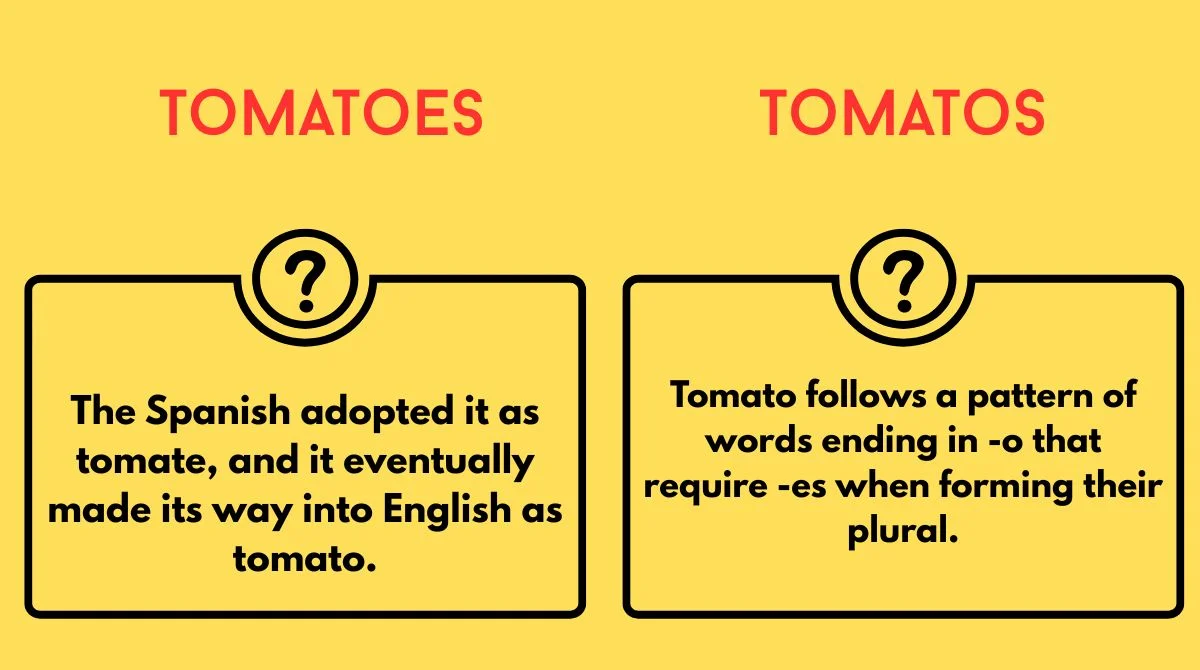
    The word tomato originates from the Nahuatl word tomatl, used by the Aztecs to describe the fruit. The Spanish adopted it as tomate, and it eventually made its way into English as tomato.

    Over time, the spelling and pronunciation evolved, but the plural form has remained consistent in accordance with standard English rules.


    Dissecting the Plural Forms of Words Ending in ‘O’

    In English, nouns ending in -o can be pluralized in two different ways:

    • Adding -s (e.g., pianos, photos, logos)
    • Adding -es (e.g., potatoes, heroes, tomatoes)

    The tricky part? There’s no single rule that applies to all words ending in -o.


    Tomatoes or Tomatos

    Why ‘Tomatoes’ is the Grammatically Correct Plural Form

    Tomato follows a pattern of words ending in -o that require -es when forming their plural. This rule generally applies to words borrowed from other languages, especially those ending in a consonant followed by -o.

    Other words that follow this pattern include:

    • Potato ➔ Potatoes
    • Hero ➔ Heroes
    • Echo ➔ Echoes
    • Veto ➔ Vetoes

    Understanding this rule can help eliminate confusion when writing plural forms of similar words.


    Examples of ‘Tomatoes’ Used in Sentences

    To reinforce the correct spelling, here are some examples:

    • “She bought fresh tomatoes from the farmers’ market.”
    • “The pasta sauce requires a handful of tomatoes.”
    • “We grew a variety of tomatoes in our backyard garden.”
    • “He sliced the tomatoes for the sandwich.”
    • “Canned tomatoes are useful for cooking in winter.”

    Common Misconceptions and Spelling Errors

    Many people mistakenly write tomatos instead of tomatoes. Some of the common reasons for this mistake include:

    • Influence of words like “photo” and “piano” that take only an -s in plural form.
    • Autocorrect errors that don’t always flag “tomatos” as incorrect.
    • Phonetic spelling leading to the assumption that -es isn’t necessary.

    However, tomatos is incorrect, and using it in formal writing can be considered a spelling mistake.


    Other English Words Following the Same Pluralization Rule

    Here are more words that, like tomato, add -es in their plural form:

    SingularPlural
    PotatoPotatoes
    HeroHeroes
    EchoEchoes
    VetoVetoes
    MosquitoMosquitoes

    By remembering these patterns, you can avoid making common pluralization mistakes.


    The Influence of Spanish on Plural Forms in English

    Since tomato was borrowed from Spanish, its pluralization follows a pattern influenced by Spanish linguistic rules. In Spanish, tomate (singular) becomes tomates (plural). This aligns closely with the English pluralization rule requiring -es for words ending in -o.

    Other Spanish-origin words in English that follow this pattern include:

    • Tornado ➔ Tornadoes
    • Mosquito ➔ Mosquitoes
    • Embargo ➔ Embargoes

    Memory Tricks to Help You Remember the Correct Spelling

    Here are some easy ways to remember that tomatoes is the correct plural form:

    1. Think of Potatoes — If potato becomes potatoes, so does tomato.
    2. Sing the “Tomatoes” Song — Remember the phrase from the song “You say tomato, I say tomato…”
    3. Mnemonic Device: Add “-es” to a tomato, so you don’t sound loco!

    Using these tricks, you’ll never second-guess your spelling again.


    Tomatoes or Tomatos

    FAQs

    1. Is “tomatos” a correct spelling?

    No, “tomatos” is incorrect. The correct plural form of “tomato” is “tomatoes”, following English pluralization rules for words ending in -o.

    2. Why do we add -es to “tomato” instead of just -s?

    English grammar requires adding -es to certain nouns ending in -o, especially those borrowed from other languages. This includes potatoes, heroes, and echoes.

    3. What other words follow the same pluralization rule?

    Similar words that take -es in their plural forms include:

    • Potato ➔ Potatoes
    • Hero ➔ Heroes
    • Echo ➔ Echoes
    • Veto ➔ Vetoes

    4. Why do some words ending in -o only take -s?

    Not all words ending in -o follow the same rule. Words like piano, photo, and memo take only -s because they were adopted differently into English.

    5. Does British and American English differ in spelling “tomatoes”?

    No, both British and American English use “tomatoes” as the correct plural form. There is no variation in this case.

    6. How can I remember the correct spelling?

    Use this simple trick: If potato becomes potatoes, then tomato becomes tomatoes! 🍅✅


    Conclusion

    Now you know: tomatoes is the correct plural form, while tomatos is simply a mistake.

    English pluralization rules can be confusing, but once you recognize patterns like adding -es to certain words ending in -o, spelling becomes much easier.

    Next time you’re writing about these delicious red fruits, you can be confident that tomatoes is the way to go. Happy writing—and happy eating!

  • Adapter vs Adaptor 🔌 – Which Spelling Should You Use?

    Adapter vs Adaptor 🔌 – Which Spelling Should You Use?

    English can be tricky. Some words look almost identical but leave writers wondering which form is correct. A classic example is adapter vs adaptor.

    If you’ve ever stared at a product box or instruction manual and noticed both versions floating around, you’re not alone.

    So, what’s the difference? The short answer: both spellings are correct, but usage depends on region, industry, and context. Let’s break down the history, meaning, and everyday use of these two words to settle the confusion once and for all.


    Understanding “Adapter” vs “Adaptor”

    Adapter or Adaptor

    At first glance, “adapter” and “adaptor” seem like separate words, but they actually refer to the same thing: a device or tool that connects, modifies, or allows compatibility between different systems.

    The only difference lies in spelling preference.

    • Adapter – The American English spelling, overwhelmingly used in the US and globally in technical industries.
    • Adaptor – The British English spelling, still common in the UK and some Commonwealth countries, though “adapter” is gaining ground there too.

    In modern English, “adapter” dominates in terms of frequency. If you’re writing for an international audience, this spelling is usually the safest choice.


    Etymology and History of the Word

    The root of both words comes from the Latin verb adaptāre, meaning to fit, adjust, or modify. Over time, this passed into Old French as adapter and then into English.

    The two spellings emerged as English standardized spelling during the 17th–18th centuries. The suffix –er was more natural in American English, while British English often kept –or endings (similar to valor/valour or humor/humour).

    Historical dictionaries and literary works show both versions in circulation. However, by the 20th century, “adapter” had become the dominant spelling in most global technical contexts, especially with the rise of electronics.

    Fun fact: Thomas Edison, who often wrote about connectors and plugs, consistently used “adapter” in his patent descriptions. That early technical adoption helped cement the spelling in engineering and electronics.


    Usage in Modern English

    Today, both spellings are correct, but they’re not equally popular. Usage depends on where you are and who you’re writing for:

    • American English (US): “Adapter” is standard. You’ll almost never see “adaptor” in American textbooks or electronics packaging.
    • British English (UK): Both forms are accepted, but “adaptor” shows up more in general writing. Technical industries, however, lean toward “adapter.”
    • International English: With globalization, “adapter” has become more common worldwide, especially in computer and travel-related products.

    Here’s a quick usage snapshot:

    SpellingRegion/Common UsePopularity
    AdapterUS, global tech, electronics, computingVery common
    AdaptorUK, Commonwealth countries, older textsLess common, but not obsolete

    Technical Context: Where You’ll See Each Spelling

    Language choice often depends on industry. If you’ve ever shopped online for electronics or travel gadgets, you’ve probably noticed both spellings on packaging.

    • Computers and electronics: “Adapter” is the global standard (USB adapter, HDMI adapter, power adapter).
    • Travel gear: “Travel adaptor” still appears widely in UK and European markets.
    • Engineering and mechanics: Both spellings are seen, but “adapter” is preferred in international technical documents.
    • Marketing materials: Companies often choose the spelling that best matches their target audience (UK vs US).

    Different Types of Adapters (with Examples)

    The word “adapter/adaptor” isn’t tied to just one device. It’s a versatile term for any tool that bridges a gap between incompatible systems.

    Here are the most common types you’ll encounter:

    Power Adapters

    • Wall chargers for phones and laptops.
    • AC-to-DC converters for appliances.
    • Example: The square charger that comes with your MacBook is a power adapter.

    Travel Adapters

    • Plug converters for international travel.
    • Example: A traveler from the US visiting Europe needs a travel adaptor to plug a laptop charger into EU sockets.

    Computer and Electronic Adapters

    • USB-to-HDMI adapters.
    • Ethernet-to-USB adapters.
    • Wireless Bluetooth adapters.
    • Example: Gamers often use a controller adapter to connect older devices to modern consoles.

    Mechanical Adapters

    • Used in cars, plumbing, and industrial machines.
    • Example: A camera lens mount adapter allows you to fit lenses across different brands.

    Common Mistakes and Misconceptions

    Despite being simple spelling variants, people often assume one form is “wrong.” Here are the most common errors:

    • Believing only “adapter” is correct. Truth: both are correct.
    • Switching spellings mid-text. This creates inconsistency and looks unprofessional.
    • Assuming regional rules are strict. Truth: even in the UK, “adapter” appears in plenty of contexts.

    Consistency matters more than the actual choice. Pick one and stick with it.


    Which One Should You Use?

    If you’re a writer, student, or professional, here’s how to decide:

    • Writing for American readers: Use “adapter.”
    • Writing for British readers: Either is fine, but “adapter” is still safer in technical writing.
    • Writing for a global audience: Stick with “adapter” for clarity and consistency.

    The rule of thumb: audience first, consistency second.


    Quick Comparison Table

    FeatureAdapter (–er)Adaptor (–or)
    OriginAmerican EnglishBritish English
    Modern popularityVery common globallyLess common, but valid
    Common fieldsElectronics, computingTravel gear, UK writing
    ExampleUSB adapter, power adapterTravel adaptor, plug adaptor

    FAQs About Adapter vs Adaptor

    Is adapter or adaptor more correct?

    Both are correct. “Adapter” is the dominant spelling worldwide, especially in technology.

    Do Americans use “adapter” or “adaptor”?

    Americans exclusively use “adapter.” You’ll almost never see “adaptor” in the US.

    Is adaptor outdated?

    Not outdated, but less common. It survives in UK writing and product labeling.

    Can I use both spellings in one document?

    It’s better not to. Pick one spelling and stay consistent.

    Are adapter and converter the same thing?

    Not always. A converter changes the electrical voltage, while an adapter changes the plug shape or connection type.


    Conclusion

    The debate between adapter vs adaptor isn’t really about right or wrong. It’s about spelling preference shaped by region and industry. While both are correct, “adapter” has become the global standard, especially in technical writing and consumer electronics.

    If you want to look polished and professional, choose one spelling that fits your audience and stick with it. In most cases, “adapter” is the safe bet.

    So the next time you’re packing for a trip or buying computer gear, don’t stress—whether it says “adapter” or “adaptor,” you’ll know it means the same thing.

  • Setup vs Set Up ✨ – The Complete Grammar Guide with Examples

    Setup vs Set Up ✨ – The Complete Grammar Guide with Examples

    English can be tricky, especially when two forms of the same phrase look almost identical but function differently. One of the most common examples is setup vs set up.

    People often use them interchangeably, but in reality, these two have very different grammatical roles.

    If you’ve ever wondered whether to write “setup” or “set up” in an email, business document, or exam, this guide will clear up the confusion. By the end, you’ll know exactly which form to use — and why.


    Core Difference Between “Setup” and “Set Up”

    Setup vs Set Up

    At its simplest:

    • Setup is usually a noun (and sometimes an adjective) → It names a thing, an arrangement, or a configuration.
    • Set up is always a verb phrase → It describes an action of arranging, preparing, or organizing.

    👉 Think of it this way:

    • If you’re talking about the process, use set up.
    • If you’re talking about the result, use setup.

    Example:

    • “I need to set up my computer.” (verb/action)
    • “The setup of my computer is complete.” (noun/result)

    Set Up – As a Verb

    The phrase set up functions as a verb phrase made of the base verb set + the particle up. It conveys the idea of preparing, arranging, or making something ready.

    Common Uses of “Set Up”

    • Arranging or organizing
      • “She set up the chairs before the event.”
    • Installing or assembling
      • “He set up the new printer in his office.”
    • Establishing
      • “They set up a new company in New York.”
    • Preparing someone
      • “He set me up on a blind date.”

    Sentence Examples

    • The team will set up the stage tomorrow.
    • Can you help me set up my email account?
    • They plan to set up a scholarship fund for students.
    • She was set up to fail by her competitors.

    Notice how each example focuses on the action of arranging or preparing.


    Synonyms for Set Up

    Here are common synonyms for “set up” depending on context:

    ContextSynonymsExample Sentence
    Arrange / Organizearrange, plan, schedule“Let’s arrange a meeting.”
    Establish / Startlaunch, found, establish“They established a charity.”
    Assemble / Buildconstruct, install, put together“He installed a new sound system.”
    Frame / Trickentrap, frame, deceive“She was framed for the crime.”

    👉 As a verb phrase, set up is flexible, and its synonyms depend heavily on the sentence’s meaning.


    Setup – As a Noun

    Now let’s shift gears. Setup is a noun that refers to the arrangement, configuration, or structure of something. It names the end result, not the process.

    Common Uses of “Setup”

    • Configuration or arrangement
      • “The computer setup was complex.”
    • Structure or system
      • “The business setup in this country is tough.”
    • Situation or scheme
      • “The entire meeting felt like a setup.”
    • Sports
      • “That was the perfect setup for the winning goal.”

    Sentence Examples

    • The classroom setup makes it easier for students to work in groups.
    • I wasn’t impressed with the hotel room setup.
    • The new company has a solid setup with modern infrastructure.

    Setup – As an Adjective

    “Setup” can also work as an adjective, describing something related to an arrangement or configuration.

    Examples

    • Setup cost → “The setup cost for this machine is high.”
    • Setup process → “The setup process only takes 10 minutes.”
    • Setup guide → “Refer to the setup guide for instructions.”

    In each case, setup modifies the noun that follows, acting like an adjective.


    Synonyms for Setup

    Depending on the context, here are common alternatives to “setup”:

    MeaningSynonymsExample Sentence
    Arrangement / Layoutconfiguration, design“The layout of the office is modern.”
    Situation / Planscheme, trap“It was all a scheme to get him fired.”
    Structure / Systemframework, organization“The framework of the project is clear.”

    Common Confusions and FAQs

    Is “Set Up” Ever Hyphenated?

    No. The correct forms are only setup (noun/adjective) and set up (verb). The form “set-up” is outdated and rarely used in modern English.

    Do You Say “Setup” or “Set Up” a Meeting?

    You set up a meeting because it’s an action (verb phrase). However, you might talk about “the meeting setup” later, referring to its arrangement.

    Other Tricky Contexts

    • Technology → “I need to set up my laptop” vs. “The laptop setup is complete.”
    • Business → “They set up a new branch” vs. “The branch’s setup is impressive.”
    • Everyday use → “He set me up on a date” vs. “It was a complete setup.”

    Side-by-Side Examples for Clarity

    Here’s a quick comparison table:

    Correct FormUsage TypeExample Sentence
    Set upVerb/action“She will set up the presentation.”
    SetupNoun/result“The setup of the presentation was flawless.”
    SetupAdjective“He bought a setup guide for the software.”

    Quick Grammar Breakdown

    To make it simple, here’s a visual grammar reminder:

    SET UP → Verb (action)  
    Example: “I will set up the chairs.”  
    
    SETUP → Noun / Adjective (thing/result)  
    Example: “The setup was perfect.”  
    

    👉 If you can replace it with another verb, use set up.
    👉 If you can replace it with another noun, use setup.


    FAQs

    What is the basic difference between setup and set up?

    Setup is a noun/adjective meaning an arrangement or configuration, while set up is a verb phrase meaning to arrange or prepare something.

    Can “setup” ever replace “set up”?

    No. “Setup” names a result or arrangement, while “set up” always expresses an action. They aren’t interchangeable.

    Do Americans and Brits use “setup” differently?

    Not really. Both American and British English use the same distinction, though “set-up” with a hyphen is more common in older British writing.

    Is “setup” formal or informal?

    “Setup” works in both formal and informal writing. For example, you can use it in a tech manual (“system setup”) or in casual speech (“That was a weird setup”).

    What’s an easy trick to remember the difference?

    If you’re describing doing something, use set up. If you’re describing the thing itself, use setup.


    Final Summary

    The battle of setup vs set up is easier once you remember this golden rule:

    • Set up = an action (verb phrase).
    • Setup = the thing created or the result (noun/adjective).

    So the next time you write an email, prepare a meeting, or explain a process, you’ll know exactly when to choose “setup” and when to choose “set up.” Practicing with examples is the best way to lock it into memory.

  • To Fast or Too Fast? ✨ A Complete Guide to Getting It Right

    To Fast or Too Fast? ✨ A Complete Guide to Getting It Right

    English can be tricky, especially when two phrases look almost the same but mean completely different things. “To fast” and “too fast” are perfect examples.

    At first glance, you might think they’re just spelling variations. But the truth is, each carries a very different meaning—and using the wrong one can confuse your reader.

    This guide clears up the confusion once and for all. We’ll explore the difference between “to” and “too”, the multiple meanings of “fast”, and how context makes or breaks these phrases.

    Along the way, you’ll see examples, a case study on fasting, real-world applications, a quick-reference table, and even a short quiz to test your skills.

    Let’s start by breaking down the basics.


    The Real Difference Between “To” and “Too”

    To Fast or Too Fast

    Before tackling “to fast” and “too fast,” you need to understand how “to” and “too” work individually. They sound alike but play very different roles in English.

    What Does “To” Mean?

    “To” is one of the most versatile words in English. It’s used in countless ways, but the two most important roles are:

    • As a preposition – It shows direction, recipient, or relationship.
      • I’m going to the store.
      • She gave the book to her friend.
    • As part of an infinitive verb – It links with a verb to express action.
      • I want to learn Spanish.
      • He decided to run.

    So when you see “to fast,” it falls under this second role: the infinitive form of the verb fast (meaning to abstain from food).


    What Does “Too” Mean?

    Unlike “to,” the word “too” usually works as an adverb. It has two main meanings:

    • Also / in addition
      • I want to come too.
      • She likes coffee, and I do too.
    • Excessively / more than necessary
      • He’s driving too fast.
      • This coffee is too hot.

    When you see “too fast,” it’s always about something happening more quickly than is appropriate or safe.


    What Does “Fast” Mean in Grammar?

    Now, let’s clear up the other half of the confusion. The word “fast” is unique because it can serve as an adjective, an adverb, or even a verb.

    • As an adjective – It describes something that moves quickly.
      • A fast train, a fast car.
    • As an adverb – It tells you how an action is done.
      • He runs fast.
      • The colors won’t wash out—they’re fast.
    • As a verb – It means abstaining from food or drink, often for religious or health reasons.
      • Many people fast during Ramadan.
      • She plans to fast for 24 hours.

    👉 This third meaning is where “to fast” comes into play.


    When “To Fast” is Correct

    “To fast” is grammatically correct when it functions as an infinitive verb phrase. It usually appears in sentences about religion, health, or lifestyle choices.

    • I want to fast tomorrow for health reasons.
    • She decided to fast during Lent.
    • Doctors sometimes ask patients to fast before surgery.

    Case Study: Intermittent Fasting

    In recent years, intermittent fasting has become a global health trend. Millions practice it as a way to manage weight and improve metabolism.

    Example sentences:

    • He chooses to fast for 16 hours a day and eat during an 8-hour window.
    • Athletes sometimes decide to fast to improve discipline and body control.

    Notice how “to fast” always links an action (abstaining from food) with a purpose.


    When “Too Fast” is Correct

    On the other hand, “too fast” is not about eating habits at all—it’s about speed or excessiveness. It means something is happening quicker than it should.

    • She was speaking too fast for me to understand.
    • The driver was going too fast and got a ticket.
    • Don’t eat too fast—you’ll get a stomachache.

    Real-World Application: Traffic Laws

    Governments often warn drivers about going too fast. Speed limits are set to keep roads safe. For example:

    • Exceeding 80 mph is driving too fast for most highways.
    • Cameras catch drivers going too fast in school zones.

    “Too fast” always relates to excess, overdoing it, or unsafe quickness.


    Common Mistakes and How to Avoid Them

    Because “to” and “too” sound identical, many learners confuse them in writing.

    Common Errors

    • Writing to fast when they mean too fast.
    • Writing too eat instead of to eat.
    • Using to instead of too in “me too.”

    Why the Confusion Happens

    The root cause is phonetics. Both words are pronounced the same, so writers often rely on sound rather than meaning.

    Tips to Catch Mistakes

    • If you mean excessive → choose too.
    • If you mean direction or infinitive → choose to.
    • Double-check by swapping with “also.” If the sentence works, use too.

    Quick Reference Tools

    Simple Trick to Remember

    • Too has an extra “o” → think of it as “extra, more than needed.”
    • To is the standard, basic form → direction, recipient, or infinitive.

    Comparison Table

    PhraseMeaningExample
    To fastInfinitive verb = abstain from food/drinkShe wants to fast during Ramadan.
    Too fastExcessive speed / over-quickHe drives too fast on highways.

    Mini Quiz

    Fill in the blanks with either to fast or too fast:

    1. The car was moving ____ for me to catch the number plate.
    2. Muslims choose ____ during Ramadan as a form of worship.
    3. You eat way ____ and it upsets your stomach.
    4. He decided ____ before his medical check-up.

    Answers:

    1. Too fast
    2. To fast
    3. Too fast
    4. To fast

    Advanced Usage: When Both Appear in the Same Sentence

    Sometimes, both phrases show up together.

    • She decided to fast because she was gaining weight too fast.
    • He wants to fast, but he breaks his fast too fast.

    This creates a clever play on meanings—one about not eating and the other about excessive speed.


    Related Confusing Word Pairs

    “To fast” vs. “too fast” isn’t the only trap. Here are a few other pairs that confuse learners:

    • To / Too / Two
      • I’m going to the park.
      • I’m going too.
      • I have two dogs.
    • Their / There / They’re
      • Their house is big.
      • The book is over there.
      • They’re going to the party.
    • So / Sow / Sew
      • So what?
      • Farmers sow seeds in spring.
      • She can sew a dress.

    FAQs

    When should I use “to fast” and “too fast”?

    Use to fast when referring to the verb meaning abstaining from food. Use too fast when describing excessive speed.

    What does “fast” mean in grammar?

    It can be an adjective (quick), an adverb (quickly), or a verb (abstain from food).

    Is “to fast” ever wrong?

    Yes, if you use it to describe speed. For speed, always use “too fast.”

    Which is correct: “I love you to” or “I love you too”?

    The correct form is I love you too (meaning “also”).

    Can I use “fast” to describe not eating?

    Yes. As a verb, “fast” means abstaining from food or drink.


    Conclusion

    The difference between “to fast” and “too fast” boils down to purpose vs. excess.

    • To fast → the act of abstaining from food (verb phrase).
    • Too fast → more speed or intensity than needed (adverb phrase).

    With examples, tricks, and practice, this confusion disappears. Just remember: if it’s about not eating, it’s to fast. If it’s about speed, it’s too fast.

  • Sweet vs Sweat 🍬💦 – Mastering the Difference with Ease

    Sweet vs Sweat 🍬💦 – Mastering the Difference with Ease

    Confused between sweet and sweat? You’re not alone. These two words look surprisingly similar, but their meanings couldn’t be further apart.

    One makes you think of desserts, compliments, and kindness, while the other brings up images of exercise, hard work, or hot summer days.

    This guide will clear the confusion once and for all. We’ll break down definitions, pronunciation, grammar roles, real-life usage, idioms, and memory tricks to help you remember the difference between sweet and sweat—forever.


    Understanding the Basics of Sweet vs Sweat

    Suite vs Sweet vs Sweat

    At first glance, the difference seems small: only one extra letter. But in English, a single vowel can completely change the meaning of a word.

    • Sweet: relates to taste, kindness, or something pleasant.
    • Sweat: relates to perspiration (the liquid your body produces when hot or working hard).

    Let’s define each one clearly.

    Sweet

    • Part of speech: adjective (most common), noun (less common).
    • Meaning: pleasant-tasting, delightful, or affectionate.
    • Examples:
      • This cake is very sweet.
      • You’re so sweet for helping me.
      • She bought some sweets at the store.

    Sweat

    • Part of speech: noun and verb.
    • Meaning: moisture from the skin caused by heat, stress, or exertion; or the act of producing it.
    • Examples:
      • He wiped the sweat from his forehead.
      • They sweat a lot during the football match.
      • Don’t sweat it—it’s not a big deal.

    Key takeaway: Sweet = taste/affection. Sweat = perspiration/effort.


    Pronunciation Guide: Sweet vs Sweat

    Even though the words look alike, their vowel sounds separate them.

    WordIPASimple PronunciationRhyme With
    Sweet/swiːt/“s-weet” (long ee sound)meet, seat, treat
    Sweat/swɛt/“sw-et” (short e sound)get, wet, set

    Tips for learners:

    • Stretch the sound in sweet—imagine savoring candy.
    • Keep sweat short and sharp, like a quick gasp when you’re tired.

    Minimal pair practice:

    • Sweet food makes me smile.
    • Sweat dripped down his face.

    Say them out loud back-to-back. The difference becomes clear.


    Grammar and Word Forms of Sweet and Sweat

    Both words shift depending on context. Here’s how they flex in grammar.

    Sweet

    • Adjective: That’s a sweet song.
    • Noun: I love Indian sweets.
    • Comparative: sweeter
    • Superlative: sweetest

    Sweat

    • Noun: Drops of sweat covered his shirt.
    • Verb: She sweats when she runs.
    • Past tense: sweated (US standard; though sweat as past is also accepted in informal use).
    • Present participle: sweating

    Quick comparison table:

    WordFormsExample
    Sweetsweeter, sweetestThis dessert is sweeter than the last one.
    Sweatsweated/sweat, sweatingHe sweated all night due to the heat.

    Usage in Everyday Contexts

    Sweet in daily life

    1. Food and taste: desserts, fruits, drinks.
      • This mango is naturally sweet.
    2. Compliment: expressing kindness or affection.
      • It’s sweet of you to visit.
    3. Slang/Informal: expressing approval.
      • You got free tickets? Sweet!

    Sweat in daily life

    1. Exercise and physical exertion:
      • The players were drenched in sweat after practice.
    2. Heat-related:
      • She began to sweat under the sun.
    3. Idiomatic/figurative:
      • Don’t sweat the small stuff.
      • He was sweating bullets before the interview.

    Comparison in sentences:

    SweetSweat
    That’s such a sweet gesture.He wiped the sweat from his brow.
    She gave me a sweet smile.The workers sweat all day in the factory.
    Kids love sweet candy.The nervous student sweated during the test.

    Idioms and Expressions with Sweet vs Sweat

    Idioms highlight cultural meanings.

    Sweet Idioms

    • Sweet tooth – a love for sugary foods.
    • Sweet spot – the best or most effective point.
    • Revenge is sweet – satisfaction in payback.
    • Home sweet home – affection for one’s home.

    Sweat Idioms

    • Break a sweat – to put in effort (sometimes used sarcastically for little effort).
    • Sweat bullets – to be extremely nervous.
    • No sweat – it’s easy, no problem.
    • Sweat the small stuff – worry unnecessarily about minor things.

    Idioms not only expand vocabulary but also help you differentiate meanings naturally.


    Common Mistakes Learners Make

    • Spelling confusion: Many learners type “sweat” instead of “sweet” because the letters look alike.
    • Pronunciation slip: Using the long ee sound in sweat (wrong).
    • Wrong usage in compliments: Saying You’re sweat instead of You’re sweet (major meaning error).

    Tip: Double-check spelling before sending messages. Small mix-ups can cause embarrassment.


    Tips to Remember the Difference

    Memory aids work wonders.

    • Mnemonic: Sweet has a treat, Sweat has heat.
    • Visual cue: Imagine candy for sweet 🍭, a workout for sweat 🏋️.
    • Practice sentences:
      • Sweet desserts bring joy.
      • Sweat proves hard work.

    The more you use both words in context, the faster your brain will separate them.


    FAQs about Sweet vs Sweat

    Is “sweet” a compliment?

    Yes. When you call someone “sweet,” you mean they are kind, thoughtful, or caring.

    Can “sweat” be used figuratively?

    Absolutely. Phrases like “Don’t sweat it” mean “don’t worry about it.”

    What’s the difference between “sweetie” and “sweaty”?

    “Sweetie” is a term of endearment. “Sweaty” describes someone covered in sweat.

    Why do “sweet” and “sweat” look similar but sound different?

    Because English spelling doesn’t always reflect pronunciation. The vowel patterns “ee” and “ea” follow different sound rules.

    Is “sweat” ever plural?

    Yes, but rarely. You may see “sweats” to mean sweatpants (clothing), not multiple drops of perspiration.


    Conclusion

    Sweet vs Sweat may share four letters, but their meanings live in different worlds. Sweet belongs to desserts, kindness, and pleasure. Sweat belongs to hard work, heat, and effort. One makes life enjoyable, while the other proves you’ve worked for it.

    Now that you understand pronunciation, grammar, idioms, and memory tricks, you’ll never confuse them again. Next time you enjoy a sweet treat, or break a sweat at the gym, you’ll know exactly which word belongs where.

  • Informational vs Informative: Learn the Key Differences! 📖✨

    Informational vs Informative: Learn the Key Differences! 📖✨

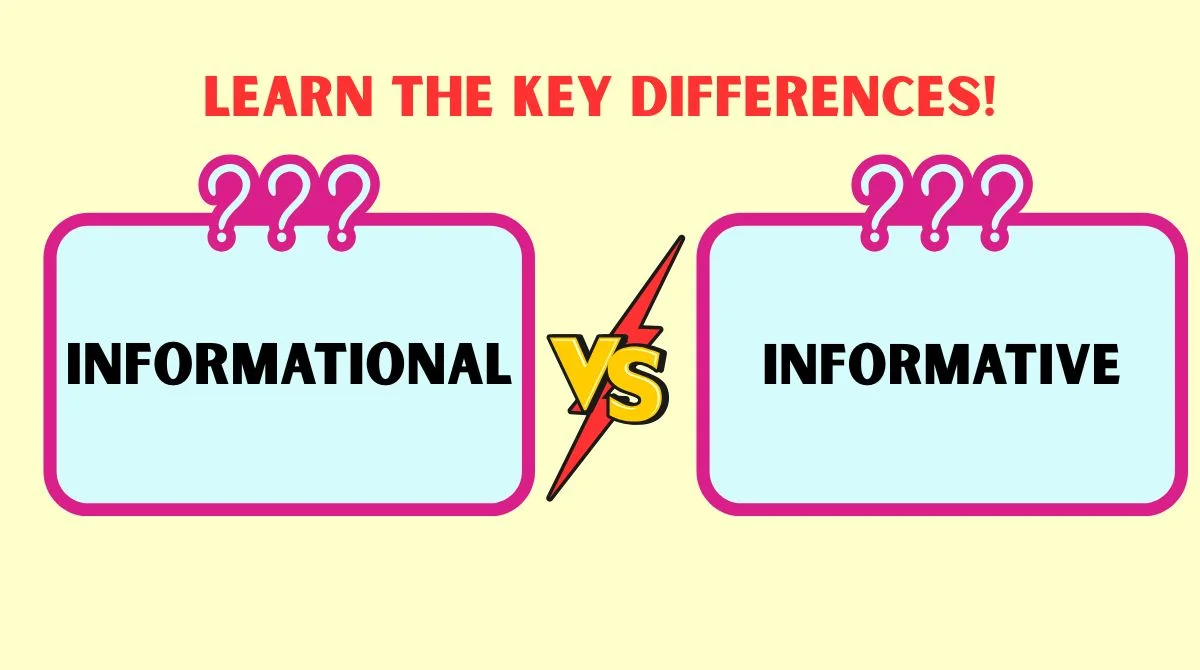
    Language can be tricky, especially when two words seem almost identical. Informational and informative are often used interchangeably, but they serve different functions. While both relate to knowledge and learning, their meanings, usage, and contexts differ.

    This article will break down the distinctions between informational and informative, explore their applications in writing, education, and social media, and provide real-world examples to help you understand when to use each term correctly.

    Is something informational or informative? “Informational” refers to presenting facts and data objectively, while “informative” enhances understanding with explanations and insights. Learn the key differences here!


    Informational vs Informative

    Understanding the Basics: Informational vs. Informative Texts

    At first glance, informational and informative may seem like synonyms, but there are subtle differences in how they function.

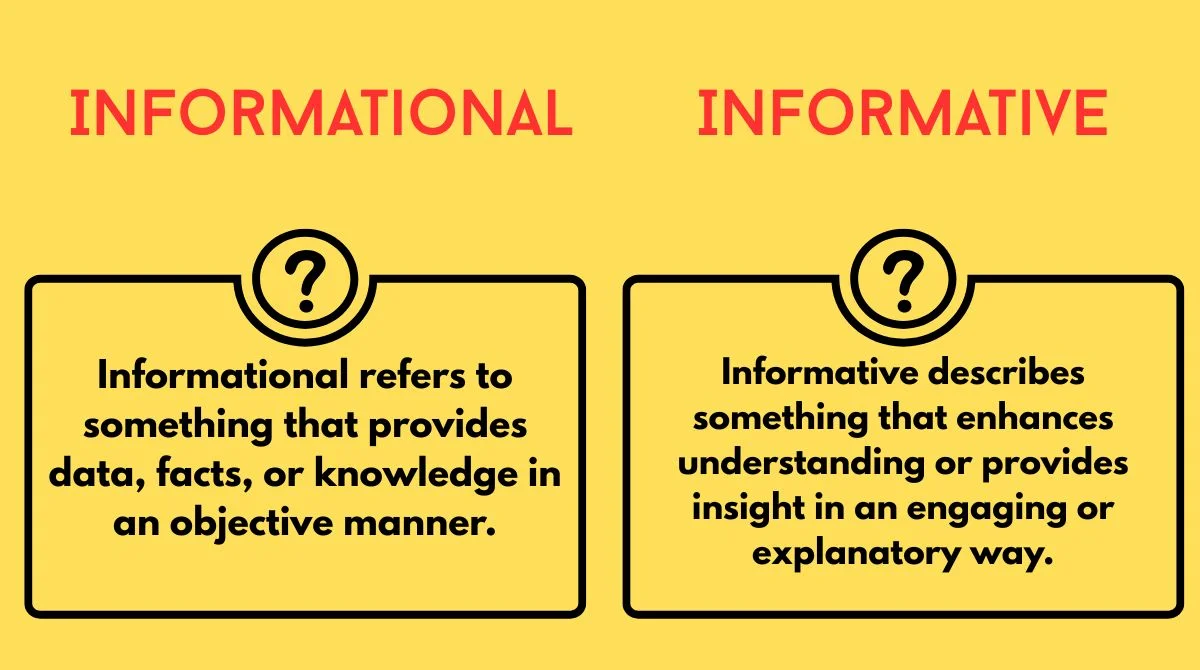
    • Informational refers to something that provides data, facts, or knowledge in an objective manner.
    • Informative describes something that enhances understanding or provides insight in an engaging or explanatory way.

    Quick Comparison Table

    AspectInformationalInformative
    DefinitionProvides factual data, raw informationProvides knowledge with added clarity, depth, or analysis
    PurposeTo present details in a structured wayTo educate, explain, or enhance understanding
    ExamplesResearch reports, data sheets, instruction manualsBlog posts, documentaries, news articles
    ToneNeutral, objective, data-drivenEngaging, explanatory, educational

    Understanding these differences is key when choosing the right term in your writing.


    Characterizing Informational Text

    Informational text is designed to present facts, statistics, and details without personal opinion or subjective analysis. It is often structured logically and follows a clear format to make data easily accessible.

    Features of Informational Text:

    • Objective Tone: Lacks opinion, emotion, or persuasion.
    • Fact-Based Content: Includes verified facts, figures, and statistics.
    • Clear Structure: Often formatted with headings, bullet points, and lists for easy comprehension.
    • Technical or Formal Language: Uses precise terminology suited to the subject matter.

    Examples of Informational Text:

    • Encyclopedias
    • Government reports
    • Scientific studies
    • Instruction manuals

    These texts exist purely to inform rather than to engage or persuade.


    The Purpose and Style of Informative Writing

    Informative writing, on the other hand, aims to present information in a way that enhances understanding and makes the content more engaging. Unlike informational text, informative writing often includes explanations, examples, and interpretations to help the reader grasp the subject.

    Characteristics of Informative Writing:

    • Clarity and Engagement: Focuses on making complex information digestible.
    • Educational Purpose: Helps readers understand a topic rather than just listing facts.
    • Explanatory Tone: Uses analogies, case studies, and examples to clarify concepts.
    • More Accessible Language: Written for general audiences, often avoiding technical jargon.

    Examples of Informative Writing:

    • Blog posts
    • Explainer articles
    • Documentaries
    • How-to guides

    While both informational and informative texts provide knowledge, informative writing is crafted to be more engaging and educational.


    Types of Informative Texts: Exploring the Variety

    Informative content appears in many forms, each designed to serve a specific audience. Here are some common types:

    1. Expository Essays – Provide explanations on a topic without personal opinions.
    2. News Articles – Present facts while also adding context and background information.
    3. How-to Guides & Tutorials – Teach readers how to perform a task step by step.
    4. Scientific and Educational Articles – Explain findings in a way that makes them understandable.
    5. FAQs (Frequently Asked Questions) – Provide detailed answers to common queries.

    Each of these forms aims to educate and engage, making learning more effective.


    Utilizing Visual Aids: Graphics and Illustrations in Informational Content

    Informational texts often include visual aids to enhance comprehension. Because these texts prioritize factual accuracy and clarity, adding charts, diagrams, and graphs helps to:

    • Present complex data in a digestible format
    • Highlight trends and relationships
    • Improve retention of information

    Examples of Visual Aids in Informational Content:

    Type of VisualPurposeExample Usage
    GraphsShow numerical data trendsPopulation growth trends
    ChartsCompare and organize informationProduct feature comparison
    DiagramsExplain processes visuallyHuman anatomy diagram
    TablesProvide structured dataMonthly expense breakdown

    In technical, academic, and research-based content, visual aids are essential tools for simplifying information.


    Visual Aids in Education: The Path to Better Learning

    Visuals play a crucial role in educational content, whether it is informational or informative. Studies show that people retain information 65% better when it’s paired with images, compared to just text alone.

    Benefits of Using Visuals in Learning:

    • Increases Retention: Visual memory is stronger than text-based memory.
    • Enhances Understanding: Complex ideas become more accessible.
    • Engages Learners: Keeps readers interested and focused.

    For example, infographics in informative articles make content easier to understand by combining facts with engaging design elements.


    Real-World Examples of Informative Content on Social Media Platforms

    Social media is full of informative content, ranging from educational videos to explainer posts. Here’s how platforms use it effectively:

    • YouTube: Educational channels like TED-Ed provide engaging informative content.
    • Instagram & TikTok: Short-form videos breaking down science, finance, and language topics.
    • LinkedIn Articles: Professionals share industry insights and career tips.

    These platforms show that informative content isn’t limited to books and blogs—it thrives in digital spaces, too.


    Keywords and Intent: Tailoring Content for Information-Seeking Audiences

    In SEO (Search Engine Optimization), understanding search intent is crucial when choosing between informational and informative content.

    Keyword TypeSearch IntentExample Searches
    InformationalUsers want raw data or factual content“List of U.S. presidents”
    InformativeUsers seek detailed explanations“What is the difference between effect and affect?”

    When creating content, knowing the intent behind keywords helps tailor it to what the audience is looking for.\


    Informational vs Informative

    FAQs

    1. What does “informational” mean?

    “Informational” describes content that presents raw facts and data without opinions or analysis. Examples include research reports, instruction manuals, and encyclopedias.

    2. What does “informative” mean?

    “Informative” refers to content that enhances understanding by explaining, analyzing, or engaging the audience. Examples include blog posts, documentaries, and how-to guides.

    3. Can “informational” and “informative” be used interchangeably?

    Not always. Informational content provides data objectively, while informative content explains and educates the reader. For example, a research paper is informational, but a TED Talk is informative.

    4. How do businesses use informational and informative content?

    • Informational content: Data sheets, reports, and policies to provide essential details.
    • Informative content: Blog posts, tutorials, and explainer videos to educate and engage customers.

    5. What type of content benefits from visual aids?

    Both informational and informative content benefit from visuals like charts, graphs, infographics, and diagrams. These tools make data easier to understand and retain.

    6. How do search engines treat informational vs. informative content?

    • Informational searches look for raw data (e.g., “list of U.S. presidents”).
    • Informative searches seek explanations (e.g., “difference between effect and affect”).
      Optimizing content based on search intent improves SEO and ranking.

    Conclusion

    While informational and informative both relate to knowledge and learning, their uses differ significantly.

    • Informational texts provide raw facts and objective data.
    • Informative writing enhances understanding through explanations and engagement.

    Whether you’re writing a research report, crafting a blog post, or creating educational materials, choosing the right term can make all the difference in clarity and accuracy.

    Which type of content do you use most often? Let us know in the comments!