Blog

  • Froze or Frozen? Learn the Right Usage with Examples! ✅❄️

    Froze or Frozen? Learn the Right Usage with Examples! ✅❄️

    Understanding verb conjugations in English can be tricky, especially when it comes to irregular verbs like “freeze.” Many learners struggle with choosing between froze and frozen in sentences.

    In this guide, we’ll break down the correct usage of these terms with clear explanations, examples, and grammatical rules to help you master them once and for all.

    Confused about “froze” vs. “frozen”? “Froze” is the simple past tense, while “frozen” is the past participle used with auxiliary verbs. Learn the difference with clear examples!


    Exploring the Verb “Freeze” – Present, Past, and Past Participle
    Froze or Frozen

    Before diving into froze and frozen, let’s examine how the verb “freeze” is conjugated in different tenses:

    TenseVerb Form
    Presentfreeze
    Pastfroze
    Past Participlefrozen
    • Freeze is the base form (present tense).
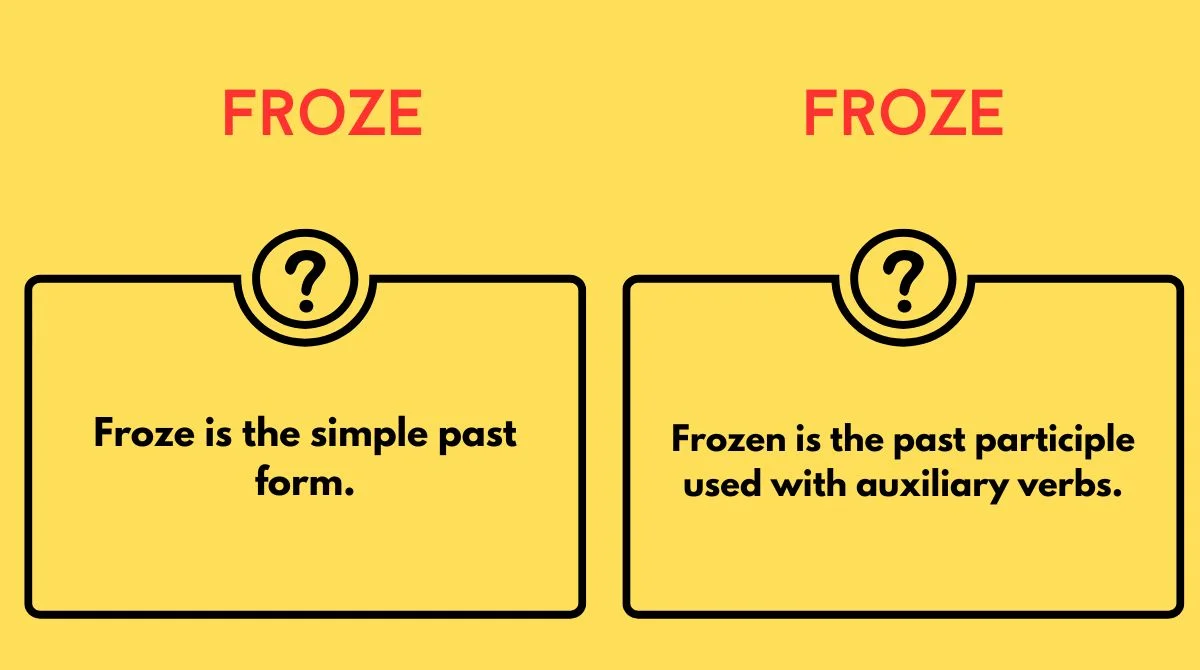
    • Froze is the simple past form.
    • Frozen is the past participle used with auxiliary verbs.

    Understanding this breakdown is crucial for using each form correctly in sentences.


    When to Use “Froze” – Simple Past Tense Illustrated

    Froze is the simple past form of freeze, used when describing an action that happened at a specific time in the past.

    Examples:

    • The lake froze overnight due to the extreme cold.
    • I froze when I heard the unexpected news.
    • She froze in fear during the scary movie.

    A key rule to remember: Froze never needs an auxiliary verb like “has” or “had.”


    The Right Contexts for “Frozen” – Understanding the Past Participle

    Frozen is the past participle form of freeze. It cannot function alone as a verb in a sentence; it requires an auxiliary verb (like “has,” “had,” or “was”).

    Examples:

    • The pond has frozen for the first time this winter.
    • By morning, the pipes had frozen completely.
    • The vegetables were frozen for preservation.

    If the sentence needs “has,” “had,” or “was,” then frozen is the correct choice.


    Using “Frozen” in Perfect Tense Constructions

    The perfect tense uses “frozen” with auxiliary verbs to show completed actions.

    Present Perfect:

    • The river has frozen solid.
    • She has frozen her leftover food.

    Past Perfect:

    • By the time we arrived, the ground had frozen.
    • He had frozen all his assets before the lawsuit.

    Future Perfect:

    • By next winter, the lake will have frozen.
    • They will have frozen all perishable items before leaving.

    Examples of “Frozen” with Auxiliary Verbs

    Auxiliary VerbExample Sentence
    HasThe water has frozen overnight.
    HadThe roads had frozen before sunrise.
    WasThe fish was frozen before shipment.
    Will haveThe lake will have frozen by January.

    This table highlights the key role auxiliary verbs play when using frozen.


    Common Mistakes with “Froze” and “Frozen”

    Learners often confuse these forms. Here are some common mistakes and corrections:

    ❌ The lake has froze overnight.
    ✔️ The lake has frozen overnight.

    ❌ She had froze all the food before leaving.
    ✔️ She had frozen all the food before leaving.

    ❌ The vegetables were froze for storage.
    ✔️ The vegetables were frozen for storage.

    A simple rule to avoid mistakes: If you see an auxiliary verb, use “frozen.” If not, use “froze.”


    Tips to Prevent Tense Misuse

    To avoid errors with “froze” and “frozen”:

    • Remember the auxiliary verb rule – Use “frozen” only with “has,” “had,” or “was.”
    • Think about timing – If the action happened at a specific past time, use “froze.”
    • Practice with sentences – Create your own examples to reinforce proper usage.

    The Grammatical Rules Behind “Freeze” Conjugations

    The verb “freeze” follows an irregular conjugation pattern, meaning it doesn’t follow the standard “-ed” ending rule. Instead, it changes form entirely from “freeze” → “froze” → “frozen.”

    This pattern is common among strong verbs in English, such as:

    • Speak → Spoke → Spoken
    • Drive → Drove → Driven
    • Break → Broke → Broken

    Memorizing these patterns can help solidify correct usage.


    Ablaut Patterns in English Verbs

    The conjugation of “freeze” follows an ablaut pattern, a linguistic process where vowel sounds shift to indicate tense.

    • Base Form: “freeze” (long ee sound)
    • Past Tense: “froze” (long o sound)
    • Past Participle: “frozen” (long o sound with “-en” ending)

    Similar verbs following this pattern include:

    • Choose → Chose → Chosen
    • Write → Wrote → Written

    Recognizing these shifts can make it easier to remember irregular verb forms.


    Practical Tips for Remembering the Past Tense of “Freeze”

    1. Use rhyming verbs – Think of “choose, chose, chosen” when recalling “freeze, froze, frozen.”
    2. Create a mnemonic – “If it’s done, it’s frozen. If it’s past, it’s froze fast.”
    3. Repeat sentences aloud – Speaking phrases like “The lake froze yesterday” and “The lake has frozen today” reinforces correct usage.

    Frozen in Time – Historical Origins of the Verb “Freeze”

    The word freeze comes from the Old English “frēosan”, which meant “to turn to ice.”

    • It shares roots with Old Norse “frjósa” and Gothic “frius” (meaning “frosty”).
    • The past participle “frozen” developed in Middle English, influenced by Germanic languages.

    Understanding its etymology helps appreciate how language evolves over time.


    Froze or Frozen

    FAQs

    1. What is the past tense of “freeze”?

    The past tense of “freeze” is “froze” (e.g., “The lake froze overnight”). The past participle is “frozen” (e.g., “The lake has frozen”).

    2. When should I use “froze” instead of “frozen”?

    Use “froze” when describing a past action without an auxiliary verb (e.g., “She froze in fear”). Use “frozen” with “has,” “had,” or “was” (e.g., “The pipes had frozen”).

    3. Why do people confuse “froze” and “frozen”?

    Many learners mistake “froze” for the past participle or use “frozen” without an auxiliary verb. A key rule: If there’s ‘has’ or ‘had,’ use ‘frozen.’ Otherwise, use ‘froze.’

    4. What are some common mistakes with “froze” and “frozen”?

    • ❌ “The lake has froze.” → ✔️ “The lake has frozen.”
    • ❌ “She had froze the meat.” → ✔️ “She had frozen the meat.”
    • ❌ “The vegetables were froze.” → ✔️ “The vegetables were frozen.”

    5. What are some other verbs that follow this pattern?

    Similar irregular verbs include:

    • Break → Broke → Broken
    • Drive → Drove → Driven
    • Choose → Chose → Chosen

    6. How can I remember the difference between “froze” and “frozen”?

    Try this mnemonic: “If it’s done, it’s frozen. If it’s past, it’s froze fast.” Also, compare it to verbs like “choose, chose, chosen” for better recall.


    Conclusion

    Mastering “froze” and “frozen” comes down to knowing when to use each form correctly:

    • Use froze for simple past actions (“The lake froze last night.”)
    • Use frozen with auxiliary verbs (“The lake has frozen.”)

    By practicing with examples and remembering the key grammar rules, you’ll avoid common mistakes and use these words naturally in conversation and writing. If you found this guide helpful, share it with others who might be struggling with English verb tenses!
  • Me Too vs Me as Well vs I as Well: What’s Correct? 🤔📖

    Me Too vs Me as Well vs I as Well: What’s Correct? 🤔📖

    When speaking or writing in English, expressing agreement is a common necessity. However, the correct phrasing can sometimes be confusing.

    Phrases like “Me too,” “Me as well,” and “I as well” may seem interchangeable, but they have distinct uses, levels of formality, and grammatical correctness. Understanding these differences is key to sounding natural and fluent in English.

    This guide breaks down the proper usage of each expression, providing clear explanations, examples, and comparisons to help you use them correctly in any context.

    Should you say “Me too” or “Me as well”? 🤔 “Me too” is casual, “Me as well” is slightly more formal, and “I as well” is incorrect. Learn the key differences with examples!


    The Correct Usage of “Me Too” in American English

    Me Too vs Me as Well vs I as Well

    Definition and Standalone Nature of “Me Too”

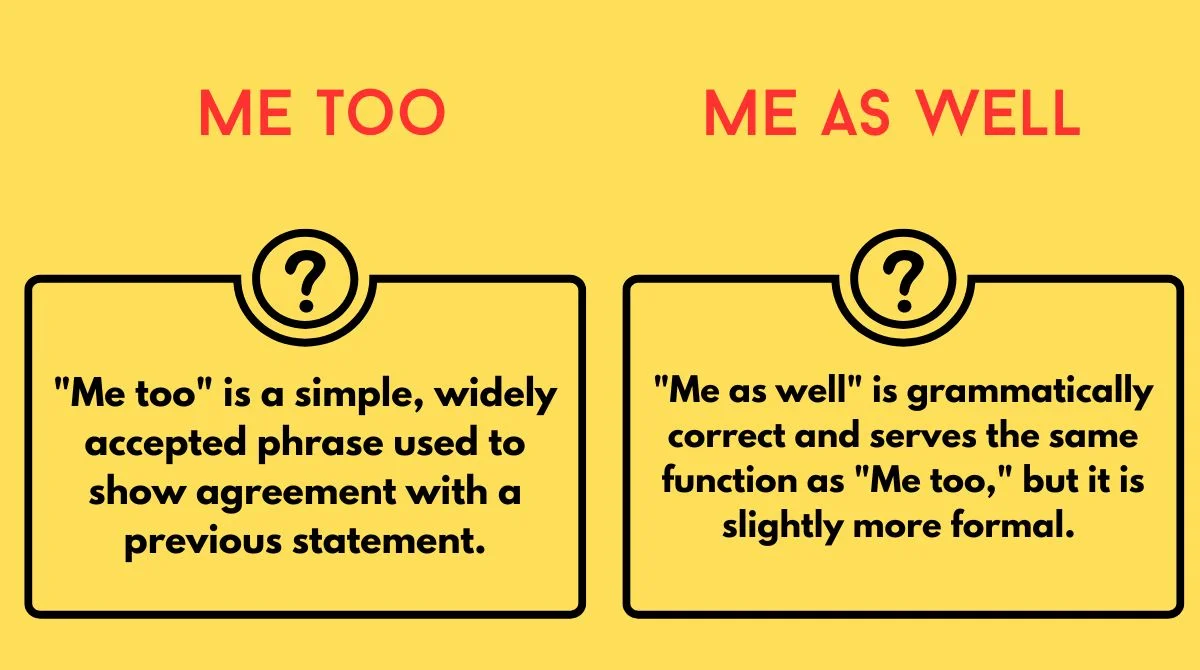
    “Me too” is a simple, widely accepted phrase used to show agreement with a previous statement. It is typically used in casual conversation and works best when responding to affirmative statements.

    • Correct example:
      • A: “I love chocolate.”
      • B: “Me too!” (This means B also loves chocolate.)

    Unlike other agreement expressions, “Me too” can stand alone as a complete response, making it particularly useful in spoken English.

    Examples Demonstrating “Me Too” in Sentences

    Here are some scenarios where “Me too” is the most natural choice:

    • “I enjoy hiking.” → “Me too!”
    • “She is going to the concert.” → “Me too!”
    • “I have a dog.” → “Me too!”

    Informality and Appropriateness of “Me Too” in Various Contexts

    “Me too” is commonly used in informal speech and casual writing. It is rarely found in formal contexts such as academic writing or business emails. In such cases, alternatives like “I also do” or “So do I” are preferred.

    • Informal:
      • “I finished my homework early.” → “Me too!”
    • Formal:
      • “I completed my assignment ahead of schedule.” → “So did I.”

    When to Use “Me as Well” Over “Me Too”

    “Me as well” is grammatically correct and serves the same function as “Me too,” but it is slightly more formal. While still used in spoken English, it is less common in casual conversation.

    • Correct example:
      • A: “I enjoy reading.”
      • B: “Me as well.” (Equivalent to “Me too,” but slightly more formal.)

    It is often used in situations where a smoother, more neutral tone is preferred.

    • “I am looking forward to the event.” → “Me as well.”
    • “She plans to attend the seminar.” → “Me as well.”

    Comparison of “Me Too” and “Me as Well”

    ExpressionFormalityCommon Usage
    Me tooInformalEveryday speech, casual conversations
    Me as wellNeutral/FormalMore polished speech, some formal settings

    While both are grammatically correct, “Me too” is more common in everyday English.


    Navigating the Incorrect Usage of “I as Well”

    The Grammatical Inaccuracy of “I as Well”

    Unlike “Me too” and “Me as well,” the phrase “I as well” is not grammatically correct in standard English. The reason is that “I” is a subject pronoun, while “me” is an object pronoun.** The phrase “Me too” works because “me” is the correct pronoun in response to most affirmative statements.

    • Incorrect example:
      • A: “I love traveling.”
      • B: “I as well.” ❌ (Incorrect!)

    Instead, the correct phrase would be:

    • “I do as well.” ✅
    • “So do I.” ✅
    • “Me too.” ✅

    Proper Alternatives to “I as Well” with Examples

    To avoid incorrect usage, try these grammatically correct alternatives:

    Incorrect UsageCorrect Alternative
    “I as well love coffee.” ❌“I love coffee as well.” ✅
    “I as well am excited.” ❌“I am excited as well.” ✅
    “I as well agree.” ❌“I agree as well.” ✅

    Using these alternatives ensures your English sounds natural and grammatically correct.

    Comparison and Popularity: “Me as Well” vs. “I as Well”

    A quick comparison shows why “Me as well” is preferred over “I as well”:

    PhraseCorrect UsageCommon in Spoken English?
    Me as wellCorrectSometimes used, but less than “Me too”
    I as wellIncorrectRarely, if ever, used

    Me Too vs Me as Well vs I as Well

    FAQs

    1. Is “Me too” grammatically correct?

    Yes! “Me too” is a widely accepted phrase for agreement in casual conversations. Example:
    A: “I love coffee.”
    B: “Me too!”

    2. When should I use “Me as well” instead of “Me too”?

    “Me as well” is more formal than “Me too” but has the same meaning. Example:
    A: “She is attending the meeting.”
    B: “Me as well.”

    3. Why is “I as well” incorrect?

    “I as well” is grammatically wrong because “I” is a subject pronoun, not an object pronoun. Use alternatives like “I do as well” or “So do I.”

    4. Can I use “Me too” in formal writing?

    Not usually. In formal contexts, use “So do I,” “I also do,” or “I agree as well” instead.

    5. What’s the difference between “Me too” and “Me as well”?

    • “Me too” → Informal, common in everyday speech
    • “Me as well” → Slightly more formal, less commonly used

    6. What’s a good alternative to “I as well”?

    Instead of “I as well,” say:
    ❌ “I as well love reading.” (Incorrect)
    ✅ “I love reading as well.” (Correct)


    Conclusion: Choosing the Right Expression for Clarity and Correctness

    When expressing agreement in English, it is essential to use the correct phrase for the context:

    • Use “Me too” in casual conversations as a quick response to show agreement.
    • Use “Me as well” in slightly more formal situations when a polished tone is required.
    • Avoid “I as well” entirely, and instead use proper alternatives like “I do as well” or “So do I.”

    By understanding these distinctions, you can communicate more naturally and confidently in English. Whether you are speaking casually with friends or writing in a professional setting, using the right expression ensures clarity and correctness.

  • Recurring vs Reoccurring: What’s the Difference? 🤔📖

    Recurring vs Reoccurring: What’s the Difference? 🤔📖

    The English language is full of words that seem almost identical yet carry subtle differences in meaning.

    Recurring and reoccurring are two such words that often confuse even native speakers. While both relate to events happening more than once, their nuances set them apart.

    This guide will explore their definitions, historical roots, and practical applications to help you use them correctly in your writing and speech.

    “Recurring” and “reoccurring” may seem similar, but they have distinct meanings. “Recurring” refers to regular repetition, while “reoccurring” means something happens again without a set pattern. Learn how to use them correctly!


    Decoding the Definitions: Recur vs. Reoccur

    At first glance, recur and reoccur may appear interchangeable, but they have distinct meanings:

    • Recur (verb): To happen repeatedly or at regular intervals.
      • Example: “The meetings recur every Monday.”
    • Reoccur (verb): To happen again, but without any implication of regularity.
      • Example: “The power outage reoccurred last night.”

    The key distinction lies in frequency and expectation. Recurring events happen periodically, whereas reoccurring events happen again but not necessarily in a repeated pattern.


    The Original Latin Roots and English Evolutions

    Understanding the etymology of words often sheds light on their meanings. Here’s how these terms evolved:

    WordLatin OriginMeaning in LatinEvolution in English
    Recurrecurrere“To run back”Implies repetition or returning at intervals
    Reoccuroccurrere“To happen”Implies happening again without set frequency

    Since recurrere means “to run back,” it makes sense that recurring events cycle back periodically. Meanwhile, reoccur simply stems from occurrere, which means “to happen,” reinforcing the idea that it just means “to happen again.”


    Breaking Down the Frequency Factor

    One of the most significant distinctions between these terms lies in how often the event happens:

    • Recurring: Happens regularly and predictably.
    • Reoccurring: Happens again, but without a set pattern.

    Examples in Context

    ScenarioCorrect WordExplanation
    A monthly subscription billing cycleRecurringIt happens at a fixed interval.
    A random earthquake in the same regionReoccurringIt happens again but unpredictably.
    A seasonal flu outbreakRecurringIt follows a seasonal pattern.
    A car breaking down unexpectedlyReoccurringIt happens more than once but randomly.

    By examining these examples, you can see why choosing the right term matters in clear communication.


    The Nuances of Usage in American English

    Both words exist in American English, but recurring is significantly more common. You’re far more likely to encounter it in various contexts, such as:

    • Finance & Business: “Recurring revenue streams”
    • Medicine & Health: “Recurring migraines”
    • Entertainment & Media: “A recurring guest star on a TV show”
    • Technology & Software: “Recurring payments on a subscription plan”

    On the other hand, reoccurring is less frequently used and mainly appears in contexts where something happens multiple times without a clear schedule:

    • “Flooding in the area has been reoccurring due to climate change.”
    • “His headaches have been reoccurring for the past few months.”

    Recurring vs Reoccurring

    When to Opt for ‘Recurring’ Over ‘Reoccurring’

    If you’re unsure which word to use, follow these simple guidelines:

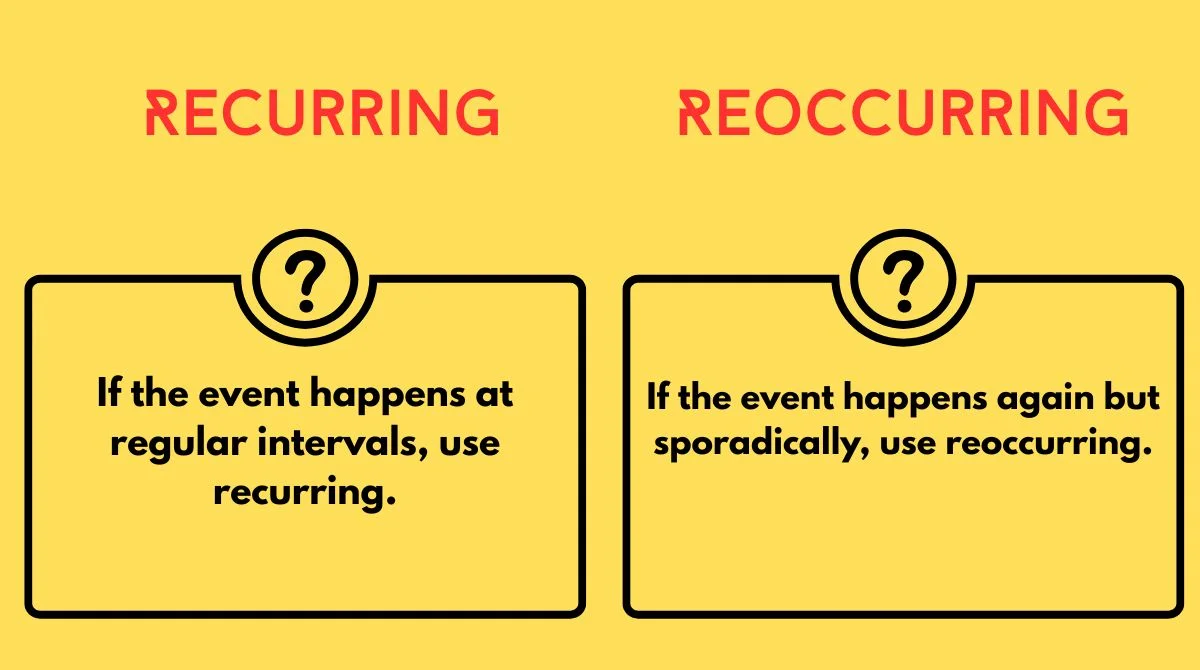
    • If the event happens at regular intervals, use recurring.
    • If the event happens again but sporadically, use reoccurring.

    Quick Trick to Remember:

    • Recurring = Regular (Both start with “R”)
    • Reoccurring = One-off reappearance

    Exploring Examples to Highlight Differences

    Common Phrases with “Recurring”

    • Recurring dream
    • Recurring theme in literature
    • Recurring expenses
    • Recurring subscriptions

    Common Phrases with “Reoccurring”

    • A reoccurring technical glitch
    • A reoccurring software bug
    • A reoccurring allergy reaction

    If the event follows a predictable cycle, recurring is correct. If it happens again but randomly, reoccurring fits better.


    Linguistic Insights: Recurrence and Reoccurrence Compared

    These two nouns follow the same distinction:

    • Recurrence: The act of happening regularly.
      • Example: “The recurrence of the flu each winter is expected.”
    • Reoccurrence: The act of happening again, without frequency.
      • Example: “The reoccurrence of a security breach surprised the company.”
    Noun FormMeaning
    RecurrenceHappens regularly, expected
    ReoccurrenceHappens again but unpredictably

    Common Misconceptions and Clarifications

    1. Can reoccurring be used instead of recurring?

    Technically, yes—but it’s less common and might sound awkward. Stick to recurring when discussing regular cycles.

    2. Is reoccur a proper word?

    Yes, but it’s much rarer in usage compared to recur. Many style guides recommend using recur instead.

    3. Do British and American English treat these words differently?

    No, the distinction remains the same in both varieties of English.

    4. Can an event be both recurring and reoccurring?

    Not at the same time! An event is either regular (recurring) or sporadic (reoccurring).


    Recurring vs Reoccurring

    Conclusion

    The difference between recurring and reoccurring may be subtle, but it’s important for clarity in communication. Remember:

    • Use “recurring” for events that repeat in a predictable manner.
    • Use “reoccurring” for events that happen again but irregularly.

    By keeping this distinction in mind, you’ll ensure your writing is precise, professional, and grammatically accurate. If in doubt, recurring is almost always the safer choice!

  • Mother Tongue vs Native Language 🌍 – Key Differences Explained with Real-Life Examples

    Mother Tongue vs Native Language 🌍 – Key Differences Explained with Real-Life Examples

    Language is more than just words. It shapes identity, connects us to our roots, and determines how we interact with the world. Two terms often used interchangeably — mother tongue and native language — actually carry different meanings.

    While both describe a person’s primary language, the context, emotional weight, and usage behind each word vary significantly.

    So, what’s the real difference between your mother tongue and your native language? Let’s break it down in detail.


    Defining the Terms Clearly

    What is Mother Tongue?

    The phrase mother tongue comes from the idea of learning the first language through one’s family, especially the mother. It’s the language that surrounds a child from birth — the one spoken at home, in lullabies, or in bedtime stories.

    • Early exposure: It’s usually the first language a child hears and absorbs naturally.
    • Family bond: It represents cultural roots and family heritage.
    • Identity marker: It stays linked to where you come from, even if you don’t use it daily.

    For example, a child born to Urdu-speaking parents in Pakistan may consider Urdu their mother tongue, even if they later grow up speaking mostly English.


    What is Native Language?

    The native language refers to the language in which a person is most fluent and comfortable. It may be the same as the mother tongue, but not always. The native language reflects usage, not just origin.

    • Fluency focus: It’s the language you use naturally in thinking, speaking, and expressing yourself.
    • Social environment: Often shaped by where you grow up, your schooling, and your peer circle.
    • May shift over time: Unlike the mother tongue, your native language can change if another language dominates your daily life.

    For example, a child whose parents speak Spanish at home but who grows up in the US might end up with English as their native language.


    Key Differences Between Mother Tongue and Native Language

    Mother Tongue vs Native Language

    Though they often overlap, mother tongue and native language are not identical. The chart below highlights the differences clearly:

    FeatureMother TongueNative Language
    OriginLearned from parents/family at birthLearned through immersion in environment
    First ExposureEarly childhood, usually at homeChildhood or later, shaped by society
    Emotional LinkStrong tie to culture and familyStrong tie to daily use and fluency
    UsageMay fade if not practicedUsually the dominant spoken language
    Change Over TimeRarely changesCan shift due to migration or adaptation

    Think of the mother tongue as your roots and the native language as your daily ground. One shows where you came from, the other shows where you stand today.


    Overlaps and Grey Areas

    Language identity isn’t always black and white. Many people experience overlaps or even conflicts between their mother tongue and native language.

    • Same language: For many, both are identical. Example: A child born and raised in France, with French spoken at home and school.
    • Different languages: Migration often creates a split. Example: A Punjabi-speaking child raised in Canada may adopt English as their native language while Punjabi remains their mother tongue.
    • Bilingual households: Children exposed to two languages from birth may consider both their mother tongues but later identify only one as their dominant native language.

    These grey areas highlight why the terms shouldn’t be confused — they describe different layers of identity.


    Real-Life Scenarios

    To understand better, let’s look at practical situations:

    Case Study 1: Punjabi Mother Tongue, English Native Language

    Ali was born in Lahore, where Punjabi was the family language. But after moving to Toronto at age 3, he grew up speaking English in school and with friends. By the time he turned 20, English had become his native language, while Punjabi remained his cultural mother tongue.


    Case Study 2: Spanish at Home, English in School

    Maria’s parents are immigrants from Mexico. At home, she spoke Spanish exclusively until age 6. But after starting school in Los Angeles, English became her dominant language. Today, Spanish is her mother tongue, but English is her native language.


    Case Study 3: Adopted Child and Language Shift

    Jin, born in Korea, was adopted by American parents at age 2. His mother tongue is Korean, but since he lost exposure early, his native language is English. For him, the connection to Korean is cultural rather than linguistic.


    Why the Distinction Matters

    Understanding the difference between mother tongue and native language is not just linguistic hair-splitting. It has practical and cultural consequences:

    • Education systems: Schools often use the native language as the medium of instruction. Confusing it with mother tongue can lead to poor policy decisions.
    • Cultural identity: Many people strongly identify with their mother tongue, even if it’s not the language they speak daily.
    • Census and documentation: Governments collect data on both to shape language policies.
    • Personal growth: Knowing the distinction helps bilinguals and multilinguals understand their own identity better.

    As one linguist once said, “Your mother tongue is the echo of your ancestry, while your native language is the voice of your present.”


    Common Misconceptions

    Several myths surround these terms. Let’s debunk them:

    • Myth 1: Mother tongue and native language are always the same.
      Reality: They often overlap but can differ due to migration, adoption, or bilingualism.
    • Myth 2: The language you speak best is always your mother tongue.
      Reality: Fluency doesn’t define mother tongue — origin does.
    • Myth 3: Once you have a native language, it never changes.
      Reality: Native language can shift over time if exposure changes.

    Mother Tongue and Native Language in a Globalized World

    In today’s interconnected world, millions grow up in environments where their mother tongue isn’t their dominant language.

    • Migration effect: Families moving abroad often pass down their mother tongue, but children adopt the local language as their native one.
    • Global English dominance: English increasingly becomes the native language for children in non-English-speaking countries if it dominates education and entertainment.
    • Cultural preservation: UNESCO emphasizes the need to preserve mother tongues, as thousands of languages are at risk of extinction.

    Globalization expands opportunities but also challenges the survival of many mother tongues.


    Practical Guidance for Readers

    Confused when filling forms or explaining your language background? Here’s some practical advice:

    • On official forms:
      • Mother tongue: Write the language spoken by your parents/family at home.
      • Native language: Write the language you are most fluent and comfortable in.
    • For parents raising bilingual kids:
      • Speak the mother tongue at home consistently.
      • Encourage exposure to the community/native language outside.
      • Balance helps children retain both cultural identity and fluency.
    • For learners: Remember that mastering a native-like command of a second language doesn’t erase your mother tongue — it adds to your linguistic wealth.

    FAQs About Mother Tongue vs Native Language

    What is the difference between mother tongue and native language?

    Mother tongue refers to the first language learned at home, while native language refers to the language a person is most fluent and comfortable using.

    Can you have more than one mother tongue?

    Yes. Children raised in bilingual households may have two mother tongues if they learn both from birth.

    Can a person’s native language change over time?

    Yes. A native language can shift if another language becomes dominant due to schooling, work, or migration.

    Is the first language always considered the mother tongue?

    Usually, but not always. If a child is exposed to multiple languages from birth, more than one can be considered a mother tongue.

    Why do official forms ask about both mother tongue and native language?

    Because they serve different purposes: mother tongue data reflects cultural background, while native language reflects current fluency.


    Conclusion

    Mother tongue and native language are like two sides of the same coin — connected but not identical. One links you to your family, roots, and ancestry; the other defines your fluency, environment, and present-day identity.

    In a globalized world, many people juggle both, sometimes even switching between them.

    Recognizing the difference isn’t just about words — it’s about understanding who you are, where you come from, and how you engage with the world.

  • Shown vs Showed 🤔 | A Complete Grammar Guide with Examples

    Shown vs Showed 🤔 | A Complete Grammar Guide with Examples

    English learners often stumble over the choice between “shown” and “showed.” Both words come from the same verb—“to show”—but they don’t appear in the same contexts.

    The good news? Once you understand a few grammar rules and see plenty of examples, you’ll never confuse them again.

    In this guide, you’ll discover when to use “shown,” when to use “showed,” and how both forms fit into different tenses. You’ll also get tables, real-life examples, and memory tips to make things stick.


    Understanding the Verb “Show”

    Shown vs Showed

    The verb “show” belongs to the irregular verb family. Irregular verbs don’t follow the usual “-ed” pattern for past tense and past participles. Instead, they often change form.

    Here’s a simple chart:

    Base FormPast TensePast Participle
    ShowShowedShown

    Notice how “showed” serves as the past tense form, while “shown” functions as the past participle. That’s where most of the confusion comes from.

    Think of it like this:

    • Use “showed” to describe a completed action in the past.
    • Use “shown” with a helping verb (have, has, had, will have) in perfect tenses.

    When to Use “Showed”

    “Showed” is the simple past tense of “show.” It tells us something happened and finished in the past.

    Examples:

    • She showed me her new car yesterday.
    • The teacher showed the students a documentary about history.
    • They showed up late to the meeting.

    Quick Reminders

    • Use “showed” without auxiliary verbs.
    • It marks a past event, not something connected to the present.
    • Avoid “have showed”—it sounds incorrect to native speakers.

    A common mistake is using “showed” in perfect tenses. For instance, “I have showed you this before” is grammatically wrong. The correct form is “I have shown you this before.”


    When to Use “Shown”

    “Shown” is the past participle of “show.” You cannot use it alone as the main verb. It always needs a helper verb.

    Examples:

    • She has shown great improvement this year.
    • By the time we arrived, he had shown everyone the pictures.
    • They will have shown their final project by next week.

    Why “shown” matters

    The past participle form is critical in perfect tenses. Without it, sentences sound unnatural. For example:

    • Wrong: He has showed me the place.
    • Correct: He has shown me the place.

    Native speakers instinctively avoid “have showed” because it doesn’t follow standard irregular verb rules.


    Side-by-Side Comparison: Shown vs. Showed

    Let’s compare the two forms directly.

    UsageShowed (Past Tense)Shown (Past Participle)
    Auxiliary Verb Needed?❌ No✅ Yes (have, has, had, will have)
    ExampleShe showed me the photo.She has shown me the photo.
    TenseSimple PastPerfect Tenses
    Common Error“I have showed”Rarely misused

    This chart shows exactly why confusion happens—both words exist, but they serve different grammatical purposes.


    Perfect Tenses Explained Simply

    Perfect tenses often scare learners, but they’re simpler than they look. Here’s how “shown” fits into each one:

    Past Perfect

    • Correct: He had shown me the document before the meeting.
    • Wrong: He had showed me the document before the meeting.

    Use “had shown” when describing something completed before another past event.

    Present Perfect

    • Correct: They have shown great responsibility.
    • Wrong: They have showed great responsibility.

    Present perfect connects the past with the present. It shows an action’s effect or relevance now.

    Future Perfect

    • Correct: By the end of the year, she will have shown real leadership.
    • Wrong: By the end of the year, she will have showed real leadership.

    Future perfect projects into the future, marking something that will be completed before a set point.


    “Have Showed” vs. “Have Shown”

    This is the heart of the confusion. Let’s break it down.

    • “Have showed” = ❌ Incorrect in standard English.
    • “Have shown” = ✅ Correct, natural, and expected.

    Examples:

    • ❌ I have showed him my work many times.
    • ✅ I have shown him my work many times.

    Think of irregular verbs like “go → went → gone” or “write → wrote → written.” In the same way, it’s “show → showed → shown.”


    Real-World Examples & Usage Notes

    Language is best understood through usage. Here are phrases you’ll often see with “shown,” but rarely with “showed”:

    • Shown interest: The candidate has shown interest in the position.
    • Shown results: The new policy has shown results quickly.
    • Shown promise: The athlete has shown promise in recent games.

    Notice how natural these sound. Replace them with “showed,” and the sentences instantly feel awkward.

    Writers, journalists, and academics overwhelmingly prefer “shown” in these cases. For example:

    • Business reports: The company has shown steady growth over five years.
    • Science: Studies have shown a correlation between diet and mood.
    • Everyday conversation: She’s shown a lot of patience lately.

    Quick Reference Table

    Here’s a one-stop table you can save or screenshot for easy recall:

    TenseCorrect FormExample
    Simple PastShowedHe showed us the way.
    Present PerfectShownThey have shown interest.
    Past PerfectShownShe had shown kindness.
    Future PerfectShownHe will have shown progress.

    FAQs About Shown vs. Showed

    Is “showed” ever wrong?

    No. “Showed” is correct in simple past tense. It only becomes wrong when used with auxiliary verbs in perfect tenses.

    Can I use “shown” without a helping verb?

    No. “Shown” always needs a helper verb like have, has, or had.

    Why does “have showed” sound incorrect?

    Because “show” is irregular. Its past participle is “shown,” not “showed.”

    Which is more common: “shown” or “showed”?

    Both are common, but “shown” appears more in professional writing, while “showed” dominates simple storytelling.

    How can I remember the difference?

    Think: show → showed → shown. If a helping verb is present, use “shown.” If not, use “showed.”


    Final Thoughts

    The debate over “shown vs. showed” isn’t really a debate—it’s about knowing when to use each.

    • Use “showed” for simple past events.
    • Use “shown” for perfect tenses with helper verbs.

    Master this simple rule, and you’ll avoid one of the most common mistakes English learners make. With enough practice, your sentences will feel smoother and sound more natural.

  • Become vs Became: What’s the Difference? (With Examples) 🤔📚

    Become vs Became: What’s the Difference? (With Examples) 🤔📚

    Understanding verb tenses in English can be tricky, especially with words that seem similar but function differently.

    Become and became often cause confusion because they both refer to change or transformation, but they are used in different tenses.

    This guide will break down their meanings, uses, and common mistakes so you can use them confidently in your writing and speech.

    Confused about become vs. became? “Become” is the present form, while “became” is the simple past tense. Learn when to use each, plus grammar rules and examples to master these tricky verb forms!


    Understanding the Basics: Present and Past Tense

    In English grammar, verbs change form based on tense. The verb become is an irregular verb, meaning it does not follow the standard pattern of adding -ed to form the past tense. Instead, its conjugation is:

    TenseVerb Form
    PresentBecome
    PastBecame
    Past ParticipleBecome
    • Become is the present tense form.
    • Became is the simple past tense form.
    • Become is also used as the past participle (e.g., has become, have become).

    Defining “Become” and “Became”

    What Does It Mean to “Become” Something?

    The verb become means to start to be something or undergo a change. It refers to an ongoing transformation or the start of a process.

    Examples:

    • She becomes more confident every day. (Present tense – happening now)
    • Over time, he will become a great leader. (Future tense – will happen in the future)

    The Transformation Indicated by “Became”

    The word became is the past tense of become. It indicates that the transformation has already happened.

    Examples:

    • He became a doctor after years of studying. (Past event – already completed)
    • The weather became colder last night. (Past action – already happened)

    Practical Usage of “Become” in Sentences

    Since become is used in the present tense, it applies to situations where something is changing now or in the future.

    Correct Examples:

    • She becomes happier when she listens to music.
    • If you study hard, you will become successful.
    • This city is rapidly becoming a tech hub.

    Incorrect Example:

    ❌ She become tired after the long day. (Incorrect because the past tense should be “became”)


    How “Became” Fits into Past Narratives

    Since became is the past tense, it is used when describing events that have already happened.

    Correct Examples:

    • He became famous after his first book was published.
    • The sky became dark before the storm.
    • They became friends after meeting at a conference.

    Incorrect Example:

    ❌ She becomes nervous before her speech yesterday. (Incorrect because “becomes” is present tense, but “yesterday” indicates past tense)


    Distinguishing “Become” from “Becomes” in Context

    While become is the base form, becomes is its third-person singular present tense form, used with he, she, it.

    Examples:

    • He becomes frustrated when people interrupt him.
    • The weather becomes colder in December.

    Become is used with plural subjects or in future tense:

    • They become tired after work.
    • If you practice, you will become better.

    Exploring Present Perfect Tense: “Has Become” and “Have Become”

    The present perfect tense describes actions that started in the past and continue into the present. It is formed with has/have + become (not became).

    SubjectPresent Perfect Form
    He/She/ItHas become
    I/You/We/TheyHave become

    Examples:

    • She has become more confident over the years.
    • They have become good friends.

    When to Use “Have Become” in Present Perfect Tense

    Use have become with plural subjects (I, you, we, they) to describe a gradual transformation.

    Examples:

    • We have become better at teamwork.
    • You have become a skilled musician.

    Why “Has Became” Is Grammatically Incorrect

    One common mistake is using has became instead of has become. The word became is a past tense verb and cannot be used with has or have.

    ❌ He has became stronger. (Incorrect)
    ✅ He has become stronger. (Correct)

    Remember: has/have + past participle (become), never became.


    The Subtleties of “Would Become” and Frequency

    Would become is used for hypothetical situations, future possibilities, or repeated past actions.

    Examples:

    • If she had studied more, she would become a doctor. (Hypothetical past event)
    • Over time, he would become a mentor to many students. (Repeated past action)

    Use would become when discussing repeated actions in the past or hypothetical situations.


    FAQs

    1. What is the difference between “become” and “became”?

    “Become” is the present tense and refers to an ongoing or future transformation (e.g., “She will become a doctor”). “Became” is the past tense and describes changes that have already happened (e.g., “She became a doctor last year”).

    2. Can “became” be used in present perfect tense?

    No, “became” is only for simple past tense. In present perfect tense, use “has become” or “have become” (e.g., “She has become more confident”).

    3. Is “has became” grammatically correct?

    No, the correct phrase is “has become.” “Became” is the past tense and cannot be used with “has” or “have.”

    4. When should I use “becomes” instead of “become”?

    “Becomes” is the third-person singular present tense (e.g., “He becomes happy when he listens to music”). “Become” is used for plural subjects or in future tense (e.g., “They become friends quickly”).

    5. How can I remember when to use “became”?

    Use became when describing a completed past event. If you’re talking about something happening now or in the future, use become.

    6. What is an example of “would become” in a sentence?

    “Would become” is used for hypothetical or past habitual actions:

    • “If she had studied more, she would become a scientist.”
    • “Over time, he would become a respected leader.”

    Conclusion

    Understanding the difference between become and became is essential for using them correctly in speech and writing:

    • Use “become” for present and future actions.
    • Use “became” for past actions.
    • Use “has/have become” for present perfect tense.
    • Avoid using “has became”—it is incorrect.

    By mastering these distinctions, you’ll avoid common grammar mistakes and express transformations clearly and accurately!

  • Incoming vs Upcoming vs Oncoming: What’s the Difference? 🤔📚

    Incoming vs Upcoming vs Oncoming: What’s the Difference? 🤔📚

    Language can sometimes be tricky, especially when words appear similar but have distinct meanings.

    Incoming, upcoming, and oncoming are three such words that often confuse English learners. While they all relate to things approaching or moving towards a certain point, their meanings and contexts differ significantly.

    In this guide, we’ll break down their definitions, typical uses, and key distinctions to ensure you use them correctly in everyday conversations and writing.

    Confused about incoming, upcoming, and oncoming? These words all relate to things approaching, but they have distinct meanings! Learn their differences, proper usage, and common mistakes to improve your English.


    Understanding “Incoming”: A Matter of Arrival

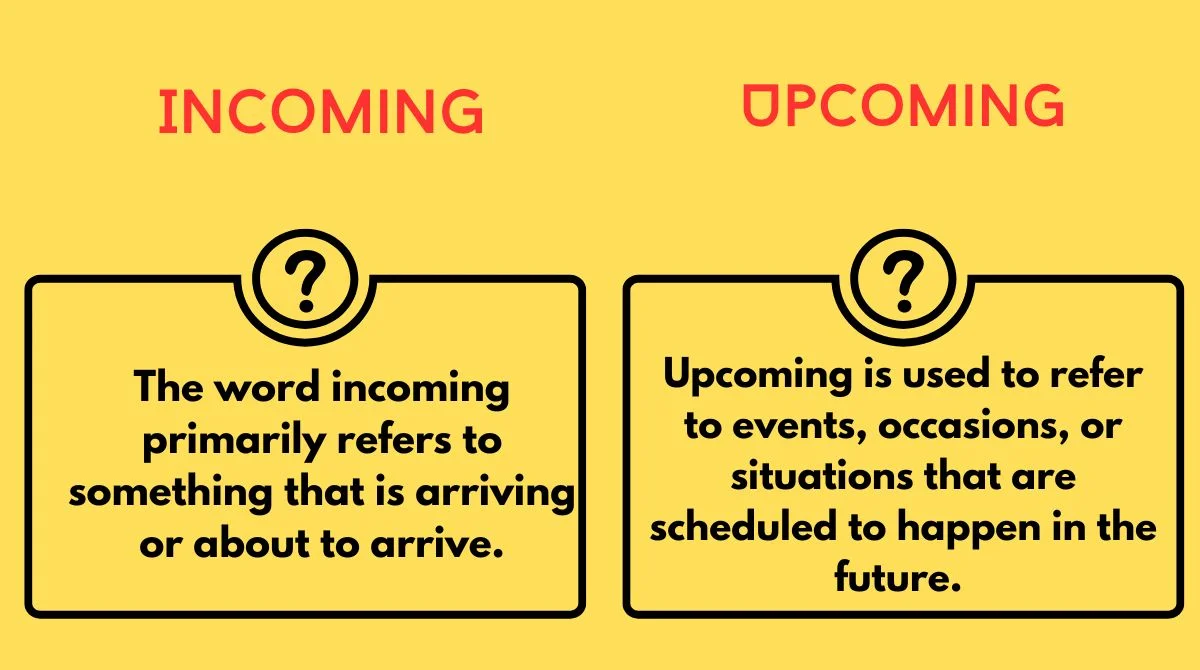
    The word incoming primarily refers to something that is arriving or about to arrive. It often describes messages, calls, shipments, or people moving toward a specific destination.

    Common Uses of “Incoming”:

    • Messages and Communication: “I have an incoming call from my manager.”
    • Physical Movement: “The incoming train will arrive in five minutes.”
    • Military or Defense Situations: “The soldiers took cover due to incoming fire.”

    Key Takeaway:

    Incoming emphasizes something that is actively in the process of arriving, whether it’s a phone call, email, or physical object.


    Incoming vs Upcoming

    Diving into “Upcoming”: Events on The Horizon

    Upcoming is used to refer to events, occasions, or situations that are scheduled to happen in the future. It suggests that something is planned but has not yet occurred.

    Common Uses of “Upcoming”:

    • Events and Appointments: “I have an upcoming meeting with my supervisor.”
    • Entertainment and Releases: “The upcoming movie has generated a lot of excitement.”
    • Deadlines and Due Dates: “Don’t forget about the upcoming exam.”

    Key Takeaway:

    Upcoming refers to future occurrences that are scheduled, anticipated, or expected.


    Typical Uses of “Upcoming” in Daily Language

    Because upcoming is closely tied to time, you’ll frequently see it in event announcements, schedules, and conversations about plans. Here are some example sentences:

    • “We should start preparing for the upcoming holiday season.”
    • “The upcoming election will determine the country’s future direction.”
    • “The upcoming weather forecast suggests rain, so bring an umbrella.”

    This word is common in both formal and informal contexts, making it a staple in event planning and personal schedules.


    Anticipating “Upcoming” Moments: A Closer Look

    Understanding the nuances of upcoming can help in planning and organization. When using the word:

    • Be specific about what is upcoming: e.g., “My upcoming flight is at 10 AM.”
    • Use it when referring to the near future: e.g., “In the upcoming weeks, we will see major changes.”
    • Avoid using it for distant future events: e.g., “The upcoming Olympics in 2050” sounds unnatural.

    By keeping these guidelines in mind, you’ll always use upcoming correctly.


    “Oncoming”: When Things Move Towards You

    Unlike incoming and upcoming, oncoming specifically refers to movement in a direction toward the speaker or a particular point. It is frequently used to describe traffic, dangers, or physical motion.

    Common Uses of “Oncoming”:

    • Traffic and Vehicles: “Be careful of the oncoming cars when crossing the street.”
    • Impending Dangers or Threats: “She braced herself for the oncoming storm.”
    • Physical Confrontations: “The knight prepared to fight the oncoming enemy.”

    Key Takeaway:

    Oncoming refers to things moving toward a specific position, often in an observable, physical sense.


    Comparing “Incoming”, “Upcoming”, and “Oncoming”

    WordMeaningExample Usage
    IncomingArriving soon“I received an incoming call.”
    UpcomingScheduled to happen in the future“We have an upcoming event next week.”
    OncomingMoving towards a specific point“The oncoming traffic was heavy.”

    Each word has a specific use case, making it essential to choose the right one based on the context.


    The Significance of Context in Using “Incoming”, “Upcoming”, “Oncoming”

    To reinforce understanding, consider these contextual differences:

    • If something is arriving soon, use incoming. Example: “I dodged the incoming ball.”
    • If an event is set for the future, use upcoming. Example: “She is excited about the upcoming concert.”
    • If something is physically moving toward a place or person, use oncoming. Example: “The oncoming truck swerved to avoid a collision.”

    Mastering these distinctions ensures clarity in speech and writing.


    Examples from Everyday Conversations

    Here are real-life examples demonstrating correct usage:

    1. Incoming:
      • “Check your inbox for the incoming email.”
      • “There’s an incoming storm; let’s stay inside.”
    2. Upcoming:
      • “I’m preparing for my upcoming vacation.”
      • “Are you free for the upcoming webinar?”
    3. Oncoming:
      • “He stepped out of the way of the oncoming bus.”
      • “The oncoming waves crashed against the shore.”

    These examples illustrate how context dictates the appropriate word choice.


    Mistakes to Avoid: Common Misuses of the Terms

    Mistakes often arise when these words are used interchangeably. Below are some common errors and their corrections:

    • Incorrect: “I have an oncoming exam next week.”
      • Correct: “I have an upcoming exam next week.”
    • Incorrect: “Beware of upcoming traffic.”
      • Correct: “Beware of oncoming traffic.”
    • Incorrect: “She is waiting for an oncoming message.”
      • Correct: “She is waiting for an incoming message.”

    By paying attention to these subtle differences, you can avoid errors and improve communication.


    Incoming vs Upcoming vs Oncoming

    Enhancing Your Vocabulary: Tips for Remembering the Differences

    Here are some memory aids to help:

    • Incoming = Arriving (Think of an incoming call on your phone)
    • Upcoming = Future event (Think of an upcoming birthday)
    • Oncoming = Moving towards (Think of oncoming traffic)

    Reinforcing these associations will make it easier to recall the right term.


    FAQs

    1. What is the difference between “incoming” and “upcoming”?

    “Incoming” refers to something that is actively arriving (e.g., “Incoming call”). “Upcoming” refers to an event that is scheduled to happen in the near future (e.g., “Upcoming meeting”).

    2. When should I use “oncoming” instead of “incoming”?

    Use oncoming for things physically moving toward a person or place (e.g., “Oncoming traffic”). Incoming is used for things that are arriving soon (e.g., “Incoming email”).

    3. Can “upcoming” be used for things that are already happening?

    No, upcoming is only used for future events. If something is happening now, use present-tense words like ongoing instead.

    4. Why is “oncoming event” incorrect?

    “Oncoming” refers to movement toward a location, not time-based events. Instead, use “upcoming event” for future occurrences.

    5. Is “incoming message” the same as “oncoming message”?

    No, incoming message is correct because incoming refers to something arriving, like emails or texts. Oncoming is not used for messages.

    6. How can I easily remember the difference between these words?

    • Incoming = Arriving soon (incoming call, incoming email)
    • Upcoming = Scheduled for the future (upcoming holiday, upcoming exam)
    • Oncoming = Moving toward you (oncoming traffic, oncoming storm)

    Conclusion

    While incoming, upcoming, and oncoming share similarities, their meanings and applications are distinct. Using them correctly will enhance clarity in both written and spoken English.

    The key to mastering these words lies in understanding their nuances and applying them in the right contexts. Keep practicing, and soon, choosing between them will become second nature!


    Did you find this guide helpful? Let us know in the comments below or share it with someone who might benefit from it!

  • Quaff or Coif? Homophones Explained! 🗣️📚

    Quaff or Coif? Homophones Explained! 🗣️📚

    Language can be tricky, especially when it comes to homophones—words that sound alike but have different meanings and spellings.

    Quaff and coif are perfect examples of this. Though they may sound similar, they have distinct definitions and uses.

    This guide will help you understand their meanings, origins, and correct usage.

    Confused between quaff and coif? These homophones sound alike but have completely different meanings! Learn the definitions, origins, and correct usage of each to avoid mix-ups in writing and speech.


    Understanding Homophones: What Are They?

    Quaff or Coif

    Definition of Homophones

    Homophones are words that have the same pronunciation but differ in meaning, spelling, or both. This linguistic phenomenon often causes confusion in writing and speech.

    Why Homophones Can Be Confusing

    Many homophones, including quaff and coif, are challenging because they:

    • Sound identical or very similar.
    • Have meanings that don’t relate to one another.
    • Often get autocorrected incorrectly in digital communication.

    Examples of Common Homophones

    To better understand homophones, here are a few common examples:

    HomophonesMeaning 1Meaning 2
    Their / There / They’rePossessive formPlace
    Flour / FlowerBaking ingredientA plant bloom
    Two / To / TooNumber 2Preposition
    Quaff / CoifTo drink deeplyA hairstyle or head covering

    What Does Quaff Mean?

    Quaff as a Verb

    The most common use of quaff is as a verb. It means to drink deeply, often with enjoyment or enthusiasm.

    Example: “After a long hike, he quaffed a refreshing glass of water.”

    Quaff as a Noun

    While less commonly used, quaff can also be a noun, referring to a hearty drink or the act of drinking deeply.

    Example: “He took a final quaff before setting the mug down.”

    Origin of the Word Quaff

    The word quaff dates back to the 16th century, though its precise origins are uncertain. Some linguists suggest it may be imitative in nature, mimicking the sound of gulping down a drink.


    What Does Coif Mean?

    Coif as a Noun

    Coif can be a noun referring to:

    • A hairstyle, particularly one that is neatly arranged.
      • Example: “Her coif was styled elegantly for the gala.”
    • A close-fitting cap or head covering, historically worn under helmets or by nuns.
      • Example: “The knight wore a coif beneath his armor.”

    Coif as a Verb

    As a verb, coif means to style or arrange hair carefully.

    Example: “She spent an hour coifing her hair before the event.”

    Historical Context of Coif

    The word coif comes from Old French coife, meaning “a cap or head covering.” In medieval times, coifs were worn for both practical and fashion purposes. Over time, the meaning evolved to include hairstyling.


    Quaff vs Coif: Detailed Comparison

    Though these words sound similar, their meanings and usage are completely different. Let’s compare them side by side:

    FeatureQuaffCoif
    Part of SpeechVerb, NounNoun, Verb
    MeaningTo drink deeplyA hairstyle or head covering / To style hair
    Example Sentence“He quaffed a pint of ale.”“Her coif was impeccably styled.”
    Historical Origin16th century, uncertain originOld French coife

    Example Sentences Using Quaff

    Quaff in Everyday Use

    • “She quaffed a large glass of lemonade after her workout.”
    • “The festival-goers quaffed their drinks with joy.”

    Quaff in Historical Texts

    • “The soldiers quaffed wine to celebrate their victory.”
    • “He quaffed mead as was custom in olden days.”

    Example Sentences Using Coif

    Coif in Modern Language

    • “The bride’s coif was styled by a professional.”
    • “The actor’s coif was admired on the red carpet.”

    Coif in Historical Context

    • “In medieval Europe, men wore a coif under their helmets.”
    • “The nun’s coif signified her devotion.”

    Common Mistakes: Interchanging Quaff and Coif

    Many people mistakenly use quaff when they mean coif, or vice versa, simply due to their similar sounds. Here’s how to avoid this mistake:

    • If it relates to drinking, use quaff.
    • If it involves hair or head coverings, use coif.

    Incorrect Example: “He coifed his beer in one gulp.” (Should be “quaffed”) Correct Example: “He quaffed his beer in one gulp.”

    Incorrect Example: “She quaffed her hair for the party.” (Should be “coifed”) Correct Example: “She coifed her hair for the party.”


    FAQs

    1. What does “quaff” mean?

    Quaff means to drink deeply and enthusiastically, often referring to beverages like water, ale, or wine. Example: “He quaffed a pint of beer after work.”

    2. What does “coif” mean?

    Coif refers to a hairstyle or a head covering. As a verb, it means to style hair neatly. Example: “Her coif was styled beautifully for the party.”

    3. Are “quaff” and “coif” pronounced the same way?

    Yes, quaff and coif are pronounced similarly in many dialects, making them homophones, which can cause confusion in writing.

    4. How can I remember the difference between “quaff” and “coif”?

    • Quaff → Think of drinking quickly (like gulping a drink).
    • Coif → Think of a coiffure (a fancy hairstyle).

    5. Can “coif” be used as a verb?

    Yes! Coif as a verb means to carefully style or arrange hair. Example: “She coifed her hair for the special event.”

    6. What are some common mistakes with “quaff” and “coif”?

    People often mix them up in writing. Example:
    🚫 Incorrect: “He coifed his beer in one gulp.”
    ✅ Correct: “He quaffed his beer in one gulp.”


    Conclusion

    Though quaff and coif sound alike, their meanings couldn’t be more different. One involves drinking deeply, while the other relates to hairstyling or head coverings.

    By understanding their definitions, origins, and usage, you can confidently use these words correctly in speech and writing.

    Next time you raise a glass, you’ll know you’re quaffing. And when you get a fancy new haircut, you’ll recognize it as a well-styled coif!

  • Did You Have or Did You Had? Grammar Explained! 📝✅

    Did You Have or Did You Had? Grammar Explained! 📝✅

    English grammar can sometimes feel like a puzzle, especially when it comes to forming past tense questions. One common source of confusion is whether to say “Did you have” or “Did you had.”

    If you’ve ever found yourself second-guessing which is correct, this guide will provide a clear and comprehensive explanation.

    Should you say Did you have or Did you had? Understanding past tense questions can be tricky, but there’s a simple rule to follow! Learn why “Did you had” is incorrect and how to use “Did you have” properly.


    Understanding the Basics of Auxiliary Verbs and Past Tense

    Before we dive into the specifics of “Did you have” vs. “Did you had,” it’s essential to understand how auxiliary verbs work in the past tense. In English, auxiliary verbs (also called helping verbs) are used to form different tenses, questions, and negatives.

    The auxiliary verb do (which changes to did in the past tense) plays a crucial role in forming questions. When did is used, it signals that the sentence is in the past tense, meaning the main verb should remain in its base form. This rule helps maintain consistency in tense structure.

    Auxiliary VerbBase Form of the Main VerbExample Sentence
    Do (present)HaveDo you have a pen?
    Did (past)HaveDid you have fun yesterday?

    The Role of “Did” in Forming Questions

    Did You Have or Did You Had

    In past tense questions, “Did” serves as the past tense marker. Since it already indicates that the action happened in the past, the main verb that follows must stay in its base form (infinitive without “to”).

    Example Sentences:

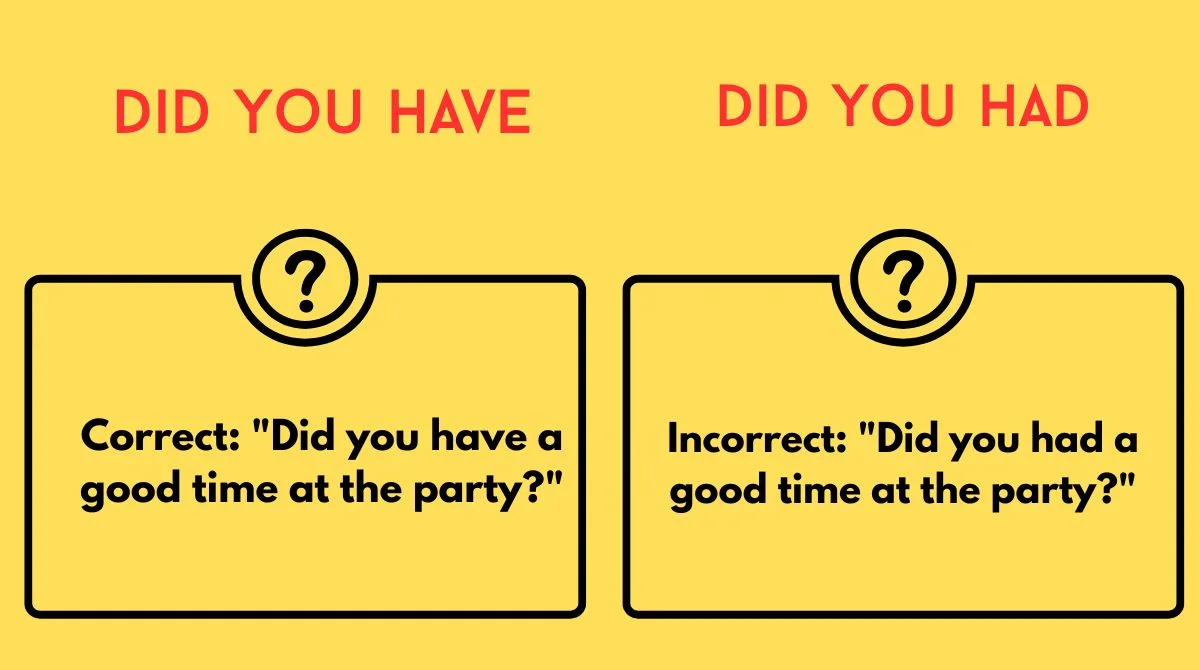
    • Correct: “Did you have a good time at the party?”
    • Incorrect: “Did you had a good time at the party?”

    The reason “Did you had” is incorrect is that had is the past tense form of have. Since “Did” already conveys the past tense, adding “had” would create a tense redundancy.


    Why “Had” Doesn’t Follow “Did”

    To put it simply, a sentence should not contain two past tense markers together in this structure. The word did already indicates that the question is in the past tense, so using had (which is also past tense) would be grammatically incorrect.

    More Examples:

    IncorrectCorrect
    Did you had breakfast?Did you have breakfast?
    Did she had a pet as a child?Did she have a pet as a child?

    The correct form keeps “Did” as the past tense marker and retains “have” in its base form.


    Common Mistakes with “Did You Have” and How to Avoid Them

    Many English learners make mistakes when forming past tense questions. Here are some common errors and how to correct them:

    1. Using “Did” and “Had” Together

    Wrong: “Did you had dinner?” Right: “Did you have dinner?”

    2. Forgetting to Use “Did” in a Question

    Wrong: “You had a nice trip?” Right: “Did you have a nice trip?”

    3. Using “Had” Instead of “Have” in Negative Sentences

    Wrong: “I didn’t had time.” Right: “I didn’t have time.”

    To avoid these mistakes, remember that whenever you use did, the main verb must stay in its base form.


    “Did You Have” Versus “Have You Had”: Decoding the Difference

    Another area of confusion is the difference between “Did you have” and “Have you had”. While they may look similar, they serve different grammatical functions.

    Key Differences:

    PhraseTenseUsage Example
    Did you haveSimple past“Did you have lunch?” (Refers to a specific past event)
    Have you hadPresent perfect“Have you had lunch?” (Asks about experience or recent completion)

    Use “Did you have” when asking about a specific moment in the past. Use “Have you had” when asking whether something has happened at any point up to now.


    Correct Use in Everyday Situations

    Asking About Past Events

    When inquiring about past actions, always use “Did you have”:

    • Did you have fun at the concert last night?
    • Did you have a good vacation?

    Inquiring About Past Possessions or Experiences

    When asking about past possessions or experiences, “Did you have” is also correct:

    • Did you have a dog when you were younger?
    • Did you have a bicycle as a child?

    Strengthen Your Grammar: Practice Examples and Tips

    Practice Sentences:

    Fill in the blanks with “Did you have” or “Have you had”:

    1. ___ a chance to visit Paris before?
    2. ___ time to complete your homework last night?
    3. ___ any experience working in a restaurant?
    4. ___ breakfast this morning?

    Quick Tips to Remember:

    ✔ Always use “Did you have” for past events.
    ✔ Never say “Did you had.”
    ✔ Use “Have you had” for asking about past experiences or recent actions.

    Did You Have or Did You Had

    FAQs

    1. Why is “Did you had” incorrect?

    “Did” is already in the past tense, so the main verb must stay in its base form. Saying “Did you had” adds an unnecessary past tense marker. The correct form is “Did you have?”

    2. When should I use “Did you have”?

    Use “Did you have” when asking about a specific past event. Example: “Did you have a good time yesterday?”

    3. What’s the difference between “Did you have” and “Have you had”?

    “Did you have” refers to a specific event in the past, while “Have you had” is used for experiences or something that happened recently.

    4. How do I form negative sentences with “Did you have”?

    For negatives, use didn’t and keep have in its base form: “I didn’t have time,” not “I didn’t had time.”

    5. Can “Did you have” be used in formal writing?

    Yes! “Did you have” is grammatically correct and can be used in both formal and informal English.

    6. How can I practice using “Did you have” correctly?

    Try writing sentences using “Did you have” for past events. Example: “Did you have breakfast this morning?” Avoid using “Did you had.”


    Conclusion

    The difference between “Did you have” and “Did you had” is simple once you understand the rules of auxiliary verbs and past tense questions. Remember:

    • “Did” already marks the past, so the main verb should remain in its base form (have).
    • “Did you had” is always incorrect.
    • “Did you have” is used for specific past events, while “Have you had” refers to past experiences.

    By practicing these structures, you’ll improve your fluency and confidence in English. Keep learning and applying these rules, and soon, using correct grammar will become second nature!

  • Feel or Felt? Learn the Right Usage! ✅✨

    Feel or Felt? Learn the Right Usage! ✅✨

    Language can be tricky, especially when two words seem closely related yet serve different purposes.

    Feel and felt are two such words that often cause confusion. Though they share the same root, they operate in different grammatical contexts.

    Understanding when to use feel versus felt is key to clear and effective communication. Let’s break it down in detail.

    Should you say feel or felt? The difference lies in verb tense—feel is present, while felt is past. Learn when to use each correctly with examples and grammar tips!


    Feel or Felt

    Unveiling the Verbs: Understanding ‘Feel’ and ‘Felt’

    At their core, feel and felt both relate to sensory perception, emotions, and states of being. However, they differ in terms of verb tense and application.

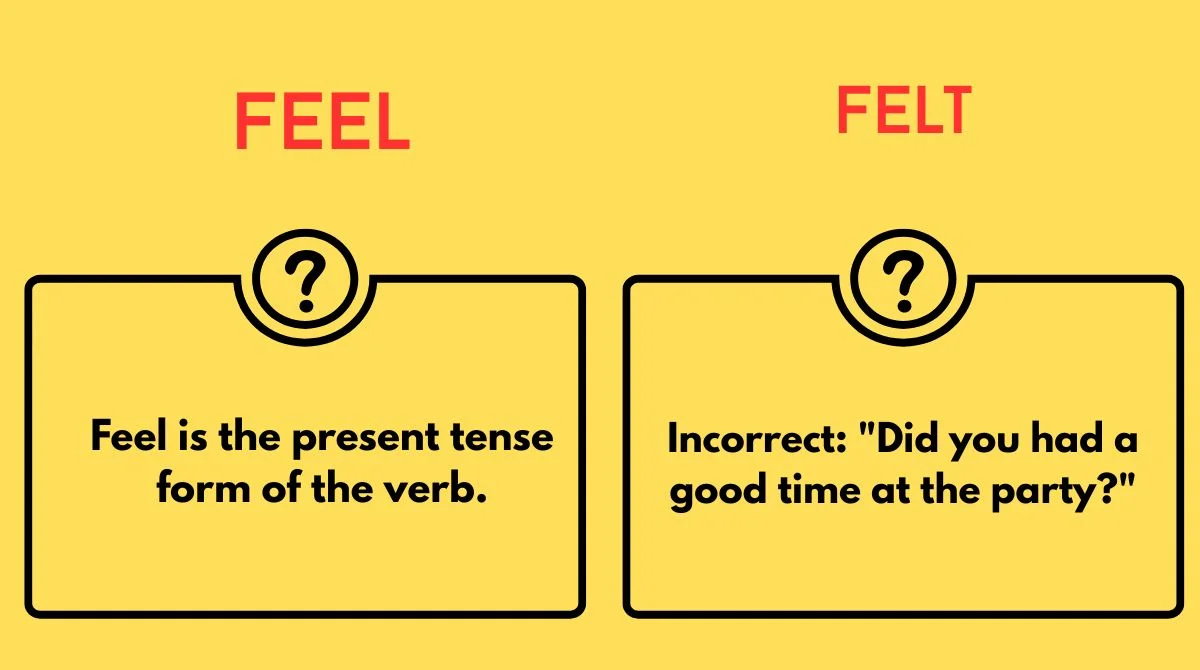
    • Feel is the present tense form of the verb.
    • Felt is the past tense and past participle form of the verb.

    By keeping this fundamental difference in mind, you can ensure you’re using the correct word for the appropriate time frame.


    Usage in Context: When to Use ‘Feel’ for Present Experiences

    We use feel when describing:

    • Current emotions or sensations
    • General truths
    • Ongoing states

    Examples of ‘Feel’ in Sentences

    ContextSentence Example
    Physical sensation“I feel cold in this air-conditioned room.”
    Emotional state“I feel happy when I listen to music.”
    Opinion or impression“I feel that this book is too long.”
    State of being“I feel tired after working all day.”

    By using feel, you indicate that the experience or emotion is happening right now or applies generally.


    Conveying Current Sensations and Emotions

    The verb feel is commonly used to describe:

    • Sensory perceptions (I feel the soft fabric.)
    • Emotional states (I feel excited about my vacation.)
    • Physical conditions (I feel dizzy after spinning in circles.)

    Because feel connects directly to personal experience, it plays a crucial role in expressing how we relate to the world around us.


    Exploring Idiomatic Expressions with ‘Feel’

    The word feel appears in numerous idiomatic expressions that enhance everyday speech. Here are some popular ones:

    • “Feel under the weather” – To feel sick or unwell.
    • “Feel out of place” – To feel uncomfortable in a situation.
    • “Feel the pinch” – To experience financial difficulty.
    • “Feel free” – To give permission or encouragement (Feel free to ask questions).

    These expressions show how feel extends beyond literal meanings into figurative speech.


    The Past Tense Puzzle: Knowing When ‘Felt’ Fits

    Now that we understand feel, let’s dive into felt.

    Felt is the past tense form of feel and is used when describing something that happened before the present moment.

    Examples of ‘Felt’ in Sentences

    ContextSentence Example
    Past physical sensation“I felt a sharp pain in my leg yesterday.”
    Past emotional state“She felt nervous before the exam.”
    Past opinion or impression“I felt that he was being rude at dinner.”
    Past experience“We felt relieved when we heard the good news.”

    Because felt refers to past events, it establishes a clear time frame that is different from feel.


    Grammar Deep Dive: Syntax and Sentiment in ‘Feel’ vs ‘Felt’

    Understanding the grammatical placement of these verbs helps prevent mistakes.

    Sentence Structures with Feel and Felt

    1. Subject + feel/felt + adjective
      • I feel happy today. (present)
      • She felt exhausted after the marathon. (past)
    2. Subject + feel/felt + like + noun/phrase
      • I feel like a winner! (present)
      • He felt like a failure after losing the match. (past)
    3. Subject + feel/felt + that + clause
      • I feel that this is the right decision. (present)
      • She felt that he was hiding something. (past)

    By following these structures, you ensure correct verb usage in different sentence formats.


    The Importance of Tense Consistency

    One common mistake is mixing tenses within the same sentence when using feel and felt. For instance:

    ❌ I feel exhausted yesterday. (Incorrect) ✅ I felt exhausted yesterday. (Correct)

    Keeping your verbs in the correct tense ensures clarity and grammatical accuracy.


    Mood and Modality: How ‘Feel’ and ‘Felt’ Express Nuances

    Both feel and felt interact with modal verbs like can, should, and might, adding layers of meaning.

    Modal VerbExample Sentence
    Can“I can feel the wind on my face.”
    Should“You should feel proud of yourself.”
    Might“He might have felt embarrassed.”

    These variations allow for different shades of meaning, from certainty to possibility.


    Nailing the Pronunciation and Common Confusions

    The pronunciation of feel and felt is straightforward:

    • Feel (/fiːl/): Rhymes with “reel.”
    • Felt (/fɛlt/): Rhymes with “belt.”

    However, some English learners confuse felt with “felt fabric,” which refers to a kind of textile material. Always consider context to determine meaning.


    Feel or Felt

    ‘Feel’ and ‘Felt’ Across Variants: Regional Differences in Use

    While feel and felt are standard in both American and British English, some minor variations exist:

    • In American English, people often say “I feel like…” to introduce opinions.
    • In British English, “I feel as though…” is slightly more common in formal contexts.

    Despite these nuances, the fundamental grammar remains the same worldwide.


    FAQs

    1. What is the main difference between “feel” and “felt”?

    “Feel” is the present tense form, while “felt” is the past tense. Example: “I feel happy today” (present), “I felt happy yesterday” (past).

    2. Can “feel” be used in the past tense?

    No, feel is only for the present. To talk about the past, use felt. Example: “I felt tired after the trip.”

    3. What are common sentence structures using “feel” and “felt”?

    You can use feel/felt in these ways:

    • I feel tired. (Present state)
    • She felt tired after the race. (Past state)
    • I feel like going out tonight. (Opinion)

    4. Is “felt” always used in the past?

    Yes, felt is strictly for past tense. However, it can be used with perfect tenses, e.g., “I have felt this way before.”

    5. What are some idioms using “feel”?

    Common expressions include:

    • Feel under the weather (to be sick)
    • Feel out of place (to be uncomfortable)
    • Feel free (to give permission)

    6. Can “feel” be used with modal verbs like “can” or “should”?

    Yes! Example:

    • I can feel the wind on my face.
    • You should feel proud of your achievements.

    Conclusion

    Mastering feel and felt is essential for fluent and accurate English communication. Remember:

    • Use feel for present sensations, emotions, and opinions.
    • Use felt for past experiences, emotions, and states.
    • Keep verb tense consistent for clarity.
    • Watch for idiomatic expressions that use feel naturally.

    By applying these principles, you’ll never second-guess your choice between feel and felt again!

    Want more grammar tips? Stay tuned for our next in-depth language breakdown!