Blog

  • Oftentimes vs Often Times: What’s Correct? 🤓📝

    Oftentimes vs Often Times: What’s Correct? 🤓📝

    Have you ever written “often times” in an email or essay and wondered if it’s actually correct? Or maybe you’ve spotted “oftentimes” in an older novel and thought, wait… is that even a real word? You’re not alone.

    “Often times” and “oftentimes” have puzzled writers and readers for generations, and the confusion doesn’t seem to be going away anytime soon.

    So, what’s the difference between often times and oftentimes? Which one should you use—and when?

    Let’s dig into the origin, usage, and modern preferences for both, so you can write with confidence and avoid this common grammatical misstep.

    Is it “often times” or “oftentimes”? While “oftentimes” is a correct adverb meaning “frequently,” “often times” is not standard and is generally considered incorrect. Discover why—and when to use which.


    Introduction to Oftentimes and Often Times

    Let’s set the record straight early on:

    • Oftentimes is a legitimate, recognized adverb.
    • Often times (two separate words) is not standard and is generally considered a mistake or a misinterpretation of “oftentimes.”

    You might see “often times” pop up in informal writing, but that doesn’t make it correct. In fact, grammar purists and style guides alike agree—“oftentimes” is the only form you should be using, if you’re not just sticking with “often.”

    Oftentimes vs Often Times

    The Historical Origins of Often and Oftentimes

    To understand the confusion, we need to go back—way back.

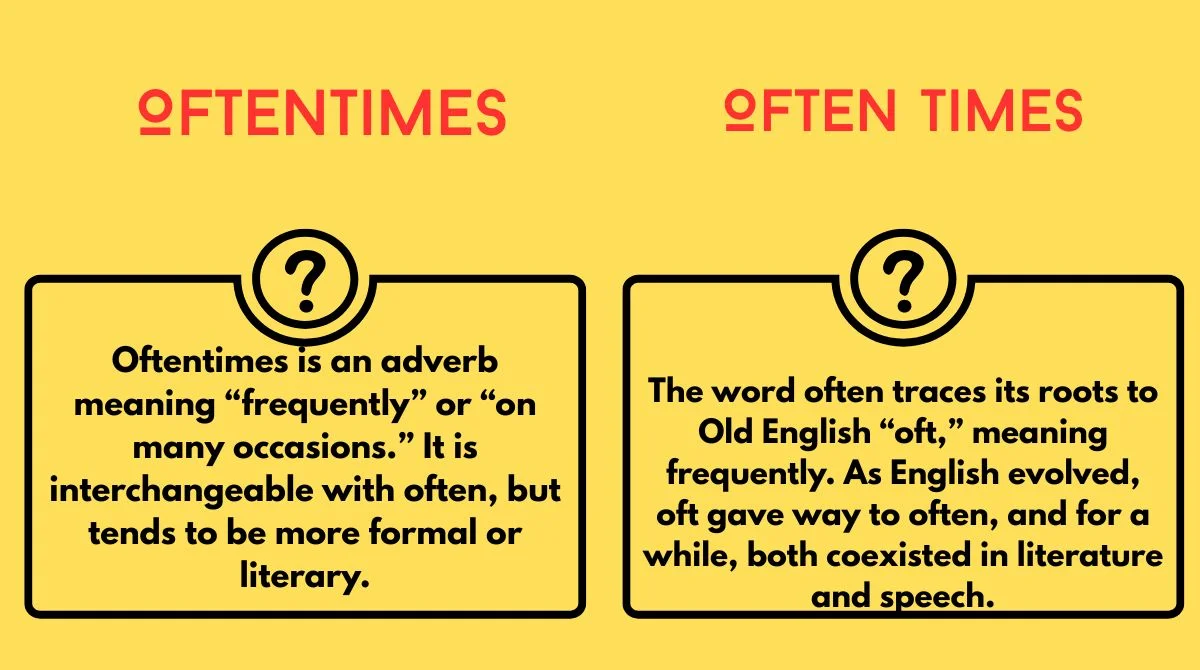
    The word often traces its roots to Old English “oft,” meaning frequently. As English evolved, oft gave way to often, and for a while, both coexisted in literature and speech.

    Then came oftentimes—a compound that essentially means frequently, just like often does. It’s formed by combining:

    • Oft (frequent)
    • en (an adverbial suffix)
    • times (occurrences)

    It’s a little redundant, sure. But in earlier centuries, redundancy was emphasis.


    Dissecting Middle English: Unearthing the Roots

    In Middle English (1100–1500), you’ll find plenty of examples of oftentimes used in poetry and prose. Authors of the time leaned heavily on repetition and rhythm. Adding -times to an adverb wasn’t seen as redundant—it was just good style.

    Consider Chaucer, who frequently used constructions like “oftentimes” and “seldomtimes.” These added musicality to the language and made meaning crystal clear.

    “Oftentimes, the knight would ride alone…”
    — The Canterbury Tales (paraphrased)

    By contrast, “often times” as two words rarely—if ever—appeared in writing until modern typographical or autocorrect errors started creeping in.


    The Evolution of Adverbial Use in American English

    American English, compared to British English, tends to favor shorter, more efficient expressions. This is likely why oftentimes started falling out of favor in the U.S. by the mid-20th century, with writers preferring the simpler often.

    That said, oftentimes hasn’t disappeared completely.

    Frequency of Usage in American English

    TermFrequency (Google Books Ngram 2000–2020)
    OftenExtremely high
    OftentimesModerate
    Often timesRare and nonstandard

    Writers like Mark Twain and Ralph Waldo Emerson used oftentimes unapologetically, proving it has held its place—even if it’s no longer fashionable in academic circles.


    Oftentimes: Understanding Its Use and Context

    Oftentimes is an adverb meaning “frequently” or “on many occasions.” It is interchangeable with often, but tends to be more formal or literary.

    Examples:

    • “Oftentimes, people ignore advice until it’s too late.”
    • “She oftentimes reflects on her childhood memories.”

    You’ll most likely see it:

    • In literature
    • In academic essays
    • In formal speeches

    It adds a poetic or reflective tone, which can be effective when used sparingly.


    The Grammatical Nuances of Often Times

    Now let’s talk about “often times”—with the space in between.

    This version is not grammatically correct as an adverbial phrase. It’s an incorrect attempt to separate a compound word that isn’t meant to be broken apart.

    Why It Happens:

    • Autocorrect errors
    • Misunderstanding the structure of “oftentimes”
    • Overgeneralizing patterns like “sometimes,” “many times,” or “at times”

    How It Can Be Misused:

    • ❌ “Often times I go running in the morning.”
    • ✅ “Oftentimes I go running in the morning.”
    • ✅ “Many times I go running in the morning.”
    • ✅ “Often, I go running in the morning.”

    While “often times” may occasionally appear in blogs or casual writing, most style guides (APA, MLA, Chicago) advise avoiding it completely.


    When Two Words Don’t Make a Right: The Misconception

    Let’s be clear: Just because “many times” and “some times” are valid doesn’t mean “often times” is.

    Here’s a quick comparison:

    PhraseStandard?Meaning
    Oftentimes✅ YesFrequently
    Often times❌ NoNonstandard (avoid it)
    Many times✅ YesNumerous occasions
    At times✅ YesOccasionally

    Lesson: Not all combinations of adverb + “times” are grammatically valid.


    The Modern Preference: Is Brevity the Soul of Wit?

    William Shakespeare once wrote, “Brevity is the soul of wit.” That sentiment rings true in modern English.

    Most editors, writing coaches, and even grammar apps prefer:

    • “Often” for everyday writing
    • “Oftentimes” for formal, poetic, or rhetorical use

    When to Choose “Oftentimes”:

    • When you want to sound reflective or literary
    • When writing a formal speech or narrative
    • When variety in tone is important

    For most modern purposes, though, often is all you need.


    Cultural Usage: Oftentimes in American versus British English

    Interestingly, oftentimes is more common in American English than British English. British writers and speakers often avoid it entirely, opting instead for:

    • Often
    • Frequently
    • Usually

    Comparison Table

    RegionPreferred Usage
    United StatesOften, Oftentimes (both valid)
    United KingdomOften, rarely Oftentimes

    Even in the U.S., some consider oftentimes a bit archaic—but that doesn’t make it incorrect.


    Adopting Oftentimes: Linguistic Quirks

    Language isn’t just about rules—it’s about rhythm, tone, and style. Oftentimes may sound old-fashioned, but it still has a place in modern writing when used thoughtfully.

    Use it:

    • To create emphasis
    • To establish a reflective tone
    • As a stylistic variation in formal essays or narratives

    But don’t overuse it. Overusing archaisms can make your writing sound forced or unnatural.


    Synonyms and Antonyms: Expanding Your Vocabulary

    To avoid repetition, try swapping often or oftentimes with these alternatives.

    Synonyms:

    • Frequently
    • Regularly
    • Repeatedly
    • Routinely
    • From time to time (less frequent)
    • On occasion

    Antonyms:

    • Rarely
    • Seldom
    • Hardly ever
    • Infrequently

    Oftentimes vs Often Times

    ❓ 6 FAQs

    Is “oftentimes” grammatically correct?

    Yes, “oftentimes” is a legitimate adverb meaning “frequently” or “on many occasions.” It’s slightly formal and more common in literature or academic writing.

    Is “often times” correct to use?

    No, “often times” is a nonstandard form and should be avoided in formal writing. It likely results from misunderstanding the correct term “oftentimes.”

    Can I use “often” instead of “oftentimes”?

    Absolutely. “Often” is simpler, more modern, and widely accepted in both casual and formal writing.

    Why does “often times” appear online if it’s wrong?

    It often shows up due to autocorrect errors or confusion with valid phrases like “many times” or “at times,” but it’s still not grammatically correct.

    Is “oftentimes” outdated or too formal?

    Not necessarily. It’s more literary or rhetorical, but still valid. Use it to add emphasis or a reflective tone—but don’t overuse it.

    How can I remember which form is correct?

    Just remember: “Oftentimes” is one word and correct. “Often times” (two words) isn’t standard. When in doubt, stick with “often.”


    Conclusion: Clarifying Frequency in Your Writing

    So, what’s the takeaway?

    • “Oftentimes” is correct, though somewhat formal or literary.
    • “Often times” is not standard and should be avoided in professional or academic writing.
    • When in doubt, just use often. It’s clean, simple, and universally accepted.

    Mastering this subtle distinction between oftentimes and often times will not only improve your grammar—it’ll elevate the clarity and credibility of your writing.

    Keep it sharp, keep it simple, and let context guide your choice.
  • “In Process” vs “In Progress”: Clear Up the Confusion ⚙️🧠

    “In Process” vs “In Progress”: Clear Up the Confusion ⚙️🧠

    Ever stopped mid-sentence, unsure whether to say “in process” or “in progress”? You’re not alone.

    These two phrases seem interchangeable at first glance, but they carry subtle distinctions that can shift your sentence’s meaning entirely—especially in business, manufacturing, or day-to-day communication.

    In this guide, we’ll break down the true differences, where each phrase fits, and how to use them correctly.

    “In process” and “in progress” both describe something ongoing—but they’re not the same. “In process” refers to structured procedures or steps, while “in progress” describes general development. Learn when to use each for clarity and professionalism.


    The Similarity in Meaning: Breaking Down ‘In Process’ and ‘In Progress’

    Let’s start with the obvious: both in process and in progress refer to something that’s not finished yet.

    But here’s the twist—they don’t always mean the same thing.

    At a glance:

    PhraseMeaningTypical Use Cases
    In ProcessSomething is actively undergoing a defined series of stepsManufacturing, business workflows, transactions
    In ProgressSomething is underway, often in a general or ongoing senseProjects, tasks, events, creative work

    Examples:

    • Correct: “Your order is in process and will ship soon.”
    • Correct: “The renovation is in progress and should finish by June.”
    • Incorrect: “The book writing is in process.” → In progress fits better here.

    While both phrases describe ongoing action, the nuance lies in how structured that action is.


    Historical Usage: Tracing the Roots of ‘In Process’ and ‘In Progress’

    The words may sound modern, but their roots stretch back centuries.

    ‘Process’

    • Originates from Latin processus, meaning “a going forward” or “advancement.”
    • First used in English around the 14th century, often in legal or scientific contexts.
    • Implies a structured series of steps with a defined outcome.

    ‘Progress’

    • From Latin progressus, meaning “an advance.”
    • By the 15th century, progress evolved to describe movement or development in a broader, more general sense.

    Fun Fact:

    In medieval English courts, “in process” often referred to legal proceedings, while “in progress” was more common in descriptions of royal tours and public events.


    The Common Choice: Why ‘In Progress’ Prevails in Modern Usage

    Take a look at most modern content—from tech startups to academic reports—and you’ll spot a trend:

    “In progress” dominates.

    Why?

    • It sounds more natural in casual and professional settings.
    • It carries fewer technical connotations, making it more accessible to general audiences.
    • It aligns with project management language, like “project in progress” or “work in progress.”

    Google Trends Snapshot:

    Over the last decade, “in progress” has consistently outperformed “in process” in global search interest.


    Context Matters: When to Prefer ‘In Progress’ Over ‘In Process’

    Using the wrong phrase won’t always confuse your reader, but it could make your writing sound awkward—or worse, incorrect in a business setting.

    Use “In Progress” when:

    • Talking about general development or ongoing tasks.
    • Describing work with no fixed structure or path.
    • Referring to something creative, academic, or project-based.

    Examples:

    • “The website redesign is in progress.”
    • “Negotiations are in progress between the two firms.”

    Use “In Process” when:

    • Referring to mechanical, transactional, or procedural steps.
    • Talking about systematic workflows—especially in business or legal contexts.

    Examples:

    • “The refund is in process.”
    • “This claim is in process and awaiting final approval.”

    The Role of ‘In Progress’ in Contemporary Language

    “In progress” has become the default choice in most conversations and writing. It feels natural, flexible, and clear.

    In Tech and Agile Teams:

    • “Sprint in progress”
    • “Deployment in progress”

    In Academia:

    • “Research in progress”
    • “Thesis in progress”

    In Art & Design:

    • “Work in progress” (WIP) is a standard term.

    This phrase has also become a part of motivational language:

    “Progress, not perfection.”

    It’s familiar, friendly, and productive—perfect for modern communication.


    Navigating Professional Contexts: Work ‘In Process’ vs. Work ‘In Progress’

    Here’s where it gets a bit more technical. In industries like manufacturing, finance, and law, “work in process” and “work in progress” are not interchangeable.

    Breakdown:

    TermIndustryMeaning
    Work in ProcessManufacturingProducts that are partially completed, often in a production line
    Work in ProgressCreative/GeneralOngoing work not yet finalized, especially in design or development

    Accounting Example:

    • A car being assembled is work in process.
    • A novel being written is work in progress.

    Industry-Specific Terminology: Understanding the Distinctions in Business

    Each industry adopts its own preferred terminology. Let’s break down where each phrase shines:

    Manufacturing:

    • In Process: Refers to materials or products currently moving through the production chain.
    • Used in inventory management and quality assurance.

    Customer Service:

    • “Your request is in process” implies it’s being handled step-by-step.
    • “Your issue is in progress” could feel vague or noncommittal.

    Software Development:

    • Agile and Scrum teams use “In Progress” to indicate items on a sprint board.
    • Tools like Jira or Trello default to columns like To Do → In Progress → Done.

    Legal:

    • “Case in process” is more formal and procedural.
    • “Discussions in progress” softens the tone and broadens scope.

    Grammatical Considerations: Crafting Correct Sentences with Each Phrase

    Let’s go practical for a moment. You need more than theory—you need solid grammar application.

    Sentence Construction:

    • In progress = Used as predicate adjectives after to be verbs.
      • “The project is in progress.”
    • In process = Often follows passive voice.
      • “The application is in process.” (vs. “The application is being processed.”)

    Verb + Phrase Examples:

    PhraseCorrect Usage
    Is in progress“The upgrade is in progress.”
    Is in process“The transaction is in process.”
    Being processed“Your refund is being processed.” (preferred over “in process” in casual usage)

    Tips for Remembering When to Use ‘In Process’ and ‘In Progress’

    Struggling to keep them apart? These memory tricks can help.

    Mnemonics:

    • In Process = Procedural steps (P for Process, P for Procedure)
    • In Progress = Gradual growth (G for Growth, G for General motion)

    Quick Test:

    Ask yourself—Is it a system of steps or general activity?

    If steps → In Process
    If activity → In Progress


    ❓ 6 FAQs

    Is “in process” the same as “in progress”?

    Not exactly. “In process” implies a structured sequence of steps, while “in progress” refers to general ongoing activity. They overlap slightly, but context determines correctness.

    When should I use “in process”?

    Use “in process” for procedural or transactional contexts—like legal cases, manufacturing steps, or business workflows. Example: “Your application is in process.”

    Is “in progress” more common than “in process”?

    Yes. “In progress” is more frequently used, especially in creative, academic, and casual settings, because it sounds more natural and less technical.

    What does ‘work in progress’ mean?

    It means a task or project that’s currently underway but not yet finished. It’s common in design, writing, software development, and other creative fields.

    Can I say ‘in progress’ for a refund?

    It’s better to say “in process” for structured actions like refunds or payments, as it implies the steps are actively being taken.

    How do I know which phrase to use?

    Use this rule: If it’s a defined process or workflow, say “in process.” If it’s general ongoing development, say “in progress.”


    Conclusion: Embracing the Subtleties of English Phrasing

    English is full of phrases that look alike but carry entirely different meanings depending on context. In process and in progress might seem like harmless variations, but their correct usage can signal professionalism, clarity, and attention to detail.

    Whether you’re managing a creative project, filing paperwork, or writing a customer email, choosing the right phrase adds polish to your language—and ensures your message lands just right.

    Next time you’re stuck between “in process” and “in progress,” pause and ask: Is it a path or a project? A system or a situation?

    Now you know the difference. Use it with confidence.

  • There Is No vs There Are No: What’s Right and Why? ❌✅

    There Is No vs There Are No: What’s Right and Why? ❌✅

    Ever paused mid-sentence wondering whether to say “there is no” or “there are no”? You’re not alone.

    These two phrases often cause confusion, especially when grammar meets tricky nouns like data, information, or apples. The good news? It’s not as complex as it seems—once you understand the grammar behind singular and plural usage.

    This guide will walk you through the difference between “there is no” and “there are no,” so you can use them confidently in writing and speech.

    Let’s break it down piece by piece.

    The choice between “there is no” and “there are no” depends on the noun that follows. Use “there is no” for singular or uncountable nouns (e.g., water, hope), and “there are no” for plural nouns (e.g., books, apples). Get the full breakdown inside!


    Understanding the Basics of Singular and Plural Forms

    Before diving into the specifics, you need to grasp the fundamental building blocks of grammar: singular vs. plural nouns.

    • Singular nouns refer to one item or concept.
      Example: book, chair, hope
    • Plural nouns refer to more than one.
      Example: books, chairs, ideas

    In English, verbs must agree with their subjects in number. That’s where the phrases there is no and there are no come into play.

    PhraseUse WithExample
    There is noSingular or uncountable nouns“There is no milk left.”
    There are noPlural nouns“There are no cookies in the jar.”

    Seems simple, right? But let’s explore each one in more depth.


    Exploring “There Is No” in Depth

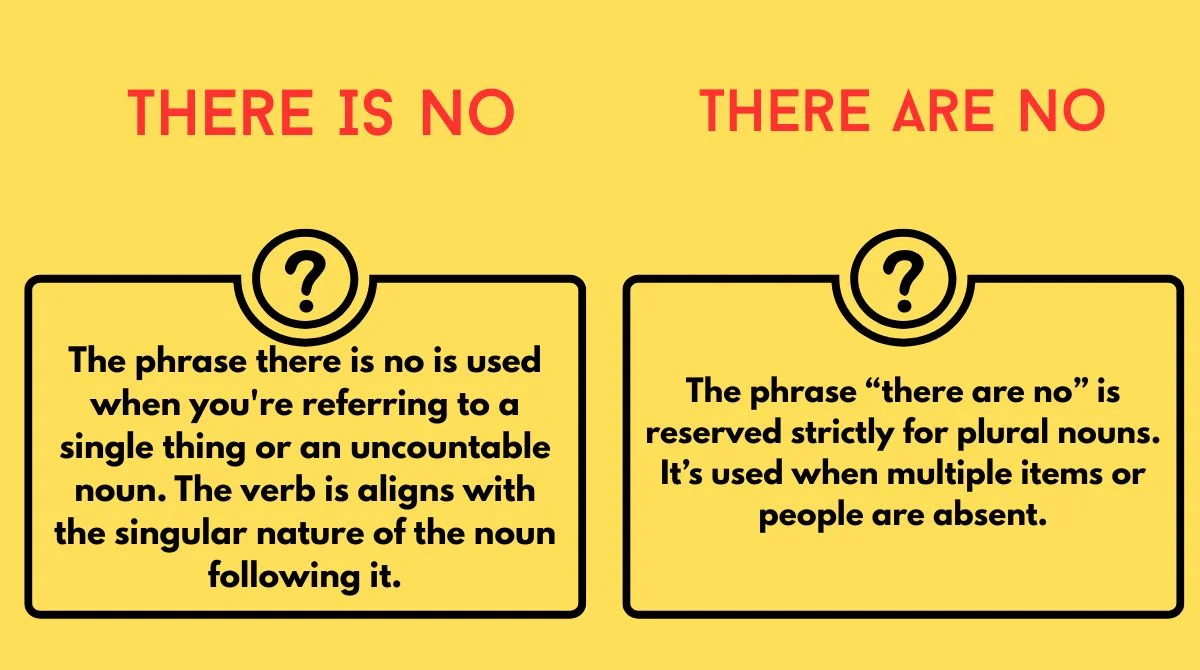
    The phrase there is no is used when you’re referring to a single thing or an uncountable noun. The verb is aligns with the singular nature of the noun following it.

    Examples:

    • “There is no solution to the problem yet.”
    • “There is no water in the bottle.”
    • “There is no hope of winning.”

    Notice how each noun here—solution, water, hope—is either singular or uncountable. These forms call for the singular verb is.

    There Is No vs There Are No

    When to Use “There is No” with Singular Nouns

    Using “there is no” makes perfect sense when you’re referring to the absence of a single item.

    Here’s a simple rule of thumb:

    If the noun is singular, use “there is no.”

    Correct Usage Examples:

    • “There is no dog in the yard.”
    • “There is no email from the manager.”
    • “There is no winner in this game.”

    Using “there are no” in these cases would be grammatically incorrect.


    The Role of Uncountable Nouns in Defining “There Is No”

    Uncountable nouns (also known as mass nouns) don’t have a plural form and can’t be counted individually. Common examples include: water, sugar, money, furniture, information, advice.

    “There is no” fits naturally with these because they’re grammatically singular.

    Examples:

    • “There is no money in my account.”
    • “There is no furniture in the room.”
    • “There is no sugar left.”

    Even though some of these things may seem plural in meaning (like furniture), grammatically, they are treated as singular.


    Deciphering “There Are No” for Plural Usage

    The phrase “there are no” is reserved strictly for plural nouns. It’s used when multiple items or people are absent.

    Examples:

    • “There are no apples in the basket.”
    • “There are no tickets left.”
    • “There are no children in the playground.”

    The key here is that the subject of the sentence is more than one item. That plural subject demands the verb are.

    Singular NounUse “There is no…”
    book“There is no book on the desk.”
    Plural NounUse “There are no…”
    books“There are no books on the desk.”

    Common Pitfalls and How to Avoid Them

    It’s easy to make mistakes with these phrases, especially when nouns are tricky or deceptive. Let’s clear up some of the most common mix-ups.

    Mistake #1: Using “there is no” with plural nouns

    ❌ “There is no bananas in the bowl.”
    ✅ “There are no bananas in the bowl.”

    Mistake #2: Treating uncountable nouns as plural

    ❌ “There are no information available.”
    ✅ “There is no information available.”

    Mistake #3: Misidentifying collective nouns

    More on that next.


    Tricky Contexts: Collective, Mass, and Quantified Nouns

    Some nouns are sneaky. They look singular but can behave like plurals, and vice versa.

    Collective Nouns

    Words like team, family, and audience refer to groups but are treated as singular in American English.

    • “There is no team like ours.” ✅ (Correct)
    • “There are no team like ours.” ❌ (Incorrect)

    Mass Nouns

    These refer to uncountable substances or concepts.

    • “There is no love like hers.”
    • “There is no rice left.”

    Even though rice might contain many grains, it’s uncountable—thus singular.

    Quantified Expressions

    When dealing with numbers or quantities, follow the noun after the number.

    • “There are no two ways about it.” ✅
    • “There is no one good answer.” ✅

    “There Is No” vs. “There Are No” with Fractions and Numbers

    Fractions and numbers can be confusing, but here’s the trick:

    👉 Look at the actual noun being quantified, not just the number.

    Examples:

    • “There is no half of the cake left.” ✅ (Singular: half of one cake)
    • “There are no three options available.” ✅ (Plural: three options)

    A single percentage can take either verb depending on the noun:

    • “There is no 50% of the water remaining.” ✅
    • “There are no 50% of the files available.” ✅

    Golden Rule:

    Always match the verb to the noun being quantified, not the number itself.


    Real-World Examples: Applying the Correct Usage in Various Situations

    Let’s look at how “there is no” and “there are no” show up in real life—from business writing to casual conversations.

    ScenarioCorrect PhraseExample
    At the officeThere is no“There is no internet connection.”
    In a restaurantThere are no“There are no free tables available.”
    ShoppingThere are no“There are no discounts this week.”
    TravelThere is no“There is no flight until tomorrow.”
    Online conversationThere is no“There is no need to panic.”

    Emphasizing the Difference Through Examples

    Sometimes, just looking at contrast can make things click.

    IncorrectCorrect
    “There is no books on the shelf.” ❌“There are no books on the shelf.” ✅
    “There are no water in the jug.” ❌“There is no water in the jug.” ✅
    “There is no chairs in the room.” ❌“There are no chairs in the room.” ✅

    Use this quick checklist when in doubt:

    • Is the noun singular or uncountable? 👉 Use is
    • Is the noun plural? 👉 Use are

    The Impact of Language Trends on “There Is No” and “There Are No”

    Modern usage is becoming increasingly casual, and you’ll often hear people say things like:

    “There’s no rules anymore.” ❌

    Technically, that’s wrong—rules is plural, so the correct form is:

    “There are no rules anymore.” ✅

    But spoken English is full of contractions like “there’s” even when referring to plurals. While that might be acceptable in informal speech, it’s best to keep your grammar sharp in writing and formal settings.

    Pro Tip:

    In writing, avoid “there’s” with plural nouns even if it sounds natural when spoken.


    There Is No vs There Are No

    ❓ 6 FAQs

    Is it “there is no” or “there are no”?

    It depends on the noun. Use “there is no” with singular or uncountable nouns, and “there are no” with plural nouns.

    Can “there is no” be used with plural nouns?

    No. Plural nouns require the verb “are,” so the correct phrase is “there are no” (e.g., “There are no chairs”).

    What are uncountable nouns and how do they affect this choice?

    Uncountable nouns (like sugar, information, furniture) take “there is no” because they’re grammatically singular, even if they refer to things in bulk.

    Why do people say “there’s no rules” in speech?

    It’s a common informal contraction, but it’s incorrect in writing. The correct form is “there are no rules” because rules is plural.

    How do I know which phrase to use quickly?

    Ask yourself if the noun is singular/uncountable or plural. Singular/uncountable = “there is no”. Plural = “there are no.”

    Can I use “there is no” with collective nouns?

    Yes, in American English, collective nouns like team or family are treated as singular, so “there is no team like ours” is correct.


    Conclusion: Trust the Grammar, Not the Gut

    If you’ve ever wondered whether to say “there is no” or “there are no,” now you know: it all comes down to the number and type of noun you’re referring to.

    ✅ Use “there is no” with singular or uncountable nouns.
    ✅ Use “there are no” with plural nouns.

    Language evolves, but clear grammar never goes out of style. Bookmark this guide, refer back to the tables, and next time you’re stuck mid-sentence—you’ll know exactly what to say.

  • “More Friendly” vs “Friendlier”: Which One’s Right? 🤔✅

    “More Friendly” vs “Friendlier”: Which One’s Right? 🤔✅

    Choosing between “more friendly” and “friendlier” might seem like splitting hairs, but in English grammar, small differences can make a big impact.

    Whether you’re writing a professional email or just chatting with a friend, knowing the correct comparative form helps you sound polished and confident.

    So, which one is grammatically correct—“more friendly” or “friendlier”? The short answer is: both can be correct, depending on context. But don’t stop here—the rules, usage trends, and exceptions are worth exploring.

    Let’s break them down with examples, comparisons, and a few rule-breaking surprises.

    Both “more friendly” and “friendlier” are grammatically correct. Use “friendlier” in casual speech or when comparing one trait. Use “more friendly” in formal writing, technical contexts, or when comparing multiple qualities. Keep reading to discover when each is best.


    Understanding the Basics of Comparative Adjectives in American English

    In American English, comparative adjectives are used to compare differences between two nouns. They’re formed in two primary ways:

    • Add “-er” to the end of short adjectives (typically one syllable or some two-syllable adjectives).
      Example:
      • tall → taller
      • kind → kinder
    • Use “more” before longer adjectives (typically two syllables or more).
      Example:
      • beautiful → more beautiful
      • interesting → more interesting

    But here’s the twist: Some two-syllable adjectives, like friendly, can go either way, which is why confusion arises.


    The Intricacies of “More Friendly” and “Friendlier”: A Detailed Analysis

    Let’s take a closer look at the word friendly.

    • It’s a two-syllable adjective.
    • It ends in -ly, which usually signals an adverb (like quickly), but not in this case—it’s still an adjective.
    • It’s a classic “borderline” word that allows both forms: “friendlier” and “more friendly.”

    But there’s a nuanced difference in tone and rhythm that influences usage:

    FormCommon UsageTone / Context
    FriendlierMore traditional, concise, conversationalUsed in speech or casual writing
    More friendlySlightly more formal or deliberateOften used in professional or written contexts

    When to Use “More Friendly” in Everyday Language

    “More friendly” often shows up when writers want to be a bit more deliberate or measured in tone. It’s also frequently used when clarity is needed—especially in sentences where the rhythm favors two words instead of a suffix.

    Examples of Correct Usage:

    • The customer service team is becoming more friendly over time.
    • I found the new software interface more friendly and intuitive.
    • Our school environment is getting more friendly to new students.

    Pro tip: If friendly is paired with another adjective or idea, “more friendly” usually flows better.

    ✅ The app is more friendly and more helpful than the old version.


    Comparing Multiple Personalities: The Use of “More Friendly”

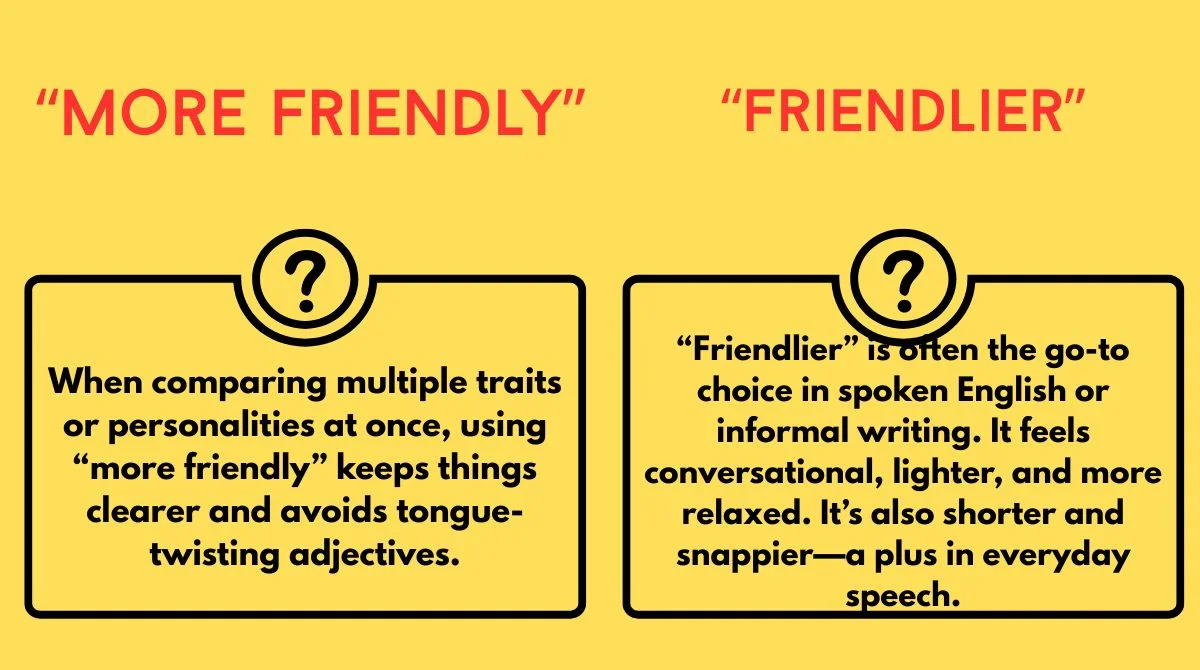
    When comparing multiple traits or personalities at once, using “more friendly” keeps things clearer and avoids tongue-twisting adjectives.

    Compare these:

    • ❌ John is friendlier and more helpful than Paul.
    • ✅ John is more friendly and more helpful than Paul.

    Why? The consistent structure (more X and more Y) improves rhythm and clarity.

    Use “more friendly” when:

    • Comparing multiple characteristics.
    • Maintaining parallel sentence structure.
    • You’re writing in a more formal or technical tone.

    Creating More Impact: Instances Where “More Friendly” Shines

    Here are a few places where “more friendly” adds more impact:

    • Marketing and branding:
      “This brand is more friendly to the environment.”
    • Technology and design:
      “The new dashboard is more user-friendly.”
    • Educational content:
      “We’re working on creating more friendly material for beginners.”

    In many of these, “friendly” works more like part of a compound modifier (like user-friendly or eco-friendly), which explains why “more friendly” fits better.

    “More Friendly” vs “Friendlier”

    Exploring the Use of “Friendlier” in American English

    “Friendlier” is often the go-to choice in spoken English or informal writing. It feels conversational, lighter, and more relaxed. It’s also shorter and snappier—a plus in everyday speech.

    Examples of “Friendlier” in Action:

    • She seems friendlier now that we’ve talked more.
    • Dogs are usually friendlier than cats.
    • My neighbor is friendlier than he used to be.

    Bonus tip: If you’re keeping your sentence short and comparing just one thing, “friendlier” sounds smoother and more natural.


    Illustrative Examples: “More Friendly” vs “Friendlier” in Context

    Let’s break down when to use each with real-life sentence comparisons:

    Scenario“Friendlier”“More Friendly”
    Casual conversation✅ “He’s friendlier than before.”Possible but less common
    Formal writingLess common✅ “Our interface is more friendly to non-technical users.”
    Comparing traits❌ “He’s friendlier and more helpful.”✅ “He’s more friendly and more helpful.”
    Tone requiredLight, informalFormal, structured

    “More Friendly” or “Friendlier”: Special Cases and Exceptions

    Some adjectives defy the usual rules and vary by usage or personal style.

    For friendly, both forms are grammatically correct, but mixing them within the same sentence can sound awkward.

    Avoid this:

    • ❌ This version is friendlier and more easy to use.

    Better:

    • ✅ This version is more friendly and more easy to use.

    Other similar adjectives with flexible comparative forms:

    • Lovely → more lovely / lovelier
    • Lonely → more lonely / lonelier
    • Silly → more silly / sillier

    Just like friendly, these can shift based on rhythm, tone, or context.


    Eco-Friendly Conversations: A Rule-breaking Exception

    You’ve probably heard the phrase eco-friendly, right? Now let’s test it:

    • “Our packaging is friendlier to the environment.”
    • “Our packaging is more eco-friendly.”

    In this case, “more eco-friendly” is the preferred form.

    That’s because eco-friendly behaves as a compound adjective, and grammar rules shift slightly. When using compound adjectives with friendly, “more” becomes the dominant comparative tool.

    Other common phrases:

    • More user-friendly
    • More budget-friendly
    • More beginner-friendly

    So in branding or environmental language, “more friendly” is often the smarter choice—even if “friendlier” is technically okay.


    The Interchangeable Use of “More Friendly” and “Friendlier” in Informal Speech

    In spoken American English, both forms are widely accepted and often used interchangeably, especially when the context is casual.

    Real-world examples:

    “I think she’s gotten a lot more friendly lately.”
    “He’s definitely friendlier than his brother.”

    Do either sound wrong? Not really. That’s why grammar purists still allow both, but context always matters.

    In professional writing, err on the side of structure: use more friendly when there’s any doubt. In everyday chat, friendlier rolls off the tongue.


    “More Friendly” vs “Friendlier”

    ❓ 6 FAQs

    Is “friendlier” grammatically correct?

    Yes, “friendlier” is correct and often preferred in informal or spoken English when making simple comparisons.

    When should I use “more friendly”?

    Use “more friendly” in formal writing, technical content, or when comparing multiple traits (e.g., “more friendly and more helpful”).

    Is “more friendly” more formal than “friendlier”?

    Yes. “More friendly” is generally seen as more deliberate and is commonly used in professional, structured, or branding contexts.

    Can I use “friendlier” in academic writing?

    It’s better to use “more friendly” in academic or formal writing to maintain a consistent and professional tone.

    Why does “friendly” allow both forms?

    Because “friendly” is a two-syllable adjective, and certain two-syllable words allow both comparative structures depending on rhythm and context.

    Is “more eco-friendly” better than “eco-friendlier”?

    Yes. In compound adjectives like eco-friendly, user-friendly, and beginner-friendly, “more” is the preferred comparative form.


    Final Verdict: Tips on Choosing the Right Form for Clear Communication

    To wrap it up, here’s a quick cheat sheet to help you choose the right form:

    ✅ Use “Friendlier” when:

    • You’re keeping things casual or conversational.
    • The comparison is simple and involves just one adjective.
    • You want a quicker, smoother sentence.

    ✅ Use “More Friendly” when:

    • You’re combining traits or using complex comparisons.
    • You’re writing in a formal or professional context.
    • You’re using compound adjectives (eco-friendly, user-friendly).

    In Summary:

    Use CaseBest Form
    Casual conversationFriendlier
    Formal writingMore Friendly
    Comparing multiple traitsMore Friendly
    Branding or design languageMore Friendly
    Fast and simple statementsFriendlier

    Grammar is flexible, but clarity is not. Let your audience, tone, and structure guide your choice.


    Let us know in the comments: Do you use “more friendly” or “friendlier” more often? Want help with other tricky grammar choices? Drop your suggestions below!

  • A MA or An MA Degree? Here’s the Right Way to Say It! 🎓🗣️

    A MA or An MA Degree? Here’s the Right Way to Say It! 🎓🗣️

    Ever found yourself hesitating before saying “a MA” or “an MA” degree? You’re not alone.

    This tiny grammar puzzle trips up native and non-native speakers alike. It’s all about how we use indefinite articles with acronyms—and more specifically, what we hear rather than what we see.

    In this guide, we’ll break it all down: when to use “a” vs. “an,” how pronunciation changes the rules, and how to refer to your degree accurately across writing styles.

    By the end, you’ll have full confidence saying (and writing) your MA degree the right way.

    The correct usage is “an MA” degree, because “MA” is pronounced “em-ay,” starting with a vowel sound. In English, article choice depends on pronunciation, not spelling—so “an MA” is grammatically correct.


    A MA or An MA Degree

    Understanding Indefinite Articles in English Grammar

    In English, the indefinite articles a and an are used before singular countable nouns when the specific identity of the noun isn’t important or known.

    • “A” is used before words that begin with a consonant sound.
      Example: a cat, a university, a user.
    • “An” is used before words that begin with a vowel sound.
      Example: an apple, an hour, an honor.

    Notice we said sound, not letter. This distinction is key when dealing with acronyms and abbreviations like “MA.”


    The Role of Vowel Sounds in Article Usage

    The article choice hinges on how the word sounds when spoken, not how it’s spelled. That’s why we say:

    • “an honor” even though honor starts with the consonant h—because the h is silent.
    • “a university” even though university starts with a vowel—because the u sounds like you.

    So, what about “MA”?

    When we say “MA” aloud, we pronounce it as “em-ay”. It starts with the vowel sound ‘e’, not the consonant m. That makes “an MA degree” the correct form.

    ✅ Correct: She earned an MA in English Literature.
    ❌ Incorrect: She earned a MA in English Literature.


    Exceptions to the Consonant Rule with Abbreviations

    Abbreviations and acronyms can throw a wrench into the article rules if you go by spelling rather than sound.

    Examples of correct article usage with abbreviations:

    AbbreviationPronunciationCorrect ArticleExample
    MA“em-ay”anan MA in Psychology
    MBA“em-bee-ay”anan MBA from Stanford
    PhD“pee-aych-dee”aa PhD in Mathematics
    BA“bee-ay”aa BA in Sociology

    The key: listen to the first sound of the abbreviation—not the first letter.


    The Correct Way to Refer to Your MA Degree

    When you’re writing about your academic qualifications, it’s important to use correct grammar and consistent style. Here’s how you should refer to your MA degree:

    • Correct: an MA degree, an MA in Political Science, an MA holder
    • Correct (full form): a Master of Arts degree

    Remember, when you spell it out—“Master of Arts”—you use “a” because “Master” begins with a consonant sound.


    Pronunciation Matters: A or An Before Acronyms

    Pronunciation is often overlooked in written communication, but it determines the use of “a” vs. “an” before acronyms and initialisms.

    Let’s look at some common acronyms and how article choice depends on their spoken form:

    AcronymSpoken AsUse “a” or “an”?Example Sentence
    MAem-ayanShe earned an MA in History.
    MBAem-bee-ayanHe pursued an MBA in Finance.
    M.Edem-edanShe holds an M.Ed in Counseling.
    JDjay-deeaHe earned a JD from Harvard.

    Tip: Always read your sentence aloud. If it starts with a vowel sound, go with “an.”


    Common Mistakes in Pronouncing Educational Degrees

    Some speakers misapply article rules by focusing on spelling instead of sound. Common errors include:

    • Saying “a MA” instead of “an MA”
    • Using “an university” because u is a vowel, even though it sounds like you

    How to Avoid These Mistakes:

    • Speak it out loud first.
    • Focus on how the abbreviation sounds, not how it’s written.
    • Practice with common educational degree acronyms.

    Mastering Academic Degrees: Capitalization and Possessiveness

    Knowing when and how to capitalize degree names can also be tricky.

    Capitalization Rules:

    • Use lowercase when describing a degree generally:
      She has a master’s degree in education.
    • Use uppercase when using the full, formal name:
      She earned a Master of Arts in Linguistics.

    Possessive Form:

    • Use apostrophe-s when writing “master’s” or “bachelor’s” in a general sense.
      Example: She holds a master’s degree, not a masters degree.

    When to Use Apostrophes in Academic Degrees

    This is one of the most overlooked grammar points in resumes and bios.

    General Rule:

    • Use an apostrophe when the degree is possessive in nature:
      a bachelor’s degree, a master’s degree
    • No apostrophe when referring to the formal title:
      Bachelor of Arts, Master of Arts

    Incorrect: She has a masters in Psychology.
    Correct: She has a master’s in Psychology.


    Distinguishing Between Degrees and Fields of Study

    Clarity is key when listing qualifications. Confusing the degree with the field of study can make your sentence sound awkward.

    Examples:

    • Correct: He earned an MA in Economics.
    • Incorrect: He earned an MA Economics.
    • Correct (formal): He earned a Master of Arts in Economics.

    Avoid shortening too aggressively or omitting necessary prepositions like “in.”


    Abbreviating Your Degree: MA, M.A., or Master’s?

    You might see your degree written in different ways. So which one’s right?

    FormatUsage ContextExample
    MAMost common, especially in the USan MA in English
    M.A.Slightly more formal or traditionalan M.A. in History
    Master’sInformal/generala master’s in Psychology

    Note: Always follow the preferred style guide of your institution, publisher, or employer.


    Global Variations in Abbreviating Degrees

    Academic degree abbreviations vary around the world. Here are a few distinctions:

    CountryCommon FormatExample Usage
    United StatesMA or M.A.an MA in Philosophy
    United KingdomMA (Oxbridge may imply undergrad)an MA from Oxford
    AustraliaMAan MA in Journalism
    CanadaMA or M.A.an MA in History

    In the UK, some MA degrees (especially from Oxford or Cambridge) are honorary or automatic upgrades from BA degrees.


    Consistency in Writing: Adhering to Style Guides

    When writing professionally, your style should stay consistent throughout. Depending on the guide, article usage and abbreviation formats may vary.

    Popular Style Guides and Their Preferences:

    Style GuideDegree AbbreviationNotes
    APAM.A. (with periods)Use consistent formatting
    MLAMA (no periods)Common in modern formatting
    ChicagoMA or M.A.Accepts both, prefer consistency
    APmaster’s degreeUse lowercase and possessive

    Tip: If you’re writing a resume, academic paper, or publication, check which guide is being followed and match it across the board.


    A MA or An MA Degree

    ❓ 6 FAQs

    Is it correct to say “a MA degree”?

    No. The correct form is “an MA degree” because “MA” starts with a vowel sound (“em-ay”), which requires “an.”

    Why do we use “an” before acronyms like MA?

    We use “an” when the acronym begins with a vowel sound, not necessarily a vowel letter. “MA” begins with the sound “e,” so “an” is correct.

    Is it “a Master of Arts” or “an Master of Arts”?

    It’s “a Master of Arts” since “Master” starts with the consonant “M” sound. Use “a” with full degree names.

    What’s the difference between “MA” and “M.A.”?

    Both refer to the same degree—Master of Arts. “MA” is common in modern writing, while “M.A.” is a more traditional or formal variant.

    Should I say “a master’s degree” or “an master’s degree”?

    Say “a master’s degree” because “master’s” starts with a consonant sound. Use “a,” not “an.”

    Can I say “an MA Economics”?

    No. It should be “an MA in Economics.” Always include “in” when mentioning the field of study.


    Final Thoughts: So, Is It “A MA” or “An MA”?

    Let’s settle it once and for all.

    ✅ The correct form is “an MA” because “MA” is pronounced “em-ay,” which begins with a vowel sound. This follows the standard grammar rule for using an before vowel sounds, not letters.

    Whether you’re applying for grad school, listing your credentials, or writing a professional bio, knowing this rule ensures your writing sounds polished, credible, and grammatically correct.

  • “Was There” or “Were There”? Know Which One to Use! 🤔🔍

    “Was There” or “Were There”? Know Which One to Use! 🤔🔍

    Understanding when to use was and were can be tricky, especially for non-native English speakers.

    Whether you’re forming simple past tense sentences or diving into more complex constructions, getting these verbs right is crucial for clear communication.

    This guide will break down the difference between “was” and “were,” explain their usage in various moods, and offer tips to help you master this important aspect of English grammar.

    Was and were are both past forms of “to be,” but they are used in different contexts. Use “was” with singular subjects (I, he, she, it), and “were” with plural subjects (we, they) and the second-person singular (you). The tricky part comes in the subjunctive mood, where we always use “were” even with singular subjects (e.g., If I were you…).


    Breaking Down the Basics of “Was” and “Were”

    "Was There” or “Were There"

    Before diving deep into the specifics, it’s essential to understand the basic role of was and were. Both words are the past tense forms of the verb to be, but they are used differently depending on the subject of the sentence.

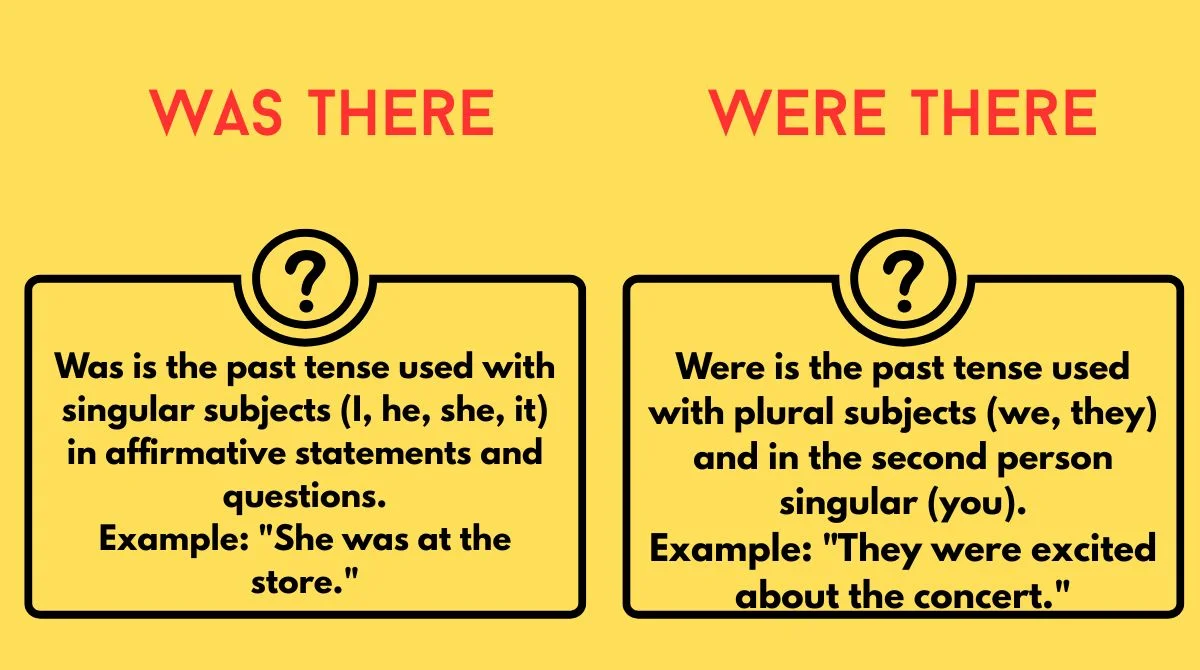
    • Was is the past tense used with singular subjects (I, he, she, it) in affirmative statements and questions.
      Example: “She was at the store.”
    • Were is the past tense used with plural subjects (we, they) and in the second person singular (you).
      Example: “They were excited about the concert.”
      Example: “You were always on time.”

    The real challenge comes when these words are used in more complex grammatical structures. That’s where understanding the mood and context comes into play.


    The Past Tense of “To Be”: Singular and Plural Distinctions

    The fundamental rule of past tense conjugation for the verb to be revolves around singular and plural distinctions.

    Singular Subjects

    • I was
    • He/She/It was

    Examples:

    • “I was tired after the long journey.”
    • “He was happy with the results.”

    Plural Subjects

    • We were
    • You were (for both singular and plural “you”)
    • They were

    Examples:

    • “We were planning a surprise party.”
    • “You were very helpful during the meeting.”
    • “They were in the park when it started raining.”

    This straightforward rule applies to most cases, but the use of was and were can get a bit more nuanced in certain contexts, especially when dealing with the subjunctive mood or specific constructions like there was/were.


    When “Was” Meets Reality: Indicative Mood in Use

    The indicative mood is used for making factual statements or asking questions about reality. It’s the most common mood in English and is where was and were are typically used in simple past tense.

    • Was is used when referring to a singular subject in statements and questions about reality.
      Example: “I was at the store yesterday.”
    • Were is used with plural subjects or with the second-person singular subject (you).
      Example: “They were at the party last night.”

    In this case, the choice between was and were is dictated by whether you’re speaking about something singular or plural in the past.


    Exploring “Were” in the Imaginary: The Subjunctive Mood

    The subjunctive mood is used to express hypothetical or unreal situations—things that aren’t necessarily true but are imagined, wished, or proposed. Here’s where the difference between was and were gets tricky.

    When using the subjunctive mood, we always use were even with singular subjects like I and he. This is often seen in conditional sentences or hypothetical situations.

    • If I were
    • If he/she were
    • If they were

    Example: “If I were you, I’d study harder.”
    Example: “If she were here, she would help.”

    You may have heard the phrase “If I was you,” but this is technically incorrect in formal English. The subjunctive were is the correct choice in these types of situations, even though it sounds a bit counterintuitive.


    If I Was Versus If I Were: Choosing the Correct Form

    One of the most common points of confusion between was and were is in conditional statements—specifically, the difference between “if I was” and “if I were.”

    The Correct Usage:

    • If I were: This is the correct form when discussing hypothetical or unreal situations.
      Example: “If I were rich, I would travel the world.”

    The Common Mistake:

    • If I was: While many native speakers use was in informal speech, this is grammatically incorrect in formal contexts where the subjunctive mood should apply.
      Example (Incorrect): “If I was you, I would not go.” (This should be “If I were you.”)

    This distinction is essential for sounding fluent and formal in English, especially in writing or formal speech.


    How Context Influences the Use of “Was” and “Were”

    The context of a sentence plays a significant role in choosing whether to use was or were. Let’s look at how different contexts guide the choice:

    1. Statements About Reality

    • Was: “I was at the store earlier today.”
    • Were: “They were at the party last night.”

    2. Hypothetical or Unreal Situations

    • Was (incorrect in formal situations): “If I was the boss, I would change things.”
    • Were (correct in formal situations): “If I were the boss, I would change things.”

    Context dictates whether you’re discussing something factual (indicative) or hypothetical (subjunctive).


    “There Was” or “There Were”: Matching the Verb to the Subject

    One of the most frequent mistakes comes with the construction there was and there were. In these cases, you must match the verb to the subject of the sentence, not the word “there.”

    • There was is used when the subject is singular.
      Example: “There was a cat on the roof.”
    • There were is used when the subject is plural.
      Example: “There were many people at the concert.”

    The key is to identify the subject (the noun that comes after “there”) to choose the correct form.


    Understanding Singular versus Plural Subjects

    It’s important to note that subjects play a crucial role in determining whether was or were should be used. Here’s a breakdown:

    Singular Subjects:

    • I was
    • He was
    • She was
    • It was

    Example: “She was the only person who showed up.”

    Plural Subjects:

    • We were
    • You were
    • They were

    Example: “They were all excited about the concert.”


    The Role of “There” in Sentences: Expletive Constructions Explained

    In certain constructions like there is/there are, was and were are used to indicate the existence of something. These are called expletive constructions, where the word “there” acts as a placeholder subject.

    • There was: Use for singular nouns.
      Example: “There was a book on the table.”
    • There were: Use for plural nouns.
      Example: “There were three books on the table.”

    "Was There” or “Were There"

    Common Mistakes and Tips to Remember

    1. Don’t confuse reality and imagination:
      • Use was for statements about reality with singular subjects.
      • Use were for hypothetical or unreal situations in the subjunctive mood.
    2. Check subject-verb agreement:
      • Singular subject = was.
      • Plural subject = were.
    3. Watch for conditional statements:
      • If I were you… (subjunctive, not was).
    4. Practice with examples:
      • Create your own sentences using both was and were to help solidify the rules in your mind.

    ❓ 6 FAQs

    When should I use “was” and “were”?

    Use “was” for singular subjects (I, he, she, it), and “were” for plural subjects (we, they) or the second person (you).

    Is it correct to say “If I was you”?

    No. The correct form is “If I were you”. In hypothetical situations, the subjunctive mood requires “were,” not “was.”

    What’s the difference between “there was” and “there were”?

    “There was” is used for singular subjects, and “there were” is used for plural subjects.
    Example: “There was a cat.” vs. “There were three cats.”

    Can I say “If I was rich”?

    While common in informal speech, “If I was rich” is technically incorrect in formal English. The correct phrase is “If I were rich” (subjunctive mood).

    What is the subjunctive mood, and how does it affect “was” and “were”?

    The subjunctive mood expresses hypothetical or unreal situations. In these cases, always use “were”, even for singular subjects.
    Example: “If I were you, I would go.”

    Why do we use “were” with the second person singular?

    In English, “were” is used for both singular and plural “you,” as in: “You were at the party.”


    Conclusion

    Mastering the difference between was and were is crucial for speaking and writing correctly in English. Whether you’re talking about past events, making hypothetical statements, or describing existence, knowing which verb to use will make your communication clearer and more accurate. Keep practicing, and soon choosing the right form will become second nature!

    If you found this guide helpful, share it with friends who may also benefit from a little clarity on the difference between was and were.

  • How Can I vs How I Can: Master the Right Usage for Perfect Grammar! ✍️🧐

    How Can I vs How I Can: Master the Right Usage for Perfect Grammar! ✍️🧐

    English is a language that thrives on its ability to express ideas in numerous ways, but with that flexibility comes the potential for confusion.

    One common point of confusion for many English learners is the difference between “How I can” and “How can I?” While they may seem similar, their correct usage depends on context and sentence structure.

    This article will break down these two expressions, explore the rules behind their use, and guide you through their proper application.

    The difference between “How I can” and “How can I?” lies in sentence structure. “How can I?” is used in direct questions (subject-verb inversion), while “How I can” is used in indirect speech or embedded questions. For example, “How can I assist you?” (direct) vs. “Can you tell me how I can assist you?” (indirect).


    The Essentials of Direct Questions in English

    How Can I vs How I Can

    In English, direct questions are typically structured with an auxiliary verb, followed by the subject, and then the main verb. This structure allows the speaker to clearly signal that they are asking for information, rather than making a statement.

    Key Elements of Direct Questions:

    1. Auxiliary Verb: The helper verb that supports the main verb in forming questions (e.g., “can,” “do,” “will”).
    2. Subject: The person or thing performing the action.
    3. Main Verb: The action or state of being.

    For example, in the question, “How can I help you?”, the structure follows the pattern:
    Auxiliary verb (can) + subject (I) + main verb (help).

    Direct questions are often used in both formal and informal settings to seek specific answers.


    Question Words

    Question words like “how,” “what,” “where,” “when,” and “why” are used to elicit detailed responses. They appear at the beginning of a sentence to indicate the type of information being requested. These words play an important role in forming questions, including in the case of “How can I?”

    Common Question Words:

    • How: Used for asking about the manner, method, or process.
    • What: Used to ask for specific information.
    • Where: Used for asking about a location or place.
    • When: Used for asking about time.
    • Why: Used for asking reasons or causes.

    In the case of “How can I?”, how is the question word indicating that the speaker wants to know the method or manner in which something is possible.


    Auxiliary Verbs

    Auxiliary verbs are crucial to the structure of English questions. These verbs help convey the tense, aspect, or mood of the main verb. When asking a question in English, an auxiliary verb is typically placed before the subject.

    Examples of Auxiliary Verbs:

    • Can: “Can I help you?”
    • Do: “Do you understand?”
    • Will: “Will you join us?”
    • Would: “Would you like some coffee?”

    The auxiliary verb “can” is commonly used in questions to express ability or possibility. In the case of “How can I?” the verb “can” introduces the ability to perform an action.


    Subject-Verb Inversion

    In English, subject-verb inversion occurs when the auxiliary verb precedes the subject in a question. This inversion is a key feature of direct questions and is one of the reasons we use the structure “How can I?” instead of “How I can?”

    Example of Inversion:

    • Statement: “I can help you.”
    • Question: “How can I help you?”

    Here, the subject (“I”) and auxiliary verb (“can”) are inverted to create a question.


    Indirect Questions: Politeness in English Queries

    Indirect questions are used to ask questions more politely or formally. These types of questions do not follow the standard inversion structure seen in direct questions. Instead, they tend to be embedded within a larger sentence. Using indirect questions allows speakers to sound more respectful, especially in formal situations.

    How to Form Indirect Questions:

    • Start with a polite phrase: “Could you tell me…,” “I wonder…,” or “I’d like to know…”
    • Follow with the indirect question: “how I can help you” (not “how can I help you”).

    For example:
    Direct Question: “How can I assist you?”
    Indirect Question: “Could you tell me how I can assist you?”


    The Role of Additional Words in Indirect Questions

    How Can I vs How I Can

    In indirect questions, additional words like “could,” “would,” or “tell me” are used to soften the request or inquiry. These words make the question less direct and more courteous, which is especially useful in formal or professional settings.

    Example of Indirect Question with Softening Phrases:

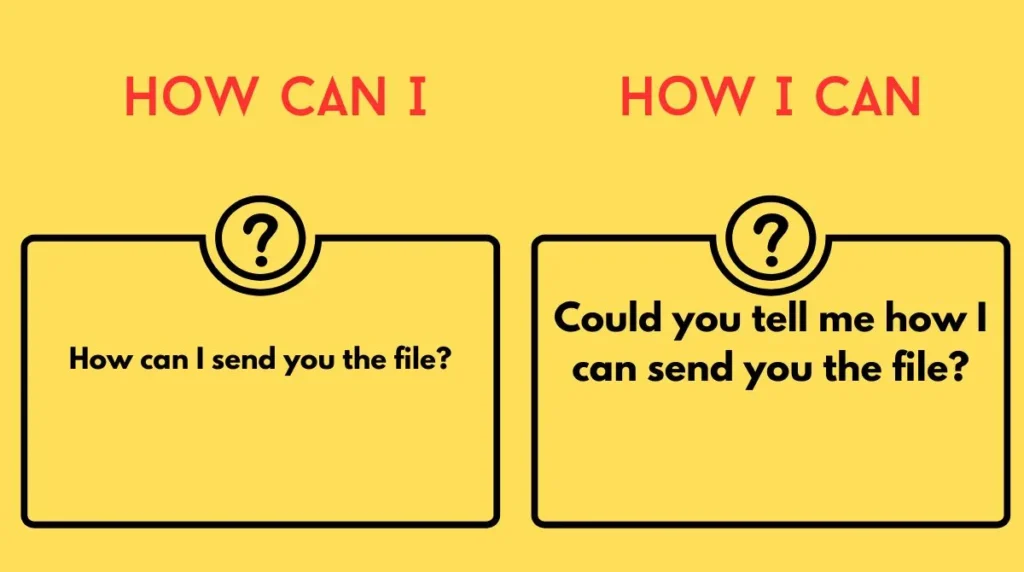
    • Direct: “How can I send you the file?”
    • Indirect: “Could you tell me how I can send you the file?”

    By using phrases like “could you tell me,” the question is softened, showing respect for the listener’s time and attention.


    Using Indirect Questions to Soften Requests

    One of the key advantages of using indirect questions is that they soften the tone of requests, making them sound more polite. This is particularly useful when asking someone to do something or when you don’t want to sound demanding.

    Example of Indirect Question for Requests:

    • Direct Request: “How can I help you?”
    • Indirect Request: “I wonder how I can assist you with this.”

    This approach is ideal for professional environments, interviews, or when you want to maintain a polite and respectful tone.


    Understanding “How Can I” in Interrogative Sentences

    The phrase “How can I” is commonly used when asking for help, offering assistance, or seeking clarification. It is part of the direct question structure and follows the subject-verb inversion rule.

    Example Usage:

    • Question for Help: “How can I help you today?”
    • Question for Understanding: “How can I improve my writing skills?”

    In these examples, “How can I?” is used to inquire about the manner or method of doing something.


    Deciphering the Structure of “How I Can” in Statements

    In contrast to “How can I?”, the phrase “How I can” appears in statements, not questions. This structure is used in indirect speech or when embedding a question inside a larger sentence. It is not used to ask a direct question.

    Example:

    • Correct Statement: “I know how I can improve my skills.”
    • Incorrect Question: “How I can help you?”

    In statements, the word order remains subject-verb-object, with no inversion of the subject and auxiliary verb.


    Embedded Questions within Larger Sentences

    Embedded questions are questions that are part of a larger sentence. They do not follow the inversion pattern of direct questions and often appear in indirect speech. The structure of these questions uses how I can or other variations, depending on the sentence.

    Example of an Embedded Question:

    • Direct Question: “How can I get to the station?”
    • Embedded Question: “Can you tell me how I can get to the station?”

    The embedded question is part of the larger sentence, and the word order is not inverted.


    Expanding Knowledge with Examples of “How Can I”

    Here are some additional examples of how to use “How can I” in various contexts. These examples will help solidify your understanding of when to use this structure.

    Examples:

    1. How can I improve my English skills?
    2. How can I make a reservation at the restaurant?
    3. How can I support you in this project?

    In each case, “How can I” is used to ask about the method, process, or ability to perform a task.


    Delving Deeper: Variations with “Why Can I” and “When Can I”

    While “How can I” is the most common structure, variations such as “Why can I” and “When can I” are also used in questions. These variations follow similar rules and are used to inquire about reasons or time-related matters.

    Examples:

    • Why can I not access the website?
    • When can I expect your response?

    In both of these questions, the word order follows the standard direct question format, with the auxiliary verb (“can”) placed before the subject (“I”).


    Direct vs. Indirect Usage with “Why Can I” and “When Can I”

    Both “Why can I” and “When can I” are also used in both direct and indirect questions, with the difference lying in the structure of the sentence.

    Direct Questions:

    • “Why can I not open this file?”
    • “When can I start the new project?”

    Indirect Questions:

    • “Could you explain why I can’t access the file?”
    • “Can you tell me when I can begin the project?”

    In indirect questions, the subject-verb inversion is not used, and the structure shifts to a more polite tone.


    The Significance of Word Order in English Questions

    In English, word order is crucial for creating correct questions. In direct questions, subject-verb inversion is required, while in indirect questions, this inversion is absent. Understanding the difference between these two structures is essential for using “How I can” and “How can I” correctly.

    Summary of Word Order in Questions:

    • Direct Questions: “How can I help you?”
    • Indirect Questions: “Can you tell me how I can help you?”

    By mastering word order, you can ensure your questions are clear and grammatically correct.


    ❓ 6 FAQs

    What’s the difference between “How I can” and “How can I”?

    “How can I” is used for direct questions with subject-verb inversion (e.g., “How can I help you?”). “How I can” is used in indirect questions or statements (e.g., “I know how I can help you.”).

    Is it correct to say “How I can help you”?

    No, this is incorrect in a direct question. The correct structure is “How can I help you?”, following subject-verb inversion for direct questions.

    When do I use indirect questions like “How I can”?

    Use “How I can” in indirect questions, often embedded in polite requests or formal speech. Example: “Could you tell me how I can improve my English?”

    What is subject-verb inversion in English questions?

    Subject-verb inversion means the auxiliary verb (like “can”) comes before the subject (like “I”) in questions. Example: “How can I help you?” (not “How I can help you?”).

    How do indirect questions sound more polite?

    Indirect questions soften the tone and sound more respectful. Example: “Could you tell me how I can assist you?” sounds more polite than “How can I assist you?”

    Can I use “How can I” to ask for help?

    Yes, “How can I” is commonly used to offer or request help. Example: “How can I help you today?”


    Conclusion

    The difference between “How I can” and “How can I?” may seem subtle, but it’s an important distinction to grasp for proper English usage.

    By understanding the principles of subject-verb inversion, auxiliary verbs, and indirect questions, you can communicate more effectively and politely in both spoken and written English.

    So, the next time you’re wondering which structure to use, refer back to this guide for clarity!

  • Install In vs Install On: Which Preposition Should You Use? 🖥️🔧

    Install In vs Install On: Which Preposition Should You Use? 🖥️🔧

    Prepositions can be tricky, especially when two similar ones—like in and on—create confusion in common phrases.

    If you’ve ever wondered whether to say install in or install on, you’re not alone!

    This guide will clear up the confusion, showing you exactly when and why to use each one in different contexts, especially in the world of technology.

    Let’s dive into the details and help you master the proper usage of these prepositions.

    When choosing between “install in” and “install on,” remember that “install in” refers to placing something inside a specific area, like a directory, whereas “install on” refers to placing something onto the surface of a device or operating system, such as an app on a phone.


    Unlocking the Confusion: “Install In” vs “Install On”

    Install In vs Install

    At first glance, install in and install on seem similar. They both refer to placing something into a system, but they apply to different scenarios. Here’s the quick breakdown:

    • Install in is typically used when something is placed inside a confined space, or when software is placed in specific directories within a system.
    • Install on refers to placing something on the surface of something else or onto a system as a whole.

    But why do we use these specific prepositions? The subtle differences between these two terms hinge on the context in which the installation happens. Let’s explore each preposition further.


    Robust Examples: Using “Install In” in Context

    Installing Hardware Inside Devices

    When it comes to hardware, you often install in a device, as the hardware is typically placed inside the casing or structure. For example:

    • “I installed the RAM in my laptop.”
    • “The technician installed a new hard drive in the computer.”

    In these cases, the hardware physically enters the device, fitting inside its components. This is where in makes sense because it suggests placement within an enclosed space.

    Placing Software in Specific Directories

    Software can also be installed in certain locations within a system. Often, we refer to software being placed in specific directories or folders on a computer or server. For example:

    • “The program was installed in the C:\ drive folder.”
    • “Make sure to install the software in the correct directory for better organization.”

    Here, in is used to describe placing something inside a directory or folder, which is technically a “container” within the system.


    When to Use “Install On” – Real Life Applications

    While install in is great for hardware and software in confined spaces, install on is more commonly used in other situations. Let’s look at when it’s appropriate to use install on.

    Installing Software on Operating Systems or Devices

    You would typically say install on when referring to the device as a whole or an operating system. For example:

    • “I installed the app on my phone.”
    • “You need to install the software on your Windows PC.”

    Here, on implies that you’re putting something on top of or within the context of an operating system, rather than inside specific folders or components. This usage is common when discussing devices like phones, tablets, or PCs, as they represent the broader surface where the installation occurs.

    Installing Apps on Smart Devices

    When talking about smartphones or tablets, the phrase install on is most frequently used. Apps are installed on the device, but they don’t get placed “in” any particular compartment of the device itself. For example:

    • “You can install Instagram on your iPhone.”
    • “I just installed a new game on my Android.”

    In these examples, install on emphasizes the device as a platform or surface, rather than a physical location within the device.


    “Install On” Rising: How Tech Language Is Evolving

    As technology continues to evolve, the usage of prepositions like install on has grown, especially in the realm of software and devices. Originally, install in was more common, especially for traditional software installed on computers, where it referred to directories or specific locations. However, with the rise of mobile devices, cloud computing, and app ecosystems, install on has become more prominent.

    The Shift in Language Patterns

    In the past, it was common to say install in when referring to software on a computer. Today, with the proliferation of mobile apps and cloud-based software, install on has gained more traction because it aligns with how we think about apps on devices like smartphones, smartwatches, and even TVs.

    For example:

    • “Install the app on your smartphone.”
    • “Install the program on your tablet.”

    This shift reflects a broader understanding of software as something that exists on the device as a whole, rather than in specific folders or directories.


    Historical Usage Patterns

    Historically, the choice of in or on for installation largely depended on the device and the type of installation being discussed. Early computing language favored install in because software was physically placed within specific directories on hard drives. As software installations have evolved, especially with the advent of cloud storage and mobile apps, the preposition on has increasingly been used.

    The Early Days of Computing

    In the early days of personal computers, software installation was a much more physical process, often involving placing software in specific system folders or drives. This resulted in the common usage of install in, especially for programs on desktop systems.

    However, as software moved into the cloud, the preposition on started becoming more popular due to its broad association with the devices or platforms where the software operates.


    The Influence of Technology and Software

    The language surrounding installation has evolved alongside technology, and it’s essential to keep up with these changes to communicate effectively. As smartphones, tablets, and other devices gain more prominence, the language surrounding software installation also adapts.

    For instance, when talking about apps, we almost always say we “install on” devices like phones or tablets. This is because the word on fits the context of installing something on a platform or operating system, whereas in still carries connotations of placing something physically inside.


    Navigating Installation Terms for Devices: Phones and Computers

    In everyday usage, the differences between install in and install on become particularly relevant when we discuss common devices. Understanding when to use each preposition can help clarify your language and avoid confusion.

    Smartphones and Tablets

    When referring to mobile devices like smartphones and tablets, install on is the standard phrase. Apps are installed on the phone or tablet’s operating system, not inside a specific component or directory.

    • “You should install this app on your phone.”
    • “I’m installing this game on my tablet.”

    Laptops and Desktop Computers

    With traditional computers, you might still hear both install in and install on, but install on is typically used when referring to the device as a whole. However, install in is more common when specifying a directory or folder.

    • “Install the software on your computer.”
    • “Install the program in the C:\ drive.”

    ❓ 6 FAQs

    What’s the difference between “Install In” and “Install On”?

    “Install in” is used when something is placed inside a confined space or directory, while “install on” refers to placing something on a device or operating system, like apps on a smartphone or software on a computer.

    Can I use “Install In” for software on my computer?

    Yes, when referring to specific directories or drives, you use “install in” (e.g., “Install the software in the C:\ drive”).

    Why do we say “Install On” for apps?

    We say “install on” for apps because they are placed on the device’s operating system as a whole, not inside a specific component.

    When should I use “Install In” for hardware?

    Use “install in” when hardware is physically placed inside a device, such as installing RAM in a laptop or a hard drive in a computer.

    How has the language around “Install In” and “Install On” evolved?

    As mobile devices and cloud-based software became more popular, “install on” became the more common term, especially for apps installed on smartphones, tablets, and PCs.

    Is it still correct to say “Install In” for software on a PC?

    Yes, when specifying a location within the computer’s system (like a directory), you use “install in” (e.g., “Install the program in the directory”).


    Conclusion

    Understanding when to use install in versus install on isn’t just a matter of grammar—it’s about improving clarity and precision in communication, especially in the tech world.

    While install in tends to be used when referring to placing something inside a system or a specific directory, install on is more appropriate for installing software or apps onto a device or platform as a whole.

    By mastering these distinctions, you’ll enhance your writing and communication skills, whether you’re dealing with tech topics or everyday scenarios.

    The evolution of language in the tech world continues to shape how we speak, so staying updated will always serve you well.

    Do you have any additional questions about prepositions in tech language? Feel free to share your thoughts in the comments!

  • Unselect vs Deselect: Which Term Should You Use in Tech? 🖱️💡

    Unselect vs Deselect: Which Term Should You Use in Tech? 🖱️💡

    When navigating the world of technology, language can sometimes get a little fuzzy.

    For instance, unselect and deselect often pop up as interchangeable terms, yet there are subtle differences in their usage.

    This article will dive into the debate, offering clear distinctions and real-world examples to guide you in selecting the right term in various contexts.

    The terms “unselect” and “deselect” are often confused, but “deselect” is the preferred choice in technical and professional settings. While unselect is informal, deselect is widely used in software interfaces and documentation for reversing selections.


    Understanding the Debate: Unselect Versus Deselect

    Unselect vs Deselect

    At first glance, unselect and deselect might seem like synonyms. Both seem to imply the action of reversing a selection, particularly in software and digital interfaces. However, a deeper examination reveals some key differences that affect when and how they should be used.

    The core of the debate lies in how these terms are perceived in everyday language versus their technical usage.

    While unselect might feel like a natural extension of the verb “select,” deselect is widely accepted as the correct term in most professional and technical environments. But why is this the case, and when should each term be used? Let’s dive deeper into the definitions and usage.


    Defining the Terms: A Linguistic Overview

    What Does Unselect Mean?

    Unselect is a verb that means to reverse a previous selection. It’s formed by combining the prefix “un-” (which implies undoing or reversing) with “select.” The word makes intuitive sense, but it is rarely used in formal or technical contexts.

    Example:

    • “I unselected all the boxes after completing the form.”

    While this feels natural in everyday speech, it’s not the preferred term in professional writing or technical documentation.

    What Does Deselect Mean?

    Deselect is the more established and widely accepted term. It also means to reverse or cancel a selection, but it’s considered the more precise, formal choice in most professional settings.

    Example:

    • “To remove the filter, deselect the ‘Apply filter’ option.”

    In contrast to unselect, deselect is the preferred term in software documentation, user interfaces, and coding environments. It sounds more technical, but it’s also more universally understood in these contexts.


    The Evolution of Language: How Tech Shapes Our Words

    As technology has evolved, so too has the language used to describe it. Deselect has been entrenched in the language of software development, user interfaces, and digital workflows.

    Over time, terms like this become standard because they’re clear, concise, and easily understood by the end-user.

    While unselect is a perfectly logical word, it hasn’t gained the same level of usage in the tech world. This is partially because terms like deselect are more consistent with established jargon.

    The preference for certain words often arises from their consistent application across various software platforms and user interfaces.

    In the case of deselect, software developers and designers have used it for years as the standard term for clearing or reversing a selection. It’s simpler, clearer, and less likely to confuse users.

    As a result, deselect has become synonymous with the process of removing a selection in almost all technical contexts.


    Dictionary Presence: The Legitimacy of Tech Jargon

    You might wonder: Is “unselect” even a real word? In fact, unselect is technically recognized by some dictionaries, but it doesn’t have the same level of legitimacy as deselect. The latter is well-documented in dictionaries and technical resources, whereas unselect is often categorized as a colloquialism or informal term.

    Here’s a quick look at the dictionary entries for both terms:

    TermDictionary PresenceDefinition
    UnselectRecognized but rareTo reverse a selection (informally used).
    DeselectWell-establishedTo cancel or remove a selection (commonly used in tech).

    While both terms are understood, deselect is the preferred choice in most professional, technical, and software-related contexts.


    Exploring the Correct Usage in Technology Contexts

    When it comes to technology, using the correct terminology is crucial for clear communication. Most software applications, from word processors to complex databases, rely on precise terms to describe user actions. Here’s why deselect has become the go-to choice for canceling selections in digital environments.

    • Clarity and Consistency: Deselect aligns better with the consistent language already used in most software interfaces.
    • Standardization: From programming languages to user guides, deselect is consistently applied across various tech-related documentation and instructions.
    • Ease of Use: Users are accustomed to the term deselect, making it more intuitive in software interactions.

    Correct Usage in Software:

    • Example 1: “Deselect all checkboxes before submitting your form.”
    • Example 2: “Click the button to deselect this option from the list.”

    The Nuances of Unselect and Deselect in Sentences

    While both unselect and deselect can convey the same action, the tone and setting can change how they are perceived. Let’s break down some key examples:

    • Unselect:
      • Example 1: “She unselected all the items in her shopping cart.”
      • Example 2: “I accidentally unselected the wrong file in the folder.”

    In these sentences, unselect feels more informal. It works in casual conversations or less technical contexts but may not be appropriate in professional documentation.

    • Deselect:
      • Example 1: “To remove your filter settings, simply deselect the options in the menu.”
      • Example 2: “Deselecting the ‘Accept terms and conditions’ box is mandatory.”

    In these cases, deselect feels more authoritative and is the preferred choice in professional or technical writing.


    How to Properly Unselect Items: Real-World Examples

    Even if unselect is not the most technically correct term, it’s still commonly used in everyday language, especially by non-tech-savvy individuals. Here are a few examples of how unselect might be used in real-world scenarios:

    • Example 1: “I unselected the first option because it wasn’t relevant.”
    • Example 2: “Please unselect the files you no longer want to keep in the folder.”

    While these sentences are understandable, it’s important to note that, in formal technical documentation or professional settings, deselect would be the preferred term.


    Deselecting Items: Usage and Clarity in Communication

    In contrast, deselect is the word of choice in most official software interfaces. Using it improves clarity and consistency.

    For example:

    • Software Interface Example: “Deselect any items you no longer wish to include in the report.”
    • Code Documentation Example: “To deselect a checkbox, use the ‘deselect’ method in your script.”

    Using deselect ensures that your instructions are precise, and they align with industry-standard terminology.


    Maximizing Clarity: More Sentences Demonstrating Proper Use

    To further clarify the correct usage, here are more sentences illustrating how to properly use unselect and deselect in context:

    • Unselect:
      • “Please unselect the duplicate entries before finalizing the list.”
      • “The program automatically unselected all outdated options.”
    • Deselect:
      • “Click on the ‘Deselect All’ button to clear all selected items.”
      • “Deselect the box if you don’t wish to receive notifications.”

    These examples show how deselect enhances the professionalism and clarity of your instructions, especially in tech environments.


    Industry Insights: How Software Documentation Differs

    In the software industry, language precision is paramount. Terms like deselect are carefully chosen to avoid confusion and ensure that users can quickly understand how to interact with the system.

    Documentation guidelines often prioritize words that are already familiar to users, ensuring that there’s no ambiguity. This is why deselect is favored over unselect in most technical documentation.


    Documentation Best Practices: Alternative Terms

    While deselect is the gold standard in many tech environments, there are alternative terms you can use depending on the context:

    • Clear Selection: In some cases, “clear selection” or “clear all” might be used to indicate the reversal of a selection.
    • Uncheck: Often used in the context of checkboxes. “Uncheck the box to opt out of notifications.”
    • Remove Selection: Another alternative when describing the action of clearing or reversing a choice.

    Common Misconceptions and How to Avoid Them

    It’s easy to mix up unselect and deselect, especially since they both seem to suggest the same action. However, as we’ve seen, understanding the context in which they’re used is key.

    Misconceptions to Avoid:

    • Unselecting is universally accepted: In most technical fields, deselect is preferred.
    • Unselecting is a newer, trendier term: Actually, deselect has been around longer and is more widely recognized in formal settings.

    By using the right terminology and following established guidelines, you’ll ensure your communication is clear, concise, and professional.


    ❓ 6 FAQs with Answers

    What’s the difference between “unselect” and “deselect”?

    “Unselect” is informal and typically used in casual conversation, while “deselect” is the correct term in technical and software contexts, referring to the action of reversing a selection.

    Is “unselect” a real word?

    Yes, unselect is recognized by some dictionaries but is less commonly used in professional or technical language compared to deselect, which is widely accepted in software documentation.

    When should I use “deselect” in tech writing?

    Use “deselect” when writing software documentation, user guides, or coding instructions. It’s the standard term for canceling or removing a selection in most tech environments.

    Can I use “unselect” in professional contexts?

    While unselect might feel natural, it is better to use deselect in professional or technical settings to maintain clarity and align with industry standards.

    What are some alternatives to “deselect”?

    Alternatives to deselect include “clear selection”, “remove selection”, or “uncheck” when referring to checkboxes in forms.

    How can using the wrong term affect my documentation?

    Using the wrong term, like unselect, can confuse your audience. In tech writing, deselect is the preferred term, ensuring clear communication and consistency in documentation.


    Conclusion

    Now that you have a better understanding of the unselect versus deselect debate, you can make informed choices about which term to use.

    While both might seem interchangeable in casual conversation, deselect is the preferred and more professional option in technical and software contexts.

    Always consider your audience and the setting in which you’re communicating—whether it’s a user manual, a programming guide, or a casual email. By doing so, you’ll ensure your language is both precise and appropriate.

  • Awaiting Approval vs Pending Approval: What’s the Difference? 📝❓

    Awaiting Approval vs Pending Approval: What’s the Difference? 📝❓

    The phrases awaiting approval and pending approval often appear to be interchangeable, but a closer look at their usage reveals subtle differences.

    Whether you’re drafting an email, a business proposal, or a formal letter, understanding which phrase to use in the right context can significantly improve clarity and professionalism.

    In this article, we’ll explore the nuances between awaiting approval and pending approval, how they’re used in different scenarios, and provide tips for choosing the right phrase.

    The phrases “awaiting approval” and “pending approval” are often used interchangeably but have subtle differences. “Awaiting approval” emphasizes the act of waiting with a sense of anticipation, while “pending approval” focuses on the formal process and indicates a document or decision is in progress but not yet finalized.


    Understanding the Context of Approval in Language

    Awaiting Approval vs Pending Approval

    Before diving into the specifics of each phrase, it’s important to understand the broader context of approval. In communication, approval refers to formal permission or acceptance, often in business, legal, or administrative settings.

    The act of approval can pertain to anything from a project proposal to a job application or even a simple request.

    In formal language, the phrase you choose—whether awaiting approval or pending approval—can influence the tone and perceived urgency of the approval process. Let’s explore each phrase and how context affects their usage.


    The Nuances of ‘Awaiting Approval’

    The phrase awaiting approval is typically used when something is in a state of waiting, with an emphasis on the act of waiting itself. It conveys a sense of expectation and suggests that the decision-making process is ongoing.

    Example:
    “The new marketing strategy is awaiting approval from the board.”

    Here, awaiting approval emphasizes that the strategy is still under consideration, and the next steps are dependent on the approval process.

    This phrase can also imply a certain level of passive anticipation, where the person or entity seeking approval has no active control over the timing of the decision.


    Examples Where ‘Awaiting Approval’ Fits Best

    1. Project Proposals:
      In corporate environments, when a proposal is submitted for review and approval, it’s common to say the project is awaiting approval. This suggests that the proposal is pending the decision but isn’t actively being worked on until it’s approved.
      Example: “Our software development proposal is awaiting approval from the finance department.”
    2. Job Applications:
      When a candidate has completed their interview but is still waiting for the final decision, the phrase awaiting approval is often used.
      Example: “The candidate’s application is awaiting approval by the hiring manager.”
    3. Legal Documents:
      Legal documents that require sign-off or review from higher authorities may be referred to as awaiting approval.
      Example: “The new contract is awaiting approval from the legal team.”

    In these examples, awaiting approval emphasizes that something is still under review and the outcome is yet to be determined.


    Variances in the Phrase ‘Awaiting Approval’

    The phrase awaiting approval can have different tones depending on how it’s used. For example:

    • Passive voice: “The document is awaiting approval” focuses on the document, not the person doing the approving.
    • Active voice: “We are awaiting approval” personalizes the waiting process, making it more immediate and human.

    In corporate environments, the tone of awaiting approval can communicate varying levels of urgency. If a deadline is involved, the phrase may imply impatience or frustration. However, if there’s no rush, it can simply express the status quo.


    Deciphering ‘Pending Approval’

    On the other hand, pending approval suggests something is in progress but hasn’t been finalized yet. It implies that approval is part of a process and that the outcome is not guaranteed. This phrase tends to emphasize the procedural or technical aspect of the approval, rather than the emotional or anticipatory aspect.

    Example:
    “The contract is pending approval from the senior manager.”

    This usage of pending approval communicates that the approval is an expected formality that will eventually occur, provided everything meets the necessary criteria. It’s often seen as a more formal, neutral term that focuses on the status of a document or process.


    Common Scenarios for Using ‘Awaiting Approval’ and ‘Pending Approval’

    Both awaiting approval and pending approval can be used in professional, legal, and corporate communication. However, the context in which they’re used makes all the difference.

    Situations for ‘Awaiting Approval’

    • Ongoing processes: When a project or document is waiting for a decision but the timeline is uncertain.
      Example: “The design draft is awaiting approval from the creative director.”
    • Anticipation or expectation: When there’s an emphasis on waiting for approval rather than the process itself.

    Situations for ‘Pending Approval’

    • Formal processes: Where the approval process is part of a system that is expected to happen.
      Example: “The new hire is pending approval from HR.”
    • Document status: When documents or actions are at a stage where they’re not yet finalized, and further steps are needed before finalization.

    Corporate Communication and Approval Processes

    In corporate communication, the choice between awaiting approval and pending approval often depends on the formality of the communication. Both phrases are common in emails, project updates, and internal memos. However, they serve slightly different functions in a business context.

    • Awaiting approval is used more when emphasizing the anticipation or uncertainty surrounding a decision. It could be used in emails to clients or in informal internal communications where the approval is a pending formality, but there’s no set date for when it will happen.
    • Pending approval is used in more formal, procedural contexts, such as when a document or action is in the queue and waiting to be processed as part of an approval workflow.

    Example of Corporate Email:

    “Dear Team, the project plan is awaiting approval from the executive team. I’ll follow up as soon as I receive their response.”
    Here, the focus is on the waiting period, highlighting that the decision is out of the sender’s hands.


    Real-World Applications of Approval Terminology

    The language we use to discuss approval can have significant consequences in professional settings. For example, awaiting approval may imply a delay in decision-making, which could affect project timelines or customer relations.

    On the other hand, pending approval suggests a formal process is in place, which might communicate a greater level of formality and control.

    Case Study 1:
    In a legal context, a pending approval status is common for contracts that are under review but not yet finalized. It’s often used in transactions, mergers, or legal agreements where approval from one or more parties is required before proceeding.

    Case Study 2:
    In government or public sector communications, awaiting approval can imply that a decision is expected but hasn’t yet been made, possibly leading to a delay in public services or projects.


    Grammatical Insights on ‘Awaiting’ vs. ‘Pending’

    Let’s break down the grammatical differences between awaiting and pending.

    • Awaiting is a present participle that typically indicates an ongoing action, where something is in the state of being awaited. It often involves a sense of expectation.
    • Pending is an adjective or noun that refers to something that is not yet decided, often used in formal or legal contexts. It doesn’t convey as much immediacy or anticipation as awaiting.

    Examples:

    • “The proposal is awaiting approval.” (Present participle)
    • “The proposal is pending approval.” (Adjective, indicates status in a formal process)

    Expert Tips on Choosing the Right Approval Phrase

    1. Consider the formality: Pending approval is more formal and procedural, making it ideal for legal documents or corporate settings.
    2. Focus on the context: Use awaiting approval when you want to convey the sense of waiting or anticipation, such as in customer service or informal business communications.
    3. Be aware of tone: If you want to sound more urgent or concerned, awaiting approval might better reflect that tone. If you’re simply informing someone of a status, pending approval can sound more neutral.
    4. Match your audience: Consider who you’re speaking to. Clients might appreciate the more approachable tone of awaiting approval, while higher-ups might prefer the more formal pending approval.

    ❓ 6 FAQs with Answers

    What’s the difference between “awaiting approval” and “pending approval”?

    “Awaiting approval” emphasizes the state of waiting and anticipation, often used informally. “Pending approval” focuses on the formal process, typically in legal or corporate contexts, indicating that the approval is in progress but not yet finalized.

    Which phrase should I use in business emails?

    Use “awaiting approval” when you want to convey a sense of waiting or expectation, especially in less formal contexts. Use “pending approval” for more formal situations where the approval process is part of a workflow.

    Can “pending approval” be used in casual settings?

    “Pending approval” is more formal and used in legal, corporate, or administrative contexts. For casual settings, “awaiting approval” may feel more natural and less rigid.

    Are both phrases grammatically correct?

    Yes, both “awaiting approval” and “pending approval” are grammatically correct. The key difference lies in their usage and tone: awaiting approval conveys a sense of anticipation, while pending approval focuses on the process.

    Which phrase is more common in legal documents?

    “Pending approval” is more commonly used in legal documents because it emphasizes the formal, procedural aspect of the approval process.

    How do I choose between the two phrases in my writing?

    Consider the formality of the context and the tone you wish to convey. Use “awaiting approval” for more informal, expectation-driven situations, and “pending approval” for more neutral, procedural contexts.


    Closing Thoughts on ‘Awaiting Approval’ vs. ‘Pending Approval’

    Understanding when to use awaiting approval and pending approval is essential for clear and professional communication. Both phrases are useful, but their subtle differences can change the tone and clarity of your message.

    By keeping the context and audience in mind, you can confidently use these terms to convey the appropriate meaning.

    So, the next time you’re drafting an email, report, or proposal, remember the key differences between awaiting approval and pending approval—and choose the one that best fits your situation.