Blog

  • Did You Had or Did You Have? Grammar Explained! 📝✅

    Did You Had or Did You Have? Grammar Explained! 📝✅

    English grammar can sometimes feel like a puzzle, especially when it comes to forming past tense questions. One common source of confusion is whether to say “Did you have” or “Did you had.”

    If you’ve ever found yourself second-guessing which is correct, this guide will provide a clear and comprehensive explanation.

    Should you say Did you have or Did you had? Understanding past tense questions can be tricky, but there’s a simple rule to follow! Learn why “Did you had” is incorrect and how to use “Did you have” properly.


    Understanding the Basics of Auxiliary Verbs and Past Tense
    Did You Have or Did You Had

    Before we dive into the specifics of “Did you have” vs. “Did you had,” it’s essential to understand how auxiliary verbs work in the past tense. In English, auxiliary verbs (also called helping verbs) are used to form different tenses, questions, and negatives.

    The auxiliary verb do (which changes to did in the past tense) plays a crucial role in forming questions. When did is used, it signals that the sentence is in the past tense, meaning the main verb should remain in its base form. This rule helps maintain consistency in tense structure.

    Auxiliary VerbBase Form of the Main VerbExample Sentence
    Do (present)HaveDo you have a pen?
    Did (past)HaveDid you have fun yesterday?

    The Role of “Did” in Forming Questions

    In past tense questions, “Did” serves as the past tense marker. Since it already indicates that the action happened in the past, the main verb that follows must stay in its base form (infinitive without “to”).

    Example Sentences:

    • Correct: “Did you have a good time at the party?”
    • Incorrect: “Did you had a good time at the party?”

    The reason “Did you had” is incorrect is that had is the past tense form of have. Since “Did” already conveys the past tense, adding “had” would create a tense redundancy.


    Why “Had” Doesn’t Follow “Did”

    To put it simply, a sentence should not contain two past tense markers together in this structure. The word did already indicates that the question is in the past tense, so using had (which is also past tense) would be grammatically incorrect.

    More Examples:

    IncorrectCorrect
    Did you had breakfast?Did you have breakfast?
    Did she had a pet as a child?Did she have a pet as a child?

    The correct form keeps “Did” as the past tense marker and retains “have” in its base form.


    Common Mistakes with “Did You Have” and How to Avoid Them

    Many English learners make mistakes when forming past tense questions. Here are some common errors and how to correct them:

    1. Using “Did” and “Had” Together

    Wrong: “Did you had dinner?” Right: “Did you have dinner?”

    2. Forgetting to Use “Did” in a Question

    Wrong: “You had a nice trip?” Right: “Did you have a nice trip?”

    3. Using “Had” Instead of “Have” in Negative Sentences

    Wrong: “I didn’t had time.” Right: “I didn’t have time.”

    To avoid these mistakes, remember that whenever you use did, the main verb must stay in its base form.


    “Did You Have” Versus “Have You Had”: Decoding the Difference
    Did You Have or Did You Had

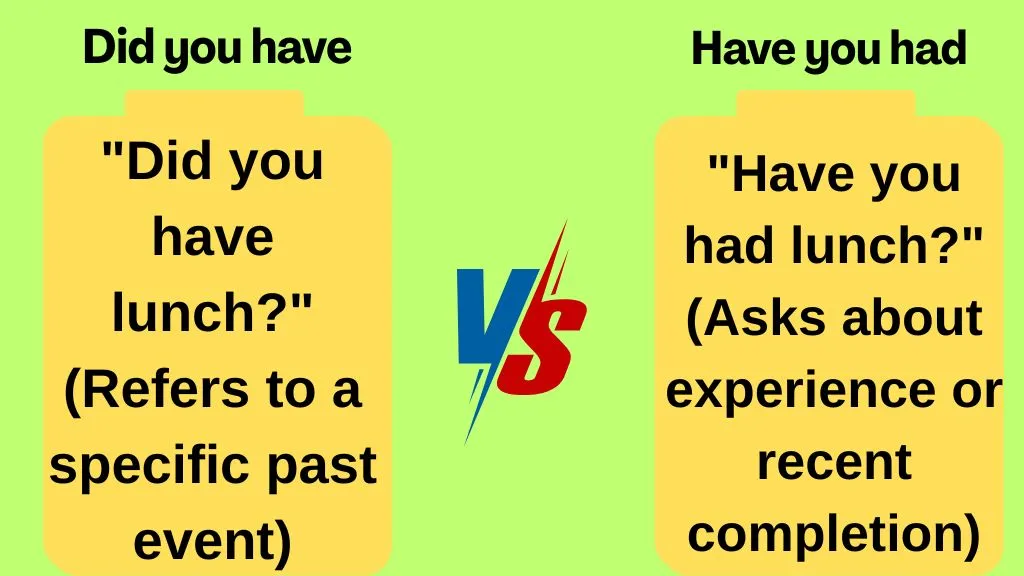
    Another area of confusion is the difference between “Did you have” and “Have you had”. While they may look similar, they serve different grammatical functions.

    Key Differences:

    PhraseTenseUsage Example
    Did you haveSimple past“Did you have lunch?” (Refers to a specific past event)
    Have you hadPresent perfect“Have you had lunch?” (Asks about experience or recent completion)

    Use “Did you have” when asking about a specific moment in the past. Use “Have you had” when asking whether something has happened at any point up to now.


    Correct Use in Everyday Situations

    Asking About Past Events

    When inquiring about past actions, always use “Did you have”:

    • Did you have fun at the concert last night?
    • Did you have a good vacation?

    Inquiring About Past Possessions or Experiences

    When asking about past possessions or experiences, “Did you have” is also correct:

    • Did you have a dog when you were younger?
    • Did you have a bicycle as a child?

    Strengthen Your Grammar: Practice Examples and Tips

    Practice Sentences:

    Fill in the blanks with “Did you have” or “Have you had”:

    1. ___ a chance to visit Paris before?
    2. ___ time to complete your homework last night?
    3. ___ any experience working in a restaurant?
    4. ___ breakfast this morning?

    Quick Tips to Remember:

    ✔ Always use “Did you have” for past events.
    ✔ Never say “Did you had.”
    ✔ Use “Have you had” for asking about past experiences or recent actions.


    FAQs

    1. Why is “Did you had” incorrect?

    “Did” is already in the past tense, so the main verb must stay in its base form. Saying “Did you had” adds an unnecessary past tense marker. The correct form is “Did you have?”

    2. When should I use “Did you have”?

    Use “Did you have” when asking about a specific past event. Example: “Did you have a good time yesterday?”

    3. What’s the difference between “Did you have” and “Have you had”?

    “Did you have” refers to a specific event in the past, while “Have you had” is used for experiences or something that happened recently.

    4. How do I form negative sentences with “Did you have”?

    For negatives, use didn’t and keep have in its base form: “I didn’t have time,” not “I didn’t had time.”

    5. Can “Did you have” be used in formal writing?

    Yes! “Did you have” is grammatically correct and can be used in both formal and informal English.

    6. How can I practice using “Did you have” correctly?

    Try writing sentences using “Did you have” for past events. Example: “Did you have breakfast this morning?” Avoid using “Did you had.”


    Conclusion

    The difference between “Did you have” and “Did you had” is simple once you understand the rules of auxiliary verbs and past tense questions. Remember:

    • “Did” already marks the past, so the main verb should remain in its base form (have).
    • “Did you had” is always incorrect.
    • “Did you have” is used for specific past events, while “Have you had” refers to past experiences.

    By practicing these structures, you’ll improve your fluency and confidence in English. Keep learning and applying these rules, and soon, using correct grammar will become second nature!

  • Felt or Feel ? Learn the Right Usage! ✅✨

    Felt or Feel ? Learn the Right Usage! ✅✨

    Language can be tricky, especially when two words seem closely related yet serve different purposes.

    Feel and felt are two such words that often cause confusion. Though they share the same root, they operate in different grammatical contexts.

    Understanding when to use feel versus felt is key to clear and effective communication. Let’s break it down in detail.

    Should you say feel or felt? The difference lies in verb tense—feel is present, while felt is past. Learn when to use each correctly with examples and grammar tips!


    Unveiling the Verbs: Understanding ‘Feel’ and ‘Felt’

    Feel or Felt

    At their core, feel and felt both relate to sensory perception, emotions, and states of being. However, they differ in terms of verb tense and application.

    • Feel is the present tense form of the verb.
    • Felt is the past tense and past participle form of the verb.

    By keeping this fundamental difference in mind, you can ensure you’re using the correct word for the appropriate time frame.


    Usage in Context: When to Use ‘Feel’ for Present Experiences

    We use feel when describing:

    • Current emotions or sensations
    • General truths
    • Ongoing states

    Examples of ‘Feel’ in Sentences

    ContextSentence Example
    Physical sensation“I feel cold in this air-conditioned room.”
    Emotional state“I feel happy when I listen to music.”
    Opinion or impression“I feel that this book is too long.”
    State of being“I feel tired after working all day.”

    By using feel, you indicate that the experience or emotion is happening right now or applies generally.


    Conveying Current Sensations and Emotions

    The verb feel is commonly used to describe:

    • Sensory perceptions (I feel the soft fabric.)
    • Emotional states (I feel excited about my vacation.)
    • Physical conditions (I feel dizzy after spinning in circles.)

    Because feel connects directly to personal experience, it plays a crucial role in expressing how we relate to the world around us.


    Exploring Idiomatic Expressions with ‘Feel’

    The word feel appears in numerous idiomatic expressions that enhance everyday speech. Here are some popular ones:

    • “Feel under the weather” – To feel sick or unwell.
    • “Feel out of place” – To feel uncomfortable in a situation.
    • “Feel the pinch” – To experience financial difficulty.
    • “Feel free” – To give permission or encouragement (Feel free to ask questions).

    These expressions show how feel extends beyond literal meanings into figurative speech.


    The Past Tense Puzzle: Knowing When ‘Felt’ Fits

    Now that we understand feel, let’s dive into felt.

    Felt is the past tense form of feel and is used when describing something that happened before the present moment.

    Examples of ‘Felt’ in Sentences

    ContextSentence Example
    Past physical sensation“I felt a sharp pain in my leg yesterday.”
    Past emotional state“She felt nervous before the exam.”
    Past opinion or impression“I felt that he was being rude at dinner.”
    Past experience“We felt relieved when we heard the good news.”

    Because felt refers to past events, it establishes a clear time frame that is different from feel.


    Grammar Deep Dive: Syntax and Sentiment in ‘Feel’ vs ‘Felt’

    Understanding the grammatical placement of these verbs helps prevent mistakes.

    Sentence Structures with Feel and Felt

    1. Subject + feel/felt + adjective
      • I feel happy today. (present)
      • She felt exhausted after the marathon. (past)
    2. Subject + feel/felt + like + noun/phrase
      • I feel like a winner! (present)
      • He felt like a failure after losing the match. (past)
    3. Subject + feel/felt + that + clause
      • I feel that this is the right decision. (present)
      • She felt that he was hiding something. (past)

    By following these structures, you ensure correct verb usage in different sentence formats.


    The Importance of Tense Consistency

    One common mistake is mixing tenses within the same sentence when using feel and felt. For instance:

    ❌ I feel exhausted yesterday. (Incorrect) ✅ I felt exhausted yesterday. (Correct)

    Keeping your verbs in the correct tense ensures clarity and grammatical accuracy.


    Mood and Modality: How ‘Feel’ and ‘Felt’ Express Nuances

    Both feel and felt interact with modal verbs like can, should, and might, adding layers of meaning.

    Modal VerbExample Sentence
    Can“I can feel the wind on my face.”
    Should“You should feel proud of yourself.”
    Might“He might have felt embarrassed.”

    These variations allow for different shades of meaning, from certainty to possibility.


    Nailing the Pronunciation and Common Confusions

    The pronunciation of feel and felt is straightforward:

    • Feel (/fiːl/): Rhymes with “reel.”
    • Felt (/fɛlt/): Rhymes with “belt.”

    However, some English learners confuse felt with “felt fabric,” which refers to a kind of textile material. Always consider context to determine meaning.


    ‘Feel’ and ‘Felt’ Across Variants: Regional Differences in Use

    While feel and felt are standard in both American and British English, some minor variations exist:

    • In American English, people often say “I feel like…” to introduce opinions.
    • In British English, “I feel as though…” is slightly more common in formal contexts.

    Despite these nuances, the fundamental grammar remains the same worldwide.


    FAQs

    1. What is the main difference between “feel” and “felt”?

    “Feel” is the present tense form, while “felt” is the past tense. Example: “I feel happy today” (present), “I felt happy yesterday” (past).

    2. Can “feel” be used in the past tense?

    No, feel is only for the present. To talk about the past, use felt. Example: “I felt tired after the trip.”

    3. What are common sentence structures using “feel” and “felt”?

    You can use feel/felt in these ways:

    • I feel tired. (Present state)
    • She felt tired after the race. (Past state)
    • I feel like going out tonight. (Opinion)

    4. Is “felt” always used in the past?

    Yes, felt is strictly for past tense. However, it can be used with perfect tenses, e.g., “I have felt this way before.”

    5. What are some idioms using “feel”?

    Common expressions include:

    • Feel under the weather (to be sick)
    • Feel out of place (to be uncomfortable)
    • Feel free (to give permission)

    6. Can “feel” be used with modal verbs like “can” or “should”?

    Yes! Example:

    • I can feel the wind on my face.
    • You should feel proud of your achievements.

    Conclusion

    Mastering feel and felt is essential for fluent and accurate English communication. Remember:

    • Use feel for present sensations, emotions, and opinions.
    • Use felt for past experiences, emotions, and states.
    • Keep verb tense consistent for clarity.
    • Watch for idiomatic expressions that use feel naturally.

    By applying these principles, you’ll never second-guess your choice between feel and felt again!

    Want more grammar tips? Stay tuned for our next in-depth language breakdown!

  • Brief vs Debrief 🧠💬 – Know the Real Difference Before and After Any Event!

    Brief vs Debrief 🧠💬 – Know the Real Difference Before and After Any Event!

    In communication, especially in professional settings, understanding the difference between terms like brief and debrief can significantly improve clarity.

    While they might seem similar, they serve very distinct roles across various fields. Whether in legal, military, corporate, or even casual contexts, these two terms have unique meanings and applications.

    Let’s break them down thoroughly to ensure you know when to use each correctly.

    The key difference between brief and debrief lies in timing and purpose. A brief prepares someone before an event by providing essential information, while a debrief occurs after the event to review what happened and extract lessons learned.


    Understanding the Term ‘Brief’ in Communication

    The word brief is often used to describe a concise communication that presents only the essential points without unnecessary details. It serves to inform, instruct, or give a quick overview of a situation, task, or event.

    What Does ‘Brief’ Mean?

    • Noun: A summary or outline, often a short written report.
      Example: “He gave me a brief about the meeting agenda.”
    • Verb: To inform someone quickly and clearly about something.
      Example: “She briefed the team on the new project updates.”

    In everyday communication, briefing is vital when you need to quickly share critical information or instructions. The goal is to avoid overwhelming the listener or reader with excessive details, instead focusing on the key points.


    Exploring the Origins and Uses of ‘Brief’ in Legal Contexts

    In the legal world, brief has a very specific meaning. It refers to a formal document or a written summary that presents the key facts, arguments, and legal precedents of a case. Lawyers and legal professionals use briefs to make their cases more concise and effective in court.

    Legal Briefs:

    • Purpose: To summarize and present the arguments and evidence in a case.
    • Types: Case briefs (summaries of case facts) and legal briefs (documents submitted to courts or clients).

    Example:
    A lawyer may submit a brief to the court before a trial, outlining the case’s main points and legal grounds for the lawsuit.


    Brief vs Debrief

    ‘Debrief’: Its Definition and Application in Various Fields

    Now, let’s take a look at the term debrief. Unlike a brief, which is used to inform, a debrief involves reviewing or discussing events after they’ve happened. It is the process of analyzing and reflecting on the information collected during an event or situation, typically to improve future performance or decisions.

    What Does ‘Debrief’ Mean?

    • Verb: To discuss the details of a completed task or event.
      Example: “After the operation, the team debriefed to discuss what went well and what could be improved.”
    • Noun: A meeting where information is reviewed and analyzed after an event.
      Example: “The team had a debriefing session after the project was completed.”

    A debrief can happen after any activity where reviewing the actions and results is essential for learning and future improvement.


    The Role of Debriefing in Intelligence and Military Operations

    In intelligence and military contexts, debriefing is a crucial process. It involves gathering and analyzing information from missions, operations, or intelligence reports to understand successes, failures, and potential improvements. This helps prepare for future operations and ensures that teams learn from their experiences.

    Military Debriefing:

    • Purpose: To evaluate the effectiveness of an operation or mission.
    • Process: Reviewing the mission’s outcomes, assessing performance, and discussing lessons learned.

    Example:
    After a covert operation, military personnel debrief to assess the success of the mission, discuss any unforeseen challenges, and prepare for future operations.


    Debriefing Procedures in Corporate and Project Management

    In business and project management, debriefing serves a similar purpose: reflection and review. After completing a project, teams debrief to discuss what went well and what could have been done differently. This is an essential part of post-project evaluation and continuous improvement.

    Debriefing in Business:

    • Purpose: To reflect on project outcomes and refine strategies.
    • Process: Gathering team members to analyze the project, identify challenges, and brainstorm solutions for the future.

    Example:
    After completing a marketing campaign, a company might hold a debriefing session to review the results, discuss what strategies worked, and refine their approach for next time.


    The Linguistic Relationship Between Briefing and Debriefing

    While brief and debrief are opposites in function, they are linguistically connected. Briefing sets the stage for action or an event, providing the necessary information to proceed. On the other hand, debriefing takes place afterward, serving as a reflective process to analyze and learn from what happened.

    Key Difference:

    • Briefing prepares you for what’s ahead.
    • Debriefing reflects on what’s already happened.

    This progression—briefing followed by debriefing—is common in fields where performance, analysis, and improvement are critical.


    Practical Scenarios: When to Brief and When to Debrief

    Knowing when to brief and when to debrief is crucial in ensuring effective communication. Here are a few scenarios to help clarify when to use each term:

    • Briefing:
      • Before a meeting to outline the agenda.
      • Prior to a project launch to inform the team of roles and expectations.
      • Before a military mission to prepare personnel with critical information.
    • Debriefing:
      • After a presentation to evaluate what went well and what could be improved.
      • After a project’s completion to review the results and discuss what worked.
      • After a military or intelligence operation to analyze outcomes and lessons learned.

    Quick Tip: If the event is upcoming, it’s time to brief. If it’s already completed, then it’s time to debrief.


    Preparing for Decision-Making: The Importance of Briefings

    Effective decision-making in business, military, and legal fields often hinges on a solid briefing. Without a clear understanding of the facts, challenges, and objectives, decisions can be misguided or inefficient.

    Key Benefits of a Good Briefing:

    • Clarity: Provides clear, concise, and actionable information.
    • Focus: Helps direct attention to key issues.
    • Preparedness: Ensures everyone involved is on the same page before moving forward.

    For example, before a key business presentation, a well-prepared briefing ensures the team knows their objectives, roles, and the important points to address.


    Learning from Experience: The Benefits of Effective Debriefing

    Just as a good briefing sets the stage for success, an effective debrief helps teams learn from past experiences. Debriefing is an essential tool for continuous improvement in many fields, especially those involving complex tasks or high stakes.

    Why Debriefing Matters:

    • Reflection: It provides a structured environment to think critically about the outcomes.
    • Improvement: Helps teams identify what went wrong and refine future strategies.
    • Team Collaboration: Encourages open communication and learning within the team.

    In a corporate setting, a project debrief can lead to significant improvements in future campaigns, while in a military context, it can be the difference between success and failure in future operations.


    Brief vs Debrief

    ❓ 6 FAQs with Answers

    What is the main difference between brief and debrief?

    A brief happens before an event to inform or prepare participants, while a debrief takes place after the event to analyze results, outcomes, and improvements.

    Is “debrief” just the opposite of “brief”?

    Yes, in function and sequence. A brief is forward-looking (preparation), and a debrief is backward-looking (reflection).

    Where are briefings and debriefings commonly used?

    They are commonly used in military, corporate, legal, intelligence, and project management settings, where planning and evaluation are essential.

    Can you use ‘brief’ as both a noun and a verb?

    Yes. As a noun, it refers to a summary or report. As a verb, it means to inform someone about key points.
    Example (verb): “She briefed the team.”
    Example (noun): “He gave a legal brief.”

    Why is debriefing important in business and project management?

    Debriefing allows teams to reflect on successes and failures, promote transparency, and improve future performance by learning from experience.

    Do briefings and debriefings always have to be formal?

    Not always. While often formal in professional contexts, both can be informal, like a quick team huddle before or after an event or task.


    Key Differences Between Brief and Debrief – Summary

    In summary, while brief and debrief might sound similar, their functions are quite distinct. A brief is used to inform and prepare someone for an event, while a debrief occurs afterward to reflect and analyze the results.

    Understanding when to use each term is vital for effective communication, whether in legal, military, corporate, or everyday settings.

    • Briefing: Used to prepare, inform, or outline before an event.
    • Debriefing: Used to review, analyze, and reflect after an event.

    By mastering these terms, you’ll ensure your communication remains clear and precise, no matter the context.

  • Analysis vs Analyses 🧪📚 – What’s the Real Difference? Find Out Here!

    Analysis vs Analyses 🧪📚 – What’s the Real Difference? Find Out Here!

    It’s easy to get tripped up by words that look similar—especially when the only difference is a single letter. “Analyses” vs “Analysis” is one of those common confusion points in both academic and everyday writing.

    One is singular, the other is plural—but there’s more to the story.

    This guide breaks it all down in plain English, with examples, tips, and expert insights to help you use the right word every time.

    Analysis is the singular form meaning one in-depth examination, while analyses is the plural, referring to multiple studies or evaluations. Their usage depends on how many items are being reviewed—one analysis or several analyses.


    Understanding the Basics: ‘Analysis’ Explained

    Let’s start with the foundation.

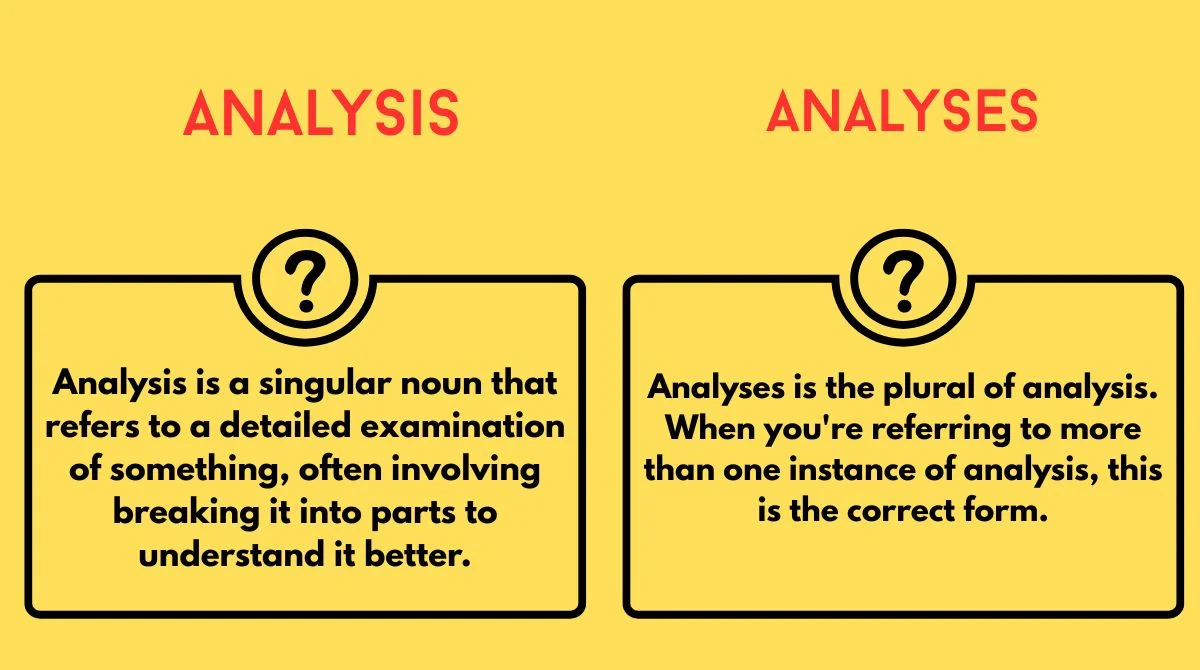
    Analysis is a singular noun that refers to a detailed examination of something, often involving breaking it into parts to understand it better.

    Examples:

    • “Her analysis of the data was insightful.”
    • “The company hired experts to conduct an environmental impact analysis.”

    In each case, we’re talking about one in-depth study or evaluation. Whether it’s text, data, behavior, or systems, analysis means digging deep to uncover meaning or patterns.

    Pronunciation tip: /ə-ˈna-lə-səs/ — emphasis on the second syllable.


    Analysis vs Analyses

    The Plural Confusion: When to Use ‘Analyses’

    Here’s where the confusion starts.

    Analyses is the plural of analysis. When you’re referring to more than one instance of analysis, this is the correct form.

    Examples:

    • “Multiple analyses were conducted to confirm the results.”
    • “The student compared various literary analyses of the novel.”

    It may look odd at first glance, but it follows a Greek-derived pluralization pattern (we’ll get to that soon).

    Pronunciation tip: /ə-ˈna-lə-ˌsēz/ — ends with a long “z” sound.


    Grammar Deep Dive: Singular and Plural Nouns in English

    English loves to break its own rules.

    Most English nouns form their plurals by simply adding -s or -es (cat → cats, box → boxes). But when a word is borrowed from another language, especially Latin or Greek, the plural rules often follow the original language’s form.

    Analysis falls into this category.
    Here’s a quick grammar check:

    WordSingularPlural
    CrisisCrisisCrises
    ThesisThesisTheses
    DiagnosisDiagnosisDiagnoses
    AnalysisAnalysisAnalyses

    These endings (-is to -es) are especially common in scientific, academic, and technical writing.


    The Greek Origin of ‘Analysis’

    Both “analysis” and “analyses” trace back to Ancient Greek.

    • The root word is ἀνάλυσις (analysis), which means “a breaking up” or “loosening.”
    • It combines ana- (up) and lysis (a loosening).

    That explains why the plural form doesn’t just add an “s.” It’s a legacy from Greek grammar, preserved in English due to its use in fields like philosophy, medicine, and science.

    This historical influence makes analyses the correct and formal plural—not “analysises.”


    Special Plural Forms in English

    English includes a handful of other Greek-derived words that pluralize like “analysis.” It’s worth knowing them if you write in academic or technical fields.

    Other examples:

    SingularPlural
    HypothesisHypotheses
    AxisAxes
    BasisBases
    ParenthesisParentheses

    Pro tip: When in doubt, don’t rely on spell-check alone. Autocorrect might not catch a wrong plural if the word still technically exists in another form.


    American vs. British English: Spelling Variations

    While American and British English often vary in spelling (think “color” vs. “colour”), the difference between analysis and analyses remains the same on both sides of the Atlantic.

    • In both dialects:
      • Analysis = singular
      • Analyses = plural

    No regional variation exists here. So whether you’re writing for an American journal or a British newspaper, the rule holds true.


    Common Mistakes and How to Avoid Them

    Let’s break down the slip-ups that happen most often—and how to dodge them.

    Mistake 1: Using “analyses” as a singular

    ❌ “Her analyses of the problem is very helpful.”
    ✅ “Her analysis of the problem is very helpful.”

    Mistake 2: Using “analysis” for multiple cases

    ❌ “The study included several analysis of the issue.”
    ✅ “The study included several analyses of the issue.”

    Mistake 3: Pronouncing both words the same

    • Analysis ends with a soft -sis sound.
    • Analyses ends with a -sees sound.

    Fixes:

    • Say the sentence out loud. Does it refer to one or multiple evaluations?
    • Match your verb form correctly (e.g., “is” vs “are”).

    Practical Examples in Academic Writing

    This word pair appears frequently in academic contexts, especially in:

    • Literature reviews
    • Research methodology
    • Data interpretation
    • Case studies

    Example Sentences from Academic Writing:

    • “This chapter presents an analysis of the key themes in postmodern fiction.”
    • “Previous analyses by Smith (2018) support this theoretical framework.”
    • “Quantitative and qualitative analyses were employed for comprehensive results.”

    These contexts demand precision, so using the wrong form can affect your credibility.


    Using ‘Analysis’ in Research Papers

    In scholarly writing, clarity is everything. Misusing singular and plural forms can weaken your argument—or confuse your readers.

    Where you’ll see “analysis”:

    • In methods sections to explain how data is examined.
    • In results sections when presenting one set of findings.
    • In discussion sections where a single perspective is explored.

    Example:

    “Our analysis of survey data shows a significant trend among first-time buyers.”

    Make sure you pair the right article or determiner:

    • “An analysis” (singular)
    • “Several analyses” (plural)

    Importance of Pluralization in Scholarly Work

    In formal research, getting the grammar right isn’t just about style—it’s about accuracy.

    If your work involves:

    • Comparing multiple studies
    • Conducting tests on various samples
    • Discussing findings from different models

    …then “analyses” will be your go-to form.

    Proper pluralization shows:

    • You understand your subject deeply.
    • You respect academic norms.
    • You can communicate ideas clearly and precisely.

    It might seem small, but it contributes to the overall credibility of your writing.


    Getting It Right: Tips for ESL Students

    For English learners, this word pair can be particularly tricky. But don’t worry—here are smart strategies to remember which one to use.

    Simple Memory Tricks:

    • Singular = Ends in -sis → one analysis
    • Plural = Ends in -ses → many analyses

    Visual Cue:

    Think of the letter “e” in analyses as extra evidence—multiple studies, multiple evaluations.

    Grammar Tip:

    Use is with analysis
    Use are with analyses

    Examples:

    • “This analysis is compelling.”
    • “These analyses are consistent with past research.”

    Practice Makes Perfect:

    Try writing your own sentences with both words. Then swap them and read them aloud—you’ll quickly hear when something sounds off.


    Analysis vs Analyses

    ❓ 6 FAQs with Answers

    What is the difference between analysis and analyses?

    Analysis refers to a single, detailed examination, while analyses is the plural form, used when discussing multiple examinations or evaluations.

    Is ‘analyses’ a correct word in English?

    Yes, analyses is the grammatically correct plural of analysis, commonly used in academic, scientific, and research writing.

    How do you pronounce ‘analysis’ and ‘analyses’?

    • Analysis: /ə-ˈna-lə-səs/
    • Analyses: /ə-ˈna-lə-ˌsēz/
      They are pronounced differently and should not be confused.

    Why is the plural of ‘analysis’ not ‘analysises’?

    Because analysis comes from Greek, its plural follows Greek grammar rules, changing -is to -es, resulting in analyses.

    Can I use ‘analysis’ to refer to multiple studies?

    No, if you’re referring to more than one study, the correct word is analyses. Use analysis only when speaking of a single instance.

    Are there other words that change like analysis and analyses?

    Yes! Similar examples include:

    • Thesis → Theses
    • Diagnosis → Diagnoses
    • Hypothesis → Hypotheses

    Final Thoughts

    So, what’s the difference between analyses and analysis?
    In a nutshell:

    • Analysis is singular: one in-depth examination.
    • Analyses is plural: more than one.

    They’re not interchangeable—and using the wrong one can change the meaning of your sentence or muddle your message. Whether you’re an ESL student, a university researcher, or just someone looking to level up their grammar, mastering the difference is a small step with a big payoff.


    Want more grammar deep-dives like this? Let us know in the comments, or explore more on commonly confused words like “datum vs. data” or “phenomenon vs. phenomena”.

  • Disbalanced vs Unbalanced or Imbalanced? 🤔 Which One’s Correct?

    Disbalanced vs Unbalanced or Imbalanced? 🤔 Which One’s Correct?

    Have you ever paused mid-sentence wondering whether to say imbalanced, unbalanced, or disbalanced? You’re not alone.

    These terms may seem interchangeable, but they carry subtle—yet important—differences in meaning, tone, and usage. Some are far more common and widely accepted, while others raise a few linguistic eyebrows.

    In this guide, we’ll unpack the differences, trace their origins, and look at how each is used in real-world contexts. Plus, we’ll dive into how prefixes like im-, un-, and dis- shape meaning in English.

    Let’s get into it and settle this once and for all.

    “Imbalanced” is used in formal and technical contexts to describe a lack of proportion or symmetry. “Unbalanced” leans more toward instability or irregularity in everyday language. “Disbalanced” is rare and often considered nonstandard.


    Understanding Imbalance in Language: Definitions and Usage

    Disbalanced vs Unbalanced or Imbalanced

    The idea of imbalance comes from the root word balance, which refers to a state of equilibrium or stability. When something lacks that balance—whether physically, mentally, emotionally, or structurally—we say it’s not balanced.

    But here’s where things get tricky: English gives us multiple negative prefixes, and not all of them function the same way.

    • Imbalanced generally describes something that lacks proper proportions or symmetry.
    • Unbalanced often leans toward describing instability or erratic conditions.
    • Disbalanced is rarely used and often flagged as incorrect or nonstandard.

    Here’s a quick comparison table to give you a snapshot:

    TermCommon UsagePart of SpeechTypical Contexts
    ImbalancedFormal and technicalAdjectivePsychology, health, society
    UnbalancedConversationalAdjectiveEmotions, behavior, structure
    DisbalancedRare, nonstandardAdjectiveOccasionally in niche writing

    An Overview of “Imbalanced”, “Unbalanced”, and “Disbalanced”

    These three terms all attempt to express a lack of balance, but the way they do it—and how often we see them—differs.

    Imbalanced

    Used in professional, clinical, or academic contexts. You’re more likely to hear this term in reports, articles, and diagnostics.

    • Example: “An imbalanced diet can lead to nutritional deficiencies.”

    Unbalanced

    This one feels more personal or colloquial. It’s used to describe mental states, structural problems, and anything that feels off-kilter.

    • Example: “After losing his job, he seemed emotionally unbalanced.”

    Disbalanced

    Although technically understandable, this variant isn’t widely accepted in modern English. It appears in non-native usage or in niche or outdated texts.

    • Example: “The disbalanced scale tilted to one side.” (less preferred)

    Note: Most style guides and dictionaries consider disbalanced incorrect or archaic.


    How Prefixes Affect Meaning in English Vocabulary

    English loves its prefixes. But they aren’t interchangeable. Each prefix adds a different flavor to the root word:

    PrefixMeaningCommon Usage Example
    un-Not / Opposite ofUnfair, untrue
    im-Not / WithoutImpossible, immature
    dis-Apart / ReverseDisconnect, disagree

    So why imbalanced and unbalanced but not disbalanced?

    • “Unbalanced” is logical—it simply means not balanced.
    • “Imbalanced” conveys a lack or deficiency in balance, especially in composition or systems.
    • “Disbalanced” seems like it should mean disrupted balance, but it’s not idiomatic in modern English.

    That’s why disbalanced remains on the fringe.


    Historical Usage Trends of Imbalance Terms in Literature

    Let’s take a peek at how these words have been used over time. Thanks to Google Books Ngram Viewer, we can see their relative popularity.

    📈 Google Ngram Insights

    WordFirst Major UsePeak Usage PeriodCurrent Trend
    Imbalanced~1950s1980s–2000sSteady
    Unbalanced~1800s1900sStill widely used
    DisbalancedScarcely usedNever peakedNear-zero usage

    Observation:
    Unbalanced has a longer history, but imbalanced gained traction in technical fields over the past few decades. Disbalanced remains obscure.


    Examples of “Imbalanced” in Various Contexts

    Let’s explore how imbalanced fits into modern communication. This word shines in formal, clinical, and diagnostic contexts:

    🔬 In Science and Health

    • “An imbalanced hormone level can affect your mood and energy.”
    • “This imbalanced dataset skews the machine learning results.”

    🌍 In Society and Economics

    • “The imbalanced power dynamics in the workplace caused tension.”
    • “An imbalanced trade agreement may harm local industries.”

    🧠 In Psychology

    • “Therapists may address imbalanced emotional responses caused by trauma.”

    Summary:
    Use imbalanced when you want to describe a lack of symmetry, proportion, or equity, especially in serious or academic discussions.


    Delving into the Meaning and Use of “Unbalanced”

    Unlike imbalanced, the word unbalanced often feels more dynamic—or even unstable. It’s commonly used to describe mental, emotional, or structural instability.

    ⚙️ Physical or Structural

    • “The unbalanced load caused the washing machine to shake violently.”
    • “The bridge collapsed due to an unbalanced foundation.”

    😟 Emotional or Psychological

    • “She became unbalanced after the loss of her loved one.”
    • “His unbalanced behavior raised concerns.”

    🗣️ In Arguments or Viewpoints

    • “The article presented an unbalanced view of the political situation.”

    Tip:
    Use unbalanced when the issue is more about instability or irregularity, rather than a measurable inequality.


    Verbal Illustrations of “Unbalanced” in Everyday Speech

    To understand how unbalanced is used in everyday language, check out these conversational examples:

    • “Don’t walk on that! It’s unbalanced and might tip over.”
    • “He went a little unbalanced after the breakup.”
    • “That opinion seems totally unbalanced. You need both sides.”

    These examples show how common unbalanced is in informal speech. It communicates instability in a relatable way.


    “Disbalanced”: A Rare Variant in the Balance Lexicon

    Let’s address the outlier: disbalanced. While it technically could make sense—just like disagree or disassemble—it’s almost never used by native speakers or major publications.

    Why Isn’t It Accepted?

    • It doesn’t appear in most major dictionaries like Merriam-Webster or Oxford.
    • It feels awkward and unidiomatic to native English speakers.
    • It lacks historical and literary backing.

    Where Might You See It?

    • Occasionally in non-native writing
    • Translations or technical texts where “disbalance” was rendered literally
    • Rare online forums or scientific articles (usually with corrections)

    Bottom line:
    Stick to imbalanced or unbalanced—disbalanced is rarely, if ever, the right choice.


    Special Cases: Dietary and Data Specifics

    Let’s look at situations where people often mix these terms up.

    🥗 Dietary Language

    CorrectIncorrect
    “An imbalanced diet leads to health issues.”“An unbalanced diet…” (still acceptable, but less precise)
    “Too many processed foods create nutritional imbalance.”“Disbalanced nutrients…” (awkward usage)

    While both imbalanced and unbalanced are used for food, imbalanced is preferred in health-related writing.

    💾 Data Science and AI

    In technical fields like machine learning, imbalanced is standard.

    • “An imbalanced dataset has more negative than positive cases.”
    • “Unbalanced data can skew results” – less common phrasing, but still understood.

    Pro Tip:
    When writing for scientific or technical audiences, use imbalanced to sound accurate and professional.


    Faqs

    What is the difference between imbalanced and unbalanced?

    “Imbalanced” is typically used in technical or clinical contexts to describe a lack of proportion or equality, while “unbalanced” refers to instability or irregular behavior in everyday speech.

    Is ‘disbalanced’ a real word?

    While technically understandable, “disbalanced” is not commonly accepted in standard English and is rarely used in professional writing. Stick to “imbalanced” or “unbalanced” instead.

    Can I use ‘imbalanced’ in casual conversation?

    Yes, but it’s more common in formal or academic contexts. In casual speech, “unbalanced” is more natural and widely used.

    Which is correct: an unbalanced diet or an imbalanced diet?

    Both are used, but “imbalanced diet” is more precise and preferred in health and nutrition writing.

    Is ‘unbalanced’ the same as unstable?

    Often, yes. “Unbalanced” can suggest physical, emotional, or mental instability depending on the context.

    How can I remember when to use imbalanced vs unbalanced?

    Use “imbalanced” when discussing measurable inequality or proportion (like data or hormones), and “unbalanced” for mental, emotional, or physical instability.


    Conclusion: Mastering the Difference Between Imbalanced, Unbalanced, and Disbalanced

    Choosing between imbalanced, unbalanced, and disbalanced is all about context and tone.

    Here’s your quick takeaway:

    • Use imbalanced for formal, academic, or technical contexts.
    • Choose unbalanced for everyday speech and emotional or structural issues.
    • Avoid disbalanced—it’s not recognized or widely accepted.

    Remember: Just because two words look similar doesn’t mean they’re used the same way.

    Now that you know the difference, you’ll never second-guess yourself when writing or speaking about balance again.

  • “What It Looks Like” vs “How It Looks Like” 🤯 | Which One Is Right?

    “What It Looks Like” vs “How It Looks Like” 🤯 | Which One Is Right?

    The English language is full of phrases that sound right but aren’t. One of the most common examples is the confusion between “what it looks like” and “how it looks like.”

    At first glance, both may seem acceptable—but only one is grammatically correct. If you’ve ever paused before writing or saying either phrase, this guide will clear things up once and for all.

    Let’s break it down, explore the grammar rules, and look at real-world usage to master the difference with confidence.

    The correct phrase is “what it looks like,” which uses “what” to introduce a noun clause describing appearance. “How it looks like” is incorrect because it combines two conflicting structures—”how” (manner) and “like” (preposition)—making it grammatically invalid.


    Introduction to Common English Phrases

    “What It Looks Like” vs “How It Looks Like”

    Everyday English is packed with idiomatic expressions that are used so often, they feel automatic. But when phrases sound similar—like “what it looks like” and “how it looks like”—even native speakers stumble.

    Why? Because conversational habits sometimes override grammar rules. This is especially common when sentence rhythm or word patterns seem familiar, even if they’re incorrect.


    Exploring the Grammar Behind “What It Looks Like”

    Let’s start with the correct phrase: “what it looks like.”

    This expression works because “what” acts as a noun clause—it represents a thing or an idea. In this case, “what it looks like” means “the appearance of something.”

    Structure Breakdown:

    • Subject: what
    • Verb: looks
    • Complement: like (used correctly with “what”)

    Example:

    • “I don’t know what it looks like, but I’ll recognize it when I see it.”

    Here, the entire clause “what it looks like” functions as a noun—something you don’t know.


    Why “What” Is the Right Choice

    The word “what” introduces indirect questions or embedded statements. It asks for a description, object, or thing.

    Key Functions of “What”:

    • Identifies something specific
    • Introduces a noun clause
    • Acts as the object of the verb

    More Examples:

    • “She explained what it looks like to the police.”
    • “Can you tell me what it looks like?”

    These are grammatically correct because the verb “looks” requires an object, and “what” fulfills that role properly.


    Examples in Context

    Let’s look at how “what it looks like” fits naturally into sentences:

    SituationCorrect Usage Example
    Description“He drew what it looks like from memory.”
    Inquiry“Do you remember what it looks like?”
    Explanation“That’s exactly what it looks like.”

    Notice how all of these examples treat “what it looks like” as a unit—a noun clause describing a thing.


    Prepositions and Their Objects

    The word “like” is a preposition. And prepositions must be followed by a noun or pronoun, not a clause that begins with “how.”

    That’s the key issue with “how it looks like.” Grammatically, it tries to jam two different structures together—and it just doesn’t work.

    Wrong construction:

    • ❌ “I don’t know how it looks like.”

    Here, “how” introduces a manner, while “like” is looking for a noun. But there’s no proper noun or pronoun between them. That makes the sentence ungrammatical.


    The Incorrect Phrase: “How It Looks Like”

    The phrase “how it looks like” may sound right because of casual conversation, but it’s grammatically incorrect in standard English.

    Why it’s wrong:

    • “How” implies manner (e.g., “how it works”).
    • “Like” implies similarity or appearance (e.g., “looks like a car”).
    • Using both in the same phrase results in redundancy and conflict.

    Correct Alternatives:

    • ✅ “How it looks”
    • ✅ “What it looks like”

    Understanding “How” in English Questions

    While “how” is not correct in “how it looks like,” it is correct in other contexts where you’re asking about the manner in which something happens.

    Examples of Correct Usage:

    • “How does it look?” (asking about appearance)
    • “I’m not sure how it looks after the redesign.”

    Here, there’s no “like” because “how” already implies the question of appearance or manner.


    Distinguishing Between “How It Looks” and “What It Looks Like”

    These two phrases are both grammatically correct—but they serve different purposes.

    PhraseUsageMeaning
    How it looksManner or condition“I don’t like how it looks now.”
    What it looks likeIdentity or description“That’s not what it looks like.”

    Quick Tip:

    • Use “how” when focusing on quality or condition.
    • Use “what” when referring to identity or visual appearance.

    Asking for Descriptions versus Value Judgments

    When someone says:

    • “Tell me what it looks like,” they want a description.
    • “Tell me how it looks,” they want a judgment or evaluation.

    Think of it this way:

    • What = physical details
    • How = opinion or manner

    Examples:

    • “Describe what it looks like so I can find it.” (detail)
    • “How does it look on me?” (judgment)

    Correcting Common Mistakes with “How” and “What”

    Common Mistake:

    • ❌ “Can you tell me how it looks like?”

    Correct Versions:

    • ✅ “Can you tell me how it looks?”
    • ✅ “Can you tell me what it looks like?”

    Correction Strategy:

    1. Identify what you’re asking: a description or a judgment.
    2. Choose “what” for things and descriptions.
    3. Choose “how” for manners and evaluations.
    4. Never use “like” with “how” in this context.

    Misconceptions Among Native and Non-Native Speakers

    Even native English speakers fall into the trap of using “how it looks like” due to regional dialects or conversational shortcuts. For non-native speakers, the confusion often comes from direct translations.

    For example:
    In some languages, both “how” and “what” might be translated from the same word, leading to structural mix-ups in English.

    Common Non-Native Pitfall:

    • Translating from a language that uses “how” for “what”
    • Applying patterns from casual speech or movies without grammar awareness

    Solution: Focus on the structure of English noun clauses and prepositional rules.


    Practical Tips for Mastering English Phraseology

    1. Read native-level writing. Notice how phrases like “what it looks like” are used in articles, books, and dialogue.
    2. Practice substitution. Replace “what it looks like” with “the appearance of it.” If it makes sense, you’re using it right.
    3. Avoid double constructions. Don’t mix “how” with “like” unless “like” is part of a different clause.
    4. Use grammar tools wisely. Grammarly, Hemingway Editor, and similar platforms can highlight these errors.
    5. Listen actively. Pay attention to how fluent speakers form questions and make descriptions.

    Faqs

    Which is correct: “what it looks like” or “how it looks like”?

    “What it looks like” is the correct phrase. “How it looks like” is ungrammatical because it incorrectly combines “how” (manner) with “like” (a preposition).

    Why is “how it looks like” incorrect?

    Because “how” introduces manner, and “like” requires a noun object. Using them together without proper structure leads to redundancy and incorrect grammar.

    What does “what it looks like” mean?

    It refers to the visual appearance or description of something, functioning as a noun clause in a sentence.

    Can I say “how it looks”?

    Yes. “How it looks” is grammatically correct when referring to evaluation or condition—for example, “I don’t like how it looks now.”

    How do I know when to use “what” vs “how”?

    Use “what” when asking for a description (identity). Use “how” when asking for a condition, opinion, or manner of something.

    Is “how it looks like” ever used by native speakers?

    Yes, but it’s considered incorrect. It may appear in informal speech or regional dialects, but it’s not accepted in standard grammar.


    Conclusion: Simplifying Complex English Language Rules

    In the battle between “what it looks like” and “how it looks like,” only one emerges grammatically correct—and that’s “what it looks like.”

    While both “what” and “how” are valuable tools in English, they serve distinct grammatical functions. Understanding when to use each helps improve clarity, fluency, and confidence in communication.

    So next time you find yourself second-guessing the phrase, just remember:
    Use “what it looks like” when describing something. Use “how it looks” when giving an opinion. Never use “how it looks like.”

  • “Wish You” vs “Wishing You” 💌 | Which Is Correct & When to Use Each

    “Wish You” vs “Wishing You” 💌 | Which Is Correct & When to Use Each

    You’ve probably written a card or sent a message that started with “Wish you…” or “Wishing you…” But have you ever stopped and wondered—which one is correct?

    Are they interchangeable, or does one fit better depending on the context?

    Let’s dig into the differences between “wish you” and “wishing you,” with clear explanations, examples, and usage tips so you can always send your well-wishes with confidence.

    Both “wish you” and “wishing you” are correct, but they aren’t interchangeable. Use “wish you” in complete, formal sentences with a subject (“I wish you success”), and use “wishing you” in casual, standalone messages (“Wishing you all the best!”). Context determines the right choice—read on to see how to use each properly.


    Understanding “Wish You” in Everyday Expressions

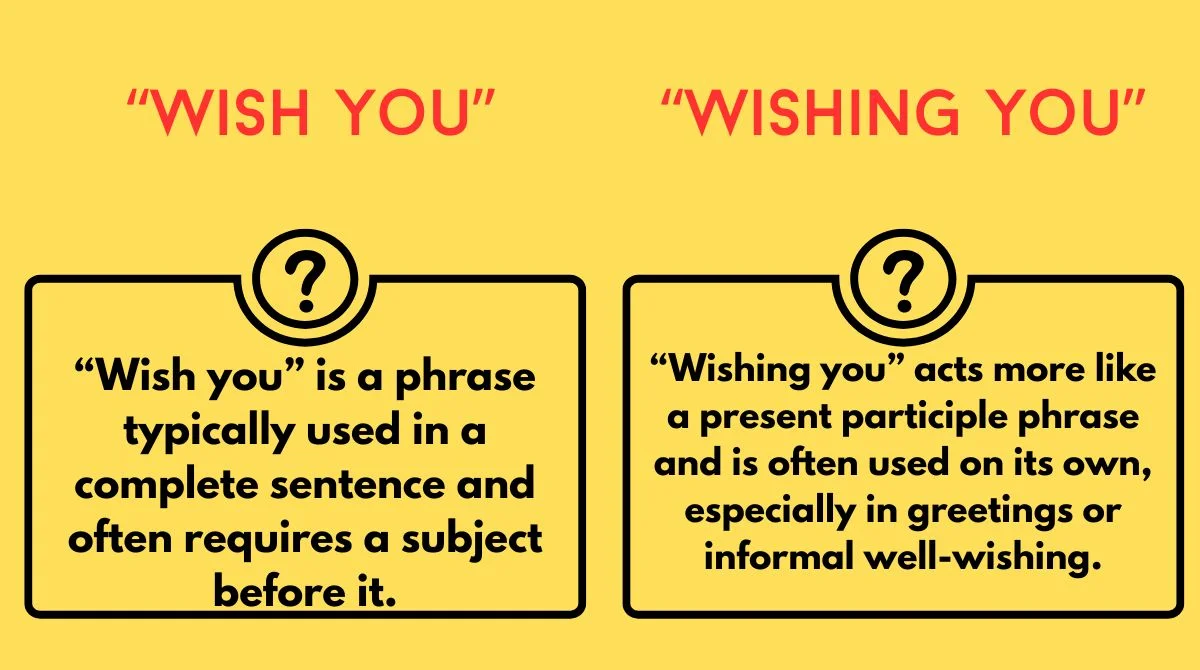
    “Wish you” is a phrase typically used in a complete sentence and often requires a subject before it. It is the base form of the verb “wish,” and it generally conveys a formal or direct tone.

    Common Uses:

    • “I wish you success in your new role.”
    • “We wish you a safe journey.”
    • “They wish you all the best.”

    Key structure:

    Subject + wish + object (you) + complement

    This structure is straightforward and commonly used in speech and writing. It appears more formal, making it a better fit for business communication or serious contexts.

    Important Tip:

    • Without a subject, “wish you” often feels incomplete or grammatically awkward.
      • ❌ Wish you a happy birthday. (Incorrect without context)
      • ✅ I wish you a happy birthday.
    “Wish You” vs “Wishing You”

    The Nuances and Uses of “Wishing You”

    “Wishing you” acts more like a present participle phrase and is often used on its own, especially in greetings or informal well-wishing. It doesn’t always need a clear subject because it implies one (often “I” or “we”).

    Common Uses:

    • “Wishing you all the best!”
    • “Wishing you a wonderful weekend.”
    • “Wishing you peace and happiness.”

    It’s often used in writing where warmth and brevity matter, such as:

    • Greeting cards
    • Email sign-offs
    • Social media posts
    • Wedding or birthday messages

    Tone and Style:

    • “Wishing you” is warmer and more emotionally expressive.
    • Ideal for personal communication or when you want to sound more heartfelt.

    Formal Celebrations and Toasts

    When you’re writing or speaking at formal events—like weddings, anniversaries, graduations—choosing between wish you and wishing you depends on tone and sentence structure.

    Formal Examples with “Wish You”:

    • “We wish you a lifetime of happiness together.”
    • “On behalf of the company, I wish you continued success.”

    More Casual, Toast-style Examples with “Wishing You”:

    • “Wishing you joy, love, and laughter today and always.”
    • “Wishing you a night to remember!”

    Quick tip: When giving a toast or writing a short, emotional message, “wishing you” often feels more natural and celebratory.


    Closing Statements in Correspondence

    In business or friendly email endings, both phrases can work—but with slightly different vibes.

    StylePreferred PhraseExample
    Professional/FormalWish you“I wish you success in your upcoming interview.”
    Warm/PersonalWishing you“Wishing you all the best for the weekend!”

    Email Sign-off Tips:

    • Use “Wishing you” to express positivity without sounding stiff.
    • Use “Wish you” when your message includes a clear subject and feels more formal.

    “Wish You” vs “Wishing You” in Common Greetings

    Let’s break down how these two phrases show up in real-world greetings.

    Greeting TypeWish YouWishing You
    Birthday“I wish you a happy birthday.”“Wishing you a happy birthday!”
    New Year“We wish you a prosperous New Year.”“Wishing you joy and success in the New Year.”
    Holiday“I wish you a Merry Christmas.”“Wishing you peace and joy this holiday season.”
    Farewell“They wish you a safe journey.”“Wishing you all the best on your travels!”

    Takeaway:
    Use “wish you” when the sentence includes a subject. Use “wishing you” when writing a standalone wish or greeting.


    The Popularity and Appropriateness of “Wish You” and “Wishing You”

    You might wonder: Which one do people use more often? And Which one sounds more natural today?

    Here’s what usage trends and stylistic preferences suggest:

    “Wishing You”:

    • More commonly used in cards, emails, and spoken well-wishes.
    • Seen as more emotionally resonant and casual-friendly.

    “Wish You”:

    • More structured and found in formal writing or professional settings.
    • Slightly less common in modern informal language.

    Expert quote:

    “Wishing you has become the go-to for personal messages because it feels more open, hopeful, and emotionally in tune with modern communication.” — LanguageStyle.org


    Insights From Google Ngram Viewer

    Using the Google Ngram Viewer, we can analyze how frequently “wish you” and “wishing you” have been used in published books over time.

    Key Findings:

    • “Wish you” had higher usage throughout the 19th and early 20th centuries.
    • “Wishing you” began gaining popularity in the late 20th century.
    • Today, both are still in use, but “wishing you” is increasingly favored for informal, expressive writing.

    Contextualizing Your Well-Wishes

    Choosing between wish you and wishing you depends entirely on the situation. Ask yourself:

    • Who am I writing or speaking to?
    • Is the tone formal or casual?
    • Is it part of a complete sentence or a standalone greeting?

    Here’s a quick-reference guide:

    ContextUse “Wish You”Use “Wishing You”
    Business Emails✔️✔️ (if warm/friendly)
    Wedding Toast✔️ (structured speech)✔️ (for personal touch)
    Greeting Card❌✔️
    Social Media Post❌✔️
    Academic/Professional Writing✔️❌

    Different Scenarios and How to Choose the Right Phrase

    Let’s walk through a few real-life situations:

    Scenario 1: Job Interview Follow-Up

    • ✅ “I wish you all the best in your interview.” (formal)
    • ✅ “Wishing you good luck tomorrow!” (friendly and supportive)

    Scenario 2: Holiday Card

    • ❌ “Wish you a Merry Christmas.” (missing subject)
    • ✅ “Wishing you a Merry Christmas and a joyful New Year!” (perfectly warm)

    Scenario 3: Office Farewell Email

    • ✅ “I wish you every success in your next role.” (professional tone)
    • ✅ “Wishing you all the best in your new adventure!” (collegial and upbeat)

    Scenario 4: Wedding Message

    • ✅ “We wish you both a lifetime of love and laughter.”
    • ✅ “Wishing you endless joy and unforgettable memories.”

    Both phrases work—you just have to match the vibe to the occasion.

    Wish You” vs “Wishing You”

    Faqs

    Which is correct: “wish you” or “wishing you”?

    Both are grammatically correct, but the usage depends on the sentence structure. “Wish you” needs a subject (e.g., “I wish you well”), while “wishing you” is often used in standalone greetings.

    When should I use “wish you”?

    Use “wish you” in formal or complete sentences where the subject is stated. It fits best in business communication, speeches, and structured writing.

    What does “wishing you” mean?

    “Wishing you” is a participial phrase commonly used to express heartfelt sentiments in cards, messages, or greetings. It implies a subject like “I” or “we” and doesn’t need to be part of a full sentence.

    Is “wish you a happy birthday” correct?

    Not on its own. It needs a subject to be complete: “I wish you a happy birthday.” Alternatively, you can say “Wishing you a happy birthday!” as a standalone message.

    Is “wishing you” formal or informal?

    “Wishing you” is generally more informal and warm. It’s great for personal communication, cards, or social media posts, but not typically used in academic or very formal writing.

    Can I use “wishing you” in business emails?

    Yes, especially in friendly sign-offs. It adds warmth without being unprofessional—for example, “Wishing you a productive week ahead!”


    Final Thoughts: Say It Right, Every Time

    So, which one is correct—wish you or wishing you?

    The answer is: both are correct, but they serve different purposes. Use wish you when writing a full, formal sentence with a clear subject. Use wishing you for personal messages, casual greetings, or heartfelt expressions.

    Now that you know the difference, you’ll never hesitate to choose the right phrase in cards, emails, or conversations.

  • Accumulative vs Cumulative 📚 | Know the Difference & Use Them Right

    Accumulative vs Cumulative 📚 | Know the Difference & Use Them Right

    Words like accumulative and cumulative often trip people up because they seem interchangeable. But here’s the catch—they’re not.

    While they share a root and both deal with growth or increase over time, they differ in nuance, tone, and usage across fields like education, finance, and even environmental science.

    So what really sets these two apart? In short: accumulative focuses more on acquisition, while cumulative emphasizes sequence and progression.

    Let’s dig into the details, clear up the confusion, and explore their real-world usage so you never second-guess them again.

    “Accumulative” and “cumulative” both relate to growth, but they aren’t the same. Use accumulative when referring to the act of collecting or gathering (e.g., wealth or data), and cumulative when describing the build-up or result of a process over time (e.g., cumulative GPA or cumulative effects). Learn how to distinguish them clearly with real-world examples.


    Accumulative vs Cumulative

    Understanding the Basics of Accumulative and Cumulative

    At first glance, accumulative and cumulative both appear to describe something growing larger through additions. And yes—they do. But here’s the twist:

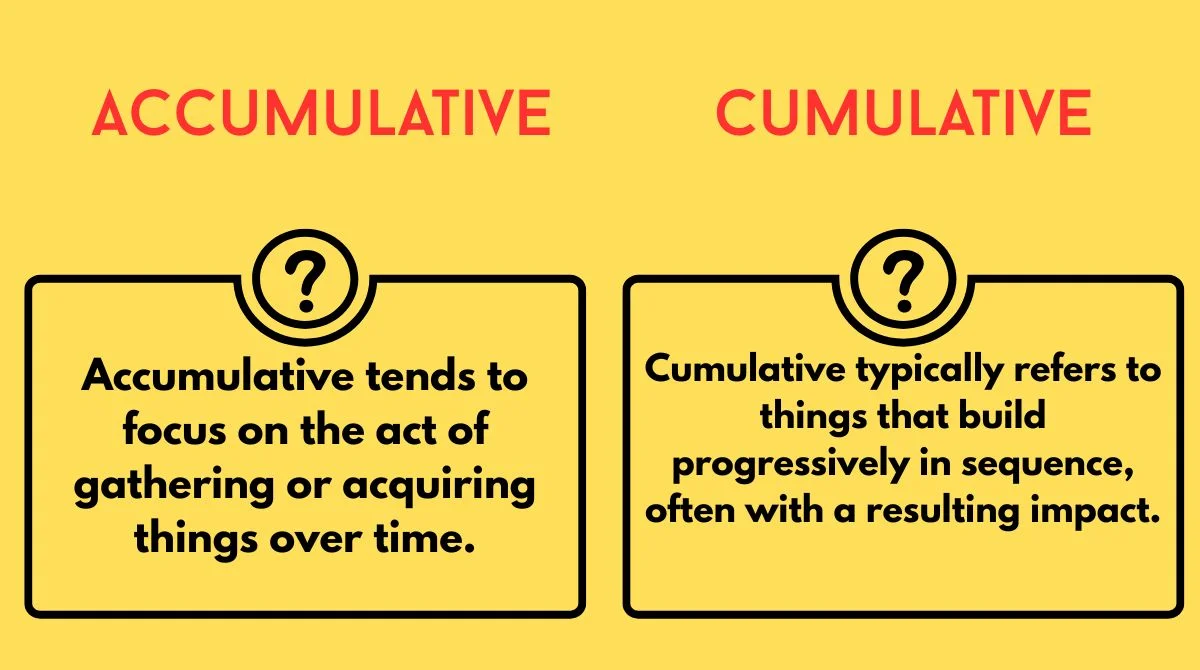
    • Accumulative tends to focus on the act of gathering or acquiring things over time.
    • Cumulative typically refers to things that build progressively in sequence, often with a resulting impact.

    These words share a Latin origin—cumulare, meaning to heap up—but their modern usage has diverged in subtle yet significant ways.


    Defining Accumulative: A Closer Look at Acquisitive Growth

    Accumulative is an adjective used to describe a gradual gathering or acquisition of something, usually in a way that emphasizes the act of collecting or hoarding.

    Characteristics of “Accumulative”:

    • Implies intentional or organic collection.
    • Often has a sense of ownership or control over what’s gathered.
    • Common in psychology, behavior, and informal economics.

    Examples:

    • He developed an accumulative habit of saving coins from every country he visited.
    • Her accumulative wealth grew steadily through smart investments.

    Synonyms:

    • Acquisitive
    • Gathering
    • Collecting

    Breaking Down Cumulative: Successive Additions Over Time

    Cumulative, on the other hand, speaks to a build-up over time—layered effects that often compound and result in an outcome or impact. It’s frequently used in scientific, educational, and technical contexts.

    Characteristics of “Cumulative”:

    • Implies ongoing sequence or progression.
    • Focuses on the total result of successive steps or events.
    • Often carries a quantifiable effect or consequence.

    Examples:

    • The cumulative effect of poor nutrition can lead to serious health problems.
    • The student’s final grade was based on cumulative assessments.

    Synonyms:

    • Increasing
    • Aggregated
    • Compound

    The Common Misconceptions and Misuses

    Here’s where people get tripped up: they use these words interchangeably—but context is everything.

    Common Errors:

    • Saying “cumulative savings” when the emphasis is on intentional collection—better to use accumulative.
    • Using “accumulative damage” in scientific contexts—cumulative is the correct term when referring to effects that build up over time.

    Quick Fix Tip:

    If you’re talking about the outcome of a process, use cumulative.
    If you’re talking about the act of collecting, use accumulative.


    The Nuances of Usage in Different Contexts

    Let’s break down how each word shows up across different domains:

    DomainAccumulativeCumulative
    FinanceAcquiring assetsCompounding returns
    EducationLearning habitsTest formats
    ScienceBehavioral traitsEnvironmental impacts
    TechnologyUser data collectionSoftware updates/effects
    PsychologyHoarding behaviorStress buildup

    The takeaway? Accumulative often has a qualitative focus, while cumulative leans quantitative.


    Exploring Examples in Real-World Scenarios

    Understanding these words becomes easier when we apply them to relatable situations.

    Example 1: Personal Growth

    • Accumulative: Over the years, she developed accumulative knowledge from her travels.
    • Cumulative: Her insights were the cumulative result of years of experience.

    Example 2: Workplace Performance

    • Accumulative: He gained accumulative respect through consistent leadership.
    • Cumulative: His bonus reflected cumulative achievements over four quarters.

    Example 3: Health & Lifestyle

    • Accumulative: An accumulative diet of processed foods can change eating habits.
    • Cumulative: The cumulative impact of lack of sleep is often underestimated.

    Accumulative vs. Cumulative in Financial Terms

    This is a domain where clarity matters most. Misusing these words could result in miscommunication or financial misunderstanding.

    Accumulative in Finance:

    Refers to gathering assets over time, often deliberately.

    Examples:

    • Accumulative savings account
    • Accumulative investment strategy

    Cumulative in Finance:

    Refers to returns, interest, or impact over time.

    Examples:

    • Cumulative interest
    • Cumulative return on investment

    Tip: Use accumulative when referring to what’s being built up; use cumulative when referring to how it’s grown over time.


    Educational Applications: Exam Types and Learning Processes

    In education, the two terms are used very precisely, especially when describing testing styles and learning development.

    Cumulative Testing:

    Tests that cover all prior material up to the present.

    • Encourages retention and integration of knowledge.
    • Used in final exams, standardized testing.

    Example:
    The biology final was cumulative, testing everything from the first day of class onward.

    Accumulative Learning:

    Describes the gathering of skills and understanding over time.

    • Implies a growing base of knowledge.
    • Often informal or self-directed.

    Example:
    Her accumulative learning process helped her master coding outside of school.


    Cumulative Effects and Sequences in Nature and Technology

    In both environmental science and tech, cumulative effects are crucial to understanding large-scale patterns.

    Cumulative Effects in Nature:

    • Greenhouse gases contribute to cumulative climate change.
    • Pollution has cumulative effects on marine life.

    Cumulative Sequences in Tech:

    • Software errors that build up over updates.
    • Memory usage that causes cumulative slowdowns.

    Meanwhile, accumulative might apply to how data is gathered or resources are compiled, but the lasting impact is cumulative.


    Case Studies: Environmental and Data Progressions

    Case Study 1: Environmental Impact

    Scenario: An industrial plant emits low levels of toxins.

    Accumulative: The company tracks accumulative emissions for compliance.
    Cumulative: Over 10 years, the toxins create a cumulative health risk for nearby residents.

    Case Study 2: Data Science

    Scenario: A machine learning model processes user behavior.

    Accumulative: The model collects accumulative data from multiple platforms.
    Cumulative: The algorithm’s accuracy improves cumulatively as more data is analyzed.


    Language Mastery: Tips for Remembering the Difference

    Still not confident? Here are some quick memory tricks and tools:

    Mnemonic Devices:

    • Accumulative = Acquiring intentionally
    • Cumulative = Compounding over time

    Word Associations:

    WordThink of…
    AccumulativeHoarding coins, growing a collection
    CumulativeBuilding blocks, a snowball effect

    Quick Quiz:

    Choose the correct word:
    The ___ GPA reflects your entire academic performance.
    ✅ Cumulative

    She has an ___ habit of collecting antique watches.
    ✅ Accumulative


    Accumulative vs Cumulative

    Faqs

    What is the difference between accumulative and cumulative?

    Accumulative refers to gathering or acquiring things over time, while cumulative refers to the increasing result or total impact of additions made over a period.

    Can “accumulative” and “cumulative” be used interchangeably?

    No, they are not truly interchangeable. While both involve growth, “accumulative” focuses on collection, and “cumulative” emphasizes resulting impact or total effect.

    What does accumulative mean in finance?

    In finance, “accumulative” refers to strategies focused on acquiring assets or savings over time, such as an accumulative savings plan.

    What does cumulative mean in education?

    “Cumulative” in education refers to assessments or grades that reflect the total performance across an entire course or curriculum.

    Is it correct to say “cumulative savings”?

    It depends on the context. If the emphasis is on gathered savings, “accumulative savings” is more precise. If highlighting total savings impact over time, “cumulative savings” may fit.

    How can I remember the difference between accumulative and cumulative?

    Think “accumulative = acquiring” and “cumulative = compounding.” Accumulative relates to what’s being gathered; cumulative relates to the final effect.


    Final Thoughts: Why Word Precision Matters

    Whether you’re writing a thesis, managing investments, or explaining climate change, the difference between accumulative and cumulative matters. One highlights the gathering, the other emphasizes the impact.

    Use them precisely to sound more professional, avoid misunderstandings, and sharpen your writing.

    If you’ve ever confused these two before, you’re not alone—but now, you’ve got the tools to keep them straight for good.

  • My Father and I vs. My Father and Me 🤔 | Simple Grammar Rules to Get It Right

    My Father and I vs. My Father and Me 🤔 | Simple Grammar Rules to Get It Right

    It’s a grammar question that trips up even native English speakers: Should you say “My father and I” or “My father and me”?

    While it might sound subtle, choosing the right phrase can make a huge difference in how polished and correct your English sounds.

    Don’t worry—this guide will break it all down with simple explanations, helpful tips, and plenty of real-life examples.

    The correct choice between “My father and I” and “My father and me” depends on grammar rules. Use “My father and I” when the phrase is the subject of the sentence (doing the action), and “My father and me” when it’s the object (receiving the action). Check by removing “my father”—if “I” or “me” sounds correct, you’ve got the right answer!


    Understanding Subject and Object Pronouns in English

    Before we get into “my father and I” vs. “my father and me,” let’s zoom out and look at how pronouns work in English grammar.

    There are two types of pronouns involved in this discussion:

    TypeExample PronounsRole in the Sentence
    Subject PronounsI, he, she, we, theyDo the action in a sentence (subject)
    Object PronounsMe, him, her, us, themReceive the action (object of a verb or preposition)

    Example Sentences:

    • Subject: I called the doctor.
    • Object: The doctor called me.

    The rule is simple: Use subject pronouns when the person is doing the action, and object pronouns when they’re receiving the action.


    The Correct Cases: “My Father and I” Versus “My Father and Me”

    My Father and I vs. My Father and Me

    The trickiest part is knowing when to use “I” and when to use “me.” Most people stumble when combining another person with themselves in a sentence.

    Let’s break it down:

    • Use “My father and I” when it’s the subject of the sentence.
    • Use “My father and me” when it’s the object of the sentence.

    Quick Test:

    If you remove “my father and” from the sentence, would you say “I” or “me”?

    ✅ Correct:

    • My father and I went to the game. → I went to the game.
    • The teacher gave my father and me a gift. → The teacher gave me a gift.

    ❌ Incorrect:

    • My father and me went to the game. → Me went to the game? (Nope.)
    • The teacher gave my father and I a gift. → The teacher gave I a gift? (Wrong.)

    When to Properly Use “My Father and I”

    You use “My father and I” when the two of you are doing something together—when you’re the subject of the sentence.

    Correct Examples:

    • My father and I are going to the store.
    • My father and I built a treehouse last summer.
    • My father and I love fishing on weekends.

    In each case, “I” is acting in the sentence. If you removed “my father,” it would still make sense:

    • I am going to the store.
    • I built a treehouse.
    • I love fishing.

    Pro Tip:

    Always mention the other person before yourself in formal writing:
    ✔️ My father and I
    ❌ I and my father


    Appropriate Usage of “My Father and Me”

    Use “My father and me” when the two of you are receiving an action—either from a verb or a preposition.

    Correct Examples:

    • The photographer took a picture of my father and me.
    • She invited my father and me to the ceremony.
    • The award was given to my father and me.

    Again, test it by removing “my father”:

    • The photographer took a picture of me.
    • She invited me.
    • The award was given to me.

    These all work perfectly. If “me” fits alone, then “my father and me” is the right choice.


    Polishing Your Grammar: Tips for Remembering the Rules

    Here are some simple ways to avoid confusion and sound more confident in your writing and speech:

    Quick Grammar Tips:

    • Drop the other person temporarily: Would you say “I” or “me” if you were alone?
    • Use your ear: Often, incorrect usage just sounds wrong.
    • Read aloud: If it sounds awkward, it probably is.
    • Remember the role: Are you doing something (subject)? Use “I.” Is something happening to you (object)? Use “me.”

    Common Misconceptions and Correcting Common Errors

    Many people wrongly believe that “my father and I” is always the correct and more polite choice. This has led to overcorrection—using “I” where “me” is needed.

    Examples of Misuse:

    • ❌ He gave the tickets to my father and I.
      ✅ He gave the tickets to my father and me.
    • ❌ The teacher spoke to my father and I about my grades.
      ✅ The teacher spoke to my father and me about my grades.

    Using “I” just to sound more formal often backfires and makes the sentence grammatically incorrect.


    Why “Me and My Father” Is Often Misused

    People commonly say “me and my father” in casual speech, but that order is considered informal and grammatically questionable, especially in writing.

    What’s the issue?

    • It’s impolite to mention yourself first.
    • It’s often grammatically wrong depending on the sentence.

    Better Alternatives:

    • My father and I went to the park.
    • She called my father and me.

    It’s okay to say “me and my father” in casual conversations with friends, but it’s best avoided in writing, interviews, or professional settings.

    Grammar Tip: In formal situations, always place the other person first and double-check the case of the pronoun.


    The Role of Context in Choosing ‘I’ or ‘Me’ With Family References

    Context is everything in grammar. Whether you use “I” or “me” depends entirely on how the phrase functions within the sentence.

    Let’s look at some examples to see how context changes the usage:

    SentenceSubject or Object?Correct Phrase
    My father and I are taking a road trip.SubjectMy father and I
    The gift was from my father and me.Object (preposition)My father and me
    She saw my father and me at the mall.ObjectMy father and me
    My father and I made breakfast together.SubjectMy father and I
    They waved at my father and me from the car.ObjectMy father and me

    Always check who is doing what in the sentence. That’s the best way to avoid mistakes.


    Faqs

    When do you use “My father and I”?

    Use “My father and I” when the phrase is the subject of the sentence, meaning you and your father are doing something together.

    When do you use “My father and me”?

    Use “My father and me” when the phrase is the object of the sentence, meaning you and your father are receiving the action or being affected by it.

    What’s the best way to check whether to use “I” or “me”?

    Test the sentence by removing “my father.” If “I” or “me” sounds correct alone, that’s your answer.

    Is it wrong to say “Me and my father”?

    In formal writing and speech, yes. It’s better to say “My father and I.” In casual conversations, it’s okay but still avoid it in professional settings.

    Can you say “My father and I” in the object position?

    No, use “My father and me” when it’s the object of the sentence, as “I” is for subjects and “me” is for objects.

    Why is “My father and I” used so often?

    People overcorrect by using “I” to sound more formal. However, using it incorrectly can make the sentence grammatically wrong.


    My Father and I vs. My Father and Me

    Final Thoughts: Mastering the “My Father and I” vs. “My Father and Me” Dilemma

    The difference between “my father and I” and “my father and me” comes down to subject vs. object, and mastering this can make your English sound more fluent and polished.

    Here’s your cheat sheet:

    • ✅ Use “My father and I” when you’re the subject (doing something).
    • ✅ Use “My father and me” when you’re the object (something is being done to you).
    • 🚫 Avoid “Me and my father” in formal speech or writing.
    • 🧠 Use the solo pronoun test: remove “my father” to figure out if it should be “I” or “me.”

    Final Tip:

    If you’re ever unsure, say the sentence aloud without the other person’s name. If it sounds right with just “I” or “me,” you’ve got your answer!

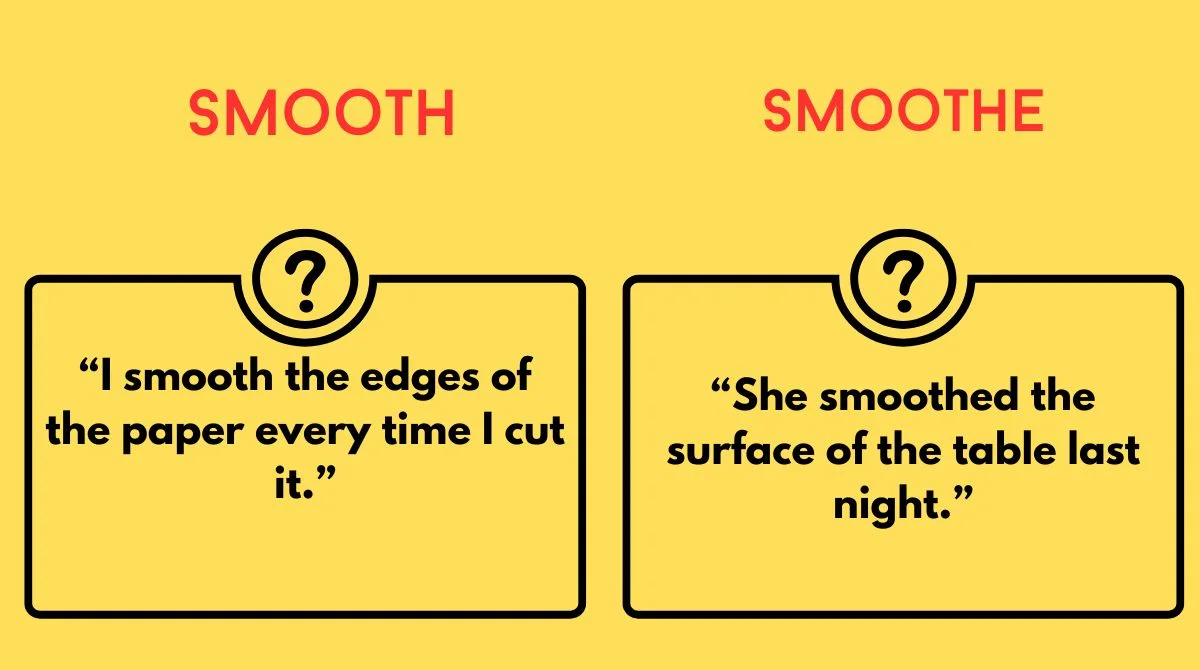
  • Smooth vs Smoothe: Which One Is Correct? 🤔 | Clear Grammar Tips

    Smooth vs Smoothe: Which One Is Correct? 🤔 | Clear Grammar Tips

    English is full of confusing words that look and sound alike, and smooth and smoothe are prime examples.

    Despite the fact that many people mistakenly add an “e” to smooth, the correct term is always smooth.

    This article will break down the differences, explore common misconceptions, and ensure you leave with a solid understanding of how to use smooth in your writing and speech.

    The correct spelling is always smooth, not smoothe. While many mistakenly add an “e” to soften the word, smooth is both the adjective and verb form, describing something even, glossy, or free from roughness. Smoothe is a common error with no basis in modern English.


    Understanding the Proper Spelling and Use of Smooth

    Let’s start by addressing the elephant in the room: smooth is the correct spelling, and smoothe is not recognized as a standard word in the English language.

    Many people mistakenly believe that adding an “e” makes the word sound softer or more refined, but in reality, the “e” at the end of smoothe is simply an error.

    Smooth as a Standard Word

    • Adjective: Describes something that is even, without bumps, or free of roughness.
      Example: “The surface of the table is smooth.”
    • Verb: Refers to the action of making something smooth, usually by rubbing or polishing.
      Example: “She smoothed out the wrinkles in her dress.”

    Smooth vs Smoothe

    Defining Smooth as a Verb and an Adjective

    Smooth as a Verb

    As a verb, smooth means to make something more even or to remove imperfections. The action of smoothing often involves physical effort, such as rubbing or polishing. It can also refer to actions that reduce tension or conflict.

    Examples of Smooth as a Verb:

    • “She smoothed the fabric with her hands to remove the wrinkles.”
    • “He tried to smooth things over after the argument.”

    Smooth as an Adjective

    When used as an adjective, smooth describes the texture or appearance of something. It suggests an absence of roughness or unevenness.

    Examples of Smooth as an Adjective:

    • “The road was smooth, making the drive very comfortable.”
    • “Her skin felt smooth after using the lotion.”

    The Correct Conjugations of Smooth

    Unlike some irregular verbs, smooth is conjugated in a predictable and simple way. Let’s take a closer look at its various forms.

    • Base form: smooth
    • Past tense: smoothed
    • Past participle: smoothed
    • Present participle/gerund: smoothing

    The correct conjugations follow the standard pattern of regular verbs, adding “-ed” in the past tense and present participle. This makes smooth straightforward to use in various tenses.

    Examples:

    • “She smoothed the surface of the wood yesterday.”
    • “He is smoothing the edges of the paper right now.”

    The Common Misconception: Smoothe Revealed

    The word smoothe has been circulating in modern English, often as a mistake for smooth. However, this is simply a misconception based on a misunderstanding of English spelling conventions.

    Why the ‘E’ Is Unnecessary

    The idea that smoothe might be a valid spelling likely comes from old English forms or confusion with similar-sounding words that do end with an “e.” In the 16th and 17th centuries, some words, like love, were often written with an “e” at the end, but this was a feature of older English spelling. The addition of “e” in smoothe does not fit modern grammatical standards.

    Smoothe in Modern Usage

    Though some may use smoothe in an attempt to soften the word, it is not recognized in standard dictionaries. The correct and widely accepted form is smooth.


    Exploring the English Language: Smooth vs. Other Similar Words

    In English, smooth has a few close relatives that might lead to confusion, especially when comparing them in certain contexts. Let’s take a look at some of these terms:

    Smooth vs. Sleek

    While both words can describe something that is even or glossy, sleek often refers to something that looks stylish or well-groomed, especially in the context of people, animals, or even vehicles.

    • Smooth: Refers more to texture and physical sensation.
      Example: “The countertop is smooth to the touch.”
    • Sleek: Often used to describe something aesthetically pleasing and shiny.
      Example: “The car had a sleek design with a shiny finish.”

    Smooth vs. Polished

    Polished implies a high level of finish or refinement, often associated with skill or effort.

    • Smooth: More about the texture or surface quality.
    • Polished: Refers to something that has been refined to a high standard, often used metaphorically.
      Example: “Her polished performance earned her a standing ovation.”

    Conjugation of Smooth

    We’ve touched on this in an earlier section, but let’s take a moment to dive deeper into the conjugations of smooth to ensure you can use it with precision.

    Present Tense

    • “I smooth the edges of the paper every time I cut it.”
    • “They smooth the fabric before stitching it together.”

    Past Tense

    Smooth vs Smoothe
    • “She smoothed the surface of the table last night.”
    • “He smoothed out the situation with a simple apology.”

    Future Tense

    • “I will smooth the wrinkles out of my shirt before the meeting.”

    Present Participle

    • “She is smoothing out the rough patches in her relationship.”

    Smooth in Action: Examples of Correct Usage in Sentences

    To further clarify the usage of smooth, here are some real-world examples that demonstrate its proper application.

    Correct Usage as an Adjective:

    • “The river was smooth, and the boat glided effortlessly.”
    • “After the haircut, his hair looked sleek and smooth.”

    Correct Usage as a Verb:

    • “She smoothed her hands over the fabric to remove any creases.”
    • “He worked hard to smooth out the wrinkles in their communication.”

    Smoothe and Smoothen: Misuses in Modern Writing

    In addition to smoothe, some people mistakenly use smoothen as a verb, which is unnecessary and incorrect.

    The Nonexistent “Smoothen”

    In standard English, smooth is both the noun and verb form, and there is no need to add an “en” to the verb. Smoothen might seem to be a logical verb form, but it is not grammatically accepted.

    Incorrect: “She will smoothen the paper before folding it.”
    Correct: “She will smooth the paper before folding it.”


    Ensuring Linguistic Accuracy: The Importance of Correct Spelling in Communication

    Correct spelling isn’t just about following grammatical rules—it’s crucial for clear, effective communication. Using words like smooth correctly ensures that your message is not only accurate but also professional and easy to understand.

    Why Correct Spelling Matters:

    • Credibility: Consistent, accurate spelling shows attention to detail.
    • Clarity: Mistakes like using smoothe instead of smooth can confuse your audience.
    • Professionalism: Proper spelling reflects well on your writing skills, whether it’s a casual blog post or a formal business email.

    By mastering the correct usage of smooth, you’ll improve both your writing and your ability to communicate effectively.


    Faqs

    What’s the difference between “smooth” and “smoothe”?

    “Smooth” is the correct spelling. “Smoothe” is an incorrect variation that many mistakenly use but is not recognized in modern English dictionaries.

    When should I use “smooth” as a verb?

    Use “smooth” as a verb when describing the action of making something even or free from wrinkles, such as smoothing a surface or smoothing out a problem.

    Can “smoothe” be used in modern English?

    No, “smoothe” is not recognized as a correct word in standard English. The proper term is always “smooth.”

    Is “smoothen” a correct form of the verb “smooth”?

    No, “smoothen” is incorrect. The verb form is simply “smooth,” with no “en” added.

    What does “smooth” mean as an adjective?

    As an adjective, “smooth” describes something that is even, glossy, or free from roughness, such as smooth skin or a smooth road.

    Why do people mistakenly use “smoothe”?

    The confusion likely arises from old English spelling conventions or the mistaken belief that the “e” softens the word, but modern English does not include “smoothe.”


    Conclusion

    In conclusion, smooth is the correct spelling, and smoothe is nothing more than a common mistake. Understanding the proper use of smooth, both as a verb and an adjective, will help you write and speak more clearly and accurately.

    Remember, language is all about precision, and knowing when and how to use words like smooth can make all the difference in your communication.

    Now that you have a deeper understanding of smooth, keep an eye out for other commonly confused words and continue to refine your language skills. If you have any questions or want to share your thoughts, feel free to leave a comment below!