Blog

  • ✨ Invision or Envision? Get the Correct Answer!

    ✨ Invision or Envision? Get the Correct Answer!

    When it comes to choosing between “invision” and “envision,” you might feel a bit uncertain. While the words may seem interchangeable at first glance, one is the correct form while the other is a persistent misspelling.

    Is it “invision” or “envision”? The answer is clear: “envision” is the correct word for imagining or visualizing something. Find out why!

    Let’s explore the origins, meanings, and proper usage of “envision” and uncover why “invision” doesn’t belong in standard English.


    Understanding the Common Confusion Between Invision and Envision

    It’s easy to see why people confuse invision and envision. The prefixes “in-” and “en-” are phonetically similar, which can cause uncertainty in spelling, especially when typing quickly or relying on autocorrect.

    The confusion is further compounded by the influence of related words like invisible or invite, which share the prefix “in-.” However, envision is the only correct term in English for imagining or visualizing something in your mind.


    The Origin and Evolution of the Word “Envision”

    The word envision traces its roots back to the French word envisager, meaning “to consider or contemplate.”

    It first appeared in English during the late 19th century, derived from the prefix en- (meaning “in” or “within”) and the Latin word visionem (meaning “sight” or “vision”).

    Initially used in philosophical and literary contexts, envision grew in popularity as a way to express imaginative foresight, such as planning for the future or visualizing abstract concepts.


    From Old Spellings to Modern Usage

    In early English texts, words with the prefix “en-” often appeared in variant spellings like “in-” due to inconsistent standardization in spelling. For example:

    • Enquire and inquire were used interchangeably for centuries.
    • Similarly, older spellings of words like envision sometimes appeared as invision, particularly in unstandardized texts.

    However, with the development of modern dictionaries and linguistic rules, envision became the established spelling, while invision was relegated to the status of a misspelling.


    How Language Evolution Affects Spelling

    Language constantly evolves, and spelling norms often shift over time. The persistence of invision as a misspelling can be attributed to:

    1. Phonetic Similarity: The “en-” prefix sounds nearly identical to “in-” in spoken English.
    2. Influence of Other Words: Words like invisible or invention may subconsciously lead people to write invision.
    3. Autocorrect Errors: Autocorrect may not always flag invision as incorrect, especially if it’s part of a name or brand (e.g., “InVision” design software).

    Despite these factors, envision remains the only correct form when referring to imagining or visualizing something.


    Correct Usage of Envision in American and British English

    Both American and British English recognize envision as the standard spelling. Here’s how it’s used in various contexts:

    • American English:
      • “The CEO envisions a future where renewable energy is the norm.”
    • British English:
      • “She envisions a world without poverty and inequality.”

    While spelling differences often exist between American and British English (e.g., color vs. colour), envision is consistent across both dialects.


    Envision vs Invision: Clarity on Proper Spelling

    Envision vs Invision

    To avoid confusion, remember this simple rule: Always use “envision” when referring to imagining or visualizing.

    Quick Comparison Table

    WordCorrect Spelling?MeaningExample Usage
    Envision✅ YesTo imagine or visualize“She envisions herself achieving her dreams.”
    Invision❌ NoNot a valid word in standard EnglishN/A

    Envision is the only correct term in English. Any use of invision is either a typo or an intentional usage in a brand name or proprietary context (e.g., InVision software).


    Why Invision Is a Persistent Misspelling

    The prevalence of invision as a misspelling stems from both linguistic and technological factors:

    1. Brand Influence: Companies like InVision (a popular design collaboration platform) have popularized the non-standard spelling, leading to accidental use in unrelated contexts.
    2. Lack of Awareness: Many people are unaware that invision isn’t an actual word in English.
    3. Typing Errors: The proximity of “i” and “e” on a keyboard often results in typographical errors.

    To avoid mistakes, double-check your spelling and consider using grammar tools like Grammarly or Microsoft Editor for professional writing.


    Expanding Your Vocabulary: Synonyms and Usage of Envision

    Expanding your vocabulary can help you avoid overusing envision. Here are some synonyms and examples of how to use them:

    Synonyms for Envision

    • Imagine: “Can you imagine a world without technology?”
    • Visualize: “The artist visualized the final painting before starting.”
    • Foresee: “Economists foresee a rise in global temperatures over the next decade.”
    • Conceive: “She conceived a groundbreaking idea for the new project.”
    • Dream up: “They dreamed up an innovative solution to the problem.”

    Example Sentences

    1. “He envisions a life filled with success and happiness.”
    2. “Try to visualize the steps you need to achieve your goals.”
    3. “The architect conceived a futuristic design for the new building.”

    By varying your word choice, you can keep your writing dynamic and engaging.


    FAQs

    What is the correct spelling: invision or envision?

    The correct spelling is “envision.” The term “invision” is a misspelling in standard English.

    What does “envision” mean?

    “Envision” means to imagine or visualize something, often related to future possibilities or abstract ideas.

    Why is “invision” incorrect?

    “Invision” is not a standard English word. Its prevalence is mainly due to brand names like “InVision” software.

    Are “envision” and “imagine” synonyms?

    Yes, “envision” and “imagine” are synonyms, but “envision” often implies a clearer or more purposeful visualization.

    How can I avoid misspelling “envision”?

    To avoid errors, remember that “envision” starts with “en-” like “enable” or “enhance,” and always proofread your writing.


    Conclusion

    When it comes to “invision” vs. “envision,” there’s no contest: envision is the correct choice in English.

    Understanding the historical origins, proper usage, and common mistakes will help you communicate more effectively and avoid common errors.

    Whether you’re writing an essay, a business proposal, or simply texting a friend, keep this guide in mind to ensure your writing remains polished and professional.
  • 🐍 Serpent vs Snake: What’s the Difference?

    🐍 Serpent vs Snake: What’s the Difference?

    When it comes to understanding the difference between serpent and snake, the conversation goes beyond mere semantics.

    While both terms refer to the same type of reptile, their usage, symbolism, and connotations can vary significantly depending on the context.

    Are serpents and snakes the same? While they describe the same reptile, “serpent” adds a mystical, symbolic tone, whereas “snake” is used in biology. Discover their fascinating differences!

    Let’s dive into the fascinating world of serpents and snakes to unravel their differences and explore their cultural, mythological, and biological significance.


    Understanding ‘Serpent’ and ‘Snake’: Etymology and Origins

    Serpent vs Snake

    The words serpent and snake have deep linguistic roots, but their etymologies highlight the divergence in their meanings and implications.

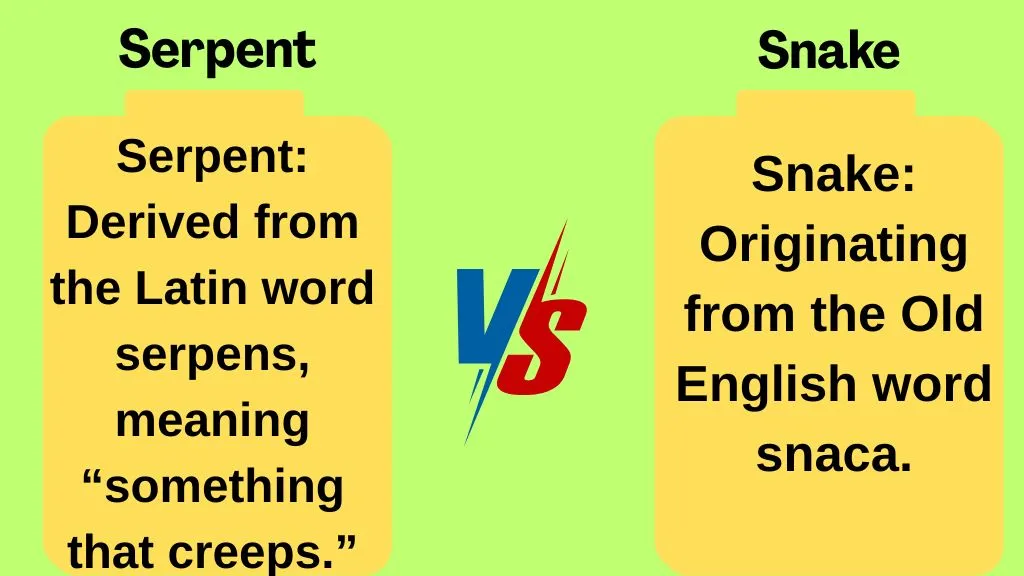
    • Serpent: Derived from the Latin word serpens, meaning “something that creeps,” this term has historically carried a more mystical and symbolic tone. Ancient texts often referred to serpents as creatures imbued with power and mystery.
    • Snake: Originating from the Old English word snaca, the term snake is more straightforward and commonly used in everyday language to describe these reptiles in a biological sense.

    Key Difference:

    While snake is primarily a zoological term, serpent often carries metaphorical and symbolic weight.


    The Cultural Significance of Serpents and Snakes

    Serpent vs Snake

    Throughout history, serpents and snakes have been revered, feared, and misunderstood. Their cultural significance is shaped by their mysterious nature and striking physical appearance.

    Serpents in Culture:

    • Frequently associated with wisdom, danger, and immortality.
    • Represented in ancient artifacts and texts as symbols of power and transformation.
    • Found in the imagery of many ancient civilizations, such as the Egyptians, Greeks, and Mayans.

    Snakes in Culture:

    • Commonly perceived as cunning or dangerous creatures.
    • Often the focus of local folklore and practical advice regarding encounters in the wild.

    While serpents are often revered in ancient contexts, snakes tend to represent a more grounded, realistic view of these creatures.


    The Symbolism of Serpents in Mythology

    Serpents have a unique place in mythology across cultures.

    • Greek Mythology: The serpent appears as a guardian of sacred spaces, such as the Python guarding the Oracle at Delphi.
    • Norse Mythology: Jörmungandr, the world serpent, embodies chaos and power.
    • Hindu Mythology: Nāgas (serpent deities) symbolize fertility, water, and protection.
    • Abrahamic Religions: The serpent in the Garden of Eden is often linked with temptation and knowledge.

    Key Takeaway:

    Serpents symbolize duality: wisdom and danger, creation and destruction.


    Snakes in Folklore and Religion

    Snakes feature prominently in folklore and religious stories, but their symbolism often contrasts with that of serpents.

    • African Folklore: Snakes are seen as omens, often representing ancestors or spirits.
    • Native American Beliefs: Many crews regard snakes as messengers or protectors.
    • Christianity: Snakes are frequently associated with sin and deceit, as seen in the story of Adam and Eve.

    Snakes, compared to serpents, are often depicted in more practical or cautionary tales, emphasizing their physical and behavioral traits.


    Modern Interpretations of These Reptiles

    Today, serpent is rarely used in a scientific context, while snake remains the go-to term for biologists and reptile enthusiasts. However, serpent persists in literature, film, and art as a symbol of mystery or malevolence.

    • In Popular Culture: Movies and books often use the word serpent to evoke fear or mystique (e.g., “The Basilisk” in Harry Potter).
    • In Science: The term snake is used universally in biological classifications, referring to over 3,000 species.

    Physical Characteristics: Serpents vs. Snakes

    From a biological perspective, there is no physical distinction between a serpent and a snake—they refer to the same animal. However, the word serpent often conjures up images of larger, more unfamiliar species.

    FeatureSnakesSerpents
    SizeAny snake, small or largeTypically evokes larger snakes
    AppearanceFocused on biological traitsOften exaggerated in art or mythology
    ExamplesGarden snake, boa constrictorHydra, Nāga, mythical basilisks

    Behavioral Tendencies: How Serpents and Snakes Diverge

    While the behaviors of snakes are well-documented, serpents in mythology are often portrayed with exaggerated or supernatural traits.

    Real Snake Behaviors:

    • Non-aggressive unless provoked.
    • Solitary hunters with efficient methods for capturing prey.

    Serpent Myths:

    • Guardian roles, such as protecting treasures or sacred spaces.
    • Depicted as cunning and malevolent in certain stories.

    Defensive Strategies and Hunting Methods

    Snakes have evolved fascinating methods for survival and hunting:

    • Defensive Strategies:
      • Camouflage to blend with surroundings.
      • Hissing and striking as warning mechanisms.
    • Hunting Methods:
      • Constriction (e.g., boa constrictors).
      • Venom delivery (e.g., cobras, vipers).

    In contrast, mythical serpents are often shown as invincible beings with magical powers.


    Habitats and Adaptations

    Snakes inhabit nearly every continent and ecosystem, demonstrating their incredible adaptability.

    EnvironmentSnake ExampleAdaptation
    DesertSidewinder snakeMoves sideways to avoid sinking in sand
    JungleGreen tree pythonPrehensile tail for climbing
    WaterSea snakeSalt glands to expel excess salt

    Serpents in mythology often inhabit otherworldly realms, emphasizing their mystical nature.


    ‘Serpent’ and ‘Snake’: Usage in Literature and Language

    The choice between serpent and snake often depends on the tone or context of the writing.

    • Serpent: Used in poetry, ancient texts, or symbolic contexts.
      Example: “The serpent coiled around the tree, whispering secrets of forbidden knowledge.”
    • Snake: Found in scientific, casual, or modern texts.
      Example: “The snake slithered across the road, startling the hikers.”

    Notable Quotes:

    • “A serpent lies hidden in the grass.” — Virgil
    • “The snake is quick, silent, and deadly.” — Field biologists

    Identifying Snakes and Serpents: A Visual and Descriptive Guide

    Visual Features for Identifying Snakes and Serpents

    • Snakes: Actual physical traits such as scales, fangs, or color patterns.
    • Serpents: Imagined or exaggerated features like glowing eyes, immense size, or ornate patterns.

    Behavioral Traits for Identifying Snakes and Serpents

    • Snakes: Observable behaviors like slithering, striking, or basking in the sun.
    • Serpents: Mythological actions such as speaking, guarding treasures, or causing destruction.

    FAQs

    What is the difference between a serpent and a snake?

    The main difference lies in usage: “serpent” often carries symbolic or mythological meanings, while “snake” is the biological term for the reptile.

    Are serpents real or mythical?

    Serpents are real but are often depicted in mythology and literature as mystical or supernatural beings, unlike snakes, which are purely biological.

    Why is the term ‘serpent’ used in mythology?

    “Serpent” evokes mystery, power, and duality, making it ideal for myths and religious stories symbolizing wisdom, danger, or transformation.

    How are snakes viewed in different cultures?

    Snakes symbolize diverse ideas—protection and fertility in Hinduism, temptation in Christianity, and ancestral spirits in African folklore.

    Can serpent and snake be used interchangeably?

    They can be interchangeable when referring to the reptile, but “serpent” is typically reserved for poetic, symbolic, or historical contexts.


    Wrapping Up the Differences Between Serpents and Snakes

    In essence, snake and serpent refer to the same animal, but their connotations and contexts are worlds apart.

    The term snake is grounded in biology, while serpent carries a rich tapestry of cultural, mythological, and symbolic meanings.

    By understanding these distinctions, we can appreciate the fascinating duality of these reptiles in language and life.

    Whether you’re reading ancient myths or observing wildlife, knowing when to use serpent versus snake adds depth to your understanding—and your vocabulary.

  • 🖋️ That’s or Thats? Grammar Made Simple!

    🖋️ That’s or Thats? Grammar Made Simple!

    English grammar can be tricky, especially when contractions come into play. One such common dilemma is whether to use that’s or thats.

    While these two forms look similar, only one of them is correct in most situations. Misusing these terms can lead to confusion, especially in formal or professional communication.

    Confused about “that’s” and “thats”? One is correct, and the other is not! Learn when to use “that’s” and avoid this common grammar mistake in your writing.

    In this guide, we’ll break down the differences between that’s and thats, explain their proper usage, and clear up misconceptions so you can always use the right form.


    Understanding the Basics: “That’s” vs. “Thats”

    That’s or Thats

    The primary difference between that’s and thats lies in their grammatical correctness:

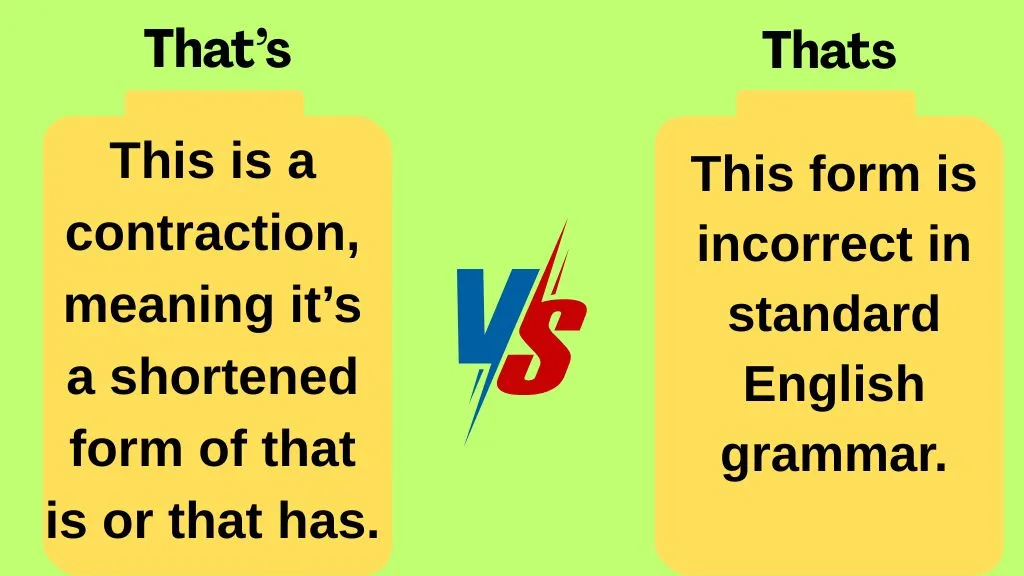
    • That’s: This is a contraction, meaning it’s a shortened form of that is or that has. It is grammatically correct and widely used.
      Example: “That’s the book I was talking about.”
    • Thats: This form is incorrect in standard English grammar. There’s no context where thats is used unless it appears as part of a name or title (e.g., the Honda That’s).

    Key takeaway: If you’re unsure, stick with that’s.


    The Correct Usage of “That’s” in Sentences

    That’s or Thats

    That’s is essential for conversational and written English. It’s used to combine two words (that is or that has) into a single, concise form.

    Examples of Correct Usage:

    1. That’s a great idea! (That is a great idea!)
    2. That’s been the case for years. (That has been the case for years.)
    3. I think that’s his car outside. (That is his car outside.)

    When used properly, that’s makes sentences sound more natural and less formal, ideal for casual or conversational contexts.


    The Contraction of “That Is”

    One of the primary functions of that’s is to stand in for that is.

    Examples:

    • That’s what I meant. (That is what I meant.)
    • That’s why we need to hurry. (That is why we need to hurry.)
    • That’s incredible! (That is incredible!)

    Using that’s in place of that is helps streamline communication without losing clarity.


    When “That’s” Means “That Has”

    In addition to that is, the contraction that’s can also replace that has.

    Examples:

    • That’s been a long time coming. (That has been a long time coming.)
    • That’s happened before. (That has happened before.)
    • That’s already been discussed. (That has already been discussed.)

    When that’s means that has, it often refers to events or actions that have occurred in the past or are ongoing.


    Examples in Everyday Language

    Here are some examples that showcase the versatility of that’s in different contexts:

    ContextExample SentenceExpanded Form
    Casual ConversationThat’s my favorite song!That is my favorite song.
    Past EventThat’s already been decided.That has already been decided.
    Explaining SomethingThat’s why we need to leave early.That is why we need to leave early.
    EmphasisThat’s the last time I’m doing that!That is the last time I’m doing that.

    Using that’s keeps sentences concise and conversational, making your speech and writing more approachable.


    Misconceptions Leading to the Common “Thats” Error

    Many people mistakenly use thats due to:

    1. Typing Errors: When typing quickly, some people forget the apostrophe in that’s.
    2. Autocorrect Issues: Autocorrect may not always flag thats as an error, especially in informal writing tools.
    3. Lack of Awareness: Some learners of English may not realize that contractions require an apostrophe to replace omitted letters.

    How to Avoid This Mistake:

    • Always double-check contractions to ensure the apostrophe is in place.
    • Read your sentences out loud to see if they make sense. If that is or that has fits, use that’s.

    Why Grammar Matters: The Importance of Using “That’s”

    Using that’s correctly might seem like a small detail, but it plays a significant role in communication. Here’s why grammar matters:

    The Impact on Professional Writing

    Incorrect grammar can undermine your credibility, especially in formal or professional settings. Imagine writing an email or report and saying, “Thats the reason for the delay.” It looks sloppy and unprofessional.

    Correct Example:

    • That’s the reason for the delay. (That is the reason for the delay.)

    Paying attention to such details ensures your writing is polished and taken seriously.


    Clarity in Communication

    Grammar isn’t just about rules; it’s about making sure your message is clear. Using thats instead of that’s might confuse readers or make them pause to figure out what you mean.

    Example of Confusion:

    • Thats incorrect. (Is this a typo?)
    • That’s incorrect. (Clear and understandable.)

    Proper usage eliminates ambiguity, allowing your audience to focus on your message rather than errors.


    Honda That’s: When “Thats” Isn’t a Mistake

    While thats is generally incorrect in English, there are rare exceptions where it’s acceptable. One notable example is the Honda That’s, a compact car model sold in Japan.

    In this case, That’s is part of a brand name and is intentionally stylized without an apostrophe. This is an exception to the rule and should not be confused with standard grammar.

    Fun Fact: The Honda That’s was marketed for its compact size and efficiency, appealing to urban drivers in Japan.


    FAQs

    What is the difference between “that’s” and “thats”?

    “That’s” is a contraction of “that is” or “that has,” while “thats” is grammatically incorrect unless part of a proper noun, such as the Honda That’s.

    Is “thats” ever correct in English?

    In standard English, “thats” is incorrect. The only exception is when it’s part of a name, like the Honda That’s.

    How do I use “that’s” in a sentence?

    Use “that’s” to replace “that is” or “that has.” Example: “That’s a great idea!” (That is a great idea.)

    Why do people confuse “that’s” with “thats”?

    Common reasons include typing errors, autocorrect issues, and a lack of understanding about the use of apostrophes in contractions.

    What are some tips to avoid the “thats” mistake?

    Double-check contractions for apostrophes, proofread your writing, and read sentences aloud to ensure “that’s” fits the context.


    Conclusion

    In summary, that’s is always the correct form in English, serving as a contraction for that is or that has. The form thats is a common error that can easily be avoided by understanding the rules of grammar and proofreading your writing.

    Whether you’re drafting an email, writing a blog post, or having a casual conversation, mastering this distinction will make your communication clearer and more professional.

    Now that you’ve got this down, why not explore other commonly confused terms? Share your thoughts or ask questions in the comments below!

  • 🚦 Impatient vs Inpatient: A Clear Grammar Breakdown

    🚦 Impatient vs Inpatient: A Clear Grammar Breakdown

    English can be a tricky language, especially when words look or sound similar but mean completely different things. Impatient and inpatient are prime examples of this.

    While they might appear related at first glance, these words belong to entirely separate categories of meaning.

    Confused between “impatient” and “inpatient”? One refers to emotions, while the other is a medical term! Learn their meanings and never mix them up again.

    In this guide, we’ll explore their definitions, delve into their origins, and provide clear examples to help you remember the difference.


    Exploring the Definition of “Impatient”

    Impatient vs Inpatient

    The word impatient is an adjective that describes a lack of patience or tolerance for delays.

    It conveys the emotional state of being restless, eager, or annoyed when something isn’t happening as quickly as desired.

    Key Characteristics of Impatient:

    • Reflects a person’s emotional state.
    • Indicates frustration or eagerness.
    • Applies to situations where waiting or tolerating is difficult.

    Example Sentences:

    • She grew impatient waiting for the doctor to arrive.
    • The child became impatient during the long car ride.

    The Emotional Implications of Being Impatient

    Impatience often stems from high expectations or urgency. While it’s a natural emotion, it can affect relationships, productivity, and personal well-being if not managed effectively.

    Common Emotional Signs of Impatience:

    • Irritability or frustration.
    • Restlessness or fidgeting.
    • An inability to focus due to eagerness for results.

    Real-life Example:
    Imagine waiting in line at the grocery store. If you’re tapping your foot, checking your watch, or sighing audibly, you’re likely feeling impatient.

    Tip: Learning to manage impatience can improve your daily interactions and reduce stress.


    Common Expressions Featuring “Impatient”

    The term impatient frequently appears in common phrases and idioms:

    • “Impatient to get started” – Describes eagerness to begin something.
    • “Impatient for results” – Indicates frustration over delays.
    • “Don’t be so impatient” – A reminder to stay calm and composed.

    These expressions emphasize the emotional nature of impatience, often tied to an underlying sense of urgency.


    The Linguistic Roots of “Impatient”

    The word impatient originates from the Latin root “im-” (meaning “not”) and “patientem” (meaning “enduring” or “bearing”). Together, they form impatientem, meaning “not able to endure.”

    Over time, this evolved into Middle English as impatient, retaining its meaning of an inability to tolerate delays.

    Fun Fact:

    The root patientem is also the basis for the word patient, showing the linguistic connection between tolerance and endurance.


    The Meaning and Usage of “Inpatient”

    Inpatient, on the other hand, is a noun or adjective used in a medical context. It refers to a person admitted to a hospital or clinic for treatment that requires an overnight stay.

    Key Characteristics of Inpatient:

    • Specifically tied to healthcare settings.
    • Involves prolonged medical care, unlike outpatient treatments.
    • Focuses on individuals who stay at a facility for observation or treatment.

    Example Sentences:

    • The hospital admitted him as an inpatient for further evaluation.
    • Inpatient care often includes 24-hour monitoring.

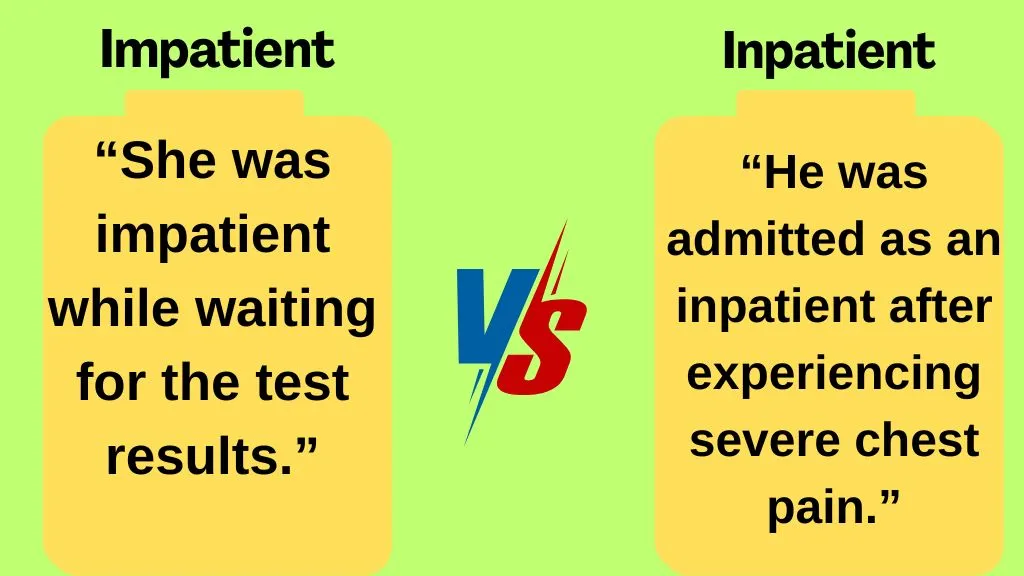
    Clarity in Context: “Impatient” and “Inpatient” in Sentences

    Impatient vs Inpatient

    To understand the difference, let’s see both words in action:

    WordExample Sentence
    Impatient“She was impatient while waiting for the test results.”
    Inpatient“He was admitted as an inpatient after experiencing severe chest pain.”

    Key Difference:

    • Impatient describes an emotional state.
    • Inpatient refers to a medical status.

    Identifying “Impatient” in Everyday Language

    You’ll often hear or see impatient used to describe common situations, especially where delays or waiting are involved.

    Examples of Impatient Behavior:

    1. A customer tapping their fingers while waiting in line.
    2. A driver honking their horn in traffic.
    3. A child asking repeatedly, “Are we there yet?”

    Quick Tip: If the context is emotional or behavioral, impatient is likely the correct choice.


    Understanding “Inpatient” Through Examples

    The word inpatient is almost exclusively used in healthcare contexts. It differentiates between patients who stay in a facility and those treated on an outpatient basis (who return home the same day).

    Examples of Inpatient Scenarios:

    1. A patient undergoing surgery that requires post-operative monitoring.
    2. Someone admitted to a psychiatric hospital for treatment.
    3. A person receiving chemotherapy that necessitates an overnight stay.

    Table: Inpatient vs. Outpatient

    AspectInpatientOutpatient
    Stay DurationOvernight or longerSame-day treatment
    ExamplesSurgery, critical care, rehabRoutine check-ups, minor procedures

    Remembering the Difference: Tips and Tricks

    If you struggle to remember which word to use, try these tips:

    • Think of the “I” in impatient: It’s about inner feelings like frustration or eagerness.
    • Focus on “In” in inpatient: It refers to being in a hospital or medical facility.
    • Visual Mnemonic: Picture an impatient person pacing back and forth versus an inpatient resting in a hospital bed.

    Common Misconceptions and Errors to Avoid

    Mistake 1: Confusing Emotional with Medical Contexts

    • Incorrect: “He felt inpatient waiting for the doctor.”
    • Correct: “He felt impatient waiting for the doctor.”

    Mistake 2: Overusing Spell-Check Without Context

    Autocorrect might not flag these words since both are valid, so context is crucial.

    Mistake 3: Assuming They’re Related

    While impatient and inpatient share similar spelling, they are not related in meaning.


    FAQs

    What is the difference between “impatient” and “inpatient”?

    “Impatient” describes a lack of patience or tolerance, while “inpatient” refers to someone admitted to a hospital for overnight care.

    Can “impatient” be used in medical contexts?

    No, “impatient” refers to emotions like frustration or eagerness. For medical settings, use “inpatient” when referring to hospital stays.

    What are some examples of “inpatient” usage?

    “Inpatient” is used in healthcare scenarios, such as:

    • “He was admitted as an inpatient for surgery.”
    • “Inpatient care involves overnight monitoring.”

    How can I remember the difference between “impatient” and “inpatient”?

    Think of the “I” in “impatient” for emotions (inner feelings), and “in” in “inpatient” for being in a hospital.

    What are common mistakes people make with these words?

    People often confuse the emotional context of “impatient” with the medical term “inpatient.” Proofreading and understanding context can help avoid errors.


    Conclusion

    While impatient describes an emotional state and inpatient refers to a medical term, both words are essential in English and serve very different purposes.

    By understanding their definitions, contexts, and origins, you’ll be able to use them with confidence.

    If this guide has helped clear up the confusion, share it with others who might also find these words puzzling!

  • 🔊 Annunciate vs Enunciate: Key Differences Explained!

    🔊 Annunciate vs Enunciate: Key Differences Explained!

    Language is a powerful tool, and sometimes, seemingly similar words can create confusion. Annunciate and enunciate are perfect examples of this.

    While these two words sound alike and are often used interchangeably, they carry distinct meanings and are suited for different contexts.

    Is it “annunciate” or “enunciate”? One focuses on proclamations, the other on clear speech. Learn their differences and how to use them confidently!

    This article will unravel the mystery behind these terms, explore their origins, and provide practical examples to ensure you never mix them up again.


    Exploring the Origins of Annunciate and Enunciate

    Both annunciate and enunciate stem from Latin roots, and their meanings are deeply tied to their linguistic heritage.

    • Annunciate comes from the Latin word annuntiare, meaning “to announce or proclaim.” It has a ceremonial or formal tone, often linked to significant announcements or religious contexts.
    • Enunciate, derived from the Latin enuntiare, translates to “to express clearly or articulate.” It focuses more on speech clarity and pronunciation rather than making proclamations.

    Although their roots are similar, their evolution has led to entirely different applications in modern language.


    Historical Context and Etymology

    Understanding the history of these words helps clarify their nuanced meanings:

    Annunciate

    • Historical Use: The term annunciate has been traditionally associated with formal or sacred declarations. For example, in Christian theology, the Annunciation refers to the angel Gabriel announcing to Mary that she would give birth to Jesus.
    • Etymology: The prefix “an-” strengthens the act of declaring, giving annunciate a weighty, ceremonious implication.

    Enunciate

    • Historical Use: Enunciate has always been tied to the act of speaking clearly and distinctly. It gained prominence during the 18th and 19th centuries when oratory skills and clear diction became crucial for public speaking and education.
    • Etymology: The prefix “e-” focuses on “out” or “forth,” emphasizing bringing words forward with clarity.

    The Evolution of Usage Over Time

    Language evolves, and so have the meanings and contexts of annunciate and enunciate.

    • Annunciate: Historically tied to religious and formal announcements, it is now rarely used in casual conversation. Its use is mostly limited to formal, literary, or ceremonial contexts.
    • Enunciate: Over time, enunciate has become widely recognized in educational and professional settings, emphasizing clarity in communication. It’s commonly used in discussions about diction, pronunciation, and effective speaking skills.

    These words reflect how language adapts to societal needs—annunciate retains its ceremonial tone, while enunciate has become more practical and applicable to everyday life.


    The Definition of Annunciate: More Than Just an Announcement

    The word annunciate is a formal verb meaning to proclaim, announce, or declare. It often carries a solemn or ceremonial undertone.

    Examples of Annunciate in Context:

    1. Religious Announcements:
      • “The priest annunciate the arrival of the holy season during the mass.”
    2. Literary Usage:
      • “The queen’s herald annunciate the royal decree to the gathered crowd.”

    Key Characteristics of Annunciate:

    • Used in formal or ceremonial contexts.
    • Has a proclamation-like tone.
    • Less common in everyday language.

    Understanding Enunciate: The Art of Clear Speech

    In contrast, enunciate means to articulate words clearly and distinctly. It focuses on the mechanics of speech and is vital for effective communication.

    Examples of Enunciate in Context:

    1. Clear Pronunciation:
      • “The actor was praised for enunciating every word in the play.”
    2. Professional Communication:
      • “In her presentation, she enunciated her ideas clearly, ensuring the audience understood every detail.”

    Key Characteristics of Enunciate:

    • Emphasizes speech clarity.
    • Commonly used in education, communication, and professional settings.
    • Helps ensure messages are easily understood.

    The Importance of Pronunciation and Diction

    Both annunciate and enunciate highlight the importance of clear communication, but they do so in different ways:

    • Pronunciation: Refers to how words are spoken, focusing on accuracy. Enunciate ensures proper pronunciation.
    • Diction: Refers to word choice and how clearly those words are spoken. Proper diction often requires enunciation.

    Clear speech improves understanding, fosters connection, and reduces miscommunication. Whether delivering a speech, teaching a class, or engaging in a conversation, enunciation plays a critical role in effective communication.


    Enunciation in Professional Settings

    In professional environments, clear speech and proper enunciation can significantly impact how others perceive you.

    Why Enunciation Matters:

    • Improves Communication: Ensures that ideas are understood without ambiguity.
    • Enhances Confidence: Well-enunciated speech makes you sound more confident and credible.
    • Fosters Connection: Listeners are more likely to engage with someone who speaks clearly.

    Practical Tips for Better Enunciation:

    1. Speak slowly and deliberately.
    2. Practice tongue twisters to improve articulation.
    3. Record yourself speaking and identify areas for improvement.
    4. Focus on vowel and consonant clarity.

    Examples of Annunciate Or Enunciate in Sentences

    Annunciate Or Enunciate

    Here are some real-world examples to help differentiate the two words:

    WordSentence
    Annunciate“The spokesperson annunciate the company’s new policy during the press conference.”
    Enunciate“The professor enunciated each word carefully so that the international students could follow along.”

    Annunciate in Action: Context and Clarity

    The act of annunciating is most often seen in formal contexts, where announcements carry significant weight.

    Examples of Annunciate in Action:

    • In a historical context:
      “The king annunciate his decision to abolish taxes in a speech to the nation.”
    • In a religious setting:
      “The angel annunciate the birth of the savior.”

    In modern times, annunciate is rarely used in casual speech but still holds value in literature and formal discourse.


    Enunciate in Everyday Speech: The Key to Clarity

    While annunciate is less common, enunciate plays a vital role in daily life. From classrooms to boardrooms, clear speech is a universal necessity.

    Everyday Examples of Enunciate:

    • Giving directions:
      “Please enunciate your words when explaining the route so I don’t get lost.”
    • Public speaking:
      “Great speakers enunciate every word to captivate their audience.”

    Mastering enunciation can elevate your communication skills and make interactions smoother.


    FAQs

    What is the difference between “annunciate” and “enunciate”?

    “Annunciate” refers to formal or ceremonial proclamations, while “enunciate” focuses on speaking words clearly and distinctly.

    Can “annunciate” be used in everyday speech?

    Not usually. “Annunciate” is reserved for formal or literary contexts, such as religious or historical announcements.

    Why is enunciation important in communication?

    Enunciation ensures clarity, reduces misunderstandings, and enhances confidence in professional and personal interactions.

    How can I improve my enunciation?

    Practice speaking slowly, use tongue twisters, focus on vowel and consonant clarity, and record yourself to identify areas for improvement.

    What are examples of annunciate and enunciate in sentences?

    • Annunciate: “The priest annunciate the arrival of the holy season.”
    • Enunciate: “She enunciated her words carefully during the presentation.”

    Concluding Thoughts on Annunciate vs Enunciate

    Though annunciate and enunciate may sound alike, their meanings and applications are entirely different. Annunciate is about formal announcements, while enunciate focuses on clarity in speech.

    Understanding these distinctions not only enhances your vocabulary but also sharpens your communication skills. Whether you’re delivering a proclamation or striving for clearer diction, knowing when to use annunciate or enunciate will ensure your message is received loud and clear.

    Which of these words have you used incorrectly in the past? Share your thoughts or questions in the comments below!

  • 🌟 Newfound vs New-Found: Spelling Differences Explained!

    🌟 Newfound vs New-Found: Spelling Differences Explained!

    English is a dynamic and ever-evolving language. Words that seem straightforward at first glance, such as newfound, can spark questions about spelling, hyphenation, and regional preferences.

    Is it newfound, new-found, or new found? Discover the history, regional variations, and rules behind this commonly debated spelling!

    Is it newfound, new-found, or even new found? The answer isn’t just about grammar—it’s about history, evolution, and usage. Let’s dive deep into this fascinating linguistic topic to uncover the truth about these variations.


    Exploring the Evolution of “Newfound”

    The word newfound refers to something newly discovered or recently realized. Over time, its spelling and hyphenation have shifted, reflecting broader trends in English.

    Historically, English compound words often began as two separate terms (e.g., new found), moved to a hyphenated form (new-found), and finally became a single word (newfound).

    This evolution mirrors changes in how people simplify language for clarity and efficiency.

    Fun Fact: The term newfound was widely used during the colonization of North America to describe newly discovered territories, such as Newfoundland in Canada.


    The Origin and Historical Use of “Newfound”

    The origin of newfound can be traced back to Old and Middle English. The term combines the words new (fresh, recent) and found (discovered). In earlier centuries, English speakers and writers preferred hyphenation to clarify compound meanings.

    For example:

    • New-found land (literally, a newly discovered land) later became Newfoundland, now the name of a Canadian province.
    • Shakespeare’s plays often included hyphenated compounds, such as new-found love in A Midsummer Night’s Dream.

    As spelling conventions standardized, the hyphen began to disappear from commonly used terms, leading to today’s preference for newfound.


    How Language Evolution Simplifies Spelling

    The progression from new-found to newfound isn’t unique. It follows a broader pattern in the English language:

    1. Two Words: Early usage often separated compound terms.
      Example: “This is a new found phenomenon.”
    2. Hyphenated Form: Hyphens became common to signal that the words were connected.
      Example: “Her new-found courage was inspiring.”
    3. Single Word: Over time, common phrases merged into single words for simplicity.
      Example: “His newfound skills surprised everyone.”

    This trend reflects the natural human inclination toward efficiency in communication.


    Newfound in Contemporary Usage

    Today, newfound is the most widely accepted spelling in modern English. It’s used to describe something recently discovered or developed, often with a sense of novelty or excitement.

    Examples in Sentences:

    • “She embraced her newfound independence with enthusiasm.”
    • “The team’s newfound strategy led to their success.”

    Its hyphenated counterpart (new-found) is still technically correct, though less common, particularly in American English.


    The Great Debate: Newfound Or New-Found

    Newfound Or New-Found

    The question of whether to use newfound or new-found often depends on:

    • Regional Preferences: British English tends to retain hyphenated forms longer than American English.
    • Context: Formal writing, such as legal or academic texts, may use hyphenation to ensure clarity.

    For instance:

    • American English: “The newfound evidence changed the course of the investigation.”
    • British English: “The new-found evidence was critical to the case.”

    While both forms are correct, newfound is increasingly dominant across both regions.


    Hyphenation and Its Role in English

    Hyphenation plays a critical role in connecting ideas and clarifying meaning. However, its use has declined over time as English evolves toward simpler, more concise expressions.

    Why Do Hyphens Disappear?

    • Frequency of Use: Common phrases tend to drop their hyphens (e.g., email instead of e-mail).
    • Reader Familiarity: As readers become accustomed to compound terms, the need for a hyphen diminishes.

    Despite this trend, hyphens remain vital in specific contexts, especially to prevent ambiguity.


    Regional Preferences: UK vs. US Spellings

    Regional differences between American and British English are well-documented, and newfound vs. new-found is no exception.

    • American English: Americans typically favor simpler, unhyphenated forms like newfound.
    • British English: British writers often prefer the hyphenated form (new-found), particularly in formal contexts.

    Example Comparison:

    ContextAmerican EnglishBritish English
    Casual Writingnewfoundnew-found
    Formal Writingnewfound (increasingly common)new-found (preferred)

    The Case of “New Found” – A Common Misuse?

    The spelling new found (as two separate words) is generally considered incorrect in modern English when used as a compound adjective.

    Why Is It Incorrect?

    • Separating the words can confuse readers and disrupt the flow of a sentence.
    • Compound adjectives like newfound need to be hyphenated (or written as a single word) to maintain clarity.

    Incorrect Example: “She has a new found love for art.”
    Correct Example: “She has a newfound love for art.”


    Hyphenation Rules: Guidance from Notable Style Manuals

    To navigate the complexities of hyphenation, it’s helpful to consult trusted style guides.

    AP Stylebook Insights on Hyphenation

    The AP Stylebook generally advocates for omitting hyphens in compound words that are well-established. According to AP:

    • Use newfound for simplicity and modernity.
    • Avoid new found, and use new-found only if required for clarity in rare cases.

    The Chicago Manual of Style’s Stance on Compound Words

    The Chicago Manual of Style aligns with the trend toward unhyphenated compounds. It recommends:

    • Using newfound in most cases.
    • Opting for hyphenation (new-found) only when explicitly emphasizing the separation of ideas.

    “Newfound” in Popular Culture and Literature

    The term newfound has appeared prominently in literature, film, and media, reflecting its widespread acceptance.

    Examples:

    • Books: “Her Newfound Passion” is a common title theme for novels about self-discovery.
    • Movies: Characters often embrace newfound courage or abilities in coming-of-age films.
    • Quotes: “With newfound hope, we move forward.”

    In each case, newfound captures the essence of something recently discovered or developed, adding depth and resonance to the message.


    FAQs

    What is the difference between newfound and new-found?

    “Newfound” is the modern, widely accepted spelling, while “new-found” is the traditional, hyphenated form often preferred in British English.

    Is it correct to write “new found” as two separate words?

    No, “new found” is generally incorrect in modern English. Use “newfound” or “new-found” instead, depending on context and region.

    Why do Americans prefer “newfound” over “new-found”?

    American English typically simplifies compound words, favoring unhyphenated forms like “newfound” for clarity and efficiency.

    When should I use “new-found” instead of “newfound”?

    “New-found” is mainly used in formal or British English contexts where traditional hyphenation is preferred for emphasis or clarity.

    How has “newfound” evolved in English usage?

    Historically, “new found” became “new-found” before evolving into the single-word form “newfound,” reflecting broader trends in language simplification.


    Conclusion

    Whether you spell it newfound, new-found, or mistakenly as new found, the meaning remains the same: something newly discovered or developed. However, understanding the correct spelling and its usage enhances clarity and professionalism in your writing.

    For most contexts, stick to newfound. It’s modern, widely accepted, and efficient. Use new-found sparingly, primarily in formal or British English contexts. Avoid new found entirely.

    Language continues to evolve, but with this guide, you can confidently navigate the intricacies of newfound and its variations.

  • 🌱 Cocoon vs Cacoon: What’s Correct and Why?

    🌱 Cocoon vs Cacoon: What’s Correct and Why?

    English can often throw us curveballs, especially when words sound similar but have completely different meanings—or in this case, one word isn’t correct at all.

    If you’ve ever paused to wonder whether to write cacoon or cocoon, this guide will clear things up for you. Spoiler alert: Cocoon is the correct spelling!

    Is it cocoon or cacoon? Discover the correct spelling, the fascinating world of cocoons, and why cacoon might mean something entirely different!

    Let’s dive into the fascinating world of cocoons, their meaning, and why this tiny silk casing plays such a big role in nature—and even in our everyday language.


    Understanding the Fundamentals: Cocoon Defined

    A cocoon is a protective covering spun by certain insects, like silkworms or moth larvae, to shield themselves during metamorphosis.

    This silk casing serves as a shelter where the transformation into an adult insect occurs. While often associated with butterflies, cocoons are specifically made by moths and other insects—not butterflies, which form a chrysalis instead.

    In a broader sense, the word cocoon has also been adopted into modern language to mean any snug or protective enclosure. For instance, you might hear phrases like “wrapped in a cocoon of blankets” to describe comfort and safety.

    Key Characteristics of a Cocoon:

    • Made of silk or other materials spun by an insect.
    • Functions as a protective covering.
    • Used during the pupal stage of some insects’ life cycles.

    Quick Fact: What About Cacoon?

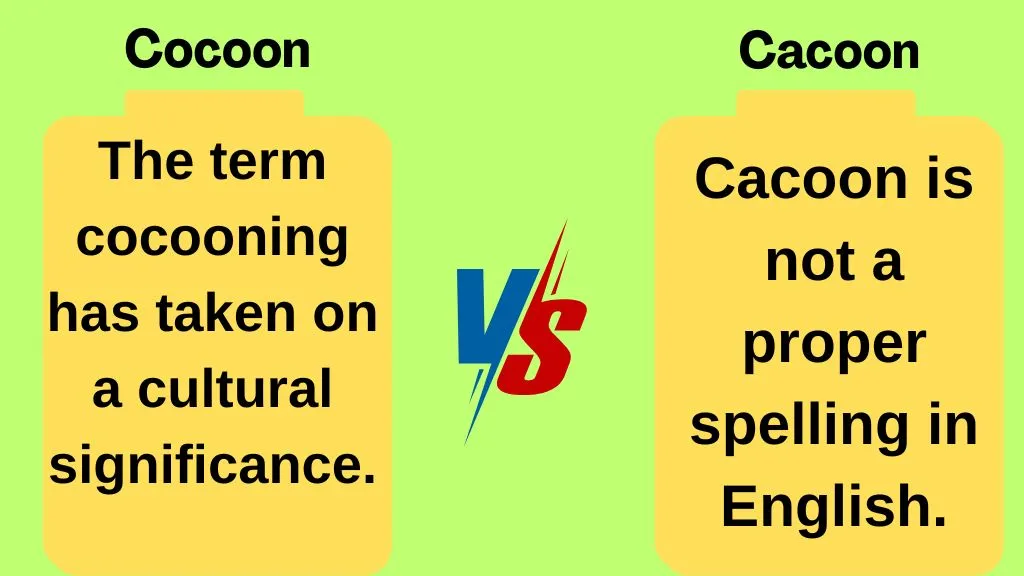
    The word cacoon is not a proper spelling in English. It’s often a typo or mispronunciation of cocoon. However, it has a completely unrelated meaning, which we’ll cover later.


    From Larva to Butterfly: The Role of a Cocoon

    Cocoons play a critical role in the metamorphosis process for certain insects. They offer a secure environment where the larva can undergo the incredible transformation into its adult form.

    Here’s how it works:

    1. The Larva Spins the Cocoon: Using silk secreted from glands, the larva creates a protective shell.
    2. Inside the Cocoon: Within this protective covering, the larva enters the pupal stage. During this time, the insect undergoes remarkable physical changes.
    3. Emergence as an Adult: After its transformation, the insect breaks free from the cocoon, fully grown and ready to live its adult life.

    While butterflies also experience metamorphosis, they form a chrysalis—a hard shell-like covering that’s different from a cocoon. This distinction is essential to understanding the insect lifecycle.


    The Lifecycle of a Butterfly: A Journey Through Phases

    To fully grasp the role of a cocoon, it’s helpful to understand the butterfly lifecycle. Although butterflies don’t spin cocoons, they share many similarities with insects that do. The butterfly’s metamorphosis occurs in four stages:

    1. Egg: A butterfly lays tiny eggs on leaves or stems.
    2. Larva (Caterpillar): After hatching, the larva feeds on plant material to grow rapidly.
    3. Pupa (Chrysalis): The caterpillar forms a chrysalis where it transforms into an adult.
    4. Adult Butterfly: The butterfly emerges, ready to pollinate and reproduce.

    Key Difference: While moths and some other insects spin cocoons, butterflies encase themselves in a chrysalis during the pupal stage. This is why the terms cocoon and chrysalis shouldn’t be used interchangeably.


    Why a Cocoon Is Not a Chrysalis: Clarifying Common Misconceptions

    It’s easy to confuse a cocoon with a chrysalis, but these terms describe two different structures.

    FeatureCocoonChrysalis
    MaterialSilk spun by the larvaHardened exoskeleton
    InsectsMoths and other non-butterfly speciesButterflies
    AppearanceSoft, silk-like coveringSmooth, shell-like, often camouflaged

    Takeaway: If you’re describing the protective covering of a butterfly, the correct term is chrysalis. Save cocoon for moths and similar insects.


    Exploring ‘Cocoon’ in Action: Usage as a Verb

    The word cocoon isn’t just a noun—it’s also a verb. When used this way, it means to wrap or envelop something in a protective or comforting way. This metaphorical use has become increasingly popular in modern English.

    Examples of Cocoon as a Verb:

    • “She cocooned herself in a warm blanket on a cold night.”
    • “The child was cocooned in his mother’s arms, feeling safe and loved.”

    This usage reflects the idea of protection, drawing inspiration from the insect world.


    Cocooning for Comfort: More Than a Natural Phenomenon

    Cocoon vs Cacoon

    In recent years, the term cocooning has taken on a cultural significance. It describes the act of staying indoors, away from the outside world, to focus on personal comfort and relaxation.

    Examples of Cocooning:

    • Watching movies under a pile of blankets on a rainy day.
    • Spending a weekend at home indulging in self-care and cozy activities.

    Cocooning became especially relevant during the pandemic, as people sought comfort and security within their homes.


    The Other Cacoon: Not a Typo, a Tropical Bean

    Interestingly, cacoon is not just a misspelling of cocoon. It’s also the name of a tropical plant, Entada rheedii, commonly known as the cacoon bean. This plant produces large seeds often used in traditional medicine or as jewelry.

    Quick Facts About the Cacoon Bean:

    • Scientific Name: Entada rheedii
    • Uses: Medicinal purposes, crafting ornaments, or as flotation devices.
    • Region: Found in tropical areas like Africa and Asia.

    While it’s unrelated to cocoons spun by insects, the shared spelling can cause confusion.


    Unraveling the Synonyms: Similar Terms for Cocoon

    The English language is rich with synonyms and related terms that can add nuance to your writing.

    Synonyms for Cocoon:

    • Covering: A general term for anything that protects or encases.
    • Pupa Case: Specifically refers to the protective casing of an insect in the pupal stage.
    • Shelter: Often used metaphorically, much like cocoon.

    Each synonym can add variety to your writing while retaining the same core idea.


    Choosing the Right Word: When to Use Pupa, Pod, or Covering

    Selecting the right word depends on context. Here’s a guide to help you choose:

    TermWhen to Use
    PupaRefers to the developmental stage within the cocoon.
    PodDescribes a protective case, often for seeds or plants.
    CoveringA broad term for any protective or enclosing layer.

    Verb Variants: Swaddle, Wrap, and Protect

    The verb cocoon has several close relatives in meaning, such as:

    • Swaddle: Commonly used to describe wrapping a baby snugly.
    • Wrap: A general term for enclosing something in layers.
    • Protect: Emphasizes the act of safeguarding something.

    Each of these verbs can be used interchangeably with cocoon in the right context.


    Embracing Etymology: Cocoon’s Linguistic Origins and Evolution

    The word cocoon traces its roots to the French term cocon, which means “shell.” This, in turn, originated from the Latin word coccum, meaning “berry” or “seed.” The term eventually evolved to describe the silk cases created by larvae.

    Key Insight: The connection to seeds and shells highlights the protective, enclosing nature of a cocoon.


    FAQs

    Which is correct: cocoon or cacoon?

    The correct spelling is “cocoon.” “Cacoon” is a common misspelling or typo, though it also refers to a tropical bean in rare contexts.

    What is the purpose of a cocoon?

    A cocoon is a protective covering spun by certain insects, such as moth larvae, to shield themselves during metamorphosis.

    Do butterflies use cocoons?

    No, butterflies form a chrysalis, which is a hardened exoskeleton. Cocoons are specific to moths and some other insects.

    What does cocoon mean in modern language?

    In everyday usage, cocoon refers to wrapping or enveloping something in a protective or comforting way, such as “cocooning” at home.

    What is the cacoon bean?

    The cacoon bean, or Entada rheedii, is a tropical plant used in traditional medicine and ornament crafting, unrelated to insect cocoons.


    Final Thoughts

    Understanding the difference between cocoon and cacoon may seem small, but it’s a great example of why language matters.

    Whether you’re discussing insect metamorphosis or using cocoon as a metaphor, precision in language elevates your communication.

    So, the next time you encounter these words, remember: Cocoon refers to a silk enclosure or a metaphorical sense of comfort. Cacoon, meanwhile, might be a fascinating tropical bean—but never a substitute for the correct spelling

  • 🌎 Hola or Ola? Which One Says Hello?

    🌎 Hola or Ola? Which One Says Hello?

    Languages are bridges that connect cultures, and greetings are one of the simplest yet most profound ways to interact with people from different backgrounds.

    For English speakers learning Spanish, “Hola” is often the first word they encounter. But is it “Hola” or “Ola”? While they might sound alike, these words have entirely different meanings and uses.

    Is it “Hola” or “Ola”? Learn the correct usage of this Spanish greeting, how it differs from “Ola,” and how to say hello like a native speaker!

    This article explores the meaning, usage, and cultural significance of “Hola,” shedding light on its distinction from “Ola” and how to incorporate this friendly Spanish greeting into everyday English communication.


    Introduction to ‘Hola’ and Its Usage in Communication

    “Hola” is a versatile and widely recognized Spanish greeting equivalent to saying “hello” in English. Unlike English, where greetings vary depending on the time of day (e.g., “good morning” or “good evening”), “Hola” is a universal term that works in nearly all contexts.

    Its simplicity makes it an excellent starting point for non-native speakers exploring the beauty of the Spanish language.

    Whether you’re traveling to a Spanish-speaking country, meeting a Spanish-speaking friend, or just expanding your linguistic horizons, “Hola” is the perfect icebreaker.


    The Spanish Greeting Explored: What Does ‘Hola’ Mean?

    At its core, “Hola” simply means “hello.” However, its application extends beyond a literal greeting. It’s a way to express warmth and friendliness, whether meeting someone for the first time or reconnecting with an old friend.

    Here’s how it’s commonly used:

    • Formal Situations: “Hola, ¿cómo está usted?” (Hello, how are you?)
    • Casual Settings: “¡Hola! ¿Qué tal?” (Hi! How’s it going?)

    Its flexibility and neutrality make it the go-to word for initiating conversations in Spanish.


    The Historical Roots of ‘Hola’ and Its Cultural Significance

    The origins of “Hola” trace back to the Old Spanish word ‘ola,’ which meant “wave.” Over time, this evolved into the greeting we know today. Interestingly, the use of greetings in Spain has deep cultural significance.

    Historically, greetings in Spain emphasized respect, formality, and warmth—values still prevalent in Spanish-speaking cultures. By saying “Hola,” speakers set a tone of approachability and politeness, reflecting their openness to connection.


    ‘Hola’ Across Different Spanish-Speaking Countries

    While “Hola” is universally understood across the Spanish-speaking world, the way it’s used can vary slightly depending on the region.

    Variations by Country

    CountryRegional Usage
    SpainOften paired with “¿Qué tal?” or “Buenas.”
    MexicoUsed casually, often with “¿Cómo estás?”
    ArgentinaFrequently combined with “¿Cómo andás?”
    ColombiaAdds warmth with phrases like “Hola, mi amigo/a.”

    In all regions, “Hola” serves as a universal opener, but local expressions often follow, adding unique cultural flavor.


    The Silent ‘H’ in Spanish and Its Impact on Pronunciation

    One of the most distinctive features of “Hola” is its silent “H.” In Spanish, the “H” at the beginning of a word is almost always silent, which can be tricky for English speakers.

    Pronunciation Guide:

    • “Hola” is pronounced as “OH-lah,” with the emphasis on the first syllable.
    • The “H” remains unspoken, making it sound fluid and natural in conversation.

    Learning to correctly pronounce “Hola” is crucial to sounding authentic and avoiding confusion with similar-sounding words like “Ola.”


    ‘Ola’ vs ‘Hola’: Understanding the Distinction

    Ola’ vs ‘Hola’

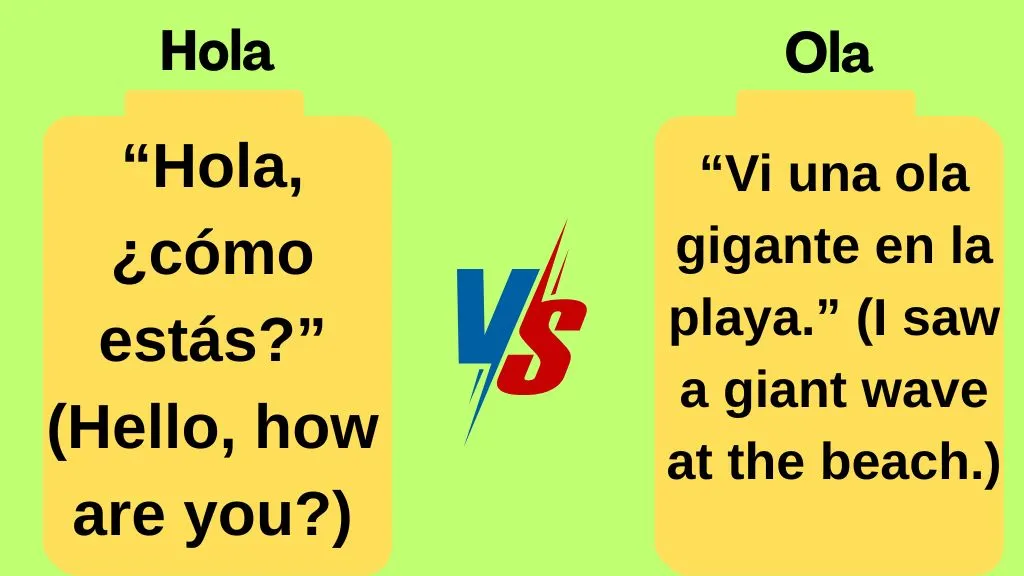
    Though they sound nearly identical, “Hola” and “Ola” are entirely different words with separate meanings:

    WordMeaningExample Usage
    HolaHello (greeting)“Hola, ¿cómo estás?” (Hello, how are you?)
    OlaWave (as in ocean wave)“Vi una ola gigante en la playa.” (I saw a giant wave at the beach.)

    Common Mistake: Mixing these words up can lead to humorous misunderstandings. Saying “Ola” when you mean “Hola” might leave your listener imagining ocean waves rather than a friendly hello!


    Navigating Homophones in Spanish: A Look at ‘Ola’ and ‘Hola’

    “Hola” and “Ola” are classic examples of homophones—words that sound alike but have different meanings and spellings. Spanish learners often encounter similar challenges with other word pairs, such as:

    • Vaca (cow) vs. Baca (roof rack).
    • Tubo (tube) vs. Tuvo (had).

    Tip for Mastery: Context is key! Pay close attention to the sentence and situation to determine the intended meaning.


    Etymology and the Usage of ‘Hola’ in Other Languages

    While “Hola” is firmly rooted in Spanish, its influence extends beyond. Many English speakers adopt “Hola” informally, especially in multicultural settings. Some even use it jokingly or affectionately when greeting friends.

    In pop culture, “Hola” often appears in movies, songs, and social media, serving as a shorthand for “cool” or “global.” This crossover reflects how languages borrow and adapt terms to enrich communication.


    Adapting ‘Hola’ for English Speakers: When and How to Use It

    For English speakers, incorporating “Hola” can be fun and practical, especially in multicultural environments. Here’s when it’s appropriate:

    • Travel: Use “Hola” to greet locals in Spanish-speaking countries—it’s an easy way to make a positive impression.
    • Multicultural Communities: Living or working in diverse settings? Adding “Hola” to your greetings fosters inclusivity.
    • Learning Spanish: Practicing simple words like “Hola” builds confidence and fluency.

    Pro Tip: Pair “Hola” with a smile—it’s universally understood and appreciated.


    Integrating Spanish Greetings into American English

    In the U.S., where Spanish is the second most spoken language, integrating words like “Hola” into English conversations is increasingly common.

    Examples of Blended Usage:

    • “Hola! How are you today?”
    • “Hola, everyone! Welcome to the meeting.”

    Such bilingual expressions showcase cultural awareness and respect, making them a great way to connect with Spanish speakers.


    ‘Hola’ in Pop Culture and Social Interactions

    “Hola” isn’t just a greeting; it’s a pop culture phenomenon. From songs to movies, this friendly word often takes center stage.

    Examples in Pop Culture:

    • Dora the Explorer: The iconic cartoon character greets viewers with a cheerful “¡Hola!”
    • Shakira’s Music: The Colombian singer often incorporates Spanish greetings into her lyrics, bridging cultural gaps.

    In social interactions, using “Hola” can make conversations feel more approachable and lively, whether at a casual gathering or online chat.


    FAQs

    What is the correct spelling: Hola or Ola?

    The correct spelling for “hello” in Spanish is “Hola.” “Ola” means “wave,” as in an ocean wave, and is unrelated to greetings.

    Why does ‘Hola’ have a silent ‘H’?

    In Spanish, the letter “H” is almost always silent, making “Hola” pronounced as “OH-lah.” This rule helps maintain the fluidity of the language.

    Can ‘Hola’ be used in formal situations?

    Yes, “Hola” is versatile and works in both formal and casual settings. For example, “Hola, ¿cómo está usted?” adds a formal tone.

    How do you use ‘Hola’ in English conversations?

    “Hola” is often used in English for fun or in multicultural settings, such as “Hola! How are you?” It’s a friendly way to greet Spanish speakers.

    What does ‘Ola’ mean in Spanish?

    “Ola” means “wave,” as in the waves of the ocean, and is not used as a greeting. For saying hello, stick with “Hola.”


    Conclusion: Embracing Spanish Greetings in a Multilingual World

    The word “Hola” goes beyond being a simple greeting—it’s a cultural symbol of warmth, connection, and openness.

    By understanding its meaning, usage, and distinction from “Ola,” you can confidently incorporate this Spanish staple into your vocabulary.

    In a world where languages and cultures constantly intertwine, embracing greetings like “Hola” bridges gaps and enriches communication. So, the next time you say “Hola,” you’re not just saying hello—you’re opening the door to a global conversation