Blog

  • Disfunction vs Dysfunction: Avoid Common Grammar Mistakes! ✅

    Disfunction vs Dysfunction: Avoid Common Grammar Mistakes! ✅

    Language is filled with words that look or sound similar but can cause confusion when used incorrectly. One such pair is “disfunction” and “dysfunction.”

    While these terms might appear interchangeable at first glance, only one is correct in English usage.

    In this article, we’ll dive deep into the origins, meanings, and proper usage of “dysfunction” while addressing the common mistakes surrounding “disfunction.”

    Confused about “disfunction” and “dysfunction”? Discover the correct term, its origins, and how to use it properly in your writing for clarity and precision!

    By the end, you’ll feel confident in distinguishing between the two and using “dysfunction” correctly in your writing.


    Exploring the Origins of “Dysfunction”
    Disfunction vs Dysfunction

    The word “dysfunction” comes from the Greek prefix dys-, meaning “bad” or “abnormal,” and the Latin root function, meaning “to perform.”

    When combined, dysfunction literally translates to “poor performance” or “abnormal functioning.”

    This term first appeared in medical and psychological contexts to describe abnormal or impaired functioning in the body, mind, or systems.

    Over time, its use expanded to describe various disruptions in societal or interpersonal systems, such as relationships or organizations.

    Why Not “Disfunction”?

    Unlike dys-, the prefix dis- means “apart” or “lack of.” While disfunction might seem logical in some contexts, it’s not recognized in standard English because the word function is more accurately paired with the Greek prefix dys- to describe an abnormal state.


    The Prevalence of “Dysfunction” in Modern Usage

    The term dysfunction has become ubiquitous in both formal and informal language. It’s commonly used to describe issues ranging from health conditions to systemic problems in organizations.

    Examples of Modern Usage:

    1. Medical Context:
      • “The patient was diagnosed with erectile dysfunction.”
      • “Hormonal dysfunction can affect overall well-being.”
    2. Social Context:
      • “The dysfunction in their family made communication challenging.”
      • “Workplace dysfunction often stems from poor leadership.”
    3. Broader Systems:
      • “Economic dysfunction has led to widespread unemployment.”
      • “Political dysfunction can destabilize a country.”

    The consistent use of dysfunction in these contexts reinforces its legitimacy as the correct term.


    Common Occurrences of “Dysfunction” in Medical and Social Contexts

    Medical Contexts:

    In healthcare, dysfunction describes conditions where a body system isn’t working as it should. Some common examples include:

    • Erectile Dysfunction (ED): A condition affecting male sexual health.
    • Cognitive Dysfunction: Impairments in memory, reasoning, or mental processing.
    • Endocrine Dysfunction: Abnormalities in hormone production, such as thyroid disorders.

    Social and Organizational Contexts:

    In non-medical settings, dysfunction is often used to describe breakdowns in relationships or systems:

    • Family Dysfunction: A lack of healthy communication or boundaries within a family unit.
    • Workplace Dysfunction: Toxic work environments where productivity and morale are impacted.
    • Systemic Dysfunction: Failures in societal or governmental structures, such as corruption or inefficiency.

    Misconceptions About “Disfunction” and Its Use

    One of the most common errors in writing is using “disfunction” instead of “dysfunction.” This mistake likely stems from:

    • Phonetic Similarity: Both terms sound alike when spoken.
    • Misunderstanding Prefixes: Writers may incorrectly apply the dis- prefix due to its prevalence in English (e.g., disconnect, dislike).
    • Typographical Errors: “Disfunction” might occur as a simple typo when typing quickly.

    Why “Disfunction” is Incorrect:

    The term disfunction is not recognized in English dictionaries. Unlike dysfunction, it has no etymological roots or established meaning. Using disfunction in professional or academic writing can diminish the credibility of your work.


    “Dysfunction” vs. “Dysfunctional”: Knowing the Difference

    While dysfunction is a noun, its adjective counterpart is dysfunctional. Understanding when to use each term is crucial for clarity in communication.

    TermPart of SpeechDefinitionExample Sentence
    DysfunctionNounThe state of being abnormal or impaired“The dysfunction in the system caused delays.”
    DysfunctionalAdjectiveDescribing something that is impaired“Their dysfunctional relationship needed help.”

    Tip for Writers: If you’re describing what is abnormal, use dysfunction. If you’re describing how something is abnormal, use dysfunctional.


    Identifying When to Use “Dysfunction” in a Sentence

    To use dysfunction accurately, consider these key points:

    1. Context Matters: Is the subject related to abnormal performance or impaired function?
    2. Avoid Overuse: Don’t use dysfunction to describe minor inconveniences or neutral situations.
    3. Match the Tone: In casual writing, consider simpler synonyms like issues or problems if appropriate.

    Example Sentences:

    • Medical: “Heart dysfunction can lead to serious complications.”
    • Social: “The dysfunction in their communication led to constant arguments.”
    • Systemic: “The economic dysfunction in the region requires urgent reform.”

    Distinguishing Between “Dysfunction” as a Noun and “Dysfunctional” as an Adjective

    Writers often confuse the noun and adjective forms of this word. Here’s a quick breakdown to avoid errors:

    Noun: Dysfunction

    • Refers to the state or condition of something being abnormal or impaired.
      Example: “The dysfunction in their family created tension at gatherings.”

    Adjective: Dysfunctional

    • Describes something as abnormal or impaired.
      Example: “They grew up in a dysfunctional household.”

    Common Errors to Avoid:

    • Writing: “The family was dysfunction.” (Incorrect: Should be “dysfunctional”)
    • Writing: “Their relationship had many dysfunctional.” (Incorrect: Should be “dysfunctions”)

    Correcting the Misuse of “Disfunction” in Writing

    If you’ve used “disfunction” in your writing, don’t worry—there’s an easy fix.

    Steps to Correct the Error:

    1. Search and Replace: Use your document’s search function to locate instances of “disfunction” and replace them with “dysfunction.”
    2. Proofread Carefully: Double-check for similar errors involving prefixes (dis- vs. dys-).
    3. Learn the Rule: Remember that “dysfunction” is the only correct form in English.

    Pro Tip: If you’re unsure about other words with similar prefixes, consult a reliable dictionary or grammar guide.


    FAQs

    What is the correct spelling: dysfunction or disfunction?

    The correct spelling is “dysfunction.” The term “disfunction” is not recognized in standard English.

    Why is it “dysfunction” and not “disfunction”?

    The word “dysfunction” uses the Greek prefix dys-, meaning “bad” or “abnormal.” The dis- prefix, meaning “apart,” is not applicable here.

    What does dysfunction mean in medical terms?

    In medical contexts, dysfunction refers to abnormal or impaired functioning of a body system, such as erectile dysfunction or cognitive dysfunction.

    How is “dysfunctional” different from “dysfunction”?

    “Dysfunction” is a noun referring to an impaired state, while “dysfunctional” is an adjective describing something as abnormal or impaired.

    Can “dysfunction” be used in social contexts?

    Yes, dysfunction can describe breakdowns in relationships, families, or organizations, such as family dysfunction or workplace dysfunction.


    Conclusion

    When it comes to “disfunction” versus “dysfunction,” there’s no competition—dysfunction is the correct and recognized form.

    By understanding its origins, meanings, and proper contexts, you can confidently use dysfunction in both professional and casual writing. Avoiding common pitfalls like disfunction ensures your communication remains clear, precise, and credible.
  • Agreed or Agree? Learn the Right Usage with Examples ✅

    Agreed or Agree? Learn the Right Usage with Examples ✅

    Language can sometimes create confusion, especially when similar words or variations of a word are used interchangeably.

    One such example is “agreed” and “agree.” Both originate from the same verb but serve different purposes in communication.

    Confused between “agreed” and “agree”? Learn the key differences, proper usage, and helpful examples to communicate effectively and confidently in any context!

    In this guide, we’ll break down the nuances between these two forms, explain their correct usage, and provide plenty of examples to help you master them.


    Understanding Verb Forms and Their Functions

    Agreed or Agree

    Verbs are the backbone of any sentence, conveying action, state, or occurrence. To understand the difference between “agree” and “agreed,” it’s essential to grasp the concept of verb forms:

    • Base Form: The simplest version of a verb, like agree.
    • Past Tense Form: Indicates an action that has already occurred, such as agreed.
    • Present Participle: Used in continuous tenses, e.g., agreeing.
    • Past Participle: Often identical to the past tense, e.g., agreed, used in perfect tenses.

    With this foundation, let’s explore each form in detail.


    Defining “Agree” As a Present Tense Verb

    “Agree” is the base and present tense form of the verb. It’s used to indicate a current or ongoing action of consensus or harmony between individuals or groups.

    • Definition: To have the same opinion, approve, or consent to something.
    • Pronunciation: /əˈɡriː/

    The Role of “Agree” in Expressing Current Consensus

    In the present tense, “agree” is dynamic and reflects real-time consensus. It’s used in formal and informal contexts to highlight mutual understanding or approval.

    Examples:

    • “We agree on the terms of the contract.”
    • “Do you agree with my suggestion?”
    • “The team agrees that this strategy is the best approach.”

    Key takeaway: Use “agree” when talking about something happening right now.


    Examples of How to Use “Agree” in a Sentence

    Here are examples that demonstrate various ways “agree” can fit into sentences:

    1. Simple Present:
      • “I agree with your perspective.”
      • “They agree on most issues.”
    2. Questions:
      • “Do you agree that this plan is effective?”
      • “Why don’t we agree to meet halfway?”
    3. Negative Statements:
      • “I don’t agree with your decision.”
      • “She doesn’t agree with the policy changes.”

    The Adjective and Past Tense Verb “Agreed”

    “Agreed” has two distinct roles:

    1. As the past tense of the verb “agree.”
    2. As an adjective to express consensus or approval.

    Let’s explore both.


    When and How to Use “Agreed” Appropriately

    As the past tense, “agreed” refers to an action that has already occurred. It implies that consensus or harmony was reached at some point in the past.

    Examples of Past Tense Usage:

    • “They agreed to the new terms yesterday.”
    • “We finally agreed on the color scheme for the project.”
    • “The committee agreed to implement the changes.”

    As an adjective, “agreed” modifies a subject to indicate mutual approval.

    Examples of Adjective Usage:

    • “It was an agreed decision to postpone the event.”
    • “The agreed-upon deadline is next Monday.”

    Expressing Acceptance with “Agreed” in Conversation

    “Agreed” can also be used as a standalone response in conversations to signify acceptance or affirmation. It’s a concise way of saying, “I agree with what you just said.”

    Examples in Dialogue:

    • Person 1: “Let’s split the cost equally.”
      Person 2: “Agreed.”
    • Person 1: “The proposal sounds fair.”
      Person 2: “Yes, agreed.”

    Using “agreed” this way adds a formal yet friendly tone to discussions.


    Utilizing “Agreed” as a Response in Dialogue

    In professional and casual conversations alike, “agreed” often works as a definitive response to emphasize understanding or acceptance.

    Real-Life Scenarios:

    • Workplace:
      • Manager: “We need to finalize the budget by Friday.”
        Team Member: “Agreed.”
    • Social Setting:
      • Friend 1: “Let’s watch the movie at 8 PM.”
        Friend 2: “Agreed.”

    This response is not only concise but also demonstrates decisiveness.


    “Agree” in Action: Present Tense Usage with Clarity

    Present tense usage of “agree” is straightforward yet powerful. It’s ideal for situations where active discussions or real-time decisions are taking place.

    Key Examples:

    • “We all agree that teamwork is essential for success.”
    • “Do you agree with the proposed timeline?”
    • “Our shareholders agree that this is the right move.”

    The Significance of Response: “Yes, Agreed” Demystified

    The phrase “Yes, agreed” carries an extra layer of affirmation, making it stronger than “agreed” alone. It’s often used in formal settings to confirm alignment on an important matter.

    Examples:

    • “Yes, agreed. Let’s proceed with the plan.”
    • “Yes, agreed on all counts. Let’s finalize the document.”

    This phrasing ensures clarity and avoids ambiguity.


    Grammar Deep Dive: Past Tense Explanation for “Agreed”

    The past tense form “agreed” follows standard English grammar rules for regular verbs:

    • Add -ed to the base verb to form the past tense.
    • Use it to describe actions or agreements that happened before the current moment.

    Examples:

    • “We agreed to the proposal last week.”
    • “They agreed after much discussion.”

    Grammar Note: The word remains consistent in both simple past tense and past participle form.


    Choosing Between “Agreed” and “Agree” in Professional Communication

    Agreed or Agree

    When communicating professionally, selecting the correct form—“agree” or “agreed”—depends on the context:

    1. Current Discussions: Use “agree” for active conversations or ongoing agreements.
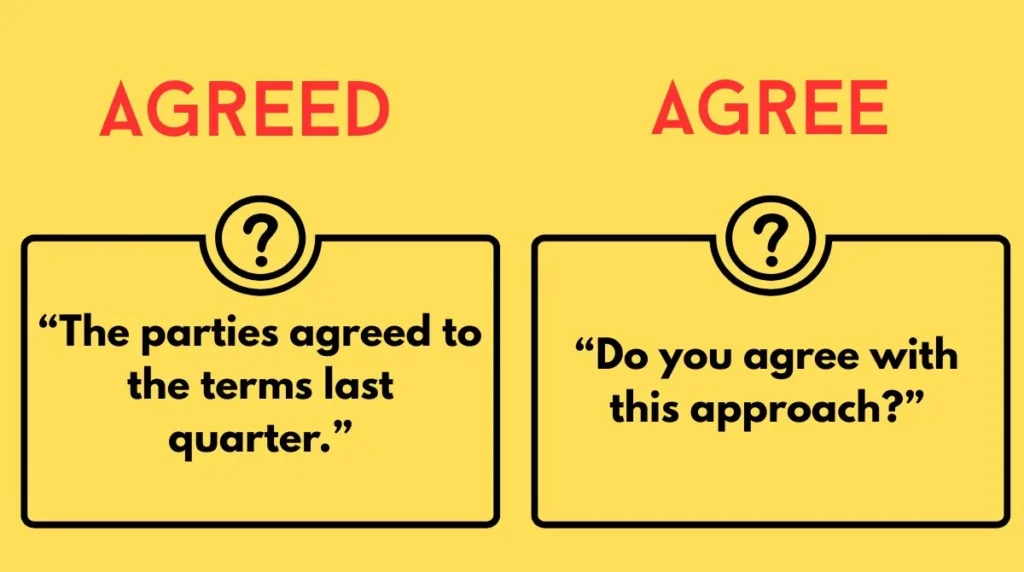
      • “Do you agree with this approach?”
      • “I agree with the client’s feedback.”
    2. Past Agreements: Use “agreed” to refer to decisions or understandings reached in the past.
      • “The parties agreed to the terms last quarter.”
      • “We agreed to follow up after the initial meeting.”
    3. Adjective Usage: When referring to consensus in written documents or formal agreements, “agreed” is preferred.
      • “The agreed-upon schedule will be shared tomorrow.”
      • “The agreed terms are now binding.”

    FAQs

    What is the difference between “agree” and “agreed”?

    “Agree” is the base form used in present tense, while “agreed” is the past tense or an adjective indicating consensus or approval.

    When should I use “agree” in a sentence?

    Use “agree” when discussing ongoing or current situations, such as “I agree with your idea” or “Do you agree with this decision?”

    Can “agreed” be used as a standalone response?

    Yes, “agreed” is often used as a concise response in conversations to signify acceptance or affirmation, like “Agreed. Let’s proceed.”

    How do I use “agreed” as an adjective?

    “Agreed” as an adjective describes something mutually accepted or decided, e.g., “The agreed-upon deadline is Friday.”

    Is it grammatically correct to say “Yes, agreed”?

    Yes, “Yes, agreed” is a formal yet emphatic way to confirm alignment, especially in professional discussions.


    Conclusion

    Mastering the difference between “agree” and “agreed” comes down to understanding verb forms and their roles in communication.

    While “agree” captures the present moment of consensus, “agreed” looks back at past decisions or functions as an adjective to describe settled matters.

    Whether you’re drafting an email, engaging in dialogue, or finalizing a contract, knowing when to use “agree” versus “agreed” will ensure your communication is both precise and professional.

  • Sweetie vs Sweety or Sweatie: A Guide to Endearments 🧡

    Sweetie vs Sweety or Sweatie: A Guide to Endearments 🧡

    When it comes to terms of endearment, selecting the right spelling matters more than you might think.

    Sweetie, Sweety, and Sweatie may seem like interchangeable variations at first glance, but they carry different connotations, cultural nuances, and levels of appropriateness.

    Confused about sweetie, sweety, or sweatie? Learn the key differences, proper usage, and cultural nuances to ensure your terms of endearment are accurate and heartfelt.

    In this comprehensive guide, we’ll untangle the complexity behind these terms, explore their usage, and provide actionable tips to ensure your communication is both accurate and meaningful.


    Understanding the Complexity of English Spelling

    Sweetie vs Sweety or Sweatie

    English is notorious for its inconsistencies in spelling and pronunciation. Words that look similar can carry entirely different meanings, leading to confusion.

    Sweetie, Sweety, and Sweatie are perfect examples of how subtle differences in spelling can impact meaning and context.

    • Homophones and Variants: The similarity in sound among these words often leads to misspellings.
    • Regional Preferences: Different cultures and dialects may favor one form over another.
    • Autocorrect Influence: Technology sometimes perpetuates errors by suggesting incorrect spellings based on frequency of use.

    Understanding these nuances can help us better grasp why these terms can be tricky to navigate.


    Decoding the Correct Usage: Sweetie vs. Sweety

    Sweetie vs Sweety or Sweatie

    The first step in choosing the right spelling is understanding what each word means and how it’s used.

    Sweetie

    • Definition: A term of endearment used to address someone affectionately, such as a romantic partner, child, or close friend.
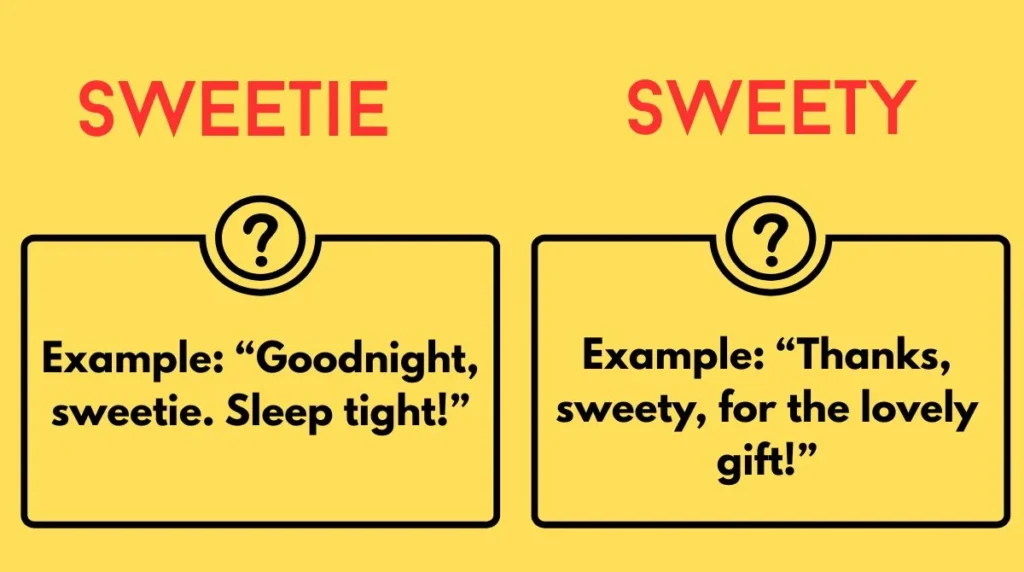
      Example: “Goodnight, sweetie. Sleep tight!”
    • Cultural Usage: Widely recognized in American and British English as a warm, loving term.
    • Connotation: Sweet and affectionate; suitable for informal, personal contexts.

    Sweety

    • Definition: An alternative spelling of sweetie, though less common in modern English.
      Example: “Thanks, sweety, for the lovely gift!”
    • Cultural Usage: Seen more frequently in South Asian English or informal writing.
    • Connotation: Has the same affectionate tone as sweetie but may come across as less standard in formal writing.

    Sweatie: The Odd One Out and Its Significance

    At first glance, sweatie might look like a playful variant of sweetie, but its meaning differs entirely.

    What Does Sweatie Mean?

    • Definition: While not a standard term of endearment, sweatie is often a misspelling or misinterpretation of “sweaty.”
    • Cultural Usage: Rarely used in English, except as a humorous or informal nickname.
      Example: “After the gym session, he jokingly called himself ‘sweatie.’”

    Examining the Misinterpretation of Sweatie as Sweaty

    The closeness in spelling between sweatie and sweaty leads to frequent mix-ups.

    • Sweaty Defined: Refers to being covered in sweat, typically after physical exertion or heat.
      Example: “She looked sweaty after running five miles.”
    • Misinterpretation: Using sweatie in place of sweetie can result in unintentional humor or confusion.
      Example: “Hey, sweatie!” (Incorrect unless referring to someone sweaty)

    Tip: Always double-check your spelling in personal or professional messages to avoid such mistakes.


    The Cultural Context of Pet Names in American English

    Pet names like sweetie are deeply embedded in American English, often symbolizing warmth and affection.

    Why Are Pet Names Used?

    • To Show Affection: Words like sweetie express love and closeness.
    • To Build Rapport: They help create a sense of intimacy in relationships.
    • To Soften Communication: Using pet names can make conversations feel more personal and less formal.

    Common Examples of Pet Names:

    • Sweetie
    • Honey
    • Darling
    • Babe

    How Sweatie Fits into the Lexicon: Clarifying the Misconception

    Despite its rarity, sweatie occasionally appears in informal settings, often as a playful or mistaken variation of sweetie.

    • Humorous Contexts: Sweatie might be used jokingly to refer to someone who’s sweating.
    • Common Errors: Some individuals mistakenly use sweatie instead of sweetie, particularly in text messages.

    Key Insight: While sweatie might elicit a laugh, it’s best avoided in formal or romantic communication to prevent misunderstandings.


    The Historical Journey of “Sweet” and Its Offshoots

    The Origin of Sweet

    The word sweet traces back to Old English swēte, meaning “pleasing to the senses.” Over time, it evolved into various derivatives, including sweetie and sweety.

    Evolution of Sweetie and Sweety

    • Sweetie: Gained popularity in the 19th century as a term of endearment.
    • Sweety: Emerged as an alternative spelling, influenced by regional and informal usage.

    Connotations and Context: When to Use Terms of Endearment

    Not all situations are appropriate for using pet names like sweetie. Understanding the context is crucial to ensure your language is both respectful and appropriate.

    When to Use Sweetie or Sweety:

    • In Romantic Relationships: To express affection for a partner.
    • With Children: As a comforting or nurturing term.
    • Among Close Friends: In informal, playful conversations.

    When to Avoid Pet Names:

    • In Professional Settings: Using terms like sweetie can come across as unprofessional.
    • With Strangers: It may be interpreted as overly familiar or even disrespectful.

    Expert Tips: Choosing Sweetie or Sweety in Your Communication

    Sweetie vs Sweety
    1. Know Your Audience: Use sweetie with people you share a close bond with.
    2. Stick to Sweetie for Formality: If you’re unsure, choose the more widely accepted spelling.
    3. Avoid Overusing Pet Names: Reserve them for personal, informal conversations to maintain sincerity.

    Etiquette and Appropriateness in Addressing Others

    Pet names can convey affection, but they should be used thoughtfully to avoid crossing boundaries.

    Key Etiquette Tips:

    • Always consider the other person’s comfort level.
    • Avoid using pet names in professional or formal settings.
    • When in doubt, stick to neutral terms like friend or colleague.

    Recognizing Cultural Sensitivities in Language Use

    Language carries cultural significance, and terms of endearment are no exception. What’s acceptable in one culture may not be in another.

    • American English: Words like sweetie are common and often viewed as endearing.
    • Other Cultures: Pet names may be perceived as overly familiar or even inappropriate in formal settings.

    Tip: Pay attention to the cultural context before using terms of endearment, especially in cross-cultural interactions.


    Guidelines for Personal and Professional Scenarios

    In Personal Settings:

    • Use sweetie or sweety with family, partners, or close friends.
    • Avoid using sweatie unless as a joke or in a humorous context.

    In Professional Settings:

    • Stick to formal language. Avoid pet names entirely.
    • Use proper names or professional titles to maintain respect.

    FAQs

    What is the correct spelling: sweetie or sweety?

    The correct and widely accepted spelling is “sweetie.” It is commonly used as a term of endearment in English. “Sweety” is an alternative spelling but less formal and less common.

    What does sweatie mean?

    “Sweatie” is not a standard term of endearment. It is often a misspelling or playful variation of “sweetie” but can also refer humorously to someone who is sweaty.

    When should I use “sweetie” in communication?

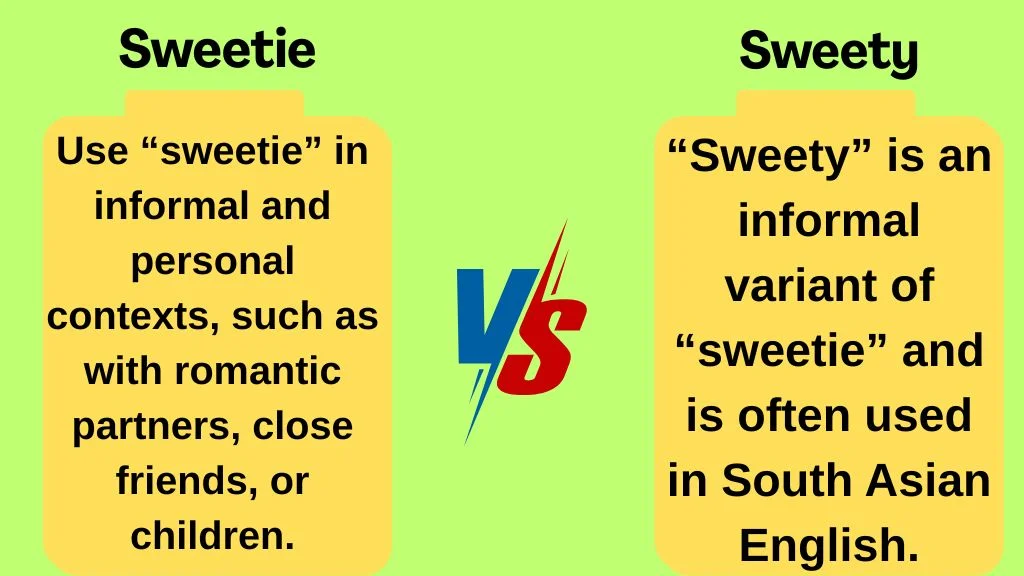
    Use “sweetie” in informal and personal contexts, such as with romantic partners, close friends, or children. Avoid it in professional or formal settings.

    Is “sweety” grammatically correct?

    “Sweety” is an informal variant of “sweetie” and is often used in South Asian English. While not incorrect, it is less standard and not commonly used in formal writing.

    Why is it important to choose the correct spelling?

    Choosing the correct spelling ensures clarity and prevents miscommunication. For instance, using “sweatie” instead of “sweetie” could lead to unintended humor or confusion.


    Final Thoughts on Sweetie, Sweety, and Sweatie in Modern Usage

    Choosing the right spelling—sweetie, sweety, or sweatie—can make all the difference in how your message is received.

    While sweetie remains the most widely accepted and appropriate term, understanding the nuances of sweety and sweatie ensures you avoid miscommunication.

    By considering the context, audience, and cultural sensitivities, you can navigate these terms confidently and make your communication more meaningful and impactful.

  • Resignate or Resonate? Get the Spelling Right! 🎯

    Resignate or Resonate? Get the Spelling Right! 🎯

    Words in the English language often cause confusion, especially when they sound similar or seem plausible in certain contexts. A common example is the mix-up between resignate and resonate.

    Confused between resignate and resonate? Discover why resonate is the correct word and how to use it for clarity, impact, and powerful communication.

    In this comprehensive guide, we’ll unravel the mystery of these two words, clarify the correct usage, and explore how resonate has earned its place in the language while resignate remains an error.


    Exploring the Common Mix-Up: ‘Resignate’ versus ‘Resonate’

    Resignate or Resonate

    The confusion between resignate and resonate often stems from how the brain processes familiar patterns in language. Many assume resignate is a word because of its similarity to legitimate terms like resign or designate.

    However, resignate is not a recognized word in English.

    The key difference:

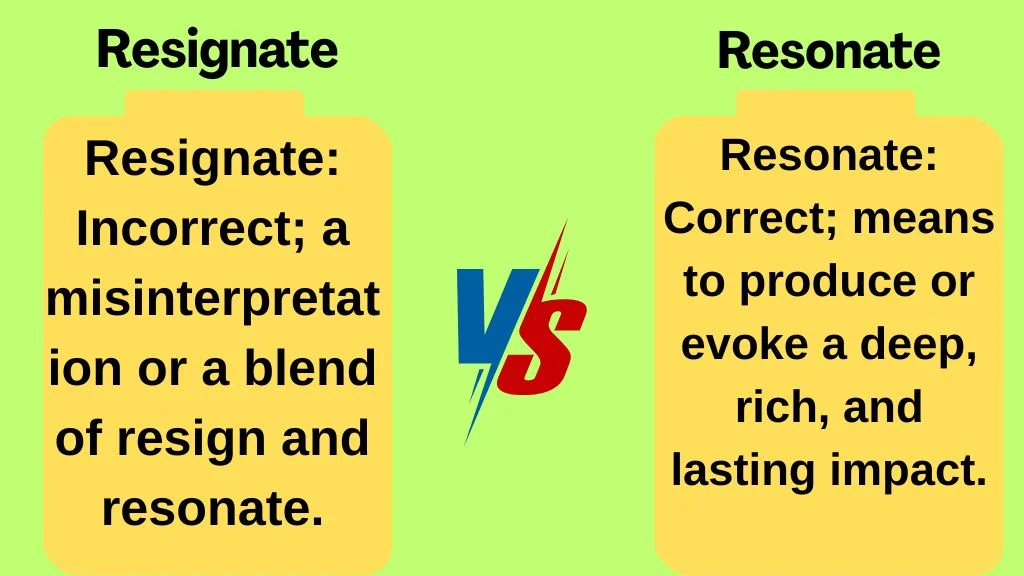
    • Resignate: Incorrect; a misinterpretation or a blend of resign and resonate.
    • Resonate: Correct; means to produce or evoke a deep, rich, and lasting impact, often referring to sound, emotion, or meaning.

    Common Missteps That Lead to This Mix-Up:

    • Overgeneralization: Applying the -ate suffix where it doesn’t belong.
    • Phonetic similarity: Mishearing or mispronouncing resonate as resignate.
    • Autocorrect issues: Digital tools may not catch subtle errors.

    Unlocking the Correct Spelling: Why ‘Resonate’ Resounds

    Resignate or Resonate

    The word resonate holds significance because of its versatility and ability to describe both literal and metaphorical impact. Here’s why it stands out:

    1. Phonetic Clarity: Resonate has a distinct and memorable pronunciation: rez-uh-nayt.
    2. Functional Meaning: It embodies the idea of amplifying or deeply connecting, making it powerful in communication.
    3. Cultural Relevance: Whether in science, music, or emotional contexts, resonate is a term that bridges disciplines and ideas.

    Looking at Lexicons: What the Dictionaries Say

    What do dictionaries reveal about these words?

    • Resignate: Not found in reputable English dictionaries.
    • Resonate: Defined consistently across lexicons as:
      • Merriam-Webster: “To produce or exhibit resonance.”
      • Cambridge Dictionary: “To produce, increase, or fill with sound, or to evoke or suggest images, memories, and emotions.”

    Key takeaway: Resonate is the only correct option acknowledged in both American and British English.


    Language Evolution and Usage Patterns

    Language is dynamic, and words often emerge from colloquial use. However, resignate is not a product of natural linguistic evolution; it is an error that has persisted due to misunderstanding.

    Why ‘Resignate’ Fails to Make the Cut

    • It lacks historical or linguistic roots in English.
    • No practical need exists for the term, as resign and resonate adequately cover relevant meanings.
    • Usage is almost exclusively in informal or mistaken contexts.

    From Latin to Modern English: Etymology of ‘Resonate’

    The journey of resonate began in Latin, and its rich history underscores its importance:

    • Latin Origin: From resonare, meaning “to resound” (re- meaning “again” and sonare meaning “to sound”).
    • Middle English Adoption: Entered English in the late Middle Ages with its current sense of producing sound or impact.
    • Modern Usage: Expanded metaphorically to describe emotional and intellectual connection, such as ideas that “resonate” with people.

    Decoding the Meaning: Understanding ‘Resonate’

    Resonate is a versatile word with multiple dimensions. Let’s break it down:

    1. Literal Meaning:
      Refers to sound waves creating vibrations that carry through a medium.
      • Example: “The singer’s voice resonated throughout the hall.”
    2. Metaphorical Meaning:
      Describes something that evokes a powerful emotional or intellectual response.
      • Example: “Her speech resonated with the audience.”

    Synonyms: Reverberate, echo, strike a chord, connect deeply.


    Using ‘Resonate’ in Everyday Language

    Common Expressions with Resonate:

    • “This message resonates with me.”
    • “The music resonated in the empty room.”
    • “His ideas resonate with modern audiences.”

    Contexts Where ‘Resonate’ is Used:

    1. Music and Sound: Literal resonance in physical spaces.
    2. Emotion: Deep emotional connection to a message or idea.
    3. Ideas and Culture: The way themes or values align with public sentiment.

    Tip: When using resonate, think of impact—whether it’s physical, emotional, or intellectual.


    Examples in Popular Media and Literature

    Language is alive in media and literature, and resonate frequently appears to illustrate depth and connection:

    In Media:

    • “The movie’s themes resonate with the struggles of today’s youth.”
    • “The song resonates with listeners who’ve experienced heartbreak.”

    In Literature:

    • Shakespeare often employed resonance in dialogue, though not the word directly.
      Example: “If music be the food of love, play on.” (Twelfth Night)—here, the connection to emotion through sound reflects resonance.

    Guidelines for Crafting Resonating Messages

    Resonance isn’t limited to sound; it’s a tool for powerful communication. Here’s how to ensure your messages resonate:

    Tips for Resonating Communication:

    1. Understand Your Audience: Tailor your language and tone to what matters to them.
    2. Be Authentic: Genuine messages are more likely to connect.
    3. Use Emotional Triggers: Relatable anecdotes or stories create a lasting impact.
    4. Simplify Your Message: Clear and concise language resonates better than complexity.
    5. Engage the Senses: Visual and auditory elements amplify resonance in communication.

    Exercises to Practice Your Usage of ‘Resonate’

    Activity 1: Sentence Completion
    Fill in the blanks with resonate or its synonyms:

    1. The speech ____ with everyone who had faced similar struggles.
    2. Her story didn’t just inform; it ____ deeply with the audience.

    Activity 2: Rewriting for Resonance
    Take a simple sentence and rewrite it for deeper impact:

    • Original: “The song was nice.”
    • Improved: “The melody resonated with the heartbreak I once felt.”

    Activity 3: Synonym Matching
    Match each synonym with its definition:

    SynonymDefinition
    ReverberateTo echo or vibrate again
    Strike a chordTo evoke an emotional response
    ConnectTo form a relationship or link

    FAQs

    Is resignate a real word?

    No, resignate is not a recognized word in English. It is a common error resulting from confusion with similar-sounding words like resonate, resign, or designate.

    What does resonate mean?

    Resonate means to produce sound vibrations or to evoke a deep emotional or intellectual response. For example, “Her story resonated with the audience.”

    Why do people confuse resignate and resonate?

    The confusion arises from phonetic similarity, overgeneralization of suffixes like “-ate,” and occasional autocorrect errors in digital writing.

    How do I use resonate in a sentence?

    Use resonate when describing sound, emotions, or ideas that connect deeply. Example: “The music resonated through the hall and touched everyone’s hearts.”

    What’s the origin of the word resonate?

    Resonate originates from the Latin word resonare, meaning “to resound.” It entered Middle English with meanings tied to sound and later evolved to include emotional and intellectual connections.


    Conclusive Thoughts on the Impact of ‘Resonate’

    Mastering the correct use of resonate not only improves your language skills but also empowers you to communicate more effectively.

    Whether you’re describing physical vibrations, emotional connections, or intellectual alignment, resonate is a word that truly “resounds” in all aspects of life.

    By understanding its meaning, history, and proper usage, you can avoid common mistakes and ensure your message strikes the right chord with your audience.

  • Run or Ran? A Grammar Guide You’ll Love 📚✨

    Run or Ran? A Grammar Guide You’ll Love 📚✨

    The English language is full of quirks, and verbs like run and ran often trip people up.

    While both words come from the same verb family, they’re used in different tenses, and mixing them up can confuse your meaning.

    Confused between run and ran? Learn the difference, their correct tenses, and how to use them with clear examples in this essential grammar guide!

    In this guide, we’ll explore the differences between run and ran, explain their proper usage, and provide clear examples so you can master their use in writing and speech.


    Understanding the Basics of ‘Run’ and ‘Ran’

    Run or Ran

    At their core, run and ran are forms of the same verb, which means “to move quickly on foot” or “to operate.”

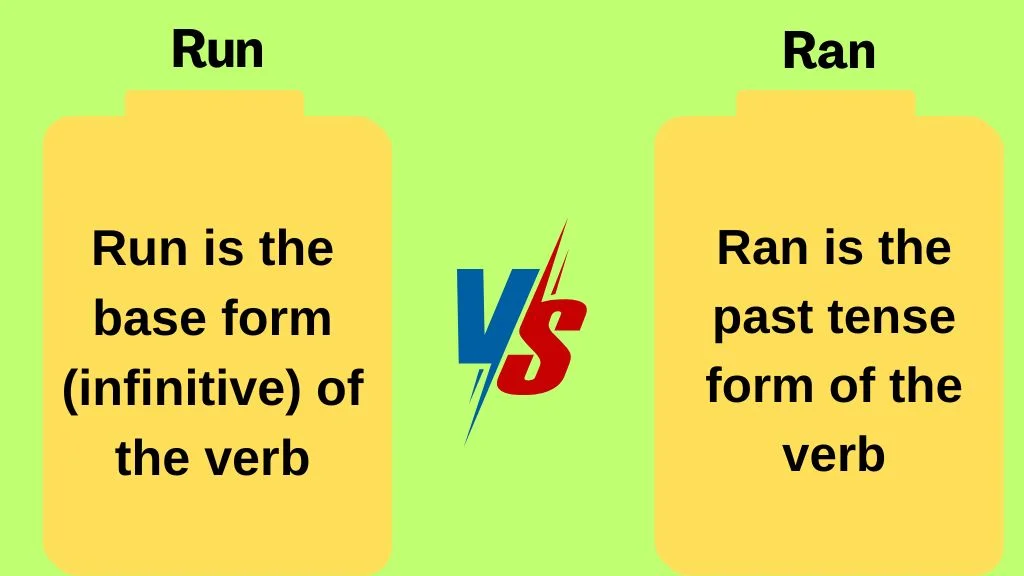
    • Run is the base form (infinitive) of the verb and is also used in present tense and some perfect tense constructions.
      Example: “I run every morning.”
    • Ran is the past tense form of the verb, used to describe actions that were completed in the past.
      Example: “She ran five miles yesterday.”

    Understanding when to use each form depends entirely on the time frame and grammatical structure of your sentence.


    When to Use ‘Run’ in a Sentence

    The Present Tense Use of ‘Run’

    The word run is primarily used in the present tense or in the present perfect tense.

    Present Tense

    In its simplest form, run is used when describing an action that is happening now or is habitual.

    • Singular Examples:
      • “He runs every morning before work.”
      • “She runs her own business successfully.”
    • Plural Examples:
      • “They run marathons together.”
      • “We run the entire project as a team.”

    Present Perfect Tense

    In perfect tense structures, run works as the past participle.

    • Example: “I have run three miles so far today.”
    • Example: “They have run this race several times before.”

    Key Tip: Always pair run with auxiliary verbs like have or has when constructing the present perfect tense.


    Common Phrases and Idioms Featuring ‘Run’

    The word run frequently appears in idiomatic expressions and phrases. Here are some common examples:

    • “Run out of time”: To have no time left.
      Example: “We’re running out of time to finish the project.”
    • “Run for office”: To campaign for a political position.
      Example: “She decided to run for mayor.”
    • “Run errands”: To perform everyday tasks.
      Example: “I need to run some errands this afternoon.”
    • “Run amok”: To behave uncontrollably.
      Example: “The kids ran amok during the party.”

    Present Tense Practical Examples

    Here are some clear examples of how run is used in the present tense:

    SentenceExplanation
    “He runs a successful café in town.”Present tense, habitual action.
    “I run every morning for exercise.”Present tense, ongoing activity.
    “They have run three times this week.”Present perfect, action completed recently.
    “We run to catch the train every day.”Present tense, habitual action.

    The Past Tense ‘Ran’ and Its Usage

    Ran is the simple past tense form of run and is used to describe actions that occurred and were completed in the past.

    • Example: “He ran to the store yesterday.”
    • Example: “They ran a marathon last year.”

    Unlike run, the word ran does not require auxiliary verbs like have or has. It stands alone as a past-tense verb.


    Grammatical Rules: Conjugating ‘Run’

    Conjugation in Different Tenses

    The verb run is irregular, which means its conjugation doesn’t follow standard patterns. Here’s a quick look at its conjugation across tenses:

    TenseSingular ExamplePlural Example
    Present“She runs daily.”“They run daily.”
    Past“She ran yesterday.”“They ran yesterday.”
    Present Perfect“She has run the race.”“They have run the race.”
    Future“She will run tomorrow.”“They will run tomorrow.”

    Misconceptions in ‘Run’ Conjugation

    Because run is an irregular verb, it often causes confusion, particularly in perfect tense forms.

    Common Misconceptions

    1. Mixing Up Past and Present:
      Incorrect: “I have ran three miles.”
      Correct: “I have run three miles.” (Ran cannot be used as a past participle.)
    2. Using ‘Run’ as Past Tense:
      Incorrect: “She run to the store yesterday.”
      Correct: “She ran to the store yesterday.” (Run is not a simple past tense verb.)

    Exploring the Irregularities of ‘Run’ and ‘Ran’

    Unlike regular verbs that simply add -ed to form their past tense, run changes to ran. Additionally, its past participle form, run, remains unchanged from its base form.

    Why Is This Irregular?

    The irregularity stems from Old English, where run derived from the verb rinnan (to flow or run). Over centuries, its conjugation evolved into its modern irregular forms.


    Common Mistakes and Confusions Explained

    To avoid confusion, here are a few quick rules:

    • Use ran only in the simple past tense.
      Example: “Yesterday, I ran to the park.”
    • Use run in present tense or as a past participle with auxiliary verbs.
      Example: “I have run this route before.”

    Examples of Common Errors

    Incorrect SentenceCorrect SentenceExplanation
    “I have ran a marathon before.”“I have run a marathon before.”Run is the past participle.
    “She run to the store yesterday.”“She ran to the store yesterday.”Ran is the correct past tense form.
    “They ran out of supplies today.”“They run out of supplies today.”Ran is used incorrectly in the present tense.

    Real-world Examples: ‘Run’ vs. ‘Ran’ in Context

    • Present Tense (Run):
      “I run my own business every day.”
    • Past Tense (Ran):
      “Last year, I ran my first marathon.”
    • Perfect Tense (Run):
      “She has run every race in the city’s annual competition.”

    The Importance of Tense Accuracy in Writing

    Using the correct tense isn’t just about grammar—it impacts how your audience interprets your message. Mixing up run and ran can confuse readers and weaken your writing’s clarity. Mastering these forms helps ensure your communication is precise and professional.


    FAQs

    What is the difference between run and ran?

    Run is used in present tense or as a past participle (e.g., “I have run”), while ran is the simple past tense (e.g., “She ran yesterday”).

    Can you use ran in the present tense?

    No, ran is only used for the simple past tense. For present tense, use run (e.g., “I run every day”).

    Is it correct to say ‘have ran’?

    No, the correct form is ‘have run.’ Run is the past participle used with auxiliary verbs like have or has.

    What are some idioms with the word run?

    Popular idioms include:

    • “Run out of time” (to have no time left).
    • “Run errands” (to complete daily tasks).
    • “Run for office” (to campaign for a position).

    Why is run an irregular verb?

    Run is irregular because its past tense (ran) and past participle (run) don’t follow the standard -ed pattern. This stems from its Old English origins.


    Conclusion

    The difference between run and ran boils down to tense. Run is used in present and perfect tenses, while ran is reserved for the past tense.

    By understanding these distinctions and practicing with examples, you can avoid common mistakes and communicate with confidence.

  • Gases or Gasses? Learn the Key Difference! 🧪

    Gases or Gasses? Learn the Key Difference! 🧪

    The English language is filled with quirks, and the words gases and gasses are no exception. While they sound almost identical and are rooted in the same word, they serve distinct purposes depending on their context.

    Misusing them might seem minor, but understanding the difference can elevate your writing and communication skills.

    Is it gases or gasses? Discover the difference between these two words, their meanings, and when to use each correctly in science and daily life!

    Let’s dive into the nuances of gases and gasses and learn when to use each correctly.


    Understanding the Basic Distinctions

    Gases or Gasses

    At first glance, gases and gasses appear to be interchangeable, but their meanings and grammatical roles differ.

    • Gases: The plural form of the word gas, typically referring to substances in the gaseous state of matter.
      Example: “Oxygen and nitrogen are two important gases in the atmosphere.”
    • Gasses: The third-person singular form of the verb to gas, meaning to emit gas, fuel up, or asphyxiate using gas.
      Example: “The car gasses up at the station every morning.”

    Key takeaway: Use gases when talking about the state of matter and gasses when referring to actions involving gas.


    When to Use Gasses or Gases

    Gasses or Gases

    The word gases is far more common and is almost always used when discussing scientific, environmental, or everyday topics related to the plural form of gas.

    Examples of When to Use ‘Gases’:

    1. In science: Describing elements or compounds in the gaseous state.
      Example: “Noble gases like helium and neon are non-reactive.”
    2. In weather reports: Referring to atmospheric conditions.
      Example: “Greenhouse gases trap heat in the atmosphere.”
    3. In chemistry: Discussing reactions or processes.
      Example: “The experiment released several harmful gases.”

    If you’re referring to multiple gas entities, stick to gases.


    The Plural Form of Gas in Science and Daily Life

    The term gases is ubiquitous in scientific writing and everyday language. It encompasses various contexts where multiple types of gas are mentioned.

    Scientific Usage of ‘Gases’

    Scientists use the word to describe elements, compounds, or mixtures in a gaseous state. For instance:

    • Noble Gases: Helium, neon, argon, krypton, xenon, and radon.
    • Greenhouse Gases: Carbon dioxide, methane, and nitrous oxide.

    Daily Life Usage of ‘Gases’

    Even outside the lab, we encounter gases frequently:

    • Cooking: “Natural gases are used for heating homes and stoves.”
    • Energy Industry: “Gases extracted during oil drilling include methane.”

    ‘Gases’ as a Reference to States of Matter

    In science, gases specifically refers to the state of matter that is neither solid nor liquid. It is characterized by molecules that are widely spaced and free-moving.

    Examples of Gases in Everyday Life:

    Type of GasExample
    Atmospheric gasesOxygen, nitrogen
    Fuel-related gasesPropane, natural gas
    Industrial gasesCarbon dioxide, ammonia

    Common Usage Examples of ‘Gases’

    Here are some additional sentences showcasing how to use gases:

    • “The gases emitted during combustion contribute to air pollution.”
    • “Divers need to understand the behavior of gases under pressure.”
    • “Volcanic eruptions release toxic gases into the atmosphere.”

    By remembering these examples, it becomes clear that gases is the go-to word for discussing the plural of gas in its noun form.


    The Verbal Usage of ‘Gasses’ in Present Tense

    While gases is a noun, gasses is primarily used as a verb in its third-person singular form. It represents an action where gas is involved.

    Definition of Gasses as a Verb:

    1. To Emit Gas: “The engine gasses up when turned on.”
    2. To Asphyxiate: “The chamber gasses its contents for sterilization.”

    Defining ‘Gasses’ as a Verb

    The verb to gas has several meanings, ranging from benign actions like fueling up a car to more serious contexts like using gas as a weapon or tool.

    Examples of ‘Gasses’ as a Verb

    • “She gasses the car every week at the local station.”
    • “The factory gasses the apples to ripen them faster.”
    • “The engine gasses heavily when it starts malfunctioning.”

    ‘Gasses’ in the Context of Fuel and Energy

    One common use of the verb gasses relates to fueling or emitting gas in machinery or vehicles. This usage is prominent in industries like transportation and manufacturing.

    Example:

    • “The machine gasses up automatically after each cycle.”

    In this context, gasses highlights the action involving gas emission or utilization.


    Historical Origins of the Spelling Variations

    The Word ‘Gas’

    • Origin: Derived from the Greek word chaos, it was introduced into scientific vocabulary by Jan Baptista van Helmont, a Flemish chemist, in the 17th century.
    • Adoption: Over time, it became a staple in describing substances in a gaseous state.

    Divergence into ‘Gases’ and ‘Gasses’

    The distinction emerged as English developed rules for pluralization (gases) and verb conjugation (gasses).


    The Grammatical Rules Behind Doubling Consonants

    Why does gasses double the ‘s,’ while gases doesn’t? It comes down to English spelling conventions.

    • Doubling Rule: When a one-syllable verb ends with a single vowel followed by a consonant, the consonant is doubled before adding endings like -es or -ed.
      Example: Gas → Gasses, Gassed.

    This rule ensures that the vowel sound remains short.


    Expanding on English Spelling Conventions

    Here are more examples of the doubling rule in action:

    Base WordVerb Form
    HopHopped
    StopStopped
    GasGasses

    Understanding these rules can help you apply them across similar verbs.


    Practical Tips to Remember the Difference

    1. Think Context:
      • If you’re describing multiple gas entities, use gases.
      • If it’s an action (verb), use gasses.
    2. Mnemonic:
      • Gases = Plural, Science, Atmosphere.
      • Gasses = Verb, Action, Fuel.
    3. Visualize Usage:
      • Imagine gases in a scientific lab and gasses at a fuel station.

    Helpful Mnemonics and Tricks for Correct Usage

    • For ‘Gases’: “Two gases make the air lighter.”
    • For ‘Gasses’: “The engine gasses up with ease.”

    Examples in Sentences: Applying What You’ve Learned

    Here are some final examples to solidify the distinction:

    Gases:

    • “All the gases in the periodic table have unique properties.”
    • “The lab stores several gases for experiments.”

    Gasses:

    • “The factory gasses the chambers to remove impurities.”
    • “The truck gasses up before every long trip.”

    FAQs

    Is it gases or gasses in science?

    In science, the correct word is gases. It is the plural form of gas and refers to substances in the gaseous state, such as oxygen and nitrogen.

    What does gasses mean as a verb?

    Gasses is the third-person singular form of the verb to gas, meaning to emit gas, fuel up, or asphyxiate using gas. For example, “The car gasses up at the station.”

    Why do gases and gasses have different spellings?

    Gases follows the regular pluralization rule for nouns, while gasses doubles the consonant due to the English spelling rule for one-syllable verbs ending in a single vowel followed by a consonant.

    How can I remember the difference between gases and gasses?

    Think of gases for science and states of matter, and gasses as an action. A mnemonic: Gases = Plural, Science, Atmosphere; Gasses = Verb, Action, Fuel.

    What are examples of gases in everyday life?

    Common examples of gases include oxygen, nitrogen, and carbon dioxide in the atmosphere, as well as natural gases used for heating and cooking.


    Conclusion

    The difference between gases and gasses might seem subtle, but it has significant implications for clarity in communication.

    By understanding their meanings, grammatical roles, and usage, you can ensure that your writing is precise and professional.

    Whether you’re discussing atmospheric gases or a machine that gasses up, you now have the tools to use these words confidently.

  • 📝 How To’s or How-Tos? Mastering the Plural of How-To

    📝 How To’s or How-Tos? Mastering the Plural of How-To

    English grammar is full of nuances, and the pluralization of terms like “how to” is no exception. Should you write how-tos or how to’s?

    The answer depends on grammar rules, punctuation trends, and clarity of meaning.

    How to’s or how-tos? Learn the correct way to pluralize “how-to,” avoid common grammar pitfalls, and enhance your writing clarity with this simple guide!

    This article delves into the heart of the debate, exploring the correct usage, common misconceptions, and practical applications.


    Understanding the Basics: When to Hyphenate “How To”

    The term how-to is commonly used as a compound modifier or noun to describe instructional content.

    The hyphen connects the two words to clarify meaning, ensuring the reader understands it as a single concept rather than separate words.

    Examples:

    • With Hyphen (Correct):
      • “This is a how-to guide for beginners.”
      • “She loves reading how-tos on DIY projects.”
    • Without Hyphen (Incorrect):
      • “This is a how to guide for beginners.” (This could confuse readers into thinking “how” and “to” are separate entities.)

    Grammar Tip:

    Always hyphenate how-to when using it as a noun or adjective. This avoids ambiguity and keeps your writing clear.


    Exploring the Plural Form: “How-Tos” or “How To’s”?

    When it comes to pluralizing how-to, two variations often appear: how-tos and how to’s. While both are seen in writing, only one aligns with modern grammar standards.

    The Two Contenders:

    1. How-Tos: This is the grammatically correct plural form. The hyphen is retained, and an “s” is added without an apostrophe.
      Example: “I read several how-tos on starting a small business.”
    2. How To’s: This form uses an apostrophe, which is traditionally reserved for possessives rather than plurals.
      Example: “She searched for how to’s on cooking.” (Grammatically incorrect but still used informally.)

    Why the Debate?

    The confusion stems from a long-standing tendency to incorrectly use apostrophes in plurals. This error, though common, has been declining in formal writing due to increased emphasis on proper grammar rules.


    Why “How-Tos” Is the Preferred Plural Form

    The pluralization of compound words like how-to follows a straightforward rule: add “-s” to the end of the compound word without introducing an apostrophe.

    Key Reasons for Using “How-Tos”:

    • Grammar Consistency: Apostrophes denote possession, not plurality. Using how-tos aligns with standard pluralization rules.
    • Clarity: Retaining the hyphen in how-tos ensures the phrase is read as a single concept.
    • Modern Usage Trends: Style guides like The Chicago Manual of Style and The AP Stylebook advocate for how-tos over how to’s.

    The Decline of Apostrophes in Plurals: The Case of “How To’s”

    In earlier decades, apostrophes were occasionally used to form plurals, especially with letters or abbreviations (e.g., “Mind your p’s and q’s”). Over time, this usage fell out of favor as language experts emphasized the difference between possession and plurality.

    Example of Decline:

    • Old Usage: “How to’s” was acceptable in informal contexts.
    • Modern Usage: “How-tos” is now the standard form in professional and academic writing.

    Why Apostrophes Create Confusion:

    • Readers might interpret how to’s as a possessive phrase, implying ownership (e.g., “the how-to’s content”).
    • This misinterpretation detracts from clarity, especially in instructional writing.

    “How-To” as a Noun Modifier: Grammar Guidelines

    When how-to functions as a noun modifier, it adheres to specific grammar rules.

    Key Guidelines:

    1. Hyphenate Consistently: The hyphen stays intact when how-to modifies another noun.
      Example: “I found a how-to article on gardening.”
    2. Avoid Overcomplication: Don’t attempt to pluralize within a compound modifier. Instead, pluralize the entire phrase.
      Example: “I wrote several how-to guides.”

    Table: How-To as a Noun Modifier

    Singular UsagePlural Usage
    “This is a how-to tip.”“I read many how-to tips.”
    “She bought a how-to book.”“They published multiple how-to books.”

    Common Misconceptions About “How To” and Its Plural Variant

    Even seasoned writers sometimes stumble over the correct usage of how-to. Let’s address some frequent misconceptions:

    1. “How-Tos” Looks Informal:
      Some writers mistakenly believe that adding “-s” without an apostrophe looks casual or incorrect. In reality, it’s the grammatically accurate choice.
    2. Apostrophes Are Always Necessary for Plurals:
      This belief likely arises from informal writing habits, but it contradicts formal grammar rules.
    3. Hyphenation Is Optional:
      Leaving out the hyphen in how-to can obscure meaning, making the text harder to read.

    The Impact of Punctuation on Meaning

    How To’s or How-Tos

    Punctuation can drastically alter the interpretation of a phrase like how-to. Consider these examples:

    • Correct: “She wrote about several how-tos.” (Plural noun indicating multiple instructional guides.)
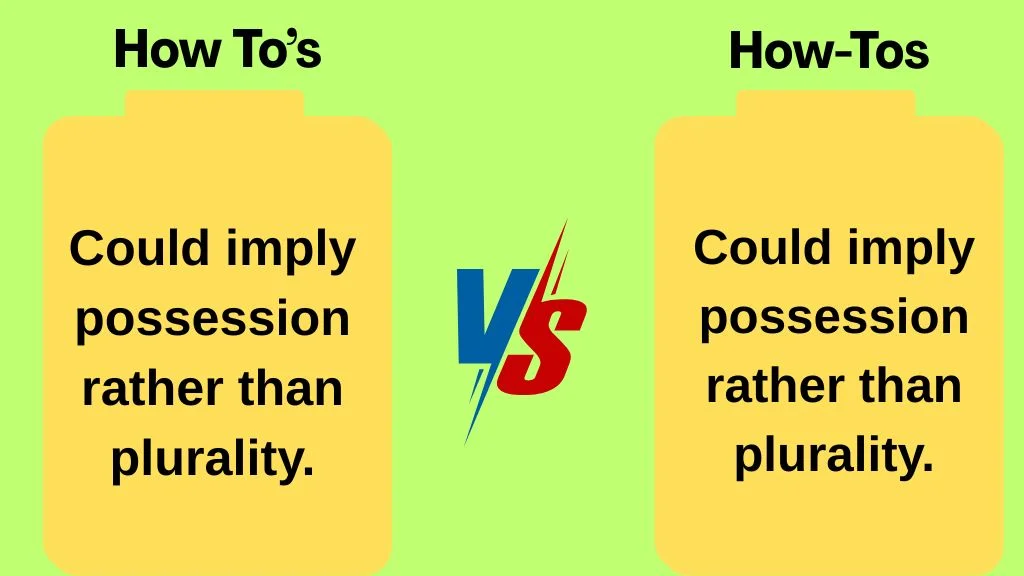
    • Incorrect: “She wrote about several how to’s.” (Could imply possession rather than plurality.)

    Circumventing Pluralization Issues: Phrasing Alternatives

    If you’re still uncertain about pluralizing how-to, consider rephrasing to avoid potential errors.

    Alternatives to Pluralizing How-To:

    • Use a descriptive phrase:
      Example: “She loves instructional guides on DIY projects.”
    • Specify the content directly:
      Example: “I read multiple tutorials on web design.”

    By rephrasing, you can maintain clarity while sidestepping tricky pluralization.


    Practical Usage: Examples of “How-Tos” in Context

    Let’s explore how how-tos is correctly used in different contexts:

    Examples in Sentences:

    1. “The website features numerous how-tos for beginners in photography.”
    2. “I compiled a list of how-tos for troubleshooting common tech issues.”
    3. “Her blog specializes in how-tos for sustainable living.”

    Case Study: Publishing Industry

    • Scenario: A publisher releases a series of instructional guides.
    • Correct Usage: “The new line of how-tos covers topics from gardening to coding.”

    FAQs

    What is the correct plural form of “how-to”?

    The correct plural form is “how-tos,” with a hyphen and no apostrophe. This follows standard grammar rules for pluralization.

    Why is “how-tos” preferred over “how to’s”?

    “How-tos” is grammatically correct because apostrophes are not used for plurals. “How to’s” incorrectly implies possession.

    Should “how-to” always be hyphenated?

    Yes, “how-to” should always be hyphenated when used as a noun or adjective to maintain clarity and proper meaning.

    Is “how-to’s” ever acceptable?

    While “how-to’s” may appear in informal writing, it is not recommended in professional or academic contexts.

    Can I rephrase to avoid pluralizing “how-to”?

    Yes, you can rephrase using alternatives like “instructional guides” or “tutorials” to avoid potential pluralization errors.


    Closing the Grammar Gap: Key Takeaways on “How To” Plurality

    • Always hyphenate how-to to avoid ambiguity.
    • Use how-tos as the correct plural form, adhering to standard grammar rules.
    • Avoid using apostrophes for pluralization unless indicating possession.
    • When in doubt, consider rephrasing to simplify your writing.

    Mastering the pluralization of how-to might seem like a small detail, but it’s an essential part of clear and professional communication.

    By following these guidelines, you’ll never second-guess your usage again!

  • How Long vs How Much Time? 🎯 Master Time Expressions in English

    How Long vs How Much Time? 🎯 Master Time Expressions in English

    Understanding how to express time accurately is a vital part of mastering the English language, especially in American English.

    Whether you’re chatting casually, writing professionally, or planning a project, knowing the difference between phrases like “how long” and “how much time” can significantly improve your communication skills.

    In this guide, we’ll explore the nuances of these phrases with examples, practical contexts, and grammar tips to ensure you use them correctly.

    By the end, you’ll have a comprehensive understanding of how to use “how long” and “how much time” effectively in both casual and formal situations.


    Key Differences Between “How Long” and “How Much Time”

    How Long vs How Much Time

    How Long

    “How long” is commonly used to ask about the duration of an event or activity. It’s flexible and works well in both casual and formal contexts. For example:

    • Casual: “How long did you wait for the bus?”
    • Formal: “How long have you been working here?”

    This phrase can refer to a range of time measures, such as minutes, hours, days, or even years. It’s versatile and appears in daily conversations, academic discussions, and professional communications alike.

    How Much Time

    “How much time” seeks a precise measurement of time. It’s often used in contexts that require specificity, such as schedules or deadlines. For example:

    • “How much time do we have left to finish this task?”
    • “How much time did you spend on this report?”

    While “How long” is broader in scope, “How much time” tends to suggest formality and precision. You’ll often hear it in professional meetings, academic settings, or detailed planning sessions.


    When to Use “How Long”

    Common Uses:

    1. General Duration:
      • “How long did the meeting last?”
      • “How long does it take to drive there?”
    2. Physical Measurements:
      • “How long is the table?” (referring to length)

    Grammatical Structures:

    • Present Perfect: “How long have you lived here?” (Action started in the past and continues to the present)
    • Past Simple: “How long did you wait?” (Action completed in the past)

    Common Mistakes:

    • Incorrect: “How long time did you wait?”
    • Correct: “How long did you wait?”

    Detailed Examples:

    1. “How long will this take?” (Asking about the estimated time required for a task.)
    2. “How long have you been studying English?” (Inquiring about the duration of an ongoing activity.)
    3. “How long does it take to bake a cake?” (Requesting a typical time frame.)

    Cultural Contexts:

    In American English, “How long” is widely understood, but subtle differences in tone or phrasing can emerge depending on the region. For example:

    • In informal conversations, contractions like “How long’ve you been here?” are common.
    • In formal settings, the complete structure (“How long have you been here?”) is preferred.

    When to Use “How Much Time”

    How Long vs How Much Time

    Common Uses:

    1. Exact Scheduling:
      • “How much time do we need for the presentation?”
      • “How much time is left before the deadline?”
    2. Formal Inquiries:
      • “How much time will this process take?”

    Grammatical Clarity:

    • “How much time” focuses on precision and is often accompanied by context requiring exact answers, like deadlines or appointments.

    Examples:

    • Academic: “How much time is allocated for the exam?”
    • Professional: “How much time do we have for this meeting?”

    Nuanced Use Cases:

    • “How much time” is frequently used when planning tasks, managing schedules, or discussing resource allocation. For example:
      • “How much time do you need to finalize this report?”
      • “How much time should we dedicate to each presentation slide?”

    Practical Tips:

    • Use “How much time” when you want exact numbers or specific answers.
    • Combine with modifiers for clarity: “Exactly how much time do we have left?”

    Comparing “How Long” vs.“How Much Time” with Examples

    Side-by-Side Comparison:

    1. “How long have you been waiting?” vs. “How much time have you spent waiting?”
    2. “How long is the movie?” vs. “How much time does the movie run?”
    3. “How long will the flight be?” vs. “How much time will we spend in transit?”

    Subtle Differences in Meaning:

    • How Long: Broader, more casual, and suitable for general inquiries.
    • How Much Time: Specific, often formal, and used when precision is required.

    Visualizing Contexts:

    Imagine planning a project:

    • You might ask, “How long will this phase take?” (General overview.)
    • Later, you could specify, “How much time do we need to allocate for testing?” (Precise inquiry.)

    Practical Applications in Daily Life

    Casual Conversations:

    • “How long will dinner take?”
    • “How much time do we have before the movie starts?”

    Professional Settings:

    • “How long have you been working on this project?”
    • “How much time do we need to complete the task?”

    Academic Environments:

    • “How long is the class?”
    • “How much time is left for the exam?”

    FAQs

    What is the difference between “how long” and “how much time”?

    “How long” refers to the general duration of an event, while “how much time” seeks a precise measurement of time.

    Can “how long” and “how much time” be used interchangeably?

    In some contexts, yes, but “how much time” is often more formal and precise.

    Is “how long” used only for time?

    No, it can also refer to physical length, such as “How long is the table?”

    What are common mistakes with these phrases?

    One common mistake is mixing them, such as saying, “How long time did you wait?”

    Which phrase is better for professional settings?

    “How much time” is generally better in professional or formal settings.


    Tables for Quick Reference

    PhraseContextExample
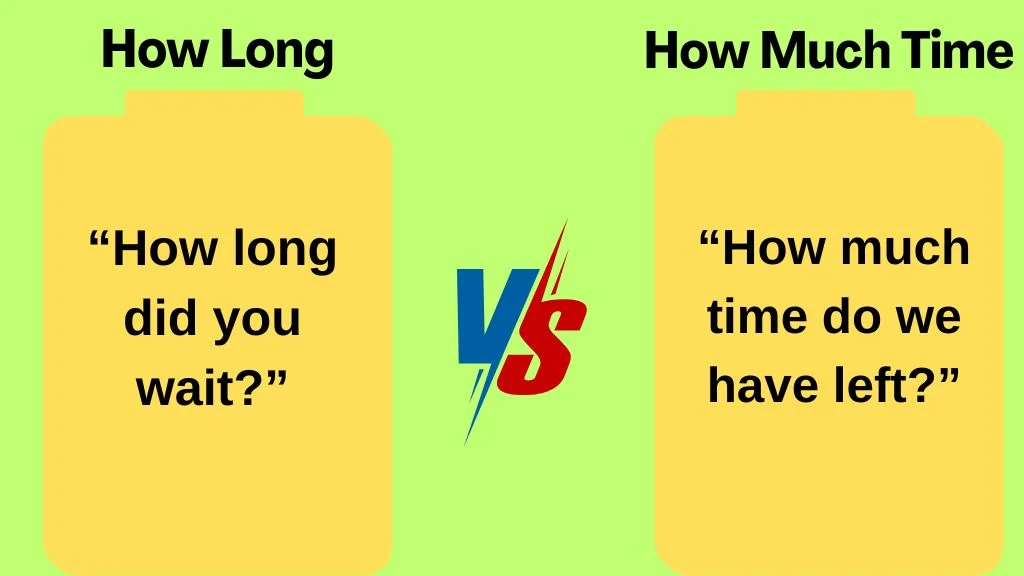
    How LongGeneral duration“How long did you wait?”
    How Much TimePrecise measurement“How much time do we have left?”
    How Long (Physical)Physical length or measurement“How long is the bridge?”

    Conclusion

    Mastering the use of “How long” and “How much time” is essential for effective communication. These phrases help you express duration accurately, whether in casual chats, formal discussions, or academic settings.

    By understanding their nuances and practicing their usage, you can convey your message clearly and confidently.

    With these insights, you’ll not only improve your English but also stand out as a precise and effective communicator in any context.

    Keep practicing, and you’ll master this subtle yet significant aspect of the language in no time!

  • Dammit vs Damn It: What’s the Difference? Learn the Right Way to Express Frustration! 🤔💬

    Dammit vs Damn It: What’s the Difference? Learn the Right Way to Express Frustration! 🤔💬

    Swearing is a fascinating and complex aspect of language that adds color, emphasis, and emotion to our conversations. Among the many expressions in English, “dammit” and “damn it” stand out for their versatility and cultural significance.

    While both are widely used, their subtle differences and contexts can confuse even seasoned speakers.

    In this blog post, we’ll explore the origins, usage, and cultural impact of these expressions, providing a comprehensive guide to help you swear correctly and effectively.

    By the end, you’ll understand when and how to use “dammit” and “damn it” with precision.


    What’s the Difference Between Dammit and Damn It?

    “Dammit” is an informal, phonetic version of “damn it,” often used to express mild frustration.

    While “damn it” retains its original spelling and formality, both phrases share a similar emotional weight but differ in tone and cultural perception. Read on to learn how to use them appropriately.


    Understanding the Origins: Dammit vs Damn It

    Both “dammit” and “damn it” originate from the verb “to damn,” which comes from the Latin word damnare, meaning “to condemn” or “to harm.”

    Historically, “damn” carried strong religious connotations, signifying eternal condemnation or divine punishment. Over centuries, its usage evolved from religious contexts to casual expressions of frustration or anger.

    Key Historical Points:

    1. Ancient Civilizations: Swearing often invoked gods or expressed strong emotions.
    2. Middle Ages: Swear words were tied to blasphemy and religious condemnation.
    3. Modern Times: Swearing became more secular, focusing on bodily functions and social taboos.

    As societal norms changed, so did the perception of words like “damn.” What was once considered blasphemous is now a common expression of annoyance.


    Dictionary Definitions and Popular Usage

    Dammit vs Damn It

    Major dictionaries define “dammit” and “damn it” as follows:

    • Oxford English Dictionary (OED):
      • Damn: To condemn or curse.
      • Dammit: Informal expletive expressing frustration.
    • Merriam-Webster:
      • Damn: To condemn to punishment or fate, especially to hell.
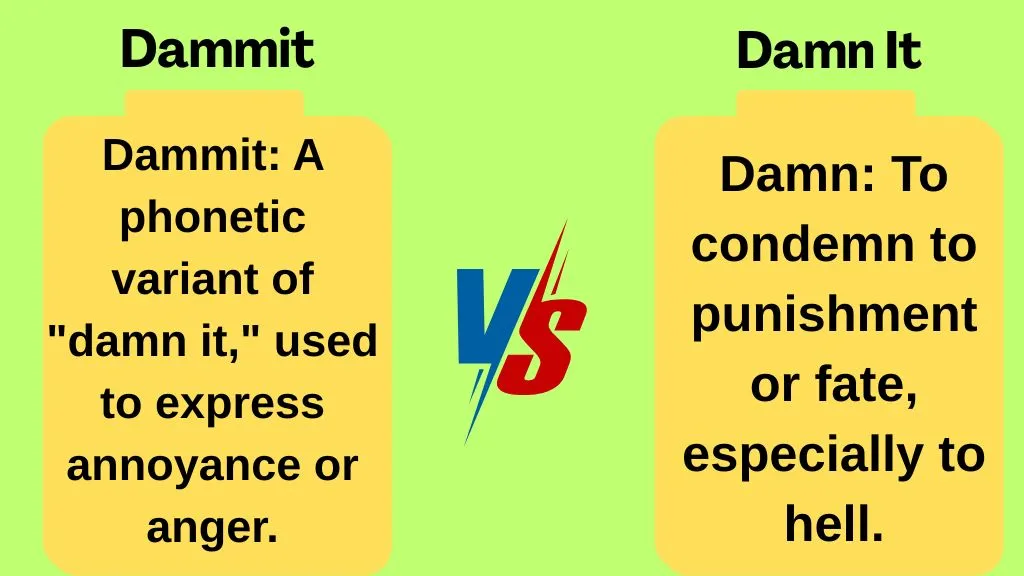
      • Dammit: A phonetic variant of “damn it,” used to express annoyance or anger.

    In popular usage, “dammit” is often seen as a milder, more casual form of “damn it,” making it suitable for everyday conversations.


    Is Dammit a Bad Word?

    The perception of “dammit” as a bad word depends on cultural and contextual factors. In many English-speaking countries, it is considered a mild expletive, acceptable in informal settings but potentially inappropriate in formal or professional environments.

    Levels of Offensiveness:

    CategoryExamplesPerception
    Mild ExpletivesDammit, heck, darnGenerally acceptable.
    Moderate ExpletivesDamn, hellAccepted in casual settings.
    Strong ExpletivesF***, s***Considered offensive.

    Cultural sensitivity also plays a role. In some cultures, even mild expletives like “dammit” may be frowned upon, while in others, they are widely accepted.


    Phonetic Spelling and American English Simplification

    The spelling “dammit” is a phonetic simplification of “damn it,” aligning with broader trends in American English to simplify language. This evolution reflects a shift toward more intuitive and accessible communication.

    Examples of Simplification:

    Traditional SpellingSimplified Spelling
    CannotCan’t
    Do notDon’t
    Damn itDammit

    Phonetic spelling not only makes words easier to pronounce but also enhances their emotional impact, especially in moments of frustration.


    Why Phonetics Influence Swearing

    Phonetics significantly affect how swear words are perceived and used. Certain sounds convey emotions more effectively, making them more appealing during moments of anger or annoyance.

    Sound Impact:

    • Hard Consonants: Sounds like “d,” “k,” and “t” add sharpness and emphasis.
    • Short Vowels: Quick, punchy vowels enhance intensity.
    • Psychological Effects: Strong phonetic elements can trigger emotional responses, providing a cathartic release.

    British vs. American English Swear Words

    Swearing varies across cultures, reflecting historical influences and societal norms.

    British Swear Words:

    • Bloody
    • Bollocks
    • Bugger

    American Swear Words:

    • Damn
    • Hell
    • Ass

    Cross-Cultural Perceptions: British swear words like “bloody” may seem quaint or humorous to Americans, while American expletives can appear harsher to British audiences.


    Correct Usage of Dammit in Sentences

    Understanding the grammatical role of “dammit” ensures its proper use in conversation and writing.

    Grammar and Syntax:

    • Interjection: “Dammit, I forgot my keys!”
    • After a Pronoun: “I lost, dammit!”

    Common Mistakes:

    • Overuse: Repeatedly using “dammit” can reduce its impact.
    • Inappropriate Contexts: Avoid using it in formal or professional settings.

    Contextual Examples: Expressing Frustration and Anger

    Using “dammit” appropriately enhances communication by clearly conveying frustration or anger.

    Real-Life Scenarios:

    • Minor Annoyances: “Dammit, I spilled my coffee.”
    • Technical Difficulties: “The printer isn’t working, dammit.”

    In contexts where stronger expletives might offend, “dammit” serves as a milder alternative.


    The Rise of Dammit in Pop Culture

    Pop culture has played a pivotal role in popularizing “dammit,” embedding it in modern vernacular.

    Iconic Quotes:

    • The Simpsons: “Dammit, Bart!”
    • Friends: “Could I be any more frustrated? Dammit!”

    These portrayals have normalized “dammit,” making it a staple expression for generations.


    FAQs About Dammit and Damn It

    Q1: What’s the difference between “dammit” and “damn it”?

    “Dammit” is an informal, phonetic version of “damn it,” used more casually. “Damn it” retains its formal spelling and tone.

    Q2: Is “dammit” considered offensive?

    “Dammit” is a mild expletive, generally acceptable in informal settings but inappropriate in formal environments.

    Q3: Can “dammit” be used in professional contexts?

    While it’s best to avoid swearing at work, “dammit” may be acceptable in relaxed or creative settings.

    Q4: How does American English influence the spelling of “dammit”?

    American English often simplifies language for ease of use, leading to the phonetic spelling “dammit.”

    Q5: Are there alternatives to “dammit”?

    Yes, alternatives like “darn,” “heck,” and “shoot” can be used to express frustration more politely.


    Conclusion

    Swearing, when used appropriately, is a powerful tool for emotional expression. Understanding the nuances of “dammit” and “damn it” allows you to communicate frustration and anger effectively while remaining contextually appropriate.

    Whether navigating everyday annoyances or adding authenticity to your language, mastering these terms will enhance your ability to connect with others.

    By learning and practicing their use, you’ll not only enrich your vocabulary but also become a more expressive and impactful communicator.

  • 🚗 Scrap or Scrape? Clear Up the Confusion!

    🚗 Scrap or Scrape? Clear Up the Confusion!

    Language can be tricky, especially when two words sound similar but mean entirely different things. Scrap and scrape are perfect examples of such words.

    If you’ve ever found yourself wondering whether you should “scrap” or “scrape” something, you’re not alone!

    “Scrap” and “scrape” may sound similar, but they have completely different meanings. Learn when to discard (scrap) and when to remove by rubbing (scrape) in this guide!

    This guide will clear up the confusion, diving deep into their definitions, origins, and real-world applications. By the end, you’ll have a crystal-clear understanding of how to use these terms correctly.


    Core Definitions: Scrap vs Scrape

    Scrap vs Scrape

    What Does Scrap Mean?

    The word scrap is versatile, functioning both as a noun and a verb.

    As a noun, it refers to:

    • A small piece of something, like paper, metal, or fabric.
      Example: “I found a scrap of paper with his phone number on it.”
    • Waste material that can be recycled or discarded.
      Example: “The factory collects metal scraps for recycling.”

    As a verb, it means:

    • To discard, abandon, or get rid of something.
      Example: “The team decided to scrap the old design and start fresh.”

    Key point: Scrap is about small pieces, leftovers, or the act of discarding something.


    What Does Scrape Mean?

    Scrap or Scrape

    The word scrape primarily functions as a verb, though it can also be a noun in specific contexts.

    As a verb, it means:

    • To remove something from a surface by rubbing or friction.
      Example: “She scraped the paint off the wall.”
    • To barely manage or achieve something.
      Example: “He managed to scrape by with just enough money to pay rent.”

    As a noun, it refers to:

    • A scratch or abrasion.
      Example: “He fell off his bike and got a scrape on his knee.”

    Key point: Scrape is associated with physical actions, friction, or barely managing something.

    A Quick Comparison Table

    AspectScrapScrape
    Part of SpeechNoun, VerbVerb, Noun
    MeaningSmall pieces, discardRemove by rubbing, barely manage
    Example Usage“Scrap the plan.” / “Metal scraps”“Scrape off the dirt.” / “Scrape by”

    The Linguistic Roots: Etymology and Evolution

    Scrap

    • Origin: The word scrap comes from Old Norse skrap, meaning “scraps or trifles,” and later from Middle English.
    • Evolution: Over time, it evolved to mean small fragments or leftover material and expanded to include the idea of discarding something.

    Scrape

    • Origin: Scrape derives from Old English scrapan or skrapa, meaning “to scratch or graze.”
    • Evolution: The term maintained its physical connotations of friction and expanded metaphorically to mean struggling to achieve or manage something.

    Understanding these origins can help clarify why the two words are distinct despite sounding similar.


    Visualizing the Actions: What Do They Represent?

    It’s often easier to understand the difference between scrap and scrape by visualizing them in action.

    Examples:

    • Scrapping an old car: Imagine taking an old, broken car to a junkyard to discard it.
    • Scraping ice off a windshield: Picture using a tool to rub off the frosty layer on your car’s glass during winter.

    Infographic Idea (if applicable):

    Scrap vs. Scrape Visualized

    ActionVisual Representation
    Scrap: DiscardingThrowing away old furniture or metal parts
    Scrape: RemovingUsing a scraper to clean a dirty surface

    Common Misconceptions and Errors

    It’s no surprise people mix up scrap and scrape. Here are the most common reasons for confusion:

    • Phonetic Similarity: Both words sound almost identical when spoken quickly.
    • Autocorrect Mistakes: Writing “scrap” when you mean “scrape” (or vice versa) is an easy typo for autocorrect to miss.
    • Context Misunderstanding: People often don’t consider the surrounding context to determine the correct word.

    Incorrect Usage Examples:

    1. “He scraped the project due to lack of funds.” (Incorrect: Should be “scrapped”)
    2. “Please scrap off the excess paint.” (Incorrect: Should be “scrape”)

    Correct Usage Tips:

    • If you’re discarding something, use scrap.
    • If you’re removing something by rubbing, use scrape.

    Real-world Applications: Where and How to Use Each Word

    Scrap

    • Recycling: Scrap metal, paper, or fabric often refers to waste that can be reused.
      Example: “The scrapyard collects old car parts for recycling.”
    • Abandoning Plans: To scrap a project means to stop working on it altogether.
      Example: “The company scrapped their expansion plans due to budget cuts.”

    Scrape

    • Physical Actions: Removing dirt, frost, or paint from surfaces.
      Example: “He scraped the mud off his boots.”
    • Metaphorical Usage: Barely achieving something, like scraping by financially.
      Example: “She scraped through the exam with a passing grade.”

    By understanding these contexts, you’ll always know which word to use.


    Case Studies: Examples in Action

    Scenario 1: Construction Industry

    • Scrap: “The contractor collected scrap wood for use in smaller projects.”
    • Scrape: “Workers scraped the old paint off the walls before repainting.”

    Scenario 2: Everyday Life

    • Scrap: “After dinner, she saved the food scraps for composting.”
    • Scrape: “He accidentally scraped the side of his car against the garage wall.”

    The Role of Technology: Autocorrect and Spell-Check Errors

    Modern technology can sometimes be a double-edged sword. While autocorrect and spell-check are useful, they can also perpetuate errors with homophones like scrap and scrape.

    Why Does This Happen?

    • Autocorrect may not catch context-specific errors.
    • Users might overlook subtle mistakes due to over-reliance on these tools.

    Tips to Avoid Errors:

    • Always proofread your work, especially if these words are involved.
    • Use grammar-checking tools like Grammarly, but don’t depend solely on them.

    Practical Tips to Avoid Confusion

    1. Context is Key: Think about the action or object you’re describing. Are you discarding something (scrap) or removing something by friction (scrape)?
    2. Mnemonic Device: Remember, scrap = stop (discard), scrape = scratch (remove).
    3. Double-check Your Writing: Especially in professional or formal communication.
    4. Consult a Dictionary: When in doubt, a quick search can clarify meanings.

    FAQs

    What does “scrap” mean as a verb?

    “Scrap” as a verb means to discard or abandon something, like a plan or an object.

    What does “scrape” mean in daily usage?

    “Scrape” means to remove something by rubbing a surface or to barely achieve something, like scraping through an exam.

    Can “scrap” and “scrape” be used interchangeably?

    No, “scrap” and “scrape” have distinct meanings and should not be used interchangeably.

    How can I avoid confusing “scrap” with “scrape”?

    Remember, “scrap” relates to discarding, while “scrape” involves rubbing or achieving something barely.

    What are common mistakes with “scrap” and “scrape”?

    A common mistake is using “scrap” instead of “scrape” for actions like removing paint, or vice versa when abandoning a plan.


    Conclusion

    By now, you should feel confident distinguishing between scrap and scrape. Though they may sound alike, their meanings, origins, and uses are entirely distinct.

    Whether you’re writing professionally or simply texting a friend, understanding the difference can make your communication clearer and more precise.

    If you’ve found this guide helpful, feel free to share it or leave a comment below about other confusing word pairs you’d like to see explained!