Blog

  • 🌈 Violet vs Indigo vs Purple: What’s the Real Difference?

    🌈 Violet vs Indigo vs Purple: What’s the Real Difference?

    When you hear the words violet, indigo, and purple, what comes to mind? Are they simply shades of the same color, or do they hold distinct meanings and characteristics?

    These colors often overlap in conversation, but they each have unique identities.

    What’s the difference between violet, indigo, and purple? Discover their unique roles in the spectrum, art, and culture, and learn how to identify them in everyday life!

    This guide will explore the spectrum, history, science, art, and cultural significance of these captivating colors, helping you understand their differences in-depth.


    Exploring the Spectrum: Understanding Violet, Indigo, and Purple
    Violet vs Indigo vs Purple

    The terms violet, indigo, and purple describe colors that sit close together on the visible light spectrum, but they’re not interchangeable.

    Here’s how they differ:

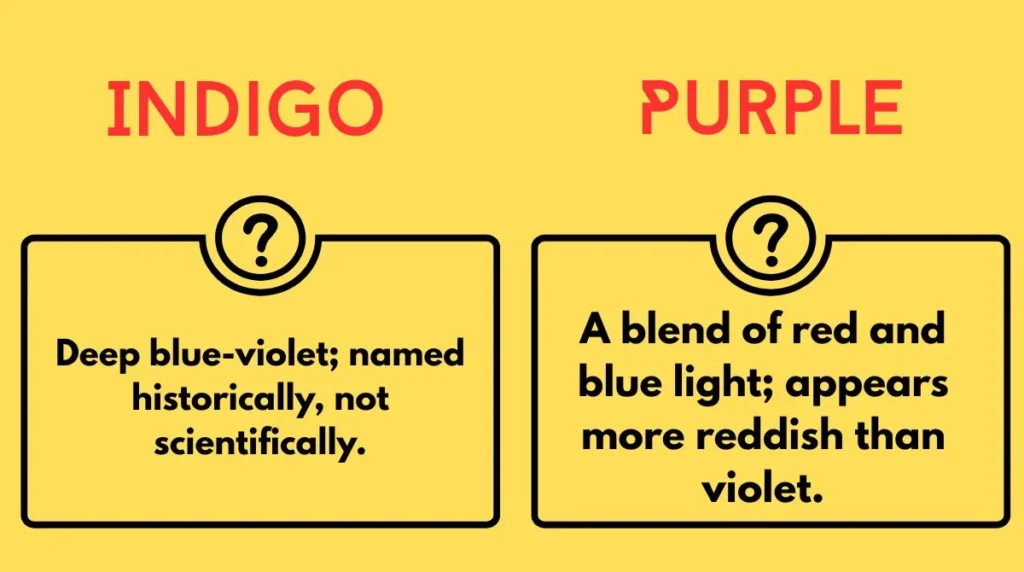
    • Violet: A spectral color with its own specific wavelength (approximately 380-450 nm), violet is closest to ultraviolet light and is found in rainbows.
    • Indigo: While not strictly defined scientifically, indigo sits between blue and violet. Historically, it’s considered a deeper, more muted blue-violet.
    • Purple: Unlike violet and indigo, purple isn’t a spectral color. Instead, it’s a mix of red and blue light, created by blending pigments.

    Quick Comparison Table:

    ColorSpectral?Wavelength RangeDescription
    VioletYes380-450 nmClosest to ultraviolet; a true spectrum color.
    IndigoNoN/ADeep blue-violet; named historically, not scientifically.
    PurpleNoN/AA blend of red and blue light; appears more reddish than violet.

    Historical Significance and Usage of Violet, Indigo, and Purple
    Violet vs Indigo

    Violet

    In history, violet has often been associated with spirituality and mysticism. Ancient civilizations believed violet light held divine properties because of its association with the heavens.

    Indigo

    Indigo gained prominence in trade and textiles. The dye derived from the Indigofera plant was so valuable that it became known as “blue gold.” It was widely used in fabrics and later became a key element in the rainbow spectrum as defined by Isaac Newton.

    Purple

    Purple’s rarity in nature made it one of the most sought-after colors in ancient times. The famed Tyrian purple dye, extracted from sea snails, was labor-intensive to produce and reserved for royalty and the elite.

    Fun Fact: The phrase “born to the purple” originates from Roman emperors who wore purple robes as a symbol of power and wealth.


    The Royal Color: Purple through the Ages

    Purple has long been associated with royalty, wealth, and status. In ancient Rome, laws like the Sumptuary Laws restricted the use of purple clothing to the ruling class. During the Renaissance, purple became synonymous with luxury and grandeur, often featured in regal portraits.

    Even today, purple remains a symbol of elegance and prestige. It’s commonly used in branding for luxury products and high-end services.


    Violet and Indigo in Art and Culture

    Violet

    Violet frequently represents imagination and spirituality in art. It’s often used to evoke serenity and mystery. Artists like Monet and van Gogh utilized violet hues in their works to depict the subtleties of light and shadow.

    Indigo

    Indigo appears in both traditional and modern art forms. In textiles, it’s a staple for creating deep, rich blues. In fine art, indigo is often chosen for its muted yet dramatic tones, perfect for expressing depth and emotion.

    Quote: “The deeper the blue becomes, the more it draws man towards the infinite.” – Wassily Kandinsky


    Color Symbolism and Its Impact

    Colors carry powerful emotional and cultural meanings. Here’s a breakdown of what violet, indigo, and purple typically represent:

    • Violet: Spirituality, creativity, and mystery.
    • Indigo: Introspection, wisdom, and intuition.
    • Purple: Luxury, ambition, and transformation.

    These associations make these colors a staple in marketing, interior design, and fashion. For example, violet is often used in wellness branding, while purple appears in luxury packaging.


    Scientific Perspectives: How We See These Colors

    From a scientific standpoint, how we perceive these colors depends on the way our eyes interpret wavelengths of light.

    • Violet is part of the visible spectrum, so our eyes see it as pure light without blending.
    • Indigo is subjective; some people distinguish it as a separate color, while others see it as a variation of blue or violet.
    • Purple, a combination of red and blue light, activates both short-wave and long-wave receptors in our eyes.

    Artistic Methods: Mixing Colors to Achieve Violet, Indigo, and Purple

    Artists often create these hues using various pigment combinations:

    • Violet: Achieved by blending blue with a touch of red. Using a cool blue like ultramarine can enhance its vibrancy.
    • Indigo: Created by mixing blue with a hint of black or violet for depth.
    • Purple: Equal parts red and blue yield pure purple, but adjusting the ratio can shift the shade warmer or cooler.

    Creating Shades: The Role of Red and Blue Ratios

    The ratio of red to blue determines the warmth or coolness of these colors:

    RatioResulting Shade
    More BlueCooler tones, closer to violet.
    More RedWarmer tones, closer to purple.

    Artists can experiment with white or black pigments to create tints and shades, adding depth to their palettes.


    The Artist’s Palette: Techniques for Capturing the Perfect Hue

    Capturing the perfect violet, indigo, or purple requires careful attention to lighting, materials, and blending methods:

    • Layering: Build up colors gradually to achieve depth and vibrancy.
    • Lighting: Natural light brings out the true richness of these hues.
    • Pigment Quality: High-quality pigments ensure accuracy and longevity.

    Practical Tips for Distinguishing Between Violet, Indigo, and Purple

    Not sure how to tell these colors apart? Here are some practical tips:

    1. Use a Color Wheel: Violet is closer to blue, while purple leans toward red. Indigo bridges the gap.
    2. Check the Hue: Violet often appears brighter, indigo is muted, and purple is vibrant.
    3. Think in Context: Is it part of a rainbow? Likely violet or indigo. A mix of pigments? It’s purple.

    Color in Nature: Flowers, Fabrics, and Rainbows

    • Violet in Nature: Think of violets, lavender, and amethyst gemstones. Violet is commonly seen in flowers and crystals.
    • Indigo in Fabrics: Indigo dye has been used for centuries to color textiles, from denim jeans to traditional Japanese kimonos.
    • Purple in Rainbows: While purple isn’t a spectral color, it’s often depicted in art and design as part of the rainbow.

    FAQs

    What’s the main difference between violet and purple?

    Violet is a spectral color with its own wavelength, while purple is a combination of red and blue light. Violet leans closer to blue, while purple often appears more reddish.

    Is indigo a real color in the rainbow?

    Yes, indigo is traditionally included in the rainbow spectrum, sitting between blue and violet. However, some people view it as a variation rather than a distinct color.

    Why is purple associated with royalty?

    Purple was historically rare and expensive to produce, making it a symbol of wealth and power. In ancient Rome and beyond, it was reserved for royalty and the elite.

    How do artists mix violet, indigo, and purple?

    Artists mix violet by blending blue with a touch of red, indigo by adding black to blue, and purple by combining equal parts red and blue. Adjusting ratios changes the tone.

    What do violet, indigo, and purple symbolize?

    Violet represents spirituality and imagination, indigo signifies wisdom and introspection, and purple conveys luxury, ambition, and transformation.


    Conclusion

    Understanding the distinctions between violet, indigo, and purple not only helps in artistic endeavors but also enriches our appreciation of the natural and cultural world.

    Whether you’re painting a masterpiece, choosing an outfit, or simply admiring a sunset, knowing these colors’ unique qualities allows you to see the world with greater depth and nuance.
  • 🤔 Soo vs So: What’s the Difference? (Clear Explanation Inside!)

    🤔 Soo vs So: What’s the Difference? (Clear Explanation Inside!)

    English is full of words and expressions that sound similar yet have completely different meanings or uses. One such pair is “soo” and “so.”

    If you’ve ever found yourself wondering whether “soo” is an actual word or just a playful, informal variation, you’re not alone.

    In this article, we’ll explore the differences between these two terms, how they’re used, and the contexts where each is appropriate.

    “Soo” or “so”? One is correct, and the other is informal! Discover the key differences between these two words, with tips on when and how to use them.

    By the end, you’ll have a clear understanding of when to use “so” versus “soo” in your writing and speech.


    Introduction to Soo and So in Daily Communication

    Soo vs So

    At first glance, “soo” and “so” might seem interchangeable. However, they serve entirely different purposes in communication.

    • So is a well-established word in English, functioning as an adverb, conjunction, and intensifier in countless situations.
    • Soo, on the other hand, is not a standard word in the dictionary but has gained popularity in informal settings, such as texting or social media.

    Understanding the differences between these two terms is key to using them appropriately in both formal and casual conversations.


    The Linguistic Role of “So” As an Adverb and Conjunction

    “So” is one of the most versatile words in the English language. Depending on its function in a sentence, it can serve as:

    • An adverb:
      Used to emphasize degree or intensity.
      Example: “I’m so excited about the trip!”
    • A conjunction:
      Used to show cause and effect or to connect ideas.
      Example: “She forgot her umbrella, so she got wet.”
    • A filler word:
      Common in casual speech to add emphasis or indicate continuation of thought.
      Example: “So, what are you going to do next?”

    This versatility makes “so” an indispensable part of everyday language.


    Understanding “So” in Various Contexts

    The meaning of “so” often depends on context. Here’s a breakdown of how it’s used:

    ContextMeaningExample
    Cause and EffectIndicates one event leads to another.“The store was closed, so I went home.”
    EmphasisIntensifies adjectives or adverbs.“That movie was so funny!”
    PurposeImplies intent or goal.“I left early so I could catch the bus.”
    ContinuationIntroduces a new idea or thought.“So, what happened after that?”

    Common Usage Examples of “So”

    “So” appears frequently in both written and spoken English. Here are some common examples:

    1. As a linking word:
      • “I was tired, so I took a nap.”
    2. In casual speech:
      • “So, do you want to grab lunch later?”
    3. To express intensity:
      • “I’m so happy you came!”
    4. To show purpose:
      • “She studied hard so she could pass the test.”

    Its adaptability makes “so” one of the most commonly used words in English.


    Exploring the Informal Use of “Soo” in Modern Language

    Unlike “so,” the term soo is not formally recognized as a standard English word. Instead, it has become a playful, informal way of exaggerating or emphasizing something.

    Examples of Informal “Soo” Usage:

    • “That dress is soo beautiful!”
    • “I’m soo ready for the weekend.”

    In these cases, “soo” is used as an extended version of “so” to add extra emphasis, often appearing in text messages or online posts.


    Clarity on “Is ‘Soo’ a Real Word?”

    The short answer is: no, “soo” is not an official word in the English language. It doesn’t appear in standard dictionaries and is not considered grammatically correct in formal writing.

    However, that doesn’t mean it’s entirely wrong to use. In informal settings, “soo” is often accepted as a playful way to intensify an idea or emotion, much like using emojis or slang.


    The Dictionary Verdict on “Soo”

    No major dictionary, including Merriam-Webster or Oxford English Dictionary, officially recognizes “soo” as a legitimate word. Instead, it’s classified as:

    • A nonstandard variation: Informal and used for emphasis in casual contexts.
    • A stylistic choice: Often used to convey tone or exaggeration in digital communication.

    Key takeaway: While “soo” has no place in formal writing, it thrives in informal, creative expression.


    Instances Where “Soo” Appears in Writing

    Even though “soo” isn’t a real word, you might still encounter it in certain contexts:

    1. Social Media Posts:
      • “This concert is soo amazing!”
    2. Text Messages:
      • “I’m soo sorry I missed your call.”
    3. Marketing or Branding:
      • Brands sometimes use “soo” in slogans to appear trendy or relatable.
        Example: “Soo good it’s irresistible!”

    These instances highlight how “soo” can convey enthusiasm or exaggeration in an informal tone.


    The Right Contexts to Use “So” Over “Soo”

    When deciding between “so” and “soo,” context is everything.

    Use “So” When:

    • Writing formally or professionally.
      Example: “The results were so conclusive that further testing wasn’t needed.”
    • Following grammatical conventions.
      Example: “The event was so well-organized.”

    Use “Soo” When:

    • Engaging in casual conversations or social media posts.
      Example: “I’m soo glad you’re here!”
    • Adding personality or humor to your tone.
      Example: “This is soo not what I expected!”

    Knowing your audience can help you decide which term is appropriate.


    The Prevalence of “So” Or “Soo” in Formal and Informal Settings

    “So” Or “Soo”

    Formal Settings:

    “So” dominates formal communication due to its grammatical accuracy and versatility. It appears in academic writing, business emails, and professional presentations.

    Informal Settings:

    “Soo” thrives in informal communication like texts, tweets, and casual conversations. Its exaggerated tone makes it perfect for expressing excitement or humor.

    Fun Fact: A search through online forums and social media shows that “soo” is significantly more common in informal settings, but “so” remains the undisputed choice for formal usage.


    Final Considerations on When to Use “Soo” Appropriately

    If you’re tempted to use “soo,” keep the following in mind:

    1. Audience Matters: Use “soo” only in casual contexts where grammar isn’t a priority.
    2. Tone and Style: “Soo” can add a playful or exaggerated tone, but don’t overuse it.
    3. Avoid Confusion: Stick to “so” in any professional or academic setting to ensure clarity.

    FAQs

    Is “soo” a real word?

    No, “soo” is not an official word in English. It’s an informal variation of “so,” often used in casual communication for added emphasis or playfulness.

    What does “so” mean in English?

    “So” is a versatile word used as an adverb, conjunction, or intensifier to express cause, purpose, or emphasis. Example: “I’m so excited!”

    When should I use “so” instead of “soo”?

    Use “so” in formal writing, professional communication, or anywhere grammatical accuracy is essential. Reserve “soo” for casual settings like social media or texting.

    Why do people write “soo”?

    People use “soo” as a playful or exaggerated version of “so” to add personality or emphasis, especially in informal contexts like texts or online posts.

    Can “soo” be used in formal writing?

    No, “soo” should not be used in formal writing as it is not grammatically correct. Stick to “so” for professionalism and clarity.


    Conclusion

    The difference between “soo” and “so” lies not just in spelling but in purpose and context.

    While “so” is a grammatically correct and versatile word used in countless ways, “soo” is an informal, playful variation best reserved for casual communication.

    By understanding their differences, you can confidently decide when and where to use each.

    English is a language full of quirks and subtleties, and mastering these nuances makes communication more effective—and fun!

  • ✅ Envolved or Involved: Which is Correct? (With Clear Examples)

    ✅ Envolved or Involved: Which is Correct? (With Clear Examples)

    English spelling can be tricky, and some words often trip people up because of how similar they look or sound. One common mistake is mixing up “envolved” and “involved.”

    If you’ve ever wondered which is correct—or if “envolved” even qualifies as a word—you’re in the right place!

    Is it “envolved” or “involved”? Only one is correct! Learn why “envolved” isn’t a word and how to properly use “involved” with examples.

    This article breaks it all down with clear explanations, examples, and tips to avoid this common error.


    Understanding the Correct Usage: Involved vs. Envolved

    The short answer? “Involved” is the correct word in standard English, while “envolved” is not.

    Despite their similar appearance, only one of these words has an actual place in the English language. Let’s explore why this mix-up happens and what each term means (or doesn’t mean).


    Explaining the Definition and Use of “Involved”

    The word involved is widely used in English, functioning primarily as an adjective and sometimes as the past tense of the verb involve.

    Definition:

    Involved means:

    1. Being actively engaged or participating in something.
      Example: “She is deeply involved in community projects.”
    2. Complicated or intricate.
      Example: “The plot of the novel is very involved.”

    It also refers to emotional or relational connections, such as being part of a romantic relationship or having a stake in something.

    Key Grammar Note:

    • Root word: Involve
    • Forms: involves, involved, involving

    Key takeaway: Involved is the correct term to describe active participation, complexity, or relationships.


    Why “Envolved” is a Common Spelling Mistake

    Envolved or Involved

    While “envolved” isn’t a word in English, it’s a frequent misspelling of involved. Why does this error occur?

    Reasons for Confusion:

    1. Phonetic Similarity:
      In casual speech, the pronunciation of “involved” can sound like “envolved,” especially when spoken quickly.
    2. Prefix Confusion:
      People might mistakenly think “en-” (as in enrich or encase) applies here, leading to the incorrect spelling “envolved.”
    3. Typing Errors:
      Fast typing or autocorrect can sometimes replace “in” with “en,” resulting in “envolved.”

    Pro Tip: Always double-check your spelling to avoid this mix-up!


    Cambridge Dictionary’s Clarification on the Matter

    According to the Cambridge Dictionary, involved is a universally recognized term, while “envolved” does not appear as a valid entry.

    Here’s how involved is defined by Cambridge:

    • Involved: Connected with something on an emotional, practical, or professional level.

    This clarity reinforces that envolved is not accepted in formal or informal English usage.


    The Grammatical Role of “Involved” in Sentences

    “Involved” plays several grammatical roles depending on context:

    1. As an Adjective:

    Used to describe engagement or connection.
    Example: “He is involved in the project from start to finish.”

    2. As a Past Participle (Passive Voice):

    Involved can form part of passive structures.
    Example: “The community was involved in the restoration process.”

    3. As a Descriptor of Complexity:

    When something is detailed or intricate.
    Example: “The calculations were too involved for beginners.”


    Diving Deeper: The Various Meanings of “Involved”

    The word “involved” has rich and varied meanings depending on its usage. Let’s break these down:

    When “Involved” Describes Complexity

    Sometimes, involved is used to mean that something is detailed, intricate, or difficult to understand.

    • Example: “The math problem was so involved that it took hours to solve.”
    • This usage highlights situations requiring time, effort, or expertise.

    The Emotional and Relational Aspects of Being “Involved”

    “Involved” also has significant emotional and relational connotations.

    • Romantic Relationships:
      Example: “They’ve been involved for years and are planning to get married.”
    • Family or Personal Connections:
      Example: “She felt emotionally involved in her friend’s struggles.”

    This usage shows how the term often conveys deep emotional ties or personal stakes.


    Professional and Hobbyist “Involvement”: A Sign of Engagement

    Being “involved” in something is often seen as a positive attribute, particularly in professional or personal pursuits.

    Examples of Professional Involvement:

    • Participating in work projects:
      Example: “He’s actively involved in developing the company’s new strategy.”
    • Engaging in networking events:
      Example: “She remains involved in the industry through conferences and seminars.”

    Examples of Hobbyist Involvement:

    • Volunteering:
      Example: “He’s involved in volunteering at the local animal shelter.”
    • Sports and Activities:
      Example: “She’s heavily involved in her community soccer league.”

    Key insight: Whether in work or leisure, involvement often signals dedication and passion.


    Real-life Examples: Incorrect vs Correct Usage

    Envolved or Involved

    Incorrect Usage:

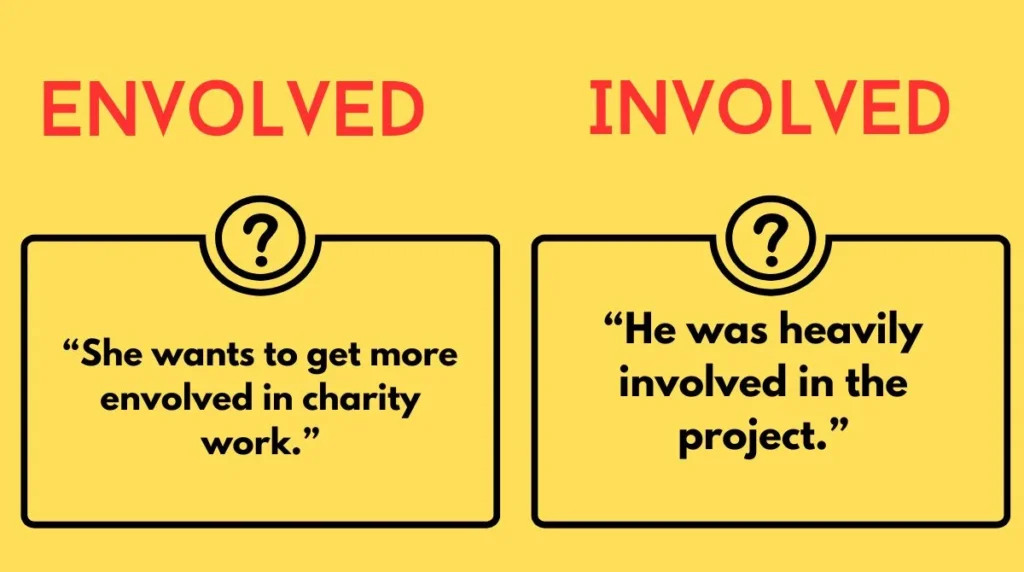
    • “He was heavily envolved in the project.” (Wrong: “envolved” is not a word.)
    • “She wants to get more envolved in charity work.” (Wrong spelling again.)

    Correct Usage:

    • “He was heavily involved in the project.”
    • “She wants to get more involved in charity work.”

    The Prevalence of “Involved” Over “Envolved” in Literature

    A quick look at published literature and reliable language corpora reveals that “involved” is widely used, while “envolved” is virtually nonexistent.

    Interesting Facts:

    • According to Google Ngram Viewer, “involved” appears millions of times across books, while “envolved” doesn’t register.
    • Writers, editors, and even autocorrect systems overwhelmingly favor the correct term involved.

    Key takeaway: When in doubt, choose “involved”—it’s the only correct option!


    FAQs

    Is “envolved” a real word?

    No, “envolved” is not a valid word in English. The correct word is “involved,” which refers to participation, complexity, or connections.

    What does “involved” mean?

    “Involved” means actively engaged in something, describing complexity, or referring to emotional or relational connections. Example: “He is involved in charity work.”

    Why do people confuse “envolved” with “involved”?

    The confusion arises from phonetic similarity and the assumption that the prefix “en-” applies, as in words like “enrich” or “encase.”

    Can “involved” describe complexity?

    Yes, “involved” can describe something intricate or detailed. Example: “The process was too involved to understand without proper training.”

    How can I avoid spelling mistakes like “envolved”?

    To avoid mistakes, proofread carefully, use spell-check tools, and familiarize yourself with the correct spelling and meaning of commonly confused words.


    Final Insights: Why Choosing the Right Word Matters

    Using the correct word enhances the clarity and professionalism of your writing. Choosing “involved” instead of the incorrect “envolved” ensures your message is understood and keeps your communication error-free.

    Recap:

    • Involved is the correct word for describing participation, complexity, or emotional connections.
    • Envolved is a misspelling caused by phonetic similarity and prefix confusion.

    Remember, careful proofreading and a solid understanding of the word’s usage can save you from common mistakes. Mastering these small details is key to effective communication!

  • 🤔 Emasculate vs Demasculate: What’s the Difference?

    🤔 Emasculate vs Demasculate: What’s the Difference?

    Language is a powerful tool for expressing ideas, but it can also lead to confusion when similar-sounding words carry distinct meanings.

    Emasculate and demasculate are two terms that often puzzle readers and writers alike.

    Is it “emasculate” or “demasculate”? While one is historically grounded, the other is a linguistic misunderstanding. Learn the difference here!

    Are they interchangeable? Do they share the same origins? This article delves into their definitions, uses, and broader implications to help you master their correct usage.


    Understanding the Roots: The Origins of ‘Emasculate’

    Emasculate vs Demasculate

    The word emasculate has its roots in Latin. It derives from the Latin term emasculatus, which combines ex- (out of, from) and masculus (male).

    Literally, it means “to deprive of manhood” or “to weaken.”

    Historically, the term was used in its literal sense to describe the physical removal of masculine traits, often in a biological or medical context. Over time, its meaning expanded metaphorically, encompassing the weakening of power, strength, or confidence.


    Exploring ‘Emasculate’: Definitions and Uses

    In modern usage, emasculate carries both literal and figurative meanings:

    • Literal Definition:
      To physically remove or impair male reproductive organs, often used in biological or medical contexts.
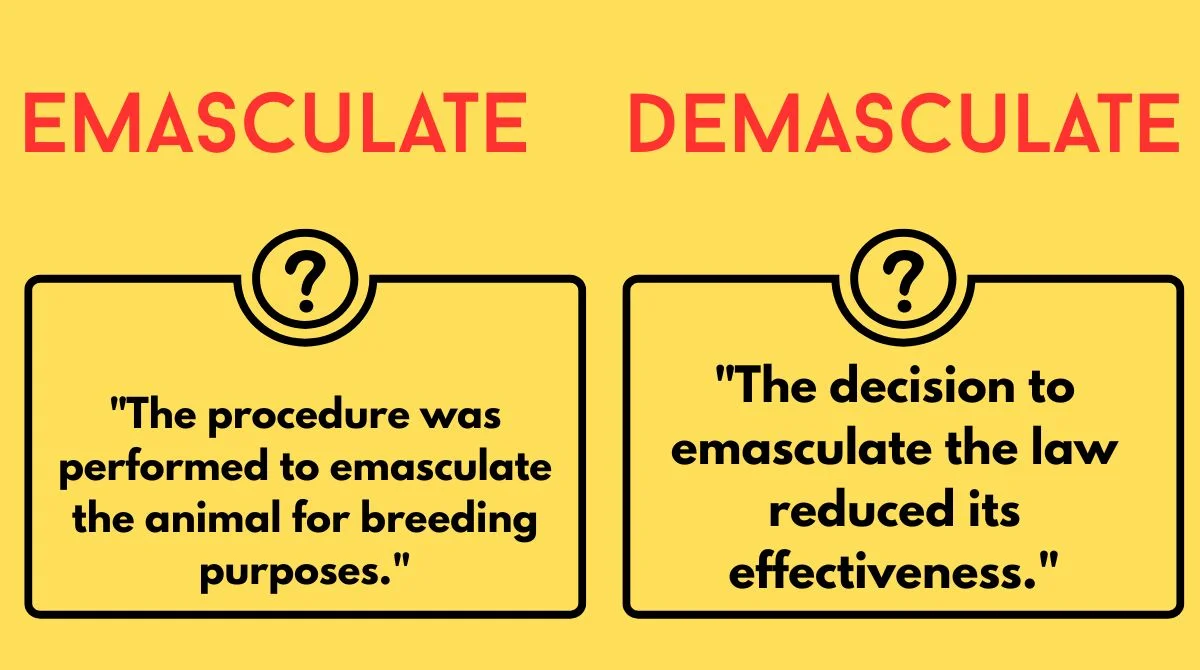
      Example: “The procedure was performed to emasculate the animal for breeding purposes.”
    • Figurative Definition:
      To weaken or deprive someone (or something) of their strength, power, or authority.
      Example: “The leader felt emasculated by the committee’s decision to overrule his authority.”

    This dual nature of the term makes it applicable in various fields, from biology to everyday language.


    The Literal Biological Context

    In its most direct sense, emasculate refers to the process of castration. Historically, this was done to animals or, in rare instances, humans for specific purposes such as controlling reproduction or altering behavior.

    In botany, emasculation refers to the removal of male parts of a flower (the stamens) to prevent self-pollination. This practice is common in plant breeding to ensure cross-pollination and genetic diversity.

    Key Example:
    “In plant breeding, the farmer emasculated the flowers to control pollination and produce hybrid crops.”


    Metaphorical Implications of ‘Emasculate’

    Emasculate vs Demasculate

    Beyond its literal meaning, emasculate is often used metaphorically to describe situations where strength, authority, or confidence is undermined. This usage frequently appears in political, professional, and personal contexts.

    Examples:

    • A political leader being undermined by their party.
    • A person feeling diminished by societal expectations or criticisms.
    • A creative project losing its integrity due to external interference.

    Quote to Illustrate:
    “Criticism can emasculate the strongest of ideas if it’s not constructive.”


    The Role of ‘Emasculate’ in Botanical Sciences

    Interestingly, the term emasculate plays a crucial role in botany. It refers to the deliberate removal of stamens (male reproductive parts) from a flower to ensure controlled breeding. This technique prevents self-pollination and promotes cross-pollination, leading to stronger, more diverse plant varieties.

    Table: Steps in Floral Emasculation

    StepDescription
    Identify the flowerSelect a flower at the right developmental stage.
    Remove the stamensCarefully detach the male parts using forceps.
    Cover the flowerProtect the flower to avoid unintended pollination.
    Introduce pollenApply pollen from the desired plant manually.

    This scientific application of emasculate highlights its precision and importance in agricultural advancements.


    Misconceptions of ‘Demasculate’ in Modern Language

    Unlike emasculate, the term demasculate is less commonly recognized or used. In fact, many linguists consider it a misunderstood or nonstandard variation of emasculate.

    Why the Confusion?

    • Prefix Misinterpretation:
      People often associate the prefix de- with removal or reversal (e.g., defrost or deactivate), leading to the mistaken belief that demasculate is a valid counterpart to emasculate.
    • Incorrect Usage:
      Some mistakenly use demasculate in place of emasculate without understanding its historical or linguistic background.

    Key Point:
    While demasculate occasionally surfaces in informal language, it lacks the historical and etymological grounding of emasculate. Stick to emasculate for clarity and correctness.


    ‘Emasculate’ Beyond the Dictionary: Cultural Impact and Controversy

    The metaphorical use of emasculate often sparks cultural and societal debates. Its association with masculinity and power has led to discussions about gender roles, identity, and the shifting dynamics of authority.

    Common Contexts of Controversy:

    1. Gender Stereotypes:
      The term is sometimes criticized for perpetuating stereotypes that equate masculinity with strength and femininity with weakness.
    2. Power Dynamics:
      In professional environments, being described as “emasculated” can feel dismissive or insulting, particularly in competitive or hierarchical settings.

    Example in Media:
    “The movie portrayed the protagonist as emasculated after losing his job, reinforcing traditional notions of masculinity tied to career success.”


    Gender Roles and the Emasculation Debate

    The word emasculate is closely tied to discussions around gender roles and expectations. It raises questions such as:

    • Why is losing power or authority associated with a loss of masculinity?
    • How does this reflect societal views on gender and strength?

    In modern dialogues, many advocate for redefining what it means to be “strong” or “masculine,” moving away from rigid, traditional definitions.

    Emerging Perspectives:

    • Strength and authority are no longer seen as inherently “masculine” traits.
    • Emotional vulnerability and collaboration are increasingly valued across genders.

    This shift challenges the historical undertones of emasculate, paving the way for a broader understanding of power and identity.


    Shifts in Perspective and Emerging Dialogues

    Language evolves alongside society. The shifting dynamics of gender roles, power, and cultural expectations influence how terms like emasculate are perceived and used.

    Key Trends:

    • Increased awareness of gender-neutral language.
    • Efforts to dismantle stereotypes associated with words like emasculate.
    • Greater emphasis on collaborative and inclusive expressions of power.

    As these dialogues grow, the figurative use of emasculate may continue to transform, reflecting new societal norms.


    Articulating Clearly: Choosing Between ‘Emasculate’ and ‘Demasculate’

    To avoid confusion, here’s how to use these terms correctly:

    • Use emasculate when referring to weakening or depriving of strength, either literally or figuratively.
      Example: “The decision to emasculate the law reduced its effectiveness.”
    • Avoid demasculate, as it is not widely accepted or recognized in standard English.

    Pro Tip: Always consider the context. If the subject involves literal removal (e.g., biology) or figurative weakening, emasculate is the appropriate choice.


    FAQs

    What does “emasculate” mean?

    “Emasculate” means to weaken or deprive someone (or something) of strength, power, or confidence. It can also have a literal biological meaning.

    Is “demasculate” a correct word?

    No, “demasculate” is not recognized in standard English. Use “emasculate” when referring to weakening or depriving of masculinity or strength.

    What is the origin of the word “emasculate”?

    “Emasculate” comes from the Latin word emasculatus, which combines ex- (out of) and masculus (male), meaning “to deprive of manhood.”

    How is “emasculate” used in botany?

    In botany, “emasculate” refers to removing the stamens (male reproductive parts) of a flower to prevent self-pollination and ensure controlled breeding.

    Why is “emasculate” controversial in cultural discussions?

    The figurative use of “emasculate” can spark debates about traditional gender roles, power dynamics, and societal expectations tied to masculinity and authority.


    Conclusion

    The distinction between emasculate and demasculate goes beyond their spelling. While emasculate holds a rich history and multifaceted meanings, demasculate remains a linguistic outlier, often misunderstood.

    Understanding the origins, applications, and cultural implications of emasculate allows for precise and thoughtful communication.

    By using it correctly, you can navigate discussions of strength, power, and identity with clarity and confidence.

  • 🕒 What Happen or What Happened? Master Verb Tenses Easily

    🕒 What Happen or What Happened? Master Verb Tenses Easily

    English grammar can often be confusing, especially when it comes to verb tenses.

    A common dilemma many face is understanding whether to use “what happen” or “what happened.” While both may sound somewhat similar, only one is correct in standard English.

    What happen or what happened? Only one is correct in standard English! Learn the key differences with examples and tips to master your grammar.

    In this guide, we’ll explore the rules behind verb tenses, the correct usage of “happened,” and why understanding grammar nuances is essential for clear communication.


    Understanding the Basics: Present and Past Tenses in English

    What Happen or What Happened

    In English, verb tenses play a critical role in expressing time. There are three primary tenses:

    • Present tense: Describes actions happening now or general truths.
      Example: “I walk to school every day.”
    • Past tense: Refers to actions that have already happened.
      Example: “I walked to school yesterday.”
    • Future tense: Describes actions that will happen.
      Example: “I will walk to school tomorrow.”

    In the context of “happen” vs. “happened,” the confusion arises because “happen” is in the present tense, while “happened” is in the past tense. Understanding this distinction is the foundation for choosing the correct form.


    The Role of Verb Tenses in Clearly Communicating Time

    Verb tenses are essential for placing an action in its proper time frame. Without proper tense usage, sentences lose clarity. Consider the difference:

    • What happen? (Incorrect): The present-tense verb “happen” doesn’t match the question format or convey past action.
    • What happened? (Correct): The past-tense verb “happened” aligns with the implied question about an event that already occurred.

    Correct tense usage ensures that the reader or listener can follow the timeline of events without confusion.


    How Incorrect Tense Usage Can Lead to Confusion

    Misusing tenses often results in ambiguity or miscommunication. For instance:

    • Incorrect: “Yesterday, I see what happen.”
    • Correct: “Yesterday, I saw what happened.”

    The incorrect sentence creates confusion because the present-tense verb “happen” conflicts with the past-tense context of “yesterday.” This inconsistency makes it harder for the reader or listener to understand when the action took place.


    Grammar Deep Dive: The Verb “Happen” Explained

    The verb happen is intransitive, meaning it doesn’t take a direct object. Its primary meaning is to describe events or occurrences.

    • Present tense: Happen
      Example: “Strange things happen in this town.”
    • Past tense: Happened
      Example: “Something strange happened yesterday.”
    • Present participle (continuous tense): Happening
      Example: “Something strange is happening right now.”
    • Past participle (used in perfect tenses): Happened
      Example: “Something strange has happened.”

    The correct usage depends on the time frame being referenced.


    Common Misconceptions in English Grammar

    One of the most common misconceptions is that what happen can be used interchangeably with what happened. This error often arises due to:

    • Informal speech patterns: Many people use incorrect grammar in casual conversations, which can lead to confusion about what’s standard.
    • Influence of non-native speakers: In some languages, verb conjugation rules differ, leading to mistakes when speaking English.
    • Autocorrect errors: Technology may fail to catch tense-related errors, especially in short phrases.

    Past Tense Pitfalls: Why “Happened” is Often Misused

    Learners of English sometimes struggle with the past tense because of irregular verb patterns. However, happen is a regular verb, making it easier to conjugate:

    • Base form: Happen
    • Past form: Happened
    • Past participle: Happened

    The problem often lies in not recognizing the context or timeframe of the action.


    Grammatical Nuances: The Difference Between Subject and Object Questions

    In English, questions can either ask about the subject or the object of a sentence. For example:

    • Subject question: “Who called you?” (The person doing the action is unknown.)
    • Object question: “Who did you call?” (The person receiving the action is unknown.)

    Similarly, “What happened?” is a subject question because the verb happened doesn’t require a helper verb. In contrast, “What did happen?” is less common but grammatically correct for emphasis.


    The Correct Usage: Investigating “What Happened”

    What happened is the correct phrase when referring to events in the past. It uses the simple past tense to ask about actions or occurrences.

    Examples:

    • “What happened at the meeting?”
    • “Can you tell me what happened yesterday?”

    This phrasing is universally accepted and grammatically correct.


    Real-life Examples of Proper “Happened” Use

    • In storytelling: “Last night, something amazing happened at the concert.”
    • In interviews: “Can you explain what happened during the incident?”
    • In casual conversations: “What happened to your car?”

    By consistently using happened for past events, you maintain clarity and grammatical accuracy.


    When to Use “What Happened” Over “What Happen”

    Here’s a simple rule:

    • Use what happened when referring to past events.
    • Avoid what happen entirely, as it’s grammatically incorrect in standard English.

    Exploring Contextual Clues for Correct Verb Tense

    Context plays a crucial role in identifying the correct tense. Words like yesterday, last night, or earlier signal the need for past tense.

    Examples with Context:

    • “Yesterday, what happened at the meeting?” (Past event → Use “happened.”)
    • “What’s happening right now?” (Ongoing event → Use “happening.”)

    Expert Opinions on English Language Conventions

    Dr. Jane Smith, a linguistics professor, explains:

    “Verb tense consistency is vital for effective communication. Using ‘what happened’ correctly ensures clarity, especially when recounting past events.”

    Language experts emphasize the importance of mastering simple grammar rules to avoid common pitfalls.


    Avoiding Common Errors: Why “What Happen” is Incorrect

    Why is “what happen” wrong?

    • It doesn’t conform to English grammar rules.
    • The subject-verb agreement is broken because “what” implies a singular event, requiring the past tense “happened.”

    By sticking to proper grammar, your communication will sound polished and professional.


    FAQs

    What is the difference between “what happen” and “what happened”?

    “What happen” is grammatically incorrect. “What happened” is the correct phrase, referring to events that occurred in the past.

    Why is “what happen” incorrect?

    “What happen” is wrong because it uses the present tense “happen” in a structure that requires the past tense “happened.”

    When should I use “what happened”?

    Use “what happened” to ask about or describe events that occurred in the past, such as, “What happened at the party last night?”

    Can “what happen” ever be correct?

    No, “what happen” is not correct in standard English grammar. Always use “what happened” when discussing past events.

    How can I avoid errors with “what happen” vs. “what happened”?

    Focus on the context of the event. If it refers to the past, always use the past tense “happened.” Practicing grammar rules can also help you avoid errors.


    Clarifying Confusion: Final Thoughts on “What Happened”

    In summary:

    • “What happened” is always correct for past events.
    • “What happen” is grammatically incorrect in standard English.
    • Understanding verb tenses and context is key to mastering this distinction.

    By using the proper phrase, you’ll ensure your speech and writing are both accurate and professional.

    Pro Tip: Always double-check your verb tenses to avoid common mistakes. This small habit will greatly improve your overall communication skills!

  • ✍️ Complete vs Completed: Grammar Explained Clearly

    ✍️ Complete vs Completed: Grammar Explained Clearly

    English grammar is filled with subtle distinctions that can confuse even fluent speakers. One such pair is complete and completed.

    While both words relate to the idea of finishing something, they differ in meaning, usage, and grammatical function.

    Complete or completed? Learn the subtle difference between these two terms, with clear examples and practical tips to use them accurately in any context.

    In this article, we’ll dive deep into the differences between these two terms, explore their nuances, and provide clear examples to help you use them correctly.


    Understanding the Basics: ‘Complete’ Versus ‘Completed’

    At their core, complete and completed both convey the idea of something being finished.

    However, the key distinction lies in their roles within a sentence.

    • Complete: Functions as both an adjective and a verb. It describes a state of being or the act of finishing something.
      Example: “The puzzle is complete.” (adjective) / “I need to complete the project.” (verb)
    • Completed: Serves as the past participle of complete. It emphasizes that the action of completing has already occurred.
      Example: “The project was completed yesterday.”

    Quick Tip: Use complete when focusing on the process or state, and completed when highlighting the finished action.


    The Nuances of ‘Complete’ in Various Contexts

    The word complete is versatile and can adapt to various scenarios depending on its role:

    1. As an adjective:
      • Describes something in its entirety or final state.
        Example: “The report is complete and ready for submission.”
      • Suggests thoroughness or being whole.
        Example: “She gave a complete account of the incident.”
    2. As a verb:
      • Refers to the act of finishing something.
        Example: “I will complete the survey by tomorrow.”

    The nuance here lies in whether you’re describing a state (complete) or an action (completed).


    When ‘Complete’ Functions as an Adjective

    When used as an adjective, complete focuses on describing the state of something as finished, whole, or entire.

    Key characteristics of complete as an adjective:

    • It denotes finality.
      Example: “The task is complete.”
    • It emphasizes thoroughness or lack of deficiency.
      Example: “The solution is complete and addresses all issues.”

    Practical Examples:

    • “The complete collection of books is now available.”
    • “Her joy was complete when she reunited with her family.”

    Tip: Think of complete as describing the current state or quality of something.


    Utilizing ‘Complete’ as a Verb

    When complete functions as a verb, it represents the action of bringing something to an end or achieving a goal.

    Common uses of complete as a verb:

    • Finishing a task or process.
      Example: “I need to complete my assignment before the deadline.”
    • Achieving something.
      Example: “He completed the marathon in record time.”

    Verb Conjugations of Complete:

    TenseExample
    Present Simple“I complete my tasks daily.”
    Past Simple“I completed the task yesterday.”
    Future Simple“I will complete the project soon.”

    Finding Closure with ‘Finished’: A Focus on ‘Finish’

    The word finish often overlaps with complete and completed, but it carries a slightly different nuance.

    Key Differences Between Finish and Complete:

    • Finish emphasizes the endpoint of a process, often without focusing on quality or thoroughness.
      Example: “He finished his dinner quickly.”
    • Complete highlights both the action and the state of achieving fullness or wholeness.
      Example: “He completed the test with excellent results.”

    Tip: Use finish for processes and complete when thoroughness or perfection is implied.


    ‘Complete’ and ‘Finished’ in Action: Practical Examples

    To clarify the differences, here’s how complete and finish work in similar contexts:

    ContextUsing CompleteUsing Finish
    Writing a report“I completed the report.”“I finished writing the report.”
    Meal consumption“I have completed my meal.”“I finished my meal.”
    Project deadlines“The project was completed on time.”“We finished the project yesterday.”

    Examples in Literature and Writing

    In literature and writing, authors often use complete and completed to describe actions or states with precision.

    Example from Literature:

    • “His happiness was complete when he saw her.”
      • Here, complete as an adjective emphasizes a sense of total fulfillment.

    Example from Academic Writing:

    • “The survey was completed in 2023, covering over 5,000 participants.”
      • In this case, completed highlights the finished action of conducting the survey.

    Real-World Applications in Project Management

    In project management, the distinction between complete and completed is crucial for clarity and reporting.

    Practical Examples in Project Management:

    • Complete: Refers to the current state of a task or milestone.
      Example: “The development phase is complete.”
    • Completed: Refers to an action that has been finished in the past.
      Example: “The testing phase was completed last week.”

    Tip: Always ensure that task statuses are updated accurately to avoid confusion.


    Casual Usage in Daily Conversations

    In casual speech, complete and completed are often interchangeable, but understanding the difference can elevate your communication.

    Examples:

    • Complete: “My to-do list is complete.”
    • Completed: “I completed my to-do list this morning.”

    Common Mistakes and Misconceptions

    Many people misuse complete and completed due to their similarity.

    Common Mistakes:

    • Saying “The task is completed” when intending to describe a current state (should be “The task is complete”).
    • Confusing complete as an adjective with its use as a verb.

    How to Avoid Errors:

    • Always consider whether you’re describing a state (complete) or an action (completed).

    How Grammar Reflects Completion: Tenses and Usage

    Present Perfect Tense: ‘Has Been Completed’

    The phrase has been completed is common in formal contexts and emphasizes that an action was finished at an unspecified time in the past.
    Example: “The project has been completed successfully.”

    Simple Present Tense and State of Being: ‘Is Completed’

    The phrase is completed describes the state of something that is finished at the present moment.
    Example: “The task is completed and ready for review.”

    Key Difference:

    • Has been completed focuses on the action.
    • Is completed emphasizes the state or condition.

    Tips to Choose the Right Word: ‘Complete’ or ‘Completed’

    1. Identify the Function: Determine if you need an adjective (complete) or a past participle (completed).
    2. Focus on Context: Are you describing a state or an action?
    3. Use Mnemonics: Remember, complete = current state, completed = past action.

    Quick Checklist for Choosing the Right Word:

    • Use complete when describing something whole, finished, or in its final state.
    • Use completed when referring to actions that have already been carried out.

    FAQs

    What is the main difference between “complete” and “completed”?

    “Complete” describes a state of being finished or whole, while “completed” refers to an action that has already been finished.

    Can “complete” and “completed” be used interchangeably?

    No, they cannot always be used interchangeably. “Complete” describes a current state, while “completed” emphasizes a past action.

    How do I know when to use “complete”?

    Use “complete” as an adjective to describe something whole or finished (e.g., “The task is complete”) or as a verb for the act of finishing something (e.g., “I need to complete the form”).

    Is “completed” only used in past tense?

    Yes, “completed” is the past participle of “complete” and is used to indicate actions finished in the past (e.g., “The survey was completed”).

    What’s the difference between “is completed” and “has been completed”?

    “Is completed” describes the current state of being finished, while “has been completed” emphasizes the action of finishing something in the past.


    Conclusion

    Understanding the difference between complete and completed is essential for clear and effective communication.

    Whether you’re writing formally or speaking casually, knowing when to use each term will ensure your message is accurate and professional.

    Next time you’re faced with choosing between complete and completed, remember this guide and let context be your guide.

  • Unaccessible vs Inaccessible 🤔 – Which One Is Correct?

    Unaccessible vs Inaccessible 🤔 – Which One Is Correct?

    English can be a puzzling language, especially when it comes to words that seem similar at first glance.

    Unaccessible and inaccessible are often confused, but only one of them is widely accepted as correct in formal usage. Let’s dive into the details, exploring the origins, differences, and contexts in which these terms are used.

    By the end, you’ll have a thorough understanding of which word to use and when.


    The Battle of Prefixes: Understanding “Un” and “In”

    Unaccessible vs Inaccessible

    The confusion between unaccessible and inaccessible stems from the prefixes “un-” and “in-.” Both prefixes mean “not,” but they’re used differently in English.

    Is it “unaccessible” or “inaccessible”? 🤔 Only one is correct! Learn why “inaccessible” dominates in English and when (if ever) “unaccessible” is acceptable.

    • “Un-” is typically applied to words of Germanic origin and denotes the opposite of a word’s base meaning.
      Examples: unhappy, unclear, unlocked.
    • “In-” is often attached to words of Latin origin, and it also means “not” or “without.”
      Examples: invalid, incomplete, inappropriate.

    Because accessible comes from the Latin root accessus (meaning “approach or entry”), the prefix “in-” is the natural and grammatically correct choice in this case.


    The Origins of English Language Prefixes

    To understand why inaccessible is correct, we need to examine the historical development of prefixes in the English language.

    • Germanic Influence: Early English relied heavily on prefixes like “un-” to negate words, reflecting its Germanic roots.
      Example: “Untamed” mirrors the structure of Old High German words like untam.
    • Latin Influence: As Latin and French shaped Middle English, prefixes like “in-,” “im-,” and “ir-” became common in more sophisticated, Latinate vocabulary.
      Example: Words like inevitable and irregular trace their origins to Latin prefixes.

    In the case of accessible, the Latinate structure calls for the prefix “in-,” making inaccessible the correct choice.


    Why “Inaccessible” Prevails in Modern Usage

    The dominance of inaccessible is tied to both its historical roots and widespread acceptance in formal English.

    • Standardization: As dictionaries and grammar rules developed, inaccessible became the standardized form.
    • Academic and Professional Use: Inaccessible appears consistently in academic writing, technical manuals, and professional contexts.

    Examples:

    • “The mountain peak was inaccessible due to heavy snowfall.”
    • “Certain online resources are inaccessible without a subscription.”

    In contrast, unaccessible rarely appears in authoritative sources or formal contexts.


    Is “Unaccessible” Ever Acceptable?

    While inaccessible is the correct term, unaccessible occasionally shows up in informal writing or historical texts. However, it’s considered a nonstandard variant.

    Why Does “Unaccessible” Appear?

    • Phonetic Simplicity: Some speakers may instinctively choose “un-” over “in-” due to its common usage in English.
    • Linguistic Drift: Language evolves, and regional dialects may occasionally produce variations like unaccessible.

    Important Note: In most formal contexts, unaccessible is viewed as incorrect.


    Regional Variations and Dialectical Differences

    Interestingly, linguistic variations might influence whether people use unaccessible or inaccessible.

    • American English: Strict adherence to standardized grammar rules means inaccessible is overwhelmingly preferred.
    • British English: While inaccessible dominates, older or rural dialects may occasionally favor unaccessible.
    • Informal Speech: In casual conversations or regional slang, unaccessible might be used for ease of expression.

    Instances Where “Unaccessible” Might Be Found

    Despite its rarity, unaccessible can occasionally appear in specific contexts:

    1. Historical Texts: Older documents or literary works might feature unaccessible due to evolving language norms.
      Example: “The library was deemed unaccessible during the renovations.”
    2. Informal Writing: Blog posts, social media captions, or casual emails might use unaccessible as a typo or stylistic choice.
    3. Poetry and Artistic License: Poets or writers might use unaccessible for rhythm, rhyme, or creative effect.

    Clarifying the Meaning of “Inaccessible”

    To solidify the correct usage, let’s break down what inaccessible truly means.

    Definition:
    Inaccessible refers to something that cannot be reached, entered, understood, or obtained.

    Common Contexts:

    • Physical Barriers: Places or objects that are out of reach.
      Example: “The cabin was inaccessible after the storm blocked the road.”
    • Abstract Barriers: Ideas, knowledge, or resources that are difficult to access.
      Example: “Advanced scientific journals can feel inaccessible to the general public.”

    Real-world Examples: Using “Unaccessible” and “Inaccessible”

    Correct Usage of “Inaccessible”:

    • The steep cliff made the trail inaccessible to hikers.
    • Certain government records remain inaccessible to the public.

    Incorrect Usage of “Unaccessible”:

    • The mountain range was unaccessible in winter. (Should be “inaccessible”)
    • Their website was unaccessible during maintenance. (Should be “inaccessible”)

    By observing real-world examples, it’s clear that inaccessible is the preferred and grammatically correct choice.


    Correct Usage in Various Contexts

    Knowing when to use inaccessible is key to effective communication.

    Formal Writing:

    • Academic papers, professional emails, and official documents should always use inaccessible.
      Example: “The confidential files were deemed inaccessible by the review board.”

    Informal Writing:

    • While casual contexts allow for flexibility, using inaccessible is still advisable for clarity and accuracy.
      Example: “The hiking trail was totally inaccessible after the rain.”

    Guidelines for Formal and Informal Settings

    Here’s a quick guide for when to use inaccessible versus unaccessible:

    SettingPreferred TermNotes
    Academic WritingInaccessibleAlways use the standard form.
    Professional EmailsInaccessibleMaintains credibility and precision.
    Casual ConversationsInaccessible (or unaccessible)Informal use of “unaccessible” might be tolerated.

    Synonyms for “Inaccessible”: Expanding Your Vocabulary

    When writing, it’s useful to have synonyms at your disposal to avoid repetition.

    Synonyms for “Inaccessible”:

    • Unreachable
    • Impassable
    • Impractical
    • Unavailable
    • Remote

    Example Sentence:

    • Instead of: “The island was inaccessible by boat.”
    • Try: “The island was unreachable by boat.”

    FAQs

    What is the difference between unaccessible and inaccessible?

    Unaccessible is a nonstandard term rarely used in formal English. Inaccessible is the correct word, meaning “not reachable or obtainable.”

    Why is “inaccessible” preferred over “unaccessible”?

    The prefix “in-” comes from Latin, which matches the root of “accessible.” Therefore, “inaccessible” is grammatically correct and widely accepted.

    Is “unaccessible” ever correct?

    Unaccessible is considered nonstandard and is generally avoided in formal contexts. It may occasionally appear in informal or historical usage.

    What does “inaccessible” mean?

    Inaccessible refers to something that cannot be reached, entered, or understood. For example, “The remote village was inaccessible after the storm.”

    What are synonyms for “inaccessible”?

    Synonyms include unreachable, impassable, remote, unavailable, and impractical. These can be used depending on the context.


    Conclusion

    While unaccessible might pop up occasionally, inaccessible is the correct and widely accepted term in modern English.

    Understanding the difference not only improves your grammar but also strengthens your communication in both formal and informal settings.

    Stick with inaccessible for clarity and accuracy, and you’ll never go wrong.

    If you’ve ever encountered other confusing word pairs, let us know in the comments! We’re here to help untangle the quirks of the English language.

  • Wasn’t vs Weren’t: Master the Difference Easily! 🎓

    Wasn’t vs Weren’t: Master the Difference Easily! 🎓

    English grammar can be a challenge, especially when dealing with tricky verb forms like wasn’t and weren’t.

    These words may seem interchangeable, but they serve distinct purposes in sentences. Understanding the difference is essential for speaking and writing fluently.

    Confused about wasn’t and weren’t? 🤔 Learn when to use these tricky contractions, master subject-verb agreement, and avoid common grammar mistakes!

    This guide will explain the rules, provide plenty of examples, and clarify common pitfalls, so you can master wasn’t and weren’t with ease.


    Understanding the Basics of Wasn’t and Weren’t

    Wasn’t vs Weren’t

    Both wasn’t and weren’t are contractions that combine a verb (was or were) with the word not.

    • Wasn’t = was not
    • Weren’t = were not

    These contractions are used to create negative sentences, but the choice between them depends on the subject of the sentence and, occasionally, the context of the mood (indicative vs. subjunctive).

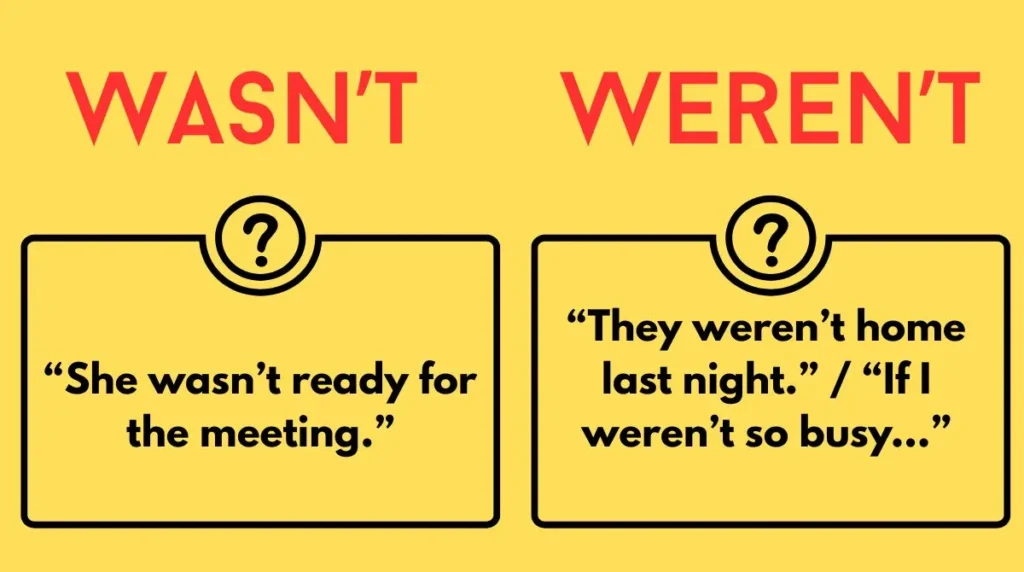
    ContractionFull FormUsageExample
    Wasn’tWas notSingular subjects“She wasn’t ready for the meeting.”
    Weren’tWere notPlural subjects or subjunctive mood“They weren’t home last night.” / “If I weren’t so busy…”

    Subject-Verb Agreement: Singular vs. Plural Usage

    Wasn’t vs Weren’t

    Subject-verb agreement is a fundamental rule in English grammar that determines whether to use wasn’t or weren’t.

    When to Use Wasn’t

    • Use wasn’t with singular subjects (e.g., he, she, it, or singular nouns).
      Examples:
      • “He wasn’t at the party.”
      • “The book wasn’t on the shelf.”

    When to Use Weren’t

    • Use weren’t with plural subjects (e.g., we, they, the children, or plural nouns).
      Examples:
      • “We weren’t expecting visitors.”
      • “The students weren’t paying attention.”

    The Rule of Thumb for Wasn’t and Weren’t

    Here’s a simple rule to remember:

    • If the subject is singular, use wasn’t.
    • If the subject is plural, use weren’t.

    However, there is an exception: the subjunctive mood, which we’ll explore later.


    Identifying the Subject: Examples of Wasn’t

    The subject of a sentence determines whether you use wasn’t. Focus on identifying singular subjects.

    Examples:

    • “She wasn’t aware of the time.” (She = singular subject)
    • “The dog wasn’t barking earlier.” (The dog = singular subject)
    • “I wasn’t feeling well yesterday.” (I = singular subject)

    Tip: When you’re uncertain, ask yourself: “Who or what is the sentence about?” If it’s one person, thing, or entity, wasn’t is correct.


    Distinguishing Plurality: Examples of Weren’t

    Plural subjects require weren’t. Let’s look at some examples.

    Examples:

    • “They weren’t interested in the offer.” (They = plural subject)
    • “The flowers weren’t blooming this season.” (The flowers = plural subject)
    • “We weren’t ready to leave yet.” (We = plural subject)

    In each example, the subject refers to multiple people, objects, or entities, so weren’t is the correct choice.


    The Subjunctive Mood: When to Use Weren’t with Singular Subjects

    One notable exception to the singular/plural rule is the subjunctive mood, which is used to express hypothetical situations, wishes, or conditions contrary to reality.

    In the subjunctive mood, weren’t is used even with singular subjects.

    Examples of Subjunctive Usage:

    • “If I weren’t so tired, I would go out tonight.”
    • “I wish he weren’t so busy all the time.”

    Key Tip: When expressing something hypothetical or contrary to fact, use weren’t regardless of the subject.


    Common Mistakes and Misconceptions

    Many learners mix up wasn’t and weren’t. Let’s clarify some common errors:

    Incorrect: “He weren’t coming to the meeting.”
    Correct: “He wasn’t coming to the meeting.” (He is singular.)

    Incorrect: “We wasn’t aware of the schedule change.”
    Correct: “We weren’t aware of the schedule change.” (We is plural.)

    Tip: Always identify whether the subject is singular or plural before choosing the correct contraction.


    Wasn’t vs. Weren’t in Questions and Negative Forms

    Formulating Questions: Examples of Proper Usage

    When forming questions with wasn’t or weren’t, the contraction typically moves to the beginning of the sentence or comes after the subject for emphasis.

    Examples:

    • “Wasn’t she supposed to arrive earlier?”
    • “Weren’t they planning to attend the event?”

    In questions, contractions emphasize the negative aspect while maintaining proper subject-verb agreement.


    Creating Negative Sentences: Correct Contractions

    Contractions like wasn’t and weren’t simplify negative sentences.

    Examples of Negative Sentences:

    • “I wasn’t prepared for the exam.” (Was not is shortened to wasn’t for ease.)
    • “They weren’t expecting such a large crowd.” (Were not becomes weren’t.)

    Using contractions helps make speech and writing more conversational and natural.


    Expanding Your Grammar Skills with Wasn’t and Weren’t

    Mastering wasn’t and weren’t opens the door to better communication and confidence in grammar. To expand your skills:

    • Practice identifying singular and plural subjects.
    • Explore more examples of the subjunctive mood.
    • Use grammar resources like Grammarly or Merriam-Webster to check your writing.

    FAQs

    What is the difference between wasn’t and weren’t?

    Wasn’t is used with singular subjects, while weren’t is used with plural subjects or in the subjunctive mood for hypothetical situations.

    When do I use wasn’t in a sentence?

    Use wasn’t with singular subjects, like “she,” “he,” or “it.” Example: “He wasn’t ready for the test.”

    Can weren’t be used with singular subjects?

    Yes, weren’t is used with singular subjects in the subjunctive mood to express hypothetical or unreal conditions. Example: “If I weren’t so tired, I’d join you.”

    Why do people confuse wasn’t and weren’t?

    Many learners confuse them because they both signify negation. The key is understanding subject-verb agreement and the subjunctive mood.

    What are some examples of subjunctive mood with weren’t?

    Examples include, “I wish he weren’t so busy,” and “If I weren’t late, I’d catch the bus.” These express hypothetical or contrary-to-fact ideas.


    Conclusion

    The difference between wasn’t and weren’t boils down to subject-verb agreement and context.

    By remembering that wasn’t pairs with singular subjects, weren’t with plural subjects, and weren’t in the subjunctive mood, you can avoid common mistakes.

  • He Is Risen or He Has Risen – Find Out Which Is Correct! 🙏

    He Is Risen or He Has Risen – Find Out Which Is Correct! 🙏

    Language, especially when tied to religious or historical contexts, often sparks questions about correctness and meaning.

    One such question arises with the phrases “He is risen” and “He has risen.” Are they interchangeable? Is one more correct than the other?

    Confused between “He is risen” and “He has risen”? Discover their grammatical, theological, and historical differences, and learn when to use each phrase correctly.

    In this article, we’ll explore the grammatical, theological, and historical dimensions of these phrases to clarify their usage and implications.


    Understanding the Phrase “He Is Risen”

    He Is Risen or He Has Risen

    The phrase “He is risen” is deeply rooted in Christian tradition, particularly as an Easter proclamation celebrating the resurrection of Jesus Christ. It’s a declaration of victory, affirming that Jesus has conquered death.

    Grammatically, “He is risen” uses an older form of English where the verb “is” functions as an auxiliary verb, indicating a state or condition.

    This usage was common in Early Modern English but has largely fallen out of favor in contemporary grammar, where “has” is now standard.

    Key Characteristics:

    • Historical Grammar: “Is risen” reflects a state rather than an action, implying that Jesus exists in a risen state.
    • Liturgical Use: The phrase is often used in church services, hymns, and religious texts, emphasizing its traditional significance.
    • Emotive Power: Many Christians prefer “He is risen” for its poetic and reverent tone.

    The Grammatical Nuances of “He Has Risen”

    In contrast, “He has risen” aligns with modern English grammar. Here, the present perfect tense (using has as an auxiliary verb) highlights the action of rising from the dead, completed in the past but with ongoing significance.

    Why It’s Grammatically Correct:

    • Present Perfect Tense: This tense connects a past action with its relevance in the present. “He has risen” signifies that Jesus rose from the dead and continues to live.
    • Clarity in Modern English: Contemporary readers and speakers are more familiar with this construction, making it feel more natural.
    • Action-Oriented Meaning: The phrase emphasizes the completed act of resurrection.

    The Influence of Religious Tradition on Language

    Religious tradition often preserves linguistic forms that may seem outdated in modern usage. “He is risen” is a prime example. This phrase comes from older Bible translations like the King James Version (1611), which heavily influenced liturgical language.

    Why Tradition Matters:

    • Cultural Resonance: Traditional phrases carry emotional and spiritual weight for many believers.
    • Liturgical Consistency: Churches often retain older language to maintain continuity with historical practices.
    • Symbolic Meaning: The use of “is” instead of “has” shifts the focus from the act of rising to the ongoing state of being risen.

    The Scriptural Evidence in Different Translations

    Examining various Bible translations helps illuminate the origins and usage of these phrases.

    Examples from Key Translations:

    • King James Version (KJV): “He is not here: for he is risen, as he said.” (Matthew 28:6)
    • New International Version (NIV): “He is not here; he has risen, just as he said.” (Matthew 28:6)
    • English Standard Version (ESV): “He is not here, for he has risen, as he said.” (Matthew 28:6)

    Insights from the Comparison:

    • Older translations like the KJV use “is risen” to reflect the linguistic norms of their time.
    • Modern translations prefer “has risen” for grammatical clarity while retaining the original meaning.
    • Both phrases communicate the same theological truth: the resurrection of Christ.

    Theological Implications of the Phrase’s Variations

    The choice between “He is risen” and “He has risen” carries subtle theological nuances.

    • “He is risen” emphasizes the eternal and ongoing nature of Jesus’ resurrection. It’s not just a past event but a present reality.
    • “He has risen” focuses on the historical act of the resurrection, highlighting its role as a pivotal moment in Christian belief.

    Neither phrase is theologically incorrect, but the emphasis differs slightly: one leans toward the eternal state, while the other underscores the completed act.


    Modern English Usage and Historical Context

    In contemporary English, “He has risen” aligns with standard grammatical norms. However, “He is risen” endures as a liturgical and symbolic expression, particularly during Easter celebrations.

    A Shift in Language:

    • The auxiliary “is” was commonly used with past participles in earlier forms of English.
    • Over time, this structure faded, replaced by “has” in most contexts.
    • Religious language often resists change, preserving forms like “He is risen” for their historical and spiritual significance.

    “He Is Risen” in Contemporary Society

    Even in a modern context, “He is risen” remains a powerful and widely recognized phrase. It appears in:

    • Easter Greetings: Churches and individuals use it as a joyful proclamation during the Easter season.
    • Hymns and Songs: Many traditional hymns incorporate the phrase, reinforcing its connection to worship.
    • Cultural References: The phrase often appears in literature, art, and media as a symbol of hope and renewal.

    Despite its archaic grammar, “He is risen” continues to resonate deeply with many Christians worldwide.


    Making the Right Choice: When to Use Each Phrase

    So, how do you decide whether to use “He is risen” or “He has risen”?

    Practical Guidelines:

    1. Formal or Religious Contexts: Use “He is risen” for traditional or liturgical settings, such as church services or religious writings.
    2. Everyday Conversations or Writing: Opt for “He has risen” in modern, casual communication for grammatical clarity.
    3. Audience Consideration: Consider who will read or hear your words. For a general audience, “He has risen” might feel more natural, while “He is risen” appeals to those familiar with religious traditions.

    FAQs

    What is the difference between “He is risen” and “He has risen”?

    “He is risen” reflects an older English style emphasizing the state of being risen, while “He has risen” uses modern grammar to highlight the completed action of rising.

    Is “He is risen” grammatically correct?

    Yes, it’s correct but archaic. It reflects Early Modern English usage, often preserved in religious contexts like Easter liturgies.

    Why is “He is risen” used in churches?

    Religious tradition retains older linguistic forms to emphasize the eternal state of Christ’s resurrection, making “He is risen” a powerful liturgical expression.

    Should I use “He has risen” in modern writing?

    Yes, for clarity in contemporary English, “He has risen” is preferred, especially in casual or non-religious contexts.

    Which Bible translations use “He is risen” and “He has risen”?

    The King James Version (KJV) uses “He is risen,” while modern translations like the NIV and ESV favor “He has risen.” Both express the same theological truth.


    Conclusion

    Both “He is risen” and “He has risen” are correct, but their usage depends on context, audience, and intent.

    While “He has risen” reflects modern grammatical norms, “He is risen” carries profound traditional and theological significance.

    Understanding the nuances of these phrases allows us to appreciate their depth and choose the right one for any situation. Whether you’re quoting scripture, writing an Easter greeting, or simply exploring language, both phrases remind us of the enduring power of words and their connection to faith and history.

  • Lunchtime vs Lunch Time: Which One is Correct? 🕛🍴

    Lunchtime vs Lunch Time: Which One is Correct? 🕛🍴

    When it comes to expressing the midday meal, should you write it as lunchtime or lunch time?

    While these two forms may look similar, their correctness depends on context and grammar rules.

    Is it “lunchtime” or “lunch time”? Learn the grammar, usage, and cultural significance of these terms to use them correctly in any context!

    This article dives deep into the meaning, grammar, and usage of both terms, exploring their differences, origins, and how they fit into our everyday lives.


    Exploring the Definition and Origin of Lunchtime

    Lunchtime vs Lunch Time

    The word lunchtime is a compound noun formed by joining lunch (the meal eaten in the middle of the day) and time (the period allocated for an activity).

    Together, lunchtime refers to the specific time during which lunch is eaten.

    Etymology of Lunch:
    The term lunch evolved from the word luncheon, which has origins in Middle English lunsh or lumpsh, meaning a small piece or portion. By the 19th century, lunch became a widely accepted term for the midday meal.

    Etymology of Lunchtime:
    The word lunchtime became popular in English usage around the late 19th century, reflecting the growing need for structured meal breaks during industrial work schedules.


    The Grammar of Meal Times: Understanding ‘Lunchtime’

    Grammatically, lunchtime functions as a single compound noun, which is why it’s generally written as one word.

    On the other hand, lunch time (two words) is technically correct but less commonly used, as it separates the noun lunch and the noun time.

    Examples:

    • Correct: “It’s almost lunchtime.” (lunchtime as a compound noun)
    • Less Common: “We’ll meet at lunch time.” (lunch time separated for emphasis)

    Key Grammar Tip: Compound nouns like lunchtime, dinnertime, and breakfast time often simplify over time, consolidating into one word.


    The Difference Between ‘Lunchtime’ and ‘Lunch Time’

    Lunchtime vs Lunch Time

    Although both terms can be used interchangeably, the context matters:

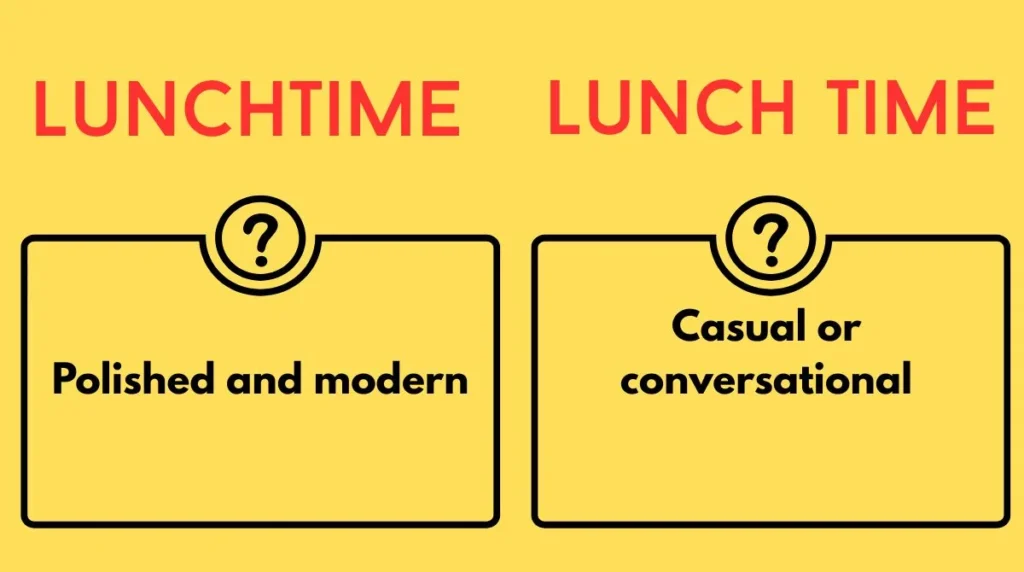
    • Lunchtime: A concise and universally recognized term for the time allocated for lunch. It’s considered more formal and polished in written and spoken English.
      Example: “Lunchtime is scheduled from 12:30 to 1:30.”
    • Lunch Time: Emphasizes the separation between the meal (lunch) and the period (time). It might be used in informal or poetic contexts.
      Example: “It’s lunch time, and everyone is hungry.”

    Quick Comparison Table:

    FeatureLunchtimeLunch Time
    FormalityMore formalLess formal
    Usage FrequencyCommonly usedLess common
    TonePolished and modernCasual or conversational

    Comparing Other Mealtime Expressions

    The evolution of lunchtime mirrors changes in other mealtime expressions.

    • Breakfast Time → Breakfast
    • Dinner Time → Dinnertime
    • Tea Time → Remains as two words in most cases

    This consolidation trend reflects the natural progression of language, where frequently used terms simplify for ease of communication.


    Historical Usage of the Term Lunchtime

    In the late 19th century, the Industrial Revolution played a pivotal role in defining lunchtime. Factory schedules required designated breaks for workers to eat, leading to the formalization of mealtimes.

    By the early 20th century, lunchtime became part of the structured workday in Western societies. It was common to hear phrases like, “Workers are entitled to a 30-minute lunchtime break.”

    Over time, lunchtime gained prominence as it was more efficient and standardized than saying lunch time.


    Lunchtime in Modern Context: Usage Across Various Regions

    Lunchtime routines and expectations differ widely across regions:

    • United States: Typically observed between 12:00 PM and 1:00 PM in workplaces, schools, and restaurants.
    • United Kingdom: Often referred to as “dinner hour” in informal contexts, especially in Northern England.
    • Spain: Lunch (or almuerzo) begins later, around 2:00 PM, reflecting the country’s siesta tradition.

    While the term lunchtime is widely recognized in English-speaking countries, cultural nuances impact when and how it’s used.


    How Lunchtime Varies in the Workplace and Schools

    Workplace Lunchtimes

    • Corporate Jobs: Employees often have structured lunchtimes, usually lasting 30 minutes to an hour.
    • Flexible Jobs: Freelancers or remote workers might define their own lunchtime schedules.

    School Lunchtimes

    In schools, lunchtime is typically between 11:30 AM and 1:00 PM, depending on the institution. Students are given this time to eat, socialize, and recharge for the rest of the day.

    Interesting Fact: Many schools in Japan incorporate kyushoku, a structured lunchtime where students eat together and learn about balanced nutrition.


    Cultural Variations of Lunchtime Practices

    Mediterranean Countries

    • Lunch is the main meal of the day, often lasting 2-3 hours. Lunchtime is viewed as a social event, especially in countries like Italy and Greece.

    Northern European Countries

    • Lunch is lighter and quicker, often consisting of sandwiches or salads. Lunchtime is short, with an emphasis on efficiency.

    Asian Countries

    • In China, lunchtime often involves a communal meal, with time allocated for a short nap (similar to a siesta).

    Fun Fact:

    In France, lunchtime is almost sacred, with laws in place to ensure workers receive adequate breaks to enjoy their meals.


    Lunchtime Etiquette: Social Norms and Expectations

    Proper lunchtime etiquette varies depending on culture and setting.

    • Workplace:
      • Avoid smelly or noisy foods in shared spaces.
      • Keep lunchtime conversations professional if dining with colleagues.
    • Social Gatherings:
      • Wait for everyone to be served before starting.
      • Follow the host’s cues for when lunch begins and ends.

    Common Misconceptions About Lunchtime and Its Correct Usage

    1. Misconception: “Lunchtime and lunch time are interchangeable in all contexts.”
      • Truth: Lunchtime is more appropriate in formal and structured communication.
    2. Misconception: “Lunchtime must always refer to noon.”
      • Truth: Lunchtime varies across cultures, workplaces, and personal schedules.
    3. Misconception: “Lunchtime is only a modern concept.”
      • Truth: While the term lunchtime gained prominence in the 19th century, structured mealtimes have existed for centuries.

    FAQs

    What is the difference between lunchtime and lunch time?

    Lunchtime is a compound noun commonly used to refer to the midday meal period. Lunch time, while grammatically correct, separates the words and is less commonly used.

    Is lunchtime one word or two?

    Lunchtime is typically written as one word, as it’s a compound noun that simplifies over time, similar to dinnertime or breakfast time.

    Why is lunchtime more common than lunch time?

    Lunchtime is more concise and formal, making it the preferred choice in modern English. Lunch time may appear in informal or poetic contexts but is less frequent overall.

    Does lunchtime refer only to noon?

    Not necessarily. While lunchtime is often associated with the midday meal, its exact timing varies across cultures, workplaces, and personal schedules.

    How does lunchtime differ across cultures?

    Lunchtime customs vary widely: Mediterranean countries enjoy long, social lunches, while Northern Europe opts for shorter, efficient meals. In Asia, communal lunchtimes are common.


    Conclusion

    Both lunchtime and lunch time are correct, but their usage depends on grammar rules and context. While lunchtime has become the preferred term due to its simplicity and formal tone, lunch time still finds its place in casual or poetic expressions.

    Understanding the history, cultural significance, and proper usage of lunchtime not only improves your grammar but also helps you appreciate the diverse practices surrounding this important mealtime.

    So, next time you’re scheduling lunch, you’ll know exactly which term to use!