Blog

  • Year Old vs Years Old 📚 The Complete Grammar Guide (With Examples)

    Year Old vs Years Old 📚 The Complete Grammar Guide (With Examples)

    English learners and even native speakers often stumble over “year old” vs “years old.” Should you write a five-year-old boy or a five years old boy? The truth is, the difference is simple once you understand a few grammar rules.

    👉 Quick Answer :

    • Use year-old with a hyphen when age modifies a noun before it: a three-year-old child.
    • Use years old (no hyphen) when the age follows a verb: The child is three years old.
    • Avoid “year old” without a hyphen unless “year” and “old” are separate words in the sentence.

    This guide will take you through clear examples, grammar rules, real-world usage, style-guide notes, and common mistakes so you’ll never second-guess age expressions again.


    Quick-Reference Table: Year Old vs Years Old
    Year Old vs Years Old

    Here’s a simple chart to clear things up at a glance:

    FormWhen to UseExample Sentence
    year-oldWhen age modifies a noun (attributive adjective)She adopted a two-year-old puppy.
    years oldWhen age follows a verb or stands aloneThe puppy is two years old.
    year old (no hyphen)Rare, only when “year” and “old” are grammatically separateHe is a year and a half old.
    year-olds (plural)When referring to people/things collectively by ageThe daycare has three four-year-olds.
    X- to Y-year-oldAge range modifying a nounA 5- to 7-year-old program.

    The Core Grammar Rules Behind “Year Old” vs “Years Old”

    Attributive vs Predicative Position

    The main distinction comes down to where the age phrase appears in the sentence.

    • Attributive (before a noun):
      • Hyphen required: a 10-year-old car.
      • Without the hyphen, readers might misinterpret it as 10 year old car (awkward and confusing).
    • Predicative (after a verb):
      • No hyphen: The car is 10 years old.
      • Notice the plural “years” because you’re counting the number of years.

    📌 Tip: If the phrase comes before the noun, use year-old (hyphenated, singular “year”). If it comes after the noun, use years old (no hyphen, plural “years”).


    Compound Adjective Mechanics

    The hyphen in “year-old” shows that the words belong together as one adjective. Without it, the sentence can be misleading.

    • ✅ She bought a 15-year-old violin.
    • ❌ She bought a 15 year old violin. (could be misread as “15 year” + “old violin”)

    Hyphens prevent confusion and keep writing precise.


    Plural Forms and Hyphen Placement

    One of the trickiest parts is pluralization. Here’s the golden rule:

    • Pluralize the whole compound, not the “year.”
      • ✅ The playground is full of six-year-olds.
      • ❌ The playground is full of six-years-old.

    📌 Also note: When listing multiple ages, keep the hyphen structure intact.

    • The five-year-old and six-year-old siblings are inseparable.
    • The five- and six-year-olds were playing together.

    Numbers, Numerals, and Style-Guide Nuances

    Numerals vs Words

    In most modern writing:

    • Use numerals for ages: 5 years old, a 5-year-old child.
    • Spell out at the beginning of a sentence: Five-year-olds love cartoons.

    Example:

    • The boy is 10 years old. (numeral)
    • Ten-year-olds are starting middle school. (spelled out at start of sentence)

    Style-Guide Differences

    Different style guides tweak the rules slightly:

    • AP Stylebook: Always use numerals for ages. Hyphenate “year-old” when used as a compound adjective.
    • Chicago Manual of Style (CMOS): Similar approach. Advises clarity with hyphens in compound adjectives.
    • MLA: Follows Chicago conventions in most cases.
    • Oxford Style: Stresses consistent use of hyphens in age modifiers.

    📌 Key takeaway: No matter which style guide you follow, the hyphen in attributive use is almost always recommended.


    Hyphenation with Ranges

    When you’re talking about age ranges, keep the structure clean:

    • ✅ a 5- to 7-year-old child
    • ✅ 5–7-year-olds need special supervision
    • ❌ a 5–7 years old child (incorrect)

    Notice that “year-old” stays singular, even in ranges.


    Real-World Examples of “Year Old” vs “Years Old”

    Here are examples you can rely on in everyday writing:

    • My daughter is eight years old. (predicative)
    • She is an eight-year-old girl. (attributive)
    • The teacher grouped the six-year-olds together. (plural)
    • He is a year and a half old. (separate words)
    • We bought a 20-year-old bottle of wine. (compound adjective)
    • The car is nearly 15 years old but still runs smoothly. (predicative)
    • The eight- and nine-year-olds competed in the spelling bee. (shared structure)

    Every example follows the hyphen and plural rules you saw earlier.


    “Year Old” Without a Hyphen — When Is It Correct?

    Many people assume “year old” without a hyphen is always wrong, but that’s not true. It works in specific cases where “year” and “old” don’t form a single modifier.

    Examples:

    • He is a year and two months old.
    • That law is one year old.
    • This tree is almost a hundred years old.

    Here, “year” and “old” are separate words, not a compound adjective. That’s why no hyphen is needed.


    Examples from Reliable Sources

    Here are examples adapted from dictionaries and style references (Merriam-Webster, AP Style, Oxford):

    • Merriam-Webster: a 30-year-old tradition
    • AP Style: The 5-year-old boy smiled for the photo.
    • Chicago Manual of Style: She is 45 years old.
    • Oxford: The ten-year-old child recited a poem.

    📌 Using examples from trusted sources ensures your writing aligns with professional standards.


    Historical Usage and Trends

    Language evolves, and hyphenation trends reflect that. According to Google Ngram Viewer:

    • Before 1950, writers often omitted the hyphen (5 year old child).
    • From the 1960s onward, hyphenated forms (5-year-old child) became dominant, especially in formal writing.
    • Today, style guides consistently favor the hyphen in attributive uses.

    👉 Takeaway: The hyphen is not a trend—it’s now the established norm.


    Special Contexts and Tricky Cases

    Legal and Formal Documents

    Contracts, medical reports, and legal records often state ages explicitly:

    • Patient is 12 years old.
    • Defendant, a 17-year-old male, was present at the hearing.

    Formal writing prioritizes clarity, so rules are strictly followed.


    Marketing and Product Copy

    Marketers rely on hyphens to avoid ambiguity:

    • a 2-year warranty (clear, professional)
    • Without the hyphen (2 year warranty), it risks misreading.

    Conversational English and Social Media

    On Twitter or casual chats, people sometimes skip hyphens:

    • My kid is 5 year old today lol.

    It’s common in informal speech, but in professional writing or published content, stick to standard grammar.


    Non-Native Speakers & ESL Learners

    Common mistakes include:

    • Writing 5 years-old child (incorrect plural).
    • Omitting the hyphen: a 10 year old house.

    💡 Quick Practice Tip: If the phrase comes before the noun, hyphenate. If it comes after, don’t.


    Quick Style Checklist

    Before publishing, check these rules:

    • ✅ Hyphenate year-old before a noun.
    • ✅ Use years old after a verb.
    • ✅ Use numerals for ages (unless starting a sentence).
    • ✅ Pluralize correctly: five-year-olds.
    • ✅ For ranges, write: 5- to 7-year-olds.
    • ❌ Don’t write 5 years-old child.

    Cheatsheet: One-Line Examples

    • She is 12 years old.
    • a 12-year-old girl
    • Two-year-olds are curious.
    • The book is one year old.
    • a 5- to 7-year-old group
    • The eight-year-old and nine-year-old siblings
    • He is a year and a half old.
    • They care for 15-year-olds at the camp.

    FAQ: Year Old vs Years Old

    When should I use “year-old” with a hyphen?

    Use “year-old” before a noun to show age as a compound adjective: a 7-year-old boy.

    Is “3 years old” or “3-year-old” correct?

    Both are correct depending on placement: She is 3 years old vs a 3-year-old girl.

    How do you pluralize age modifiers?

    Add “s” to the whole phrase, not “year”: six-year-olds.

    Which style guide should I follow?

    Most guides (AP, Chicago, Oxford) agree: numerals for ages and hyphenate compound modifiers.

    How do I write age ranges?

    Write 5- to 7-year-old children or 5–7-year-olds. Don’t write 5–7 years old children.

    Is “year old” ever correct as two words?

    Yes, when “year” and “old” stand separately: a year and two months old.


    Quick Quiz: Test Yourself

    Fill in the blanks with the correct form:

    1. The boy is ___ (five years old / five-year-old).
    2. She bought a ___ (12 years old / 12-year-old) bicycle.
    3. The playground has many ___ (three-year-olds / three-years-old).
    4. He is a year and a half ___.
    5. They are raising funds for ___ (10 to 12 years old / 10- to 12-year-olds).

    Answers:

    1. five years old
    2. 12-year-old
    3. three-year-olds
    4. old
    5. 10- to 12-year-olds

    Conclusion

    Mastering year old vs years old is about placement and hyphenation.

    • Year-old = before the noun, hyphenated.
    • Years old = after the verb, no hyphen.
    • Year old (separate words) = only in rare contexts like a year and a half old.

    When in doubt, ask: Is the age describing a noun directly before it? If yes, hyphenate. If not, leave it open.

    👉 Bookmark this guide, use the cheatsheet, and you’ll never stumble on this rule again.
  • Myself vs My Self: What’s the Difference in Grammar? 🤔📚

    Myself vs My Self: What’s the Difference in Grammar? 🤔📚

    In the world of English grammar, myself and my self are often used interchangeably, but they have distinct meanings and purposes.

    Understanding the difference between these two terms will not only enhance your writing but also sharpen your understanding of how pronouns work.

    This article delves into the proper use of “myself” and “my self,” highlighting key distinctions and offering practical advice on when to use each one.


    Exploring the Pronoun “Myself” in American English

    Myself vs My Self

    At first glance, myself may seem like a simple word, but it holds more weight in grammar than many realize.

    In American English, myself is a reflexive pronoun, a term that refers back to the subject of the sentence.

    Reflexive pronouns are used when the subject and the object of the sentence are the same person or thing.

    Defining Myself as a Reflexive Pronoun

    A reflexive pronoun is used when the subject of the sentence performs an action on itself. Myself specifically refers to the first person singular.

    For example:

    • “I taught myself how to play the piano.”
      In this case, the action (teaching) is performed by the subject (I) on itself (myself).
      Reflexive pronouns are important for clarity in sentences, ensuring the subject and object are connected. They include myself, yourself, himself, herself, itself, ourselves, yourselves, and themselves.

    Is it “myself” or “my self”? Learn the key differences between these terms, from reflexive pronouns to discussions on personal identity.


    Examples of Using “Myself” in Sentences

    Let’s break down how myself works in context with a few practical examples:

    1. “I hurt myself while jogging yesterday.”
      • Here, the subject (I) performed the action (hurt) on itself.
    2. “I made the decision to go on vacation by myself.”
      • In this case, the word myself emphasizes that the action was done alone.
    3. “I will take care of it myself.”
      • Myself emphasizes personal responsibility for the task.

    Each of these examples shows how myself links the subject to the object of the sentence.


    The Nuanced Context of “My Self”

    Now that we’ve examined the reflexive use of myself, let’s dive into the term my self. Unlike myself, my self is rarely used in standard English writing and has specific, more philosophical or introspective connotations.

    When to Use “My Self”

    My self is often used in discussions about one’s identity or self-awareness, focusing on the individual as a concept rather than a subject performing an action. For example:

    • “I need to understand my self better before making any decisions.”
      In this sentence, my self refers to the speaker’s broader sense of identity or existence, rather than an action being performed on the speaker.

    This distinction highlights the philosophical angle of my self, which can be used when exploring concepts of self-awareness or personal growth.


    “Myselves”: Addressing the Common Misconception

    One of the most common errors people make with myself is attempting to use myselves in place of myself in the plural form. While it might sound natural to some, myselves is grammatically incorrect and never used in standard English.

    Why “Myselves” Is Incorrect

    Myself is a singular reflexive pronoun and has no plural counterpart. The correct plural form is ourselves when referring to the first person plural. For example:

    • “We made the decision ourselves.”
      Rather than using myselves, always opt for ourselves when referring to multiple people performing actions on themselves.

    Historical Usage and Popularity: “Myself” in Literature

    Myself has an interesting history in the English language, especially in literature. Historically, it has been used to emphasize personal involvement or action in a sentence, providing a deeper sense of individual control or responsibility.

    “Myself” in Classical Literature

    • Shakespeare, for instance, often used myself for dramatic emphasis in his plays.
    • In works such as Hamlet or Macbeth, the use of reflexive pronouns like myself helped to build tension and underscore characters’ personal struggles.

    Although the word myself has evolved, its use in literature set the stage for its more common use in modern grammar.


    How “Myself” Functions Grammatically

    Now that we’ve explored myself in its reflexive form, let’s break down its grammatical role in more detail. Reflexive pronouns serve not only to link the subject and object but also to emphasize the subject’s agency in performing an action.

    When “Myself” Is Both the Subject and the Object

    The most common grammatical structure with myself involves the subject and object being the same. For instance:

    • “I made this decision by myself.”
      In this sentence, the subject (I) is performing the action, and the object (myself) is the same person. This helps to emphasize the isolation or independence of the action.

    The Role of “Myself” in Emphasizing Personal Action

    While reflexive pronouns like myself are commonly used to indicate self-directed action, they also serve to emphasize the degree to which an action is personal.

    Emphasis on Personal Responsibility or Action

    For example:

    • “I’ll handle it myself.”
      Here, myself emphasizes that the speaker will take full responsibility for the task, leaving no room for others to interfere.

    Using myself for emphasis adds weight to the action, signaling that it was done deliberately or with extra effort.


    Conversing About Identity: The Non-Reflexive “My Self”

    As mentioned earlier, my self is sometimes used to discuss personal identity in a broader, more introspective context. It’s not used for actions but rather for philosophical or psychological discussions of who we are.

    Philosophical and Psychological References to “My Self”

    • “I must align my self with my values if I am to succeed in life.”
      Here, my self refers to the inner, personal self, emphasizing identity and personal growth.
      This usage is more common in fields like psychology, philosophy, and self-help literature.

    Common Mistakes and Tips to Remember the Difference

    Myself vs My Self

    Understanding the distinctions between myself and my self isn’t always easy, but here are a few tips to avoid common mistakes:

    1. Don’t use myself as the subject of a sentence.
      • Incorrect: Myself went to the store.
      • Correct: I went to the store.
    2. Use myself only as a reflexive pronoun or for emphasis.
      • Correct: I’ll do it myself.
    3. Reserve my self for philosophical contexts or when discussing identity.
      • Correct: I’m trying to find my self through meditation.

    FAQs

    What is the difference between “myself” and “my self”?

    “Myself” is a reflexive pronoun used for actions performed by the subject on themselves, while “my self” refers to personal identity or self-awareness in philosophical contexts.

    When should I use “myself”?

    Use “myself” when the subject performs an action on itself (e.g., “I taught myself”) or to emphasize personal responsibility (e.g., “I did it myself”).

    When is it correct to use “my self”?

    “My self” is used in philosophical or introspective contexts to discuss one’s sense of identity, as in “I need to understand my self better.”

    Is “myself” ever incorrect?

    Yes, “myself” should never be used as the subject of a sentence. For example, “Myself went to the store” is incorrect; use “I went to the store” instead.

    Why is “myselves” incorrect?

    “Myselves” is a common mistake. The plural form of “myself” is “ourselves,” not “myselves.”

    How can I remember when to use “myself” and “my self”?

    Think about the context: Use “myself” for reflexive actions or emphasis, and use “my self” for discussions about personal identity or growth.


    Final Thoughts and Best Practices in Writing

    In conclusion, while myself and my self may seem similar at first, understanding their unique roles can make your writing more precise and impactful.

    Always remember that myself is a reflexive pronoun used for self-action and emphasis, while my self refers to identity and self-awareness.

    By mastering these distinctions, you’ll elevate your communication skills and avoid common grammatical mistakes.

    If you ever find yourself unsure, take a moment to consider the context—are you talking about an action, or are you reflecting on your personal identity? That simple step will help you choose the right form every time.

  • Resetted or Reset? The Past Tense of ‘Reset’ Explained 🕒📚

    Resetted or Reset? The Past Tense of ‘Reset’ Explained 🕒📚

    English grammar can be tricky, especially when dealing with irregular verbs. Words like reset often lead to confusion because they don’t follow the typical patterns of regular verbs.

    Is the past tense of reset “reset” or “resetted”? Let’s explore the rules, correct usage, and common mistakes to ensure you never stumble over this verb again.


    Understanding the Irregular Verb “Reset”

    Resetted or Reset

    The word reset is an irregular verb, meaning its past tense does not follow the conventional rule of adding “-ed” to the base form.

    • Definition of Reset: To set something again or restore it to its original state.
      Example: “I reset my alarm clock every night before bed.”

    Unlike regular verbs, reset retains the same form across the present, past, and past participle tenses. This can make it tricky, as people may incorrectly assume that “resetted” is a valid past tense form.

    Is it “resetted” or “reset”? Learn the rules of this irregular verb and discover why “reset” is the correct past tense in English grammar.


    The Correct Past Tense Form of “Reset”

    The correct past tense of reset is reset.

    • Present Tense: I reset the machine.
    • Past Tense: Yesterday, I reset the machine.
    • Past Participle: I have reset the machine.

    Why doesn’t it change?
    The verb reset belongs to a group of irregular verbs known as “zero-change verbs,” where the base form, past tense, and past participle remain identical.

    Other examples of such verbs include:

    • Put → Put → Put
    • Cut → Cut → Cut
    • Hit → Hit → Hit

    Reset vs. Resetted: Grammatical Clarification

    Is “Resetted” Ever Correct?

    No, resetted is not a grammatically correct word. Adding the “-ed” ending is unnecessary because reset already serves as the past tense form.

    Common Mistake:
    Incorrect: I resetted the router yesterday.
    Correct: I reset the router yesterday.

    Using resetted not only breaks grammatical rules but also creates confusion. It’s essential to stick to the standard irregular form: reset.


    Pronunciation and Usage of “Reset” in Different Tenses

    While reset doesn’t change its spelling across tenses, its pronunciation stays consistent as well: /ˈriːˌsɛt/.

    Here’s how it appears in different contexts:

    • Present Tense:
      Example: “I reset the password every month for security.”
    • Past Tense:
      Example: “She reset her phone to factory settings yesterday.”
    • Past Participle:
      Example: “They have reset the clocks for daylight saving time.”

    To avoid confusion, focus on the context of the sentence to determine the tense being used.


    Common Mistakes and How to Avoid Them

    Mistakes often arise when people incorrectly assume that all verbs must conform to regular patterns. Here are some common errors and ways to avoid them:

    Mistake 1: Using “Resetted” as the Past Tense

    • Why it happens: Regular verbs like “restart” (restarted) may cause learners to apply the same rule to reset.
    • How to avoid it: Remember that reset is irregular and doesn’t change form.

    Mistake 2: Misinterpreting the Tense of “Reset”

    • Why it happens: Since the word looks the same in the present and past tense, readers or listeners might misunderstand the time frame.
    • How to avoid it: Use context clues like time markers (yesterday, last week) to clarify the tense.

    Mistake 3: Overcomplicating the Verb

    • Why it happens: People assume irregular verbs are “harder” to use, leading to overthinking.
    • How to avoid it: Keep it simple—reset is the correct form for all tenses.

    Expanding Your Grammar: Similar Irregular Verbs

    To master irregular verbs like reset, it helps to compare them with others that follow similar patterns. Here’s a quick list:

    Base FormPast TensePast ParticipleExample Sentence (Past Tense)
    SetSetSetI set the table before dinner.
    CutCutCutShe cut the paper into shapes.
    HitHitHitHe hit the ball out of the park.
    LetLetLetThey let the dog out earlier.
    ShutShutShutI shut the door when I left.

    Pro Tip: Irregular verbs often follow unique rules, so it’s best to memorize them through practice and examples.


    FAQs

    What is the past tense of “reset”?

    The past tense of “reset” is simply “reset.” It doesn’t change in form like regular verbs.

    Is “resetted” ever correct?

    No, “resetted” is grammatically incorrect. The correct form is “reset” in both the present, past, and past participle.

    Why doesn’t “reset” change in the past tense?

    “Reset” is an irregular verb that belongs to a group of verbs where the base form, past tense, and past participle are the same.

    How can I avoid confusing “reset” with “resetted”?

    Focus on recognizing “reset” as an irregular verb, and avoid adding “-ed” to it in the past tense.

    Can you give examples of “reset” in sentences?

    Present Tense: “I reset the device.”
    Past Tense: “She reset the system yesterday.”
    Past Participle: “They have reset the router.”

    Are there other irregular verbs like “reset”?

    Yes, other irregular verbs like “put,” “cut,” and “hit” do not change forms in the past tense.


    Conclusion

    The past tense of reset is simply reset—not “resetted.” Understanding its irregular nature is crucial for accurate communication, especially in written English.

    While irregular verbs can be challenging, recognizing patterns and practicing similar examples will help you avoid mistakes.

    Now that you’ve mastered reset, why not explore other irregular verbs? Share your thoughts or questions in the comments below!

  • Timeslot vs Time Slot: Which One Is Correct? 🤔✍️

    Timeslot vs Time Slot: Which One Is Correct? 🤔✍️

    Words in English often cause confusion, and “timeslot” vs “time slot” is no exception.

    Should it be written as one word, two words, or hyphenated? This article dives into the details of correct usage, how hyphenation works, and why making the right choice matters, especially in different contexts.

    Let’s settle the debate once and for all.


    The Great Debate: Timeslot vs. Time Slot

    Timeslot vs Time Slot

    At first glance, “timeslot” and “time slot” might seem interchangeable, but they differ in formality and correctness depending on the context.

    • Time Slot (Two Words): The grammatically correct and widely accepted form in formal and professional writing.
      Example: “Please select a time slot for your appointment.”
    • Timeslot (One Word): This informal variation has become more popular in casual usage, especially online and in social media contexts.
      Example: “The next timeslot available is at 3 PM.”

    While both forms are used, “time slot” remains the standard in formal and professional communication.

    Timeslot, time slot, or time-slot—which is correct? Learn the key grammar rules, proper usage, and when to hyphenate for clear and professional writing.


    What Does the Hyphen Rule Tell Us?

    Hyphens play a critical role in compound words, but they aren’t always necessary. The hyphenation of “time-slot” depends on its function in a sentence.

    The Hyphen Rule in Action:

    • Use a hyphen when the compound word acts as a modifier before a noun.
      Example: “We need to reserve a time-slot reservation system.”
    • Do not hyphenate when the term stands alone.
      Example: “The time slot has been reserved.”

    Why This Matters

    Incorrect hyphenation can lead to confusion or make your writing seem unpolished. The key is to understand how compound modifiers work and apply the rule consistently.


    Time Slot: Breaking It Down

    The term “time slot” refers to a designated period reserved for a specific purpose. It’s commonly used in scheduling, broadcasting, and everyday planning.

    Examples of Usage:

    • Broadcasting: “The show airs in the prime-time slot at 8 PM.”
    • Scheduling: “You can book a 30-minute time slot for your meeting.”
    • Transportation: “Passengers must arrive 15 minutes before their time slot.”

    Grammar Tip: Always write “time slot” as two words in formal contexts unless it’s used as a compound modifier (e.g., “time-slot allocation”).


    Navigating Grammar and Style Guides

    Grammar and style guides like The Chicago Manual of Style and AP Stylebook provide clear guidelines:

    • Preferred Usage: Always use “time slot” (two words).
    • Hyphenation Rules: Only hyphenate when used as a compound modifier.

    Why follow style guides? Consistency in your writing builds credibility and ensures clarity for readers. Deviating from standard forms, especially in professional contexts, may make your work appear less polished.


    Time Slot in Formal Writing

    In formal writing, adhering to grammatical standards is crucial. “Time slot” is the only acceptable form in professional documents, academic papers, and business communications.

    Examples:

    • Academic Paper: “Each participant was assigned a 15-minute time slot for their presentation.”
    • Business Communication: “Please confirm your time slot for the meeting by Friday.”

    Avoid using “timeslot” or any variation that doesn’t align with formal conventions.


    Common Mistakes to Avoid

    Many writers accidentally misuse or misspell “time slot.” Here are common errors and how to avoid them:

    Mistake 1: Using “Timeslot” in Formal Writing

    • Incorrect: “Please book your timeslot for the interview.”
    • Correct: “Please book your time slot for the interview.”

    Mistake 2: Adding an Unnecessary Hyphen

    • Incorrect: “Each time-slot will last 30 minutes.”
    • Correct: “Each time slot will last 30 minutes.”

    Mistake 3: Forgetting the Hyphen in Compound Modifiers

    • Incorrect: “This is a time slot system.”
    • Correct: “This is a time-slot system.”

    Pro Tip: Always double-check compound modifiers to ensure proper hyphenation.


    Timeslot in Informal Contexts

    While “timeslot” isn’t technically correct, it has gained popularity in informal contexts such as:

    • Social Media: “Book your timeslot now for the event!”
    • Marketing Copy: “The next timeslot opens at 4 PM.”

    This informal variation reflects the evolution of language in casual communication. However, keep in mind that it may not be appropriate for professional or academic use.


    The Evolution of Language and Informal Usage

    Language evolves, and so do word forms. Over time, compound words like “time slot” may merge into single words like “timeslot,” much like “email” evolved from “e-mail.”

    However, formal conventions often lag behind informal trends. While “timeslot” may eventually become standard, it’s still considered non-standard today in most professional contexts.


    Hyphenation in Compound Modifiers: The Case of Time-Slot

    Hyphenation can be tricky, especially with compound modifiers like “time-slot.” Here’s a breakdown:

    When to Hyphenate:

    • Before a noun to clarify meaning.
      Example: “Time-slot management is essential for efficiency.”

    When Not to Hyphenate:

    • When used as a standalone phrase.
      Example: “The time slot is scheduled for 10 AM.”

    Why This Rule Matters

    Hyphens ensure clarity and prevent ambiguity. Without proper hyphenation, your writing could be misunderstood.


    Maximizing Clarity: Why Choosing the Right Form Matters

    Choosing between “timeslot,” “time slot,” and “time-slot” is about clarity and context.

    • For formal writing: Use “time slot.”
    • For modifiers: Use “time-slot” with a hyphen.
    • For casual settings: “Timeslot” may be acceptable but isn’t recommended in professional contexts.

    Quote:
    “Good writing is clear writing. When in doubt, choose the form that enhances understanding.”


    FAQs

    What is the correct form: timeslot or time slot?

    The correct form is “time slot” (two words), especially in formal and professional writing.

    When should I use a hyphen in “time slot”?

    Use a hyphen when “time-slot” functions as a compound modifier before a noun, such as in “time-slot management.”

    Is “timeslot” an acceptable spelling?

    “Timeslot” is an informal variation that is commonly used online or in casual contexts but is not considered standard in formal writing.

    Why is “time slot” preferred in formal writing?

    “Time slot” follows proper grammar and style conventions, making it clear and professional for business, academic, and formal contexts.

    Can “time slot” and “time-slot” be used interchangeably?

    Not entirely. “Time slot” is the standard form, while “time-slot” is only used as a compound modifier before a noun.

    Will “timeslot” become standard in the future?

    Language evolves, and informal forms like “timeslot” may become standard over time. However, “time slot” remains the correct choice for now.


    Conclusion

    The debate between “timeslot” and “time slot” boils down to understanding context and following grammar rules.

    In formal writing, “time slot” (two words) is the clear winner, while “timeslot” may be acceptable in informal or casual communication.

    By mastering the hyphen rule and knowing when to use each form, you can ensure your writing is professional, polished, and easy to understand. Remember, language evolves, but clarity always comes first.

  • Passerbyers vs Passersby vs Passerby: Master English Grammar Today! 📝✨

    Passerbyers vs Passersby vs Passerby: Master English Grammar Today! 📝✨

    English can be confusing, especially when it comes to unusual plural forms.

    One word that often stumps people is passerby. Should you say passerbyers, passersby, or just passerby? If you’ve ever hesitated over this, you’re not alone.

    This guide will break it all down for you, exploring the origins, proper usage, and why “passersby” is the correct plural form.


    Understanding “Passerby”: Definitions and Origins

    To fully understand the confusion, let’s first define passerby.

    • Passerby (noun): A person who happens to be passing by, typically on foot.
      Example: “A passerby helped the injured cyclist.”

    Origins:

    • The word passerby is a compound noun made up of two parts:
      • Passer: Someone who passes or moves along.
      • By: A preposition indicating closeness or movement near something.
    • Together, passerby refers to someone passing by a specific location.

    Interestingly, this structure follows a pattern common in English for creating nouns from verbs and prepositions, such as go-between or runner-up.

    Passerbyers, passersby, or passerby—which one is correct? Learn the proper singular and plural forms of this commonly misused word and never mix them up again!


    Pluralizing “Passerby”: Common Mistakes to Avoid

    Passerbyers vs Passersby vs Passerby

    The pluralization of passerby often trips people up because it doesn’t follow standard rules. Unlike most English nouns, where adding -s to the end makes them plural, passerby pluralizes differently.

    • Correct plural form:Passersby
      • The pluralization happens with the first word (passer), while by remains unchanged.
        Example: “Several passersby witnessed the accident.”
    • Incorrect forms:
      • Passerbyers: This form is entirely incorrect and not recognized in English.
      • Passerbys: While it may seem logical to add -s to the end, this is also incorrect because it doesn’t follow the compound noun’s pluralization pattern.

    Key Tip: Focus on pluralizing the primary noun (passer) in compound words like these.


    The Incorrect Form “Passerbyers” and Why It’s Used

    Despite being incorrect, the form passerbyers still pops up frequently in informal settings. Why?

    Reasons for Misuse:

    1. Overgeneralization of Plural Rules:
      English learners often apply the standard -s or -es plural rule to the entire word without realizing the compound structure.
    2. Phonetic Similarity:
      The extra -ers in passerbyers may feel natural to some because it mirrors other plurals like engineers or bakers.
    3. Lack of Familiarity with “Passersby”:
      Since passersby isn’t commonly used in casual conversation, people sometimes create their own version based on intuition.

    Important Note: While it’s easy to see why passerbyers might seem correct, it’s important to stick to passersby to maintain proper grammar and usage.


    Hyphenation and Its Role in “Passersby”

    You might wonder: Does passerby need a hyphen?

    Hyphenation in Compound Nouns:

    • Historically, compound nouns like passerby were hyphenated (passer-by). Over time, the hyphen was dropped, and the word became a single entity.
    • Modern Usage: The unhyphenated form (passerby) is now standard in both American and British English.

    However, when writing formally or stylistically, always check the style guide you’re following. Certain older texts may still use passer-by.

    Fun Fact:

    The hyphenated form might actually help clarify pluralization, making passers-by more visually intuitive. This form is still correct but less common today.


    Correct Usage: Why “Passersby” is the Standard Form

    When in doubt, remember: The correct plural form is passersby.

    • Why it’s correct:
      • The word passerby is a compound noun, and in English, compound nouns often pluralize the first word while leaving the second word unchanged.
      • Other examples:
        • Attorney general → Attorneys general
        • Mother-in-law → Mothers-in-law
    • Grammar Tip: When pluralizing, always identify the main noun in the compound and apply the plural form there.

    Examples in Sentences:

    • Incorrect: “Passerbyers gathered around the scene.”
    • Incorrect: “Passerbys reported the incident.”
    • Correct: “Several passersby stopped to offer assistance.”

    Real-World Examples: “Passersby” in Use

    Seeing a word in action often solidifies its meaning and proper usage. Here are some examples from real-world contexts:

    1. Media Reports:
      “Passersby alerted authorities to the fire, helping prevent further damage.”
    2. Everyday Conversations:
      “A group of passersby stopped to watch the street performer.”
    3. Literature:
      “The passersby hurried along, unfazed by the rain.”

    Tip for Writers: Whenever you’re unsure, substitute passerby with synonyms like pedestrian or onlooker. While not exact equivalents, they can often clarify the context.


    The Evolution of Language and “Passersby”

    Language is constantly evolving, and so are the ways we pluralize words. Historically, the pluralization of compound nouns followed strict rules, but modern usage is often influenced by convenience and common practice.

    Why “Passersby” Endures:

    • Its structure aligns with traditional grammatical rules.
    • It reflects clarity and precision in formal writing.

    However, as informal language and digital communication grow, incorrect forms like passerbyers may appear more frequently. It’s important to resist the temptation to conform to incorrect usage, especially in professional or academic contexts.

    Quote:
    “Good grammar is credibility, especially on the Internet. In an era of text-speak, knowing the difference between ‘passerbyers’ and ‘passersby’ sets you apart.”


    FAQs

    What is the singular form of “passersby”?

    The singular form of “passersby” is “passerby,” which refers to a single person passing by a location.

    Why is “passersby” the correct plural form?

    “Passersby” is correct because in compound nouns, the primary noun (passer) is pluralized, while the second part (by) remains unchanged.

    Is “passerbyers” a correct word?

    No, “passerbyers” is incorrect. It doesn’t follow English grammar rules for pluralizing compound nouns like passerby.

    Can I use “passerbys” instead of “passersby”?

    No, “passerbys” is also incorrect. Always use “passersby” as the plural form of passerby.

    Are hyphenated forms like “passer-by” still used?

    While older texts may use “passer-by,” modern English typically uses the unhyphenated form, “passerby.”

    What are synonyms for “passersby”?

    Synonyms include pedestrians, bystanders, onlookers, or observers, depending on the context of your sentence.


    Conclusion

    So, which is correct: passerbyers, passersby, or passerby? The answer is clear:

    • Passerby is the singular form, referring to one person passing by.
    • Passersby is the correct plural form, used for multiple people.
    • Passerbyers is entirely incorrect and should be avoided.

    By understanding the rules of compound nouns and practicing their proper usage, you’ll never confuse these terms again.

    Whether you’re writing a blog post, a formal letter, or just chatting with friends, remember that passersby is the gold standard for pluralization.

  • Cartel vs Mafia: What Sets Them Apart? 🌍🔍

    Cartel vs Mafia: What Sets Them Apart? 🌍🔍

    When it comes to organized crime, two terms dominate the narrative: cartel and mafia. These words are often used interchangeably, yet they represent distinct entities with unique histories, structures, and impacts.

    This article dives deep into the world of organized crime, dissecting the key differences between cartels and mafias, their historical roots, operations, and cultural representations.

    By the end, you’ll have a clear understanding of what sets these two underworld forces apart.


    Unraveling the Definitions: Cartel and Mafia Explained

    To differentiate between cartel and mafia, it’s essential to understand their definitions.

    What is a Cartel?

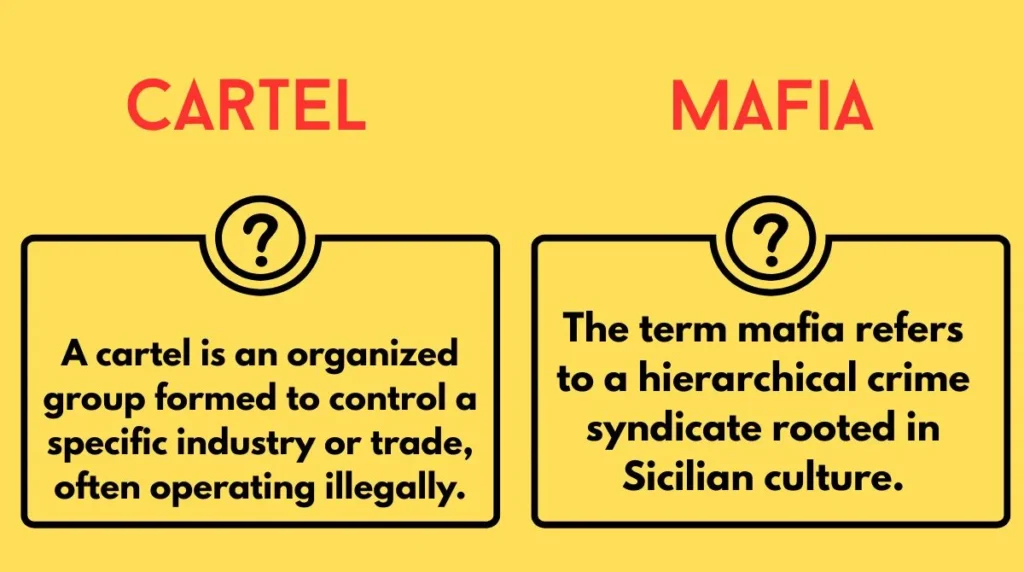
    A cartel is an organized group formed to control a specific industry or trade, often operating illegally.

    While cartels exist in legal industries, the term is most associated with drug trafficking organizations that monopolize the production, distribution, and sale of illicit substances.

    Key Characteristics of Cartels:

    • Operate as a network of interconnected factions or “cells.”
    • Engage in violent territorial disputes to maintain control.
    • Often tied to the narcotics trade but may diversify into other illegal activities like human trafficking or arms smuggling.

    Examples:

    • The Sinaloa Cartel: A dominant player in global drug trafficking.
    • The Medellín Cartel: A Colombian cartel led by Pablo Escobar in the 1980s.

    What is a Mafia?

    The term mafia refers to a hierarchical crime syndicate rooted in Sicilian culture. Over time, it has expanded globally, with branches like the American Cosa Nostra and Russian mafia.

    Unlike cartels, mafias focus on maintaining secrecy, loyalty, and territorial dominance in various illicit activities, including extortion, gambling, and racketeering.

    Key Characteristics of Mafias:

    • Operate with a strict code of silence (Omertà).
    • Structured hierarchically, with clear leadership roles like boss, underboss, and caporegime.
    • Often deeply entrenched in local politics and businesses.

    Examples:

    • The Sicilian Mafia: Originating in Sicily, it remains a powerful force in Italy.
    • The American Mafia: Notable for its role in the Prohibition era and beyond.

    Cartel or mafia? While both are forms of organized crime, they differ in history, structure, and operations. Dive into this guide to uncover the unique traits of these underworld giants.


    Historical Roots: From Sicily to International Syndicates

    Cartel vs Mafia

    The origins of cartels and mafias reveal their distinct paths to power.

    The Mafia’s Beginnings in Sicily

    The mafia traces its roots to 19th-century Sicily, where it began as a local protection organization. Over time, it evolved into a criminal network exerting control over businesses, politics, and society. The Sicilian Mafia spread internationally, especially to the United States, during waves of immigration.

    The Emergence of Cartels

    In contrast, cartels are a relatively modern phenomenon. They gained prominence in the late 20th century, particularly in Latin America. Fueled by the demand for drugs in the U.S. and Europe, cartels established themselves as powerful transnational entities, controlling every stage of the drug trade.

    Comparison Table: Historical Roots

    AspectMafia OriginsCartel Origins
    Time Period19th centuryLate 20th century
    Primary LocationSicily, ItalyLatin America (Mexico, Colombia)
    Initial RoleLocal protection and governanceDrug production and trafficking

    The Mafia: A Century-Old Sicilian Legacy

    The mafia’s deep ties to Sicilian culture have made it a unique institution. Its structure, traditions, and code of ethics set it apart from other criminal organizations.

    Key Features of the Mafia:

    • Omertà: The code of silence that discourages members and associates from cooperating with authorities.
    • Family Structure: Mafia families operate like dynasties, passing down power through generations.
    • Political Ties: Over decades, the mafia has infiltrated politics, securing influence and protection.

    Famous mafia figures, such as Al Capone and Lucky Luciano, have shaped the syndicate’s image as both feared and admired entities.


    The Emergence of Cartels: A Modern Menace with Global Impact

    Cartels thrive in regions with weak governance, leveraging violence and corruption to establish control. Their power lies in their ability to operate across national borders, creating an unparalleled global impact.

    Key Features of Cartels:

    • Decentralized Networks: Unlike the mafia, cartels operate through loosely connected cells, allowing flexibility and resilience.
    • Extreme Violence: Cartels often employ brutal tactics, such as public executions, to instill fear and maintain control.
    • Economic Influence: Cartels often have significant economic power, funding entire communities while engaging in money laundering.

    Notable leaders like Pablo Escobar and Joaquín “El Chapo” Guzmán have become synonymous with cartel operations, showcasing their far-reaching influence.


    Operational Differences: Organizational Structures and Strategies

    The organizational structures of cartels and mafias are one of their most distinctive features.

    Mafia Structure:

    • Hierarchical: Leadership flows from the boss to underlings in a pyramid-like structure.
    • Territorial: Mafias focus on controlling specific regions or industries.
    • Secrecy: Communication is limited to trusted members to avoid leaks.

    Cartel Structure:

    • Decentralized: Leadership is distributed across multiple factions, reducing reliance on a single figurehead.
    • Aggressive Expansion: Cartels frequently engage in wars over territory and markets.
    • Global Reach: Their operations span continents, utilizing advanced logistics.

    Cultural Perceptions and Misconceptions

    Public perception of cartels and mafias has often been shaped by stereotypes.

    The Mafia’s Romanticized Image

    The mafia is frequently portrayed as a “family-first” organization with a sense of honor. Films like The Godfather depict mafias as powerful yet principled, glossing over their violent and exploitative activities.

    Cartels: A Symbol of Chaos

    Cartels, on the other hand, are depicted as chaotic and excessively violent. Shows like Narcos highlight their brutality but often overlook the socio-economic factors driving their rise.

    Reality Check: Both organizations are highly destructive, exploiting vulnerable communities for profit.


    The Hollywood Effect: Media’s Role in Shaping Public Views

    Cartel vs Mafia

    The entertainment industry has played a significant role in popularizing the mafia and cartel narratives.

    The Mafia in Hollywood

    Films like Goodfellas and The Sopranos paint mafias as intricate, hierarchical families with codes of loyalty. These portrayals have contributed to a romanticized perception of the mafia, overshadowing their criminal activities.

    Cartels in Media

    Shows like Breaking Bad and Narcos present cartels as ruthless, with an emphasis on their violent and unpredictable nature. However, they also highlight the socio-economic factors fueling cartel activity, offering a more nuanced view.


    Current Global Influence: Cartel and Mafia Today

    Both cartels and mafias continue to wield significant power in the modern world.

    The Mafia’s Current Status

    • The Sicilian Mafia, though weakened by anti-mafia laws, remains influential in Italy.
    • In the U.S., the American Mafia still controls aspects of gambling, loan-sharking, and unions.

    Cartels’ Global Reach

    • Mexican cartels like the Sinaloa and Jalisco New Generation Cartel dominate the global drug trade.
    • Cartels are increasingly involved in cybercrime, human trafficking, and environmental crimes.

    Quote: “Cartels have become multinational enterprises, adapting faster than governments can respond.”


    FAQs

    What is the main difference between a cartel and a mafia?

    The primary difference lies in their structure and focus: cartels are decentralized, focusing on drug trade and global reach, while mafias are hierarchical, rooted in secrecy and territorial control.

    Are cartels more violent than mafias?

    Cartels are often perceived as more violent due to their public displays of brutality and extreme tactics, whereas mafias maintain a code of secrecy, keeping their operations more discreet.

    Which is older, cartels or mafias?

    Mafias are older, with origins in 19th-century Sicily, while cartels emerged in the late 20th century, primarily in Latin America, driven by the global drug trade.

    How are cartels and mafias portrayed in media?

    The mafia is often romanticized in films like The Godfather, emphasizing loyalty and family, while cartels are depicted as chaotic and violent in shows like Narcos.

    Do mafias and cartels operate globally?

    Both operate globally, but cartels have a more extensive international reach due to their involvement in the drug trade and transnational logistics. Mafias tend to maintain regional dominance with political ties.

    How do governments combat cartels and mafias?

    Governments use anti-mafia laws, international cooperation, and intelligence operations to combat both groups, although their adaptability makes them challenging to dismantle.


    Conclusion

    While both cartels and mafias are forms of organized crime, their origins, structures, and operations set them apart. The mafia’s legacy is rooted in tradition and secrecy, while cartels represent a modern, violent, and globalized menace.

    Understanding these differences isn’t just an academic exercise—it sheds light on the socio-economic and cultural factors shaping these criminal entities.

    As their influence evolves, so too must efforts to combat them. By exploring their histories and operations, we gain valuable insights into the ongoing fight against organized crime.

  • Hastle or Hassle? The Spelling Dilemma Solved! 🔤✨

    Hastle or Hassle? The Spelling Dilemma Solved! 🔤✨

    Language can be tricky, especially when words look or sound similar but one of them isn’t actually a word.

    Hassle and hastle are perfect examples. Many people find themselves typing or saying hastle instead of the correct word, hassle.

    In this article, we’ll dive deep into these terms, explore the origins of hassle, and discuss why hastle has mistakenly entered some people’s vocabularies. By the end, you’ll know exactly when and how to use hassle correctly.


    Understanding the Spelling: Hassle vs Hastle

    Let’s get straight to the point—hassle is the correct spelling, while hastle is not a valid word in English. The confusion often arises from how the two words sound when spoken.

    However, in formal and informal writing, only hassle is recognized and accepted.

    Common Errors

    • Mistake: “Dealing with customer service was such a hastle.”
    • Correction: “Dealing with customer service was such a hassle.”

    The key to avoiding this mistake is recognizing that hastle is a misspelling and has no defined meaning in English.

    Confused between ‘hastle’ and ‘hassle’? Only one of these is correct! Dive into this guide to learn the meaning, origins, and proper usage of ‘hassle’ while avoiding common spelling mistakes.


    The Definition of Hassle in Different Contexts

    The word hassle is both a noun and a verb, giving it flexibility in usage. Let’s explore its meanings in various contexts.


    As a Verb: The Act of Hassling

    When used as a verb, hassle refers to bothering or pestering someone persistently. It’s often used in situations where one person is trying to force another into action or agreement.

    Examples:

    • “Stop hassling me about cleaning my room—I’ll do it later.”
    • “The salesperson kept hassling me to buy the more expensive option.”

    In these cases, the act of hassling involves irritation or undue pressure.


    As a Noun: The Concept of a Hassle

    As a noun, hassle describes something that is inconvenient, difficult, or annoying to deal with. It often refers to unnecessary effort or trouble.

    Examples:

    • “Finding parking downtown is such a hassle.”
    • “Getting a visa for international travel can be a real hassle.”

    In this sense, hassle captures the frustration or annoyance caused by a situation or task.


    Common Usage of the Word ‘Hassle’ in Sentences

    Here’s how hassle is commonly used in everyday sentences:

    • “Returning items without a receipt can be a hassle.”
    • “She doesn’t like to hassle people, but she needed help.”
    • “Why go through the hassle of cooking when we can order takeout?”

    Whether as a noun or verb, hassle conveys irritation, annoyance, or persistence.


    Hastle or Hassle

    Etymology: Tracing the Origin of ‘Hassle’

    The origin of hassle is relatively modern compared to many English words. Its first recorded use was in the United States during the mid-20th century.

    Possible Origins

    • The word may have evolved from hustle, reflecting a sense of urgency or pressure.
    • Others suggest it could be related to haggle, which means to argue persistently over a price.

    While the exact roots remain uncertain, hassle quickly gained popularity as a term for minor annoyances or persistent pressure.


    Common Meanings and Usage

    Over time, hassle has taken on various nuances in meaning:

    MeaningExamples
    Annoyance or Trouble“Dealing with that form was such a hassle.”
    Persistent Bothering“He kept hassling me to finish the report.”
    Irritating Task“Assembling furniture is always a hassle.”

    These variations show the versatility of the word in describing different types of frustration.


    Hassle Through Time

    The term hassle has remained relevant since its introduction, adapting to both casual and professional usage. Its broad application makes it a staple in modern English, whether you’re describing workplace challenges or personal frustrations.

    For example:

    • In the 1970s, hassle was commonly used to describe interpersonal conflicts or disputes.
    • Today, it’s often associated with bureaucratic or logistical challenges, such as “What a hassle it is to renew a passport!”

    Why the Confusion? Exploring the Spelling Challenges with ‘Hassle’

    Why do so many people mistakenly use hastle? Here are some reasons:

    • Phonetic Similarity: The word hassle has a soft “a” sound, which some might mishear as hastle.
    • Typing Errors: People often type phonetically, leading to the incorrect hastle.
    • Lack of Awareness: Many don’t realize that hastle isn’t a word, so they continue to use it informally.

    The best way to avoid this error is by consciously practicing the correct spelling: hassle.


    Tips to Remember the Correct Spelling: ‘Hassle’

    Here are some practical tips to help you remember how to spell hassle correctly:

    1. Think of the Double “S” for Stress: A hassle is often stressful, and the double “s” mirrors that feeling.
    2. Mnemonic Device: “Handling Annoying Stuff? Spell it with Hassle.”
    3. Practice with Sentences: Write a few sentences using the word hassle correctly to reinforce its spelling.

    ‘Hassle’ in Popular Culture and Examples

    The term hassle has frequently appeared in movies, music, and literature, cementing its place in popular culture.

    • In Movies: Characters often use the term to express frustration, such as, “Why go through the hassle?”
    • In Music: Lyrics in pop and rap songs sometimes include hassle to convey struggles or challenges.

    Using ‘Hassle’ in Literature

    Although hassle is more common in casual speech, it has made its way into contemporary literature. Authors use it to highlight characters’ struggles or frustrations.

    Example from Fiction:

    • “The hassle of getting through airport security made her dread flying altogether.”

    Such usage helps convey realism and relatability in modern storytelling.


    Real-life Examples: When ‘Hassle’ Becomes Tumultuous

    Example 1: Customer Service

    • A customer waiting for hours to resolve a billing issue might say, “What a hassle this has been!”

    Example 2: Travel

    • Delayed flights, long security lines, and lost luggage are often described as “the hassles of air travel.”

    Hastle or Hassle

    FAQs

    Is ‘hastle’ a word in English?

    No, ‘hastle’ is not a valid word in English. The correct spelling is ‘hassle.’

    What does ‘hassle’ mean?

    ‘Hassle’ can mean an inconvenience or trouble (as a noun) or to bother someone persistently (as a verb).

    Why do people confuse ‘hassle’ and ‘hastle’?

    The confusion arises from phonetic similarity and common typing errors. ‘Hassle’ has a soft “a” sound, which some mistakenly interpret as hastle.

    How can I remember the correct spelling of ‘hassle’?

    Think of the double “s” for ‘stress’—hassles are often stressful! Use mnemonics like “Handling Annoying Stuff? Spell it with Hassle.”

    Can you give examples of how to use ‘hassle’ in sentences?

    • “Getting through security at the airport is such a hassle.”
    • “Stop hassling me about cleaning my room!”

    Where did the word ‘hassle’ come from?

    The term ‘hassle’ originated in the U.S. in the mid-20th century, possibly evolving from words like ‘hustle’ or ‘haggle.’


    Conclusion

    So, hassle or hastle? The answer is clear: hassle is the correct spelling and the only recognized term in English.

    Whether you’re using it as a noun to describe frustration or as a verb to describe persistent bothering, hassle is a versatile word that fits seamlessly into modern communication.

    By understanding its meaning, usage, and origins, you can confidently use hassle without any confusion. And remember—when in doubt, think of the double “s” to avoid the nonexistent hastle!

    Feel free to share this guide or bookmark it for future reference, especially if you’ve ever second-guessed your spelling!

  • 🛠️ Linchpin vs Lynchpin: What’s the Difference and Which is Correct?

    🛠️ Linchpin vs Lynchpin: What’s the Difference and Which is Correct?

    Language is constantly evolving, and spelling variations are no exception. The words lynchpin and linchpin are often used interchangeably, but which one is correct?

    And what’s the difference between the two? While the answer may seem straightforward, the history, etymology, and modern usage of these terms reveal fascinating details about their origins and meanings.

    Lynchpin or linchpin? Learn the subtle difference between these terms, their origins, and which spelling is correct for professional use.

    In this guide, we’ll break it all down, so you can confidently choose the right term in any context.


    Understanding the Origins: From Old English to Today

    Linchpin vs Lynchpin

    The term linchpin has roots that date back to Old English.

    It originally referred to a literal pin used to secure a wheel to its axle. Over time, its meaning expanded to include metaphorical applications, signifying something central or crucial that holds everything together.

    The variation lynchpin is a more modern development, primarily arising from phonetic similarity and occasional misspellings.

    Despite its prevalence, lynchpin is considered a less common or secondary spelling compared to linchpin.


    The Etymology of Linchpin

    The word linchpin comes from the Middle English term lynspin, which evolved from the Old English lynis. This Old English word was derived from Proto-Germanic roots, combining “lin” (axle) with “pin” (a fastening device).

    The term’s mechanics-based origins make its primary definition deeply rooted in physical construction and engineering.

    Etymological Breakdown:

    • Old English: Lynis – meaning axle pin.
    • Proto-Germanic Roots: Lini (axle) + Spinnaz (pin).
    • Modern English: Linchpin – a vital fastening or cohesive element.

    The evolution of the word reflects its transition from a purely technical term to one with broader metaphorical significance.


    Historical Uses and Evolution of the Term

    In its earliest recorded uses, linchpin referred exclusively to a mechanical device—a metal pin inserted into an axle to prevent a wheel from sliding off. This practical application made it an essential component of carts, wagons, and other wheeled vehicles.

    Over time, the term gained figurative meaning. By the 17th century, linchpin was being used metaphorically to describe something or someone critical to the success of a system, organization, or idea. For example:

    • Historical Example (Mechanical): “The linchpin of the carriage was reinforced to ensure safety.”
    • Historical Example (Figurative): “The trade route acted as a linchpin for economic growth in the region.”

    The Technical Definition and Use in Mechanics

    In mechanics, a linchpin is a small but vital component. It secures a wheel to its axle, ensuring stability and preventing the wheel from detaching during movement. Without this pin, transportation systems in historical times would have been prone to failure.

    Linchpin in Modern Mechanical Context:

    • Still used in machinery, farming equipment, and industrial tools.
    • Typically made from sturdy metals like steel to withstand pressure and wear.
    • Synonymous with safety and reliability in technical fields.

    Fun Fact: Linchpins were so important in early transportation that losing one could mean the difference between a successful journey and disaster.


    Linchpin in Metaphorical Contexts

    Beyond its mechanical use, linchpin has become a metaphor for something central and indispensable. In modern language, it often describes people, ideas, or components that hold a system together.

    Examples of Metaphorical Usage:

    • “She’s the linchpin of the team, ensuring everyone stays on track.”
    • “The company’s innovative technology is the linchpin of its success.”
    • “Trust is the linchpin of any healthy relationship.”

    These metaphorical applications highlight the versatility of the term, making it relevant in both technical and everyday contexts.


    Examples of Linchpin as a Central Cohesive Element

    Real-World Examples:

    1. Business:
      • A CEO can be described as the linchpin of an organization, guiding strategic decisions and ensuring the company’s success.
    2. Science:
      • “Water is the linchpin of all life on Earth, connecting ecosystems and sustaining life forms.”
    3. History:
      • “The Marshall Plan was the linchpin of Europe’s post-war recovery.”

    These examples show how linchpin captures the essence of something crucial and irreplaceable.


    How Linchpin is Employed in Modern Language

    In contemporary usage, linchpin is widely used in professional, academic, and colloquial contexts. Its versatility allows it to describe people, ideas, or elements that play a pivotal role in various fields.

    Examples Across Contexts:

    • Politics: “The treaty became the linchpin of lasting peace in the region.”
    • Sports: “The midfielder is the linchpin of the team’s strategy, connecting defense and offense.”
    • Education: “Critical thinking skills are the linchpin of effective learning.”

    By focusing on centrality and indispensability, linchpin maintains its relevance in modern discourse.


    linchpin-vs-lynchpin

    Lynchpin: A Common Variant and Its Usage

    The variant lynchpin is a less common spelling of linchpin. While it is phonetically identical and often used interchangeably, it is not the preferred spelling in formal writing.

    Why Does Lynchpin Exist?

    • Phonetic Confusion: The similarity in pronunciation has led to the creation of lynchpin.
    • Popularity in Informal Writing: Some writers use lynchpin for aesthetic or stylistic reasons.

    Should You Use Lynchpin?

    While lynchpin is understood, sticking to linchpin is recommended for professional and academic contexts.


    Comparing Prevalence in British, Canadian, and American English

    The spelling linchpin is the dominant form across most English-speaking regions. However, there are subtle differences in how frequently the variant lynchpin appears.

    RegionPreferred SpellingNotes
    British EnglishLinchpinLynchpin appears occasionally in informal contexts.
    American EnglishLinchpinLynchpin is more common than in British English but still secondary.
    Canadian EnglishLinchpinSimilar to British usage.

    Graphical Representation of Usage Over Time

    A graphical analysis of the terms’ usage over time reveals an interesting pattern:

    • Linchpin has maintained steady usage since the 1800s, reflecting its long-standing relevance.
    • Lynchpin began to appear sporadically in the mid-20th century, likely due to phonetic variations in spoken language.

    Usage Trends (Example):

    (Add a graph if possible, showing “linchpin” vs. “lynchpin” usage trends over the decades using Google Ngram Viewer or other tools.)


    Making the Correct Choice: Linchpin vs Lynchpin

    To avoid confusion, here’s a quick guide:

    1. Stick to Linchpin: This is the standard and widely accepted spelling.
    2. Use Lynchpin Sparingly: Only use this variant if it fits a stylistic purpose in informal writing.
    3. Double-Check Your Audience: For professional or formal audiences, always use linchpin.

    FAQs

    Which spelling is correct: lynchpin or linchpin?

    Linchpin is the correct and widely accepted spelling. Lynchpin is a less common variant used in informal contexts.

    Why is linchpin preferred over lynchpin?

    Linchpin has historical and etymological roots dating back to Old English. Lynchpin emerged later due to phonetic similarities.

    What does linchpin mean?

    Linchpin refers to something central or crucial that holds everything together, whether literally (a mechanical pin) or figuratively (an essential element).

    Is lynchpin incorrect?

    No, lynchpin is not incorrect but is considered less formal. Linchpin is the standard spelling for formal and professional contexts.

    Can linchpin be used metaphorically?

    Yes, linchpin is often used metaphorically to describe something vital or indispensable, such as a key person or idea in a system.


    Conclusion

    The difference between linchpin and lynchpin may seem minor, but understanding the distinction ensures clarity and precision in your writing.

    While lynchpin is a valid variant, linchpin remains the preferred form across most contexts, whether you’re describing a mechanical device or a metaphorical central element.

    By mastering this distinction, you’ll not only elevate your language skills but also confidently navigate one of the quirks of the English language.

    So, remember: the linchpin holds everything together—whether it’s a wheel or your words.

  • 📖 Afterward or Afterwards? Understand the Difference Like a Pro!

    📖 Afterward or Afterwards? Understand the Difference Like a Pro!

    English is full of subtle differences that can trip up even the most seasoned writer. One such pair of words is afterward and afterwards.

    At first glance, they seem interchangeable, but they carry nuanced distinctions that are worth exploring.

    Afterward or afterwards? Learn the subtle differences between these words, their regional preferences, and how to use them correctly in writing.

    In this guide, we’ll dive into their meanings, origins, regional preferences, and proper usage to help you confidently choose the right term.


    Unraveling the Mystery of Afterward and Afterwards

    If you’ve ever paused while writing to wonder whether to use afterward or afterwards, you’re not alone.

    These words are often used interchangeably in casual conversation, but subtle differences in regional preferences and usage contexts set them apart.

    This article will clarify these distinctions and provide tips to ensure you never confuse them again.


    Defining Afterward and Afterwards: More Than Just Directional Suffixes

    At their core, afterward and afterwards both function as adverbs that mean “at a later time” or “following an event.”

    Examples of Definitions:

    • Afterward: “At a subsequent time.”
      Example: “We went to the park, and afterward, we had ice cream.”
    • Afterwards: “At a later or subsequent time.”
      Example: “The meeting ended, and afterwards, everyone left for lunch.”

    The key takeaway: Both words have the same meaning. However, their usage varies depending on the writer’s style and regional norms.


    Exploring the Origins of the -ward and -wards Suffixes

    Afterward or Afterwards

    The distinction between afterward and afterwards stems from their suffixes, -ward and -wards.

    Etymology of the Suffixes

    • -ward: Derived from Old English -weard, meaning “direction.”
    • -wards: An older variant of the suffix, more common in British English, indicating “in the direction of.”

    Notable Observations:

    • -ward is often seen as slightly more formal.
    • -wards is a later adaptation, reflecting conversational patterns in British English.

    Understanding these historical nuances sheds light on how the terms evolved differently in American and British usage.


    The Regional Preferences of Afterward vs. Afterwards

    One of the most significant differences between afterward and afterwards lies in regional preferences.

    North American English (United States and Canada):

    • Tends to favor afterward.
      Example: “She completed her studies and joined the workforce shortly afterward.”

    British English:

    • Commonly uses afterwards.
      Example: “He finished the book and felt satisfied afterwards.”

    Regional Usage Table

    WordPreferred RegionExample Sentence
    AfterwardUnited States, Canada“He left the office, and afterward, he went home.”
    AfterwardsUnited Kingdom, Australia“She apologized afterwards for the mistake.”

    Examples of Usage in North American Publications

    In American English, afterward dominates formal writing and publications. Let’s look at examples from well-known North American sources:

    1. The New York Times:
      • “The president addressed the nation, and afterward, he took questions from reporters.”
    2. Scientific Journals:
      • “The experiment was concluded, and afterward, the results were analyzed in detail.”

    In these examples, afterward aligns with the American preference for concise and straightforward language.


    The Significance of Contextual Usage in American and British English

    While regional preferences are a major factor, the choice between afterward and afterwards can also depend on the tone and context of your writing:

    • Formal Writing:
      • American English tends to favor afterward in academic, legal, and professional contexts.
      • British English leans toward afterwards, even in formal writing.
    • Conversational Tone:
      • In informal contexts, both terms may appear interchangeably depending on the writer’s background.

    Key Takeaway: When writing for an international audience, consider the regional norms and tone of your content to choose the appropriate term.


    How Afterward and Afterwards Fit into Different Parts of Speech

    Both afterward and afterwards function exclusively as adverbs, modifying verbs to indicate when an action takes place.

    Examples:

    • Verb modification:
      • “She spoke passionately about her ideas; afterward, the audience applauded.”
      • “He tripped and fell, but afterwards, he laughed it off.”

    Neither term can serve as a noun or adjective, which differentiates them from similar-sounding words like afterword.


    The Common Confusion with Homophones: Afterward vs. Afterword

    Afterward or Afterwards

    Adding to the confusion is the homophone afterword, which sounds similar but carries an entirely different meaning.

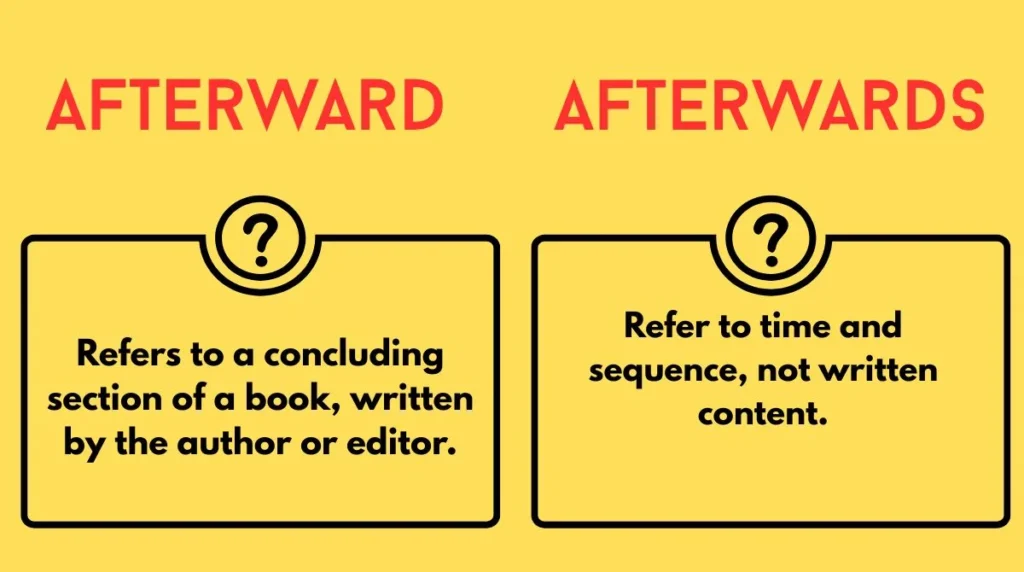
    • Afterword: Refers to a concluding section of a book, written by the author or editor.
      Example: “The author included a heartfelt afterword, reflecting on the writing process.”
    • Afterward/Afterwards: Refer to time and sequence, not written content.

    Quick Tip to Avoid Confusion:
    Remember that afterword ends with “word,” linking it to text or written material, while afterward/afterwards are purely about timing.


    Distinguishing Between Time and Text: Afterward and Afterword

    To further clarify the difference between afterward (and afterwards) and afterword, let’s compare their usage side by side:

    TermPart of SpeechMeaningExample Sentence
    Afterward(s)AdverbLater in time, following an event“He apologized afterward/afterwards for the delay.”
    AfterwordNounA concluding section in a book“The afterword explained the book’s inspiration.”

    Key Takeaway: Afterward and afterwards deal with time, while afterword deals with text.


    Tips to Remember the Difference and Avoid Misinterpretations

    Confused? Use these practical tips to distinguish between these terms:

    1. Associate the Ending:
      • Afterward(s): Focus on the directional or time-related nature of “-ward” or “-wards.”
      • Afterword: Relate the “word” ending to books or writing.
    2. Think About Region:
      • Writing for an American audience? Choose afterward.
      • Writing for a British audience? Opt for afterwards.
    3. Consistency Is Key:
      • In longer pieces, stick with one term to maintain clarity and flow.
    4. Use Mnemonics:
      • “Afterwards is popular in Britain because Brits add words.”

    FAQs

    What is the difference between afterward and afterwards?

    Both mean “at a later time,” but afterward is preferred in American English, while afterwards is more common in British English.

    Is it wrong to use afterwards in American English?

    No, it’s not wrong, but afterward is more commonly used in American English for formal and informal contexts.

    Which should I use in professional writing: afterward or afterwards?

    In professional writing, use afterward for American audiences and afterwards for British audiences. Stay consistent throughout your piece.

    Are afterward and afterword the same?

    No, they’re different. Afterward/afterwards refer to time, while afterword is a concluding section of a book.

    Can afterward or afterwards be used as a noun?

    No, both are adverbs. They modify verbs to indicate when an action takes place. For example, “We went home afterward.”


    Summary and Best Practices for Choosing Between Afterward and Afterwards

    While afterward and afterwards are essentially interchangeable, understanding their subtle distinctions can elevate your writing. Here’s a quick recap:

    • Both words mean “at a later time” or “following an event.”
    • Afterward is preferred in North America, while afterwards is favored in British English.
    • The choice often depends on regional norms, tone, and context.

    Best Practices:

    • Choose the term based on your target audience and region.
    • Avoid mixing afterward and afterwards within the same piece.
    • Double-check for homophones like afterword to ensure clarity.

    Mastering these subtle differences ensures your writing stays polished, professional, and easy to understand. Have any other confusing word pairs you’d like us to tackle? Drop them in the comments below!

  • 📝 Reevaluation or Re-evaluation? Master the Hyphen Rule with Ease

    📝 Reevaluation or Re-evaluation? Master the Hyphen Rule with Ease

    The way we use hyphens in English can significantly impact the clarity of our writing. One common area of confusion involves the prefix “re-” and whether to hyphenate words like reevaluation or re-evaluation.

    Should we include the hyphen, or is it unnecessary?

    This article dives deep into hyphenation rules in American English, with a specific focus on the “re-” prefix, to help you make the right choice every time.


    Introduction to Hyphenation in American English

    Hyphenation rules in American English can seem inconsistent, but they serve an essential purpose: clarity. Hyphens connect parts of compound words, making them easier to read and preventing misinterpretation.

    Reevaluation or re-evaluation? The hyphen choice matters for clarity and professionalism. Learn when to hyphenate “re-” words in American English.

    For example:

    • Re-sign (to sign again) versus resign (to quit a position).

    The presence or absence of a hyphen can completely change a word’s meaning. While some rules about hyphenation are flexible, others depend on specific contexts or word formations, especially with prefixes like “re-.”


    When to Hyphenate: The Prefix “Re-” Explained

    The prefix “re-” generally means again or back and is attached to base words without a hyphen. However, hyphenation is required when not using it could lead to ambiguity or confusion in meaning.

    Key Situations Requiring a Hyphen:

    1. Avoiding Misreading:
      If the unhyphenated word could be confused with another word, use a hyphen.
      • Re-cover (to cover again) vs. recover (to regain).
      • Re-create (to create again) vs. recreate (to relax or play).
    2. Consistency in Usage:
      Some writers prefer to hyphenate longer or less common words for readability, even when there’s no ambiguity.
    3. Specialized Terms:
      In technical or formal contexts, hyphenation often reflects precision.

    The General Rule for Prefixes in English

    The general guideline for prefixes like “re-” is to avoid hyphenation unless:

    • The base word begins with a capital letter.
      Example: Re-elect, Re-enact.
    • The lack of a hyphen creates ambiguity.
      Example: Re-evaluate vs. reevaluate.
    • A style guide or organization explicitly requires it (e.g., Chicago Manual of Style or AP Stylebook).

    For most common words, omitting the hyphen is now preferred in American English. For instance:

    • Reelection
    • Reexamine
    • Reevaluate

    However, exceptions often depend on specific contexts or regional preferences.


    Understanding the Meaning of “Re-” and Its Exceptions

    The prefix “re-” serves to indicate repetition or reversal of an action. Yet, in some cases, its placement affects the meaning of the word.

    Examples of Words Where Hyphenation Changes the Meaning:

    • Reform (to improve) vs. Re-form (to form again).
    • Resort (a vacation destination) vs. Re-sort (to sort again).

    Key exceptions to the “no hyphen” rule include:

    • Words where the base term already starts with “e-,” such as re-elect or re-enlist.
    • Compound words that become difficult to read without a hyphen, like re-establish or re-educate.

    Reevaluation vs. Re-evaluation: Which is Correct?

    Reevaluation or Re-evaluation

    Now to the big question: reevaluation or re-evaluation?

    Both forms are technically correct, but the choice depends on the context and your preferred style guide.

    1. Modern American English:
      • Reevaluation is the preferred spelling, as American English trends toward omitting hyphens for readability and simplicity.
    2. Traditional or Formal Writing:
      • Re-evaluation is more common in formal or technical writing, where the hyphen is used to ensure clarity.
    3. Style Guides:
      • The AP Stylebook typically avoids hyphens unless required for clarity, favoring reevaluation.
      • The Chicago Manual of Style allows both but leans toward the simpler form.

    The Impact of Omitting Hyphens in Common Usage

    Omitting hyphens can streamline text but also lead to misunderstandings. For example:

    • Reevaluate is clear in most contexts, but in complex sentences, it may confuse readers who associate “ree-” as one unit.
    • Removing hyphens can sometimes reduce visual clarity, especially in professional or academic writing.

    Examples of Misinterpretation Due to Missing Hyphens

    Here are real-world examples where hyphenation changes the meaning of a word:

    PhraseWithout HyphenWith Hyphen
    Recover plansTo regain plans.To cover plans again (Re-cover plans).
    Resign contractTo quit a contract.To sign a contract again (Re-sign contract).
    Recreate eventTo enjoy an event (recreate).To create an event again (Re-create event).

    Takeaway: When clarity is at stake, hyphenate!


    The Importance of Clarity in Professional Writing

    In professional settings, even minor punctuation choices like hyphens can have significant consequences. Miscommunication due to unclear wording might lead to:

    • Legal misunderstandings (resign vs. re-sign).
    • Project delays (reevaluate vs. re-evaluate).
    • Damage to credibility in academic or business contexts.

    Always consider your audience and whether the presence of a hyphen adds necessary clarity.


    Capitalization and Hyphenation: Special Case for Titles

    When writing titles or headings, hyphenation rules differ slightly. Generally, capitalize the first letter of each major word but retain the hyphen. For example:

    • Correct: “Re-evaluation of Policies”
    • Incorrect: “ReEvaluation of Policies”

    Consistency in capitalization and hyphenation demonstrates professionalism and adherence to style guides.


    FAQs

    When should I use “reevaluation” instead of “re-evaluation”?

    In American English, “reevaluation” is preferred for simplicity and modern usage, especially in casual or general writing. Use “re-evaluation” in formal or technical contexts.

    Why is hyphenation important for words with the prefix “re-”?

    Hyphenation prevents ambiguity. For instance, “re-cover” means to cover again, while “recover” means to regain something.

    Does the Chicago Manual of Style recommend reevaluation or re-evaluation?

    The Chicago Manual of Style accepts both forms but leans toward the simpler “reevaluation” unless the hyphen is necessary for clarity.

    What are some examples of “re-” words requiring hyphens?

    Examples include:

    • Re-cover (to cover again) vs. recover (to regain).
    • Re-create (to create again) vs. recreate (to relax).
    • Re-sign (to sign again) vs. resign (to quit).

    How can I decide whether to hyphenate or not?

    Consider context and clarity. Use a hyphen if the unhyphenated form could cause confusion or misinterpretation, or if required by a specific style guide.


    Conclusion

    To master hyphenation with words like reevaluation and re-evaluation:

    • Follow the context-specific rules of your audience or style guide.
    • Use hyphens when they clarify meaning or improve readability.
    • Omit hyphens for simplicity when ambiguity isn’t a concern.

    In most cases, reevaluation is acceptable and preferred in American English, while re-evaluation may suit more formal or British contexts. When in doubt, consult a style guide or prioritize clarity for your readers.

    Pro Tip: Always proofread your writing to ensure your choice of hyphenation aligns with your intended meaning. A small hyphen can make a big difference!