Blog

  • Its Self or Itself? Understand the Difference! 🤔

    Its Self or Itself? Understand the Difference! 🤔

    The English language is full of subtle nuances, and the distinction between “its self” and “itself” is no exception.

    While they might seem interchangeable at first glance, their correct usage depends on grammar, context, and even philosophical interpretation.

    This guide will break down their meanings, uses, and how to avoid common errors, ensuring your writing is precise and polished.


    Deciphering ‘Itself’ and ‘Its Self’: A Grammatical Exploration
    Its Self or Itself

    At first glance, “itself” and “its self” appear to be variations of the same idea. However, they are fundamentally different.

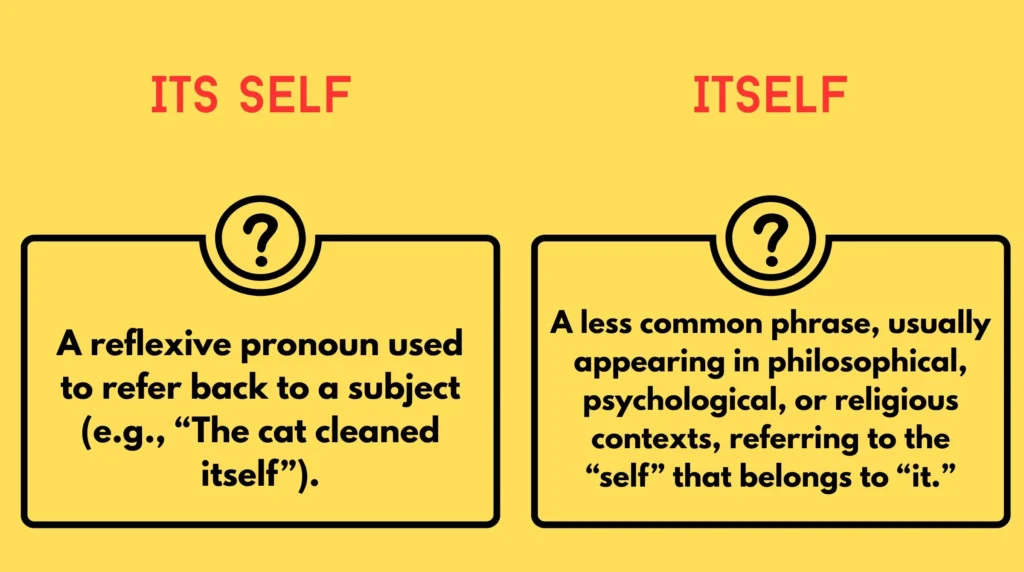
    • Itself: A reflexive pronoun used to refer back to a subject (e.g., “The cat cleaned itself”).
    • Its self: A less common phrase, usually appearing in philosophical, psychological, or religious contexts, referring to the “self” that belongs to “it.”

    Understanding when to use each depends largely on their grammatical function and intended meaning. Let’s dive deeper.

    Confused about “its self” vs. “itself”? Discover their differences, meanings, and correct usage with clear examples and expert tips!


    Defining Reflexive Pronouns in English

    Reflexive pronouns, like “itself,” are essential for expressing actions that the subject performs on itself. Other examples include “myself,” “yourself,” and “themselves.”

    Key Features of Reflexive Pronouns:

    1. Refer Back to the Subject:
      Example: “The robot fixed itself after the malfunction.”
    2. Show Emphasis:
      Example: “The dog itself opened the door!”
    3. Never Use Apostrophes: Reflexive pronouns are always written as one word without any apostrophes.

    Table of Reflexive Pronouns

    Subject PronounReflexive Pronoun
    IMyself
    YouYourself/Yourselves
    He/She/ItHimself/Herself/Itself
    WeOurselves
    TheyThemselves

    Contextual Usage of ‘Itself’ in Sentences

    The word “itself” is incredibly versatile. Here are some contexts where it shines:

    Examples in Everyday Usage

    1. Referring to Objects:
      Example: “The book fell off the shelf by itself.”
    2. Emphasizing Independence:
      Example: “The idea itself is brilliant.”
    3. Reflexive Actions:
      Example: “The machine started repairing itself automatically.”

    In all these cases, “itself” points back to the subject and provides clarity or emphasis.


    The Intricacies of ‘Its Self’ in Philosophical and Religious Texts

    Unlike the grammatical term “itself,” “its self” takes on a more abstract meaning. It is primarily found in discussions of identity, consciousness, or spirituality.

    Philosophical Usage

    1. The Concept of Self: In philosophy, “its self” may refer to an entity’s sense of identity.
      Example: “The organism understands its self as part of a larger ecosystem.”
    2. Existential Inquiry:
      Example: “The soul searches for its self in moments of reflection.”

    Religious and Psychological Contexts

    • In religious texts, “its self” often explores themes of the soul or inner being.
    • In psychology, it may describe an entity’s perception of its own identity.

    Note: Outside these specialized contexts, “its self” is rarely used in everyday English.


    Common Mistakes and Misconceptions in Using ‘Its’ and ‘It’s’

    The mix-up between “its” and “it’s” is one of the most frequent grammar mistakes. Let’s clarify their distinctions:

    • Its: A possessive pronoun, showing ownership.
      Example: “The dog wagged its tail.”
    • It’s: A contraction of “it is” or “it has.”
      Example: “It’s been a long day.”

    Quick Tip to Avoid Mistakes

    If you can replace the word with “it is” or “it has,” use “it’s.” Otherwise, use “its.”


    Identifying Contractions: When ‘It’s’ Is Not ‘Its’

    Contractions like “it’s” can trip up even seasoned writers. Remember:

    • It’s = It is/It has
      Example: “It’s raining today” = “It is raining today.”
    • Its = Possessive Pronoun
      Example: “The tree lost its leaves in the winter.”

    A helpful strategy is to reread your sentence and mentally expand “it’s” to “it is” or “it has.” If it doesn’t make sense, you’ve likely used the wrong form.


    Understanding Possessive Pronouns: When to Drop the Apostrophe

    Possessive pronouns like “its” don’t require apostrophes. This rule can seem counterintuitive since apostrophes often indicate possession, but possessive pronouns are an exception.

    Examples of Possessive Pronouns

    PronounExample Usage
    Its“The robot lost its battery.”
    His“The cat played with his toy.”
    Her“The bird built her nest.”
    Their“The students shared their notes.”

    The lack of an apostrophe helps distinguish possessive pronouns from contractions.


    Practical Examples: Strengthening Your Grammar with ‘Itself’

    Its Self or Itself

    To solidify your understanding, let’s look at practical examples of “itself” in action:

    1. Scientific Context:
      “The cell divides itself to form new cells.”
    2. Emphasis in Writing:
      “The painting itself is a masterpiece, even without the frame.”
    3. Everyday Scenarios:
      “The car locked itself automatically after five minutes.”

    By practicing with examples, you’ll gain confidence in using “itself” correctly.


    FAQs

    What does “itself” mean in grammar?

    “Itself” is a reflexive pronoun used to refer back to a subject, often emphasizing or showing an action performed on the subject by itself.

    When should you use “its self”?

    Use “its self” in philosophical, psychological, or religious contexts to describe an entity’s sense of identity or inner being. It’s not common in everyday grammar.

    What’s the difference between “its” and “it’s”?

    “Its” is a possessive pronoun showing ownership, while “it’s” is a contraction of “it is” or “it has.”

    How can I avoid mixing up “its” and “it’s”?

    If you can replace the word with “it is” or “it has,” use “it’s.” Otherwise, use “its.”

    Why is there no apostrophe in “its” for possession?

    Possessive pronouns like “its,” “his,” and “hers” do not require apostrophes to indicate ownership, unlike nouns.


    Conclusion: Mastering the Nuances of ‘Its Self’ and ‘Itself’

    Understanding the difference between “its self” and “itself” requires both grammatical knowledge and an appreciation for context.

    While “itself” serves as a reflexive pronoun, “its self” is reserved for abstract discussions of identity or consciousness.

    By mastering these distinctions and avoiding common pitfalls with “its” and “it’s,” you’ll improve your writing precision and clarity. Next time you encounter these terms, you’ll know exactly which one to use.
  • Copy That vs Roger That ✈️📻: Meaning, Origin & Real Usage Explained

    Copy That vs Roger That ✈️📻: Meaning, Origin & Real Usage Explained

    When someone says “Copy That” or “Roger That”, you instantly know they’re acknowledging a message. But are these phrases really the same? Not exactly.

    While both express understanding, their roots and nuances reveal subtle differences. To make sense of this, let’s break down their origins, meanings, and real-world usage.

    This article digs deep into Copy That vs Roger That, explores military communication protocols, and shows you when and how to use each phrase naturally in everyday conversation.


    Understanding “Copy That”

    ‘Copy That’ vs ‘Roger That’

    Meaning and Use

    “Copy That” means “I received and understood your message.” It’s short, clear, and practical. The phrase is often used in radio communication where brevity is critical.

    • Copy in this context comes from “to copy down a message,” just like a radio operator would jot notes during transmission.
    • That refers to the specific message received.

    In modern usage, you’ll hear people say it casually, almost like saying “Got it” or “Understood.”

    Example:

    Pilot: “Flight 271, maintain altitude 10,000 feet.”
    Copilot: “Copy That.”

    Here, “Copy That” confirms both receipt and comprehension.


    Origin

    The phrase grew out of 20th-century military and aviation communication. Early radio signals were often noisy and hard to hear. Operators needed a quick, unmistakable acknowledgment word.

    “Copy” was perfect: short, distinct, and easy to catch even in static. When paired with “That,” it became a concise acknowledgment tool.


    Everyday Use

    In civilian life, “Copy That” has shifted into casual slang. You might hear:

    • At work: “Meeting moved to 3 PM.” → “Copy That.”
    • Among friends: “Pick me up at 7.” → “Copy That.”
    • In texting: “Bring chips for the party.” → “Copy That.”

    It’s professional yet relaxed, which is why you see it in office chats, police shows, and even workplace jargon.


    Examples in Conversation

    • In the office:
      • Manager: “Deadline’s tomorrow at noon.”
      • Employee: “Copy That, I’ll send the draft.”
    • In casual talk:
      • Friend: “We’re meeting at Jake’s place.”
      • You: “Copy That.”
    • In emergency services:
      • Dispatcher: “Unit 4, proceed to Main Street for traffic control.”
      • Officer: “Copy That.”

    Understanding “Roger That”

    Meaning and Use

    “Roger That” means “Message received.” Unlike “Copy That,” it doesn’t explicitly say the message was understood. Instead, it signals receipt. However, in practice, both phrases are treated similarly.


    Origin

    The story of “Roger That” traces back to the NATO phonetic alphabet.

    • In 1927, the International Telecommunication Union created a spelling alphabet.
    • At that time, “Roger” represented the letter “R.”
    • In radio lingo, “R” = “Received.”

    So when a pilot or soldier said “Roger,” it literally meant “Received your transmission.” Adding “That” made it even clearer.

    Later, “Roger” was replaced by “Romeo” in the NATO alphabet, but by then, “Roger That” had already cemented itself in radio and military communication.


    Difference from “Copy That”

    The difference lies in nuance:

    • Copy That = Message received and understood.
    • Roger That = Message received (understanding implied, but not guaranteed).

    For critical communication, this distinction mattered. In fact, when action was required, operators often used “Wilco” (Will Comply) to show they not only received the order but also intended to carry it out.


    Everyday Use

    Today, “Roger That” often carries a military or retro feel. You’ll hear it in:

    • Movies like Top Gun or Black Hawk Down.
    • TV shows portraying police, military, or firefighters.
    • Casual slang among friends: “Be there at 9.” → “Roger That.”

    It’s slightly less common than “Copy That” in casual speech, but it packs more personality.


    Examples in Conversation

    • In aviation:
      • Tower: “Delta 319, cleared for landing runway 27.”
      • Pilot: “Roger That, runway 27.”
    • Among friends:
      • Friend: “Don’t forget the tickets.”
      • You: “Roger That.”
    • In military drills:
      • Commander: “Squad, hold position.”
      • Soldier: “Roger That.”

    Side-by-Side Comparison: Copy That vs Roger That

    Here’s a quick comparison for clarity:

    AspectCopy ThatRoger That
    Core MeaningMessage received + understoodMessage received
    OriginMilitary/aviation shorthandPhonetic alphabet “R” = received
    FormalitySlightly informalTraditional military phrase
    Common Use TodayCivilian + casualMilitary + casual
    ToneNeutral, practicalMilitary-flavored, emphatic

    Beyond “Copy” and “Roger”: Other Military Radio Terms

    Communication on radios follows strict protocol. A few related terms help put things in context:

    • Wilco → Short for Will Comply. Confirms not just receipt but also action.
    • Over → End of your message; expecting a reply.
    • Out → End of communication; no reply expected.
    • Break → Pause between messages or separating thoughts.
    • 10-4 → CB radio code for acknowledgment, still popular among truckers.

    Quote from WWII field manual:

    “Say ‘Roger’ to indicate message received. Say ‘Wilco’ when action will be carried out.”

    This shows how carefully each phrase was chosen to prevent deadly misunderstandings.


    Pronunciation and Radio Clarity

    Both “Copy That” and “Roger That” are designed for clarity.

    • Copy That uses hard consonants (“C,” “T”) that cut through static.
    • Roger That has a rolling “R” and sharp “T” ending, making it distinct on noisy channels.

    In radio protocol, brevity + clarity = survival. That’s why these phrases stuck around.


    Pop Culture and Civilian Influence

    Part of the reason these phrases feel familiar is Hollywood.

    • In Top Gun (1986), Tom Cruise’s Maverick made “Roger That” iconic.
    • Police shows like CSI and NCIS often use “Copy That” for realism.
    • Games like Call of Duty popularized both phrases among younger generations.

    In modern texting, both are shorthand for “Got it”—but “Roger That” often carries a playful, mock-military tone, while “Copy That” feels more natural and neutral.


    Common Mistakes and Misunderstandings

    Even though both phrases are straightforward, mistakes happen:

    • Assuming they’re identical. “Copy That” implies understanding, “Roger That” only acknowledgment.
    • Using Roger That when action is needed. For orders requiring compliance, “Wilco” is correct.
    • Mixing Over and Out. Hollywood often says “Over and Out,” but in real radio talk, it’s contradictory.

    Final Advice: Which One Should You Use?

    • Use “Copy That” in work chats, casual conversation, or when confirming instructions.
    • Use “Roger That” if you want to sound military-style, emphatic, or a little dramatic.
    • Use “Wilco” if you need to show you’ll act on the order.

    Key Takeaway:
    Both phrases mean acknowledgment. But Copy That = understood, while Roger That = received.


    Case Study: Communication Gone Wrong

    During WWII, unclear communication often cost lives. In one recorded incident, a unit misheard an order. They responded with “Roger” to acknowledge hearing it but didn’t act, assuming it was just confirmation. The commander expected compliance. The result? A critical delay that shifted the battle outcome.

    Lesson learned: every word in radio protocol matters. That’s why phrases like Copy That, Roger That, and Wilco became standardized.


    FAQs

    What does “Copy That” mean?

    “Copy That” means you’ve received and understood a message. It’s widely used in aviation, military, and casual conversations.

    What does “Roger That” mean?

    “Roger That” means the message has been received. It signals acknowledgment but doesn’t always guarantee full understanding.

    Is “Copy That” the same as “Roger That”?

    Not exactly. Copy That confirms both receipt and understanding, while Roger That confirms receipt only.

    When should I use “Copy That” vs “Roger That”?

    Use Copy That in casual or professional settings. Use Roger That if you want a more military-style acknowledgment or emphatic tone.

    What does “Wilco” mean in radio communication?

    “Wilco” stands for Will Comply. It means the message is received and the order will be carried out.

    Why do movies and TV use “Over and Out”?

    Hollywood popularized “Over and Out,” but in real communication, it’s incorrect. “Over” means expecting a reply, while “Out” ends the conversation.


    Conclusion

    The debate of Copy That vs Roger That boils down to nuance.

    • Copy That signals you both heard and understood.
    • Roger That signals you heard and acknowledged.

    Both serve as linguistic fossils of radio-era communication, now living on in everyday speech, workplace chats, and pop culture.

    So the next time someone asks you to confirm, you’ll know when to go with Copy That—and when to add a little flair with Roger That.

  • Disoriented vs Disorientated: Which One Should You Use? ✅

    Disoriented vs Disorientated: Which One Should You Use? ✅

    English is full of nuances, and choosing between words like disoriented and disorientated can leave even native speakers scratching their heads.

    While both words share a similar root and meaning, they’re used differently depending on context, geography, and personal preference.

    Let’s dive into the fascinating distinctions, origins, and practical applications of these terms to help you master their usage.


    Understanding ‘Disoriented’ in American English

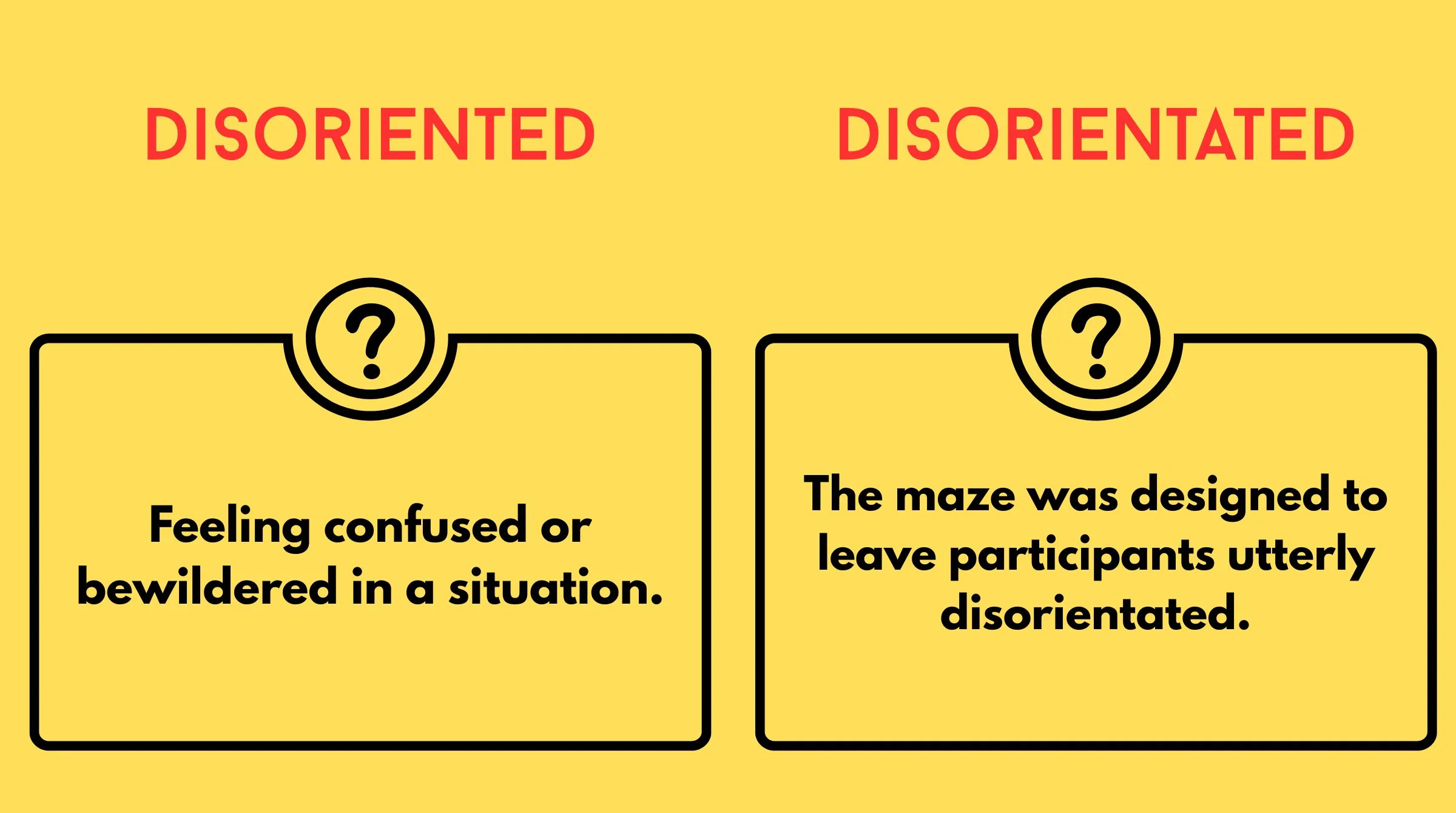
    In American English, disoriented is the preferred term. It describes a state of confusion or losing one’s sense of direction—both literally and figuratively.

    Definition:

    • Lacking a sense of direction or clarity.
    • Feeling confused or bewildered in a situation.

    Examples in Context:

    • “After spinning on the amusement park ride, I felt completely disoriented.”
    • “She was disoriented by the sudden changes in her schedule.”

    Why Is ‘Disoriented’ Common in the U.S.?

    • Simplicity: American English tends to favor shorter, more streamlined words.
    • Efficiency: Dropping the additional syllable in disorientated makes the word quicker to use in conversation and writing.

    Key point: If you’re writing or speaking in American English, disoriented is almost always the better choice.

    Is it “disoriented” or “disorientated”? Learn the differences, origins, and how to choose the right term for your audience with confidence!


    Disoriented vs Disorientated

    Exploring ‘Disorientated’ in British English

    Across the pond, disorientated is more common, especially in formal British English. While it means the same thing as disoriented, the extra syllable is a nod to the word’s etymological roots.

    Definition:

    • The British English equivalent of disoriented, used to describe a state of confusion or loss of direction.

    Examples in Context:

    • “After the long flight, I was completely disorientated when I landed in London.”
    • “The maze was designed to leave participants utterly disorientated.”

    Why Do Brits Prefer ‘Disorientated’?

    • Tradition: British English often retains longer forms of words, reflecting historical spellings and pronunciations.
    • Regional Variation: Usage varies within British dialects, but disorientated is generally more accepted and widely used.

    Key point: If you’re addressing a British audience, disorientated might feel more natural and relatable.


    The Historical Roots of ‘Disorientated’

    The origins of these terms can be traced back to the same Latin root: orientare, meaning “to arrange” or “to direct.”

    • Disoriented: Emerged in American English in the mid-19th century. Its streamlined form aligns with the American preference for shorter words.
    • Disorientated: Evolved from the longer, more formal structures of British English. Its first recorded use dates back to the 17th century.

    Interestingly, both forms grew independently as English spread across the globe, reflecting the cultural and linguistic differences between British and American English.


    Usage of ‘Disorientated’ in Literature

    While disoriented dominates American writing, disorientated has found a place in British literature and formal texts.

    Examples from Notable Works:

    • In British novels, such as those by Charles Dickens or Jane Austen, disorientated is used to describe characters in states of confusion or unease.
    • Modern British writers, like Zadie Smith and Kazuo Ishiguro, also employ disorientated in their works, maintaining its presence in contemporary literature.

    This literary preference underscores how regional conventions shape the way words are written and perceived.


    Disoriented vs. Disorientated: Cultural Perspectives

    Cultural differences play a significant role in word choice. Beyond just British and American conventions, the usage of disoriented and disorientated can reveal deeper insights into language evolution.

    American Perspective

    • Focuses on simplicity and clarity.
    • Disoriented is the overwhelmingly dominant choice in both casual and formal contexts.

    British Perspective

    • Values traditional forms and richer phonetics.
    • Disorientated is viewed as more elegant and nuanced, particularly in academic or literary writing.

    This divergence reflects broader differences in how each culture approaches language and communication.


    Common Scenarios of Disorientation and Their Impact

    Physical Disorientation:

    • Situations: Getting lost in an unfamiliar place, experiencing vertigo, or recovering from anesthesia.
    • Example: “He was disoriented after coming out of the dark cave.”

    Mental Disorientation:

    • Situations: Encountering unfamiliar concepts or environments, such as starting a new job or moving to a foreign country.
    • Example: “She felt disorientated during her first week abroad.”

    Disorientation can have real-world implications, from mild confusion to severe stress, making it essential to communicate these states effectively.


    The Linguistic Evolution of Disorientation Terms

    Language is constantly evolving, and disoriented and disorientated are no exceptions.

    Key Developments:

    • Disoriented: Adopted for its simplicity and has largely overtaken disorientated in modern American English.
    • Disorientated: Maintains a foothold in British English, appealing to those who favor traditional structures.

    Linguistic Trend: As global communication grows, disoriented is becoming more common internationally, potentially bridging the gap between the two forms.


    Choosing the Right Term: Style, Rhythm, and Audience

    When deciding between disoriented and disorientated, consider the following:

    • Audience:
      • Use disoriented for an American audience.
      • Use disorientated for a British audience.
    • Style:
      • If brevity is important, opt for disoriented.
      • For a more formal or traditional tone, choose disorientated.
    • Rhythm:
      • In some sentences, the additional syllable in disorientated may improve the flow or cadence.

    Example:

    • “She was completely disoriented by the rapid turn of events.” (Shorter and punchier)
    • “He felt utterly disorientated after stepping off the spinning ride.” (Smoother and more rhythmic)

    Impact on Clarity in Communication

    Choosing the wrong term can confuse your audience or make your writing feel less natural. To ensure clarity:

    • Match the word to your target region or audience.
    • Be consistent in your usage throughout a document or conversation.
    • When in doubt, opt for disoriented, as it’s more widely recognized globally.

    Tip: Avoid mixing both terms in the same piece unless you’re explicitly comparing them.


    Final Thoughts: Embracing Linguistic Differences

    Disoriented vs Disorientated

    The debate between disoriented and disorientated highlights the richness of the English language. Rather than seeing these differences as a source of confusion, they should be embraced as a testament to the language’s diversity and adaptability.

    Whether you lean toward the streamlined American disoriented or the traditional British disorientated, understanding their distinctions will enhance your communication and appreciation of English’s global variations.


    FAQs

    What is the difference between “disoriented” and “disorientated”?

    “Disoriented” is preferred in American English for simplicity, while “disorientated” is common in British English, reflecting traditional language forms.

    Is “disorientated” incorrect?

    No, “disorientated” is correct in British English, but it’s less common in American English, where “disoriented” is the preferred term.

    Why does American English favor “disoriented”?

    American English often opts for shorter, more efficient words, making “disoriented” the popular choice.

    When should I use “disorientated”?

    Use “disorientated” if your audience is primarily British or if you’re aiming for a formal or traditional tone in your writing.

    Can both “disoriented” and “disorientated” be used interchangeably?

    Yes, they can be used interchangeably in meaning, but the choice depends on your audience’s region and the context of your writing.


    Conclusion

    At first glance, disoriented and disorientated may seem interchangeable, but they reflect unique linguistic and cultural preferences.

    By understanding their origins, usage, and regional nuances, you can confidently choose the right term for any situation.

    What’s your preference—disoriented or disorientated? Let us know in the comments and share your own examples of disorientation in daily life!

  • Sustain vs Substain: Clear the Confusion! ❌✅

    Sustain vs Substain: Clear the Confusion! ❌✅

    English is full of words that sound similar, but their meanings—or even their existence—can differ significantly. One common point of confusion arises with the words sustain and substain.

    While sustain is a valid English word with broad applications, substain doesn’t actually exist in the English language.

    This article will break down their usage, meanings, and the common mistakes people make, ensuring you never confuse the two again.


    Understanding the Correct Usage: Sustain vs Substain

    Sustain vs Substain

    The key to understanding the difference between sustain and substain lies in their very nature.

    Is it sustain or substain? Discover why sustain is correct, what it means, and how to use it effectively while avoiding common mistakes.

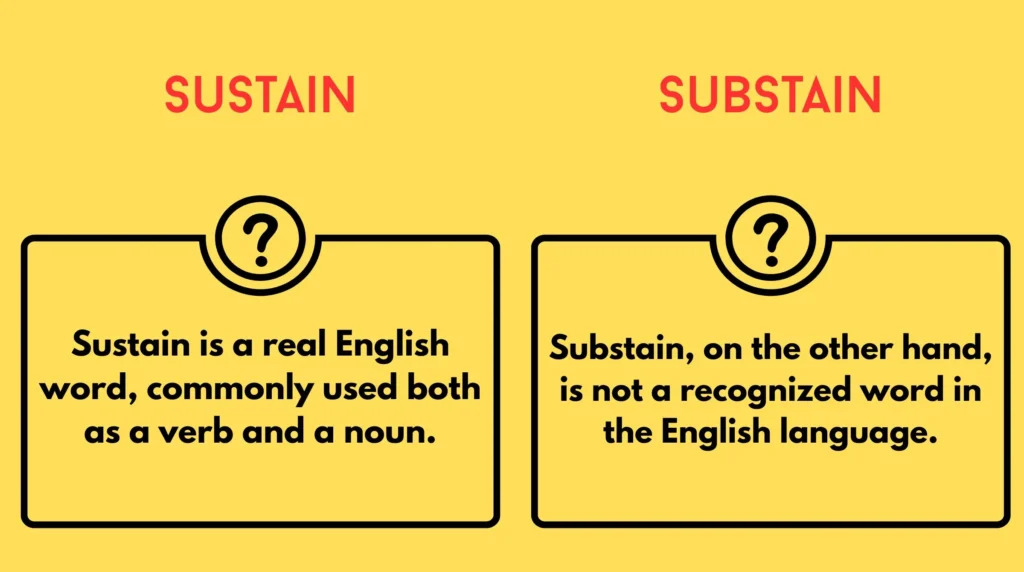
    • Sustain is a real English word, commonly used both as a verb and a noun.
    • Substain, on the other hand, is not a recognized word in the English language. It’s a misspelling or mispronunciation often made by mistake.

    This distinction is important because incorrect usage can confuse your audience and reduce the clarity of your communication.


    The Definition and Significance of Sustain in English

    Sustain has a rich and versatile meaning, making it an essential word in English vocabulary.

    Definition of Sustain

    • As a verb:
      To support, maintain, or keep something going over time.
      • Example: “She worked hard to sustain her family’s livelihood.”
    • As a noun (in music):
      A prolonged sound or note, often used in musical contexts.

    Why Is Sustain Important?

    The word sustain is crucial in various fields, from everyday communication to technical disciplines like music, engineering, and environmental studies. Its frequent use in different contexts highlights its adaptability and significance.


    The Role of Sustain as a Verb

    When used as a verb, sustain generally conveys the idea of supporting or maintaining something. Here are some specific examples:

    • To Support Physically:
      “The bridge is built to sustain heavy loads.”
    • To Maintain Over Time:
      “He couldn’t sustain the same level of performance throughout the game.”
    • To Endure or Withstand:
      “She sustained significant injuries during the accident but made a full recovery.”
    • To Uphold or Confirm:
      In legal contexts, sustain means to uphold or validate a decision.
      • Example: “The judge sustained the objection raised by the lawyer.”

    Common Synonyms for Sustain

    • Maintain
    • Support
    • Uphold
    • Prolong
    • Endure

    Using these synonyms can enhance your writing and avoid repetition.


    Sustain’s Meaning as a Noun in Music

    In the world of music, sustain takes on a specialized meaning.

    • Definition: The prolonged duration of a note or sound.
    • Usage in Context:
      • “The guitar pedal increases the sustain of the note, creating a richer sound.”
      • “The singer’s ability to sustain a high note captivated the audience.”

    This application is especially important in understanding how musical instruments and vocal techniques create emotional impact.


    The Nonexistence of ‘Substain’ in English Language

    Unlike sustain, the word substain has no place in the English language. It often appears due to:

    • Typos or Spelling Errors:
      People accidentally type “substain” when they mean “sustain.”
    • Phonetic Misunderstandings:
      In speech, the similarity of sounds might lead to confusion.
    • Lack of Awareness:
      Some learners of English might assume “substain” is a variation or related word.

    Key Point: Always double-check your spelling and use a trusted dictionary to avoid such errors.


    Common Mistakes and Confusions in English Vocabulary

    Mix-ups between sustain and substain are part of a larger pattern of English vocabulary mistakes. Here are some other commonly confused words:

    • Accept vs. Except:
      • Accept: To receive something.
      • Except: Excluding something.
    • Affect vs. Effect:
      • Affect: To influence (verb).
      • Effect: A result (noun).
    • Compliment vs. Complement:
      • Compliment: A kind remark.
      • Complement: Something that completes or goes well with something else.

    Avoiding such mistakes requires attention to detail and practice.


    Examples of How to Use Sustain in a Sentence

    Here are several examples to help solidify your understanding of sustain:

    1. In Everyday Conversation:
      • “Good nutrition is essential to sustain your energy throughout the day.”
    2. In Legal Contexts:
      • “The court sustained the previous ruling, maintaining the defendant’s sentence.”
    3. In Music:
      • “The sustain on the piano note gave the composition a hauntingly beautiful quality.”
    4. In Environmental Discussions:
      • “We must adopt sustainable practices to sustain our planet’s resources for future generations.”

    By using sustain correctly, you enhance the precision and professionalism of your communication.


    Remembering the Right Word: Tips to Avoid Misspellings

    Sustain vs Substain
    1. Visualize the Correct Word:
      Picture the word sustain in a sentence to reinforce its spelling and meaning.
    2. Practice with Mnemonics:
      • “Sustain is about support; substain is a mistake.”
    3. Leverage Spell-Check Tools:
      Use grammar-checking software, but always review suggestions critically.
    4. Read Aloud:
      Hearing the word in context can help you internalize its correct form.
    5. Learn Through Repetition:
      Write sentences using sustain to solidify your understanding.

    FAQs

    Is substain a real word?

    No, substain is not a recognized English word. It is often a misspelling or mispronunciation of sustain.

    What does sustain mean?

    Sustain means to support, maintain, or endure something over time. It is used in various contexts, including daily conversation, music, and legal terminology.

    How can I avoid confusing sustain with substain?

    To avoid confusion, remember that sustain is about support or endurance. Substain doesn’t exist, so use tools like spell-checkers and dictionaries for accuracy.

    What are some synonyms for sustain?

    Common synonyms for sustain include maintain, support, uphold, prolong, and endure.

    How is sustain used in music?

    In music, sustain refers to the prolonged duration of a sound or note. For example, a guitar pedal can enhance the sustain of a note.


    Conclusion

    The confusion between sustain and substain is a simple yet common mistake. While sustain is a versatile and meaningful word used across multiple disciplines, substain does not exist in English.

    By understanding the definitions, context, and correct usage of sustain, you can communicate more effectively and avoid embarrassing errors.

    Remember, clarity in language not only reflects your knowledge but also strengthens your message. So, the next time you write or speak, confidently choose sustain, and leave substain behind.

  • There Have Been or Has Been? Get It Right Every Time! ✅

    There Have Been or Has Been? Get It Right Every Time! ✅

    English grammar often feels like a maze, especially when it comes to figuring out which verb form to use in different contexts.

    One such puzzle involves the phrases “there have been” and “there has been.” Both are correct, but their usage depends entirely on the subject and its agreement with the verb.

    In this comprehensive guide, we’ll break down the rules, provide practical examples, and help you master when to use each phrase confidently.


    Understanding the Basics of ‘Has Been’ and ‘Have Been’

    There Have Been or Has Been

    To understand when to use has been and have been, it’s essential to revisit their grammatical foundations.

    Both are part of the present perfect tense, which is used to describe actions or situations that began in the past and continue to the present, or whose effects are still relevant.

    Confused between “there have been” and “there has been”? Learn the difference, grammar rules, and examples to confidently use them in any context.

    • ‘Has Been’ is used with singular subjects in the third person.
      Example: “She has been working here for years.”
    • ‘Have Been’ is used with plural subjects and the pronouns I, we, you, and they.
      Example: “We have been waiting for hours.”

    The distinction boils down to subject-verb agreement, which is one of the core principles of English grammar.


    The Present Perfect Tense: ‘Has Been’ vs. ‘Have Been’

    The present perfect tense combines the auxiliary verbs has or have with the past participle of the main verb.

    Why Use the Present Perfect Tense?

    1. To indicate actions that began in the past but are still ongoing.
      Example: “It has been raining all day.”
    2. To show the result of a past action that affects the present.
      Example: “There have been changes to the schedule.”

    Key Difference

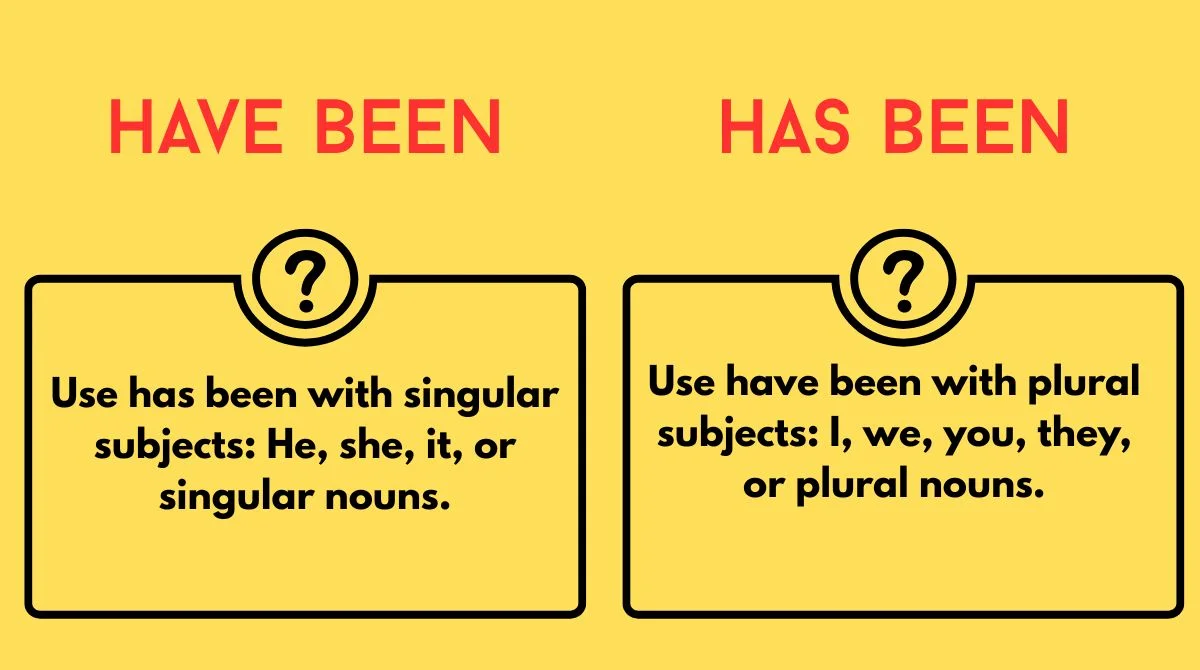
    • Use has been with singular subjects: He, she, it, or singular nouns.
    • Use have been with plural subjects: I, we, you, they, or plural nouns.

    When to Use ‘Has Been’ with Third Person Singular Subjects

    Has been specifically applies to singular third-person subjects, which include pronouns like he, she, it, and singular nouns.

    Examples:

    • “She has been the CEO since 2020.”
    • “It has been a long journey.”
    • “The dog has been barking all night.”

    Tip:

    When in doubt, check the subject of the sentence. If it’s singular and in the third person, has been is the correct choice.


    Applying ‘Have Been’ with Plural and First Person Subjects

    On the other hand, have been aligns with plural subjects and the first and second person pronouns I, we, you, they.

    Examples:

    • “I have been learning French for two years.”
    • “We have been friends since childhood.”
    • “They have been busy with their new project.”

    This rule applies regardless of whether the sentence describes an action or a state of being.


    The Role of ‘Had Been’ in Perfect Tenses

    While has been and have been are present perfect, had been takes us into the past perfect tense.

    When to Use ‘Had Been’

    • To describe an action or state that was completed before another past action.
      Example: “She had been studying for hours before the exam started.”

    Comparison:

    TenseUsage Example
    Present Perfect“She has been working here since 2015.”
    Past Perfect“She had been working here before the merger.”

    Distinguishing Between Past and Present Perfect Uses

    A common source of confusion is when to use present perfect versus past perfect. The key lies in the timeframe:

    • Present Perfect: Refers to ongoing relevance or a connection to the present.
      Example: “There have been many advances in technology recently.”
    • Past Perfect: Refers to something completed entirely in the past.
      Example: “There had been no electricity during the storm.”

    Complexities of Subject-Verb Agreement in English

    Subject-verb agreement plays a crucial role in choosing between has been and have been. This is where English learners often stumble, especially with tricky subjects like compound phrases or collective nouns.


    Navigating Compound Subjects and Prepositional Phrases

    Compound Subjects

    If two singular nouns are joined by and, the subject becomes plural, requiring have been.

    • “John and Sarah have been traveling together.”

    Prepositional Phrases

    Sometimes, prepositional phrases between the subject and verb cause confusion. Ignore them to identify the true subject.

    • Incorrect: “The group of students have been practicing.”
    • Correct: “The group of students has been practicing.”

    Identifying the Real Subject in Complex Sentences

    In complex sentences, the subject isn’t always straightforward.

    Example:

    • “There has been a series of unfortunate events.”
      Here, the real subject is a series (singular), so we use has been.

    Expanding the Verb Phrase: Adverbs with ‘Has Been’ and ‘Have Been’

    Adverbs are often used to modify has been or have been, adding nuance or emphasis.

    Examples:

    • “He has been consistently meeting his goals.”
    • “They have been always supportive of our efforts.”

    Adverbs should be placed either before the main verb or at the end of the sentence for clarity.


    Practical Examples: Using ‘Has Been’, ‘Have Been’, and ‘Had Been’ in Sentences

    Present Perfect:

    • “There has been a lot of debate about climate change.”
    • “There have been several proposals for the new project.”

    Past Perfect:

    • “There had been no announcements before the sudden decision.”

    Table for Quick Reference:

    SubjectCorrect PhraseExample
    He, she, it, singularHas been“He has been waiting for hours.”
    I, we, you, they, pluralHave been“They have been preparing for the event.”
    All subjects (past)Had been“She had been hoping for a promotion.”

    There Have Been or Has Been

    Common Mistakes and Tips for Mastery

    Mistake 1: Misusing has been with plural subjects

    • Incorrect: “They has been working hard.”
    • Correct: “They have been working hard.”

    Mistake 2: Ignoring the real subject in sentences with there

    • Incorrect: “There has been many problems.”
    • Correct: “There have been many problems.”

    Tips for Mastery:

    1. Always identify the true subject of the sentence.
    2. Double-check singular vs. plural agreement.
    3. Practice with examples to build confidence.

    FAQs

    When should I use “there have been”?

    Use “there have been” when the subject is plural. For example: “There have been many changes recently.”

    When do I use “there has been”?

    Use “there has been” when the subject is singular. For instance: “There has been a significant update.”

    What is the main difference between “have been” and “has been”?

    The difference lies in subject-verb agreement. “Have been” is for plural subjects or pronouns like I, we, you, and they. “Has been” is for singular third-person subjects.

    Can I use “has been” with plural subjects?

    No, “has been” is only correct with singular subjects like he, she, it, or singular nouns.

    Why is subject-verb agreement important in English?

    Subject-verb agreement ensures clarity and correctness in communication. Mistakes can confuse readers or listeners.


    Conclusion

    Mastering the distinction between has been and have been is all about understanding subject-verb agreement and the nuances of perfect tenses.

    With this guide, you now have the tools to use these phrases correctly and confidently in any context.

    Whether you’re writing a formal paper or having a casual conversation, remembering these rules will ensure your grammar is spot-on every time.

  • Ourselves or Ourself? When and How to Use Them Correctly 📘

    Ourselves or Ourself? When and How to Use Them Correctly 📘

    Pronouns are essential in everyday communication, yet they can sometimes be tricky to use correctly.

    Among the lesser-discussed yet confusing pronouns are ourselves and ourself. While they may seem interchangeable at first glance, their usage depends on specific contexts.

    In this article, we’ll break down the distinctions between these pronouns, explore their historical roots, and clarify how to use them correctly in modern English.


    The Basic Distinction between Ourselves and Ourself

    Ourselves or Ourself

    Is it “ourselves” or “ourself”? Discover the key differences, grammar rules, and examples to master these reflexive pronouns in any context!

    The difference between ourselves and ourself lies primarily in number and context:

    • Ourselves: A reflexive pronoun used when the subject of the sentence is plural (we or us).
      Example: “We should prepare ourselves for the upcoming challenges.”
    • Ourself: A singular reflexive pronoun, typically used in formal or rare contexts where we is singular (e.g., the royal we or editorial we).
      Example: “As the editor, we have taken it upon ourself to review the article.”

    Historical Context and the Royal We

    The use of ourself is deeply rooted in history, particularly in the concept of the royal we.

    Monarchs and other figures of authority would use we instead of I to convey their position as a representative of the people or divine authority.

    For example:

    • A king might declare, “We decree this law to be absolute,” referring to himself as a representative of the kingdom.
    • In such cases, ourself functions as a singular reflexive pronoun.

    The editorial we, used in academic and professional writing, also borrows from this historical convention. Here, authors refer to themselves in the plural to sound objective and formal.


    Usage of ‘Ourselves’ and ‘Ourself’ in Historical Texts

    In historical literature, both ourselves and ourself have been used, but their prevalence depended on the era and context:

    • Ourselves: Found in collective or plural contexts, often in works by authors addressing groups or societies.
      Example: “We must remind ourselves of our duty.” (John Locke, 17th century)
    • Ourself: Commonly associated with royal declarations or formal writings.
      Example: “We find ourself most content in solitude.” (Shakespeare, Richard II)

    A deeper dive into historical texts reveals that the singular ourself has steadily declined in usage in modern English, while ourselves remains the standard reflexive pronoun for plural subjects.


    Reflecting Authority: The Royal and Editorial We

    The royal we and editorial we demonstrate instances where ourself might still appear.

    • The Royal We: Used by monarchs, popes, and other figures of authority to reflect their position as representatives of a collective.
      Example: “We have bestowed upon ourself the responsibility of maintaining peace.”
    • The Editorial We: Used in academic or formal settings where the author speaks on behalf of a group or organization.
      Example: “We have reviewed the findings and made our conclusions.”

    In both cases, the plural we refers to a singular entity, making ourself appropriate in these contexts.


    Correct Usage of ‘Ourselves’ in Modern English

    In modern English, ourselves is the reflexive pronoun used in plural contexts. It aligns with the subject we or us.

    Key Rules for Using Ourselves:

    1. Reflexive Actions: When the subject and object of the verb are the same.
      Example: “We taught ourselves how to cook.”
    2. Emphasis: To stress the role of the subject.
      Example: “We, ourselves, completed the project without external help.”
    3. Reciprocal Actions: When referring to actions done mutually within a group.
      Example: “We congratulated ourselves on the success of the campaign.”

    When ‘Ourself’ Makes Sense: Special Contexts and Exceptions

    Although rare, ourself is used in very specific contexts:

    1. The Royal We: As mentioned earlier, monarchs and popes use ourself when referring to themselves in the singular while using we.
      Example: “We find ourself deeply moved by the events of the day.”
    2. The Editorial We: Authors or editors may use ourself to represent themselves formally.
      Example: “As editors, we hold ourself accountable for maintaining accuracy.”
    3. Poetic or Stylistic Choices: Writers occasionally use ourself to achieve a certain tone or rhythm in their work.

    Examples of ‘Ourselves’ and ‘Ourself’ in Literature

    Let’s examine how these pronouns have been used in literature:

    AuthorWorkSentence
    William ShakespeareRichard II“We are not ourself when nature, being oppressed, commands the mind to suffer with the body.”
    Virginia WoolfA Room of One’s Own“We think back through our mothers if we are women.”
    Modern ExampleFictional Usage“We prepared ourselves for what lay ahead, knowing it wouldn’t be easy.”

    Common Misconceptions and Grammar Myths Debunked

    Myth: Ourself Is Always Incorrect

    This is false. While ourself is less common, it is correct in specific contexts like the royal or editorial we.

    Myth: Ourselves Can Be Used for Singular Subjects

    Incorrect. Ourselves should only be used for plural subjects (we or us).

    Myth: The Two Words Are Interchangeable

    Not true. Their usage is entirely dependent on context, as explained above.


    Practical Tips to Ensure Correct Pronoun Usage

    1. Identify the Subject: Determine if the subject is singular or plural.
      • Singular: Use ourself.
      • Plural: Use ourselves.
    2. Check the Context: Is it a formal, historical, or stylistic use? If so, ourself may be appropriate.
    3. Rely on Modern Standards: In most cases, especially in casual writing, stick to ourselves.
    4. Proofread Carefully: Reflexive pronoun errors can easily slip through.

    FAQs

    What is the difference between “ourselves” and “ourself”?

    “Ourselves” is used for plural subjects (we, us), while “ourself” is singular and appears in formal or historical contexts like the royal we.

    When should I use “ourselves”?

    Use “ourselves” when the subject is plural, such as “we” or “us.” Example: “We taught ourselves how to code.”

    Is “ourself” grammatically correct?

    Yes, but it’s rare. “Ourself” is used in specific contexts like the royal or editorial we, where “we” refers to a singular subject.

    Can I use “ourselves” for singular subjects?

    No, “ourselves” is strictly for plural subjects. For singular contexts with “we,” use “ourself” instead.

    Why do monarchs and editors use “ourself”?

    They use “ourself” to reflect the royal or editorial we, a formal way of representing a single person speaking as a collective.


    Conclusion

    Understanding the distinction between ourselves and ourself is vital for clear and accurate communication.

    While ourselves dominates modern English as the standard reflexive pronoun for plural subjects, ourself remains relevant in historical, royal, and editorial contexts.

    By mastering these differences, you can ensure your writing is both grammatically correct and contextually appropriate.

    Have you encountered any confusing pronouns lately? Share your thoughts or questions in the comments below!

  • Strongly Recommend vs Highly Recommend: Know the Key Difference! 🤔

    Strongly Recommend vs Highly Recommend: Know the Key Difference! 🤔

    In everyday communication, we often hear phrases like strongly recommend and highly recommend. While these expressions may seem interchangeable at first glance, they carry subtle differences in tone, intent, and application.

    Understanding the nuances of these phrases can help you use them more effectively, whether you’re writing a review, giving advice, or offering a suggestion.

    Let’s break down the differences, contexts, and best uses of these commonly used recommendation phrases.


    Introduction to Recommendation Phrases

    Strongly Recommend vs Highly Recommend

    Recommendation phrases play a vital role in how we communicate support or approval. They help convey our level of enthusiasm, trust, or conviction about a particular subject.

    For example, saying, “I strongly recommend this book” implies a personal conviction, whereas “I highly recommend this book” might focus more on its broad appeal or quality. These subtle differences can make a big impact on how your message is received.

    By exploring the nuances of strongly and highly recommend, we’ll uncover how these terms differ in tone and usage.

    Is it better to say “strongly recommend” or “highly recommend”? Learn the key differences, examples, and best practices to master these phrases!


    The Nuances of “Strongly Recommend”

    Emphasizing Urgency and Conviction

    The phrase strongly recommend conveys a sense of personal urgency or deep conviction.

    It’s often used when you feel passionately about your suggestion or when there’s a significant reason behind the recommendation.

    Examples:

    • “I strongly recommend using sunscreen to protect your skin from UV damage.”
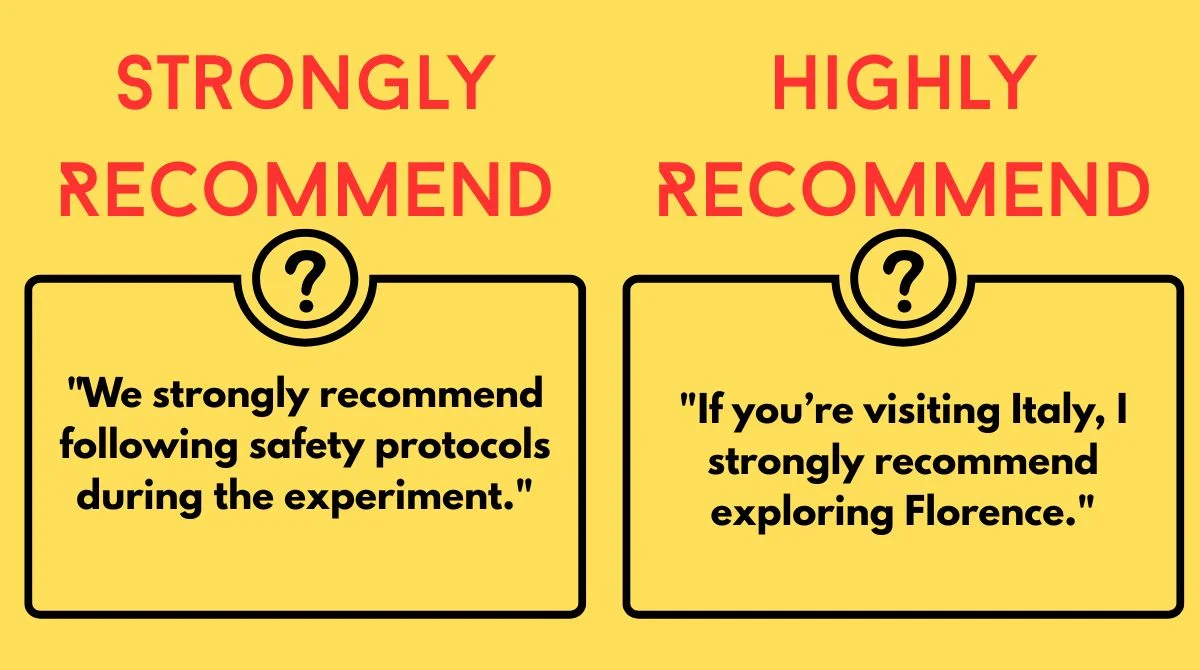
    • “We strongly recommend following safety protocols during the experiment.”

    Here, the emphasis lies on strength and necessity. The suggestion carries weight, urging the listener to act immediately or consider the advice seriously.


    The Subjectivity of “Strongly Recommend”

    One key nuance of strongly recommend is its subjectivity. This phrase often reflects personal experience or strong emotional involvement.

    For instance:

    • “I strongly recommend this restaurant—it’s my absolute favorite!”
    • “If you’re visiting Italy, I strongly recommend exploring Florence.”

    In these cases, the recommendation stems from individual preferences, making it more personal and heartfelt.


    When to Use “Strongly Recommend” in Communication

    Using strongly recommend is appropriate when:

    • You want to convey urgency or necessity.
    • Your recommendation is based on personal experience or expertise.
    • The stakes are high, and you need to stress the importance of action.

    Examples of Usage:

    • Workplace: “We strongly recommend updating your password to improve security.”
    • Health: “Doctors strongly recommend regular exercise to maintain heart health.”

    By choosing this phrase, you align your recommendation with authority and conviction, making it more impactful.


    Breaking Down “Highly Recommend”

    The Contextual Use of Recommendations

    On the other hand, highly recommend suggests a more general endorsement. It’s often used to highlight excellence, quality, or widespread approval. The tone is enthusiastic but less urgent compared to strongly recommend.

    Examples:

    • “I highly recommend this movie—it’s a masterpiece!”
    • “We highly recommend this product based on customer reviews.”

    Here, highly recommend conveys enthusiasm for something that’s widely appreciated or objectively commendable.


    Positive Consensus: Using “Highly Recommend”

    Unlike strongly recommend, which can feel personal, highly recommend often implies positive consensus. It’s suitable for situations where your suggestion aligns with popular opinion or general quality standards.

    For instance:

    • “This hotel is highly recommended for its excellent service and amenities.”
    • “I highly recommend this book—it has received glowing reviews from critics.”

    This phrase works well when your recommendation is based on external validation rather than personal conviction.


    Personal Advice: The Case for “Strongly Recommend”

    Strongly Recommend vs Highly Recommend

    When giving personal advice, strongly recommend is often more effective. It emphasizes your personal connection to the advice and adds a layer of sincerity.

    Example:

    • “If you’re struggling with time management, I strongly recommend using a planner.”

    This approach makes the suggestion feel tailored and genuine, building trust with your audience.


    Real-World Examples: How “Strongly” and “Highly” Impact Meaning

    Example 1: Travel

    • Strongly Recommend: “I strongly recommend visiting the Louvre if you’re passionate about art history.”
    • Highly Recommend: “The Louvre is highly recommended by travel experts and guides.”

    Example 2: Products

    • Strongly Recommend: “I strongly recommend this laptop for graphic design—it’s the best I’ve ever used.”
    • Highly Recommend: “This laptop is highly recommended for its speed and performance.”

    Key Difference: Strongly conveys personal conviction, while highly reflects general approval or quality.


    Substitutes for “Strongly Recommend” and “Highly Recommend”

    To keep your writing varied, consider these alternatives:

    Alternatives for “Strongly Recommend”

    • “I urge you to…”
    • “I insist on…”
    • “I firmly believe…”

    Alternatives for “Highly Recommend”

    • “I wholeheartedly endorse…”
    • “I give my highest praise to…”
    • “This comes with my full recommendation…”

    Using these variations can enhance your communication while avoiding repetition.


    FAQs

    What is the difference between “strongly recommend” and “highly recommend”?

    “Strongly recommend” emphasizes urgency and personal conviction, while “highly recommend” highlights quality or widespread approval.

    When should I use “strongly recommend”?

    Use “strongly recommend” when expressing personal urgency, conviction, or necessity, such as in advice or important suggestions.

    Is “highly recommend” less personal than “strongly recommend”?

    Yes, “highly recommend” often implies external validation or general quality rather than personal conviction.

    Can I use “highly recommend” in professional reviews?

    Absolutely! “Highly recommend” is ideal for professional or objective endorsements based on quality or popular opinion.

    Are there alternatives to “strongly recommend” and “highly recommend”?

    Yes! For “strongly recommend,” try “I urge you to” or “I insist on.” For “highly recommend,” use “I wholeheartedly endorse” or “I give my highest praise to.”


    Conclusion

    Choosing between strongly recommend and highly recommend depends on the tone and context of your message.

    • Use strongly recommend to convey urgency, personal conviction, or emotional involvement.
    • Use highly recommend for endorsements based on quality, excellence, or popular consensus.

    By understanding these differences, you can tailor your recommendations to be more effective and impactful. Whether you’re writing a review, offering advice, or persuading someone to act, these phrases will help you communicate with clarity and precision.

  • Proud for You vs Proud of You: Which One is Correct? 🤔✨

    Proud for You vs Proud of You: Which One is Correct? 🤔✨

    When it comes to expressing pride in someone else’s achievements, choosing the right phrase can sometimes be tricky.

    You might have heard people say, “I’m proud for you,” but is that the correct way to show your pride? Or should it be “proud of you”?

    This article will break down the grammatical distinctions, explain the nuances of each phrase, and clarify why one is often favored over the other.

    By the end, you’ll know how to use these expressions confidently and avoid common mistakes.


    Understanding the Correct Usage of Pride Expressions

    Proud for You vs Proud of You

    Expressing pride in someone’s accomplishments is an emotional and personal experience, but it’s important to get the phrasing right.

    The two most commonly used expressions are “proud of you” and “proud for you.” While both convey positive emotions, they’re not interchangeable.

    “Proud of You”

    This is the standard and widely accepted way to express pride. You use “proud of you” when you’re acknowledging someone’s achievements or the person themselves. It shows a deep connection to the individual’s actions, character, or success.

    Example:
    “I’m so proud of you for completing your degree!”

    “Proud for You”

    Though less common, some people use “proud for you” to convey a sense of joy for someone else’s success. It implies that you feel happiness on their behalf, but not necessarily that you have a personal connection to their achievement.

    Example:
    “I’m proud for you, now that you’ve gotten the job you wanted.”

    In the following sections, we’ll dive deeper into why “proud of you” is typically the go-to choice and why “proud for you” can sound a little off to native speakers.

    Confused about whether to say “proud for you” or “proud of you”? This guide explains the correct usage, common mistakes, and how to express pride with confidence.


    Exploring the Grammatical Nuances of “Proud of You”

    The expression “proud of you” is widely accepted because it follows standard grammar rules. Here’s why:

    The Preposition “Of”

    The preposition “of” is used to show possession, connection, or a state of being. In the phrase “proud of you,” it signifies that the speaker’s pride stems from the person’s qualities or achievements. It’s about feeling connected to or moved by someone else’s success.

    Grammatical Breakdown:

    • Proud is an adjective that expresses a feeling.
    • Of links the adjective to the noun or pronoun (in this case, “you”).
    • You is the person receiving the pride or acknowledgment.

    Example:
    “I’m proud of you for working so hard.”
    Here, “of you” directly links the speaker’s pride to the individual’s effort.


    Why “Proud for You” Sounds Awkward in English

    On the other hand, “proud for you” isn’t incorrect grammatically, but it’s rarely used and tends to sound awkward. This is because the preposition “for” typically implies doing something on someone’s behalf or expressing support, rather than personal connection. It shifts the focus from the individual to their success, making the statement feel less personal.

    The Difference Between “Proud Of” vs “Proud For”

    • Proud of suggests a deep, personal feeling of admiration or connection.
    • Proud for expresses an external sense of happiness or joy for someone, but without a direct connection.

    For example, it might feel more natural to say, “I’m happy for you,” because you are expressing joy on their behalf. However, “proud for you” doesn’t convey that same deep personal pride.


    Common Mistakes and How to Avoid Them

    One of the most common errors people make is using “proud for you” when they mean to express a deeper sense of connection or pride. This usually happens because “for” is often used in similar emotional contexts (e.g., “happy for you” or “excited for you”). However, remember that “proud of you” should always be your go-to when showing admiration for someone’s achievements.

    Example Mistakes:

    • “I’m proud for you for finishing the marathon.” (Incorrect: It should be “proud of you.”)
    • “He’s proud for you for getting the promotion.” (Incorrect: It should be “proud of you.”)

    How to Avoid This Mistake

    • Always remember that “proud of” links the speaker’s pride directly to the individual.
    • “Proud for” is less personal and tends to focus on the external achievement rather than the person’s qualities. If you’re unsure, use “proud of” to avoid sounding awkward.

    Expert Opinions on Proper Language Etiquette

    Linguists and grammarians widely agree that “proud of you” is the correct and preferred expression. According to English language experts, using “of” aligns with the fundamental rules of grammar in expressing pride or admiration. “Proud for you” is generally discouraged, unless you’re specifically discussing someone else’s joy or happiness for the person, as in “I’m so happy for you.”

    Dr. Robert Jones, a linguist at Harvard University, notes, “‘Proud of’ conveys a direct connection between the speaker and the person being admired, while ‘proud for’ distances the two, making it less intimate and more neutral.”


    The Historical Prevalence of “Proud for You” vs “Proud of You”

    Historically, “proud of you” has been the standard expression in English. “Proud for you” is a more recent construction, possibly influenced by the more common “happy for you” phrase. In older literature and writings, “proud of” was always used to show admiration or pride in someone’s accomplishments.

    In Early Literature:

    • Shakespeare and other classic authors often used “proud of” to express pride in characters or their actions.
    • “Proud for” was rarely seen and often felt out of place in formal or poetic contexts.

    As time passed, “proud of” remained the dominant choice due to its deeper emotional and grammatical resonance.


    Deciphering the Meaning Behind “Proud of You”

    When someone says, “I’m proud of you,” the phrase holds significant emotional weight. It’s not just a casual remark but a declaration of admiration. The speaker is saying, “I recognize your hard work, talent, and dedication, and I’m moved by it.”

    The Emotional Weight

    “Proud of you” carries a sense of connection, as if the speaker is personally invested in the person’s growth or success. Whether it’s a family member, a friend, or a colleague, this expression shows emotional attachment and genuine pride.


    The Emotional Impact of This Phrase on Relationships

    Using “proud of you” in relationships—whether familial, romantic, or professional—has a powerful emotional impact. It strengthens bonds and provides affirmation to the person being acknowledged. It shows that the speaker values not just the outcome (e.g., success or achievement) but also the effort and personal growth behind it.

    Strengthening Bonds with “Proud of You”

    When used appropriately, “proud of you” can enhance a person’s sense of self-worth and deepen relationships. It’s a way to tell someone, “I see you, I appreciate you, and I celebrate your accomplishments.”


    Alternatives to Expressing Pride in Someone’s Achievements

    If you want to mix it up and avoid overusing “proud of you,” here are some alternatives:

    • “I’m so impressed by you.”
    • “You did an amazing job!”
    • “Your hard work really paid off.”
    • “I’m in awe of what you’ve achieved.”
    • “You should be really proud of yourself.”

    These alternatives still express admiration but provide variety in your language.


    Final Thoughts on Using Pride Expressions Effectively

    In conclusion, while “proud for you” can be used in certain contexts, “proud of you” is the grammatically correct and emotionally powerful phrase to express genuine pride in someone’s achievements.

    Whether in personal or professional relationships, using the right expression helps communicate admiration, respect, and love.

    When in doubt, always choose “proud of you.” It’s clear, heartfelt, and universally understood. So, next time someone accomplishes something noteworthy, use this phrase with confidence!


    FAQs

    What’s the difference between “proud of you” and “proud for you”?

    “Proud of you” expresses a personal connection to someone’s achievements, while “proud for you” conveys happiness on someone’s behalf without deep personal involvement.

    When should I use “proud of you”?

    Use “proud of you” when expressing deep admiration or pride for someone’s accomplishments, particularly when you feel a personal connection to their success.

    Can “proud for you” be used in English?

    Yes, but it’s less common and typically used to express happiness for someone’s achievement without implying a deep personal connection.

    What are common mistakes with “proud of you” and “proud for you”?

    A common mistake is saying “proud for you” when you mean to express a personal connection or admiration, which should be “proud of you.”

    Why does “proud for you” sound awkward?

    It sounds awkward because “for” is typically used for external support, not for expressing personal pride or admiration.

    What is the emotional impact of saying “proud of you”?

    Saying “proud of you” shows emotional attachment and affirmation, strengthening relationships by acknowledging someone’s effort and success.


    Conclusion

    Now that we’ve unpacked the difference between “proud for you” and “proud of you,” you’re equipped to use these phrases effectively.

    Whether you’re cheering someone on or celebrating a milestone, expressing pride is a beautiful way to strengthen connections and uplift others.

  • Are vs Were: Master English Grammar with Ease 📚🤓

    Are vs Were: Master English Grammar with Ease 📚🤓

    When learning English, one of the most important elements to master is the verb “to be.” It’s essential for forming complete sentences and expressing both the present and past.

    The confusion between “are” and “were” can be especially tricky for English learners, but once you understand the rules and practice using them, it will become second nature.

    In this article, we’ll break down everything you need to know to confidently use are and were in American English grammar.


    Understanding the Verb “Be”: A Brief Overview

    The verb to be is one of the most fundamental and versatile verbs in English. It’s used to describe existence, state of being, and to form various tenses. The verb has different forms based on the subject and tense:

    • Am (used with the subject “I” in the present tense)
    • Is (used with singular subjects in the present tense)
    • Are (used with plural subjects or the pronouns “you” and “we”)
    • Was (used with singular subjects in the past tense)
    • Were (used with plural subjects or the pronouns “you” and “we” in the past tense)

    Understanding these different forms is essential because the correct usage of are and were depends largely on the subject of the sentence and the tense you’re using.

    Confused about when to use “are” or “were”? Learn the difference between these verbs, including their usage in present and past tense, as well as tips for common mistakes.


    The Present Tense of “Be”: When to Use “Are”

    In the present tense, are is used primarily with plural subjects or the pronouns “you” and “we.”

    • Examples:
      • “You are amazing.”
      • “They are ready for the test.”
      • “We are going to the store.”

    In these examples, are helps link the subject to the complement, whether it’s a description, an action, or a state.


    Examples of “Are” in Sentences

    Here are a few more examples to show the versatility of are in the present tense:

    • “My friends are coming over later.”
    • “The dogs are playing in the yard.”
    • “You are a great listener.”
    • “The books are on the table.”

    These sentences highlight are being used with both plural nouns (friends, dogs, books) and the pronoun you.


    Using “Are” with Plural Nouns and Pronouns

    Are is almost always used with plural nouns and pronouns to show that multiple subjects are involved. This helps indicate that the action or state is happening with more than one person or thing.

    • Plural Nouns:
      • “The children are excited for the weekend.”
      • “The cars are parked in the driveway.”
    • Pronouns (We, You, They):
      • “We are planning a trip.”
      • “You are all invited to the party.”
      • “They are studying for their exams.”

    Using are correctly with plural subjects is key to mastering the present tense in English.


    “Are” as an Auxiliary Verb in Progressive Tenses

    In addition to being used as a linking verb, are also functions as an auxiliary (or helping) verb in progressive tenses. These tenses describe actions that are ongoing or in progress. When are is paired with the present participle (the verb ending in “-ing”), it creates the present progressive tense.

    • Examples:
      • “She is studying for her finals.”
      • “They are playing soccer right now.”
      • “I am reading a great book.”

    In these sentences, are helps convey the idea that the actions are happening right now or in the present moment.


    Exploring the Past Tense: The Correct Use of “Were”

    When shifting to the past tense, were replaces are and is used with plural subjects or the pronouns you and we.

    • Examples:
      • “They were excited about the new movie.”
      • “You were supposed to finish the project yesterday.”
      • “We were at the park all afternoon.”

    Unlike are, which expresses the present, were links the subject to a state or action in the past.


    Examples of Using “Were” Correctly in Sentences

    Using were correctly depends on recognizing that it refers to actions, states, or conditions that occurred in the past, often involving more than one subject.

    • “The team were tired after the long match.”
    • “We were waiting for the bus when it started raining.”
    • “They were upset about the canceled event.”

    In each example, were helps convey that the action or state is entirely in the past.


    Customary Grammar Rules for “Were”

    While were is typically used with plural nouns and the pronouns you and we in the past tense, there are some specific rules and usages to keep in mind:

    • Use of “Were” with the Subjunctive Mood: In hypothetical or wishful statements, were is used even with singular subjects. This is known as the subjunctive mood.
      • Example: “If I were you, I would take the job.”
      • Example: “I wish she were here right now.”
    • For all plural subjects and “you” in the past tense:
      • “They were at the concert last night.”
      • “You were the best player on the team.”

    Common Mistakes and Confusions Between “Are” and “Were”

    Even though the rules seem clear, many people still mix up are and were in their writing and speech. Here are a few common mistakes:

    Mixing up Singular and Plural Forms

    • Incorrect: “She were late for class.”
    • Correct: “She was late for class.” (singular subject)

    Using the Wrong Verb for the Tense

    • Incorrect: “I wish I are a better singer.”
    • Correct: “I wish I were a better singer.” (subjunctive mood)

    Subjunctive Mood Usage of “Were”

    One of the trickiest areas of grammar for were is its use in the subjunctive mood. In conditional or hypothetical situations, even singular subjects require were rather than was.

    • Example: “If he were here, he could explain everything.”
    • Example: “I wish she were more interested in this topic.”

    The subjunctive mood helps express wishes, suggestions, or hypothetical situations.


    Practical Tips to Remember the Difference Between “Are” and “Were”

    1. Check the Tense:
      • If the action is happening right now, use are with plural subjects or “you” and “we.”
      • If the action took place in the past, use were with plural subjects or “you” and “we.”
    2. Consider the Subject:
      • Are goes with plural subjects and “you” in the present.
      • Were goes with plural subjects, “you,” and “we” in the past.
    3. Remember the Subjunctive Mood:
      • If you’re expressing a hypothetical or wishful statement, use were even with singular subjects.

    FAQs

    When should I use “Are” in a sentence?

    Use “are” when referring to a plural subject in the present tense or when using the pronouns “you” and “we.”

    When is it correct to use “Were”?

    Use “were” for plural subjects or the pronouns “you” and “we” in the past tense, or in the subjunctive mood for hypothetical situations.

    What’s the difference between “are” and “were”?

    “Are” is used in the present tense with plural subjects, while “were” is used in the past tense or for hypothetical statements, even with singular subjects.

    What is the subjunctive mood with “Were”?

    The subjunctive mood uses “were” to express hypothetical or wishful situations, such as “If I were you, I would do it.”

    Why do people confuse “are” and “were”?

    Many mix up these verbs because they sound similar, but “are” is for present tense, while “were” is for past tense or hypothetical cases.

    How can I avoid mistakes with “Are” and “Were”?

    Remember that “are” is for present tense and plural subjects, while “were” is for past tense, with special cases for the subjunctive mood.


    Conclusion

    Mastering the difference between are and were can significantly improve your English grammar skills.

    While are is used in the present tense with plural subjects and “you” and “we,” were is reserved for the past tense, and in certain cases, it’s used with singular subjects in the subjunctive mood.

    By following the rules and practicing with these examples, you’ll soon be able to use are and were with confidence.

  • Me and My Family vs My Family and I: A Clear Guide 🧑‍👩‍👧‍👦📚

    Me and My Family vs My Family and I: A Clear Guide 🧑‍👩‍👧‍👦📚

    The English language is full of tricky grammar rules that often leave even the most seasoned speakers scratching their heads.

    One of the most common dilemmas? Whether to say “Me and my family” or “My family and I”. Though these phrases might sound interchangeable to many, they are not always used correctly.

    Understanding when to use each form is key to sounding polished and professional.

    In this guide, we’ll dive deep into the correct usage, break down common mistakes, and provide clarity on this often-confused grammar rule.


    Decoding the Grammatical Dilemma: Subject vs. Object Pronouns

    Before we tackle me and my family versus my family and I, it’s crucial to understand the difference between subject and object pronouns.

    This is the foundation for determining which phrase is appropriate in any given context.

    • Subject Pronouns: These pronouns are used when the person or group performing the action of the sentence is in focus. I, we, he, she, they are all subject pronouns.
      Example: “I went to the park with my family.”
    • Object Pronouns: These pronouns take the role of the recipient of the action. Me, us, him, her, them are all object pronouns.
      Example: “He invited me to the party with my family.”

    Knowing whether your pronoun is a subject or an object will guide your choice between I and me in sentences.

    Confused about whether to say “Me and my family” or “My family and I”? Learn the grammatical rules and etiquette behind these phrases for more polished speech and writing.


    Pronoun Placement Etiquette in English

    In English, the order of pronouns in a sentence isn’t just about grammar rules—it’s also about etiquette and respect. My family and I is traditionally the more polite and formal choice, especially when you are the subject of a sentence. The reason? In English-speaking cultures, the other person (or group) is often placed first as a sign of respect.

    Correct Placement:

    • “My family and I went on vacation.” (Formal, respectful)
    • “He invited my family and I to dinner.” (Polite phrasing, subject)

    Incorrect Placement:

    • “Me and my family went on vacation.” (Informal, incorrect usage for subject pronouns)
    • “He invited me and my family to dinner.” (Common mistake, though technically used as an object, it sounds less polished)

    The Tradition of Self-Referential Politeness

    In formal or respectful English, we tend to place others before ourselves. This principle is especially evident when using pronouns like I and me. While my family and I is grammatically correct when you are the subject, it’s also a matter of maintaining politeness and decorum. This tradition of placing my family before I reflects the cultural practice of showing deference to others.

    In a casual conversation, it’s fine to say me and my family, but it’s not considered as polite or proper as my family and I. So, when in doubt, follow the tradition of placing others before yourself, especially in more formal contexts.


    Implications of Pronoun Order in Perception

    Me and My Family vs My Family and I

    The order of pronouns in a sentence can influence how the speaker is perceived. For instance, saying “Me and my family” might sound too informal or even self-centered in certain settings, especially in professional or academic communication. This structure places the speaker first, which can inadvertently shift the focus to them rather than the group.

    Example 1:

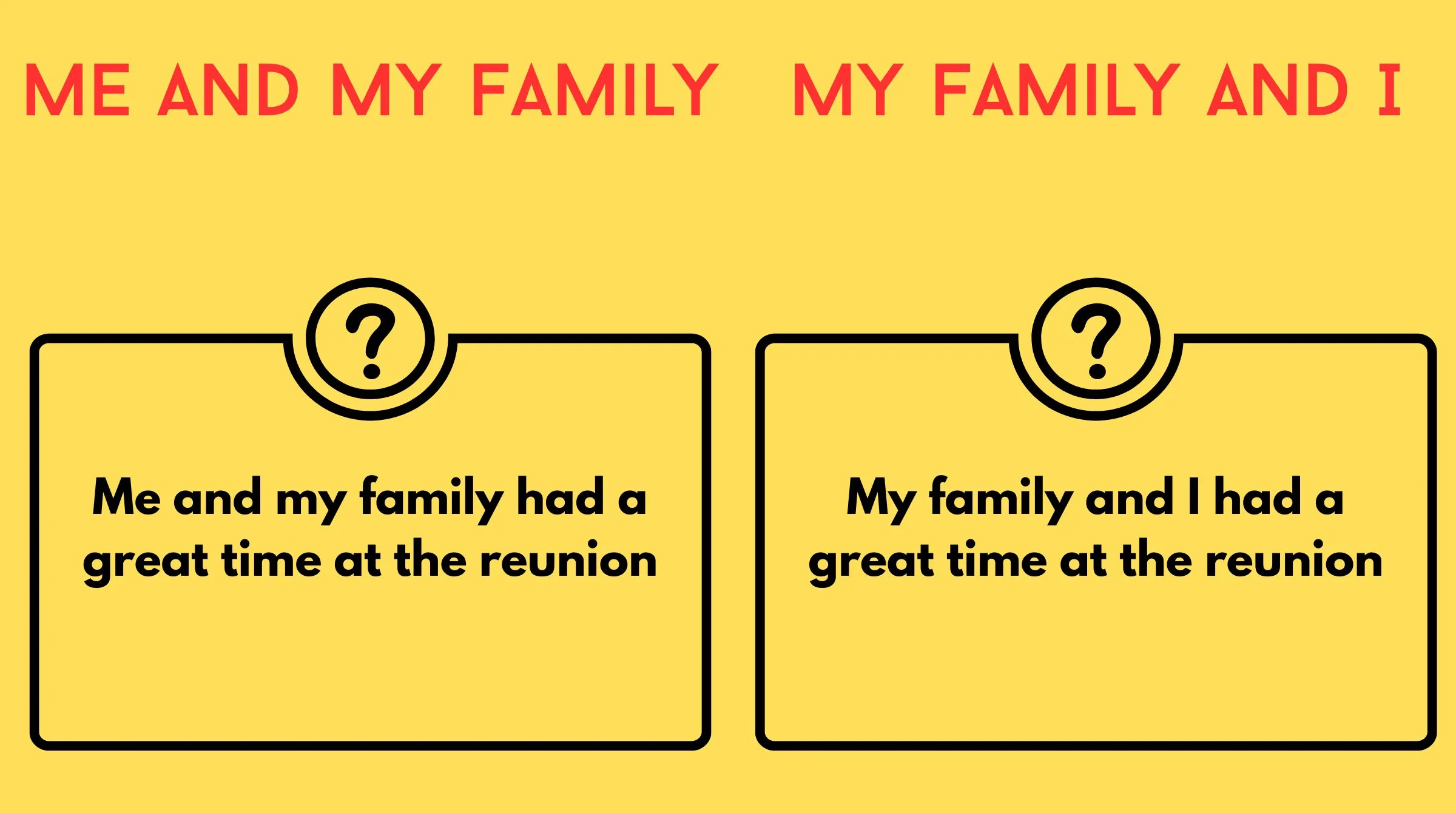
    • “Me and my family had a great time at the reunion.” (Casual, informal tone)
    • “My family and I had a great time at the reunion.” (More respectful, appropriate for formal settings)

    Why it matters: Using the proper order helps maintain the professionalism of your writing and ensures you’re being perceived as polite and respectful.


    Breaking Down Examples: “My Family and I” in Sentences

    Let’s break down a few sentences to clearly see how my family and I works in context. Understanding the structure will help you apply it confidently in your own speech and writing.

    Correct Usage for Subject Pronouns (when the action is performed by the speaker):

    • “My family and I went to the zoo last weekend.”
      (Here, I is the subject and is performing the action along with my family.)
    • “My family and I are excited for the upcoming vacation.”
      (Again, the subject of the sentence—my family and I—are the ones performing the action.)

    When to Use “My Family and Me”: A Focus on Object Pronouns

    Now that we’ve addressed the subject pronoun case, let’s talk about when to use my family and me. As mentioned earlier, this version of the phrase is used when the pronoun is an object, or the recipient of the action.

    Correct Usage for Object Pronouns (when the speaker is the recipient of the action):

    • “The teacher gave my family and me a tour of the campus.”
      (Here, my family and me are the objects of the action.)
    • “The host welcomed my family and me to the event.”
      (Again, my family and me are receiving the action.)

    The Influence of Context: Understanding the Correct Usage

    Sometimes, the context of a sentence plays a significant role in deciding whether to use I or me. Here’s a helpful rule:

    • If you’re the subject of the sentence (performing the action), use I.
    • If you’re the object of the action (receiving the action), use me.

    Example 1:

    • “My family and I will go to the concert.”
      (Subject: I is performing the action.)

    Example 2:

    • “The organizer invited my family and me to the concert.”
      (Object: me is receiving the action.)

    Common Mistakes to Avoid: Pronoun Misplacement in Speech and Writing

    A common mistake many people make is misplacing the pronoun order or choosing the wrong pronoun for the subject/object. Let’s explore a few scenarios and how to correct them:

    • Incorrect: “Me and my family are going to the movies.”
      Correct: “My family and I are going to the movies.”
    • Incorrect: “They gave my family and I tickets to the event.”
      Correct: “They gave my family and me tickets to the event.”

    To avoid these errors, pay attention to whether the pronoun is acting as the subject or the object.


    Identifying Incorrect Usage in Everyday Communication

    One of the easiest places to spot errors is in casual conversations, social media posts, and emails. These mistakes often go unnoticed, but they can affect how others perceive your language proficiency.

    Common Incorrect Examples:

    • “Me and my friends are meeting later.”
    • “The manager called my family and I to the office.”

    In both of these examples, the incorrect pronoun placement could easily be fixed by switching me and I based on whether it’s a subject or object.


    Correcting Misconceptions: Education vs. Convention

    Many people are taught to say my family and I in all contexts, regardless of whether the pronoun is the subject or object. While this can be useful for promoting formal speech, it’s important to teach the difference between subject and object pronouns to ensure proper grammar in every situation.

    Myth: “My family and I” is always correct.
    Reality: “My family and me” is correct when the pronoun is the object of the action.

    By addressing these misconceptions, we can help others understand and use language more effectively.


    Cultural Nuances and Their Impact on Language Structure

    Me and My Family vs My Family and I

    Pronoun usage is also influenced by cultural norms and regional language variations. For example, in some cultures, formality and politeness are highly emphasized, leading to a greater preference for my family and I.

    In other settings, particularly in casual conversations, people might be more likely to say me and my family, especially in more informal contexts. Recognizing these nuances can help you navigate social situations and communicate more effectively.


    FAQs

    When should I use “My family and I”?

    Use “My family and I” when you are the subject of the sentence, meaning you and your family are performing the action.

    When is it correct to say “My family and me”?

    Say “My family and me” when you are the object of the action, meaning you and your family are receiving the action.

    Why do we say “My family and I” instead of “Me and my family”?

    In formal English, it’s customary to place others (like your family) before yourself, especially in subject positions, for politeness and respect.

    Can I always use “My family and I” in every sentence?

    No, it’s not always correct. Use “My family and I” when the pronoun is the subject; use “My family and me” when the pronoun is the object of the action.

    Why does pronoun order matter?

    The order reflects politeness, and in formal writing, it’s more respectful to place others before yourself, making “My family and I” the preferred form.

    How can I avoid pronoun placement mistakes?

    Be mindful of whether the pronoun is the subject or object. If you’re performing the action, use “I.” If receiving the action, use “me.”


    Conclusion

    In conclusion, knowing when to use my family and I versus me and my family is not just about grammar—it’s about understanding the role of pronouns in your sentence.

    Whether you’re speaking formally or casually, using the correct form shows that you understand language rules and are mindful of politeness conventions.

    Next time you’re faced with this dilemma, remember:

    • Use my family and I when you are the subject of the sentence.
    • Use my family and me when you are the object.

    Feel free to share this guide or leave a comment if you’ve come across other tricky grammatical dilemmas!