Blog

  • World-Class vs World Class ✍️ Grammar Rules Made Simple

    World-Class vs World Class ✍️ Grammar Rules Made Simple

    Language has a way of tripping us up with the smallest details. One little hyphen can change the entire role of a word in a sentence. A perfect example is the confusion between “world-class” and “world class.”

    At first glance, they look almost identical, but writers, students, and professionals often wonder: When should I use “world-class” with a hyphen, and when should it be written as two words?

    This article clears up the confusion with grammar rules, real-life examples, and expert writing guidelines. By the end, you’ll not only know the difference but also feel confident applying it in everything from academic papers to resumes and marketing copy.


    Understanding “World-Class” vs “World Class”

    World-Class vs World Class

    The distinction comes down to grammar function and hyphenation rules.

    • World-class (with a hyphen): Functions as an adjective, modifying a noun. Example: She delivered a world-class performance.
    • World class (two words): Functions as a noun phrase, referring to a level of excellence itself. Example: His skills are world class.

    Here’s a quick comparison:

    FormGrammar FunctionExample SentenceNotes
    World-classAdjective (modifies a noun)She runs a world-class restaurant.Always hyphenated before the noun.
    World classNoun phraseHis talent is world class.No hyphen when standing alone.

    Key takeaway: The hyphen isn’t optional. It signals whether you’re using the phrase to describe (adjective) or to define (noun phrase).


    “World-Class” as an Adjective

    When “world-class” is used to describe something else, it acts as a compound adjective. In grammar, compound adjectives that come before a noun almost always need a hyphen.

    Correct examples:

    • A world-class university attracts students globally.
    • The chef prepared a world-class meal.
    • They hired a world-class team of engineers.

    Incorrect examples:

    • A world class university attracts students globally. (missing hyphen)
    • The chef prepared a world class meal. (ambiguous, looks sloppy)

    Style Guide Notes:

    • AP Stylebook: Requires the hyphen in “world-class” when used as an adjective.
    • Chicago Manual of Style: Also supports hyphenation for clarity in compound adjectives.
    • Oxford Style Guide: Recommends consistency, advising “world-class” before nouns.

    Why it matters: Without the hyphen, a reader may stumble or misinterpret the meaning. Hyphenation eliminates doubt and shows precision.


    “World Class” as a Noun Phrase

    Now let’s shift focus. When “world class” stands on its own, it’s not describing a noun but acting as one.

    Correct examples:

    • His stamina is world class.
    • The movie’s cinematography is simply world class.
    • In sports, few players can reach world class levels.

    Incorrect examples:

    • His stamina is world-class. (hyphen unnecessary, creates awkwardness)
    • The movie’s cinematography is world-class. (again, wrong since it follows the verb is)

    Edge case: Both can appear in the same sentence but in different roles.

    • She gave a world-class presentation, proving her skills are world class.

    Here, the first is an adjective (modifies “presentation”), and the second is a noun phrase (describes “skills”).


    Why “World-Class” Is Not a Verb

    Many people mistakenly treat “world-class” or “world class” like a verb, as in:

    • He world-classed the competition. ❌

    This is grammatically incorrect. Neither form can function as a verb. Instead, writers should use:

    • He achieved world-class status.
    • She rose to a world-class level.
    • The team reached world-class standards.

    It’s a descriptive phrase, never an action word.


    Grammar and Hyphenation Rules

    To understand “world-class,” it helps to look at broader compound adjective rules.

    • Hyphen before a noun:
      • She owns a well-known company.
      • They stayed in a five-star hotel.
      • He joined a world-class orchestra.
    • No hyphen after the noun:
      • The company is well known.
      • The hotel is five star.
      • His talent is world class.

    UK vs US English

    While both US and UK English agree on the hyphen, there are small style differences:

    RegionPreferred FormExample
    US English“world-class” as adjective; “world class” as nounHarvard is a world-class university.
    UK EnglishSame rule, but UK writing sometimes retains hyphen in more cases for clarityOxford produces world-class research, and its standards are world class.

    In practice, both regions agree: hyphen when it comes before a noun, no hyphen when it stands alone.


    Practical Writing Guidelines

    Here’s how to decide in real writing situations:

    • Use “world-class” with a hyphen when it directly modifies a noun:
      • A world-class athlete
      • A world-class strategy
    • Use “world class” (no hyphen) when it describes excellence after a verb:
      • Her skills are world class.
      • This event is world class.

    Editing Checklist

    • Am I using it as an adjective before a noun? → Hyphenate.
    • Am I describing excellence in general, after a verb? → No hyphen.
    • Am I writing for business, academic, or journalistic context? → Follow AP/Chicago rules for consistency.

    Common Contexts and Real-Life Examples

    Academic Writing

    • MIT is a world-class institution recognized globally.
    • Its research output is world class in scope and influence.

    Business and Marketing

    • Our software provides a world-class user experience.
    • Customer service here is truly world class.

    Everyday Conversations

    • That was a world-class dinner.
    • Her guitar skills are world class.

    Media and Headlines

    • BBC: “A world-class performance from Serena Williams”
    • NYT: “US healthcare still not world class”

    Quote to remember:

    “Clarity in writing is the same as clarity in thought. One cannot exist without the other.” — Richard North


    Case Study: Resume Writing

    Imagine you’re writing a professional resume. The wrong choice can make you look careless.

    Incorrect:

    • “Seeking opportunities to join a world class organization.”
      (Should be world-class organization)

    Correct:

    • “Seeking opportunities to join a world-class organization.”

    Or, when describing skills:

    • “Technical abilities are world class.”

    Small details like a hyphen show attention to grammar, which employers notice.


    Conclusion

    The debate over “world-class vs world class” is settled once you know the rules:

    • Use world-class with a hyphen as an adjective before a noun.
    • Use world class (two words) as a noun phrase after a verb.
    • Never use it as a verb.
    • Follow style guides for consistency, and keep regional preferences in mind.

    In short, the hyphen matters. It’s not decoration—it changes function, meaning, and professionalism. Writers who master these small details stand out as clear and credible.


    FAQs on World-Class vs World Class

    Is “world-class” always hyphenated?

    No. It’s only hyphenated when used before a noun, such as a world-class hotel.

    Can I use “world class” without a hyphen?

    Yes. When it stands alone or follows a verb, write it without a hyphen, e.g., Her skills are world class.

    What’s the difference between UK and US usage?

    Both follow the same rule, but UK English sometimes prefers the hyphen in slightly more cases for clarity.

    Is “world class” considered formal writing?

    Yes. Both “world-class” and “world class” are accepted in formal contexts, as long as you apply them correctly.

    Can “world class” stand alone in a sentence?

    Absolutely. Example: The performance was world class.

    Do style guides agree on using “world-class”?

    Yes. AP, Chicago, and Oxford all recommend the hyphen when it functions as an adjective before a noun.
  • 🕒 “To Early” vs “Too Early”: Which One Is Correct in English?

    🕒 “To Early” vs “Too Early”: Which One Is Correct in English?

    English can be tricky. Small words like “to” and “too” look alike, sound alike, and often confuse even fluent speakers.

    One of the most common slip-ups is writing “to early” instead of “too early.” At first glance, it may not seem like a big deal, but in grammar and communication, these little details matter a lot.

    So, is it to or too early? The short answer is: it’s almost always “too early.” But to understand why, let’s dig deeper into the meaning, usage, and rules behind these words.


    Why “To” vs. “Too” Causes Confusion

    To or Too Early

    Both words are pronounced the same, which naturally creates mix-ups in writing. Add to that the fact that texting, fast typing, and autocorrect errors creep into our daily lives, and suddenly you’ll see “to early” plastered all over social media posts, emails, and even advertisements.

    The confusion boils down to two things:

    • Homophones: Words that sound the same but differ in meaning or spelling.
    • Context dependency: The correct choice depends on the role of the word in a sentence.

    When you rely only on how words sound, “to early” feels fine. But when you look at grammar rules, the story changes.


    What “To” Really Means

    “To” is one of the most versatile words in English. Primarily, it acts as a preposition that shows:

    • Direction: I’m going to the park.
    • Recipient: She gave the book to him.
    • Purpose/Infinitive marker: I want to learn French.

    Notice something? In every example, “to” connects one element to another. It creates relationships, shows direction, or introduces an action.

    Now, let’s test it with “early”:

    ❌ I woke up to early.
    This doesn’t work, because “early” is an adjective/adverb, not something you can “go to” or “give to.”

    That’s why “to early” doesn’t fit standard grammar rules.


    The Power of “Too” as an Intensifier

    “Too” has an entirely different role. It acts as an adverb, often used as an intensifier. Its meanings include:

    • Excessively / more than enough: It’s too hot outside.
    • Also: I want to go too.

    When we pair “too” with “early,” it naturally conveys the idea of excessive earliness — earlier than expected, necessary, or appropriate.

    Examples:

    • We arrived too early for the concert, and the gates were still closed.
    • Calling someone at 5 a.m. is too early unless it’s an emergency.

    Here, “too” modifies “early” and makes logical sense.


    Breaking Down the Phrase “Too Early”

    At its core, “too early” means before the right time. But it shows up in both literal and figurative ways.

    Literal meaning

    • The shop was too early to open at 6 a.m.
    • It’s too early in the season for strawberries.

    Figurative meaning

    • It’s too early to judge the outcome of the project.
    • Some say it’s too early to fall in love, but feelings don’t follow a schedule.

    In both senses, “too early” expresses a mismatch between time and appropriateness.


    Why “To Early” Is Incorrect in Standard Grammar

    The phrase “to early” is considered a grammatical mistake. Here’s why:

    • “To” cannot directly modify an adjective or adverb.
    • “Early” doesn’t fit as the object of “to.”

    Think of it this way: you wouldn’t say “to tall” or “to hot” either. The same rule applies here.

    Common slip-ups include:

    • Social media captions (“It’s to early for this!”).
    • Quick texts (“Sorry I’m to early”).
    • Ads or headlines with rushed editing.

    These aren’t just minor typos — they change the grammatical integrity of your writing.


    Practical Examples: To vs. Too with “Early”

    To see the difference clearly, let’s put examples side by side:

    Incorrect (To Early)Correct (Too Early)
    We arrived to early for class.We arrived too early for class.
    It’s to early to tell who’ll win.It’s too early to tell who’ll win.
    She called me to early in the morning.She called me too early in the morning.

    The table shows how one extra “o” completely changes correctness.


    Tips for Remembering the Difference

    Learning grammar hacks can make “to” vs. “too” second nature. Try these:

    • Think of the extra “o.” “Too” means an extra amount. Extra “o” = extra meaning.
    • Ask: does it mean “also” or “excessively”? If yes, use “too.”
    • Test substitution. Replace “too” with “very.” If the sentence still makes sense, “too” is correct.
      • Example: It’s very early ✅ matches It’s too early.

    Advanced Cases: When “To” and “Too” Appear Near Each Other

    Here’s where it gets interesting. Sometimes, both words appear in the same sentence:

    • I went to bed too early.
    • He moved to the city too early in his career.

    Notice how “to” serves its role as a preposition, while “too” modifies “early.” This is perfectly correct, though visually it can trick the eye.


    Insights from Grammar Experts and Style Guides

    According to Merriam-Webster, “too” is defined as “to a degree exceeding what is desirable, fitting, or right.” This lines up directly with “too early.”

    The Cambridge English Dictionary explains “too” as “more than is allowed, necessary, possible, or acceptable.” Again, this fits.

    Style authorities like the Chicago Manual of Style also emphasize clarity: in professional writing, “too early” is correct, while “to early” should be avoided at all costs.


    Quick Reference Table: “To” vs. “Too” with Examples

    Here’s a handy cheat sheet:

    WordFunctionExampleWrong Use
    ToPreposition (direction, purpose, recipient)I went to the park.It’s to early.
    TooAdverb (excess, also)It’s too early to call.N/A

    Keep this table in mind, especially if you’re prone to typos.


    Common Mistakes and How to Avoid Them

    People often make the “to early” mistake due to:

    • Rushed writing: Texting or typing quickly.
    • Overreliance on sound: Since they’re homophones, people default to the wrong spelling.
    • Autocorrect mishaps: Phones sometimes “correct” incorrectly.

    How to avoid the slip-up:

    • Slow down when writing important texts or emails.
    • Proofread for common homophone errors.
    • Use grammar-check tools like Grammarly or Hemingway Editor.

    Summary and Final Thoughts

    The phrase “too early” is the correct and accepted form, while “to early” is simply incorrect. Remember:

    • “To” = direction, relation, purpose.
    • “Too” = excess or also.
    • “Too early” = earlier than necessary, right, or expected.

    Even though it’s a small difference, mastering it improves both your grammar and credibility in writing.


    🙋 FAQs

    What is the correct phrase: “to early” or “too early”?

    The correct phrase is “too early.” “To early” is always grammatically incorrect.

    Why is “too early” correct in English grammar?

    “Too” means excessively or more than necessary, which makes sense with “early.” That’s why “too early” works while “to early” doesn’t.

    Can “to” ever be used before “early”?

    No, “to early” isn’t valid in English. “To” doesn’t modify adjectives like “early.”

    How can I remember the difference between “to” and “too”?

    Think of the extra “o” in “too” as meaning “extra” or “excess.” That’s the quick memory trick.

    Are “to” and “too” homophones?

    Yes. They sound the same, which is why people often confuse them in writing.

    Is it “too early to tell” or “to early to tell”?

    The correct phrase is “too early to tell.” It means it’s premature to know the outcome.


    Conclusion

    So, is it to or too early? The answer is clear: it’s always “too early.” That single extra “o” makes all the difference between a mistake and proper English.

    Language thrives on clarity, and choosing the right word — even when it’s just two letters long — ensures your message comes across sharp, professional, and confident. Next time you’re tempted to write “to early,” stop and remember: extra “o,” extra correctness.

  • Quieter vs More Quiet 🤔 What’s the Difference & Which One’s Correct?

    Quieter vs More Quiet 🤔 What’s the Difference & Which One’s Correct?

    English grammar has a funny way of throwing curveballs when you least expect it. Words like “quieter” and “more quiet” look so similar yet often leave learners scratching their heads.

    Are both correct? Which one sounds natural? And when should you use one over the other?

    Here’s the good news: both forms are grammatically correct. But that doesn’t mean they’re used the same way.

    In this guide, we’ll break down every detail you need to know, from basic grammar rules to real-world usage, so you never hesitate when choosing between quieter and more quiet.

    Both quieter and more quiet are grammatically correct. The difference lies in preference—quieter is the natural choice in everyday English, while more quiet adds emphasis or formality.


    Understanding “Quiet” as an Adjective

    Quieter vs More Quiet

    Before we compare, let’s start with the root word: quiet.

    • Part of speech: Adjective
    • Meaning: Little or no noise; calm; peaceful.

    Examples:

    • The library is quiet.
    • He enjoys a quiet life in the countryside.

    Why does this matter? Because adjectives change form when we want to compare. And that’s exactly where quieter and more quiet come in.


    Quieter as the Standard Comparative Form

    For one-syllable adjectives like quiet, English typically forms comparatives by adding -er.

    • Tall → Taller
    • Small → Smaller
    • Quiet → Quieter

    Quieter follows the most natural pattern. That’s why you’ll hear native speakers use it more often than “more quiet.”

    Examples:

    • The garden is quieter than the street outside.
    • She spoke in a quieter voice to avoid waking the baby.

    A quick note: “quiet” technically has two syllables (qui-et), but it’s still treated like a one-syllable adjective because of its short sound. That’s why the -er form feels natural.

    👉 Rule of thumb: For everyday situations, “quieter” is the go-to choice.


    When “More Quiet” Is Grammatically Correct

    So if “quieter” is standard, does that make “more quiet” wrong? Not at all. It’s just less common and usually chosen for emphasis.

    Consider these examples:

    • We need a more quiet environment to concentrate.
    • This design creates a more quiet and peaceful space.

    In these cases, “more quiet” adds weight, almost as if saying “extra quiet.” Writers may also prefer it for rhythm or style, especially in poetry, speeches, or formal texts.

    Stylistic usage example from literature:

    “I long for a more quiet retreat, far from the city’s endless noise.”

    👉 Think of “more quiet” as a deliberate choice. It’s correct, but it feels slightly formal or emphatic compared to the easy flow of “quieter.”


    Quieter vs More Quiet in Real Usage

    Here’s where things get interesting. Both forms exist, but which one do people actually use?

    Studies of written and spoken English show that:

    • Quieter is far more common in everyday conversation.
    • More quiet appears in formal writing, literature, or when speakers want to emphasize calmness.

    Frequency Comparison

    FormCommon ContextsFrequency in UseExample Sentence
    QuieterCasual speech, everyday writingVery commonThis café is quieter than Starbucks.
    More QuietFormal tone, emphasis, stylistic writingLess commonThe monastery offers a more quiet retreat.

    👉 Tip: If in doubt, choose “quieter.” It’s natural and widely accepted. Use “more quiet” sparingly, when you want a stronger emphasis.


    Quietest or The Most Quiet – Which Should You Use?

    Comparatives aren’t the end of the story. When we want to describe the highest degree of quiet, we move to the superlative form.

    • Quieter → Quietest
    • More quiet → Most quiet

    Which one is correct?

    Both. But just like with comparatives, the -est form is more natural.

    Examples:

    • This is the quietest place in town.
    • She is the quietest student in the class.

    “The most quiet” isn’t wrong, but it tends to sound heavy and is usually chosen for stylistic effect.

    Example:

    • That was the most quiet evening we ever spent together.

    👉 Rule: Use “quietest” in everyday English. Use “the most quiet” only when you want an elevated or literary tone.


    Quieter vs Less Noisy

    Sometimes, instead of saying “quieter,” people say “less noisy.” Are these two the same? Not exactly.

    • Quieter: Puts focus on peace and calm.
    • Less noisy: Focuses on the absence of noise.

    Usage Examples

    • The library is quieter than the park. (positive emphasis on calmness)
    • The park is less noisy than the market. (negative emphasis on reduced noise)

    Think of them as two sides of the same coin. One stresses presence of calm, the other stresses reduction of disturbance.

    👉 Both are correct, but “quieter” sounds smoother and more natural in most cases.


    “As Quiet As” for Equal Comparisons

    Another way to compare is with the as…as structure. Instead of saying one thing is quieter, we might say two things are equally quiet.

    Examples:

    • The forest is as quiet as the grave.
    • The child was as quiet as a mouse during the movie.

    Common Idioms with “As Quiet As”

    • As quiet as a mouse → extremely quiet
    • As quiet as the grave → silent, often eerie
    • As quiet as a whisper → very soft and hushed

    👉 Use this form when you want to highlight balance or equality, not difference.


    Common Mistakes and Misunderstandings

    Learners often trip over these forms. Let’s clear up some frequent errors.

    • ❌ He is more quieter than his brother.
      ✅ He is quieter than his brother.
      (Never mix “more” with the -er ending.)
    • ❌ This is the most quietest room in the house.
      ✅ This is the quietest room in the house.
      (Don’t double up on superlatives.)
    • ❌ She is quite than him.
      ✅ She is quieter than him.
      (Confusing “quite” with “quiet.”)

    👉 Always remember: choose either the -er/-est ending or the “more/most” form, not both.


    Practical Tips for Choosing the Right Form

    Here’s a quick guide you can keep in mind:

    Quick Rules

    • Use quieter in normal conversation.
    • Use more quiet for emphasis or formal writing.
    • Use quietest for superlatives.
    • Use less noisy when highlighting reduction of noise.
    • Use as quiet as for equal comparisons.

    Handy Chart

    SituationBest ChoiceExample Sentence
    Everyday talkQuieterThe house is quieter at night.
    Emphasis/formalityMore quietWe want a more quiet location for the meeting.
    Highest degreeQuietestThis is the quietest classroom in school.
    Noise reductionLess noisyThis engine is less noisy than the older model.
    Equal comparisonAs quiet asThe forest is as quiet as a church.

    👉 If you stick to this chart, you’ll never misuse these forms again.


    🙋‍♂️ FAQs

    What is the difference between quieter and more quiet?

    Both are correct, but “quieter” is the standard form, while “more quiet” is used for emphasis or formal style.

    Is it correct to say more quieter?

    No. You can’t combine “more” with “-er.” Use either “quieter” or “more quiet,” but not both together.

    Which is better: quietest or most quiet?

    “Quietest” is the natural superlative form. “Most quiet” is grammatically fine but sounds formal or poetic.

    Can I use less noisy instead of quieter?

    Yes, but the nuance changes. “Quieter” emphasizes calmness, while “less noisy” highlights reduced disturbance.

    When should I use as quiet as?

    Use “as quiet as” for equal comparisons, like The library is as quiet as a church.

    Why does quieter sound more natural than more quiet?

    Because English usually forms comparatives with -er for short adjectives, making “quieter” the default choice.


    Conclusion

    So, quieter vs more quiet—which should you use?

    Both are correct, but quieter is by far the preferred choice in everyday English. It’s simple, natural, and widely understood. “More quiet” isn’t wrong, but it carries a formal, emphatic, or stylistic edge. The same rule applies to the superlative forms: quietest is standard, while “the most quiet” feels formal or literary.

    Here’s the bottom line:

    • In most cases, say quieter.
    • Save more quiet for emphasis or style.
    • Don’t mix the two forms in the same phrase.

    By mastering these nuances, you’ll sound more natural and confident every time you describe silence, peace, or calm.

  • Screen vs Monitor vs Display 🖥️: Understanding the Key Differences

    Screen vs Monitor vs Display 🖥️: Understanding the Key Differences

    In today’s digital age, the terms screen, monitor, and display are often used interchangeably, but they each have distinct meanings and functions.

    Whether you’re looking to upgrade your workspace, purchase a new TV, or build a gaming setup, understanding the subtle differences between these terms will help you make an informed decision.

    Let’s dive into the specifics and clear up the confusion once and for all.


    Introduction to the Terminology of Visual Technology

    Screen vs Monitor vs Display

    Technology has evolved rapidly in recent decades, and so has the terminology used to describe the devices that display our digital world.

    We often hear about screens, monitors, and displays, but what exactly are these devices, and how are they different from each other?

    In this article, we’ll explore each term in-depth and unravel their meanings, uses, and the subtle differences that set them apart.

    Confused by the terms screen, monitor, and display? Our guide breaks down the differences and helps you understand the unique functions and technologies behind each, from gaming to everyday use. Find out which is best for your needs!


    Unveiling the Concept of a Screen

    The word screen is perhaps the broadest term in the visual technology world. It refers to any surface or device that displays information, images, or videos. Essentially, a screen is a surface where content is projected, whether it’s on your smartphone, laptop, TV, or digital signage.

    What Defines a Screen in Electronics?

    • Definition: A screen is a surface that displays visuals produced by a device such as a TV, phone, or computer.
    • Functionality: The screen can show anything from static images to dynamic video content, and it can be interactive, like touchscreens.
    • Materials and Technology: Screens often use various technologies like LCD (Liquid Crystal Display), OLED (Organic Light Emitting Diode), or LED (Light Emitting Diode) to create images.

    Screens are not limited to computers and monitors; they can be found in smartphones, tablets, and even billboards.


    The Historical Evolution of the Screen

    The screen, in its modern form, has evolved over the past century. Let’s take a quick journey through its history:

    • Early Beginnings: The first screens were cathode ray tubes (CRT) in the 1930s, used for televisions and radar displays.
    • Mid-20th Century: With the advent of television, screens became household items.
    • Modern Revolution: LCD and LED technology took over in the 1990s and early 2000s, leading to thinner, brighter, and more energy-efficient screens.

    Each technological leap brought about better image quality, increased portability, and greater clarity in the visuals we see on our screens.


    Screen Applications Beyond Computing Devices

    While screens are integral to computing devices, their applications extend far beyond that:

    • Television: The screen is the heart of the TV, delivering everything from news to entertainment.
    • Smartphones and Tablets: Portable screens allow us to stay connected and entertained on the go.
    • Digital Billboards: Large outdoor screens are used for advertising and public information.
    • Medical Displays: High-resolution screens are essential for diagnostic imaging and monitoring in healthcare.

    In essence, screens have permeated every facet of our lives, from entertainment to work and beyond.


    Monitor: The Gateway to Digital Content

    Now, let’s narrow our focus. The term monitor is often used specifically in the context of computing and digital media consumption. But what exactly makes a monitor different from a screen?

    What Sets a Monitor Apart?

    A monitor is a specific type of screen designed primarily for use with computers and other digital devices. Monitors have higher functionality than basic screens because they are engineered to display content from a computer or video source.

    • Use Case: Monitors are designed for use with desktop computers, laptops, gaming consoles, and other devices that require detailed image rendering.
    • Resolution and Refresh Rate: Monitors typically offer high resolutions (1080p, 4K) and high refresh rates (60Hz, 144Hz, or 240Hz for gaming monitors).

    In short, a monitor is a specialized screen for more complex visual tasks.


    Deep Dive into Display Technology

    The term display refers to the actual technology that makes the images on a screen or monitor visible to the viewer. Display technology has evolved significantly over the years and plays a major role in the quality of the visuals we experience.

    Key Display Technologies

    • LCD (Liquid Crystal Display): A common technology used in both monitors and TVs. LCDs are energy-efficient and offer good picture quality at affordable prices.
    • LED (Light Emitting Diode): A variant of LCD technology where LEDs provide the backlight. LEDs offer brighter and more vibrant images.
    • OLED (Organic Light Emitting Diode): Offers superior image quality with deeper blacks and more vivid colors, ideal for high-end TVs and smartphones.
    • QLED (Quantum Dot LED): A newer technology that improves upon LED by adding quantum dots for even more precise color reproduction.

    Differentiating Displays: CRT, LCD, and LED

    Now that we’ve explored the basics, let’s delve deeper into the different types of displays that have been used in screens and monitors.

    CRT (Cathode Ray Tube)

    • Used in: Older televisions and monitors.
    • Technology: Relies on electron beams to light phosphor dots, creating an image on a glass tube.
    • Pros: Large size, lower cost in the past.
    • Cons: Bulky, heavy, and energy-inefficient.

    LCD (Liquid Crystal Display)

    • Used in: Most modern monitors and TVs.
    • Technology: Uses liquid crystals that align when an electric current passes through, allowing light to pass and form an image.
    • Pros: Slim profile, energy-efficient, and cost-effective.
    • Cons: Limited viewing angles and slower response time compared to OLED.

    LED (Light Emitting Diode)

    • Used in: Modern LED-backlit monitors and TVs.
    • Technology: Uses LEDs as a backlight for the liquid crystal display.
    • Pros: Bright, vibrant images with lower power consumption.
    • Cons: Can be expensive compared to traditional LCDs.

    Understanding Image Rendering on Displays

    When it comes to screens and monitors, the way images are rendered is crucial for image clarity, response time, and overall quality. Here are some factors involved in image rendering:

    • Resolution: The number of pixels displayed on the screen, typically measured in width x height (e.g., 1920×1080).
    • Refresh Rate: How often a screen updates per second, measured in Hz. Higher refresh rates (e.g., 144Hz) are crucial for gaming monitors.
    • Color Accuracy: Displays with higher color accuracy provide more realistic and vibrant images.

    The Integrated World of Monitors and Computing

    Monitors are an integral part of the computing experience. Without them, computers would be nearly useless, as they display all the output from the computer’s internal systems.

    How Monitors Enhance Computing:

    • Productivity: A high-quality monitor improves productivity, especially in fields like graphic design, video editing, and coding.
    • Gaming: Monitors are a crucial component for gamers, as they influence everything from visual immersion to frame rates.

    Monitor Components and Their Functions

    Monitors are complex devices with several key components that work together to deliver visual output. Here’s a breakdown of these components:

    ComponentFunction
    PanelThe screen itself, where images are displayed.
    BacklightProvides illumination for the screen (in LCD, LED, or OLED displays).
    Input PortsPorts like HDMI, VGA, or DisplayPort for connecting to computers.
    Graphics CardThe device that processes and sends image data to the monitor.

    Each of these components plays a vital role in the monitor’s overall performance and image quality.


    The Intricacies of Display Resolution and Quality

    Display resolution and quality are some of the most important considerations when choosing between monitors or screens. Higher resolutions deliver sharper, more detailed images. Here are the most common display resolutions:

    • HD (720p): Standard resolution for basic screens and older TVs.
    • Full HD (1080p): The most common resolution for modern monitors and TVs.
    • 4K (2160p): Ultra-high definition, offering crisp details for gaming and professional work.
    • 8K (4320p): Cutting-edge technology, though it is still rare and expensive.

    When selecting a monitor or screen, it’s essential to balance resolution with other factors like refresh rate and color accuracy to get the best overall image quality.


    Connectivity: How Devices Talk to Monitors and Displays

    Monitors and displays rely on a variety of connections to receive data from devices like computers, gaming consoles, and media players. These connections are crucial for ensuring a smooth experience.

    • HDMI: The most common video and audio connection for modern monitors and TVs.
    • DisplayPort: Common for high-end monitors, especially those used for gaming and professional work.
    • VGA: An older standard, still found on some legacy monitors and devices.

    Choosing the Right Visual Device for Your Needs

    When deciding between a screen, monitor, or display, you must consider what you’re using it for.

    • For Gaming: A high-resolution monitor with a fast refresh rate (144Hz or higher) and low response time is crucial.
    • For Office Work: A monitor with good color accuracy and resolution is ideal.
    • For Entertainment: A large screen with high-quality display technology, like OLED or QLED, is best for watching movies and TV shows.

    FAQs

    What’s the difference between a screen and a monitor?

    A screen is any surface that displays images, including phones and TVs, while a monitor is a specific type of screen designed for use with computers, offering higher resolution and refresh rates.

    Is a monitor always a display?

    Yes, a monitor is a type of display, but not all displays are monitors. A display refers to the technology behind the image, such as LCD, OLED, or LED, used in various devices.

    Can a TV be considered a monitor?

    Technically, yes. A TV is a display device that functions like a monitor but is typically optimized for media consumption rather than computing tasks.

    What are the key differences in display technologies?

    LCD, LED, and OLED are different display technologies, each offering varying levels of brightness, contrast, energy efficiency, and color accuracy, with OLED providing the highest quality visuals.

    Which resolution is best for gaming?

    For gaming, a monitor with at least 1080p (Full HD) resolution is recommended, though 4K and 144Hz refresh rate options provide even better clarity and performance.

    How do I choose between a screen, monitor, or display for my needs?

    For gaming, opt for a high-resolution monitor with fast refresh rates. For office work, choose a monitor with good color accuracy. For entertainment, consider a display with OLED or QLED technology for vivid images.


    Conclusion

    Though often used interchangeably, screen, monitor, and display have distinct roles in the world of visual technology.

    Whether you’re looking for a high-end monitor for gaming or a basic screen for daily use, understanding the difference between these terms ensures that you make the right choice for your needs.

    Always consider factors like resolution, refresh rate, and display technology to get the best viewing experience for your specific requirements.

  • Anyone Has or Anyone Have? 📝 Unraveling the Grammar Mystery

    Anyone Has or Anyone Have? 📝 Unraveling the Grammar Mystery

    In English, small grammatical nuances can cause big confusion, especially when dealing with phrases like “anyone has” and “anyone have.”

    Whether you’re writing a formal essay or having a casual conversation, knowing when to use the correct phrase is essential for clear and accurate communication.

    This comprehensive guide will break down the rules, exceptions, and contexts where each phrase is used. By the end, you’ll feel confident navigating this tricky aspect of English grammar.


    Understanding the Basics: ‘Anyone Has’ vs. ‘Anyone Have’

    Anyone Has or Anyone Have

    To understand the difference between “anyone has” and “anyone have,” let’s start with the basics:

    • ‘Anyone’: This is an indefinite pronoun, referring to any one person out of a group. It is singular in grammatical structure.
      Example: “Anyone is welcome to join the meeting.”
    • ‘Has’: This is the third-person singular form of the verb to have.
      Example: “She has a question.”
    • ‘Have’: This is the base form of the verb to have. It is used with plural subjects or in specific constructions like questions and conditional clauses.
      Example: “They have a lot of ideas.”

    Quick Summary: “Anyone has” is used in declarative sentences, while “anyone have” appears in questions or conditional statements.

    Is it “Anyone has” or “Anyone have”? In this detailed guide, we’ll explore the rules of subject-verb agreement and show you when to use each form, from questions to declarative statements. Learn the grammar nuances for clear, confident communication!


    Grammatical Rules: When to Use ‘Anyone Has’

    Declarative Sentences

    In most declarative sentences, “anyone has” is the grammatically correct choice because anyone is a singular pronoun.

    Examples:

    • “If anyone has a question, please raise your hand.”
    • “Does anyone here know if anyone has a copy of the report?”

    Situational Contexts

    Use “anyone has” when you are stating a fact or making a statement where anyone serves as the subject.

    Tip: Remember, has follows singular pronouns like he, she, it, and anyone.


    Conditional Clauses and Statements

    Conditional sentences often create confusion with “anyone have” because the structure changes slightly.

    Example of Correct Usage:

    • “If anyone has any ideas, they should share them now.” (Declarative conditional statement)

    However, in a question or an inverted structure, “anyone have” may appear.

    Example in a Question:

    • “Does anyone have a pen I can borrow?” (Here, the auxiliary verb does takes precedence, so have is correct.)

    Formal Sentences and Correct Structures

    In formal writing or speech, understanding subject-verb agreement is critical. “Anyone has” remains the correct choice in most structured, declarative sentences.

    Examples in Formal Contexts:

    • “If anyone has the qualifications for this role, please submit your application.”
    • “It is important to verify whether anyone has completed the required training.”

    Common Mistakes and Exceptions

    Many people mistakenly use “anyone have” in declarative sentences, influenced by informal speech patterns or misunderstanding subject-verb agreement.

    Common Mistake:

    • “Anyone have questions before we start?” (Incorrect: Should be “Does anyone have questions?”)

    Why the Mistake Happens:

    • The influence of conversational shortcuts.
    • Overlooking the role of auxiliary verbs in questions or negative statements.

    Key Rule to Remember: Always check if an auxiliary verb (e.g., does) is present to determine the correct form of the verb.


    Exploring the Use of ‘Anyone Have’

    Although “anyone has” dominates declarative sentences, “anyone have” has its place in questions, conditional statements, and subjunctive constructions.

    Questions

    When forming questions, the auxiliary verb does changes the verb have back to its base form.

    Examples:

    • “Does anyone have a suggestion for the next meeting?”
    • “Does anyone have the time?”

    Subjunctive Mood

    The subjunctive mood occasionally calls for “anyone have.”

    Example:

    • “If anyone have objections, let them speak now.” (Rarely used in modern English, but grammatically correct in older or formal contexts.)

    Incremental Nuances in English Grammar

    English grammar is filled with subtle nuances, and mastering them takes practice. The distinction between “anyone has” and “anyone have” highlights how verb forms change based on sentence structure, mood, and context.

    Fun Fact: The subjunctive mood was more commonly used in older forms of English but has been largely replaced by indicative forms in modern usage.


    The Role of Indefinite Pronouns

    Why Is ‘Anyone’ Singular?

    Indefinite pronouns like anyone, someone, and everyone refer to singular subjects, even though they imply a group.

    Examples:

    • “Everyone has their own opinion.” (Singular subject)
    • “Does anyone have a different perspective?” (Still singular, despite the plural idea.)

    Common Indefinite Pronouns

    Here’s a quick list of singular indefinite pronouns to watch out for:

    • Anyone
    • Someone
    • Everyone
    • Nobody
    • Each

    Tip: Always pair these pronouns with singular verbs unless auxiliary verbs change the structure.


    Subject-Verb Agreement with ‘Anyone’

    The heart of this issue lies in subject-verb agreement. Since anyone is singular, it requires singular verbs like has in statements. However, in questions or negative sentences, the auxiliary verb dictates the verb form.

    Examples for Clarity:

    • Statement: “Anyone has the right to speak.”
    • Question: “Does anyone have the right to speak?”
    • Negative: “No one has the right to speak.”

    Understanding Singular Versus Plural Contexts

    Sometimes, the confusion arises because anyone implies a group, but it remains grammatically singular.

    Singular Contexts:

    • “If anyone has a key, we can open the door.”

    Plural Contexts (Implied):

    • “Does anyone have their keys?” (Here, the use of their accommodates gender-neutral language while keeping anyone singular.)

    Practical Examples in Everyday Language

    Here’s how these phrases appear in daily life:

    ContextCorrect Usage
    Asking for help“Does anyone have a spare charger?”
    Giving instructions“If anyone has questions, ask now.”
    Checking availability“Anyone has a moment to discuss this?”
    Error-prone usage“Anyone have questions?” (Incorrect)

    Clarifying Common Confusions with Pronunciation Tips

    Interestingly, the confusion between “has” and “have” can sometimes stem from regional accents or pronunciation habits. To avoid errors:

    1. Slow down your speech to pronounce each word clearly.
    2. Practice using both phrases in different contexts to reinforce the rules.

    Additional Insights: ‘Anybody Have’ vs. ‘Anybody Has’

    Like “anyone,” the indefinite pronoun “anybody” follows the same grammatical rules.

    Correct Usage:

    • “Anybody has the right to attend.” (Statement)
    • “Does anybody have the right to attend?” (Question)

    Key Takeaway: Treat anybody and anyone as interchangeable when it comes to subject-verb agreement.


    FAQs

    When do I use “Anyone has”?

    “Anyone has” is used in declarative sentences where “anyone” is the singular subject, such as “If anyone has a question, please ask.”

    When should I use “Anyone have”?

    Use “Anyone have” in questions and conditional statements where the auxiliary verb “does” or “should” is present, e.g., “Does anyone have a pen?”

    Is it correct to say “Anyone have a question”?

    No, the correct form is “Does anyone have a question?” because it follows the subject-verb agreement rule in questions.

    Why does “Anyone” take a singular verb like “has”?

    “Anyone” is a singular indefinite pronoun, so it requires a singular verb like “has,” despite implying a group.

    What’s the difference between “Anyone” and “Anybody”?

    Both “anyone” and “anybody” follow the same grammatical rules. For example, “Anyone has a right to speak” and “Anybody has a right to speak” are both correct.

    Why do people confuse “Anyone has” and “Anyone have”?

    The confusion often arises from informal speech patterns or mistakes in subject-verb agreement, especially in casual settings.


    Conclusion

    Grasping the difference between “anyone has” and “anyone have” is all about understanding grammar rules, sentence structure, and context. Remember:

    • Use “anyone has” in declarative sentences.
    • Use “anyone have” in questions or conditional statements when paired with auxiliary verbs.

    By practicing these rules and reviewing examples, you’ll avoid common mistakes and communicate with confidence. Have more grammar questions? Dive into the nuances of English with us to strengthen your skills!

  • Master’s Student vs Masters Student vs MS Student 🎓: Which Is Correct?

    Master’s Student vs Masters Student vs MS Student 🎓: Which Is Correct?

    Language, especially in academic contexts, can be tricky.

    The terms Master’s Student, Masters Student, and MS Student are often used interchangeably, but are they all correct? What do they mean, and when should you use each?

    This guide will decode the grammar, usage, and nuances behind these terms, helping you navigate academic titles with precision.


    Decoding the Grammar: The Significance of the Apostrophe in ‘Master’s Degree’

    Master’s Student vs Masters Student vs MS Student

    The apostrophe in Master’s Degree is more than a punctuation mark—it denotes possession. The degree belongs to the field of study or mastery, which is why the possessive form is grammatically correct.

    • Correct: Master’s Degree (possessive form)
    • Incorrect: Masters Degree (missing the apostrophe)

    The omission of the apostrophe is a common mistake, but one that changes the grammatical meaning. Without the apostrophe, Masters Degree implies a plural rather than ownership or mastery of a subject.

    Is it “Master’s Student,” “Masters Student,” or “MS Student”? The correct term depends on grammar, possession, and context. This guide explains the differences, highlights common mistakes, and provides clear examples to ensure you use academic titles correctly. Read on to master the nuances!


    Navigating Academic Titles: Understanding ‘Master’s Student’ vs. ‘MS Student’

    Master’s Student refers to an individual pursuing a Master’s Degree. On the other hand, MS Student is an abbreviation that specifically refers to someone enrolled in a Master of Science program.

    Key Differences:

    TermMeaningUsage Example
    Master’s StudentGeneral term for anyone pursuing a Master’s Degree“She’s a Master’s Student in Education.”
    MS StudentSpecific to Master of Science programs“He’s an MS Student in Computer Science.”

    While Master’s Student is broad, MS Student applies exclusively to technical or scientific fields.


    The Definition of a ‘Master’s Student’

    A Master’s Student is someone currently enrolled in a postgraduate program to earn a Master’s Degree. This term applies to various disciplines, from arts and humanities to business and engineering.

    Key Characteristics of a Master’s Student:

    • Has already earned a Bachelor’s Degree.
    • Enrolled in a postgraduate program.
    • Works toward specialized knowledge in a specific field.

    Exploring the Term ‘MS Student’ and Its Usage

    The abbreviation MS stands for Master of Science, and an MS Student is specifically pursuing a Master of Science degree. This abbreviation is widely used in technical and scientific fields like:

    • Computer Science
    • Biology
    • Engineering

    Usage Example:
    “He’s an MS Student researching artificial intelligence.”

    It’s worth noting that in informal settings, MS Student may be used interchangeably with Master’s Student, but in formal writing, the distinction should be preserved.


    Common Misconceptions and Errors in Referring to Graduate Students

    Common Mistakes:

    1. Using Masters Student without the apostrophe.
    2. Referring to a general Master’s Student as an MS Student.
    3. Inconsistently capitalizing academic titles.

    Correct Examples:

    • She’s a Master’s Student in Business Administration.
    • The MS Student is focusing on renewable energy systems.

    Avoid These Errors:

    • Don’t write masters degree or masters student without the apostrophe.
    • Don’t confuse MS programs with MA (Master of Arts) or MBA (Master of Business Administration) programs.

    Capitalization and Formality: When to Use ‘Master of Science’ or ‘Master’s’

    Capitalization in academic titles often depends on formality:

    • Formal Usage: Use the full term Master of Science or Master’s Degree.
      Example: “She earned her Master of Science in Biology.”
    • Informal Usage: It’s acceptable to use MS or Master’s.
      Example: “He’s working toward his Master’s in Engineering.”

    When writing formal documents, stick to the full title, as it conveys professionalism.


    Master’s Student vs Masters Student vs MS Student

    Possession and Precision: The Case for ‘Master’s Degree’ Over ‘Masters Degree’

    The possessive form, Master’s Degree, is the universally accepted term. Why? Because the degree signifies mastery in a specific field. Without the apostrophe, the term becomes ambiguous.

    Examples:

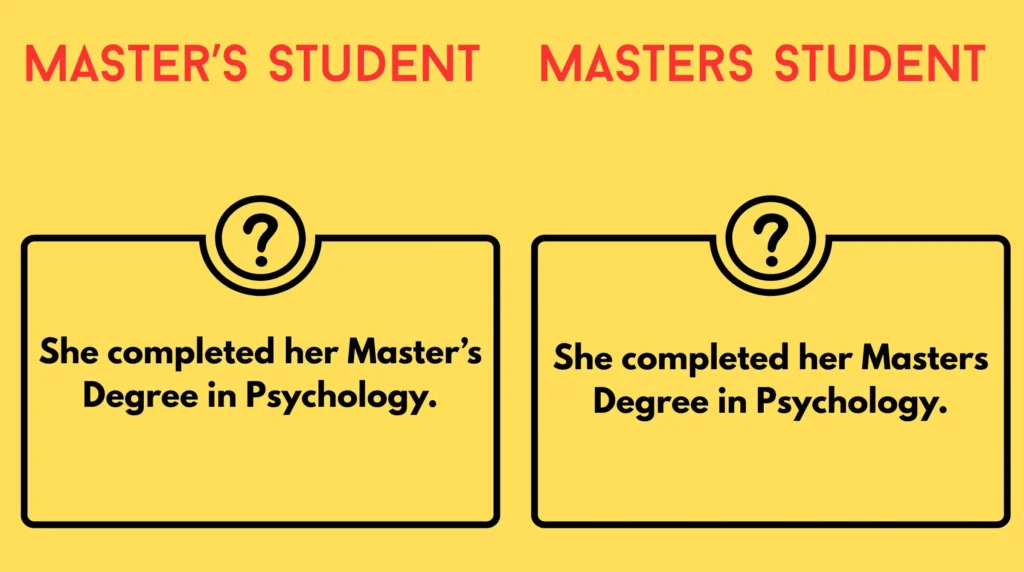
    • Correct: “She completed her Master’s Degree in Psychology.”
    • Incorrect: “She completed her Masters Degree in Psychology.”

    The Rule of Possessive Form in Academic Degrees

    The possessive apostrophe applies to all postgraduate degrees:

    • Master’s Degree
    • Bachelor’s Degree
    • Doctor’s Degree (though this is less common, with Doctorate often used instead)

    Quick Rule: Always include the apostrophe when referencing academic degrees in their possessive form.


    Contextual Application: Using ‘Master’s’ and ‘MS’ in Sentences Correctly

    Here’s how to use these terms accurately in sentences:

    • Master’s Student: “The Master’s Student presented her thesis on climate change.”
    • MS Student: “The MS Student received funding for his robotics project.”
    • Master’s Degree: “He earned a Master’s Degree in Fine Arts.”
    • Master of Science: “Her Master of Science degree is in Astrophysics.”

    Mastering the Academic Lexicon: A Guide to Grammar and Abbreviations for Students

    When discussing academic degrees, precision is key. Here’s a quick guide to common abbreviations:

    Degree NameAbbreviationField Examples
    Master of ScienceMSBiology, Physics, Computer Science
    Master of ArtsMALiterature, History, Philosophy
    Master of Business AdminMBABusiness, Management

    Tip: Use abbreviations only when context makes them clear.


    Distinguishing Between ‘Master’s Candidate’ and ‘Master’s Student’

    While the terms Master’s Candidate and Master’s Student are often used interchangeably, there is a subtle difference:

    • Master’s Student: Enrolled in the program, typically in the coursework stage.
    • Master’s Candidate: Has completed most coursework and is focused on final requirements like a thesis or capstone project.

    Example:

    • “As a Master’s Candidate, she’s completing her thesis on renewable energy.”

    The Correct Abbreviations for Various Master’s Degrees

    Abbreviations vary based on degree type. Here are some commonly used ones:

    Degree Full NameAbbreviation
    Master of ScienceMS
    Master of ArtsMA
    Master of Fine ArtsMFA
    Master of Business AdminMBA
    Master of Public HealthMPH

    Note: Always capitalize abbreviations when used as a title.


    Closing the Book: Ensuring Clarity in Higher Education Terminology

    Academic terminology can be complex, but understanding the nuances of terms like Master’s Student, Masters Student, and MS Student can eliminate confusion. Whether you’re writing formally or casually, prioritize grammatical accuracy and context-appropriate usage.


    FAQs

    What is the correct term: Master’s Student or Masters Student?

    The correct term is “Master’s Student” because the apostrophe denotes possession, showing that the degree belongs to the field of mastery.

    When should I use “MS Student” instead of “Master’s Student”?

    Use “MS Student” when referring specifically to a student pursuing a Master of Science degree. “Master’s Student” is a more general term for anyone pursuing a Master’s Degree.

    Why is the apostrophe important in “Master’s Degree”?

    The apostrophe in “Master’s Degree” signifies possession, indicating the degree is related to the field of mastery. Omitting it (“Masters Degree”) is grammatically incorrect.

    Can I use “Master of Science” and “MS” interchangeably?

    Yes, but context matters. Use “Master of Science” in formal writing and “MS” in informal or space-limited contexts like resumes or notes.

    What’s the difference between a Master’s Student and a Master’s Candidate?

    A Master’s Student is enrolled in the program, while a Master’s Candidate has completed most coursework and is focused on final requirements like a thesis or project.

    How should academic titles be capitalized in formal writing?

    Always capitalize academic degree titles when used formally, such as “Master of Science” or “Master’s Degree.” Abbreviations like “MS” should also be capitalized.


    Conclusion

    Understanding the difference between Master’s Student, Masters Student, and MS Student is essential for clear communication in academic and professional contexts.

    Remember to use the possessive form (Master’s) when referring to degrees and titles, and reserve abbreviations like MS for specific fields of study. With these guidelines, you’ll master the language of academia effortlessly!

  • Pre vs Post ⏳: What’s the Real Difference in Prefixes?

    Pre vs Post ⏳: What’s the Real Difference in Prefixes?

    Prefixes are an essential part of the English language, helping us modify and extend the meanings of root words. Among the most common prefixes are pre- and post-, which relate to time and order.

    But how do they work, and what’s the difference between them?

    This comprehensive guide dives into the origins, meanings, and correct usage of pre- and post- to help you sharpen your language skills.


    Exploring the Roles of Prefixes in the English Language

    Prefixes are powerful linguistic tools that attach to the beginning of root words, altering their meanings in specific ways. They can:

    • Indicate time (e.g., prehistory = before history).
    • Show quantity (e.g., multitask = many tasks).
    • Change a word’s direction or state (e.g., undo = reverse an action).

    By learning how prefixes work, you can decode unfamiliar words, improve your vocabulary, and communicate more effectively.

    Are you confused about when to use “pre” and “post”? These prefixes indicate “before” and “after,” but understanding their nuances can make your communication clearer. Discover the key differences, examples, and tips to master these time-related prefixes. Read more to sharpen your language skills!


    Defining What Prefixes Are

    A prefix is a group of letters added to the beginning of a base or root word to create a new meaning. For example:

    • Un- in undo means “reverse or negate.”
    • Re- in rewrite means “again.”

    Prefixes don’t stand alone—they always modify another word. They’re a crucial part of English morphology, shaping how we understand and use language.


    The Significance of ‘Pre’ and ‘Post’ in Word Formation

    The prefixes pre- and post- are particularly important because they help us communicate ideas about time, sequence, and order.

    • Pre-: Denotes “before” in time or order.
      Example: Preview (to see something before others).
    • Post-: Indicates “after” in time or order.
      Example: Postscript (something added after the main text).

    Understanding these prefixes gives you a better grasp of how English words convey complex ideas efficiently.


    Common Misconceptions About Prefix Usage

    Even native English speakers sometimes misuse pre- and post-. Here are a few common errors:

    • Confusing “pre” with “pro”: Pre- refers to “before,” while pro- often indicates “in favor of” or “forward.”
      Example: Preempt ≠ Promote.
    • Overusing prefixes unnecessarily: Some people add prefixes where they aren’t needed, creating nonstandard words like pre-prepared.
    • Ignoring context: Prefixes can change meanings depending on their usage.
      Example: Post-: Does it refer to time (post-event) or a position (post-office)?

    To avoid these mistakes, always consider the root word and the context.


    The Origins of ‘Pre’ and ‘Post’

    Both pre- and post- have rich histories rooted in Latin, and their development sheds light on how English has evolved.


    The Latin Roots and Their Impact on Modern English

    Pre vs Post

    Pre-

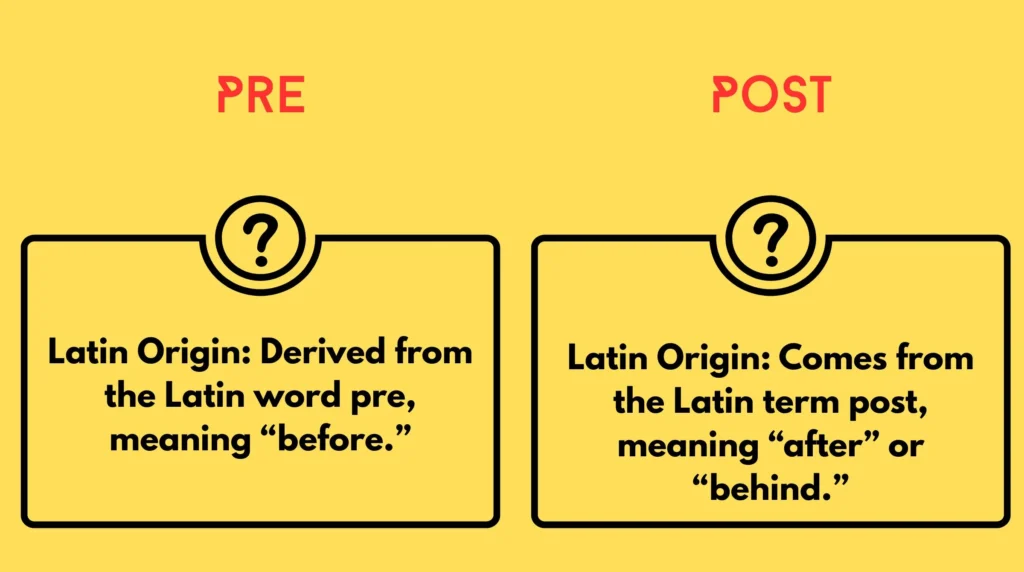
    • Latin Origin: Derived from the Latin word prae, meaning “before.”
    • Influence on English: Pre- has carried its original meaning into modern usage, showing up in words like prefix, prelude, and precaution.

    Post-

    • Latin Origin: Comes from the Latin term post, meaning “after” or “behind.”
    • Influence on English: It has remained consistent, forming words such as postpone, postgraduate, and postmortem.

    By borrowing these Latin terms, English gained precision and clarity in expressing temporal and sequential relationships.


    When and How to Use ‘Pre’

    The prefix pre- is used when referring to something that occurs earlier in time, sequence, or priority.

    Examples of Words with Pre-

    • Prehistoric: Relating to the time before recorded history.
    • Preview: A glimpse or demonstration of something before it’s officially released.
    • Precaution: An action taken beforehand to prevent harm.

    Contextual Tip: Use pre- when describing actions, events, or conditions that precede something else.


    Real-World Applications of ‘Post’

    The prefix post- applies to situations occurring after a specific point in time or order.

    Examples of Words with Post-

    • Postgraduate: A student who continues education after earning a degree.
    • Postwar: Referring to the period after a war has ended.
    • Postscript (P.S.): A note added at the end of a written document.

    Contextual Tip: Use post- to indicate actions, periods, or conditions following another event.


    Understanding ‘Post’ in Various Contexts

    The meaning of post- can shift depending on the field of study or usage.

    • Medical Terms:
      Postoperative refers to the period after surgery.
    • Social Media:
      In the digital age, a post refers to content shared online, like a blog post or tweet.
    • Historical Usage:
      Postcolonial refers to the era after a country gains independence from colonial rule.

    By recognizing the versatility of post-, you can better interpret its meaning in different contexts.


    Comparing ‘Pre’ and ‘Post’ with Time-Specific Examples

    PrefixMeaningExampleExplanation
    Pre-BeforePreflightActivities or checks done before a flight.
    Post-AfterPostflightActivities or analysis done after a flight.
    Pre-EarlierPrehistoricRefers to the period before recorded history.
    Post-LaterPostwarRefers to events occurring after a war.

    Key Insight: While pre- focuses on what comes earlier, post- highlights what follows. Both are indispensable for expressing time and sequence.


    Improving Language Proficiency with Correct Prefix Application

    Pre vs Post

    Mastering prefixes like pre- and post- can significantly enhance your language skills. Here’s how:

    1. Build Vocabulary: Learning prefixes helps you break down and understand unfamiliar words.
    2. Boost Clarity: Using precise prefixes ensures your writing is clear and effective.
    3. Avoid Errors: Understanding prefix meanings prevents common mistakes in communication.

    FAQs

    What does the prefix “pre” mean in English?

    The prefix “pre” means “before” in time or sequence, as seen in words like “preview” (to see before) or “precaution” (a measure taken beforehand).

    What is the meaning of the prefix “post”?

    The prefix “post” means “after” or “behind,” as in “postgraduate” (after graduation) or “postwar” (the period after a war).

    Can “pre” and “post” be used interchangeably?

    No, “pre” and “post” have opposite meanings. “Pre” indicates “before,” while “post” signifies “after.” Using them interchangeably would confuse the intended timeline.

    How do “pre-” and “post-” originate from Latin?

    The prefix “pre-” comes from the Latin “prae,” meaning “before,” while “post-” derives from the Latin “post,” meaning “after” or “behind.” Both retain their meanings in modern English.

    What are examples of common words with “pre” and “post”?

    Examples include “prehistoric” (before recorded history) and “postscript” (a note added after a text). Each prefix clearly defines its timeline.

    Why is it important to understand prefixes like “pre” and “post”?

    Understanding prefixes improves your vocabulary and helps you communicate ideas about time, sequence, and order more clearly and effectively.


    Conclusion

    Prefixes like pre- and post- are small but mighty tools in the English language. They allow us to express complex ideas about time, sequence, and order with just a few letters.

    By understanding their origins, meanings, and usage, you can use them confidently in your writing and speech.

    Whether you’re discussing prehistoric times or postmodern art, these prefixes help you communicate with precision and style. Start applying what you’ve learned today and watch your language skills improve!

  • Disloyal vs Unloyal 🤔: What’s the Real Difference?

    Disloyal vs Unloyal 🤔: What’s the Real Difference?

    Language is full of subtle nuances, and words like disloyal and unloyal exemplify this complexity. While they may appear to be interchangeable at first glance, their usage and acceptance in English vary widely.

    This article dives deep into the distinction between these two words, exploring their meanings, usage, and cultural perceptions.

    By the end, you’ll have a thorough understanding of when and why to choose one over the other.


    The Meaning Behind the Words “Disloyal” and “Unloyal”

    Disloyal vs Unloyal

    Both disloyal and unloyal share the common theme of a lack of loyalty. However, the differences lie in their formation and historical acceptance.

    • Disloyal: The prefix dis- indicates opposition, negation, or reversal, giving disloyal the meaning of actively betraying or being unfaithful.
      Example: “The soldier was punished for his disloyal actions toward his comrades.”
    • Unloyal: The prefix un- simply negates the root word, making unloyal mean not loyal or lacking loyalty without necessarily implying betrayal.
      Example: “The dog was described as unloyal, often wandering away from its owner.”

    Key takeaway: Disloyal often carries stronger emotional weight, suggesting betrayal, while unloyal feels less intense and is rarely used in modern English.

    Is “unloyal” correct, or should you always use “disloyal”? While both words suggest a lack of loyalty, only one is widely accepted in English. Discover the nuanced differences between these terms and learn when to use them effectively. Read more to master this subtle distinction!


    Common Usage: Why “Disloyal” Dominates the Conversation

    The word disloyal is far more prevalent in both written and spoken English. This dominance can be attributed to several factors:

    1. Historical Precedence: Disloyal has been a part of the English lexicon for centuries and is firmly entrenched in formal and informal usage.
    2. Cultural Norms: Society often emphasizes acts of betrayal over passive disloyalty, aligning more naturally with the connotations of disloyal.
    3. Dictionary Inclusion: Most major dictionaries define and list disloyal, while unloyal is often excluded or marked as less common.

    The Role of Language Trends in Word Preference

    Language is shaped by the way people communicate, and some words naturally rise to prominence while others fade away. The preference for disloyal over unloyal is an example of this phenomenon.

    Factors Driving Word Trends:

    • Ease of Use: Words that sound more familiar or natural are more likely to be used. Disloyal follows this pattern, as it aligns with other common dis- words like dishonest or disrespectful.
    • Perceived Formality: Unloyal might feel awkward or incomplete to speakers, leading to its avoidance in favor of disloyal.

    Insights from Google’s Ngram Viewer

    Google’s Ngram Viewer offers a fascinating glimpse into the popularity of words over time.

    WordFrequency in Literature (1800–2020)
    DisloyalConsistently high usage
    UnloyalMinimal and declining usage

    What Ngram Data Reveals:

    The data shows that disloyal has maintained steady usage across centuries, whereas unloyal has remained marginal, with no significant spikes.

    Conclusion from Data: English speakers have consistently preferred disloyal over unloyal, reinforcing the latter’s status as a rare or even non-standard word.


    Is “Unloyal” Grammatically Incorrect?

    Strictly speaking, unloyal is not grammatically incorrect. However, it is considered less conventional and may be seen as awkward or informal.

    Why It’s Rarely Used:

    • Lack of Familiarity: Speakers tend to avoid words that don’t feel established in common usage.
    • Alternative Options: Words like disloyal and unfaithful serve the same purpose and are more widely understood.

    Tip: While unloyal is not “wrong,” using disloyal will likely sound more polished and natural.


    The Nuances of Language: When to Use “Disloyal” Over “Unloyal”

    Use Disloyal When:

    1. Describing an act of betrayal.
      Example: “The employee’s disloyal behavior shocked the management team.”
    2. Conveying a sense of deliberate unfaithfulness.
      Example: “Her disloyalty to the cause was evident in her actions.”

    Use Unloyal When:

    1. Referring to a passive or less intentional lack of loyalty.
      Example: “The unloyal dog often followed strangers home.”

    However, even in these cases, other alternatives like not loyal or unfaithful may sound better.


    Context Matters: Examining Sentence Examples

    Examples with Disloyal:

    • “The politician’s disloyal comments created a media storm.”
    • “He was accused of disloyalty to his country.”

    Examples with Unloyal:

    • “The unloyal friend didn’t stand by her during tough times.”
    • “Unloyal behavior is uncommon in domesticated animals.”

    Observation: The examples with disloyal sound more natural and impactful, further highlighting its dominance in English.


    Perceptions of Loyalty: Exploring Cultural Influences on Language

    Cultural values shape how people perceive and express loyalty, influencing word choice.

    Key Cultural Insights:

    1. Western Norms: In Western cultures, loyalty is often associated with relationships and national identity, making disloyal a critical descriptor for betrayal.
    2. Eastern Perspectives: In collectivist societies, loyalty to family or community is paramount, and violations are often framed in strong terms like betrayal.
    3. Media Influence: Movies, books, and news headlines frequently use disloyal, reinforcing its dominance.

    Avoiding the Trap of Spellcheckers: Navigating “Unloyal” and “Disloyal”

    Spellcheck tools are designed to catch errors, but they might not always flag uncommon words like unloyal.

    Common Scenarios:

    • Autocorrect: May not recognize unloyal as a legitimate word, suggesting alternatives like disloyal or loyal.
    • Grammar Checkers: Tools like Grammarly might highlight unloyal as non-standard or suggest revisions.

    Best Practice: Trust your understanding of the context and use disloyal for clearer, more widely accepted communication.


    Unloyal in Digital Searches: Understanding Search Engine Behavior

    Search engines like Google provide insight into how often people look up terms like unloyal versus disloyal.

    Keyword Data:

    • Disloyal: High search volume, with people seeking definitions and examples.
    • Unloyal: Relatively low search volume, indicating less curiosity or usage.

    Implication: Opting for disloyal in your writing increases clarity and aligns better with user expectations.


    FAQs

    What is the difference between “disloyal” and “unloyal”?

    “Disloyal” implies betrayal or active unfaithfulness, while “unloyal” simply means lacking loyalty and is considered less conventional in modern usage.

    Is “unloyal” a real word in English?

    Yes, “unloyal” is a real word and not grammatically incorrect. However, it is rarely used and considered less formal or natural than “disloyal.”

    Why is “disloyal” more common than “unloyal”?

    “Disloyal” has historical precedence, stronger emotional weight, and wider acceptance in dictionaries, making it the preferred choice in English.

    Can I use “unloyal” in professional writing?

    It’s best to avoid “unloyal” in professional writing as it may seem awkward or informal. Opt for “disloyal” or “not loyal” instead.

    What are some examples of sentences with “disloyal”?

    Examples include: “The spy was disloyal to his country,” or “Her disloyalty to the team was shocking.”

    Is “disloyal” a stronger word than “unloyal”?

    Yes, “disloyal” carries a stronger connotation of betrayal, while “unloyal” feels passive and less emotionally charged.


    Conclusion

    The debate between disloyal and unloyal is less about correctness and more about preference and clarity. While unloyal isn’t technically wrong, disloyal has long been the favored choice in English, thanks to its historical roots and stronger emotional impact.

    If you want your writing to resonate and feel natural, stick with disloyal. It’s a word that carries weight, conveys intent, and aligns with both cultural and linguistic norms. By understanding the nuances outlined in this guide, you’ll always choose the right word with confidence.

  • Most Important or Most Importantly 🤔: Grammar Secrets Revealed!

    Most Important or Most Importantly 🤔: Grammar Secrets Revealed!

    Language evolves over time, and some debates in English grammar never truly fade. One such discussion revolves around the phrases most important and most importantly.

    While both expressions are commonly used, they serve slightly different purposes, and their usage often sparks controversy among grammarians and writers alike.

    This article dives deep into the distinctions, historical evolution, and modern applications of these phrases to help you use them with confidence and precision.


    Exploring the Historical Use of “Most Important” and “Most Importantly”

    Most Important or Most Importantly

    Historically, most important and most importantly have played different roles in English writing and speech.

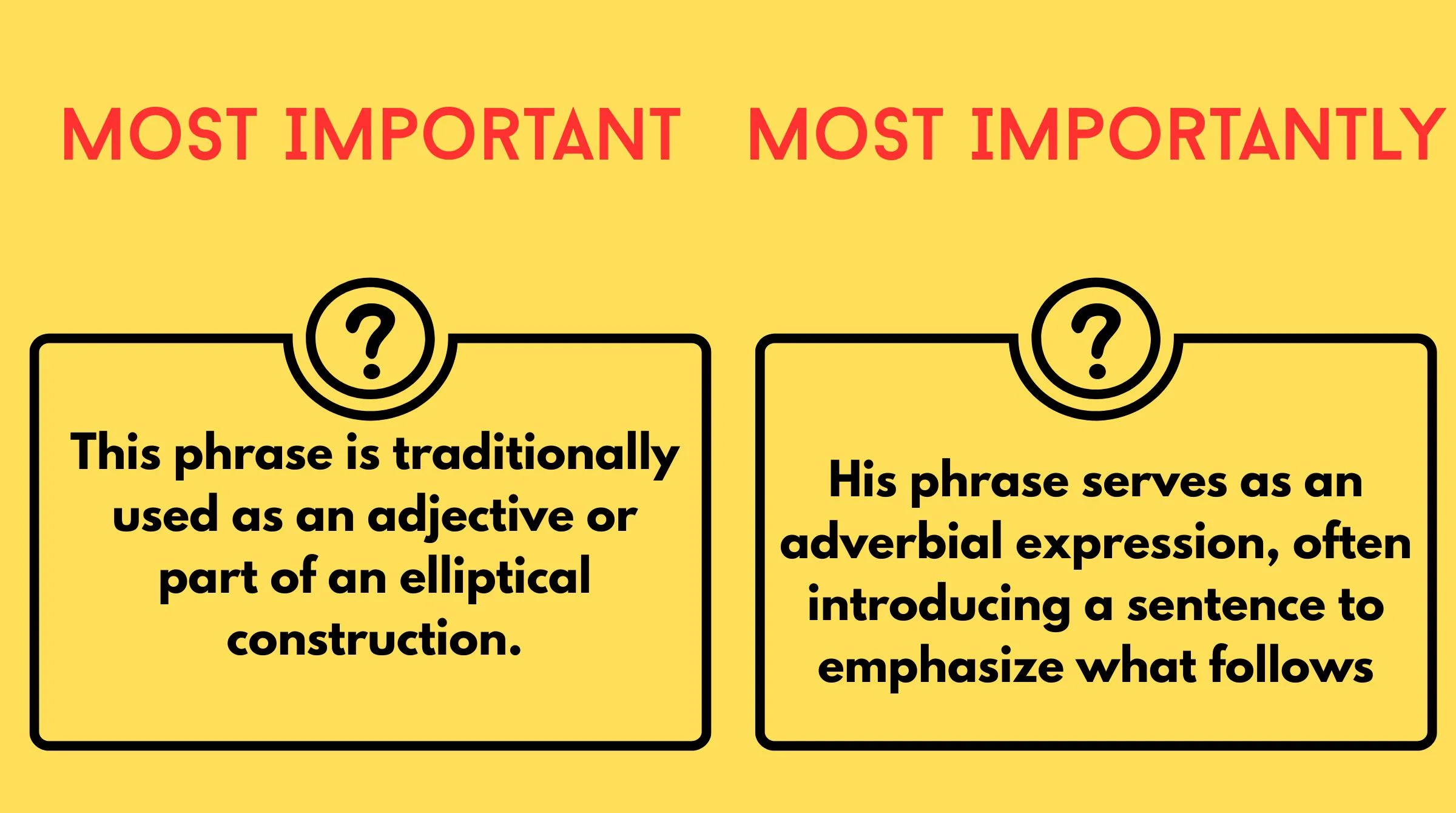
    • Most Important: This phrase is traditionally used as an adjective or part of an elliptical construction. For example, in the sentence “What is most important is honesty,” most important modifies the subject.
    • Most Importantly: This phrase serves as an adverbial expression, often introducing a sentence to emphasize what follows. For instance, “Most importantly, honesty builds trust.”

    The distinction lies in their grammatical functions: while one describes a noun (adjective), the other modifies the entire sentence (adverb).

    Confused between “most important” and “most importantly”? Both are correct, but they serve different purposes in grammar. Discover their unique uses and how to choose the right one in your writing. Read more to master this distinction!


    The Rise and Decline of “Most Important” in the 20th Century

    The use of most important in its elliptical form gained significant traction during the early 20th century. Writers began shortening sentences like “What is most important is…” to simply “Most important,” treating the adjective as an introductory phrase.

    However, the rise of adverbial constructions in the mid-20th century, influenced by stylistic shifts and evolving grammar rules, caused most importantly to gain popularity. This trend was further fueled by the belief that adverbs were better suited for introductory phrases.

    Key Insights from Usage Trends

    PhrasePeak PopularityContext of Usage
    Most ImportantEarly 20th C.Formal writing, concise sentence structures
    Most ImportantlyMid-20th C.Conversational tone, emphasis in speech

    Grammar Experts Debate on Adjective Versus Adverb Usage

    The debate over most important versus most importantly largely centers on grammatical precision and stylistic preference.

    • Proponents of “Most Important”: Some argue that the adjective form is more concise and elegant, particularly in formal writing. For example, “Most important, the plan must be feasible.”
    • Supporters of “Most Importantly”: Others claim that the adverbial form better aligns with traditional grammatical rules, as it clearly modifies the sentence rather than acting ambiguously.

    What Experts Say:

    • Strunk and White’s The Elements of Style: Advocates for simplicity, often favoring most important.
    • Garner’s Modern English Usage: Acknowledges both forms but leans toward most importantly for clarity.

    The truth is, neither phrase is grammatically incorrect. Instead, their usage often depends on style guides, audience expectations, and personal preference.


    Examples from Literature and Academic Sources

    To better understand how these phrases function, let’s explore examples from notable works.

    Examples Using “Most Important”

    1. “The most important thing is not to stop questioning.” – Albert Einstein
    2. “Most important, we must remember the value of education.” – Found in academic journals emphasizing brevity.

    Examples Using “Most Importantly”

    1. “Most importantly, the reforms will help reduce poverty.” – Common in modern newspapers and essays.
    2. “Most importantly, she believed in herself.” – Popular in motivational writing and speeches.

    These examples demonstrate how both forms are used effectively depending on the tone and context of the writing.


    “Most Important” vs. “Most Importantly”: Grammatical Perspectives

    Understanding the grammatical distinction can help clarify their appropriate use:

    • Most Important: Functions as an elliptical construction, where the subject is implied or understood. It avoids redundancy in formal writing.
    • Most Importantly: Operates as an adverbial phrase, modifying the entire sentence that follows. It’s often used to add emphasis or highlight a key point.

    Quick Tip:
    If you’re unsure which to use, consider the sentence structure. If it feels incomplete without a subject, most important may be your best choice. Otherwise, most importantly is likely more appropriate.


    Contemporary Usage: Which is More Acceptable Today?

    Most Important or Most Importantly

    In modern English, both most important and most importantly are widely accepted. However, usage trends show a preference based on formality and audience:

    • Formal Writing: Most important often appears in academic papers, legal documents, and professional reports for its brevity and directness.
    • Casual Writing/Speech: Most importantly is frequently used in conversations, blogs, and speeches where a more conversational tone is appropriate.

    Insights from Recent Linguistic Research

    Recent studies in linguistics shed light on how readers perceive these phrases. Researchers found that:

    • Most importantly tends to resonate more with readers due to its emphasis on the overall message.
    • Most important is seen as authoritative and concise, making it ideal for professional communication.

    Quote from a Linguist:
    “Both phrases hold value in modern English, but their impact depends on the audience and context. Clarity should always be the guiding principle.” – Dr. Emily Carter, Linguistic Researcher


    How Modern Usage Guides Address the Phrases

    Modern grammar guides take a flexible approach:

    • The Chicago Manual of Style: Allows both forms but recommends most importantly for introductory phrases.
    • The Associated Press Stylebook: Acknowledges both forms but suggests consistency in usage.

    These guidelines emphasize that there’s no universal “right” answer. Instead, context and clarity should drive your choice.


    The Role of Personal Preference and Context in Grammar

    Ultimately, your choice between most important and most importantly depends on factors like:

    • Audience: Who are you writing for? Formal audiences may prefer most important.
    • Tone: Are you aiming for a conversational or authoritative tone?
    • Sentence Structure: Does the phrase fit grammatically within your sentence?

    Tip: When in doubt, read your sentence aloud to see which phrase feels more natural.


    Understanding the Nuance Between Formal and Informal Writing

    The distinction between formal and informal writing often determines which phrase is more suitable.

    Writing StylePreferred PhraseReason
    FormalMost ImportantDirect, concise, aligns with professional tone.
    InformalMost ImportantlyEmphasizes the main point, conversational feel.

    Context is everything. Choose the phrase that aligns with your writing goals.


    Final Thoughts on Selecting Between “Most Importantly” and “Most Important”

    While both phrases are grammatically correct, their effectiveness depends on how you use them. Remember:

    • Most important is concise and formal.
    • Most importantly emphasizes the broader message and works well in casual contexts.

    Whichever you choose, clarity and context should guide your decision.


    FAQs

    What is the key difference between “most important” and “most importantly”?

    “Most important” functions as an adjective or part of a shortened sentence, while “most importantly” acts as an adverbial phrase emphasizing the whole sentence.

    When is it correct to use “most important”?

    Use “most important” in formal writing or when you need a concise expression, such as “Most important, honesty matters.”

    How does “most importantly” add emphasis?

    “Most importantly” emphasizes the key message or idea that follows, making it suitable for casual or conversational contexts.

    Can both phrases be used interchangeably?

    Not always. While both are correct, their usage depends on the sentence structure and the level of formality required.

    Which phrase is better for formal writing?

    “Most important” is better for formal writing due to its brevity and authoritative tone.

    Why do people often debate these two phrases?

    The debate arises because both phrases are grammatically correct, but their usage reflects different grammatical roles and writing styles.


    Conclusion

    The debate over most important versus most importantly boils down to style, audience, and intent. Both phrases are tools in your grammatical toolbox, and knowing when to use each can elevate your writing.

    Whether you prefer the brevity of most important or the emphasis of most importantly, mastering their nuances ensures clear and effective communication.

  • ✈️ On The Plane or In The Plane? Decoding the Correct Preposition

    ✈️ On The Plane or In The Plane? Decoding the Correct Preposition

    Prepositions can be tricky, especially when it comes to words we use every day like on and in.

    If you’ve ever wondered whether you should say on the plane or in the plane, you’re not alone. The English language is filled with subtle distinctions that affect both how we speak and how we understand one another.

    In this article, we’ll explore the nuances of these prepositions and help you master their correct usage when it comes to air travel.


    On The Plane or In The Plane

    Understanding “On The Plane” vs. “In The Plane”

    At first glance, on and in seem interchangeable, but the two prepositions convey different meanings depending on context. When we’re talking about air travel, the distinction becomes clearer.

    On the Plane

    • This phrase refers to the experience of being aboard an aircraft.
    • It emphasizes that you’re inside the space, but also that you’re part of a group or in a larger context, such as a flight.Example: “We’re on the plane, ready for takeoff.”

    In the Plane

    • This phrase is more technical and could refer to the physical location inside the aircraft itself.
    • It emphasizes being within the structure of the plane, focusing more on the physical boundaries of the aircraft.Example: “The pilot is in the plane, preparing for takeoff.”

    While both phrases can technically work, on the plane is the more natural and common choice when discussing air travel in everyday conversation.

    Ever wondered whether it’s “on the plane” or “in the plane”? This article decodes the subtle difference between these two prepositions in the context of air travel, making it easy to master correct usage.


    Exploring The Prepositions: When to Use “On” and “In”

    Understanding when to use on and when to use in isn’t just about the plane—it’s about how English speakers view objects and environments. Generally, we use on for surfaces, larger objects, or when something is attached to something else. On the other hand, we use in when something is enclosed or inside a boundary.

    • Use on when referring to a vehicle or transport that functions as a platform or a surface.
      Example: “I’m on the bus.” “She’s on the train.”
    • Use in when referring to smaller vehicles or enclosed spaces.
      Example: “I’m in the car.” “He’s in the taxi.”

    For air travel, on the plane follows the same logic: while you are physically inside the plane, you’re considered on the plane because it’s viewed as a platform for transportation.


    The General Rule of Thumb for Transportation

    When it comes to transportation, there’s a straightforward rule of thumb that can help you choose the correct preposition:

    • Larger or public vehicles (planes, trains, buses, ships): Use on.
    • Smaller, enclosed vehicles (cars, taxis, submarines): Use in.

    So, for air travel, since a plane is a large, public mode of transport, you’d say, “on the plane” rather than “in the plane,” which could be perceived as overly technical.


    Special Cases and Exceptions

    English is full of exceptions, and air travel vocabulary is no different. For example, there are situations where “in the plane” might be used:

    • Technical or precise contexts: When discussing the physical location inside the plane (e.g., the cockpit, or cabin).
      Example: “The engineer is in the plane fixing the radar.”
    • Metaphorical or figurative speech: If someone is metaphorically “inside” the journey or the experience, they might refer to in the plane.
      Example: “I was in the plane when the announcement was made.”

    While these cases are less common, they still occur depending on the context.


    Navigating the Subtleties of English Prepositions

    English prepositions often don’t follow strict logic, which is why native speakers don’t always have trouble with these subtleties. To understand prepositions better, it’s important to grasp the underlying concept of physical versus figurative meanings. Here’s a breakdown:

    • In: More common for enclosed spaces. You’re surrounded by something, such as “in the room” or “in the car.”
    • On: More common for surfaces or vehicles, as mentioned earlier. You’re positioned on something that has a surface you’re attached to, like “on the floor” or “on the boat.”

    When choosing between on and in for planes, it’s about whether you’re thinking of the plane as a space or a mode of transport.


    “On The Plane”: The Idiomatic Choice

    In most cases, on the plane is the idiomatic and natural way to talk about being aboard an aircraft. It’s an expression that has become deeply embedded in everyday language.

    • Idiom Usage:
      “On the plane” has been adopted widely in both informal and formal language. We use it in the context of flight schedules, experiences, or interactions aboard the aircraft. For example, “I was on the plane when the turbulence started.” It’s rare for anyone to say “in the plane” unless referring to the physical space.
    • Why “On” is Preferred:
      The term on the plane mirrors how we talk about other large transportation methods. People generally say on the bus, on the train, and on the ship, so it’s a linguistic pattern.

    Historical Usage and Current Trends

    Historically, both on and in were used to describe being aboard an aircraft, though on has become the dominant choice in modern times. Over the years, as air travel became more routine and mainstream, the phrase on the plane began to dominate in everyday language. There was a shift toward viewing the plane as a mode of transport that one was on, just like a bus or a train, rather than something one was in.

    • Past Trends: Early aviation terms often used in the plane, especially in more technical discussions about flight operations. However, with the rise of commercial air travel, on the plane became more commonplace.
    • Current Trends: Today, on the plane is the go-to phrase, used by pilots, flight attendants, passengers, and in nearly all airline communications.

    Grammatical Nuances of Air Travel Language

    The language of air travel also has its quirks. While you are “on the plane” for most purposes, other related terms use in or on based on context.

    Related Phrases:

    • In the cockpit: Refers to the pilot’s area inside the plane.
    • On the runway: Describes the plane before it takes off.
    • In the air: Refers to the flight being airborne.

    Notice how the use of prepositions shifts based on the part of the journey and what aspect of the plane you’re referring to.


    Additional Insights: “By Plane” and “Travel By Plane”

    Another related phrase is “by plane,” which means to travel using a plane as your mode of transport. This phrase is common when discussing travel routes or choices of transportation.

    • Example: “I prefer to travel by plane because it’s faster.”

    Key difference: While on the plane refers to being inside the aircraft during your journey, by plane focuses on the mode of transport.


    Cultural and Contextual Influences on Language

    On The Plane or In The Plane

    Language usage often varies across cultures, and English is no exception. Different English-speaking countries may have slightly different preferences for using on and in. However, across the board, on the plane is the most widely accepted and used term.

    In more technical settings, such as aviation or engineering, professionals might use in the plane to describe specific operations or locations inside the aircraft.


    Conclusion

    Understanding when to use on the plane vs. in the plane is a subtle but important aspect of English grammar.

    By following general rules about transportation prepositions and recognizing when exceptions apply, you can confidently use these phrases correctly.

    Whether you’re preparing for your next flight or explaining air travel to others, remember: it’s typically on the plane, and that’s the most idiomatic choice.