Blog

  • People Do or People Does? Learn the Correct Usage! ✅📖

    People Do or People Does? Learn the Correct Usage! ✅📖

    English grammar can be tricky, especially when it comes to subject-verb agreement.

    One common area of confusion is whether to say “people do” or “people does.” Understanding the correct usage is crucial for clear and grammatically sound communication.

    Let’s break down the rules, explore common mistakes, and provide practical examples to help you master this aspect of English.

    Should you say “people do” or “people does”? The answer lies in subject-verb agreement rules. Since “people” is plural, the correct choice is always “people do.” Learn why and avoid this common grammar mistake!


    Understanding Subject-Verb Agreement

    Subject-verb agreement refers to ensuring that a verb matches the number (singular or plural) of the subject. In English:

    • Singular subjects take singular verbs.
    • Plural subjects take plural verbs.

    For example:

    • She runs every morning. (Singular subject, singular verb)
    • They run every morning. (Plural subject, plural verb)

    Verb Conjugation and Noun Plurality

    A key factor in subject-verb agreement is the number of the noun.

    • Singular nouns (e.g., dog, child, teacher) take singular verbs (barks, plays, teaches).
    • Plural nouns (e.g., dogs, children, teachers) take plural verbs (bark, play, teach).

    The challenge comes with irregular nouns and collective nouns, which we will explore further.


    Conjugation Challenges and Tips

    Some nouns in English seem singular but are actually plural. People is one such word—it is the plural of person. Many learners mistakenly believe that people should take a singular verb like does, but that’s incorrect.

    Quick Tip:

    • Use does with singular subjects: He does his homework.
    • Use do with plural subjects: They do their homework.
    • Since people is plural, always use do: People do amazing things.

    Avoiding Subject-Verb Agreement Errors

    Errors in subject-verb agreement often occur when:

    • A plural noun is mistaken for a singular one.
    • An irregular noun confuses the speaker.
    • The sentence structure is complicated.

    Example errors: ❌ People does not like loud noises. (Incorrect) ✅ People do not like loud noises. (Correct)


    The Plural Subject “People” and Its Conjugation

    Unlike most nouns, people is inherently plural. While person is singular (one person does), people refers to more than one individual, requiring the plural verb do.

    Example Sentences:

    • People do great things when they work together.
    • People do their best when they feel motivated.

    Common Mistakes in English Grammar

    Some common grammar mistakes involve misunderstanding subject-verb agreement:

    • Using singular verbs with plural subjects
    • Forgetting that certain words are always plural (police, cattle, children, people)
    • Confusing collective nouns with singular nouns

    To avoid these mistakes, always identify whether the subject is singular or plural before choosing a verb.


    Why “People Does” is Grammatically Incorrect

    The phrase “people does” is incorrect because people is plural, and does is the singular form of do.

    Compare:

    • A person does their best. (Singular)
    • People do their best. (Plural)

    The Importance of Consistency in Verb Usage

    Consistency in grammar ensures clarity and professionalism in writing. Switching between singular and plural verb forms incorrectly can confuse readers.

    Example of Incorrect Consistency:

    ❌ People does many things in society, but they also do harm.

    Corrected Version:

    ✅ People do many things in society, but they also do harm.

    People Do or People Does

    Examples of Incorrect Usage and How to Correct Them

    Incorrect SentenceCorrected Sentence
    People does their best to succeed.People do their best to succeed.
    People does not like waiting in long lines.People do not like waiting in long lines.
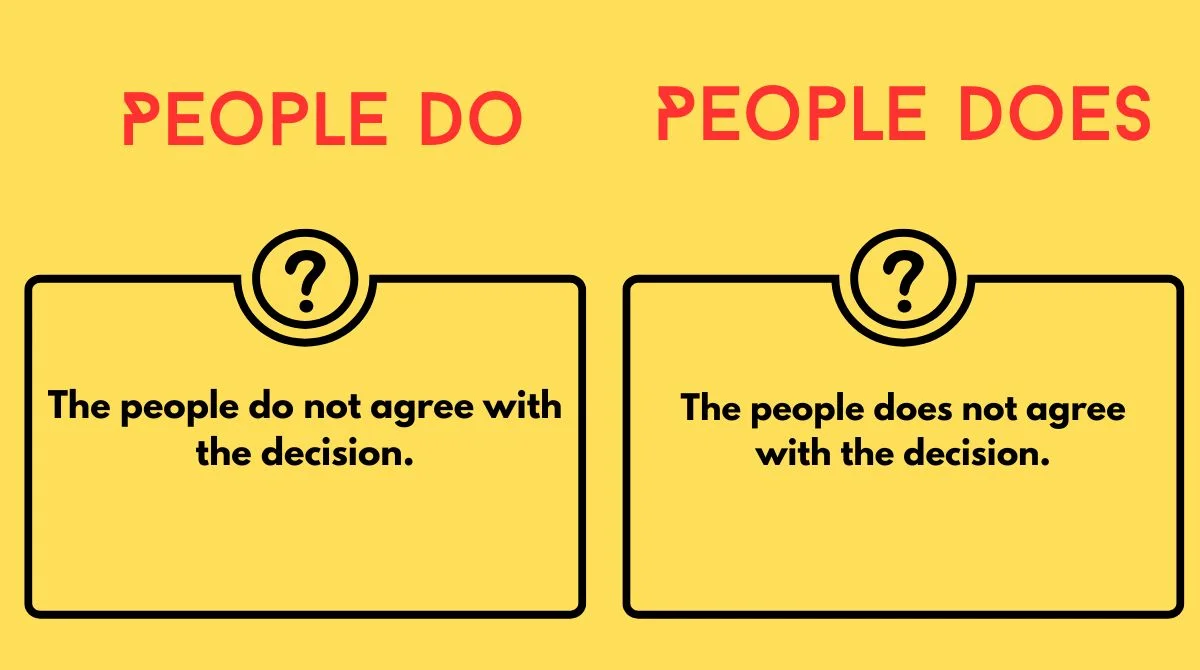
    The people does not agree with the decision.The people do not agree with the decision.

    Exploring the Correct Use of “People Do”

    Since people is a plural noun, the correct phrase is always “people do.” This rule applies in all cases:

    • People do need to rest after a long day.
    • Why do people believe in myths?

    The Role of Verb Conjugation in American English

    In American English, verb conjugation follows consistent patterns. For the verb do:

    • Do is used with plural subjects (e.g., they, we, people).
    • Does is used with singular subjects (e.g., he, she, it).

    How Conjugation Affects Meaning in Sentences

    Changing verb conjugation can alter the entire meaning of a sentence.

    • People do their work every day. (Plural, correct)
    • A person does their work every day. (Singular, correct)

    Conjugation Rules for Regular and Irregular Verbs

    SubjectCorrect Verb
    Ido
    Youdo
    He/She/Itdoes
    Wedo
    Theydo
    Peopledo

    Practical Examples Demonstrating “People Do” in Sentences

    • People do amazing things when given the opportunity.
    • Do people always behave rationally?
    • What do people usually say about this topic?

    Grammar Tips for Non-Native English Speakers

    If you struggle with subject-verb agreement, try these tips:

    1. Identify whether the subject is singular or plural before choosing a verb.
    2. Remember that people is always plural.
    3. Read sentences out loud to hear if they sound correct.

    Resources for Mastering American English Usage

    For more grammar tips, check out:

    • Merriam-Webster’s Learner’s Dictionary
    • The Chicago Manual of Style
    • Grammarly and other grammar-checking tools

    People Do or People Does

    Strategies for Remembering Correct Grammar Structures

    1. Practice daily – Write sentences using correct subject-verb agreement.
    2. Use flashcards – Create grammar flashcards to reinforce rules.
    3. Engage with native speakers – Hearing proper grammar helps reinforce learning.

    FAQs

    1. Why is “people does” incorrect?

    “People” is a plural noun, so it takes the plural verb “do” instead of the singular “does.” The correct phrase is “people do” in all cases.

    2. What is the singular form of “people”?

    The singular form of “people” is “person”. When using “person,” the correct verb is “does” (e.g., “A person does their best”).

    3. Are there other nouns like “people” that take plural verbs?

    Yes, some plural-only nouns include:

    • Police (“The police do their job well.”)
    • Cattle (“Cattle do not like loud noises.”)
    • Children (“Children do their homework.”)

    4. Can “people” ever take a singular verb?

    No, “people” is always plural. However, “the people” (referring to a specific group) still takes a plural verb: “The people do not agree with the decision.”

    5. How can I remember the difference between “do” and “does”?

    A simple trick: “He/She/It does, but they/we/people do.” If the subject is plural, always use “do.”

    6. What are some example sentences using “people do”?

    • “People do amazing things when they work together.”
    • “Why do people believe in superstitions?”
    • “People do their best to succeed in life.”

    Final Thoughts and Additional Language Learning Advice

    Understanding subject-verb agreement is essential for clear communication in English. Always remember:

    • People is plural and takes do.
    • Does is for singular subjects like he, she, it.
    • Proofreading and practice will help you avoid common mistakes.

    By mastering these grammar rules, you’ll speak and write with greater confidence. Keep practicing, and soon, these rules will feel natural!

  • 🚀 Headed vs Heading: The Complete Grammar & Usage Guide

    🚀 Headed vs Heading: The Complete Grammar & Usage Guide

    English learners and even fluent speakers often pause when choosing between “headed” and “heading.” At first glance, the difference seems tiny. Yet once you dig deeper, you realize these words reveal subtle distinctions about time, focus, and meaning.

    If you’ve ever wondered whether to say “I’m headed home” or “I’m heading home,” this guide is for you.

    By the end, you’ll know exactly which to use, why it matters, and how context (grammar, culture, and even psychology) shapes the choice.


    Why This Phrase Matters More Than You Think

    Headed vs Heading

    Tiny details in language often carry bigger implications than we notice. The choice between headed vs heading doesn’t just change grammar — it shifts emphasis.

    • Headed highlights the destination.
    • Heading emphasizes the movement or process.

    This isn’t just about textbook correctness. The way you phrase a simple sentence can change how people perceive your goals, your mindset, and your tone. Coaches, writers, and speakers know this, which is why both forms appear often in motivational language, travel talk, and everyday speech.


    Grammar Breakdown: Headed vs Heading

    To master the difference, let’s start with grammar.

    What Does “Headed” Mean?

    • Form: past participle of the verb head.
    • Use: often paired with “to” or “for” to indicate direction or destination.
    • Meaning: points to where someone or something is going.

    Examples:

    • I’m headed to the store. (Destination focus)
    • They were headed for trouble. (Outcome focus)
    • She’s headed north on the freeway. (Directional focus)

    Here, the journey matters less than the end point.


    What Does “Heading” Mean?

    • Form: present participle of the verb head.
    • Use: describes the action of moving in a direction.
    • Meaning: focuses on the process or motion.

    Examples:

    • I’m heading to the store. (Action focus)
    • He’s heading up the committee. (Leadership role — different meaning)
    • We’re heading into dangerous territory. (Ongoing process)

    Unlike “headed,” this form emphasizes the movement itself, not just the destination.


    Quick Grammar Table: Headed vs Heading

    WordFormFocusExample
    HeadedPast participleDestination / OutcomeShe’s headed home.
    HeadingPresent participleProcess / MovementShe’s heading home.

    What People Actually Say: Real Usage Trends

    Grammar is only half the story. What do people actually use in daily life?

    • In casual conversations, both appear frequently and interchangeably.
    • In formal writing, “heading” tends to be more common.
    • In regional English (US vs UK), preferences differ (covered below).

    When you listen closely, you’ll notice that Americans lean on “headed” more, while “heading” dominates in British speech.


    Which Is More Common? Corpus Frequency Comparison

    Large text databases (called corpora) help us see usage trends. Data from American and British sources consistently shows:

    • US English: “headed” is favored in everyday talk, especially with travel or destinations (I’m headed to work).
    • UK English: “heading” wins, especially in written form (I’m heading to the station).
    RegionPreferred FormExample
    U.S. EnglishHeadedI’m headed to the airport.
    U.K. EnglishHeadingI’m heading to the station.
    Global MixBothBoth forms understood widely

    Colloquial English: Speech vs. Text Patterns

    • Spoken English: People often shorten or blur grammar. “I’m headed” and “I’m heading” both sound natural.
    • Texting & Chat: Quick phrases like “heading out” are more common.
    • Formal writing: “Heading” appears more, especially in edited texts or journalism.

    Regional Usage: Geography Makes a Difference

    U.S. English

    In American English, “headed” often dominates. It feels natural in sentences like:

    • We’re headed to Vegas this weekend.
    • He’s headed for trouble if he keeps skipping work.

    U.K. English

    British English leans toward “heading.”

    • She’s heading to the shops.
    • I’m heading off now.

    Australia and Canada

    Usage blends here. Canadians mirror Americans with “headed,” while Australians often sound more British, preferring “heading.”


    Regional Preference Map

    (Insert simple regional comparison chart here in your blog for visuals — e.g., map shading for “headed” vs. “heading”)


    How Context Shapes Meaning

    Destination vs. Process Focus

    Think of it this way:

    • Headed = Destination → The end point matters.
    • Heading = Process → The action of moving matters.

    Examples:

    • I’m headed to college next year. (Where you’re going — future plan)
    • I’m heading to college now. (Action happening right now)

    Everyday Situations With Examples

    Travel:

    • I’m headed to Paris next week. (Destination goal)
    • I’m heading to Paris now. (Currently traveling)

    Work:

    • She’s headed for a promotion. (Outcome focus)
    • She’s heading the new project. (Different verb sense = leading)

    Life Goals:

    • We’re headed toward success. (Future destination)
    • We’re heading into uncharted waters. (Process underway)

    Formal vs. Informal Registers

    • Informal chat: Both work. “I’m headed home” sounds casual and American.
    • Professional context: “Heading” tends to read smoother in business writing.

    Metaphors & Mindsets: What the Phrase Says About You

    Language isn’t just grammar. It also signals mindset.

    • Headed implies vision and destination — you know your target.
    • Heading implies action, momentum, and movement — you’re in the process.

    This difference makes both words powerful tools in coaching, therapy, and leadership communication.


    Examples in Coaching and Self-Help

    • You’re headed for greatness. → Destination, vision, future.
    • You’re heading into a season of growth. → Action, transition, process.

    Quote Box: Metaphorical Uses in Media

    “The company is headed for a record year.” – The Wall Street Journal

    “We’re heading into an age of AI transformation.” – The Guardian


    Goal Setting: The Language of Future Thinking

    When setting goals, the difference matters:

    • Headed inspires clarity: I’m headed toward financial freedom.
    • Heading inspires momentum: I’m heading into new opportunities.

    Application in Journaling and Therapy

    Therapists often notice language patterns. Someone who says “I’m headed for disaster” frames life as outcome-driven. Someone who says “I’m heading into challenges” focuses on the journey.


    Cultural Differences: Directional Language Across the World

    Different cultures place emphasis on where you end up vs. how you get there.

    Idioms in Other Languages

    • Spanish: “Voy rumbo a…” (I’m headed toward…) emphasizes destination.
    • French: “Je me dirige vers…” (I’m heading toward…) emphasizes movement.

    Directional Thinking Across Cultures

    Research in cognitive linguistics shows that Western cultures favor destinations, while Eastern cultures often value the process itself. This echoes the split between headed vs heading.


    Which Should You Use – and When?

    Quick Decision Framework

    Ask yourself: Do I want to highlight the destination or the action?

    • Use headed if the end point matters.
    • Use heading if the action or process matters.

    Quick Reference Chart

    ContextBetter ChoiceExample
    Travel plansHeadedI’m headed to the airport.
    Current motionHeadingI’m heading out now.
    Future goalsHeadedWe’re headed for success.
    Process focusHeadingWe’re heading into change.

    Case Study: How Word Choice Changed a Coaching Session

    A life coach once described a client’s language shift. At first, the client said: “I’m headed for failure.” The coach asked her to reframe it. She tried: “I’m heading into challenges.”

    That small change shifted the conversation. Instead of predicting doom, she saw herself actively engaging in a process she could manage.

    Language shapes mindset — and headed vs heading is a prime example.


    FAQs: Headed vs Heading

    Is “I’m headed home” correct?

    Yes. In American English, “I’m headed home” is widely used to mean you’re going home.

    Is “I’m heading home” more formal?

    Yes, “I’m heading home” feels smoother in writing and slightly more formal than “I’m headed home.”

    Do British speakers use “headed”?

    Not often. British English favors “heading,” especially in everyday conversation.

    Can “heading” mean leadership?

    Yes. Example: She’s heading the project means she’s leading it. “Headed” doesn’t carry this meaning.

    Which is better for motivational writing: headed or heading?

    Both work. Use headed to stress destination, heading to highlight action and momentum.


    Conclusion

    Both headed and heading are correct, natural, and widely understood. The difference lies in emphasis:

    • Headed = destination and outcome.
    • Heading = process and action.

    Your choice depends on context, region, and intent. Next time you write or speak, ask yourself: Do I want to stress where I’m going, or the fact that I’m moving? That small decision can change the entire tone of your message.

  • Congratulations On vs Congratulations For: The Key Difference! 🎊📚

    Congratulations On vs Congratulations For: The Key Difference! 🎊📚

    Language is full of subtle nuances, and even small prepositional differences can change the meaning or appropriateness of a phrase. One common point of confusion is whether to say “Congratulations on” or “Congratulations for”.

    While both expressions exist, their usage differs based on context. This guide will explore their distinctions, provide practical examples, and help you master the art of congratulatory language.

    Should you say “Congratulations on” or “Congratulations for”? The difference lies in context! Use “on” for achievements and “for” when praising effort or actions. Learn the full explanation with examples!


    Understanding the Basics: “Congratulations On” Explained

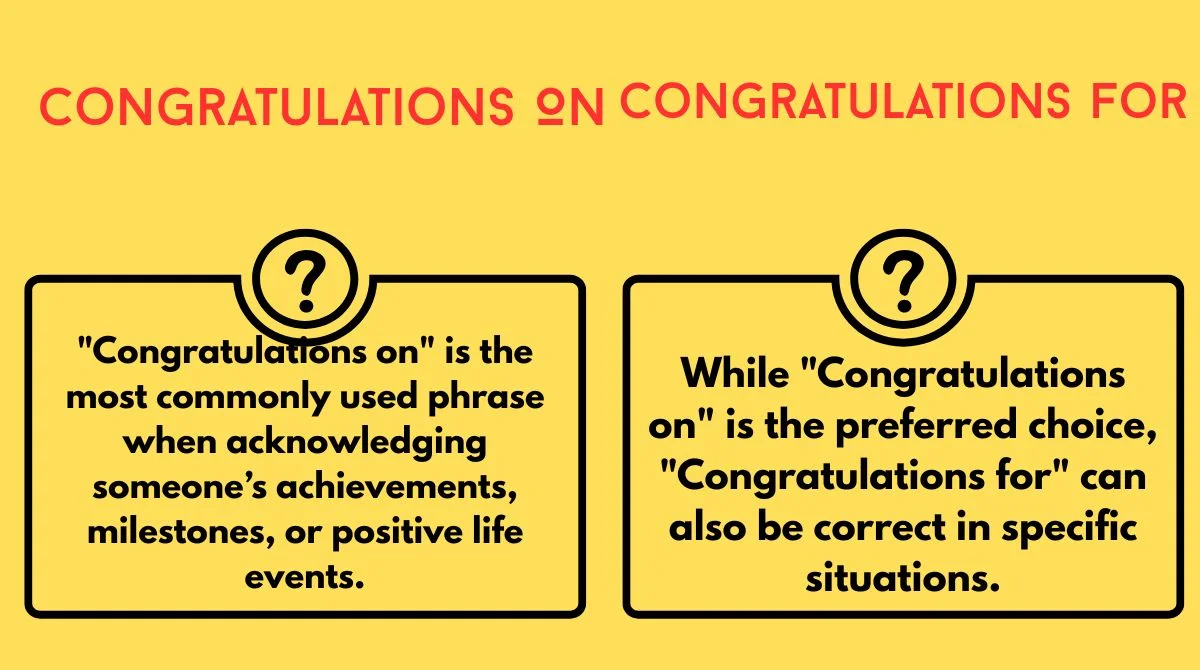
    “Congratulations on” is the most commonly used phrase when acknowledging someone’s achievements, milestones, or positive life events. It is considered the grammatically standard form when offering praise for accomplishments.

    When to Use “Congratulations On”

    • Academic achievements: Congratulations on graduating with honors!
    • Job-related success: Congratulations on your promotion!
    • Personal milestones: Congratulations on your engagement!
    • Awards and recognition: Congratulations on winning the tournament!

    In these cases, “on” helps connect the word “congratulations” to a specific accomplishment, making the praise sound natural and fluid.


    Congratulations On vs Congratulations For

    When to Use “Congratulations For”: Contexts and Usage

    While “Congratulations on” is the preferred choice, “Congratulations for” can also be correct in specific situations. The key difference is that “for” is generally used when emphasizing the reason behind the achievement or the effort made to attain success.

    When to Use “Congratulations For”

    • Commending effort rather than results: Congratulations for working so hard on this project!
    • Recognizing good behavior or character: Congratulations for being such a great mentor!
    • Praising a cause or action: Congratulations for supporting this charity event!

    Rule of thumb: Use “on” for achievements and “for” when recognizing actions or efforts leading to success.


    The Nuance in Praising Achievements

    Although both phrases are grammatically acceptable, their subtle distinctions influence tone and perception. Consider the following examples:

    SentenceCorrect Usage?Explanation
    Congratulations on your new book deal!✔ YesFocuses on the accomplishment (getting the book deal).
    Congratulations for your new book deal!✘ NoSounds unnatural; doesn’t highlight effort.
    Congratulations for writing an inspiring book!✔ YesFocuses on the effort put into writing.

    Using the wrong preposition might not render the sentence completely incorrect, but it can sound unnatural or less idiomatic.


    Structural Clarity in Sentences

    When forming congratulatory statements, sentence structure plays a crucial role. Here are some common formats:

    1. Congratulations on + noun/gerund
      • Congratulations on your success.
      • Congratulations on completing your first marathon.
    2. Congratulations for + action (verb phrase)
      • Congratulations for helping the community.
      • Congratulations for standing up for what you believe in.

    By following these patterns, your sentences will remain grammatically sound and convey the intended meaning clearly.


    The Popularity Contest: Which Phrase Wins According to Usage Data?

    A review of language databases and search trends reveals that “Congratulations on” overwhelmingly dominates in formal and informal usage.

    • Google Ngram Viewer data indicates that “congratulations on” is used nearly five times more frequently than “congratulations for.”
    • Common English exams (TOEFL, IELTS) reinforce that “on” is the correct choice for academic and professional writing.

    While “for” isn’t necessarily incorrect, it remains far less common than “on,” especially in formal settings.


    The Interchangeability Debate: Can “On” and “For” Be Used the Same Way?

    Although some might argue that “Congratulations for” and “Congratulations on” can be used interchangeably, native speakers instinctively lean towards “on” for most scenarios.

    Consider These Examples:

    • Congratulations on your wedding! (✔ Sounds natural)
    • Congratulations for your wedding! (✘ Sounds awkward)
    • Congratulations for organizing such a beautiful wedding! (✔ Acceptable when emphasizing effort)

    Final Verdict:

    Stick to “on” for achievements and “for” when acknowledging effort.


    Dissecting “Congratulations”: More Than Just a Word

    The word “congratulations” itself originates from the Latin congratulatio, meaning “expression of joy or pleasure.” It has been in use since the 15th century, evolving into a universal way to acknowledge success and good fortune.

    Singular vs. Plural Forms of Congratulations

    • “Congratulation” (singular) is rarely used and sounds unnatural in most cases.
    • “Congratulations” (plural) is the accepted form when offering praise.

    Celebratory Circumstances and Their Proper Expressions

    EventCorrect Phrase
    GraduationCongratulations on graduating!
    New JobCongratulations on your new position!
    Running a MarathonCongratulations for training so hard!
    Winning an AwardCongratulations on your achievement!

    “Congratulations On” Beyond the Basics: Advanced Examples

    1. Congratulations on your successful business launch; your dedication is inspiring!
    2. Congratulations on passing your medical board exams; you deserve it!
    3. Congratulations for advocating for positive change in your community.

    Mastering the Art of Congratulatory Language

    Tips for Sounding Natural:

    • Avoid overcomplicating phrases; keep it simple and heartfelt.
    • Match the preposition to the intent (“on” for achievement, “for” for effort).
    • If in doubt, “on” is usually the safer choice.

    Congratulations On vs Congratulations For

    Responding to Congratulations: Etiquette and Synonyms

    When someone congratulates you, responding appropriately maintains the flow of conversation.

    Common Responses:

    • Thank you! I really appreciate it.
    • Thanks so much; that means a lot!
    • I couldn’t have done it without support!

    Alternative Words for “Congratulations”:

    • Well done!
    • Kudos!
    • Hats off to you!
    • Bravo!

    FAQs

    1. When should I use “Congratulations on”?

    Use “Congratulations on” when celebrating achievements, milestones, or successes. Example: “Congratulations on your promotion!”

    2. When is “Congratulations for” appropriate?

    Use “Congratulations for” when praising effort or a specific action. Example: “Congratulations for working so hard on this project!”

    3. Is “Congratulations for your success” correct?

    No, it sounds unnatural. The correct phrasing is “Congratulations on your success.”

    4. Why do we say “Congratulations on your wedding” instead of “for your wedding”?

    “Congratulations on your wedding” is correct because it recognizes the event itself, not the effort behind it.

    5. Which phrase is more common: “Congratulations on” or “Congratulations for”?

    “Congratulations on” is much more common and grammatically preferred in most situations, especially in formal writing.

    6. Can I say “Congratulations on winning the award” and “Congratulations for winning the award”?

    “Congratulations on winning the award” is the correct and natural choice. “For” is not typically used when acknowledging achievements.


    Conclusion

    Understanding when to use “Congratulations on” vs. “Congratulations for” can greatly improve your communication skills.

    While “on” remains the dominant choice for acknowledging accomplishments, “for” serves a role in recognizing effort or actions. By mastering these nuances, you can confidently express praise in both casual and formal settings.

    Now that you know the difference, go ahead and congratulate someone the right way!

  • Persue or Pursue ✨ The Correct Spelling Explained (With Real Examples)

    Persue or Pursue ✨ The Correct Spelling Explained (With Real Examples)

    English spelling can be tricky, especially when words look and sound almost the same. One common mistake people make is writing persue instead of pursue.

    At first glance, the difference seems small. But in writing, those few letters can make a big impact on how professional and credible you sound.

    This guide clears up the confusion once and for all. You’ll learn the correct spelling, meaning, real-world uses, memory tricks, common mistakes, historical background, and practical examples of “pursue.” By the end, you’ll never mix up persue and pursue again.


    Persue vs. Pursue — Clearing the Confusion

    Persue or Pursue

    Many learners (and even native speakers) confuse the two because of how they sound. When spoken quickly, “pursue” almost sounds like it has an e instead of a u. Typing errors and phonetic spelling often lead to the incorrect form persue.

    Here’s a quick comparison:

    WordStatusCorrect Usage?Example Sentence
    Persue❌ IncorrectNeverShe decided to persue her goals.
    Pursue✅ CorrectAlwaysShe decided to pursue her goals.

    Key point: Persue is not a word in English. The only correct spelling is pursue.


    The Correct Spelling: Pursue

    To be crystal clear: the correct spelling is always pursue.

    • Part of speech: Verb
    • Verb forms: pursue, pursues, pursued, pursuing
    • Pronunciation (IPA): /pərˈsuː/
    • Stress pattern: second syllable (per-SUE)

    Example sentences:

    • They chose to pursue a career in medicine.
    • We must pursue justice no matter how difficult.
    • She is pursuing her dream of becoming a pilot.

    Meaning and Usage of “Pursue” in American English

    The word pursue means to follow, chase, or strive for something with determination. It can be used both literally and figuratively.

    Synonyms of “Pursue”:

    • Chase
    • Seek
    • Strive for
    • Follow
    • Aim for
    • Go after

    Example sentences in daily English:

    • Literal: The police pursued the suspect.
    • Figurative: He pursued his ambition of writing a novel.

    In American English, pursue is used in formal, professional, and casual contexts, making it one of the most versatile verbs in the language.


    Contextual Applications of “Pursue”

    The beauty of pursue lies in how adaptable it is. Let’s explore how it’s used in different settings:

    Legal Context

    • “The victim decided to pursue legal action.”
    • Often used in law to mean filing or continuing a case.

    Academic Context

    • “She wants to pursue a degree in law.”
    • Refers to continuing education or advanced study.

    Career Context

    • “He chose to pursue a career in medicine.”
    • Implies actively working toward professional goals.

    Personal Context

    • “We should all pursue happiness in life.”
    • Used figuratively to mean seeking fulfillment or satisfaction.

    Literal vs. Figurative Use of “Pursue”

    “Pursue” has both literal and figurative meanings. Knowing the difference makes your writing stronger.

    TypeMeaningExample
    LiteralTo physically chase or follow someone/somethingThe cat pursued the mouse.
    FigurativeTo strive for or seek something abstractShe pursued her passion for music.

    Memory Tricks to Remember the Correct Spelling

    Spelling mistakes happen, but here are some easy ways to lock in the correct form pursue:

    • Mnemonic: Think of it as PURSUe because YOU pursue something.
    • Visual cue: The “u” in pursue matches the “u” in “you.”
    • Sound link: Break it down as “per” + “sue.”
    • Practice tip: Write a few example sentences daily to build muscle memory.

    Historical Background: Evolution of “Pursue”

    The word pursue has an interesting history:

    • Originates from Old French poursuir meaning “to follow.”
    • Traces back to Latin prosequi meaning “to follow after.”
    • Entered English in the 14th century with nearly the same meaning it holds today.

    This shows how words evolve, but the spelling of pursue has remained fairly stable over centuries, making persue a modern misspelling rather than a historical variant.


    “Pursue” in Literature and Famous Quotes

    Writers throughout history have used pursue to inspire determination and resilience.

    Classic Literature Examples

    • Shakespeare: “The better part of valour is discretion; in the which better part I have saved my life.” (Though “pursue” itself appears in several plays when characters chase honor or love.)
    • Charles Dickens used “pursue” to describe relentless characters in his novels.

    Inspirational Quotes

    • “Don’t be afraid to pursue what sets your soul on fire.”
    • “Greatness comes to those who pursue it with passion.”

    Common Mistakes and How to Avoid Them

    The misspelling persue is widespread online, especially in informal writing.

    Frequent Wrong Spellings

    • Persue
    • Perssu
    • Pursu

    Quick Fix Tips

    • Always use spell-check.
    • Remember the phrase: “YOU pursue your goals.”
    • Double-check formal documents (resumes, applications, academic essays).

    Example Correction:

    • Wrong: She wants to persue law.
    • Right: She wants to pursue law.

    Practical Guide: How to Use “Pursue” in Different Writing Styles

    “Pursue” works across all kinds of writing. Here’s how to apply it properly:

    Professional Writing

    • Resume: “I am eager to pursue opportunities in finance.”
    • Cover letter: “I wish to pursue a leadership role.”

    Academic Writing

    • Essay: “Students often pursue higher education abroad.”
    • Research: “Scientists pursue solutions to global challenges.”

    Creative Writing

    • Novel: “He vowed to pursue the villain to the ends of the earth.”
    • Poetry: “Pursue the whispers of dreams unseen.”

    Everyday Writing

    • Text message: “I’m planning to pursue photography as a hobby.”
    • Email: “We should pursue this idea further.”

    Examples of Correction in Real Sentences

    Seeing the difference in action reinforces correct spelling:

    • ❌ Wrong: “They plan to persue justice.”
    • ✅ Right: “They plan to pursue justice.”
    • ❌ Wrong: “I decided to persue engineering.”
    • ✅ Right: “I decided to pursue engineering.”
    • ❌ Wrong: “We must persue our dreams.”
    • ✅ Right: “We must pursue our dreams.”

    FAQs About Persue vs. Pursue

    What is the correct spelling: persue or pursue?

    The correct spelling is pursue. Persue is always wrong.

    Why do people write persue instead of pursue?

    It’s usually a phonetic or typing mistake because of how the word sounds.

    How do I remember the correct spelling of pursue?

    Think of the phrase: “You pursue your dreams” — the “u” helps you remember.

    Can persue be used in British English?

    No. Persue is incorrect in all forms of English. The spelling pursue is universal.

    What are some common collocations with pursue?

    • Pursue a career
    • Pursue higher education
    • Pursue happiness
    • Pursue justice

    Final Takeaway — Why Correct Spelling Matters

    Words are powerful tools. Using the wrong spelling, like persue, can undermine your credibility, especially in professional or academic settings. The right form, pursue, carries respect, clarity, and confidence.

    To recap:

    • Persue ❌ — Not a word
    • Pursue ✅ — Always correct

    Whether you’re writing a resume, a school essay, or a personal note, remember that spelling reflects attention to detail. If you want your words to leave a strong impression, always choose pursue.

  • Eventhough vs Even Though ✨ Grammar Rule You Can’t Ignore

    Eventhough vs Even Though ✨ Grammar Rule You Can’t Ignore

    English is full of phrases that look like they should exist but don’t. One of the most common offenders is “eventhough.” At first glance, it feels like it belongs in the language. After all, we join words all the time—“everyday,” “anymore,” “nowadays.” So why not “eventhough”?

    Here’s the truth: “eventhough” is never correct. The correct form is always “even though.”

    That sounds simple, but there’s a reason so many people keep typing it wrong. In this article, we’ll dive deep into why “eventhough” is incorrect, how to use “even though” naturally, and practical tricks to avoid mistakes.


    Understanding the Confusion: Why “Eventhough” Looks Plausible

    Eventhough vs Even Though

    If you’ve ever typed “eventhough,” you’re not alone. The mistake happens because:

    • We often pronounce “even though” quickly, making it sound like one long word.
    • English already has examples of words that started as two words but fused together (e.g., “every day” → “everyday”).
    • People tend to trust their ears over their eyes when spelling.

    It doesn’t help that autocorrect sometimes misses the error. Add in casual texting culture, and “eventhough” spreads fast.

    Think of it like hearing a song lyric wrong and singing it confidently for years—until someone points out what it really says.


    Grammar Rule: Why “Even Though” Is the Only Correct Form

    Here’s the rule: “even though” is a concessive conjunction. That means it introduces a contrast or unexpected result, similar to “although” or “despite the fact that.”

    • Correct: Even though it was raining, we went hiking.
    • Incorrect: Eventhough it was raining, we went hiking.

    Unlike words such as “everyday,” which evolved into a single word, “even though” has never been accepted as one word in any dictionary, grammar book, or style guide.


    Origin & Historical Usage of “Even Though”

    The phrase “even though” dates back to Middle English. Both “even” and “though” were used separately long before they were paired.

    • “Though” has roots in Old English (þēah), meaning “nevertheless” or “however.”
    • “Even” has long been used for emphasis, meaning “just” or “exactly.”

    When combined, they formed a phrase that emphasizes contrast. Unlike “anymore” or “already,” this pair never fused into one word historically. That’s why “eventhough” has no linguistic basis.


    Why “Eventhough” Is Always Incorrect

    Every major English authority rejects “eventhough.” That includes:

    • Oxford English Dictionary
    • Merriam-Webster
    • Cambridge Dictionary
    • Chicago Manual of Style

    Type “eventhough” into Word, Google Docs, or Grammarly—you’ll get a red underline every time.

    Still, you’ll find it on social media, in casual chats, and sometimes even in blog posts. Just because it exists in writing doesn’t mean it’s right.


    The Cost of Using the Wrong Form

    Does it really matter if you type “eventhough”? Yes—context decides how serious the mistake looks.

    • In professional settings: Writing “eventhough” in a cover letter, report, or client email can make you look careless.
    • In academics: Professors and examiners mark down grammar mistakes in essays or theses.
    • In SEO writing: Google prefers clean, authoritative text. Misspellings reduce credibility and ranking potential.

    A small mistake can create a big impression. Think of it like showing up to a job interview with mismatched shoes.


    Myths and Misconceptions About “Eventhough”

    Some people argue, “Language evolves—maybe one day ‘eventhough’ will be correct.” That’s unlikely.

    Why? Because:

    • No dictionary or style guide shows evidence of adoption.
    • The phrase isn’t simplifying language. Writing “even though” is already short and clear.
    • Similar phrases (“as if,” “in spite of”) remain separate words despite centuries of use.

    So while texting slang like “gonna” or “lemme” may gain informal acceptance, “eventhough” stays outside the rules.


    Usage in Context: How to Use “Even Though” Naturally

    “Even though” introduces contrast. Here’s how it looks in real life:

    • Even though I was tired, I finished the project.
    • She smiled, even though she was nervous.
    • He kept playing, even though it started raining.

    To make it crystal clear, here’s a comparison table:

    Incorrect (❌)Correct (✅)
    Eventhough I studied, I failed the test.Even though I studied, I failed the test.
    She came late eventhough she promised.She came late, even though she promised.
    Eventhough it’s cheap, I won’t buy it.Even though it’s cheap, I won’t buy it.

    Common Mistakes and Fixes

    Here are the most frequent errors:

    • Writing it as one word → Fix: Always two words.
    • Dropping “even” → Though it rained, we went out is fine, but it’s not the same as “even though.”
    • Overusing it → Too many “even though” sentences can make writing clunky.

    Before-and-after example:

    • ❌ Eventhough I wanted coffee, I drank tea. Eventhough it was late, I stayed up. Eventhough I was tired, I worked.
    • ✅ Even though I wanted coffee, I drank tea. Later, even though it was late, I stayed up. Eventually, despite being tired, I kept working.

    Notice how variety keeps the flow natural.


    Pronunciation vs. Spelling: Why the Ear Tricks the Eye

    Say this quickly: “Even though it’s cold, I’ll go outside.”

    Sounds like one long word, right? That’s why “eventhough” pops up so often. Our ears merge sounds when we speak fast.

    But spelling must follow grammar rules, not pronunciation. Otherwise, we’d also write:

    • “gonnago” instead of “going to go”
    • “dunno” instead of “don’t know”

    Those spellings belong in informal texting, not standard English.


    Global Perspective: Do Other Languages Combine Similar Phrases?

    Yes, but English works differently.

    • In German, long words are often merged: obwohl (although) literally means “whether-though.”
    • In Spanish, phrases like aunque combine “aunque” (although) into one word.
    • In French, bien que stays separate, just like English “even though.”

    So while other languages sometimes merge, English hasn’t with “even though.”


    The Digital Factor: Autocorrect, Spellcheck & Internet Language

    Technology plays a role in spreading errors:

    • Autocorrect: Sometimes ignores “eventhough” because it looks similar to “although.”
    • Predictive text: Phones suggest “eventhough” based on frequent typing patterns.
    • Internet culture: Social media rewards speed over accuracy. If you’re typing fast, mistakes spread.

    Ironically, the very tools designed to help us sometimes reinforce errors.


    Tricks to Remember the Correct Form

    Want a quick way to stop writing “eventhough”? Try these mnemonics:

    • Think of “even if, even when, even though” → all two words.
    • Imagine the word “evening.” You wouldn’t write “eventing.” Same logic applies.
    • Visual trick: Write it as EVEN + THOUGH in bold or uppercase when practicing.

    The more you train your eyes, the less your ears will trick you.


    Quick Grammar Check: Alternatives to “Even Though”

    Sometimes, you don’t need “even though.” Other options include:

    PhraseUsage Example
    AlthoughAlthough it rained, we played soccer.
    ThoughThough he was late, he apologized.
    DespiteDespite the cold, she went swimming.
    In spite ofIn spite of the delay, we arrived on time.

    Tip: “Even though” adds stronger emphasis than “although” or “though.”


    Real-Life Applications: Fixing Your Writing Instantly

    If you catch yourself typing “eventhough,” here’s how to fix it:

    1. Search your document for “eventhough.”
    2. Replace all with “even though.”
    3. Read aloud to make sure it flows naturally.

    Example fix:

    • Original: Eventhough it was snowing, they went outside.
    • Fixed: Even though it was snowing, they went outside.

    Simple, effective, and instantly correct.


    Why It Pays to Get It Right

    Mastering small details like this makes a big difference. When you consistently write “even though” correctly:

    • You sound professional and credible.
    • Readers trust your message.
    • Employers, teachers, and clients see you as detail-oriented.

    Correct grammar isn’t about being a perfectionist—it’s about showing respect for your audience.


    🙋 FAQs

    What is the difference between “eventhough” and “even though”?

    “Eventhough” is always incorrect, while “even though” is the only correct form used to express contrast.

    Is “eventhough” ever accepted in English?

    No, dictionaries and grammar authorities do not recognize “eventhough” as a valid word.

    Can I use “even though” in formal writing?

    Yes, “even though” works in both formal and informal writing to show contrast.

    What are some alternatives to “even though”?

    You can use “although,” “though,” “despite,” or “in spite of,” depending on the context.

    Why do people mistakenly write “eventhough”?

    It happens because in fast speech, “even though” sounds like one word, tricking the ear and influencing spelling.

    How can I remember to write “even though” correctly?

    Use memory tricks like “even if, even when, even though” — all are always two words.


    Conclusion

    At the end of the day, the Eventhough vs Even Though debate isn’t really a debate at all. One is a common mistake, and the other is the only correct choice.

    Remember:

    • Always two words → even though.
    • Use it when showing contrast.
    • Avoid the trap of letting your ears decide your spelling.

    So next time your fingers want to type “eventhough,” pause, separate the words, and keep your writing sharp.

  • “My Wife and I” or “My Wife and Me” 🤔 The Clear Grammar Rule Explained

    “My Wife and I” or “My Wife and Me” 🤔 The Clear Grammar Rule Explained

    If you’ve ever paused mid-sentence wondering whether to say “my wife and I” or “my wife and me,” you’re not alone. Even native speakers trip over this choice because both sound familiar in everyday speech.

    One version is grammatically correct in certain contexts, while the other works in different situations. And then there’s “me and my wife,” which adds another wrinkle.

    This guide cuts through the confusion with clear rules, examples, and memory tricks. By the end, you’ll know exactly which phrase to use, why it matters, and how to avoid common mistakes.


    Understanding the Basics: “I” vs. “Me”

    My Wife and I or My Wife and Me

    The whole debate comes down to the roles words play in a sentence. English grammar divides pronouns into two camps:

    • Subject pronouns (I, he, she, we, they)
    • Object pronouns (me, him, her, us, them)

    Subjects perform the action. Objects receive the action.

    Examples without “wife” for clarity:

    • ✅ I went to the store. (I = subject)
    • ✅ He gave it to me. (Me = object)

    Now let’s add “my wife” into the mix:

    • ✅ My wife and I went to the store. (We = subject)
    • ✅ He gave the tickets to my wife and me. (Us = object)

    Already, you can see the difference. But word order and tone also shape how natural each phrase sounds.


    Word Order and Politeness Rules

    English speakers usually list the other person before themselves in sentences. It’s considered polite and less self-centered.

    • ✅ My wife and I are traveling this summer.
    • ❌ I and my wife are traveling this summer.

    That’s why “my wife and I” sounds smoother than “I and my wife.”

    As for “me and my wife,” people use it often in casual conversation. While not technically wrong in some cases, it can sound informal or careless in writing or professional contexts.

    Think of it like table manners: eating with your hands at a picnic is fine, but at a wedding dinner, it feels out of place.


    Case Study 1: “My Wife and I” as the Subject

    “My wife and I” should be used when the phrase functions as the subject—the doers of the action.

    Examples:

    • ✅ My wife and I are planning a trip.
    • ✅ My wife and I baked a cake.
    • ❌ He invited my wife and I to dinner. (wrong: “I” is not an object)

    Common mistakes to avoid:

    • Using “I” as an object just because it “sounds more formal.”
    • Overcorrecting in professional settings by saying “I” when “me” is right.

    👉 Quick check: Remove “my wife.” If the sentence still works with “I,” you’ve got it right.

    • I baked a cake. ✅
    • He invited I. ❌

    Case Study 2: “My Wife and Me” as the Object

    Use “my wife and me” when the phrase receives the action—the object of the sentence.

    Examples:

    • ✅ He invited my wife and me to the party.
    • ✅ The manager spoke to my wife and me about the policy.
    • ❌ My wife and me went to the concert. (wrong: “me” isn’t a subject)

    Why mistakes happen:
    People often assume “I” always sounds smarter or more formal. This leads to hypercorrection—using “I” in places where “me” is actually right.

    👉 Memory trick: Remove “my wife.” If “me” fits, then “my wife and me” is correct.

    • He invited me. ✅
    • Me went to the concert. ❌

    Is “Me and My Wife” Always Wrong?

    Not always. Grammatically, “me and my wife” can be correct when used as an object:

    • ✅ He invited me and my wife to dinner.

    But when it’s the subject, it sounds informal—even though many people use it:

    • ❌ Me and my wife went shopping. (common but not polished)

    The issue isn’t grammar alone—it’s perception. Saying “me and my wife” at a job interview or in formal writing gives an uneducated impression. Among friends, though, no one will blink.


    The Awkward Option: “I and My Wife”

    Technically, “I and my wife” is grammatically correct as a subject. But it sounds stilted and unnatural. English prefers the other person first, yourself second.

    • ❌ I and my wife are going to the event. (grammatical but clumsy)
    • ✅ My wife and I are going to the event. (natural and polished)

    Think of it as the linguistic version of holding the door open—it just feels right.


    The Reflexive Trap: “My Wife and Myself”

    One of the most common professional email blunders is writing “my wife and myself” when “my wife and me” is correct.

    Examples:

    • ❌ He invited my wife and myself. (wrong)
    • ✅ He invited my wife and me.

    Reflexive pronouns like “myself” are only correct when:

    • You reflect the subject back on itself: I made myself a sandwich.
    • You emphasize: I’ll do it myself.

    Outside those uses, “myself” doesn’t belong.


    Language in the Real World: Pop Culture & Everyday Speech

    Everyday language often bends rules. Pop culture cements these habits.

    Examples from movies and songs:

    • “Me and Bobby McGee” (Kris Kristofferson/Janis Joplin)
    • “Me and You” (Kenny Chesney)

    While catchy, they don’t showcase formal grammar. In professional or academic writing, those patterns don’t fly.

    But in casual speech, no one pulls out a grammar book. Context dictates whether you stick to rules or let them slide.


    Practical Grammar Test

    Try this quick test. Fill in the blanks before checking the answers.

    1. _____ are going to the beach.
    2. He invited _____ to the ceremony.
    3. The teacher spoke to _____ about the project.
    4. _____ baked cookies for the bake sale.

    Answers:

    1. My wife and I are going to the beach.
    2. He invited my wife and me to the ceremony.
    3. The teacher spoke to my wife and me about the project.
    4. My wife and I baked cookies for the bake sale.

    Common Mistakes and Why They Happen

    Why do people stumble over this? Three main reasons:

    • Hypercorrection: Thinking “I” always sounds smarter.
    • Speech habits: Casual talk influences writing.
    • Reflexive misuse: Overusing “myself” to avoid choosing between “I” and “me.”

    These errors are so common that most people overlook them in conversation. But in writing, especially formal contexts, they stand out.


    Expert Insights

    Grammar authorities agree: follow the subject-object rule.

    • Chicago Manual of Style: Always use “I” as a subject and “me” as an object.
    • Merriam-Webster: Notes that “me and my wife” is widespread in speech but not recommended in formal writing.

    Quote from linguist Steven Pinker:

    “Correct grammar is less about prestige and more about clarity. When in doubt, choose the option that makes the sentence easiest to process.”


    Formal vs. Informal: Which Form to Use Where

    Formal contexts (resume, academic paper, work email):

    • Always stick with “my wife and I” (subject) or “my wife and me” (object).

    Informal contexts (texts, casual conversations, social media):

    • “Me and my wife” won’t raise eyebrows, but it’s less polished.

    Rule of thumb: When your reputation matters, follow strict grammar rules. When chatting casually, focus on sounding natural.


    Visual Aid: Summary Table

    UsageCorrect FormExampleNotes
    SubjectMy wife and IMy wife and I are hosting dinner.Always correct in subject position.
    ObjectMy wife and meThe gift was for my wife and me.Correct object form.
    InformalMe and my wifeMe and my wife went shopping.Common in speech but not formal.
    WrongMy wife and myselfHe gave it to my wife and myself.Reflexive misuse.

    Native Speaker Tips to Sound Polished

    Here are three quick tips to always get it right:

    1. Drop “my wife.”
      • If “I” works, use “my wife and I.”
      • If “me” works, use “my wife and me.”
    2. Put your partner first.
      • Say “my wife and I,” not “I and my wife.”
    3. Avoid reflexives unless necessary.
      • Skip “myself” unless it’s reflecting back on “I.”

    With practice, this choice becomes second nature.


    🙋 FAQs

    What is the difference between “my wife and I” and “my wife and me”?

    Use “my wife and I” as the subject of the sentence and “my wife and me” as the object.

    Is it wrong to say “me and my wife”?

    It’s not strictly wrong, but it sounds informal. In formal writing, always use “my wife and I” or “my wife and me.”

    Why does “I and my wife” sound awkward?

    English places the other person first out of politeness, so “my wife and I” sounds natural while “I and my wife” feels clumsy.

    Can I use “my wife and myself” instead?

    No, unless the sentence truly requires a reflexive pronoun. “Myself” is often misused in place of “me.”

    How can I easily check if I should use “I” or “me”?

    Remove “my wife” from the sentence. If “I” works, use “my wife and I.” If “me” works, use “my wife and me.”

    Do people care if I use the wrong one in casual speech?

    Most people won’t notice in conversation, but in professional or formal writing, the mistake stands out.


    Conclusion

    So, should you say “my wife and I” or “my wife and me”? The answer depends entirely on the role the phrase plays in the sentence. Use “my wife and I” when it’s the subject.

    Use “my wife and me” when it’s the object. Skip “I and my wife” unless you enjoy sounding robotic, and avoid “my wife and myself” unless the grammar truly calls for a reflexive.

    Language is fluid, and in casual speech people bend rules without consequence. But when you want to sound polished and professional, sticking to subject-object grammar keeps your message clear and confident.

  • Assist With or Assist In? Grammar Rules & Examples Explained! ✅

    Assist With or Assist In? Grammar Rules & Examples Explained! ✅

    When it comes to using “assist with” and “assist in,” many English learners and even native speakers find themselves second-guessing which preposition is correct.

    While both phrases convey a similar meaning, they are not always interchangeable. The difference lies in context, grammatical nuances, and usage patterns in modern English.

    This article will break down the distinctions between assist with and assist in, explore their historical roots, and analyze dictionary definitions, linguistic data, and real-world applications.

    By the end, you’ll have a solid understanding of when and how to use each phrase correctly.

    Should you use “assist with” or “assist in”? The difference depends on whether you’re referring to a specific task (assist with) or a broader process (assist in). Learn the grammar rules, examples, and expert insights to always use the right phrase!


    Understanding “Assist With” Through Historical Usage

    Assist With or Assist In

    The phrase assist with has been in use for centuries, primarily appearing in contexts where one provides help with a tangible task, object, or process.

    Historically, assist with gained traction in the 19th and 20th centuries, especially in professional, technical, and casual conversations. The preposition with naturally connects to things, making assist with the preferred choice for handling objects, tasks, or responsibilities.

    Examples from Historical Texts

    • 19th Century Usage: “He was asked to assist with the preparation of legal documents.”
    • 20th Century Literature: “Nurses assist with patient care by managing daily treatments.”

    In both examples, assist with is used when referring to tangible, specific tasks that require direct involvement.


    Exploring “Assist In” Across Modern Dictionaries

    Unlike assist with, which often relates to objects or tasks, assist in is typically used for ongoing processes, activities, or abstract actions. Modern dictionaries, including Oxford, Macmillan, and Cambridge, highlight this distinction by showing different contexts for each phrase.

    Let’s examine their definitions and examples.


    Oxford and Macmillan’s Take on Assisting In Actions

    Oxford Dictionary Definition

    Oxford defines assist in as helping to bring about or facilitate a particular action or process.

    Example Usage:

    • “He assisted in organizing the charity event.”
    • “She assists in developing new marketing strategies.”

    In these examples, assist in refers to participation in an ongoing process or activity rather than a singular, tangible task.

    Macmillan Dictionary’s Insights

    Macmillan reinforces this perspective, describing assist in as helping with actions that involve processes, events, or decision-making.

    Example Usage:

    • “Volunteers assist in the rebuilding efforts after natural disasters.”
    • “Teachers assist in shaping young minds.”

    The key takeaway is that assist in typically precedes an -ing verb, signaling involvement in something continuous or procedural.


    Merriam-Webster’s Learner’s Dictionary Insights

    Merriam-Webster takes a more practical approach by categorizing assist with and assist in based on common usage:

    PhraseMeaning & Usage Example
    Assist WithUsed when referring to objects, tasks, or tangible things. Example: “She assisted with the event decorations.”
    Assist InUsed for abstract or procedural actions. Example: “He assisted in planning the conference.”

    This confirms the functional difference: assist with relates to things, while assist in relates to processes.


    Cambridge Dictionary’s Contribution

    The Cambridge Dictionary further clarifies the distinction, listing assist in for broader participation and assist with for specific elements.

    Key Definitions & Examples:

    • Assist With:Providing help with a particular thing or task.
      • “Can you assist with the report formatting?”
    • Assist In:Taking part in a broader process or effort.
      • “She assisted in drafting the company’s annual budget.”

    Cambridge’s explanation aligns with the previous dictionaries—assist with deals with specific tasks, while assist in involves participation in a broader action.


    Dissecting Grammatical Nuances in Everyday Language

    English grammar often follows patterns that help determine the right preposition:

    1. “Assist With” + Noun
      • Used when referring to an object or task.
      • “Can you assist with my luggage?”
      • “He assisted with the software installation.”
    2. “Assist In” + Verb (-ing form) or Process
      • Used when referring to participation in an ongoing action.
      • “They assisted in resolving the issue.”
      • “She assisted in coordinating the event.”

    Grammatical Tip: If the sentence involves an action, assist in is preferred. If it involves a tangible task, assist with is more appropriate.


    Merriam-Webster’s Usage Notes on “Assist”

    Merriam-Webster also notes that while assist with and assist in are distinct, they sometimes overlap in casual usage.

    For example:

    • “He assisted in the project.” (Correct)
    • “He assisted with the project.” (Also correct, but leans toward handling specific tasks within the project.)

    This minor overlap means that in some informal contexts, assist with may be used interchangeably with assist in, but the distinctions hold in formal writing.


    Data-Driven Linguistics: The Ngram Viewer’s Findings

    Google Ngram Viewer, a tool that analyzes language trends in published books, provides insight into which phrase is more commonly used.

    Findings:

    • Assist with appears more frequently in business, technical, and medical contexts.
    • Assist in is often found in legal, educational, and strategic planning discussions.
    PhraseCommon Usage Domains
    Assist WithBusiness tasks, event planning, hands-on work
    Assist InPolicy development, academic research, strategic actions

    These trends highlight that assist with is practical, while assist in is conceptual.


    Real-World Applications: Distinguishing “Assist With” and “Assist In”

    Assist With or Assist In

    Business & Workplace

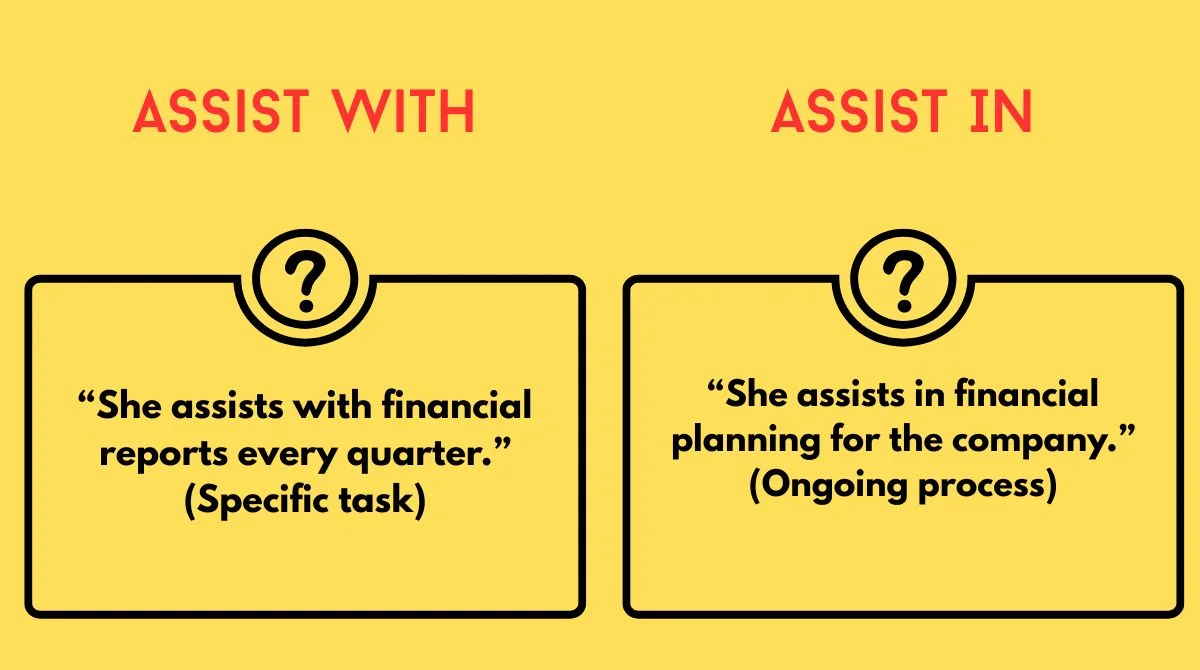
    • Assist With:
      • “She assists with financial reports every quarter.” (Specific task)
    • Assist In:
      • “She assists in financial planning for the company.” (Ongoing process)

    Education & Learning

    • Assist With:
      • “The tutor assisted with math homework.”
    • Assist In:
      • “The tutor assisted in developing a better curriculum.”

    Medical Field

    • Assist With:
      • “The nurse assisted with wound dressing.”
    • Assist In:
      • “The nurse assisted in surgical procedures.”

    By identifying the right context, you’ll always choose the correct phrase.


    FAQs

    1. When should I use “assist with”?

    Use “assist with” when referring to specific tasks, objects, or responsibilities.
    Example: “She assisted with the event decorations.”

    2. When should I use “assist in”?

    Use “assist in” when referring to participation in a process, action, or ongoing effort.
    Example: “He assisted in planning the conference.”

    3. Can “assist with” and “assist in” be used interchangeably?

    Not always. While there is some overlap in informal speech, in formal writing, it’s best to use:

    • “Assist with” for tangible tasks (e.g., reports, equipment, schedules).
    • “Assist in” for abstract processes (e.g., decision-making, policy development).

    4. What’s the grammatical difference between “assist with” and “assist in”?

    • “Assist with” is followed by a noun (task, object, thing).
      • Example: “He assisted with the installation.”
    • “Assist in” is followed by a verb (-ing form) or process.
      • Example: “She assisted in coordinating the event.”

    5. Which phrase is more common in professional settings?

    • “Assist with” is often used in business, healthcare, and technical fields (e.g., “assisting with patient care”).
    • “Assist in” is common in education, legal, and strategic planning (e.g., “assisting in curriculum development”).

    6. How can I quickly decide whether to use “assist with” or “assist in”?

    Use this trick:

    • If it involves a task or object, use “assist with.”
    • If it involves an ongoing action, use “assist in.”
      Example:
      ❌ “Can you assist in the report?” → Sounds unnatural.
      ✅ “Can you assist with the report?” → Correct!

    Conclusion

    Though assist with and assist in are closely related, they serve distinct purposes in the English language. Assist with applies to specific, tangible tasks, while assist in relates to broader processes and actions.

    Key Takeaways:

    • Use assist with when referring to objects or tasks.
    • Use assist in when discussing participation in a process or event.
    • Dictionaries and linguistic data support these distinctions.
    • Context matters—choose the right phrase based on what you’re describing.
  • ⏳ Time Has Flew By or Time Has Flown By? ✅ Grammar Explained Simply

    ⏳ Time Has Flew By or Time Has Flown By? ✅ Grammar Explained Simply

    Have you ever caught yourself saying “Time has flew by” and then paused, wondering if it actually sounds right? You’re not alone. Many English learners—and even native speakers—struggle with irregular verbs, especially when it comes to the tricky difference between “flew” and “flown.”

    The correct phrase is “Time has flown by.” But why is it correct? And why does “Time has flew by” feel so natural in casual speech, even though it’s grammatically wrong?

    This guide will break it all down for you. We’ll explore grammar rules, meanings, synonyms, common mistakes, and even ways to avoid confusion in the future. By the end, you’ll never mix up “flew” and “flown” again.


    Breaking Down the Grammar

    To understand why one version is correct and the other isn’t, let’s look at the verb to fly.

    The Three Main Forms of “Fly”

    Verb FormExample in a SentenceUsage
    Fly (base form)Birds fly across the sky.Present tense
    Flew (simple past)The plane flew over the mountains.Past tense
    Flown (past participle)The birds have flown south for the winter.Used with has/have/had

    The confusion starts when people forget the rule:

    • Simple past (flew) stands alone without helpers.
    • Past participle (flown) always works with has, have, or had.

    So, in the sentence “Time has … by” you need the past participle because you’re pairing it with has.

    👉 Correct: Time has flown by.
    👉 Incorrect: Time has flew by.

    Think of it this way: whenever you use has, your verb must wear its “past participle outfit.”


    What Does “Time Has Flown By” Mean?

    Time Has Flew By or Time Has Flown By

    The phrase is usually figurative—you’re not talking about time literally flying like a bird or an airplane. Instead, you’re expressing how quickly it seems to have passed.

    • When you look back at summer vacation and say, “Wow, time has flown by,” you mean it went by faster than you realized.
    • Parents often use it when watching kids grow up: “It feels like just yesterday you were a baby—time has flown by.”

    Literal vs. Figurative

    • Literal: Birds have flown by the window. (Real physical action)
    • Figurative: Time has flown by this year. (Impression of speed or brevity)

    The figurative version is far more common and is almost always the one people mean.

    Example Sentences

    • “The last three years have flown by since I started this job.”
    • “Summer always feels like it has flown by too quickly.”
    • “The weekend flew by, and now it’s Monday again.”

    Notice how the phrase carries a touch of nostalgia or surprise. It highlights how moments slip away before you even notice.


    Is “Time Has Flew By” Correct?

    In short: No, it’s not correct.

    But here’s why so many people say it anyway:

    Why People Make This Mistake

    • Spoken English feels looser. Many speakers use the past tense in place of the participle without realizing it.
    • Irregular verbs are tricky. English has many verbs like go → went → gone and eat → ate → eaten. If you’ve ever heard someone say “I have went” instead of “I have gone,” it’s the same mistake.
    • Regional influence. Some dialects are more forgiving about swapping verb forms, especially in casual conversation.

    Correct vs. Incorrect in Action

    • ❌ Time has flew by since we last met.
    • ✅ Time has flown by since we last met.

    Grammar rules don’t bend here. If you’re writing, always stick with flown. In casual speech, you might hear “flew,” but that doesn’t make it right.


    Common Confusions and Misspellings

    This expression brings up a few more mistakes worth clearing up.

    Flown Bye vs. Flown By

    Some writers mistakenly type “flown bye” instead of “flown by.”

    • By means “past” or “near.”
    • Bye means “goodbye.”

    So, “Time has flown bye” is completely wrong—it sounds like time is waving at you as it leaves!

    👉 Correct: Time has flown by.

    Similar Mistakes with Irregular Verbs

    Here’s a quick table with other verbs that cause the same type of error:

    VerbSimple PastPast ParticipleWrong ExampleCorrect Example
    GoWentGoneI have went home.I have gone home.
    EatAteEatenShe has ate dinner.She has eaten dinner.
    WriteWroteWrittenHe has wrote a book.He has written a book.
    FlyFlewFlownTime has flew by.Time has flown by.

    The pattern is clear: if you see “has/have/had,” always use the past participle.


    Synonyms and Alternatives for “Time Has Flown By”

    You don’t always need to use this exact phrase. There are plenty of ways to express the same idea depending on your tone.

    Casual Alternatives

    • Time has gone by
    • Time has slipped away
    • The days flew past
    • The months raced by

    Formal Alternatives

    • Time has elapsed
    • Time has passed quickly
    • A significant period has gone by

    Poetic or Figurative Alternatives

    • Time has vanished in the blink of an eye
    • The years melted away
    • Hours dissolved into memories

    Example in Context

    • Formal: “A decade has elapsed since the company’s founding.”
    • Casual: “This summer has slipped away so fast.”
    • Poetic: “The years have melted away like snow in spring.”

    By using synonyms, you can tailor your writing for different audiences—whether it’s a heartfelt message, a professional report, or a piece of creative writing.


    Real-Life Examples of Usage

    This phrase isn’t just for grammar textbooks—it shows up everywhere.

    In Literature

    • “Time has flown by, leaving only the echoes of yesterday.” (Common in reflective writing)

    In Speeches

    • Graduation speeches often include it: “These four years have flown by, but the memories will last forever.”

    In Everyday Conversations

    • Friends catching up: “Can you believe it’s been ten years? Time has flown by.”

    This variety shows how versatile the phrase is—it works in casual, formal, and emotional contexts.


    Quick Recap: Which Should You Use?

    Here’s the takeaway:

    • Correct: Time has flown by.
    • Incorrect: Time has flew by.
    • “Has” demands the past participle, not the simple past.
    • Remember the rule: “has/have/had” → past participle only.

    Think of it like a math formula:

    Has + (Past Participle) = Correct Grammar

    That simple tip will save you from making the same mistake with dozens of irregular verbs.


    ❓ FAQs

    What is correct: Time has flew by or time has flown by?

    The correct form is “Time has flown by.” “Has” requires the past participle “flown,” not the simple past “flew.”

    Why do people say Time has flew by?

    Many people use it in casual speech, but it’s a grammar mistake caused by mixing up the past tense with the past participle.

    What does Time has flown by mean?

    It means time passed quickly, often faster than expected, leaving you surprised at how fast events or moments ended.

    Is Time has flew by ever acceptable?

    No. It may appear in informal speech, but it is never correct in formal writing or standard English grammar.

    What are synonyms for Time has flown by?

    Common alternatives include “time has passed quickly,” “time has slipped away,” “time has raced by,” and “time has gone by.”

    What is the difference between flew and flown?

    Flew is the simple past (The bird flew away), while flown is the past participle used with “has/have/had” (The bird has flown away).


    Conclusion

    Language changes over time, but some grammar rules hold steady. “Time has flown by” is the correct phrase, and it captures a feeling we’ve all experienced—how quickly moments slip away.

    Next time you’re tempted to say “time has flew by,” remember the grammar table, think of other irregular verbs, and you’ll land on the right choice.

    After all, as the saying goes: Time waits for no one, and it certainly flies.

  • Throughout the Years vs Over the Years – What’s the Difference? 🤔📖

    Throughout the Years vs Over the Years – What’s the Difference? 🤔📖

    Language is full of subtle distinctions, and the phrases throughout the years and over the years exemplify this beautifully.

    Though often used interchangeably, these expressions carry nuanced meanings that can impact clarity and emphasis in writing and speech.

    Understanding the differences will refine your linguistic skills and enhance communication.

    Should you say “throughout the years” or “over the years”? While both refer to time, “over the years” suggests gradual change, while “throughout the years” emphasizes consistency. Learn how to use them correctly!

    Throughout the Years vs Over the Years

    The Evolving Story: What Does “Over the Years” Really Mean?

    The phrase over the years suggests a gradual progression or accumulation of events across time. It implies changes, developments, or trends occurring in a broad temporal span.

    Key Characteristics:

    • Implies progression or accumulation over a period.
    • Emphasizes change rather than continuity.
    • Commonly used in narratives discussing evolution or growth.

    Examples:

    1. Over the years, technology has significantly transformed the way we communicate.
    2. Her writing skills improved over the years as she gained more experience.
    3. The city expanded over the years, turning into a bustling metropolis.

    Key Takeaway:

    Use over the years when referring to gradual developments, trends, or accumulated experiences.


    Unchanging Echoes: Understanding “Throughout the Years”

    Unlike over the years, throughout the years emphasizes consistency and persistence rather than change. It denotes something that remained steady across a given time span.

    Key Characteristics:

    • Implies constancy and continuity from the beginning to the end of a period.
    • Best for describing stability, endurance, or recurring events.
    • Often used when emphasizing tradition or persistence.

    Examples:

    1. Throughout the years, she remained dedicated to her craft.
    2. Their friendship endured throughout the years despite many challenges.
    3. The company maintained its high standards throughout the years.

    Key Takeaway:

    Use throughout the years when highlighting consistency, endurance, or sustained presence across time.


    Defining the Constant Nature of “Throughout the Years”

    One way to clearly understand throughout the years is by considering its application in different contexts. It signifies that something persisted over time rather than evolving.

    PhraseImplicationExample
    Throughout the yearsContinuity, endurance“She supported him throughout the years.”
    Over the yearsChange, evolution“His opinions changed over the years.”

    The table highlights that throughout the years keeps its subject in an unbroken timeline, whereas over the years conveys an evolving narrative.


    Usage in American English: Distinguishing Scenarios for “Throughout the Years”

    In American English, both phrases appear in various contexts, but their usage depends on what aspect of time you want to emphasize.

    • Use throughout the years when talking about something that remained constant.
      • Example: “Throughout the years, she has always been a leader.”
    • Use over the years when discussing changes or trends.
      • Example: “Over the years, leadership styles have evolved.”

    Understanding this distinction allows for more precise communication, ensuring that your message aligns with your intended meaning.


    Why “Throughout the Years” Can Still Be Relevant Today

    Some might argue that throughout the years is less commonly used in casual speech compared to over the years. However, it remains highly relevant in certain scenarios:

    1. Historical Narratives: Used when emphasizing a tradition or ongoing presence.
    2. Formal Writing: Found in literature, speeches, and historical discussions.
    3. Emotional Contexts: Emphasizing loyalty, endurance, and consistency.

    While over the years might be more prevalent in casual conversations, throughout the years carries a deeper, more enduring tone suitable for emphasizing steadfastness.


    Comparative Insights: When to Use Each Phrase Correctly

    Let’s break it down further with some practical examples:

    ScenarioUse “Throughout the Years”Use “Over the Years”
    Describing loyalty“She has been a great friend throughout the years.”“She has changed a lot over the years.”
    Discussing historical patterns“Throughout the years, the town has celebrated the same traditions.”“Over the years, the town has modernized.”
    Talking about achievements“His passion for music remained strong throughout the years.”“His musical style evolved over the years.”

    These examples reinforce that throughout is about continuity, while over emphasizes transformation.


    Cultural Reflections: How Phrasing Evolves with Society

    Language changes over time, and certain expressions fall in and out of favor. In modern usage, over the years has become the dominant phrase due to its flexibility in conversations about trends and change. However, throughout the years still holds weight in formal and literary contexts.

    • Pop Culture: You’ll find “over the years” used in news articles, TV shows, and everyday discussions.
    • Literature and History: “Throughout the years” is more commonly seen in books, speeches, and historical narratives.

    Understanding these cultural preferences helps you tailor your phrasing to your audience.


    Analyzing Trends in Language: The Google Ngram Viewer Perspective

    A great way to visualize language trends is through Google Ngram Viewer, which tracks the frequency of words and phrases in published books.

    • A quick search on Google Ngram Viewer shows that over the years has increased significantly in usage since the mid-20th century.
    • Throughout the years, while still in use, has remained relatively stable and is less frequently used in contemporary texts.

    This data supports the idea that over the years is the more commonly used phrase today, yet throughout the years remains valuable in specific contexts.


    Synonyms and Variations: Expanding Your Linguistic Toolkit

    Throughout the Years vs Over the Years

    If you want to avoid repetition, here are some alternative expressions:

    PhraseAlternative Synonyms
    Over the yearsOver time, as time passed, in the past decades
    Throughout the yearsThrough the decades, during this period, from start to finish

    Using these variations can make your writing richer and more engaging.


    FAQs

    What is the difference between “throughout the years” and “over the years”?

    “Throughout the years” emphasizes consistency and persistence, while “over the years” suggests gradual changes or developments over time.

    When should I use “over the years”?

    Use “over the years” when referring to something that has evolved or changed gradually, such as skills, technology, or trends. Example: “Over the years, technology has advanced rapidly.”

    When is “throughout the years” more appropriate?

    Use “throughout the years” when talking about something that has remained constant or persisted over time. Example: “Throughout the years, she has been a dedicated leader.”

    Is “over the years” more common than “throughout the years”?

    Yes, “over the years” is more commonly used in modern conversation and writing, while “throughout the years” is more formal and often appears in literature or historical contexts.

    Can “throughout the years” and “over the years” be used interchangeably?

    Not always. While both refer to time, “throughout the years” implies continuity, whereas “over the years” indicates progression or gradual change.

    Are there synonyms for these phrases?

    Yes! For “over the years,” you can use “over time” or “as time passed.” For “throughout the years,” alternatives include “through the decades” or “from start to finish.”


    Conclusion

    While throughout the years and over the years may seem similar, they serve distinct linguistic functions.

    • Use throughout the years for continuity and endurance.
    • Use over the years for change and evolution.

    By mastering these distinctions, you’ll enhance your precision in writing and speaking, ensuring that your message resonates exactly as intended.

  • Here Is or Here Are 🤔 Which One Is Correct in English Grammar?

    Here Is or Here Are 🤔 Which One Is Correct in English Grammar?

    English grammar can feel like a puzzle, especially when small words make a big difference.

    One of the most common questions learners ask is whether they should say “Here is” or “Here are.” Both are correct, but the trick lies in knowing when to use each one.

    If you’ve ever hesitated before speaking or second-guessed yourself while writing, this guide will clear everything up once and for all.


    Understanding “Here Is” and “Here Are”

    Here Is or Here Are

    At the heart of this question is subject–verb agreement. The word “here” functions as an introductory adverb, pointing to something nearby or calling attention to something. What really determines the verb choice is the subject that follows.

    • “Here is” introduces a singular noun or an uncountable noun.
    • “Here are” introduces a plural noun.

    Think of it like this: the noun after “here” decides the verb.

    Examples:

    • Correct: Here is the book. (singular)
    • Correct: Here are the books. (plural)
    • Correct: Here is the water. (uncountable)

    It’s simple when you see it laid out — but in everyday speech, confusion creeps in. Let’s look at why.


    Why Do People Get Confused?

    Even native speakers sometimes stumble here. Why? A few common reasons:

    • Contractions muddy the waters. “Here’s” is short for “Here is.” People use it in front of plural nouns without noticing: Here’s the keys.
    • Spoken rhythm favors shortcuts. The phrase Here’s the pens rolls off the tongue more easily than Here are the pens.
    • Focus on the first word. Many people look only at “here” instead of the subject that follows.

    This mismatch between grammar rules and natural speech creates the confusion. In writing, especially in formal contexts, the correct version matters more.


    Subject–Verb Agreement Refresher

    Before diving deeper, let’s revisit the rule:

    • A singular subject requires a singular verb → is.
    • A plural subject requires a plural verb → are.
    • An uncountable noun acts like a singular → is.

    Here’s a quick table to make it crystal clear:

    Subject TypeCorrect FormExample
    Singular nounHere isHere is the key.
    Plural nounHere areHere are the keys.
    Uncountable nounHere isHere is the information.
    Collective nounUsually “is”Here is the team.

    Notice how uncountable nouns behave like singulars. You wouldn’t say Here are the water — it’s always Here is the water.


    Countable and Uncountable Nouns in Action

    The difference between countable and uncountable nouns is what really shapes the use of “is” and “are.”

    Countable nouns

    These are items you can count individually. They can be singular or plural.

    • Singular → Here is a cookie.
    • Plural → Here are two cookies.

    Uncountable nouns

    These are things you cannot separate into individual units easily. They take singular verbs.

    • Here is the rice.
    • Here is the advice.

    Edge cases

    • Collective nouns (like team, group, or family) usually take “is” in American English: Here is the team ready to play.
    • But in British English, plural usage is sometimes allowed: Here are the team celebrating their win.

    So, your choice may also depend on which variety of English you’re using.


    Everyday Usage and Style Considerations

    Language in the real world doesn’t always follow strict rules. People bend grammar for speed and convenience.

    The “Here’s” problem

    You’ve probably heard sentences like:

    • Here’s the details you asked for.
    • Here’s my car keys.

    Both are technically wrong, because “details” and “keys” are plural. The correct form should be Here are the details and Here are my car keys.

    Formal vs. informal

    • In formal writing (emails, reports, academic work), always follow the rule.
    • In casual conversation, contractions and shortcuts are widely accepted.

    Think of it this way: a boss reading your email expects “Here are the documents,” not “Here’s the documents.”

    Tip to avoid mistakes

    • Expand contractions in your head. If “Here’s” = “Here is,” you’ll notice when it doesn’t fit.

    Special Cases and Exceptions

    English loves exceptions. Let’s look at some tricky spots.

    “There is / There are” vs. “Here is / Here are”

    Both work the same way, but “there” introduces existence while “here” points to location or immediacy.

    • There is a problem with the engine.
    • Here is the problem we must fix.
    • There are several reasons to reconsider.
    • Here are the reasons we need to talk.

    Lists of nouns

    When a list follows, the first noun matters less than the whole phrase.

    • Here are the pen, notebook, and ruler you requested.
    • Here is the pen and the notebook. (if treated as a single package)

    Pronoun cases

    “Here are they” sounds unnatural. Instead, we usually flip the order: Here they are. Similarly, we say Here it is rather than Here is it.


    Quick Checklist for Writers and Learners

    When you’re unsure, run through this mental checklist:

    • Look at the noun after “here.”
    • Is it singular? Use is.
    • Is it plural? Use are.
    • Is it uncountable? Use is.
    • Collective noun? Usually is in American English, sometimes are in British English.

    Quick examples

    • Here is the report. ✅
    • Here are the reports. ✅
    • Here is the sugar. ✅
    • Here are my friends. ✅
    • Here is the team ready to start. ✅

    Having this checklist in mind will save you from second-guessing yourself.


    Case Study: Common Mistakes in Professional Writing

    Imagine you’re sending an email at work:

    ❌ Here’s the documents you asked for.
    This mistake instantly makes your writing look less polished.

    ✅ Here are the documents you asked for.
    This version shows attention to detail and grammar.

    The difference may feel small, but in professional settings, grammar choices affect how credible and careful you appear. Employers, clients, and colleagues notice these details.


    Memorable Quotes About Grammar

    Sometimes it helps to lighten grammar with a bit of wisdom:

    • “Grammar is the logic of speech, even as logic is the grammar of reason.” — Richard C. Trench
    • “Let’s eat, Grandma!” vs. “Let’s eat Grandma!” — punctuation saves lives. (Popular grammar joke that applies to subject–verb agreement too.)

    These reminders reinforce why correctness matters — it’s about clarity, not nitpicking.


    🙋‍♂️ FAQs

    What is the difference between “here is” and “here are”?

    “Here is” introduces singular or uncountable nouns, while “here are” introduces plural nouns.

    Can I use “here’s” with plural nouns?

    Technically no. “Here’s” = “Here is,” so it should only be used with singular or uncountable nouns, not plurals.

    Why do people say “here’s the keys” if it’s wrong?

    Because in casual speech contractions flow more naturally, even if they break grammar rules.

    Which is correct: “here are the information” or “here is the information”?

    The correct form is “here is the information,” since “information” is an uncountable noun.

    Do British and American English treat “here is” and “here are” differently?

    Mostly no, but in British English, collective nouns sometimes take plural verbs, so you might see “Here are the team.”

    How can I quickly decide whether to use “is” or “are”?

    Look at the noun after “here.” If it’s singular or uncountable, use is. If it’s plural, use are.


    Conclusion: To Wrap Up

    So, which is correct: “Here is” or “Here are”? Both. The choice depends entirely on the subject that follows.

    • Use “Here is” for singular and uncountable nouns.
    • Use “Here are” for plural nouns.

    While casual speech often bends the rule with phrases like Here’s the keys, formal writing demands precision. Mastering this difference will not only sharpen your grammar but also boost your confidence in both professional and personal communication.

    Next time you face this choice, remember: look at the subject, not just the word “here.”