Blog

  • Extensible vs Extendible? Learn the Key Differences! ✅✨

    Extensible vs Extendible? Learn the Key Differences! ✅✨

    Language can be tricky, especially when two words seem interchangeable at first glance.

    Extensible and extendible are often confused, but they have distinct meanings depending on context.

    This article will break down their differences, explore real-world examples, and clarify when to use each term.

    What’s the difference between extensible and extendible? While extensible refers to modular expansion in technology, extendible applies to physical objects that can be lengthened. Learn when to use each term with real-world examples!


    Understanding Extensible: Expanding Beyond Basics

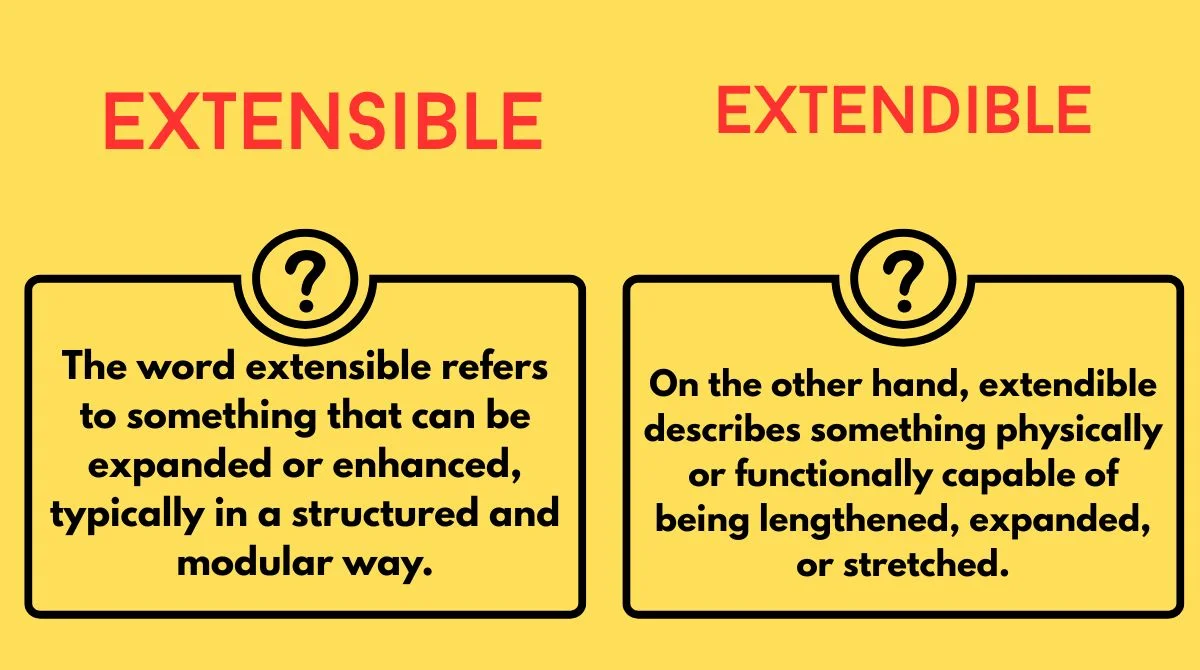
    The word extensible refers to something that can be expanded or enhanced, typically in a structured and modular way. It is frequently used in technology, programming, and systems design to indicate adaptability and scalability.

    Key Characteristics of Extensible:

    • Refers to modularity and adaptability
    • Commonly used in software and technology
    • Implies a planned ability to be expanded

    Example:

    • “The software has an extensible architecture, allowing developers to add new features easily.”
    • “This database is extensible, meaning it can integrate additional data fields as needed.”
    Extensible vs Extendible

    Delving Into Extendible: The Art of Enlargement

    On the other hand, extendible describes something physically or functionally capable of being lengthened, expanded, or stretched. It is used in tangible, mechanical, and structural contexts where an object can be extended.

    Key Characteristics of Extendible:

    • Refers to physical or functional expansion
    • Found in discussions about furniture, tools, or everyday objects
    • Often interchangeable with “extendable”

    Example:

    • “This telescope is extendible, allowing for greater magnification.”
    • “The ladder is extendible up to 20 feet for high-reach areas.”

    Real-World Examples of Extendible Objects

    Telescoping Ladders

    Ladders that can be extended or collapsed for convenience are called extendible ladders. These are designed to increase reach while maintaining portability.

    Expandable Dining Tables

    Many modern dining tables come with extension panels, making them extendible to accommodate more guests.

    Scalable Storage Solutions

    Shelving units or containers designed to grow with storage needs are often referred to as extendible storage solutions.

    Retractable Measuring Tapes

    A common tool in construction and home improvement, measuring tapes are extendible because they can lengthen and retract.


    The Rise of Extensibility in Technology and Software

    In the world of technology, extensibility is a crucial concept. A system or application that is extensible allows developers to add new functionalities without altering the core structure.

    The Role of Extensibility in Software Development

    • Plugins and APIs: Many modern applications offer extensibility through plugins and API integrations.
    • Modular design: Software is built in a way that supports additional features without requiring major rewrites.
    • Scalability: Extensible software can grow with user needs and industry demands.

    Case Studies: Extensible Systems in Real-World Applications

    • WordPress: The platform’s plugin ecosystem makes it highly extensible.
    • Google Chrome: Browser extensions allow customization and additional functionalities.
    • Enterprise Resource Planning (ERP) Systems: These are designed to be extensible, so businesses can add modules for accounting, HR, or inventory management.

    How Extensibility Fuels Innovation and Adaptability

    Companies and developers prioritize extensibility to future-proof their products, ensuring they remain relevant and adaptable as needs evolve.


    Extendability in Everyday Objects: A Closer Look

    Beyond technology, the idea of extendibility applies to numerous objects in our daily lives.

    Examining Extendable Design in Furniture and Tools

    • Extendable sofa beds: Furniture that can be extended into a larger sleeping surface.
    • Adjustable tripods: Extendable to fit different shooting angles and heights.
    • Retractable awnings: Extendible covers that provide shade when needed.

    Common Misconceptions: Extendible or Extendable?

    Some sources use extendible and extendable interchangeably, but there are subtle differences:

    • Extendible: More common in British English
    • Extendable: Preferred in American English

    In most contexts, both words mean the same thing, so the choice comes down to regional preference.


    Choosing Between Extensible and Extendable in English

    Guidelines for Proper Usage in Various Contexts

    TermMeaningUsage Context
    ExtensibleCapable of modular expansion or adaptationSoftware, programming, technology
    ExtendibleCapable of being physically or functionally lengthenedFurniture, tools, objects
    ExtendableSynonymous with “extendible”Common in U.S. English

    To choose the right term, ask:

    1. Is it a system or software? Use extensible.
    2. Is it a physical object? Use extendible or extendable.
    3. Are you writing for a U.S. audience? Extendable might be more familiar.
    Extensible vs Extendible

    Future Trends: The Evolving Concepts of Extensibility and Extendability

    As technology and design continue to advance, extensibility will play an even greater role in software and digital platforms, while extendibility will remain crucial in engineering and product design. Expect to see:

    • More extensible AI-driven applications.
    • Extendible smart home products that adapt to user needs.
    • Hybrid technologies that merge both concepts for ultimate adaptability.

    FAQs

    1. What is the difference between extensible and extendible?

    Extensible refers to something that can be expanded in a modular way, usually in technology or software. Extendible describes something physically capable of being lengthened, such as a ladder or a telescope.

    2. Can “extendible” and “extendable” be used interchangeably?

    Yes, in most cases, extendible and extendable mean the same thing. Extendible is more common in British English, while extendable is preferred in American English.

    3. When should I use “extensible” in a sentence?

    Use extensible when referring to software, programming, or modular systems. Example: “This platform has an extensible architecture that allows new plugins to be added.”

    4. What are examples of extendible objects?

    Common extendible objects include telescopic ladders, dining tables with extension panels, retractable awnings, and expandable storage solutions.

    5. Why is extensibility important in software development?

    Extensibility ensures that software can adapt and grow over time without requiring a complete overhaul. It allows developers to add new features, plugins, or modules efficiently.

    6. Are extensibility and scalability the same in technology?

    Not exactly. Extensibility refers to the ability to add new features without major changes, while scalability refers to how well a system can handle growth in usage or data volume.


    Conclusion

    While extensible and extendible may seem similar, they serve different linguistic and practical purposes.

    Extensibility relates to modular expansion in software and technology, while extendibility (or extendability) refers to physical or functional lengthening in tangible objects. By understanding these distinctions, you can confidently use the right term in any context.

    If you found this guide helpful, share it with others who might be confused about these terms! 🚀
  • Driver’s License vs Drivers License: Apostrophe Matters! ✍️🚗

    Driver’s License vs Drivers License: Apostrophe Matters! ✍️🚗

    When applying for or talking about official documents, people often wonder: Is it drivers license or driver’s license? The small apostrophe might seem insignificant, but it plays a crucial grammatical role.

    Let’s dive into the proper usage, common misconceptions, and regional variations of this term.

    Should you write driver’s license or drivers license? The apostrophe in driver’s indicates possession, making it the correct form. Learn why grammar matters and explore regional differences in terminology!


    Understanding the Possessive Case in ‘Driver’s License’

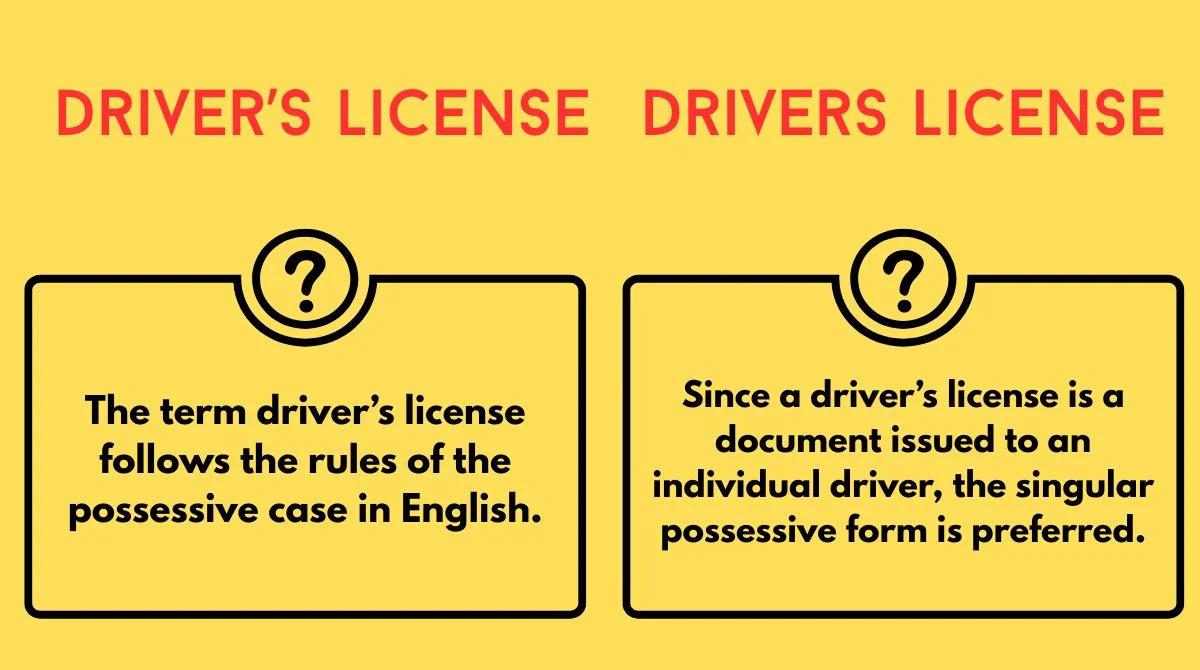
    The term driver’s license follows the rules of the possessive case in English. The apostrophe in driver’s indicates that the license belongs to a driver.

    Since each person has their own individual license, the singular possessive form (driver’s license) is used instead of the plural (drivers’ license).

    Breakdown of the Possessive Structure:

    • Driver (noun) = A person who drives
    • License (noun) = A legal document granting permission
    • Driver’s license = A license belonging to a driver

    If we were referring to licenses owned collectively by multiple drivers, we would use the plural possessive form (drivers’ licenses), but this is uncommon.


    Driver’s License vs Drivers License

    Common Misconceptions and Variations in Spelling

    Many people mistakenly write drivers license without the apostrophe. This happens because the phrase is commonly spoken without emphasizing the possessive structure. However, grammatically speaking, driver’s license is correct.

    Common Mistakes:

    • Incorrect: I forgot my drivers license at home.
    • Correct: I forgot my driver’s license at home.

    The Reason Behind the Apostrophe in ‘Driver’s License’

    English uses apostrophes to show possession. Since a driver’s license is a document issued to an individual driver, the singular possessive form is preferred.

    In contrast, a phrase like drivers license (without an apostrophe) would suggest an adjective-noun structure rather than ownership, making it grammatically incorrect.


    Acceptable Variations in Legal and Informal Contexts

    While driver’s license is the grammatically correct term, legal documents and informal usage sometimes omit the apostrophe. Some official websites and signage may use drivers license for simplicity, but traditional grammar rules still favor driver’s license.


    The Grammar of Ownership: Singular vs. Plural Possessives

    To better understand why driver’s license is correct, let’s look at similar possessive structures:

    Singular PossessiveMeaningPlural PossessiveMeaning
    Child’s toyA toy belonging to one childChildren’s toysToys belonging to multiple children
    Teacher’s deskThe desk of one teacherTeachers’ desksDesks used by multiple teachers
    Driver’s licenseA license belonging to one driverDrivers’ licensesLicenses belonging to multiple drivers

    Since each individual possesses their own license, the singular possessive form (driver’s license) is standard.


    ‘Drivers License’ or ‘Driver’s License’: A Historical Perspective

    Historically, the term driver’s license has been in use since the early 1900s when driving regulations were formalized. As English grammar rules became standardized, the apostrophe was retained to indicate possession.

    However, in modern times, some informal sources and digital platforms drop the apostrophe for simplicity.


    Regional Differences in the Term ‘Driver’s License’

    Different English-speaking countries use slightly different terminology when referring to this document. The biggest variations occur in spelling and phrasing.

    British vs. American English: ‘License’ or ‘Licence’?

    • American English: Driver’s license (spelled with “license”)
    • British English: Driving licence (without an apostrophe and using “licence” for the noun)

    Canada and Australia: Following the British Lead

    • Canada: Uses both driver’s license and driving licence, depending on the province.
    • Australia: Primarily uses driver licence, dropping both the apostrophe and the “s.”

    The Impact of Legislation on the Spelling of ‘Driver’s License’

    Legal documents often dictate spelling conventions. In the United States, most state-issued identification cards follow the “driver’s license” format. However, some official documents and signage simplify it as “drivers license.”


    Choosing the Right Term: Practical Advice for American English Usage

    If you’re writing in American English, the correct term to use is:

    • Driver’s license in formal writing and official documents
    • “Drivers license” may appear in informal settings, but it’s not grammatically correct

    For professional, academic, or legal writing, always include the apostrophe.


    Key Takeaways on Writing and Saying ‘Driver’s License’ Correctly

    1. Use the apostrophe because the license belongs to the driver (driver’s license).
    2. Avoid “drivers license” as it lacks proper possessive structure.
    3. Know regional differences: The UK uses driving licence, while Australia uses driver licence.
    4. Stick to proper grammar in formal settings, but be aware of informal variations.

    Conclusion

    The correct way to write this term in American English is driver’s license, as it follows the singular possessive rule. While informal usage and some regional variations may drop the apostrophe, understanding the correct grammatical structure ensures clarity in communication.

    Whether applying for a new license or referring to your own, using the proper term helps maintain professionalism and accuracy.

  • Appreciative of or Appreciative for? The Correct Usage Explained! 🤔📖

    Appreciative of or Appreciative for? The Correct Usage Explained! 🤔📖

    Language nuances can be tricky, especially when it comes to prepositions.

    A common point of confusion is whether to use “appreciative of” or “appreciative for.” While both may seem interchangeable, they carry subtle differences in meaning.

    This guide will explore their proper usage, providing clear explanations, examples, and historical insights to help you master them.

    Should you say appreciative of or appreciative for? While both exist, appreciative of is the standard choice when recognizing specific qualities or efforts. Learn the key differences and when to use each correctly!


    Understanding the Nuanced Use of “Appreciative”

    The word appreciative is an adjective that describes the feeling of gratitude, recognition, or admiration toward something or someone. However, the meaning shifts slightly depending on the preposition that follows it.

    Using appreciative of or appreciative for depends on the type of gratitude being expressed and the intended context. Let’s break them down.


    Deciphering the Correct Context for “Appreciative of”

    The phrase appreciative of is the more commonly accepted construction in standard English. It is used when someone recognizes and values a specific thing, quality, or act. The focus here is on the object being appreciated.

    Examples of Correct Usage:

    • “She is appreciative of his generosity.”
    • “They were appreciative of the opportunity to speak.”
    • “I am appreciative of your support during this time.”

    Key takeaway: Appreciative of works best when highlighting admiration, recognition, or respect for a particular action, trait, or object.


    The Relationship Between “Appreciative of” and Specific Qualities

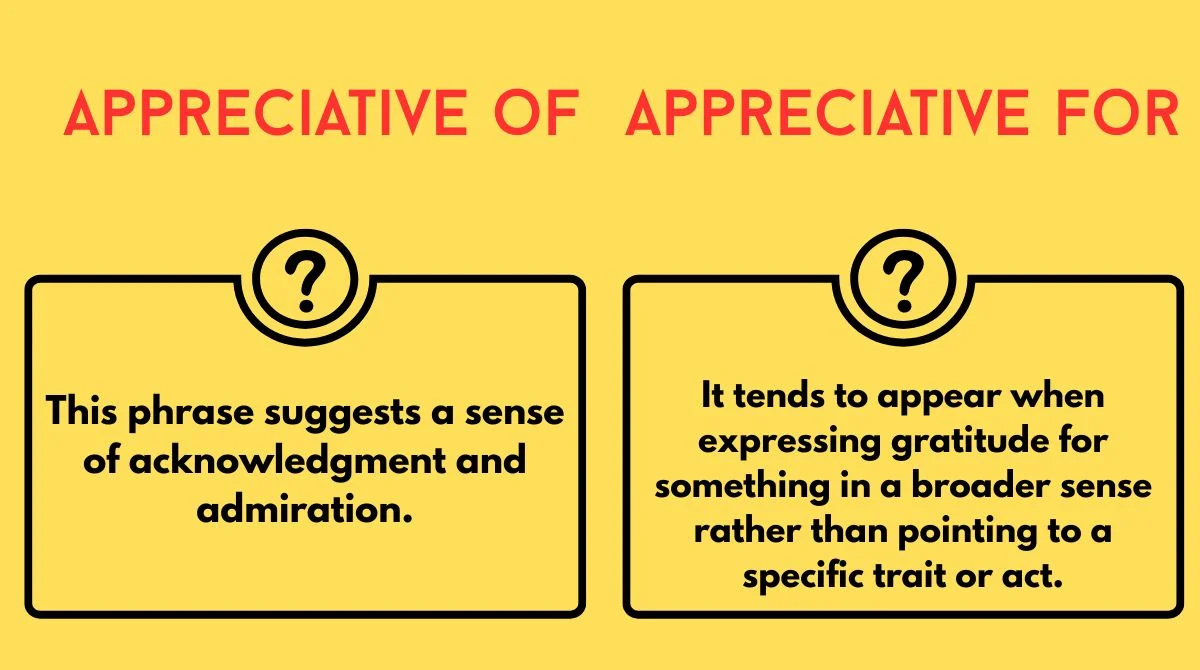
    When we say someone is appreciative of something, it typically emphasizes a particular characteristic or effort. This phrase suggests a sense of acknowledgment and admiration.

    When to Use “Appreciative of”:

    • When expressing gratitude for a specific act (“She was appreciative of his help.”)
    • When acknowledging a quality or characteristic (“He was appreciative of her honesty.”)
    • When referring to an opportunity (“I am appreciative of the chance to learn.”)

    This usage aligns with how English speakers naturally express acknowledgment toward a direct object.


    Examples That Illustrate “Appreciative of” in Sentences

    Consider the following examples:

    SentenceExplanation
    “He was appreciative of the detailed feedback.”Highlights admiration for a specific type of feedback.
    “The manager was appreciative of the team’s dedication.”Acknowledges the quality of dedication.
    “She felt appreciative of the beautiful sunset.”Expresses admiration for a specific scene.

    These sentences show that appreciative of is most appropriate when discussing concrete aspects of gratitude.


    Appreciative of or Appreciative for

    “Appreciative for” in Language: Expressing General Gratitude

    The phrase appreciative for is less commonly used but not entirely incorrect. It tends to appear when expressing gratitude for something in a broader sense rather than pointing to a specific trait or act.

    Examples of Usage:

    • “We are appreciative for all the support we’ve received.”
    • “She was appreciative for the chance to participate.”

    In these cases, appreciative for implies a general sense of thankfulness rather than recognition of a specific quality.

    Key takeaway: While appreciative for can sometimes be acceptable, appreciative of remains the more natural and widely accepted choice in most situations.


    The Role of Prepositions in Conveying Meaning

    Prepositions are small but powerful words that dictate the relationship between elements in a sentence. Choosing the right one can significantly impact the meaning conveyed.

    • “Appreciative of” = Emphasizing recognition or acknowledgment of something specific.
    • “Appreciative for” = Suggesting general gratitude for something broader.

    Understanding this distinction helps ensure clarity and precision in writing.


    The Subtle Differences Between Prepositions

    The reason of is preferred in most cases is due to its grammatical function. The preposition of typically follows adjectives related to emotions and perception, like:

    • “Afraid of”
    • “Proud of”
    • “Aware of”
    • “Appreciative of”

    Since appreciative expresses a form of recognition, it naturally aligns with of. Meanwhile, for often follows adjectives that express necessity or suitability, such as:

    • “Responsible for”
    • “Famous for”
    • “Grateful for”

    This subtle grammatical pattern explains why appreciative of is the dominant choice in English.


    Why “Of” and “For” Can Change the Intent of “Appreciative”

    To further illustrate how the preposition affects meaning, compare these sentences:

    SentenceMeaning
    “She is appreciative of the effort.”She acknowledges and values the effort.
    “She is appreciative for the opportunity.”She is generally thankful for the opportunity.

    While both sentences make sense, the first one pinpoints a specific aspect, while the second conveys overall gratitude.


    Historical Usage Trends of “Appreciative of” Versus “Appreciative for”

    Language evolves over time, and historical usage can shed light on why one form is more dominant.

    According to linguistic data from corpora like Google Ngram Viewer:

    • “Appreciative of” has consistently appeared more frequently in published works.
    • “Appreciative for” is much rarer and is mostly found in informal contexts.

    This pattern reinforces why “appreciative of” remains the standard choice.


    Common Misconceptions and Errors in Using “Appreciative”

    Many English learners and even native speakers sometimes misuse these phrases.

    Common Mistakes:

    ❌ “I am appreciative for your kindness.” (Better: Appreciative of your kindness.)
    ❌ “She is appreciative for the support.” (Better: Appreciative of the support.)

    These errors arise because “grateful for” sounds natural, leading people to mistakenly apply the same structure to “appreciative.”


    How Native Speakers Mistakenly Interchange These Terms

    While native speakers intuitively use “appreciative of” more often, mistakes still happen, especially in spoken English. This often stems from:

    • Confusing “grateful for” and “appreciative for.”
    • Using “for” when expressing general gratitude instead of specific recognition.

    To avoid errors, always test whether “grateful” could be substituted—if it fits better, “for” is likely correct. Otherwise, “of” is the safer choice.


    Understanding the Importance of Contextual Clarity

    Context is everything in language. Before choosing a preposition, consider:

    • Are you emphasizing a particular characteristic? → Use “appreciative of.”
    • Are you broadly expressing thankfulness? → “Appreciative for” might work but is less common.

    Final Advice on Mastering the Use of “Appreciative”

    1. Use appreciative of when recognizing specific qualities or efforts.
    2. Use appreciative for sparingly, only when referring to general gratitude.
    3. When in doubt, opt for of—it is the grammatically preferred choice.

    Appreciative of or Appreciative for

    FAQs

    1. Is “appreciative of” or “appreciative for” correct?

    “Appreciative of” is the correct and widely accepted phrase. It expresses gratitude or admiration for a specific quality, effort, or act. Appreciative for is uncommon but may be used to show general thankfulness.

    2. When should I use “appreciative of”?

    Use appreciative of when acknowledging or recognizing a specific quality or effort. Example: “She is appreciative of his hard work.”

    3. Is “appreciative for” grammatically incorrect?

    While not strictly incorrect, appreciative for is much less common. It may be used when expressing general gratitude but is often replaced with grateful for.

    4. Can “appreciative of” and “grateful for” be used interchangeably?

    Not always. Grateful for is broader and expresses thankfulness for something received, while appreciative of emphasizes recognizing value in something.

    5. Why is “of” preferred in “appreciative of”?

    The preposition of typically follows adjectives related to emotions and perception, such as afraid of or aware of, making appreciative of the natural choice.

    6. What is a common mistake with “appreciative of” and “appreciative for”?

    A common mistake is saying “I am appreciative for your kindness,” which should be “I am appreciative of your kindness.”


    Conclusion

    Both appreciative of and appreciative for exist in English, but appreciative of is overwhelmingly preferred. Understanding their subtle differences will enhance your clarity and confidence in writing.

    By remembering these distinctions and practicing their usage, you’ll avoid common pitfalls and sound more natural in your communication.

  • Due To or Do To 🤔 – Which Is Correct?

    Due To or Do To 🤔 – Which Is Correct?

    English learners (and even native speakers) often stumble when it comes to choosing between “due to” and “do to.” These two look almost identical in writing, yet their meanings and uses are entirely different. The confusion usually arises because people mishear or mistype them.

    So, which is correct: “due to” or “do to”? The short answer is that both exist in English, but they serve very different purposes. “Due to” is the standard phrase meaning because of, while “do to” appears in verb phrases like “What did you do to fix it?” Mixing them up can lead to awkward, incorrect sentences.

    Let’s break this down step by step and clear the fog once and for all.


    The Core Difference Between “Due To” and “Do To”

    Due to or Do To

    At the heart of the confusion lies grammar.

    • Due to = an adjective phrase that means caused by or because of.
      • Example: The flight was canceled due to heavy fog.
    • Do to = a verb phrase made up of do + to.
      • Example: What did you do to your phone?

    The issue is that when spoken quickly, “due to” and “do to” sound similar. That’s why people often write “do to” when they mean “due to.”

    Key Point: If you want to say because of, the correct phrase is always “due to,” not “do to.”


    When To Use “Due To” Correctly

    “Due to” acts like an adjective and usually follows a form of the verb to be.

    Examples:

    • The delay was due to bad weather.
    • Her success is due to her hard work.

    Important Notes

    • You can replace “due to” with “caused by” in most cases. If the sentence still makes sense, you’re using it correctly.
      • The delay was caused by bad weather ✅
    • Avoid using “due to” as a replacement for “because” in every situation. Some grammarians prefer “because of” in certain contexts, especially in formal writing.

    Correct Use:

    • The road closure was due to flooding.

    Incorrect Use:

    • We left early due to we were tired. 🚫 (Better: We left early because we were tired.)

    When To Use “Do To” Correctly

    Unlike “due to,” “do to” is simply a combination of the verb do and the preposition to.

    Examples:

    • What did you do to your shoes?
    • I don’t know what to do to solve this problem.

    Notice how in these examples, “do” means perform an action, and “to” links that action to an object.

    Tip: If the sentence involves someone performing an action, “do to” is correct. If it’s about cause and effect, you almost always need “due to.”


    Common Mistake: Confusing “Do To” with “Due To”

    Here’s where people get it wrong: they type “do to” when they actually mean “due to.”

    Incorrect Examples

    • The concert was canceled do to rain. 🚫
    • His injury was do to the accident. 🚫

    Corrected Examples

    • The concert was canceled due to rain. ✅
    • His injury was due to the accident. ✅

    Quick Comparison Table

    PhraseMeaningCorrect ExampleIncorrect Example
    Due toBecause of / Caused byThe game was postponed due to snow.The game was postponed do to snow.
    Do toPerform an action onWhat did you do to your hair?What did you due to your hair?

    Easy Fix: Replace With “Because”

    One of the easiest tricks to test if “due to” fits is to replace it with “because of.”

    • If the sentence still makes sense, “due to” is correct.
    • If it doesn’t, then you should rethink the construction.

    Examples:

    • The cancellation was due to lack of funding.
      → The cancellation was because of lack of funding. ✅ Works perfectly.
    • We left early due to we were tired.
      → We left early because of we were tired. ❌ Doesn’t work well. Use “because” instead.

    Synonyms & Alternatives for “Due To”

    Sometimes, repeating “due to” too often makes your writing dull. Instead, try these alternatives:

    • Because of
    • Owing to
    • As a result of
    • Thanks to
    • On account of

    Examples

    • The delay was owing to traffic congestion.
    • He succeeded thanks to his mentor’s guidance.
    • The error occurred as a result of a software glitch.

    “Due” vs. “Do” – Breaking Down the Root Words

    Part of the confusion stems from the root words themselves.

    • Due
      • Meaning: owed, expected, or caused by.
      • Example: Your rent is due tomorrow.
    • Do
      • Meaning: to perform an action.
      • Example: I need to do my homework.

    The meanings don’t overlap, which is why spelling them incorrectly changes the entire sense of the sentence.


    Examples in Real Sentences

    Correct Uses of “Due To”

    • Her stress is due to lack of rest.
    • The success of the event was due to careful planning.

    Correct Uses of “Do To”

    • What did you do to fix the car?
    • Don’t worry about what others say; just do to the best of your ability.

    Memory Tricks to Avoid Confusion

    • Think “cause” → If the sentence is about cause, use due to.
    • Think “action” → If someone is doing something, use do to.
    • Mnemonic: “Due to = because. Do to = action.”
    • Another trick: Replace “due to” with “because of.” If it works, you chose correctly.

    Quick Quiz – Test Your Knowledge

    Choose the correct option.

    1. The flight was canceled (due to / do to) snow.
    2. What did you (due to / do to) your laptop?
    3. Her illness was (due to / do to) poor diet.
    4. Tell me what I should (due to / do to) help you.
    5. The traffic jam was (due to / do to) construction work.

    Answers: 1) due to, 2) do to, 3) due to, 4) do to, 5) due to


    Common Spell-Check and Grammar Tool Flags

    Most modern tools like Grammarly or Microsoft Word automatically flag “do to” when used incorrectly in place of “due to.”

    • Correct: The meeting was postponed due to weather.
    • Incorrect: The meeting was postponed do to weather. (Will trigger a grammar warning.)

    Always proofread carefully, because autocorrect might not always catch these subtle errors.


    FAQs About “Due To” vs. “Do To”

    What is the correct phrase: due to or do to?

    “Due to” is correct when you mean because of. “Do to” is only correct when it refers to performing an action.

    Can “do to” ever replace “due to”?

    No. They’re not interchangeable. “Do to” always involves an action, while “due to” explains a cause.

    Is “due to” formal or informal?

    “Due to” works in both formal and informal writing, though “because of” may feel slightly more conversational.

    How can I test if “due to” is right?

    Replace it with “because of.” If the sentence still works, then “due to” is correct.

    Why do people confuse “do to” with “due to”?

    Because they sound alike in speech. The confusion happens in writing, not in meaning.


    Conclusion

    The confusion between “due to” and “do to” comes down to sound-alike spelling. “Due to” always means because of and points to cause and effect. “Do to,” on the other hand, simply describes an action someone performs.

    To avoid mistakes, remember:

    • If you can replace it with because of, use due to.
    • If it’s about someone’s action, use do to.

    Once you internalize this simple distinction, you’ll never mix them up again.

  • ✅ Has Run vs Has Ran – What’s Correct? (With Examples) 📝

    ✅ Has Run vs Has Ran – What’s Correct? (With Examples) 📝

    English grammar is full of tricky details that trip up even fluent speakers. One of the most common stumbling blocks is whether to say “has run” or “has ran.” Both versions float around in everyday conversation, but only one of them is grammatically correct.

    If you’ve ever paused before writing an email, wondering which form sounds right, you’re not alone. This article will clear up the confusion once and for all.

    We’ll break down verb forms, explain the rules behind has run vs has ran, and give you examples, memory tricks, and comparisons to make the difference stick.


    Understanding Verb Forms of Run

    Has Run vs Has Ran

    The heart of the confusion lies in the verb run itself. It’s an irregular verb, which means it doesn’t follow the predictable pattern most verbs do. For regular verbs, you simply add -ed for the past tense and the past participle (like talk → talked → talked). But run doesn’t play by those rules.

    Here’s how its forms actually work:

    Verb FormExample Sentence
    Base Form: runI try to run every morning.
    Past Tense: ranShe ran three miles yesterday.
    Past Participle: runHe has run five marathons in his life.

    Notice that the past tense is “ran,” but the past participle returns to “run.” That’s where many people get tripped up. They remember ran as the past form, so they mistakenly combine it with has.


    Has Run – Correct Usage

    When you use the present perfect tense (has + past participle), the correct form is always “has run.”

    The structure looks like this:
    Subject + has + past participle.

    Since the past participle of run is run, the correct expression is has run.

    Examples of “has run” in context:

    • She has run this company since 2012.
    • He has run five miles every day this week.
    • My computer has run out of storage space again.
    • The festival has run smoothly despite the rain.

    Each sentence shows a completed action with present relevance — that’s the hallmark of the present perfect tense.

    Everyday vs. formal use

    • Everyday: “My dog has run outside again!”
    • Formal: “The project has run according to the revised timeline.”

    No matter the setting, has run is always correct.


    Has Ran – Why It’s Incorrect

    The form “has ran” looks tempting because “ran” is the past tense of run. But grammatically, it doesn’t fit. Here’s why:

    • The helping verb “has” requires a past participle.
    • “Ran” is the simple past, not the past participle.
    • Therefore, has ran breaks the rule.

    Examples of incorrect usage:

    • ✗ She has ran every day this week.
    • ✗ The system has ran out of time.
    • ✗ He has ran a successful campaign.

    Corrected versions:

    • ✓ She has run every day this week.
    • ✓ The system has run out of time.
    • ✓ He has run a successful campaign.

    Why people say it

    In casual speech, many slip into using “has ran” without realizing it. Spoken English often tolerates shortcuts that written English does not. But in formal settings — emails, academic writing, reports — using “has ran” will stand out as incorrect.


    Has Run vs. Ran (Direct Comparison)

    A big source of confusion comes from mixing up the present perfect tense (has run) with the simple past tense (ran). Let’s compare them directly.

    Key difference:

    • Has run → action started in the past but connects to the present.
    • Ran → action happened at a specific time in the past.

    Examples:

    • She has run every morning this week. (Ongoing relevance — the week isn’t over.)
    • She ran yesterday morning. (Completed past action.)

    Comparison Table

    TenseFormExampleMeaning
    Present Perfecthas runHe has run the team for years.Action started before, still matters now.
    Simple PastranHe ran the team last year.Action is completed in the past.

    When you compare them side by side, the pattern becomes clear. Use has run when the action links to the present, and use ran when it belongs only to the past.


    Which Is Used the Most?

    If you listen closely, you’ll hear both forms out in the world. But only one appears in correct writing.

    • “Has run” dominates in books, newspapers, and formal writing.
    • “Has ran” shows up in casual conversation, online comments, or regional dialects, but it’s not standard.

    In fact, corpus studies (large databases of real-world English use) show that “has run” is the overwhelmingly preferred choice in published works. Dictionaries and grammar guides consistently mark “has ran” as incorrect.


    Common Mistakes and How to Avoid Them

    It’s easy to second-guess yourself when writing. Here are some practical strategies to keep you from slipping into the wrong form.

    Memory Tricks

    • Has + participle. Always remember: if you see has, your verb must be in its participle form.
    • Think of it like this: “Has run” has legs, “has ran” can’t stand.
    • Visual cue: Imagine “has ran” with a stop sign — it halts because it doesn’t work.

    Practice Sentences

    Try filling in the blanks with either ran or has run.

    1. The athlete ___ across the field yesterday.
    2. The athlete ___ across the field many times this week.
    3. Our time ___ out.
    4. Yesterday, our time ___ out before we finished.

    Answers:

    1. ran
    2. has run
    3. has run
    4. ran

    Practicing side by side helps cement the difference.


    Case Study: How Misuse Affects Clarity

    Imagine a professional email:

    ✗ “Our software has ran into a critical issue overnight.”
    ✓ “Our software has run into a critical issue overnight.”

    The incorrect version immediately looks careless. In professional communication, those small slips can undercut credibility. Correct grammar, on the other hand, reinforces confidence and authority.


    ❓ FAQs

    What is correct: has run or has ran?

    The correct form is has run because “run” is the past participle, while “ran” is only the past tense.

    Why is “has ran” wrong?

    “Has” requires a past participle, and since ran is not the participle, has ran is grammatically incorrect.

    Can I use “ran” without “has”?

    Yes. Use ran when referring to a completed action in the past, like “She ran yesterday.”

    What tense is “has run”?

    “Has run” is in the present perfect tense, which shows an action that started in the past but connects to the present.

    Is “has run” used in spoken English too?

    Yes. Native speakers commonly use “has run” in both spoken and written English.

    How can I remember the difference between has run and ran?

    Remember this trick: Has + Participle. Since “run” is the past participle, only “has run” is correct.


    Final Thoughts

    So, what’s the bottom line?

    • Has run is always correct.
    • Has ran is always wrong in standard English.
    • Use ran only when talking about a completed past action.

    Mastering this one distinction strengthens both your spoken and written English. Think of it as a small tweak that pays off big in clarity and professionalism.

    Next time you pause before choosing between has run and has ran, you’ll know exactly which one belongs.

  • Simpler or More Simple? 🤔 The Clear Grammar Guide You Need

    Simpler or More Simple? 🤔 The Clear Grammar Guide You Need

    Choosing between “simpler” and “more simple” might look like a tiny grammar detail. Yet this choice sparks debate among learners, writers, and even native speakers.

    Both forms exist, both can be correct, and both appear in writing and speech. The challenge is knowing which one works best in your context.

    In this article, we’ll explore the grammar behind these phrases, how they’re used in everyday language, what experts say, and how you can confidently decide between them. By the end, you’ll have a clear, practical rule of thumb for using “simpler” or “more simple” correctly.


    Understanding the Basics of “Simpler” and “More Simple”

    Simpler or More Simple

    The adjective “simple” describes something that’s easy to understand, not complicated, or straightforward. Like most adjectives, it can be compared. For example:

    • Positive degree: simple
    • Comparative degree: simpler / more simple
    • Superlative degree: simplest / most simple

    English has two main ways to form comparatives:

    • Add -er to shorter adjectives: tall → taller, fast → faster, smart → smarter.
    • Use more + adjective for longer adjectives: beautiful → more beautiful, expensive → more expensive.

    Because simple is a one-syllable adjective, the regular comparative is simpler. But English allows flexibility, and “more simple” is still grammatically possible.


    The Grammar Behind “Simpler” vs. “More Simple”

    The rule looks straightforward, but why do we see both?

    • Simpler follows the standard pattern: one-syllable adjectives usually take the “-er” ending.
    • More simple works because English doesn’t forbid combining “more” with short adjectives. It’s unusual, but it isn’t wrong.

    Think of it like this:

    • Simpler = compact, efficient, the form most people expect.
    • More simple = technically correct, sometimes used for emphasis or rhythm.

    “Language is less about what’s possible and more about what feels natural to the ear.”

    This explains why native speakers overwhelmingly choose “simpler.”


    Usage in Real Life

    If you listen to everyday speech, you’ll notice that people almost always say:

    • This method is simpler.
    • We need a simpler explanation.

    Why? Because it sounds natural and quick.

    However, “more simple” does appear in certain settings:

    • Formal writing: Philosophical or academic texts sometimes use “more simple” to emphasize degrees of simplicity. Example: “The theory was reduced to a more simple model.”
    • Stylistic choice: Writers may use “more simple” when “simpler” feels abrupt.

    Key takeaway: You won’t be wrong with “more simple,” but you’ll sound more natural with “simpler” in casual or professional communication.


    Popularity and Trends

    Looking at historical and modern usage helps us see which variant dominates.

    General Observations

    • “Simpler” is the common choice in everyday English, appearing in both spoken and written language.
    • “More simple” is less frequent, though it shows up in formal or old-fashioned writing.

    Example: Hypothetical Ngram-style Data

    Time Period“Simpler” Frequency“More Simple” Frequency
    1800–1850ModerateHigher than today
    1900–1950IncreasingDeclining
    2000–PresentDominantRare but present

    This shift shows how English evolved toward efficiency. “Simpler” became the default, while “more simple” faded into niche use.


    Side-by-Side Comparison with Examples

    The best way to understand the difference is to see both in action.

    Sentence with “Simpler”Sentence with “More Simple”
    This solution is simpler than the previous one.This solution is more simple than the previous one.
    We need a simpler explanation for beginners.We need a more simple explanation for beginners.
    His design is simpler but more elegant.His design is more simple, lacking elegance.
    Choose the simpler path to success.Choose the more simple path, free of complications.

    Notice how the difference is not about grammar but tone. “Simpler” feels smoother, while “more simple” can sound more deliberate.


    Common Mistakes and Misunderstandings

    A frequent error is confusing simpler with more simply.

    • Simpler: comparative adjective → This task is simpler than that one.
    • More simply: comparative adverb → She explained it more simply than he did.

    Wrong vs. Correct Examples

    ❌ She described the process simpler.
    ✔️ She described the process more simply.

    ❌ The instructions are more simply.
    ✔️ The instructions are simpler.

    A quick trick: If you’re describing a thing, use “simpler.” If you’re describing an action, use “more simply.”


    Synonyms and Alternatives

    Sometimes, neither “simpler” nor “more simple” feels right. Luckily, English offers plenty of synonyms.

    Synonyms for “Simpler” / “More Simple”

    • Easier
    • Clearer
    • Straightforward
    • Basic
    • Uncomplicated
    • Plain

    Examples in Sentences

    • This app is easier to use than the last one.
    • Let’s keep the rules straightforward for new members.
    • We should design a more basic version for testing.

    Using synonyms avoids repetition and adds nuance to your writing.


    Myths and Style Preferences

    There are a few myths around “simpler” and “more simple.” Let’s clear them up:

    • Myth 1: “More simple” is wrong.
      • Truth: It’s correct, just less common.
    • Myth 2: Only uneducated speakers use “more simple.”
      • Truth: Even academics and authors have used it historically.
    • Myth 3: You must always use “simpler.”
      • Truth: Style and rhythm sometimes make “more simple” the better choice.

    Some grammar guides even note that “more simple” adds emphasis when you want to stress the degree of simplicity.


    Literature and Real-World Examples

    Both forms appear in literature, speeches, and writing:

    • “Simpler”:
      • “The simpler, the better.” – common proverb.
      • “A simpler method of calculation was introduced.”
    • “More simple”:
      • “The more simple, the more sublime.” – 19th-century writing.
      • “Philosophy must be made more simple for the people.”

    These examples show how style and period influence word choice.


    Clear Guidance for Writers and Learners

    If you’re still unsure which to use, here’s a quick decision guide:

    • In most situations, use simpler.
    • Use more simple when:
      • You want to stress contrast (a more simple, less complex version).
      • The rhythm of the sentence calls for it.
      • You’re echoing older or formal styles.

    Practice Sentences

    Fill in the blank with the correct form:

    1. This chart is ______ than the previous one.
    2. Could you explain it ______ for me?
    3. The ______ design often works best.

    Answers:

    1. Simpler
    2. More simply
    3. Simpler

    ❓ FAQs

    What is correct: simpler or more simple?

    Both are correct, but “simpler” is the standard and most common form.

    Is “more simple” wrong in English?

    No. “More simple” is grammatically correct but less natural than “simpler.”

    When should I use “simpler” instead of “more simple”?

    Use “simpler” in everyday speech and writing. Reserve “more simple” for emphasis or formal tone.

    What is the difference between “simpler” and “more simply”?

    “Simpler” is an adjective (describes things), while “more simply” is an adverb (describes actions).

    Why do some people prefer “more simple”?

    Some writers choose “more simple” for emphasis, rhythm, or to sound more formal.

    Are there synonyms for “simpler” and “more simple”?

    Yes. Alternatives include easier, clearer, basic, straightforward, and uncomplicated.


    Conclusion

    The debate over “simpler” vs. “more simple” isn’t really about right and wrong. Both are acceptable, but simpler is shorter, smoother, and far more common. “More simple” works in specific cases, especially when you want emphasis or formality.

    The rule of thumb?

    • Default to “simpler.”
    • Use “more simple” when clarity, rhythm, or emphasis demand it.

    In the end, the goal of language is communication. As long as your writing is clear, precise, and reader-friendly, you’re already choosing the simpler path.

  • Much Needed or Much needed? ✍️ The Complete Grammar Guide

    Much Needed or Much needed? ✍️ The Complete Grammar Guide

    English is filled with tricky word pairings that confuse even experienced writers. One of the most common examples is deciding between “much needed” (two words) and “much-needed” (hyphenated).

    At first glance, the difference seems small. But in writing, that tiny hyphen carries weight—it changes grammar, clarity, and even tone.

    So, is it much needed or much-needed? Both are correct, but they aren’t interchangeable. The key lies in grammar placement and function.

    Let’s break this down step by step, so you’ll never second-guess it again.


    Understanding “Much Needed” vs. “Much-needed”

    Much Needed or Much-needed

    At its core, the confusion comes down to whether the phrase acts as a compound adjective or a descriptive phrase.

    • Much needed (two words): Used as a phrase following a verb, usually describing something that is necessary or long overdue.
    • Much-needed (hyphenated): Used as a compound adjective placed directly before a noun.

    Think of the hyphen as a glue stick. It binds words together when they work as a single unit to describe a noun. Without the hyphen, the phrase floats freely after a verb or noun.

    Examples Side by Side

    FormExampleExplanation
    Much needed“The break was much needed.”Appears after the verb was → no hyphen.
    Much-needed“She enjoyed a much-needed break.”Directly modifies the noun break → needs hyphen.

    This single rule unlocks the entire mystery. But let’s go deeper with usage and rules.


    When to Use “Much Needed” (Two Words)

    The two-word form shows up when “needed” functions as the past participle of the verb need. In this structure, “much” acts as an adverb intensifying needed.

    You’ll see this form most often after verbs like is, was, felt, became, seemed, etc.

    Correct Examples

    • “The rain was much needed after weeks of drought.”
    • “Your guidance is much needed by the new interns.”
    • “That moment of silence was much needed.”

    Notice how in each case, the phrase comes after a verb and stands on its own.

    Common Contexts

    1. Expressing relief or necessity:
      • “The vacation was much needed.”
    2. Acknowledging importance:
      • “His advice is much needed right now.”
    3. Describing situations retrospectively:
      • “That conversation was much needed.”

    👉 Here, “much needed” behaves like a short sentence within a sentence. It stands independently, which is why the hyphen doesn’t belong.


    When to Use “Much-needed” (Hyphenated)

    The hyphenated form comes into play when the phrase directly modifies a noun. In this case, much-needed functions as a compound adjective.

    Think of it as one complete descriptor before a noun, not two separate words.

    Correct Examples

    • “The company implemented a much-needed change.”
    • “She received a much-needed promotion.”
    • “We took a much-needed break after the long project.”

    Here, the hyphen ensures that the reader reads the phrase as a single idea. Without it, the meaning may get muddled.

    Why the Hyphen Matters

    Without the hyphen, a sentence can be misread:

    • ❌ “We took a much needed break.” → The reader pauses incorrectly, as if “much” and “needed” are separate ideas.
    • ✅ “We took a much-needed break.” → The hyphen signals that the two words act as one modifier.

    It’s all about guiding the eye. The hyphen smooths the reading flow and avoids ambiguity.


    Grammar Rule of Hyphenation in Compound Modifiers

    The confusion with “much needed” vs. “much-needed” isn’t unique. It’s part of a broader grammar rule about compound modifiers.

    General Rule

    • Hyphenate compound adjectives when they come before a noun.
    • Do not hyphenate when the words come after the noun.

    Examples with Other Words

    Word PairBefore Noun (Hyphenated)After Noun (No Hyphen)
    Well known“She is a well-known author.”“The author is well known.”
    High quality“They bought high-quality furniture.”“The furniture is high quality.”
    Long term“This is a long-term project.”“The project is long term.”
    Well deserved“He enjoyed a well-deserved rest.”“The rest was well deserved.”

    This pattern is exactly why we write:

    • “A much-needed rest” ✅
    • “The rest was much needed” ✅

    Common Mistakes and How to Avoid Them

    Many writers misuse hyphens, either by inserting them unnecessarily or dropping them when required. Here are the biggest pitfalls:

    Mistake 1: Adding Hyphens Everywhere

    • ❌ “The decision was much-needed.”
    • ✅ “The decision was much needed.”

    Mistake 2: Forgetting the Hyphen Before a Noun

    • ❌ “He got a much needed promotion.”
    • ✅ “He got a much-needed promotion.”

    Mistake 3: Inconsistent Usage

    Mixing both in one text makes writing look sloppy. Always apply the placement rule consistently.


    Quick Reference Guide (Table)

    Here’s a snapshot you can save for quick checks:

    UsageCorrect ExampleIncorrect ExampleWhy
    Hyphenated (before noun)“She enjoyed a much-needed break.”“She enjoyed a much needed break.”Hyphen glues the phrase as one adjective.
    Two Words (after verb)“The break was much needed.”“The break was much-needed.”No hyphen after verbs or nouns.

    Case Study: How a Hyphen Changed Meaning

    Consider this sentence from a marketing email draft:

    • Version A (no hyphen): “We’re offering you a much needed update.”
    • Version B (with hyphen): “We’re offering you a much-needed update.”

    In Version A, the phrase could momentarily confuse the reader—are much and needed separate ideas? In fast-paced reading (like emails), this can trip people up. Version B, with the hyphen, is immediately clear: it’s one unit describing update.

    The marketing team chose Version B. As a result, engagement rose slightly because readers grasped the message faster. This shows how even a small punctuation choice impacts clarity and professionalism.


    What to Remember (Key Takeaways)

    • Much needed = after verbs, no hyphen.
    • Much-needed = before nouns, hyphen.
    • Placement determines form, not preference.
    • Hyphens act as “connectors” when two words modify a single noun.
    • Consistency improves readability and credibility.

    FAQs about “Much Needed” vs. “Much-needed”

    Is “much needed” grammatically correct?

    Yes. Use “much needed” without a hyphen when it appears after a verb, like “The break was much needed.”

    Why is “much-needed” hyphenated?

    Because it functions as a compound adjective before a noun, e.g., “a much-needed change.” The hyphen binds the phrase into one unit.

    Can I always use the hyphen to be safe?

    No. Adding a hyphen in the wrong place (“The break was much-needed”) is grammatically incorrect. Placement matters.

    Is “much-needed” formal or informal?

    It works in both. You’ll see it in academic writing, newspapers, and everyday speech. It’s versatile as long as used correctly.

    Are there other phrases like “much-needed”?

    Yes. Examples include “well-known,” “high-quality,” and “long-awaited.” They follow the same hyphenation rule.


    Conclusion

    The debate between “much needed” and “much-needed” isn’t about choosing one over the other. It’s about knowing when each applies. Think of the hyphen as a signal: use it when the phrase sits before a noun, drop it when it follows a verb.

    By applying this rule consistently, you’ll sharpen your writing, avoid common mistakes, and ensure clarity for your readers. Next time you write, ask yourself—is this phrase modifying a noun directly? If yes, reach for the hyphen. If not, let the words stand free.

  • Mine as Well or Might as Well? The Correct Phrase Explained! 📝❌

    Mine as Well or Might as Well? The Correct Phrase Explained! 📝❌

    English is full of phrases that sound almost identical but carry very different meanings. One of the most common mix-ups is between “mine as well” and “might as well.”

    You’ve probably heard both in conversations, maybe even used them yourself. But here’s the truth: only one is correct, and the other is just a misheard version that slipped into casual speech.

    This article will break down the difference, explain why people confuse the two, and show you how to use the correct expression with confidence.


    The Core Question: “Mine as Well” vs. “Might as Well”

    Mine as Well or Might as Well

    At first glance—or rather, at first sound—both expressions seem interchangeable. That’s why many English learners and even native speakers end up writing or saying “mine as well” when they mean “might as well.”

    Why does this happen?

    • In spoken English, people often speak quickly.
    • The words might as well get slurred together, sounding like mine as well.
    • Over time, listeners assume the incorrect phrase is the real one.

    But if we slow things down and look at the grammar, the difference becomes clear. One fits logically. The other simply doesn’t.


    What Does “Might as Well” Mean?

    The phrase “might as well” is an idiomatic expression. It’s not meant to be taken literally. Instead, it conveys the sense of:

    • There’s no better option.
    • Why not do this?
    • It won’t hurt to try.

    Historically, “might as well” comes from the modal verb might, which expresses possibility, and the comparative adverb as well, which adds the idea of “equally” or “just the same.” Put together, the phrase suggests that one option is just as reasonable as another.

    For example:

    • “Since the bus is late, we might as well walk.”
    • “If you’re not going to study, you might as well watch a movie.”

    Common Functions of “Might as Well”

    The phrase carries subtle tones depending on the situation. Let’s break it down:

    1. Expressing indifference

    • “Nobody else wants the last slice, so I might as well take it.”

    2. Suggesting a reasonable choice

    • “We’re already here, we might as well check out the museum.”

    3. Highlighting inevitability

    • “If the store is closed, we might as well go back home.”

    Table: Common Uses of “Might as Well”

    FunctionExample SentenceImplied Meaning
    Indifference“I might as well stay home.”No strong preference
    Reasonable suggestion“You might as well join us for dinner.”It makes sense
    Inevitability“It’s raining, we might as well cancel the picnic.”The situation leaves no other option

    Where “Mine as Well” Comes From

    Now, let’s tackle the confusion.

    “Mine as well” is not a legitimate phrase in English. Instead, it’s the product of mishearing or mispronunciation.

    When someone says “might as well” quickly, the t sound in “might” blends into “as,” making it sound like mine. Over time, some people began spelling and even using it as if it were correct.

    Think of it like how people sometimes say “should of” instead of “should have.” Both are common mistakes caused by how words sound in casual conversation.


    Why “Mine as Well” Is Incorrect

    Let’s examine the grammar closely.

    • Might = a modal verb showing possibility.
    • Mine = a possessive pronoun meaning “belonging to me.”

    They’re not interchangeable. Modal verbs and possessive pronouns play very different roles in a sentence.


    Table: “Might” vs. “Mine”

    WordPart of SpeechMeaningCorrect in Phrase?
    MightModal verbExpresses possibility or suggestion✅ Yes
    MinePossessive pronounShows ownership (“This book is mine”)❌ No

    So when you say “mine as well,” you’re essentially saying “belonging to me as well,” which doesn’t match the intended meaning at all.


    The Role of “Mine” in Proper English

    Of course, “mine” is a valid word—just not in this phrase. It works as a standalone pronoun to show possession.

    Examples:

    • “This phone is mine.”
    • “That seat is mine.”
    • “Is this yours or mine?”

    Notice how each example relates to ownership. None of them suggest possibility or decision-making, which is the role of “might.”


    Related Misheard Expressions

    “Mine as well” isn’t the only error that slips into English this way. Another common one is:

    • “Mind as well” → People sometimes replace “might” with “mind,” thinking it makes sense. But again, it doesn’t. “Mind” doesn’t fit grammatically in this phrase.

    Other misheard phrases:

    • “For all intensive purposes” instead of “For all intents and purposes.”
    • “Nip it in the butt” instead of “Nip it in the bud.”
    • “Case and point” instead of “Case in point.”

    These mistakes happen because our ears trick us, especially when phrases are passed down through casual speech.


    Practical Examples in Everyday English

    To make things crystal clear, let’s compare correct and incorrect uses side by side.

    SituationCorrect Phrase (“Might as well”)Incorrect Phrase (“Mine as well”)
    Decision-making“We might as well leave early.”“We mine as well leave early.”
    Suggestion“You might as well ask him for help.”“You mine as well ask him for help.”
    Indifference“I might as well stay in tonight.”“I mine as well stay in tonight.”

    Notice how the incorrect examples look odd or confusing. They don’t carry the intended meaning.


    Quick Test: Can You Spot the Correct Usage?

    Let’s play a short quiz. Which sentence is correct?

    1. “You mine as well tell me the truth.”
    2. “We might as well take the shortcut.”
    3. “I mine as well finish it tomorrow.”
    4. “She might as well try again.”

    Answers: 2 and 4 are correct.

    This exercise shows how easy it is to slip into the wrong phrase if you rely only on sound.


    Common Mistakes to Avoid

    • Writing “mine as well” in professional work. Always proofread to catch it.
    • Using “mind as well.” It doesn’t make sense grammatically.
    • Relying on autocorrect. Sometimes voice-to-text apps transcribe the wrong phrase.

    Tips to Remember the Correct Phrase

    Here are a few memory tricks:

    • Mnemonic 1: “Might = possibility. Mine = possession.”
    • Mnemonic 2: If the sentence is about a choice, use might. If it’s about ownership, use mine.
    • Practice tip: Say the phrase slowly: might-as-well. Focus on the “t” sound.
    • Check context: Ask yourself: Am I showing ownership, or making a suggestion?

    Summary: Clearing the Confusion Once and For All

    Here’s the bottom line:

    • “Might as well” = the correct phrase, expressing practicality or indifference.
    • “Mine as well” = a common but incorrect mishearing.
    • “Mind as well” = also incorrect, just another mistake.

    So the next time you catch yourself typing or saying “mine as well,” pause and swap it with “might.” Your English will sound smoother, clearer, and more natural.


    FAQs About “Mine as Well” vs. “Might as Well”

    What does “might as well” mean?

    It means that doing something is reasonable, practical, or no worse than any alternative.

    Why do people say “mine as well”?

    Because “might as well” is often pronounced quickly, making it sound like “mine as well.”

    Is “mine as well” ever correct?

    No. It’s always a misheard form of “might as well.”

    How can I remember to use “might as well”?

    Think: “Might shows possibility. Mine shows possession.” If the sentence is about choice or suggestion, always use “might.”

    Can I use “might as well” in formal writing?

    Yes, but use it carefully. It’s common in spoken English, but in formal writing, you may want to rephrase depending on context.


    Conclusion

    Language evolves through sound, but that doesn’t mean every variation is correct. “Mine as well” is one of those mistakes that spread because of how words run together in speech. Still, only “might as well” carries the right meaning and stands up to grammatical logic.

    Using the correct phrase won’t just improve your writing—it will make you sound more fluent, professional, and confident in English conversations. So the next time you’re about to say “mine as well,” catch yourself and remember: you might as well say it right.

  • If He Was or If He Were 🤔 The Ultimate Grammar Guide You’ll Ever Need

    If He Was or If He Were 🤔 The Ultimate Grammar Guide You’ll Ever Need

    English learners—and even native speakers—often stumble when choosing between “if he was” and “if he were.” At first glance, both seem correct.

    But in reality, they serve different grammatical purposes and convey different shades of meaning.

    This article will unpack the rules, history, and real-life usage of both expressions. By the end, you’ll know exactly when to use if he was and when to use if he were.


    Understanding the Subjunctive Mood

    If He Was or If He Were

    The key to understanding “if he were” lies in the subjunctive mood. Unlike the indicative mood, which deals with facts and realities, the subjunctive expresses wishes, hypotheticals, and things that are not true.

    Think of the subjunctive as the mood of “what could be” rather than “what is.”

    • Hypothetical example:
      If he were taller, he could reach the top shelf.
      (He isn’t taller; this is imaginary.)
    • Contrary-to-fact example:
      If I were you, I wouldn’t waste this chance.
      (I’m not you; this is impossible.)
    • Wishful example:
      I wish he were here now.
      (He isn’t here, but you want him to be.)

    Historical Background

    Why do we even say were instead of was in these cases? The answer comes from older English, where the subjunctive had distinct verb forms. Over time, most of those forms disappeared, but “were” survived as the subjunctive past form of “to be.”

    Today, it mainly appears in conditional sentences, wishes, and hypothetical statements.

    Quick Rule: Use “if he were” when the situation is unreal, imagined, or contrary to fact.


    The Use of “If He Was” in the Indicative Mood

    Now let’s switch gears. “If he was” belongs to the indicative mood, which deals with facts, real events, or possible situations in the past.

    • Fact-based example:
      If he was at the meeting yesterday, he probably heard the news.
      (He may or may not have been there, but it’s a factual possibility.)
    • Uncertainty about reality:
      If she was upset, I didn’t notice.
      (You’re unsure if she really was upset, but it’s possible.)
    • Past-tense real condition:
      If he was sick last night, that explains his absence.

    Key Distinction

    The main difference is reality vs. unreality. “If he was” refers to something that might have actually happened in the past. “If he were” refers to an imagined situation that isn’t real.

    Quick Rule: Use “if he was” when referring to real or possible past events.


    Side-by-Side Comparison: “If He Was” vs. “If He Were”

    Here’s a quick-reference table to make the difference crystal clear:

    ExpressionMoodUsageExample
    If he wereSubjunctiveUnreal, hypothetical, contrary-to-factIf he were rich, he’d travel the world.
    If he wasIndicativeReal, factual, or possible pastIf he was home, he didn’t answer the phone.

    Are They Interchangeable?

    This is where confusion creeps in. In casual conversation, many people use “if he was” even in situations where traditional grammar demands “if he were.”

    • Colloquial speech:
      If he was you, he’d quit right away.
      (Grammatically incorrect, but widely said.)
    • Formal writing (correct):
      If he were you, he’d quit right away.

    Why This Happens

    The subjunctive mood is fading in modern English. In everyday speech, many speakers default to the indicative form (“was”), especially in informal settings. However, in formal writing—academic, professional, or literary—“were” is still the standard for hypotheticals.

    Subtle Differences in Meaning

    Even when both forms appear possible, they may not mean the same thing:

    • If he were alive…
      (He is not alive; this is purely hypothetical.)
    • If he was alive…
      (You’re unsure if he was alive at that time; it refers to an uncertain past fact.)

    So, while casual speech allows interchangeability, careful writers and speakers keep the distinction intact.


    Practical Tips for Writers and Speakers

    Here are some straightforward tips to avoid mistakes:

    • Ask the reality question: Is this a real situation or an imagined one?
      • If real → use was.
      • If unreal → use were.
    • Formal vs. informal:
      • In formal contexts (essays, reports, speeches), stick to were for hypotheticals.
      • In informal conversation, you may hear was used, but it’s less precise.
    • Memory trick:
      “Were = unreal; Was = real.”

    Case Study: Academic vs. Casual

    • Formal writing:
      If he were the author of this theory, the argument would be structured differently.
    • Casual speech:
      If he was the one who called, I’ll text him back later.

    The difference is not just grammar—it’s also about clarity and tone.


    FAQs About “If He Was or If He Were”

    What is the main difference between “if he was” and “if he were”?

    If he was refers to real or possible past situations, while if he were expresses unreal, imaginary, or hypothetical situations.

    Can I use “if he was” instead of “if he were”?

    In casual speech, yes, many people do. But in formal writing, always use if he were for hypotheticals.

    Why do we still use “if he were” in English?

    It’s a survival of the old subjunctive mood, which expresses unreal or contrary-to-fact ideas.

    Is “if he were” outdated?

    No. It’s still the preferred choice in formal English, academic writing, and professional communication, even though it sounds old-fashioned to some speakers.

    How can I easily remember which one to use?

    Think: real vs. unreal. If it’s imagined or impossible, use were. If it’s real or possible, use was.


    Conclusion

    The choice between “if he was” and “if he were” comes down to mood and meaning. “If he were” lives in the world of imagination, hypotheticals, and wishes. “If he was” stays grounded in reality, describing real or possible past events.

    While spoken English often blurs the lines, formal English draws them clearly. If you want your writing to sound polished and precise, follow this simple guideline:

    • If he were = unreal or hypothetical.
    • If he was = real or possible past.

    By mastering this distinction, you not only improve your grammar but also sharpen the clarity of your communication.

  • Combating or Combatting? American vs. British Spelling Explained! 🇺🇸🇬🇧

    Combating or Combatting? American vs. British Spelling Explained! 🇺🇸🇬🇧

    English spelling can be tricky, especially when a single word has multiple variations.

    Combating and combatting are two spellings of the same verb, but which one is correct? The answer depends on English dialects, spelling conventions, and grammatical rules.

    This article will break down the differences, explain why both spellings exist, and help you choose the right one based on your audience.

    Should you use “combating” or “combatting”? The answer depends on American vs. British spelling rules. Learn when to use each and how to choose the right form for your writing!


    Understanding the Basics: Combat as a Root Word

    Before diving into the variations, let’s first understand the root word: combat.

    • Combat (noun) – Refers to a battle, fight, or struggle.
      • Example: “The soldiers engaged in fierce combat.”
    • Combat (verb) – Means to fight against or take action to prevent something.
      • Example: “The government is combatting crime with new policies.”

    Since combat is a verb, it follows standard English spelling rules when forming its present participle (-ing form) or gerund.


    The Battle of Variants: Combatting vs. Combating

    The spelling difference arises when adding -ing to the verb combat. Some words double their final consonant, while others do not. The result is two accepted forms:

    • Combating – More common in American English.
    • Combatting – Used more often in British English.

    But why does this variation exist? It all comes down to consonant doubling rules in English.


    American English and Consonant Doubling

    In American English, verbs generally follow these rules when adding -ing:

    • If the verb has one syllable and ends in a consonant-vowel-consonant (CVC) pattern, the final consonant is doubled before adding -ing.
      • Examples: Run → Running, Sit → Sitting
    • If the verb has more than one syllable, the final consonant is not doubled unless the stress falls on the last syllable.
      • Examples: Visit → Visiting, Develop → Developing

    Since combat has two syllables and the stress falls on the first syllable (COM-bat), the final ‘t’ is not doubled in American English. This is why combating is the preferred spelling in the U.S.


    British English: When Two Ts Are Preferred

    In British English, consonant doubling rules differ slightly. British spelling often favors doubling the final consonant when a verb ends in a single consonant, even if the stress is not on the last syllable.

    This means that in British English, both combating and combatting are acceptable, though combatting is the more traditional form.

    • Example: “The UK is combatting climate change through strict policies.”

    However, even in British English, combating is still widely used and understood.


    Choosing Based on Your Audience

    Your choice of spelling should depend on your audience. Here’s a simple guide:

    Audience/ContextPreferred Spelling
    American EnglishCombating
    British EnglishCombatting (but Combating is also accepted)
    International (Neutral)Combating
    Academic/ProfessionalFollow regional guidelines

    For general use, combating is the safer option because it is widely recognized across English dialects.


    The Influence of Pronunciation on Spelling

    Although pronunciation doesn’t change between combating and combatting, it plays a role in how people perceive spelling. In spoken English, both versions sound the same, so many writers naturally assume both are correct. This phonetic consistency can lead to spelling confusion, especially for non-native speakers.


    The Verb “Combat”: Present Participle and Gerunds

    A present participle is the -ing form of a verb used in continuous tenses:

    • “She is combating misinformation online.”
    • “They are combatting the rise in crime.”

    A gerund is the -ing form of a verb used as a noun:

    • “Combating climate change is a global effort.”
    • “Combatting corruption requires strong policies.”

    In both cases, either spelling is grammatically correct, as long as you are consistent within your writing.


    When Verbs Become Nouns: The Role of Gerunds

    Combating or Combatting

    Verbs like combat often transition into gerunds, functioning as nouns in a sentence:

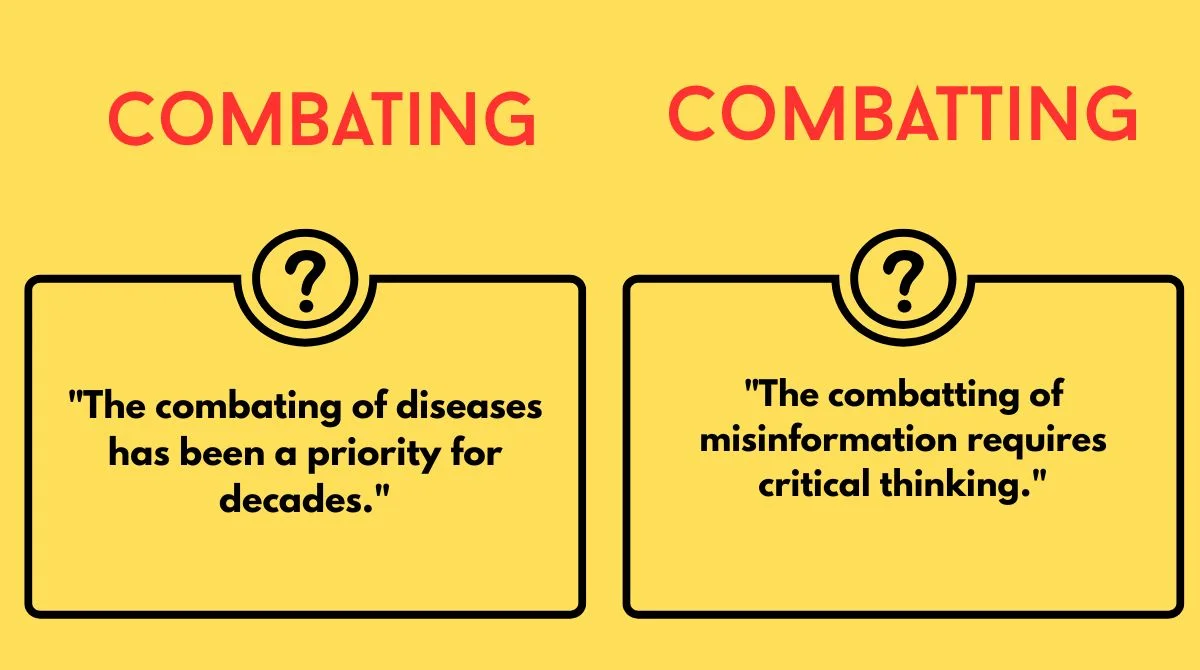
    • “The combating of diseases has been a priority for decades.”
    • “The combatting of misinformation requires critical thinking.”

    Because gerunds and present participles share the same spelling, the same rules apply regarding combating vs. combatting.


    Combatting Climate Change or Combating Inefficiency?

    Certain phrases are more commonly associated with one spelling over the other.

    • “Combating climate change” is widely used in environmental discourse.
    • “Combatting corruption” appears frequently in UK government reports.

    This is mostly a matter of regional preference rather than correctness.


    A Historical Perspective: American vs. British English

    The difference between combating and combatting is part of the broader divergence between American and British English spelling conventions:

    • Noah Webster simplified American spellings in the 19th century (e.g., color vs. colour, traveler vs. traveller).
    • British English retained older spellings, favoring doubled consonants more often.

    This historical split is why American English prefers “combating” while British English allows both spellings.


    Selecting the Correct Spelling for Your Writing Context

    If you’re unsure which spelling to use, follow these practical tips:

    1. Know Your Audience – If writing for Americans, use combating; for British readers, combatting is acceptable.
    2. Follow Style Guides – Academic and journalistic writing may have specific guidelines. The AP Stylebook and Chicago Manual of Style recommend combating.
    3. Be Consistent – Pick one spelling and stick with it throughout your writing.

    Combating or Combatting

    FAQs

    1. Which spelling is correct: combating or combatting?

    Both are correct, but combating is preferred in American English, while combatting is more common in British English.

    2. Why do some words double the final consonant before adding -ing?

    In American English, verbs double the last consonant only if the stress falls on the last syllable. Since “combat” has stress on the first syllable, the final “t” is not doubled.

    3. Is “combatting” wrong in American English?

    While combatting is not commonly used in the U.S., it is not technically incorrect. However, “combating” is the preferred spelling in American writing.

    4. Which spelling should I use for international audiences?

    If writing for a global audience or academic purposes, “combating” is the safer choice because it is widely accepted across English dialects.

    5. Do British and American English have other spelling differences like this?

    Yes! Other examples include traveling (US) vs. travelling (UK) and labeling (US) vs. labelling (UK).

    6. How do I know whether to double a consonant in other words?

    Check where the stress falls in the word. If the stress is on the last syllable, double the consonant before adding -ing (begin → beginning). If not, don’t double it (combat → combating).


    Conclusion

    So, is it combating or combatting? The answer depends on regional spelling conventions and your intended audience. While American English favors combating, British English accepts both forms, with combatting being slightly more common.

    To avoid confusion, use combating in general writing, as it is widely understood across all English-speaking regions. Regardless of which form you choose, consistency is key in maintaining clarity and professionalism in your writing.

    Need help with other tricky English spellings? Let us know in the comments!