
Understanding the difference between maximal and maximum can feel like parsing a riddle. You might think they’re interchangeable.
They’re not. In math, language, and daily life, using one instead of the other could change your meaning entirely—or even render your statement incorrect.
Let’s dig deep into what these terms truly mean. I’ll keep it conversational, break up complex ideas, and mix in analogies, tables, quotes, and case studies.
You’ll walk away knowing exactly when to use maximum and when maximal fits best.
Introduction to Maximal vs Maximum
Words matter—especially those that look and sound so similar. You might shrug and choose one based on gut feel. But these two subtle siblings play very different roles. In math, a “maximum” means the highest point.
A “maximal” element simply means there’s nothing larger within a given set—but it might not be the absolute highest. In casual speech Americans default to maximum almost every time, while maximal hides mostly in academic corners.
Imagine this teaser:
“You hit your maximum speed on the highway—but you found a maximal route after detouring around roadwork.”
See? Similar vibes, different meanings.
Core Definitions with Context
Maximum – The Highest Value
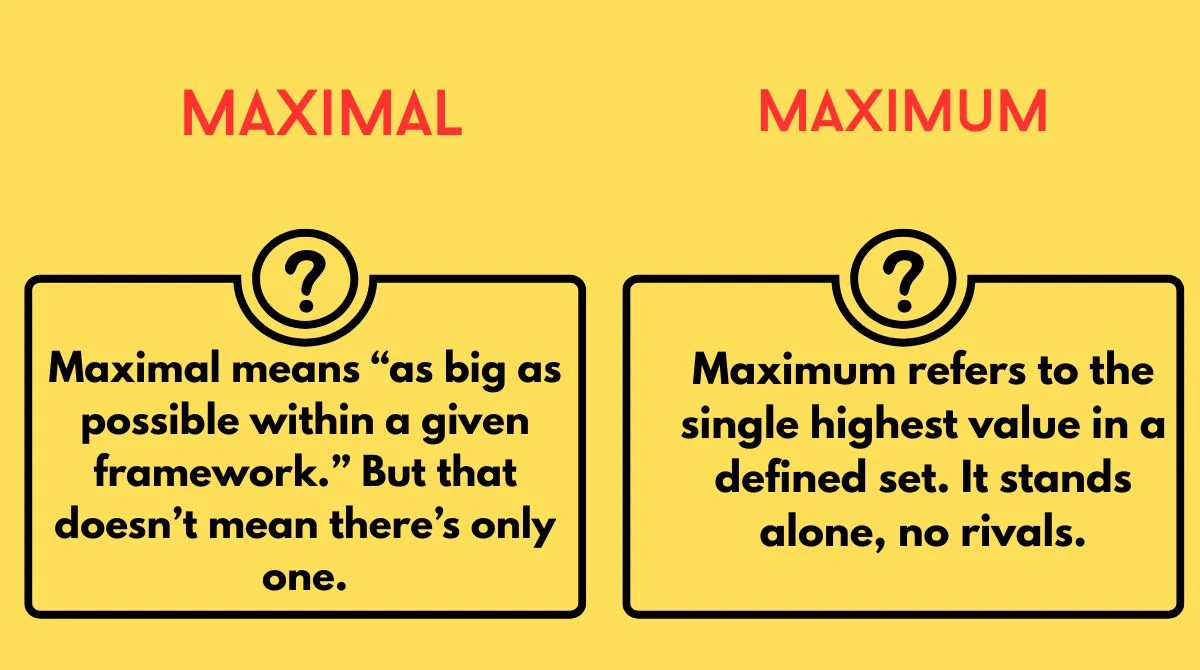
Maximum refers to the single highest value in a defined set. It stands alone, no rivals.
- Everyday example: “The maximum speed limit on this highway is 70 mph.” That means you can’t legally drive faster than 70 mph.
- In a dataset: if heights are 5′, 6′, 6’2″, the maximum height is 6’2″.
Maximum often flags absolute top value, clear cut.
Maximal – Greatest Under Constraints
Maximal means “as big as possible within a given framework.” But that doesn’t mean there’s only one.
- In mathematics, a maximal element in a set with a partial order means: there’s no bigger element, but there might be several ‘largest’ ones.
- Example: in a family tree, siblings might each be maximal in age if none is older than the other, but no single “oldest” exists.
Maximal implies relative, not absolute.
Mathematical Foundations
These terms often trip students and professionals. Let’s unpack them clearly.
Maximum in Mathematics
In mathematics, maximum has a clean meaning:
- Calculus: A function f(x)f(x)f(x)’s maximum is its highest point on an interval.
- Statistics: If you collect test scores—and the highest score is 98—that’s the maximum.
- Algebra/Data: In set theory, maximum of {1, 3, 5} equals 5.
Clear. Absolute. Singular.
Maximal in Mathematics
Maximal introduces nuance:
- Abstract algebra: A maximal subgroup of a group GGG is a subgroup HHH so there’s no subgroup strictly between HHH and GGG. Yet other such H′H’H′ may exist.
- Order theory: In a partially ordered set, an element is maximal if no other element is strictly greater—but it might not be the ‘greatest’ because the set lacks a single top value.
Partial Orders vs Total Orders
Understanding the difference clarifies everything. Here’s a quick visual:
| Type of Order | Definition | Maximum exists? | Unique maximal element? |
|---|---|---|---|
| Total Order | Every pair is comparable (like ≤ on real numbers) | Yes, a single maximum | Yes |
| Partial Order | Some pairs not comparable | Not always | Possibly multiple maximals |
Total Order Example: In numbers {1, 2, 3}, 3 is maximum because every number compares.
Partial Order Example: Consider subsets of {a, b}:
- Subsets are {}, {a}, {b}, {a, b}.
- The maximal elements are {a, b} (it’s the greatest). But if we considered subsets without {a, b}, {a} and {b} both are maximal—neither is the absolute largest since they’re incomparable.
Everyday Language vs Technical Language
How often does daily chatter use maximal? Rarely. Americans almost always default to maximum.
Everyday Usage
- Maximum: “The maximum weight this elevator can hold is 2,000 lbs.”
- Maximal is awkward: “The maximal weight…” sounds formal or technical.
Academic & Technical Usage
- Maximal subgroup is common in algebra.
- In optimization: “local maximum” vs “global maximum.” Maximal pops up when discussing theoretical constructs, like chains or ideals.
You’d rarely say, “I reached my maximal budget limit,” unless in philosophical tone.
Real-World Applications of Maximal vs Maximum
Everyday Life Examples
- Maximum capacity on a bus: you’ve hit the very top.
- Maximal effort: you’re pushing all you can, but that doesn’t mean you’re the strongest on earth—just in your own limits.
Professional & Academic Usage
In fields like law and finance, you’ll see maximum:
- “Maximum liability.”
- “Maximum allowed deduction.”
Maximal stays in advanced theory:
- In law, “maximal compliance” may mean doing the most you can under regulations.
- Researchers talk about “maximal models” in logic.
Specialized Fields Breakdown
- Graph Theory:
- Maximal clique: cannot add another vertex to still have a clique—but not necessarily the largest clique.
- Maximum clique: the largest clique in the graph.
- Calculus & Optimization:
- Local maximum: highest point in a small interval.
- Global maximum: highest across the whole domain.
- Order Theory:
- Maximal chains of elements: no larger chain exists beyond.
- Computer Science:
- Maximal matching in a graph: you can’t add an edge without breaking the matching, but there might be a maximum matching that’s larger.
Common Misconceptions and Mistakes
We often assume maximal = maximum. That slip can derail math logic or create misunderstandings.
- Claim: “Every maximal element is maximum.” That’s true only in total orders—not in partial orders.
- Confusion in casual contexts: Saying “maximal limit” when “maximum limit” is intended misleads others.
Example of Wrong vs Correct Usage
- Wrong: “This subset is maximal—it’s the biggest one.”
- Better: “This subset is maximal—it can’t grow further under current rules, though there may be others just as large.”
Comparison Table: Maximal vs Maximum
| Aspect | Maximum | Maximal |
|---|---|---|
| Meaning | Absolute highest value | Largest possible under constraints |
| Uniqueness | Always unique in total orders | Multiple maximal elements possible in partial orders |
| Common Usage | Everyday language, business, engineering | Advanced mathematics, theoretical contexts |
| Example (Everyday) | “Maximum capacity = 50” | “Maximal effort” meaning full effort—not absolute best |
| Example (Math) | In {1,2,3}, max = 3 | In a poset, multiple incomparable elements may be maximal |
| Technical Fields | Calculus, statistics, general usage | Algebra, graph theory, order theory, logic languages |
Case Study: VO₂ Max in Sports Science
Understanding VO₂ max brings clarity—and a good real-life example.
VO₂ max (Volume of Oxygen Maximum) is the greatest volume of oxygen your body can use during intense exercise. It’s very specifically named. Maximum is correct because you’re measuring an absolute physiological limit.
Why not maximal? Because researchers aren’t saying “under these constraints it’s as big as possible.” They’re measuring your absolute peak capacity.
In elite athletes, average VO₂ max values range between 60–84 ml/kg/min for men and 50–72 ml/kg/min for women. These are actual data points, not theoretical bounds.
Using maximal here would muddy the meaning. It’s specific. It’s absolute.
Language Nuances and Regional Usage
American and British English lean hard on maximum in business, contracts, and everyday chat. Maximal tends to sneak in only in academic or scientific texts.
- American English: “Maximum efficiency,” “Maximum yield,” “Maximum coverage.”
- British English: Similar, though “maximal” might appear slightly more often in technical prose—but still rare outside maths.
In everyday talk, you’ll almost always hear “maximum.”
Summary and Key Takeaways
Let’s wrap everything up—short and helpful:
- Maximum = the absolute highest value. Unique, clear, most common.
- Maximal = the greatest within constraints. Could be many. Mostly technical.
- In total orders, maximal = maximum; in partial orders, they diverge.
- In daily speech, stick with maximum unless discussing technical structures in math.
- Remember: maximum for peaks, maximal for local—but fully-grown limits under specific rules.
Memory tip:
Max-imum = Most.
Max-imal = Most within a set.
FAQs
What’s the core difference between maximal and maximum?
- Maximum denotes the single highest value in a set. Maximal signals there’s no larger element, but there may be more than one.
Can something be maximal but not maximum?
Yes—especially in partial orders. Multiple elements may be maximal without any being the absolute biggest.
Why do mathematicians prefer ‘maximal’?
Because they work with structures where not every pair is comparable—like subgroups or graph subsets.
Is ‘maximal’ outdated?
Not at all. It persists strongly in advanced math, logic, and theory. You just don’t see it much in casual speech.
How do you know when to use which term?
Ask yourself: am I naming “the highest overall” or “as high as possible under rules”? Use maximum for the former, maximal for the latter.
Are there fields that use both regularly?
Absolutely. Graph theory, optimization, and abstract algebra rely on both—and misuse can lead to errors.
Final Thoughts
You’ve embarked on a journey from everyday chatter to deep mathematics and physiology. You now know when to say maximum and when maximal fits the bill. That nuance adds clarity and precision to your writing and speaking.
Next time you see these terms, you’ll recognize the subtle—but powerful—difference. And you’ll choose the right one, with confidence.

Leave a Reply