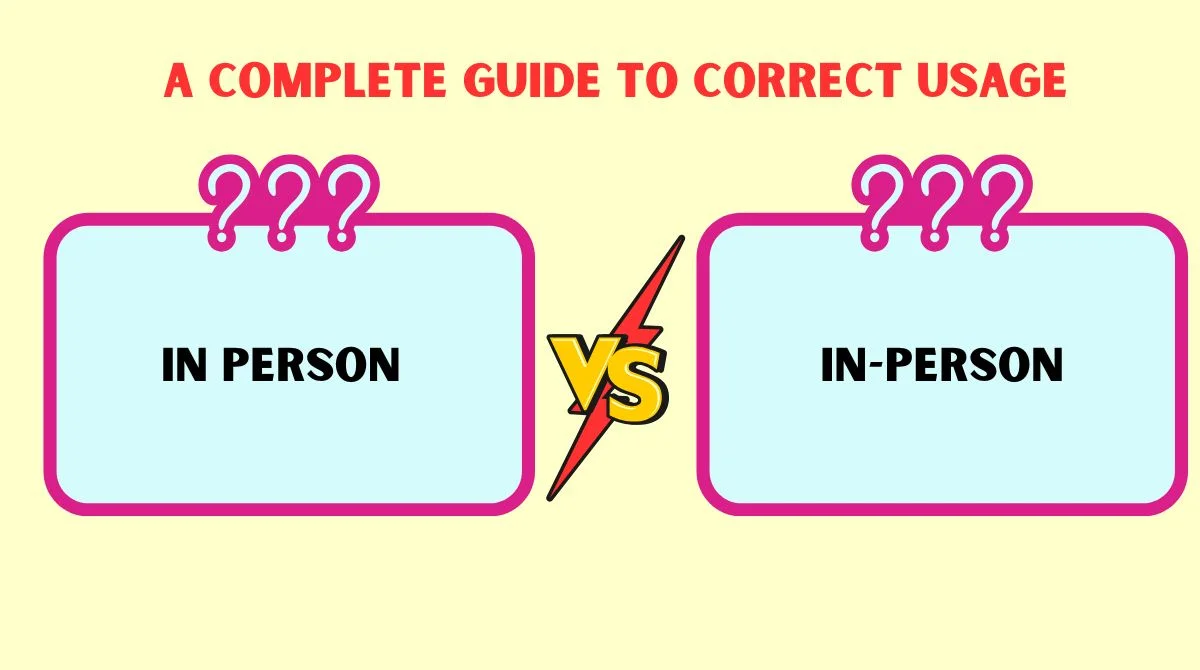
Language can trip you up in the smallest ways. One of the most common examples? “In person” vs “in-person.”
You’ve probably paused while writing an email or a report and wondered: Do I need that hyphen?
This article dives deep into that very question. By the end, you’ll know exactly when to use each form, why the hyphen matters, and how to avoid common mistakes. Let’s start with the basics.
Understanding the Core Difference
The key to using the correct form lies in knowing what part of speech each one is and where it appears in a sentence.
What “In Person” Means
The phrase “in person” refers to physically being present. It functions as an adverbial phrase—it modifies a verb and tells you how something is done.
👉 Examples:
- “I delivered the application in person.”
- “She prefers to discuss important matters in person.”
- “You must sign the form in person at the office.”
Here, “in person” describes the manner of the action. There’s no noun to modify, so no hyphen is needed.
What “In-Person” Means
The term “in-person” is a compound adjective. It’s used to modify a noun and describes the type of meeting, interaction, or activity.
👉 Examples:
- “We had an in-person meeting to discuss the project.”
- “The school resumed in-person classes after the holidays.”
- “An in-person interview often feels more personal than a virtual one.”
When “in-person” directly describes a noun (like meeting, event, class), the hyphen connects the two words, making it clear they act together as a single idea.
Side-by-Side Comparison
| Aspect | In Person | In-Person |
|---|---|---|
| Part of Speech | Adverbial phrase | Compound adjective |
| Function | Describes how something happens | Describes what kind of noun |
| Position in Sentence | Usually follows a verb | Usually appears before a noun |
| Example | “I spoke with her in person.” | “It was an in-person meeting.” |
💡 Quick tip: If the phrase comes after the verb, use in person. If it comes before a noun, use in-person.
Grammar Rules Behind the Hyphen
Understanding the rules of hyphenation helps you avoid many writing mistakes.
Why Hyphens Exist in English
A hyphen connects two or more words that act as a single unit. Without it, sentences can become confusing.
👉 Example:
- Without hyphen: “small business owner” (a business owner who is small in size)
- With hyphen: “small-business owner” (an owner of a small business)
The hyphen often prevents ambiguity. That’s exactly what it does in “in-person.”
Rule of Position: Before vs After the Noun
The hyphen’s role depends on where the phrase appears.
- When the phrase comes before a noun, it acts as a compound adjective and needs a hyphen.
- ✅ “The company hosted an in-person workshop.”
- When the phrase comes after a verb, it functions as an adverbial phrase and does not need a hyphen.
- ✅ “The workshop was conducted in person.”
Common Pitfalls and Misconceptions
Many writers misuse the hyphen because they don’t fully grasp this rule. Let’s highlight a few mistakes:
- Adding a Hyphen After the Verb
- ❌ “We met in-person yesterday.”
- ✅ “We met in person yesterday.”
- Forgetting the Hyphen Before a Noun
- ❌ “It was an in person class.”
- ✅ “It was an in-person class.”
- Overusing Hyphens
- Hyphens should only be used when needed for clarity. Avoid sticking them in unnecessarily.
Everyday Usage Examples
Understanding theory isn’t enough. Let’s look at real-world examples of when to use each form.
When to Use “In Person”
Use “in person” when describing how something happens.
👉 Scenarios:
- Attending a wedding: “They attended the ceremony in person.”
- Submitting a passport application: “You must apply in person at the office.”
- Meeting a new client: “I prefer to greet new clients in person.”
When to Use “In-Person”
Use “in-person” when describing what type of meeting, event, or interaction it is.
👉 Scenarios:
- Meetings: “An in-person meeting often builds stronger rapport.”
- Appointments: “The clinic requires in-person appointments for new patients.”
- Interviews: “Companies often favor in-person interviews over virtual ones.”
Quick Visual Guide
| Context | Correct Form | Example Sentence |
|---|---|---|
| After a verb | in person | “The professor met students in person.” |
| Before a noun | in-person | “The school hosted an in-person workshop.” |
| Describing physical presence | in person | “I wanted to say thank you in person.” |
| Describing a type of event | in-person | “She prefers in-person consultations.” |
Tips for Avoiding Mistakes
Many writers struggle with hyphen use. Here’s how to simplify it.
Simple Rule of Thumb
- If it answers the question “how?”, use in person.
- If it answers the question “what kind?”, use in-person.
Quick Checklist for Writers
✅ Comes before a noun → Hyphenate → in-person
✅ Comes after a verb → Don’t hyphenate → in person
✅ Read aloud → If it describes the manner, not the noun, drop the hyphen.
Case Study: How a Single Hyphen Changes Meaning
Consider this sentence pair:
- “The in-person registration process is faster.”
- “Students must register in person.”
In the first, “in-person” modifies “registration process.”
In the second, “in person” modifies the verb “register.”
👉 The presence or absence of the hyphen changes what the phrase describes—this is why it matters.
Frequently Asked Questions
Is “in-person” ever used after a verb?
No. When the phrase follows a verb, it acts as an adverbial phrase and does not take a hyphen.
Has the hyphen rule changed over time?
Not really. Style guides like The Chicago Manual of Style and AP Stylebook consistently support using the hyphen only when the phrase functions as a compound adjective before a noun.
What about British vs. American English?
Both follow the same rule for “in-person” vs “in person.”
Minor spelling differences in other words don’t affect this usage.
Can I skip the hyphen in informal writing?
You shouldn’t. Hyphens make your writing clearer and more professional, even in casual contexts.
Are there any exceptions?
No meaningful exceptions exist. The rule is simple: hyphen before a noun, no hyphen after the verb.
Conclusion
Here’s the takeaway:
- Use in person when you’re describing being physically present or how something happens.
- Use in-person when you’re describing the type of event, meeting, interaction, or process.
Following this rule not only improves grammar but also ensures your writing is clear, concise, and professional.
“Good writing is clear thinking made visible.” — Bill Wheeler
By applying the simple checklist and remembering the rule of position, you’ll never get tripped up by this common grammar dilemma again.

Leave a Reply