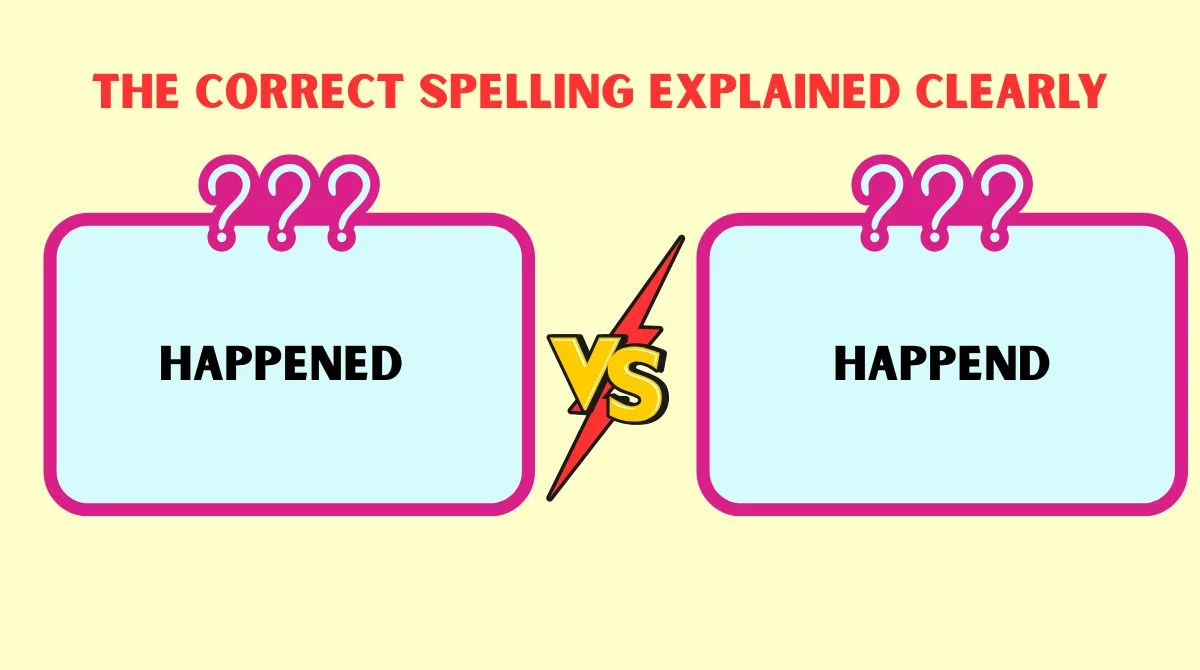
English can be tricky, especially when two words look similar but only one is correct. Many writers often wonder whether to write “Happened” or “Happend.”
The short answer is simple: “Happened” is correct. The word “Happend” is just a common misspelling.
This guide dives deep into everything you need to know — from spelling and grammar rules to common mistakes, examples, and practical tips.
Introduction: Clearing Up the Confusion
You’ve probably seen this in text messages, social media posts, or even emails:
“I don’t know what happend yesterday.”
That single missing “e” changes the word from correct to incorrect.
Spell-check tools often underline “happend” in red, which hints at the error.
So why do so many people make this mistake?
- English pronunciation often “swallows” the second e, so it sounds like “hap-pnd.”
- Many learners assume the past tense of “happen” drops the final e, as in other verbs.
- Typing quickly on phones can lead to typos.
Understanding why the mistake occurs is the first step toward avoiding it.
Understanding the Basics
Definition of “Happened”
“Happened” is the past tense of the verb happen.
It describes an event that occurred or took place.
Example:
“The concert happened last night.”
Why “Happend” Appears
The misspelling “happend” usually appears due to:
- Typing too fast and skipping the e.
- Hearing the word pronounced in casual speech without emphasizing the second syllable.
- Lack of familiarity with English spelling rules.
Remember: “Happend” is never correct in standard English.
Correct Form: “Happened”
Spelling and Pronunciation
- Correct spelling: H-A-P-P-E-N-E-D
- Pronunciation: /ˈhæp.ənd/
- Syllables: hap-pened
Although it’s pronounced in two soft syllables, the e in the middle must be written.
Meaning and Function
- Describes something that took place in the past.
- Functions as the past tense of the verb happen.
Examples:
- “A strange thing happened at the park.”
- “What happened to your phone?”
Grammatical Context
“Happened” works in sentences as:
- The main verb: “The festival happened in July.”
- In questions: “What happened next?”
- In reported speech: “He said it happened last week.”
The word is regular, not irregular — it follows the standard rule of adding –ed to form the past tense.
Why “Happend” Is Incorrect
Common Reason for the Misspelling
- Writers drop the second e because in fast speech it’s barely heard.
- Some think it follows patterns like “planned” or “dropped”, which double the final consonant.
No Rule Justifies Dropping the “e”
English verbs that end in –en (like happen) do not drop the “e” when forming the past tense.
You simply add –ed: happen → happened.
Compare:
- Make → made (irregular change)
- Stop → stopped (doubled consonant before –ed)
- Happen → happened (no double consonant, keep the e)
Spell-Checker Example
Modern writing tools like Grammarly, MS Word, or Google Docs will always mark “happend” as a spelling error and suggest “happened.”
Spelling Rules That Apply
Standard Past-Tense Formation
Most regular English verbs form their past tense by adding –ed:
- Play → played
- Walk → walked
- Happen → happened
Double-Consonant Confusion
Writers often confuse happen → happened with verbs like:
- Stop → stopped
- Plan → planned
The rule:
If the final syllable is stressed and ends in a single vowel + consonant, double the consonant before adding –ed.
Since in happen, the stress is on the first syllable (HAP-pen), no doubling is needed.
Silent “e” vs. Retained “e”
Some verbs drop the silent e before adding endings:
- Love → loved
- Move → moved
But verbs like happen keep the e because it’s part of the main syllable.
Side-by-Side Comparison
Here’s a quick table to clear any remaining doubts:
| Aspect | Happened ✅ | Happend ❌ |
|---|---|---|
| Part of speech | Past tense of happen | Not a real word |
| Spelling | Includes final e | Missing the e |
| Pronunciation | /ˈhæp.ənd/ | Mispronounced or unclear |
| Grammar use | Correct and standard | Error or typo |
| Acceptance | Recognized worldwide | Never correct in English |
Everyday Usage Examples
Correct Usage in Sentences
- “An unexpected incident happened during the ceremony.”
- “What happened to the files on my computer?”
- “Something amazing happened at the meeting.”
Incorrect Usage
- ❌ “An unexpected incident happend during the ceremony.”
- ❌ “What happend to your bag?”
Contextual Scenarios
- Informal Writing: Often mistyped in text messages or social media.
- Formal Writing: Must always use the correct spelling to maintain professionalism.
- Academic/Business: Using the correct form builds credibility.
Tips to Avoid the Mistake
- Mnemonic: Happen + ed = Happened (don’t drop the “e”).
- Pronunciation Trick: Say it slowly: hap-pen-ed.
- Reading Aloud: Helps you hear the middle vowel.
- Spell-Check Tools: Enable them on your devices.
- Practice: Write 10 sentences using “happened” correctly.
- Visual Flashcards: Highlight the e to remember it stays in the word.
Top 6 FAQs
Is “happend” ever correct?
No. It’s always an incorrect spelling.
What part of speech is “happened”?
It’s the past tense form of the verb happen.
Why do people write “happend” online?
Usually due to typing too fast, autocorrect errors, or confusion about the rule.
Is “happen” a regular or irregular verb?
It’s a regular verb — it forms the past tense by simply adding –ed.
How do I pronounce “happened” correctly?
Say it in two syllables: hap-pened (/ˈhæp.ənd/).
Can “happened” be used in questions?
Yes. Example: “What happened yesterday?”
Final Takeaway
Whenever you describe something that occurred in the past, the correct spelling is “happened.”
The version “happend” is always a mistake — no exceptions.
Use the tips above to remember the rule. With practice, you’ll never miss that crucial e again.

Leave a Reply