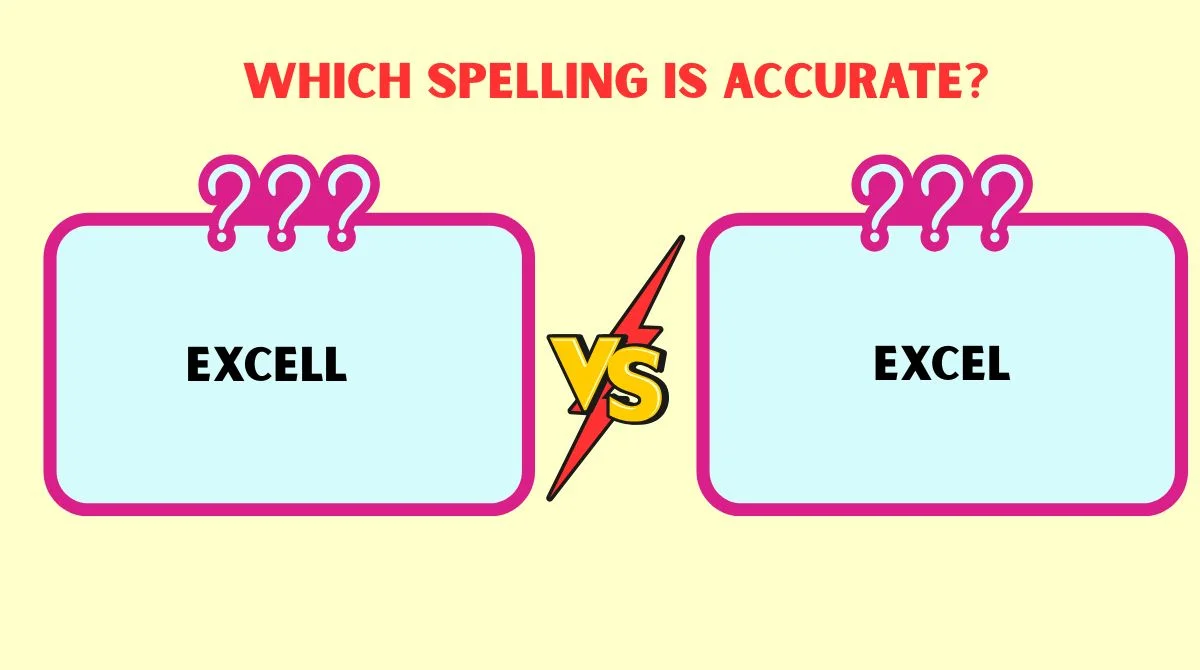
Are you confused about whether to write Excell or Excel? You’re not alone. Many people struggle with this seemingly small difference, but it can make a big impact in writing, professional communication, and even software references.
This guide dives deep into the differences, origins, common mistakes, and correct usage of Excel so you can write with confidence.
Quick Overview
Many people mistakenly add an extra ‘l’ and write Excell instead of Excel. The confusion often arises due to similar words, software branding, or verb conjugation patterns in English.
Here’s what you’ll learn in this post:
- The meaning and correct spelling of Excel
- Why Excell is incorrect
- Historical and linguistic origins of Excel
- Correct grammar, capitalization, and conjugation
- Real-life examples of usage
By the end, you’ll never second-guess yourself again when deciding between Excell or Excel.
Understanding the Confusion: “Excell vs Excel”
People often add an extra ‘l’ in English words when they think it looks right. Consider words like “travelled” (British spelling) or “cancelled” — this trick doesn’t apply to Excel.
Here’s why the confusion happens:
- Pronunciation: “Excel” is pronounced with a single ‘l’ sound at the end, but some hear it as “Excell.”
- Software influence: Microsoft Excel is a globally recognized tool, but people sometimes think the double ‘l’ looks “official.”
- Autocorrect and typing habits: Phones and computers sometimes mistakenly suggest “Excell” as a spelling.
Fact: According to the Oxford English Dictionary, Excel is the only correct spelling in all formal and dictionary-approved contexts.
What Does “Excell” Mean?
Short answer: nothing official.
Excell is a common typo or informal misspelling. It does not appear in any reputable English dictionary. When you use “Excell,” readers may assume you are careless or unaware of proper spelling.
Key takeaway: Avoid using Excell in professional writing.
Why People Use “Excell”
Several factors contribute to the popularity of Excell as a mistaken form:
- Overgeneralization of double letters: Words like “cancelled” or “controlled” make writers think doubling ‘l’ is standard.
- Phonetics: The ending sound can be misleading for non-native speakers.
- Brand perception: Some think adding an extra ‘l’ looks more “formal” or branded.
Example:
“I’ll Excell at this task” — Incorrect.
Correct version: “I’ll excel at this task.”
Examples of Incorrect Usage
Here are some common mistakes:
- Excell in emails: “Please see the attached file to Excell in your reports.”
- Excell in social media posts: “I want to Excell in all my exams.”
- Excell in blogs or articles: “Learn how to Excell in Excel software.”
These mistakes often reduce credibility and confuse readers.
What Does “Excel” Mean?
The word Excel has two main contexts:
Definition as a Verb
Excel means to surpass others, to perform exceptionally well, or to achieve outstanding results.
Examples:
- She excels in mathematics.
- Athletes who excel often train relentlessly.
- Your business can excel with proper strategy.
Definition as a Proper Noun
Excel is also a proper noun referring to Microsoft Excel, the world-famous spreadsheet software.
Examples:
- “I created a budget in Excel.”
- “Excel can perform complex calculations and data visualization.”
Origins and Etymology of “Excel”
Understanding the history helps clarify why Excel is correct:
- Latin Roots: From the Latin verb excellere, meaning “to rise above” or “to surpass.”
- Historical Usage: Entered English in the late 14th century with the same meaning.
- Microsoft Adoption: Chosen as a brand name to signify efficiency, performance, and superiority in data management.
Quote:
“Excel is named for its ability to help users rise above the rest in data handling.” — Microsoft Branding Guide
Comparing “Excell vs Excel”
Here’s a side-by-side look:
| Feature | Excell | Excel |
|---|---|---|
| Dictionary recognition | ❌ Not recognized | ✅ Correct |
| Usage as a verb | ❌ Incorrect | ✅ Correct |
| Usage as a proper noun | ❌ Incorrect | ✅ Correct |
| Conjugation | ❌ Wrong forms | ✅ Excelled, Excelling |
| Professional credibility | ❌ Damages trust | ✅ Builds trust |
Key point: If in doubt, always write Excel.
Spelling Rules for “Excel”
Correct Verb Conjugation
- Base form: Excel
- Past tense: Excelled
- Present participle: Excelling
Notice the double ‘l’ only appears in conjugated forms like excelled or excelling — not in the base form.
Why the Extra ‘L’ in Conjugations?
English spelling rules often double the final consonant when adding suffixes like -ed or -ing if the last syllable is stressed.
Examples:
- “I excelled in my studies.”
- “She is excelling at work.”
Examples in Context
Incorrect: “Excell”
- I want to excell in my exams. ❌
- Let’s excell at this project. ❌
Correct: “Excel”
- I want to excel in my exams. ✅
- Let’s excel at this project. ✅
- Microsoft Excel makes budgeting easier. ✅
Quick Comparison Table: “Excell vs Excel”
| Aspect | Excell | Excel |
|---|---|---|
| Dictionary | ❌ | ✅ |
| Verb usage | ❌ | ✅ |
| Proper noun | ❌ | ✅ |
| Common misspellings | ✅ | ❌ |
| Conjugation | ❌ | ✅ |
Synonyms and Alternatives for “Excel”
If you want to diversify your writing:
Synonyms for the verb ‘excel’:
- Surpass
- Outperform
- Shine
- Thrive
- Lead
Example sentence:
“She continues to thrive in competitive environments, proving she can excel anywhere.”
Common Misspellings Related to “Excel”
| Misspelling | Reason |
|---|---|
| Excell | Extra ‘l’ added mistakenly |
| Exel | Typo or phonetic error |
| Xcel | Abbreviated form or brand shorthand |
| Excelle | French-influenced misspelling |
Tip: Always check autocorrect before sending emails or publishing documents.
Grammar and Capitalization Rules
- Verb usage: Always lowercase unless starting a sentence: “I excel in coding.”
- Proper noun: Capitalize Microsoft Excel: “I use Excel daily for work.”
- Conjugation: Follow doubling rules carefully for “excelled” and “excelling.”
FAQs
Is “Excell” ever correct?
No, Excell is not correct in English. Always use Excel.
Can “Excel” be plural?
No, “Excel” as a verb or software name is not pluralized. You can say “Excel files” when referring to multiple documents.
How to remember the correct spelling?
Think of Excel as “one ‘l’ to rule them all.” Always check dictionary references.
Why do people still write “Excell”?
It’s often a mix of habit, phonetics, and influence from words that double the final consonant.
What’s the difference between “Excel” the verb and “Excel” the software?
- Verb: To perform exceptionally.
- Software: Microsoft Excel, a spreadsheet tool. Context usually makes it clear.
Conclusion
The correct spelling is always Excel — with one ‘l’ — whether you’re using it as a verb or referring to Microsoft’s software. Excell is a common but incorrect misspelling.
Remember the historical roots, grammar rules, and proper conjugation, and you’ll never make this mistake again. Always trust the dictionary and your knowledge: Excel with confidence!

Leave a Reply