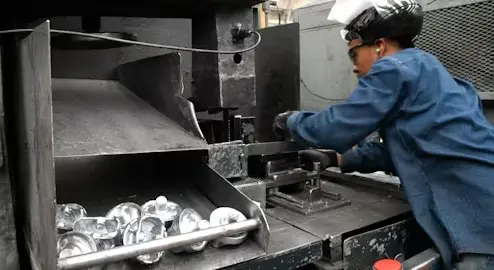
For precision performance in global manufacturing today, various industries such as aerospace, auto, construction and energy have advanced their casting technology to successfully produce and durable components with precision and high quality. Investment casting technology is one of the most advanced as it can produce intricate parts of various geometries and have a high degree of uniformity on their surfaces.
But modern industry needs more than one process to achieve the desired final properties. To achieve the desired properties by modern industries, investment casting factory operations combine two essential value adding processes of cnc machining and heat treatment. These processes include post casting operations that further improve the properties of the raw castings to not only satisfy but exceed the B2B industrial requirements.
This article is intended to help the industrial buyers understand the role of post casting operations, especially cnc machining and heat treatment, in adding quality and efficiency to modern investment castings, and the importance of partnering with a full service foundry and a seasoned steel castings manufacturer to achieve maximum value.
The Role of CNC Machining in Precision Engineering
CNC machining is essential for the final step of post-processing in turning investment-cast components to finished products of the required sizes and surface details. Investment casting is capable of producing components with near-net-shape accuracy. Nonetheless, there may be a few deviations, which CNC machining corrects to ensure that there is accuracy throughout the production run.
One of the advanced investment casting factories has fully equipped CNC machining centers that can perform integrated machining on complex geometries made of high-strength alloys. They operate using technology with several axes in a coordinated movement to perform cuts, drill holes, thread, and profile the surface, and can do this with a few micrometres of error.
Working with steel castings manufacturers and machining specialists allows for all steps, including converting molten metal to a fully finished component, to take place without interruptions in a singular, unified quality control system.
Heat Treatment: Strengthening Metal Integrity
Another absolutely essential step in the modern investment casting process is the heat treatment step. Heat treatment consists of the cast pieces being subject to a carefully controlled heating and cooling process. This influences the microstructure of the pieces and improves the mechanical properties, such as increasing the hardness, the tensile strength, the ductility and the fatigue resistance.
Various alloys will have different optimum cycles of heating and cooling. For example:
- Stainless steels are subjected to solution annealing in order to gain enhanced corrosion resistance and a uniform grain structure, as well as to restore any astringency.
- Carbon and low alloy steels are quenching and tempering heat-treated in order to gain a better equilibrium between strength and toughness.
- Nickel based alloys are improved by precipitation hardening for better resistance to creep at elevated temperatures.
Precision thermal control systems and programmable furnaces are found in the investment casting factory of your choice, which will ensure uniformity between batches. uniform output above specified performance levels is guaranteed, regardless of the environment.
Benefits include the following:
- Enhanced Mechanical Properties: Increased strength and hardness, as well as a greater overall durability.
- Stress Relief: Internal stresses that are created at the time of cooling and solidifying are removed.
- Improved wear and corrosion resistance: This strengthens and protects parts from damage during extreme operating conditions.
- Improved Processability: This aids in CNC operations to be more efficient and results in a more precise output after a CNC process.
The completion of a heat treatment process allows standard cast parts the opportunity to function as real high-performance parts in the aerospace engines, oil and gas machinery, and heavy-duty machinery.
Joint Casting, Machining and Heat Treatment
In the past, the separation of casting, machining, and heat treatment from each other and into distinct vendors was the norm. This resulted in long lead time, and complications in the workflow from the communication gap. Nowadays, modern investment casting factory operations combine these practices in one place to fully optimize the workflow.
This unique production method creates a set of advantages:
- Less logistical complication: This removes the need for several suppliers and reduces transport stages.
- Improved Processability: This increases the efficiency of the system leading to better production cycles from casting to delivery.
- Unified control of quality: This offers inspection and control of the quality to be more standardized.
- Improved Resource Management: This results in the reduction of time and resources as the system optimizes the workflow.
- Unique Production Methods: This offers the providers of the services more options to be created with the machining.
With manufacturers having complete control over the entire manufacturing process from wax pattern design to final touch, they can achieve a complete cycle of manufacturing, which fosters more trust and predictability in the system. This production system supports more rapid iteration and prototyping. It also offers the flexibility to tailor production to the needs of clients, especially in B2B setups, from small units to larger quantities.
In the case of firms wishing to establish a steady supply partnership, the combination of a full-service facility with a steel castings manufacturer allows for predictable quality to be attained with quicker lead times and a lower total cost of ownership.
Quality control when it comes to heat treatment and CNC machining operations must be of the highest standard, as there are fundamental engineering specifications which must be satisfied for the components to be acceptable. Modern casting facilities utilize advanced techniques to evaluate consistency in performance and verify structural integrity.
Some common quality control measures include:
- Dimensional inspection: After machining, tight tolerances are established using coordinate measuring machines (CMM).
- Non-destructive testing (NDT): Internal defects are identified through x-ray, ultrasonic, or magnetic particle testing.
- Hardness and tensile testing: Confirms attainment of the desired mechanical properties as a result of heat treatment.
- Surface analysis: Evaluates finish quality, surface roughness, and retention of the coating.
B2B buyers gained insightful reports on each batch of production, performance data, and complete international compliance confidence. This offers enhanced supply chain confidence through complete transparency.
An accommodation investment casting factory can achieve high standards of quality and maintain focus on the special needs of each industry through continuous process improvement and disciplined documentation of the processes.
Increasing B2B Supply Chain Effectiveness
There are financial and operational improvements to the supply chain for B2B customers when we add the integration of CNC machining and heat treatment to the investment casting process.
Some of the supply chain benefits are:
- Less supplier management: This simplifies procurement and vendor management.
- Consistent lead times: Optimized processes guarantee scheduled production efficiency.
- Lower transportation and handling costs: Minimized shipping and less handling reduces costs.
- Better quality consistency. Same processes ensure quality consistency across multiple orders.
- More agile: Adaptable production systems respond to demand fluctuations quickly.
These benefits improve operational focus and allow businesses to concentrate on primary business functions while the casting partner executes complete manufacturing processes. In reliability and precision dependent markets, the supply chain is better, and components are superior when an integrated partner is selected.
Conclusion
CNC machining and heat treatment are the foundation of every investment casting factory in the world. They enable the transformation of precision casting components to the highest level in high-performance parts to fulfill the most demanding of industries. Through customizable advanced tech, engineering, and integrated manufacturing, investment casting achieves the highest of a kind precision, durability, and efficiency.
Having a seasoned steel castings manufacturer and full-service foundry partner enables B2B firms to enhance production and mitigate operational risks leading to optimum results ranging from concepts to results. No matter the production of turbine blades in the aerospace industry, gear in the automotive, or components in heavy machinery, the combination of casting, machining, and heat treatment guarantees every product stands the polymer for performance and reliability.
Also Read-What Playtech Slot Has The Biggest Hit Frequency?

Leave a Reply