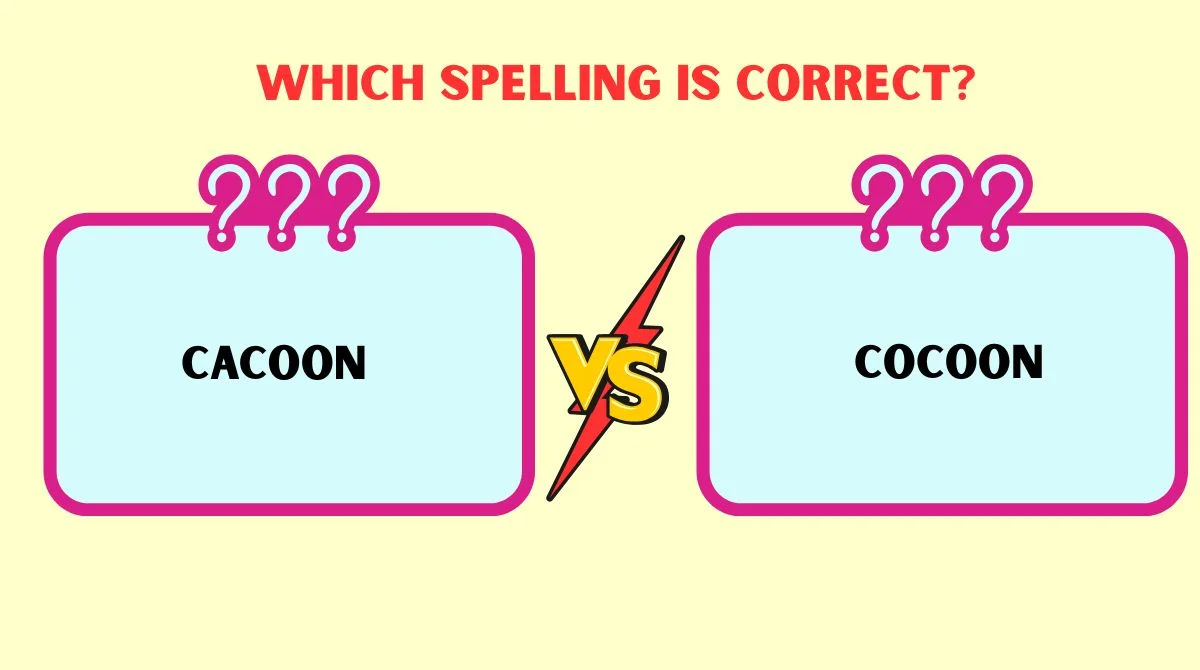
Spelling mistakes can sneak into even the most careful writer’s work. One of the most common slip-ups is typing “Cacoon” instead of “Cocoon.”
At first glance, the two words look almost the same. They sound alike too.
Yet only one is correct — and knowing why matters whether you’re writing a school essay, posting on social media, or publishing a blog.
This comprehensive guide clears up the confusion. You’ll discover the correct spelling, the word’s origins, its scientific and metaphorical uses, and practical ways to avoid the common mistake.
🌟 Introduction: Why the Confusion Exists
Many English words don’t sound the way they’re spelled. That’s why homophones — words that sound the same but have different spellings — often confuse writers.
“Cacoon” looks like a reasonable way to spell the word because the first syllable sounds like ka. However, English keeps the original spelling borrowed from French: “Cocoon.”
Understanding this difference isn’t just about passing a spelling test. It also shows respect for language accuracy and helps your writing look polished and professional.
Quote:
“Correct spelling isn’t pedantic. It’s a sign of attention to detail.” – Anonymous
⚡ Cacoon vs. Cocoon: Quick Answer
Here’s the truth in a nutshell:
- ✅ Cocoon — Correct spelling.
- ❌ Cacoon — Incorrect spelling, not found in reputable dictionaries.
You can think of “cocoon” as the soft protective casing spun by certain insects, especially moths and butterflies. “Cacoon” has no recognized meaning in English.
Quick Visual Comparison
| Aspect | Cocoon ✅ | Cacoon ❌ |
|---|---|---|
| Dictionary entry | Yes | No |
| Spelling origin | From French cocon | Not an actual word |
| Biological meaning | Protective casing for pupating insects | None |
| Figurative meaning | Safe or sheltered state | None |
| Common usage | Everyday English, science, literature | Misspelling only |
Tip: If you can’t find it in a trusted dictionary, it’s probably not a real English word.
🐛 What Does Cocoon Mean?
Biological Meaning
A cocoon is a protective silk case spun by the larvae of certain insects such as silkworms, moths, and butterflies. Inside it, the insect transforms during its pupal stage.
Key facts:
- Cocoons provide protection from predators and harsh weather.
- They are usually made of silk produced by the insect.
- The word is often associated with silk production because silkworm cocoons are harvested to make silk fabric.
Case Study:
The domesticated silkworm (Bombyx mori) spins a dense, oval-shaped cocoon. Each cocoon can yield up to 900 meters of silk thread — a fact that made cocoons historically valuable.
Metaphorical Meaning
In English, “cocoon” has also developed rich figurative uses:
- A cocoon of comfort — a cozy, safe place (e.g., “She wrapped herself in a cocoon of blankets.”)
- A cocoon of isolation — being shielded from the outside world.
- To cocoon (verb) — to withdraw or envelop oneself for protection or comfort.
Example sentence:
“After the stressful week, he cocooned himself in his room with books and music.”
🚫 What Is “Cacoon”?
“Cacoon” is not a real word in standard English.
You won’t find it in Merriam-Webster, Oxford English Dictionary, or any reputable linguistic database.
Why it appears:
- Phonetic spelling: People spell it how they hear it.
- Typos and autocorrect: Smartphones sometimes “correct” wrongly.
- Informal writing online: Social media often favors speed over accuracy.
But remember, it has no defined meaning.
Example of Incorrect Usage:
❌ “The caterpillar spun a cacoon on the tree branch.”
🔑 Key Differences Between Cacoon and Cocoon
| Feature | Cocoon (Correct) | Cacoon (Incorrect) |
|---|---|---|
| Part of Speech | Noun, also used as verb | Not applicable |
| Recognized Meaning | Yes – protective covering; figurative shelter | None |
| Example Sentence | “The silkworm’s cocoon was harvested for silk.” | “The silkworm’s cacoon was harvested for silk.” (❌) |
| Correct Pronunciation | /kəˈkuːn/ | No standard pronunciation |
Mnemonic:
Think of the two O’s in “cocoon” as the two halves of a soft, rounded shell.
This visual trick can help you remember the correct spelling.
❗ Common Mistakes: Why “Cacoon” Persists
Many writers continue using the wrong spelling because:
- Phonetic Influence: English often spells “ka” sounds with “ca” (e.g., camera, calendar).
- Lack of Exposure: People may have only heard the word and never seen it written.
- Autocorrect Errors: Some text editors fail to highlight the mistake.
- Informal Learning: Social media posts and casual conversations reinforce the error.
✍️ Using “Cocoon” Correctly
In Scientific Context
- “The caterpillar created a cocoon before transforming into a butterfly.”
- “Silk is extracted from silkworm cocoons.”
In Literature and Metaphor
- “He lived in a cocoon of privilege, shielded from the harsh realities of life.”
- “The story describes the hero breaking out of a cocoon of fear.”
In Everyday Language
- “I spent the rainy weekend cocooned in bed with my favorite novels.”
- “Her small apartment became a cocoon of peace during tough times.”
📜 Origins and History of the Word “Cocoon”
Etymology
The word “cocoon” comes from the French word cocon, meaning “shell” or “egg case.”
It entered English in the 17th century, during an era of increased interest in silk production.
Historical Notes
- The silk trade in Europe spread familiarity with the term.
- By the 18th and 19th centuries, writers started using “cocoon” metaphorically to describe a protective or isolating layer.
🕰️ Emergence of the Misspelling “Cacoon”
“Cacoon” appeared mainly with the rise of informal online writing in forums, comments, and text messaging.
Despite frequent appearance in informal contexts, it has never been recognized by dictionaries or style guides.
💡 Practical Tips to Avoid the Misspelling
- Visual Mnemonic: Picture the two O’s as the snug, rounded halves of a cocoon.
- Dictionary Check: Always verify spelling in a trusted dictionary.
- Write It Out Loud: The word “cocoon” sounds like kuh-koon, not ka-koon.
- Editing Tools: Use writing assistants or spell checkers to catch typos.
📊 Summary Table for Quick Reference
| Question | Correct Answer |
|---|---|
| Correct spelling | Cocoon |
| Recognized in English dictionaries | Yes |
| Is “Cacoon” correct? | No |
| Biological meaning | Protective casing for insect pupae |
| First recorded use | 17th century |
| Figurative meaning | Safe, sheltered state |
❓ FAQs About Cacoon vs. Cocoon
What is the correct spelling: Cacoon or Cocoon?
The only correct spelling is “cocoon.” “Cacoon” is a common but incorrect misspelling.
Why do people spell cocoon as cacoon?
Mostly because of phonetic spelling errors, typos, or seeing it used incorrectly online.
Can “Cacoon” ever be used informally?
No. It has no accepted meaning and should be avoided in all forms of writing.
What is the plural of cocoon?
The plural is “cocoons.”
Example: “The butterflies emerged from their cocoons.”
How do you use “cocoon” as a verb?
You can use it to describe enveloping or sheltering something or someone.
Example: “The cabin was cocooned in a blanket of snow.”
🏁 Conclusion: The Final Word
The verdict is clear: “Cocoon” is always the correct spelling.
“Cacoon” remains a widespread typo without recognition in English.
By understanding its history, meaning, and proper use, you’ll write with greater accuracy and professionalism.
Next time you see the two spellings, you’ll know immediately which one is right — and why.
Key Takeaway:
Accuracy in language builds trust. Get the small things right, and your writing gains clarity and credibility.

Leave a Reply