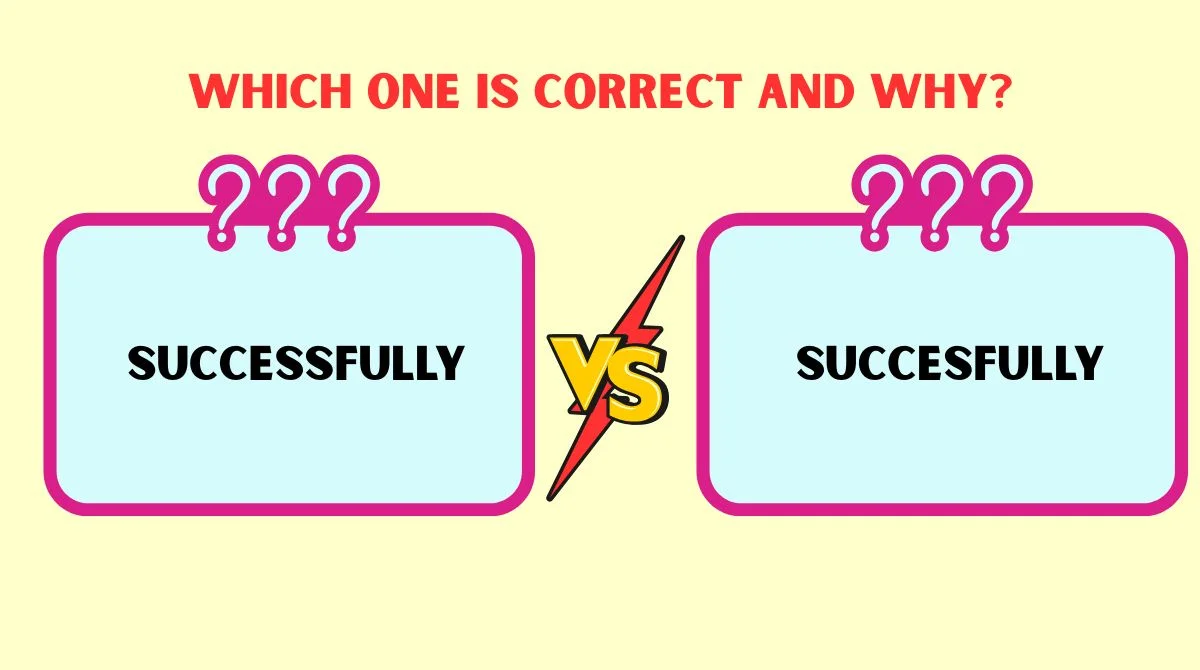
Have you ever paused while typing an email and wondered whether it’s “successfully” or “succesfully”?
You’re not alone. This small spelling detail often trips up even experienced writers.
In this guide, you’ll learn the correct spelling, why the other form is wrong, how the word evolved, and how to remember it forever.
Let’s dive in and clear the confusion once and for all.
The Quick Answer: Always Spell It as “Successfully”
The correct spelling is “successfully.”
The version with a single “s” — “succesfully” — is simply incorrect in every professional and academic context.
Why does it matter? Because spelling is more than formality. It reflects attention to detail, credibility, and professionalism.
Language expert Dr. Anne-Marie Carter puts it well:
“Spelling errors may seem minor, but they can silently shape how people judge your competence.”
The Origin Story of “Successfully”
Understanding the history of the word makes it easier to remember its spelling.
- The root “success” comes from the Latin word successus, meaning “an outcome” or “a good result.”
- It entered English through Old French as succès and Middle English as success.
- The suffix “-ful” means “full of”, and adding “-ly” turns it into an adverb.
So the modern form breaks down neatly into success + ful + ly.
Anatomy of the Word
Here’s a simple breakdown that shows why the double “s” remains:
| Part | Meaning | Example in Context |
|---|---|---|
| Success | Achievement or favorable outcome | “Her success inspired others.” |
| -ful | Full of or characterized by | “He is hopeful about the project.” |
| -ly | Manner of action (adverb) | “She spoke kindly to the child.” |
👉 When combined, the structure is:
Success + ful + ly → Successfully
That second “s” after “succe-” is part of the original root “success.”
Dropping it breaks the link to the root word.
Why the Misspelling Happens
It’s not just you — “succesfully” appears in thousands of online posts, resumes, and emails.
Here’s why people often get it wrong:
- Typing speed: Fingers skip one “s” while typing fast.
- Visual confusion: The double “s” looks redundant.
- Sound mismatch: When spoken, the double “s” blends into one /s/ sound.
- Autocorrect: Sometimes software doesn’t catch the missing letter.
Case Study:
In 2019, a major job board found that “succesfully” was among the top 50 misspelled words on resumes.
Recruiters noted that such errors often influenced first impressions.
Correct Usage in Context
Here are clear examples of “successfully” in different settings:
| Context | Example Sentence |
|---|---|
| Academic | “She successfully defended her doctoral thesis.” |
| Business | “The company successfully launched its new app.” |
| Everyday Life | “He successfully fixed the leaky faucet.” |
| Technology | “The file was successfully uploaded to the server.” |
| Sports | “The athlete successfully broke the national record.” |
❌ Incorrect: “The team succesfully completed the project.”
✅ Correct: “The team successfully completed the project.”
Professional & Real-World Stakes
Spelling mistakes can affect how others perceive your work.
Here’s why getting it right matters:
- Resumes & Job Applications: Misspellings may imply lack of attention to detail.
- Business Communications: Errors can hurt credibility and brand image.
- Academic Writing: Professors often deduct marks for incorrect spelling.
- Legal & Medical Fields: Precision in language avoids misunderstandings.
A survey by the Society for Human Resource Management found that 58% of hiring managers discard resumes with frequent spelling errors.
Memory Hacks & Learning Aids
Struggling to remember the extra “s”?
Here are some proven tips:
- Mnemonic: “Success needs two ‘s’ to succeed.”
- Visual Trick: Imagine a ladder 🪜—you need two steps (ss) to reach success.
- Family Connection: Remember that “success” itself has two “s’s,” and its related forms keep them.
- Proofread Backwards: Reading your text from the end to the start helps spot spelling errors.
- Practice Sentences: Write five sentences daily using “successfully.”
Mini Practice Box:
Fill in the blank with the correct spelling.
- She ______ completed the marathon.
- The software installed ______ on the first try.
- They ______ negotiated the merger.
(Answers: successfully, successfully, successfully)
Common Related Mistakes
Spelling errors often occur in the same family of words.
Here’s a quick table of common pitfalls:
| ❌ Incorrect | ✅ Correct | Reason |
|---|---|---|
| succesful | successful | Needs double “s” in root |
| succesfully | successfully | Follows the correct root form |
| sucess | success | Missing one “c” |
| succesion | succession | Same root word mistake |
Quick Reference Cheat Sheet
Keep this handy cheat sheet for fast recall:
- ✅ Always use “successfully” with two s’s after the “u.”
- 🔑 Link it to its root: success → successful → successfully.
- 🚫 Never drop the extra “s.”
- 📚 Use proofreading tools but double-check manually.
Final Takeaways & Practice Challenge
Key insight: The only correct spelling is “successfully.”
It retains the structure and meaning of its root word, “success.”
Practice Challenge:
Write three original sentences using “successfully” in different contexts: personal, professional, and academic.
Then check your sentences against this guide.
FAQs About Successfully or Succesfully
What is the correct spelling: Successfully or Succesfully?
Always use “successfully.” The other version is a misspelling and not accepted in standard English.
Why does “successfully” have two S’s?
It keeps the spelling of its root word “success.” Dropping one “s” changes the structure and is incorrect.
Is “succesfully” ever acceptable?
No. “Succesfully” is never correct in English writing, whether formal or informal.
How can I remember the correct spelling?
Use the mnemonic: “Success needs two ‘s’ to succeed.”
Practice writing the word regularly.
Does spelling really affect job applications?
Yes. Many recruiters consider consistent spelling a sign of attention to detail and professionalism.
What tools can help me spell it right?
Spell-check software, grammar tools like Grammarly, and manual proofreading are all effective.
