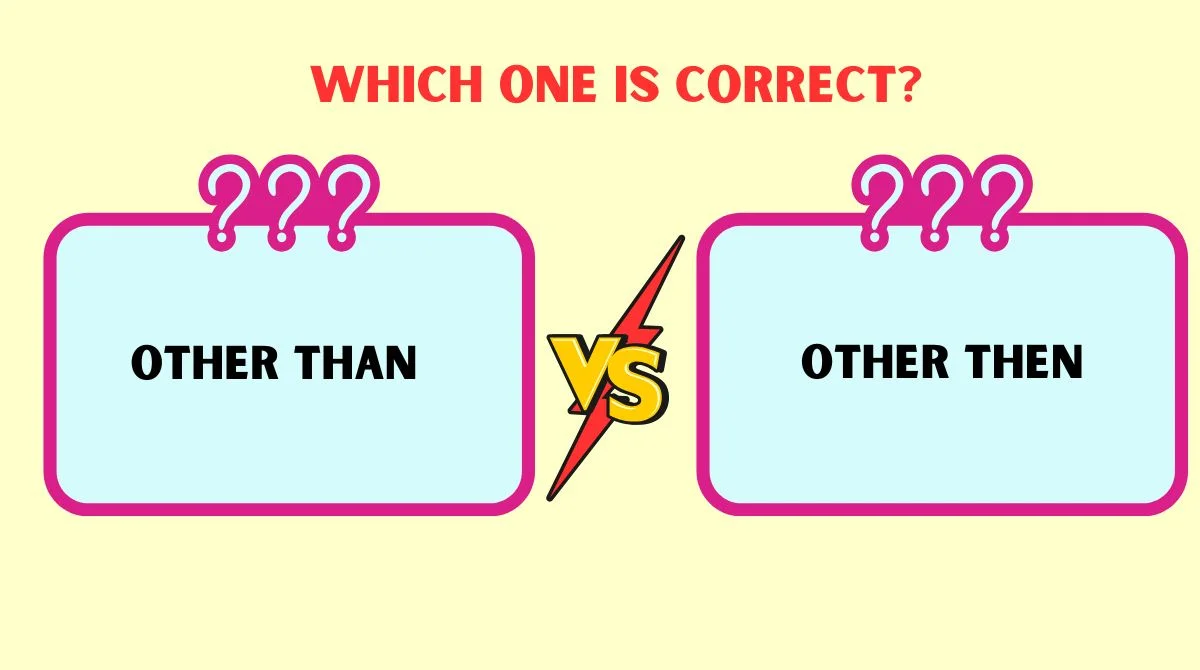
Confused about whether to write other than or other then? You’re not alone. Many writers, both native and non-native English speakers, stumble over these two similar-sounding phrases.
While one is grammatically correct and widely used, the other is a common mistake. By the end of this article, you’ll master the difference and never mix them up again.
Understanding the Confusion
English can be tricky. Words that sound alike often lead to mistakes, and “other than” vs “other then” is a perfect example.
The confusion mainly arises because:
- They sound almost identical when spoken.
- Writers confuse prepositions with adverbs, thinking “then” can replace “than.”
- Casual writing often ignores grammar rules, which spreads the mistake further.
For instance, someone might write:
“I don’t have any plans other then studying.”
This is incorrect, but it’s common in emails, text messages, and social media posts. Understanding why it’s wrong requires a closer look at each phrase.
What “Other Than” Means and How to Use It
“Other than” is a preposition. Its primary function is to mean:
- Except
- Besides
Think of it as a way to separate one thing from the rest in a sentence.
Proper Usage in Sentences
Here are some examples to make it clear:
- Negative context: “No one other than you can solve this problem.”
This means: You are the only person who can solve this problem. - Additive context: “I have no hobbies other than reading and writing.”
This shows inclusion of only specific items. - Comparative or alternative context: “Other than the weather, everything went perfectly.”
This points out a single exception in an otherwise normal situation.
Tips for identifying correct usage:
- Ask yourself: Am I listing exceptions or additions? If yes, use other than.
- Replace “other than” with “except” or “besides.” If it still makes sense, you’re correct.
Why “Other Then” Is Incorrect
“Other then” is grammatically incorrect in almost every situation. Here’s why:
- Then is an adverb of time. It refers to what comes next or at that time.
- Using then in place of than doesn’t make logical or grammatical sense.
Examples of Incorrect Usage
- ❌ “I like all fruits other then apples.”
- ❌ “No one other then John attended the meeting.”
Both should be written as:
- ✅ “I like all fruits other than apples.”
- ✅ “No one other than John attended the meeting.”
Trying to use “other then” confuses readers and makes sentences sound unprofessional.
Direct Comparison: “Other Than” vs “Other Then”
Sometimes, seeing things side by side helps. Here’s a quick comparison:
| Phrase | Correct/Incorrect | Meaning | Example |
|---|---|---|---|
| Other than | ✅ Correct | Except / besides | “I like all pets other than snakes.” |
| Other then | ❌ Incorrect | N/A | “I like all pets other then snakes.” |
Quick memory tip:
- If it expresses exception, always use than.
- If it expresses time, “then” is correct, but rarely used after “other.”
Real-Life Examples and Scenarios
Understanding examples from real-life writing will make this easier to remember.
- Emails and messages: “Other than the delay, your report is perfect.” ✅
“Other then the delay, your report is perfect.” ❌ - Social media captions: “I enjoy all movies other than horror.” ✅
“I enjoy all movies other then horror.” ❌ - Casual writing: “No one other than Sarah came to the party.” ✅
“No one other then Sarah came to the party.” ❌
Notice how small mistakes can change readability and credibility instantly.
Common Writing Mistakes
Writers often make recurring errors with other than:
- Adding “that” incorrectly:
- ❌ “Other then that, everything is fine.”
- ✅ “Other than that, everything is fine.”
- Mixing with “then” for time:
- ❌ “I have no hobbies other then painting.”
- ✅ “I have no hobbies other than painting.”
- Overcomplicating sentences:
- ❌ “I don’t have any other then reading.”
- ✅ “I don’t have any other than reading.”
Being aware of these mistakes prevents frequent errors in both casual and professional writing.
Quick Comparison Table
Here’s a simple table to remember the correct usage instantly:
| Use Case | Correct Form | Incorrect Form | Notes |
|---|---|---|---|
| Expressing exception | Other than | Other then | Use in prepositional phrases |
| Time-related statements | Then (standalone) | Other then | Rarely appears after “other” |
| Adding “that” | Other than that | Other then that | “Than” always fits here |
Why Do People Mix Up “Other Than” and “Other Then”?
The confusion often stems from:
- Phonetic similarity: Both sound almost identical in fast speech.
- Auto-correct mistakes: Phones and word processors often change “than” to “then.”
- Lack of grammar awareness: Writers rely on intuition rather than rules.
- Influence of spoken English: Casual speech can normalize mistakes over time.
By understanding the root cause, you’ll be less likely to repeat the mistake.
Tips to Always Use “Other Than” Correctly
Here are some practical tips and memory hacks:
- Substitute “except” or “besides.” If it works, use other than.
- Avoid “then” after other unless talking about time.
- Read aloud: Mistakes often become obvious when spoken.
- Use online grammar tools to double-check tricky sentences.
- Create a mental trigger: “Than = exception; Then = time.”
Practical Exercises
Practice makes perfect. Try these fill-in-the-blank exercises:
- I don’t eat any meat ___ fish.
- No one ___ Anna can solve this puzzle.
- ___ the rain, the picnic was enjoyable.
- She likes all sports ___ tennis.
- Other ___ that, everything is ready.
Answers:
- other than
- other than
- Other than
- other than
- than
By doing these exercises, your brain starts automatically choosing the correct form.
Frequently Asked Questions (FAQs)
Can “Other Then” Ever Be Correct?
Almost never. “Other then” is almost always a grammatical error. Use “other than” for exceptions.
How Can I Remember the Difference?
Think: Than = exception, Then = time. Replace with “except” or “besides” to check correctness.
Why Do Native Speakers Make This Mistake?
It’s usually due to casual speech, typing errors, or auto-correct changing “than” to “then.”
Is “Other Than That” Correct?
Yes. Example: “Other than that, everything is fine.” Never replace “than” with “then.”
Can This Mistake Affect Professional Writing?
Absolutely. Misusing “other than” can make reports, emails, or essays look careless or unprofessional.
Conclusion
In summary:
- Use “other than” to express exceptions or additions.
- Never use “other then” in these contexts.
- Read, practice, and apply memory hacks to avoid mistakes.
- Side-by-side comparison and exercises can solidify understanding.
Mastering this small detail in grammar improves credibility, clarity, and confidence in writing. Now, you can write without second-guessing, whether in emails, essays, or social posts.
