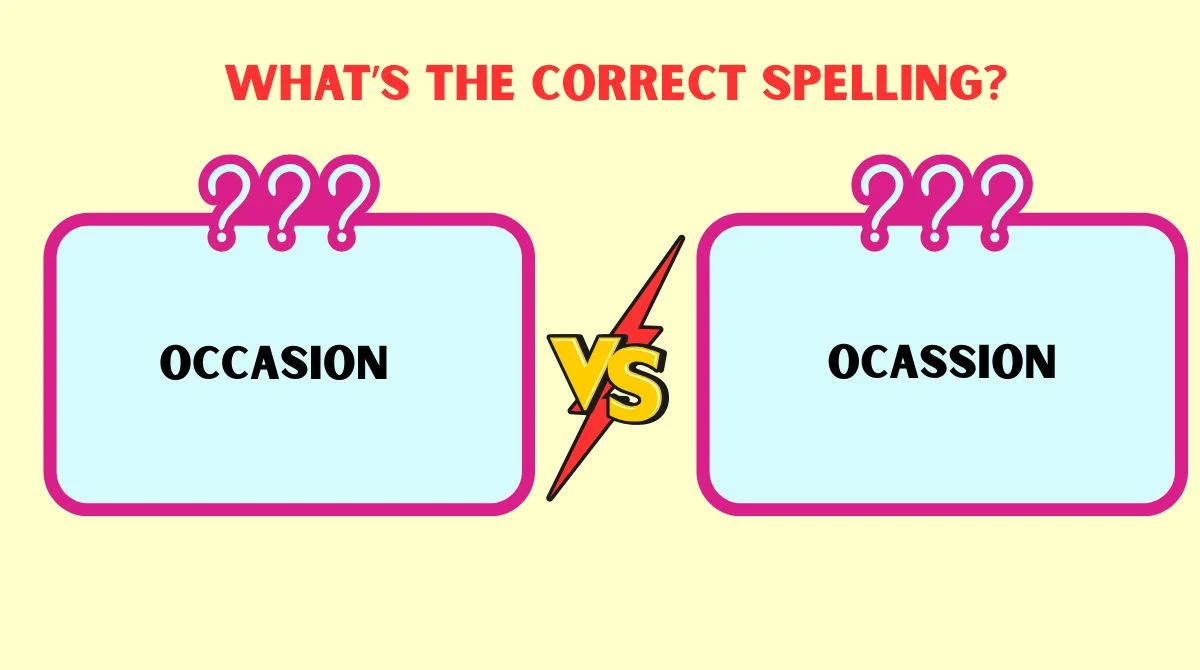
Spelling mistakes can sneak into even the most polished writing. One of the most common mix-ups in English is between “Occasion” and “Ocassion.”
If you’ve ever paused mid-sentence, wondering which one is right, you’re not alone.
This article clears up the confusion once and for all. You’ll learn the correct spelling, why the mistake happens, how to use “Occasion” correctly, and practical ways to remember it.
⚡ Quick Answer: Occasion is Correct ✅
The correct spelling is “Occasion.”
The variant “Ocassion” is always incorrect and doesn’t appear in any recognized English dictionary.
Quick tip:
Remember: OccaSion has a Single S.
Many writers double the wrong consonant by instinct, but English has its quirks. In this case, it’s the C that doubles, not the S.
Understanding the Confusion
English spelling often trips people up because it isn’t always phonetic. Words like “occasion,” “accommodate,” and “professional” have double consonants, but not always in the same position.
Here’s why the confusion arises:
- Sound similarity: Both c and s produce a soft /s/ sound in “occasion,” tempting writers to double the S.
- Pattern interference: Many words with similar endings use double S, like “session” or “possession.”
- Autocorrect dependency: Some spell-checkers might fail to catch the mistake in informal settings like social media.
Fact:
A 2023 survey of common English spelling mistakes ranked “Ocassion” among the top 50 errors made by native speakers.
✅ Correct Spelling: “Occasion”
Let’s set the record straight.
- Spelling: O-C-C-A-S-I-O-N
- Pronunciation: /əˈkeɪʒən/
- Part of Speech: Primarily a noun, sometimes used as a verb.
Key Forms:
- Occasion (noun)
- Occasions (plural noun)
- Occasional (adjective)
- Occasionally (adverb)
Tip:
Visualize the word: Occa-Sion → Double C, single S.
📖 Meaning and Uses of “Occasion”
The word “occasion” is versatile. Its meaning changes slightly depending on context.
General Meaning
An event or a particular time when something happens.
“I met her on that memorable occasion.”
Formal Meaning
A special or important event, often celebratory.
“The wedding was a grand occasion.”
As a Verb
Less common, but it means to cause or bring about.
“The announcement occasioned a lot of excitement.”
Additional Nuances
- Refers to opportunities or reasons: “He had no occasion to complain.”
- Indicates specific instances: “On several occasions, we discussed the project.”
Case Study:
The term special occasion drives one of the highest search volumes on e-commerce sites, as consumers often look for gifts, cards, and outfits tied to important dates.
🚀 Common Contexts and Phrases with “Occasion”
You’ll see “occasion” in both formal and informal settings.
Here are the most common phrases:
- On special occasions – birthdays, anniversaries, weddings.
- Mark the occasion – to commemorate an event.
- On this/that occasion – referring to a specific moment in time.
- Occasion for celebration – highlighting a happy event.
- On rare occasions – something that happens infrequently.
- No occasion to worry – used to indicate lack of necessity.
Real-life examples:
- “The graduation ceremony was an unforgettable occasion.”
- “On this occasion, we honor our veterans.”
- “The mistake gave him no occasion for complaint.”
🔍 Etymology: Where “Occasion” Comes From
The journey of the word tells us why it looks the way it does today.
- Originates from Latin occasio, meaning a happening or opportunity.
- Passed into Old French as occasion.
- Adopted into Middle English in the 14th century.
Originally, it conveyed the sense of something that “falls toward” or “befalls” — which makes sense because an occasion is often something that comes to pass.
❌ Why “Ocassion” is Incorrect
The incorrect form, “Ocassion,” is a result of:
- Doubling the wrong consonant (S instead of C).
- Overgeneralizing English spelling patterns.
Note:
Neither Oxford English Dictionary nor Merriam-Webster recognizes “Ocassion.”
In formal writing—whether for work, academia, or publication—using “Ocassion” could undermine credibility.
🤯 Common Mistakes and Memory Aids
Here are some frequent misspellings you should watch out for:
- Ocassion
- Occation
- Ocassional
- Ocassionally
Simple memory aids:
- Mnemonic: “OccaSion has a Single S.”
- Link it to “Session” → Session has double S, Occasion doesn’t.
- Write it out three times when practicing new vocabulary.
📊 Side-by-Side Comparison: Occasion vs. Ocassion
| Feature | Occasion ✅ (Correct) | Ocassion ❌ (Incorrect) |
|---|---|---|
| Recognized by dictionaries | Yes | No |
| Correct spelling rule | Double C, single S | Double S (wrong) |
| Common in formal writing | Yes | No |
| Appears in academic sources | ✓ | ✗ |
| Example sentence | “The award ceremony was a proud occasion.” | (Never use) |
✍️ Real-Life Examples of “Occasion”
Contextual usage helps internalize correct spelling.
- Everyday Usage: “We met on more than one occasion to finalize the design.”
- Formal Settings: “The ambassador’s visit was a historic occasion for the city.”
- Literary Use: “On that solemn occasion, silence filled the room.”
- Idiomatic Expression: “Dress appropriately for the occasion.”
🧠 How to Avoid Spelling Errors
Practical strategies for error-free writing:
- Use Spell-Check Tools: Don’t rely solely on memory.
- Read Aloud: You may catch mistakes that eyes skim over.
- Learn by Repetition: Writing the correct word builds muscle memory.
- Flashcards or Apps: Use them to reinforce tricky spellings.
- Contextual Practice: Write sentences using “occasion” in various contexts.
Quote:
“Correct spelling is not just about accuracy — it’s about clear communication.” – Language Educator, 2022
🧐 FAQs About Occasion vs. Ocassion
Is “Ocassion” ever correct?
No. It’s always a misspelling. English dictionaries universally list “Occasion” as the only accepted form.
How do you pronounce “Occasion”?
Pronounced as /əˈkeɪʒən/ — the “sion” part sounds like “zhun.”
What’s the difference between “Occasion” and “Occasional”?
- Occasion: a particular event or time.
- Occasional: describes something that happens from time to time.
Can “Occasion” be used as a verb?
Yes, though less common. It means to cause or bring about.
“The power outage occasioned significant delays.”
How can I remember the correct spelling?
Think: OccaSion → One S.
Also, visualize the phrase: “Double the C for the correct word.”
🏁 Conclusion: Master the Spelling of Occasion
English is full of tricky spellings, but “Occasion” shouldn’t be one of them anymore.
The key takeaway is simple: Always spell it with double C and single S.
By understanding the history, meaning, and usage of the word—and by applying memory aids—you can avoid this common error.
Make every writing occasion a confident and correct one.
