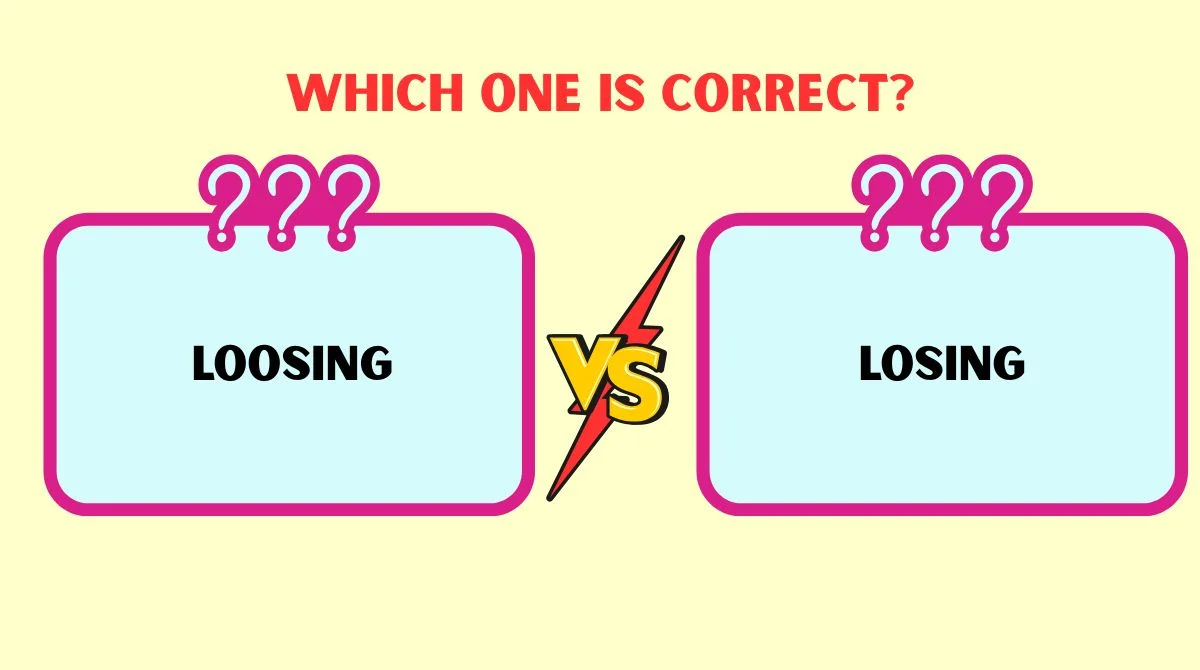
Have you ever paused mid-sentence wondering whether to type “loosing” or “losing”?
You’re not alone. Even seasoned writers stumble over this pair.
In this guide, we’ll dig deep into the difference, why people confuse them, and how you can remember which word to use. By the end, you’ll never second-guess yourself again.
Understanding the Confusion
English is full of look-alike words that trip up even native speakers.
“Loosing” and “losing” sound nearly identical, yet they mean completely different things.
- The confusion stems mainly from spelling patterns and phonetics.
- Many learners assume that if loose becomes looser, then lose should become looser too—but it doesn’t.
- The difference between these two words also reflects the difference between lose and loose, their root forms.
The Root Words: Lose vs Loose
Understanding the parent words is the key.
| Word | Part of Speech | Meaning | Example |
|---|---|---|---|
| Lose | Verb | To misplace, to fail to win, to be deprived of something | “I don’t want to lose my wallet.” |
| Loose | Adjective / Verb | Not tight; to free, release | “Tie the rope, it’s too loose.” or “They loose the horses.” |
Historical Note
- Lose comes from Old English losian, meaning to perish or be destroyed.
- Loose comes from Old Norse lauss, meaning free or unbound.
The historical split explains why they look similar but act differently in modern English.
Breaking Down the Words
Losing
- Definition: Present participle of lose.
- Usage: Means to misplace, to fail to win, or to suffer defeat or loss.
- Common Contexts:
- Sports: “Our team is losing the match.”
- Misplacing things: “I keep losing my glasses.”
- Abstract losses: “She’s losing her patience.”
💡 Key Fact: In 99% of everyday situations, the correct word is losing.
Loosing
- Definition: Present participle of loose, meaning to release, to set free, to untie.
- Usage: Far less common in daily conversation.
- Typical Contexts:
- Historical or formal writing: “The king ordered the guards to start loosing the prisoners.”
- Religious texts: “And whatsoever thou shalt bind on earth shall be bound in heaven: and whatsoever thou shalt loose on earth shall be loosed in heaven.”
- Poetic or old-fashioned language: “The archer was loosing his arrow.”
🔑 Key Fact: Loosing is rarely used today except in specific historical, literary, or religious contexts.
Common Sources of Confusion
Phonetic Similarity
- Both words sound nearly the same in casual speech.
- English often drops unstressed vowel sounds, making lose-ing and loose-ing sound identical.
Spelling Pattern Trap
- Many learners think that since loose has two o’s, its participle should be loosing, but then mistakenly use it in place of losing.
Influence of Technology
- Autocorrect sometimes replaces losing with loosing (or vice versa), especially when typing quickly.
Real-World Mistakes
- Sports headlines: “The team is loosing again!” (incorrect)
- Social media posts: “I’m tired of loosing weight and gaining it back.” (incorrect)
- Corrected: “The team is losing again!” / “I’m tired of losing weight…”
Side-by-Side Comparison
Here’s a quick chart you can bookmark for future reference:
| Aspect | Losing | Loosing |
|---|---|---|
| Root Word | Lose | Loose |
| Meaning | Misplacing, failing to win, experiencing defeat | Releasing, freeing, untying |
| Part of Speech | Verb (present participle) | Verb (present participle) |
| Usage Frequency | Extremely common in modern English | Rare, mostly in literary or historical texts |
| Typical Contexts | Games, sports, emotions, possessions | Untying ropes, freeing captives, archery |
Everyday Usage Examples
Correct Use of Losing
- “The company is losing revenue due to poor marketing.”
- “He’s afraid of losing his job.”
- “I’m always losing my house keys.”
- “Our team is losing the final game by two points.”
Correct Use of Loosing
- “The general was loosing his troops to charge the enemy.”
- “They were loosing the dogs to track the scent.”
- “The blacksmith was loosing the chain from the gate.”
📌 Tip: If you mean not winning or misplacing, use losing.
If you mean setting free or untying, use loosing.
Case Study: A Costly Spelling Error
In 2018, a small business ran a social media campaign promoting a “Stop Loosing Money” course.
The ad went viral—not for the right reason. Thousands mocked the mistake, questioning the company’s credibility.
Within hours, the business had to pull the campaign and re-release it using the correct spelling, “Stop Losing Money.”
✏️ Lesson: A single spelling mistake can hurt trust, brand image, and even sales.
Tips for Remembering the Difference
Here are some practical ways to keep them straight:
- Mnemonic for Losing:
- “You can lose something. So you are losing it.”
- Mnemonic for Loosing:
- “Think of loose as not tight. So you’re loosing what was tied.”
- Visual Cue:
- Imagine the double “o” in loose as two open circles—like links of a chain being released.
- Practice Sentences:
- Write five sentences each with losing and loosing.
- Read them aloud to hear how similar they sound but mean different things.
- Context is King:
- If the sentence involves defeat, misplacing, or deprivation → use losing.
- If it’s about freeing, untying, or letting go → use loosing.
Top 6 FAQs
Is “loosing” a real word?
Yes. It’s the present participle of loose, meaning to free, untie, or release. It’s far less common than losing.
Why do people often write “loosing” instead of “losing”?
Because both words sound almost identical in speech, and many people wrongly assume they share the same spelling pattern.
Can I use “loosing” in everyday writing?
Generally no. Unless you’re writing about freeing something or using poetic or historical language, stick with losing.
What’s the best trick to remember the difference?
Associate losing with loss (both have a single “o”). Associate loosing with loose ropes (think of releasing something).
Is “loosing weight” incorrect?
Yes. The correct phrase is “losing weight.” You’re not freeing your weight; you’re shedding it.
Which is more common in modern English?
Losing is far more common. Loosing is rarely used outside of literature, history, or religion.
Key Takeaways
- Losing = the opposite of winning, or misplacing something.
- Loosing = releasing or setting free.
- In everyday writing, you’ll almost always use losing.
- Spelling mistakes like mixing up these two words can damage credibility.
- Use mnemonics and context clues to remember the right choice.
Conclusion
The confusion between loosing and losing is widespread but easily fixed.
By understanding their origins, meanings, and usage patterns, you can confidently choose the correct word.
Next time you write about defeat, misplaced keys, or shedding weight, you’ll know it’s losing.
And if you’re describing untying ropes or freeing something, you’ll reach for loosing.
✍️ Correct spelling not only improves your writing but also preserves your credibility—whether in a blog post, a headline, or a social media caption.
