Category: Tricky Terms

  • Annual vs Yearly vs Every Year 📅 – Key Differences Explained with Examples

    Annual vs Yearly vs Every Year 📅 – Key Differences Explained with Examples

    Language often throws curveballs at even fluent speakers. Words like annual, yearly, and every year look interchangeable, yet each one carries unique tones, contexts, and subtle differences.

    Writers, students, and professionals alike ask the same question: Which one should I use?

    The short answer?

    • Annual is formal and often tied to events or official reports.
    • Yearly is more flexible, slightly less formal, and often relates to recurring schedules.
    • Every year is conversational, plain, and best for emphasizing frequency.

    But there’s a lot more to it than that. In this article, you’ll get a full breakdown with clear definitions, practical examples, usage tips, comparisons, and even common mistakes people make with these words.


    Breaking Down the Core Question
    Annual vs Yearly vs Every Year

    When someone says, “We have an annual meeting” and another person says, “We meet yearly”, both sound correct. Add “We meet every year” into the mix, and things get blurry.

    The confusion exists because all three refer to something happening once in a year, yet they differ in:

    • Formality – some are used in formal reports, others in everyday talk.
    • Grammar – one is a single word, another a phrase, and another has both adjective and adverb forms.
    • Context – you won’t call your family barbecue an annual report, but you might call it an annual barbecue.

    Here’s a quick at-a-glance table to set the stage:

    Word/PhraseFormalityCommon ContextsExample Sentence
    AnnualHigh (formal)Events, reports, publications“The company hosts an annual conference.”
    YearlyMedium (neutral)Bills, subscriptions, habits“The magazine offers a yearly subscription.”
    Every yearLow (informal)Conversations, traditions, storytelling“We visit our grandparents every year.”

    What Does “Annual” Mean?

    The word annual comes from the Latin annus, meaning “year.” It refers to something that happens once a year or lasts for a year.

    Key traits of “annual”:

    • More formal than “yearly.”
    • Frequently used in official, academic, or professional settings.
    • Common in names of events: annual report, annual meeting, annual award show.

    Examples:

    • The school holds its annual science fair each March.
    • Investors eagerly read the company’s annual report.
    • The city’s annual marathon draws runners from around the world.

    Grammatical Role:

    • Adjective: “The annual conference attracted 5,000 attendees.”
    • Noun (less common): “Perennials last multiple seasons, while annuals bloom once a year.”

    Annual is best when you want a polished, professional tone or when naming something that repeats on a yearly schedule.


    What Does “Yearly” Mean?

    The word yearly is simpler and more neutral than “annual.” It conveys the same meaning—something that happens once per year—but it lacks the formality of “annual.”

    Key traits of “yearly”:

    • Slightly less formal than “annual.”
    • Often used in business, everyday life, and finance.
    • Works well when describing recurring schedules, payments, or habits.

    Examples:

    • My insurance premium is billed yearly.
    • We take a yearly family trip to the beach.
    • The yearly rainfall in the region averages 40 inches.

    Grammatical Role:

    • Adjective: “She made a yearly donation to the charity.”
    • Adverb: “The flowers bloom yearly in the spring.”

    While “annual” sounds polished, “yearly” feels straightforward. It’s the word you’d use in contracts, everyday writing, or when discussing recurring actions without formal naming.


    What Does “Every Year” Mean?

    Unlike the first two, every year is a phrase rather than a single word. It’s direct, clear, and very conversational.

    Key traits of “every year”:

    • More informal than “annual” or “yearly.”
    • Common in storytelling, traditions, or casual speech.
    • Focuses on frequency, not naming events.

    Examples:

    • We decorate the house together every year.
    • The town floods every year during monsoon season.
    • He forgets my birthday every year without fail.

    This phrase is easy for learners and everyday speakers because it avoids formality. However, it’s usually not the best choice in professional documents or official reports.


    Comparing “Annual” vs “Yearly” vs “Every Year”

    Now let’s line them up side by side:

    AspectAnnualYearlyEvery Year
    FormalityHigh (official, academic)Medium (neutral)Low (casual, conversational)
    TonePolished, professionalNeutral, simpleFriendly, informal
    Grammatical RoleAdjective, nounAdjective, adverbPhrase
    Common UsesReports, events, publicationsPayments, contracts, habitsTraditions, casual speech
    Example“Annual report”“Yearly subscription”“Every year we travel”

    Quick Takeaway:

    • Use annual when naming formal events or writing professional documents.
    • Use yearly when describing recurring things without formality.
    • Use every year when speaking casually or telling stories.

    Example Sentences in Action

    Using “Annual”

    • The United Nations releases an annual report on climate change.
    • Her promotion was announced at the company’s annual dinner.
    • The museum’s annual exhibit focuses on modern art.

    Using “Yearly”

    • We make yearly updates to our software.
    • The landlord collects yearly maintenance fees.
    • He schedules a yearly check-up with the doctor.

    Using “Every Year”

    • We bake cookies together every year on Christmas Eve.
    • The same mistake happens every year during tax season.
    • She volunteers at the shelter every year without fail.

    Common Variations and Confusions

    Annual vs Annually

    • Annual = adjective (The annual meeting was held in June.)
    • Annually = adverb (The company meets annually to discuss profits.)

    Both are correct, but they play different grammatical roles.

    Yearly vs “Yearlies”

    Some learners mistakenly say “yearlies” to mean annual events or bills. This is incorrect. Stick to “yearly” as either an adjective or an adverb.

    Every Year vs Each Year

    • Every year emphasizes repetition (It rains every year without fail.).
    • Each year highlights individual instances (Each year brings new opportunities.).
      Both are correct, but “each year” often sounds slightly more formal.

    Practical Usage Tips for Writers and Speakers

    Here’s how to decide which word or phrase works best in your sentence:

    • Ask yourself the context.
      • Writing a report? → Use annual.
      • Describing a subscription or payment? → Use yearly.
      • Talking casually with a friend? → Use every year.
    • Check the tone.
      • Annual = professional and polished.
      • Yearly = clear and straightforward.
      • Every year = simple and conversational.
    • Think about grammar.
      • Need an adjective? → Annual report / yearly subscription.
      • Need an adverb? → Meet annually / renew yearly.
      • Need a phrase? → We celebrate every year.

    Case Study: Business vs Casual Writing

    Imagine two different contexts:

    1. Business Report

    • “The company hosts an annual general meeting where shareholders vote.”
      Using “annual” fits here because it signals formality and professionalism.

    2. Conversation Between Friends

    • “We go camping every year in the summer.”
      This version feels natural in everyday speech and storytelling.

    3. Personal Finance Blog

    • “Switch to a yearly subscription and save 20% compared to paying monthly.”
      Here, “yearly” balances clarity with a practical, reader-friendly tone.

    🙋 FAQs

    What is the difference between annual and yearly?

    Annual is more formal and often used in reports or events, while yearly is neutral and commonly used for payments, habits, or schedules.

    Can I use every year instead of yearly?

    Yes, but every year is more conversational, while yearly works better in business, contracts, and formal writing.

    Is annual the same as annually?

    No. Annual is an adjective (annual meeting), while annually is an adverb (meet annually).

    Which is more formal: yearly or every year?

    Yearly is more formal than every year, but less formal than annual.

    When should I use annual instead of yearly?

    Use annual for formal reports, events, or publications, and yearly for recurring bills, subscriptions, or neutral contexts.

    What is the difference between every year and each year?

    Every year emphasizes repetition, while each year focuses on individual yearly occurrences. Both are correct.


    Conclusion

    While annual, yearly, and every year all describe once-a-year occurrences, they aren’t identical.

    • Annual is formal and professional—perfect for reports, events, and official documents.
    • Yearly is versatile and neutral—great for payments, schedules, or habits.
    • Every year is conversational—ideal for storytelling and everyday use.

    By understanding these distinctions, you can choose the right term for the right audience. Whether you’re drafting a business report, writing a casual blog, or just chatting with friends, the right word choice adds clarity and impact.

  • Ask vs Pose 🤔 | Key Differences, Examples & Correct Usage

    Ask vs Pose 🤔 | Key Differences, Examples & Correct Usage

    Have you ever stopped mid-sentence, wondering whether you should ask a question or pose one? At first glance, both verbs seem to do the same job.

    Yet in English, the choice between ask and pose can completely shift the tone, context, and even the level of formality in your message.

    Here’s the key takeaway: “Ask” is the go-to verb for everyday questions and requests, while “pose” is typically used in formal, academic, or philosophical settings when you frame a question for thought or discussion.

    That distinction might sound simple, but in practice, learners often misuse “pose,” either making their sentence sound too formal or downright awkward.

    This article will break it down clearly: definitions, contexts, nuances, comparisons, practical tips, and plenty of real-life examples. By the end, you’ll know exactly when to ask a question and when to pose one.


    Understanding the Core Meaning

    Ask vs Pose

    Defining “Ask”

    The verb ask comes from Old English ascian, meaning to request, seek, or inquire. In modern English, its meaning hasn’t drifted far. It’s direct, personal, and highly versatile.

    To ask is to:

    • Request information: I asked her about the project deadline.
    • Seek permission: Can I ask if you’re free tonight?
    • Make a request: He asked for help with his homework.
    • Invite a response: She asked what everyone thought of the film.

    Because it’s so flexible, ask works in nearly every context—casual conversation, business meetings, and even formal writing.


    Defining “Pose”

    The verb pose stems from Latin pausare, meaning to put, place, or set forth. In English, pose has several senses, but when linked to questioning, it means to present a question or problem for others to consider.

    To pose is to:

    • Frame a question formally: The professor posed a difficult ethical dilemma.
    • Present an issue for discussion: The report poses new challenges for policymakers.
    • Suggest or introduce a thought: This study poses interesting possibilities for the future.

    Unlike ask, pose is less about expecting a direct answer and more about framing ideas, sparking thought, or highlighting challenges.


    Usage in Context

    When to Use “Ask”

    You should use ask when:

    • You want a direct answer: I asked him where the station was.
    • You make a personal request: She asked me for a pen.
    • You need to be polite but clear: Can I ask for your opinion?

    In short, ask fits best in everyday conversation, polite requests, and straightforward inquiries.


    When to Use “Pose”

    You should use pose when:

    • The context is formal or academic: The article poses an important question about global warming.
    • The question is abstract or rhetorical: His speech posed the question of justice in society.
    • You’re highlighting a problem or challenge: This policy poses risks to small businesses.

    In casual conversation, pose often sounds out of place. Imagine saying, “I posed my friend if he wanted coffee.” It feels clunky and unnatural.


    Nuances in Questioning

    English speakers instinctively choose ask or pose depending on the kind of question they want to create. Let’s break it down.

    Direct Questions (Ask)

    • Expect a clear answer
    • Usually tied to practical matters
    • Fit for personal and professional interactions

    Example:

    • I asked the waiter for the menu.
    • She asked me how I was feeling.

    Open-Ended / Thought-Provoking Questions (Pose)

    • Don’t demand immediate answers
    • Encourage reflection, debate, or exploration
    • Common in academic, philosophical, and political speech

    Example:

    • The scientist posed the question of whether artificial intelligence can think.
    • The teacher posed a riddle to the class.

    Seeking Specific Answers vs. Sparking Ideas

    • Ask = Specific answers.
      “I asked my boss if I could leave early.”
    • Pose = Discussion starters.
      “The debate posed difficult questions about freedom of speech.”

    Comparative Analysis: Ask vs Pose

    Here’s a side-by-side look at the two verbs:

    FeatureAskPose
    ToneCasual, neutral, politeFormal, academic, elevated
    ContextEveryday speech, requests, direct inquiriesResearch, debates, professional presentations
    ExpectationDirect responseReflection or discussion
    Use with PeopleCommon (ask someone…)Rare (pose to someone sounds odd)
    FlexibilityWorks in all settingsBest in academic/professional writing

    Practical Applications

    In Daily Conversation

    Stick with ask. It’s natural, expected, and never sounds pretentious.

    • I asked my mom for advice.
    • He asked me to pick him up.

    In Professional & Academic Settings

    Use pose when the focus is on ideas, not answers.

    • The study poses a new theory about brain development.
    • Her research poses challenges to existing beliefs.

    Situations Where “Pose” Sounds Awkward

    Avoid using pose in casual speech. Examples that don’t work:

    • I posed my friend for directions.
    • He posed me what time the train leaves.

    They sound wrong because pose doesn’t naturally attach to everyday requests.


    Mastering the Art of Questioning

    Being good at questioning isn’t only about knowing when to use ask or pose. It’s about framing questions effectively.

    Effective Questioning Techniques

    • Be clear and concise. Avoid long-winded questions.
    • Know your audience. Use ask for casual, pose for formal.
    • Encourage engagement. Posed questions should invite thought.
    • Balance tone. Too many formal “posed” questions may feel heavy.

    Shifting Between Ask and Pose

    • In meetings, you might ask for clarification but pose a strategic question.
    • In classrooms, teachers ask for answers but pose scenarios.
    • In research, scholars pose hypotheses but ask specific questions during experiments.

    Common Mistakes Learners Make

    • Using pose in casual speech → sounds unnatural.
    • Overusing ask in formal writing → can make academic work seem too casual.
    • Forgetting that pose often refers to problems or challenges, not just questions.

    Examples in Real Sentences

    “Ask” Examples

    • I asked my teacher about the homework deadline.
    • She asked him to join the group.
    • They asked us if we wanted dessert.

    “Pose” Examples

    • The article poses an interesting question about climate change.
    • The philosopher posed the problem of free will.
    • This new regulation poses a threat to small businesses.

    Broader Language Insight

    Why does English give us two verbs that mean “to question”? Because English adapts words for different tones and registers.

    • Ask → simple, flexible, universal.
    • Pose → elevated, formal, rhetorical.

    The impact is clear: choosing one over the other shapes how your audience perceives you. Use ask, and you sound approachable. Use pose, and you sound academic or intellectual.


    FAQs

    When should I use “ask” instead of “pose”?

    Use ask when you want a direct response in everyday or professional interactions. Example: I asked him where he lived.

    Can I use “pose” in casual conversation?

    Not usually. Pose sounds formal and academic. Saying “I posed my friend a question” feels stiff. Stick with ask in daily life.

    Are there situations where “pose” is inappropriate?

    Yes. Avoid pose for personal requests or informal settings. Example: “I posed my mom for lunch money” is awkward and incorrect.

    Can “ask” and “pose” be used interchangeably?

    Not exactly. While both deal with questions, ask expects answers while pose frames issues for thought or discussion.

    How can I improve my questioning techniques?

    Practice both styles. Use ask to get clear, actionable answers. Use pose in essays, debates, or speeches to encourage deeper thinking.

    Why does “pose” often appear in academic writing?

    Because it emphasizes framing questions, raising issues, or highlighting problems—key features of scholarly discussion.


    Conclusion / Wrap Up

    The difference between ask and pose might seem minor, but it makes a huge impact on communication.

    • Ask works in all contexts, especially casual and direct ones.
    • Pose belongs in formal, academic, and intellectual settings where the focus is on ideas, not immediate answers.

    By mastering both, you’ll sound natural in conversation and precise in formal writing. So the next time you’re crafting a sentence, ask yourself: do I need an answer, or do I want to spark thought? That’s the heart of ask vs pose.

  • Taken vs Taking 🤔 Grammar Made Easy with Clear Examples

    Taken vs Taking 🤔 Grammar Made Easy with Clear Examples

    English verbs can be tricky, especially when they change form. The verb “take” often confuses learners because it appears in many variations—take, took, taken, taking. Out of these, the pair “taken” and “taking” cause the most trouble.

    Should you say “She is taking notes” or “She has taken notes”? Is it “The event is taking place” or “The event has taken place”? These small differences change the meaning completely.

    This guide will break down taken vs taking in a way that finally makes sense. You’ll see grammar rules, real-world examples, idioms, tables for clarity, and even memory tricks to help you remember the difference.


    Understanding the Grammar Basics of “Taken” vs “Taking”

    Taken vs Taking

    Before diving into usage, it helps to understand what’s happening grammatically.

    What Does “Take” Mean?

    At its core, take means to get, hold, or accept something. But in English, it stretches into dozens of meanings:

    • To grab or receive: Take this book.
    • To capture: The army took the city.
    • To travel by a method: She takes the bus every day.
    • To spend or require time: The test takes an hour.
    • To accept or handle something: I can’t take the pressure.

    This flexibility is why “taken” and “taking” appear everywhere.

    Participles Explained Simply

    English verbs have different forms called participles:

    FormExampleUsage
    Present participletakingUsed in continuous tenses and as a gerund
    Past participletakenUsed in perfect tenses and passive voice

    Think of it this way:

    • Taking = happening now, in progress
    • Taken = already done, completed

    When to Use “Taking”

    “Taking” is the present participle of “take.” It shows ongoing action, or it works as a noun (a gerund).

    Taking in Continuous Tenses

    “Taking” helps build continuous tenses that describe something happening right now or over a period.

    • She is taking photos of the sunset.
    • They were taking notes during the lecture.
    • I will be taking a course this summer.

    Here, “taking” shows action in progress.

    Taking as a Gerund (Noun Form)

    Sometimes “taking” acts like a noun. This form is called a gerund.

    • Taking risks is part of success.
    • He enjoys taking long walks.
    • Your taking of responsibility matters to the team.

    Notice how “taking” functions as the subject or object in these sentences.

    Common Expressions with “Taking”

    English is full of set phrases with “taking.” Here are a few important ones:

    • Taking chargeShe is taking charge of the meeting.
    • Taking partHe’s taking part in the marathon.
    • Taking responsibilityThey’re taking responsibility for the mistake.
    • Taking timeIt’s taking longer than expected.

    These idioms use “taking” to show ongoing involvement.

    Quick Reference Table for “Taking”

    RoleExample SentenceMeaning
    Continuous tenseHe is taking the bus.Action happening now
    GerundTaking care of pets is rewarding.Action as a noun
    ExpressionShe’s taking charge.Idiomatic phrase

    When to Use “Taken”

    “Taken” is the past participle of “take.” It shows completed action or something received.

    Taken in Perfect Tenses

    “Taken” appears in perfect tenses when action is completed at some point.

    • She has taken the medicine.
    • I had taken the wrong train before I realized.
    • They will have taken the exam by Friday.

    Each example shows something finished or accomplished.

    Taken in Passive Voice

    “Taken” often appears in passive sentences, where the subject receives the action.

    • The photo was taken yesterday.
    • Her idea was taken seriously.
    • Several measures were taken to ensure safety.

    Here, focus shifts from the person doing the action to the result.

    Common Expressions with “Taken”

    Like “taking,” “taken” has its own idioms.

    • Taken abackI was taken aback by her honesty.
    • Taken for grantedDon’t let your kindness be taken for granted.
    • Taken into accountYour feedback will be taken into account.
    • Taken illHe was suddenly taken ill during the trip.

    These expressions highlight unexpected or completed states.

    Quick Reference Table for “Taken”

    RoleExample SentenceMeaning
    Perfect tenseShe has taken her seat.Completed action
    Passive voiceThe prize was taken by him.Action received
    ExpressionI was taken aback.Idiomatic phrase

    Common Confusions Between Taken and Taking

    Some English phrases look almost the same but mean different things depending on whether you use “taken” or “taking.” Let’s clear them up.

    Taking Care Of vs Taken Care Of

    • Taking care of → Present/ongoing action
      • She is taking care of the kids.
    • Taken care of → Past/completed action
      • The problem has been taken care of.

    👉 Rule of thumb: Taking care of = in progress, Taken care of = already done.

    Taking Place vs Taken Place

    • Taking place → Happening now or scheduled
      • The meeting is taking place right now.
      • The concert will be taking place downtown.
    • Taken place → Already happened
      • The changes have taken place.
      • A miracle has taken place.

    👉 Rule of thumb: Taking place = current/future, Taken place = completed event.

    Other Tricky Pairs

    • He is taking the lead vs He has taken the lead.
    • They are taking action vs Action has been taken.

    In every case, “taking” signals movement or progress, while “taken” signals results or completion.


    Frequency of Use in Real English

    Curious which form appears more often? Let’s look at real usage.

    • “Taking” dominates in everyday conversation because continuous tenses are common in spoken English. Phrases like taking a break or taking time are part of daily talk.
    • “Taken” appears more in formal or written contexts—legal documents, academic writing, or news reports often use “steps have been taken” or “data was taken from surveys.”

    According to the Corpus of Contemporary American English (COCA):

    • “Taking” shows up most in casual speech and storytelling.
    • “Taken” shows up in reporting, official documents, and formal writing.

    👉 Both are essential, but “taking” feels more active and conversational, while “taken” feels more formal and result-oriented.


    Practical Tips to Remember the Difference

    Sometimes memory tricks help more than rules. Try these:

    • Taking = now, Taken = done.
    • Think of taking as someone in motion (still carrying something).
    • Think of taken as someone who already finished the action (it’s no longer with them).
    • Analogy: It’s like “running” vs “ran.” One shows action happening, the other shows it’s finished.

    Quick Checklist Before Choosing

    Ask yourself:

    • Is the action happening right now? → Use taking.
    • Has the action already been completed? → Use taken.
    • Am I describing a state caused by the action? → Use taken.
    • Am I describing the process of the action? → Use taking.

    Case Study: A Classroom Example

    Imagine a teacher reviewing homework.

    • She says: “I am taking your homework to grade tonight.”
      • Here, “taking” shows her current action.
    • Later, she says: “I have taken your homework home.”
      • Now, “taken” shows the action is already complete.

    This simple shift completely changes the timeline.


    FAQs

    What is the difference between taken and taking?

    Taken is the past participle of “take” (completed action), while taking is the present participle (ongoing action).

    Can “taking” be used as a noun?

    Yes. When used as a gerund, “taking” acts as a noun, for example: Taking risks can lead to success.

    When should I use “taken care of” vs “taking care of”?

    Use taking care of for something in progress, and taken care of for something already completed.

    Is it correct to say “has taken place” or “is taking place”?

    Both are correct. Has taken place means it already happened, while is taking place means it’s happening now.

    Which is used more in daily English: taken or taking?

    Taking is more common in casual speech, while taken appears more in formal or written contexts.

    What are some common phrases with “taken” and “taking”?

    With “taken”: taken aback, taken for granted.
    With “taking”: taking part, taking charge.


    Conclusion

    Both “taken” and “taking” come from the versatile verb “take,” but they play very different roles.

    • Taking = ongoing action or gerund (noun use).
    • Taken = past participle showing completed action or passive meaning.
    • Expressions like “taken for granted” or “taking part” make each form feel natural in English.
    • Remember: Taking is now, Taken is done.

    Once you start spotting the difference in real conversations, you’ll never mix them up again. With practice, using taken vs taking will feel as natural as speaking itself.

  • Concurrent vs Simultaneous: What’s the Real Difference? ⏱️🔄

    Concurrent vs Simultaneous: What’s the Real Difference? ⏱️🔄

    We often use words like concurrent and simultaneous interchangeably, assuming they mean the same thing.

    However, there are subtle differences that can change the meaning, especially in technical, professional, and everyday contexts.

    In this article, we’ll break down these two terms, explore their definitions, and help you understand when to use each one to communicate clearly and accurately.


    Understanding the Basics: Concurrent and Simultaneous Defined

    Concurrent vs Simultaneous

    At their core, both concurrent and simultaneous refer to actions that happen at the same time, but they are used in different contexts and have distinct nuances.

    Let’s define both terms clearly before diving into the differences.

    What Does Concurrent Mean?

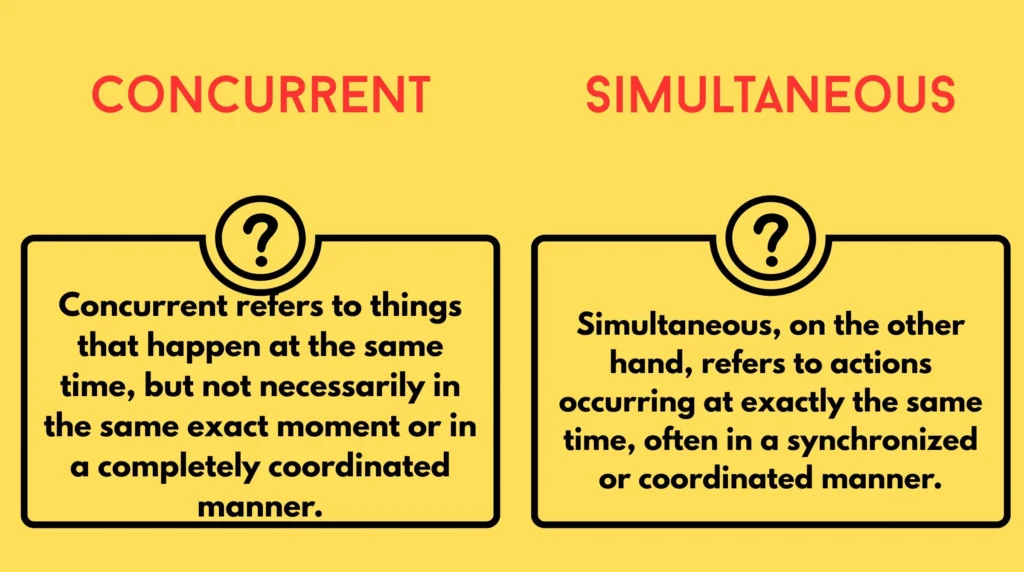
    Concurrent refers to things that happen at the same time, but not necessarily in the same exact moment or in a completely coordinated manner. It implies that multiple events or processes are happening alongside one another, often with an overlap but not necessarily synchronized.

    Example:

    • “The students worked on concurrent tasks during the workshop.”
      In this case, the tasks happened at the same time, but each student might have been focused on a different task independently.

    What Does Simultaneous Mean?

    Simultaneous, on the other hand, refers to actions occurring at exactly the same time, often in a synchronized or coordinated manner.

    It highlights that the events are not just overlapping—they are happening at precisely the same moment.

    Example:

    • “The fireworks exploded simultaneously at midnight.”
      The fireworks all went off at exactly the same time, coordinated to create a visual effect.

    Struggling to tell the difference between concurrent and simultaneous? This guide explains the key differences, real-life examples, and when to use each term in everyday and technical contexts.


    The General Meaning of Concurrent and Simultaneous

    Both words describe the idea of time overlap, but the way they are used changes the emphasis. Understanding the general meaning of each will help you choose the correct term in any context.

    • Concurrent suggests that multiple things are happening during the same period but aren’t necessarily bound to the exact moment.
    • Simultaneous suggests a stronger connection, where the events or actions happen in perfect synchronization.

    Key Differences in General Usage:

    • Concurrent is often used for situations where tasks, events, or actions are happening over a span of time, but not always at the exact same point in time.
    • Simultaneous is typically reserved for situations where everything happens exactly at the same instant.

    Distinguishing the Subtle Nuances

    The primary difference between concurrent and simultaneous lies in their level of precision and synchronization. Let’s break it down into a few key points:

    Concurrent:

    • Time span: Things overlap in time but don’t need to start or end at the exact same moment.
    • Asynchronous nature: The actions or events can still have independent durations.
    • Contextual flexibility: Often used in professional, technological, or broader contexts.

    Simultaneous:

    • Exact timing: Everything occurs at the exact same moment, emphasizing perfect synchronization.
    • Synchronized: Actions are tightly coordinated, usually within a very short time frame.
    • Precise nature: More specific, often used in scientific or high-precision contexts.

    Real-life Examples of Concurrent Actions

    Let’s look at some everyday examples to better understand when concurrent actions take place. In these instances, multiple activities happen during the same time frame, but not necessarily all at once.

    Example 1:

    Two people reading books at the same time. While both are reading, they might be reading different books at different speeds. This is a concurrent action because both activities occur during the same period.

    Example 2:

    At a busy coffee shop, one person is ordering coffee while another is picking up their order. These are concurrent actions because both are happening at the same time, but they’re independent of each other.

    Example 3:

    An office worker might be answering emails while attending a conference call. Both tasks are occurring at the same time, but they are handled separately.


    The Intricacies of Simultaneous Occurrences

    On the flip side, when something is simultaneous, it means everything happens at the exact same moment, with no time difference between the actions. Here’s how you might encounter simultaneous events in everyday life:

    Example 1:

    The synchronized launch of multiple rockets in a space mission. All rockets are launched at the exact same moment, which makes the event simultaneous.

    Example 2:

    When two people clap at the same exact moment during a performance. The clapping occurs simultaneously—both people clapping at the exact same time.

    Example 3:

    A group of friends shouting “Surprise!” at the same instant during a birthday party. The action of shouting is simultaneous, as everyone shouts at precisely the same time.


    Deciphering Concurrent and Simultaneous in a Technological Context

    In technology and computing, the difference between concurrent and simultaneous becomes especially important. Let’s explore how these terms apply in the world of software and performance testing.

    Interpreting Concurrent and Simultaneous Users in Performance Testing

    In performance testing, concurrent users refers to users who interact with a system within the same time frame but may not be performing actions at the exact same moment. These users are often active in parallel but asynchronously.

    • Concurrent users could mean 10 users browsing a website at the same time, but they may click on different links or visit different pages, performing actions at slightly different times.

    In contrast, simultaneous users would imply that all 10 users are performing actions exactly at the same moment, such as pressing a button or submitting a form at the exact second.

    How Software Handles Concurrent Operations

    Software systems often need to handle concurrent operations. This doesn’t mean that every operation happens at the same exact time; rather, operations are processed in parallel, often via multithreading or asynchronous processing. For example, a user might upload a photo while another is browsing content on the same platform. The system processes these actions concurrently but not simultaneously.


    The Impact of Context on Choosing Between Concurrent and Simultaneous

    When deciding between concurrent and simultaneous, context is crucial. Consider the situation carefully before choosing a term. If you’re describing actions that happen in parallel but don’t require exact timing, concurrent is often the best choice. If the events must occur at the exact same moment, use simultaneous.

    Example:

    • Concurrent: “The workers are performing concurrent tasks in different parts of the factory.”
    • Simultaneous: “The lights turned on simultaneously, creating a dramatic effect.”

    Examining Usage Frequency: Concurrent vs Simultaneous in Everyday Language

    In everyday language, concurrent is often used more frequently than simultaneous because it applies to a wider range of situations. For example, in a busy office, people may often be working on concurrent tasks. Simultaneous, on the other hand, tends to be reserved for more precise or specialized situations, such as in scientific experiments or performances where timing is crucial.


    Insights from Google Ngram Viewer

    Concurrent vs Simultaneous

    Using Google Ngram Viewer, we can track the frequency of both concurrent and simultaneous over time. Concurrent has seen more consistent usage across various fields, especially in business, technology, and casual conversation.

    Simultaneous, however, peaks in usage during discussions of scientific, technical, and theatrical contexts, where precise timing is necessary.


    FAQs

    What is the difference between ‘concurrent’ and ‘simultaneous’?

    ‘Concurrent’ refers to actions happening at the same time but not necessarily in sync, while ‘simultaneous’ means actions happening at the exact same moment.

    Can concurrent events happen at different times?

    No, concurrent events happen during the same time frame but may not occur at the same exact moment.

    When should I use the word ‘simultaneous’?

    Use ‘simultaneous’ when you want to describe events that happen at the exact same time, often with perfect synchronization.

    Can you give examples of concurrent actions?

    • Two people reading different books at the same time.
    • One person ordering coffee while another picks up their order at a cafe.

    What are some real-life examples of simultaneous events?

    • Rockets launching at the exact same moment.
    • A group of people clapping at the same time during a concert.

    How are concurrent users different from simultaneous users in tech?

    Concurrent users interact with a system at the same time but may not be performing actions simultaneously. Simultaneous users perform actions at exactly the same moment.


    Concluding Thoughts on When to Use Concurrent vs Simultaneous

    In conclusion, while concurrent and simultaneous both refer to actions occurring at the same time, the context and level of synchronization matter.

    Use concurrent when events overlap in time but don’t need to happen at exactly the same moment, and choose simultaneous when timing is crucial and everything happens in perfect synchronization.

  • That’s Mean vs That Means 🤔 | The Real Difference Explained with Examples

    That’s Mean vs That Means 🤔 | The Real Difference Explained with Examples

    English can be tricky. Two short phrases like “That’s mean” and “That means” look almost identical, but they carry completely different ideas.

    Learners often stumble over them because the only visible difference is one tiny word — mean versus means. Yet, this subtle change flips the meaning entirely.

    This guide dives deep into their definitions, usage, grammar, pronunciation, common mistakes, and practical tips. By the end, you’ll know exactly when to use “That’s mean” and when to use “That means.”


    Understanding the Core Difference

    That’s Mean vs That Means

    At first glance, both phrases begin the same way: “That’s…” But what follows changes everything.

    • That’s mean → a reaction to someone’s behavior. It shows disapproval, usually describing something as unkind, unfair, or harsh.
    • That means → an explanation or logical consequence. It introduces clarification, results, or interpretations.

    Here’s a quick comparison to make it crystal clear:

    PhraseFunctionExample Sentence
    That’s meanExpresses judgment (unkind, rude, unfair)“You pushed him? That’s mean.”
    That meansExplains a result or conclusion“It’s raining. That means we need umbrellas.”

    Think of it this way: “That’s mean” talks about people. “That means” talks about situations.


    Deep Dive: What Does “That’s Mean” Mean?

    The word mean in this phrase is an adjective. It describes something cruel, nasty, or hurtful. When you say “That’s mean,” you’re labeling an action or statement as unkind.

    Emotional and Social Context

    • Used when judging behavior:
      • “You didn’t share your food? That’s mean.”
    • Expresses empathy for someone else:
      • “You ignored her message? That’s mean.”

    Positive or Sarcastic Uses

    In informal slang, especially among friends, “mean” can sometimes mean impressive or awesome. For example:

    • “He plays a mean guitar.” (meaning: very skilled)
    • “Ooh, that’s mean!” (playful, joking, not literal cruelty)

    This makes context vital. Tone, body language, and situation determine whether it’s negative or playful.

    Common Situations for “That’s Mean”

    • Bullying or teasing → “He called you names? That’s mean.”
    • Unfairness → “She got punished for nothing? That’s mean.”
    • Joking among friends → “You took the last cookie? That’s mean!”

    In every case, it reacts to an action or choice, not an explanation.


    Deep Dive: What Does “That Means” Mean?

    Here, means is a verb, not an adjective. It comes from the verb to mean, which expresses purpose, explanation, or implication.

    Definition and Usage

    • Used to clarify or interpret something.
    • Connects facts with conclusions.

    Examples:

    • “I passed the exam. That means I’ll graduate.”
    • “The light is red. That means you must stop.”

    Everyday Functions of “That Means”

    1. Explanation:
      • “You missed the bus. That means you’ll be late.”
    2. Consequence:
      • “We won the game! That means we’re in the finals.”
    3. Instruction:
      • “It’s locked. That means you need a key.”

    Signal Words That Often Follow

    After “That means,” you’ll often see pronouns and modal verbs like:

    • I/you/we + have to/should/must…
    • It’s clear that…
    • Therefore…

    For example:

    • “It’s raining. That means we should stay inside.”
    • “He got the promotion. That means he’s the new manager.”

    Pronunciation and Grammar Notes

    Even though both phrases start with “That’s” (contraction of “That is”), their grammar paths split after the contraction.

    • That’s meanThat is + adjective (mean = unkind).
    • That meansThat + verb (means = explains or implies).

    Pronunciation

    • That’s mean → /ðæts miːn/
    • That means → /ðæt miːnz/

    The subtle difference lies in the ending sound:

    • /n/ for “mean”
    • /nz/ for “means”

    A native speaker may blend them quickly, but careful listening reveals the difference.


    Examples in Real Sentences

    Seeing phrases in context is the fastest way to understand.

    “That’s Mean” Examples

    • “You told her secret? That’s mean.”
    • “Don’t laugh at his accent. That’s mean.”
    • “You left without me? That’s mean!”

    “That Means” Examples

    • “We got a flat tire. That means we’ll be late.”
    • “It’s the last day of the sale. That means everything is cheaper.”
    • “She didn’t answer. That means she’s busy.”

    Notice how “That’s mean” judges people, while “That means” explains situations.


    Related and Confusing Phrases

    Sometimes learners confuse similar phrases. Here are useful alternatives:

    Alternatives to “That’s Mean”

    • That’s rude
    • That’s cruel
    • That’s unfair
    • That’s harsh
    • That’s nasty

    Alternatives to “That Means”

    • That implies
    • That indicates
    • That suggests
    • That shows
    • Therefore

    Quick comparison:

    Instead of “That’s mean”Instead of “That means”
    “That’s rude.”“That suggests…”
    “That’s unfair.”“That indicates…”
    “That’s harsh.”“That shows…”

    Common Mistakes Learners Make

    Because both phrases look and sound nearly identical, English learners often swap them accidentally.

    Frequent Errors

    • Saying “That’s mean” when they want to explain something:
      • Wrong: “He’s late. That’s mean he’s coming soon.”
      • Correct: “He’s late. That means he’s stuck in traffic.”
    • Using “That means” when judging someone:
      • Wrong: “You hit her? That means.”
      • Correct: “You hit her? That’s mean.”

    Why Mistakes Happen

    • Both share That’s/That at the start.
    • Non-native speakers may not hear the subtle /n/ vs /nz/ sound difference.
    • The word “mean” also has multiple definitions (unkind, average, mathematical mean).

    Practical Usage Tips

    When in doubt, follow this quick guide:

    • Talking about behavior or personality? → Use That’s mean.
    • Explaining a situation or result? → Use That means.

    Quick Decision Checklist

    • Is it about kindness or rudeness? → That’s mean.
    • Is it about explanation or consequence? → That means.

    Mnemonic Device

    • “Mean = Mean people.” (Judging behavior)
    • “Means = Meaning.” (Explaining result)

    Case Study: Real-Life Conversation Example

    Imagine two friends talking:

    Scenario 1 – Using “That’s mean”

    • Alex: “I told John his shoes looked funny.”
    • Mia: “Wow, that’s mean. He probably felt bad.”

    Scenario 2 – Using “That Means”

    • Alex: “The teacher canceled class today.”
    • Mia: “That means we can leave early.”

    Same starter phrase, different functions. This shows why paying attention to context is crucial.


    🙋 FAQs

    What does “That’s mean” mean?

    That’s mean describes behavior that is unkind, rude, or unfair, often used to show disapproval.

    What does “That means” mean?

    That means is used to explain or clarify a result, consequence, or implication of something.

    How do I know when to use “That’s mean” vs “That means”?

    Use That’s mean when judging someone’s behavior and That means when explaining a situation or result.

    Is “That’s mean” always negative?

    Not always. In slang, it can be playful or even positive, like “He plays a mean guitar,” meaning very skilled.

    What are alternatives to “That means”?

    You can say that implies, that suggests, that indicates, or that shows instead of “That means.”

    Why do learners confuse “That’s mean” and “That means”?

    Both sound very similar, but the difference lies in meaning: mean (adjective for behavior) vs means (verb for explanation).


    Conclusion

    The confusion between “That’s mean” and “That means” is completely normal, especially for learners. But the difference is simple once you break it down:

    • That’s mean → Describes behavior as unkind, unfair, or rude.
    • That means → Explains a result, implication, or conclusion.

    By practicing with real examples, listening closely to pronunciation, and remembering the people vs situation trick, you’ll never mix them up again. Next time you’re about to say one of these phrases, stop and ask yourself: Am I judging behavior or explaining a result? The answer will guide you to the correct choice.

  • Drove or Driven? Master the Difference with Examples 🚙📚

    Drove or Driven? Master the Difference with Examples 🚙📚

    The English language is filled with words and phrases that can cause confusion, especially when it comes to verb forms.

    Drove and driven are two such words that often leave people second-guessing themselves. If you’ve ever wondered which one to use and when, you’re not alone.

    In this guide, we’ll break down the differences between drove and driven, explore their grammatical uses, and provide practical examples to help you master these forms of the verb “drive.”


    Understanding the Basics: The Verb “Drive”

    The word drive is a versatile and commonly used verb in English. Its primary meaning is to operate or control the movement of a vehicle, but it can also be used metaphorically in various contexts.

    Primary Definitions of “Drive”:

    • Literal Meaning: To control a vehicle’s movement.
      Example: “She drives to work every morning.”
    • Figurative Meaning: To compel or push something forward.
      Example: “His passion drives him to succeed.”

    Forms of “Drive”

    • Base Form (Infinitive): Drive
    • Simple Past Tense: Drove
    • Past Participle: Driven
    • Present Participle: Driving

    Understanding these forms is crucial to using the verb correctly in various tenses.

    Wondering whether to use “drove” or “driven”? This guide simplifies the rules, explains the differences, and provides examples to help you master these verb forms with ease.


    The Simple Past and Past Participle Forms of “Drive”

    When we talk about drove and driven, we are dealing with the simple past and past participle forms of the verb drive, respectively.

    What Is the Simple Past?

    The simple past describes actions that were completed in the past. It is used without auxiliary verbs.

    • Example: “I drove to the store yesterday.”

    What Is the Past Participle?

    The past participle form is used in perfect tenses and passive voice. It typically follows auxiliary verbs like has, have, had, was, or were.

    • Example: “I have driven this route many times.”

    Key Difference:
    While drove is used on its own in past-tense sentences, driven requires a helping verb to function grammatically.


    Drove or Driven

    Distinguishing Between “Drove” and “Driven”

    The simplest way to remember the difference is this:

    • Drove = Simple Past
    • Driven = Past Participle (Used with Helping Verbs)

    Examples of Correct Usage

    • Drove:
      • “He drove to the meeting early this morning.”
      • “They drove through the countryside during their vacation.”
    • Driven:
      • “She has driven this road so many times that she knows every turn.”
      • “The team was driven to succeed despite the challenges.”

    Pro Tip: If you’re unsure, check for a helping verb. If there isn’t one, drove is likely correct.


    How Context Influences the Correct Usage

    Context plays a huge role in determining whether to use drove or driven. Consider these examples:

    • Simple Past Context:
      • Action completed in the past without any auxiliary verb.
      • Example: “Yesterday, we drove to the park.”
    • Perfect Tense Context:
      • Describes an action that has been completed before another point in time.
      • Example: “By the time they arrived, we had already driven to the venue.”

    Practical Tip: Ask Yourself These Questions

    1. Is there a helping verb in the sentence? If yes, use driven.
    2. Is the action complete and expressed without a helping verb? If yes, use drove.

    Common Errors to Avoid: “Drove” Vs. “Driven”

    Even seasoned English speakers sometimes mix up drove and driven. Here are common mistakes and how to avoid them:

    Mistake 1: Using Drove with a Helping Verb

    • Incorrect: “I had drove to the city before sunset.”
    • Correct: “I had driven to the city before sunset.”

    Mistake 2: Using Driven Without a Helping Verb

    • Incorrect: “He driven us to the concert last week.”
    • Correct: “He drove us to the concert last week.”

    Quick Tip: Always pair driven with an auxiliary verb like has, had, or was.


    Grammatical Rules for Using “Drove” Correctly

    Using drove correctly is straightforward. It simply requires understanding the simple past tense.

    When to Use Drove:

    • To describe a completed action in the past.
    • Without any auxiliary verbs.

    Examples:

    • “They drove to the lake for a picnic.”
    • “I drove all night to get here on time.”

    Key Grammar Rule:

    • Never combine drove with auxiliary verbs.

    When to Use “Driven” in Perfect Tenses

    Driven is the go-to form when constructing perfect tenses or using passive voice.

    Perfect Tense Examples:

    • Present Perfect: “She has driven the same car for years.”
    • Past Perfect: “By the time I called, he had already driven home.”
    • Future Perfect: “By next week, we will have driven across the entire country.”

    Passive Voice Examples:

    • “The bus was driven by a skilled driver.”
    • “The campaign was driven by a strong sense of purpose.”

    Key Rule: Always use driven with a helping verb.


    Exploring the Past, Present, and Future Perfect Constructs

    Perfect tenses can sometimes feel complex, but they follow clear patterns.

    TenseStructureExample
    Present PerfectHas/Have + Driven“I have driven to this place many times.”
    Past PerfectHad + Driven“She had driven the route before sunset.”
    Future PerfectWill Have + Driven“By tomorrow, they will have driven 500 miles.”

    Drove or Driven

    Digging Deeper: The Impact of Tense on Meaning

    Tenses do more than just place actions in time; they also affect the nuances of meaning. For example:

    • “I drove to work.” (This indicates the action is completed and focuses on the event itself.)
    • “I have driven to work before.” (This emphasizes experience or repetition.)
    • “I had driven to work by the time the meeting started.” (This adds a sense of sequence and completion before another event.)

    FAQs

    When should I use “drove”?

    Use “drove” to describe a completed past action without a helping verb. For example: “I drove to work yesterday.”

    What is the difference between “drove” and “driven”?

    “Drove” is the simple past form, used on its own to describe a past action. “Driven” is the past participle form, used with helping verbs like “have” or “had.”

    Can “driven” be used without a helping verb?

    No, “driven” requires a helping verb like “has,” “had,” or “was.” For example: “I have driven this road before.”

    What are examples of perfect tense with “driven”?

    • Present Perfect: “She has driven to the city many times.”
    • Past Perfect: “By 8 PM, he had driven home.”
    • Future Perfect: “By tomorrow, they will have driven 500 miles.”

    How do I avoid common mistakes with “drove” and “driven”?

    Remember:

    • Use “drove” without a helping verb (e.g., “I drove to school”).
    • Use “driven” with a helping verb (e.g., “I have driven this car”).

    What’s a quick way to decide between “drove” and “driven”?

    Ask yourself: Does the sentence have a helping verb (e.g., have, had, was)? If yes, use “driven.” If no, use “drove.”


    Conclusion

    The difference between drove and driven boils down to tense and grammar. Use drove when describing completed past actions without helping verbs, and driven when constructing perfect tenses or using passive voice.

    With the tips and examples provided here, you can confidently choose the correct word every time.

    Remember: Drove stands alone, while driven needs support. Keep practicing, and soon, the distinction will come naturally!

  • World-Class vs World Class ✍️ Grammar Rules Made Simple

    World-Class vs World Class ✍️ Grammar Rules Made Simple

    Language has a way of tripping us up with the smallest details. One little hyphen can change the entire role of a word in a sentence. A perfect example is the confusion between “world-class” and “world class.”

    At first glance, they look almost identical, but writers, students, and professionals often wonder: When should I use “world-class” with a hyphen, and when should it be written as two words?

    This article clears up the confusion with grammar rules, real-life examples, and expert writing guidelines. By the end, you’ll not only know the difference but also feel confident applying it in everything from academic papers to resumes and marketing copy.


    Understanding “World-Class” vs “World Class”

    World-Class vs World Class

    The distinction comes down to grammar function and hyphenation rules.

    • World-class (with a hyphen): Functions as an adjective, modifying a noun. Example: She delivered a world-class performance.
    • World class (two words): Functions as a noun phrase, referring to a level of excellence itself. Example: His skills are world class.

    Here’s a quick comparison:

    FormGrammar FunctionExample SentenceNotes
    World-classAdjective (modifies a noun)She runs a world-class restaurant.Always hyphenated before the noun.
    World classNoun phraseHis talent is world class.No hyphen when standing alone.

    Key takeaway: The hyphen isn’t optional. It signals whether you’re using the phrase to describe (adjective) or to define (noun phrase).


    “World-Class” as an Adjective

    When “world-class” is used to describe something else, it acts as a compound adjective. In grammar, compound adjectives that come before a noun almost always need a hyphen.

    Correct examples:

    • A world-class university attracts students globally.
    • The chef prepared a world-class meal.
    • They hired a world-class team of engineers.

    Incorrect examples:

    • A world class university attracts students globally. (missing hyphen)
    • The chef prepared a world class meal. (ambiguous, looks sloppy)

    Style Guide Notes:

    • AP Stylebook: Requires the hyphen in “world-class” when used as an adjective.
    • Chicago Manual of Style: Also supports hyphenation for clarity in compound adjectives.
    • Oxford Style Guide: Recommends consistency, advising “world-class” before nouns.

    Why it matters: Without the hyphen, a reader may stumble or misinterpret the meaning. Hyphenation eliminates doubt and shows precision.


    “World Class” as a Noun Phrase

    Now let’s shift focus. When “world class” stands on its own, it’s not describing a noun but acting as one.

    Correct examples:

    • His stamina is world class.
    • The movie’s cinematography is simply world class.
    • In sports, few players can reach world class levels.

    Incorrect examples:

    • His stamina is world-class. (hyphen unnecessary, creates awkwardness)
    • The movie’s cinematography is world-class. (again, wrong since it follows the verb is)

    Edge case: Both can appear in the same sentence but in different roles.

    • She gave a world-class presentation, proving her skills are world class.

    Here, the first is an adjective (modifies “presentation”), and the second is a noun phrase (describes “skills”).


    Why “World-Class” Is Not a Verb

    Many people mistakenly treat “world-class” or “world class” like a verb, as in:

    • He world-classed the competition.

    This is grammatically incorrect. Neither form can function as a verb. Instead, writers should use:

    • He achieved world-class status.
    • She rose to a world-class level.
    • The team reached world-class standards.

    It’s a descriptive phrase, never an action word.


    Grammar and Hyphenation Rules

    To understand “world-class,” it helps to look at broader compound adjective rules.

    • Hyphen before a noun:
      • She owns a well-known company.
      • They stayed in a five-star hotel.
      • He joined a world-class orchestra.
    • No hyphen after the noun:
      • The company is well known.
      • The hotel is five star.
      • His talent is world class.

    UK vs US English

    While both US and UK English agree on the hyphen, there are small style differences:

    RegionPreferred FormExample
    US English“world-class” as adjective; “world class” as nounHarvard is a world-class university.
    UK EnglishSame rule, but UK writing sometimes retains hyphen in more cases for clarityOxford produces world-class research, and its standards are world class.

    In practice, both regions agree: hyphen when it comes before a noun, no hyphen when it stands alone.


    Practical Writing Guidelines

    Here’s how to decide in real writing situations:

    • Use “world-class” with a hyphen when it directly modifies a noun:
      • A world-class athlete
      • A world-class strategy
    • Use “world class” (no hyphen) when it describes excellence after a verb:
      • Her skills are world class.
      • This event is world class.

    Editing Checklist

    • Am I using it as an adjective before a noun? → Hyphenate.
    • Am I describing excellence in general, after a verb? → No hyphen.
    • Am I writing for business, academic, or journalistic context? → Follow AP/Chicago rules for consistency.

    Common Contexts and Real-Life Examples

    Academic Writing

    • MIT is a world-class institution recognized globally.
    • Its research output is world class in scope and influence.

    Business and Marketing

    • Our software provides a world-class user experience.
    • Customer service here is truly world class.

    Everyday Conversations

    • That was a world-class dinner.
    • Her guitar skills are world class.

    Media and Headlines

    • BBC: “A world-class performance from Serena Williams”
    • NYT: “US healthcare still not world class

    Quote to remember:

    “Clarity in writing is the same as clarity in thought. One cannot exist without the other.” — Richard North


    Case Study: Resume Writing

    Imagine you’re writing a professional resume. The wrong choice can make you look careless.

    Incorrect:

    • “Seeking opportunities to join a world class organization.”
      (Should be world-class organization)

    Correct:

    • “Seeking opportunities to join a world-class organization.”

    Or, when describing skills:

    • “Technical abilities are world class.”

    Small details like a hyphen show attention to grammar, which employers notice.


    Conclusion

    The debate over “world-class vs world class” is settled once you know the rules:

    • Use world-class with a hyphen as an adjective before a noun.
    • Use world class (two words) as a noun phrase after a verb.
    • Never use it as a verb.
    • Follow style guides for consistency, and keep regional preferences in mind.

    In short, the hyphen matters. It’s not decoration—it changes function, meaning, and professionalism. Writers who master these small details stand out as clear and credible.


    FAQs on World-Class vs World Class

    Is “world-class” always hyphenated?

    No. It’s only hyphenated when used before a noun, such as a world-class hotel.

    Can I use “world class” without a hyphen?

    Yes. When it stands alone or follows a verb, write it without a hyphen, e.g., Her skills are world class.

    What’s the difference between UK and US usage?

    Both follow the same rule, but UK English sometimes prefers the hyphen in slightly more cases for clarity.

    Is “world class” considered formal writing?

    Yes. Both “world-class” and “world class” are accepted in formal contexts, as long as you apply them correctly.

    Can “world class” stand alone in a sentence?

    Absolutely. Example: The performance was world class.

    Do style guides agree on using “world-class”?

    Yes. AP, Chicago, and Oxford all recommend the hyphen when it functions as an adjective before a noun.

  • 🕒 “To Early” vs “Too Early”: Which One Is Correct in English?

    🕒 “To Early” vs “Too Early”: Which One Is Correct in English?

    English can be tricky. Small words like “to” and “too” look alike, sound alike, and often confuse even fluent speakers.

    One of the most common slip-ups is writing “to early” instead of “too early.” At first glance, it may not seem like a big deal, but in grammar and communication, these little details matter a lot.

    So, is it to or too early? The short answer is: it’s almost always “too early.” But to understand why, let’s dig deeper into the meaning, usage, and rules behind these words.


    Why “To” vs. “Too” Causes Confusion

    To or Too Early

    Both words are pronounced the same, which naturally creates mix-ups in writing. Add to that the fact that texting, fast typing, and autocorrect errors creep into our daily lives, and suddenly you’ll see “to early” plastered all over social media posts, emails, and even advertisements.

    The confusion boils down to two things:

    • Homophones: Words that sound the same but differ in meaning or spelling.
    • Context dependency: The correct choice depends on the role of the word in a sentence.

    When you rely only on how words sound, “to early” feels fine. But when you look at grammar rules, the story changes.


    What “To” Really Means

    “To” is one of the most versatile words in English. Primarily, it acts as a preposition that shows:

    • Direction: I’m going to the park.
    • Recipient: She gave the book to him.
    • Purpose/Infinitive marker: I want to learn French.

    Notice something? In every example, “to” connects one element to another. It creates relationships, shows direction, or introduces an action.

    Now, let’s test it with “early”:

    I woke up to early.
    This doesn’t work, because “early” is an adjective/adverb, not something you can “go to” or “give to.”

    That’s why “to early” doesn’t fit standard grammar rules.


    The Power of “Too” as an Intensifier

    “Too” has an entirely different role. It acts as an adverb, often used as an intensifier. Its meanings include:

    • Excessively / more than enough: It’s too hot outside.
    • Also: I want to go too.

    When we pair “too” with “early,” it naturally conveys the idea of excessive earliness — earlier than expected, necessary, or appropriate.

    Examples:

    • We arrived too early for the concert, and the gates were still closed.
    • Calling someone at 5 a.m. is too early unless it’s an emergency.

    Here, “too” modifies “early” and makes logical sense.


    Breaking Down the Phrase “Too Early”

    At its core, “too early” means before the right time. But it shows up in both literal and figurative ways.

    Literal meaning

    • The shop was too early to open at 6 a.m.
    • It’s too early in the season for strawberries.

    Figurative meaning

    • It’s too early to judge the outcome of the project.
    • Some say it’s too early to fall in love, but feelings don’t follow a schedule.

    In both senses, “too early” expresses a mismatch between time and appropriateness.


    Why “To Early” Is Incorrect in Standard Grammar

    The phrase “to early” is considered a grammatical mistake. Here’s why:

    • “To” cannot directly modify an adjective or adverb.
    • “Early” doesn’t fit as the object of “to.”

    Think of it this way: you wouldn’t say “to tall” or “to hot” either. The same rule applies here.

    Common slip-ups include:

    • Social media captions (“It’s to early for this!”).
    • Quick texts (“Sorry I’m to early”).
    • Ads or headlines with rushed editing.

    These aren’t just minor typos — they change the grammatical integrity of your writing.


    Practical Examples: To vs. Too with “Early”

    To see the difference clearly, let’s put examples side by side:

    Incorrect (To Early)Correct (Too Early)
    We arrived to early for class.We arrived too early for class.
    It’s to early to tell who’ll win.It’s too early to tell who’ll win.
    She called me to early in the morning.She called me too early in the morning.

    The table shows how one extra “o” completely changes correctness.


    Tips for Remembering the Difference

    Learning grammar hacks can make “to” vs. “too” second nature. Try these:

    • Think of the extra “o.” “Too” means an extra amount. Extra “o” = extra meaning.
    • Ask: does it mean “also” or “excessively”? If yes, use “too.”
    • Test substitution. Replace “too” with “very.” If the sentence still makes sense, “too” is correct.
      • Example: It’s very early ✅ matches It’s too early.

    Advanced Cases: When “To” and “Too” Appear Near Each Other

    Here’s where it gets interesting. Sometimes, both words appear in the same sentence:

    • I went to bed too early.
    • He moved to the city too early in his career.

    Notice how “to” serves its role as a preposition, while “too” modifies “early.” This is perfectly correct, though visually it can trick the eye.


    Insights from Grammar Experts and Style Guides

    According to Merriam-Webster, “too” is defined as “to a degree exceeding what is desirable, fitting, or right.” This lines up directly with “too early.”

    The Cambridge English Dictionary explains “too” as “more than is allowed, necessary, possible, or acceptable.” Again, this fits.

    Style authorities like the Chicago Manual of Style also emphasize clarity: in professional writing, “too early” is correct, while “to early” should be avoided at all costs.


    Quick Reference Table: “To” vs. “Too” with Examples

    Here’s a handy cheat sheet:

    WordFunctionExampleWrong Use
    ToPreposition (direction, purpose, recipient)I went to the park.It’s to early.
    TooAdverb (excess, also)It’s too early to call.N/A

    Keep this table in mind, especially if you’re prone to typos.


    Common Mistakes and How to Avoid Them

    People often make the “to early” mistake due to:

    • Rushed writing: Texting or typing quickly.
    • Overreliance on sound: Since they’re homophones, people default to the wrong spelling.
    • Autocorrect mishaps: Phones sometimes “correct” incorrectly.

    How to avoid the slip-up:

    • Slow down when writing important texts or emails.
    • Proofread for common homophone errors.
    • Use grammar-check tools like Grammarly or Hemingway Editor.

    Summary and Final Thoughts

    The phrase “too early” is the correct and accepted form, while “to early” is simply incorrect. Remember:

    • “To” = direction, relation, purpose.
    • “Too” = excess or also.
    • “Too early” = earlier than necessary, right, or expected.

    Even though it’s a small difference, mastering it improves both your grammar and credibility in writing.


    🙋 FAQs

    What is the correct phrase: “to early” or “too early”?

    The correct phrase is “too early.” “To early” is always grammatically incorrect.

    Why is “too early” correct in English grammar?

    “Too” means excessively or more than necessary, which makes sense with “early.” That’s why “too early” works while “to early” doesn’t.

    Can “to” ever be used before “early”?

    No, “to early” isn’t valid in English. “To” doesn’t modify adjectives like “early.”

    How can I remember the difference between “to” and “too”?

    Think of the extra “o” in “too” as meaning “extra” or “excess.” That’s the quick memory trick.

    Are “to” and “too” homophones?

    Yes. They sound the same, which is why people often confuse them in writing.

    Is it “too early to tell” or “to early to tell”?

    The correct phrase is “too early to tell.” It means it’s premature to know the outcome.


    Conclusion

    So, is it to or too early? The answer is clear: it’s always “too early.” That single extra “o” makes all the difference between a mistake and proper English.

    Language thrives on clarity, and choosing the right word — even when it’s just two letters long — ensures your message comes across sharp, professional, and confident. Next time you’re tempted to write “to early,” stop and remember: extra “o,” extra correctness.

  • Quieter vs More Quiet 🤔 What’s the Difference & Which One’s Correct?

    Quieter vs More Quiet 🤔 What’s the Difference & Which One’s Correct?

    English grammar has a funny way of throwing curveballs when you least expect it. Words like “quieter” and “more quiet” look so similar yet often leave learners scratching their heads.

    Are both correct? Which one sounds natural? And when should you use one over the other?

    Here’s the good news: both forms are grammatically correct. But that doesn’t mean they’re used the same way.

    In this guide, we’ll break down every detail you need to know, from basic grammar rules to real-world usage, so you never hesitate when choosing between quieter and more quiet.

    Both quieter and more quiet are grammatically correct. The difference lies in preference—quieter is the natural choice in everyday English, while more quiet adds emphasis or formality.


    Understanding “Quiet” as an Adjective

    Quieter vs More Quiet

    Before we compare, let’s start with the root word: quiet.

    • Part of speech: Adjective
    • Meaning: Little or no noise; calm; peaceful.

    Examples:

    • The library is quiet.
    • He enjoys a quiet life in the countryside.

    Why does this matter? Because adjectives change form when we want to compare. And that’s exactly where quieter and more quiet come in.


    Quieter as the Standard Comparative Form

    For one-syllable adjectives like quiet, English typically forms comparatives by adding -er.

    • Tall → Taller
    • Small → Smaller
    • Quiet → Quieter

    Quieter follows the most natural pattern. That’s why you’ll hear native speakers use it more often than “more quiet.”

    Examples:

    • The garden is quieter than the street outside.
    • She spoke in a quieter voice to avoid waking the baby.

    A quick note: “quiet” technically has two syllables (qui-et), but it’s still treated like a one-syllable adjective because of its short sound. That’s why the -er form feels natural.

    👉 Rule of thumb: For everyday situations, “quieter” is the go-to choice.


    When “More Quiet” Is Grammatically Correct

    So if “quieter” is standard, does that make “more quiet” wrong? Not at all. It’s just less common and usually chosen for emphasis.

    Consider these examples:

    • We need a more quiet environment to concentrate.
    • This design creates a more quiet and peaceful space.

    In these cases, “more quiet” adds weight, almost as if saying “extra quiet.” Writers may also prefer it for rhythm or style, especially in poetry, speeches, or formal texts.

    Stylistic usage example from literature:

    “I long for a more quiet retreat, far from the city’s endless noise.”

    👉 Think of “more quiet” as a deliberate choice. It’s correct, but it feels slightly formal or emphatic compared to the easy flow of “quieter.”


    Quieter vs More Quiet in Real Usage

    Here’s where things get interesting. Both forms exist, but which one do people actually use?

    Studies of written and spoken English show that:

    • Quieter is far more common in everyday conversation.
    • More quiet appears in formal writing, literature, or when speakers want to emphasize calmness.

    Frequency Comparison

    FormCommon ContextsFrequency in UseExample Sentence
    QuieterCasual speech, everyday writingVery commonThis café is quieter than Starbucks.
    More QuietFormal tone, emphasis, stylistic writingLess commonThe monastery offers a more quiet retreat.

    👉 Tip: If in doubt, choose “quieter.” It’s natural and widely accepted. Use “more quiet” sparingly, when you want a stronger emphasis.


    Quietest or The Most Quiet – Which Should You Use?

    Comparatives aren’t the end of the story. When we want to describe the highest degree of quiet, we move to the superlative form.

    • Quieter → Quietest
    • More quiet → Most quiet

    Which one is correct?

    Both. But just like with comparatives, the -est form is more natural.

    Examples:

    • This is the quietest place in town.
    • She is the quietest student in the class.

    “The most quiet” isn’t wrong, but it tends to sound heavy and is usually chosen for stylistic effect.

    Example:

    • That was the most quiet evening we ever spent together.

    👉 Rule: Use “quietest” in everyday English. Use “the most quiet” only when you want an elevated or literary tone.


    Quieter vs Less Noisy

    Sometimes, instead of saying “quieter,” people say “less noisy.” Are these two the same? Not exactly.

    • Quieter: Puts focus on peace and calm.
    • Less noisy: Focuses on the absence of noise.

    Usage Examples

    • The library is quieter than the park. (positive emphasis on calmness)
    • The park is less noisy than the market. (negative emphasis on reduced noise)

    Think of them as two sides of the same coin. One stresses presence of calm, the other stresses reduction of disturbance.

    👉 Both are correct, but “quieter” sounds smoother and more natural in most cases.


    “As Quiet As” for Equal Comparisons

    Another way to compare is with the as…as structure. Instead of saying one thing is quieter, we might say two things are equally quiet.

    Examples:

    • The forest is as quiet as the grave.
    • The child was as quiet as a mouse during the movie.

    Common Idioms with “As Quiet As”

    • As quiet as a mouse → extremely quiet
    • As quiet as the grave → silent, often eerie
    • As quiet as a whisper → very soft and hushed

    👉 Use this form when you want to highlight balance or equality, not difference.


    Common Mistakes and Misunderstandings

    Learners often trip over these forms. Let’s clear up some frequent errors.

    • He is more quieter than his brother.
      He is quieter than his brother.
      (Never mix “more” with the -er ending.)
    • This is the most quietest room in the house.
      This is the quietest room in the house.
      (Don’t double up on superlatives.)
    • She is quite than him.
      She is quieter than him.
      (Confusing “quite” with “quiet.”)

    👉 Always remember: choose either the -er/-est ending or the “more/most” form, not both.


    Practical Tips for Choosing the Right Form

    Here’s a quick guide you can keep in mind:

    Quick Rules

    • Use quieter in normal conversation.
    • Use more quiet for emphasis or formal writing.
    • Use quietest for superlatives.
    • Use less noisy when highlighting reduction of noise.
    • Use as quiet as for equal comparisons.

    Handy Chart

    SituationBest ChoiceExample Sentence
    Everyday talkQuieterThe house is quieter at night.
    Emphasis/formalityMore quietWe want a more quiet location for the meeting.
    Highest degreeQuietestThis is the quietest classroom in school.
    Noise reductionLess noisyThis engine is less noisy than the older model.
    Equal comparisonAs quiet asThe forest is as quiet as a church.

    👉 If you stick to this chart, you’ll never misuse these forms again.


    🙋‍♂️ FAQs

    What is the difference between quieter and more quiet?

    Both are correct, but “quieter” is the standard form, while “more quiet” is used for emphasis or formal style.

    Is it correct to say more quieter?

    No. You can’t combine “more” with “-er.” Use either “quieter” or “more quiet,” but not both together.

    Which is better: quietest or most quiet?

    “Quietest” is the natural superlative form. “Most quiet” is grammatically fine but sounds formal or poetic.

    Can I use less noisy instead of quieter?

    Yes, but the nuance changes. “Quieter” emphasizes calmness, while “less noisy” highlights reduced disturbance.

    When should I use as quiet as?

    Use “as quiet as” for equal comparisons, like The library is as quiet as a church.

    Why does quieter sound more natural than more quiet?

    Because English usually forms comparatives with -er for short adjectives, making “quieter” the default choice.


    Conclusion

    So, quieter vs more quiet—which should you use?

    Both are correct, but quieter is by far the preferred choice in everyday English. It’s simple, natural, and widely understood. “More quiet” isn’t wrong, but it carries a formal, emphatic, or stylistic edge. The same rule applies to the superlative forms: quietest is standard, while “the most quiet” feels formal or literary.

    Here’s the bottom line:

    • In most cases, say quieter.
    • Save more quiet for emphasis or style.
    • Don’t mix the two forms in the same phrase.

    By mastering these nuances, you’ll sound more natural and confident every time you describe silence, peace, or calm.

  • Screen vs Monitor vs Display 🖥️: Understanding the Key Differences

    Screen vs Monitor vs Display 🖥️: Understanding the Key Differences

    In today’s digital age, the terms screen, monitor, and display are often used interchangeably, but they each have distinct meanings and functions.

    Whether you’re looking to upgrade your workspace, purchase a new TV, or build a gaming setup, understanding the subtle differences between these terms will help you make an informed decision.

    Let’s dive into the specifics and clear up the confusion once and for all.


    Introduction to the Terminology of Visual Technology

    Screen vs Monitor vs Display

    Technology has evolved rapidly in recent decades, and so has the terminology used to describe the devices that display our digital world.

    We often hear about screens, monitors, and displays, but what exactly are these devices, and how are they different from each other?

    In this article, we’ll explore each term in-depth and unravel their meanings, uses, and the subtle differences that set them apart.

    Confused by the terms screen, monitor, and display? Our guide breaks down the differences and helps you understand the unique functions and technologies behind each, from gaming to everyday use. Find out which is best for your needs!


    Unveiling the Concept of a Screen

    The word screen is perhaps the broadest term in the visual technology world. It refers to any surface or device that displays information, images, or videos. Essentially, a screen is a surface where content is projected, whether it’s on your smartphone, laptop, TV, or digital signage.

    What Defines a Screen in Electronics?

    • Definition: A screen is a surface that displays visuals produced by a device such as a TV, phone, or computer.
    • Functionality: The screen can show anything from static images to dynamic video content, and it can be interactive, like touchscreens.
    • Materials and Technology: Screens often use various technologies like LCD (Liquid Crystal Display), OLED (Organic Light Emitting Diode), or LED (Light Emitting Diode) to create images.

    Screens are not limited to computers and monitors; they can be found in smartphones, tablets, and even billboards.


    The Historical Evolution of the Screen

    The screen, in its modern form, has evolved over the past century. Let’s take a quick journey through its history:

    • Early Beginnings: The first screens were cathode ray tubes (CRT) in the 1930s, used for televisions and radar displays.
    • Mid-20th Century: With the advent of television, screens became household items.
    • Modern Revolution: LCD and LED technology took over in the 1990s and early 2000s, leading to thinner, brighter, and more energy-efficient screens.

    Each technological leap brought about better image quality, increased portability, and greater clarity in the visuals we see on our screens.


    Screen Applications Beyond Computing Devices

    While screens are integral to computing devices, their applications extend far beyond that:

    • Television: The screen is the heart of the TV, delivering everything from news to entertainment.
    • Smartphones and Tablets: Portable screens allow us to stay connected and entertained on the go.
    • Digital Billboards: Large outdoor screens are used for advertising and public information.
    • Medical Displays: High-resolution screens are essential for diagnostic imaging and monitoring in healthcare.

    In essence, screens have permeated every facet of our lives, from entertainment to work and beyond.


    Monitor: The Gateway to Digital Content

    Now, let’s narrow our focus. The term monitor is often used specifically in the context of computing and digital media consumption. But what exactly makes a monitor different from a screen?

    What Sets a Monitor Apart?

    A monitor is a specific type of screen designed primarily for use with computers and other digital devices. Monitors have higher functionality than basic screens because they are engineered to display content from a computer or video source.

    • Use Case: Monitors are designed for use with desktop computers, laptops, gaming consoles, and other devices that require detailed image rendering.
    • Resolution and Refresh Rate: Monitors typically offer high resolutions (1080p, 4K) and high refresh rates (60Hz, 144Hz, or 240Hz for gaming monitors).

    In short, a monitor is a specialized screen for more complex visual tasks.


    Deep Dive into Display Technology

    The term display refers to the actual technology that makes the images on a screen or monitor visible to the viewer. Display technology has evolved significantly over the years and plays a major role in the quality of the visuals we experience.

    Key Display Technologies

    • LCD (Liquid Crystal Display): A common technology used in both monitors and TVs. LCDs are energy-efficient and offer good picture quality at affordable prices.
    • LED (Light Emitting Diode): A variant of LCD technology where LEDs provide the backlight. LEDs offer brighter and more vibrant images.
    • OLED (Organic Light Emitting Diode): Offers superior image quality with deeper blacks and more vivid colors, ideal for high-end TVs and smartphones.
    • QLED (Quantum Dot LED): A newer technology that improves upon LED by adding quantum dots for even more precise color reproduction.

    Differentiating Displays: CRT, LCD, and LED

    Now that we’ve explored the basics, let’s delve deeper into the different types of displays that have been used in screens and monitors.

    CRT (Cathode Ray Tube)

    • Used in: Older televisions and monitors.
    • Technology: Relies on electron beams to light phosphor dots, creating an image on a glass tube.
    • Pros: Large size, lower cost in the past.
    • Cons: Bulky, heavy, and energy-inefficient.

    LCD (Liquid Crystal Display)

    • Used in: Most modern monitors and TVs.
    • Technology: Uses liquid crystals that align when an electric current passes through, allowing light to pass and form an image.
    • Pros: Slim profile, energy-efficient, and cost-effective.
    • Cons: Limited viewing angles and slower response time compared to OLED.

    LED (Light Emitting Diode)

    • Used in: Modern LED-backlit monitors and TVs.
    • Technology: Uses LEDs as a backlight for the liquid crystal display.
    • Pros: Bright, vibrant images with lower power consumption.
    • Cons: Can be expensive compared to traditional LCDs.

    Understanding Image Rendering on Displays

    When it comes to screens and monitors, the way images are rendered is crucial for image clarity, response time, and overall quality. Here are some factors involved in image rendering:

    • Resolution: The number of pixels displayed on the screen, typically measured in width x height (e.g., 1920×1080).
    • Refresh Rate: How often a screen updates per second, measured in Hz. Higher refresh rates (e.g., 144Hz) are crucial for gaming monitors.
    • Color Accuracy: Displays with higher color accuracy provide more realistic and vibrant images.

    The Integrated World of Monitors and Computing

    Monitors are an integral part of the computing experience. Without them, computers would be nearly useless, as they display all the output from the computer’s internal systems.

    How Monitors Enhance Computing:

    • Productivity: A high-quality monitor improves productivity, especially in fields like graphic design, video editing, and coding.
    • Gaming: Monitors are a crucial component for gamers, as they influence everything from visual immersion to frame rates.

    Monitor Components and Their Functions

    Monitors are complex devices with several key components that work together to deliver visual output. Here’s a breakdown of these components:

    ComponentFunction
    PanelThe screen itself, where images are displayed.
    BacklightProvides illumination for the screen (in LCD, LED, or OLED displays).
    Input PortsPorts like HDMI, VGA, or DisplayPort for connecting to computers.
    Graphics CardThe device that processes and sends image data to the monitor.

    Each of these components plays a vital role in the monitor’s overall performance and image quality.


    The Intricacies of Display Resolution and Quality

    Display resolution and quality are some of the most important considerations when choosing between monitors or screens. Higher resolutions deliver sharper, more detailed images. Here are the most common display resolutions:

    • HD (720p): Standard resolution for basic screens and older TVs.
    • Full HD (1080p): The most common resolution for modern monitors and TVs.
    • 4K (2160p): Ultra-high definition, offering crisp details for gaming and professional work.
    • 8K (4320p): Cutting-edge technology, though it is still rare and expensive.

    When selecting a monitor or screen, it’s essential to balance resolution with other factors like refresh rate and color accuracy to get the best overall image quality.


    Connectivity: How Devices Talk to Monitors and Displays

    Monitors and displays rely on a variety of connections to receive data from devices like computers, gaming consoles, and media players. These connections are crucial for ensuring a smooth experience.

    • HDMI: The most common video and audio connection for modern monitors and TVs.
    • DisplayPort: Common for high-end monitors, especially those used for gaming and professional work.
    • VGA: An older standard, still found on some legacy monitors and devices.

    Choosing the Right Visual Device for Your Needs

    When deciding between a screen, monitor, or display, you must consider what you’re using it for.

    • For Gaming: A high-resolution monitor with a fast refresh rate (144Hz or higher) and low response time is crucial.
    • For Office Work: A monitor with good color accuracy and resolution is ideal.
    • For Entertainment: A large screen with high-quality display technology, like OLED or QLED, is best for watching movies and TV shows.

    FAQs

    What’s the difference between a screen and a monitor?

    A screen is any surface that displays images, including phones and TVs, while a monitor is a specific type of screen designed for use with computers, offering higher resolution and refresh rates.

    Is a monitor always a display?

    Yes, a monitor is a type of display, but not all displays are monitors. A display refers to the technology behind the image, such as LCD, OLED, or LED, used in various devices.

    Can a TV be considered a monitor?

    Technically, yes. A TV is a display device that functions like a monitor but is typically optimized for media consumption rather than computing tasks.

    What are the key differences in display technologies?

    LCD, LED, and OLED are different display technologies, each offering varying levels of brightness, contrast, energy efficiency, and color accuracy, with OLED providing the highest quality visuals.

    Which resolution is best for gaming?

    For gaming, a monitor with at least 1080p (Full HD) resolution is recommended, though 4K and 144Hz refresh rate options provide even better clarity and performance.

    How do I choose between a screen, monitor, or display for my needs?

    For gaming, opt for a high-resolution monitor with fast refresh rates. For office work, choose a monitor with good color accuracy. For entertainment, consider a display with OLED or QLED technology for vivid images.


    Conclusion

    Though often used interchangeably, screen, monitor, and display have distinct roles in the world of visual technology.

    Whether you’re looking for a high-end monitor for gaming or a basic screen for daily use, understanding the difference between these terms ensures that you make the right choice for your needs.

    Always consider factors like resolution, refresh rate, and display technology to get the best viewing experience for your specific requirements.