Category: Tricky Terms

  • There Have Been or Has Been? Get It Right Every Time! ✅

    There Have Been or Has Been? Get It Right Every Time! ✅

    English grammar often feels like a maze, especially when it comes to figuring out which verb form to use in different contexts.

    One such puzzle involves the phrases “there have been” and “there has been.” Both are correct, but their usage depends entirely on the subject and its agreement with the verb.

    In this comprehensive guide, we’ll break down the rules, provide practical examples, and help you master when to use each phrase confidently.


    Understanding the Basics of ‘Has Been’ and ‘Have Been’
    There Have Been or Has Been

    To understand when to use has been and have been, it’s essential to revisit their grammatical foundations.

    Both are part of the present perfect tense, which is used to describe actions or situations that began in the past and continue to the present, or whose effects are still relevant.

    Confused between “there have been” and “there has been”? Learn the difference, grammar rules, and examples to confidently use them in any context.

    • ‘Has Been’ is used with singular subjects in the third person.
      Example: “She has been working here for years.”
    • ‘Have Been’ is used with plural subjects and the pronouns I, we, you, and they.
      Example: “We have been waiting for hours.”

    The distinction boils down to subject-verb agreement, which is one of the core principles of English grammar.


    The Present Perfect Tense: ‘Has Been’ vs. ‘Have Been’

    The present perfect tense combines the auxiliary verbs has or have with the past participle of the main verb.

    Why Use the Present Perfect Tense?

    1. To indicate actions that began in the past but are still ongoing.
      Example: “It has been raining all day.”
    2. To show the result of a past action that affects the present.
      Example: “There have been changes to the schedule.”

    Key Difference

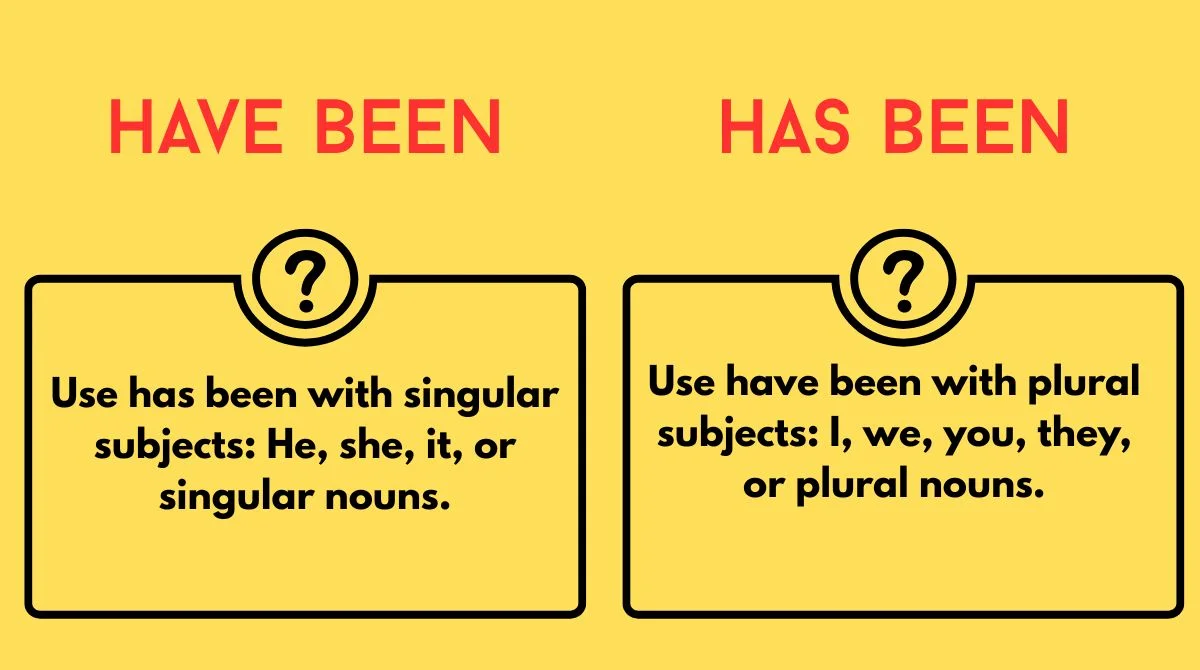
    • Use has been with singular subjects: He, she, it, or singular nouns.
    • Use have been with plural subjects: I, we, you, they, or plural nouns.

    When to Use ‘Has Been’ with Third Person Singular Subjects

    Has been specifically applies to singular third-person subjects, which include pronouns like he, she, it, and singular nouns.

    Examples:

    • “She has been the CEO since 2020.”
    • “It has been a long journey.”
    • “The dog has been barking all night.”

    Tip:

    When in doubt, check the subject of the sentence. If it’s singular and in the third person, has been is the correct choice.


    Applying ‘Have Been’ with Plural and First Person Subjects

    On the other hand, have been aligns with plural subjects and the first and second person pronouns I, we, you, they.

    Examples:

    • “I have been learning French for two years.”
    • “We have been friends since childhood.”
    • “They have been busy with their new project.”

    This rule applies regardless of whether the sentence describes an action or a state of being.


    The Role of ‘Had Been’ in Perfect Tenses

    While has been and have been are present perfect, had been takes us into the past perfect tense.

    When to Use ‘Had Been’

    • To describe an action or state that was completed before another past action.
      Example: “She had been studying for hours before the exam started.”

    Comparison:

    TenseUsage Example
    Present Perfect“She has been working here since 2015.”
    Past Perfect“She had been working here before the merger.”

    Distinguishing Between Past and Present Perfect Uses

    A common source of confusion is when to use present perfect versus past perfect. The key lies in the timeframe:

    • Present Perfect: Refers to ongoing relevance or a connection to the present.
      Example: “There have been many advances in technology recently.”
    • Past Perfect: Refers to something completed entirely in the past.
      Example: “There had been no electricity during the storm.”

    Complexities of Subject-Verb Agreement in English

    Subject-verb agreement plays a crucial role in choosing between has been and have been. This is where English learners often stumble, especially with tricky subjects like compound phrases or collective nouns.


    Navigating Compound Subjects and Prepositional Phrases

    Compound Subjects

    If two singular nouns are joined by and, the subject becomes plural, requiring have been.

    • “John and Sarah have been traveling together.”

    Prepositional Phrases

    Sometimes, prepositional phrases between the subject and verb cause confusion. Ignore them to identify the true subject.

    • Incorrect: “The group of students have been practicing.”
    • Correct: “The group of students has been practicing.”

    Identifying the Real Subject in Complex Sentences

    In complex sentences, the subject isn’t always straightforward.

    Example:

    • “There has been a series of unfortunate events.”
      Here, the real subject is a series (singular), so we use has been.

    Expanding the Verb Phrase: Adverbs with ‘Has Been’ and ‘Have Been’

    Adverbs are often used to modify has been or have been, adding nuance or emphasis.

    Examples:

    • “He has been consistently meeting his goals.”
    • “They have been always supportive of our efforts.”

    Adverbs should be placed either before the main verb or at the end of the sentence for clarity.


    Practical Examples: Using ‘Has Been’, ‘Have Been’, and ‘Had Been’ in Sentences

    Present Perfect:

    • “There has been a lot of debate about climate change.”
    • “There have been several proposals for the new project.”

    Past Perfect:

    • “There had been no announcements before the sudden decision.”

    Table for Quick Reference:

    SubjectCorrect PhraseExample
    He, she, it, singularHas been“He has been waiting for hours.”
    I, we, you, they, pluralHave been“They have been preparing for the event.”
    All subjects (past)Had been“She had been hoping for a promotion.”

    There Have Been or Has Been

    Common Mistakes and Tips for Mastery

    Mistake 1: Misusing has been with plural subjects

    • Incorrect: “They has been working hard.”
    • Correct: “They have been working hard.”

    Mistake 2: Ignoring the real subject in sentences with there

    • Incorrect: “There has been many problems.”
    • Correct: “There have been many problems.”

    Tips for Mastery:

    1. Always identify the true subject of the sentence.
    2. Double-check singular vs. plural agreement.
    3. Practice with examples to build confidence.

    FAQs

    When should I use “there have been”?

    Use “there have been” when the subject is plural. For example: “There have been many changes recently.”

    When do I use “there has been”?

    Use “there has been” when the subject is singular. For instance: “There has been a significant update.”

    What is the main difference between “have been” and “has been”?

    The difference lies in subject-verb agreement. “Have been” is for plural subjects or pronouns like I, we, you, and they. “Has been” is for singular third-person subjects.

    Can I use “has been” with plural subjects?

    No, “has been” is only correct with singular subjects like he, she, it, or singular nouns.

    Why is subject-verb agreement important in English?

    Subject-verb agreement ensures clarity and correctness in communication. Mistakes can confuse readers or listeners.


    Conclusion

    Mastering the distinction between has been and have been is all about understanding subject-verb agreement and the nuances of perfect tenses.

    With this guide, you now have the tools to use these phrases correctly and confidently in any context.

    Whether you’re writing a formal paper or having a casual conversation, remembering these rules will ensure your grammar is spot-on every time.

  • Ourselves or Ourself? When and How to Use Them Correctly 📘

    Ourselves or Ourself? When and How to Use Them Correctly 📘

    Pronouns are essential in everyday communication, yet they can sometimes be tricky to use correctly.

    Among the lesser-discussed yet confusing pronouns are ourselves and ourself. While they may seem interchangeable at first glance, their usage depends on specific contexts.

    In this article, we’ll break down the distinctions between these pronouns, explore their historical roots, and clarify how to use them correctly in modern English.


    The Basic Distinction between Ourselves and Ourself

    Ourselves or Ourself

    Is it “ourselves” or “ourself”? Discover the key differences, grammar rules, and examples to master these reflexive pronouns in any context!

    The difference between ourselves and ourself lies primarily in number and context:

    • Ourselves: A reflexive pronoun used when the subject of the sentence is plural (we or us).
      Example: “We should prepare ourselves for the upcoming challenges.”
    • Ourself: A singular reflexive pronoun, typically used in formal or rare contexts where we is singular (e.g., the royal we or editorial we).
      Example: “As the editor, we have taken it upon ourself to review the article.”

    Historical Context and the Royal We

    The use of ourself is deeply rooted in history, particularly in the concept of the royal we.

    Monarchs and other figures of authority would use we instead of I to convey their position as a representative of the people or divine authority.

    For example:

    • A king might declare, “We decree this law to be absolute,” referring to himself as a representative of the kingdom.
    • In such cases, ourself functions as a singular reflexive pronoun.

    The editorial we, used in academic and professional writing, also borrows from this historical convention. Here, authors refer to themselves in the plural to sound objective and formal.


    Usage of ‘Ourselves’ and ‘Ourself’ in Historical Texts

    In historical literature, both ourselves and ourself have been used, but their prevalence depended on the era and context:

    • Ourselves: Found in collective or plural contexts, often in works by authors addressing groups or societies.
      Example: “We must remind ourselves of our duty.” (John Locke, 17th century)
    • Ourself: Commonly associated with royal declarations or formal writings.
      Example: “We find ourself most content in solitude.” (Shakespeare, Richard II)

    A deeper dive into historical texts reveals that the singular ourself has steadily declined in usage in modern English, while ourselves remains the standard reflexive pronoun for plural subjects.


    Reflecting Authority: The Royal and Editorial We

    The royal we and editorial we demonstrate instances where ourself might still appear.

    • The Royal We: Used by monarchs, popes, and other figures of authority to reflect their position as representatives of a collective.
      Example: “We have bestowed upon ourself the responsibility of maintaining peace.”
    • The Editorial We: Used in academic or formal settings where the author speaks on behalf of a group or organization.
      Example: “We have reviewed the findings and made our conclusions.”

    In both cases, the plural we refers to a singular entity, making ourself appropriate in these contexts.


    Correct Usage of ‘Ourselves’ in Modern English

    In modern English, ourselves is the reflexive pronoun used in plural contexts. It aligns with the subject we or us.

    Key Rules for Using Ourselves:

    1. Reflexive Actions: When the subject and object of the verb are the same.
      Example: “We taught ourselves how to cook.”
    2. Emphasis: To stress the role of the subject.
      Example: “We, ourselves, completed the project without external help.”
    3. Reciprocal Actions: When referring to actions done mutually within a group.
      Example: “We congratulated ourselves on the success of the campaign.”

    When ‘Ourself’ Makes Sense: Special Contexts and Exceptions

    Although rare, ourself is used in very specific contexts:

    1. The Royal We: As mentioned earlier, monarchs and popes use ourself when referring to themselves in the singular while using we.
      Example: “We find ourself deeply moved by the events of the day.”
    2. The Editorial We: Authors or editors may use ourself to represent themselves formally.
      Example: “As editors, we hold ourself accountable for maintaining accuracy.”
    3. Poetic or Stylistic Choices: Writers occasionally use ourself to achieve a certain tone or rhythm in their work.

    Examples of ‘Ourselves’ and ‘Ourself’ in Literature

    Let’s examine how these pronouns have been used in literature:

    AuthorWorkSentence
    William ShakespeareRichard II“We are not ourself when nature, being oppressed, commands the mind to suffer with the body.”
    Virginia WoolfA Room of One’s Own“We think back through our mothers if we are women.”
    Modern ExampleFictional Usage“We prepared ourselves for what lay ahead, knowing it wouldn’t be easy.”

    Common Misconceptions and Grammar Myths Debunked

    Myth: Ourself Is Always Incorrect

    This is false. While ourself is less common, it is correct in specific contexts like the royal or editorial we.

    Myth: Ourselves Can Be Used for Singular Subjects

    Incorrect. Ourselves should only be used for plural subjects (we or us).

    Myth: The Two Words Are Interchangeable

    Not true. Their usage is entirely dependent on context, as explained above.


    Practical Tips to Ensure Correct Pronoun Usage

    1. Identify the Subject: Determine if the subject is singular or plural.
      • Singular: Use ourself.
      • Plural: Use ourselves.
    2. Check the Context: Is it a formal, historical, or stylistic use? If so, ourself may be appropriate.
    3. Rely on Modern Standards: In most cases, especially in casual writing, stick to ourselves.
    4. Proofread Carefully: Reflexive pronoun errors can easily slip through.

    FAQs

    What is the difference between “ourselves” and “ourself”?

    “Ourselves” is used for plural subjects (we, us), while “ourself” is singular and appears in formal or historical contexts like the royal we.

    When should I use “ourselves”?

    Use “ourselves” when the subject is plural, such as “we” or “us.” Example: “We taught ourselves how to code.”

    Is “ourself” grammatically correct?

    Yes, but it’s rare. “Ourself” is used in specific contexts like the royal or editorial we, where “we” refers to a singular subject.

    Can I use “ourselves” for singular subjects?

    No, “ourselves” is strictly for plural subjects. For singular contexts with “we,” use “ourself” instead.

    Why do monarchs and editors use “ourself”?

    They use “ourself” to reflect the royal or editorial we, a formal way of representing a single person speaking as a collective.


    Conclusion

    Understanding the distinction between ourselves and ourself is vital for clear and accurate communication.

    While ourselves dominates modern English as the standard reflexive pronoun for plural subjects, ourself remains relevant in historical, royal, and editorial contexts.

    By mastering these differences, you can ensure your writing is both grammatically correct and contextually appropriate.

    Have you encountered any confusing pronouns lately? Share your thoughts or questions in the comments below!

  • Strongly Recommend vs Highly Recommend: Know the Key Difference! 🤔

    Strongly Recommend vs Highly Recommend: Know the Key Difference! 🤔

    In everyday communication, we often hear phrases like strongly recommend and highly recommend. While these expressions may seem interchangeable at first glance, they carry subtle differences in tone, intent, and application.

    Understanding the nuances of these phrases can help you use them more effectively, whether you’re writing a review, giving advice, or offering a suggestion.

    Let’s break down the differences, contexts, and best uses of these commonly used recommendation phrases.


    Introduction to Recommendation Phrases

    Strongly Recommend vs Highly Recommend

    Recommendation phrases play a vital role in how we communicate support or approval. They help convey our level of enthusiasm, trust, or conviction about a particular subject.

    For example, saying, “I strongly recommend this book” implies a personal conviction, whereas “I highly recommend this book” might focus more on its broad appeal or quality. These subtle differences can make a big impact on how your message is received.

    By exploring the nuances of strongly and highly recommend, we’ll uncover how these terms differ in tone and usage.

    Is it better to say “strongly recommend” or “highly recommend”? Learn the key differences, examples, and best practices to master these phrases!


    The Nuances of “Strongly Recommend”

    Emphasizing Urgency and Conviction

    The phrase strongly recommend conveys a sense of personal urgency or deep conviction.

    It’s often used when you feel passionately about your suggestion or when there’s a significant reason behind the recommendation.

    Examples:

    • “I strongly recommend using sunscreen to protect your skin from UV damage.”
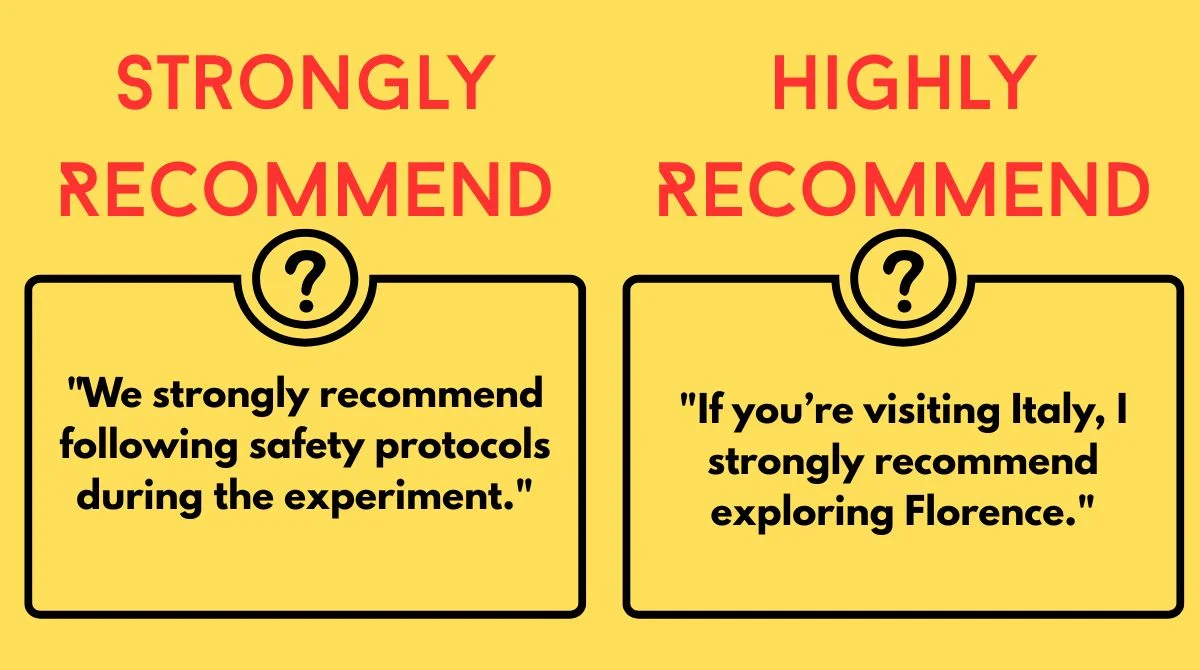
    • “We strongly recommend following safety protocols during the experiment.”

    Here, the emphasis lies on strength and necessity. The suggestion carries weight, urging the listener to act immediately or consider the advice seriously.


    The Subjectivity of “Strongly Recommend”

    One key nuance of strongly recommend is its subjectivity. This phrase often reflects personal experience or strong emotional involvement.

    For instance:

    • “I strongly recommend this restaurant—it’s my absolute favorite!”
    • “If you’re visiting Italy, I strongly recommend exploring Florence.”

    In these cases, the recommendation stems from individual preferences, making it more personal and heartfelt.


    When to Use “Strongly Recommend” in Communication

    Using strongly recommend is appropriate when:

    • You want to convey urgency or necessity.
    • Your recommendation is based on personal experience or expertise.
    • The stakes are high, and you need to stress the importance of action.

    Examples of Usage:

    • Workplace: “We strongly recommend updating your password to improve security.”
    • Health: “Doctors strongly recommend regular exercise to maintain heart health.”

    By choosing this phrase, you align your recommendation with authority and conviction, making it more impactful.


    Breaking Down “Highly Recommend”

    The Contextual Use of Recommendations

    On the other hand, highly recommend suggests a more general endorsement. It’s often used to highlight excellence, quality, or widespread approval. The tone is enthusiastic but less urgent compared to strongly recommend.

    Examples:

    • “I highly recommend this movie—it’s a masterpiece!”
    • “We highly recommend this product based on customer reviews.”

    Here, highly recommend conveys enthusiasm for something that’s widely appreciated or objectively commendable.


    Positive Consensus: Using “Highly Recommend”

    Unlike strongly recommend, which can feel personal, highly recommend often implies positive consensus. It’s suitable for situations where your suggestion aligns with popular opinion or general quality standards.

    For instance:

    • “This hotel is highly recommended for its excellent service and amenities.”
    • “I highly recommend this book—it has received glowing reviews from critics.”

    This phrase works well when your recommendation is based on external validation rather than personal conviction.


    Personal Advice: The Case for “Strongly Recommend”

    Strongly Recommend vs Highly Recommend

    When giving personal advice, strongly recommend is often more effective. It emphasizes your personal connection to the advice and adds a layer of sincerity.

    Example:

    • “If you’re struggling with time management, I strongly recommend using a planner.”

    This approach makes the suggestion feel tailored and genuine, building trust with your audience.


    Real-World Examples: How “Strongly” and “Highly” Impact Meaning

    Example 1: Travel

    • Strongly Recommend: “I strongly recommend visiting the Louvre if you’re passionate about art history.”
    • Highly Recommend: “The Louvre is highly recommended by travel experts and guides.”

    Example 2: Products

    • Strongly Recommend: “I strongly recommend this laptop for graphic design—it’s the best I’ve ever used.”
    • Highly Recommend: “This laptop is highly recommended for its speed and performance.”

    Key Difference: Strongly conveys personal conviction, while highly reflects general approval or quality.


    Substitutes for “Strongly Recommend” and “Highly Recommend”

    To keep your writing varied, consider these alternatives:

    Alternatives for “Strongly Recommend”

    • “I urge you to…”
    • “I insist on…”
    • “I firmly believe…”

    Alternatives for “Highly Recommend”

    • “I wholeheartedly endorse…”
    • “I give my highest praise to…”
    • “This comes with my full recommendation…”

    Using these variations can enhance your communication while avoiding repetition.


    FAQs

    What is the difference between “strongly recommend” and “highly recommend”?

    “Strongly recommend” emphasizes urgency and personal conviction, while “highly recommend” highlights quality or widespread approval.

    When should I use “strongly recommend”?

    Use “strongly recommend” when expressing personal urgency, conviction, or necessity, such as in advice or important suggestions.

    Is “highly recommend” less personal than “strongly recommend”?

    Yes, “highly recommend” often implies external validation or general quality rather than personal conviction.

    Can I use “highly recommend” in professional reviews?

    Absolutely! “Highly recommend” is ideal for professional or objective endorsements based on quality or popular opinion.

    Are there alternatives to “strongly recommend” and “highly recommend”?

    Yes! For “strongly recommend,” try “I urge you to” or “I insist on.” For “highly recommend,” use “I wholeheartedly endorse” or “I give my highest praise to.”


    Conclusion

    Choosing between strongly recommend and highly recommend depends on the tone and context of your message.

    • Use strongly recommend to convey urgency, personal conviction, or emotional involvement.
    • Use highly recommend for endorsements based on quality, excellence, or popular consensus.

    By understanding these differences, you can tailor your recommendations to be more effective and impactful. Whether you’re writing a review, offering advice, or persuading someone to act, these phrases will help you communicate with clarity and precision.

  • Proud for You vs Proud of You: Which One is Correct? 🤔✨

    Proud for You vs Proud of You: Which One is Correct? 🤔✨

    When it comes to expressing pride in someone else’s achievements, choosing the right phrase can sometimes be tricky.

    You might have heard people say, “I’m proud for you,” but is that the correct way to show your pride? Or should it be “proud of you”?

    This article will break down the grammatical distinctions, explain the nuances of each phrase, and clarify why one is often favored over the other.

    By the end, you’ll know how to use these expressions confidently and avoid common mistakes.


    Understanding the Correct Usage of Pride Expressions

    Proud for You vs Proud of You

    Expressing pride in someone’s accomplishments is an emotional and personal experience, but it’s important to get the phrasing right.

    The two most commonly used expressions are “proud of you” and “proud for you.” While both convey positive emotions, they’re not interchangeable.

    “Proud of You”

    This is the standard and widely accepted way to express pride. You use “proud of you” when you’re acknowledging someone’s achievements or the person themselves. It shows a deep connection to the individual’s actions, character, or success.

    Example:
    “I’m so proud of you for completing your degree!”

    “Proud for You”

    Though less common, some people use “proud for you” to convey a sense of joy for someone else’s success. It implies that you feel happiness on their behalf, but not necessarily that you have a personal connection to their achievement.

    Example:
    “I’m proud for you, now that you’ve gotten the job you wanted.”

    In the following sections, we’ll dive deeper into why “proud of you” is typically the go-to choice and why “proud for you” can sound a little off to native speakers.

    Confused about whether to say “proud for you” or “proud of you”? This guide explains the correct usage, common mistakes, and how to express pride with confidence.


    Exploring the Grammatical Nuances of “Proud of You”

    The expression “proud of you” is widely accepted because it follows standard grammar rules. Here’s why:

    The Preposition “Of”

    The preposition “of” is used to show possession, connection, or a state of being. In the phrase “proud of you,” it signifies that the speaker’s pride stems from the person’s qualities or achievements. It’s about feeling connected to or moved by someone else’s success.

    Grammatical Breakdown:

    • Proud is an adjective that expresses a feeling.
    • Of links the adjective to the noun or pronoun (in this case, “you”).
    • You is the person receiving the pride or acknowledgment.

    Example:
    “I’m proud of you for working so hard.”
    Here, “of you” directly links the speaker’s pride to the individual’s effort.


    Why “Proud for You” Sounds Awkward in English

    On the other hand, “proud for you” isn’t incorrect grammatically, but it’s rarely used and tends to sound awkward. This is because the preposition “for” typically implies doing something on someone’s behalf or expressing support, rather than personal connection. It shifts the focus from the individual to their success, making the statement feel less personal.

    The Difference Between “Proud Of” vs “Proud For”

    • Proud of suggests a deep, personal feeling of admiration or connection.
    • Proud for expresses an external sense of happiness or joy for someone, but without a direct connection.

    For example, it might feel more natural to say, “I’m happy for you,” because you are expressing joy on their behalf. However, “proud for you” doesn’t convey that same deep personal pride.


    Common Mistakes and How to Avoid Them

    One of the most common errors people make is using “proud for you” when they mean to express a deeper sense of connection or pride. This usually happens because “for” is often used in similar emotional contexts (e.g., “happy for you” or “excited for you”). However, remember that “proud of you” should always be your go-to when showing admiration for someone’s achievements.

    Example Mistakes:

    • “I’m proud for you for finishing the marathon.” (Incorrect: It should be “proud of you.”)
    • “He’s proud for you for getting the promotion.” (Incorrect: It should be “proud of you.”)

    How to Avoid This Mistake

    • Always remember that “proud of” links the speaker’s pride directly to the individual.
    • “Proud for” is less personal and tends to focus on the external achievement rather than the person’s qualities. If you’re unsure, use “proud of” to avoid sounding awkward.

    Expert Opinions on Proper Language Etiquette

    Linguists and grammarians widely agree that “proud of you” is the correct and preferred expression. According to English language experts, using “of” aligns with the fundamental rules of grammar in expressing pride or admiration. “Proud for you” is generally discouraged, unless you’re specifically discussing someone else’s joy or happiness for the person, as in “I’m so happy for you.”

    Dr. Robert Jones, a linguist at Harvard University, notes, “‘Proud of’ conveys a direct connection between the speaker and the person being admired, while ‘proud for’ distances the two, making it less intimate and more neutral.”


    The Historical Prevalence of “Proud for You” vs “Proud of You”

    Historically, “proud of you” has been the standard expression in English. “Proud for you” is a more recent construction, possibly influenced by the more common “happy for you” phrase. In older literature and writings, “proud of” was always used to show admiration or pride in someone’s accomplishments.

    In Early Literature:

    • Shakespeare and other classic authors often used “proud of” to express pride in characters or their actions.
    • “Proud for” was rarely seen and often felt out of place in formal or poetic contexts.

    As time passed, “proud of” remained the dominant choice due to its deeper emotional and grammatical resonance.


    Deciphering the Meaning Behind “Proud of You”

    When someone says, “I’m proud of you,” the phrase holds significant emotional weight. It’s not just a casual remark but a declaration of admiration. The speaker is saying, “I recognize your hard work, talent, and dedication, and I’m moved by it.”

    The Emotional Weight

    “Proud of you” carries a sense of connection, as if the speaker is personally invested in the person’s growth or success. Whether it’s a family member, a friend, or a colleague, this expression shows emotional attachment and genuine pride.


    The Emotional Impact of This Phrase on Relationships

    Using “proud of you” in relationships—whether familial, romantic, or professional—has a powerful emotional impact. It strengthens bonds and provides affirmation to the person being acknowledged. It shows that the speaker values not just the outcome (e.g., success or achievement) but also the effort and personal growth behind it.

    Strengthening Bonds with “Proud of You”

    When used appropriately, “proud of you” can enhance a person’s sense of self-worth and deepen relationships. It’s a way to tell someone, “I see you, I appreciate you, and I celebrate your accomplishments.”


    Alternatives to Expressing Pride in Someone’s Achievements

    If you want to mix it up and avoid overusing “proud of you,” here are some alternatives:

    • “I’m so impressed by you.”
    • “You did an amazing job!”
    • “Your hard work really paid off.”
    • “I’m in awe of what you’ve achieved.”
    • “You should be really proud of yourself.”

    These alternatives still express admiration but provide variety in your language.


    Final Thoughts on Using Pride Expressions Effectively

    In conclusion, while “proud for you” can be used in certain contexts, “proud of you” is the grammatically correct and emotionally powerful phrase to express genuine pride in someone’s achievements.

    Whether in personal or professional relationships, using the right expression helps communicate admiration, respect, and love.

    When in doubt, always choose “proud of you.” It’s clear, heartfelt, and universally understood. So, next time someone accomplishes something noteworthy, use this phrase with confidence!


    FAQs

    What’s the difference between “proud of you” and “proud for you”?

    “Proud of you” expresses a personal connection to someone’s achievements, while “proud for you” conveys happiness on someone’s behalf without deep personal involvement.

    When should I use “proud of you”?

    Use “proud of you” when expressing deep admiration or pride for someone’s accomplishments, particularly when you feel a personal connection to their success.

    Can “proud for you” be used in English?

    Yes, but it’s less common and typically used to express happiness for someone’s achievement without implying a deep personal connection.

    What are common mistakes with “proud of you” and “proud for you”?

    A common mistake is saying “proud for you” when you mean to express a personal connection or admiration, which should be “proud of you.”

    Why does “proud for you” sound awkward?

    It sounds awkward because “for” is typically used for external support, not for expressing personal pride or admiration.

    What is the emotional impact of saying “proud of you”?

    Saying “proud of you” shows emotional attachment and affirmation, strengthening relationships by acknowledging someone’s effort and success.


    Conclusion

    Now that we’ve unpacked the difference between “proud for you” and “proud of you,” you’re equipped to use these phrases effectively.

    Whether you’re cheering someone on or celebrating a milestone, expressing pride is a beautiful way to strengthen connections and uplift others.

  • Are vs Were: Master English Grammar with Ease 📚🤓

    Are vs Were: Master English Grammar with Ease 📚🤓

    When learning English, one of the most important elements to master is the verb “to be.” It’s essential for forming complete sentences and expressing both the present and past.

    The confusion between “are” and “were” can be especially tricky for English learners, but once you understand the rules and practice using them, it will become second nature.

    In this article, we’ll break down everything you need to know to confidently use are and were in American English grammar.


    Understanding the Verb “Be”: A Brief Overview

    The verb to be is one of the most fundamental and versatile verbs in English. It’s used to describe existence, state of being, and to form various tenses. The verb has different forms based on the subject and tense:

    • Am (used with the subject “I” in the present tense)
    • Is (used with singular subjects in the present tense)
    • Are (used with plural subjects or the pronouns “you” and “we”)
    • Was (used with singular subjects in the past tense)
    • Were (used with plural subjects or the pronouns “you” and “we” in the past tense)

    Understanding these different forms is essential because the correct usage of are and were depends largely on the subject of the sentence and the tense you’re using.

    Confused about when to use “are” or “were”? Learn the difference between these verbs, including their usage in present and past tense, as well as tips for common mistakes.


    The Present Tense of “Be”: When to Use “Are”

    In the present tense, are is used primarily with plural subjects or the pronouns “you” and “we.”

    • Examples:
      • “You are amazing.”
      • “They are ready for the test.”
      • “We are going to the store.”

    In these examples, are helps link the subject to the complement, whether it’s a description, an action, or a state.


    Examples of “Are” in Sentences

    Here are a few more examples to show the versatility of are in the present tense:

    • “My friends are coming over later.”
    • “The dogs are playing in the yard.”
    • “You are a great listener.”
    • “The books are on the table.”

    These sentences highlight are being used with both plural nouns (friends, dogs, books) and the pronoun you.


    Using “Are” with Plural Nouns and Pronouns

    Are is almost always used with plural nouns and pronouns to show that multiple subjects are involved. This helps indicate that the action or state is happening with more than one person or thing.

    • Plural Nouns:
      • “The children are excited for the weekend.”
      • “The cars are parked in the driveway.”
    • Pronouns (We, You, They):
      • “We are planning a trip.”
      • “You are all invited to the party.”
      • “They are studying for their exams.”

    Using are correctly with plural subjects is key to mastering the present tense in English.


    “Are” as an Auxiliary Verb in Progressive Tenses

    In addition to being used as a linking verb, are also functions as an auxiliary (or helping) verb in progressive tenses. These tenses describe actions that are ongoing or in progress. When are is paired with the present participle (the verb ending in “-ing”), it creates the present progressive tense.

    • Examples:
      • “She is studying for her finals.”
      • “They are playing soccer right now.”
      • “I am reading a great book.”

    In these sentences, are helps convey the idea that the actions are happening right now or in the present moment.


    Exploring the Past Tense: The Correct Use of “Were”

    When shifting to the past tense, were replaces are and is used with plural subjects or the pronouns you and we.

    • Examples:
      • “They were excited about the new movie.”
      • “You were supposed to finish the project yesterday.”
      • “We were at the park all afternoon.”

    Unlike are, which expresses the present, were links the subject to a state or action in the past.


    Examples of Using “Were” Correctly in Sentences

    Using were correctly depends on recognizing that it refers to actions, states, or conditions that occurred in the past, often involving more than one subject.

    • “The team were tired after the long match.”
    • “We were waiting for the bus when it started raining.”
    • “They were upset about the canceled event.”

    In each example, were helps convey that the action or state is entirely in the past.


    Customary Grammar Rules for “Were”

    While were is typically used with plural nouns and the pronouns you and we in the past tense, there are some specific rules and usages to keep in mind:

    • Use of “Were” with the Subjunctive Mood: In hypothetical or wishful statements, were is used even with singular subjects. This is known as the subjunctive mood.
      • Example: “If I were you, I would take the job.”
      • Example: “I wish she were here right now.”
    • For all plural subjects and “you” in the past tense:
      • “They were at the concert last night.”
      • “You were the best player on the team.”

    Common Mistakes and Confusions Between “Are” and “Were”

    Even though the rules seem clear, many people still mix up are and were in their writing and speech. Here are a few common mistakes:

    Mixing up Singular and Plural Forms

    • Incorrect: “She were late for class.”
    • Correct: “She was late for class.” (singular subject)

    Using the Wrong Verb for the Tense

    • Incorrect: “I wish I are a better singer.”
    • Correct: “I wish I were a better singer.” (subjunctive mood)

    Subjunctive Mood Usage of “Were”

    One of the trickiest areas of grammar for were is its use in the subjunctive mood. In conditional or hypothetical situations, even singular subjects require were rather than was.

    • Example: “If he were here, he could explain everything.”
    • Example: “I wish she were more interested in this topic.”

    The subjunctive mood helps express wishes, suggestions, or hypothetical situations.


    Practical Tips to Remember the Difference Between “Are” and “Were”

    1. Check the Tense:
      • If the action is happening right now, use are with plural subjects or “you” and “we.”
      • If the action took place in the past, use were with plural subjects or “you” and “we.”
    2. Consider the Subject:
      • Are goes with plural subjects and “you” in the present.
      • Were goes with plural subjects, “you,” and “we” in the past.
    3. Remember the Subjunctive Mood:
      • If you’re expressing a hypothetical or wishful statement, use were even with singular subjects.

    FAQs

    When should I use “Are” in a sentence?

    Use “are” when referring to a plural subject in the present tense or when using the pronouns “you” and “we.”

    When is it correct to use “Were”?

    Use “were” for plural subjects or the pronouns “you” and “we” in the past tense, or in the subjunctive mood for hypothetical situations.

    What’s the difference between “are” and “were”?

    “Are” is used in the present tense with plural subjects, while “were” is used in the past tense or for hypothetical statements, even with singular subjects.

    What is the subjunctive mood with “Were”?

    The subjunctive mood uses “were” to express hypothetical or wishful situations, such as “If I were you, I would do it.”

    Why do people confuse “are” and “were”?

    Many mix up these verbs because they sound similar, but “are” is for present tense, while “were” is for past tense or hypothetical cases.

    How can I avoid mistakes with “Are” and “Were”?

    Remember that “are” is for present tense and plural subjects, while “were” is for past tense, with special cases for the subjunctive mood.


    Conclusion

    Mastering the difference between are and were can significantly improve your English grammar skills.

    While are is used in the present tense with plural subjects and “you” and “we,” were is reserved for the past tense, and in certain cases, it’s used with singular subjects in the subjunctive mood.

    By following the rules and practicing with these examples, you’ll soon be able to use are and were with confidence.

  • Me and My Family vs My Family and I: A Clear Guide 🧑‍👩‍👧‍👦📚

    Me and My Family vs My Family and I: A Clear Guide 🧑‍👩‍👧‍👦📚

    The English language is full of tricky grammar rules that often leave even the most seasoned speakers scratching their heads.

    One of the most common dilemmas? Whether to say “Me and my family” or “My family and I”. Though these phrases might sound interchangeable to many, they are not always used correctly.

    Understanding when to use each form is key to sounding polished and professional.

    In this guide, we’ll dive deep into the correct usage, break down common mistakes, and provide clarity on this often-confused grammar rule.


    Decoding the Grammatical Dilemma: Subject vs. Object Pronouns

    Before we tackle me and my family versus my family and I, it’s crucial to understand the difference between subject and object pronouns.

    This is the foundation for determining which phrase is appropriate in any given context.

    • Subject Pronouns: These pronouns are used when the person or group performing the action of the sentence is in focus. I, we, he, she, they are all subject pronouns.
      Example:I went to the park with my family.”
    • Object Pronouns: These pronouns take the role of the recipient of the action. Me, us, him, her, them are all object pronouns.
      Example: “He invited me to the party with my family.”

    Knowing whether your pronoun is a subject or an object will guide your choice between I and me in sentences.

    Confused about whether to say “Me and my family” or “My family and I”? Learn the grammatical rules and etiquette behind these phrases for more polished speech and writing.


    Pronoun Placement Etiquette in English

    In English, the order of pronouns in a sentence isn’t just about grammar rules—it’s also about etiquette and respect. My family and I is traditionally the more polite and formal choice, especially when you are the subject of a sentence. The reason? In English-speaking cultures, the other person (or group) is often placed first as a sign of respect.

    Correct Placement:

    • “My family and I went on vacation.” (Formal, respectful)
    • “He invited my family and I to dinner.” (Polite phrasing, subject)

    Incorrect Placement:

    • “Me and my family went on vacation.” (Informal, incorrect usage for subject pronouns)
    • “He invited me and my family to dinner.” (Common mistake, though technically used as an object, it sounds less polished)

    The Tradition of Self-Referential Politeness

    In formal or respectful English, we tend to place others before ourselves. This principle is especially evident when using pronouns like I and me. While my family and I is grammatically correct when you are the subject, it’s also a matter of maintaining politeness and decorum. This tradition of placing my family before I reflects the cultural practice of showing deference to others.

    In a casual conversation, it’s fine to say me and my family, but it’s not considered as polite or proper as my family and I. So, when in doubt, follow the tradition of placing others before yourself, especially in more formal contexts.


    Implications of Pronoun Order in Perception

    Me and My Family vs My Family and I

    The order of pronouns in a sentence can influence how the speaker is perceived. For instance, saying “Me and my family” might sound too informal or even self-centered in certain settings, especially in professional or academic communication. This structure places the speaker first, which can inadvertently shift the focus to them rather than the group.

    Example 1:

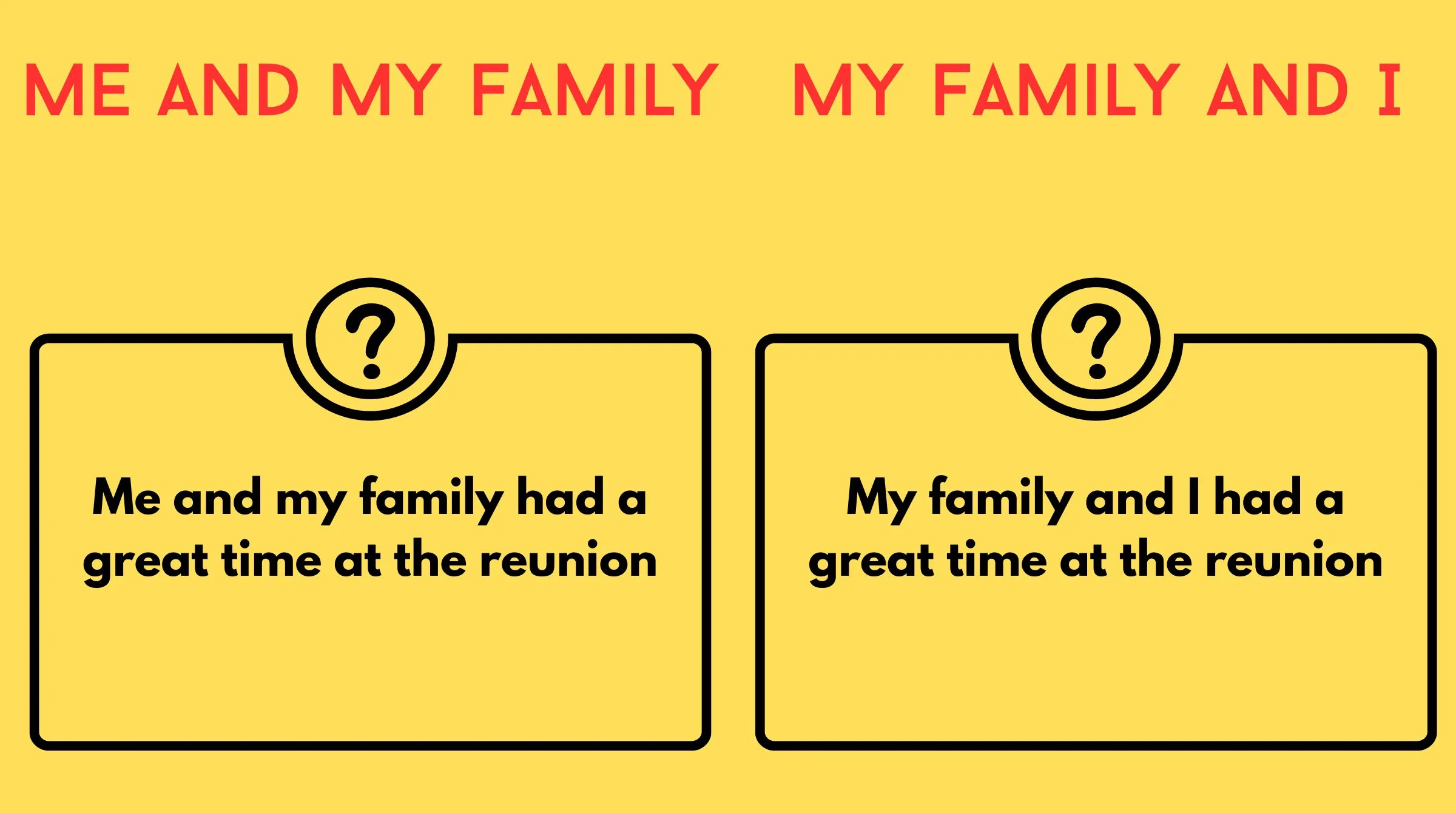
    • “Me and my family had a great time at the reunion.” (Casual, informal tone)
    • “My family and I had a great time at the reunion.” (More respectful, appropriate for formal settings)

    Why it matters: Using the proper order helps maintain the professionalism of your writing and ensures you’re being perceived as polite and respectful.


    Breaking Down Examples: “My Family and I” in Sentences

    Let’s break down a few sentences to clearly see how my family and I works in context. Understanding the structure will help you apply it confidently in your own speech and writing.

    Correct Usage for Subject Pronouns (when the action is performed by the speaker):

    • “My family and I went to the zoo last weekend.”
      (Here, I is the subject and is performing the action along with my family.)
    • “My family and I are excited for the upcoming vacation.”
      (Again, the subject of the sentence—my family and I—are the ones performing the action.)

    When to Use “My Family and Me”: A Focus on Object Pronouns

    Now that we’ve addressed the subject pronoun case, let’s talk about when to use my family and me. As mentioned earlier, this version of the phrase is used when the pronoun is an object, or the recipient of the action.

    Correct Usage for Object Pronouns (when the speaker is the recipient of the action):

    • “The teacher gave my family and me a tour of the campus.”
      (Here, my family and me are the objects of the action.)
    • “The host welcomed my family and me to the event.”
      (Again, my family and me are receiving the action.)

    The Influence of Context: Understanding the Correct Usage

    Sometimes, the context of a sentence plays a significant role in deciding whether to use I or me. Here’s a helpful rule:

    • If you’re the subject of the sentence (performing the action), use I.
    • If you’re the object of the action (receiving the action), use me.

    Example 1:

    • “My family and I will go to the concert.”
      (Subject: I is performing the action.)

    Example 2:

    • “The organizer invited my family and me to the concert.”
      (Object: me is receiving the action.)

    Common Mistakes to Avoid: Pronoun Misplacement in Speech and Writing

    A common mistake many people make is misplacing the pronoun order or choosing the wrong pronoun for the subject/object. Let’s explore a few scenarios and how to correct them:

    • Incorrect: “Me and my family are going to the movies.”
      Correct: “My family and I are going to the movies.”
    • Incorrect: “They gave my family and I tickets to the event.”
      Correct: “They gave my family and me tickets to the event.”

    To avoid these errors, pay attention to whether the pronoun is acting as the subject or the object.


    Identifying Incorrect Usage in Everyday Communication

    One of the easiest places to spot errors is in casual conversations, social media posts, and emails. These mistakes often go unnoticed, but they can affect how others perceive your language proficiency.

    Common Incorrect Examples:

    • “Me and my friends are meeting later.”
    • “The manager called my family and I to the office.”

    In both of these examples, the incorrect pronoun placement could easily be fixed by switching me and I based on whether it’s a subject or object.


    Correcting Misconceptions: Education vs. Convention

    Many people are taught to say my family and I in all contexts, regardless of whether the pronoun is the subject or object. While this can be useful for promoting formal speech, it’s important to teach the difference between subject and object pronouns to ensure proper grammar in every situation.

    Myth: “My family and I” is always correct.
    Reality: “My family and me” is correct when the pronoun is the object of the action.

    By addressing these misconceptions, we can help others understand and use language more effectively.


    Cultural Nuances and Their Impact on Language Structure

    Me and My Family vs My Family and I

    Pronoun usage is also influenced by cultural norms and regional language variations. For example, in some cultures, formality and politeness are highly emphasized, leading to a greater preference for my family and I.

    In other settings, particularly in casual conversations, people might be more likely to say me and my family, especially in more informal contexts. Recognizing these nuances can help you navigate social situations and communicate more effectively.


    FAQs

    When should I use “My family and I”?

    Use “My family and I” when you are the subject of the sentence, meaning you and your family are performing the action.

    When is it correct to say “My family and me”?

    Say “My family and me” when you are the object of the action, meaning you and your family are receiving the action.

    Why do we say “My family and I” instead of “Me and my family”?

    In formal English, it’s customary to place others (like your family) before yourself, especially in subject positions, for politeness and respect.

    Can I always use “My family and I” in every sentence?

    No, it’s not always correct. Use “My family and I” when the pronoun is the subject; use “My family and me” when the pronoun is the object of the action.

    Why does pronoun order matter?

    The order reflects politeness, and in formal writing, it’s more respectful to place others before yourself, making “My family and I” the preferred form.

    How can I avoid pronoun placement mistakes?

    Be mindful of whether the pronoun is the subject or object. If you’re performing the action, use “I.” If receiving the action, use “me.”


    Conclusion

    In conclusion, knowing when to use my family and I versus me and my family is not just about grammar—it’s about understanding the role of pronouns in your sentence.

    Whether you’re speaking formally or casually, using the correct form shows that you understand language rules and are mindful of politeness conventions.

    Next time you’re faced with this dilemma, remember:

    • Use my family and I when you are the subject of the sentence.
    • Use my family and me when you are the object.

    Feel free to share this guide or leave a comment if you’ve come across other tricky grammatical dilemmas!

  • Year Old vs Years Old 📚 The Complete Grammar Guide (With Examples)

    Year Old vs Years Old 📚 The Complete Grammar Guide (With Examples)

    English learners and even native speakers often stumble over “year old” vs “years old.” Should you write a five-year-old boy or a five years old boy? The truth is, the difference is simple once you understand a few grammar rules.

    👉 Quick Answer :

    • Use year-old with a hyphen when age modifies a noun before it: a three-year-old child.
    • Use years old (no hyphen) when the age follows a verb: The child is three years old.
    • Avoid “year old” without a hyphen unless “year” and “old” are separate words in the sentence.

    This guide will take you through clear examples, grammar rules, real-world usage, style-guide notes, and common mistakes so you’ll never second-guess age expressions again.


    Quick-Reference Table: Year Old vs Years Old

    Year Old vs Years Old

    Here’s a simple chart to clear things up at a glance:

    FormWhen to UseExample Sentence
    year-oldWhen age modifies a noun (attributive adjective)She adopted a two-year-old puppy.
    years oldWhen age follows a verb or stands aloneThe puppy is two years old.
    year old (no hyphen)Rare, only when “year” and “old” are grammatically separateHe is a year and a half old.
    year-olds (plural)When referring to people/things collectively by ageThe daycare has three four-year-olds.
    X- to Y-year-oldAge range modifying a nounA 5- to 7-year-old program.

    The Core Grammar Rules Behind “Year Old” vs “Years Old”

    Attributive vs Predicative Position

    The main distinction comes down to where the age phrase appears in the sentence.

    • Attributive (before a noun):
      • Hyphen required: a 10-year-old car.
      • Without the hyphen, readers might misinterpret it as 10 year old car (awkward and confusing).
    • Predicative (after a verb):
      • No hyphen: The car is 10 years old.
      • Notice the plural “years” because you’re counting the number of years.

    📌 Tip: If the phrase comes before the noun, use year-old (hyphenated, singular “year”). If it comes after the noun, use years old (no hyphen, plural “years”).


    Compound Adjective Mechanics

    The hyphen in “year-old” shows that the words belong together as one adjective. Without it, the sentence can be misleading.

    • She bought a 15-year-old violin.
    • She bought a 15 year old violin. (could be misread as “15 year” + “old violin”)

    Hyphens prevent confusion and keep writing precise.


    Plural Forms and Hyphen Placement

    One of the trickiest parts is pluralization. Here’s the golden rule:

    • Pluralize the whole compound, not the “year.”
      • The playground is full of six-year-olds.
      • The playground is full of six-years-old.

    📌 Also note: When listing multiple ages, keep the hyphen structure intact.

    • The five-year-old and six-year-old siblings are inseparable.
    • The five- and six-year-olds were playing together.

    Numbers, Numerals, and Style-Guide Nuances

    Numerals vs Words

    In most modern writing:

    • Use numerals for ages: 5 years old, a 5-year-old child.
    • Spell out at the beginning of a sentence: Five-year-olds love cartoons.

    Example:

    • The boy is 10 years old. (numeral)
    • Ten-year-olds are starting middle school. (spelled out at start of sentence)

    Style-Guide Differences

    Different style guides tweak the rules slightly:

    • AP Stylebook: Always use numerals for ages. Hyphenate “year-old” when used as a compound adjective.
    • Chicago Manual of Style (CMOS): Similar approach. Advises clarity with hyphens in compound adjectives.
    • MLA: Follows Chicago conventions in most cases.
    • Oxford Style: Stresses consistent use of hyphens in age modifiers.

    📌 Key takeaway: No matter which style guide you follow, the hyphen in attributive use is almost always recommended.


    Hyphenation with Ranges

    When you’re talking about age ranges, keep the structure clean:

    • a 5- to 7-year-old child
    • 5–7-year-olds need special supervision
    • a 5–7 years old child (incorrect)

    Notice that “year-old” stays singular, even in ranges.


    Real-World Examples of “Year Old” vs “Years Old”

    Here are examples you can rely on in everyday writing:

    • My daughter is eight years old. (predicative)
    • She is an eight-year-old girl. (attributive)
    • The teacher grouped the six-year-olds together. (plural)
    • He is a year and a half old. (separate words)
    • We bought a 20-year-old bottle of wine. (compound adjective)
    • The car is nearly 15 years old but still runs smoothly. (predicative)
    • The eight- and nine-year-olds competed in the spelling bee. (shared structure)

    Every example follows the hyphen and plural rules you saw earlier.


    “Year Old” Without a Hyphen — When Is It Correct?

    Many people assume “year old” without a hyphen is always wrong, but that’s not true. It works in specific cases where “year” and “old” don’t form a single modifier.

    Examples:

    • He is a year and two months old.
    • That law is one year old.
    • This tree is almost a hundred years old.

    Here, “year” and “old” are separate words, not a compound adjective. That’s why no hyphen is needed.


    Examples from Reliable Sources

    Here are examples adapted from dictionaries and style references (Merriam-Webster, AP Style, Oxford):

    • Merriam-Webster: a 30-year-old tradition
    • AP Style: The 5-year-old boy smiled for the photo.
    • Chicago Manual of Style: She is 45 years old.
    • Oxford: The ten-year-old child recited a poem.

    📌 Using examples from trusted sources ensures your writing aligns with professional standards.


    Historical Usage and Trends

    Language evolves, and hyphenation trends reflect that. According to Google Ngram Viewer:

    • Before 1950, writers often omitted the hyphen (5 year old child).
    • From the 1960s onward, hyphenated forms (5-year-old child) became dominant, especially in formal writing.
    • Today, style guides consistently favor the hyphen in attributive uses.

    👉 Takeaway: The hyphen is not a trend—it’s now the established norm.


    Special Contexts and Tricky Cases

    Legal and Formal Documents

    Contracts, medical reports, and legal records often state ages explicitly:

    • Patient is 12 years old.
    • Defendant, a 17-year-old male, was present at the hearing.

    Formal writing prioritizes clarity, so rules are strictly followed.


    Marketing and Product Copy

    Marketers rely on hyphens to avoid ambiguity:

    • a 2-year warranty (clear, professional)
    • Without the hyphen (2 year warranty), it risks misreading.

    Conversational English and Social Media

    On Twitter or casual chats, people sometimes skip hyphens:

    • My kid is 5 year old today lol.

    It’s common in informal speech, but in professional writing or published content, stick to standard grammar.


    Non-Native Speakers & ESL Learners

    Common mistakes include:

    • Writing 5 years-old child (incorrect plural).
    • Omitting the hyphen: a 10 year old house.

    💡 Quick Practice Tip: If the phrase comes before the noun, hyphenate. If it comes after, don’t.


    Quick Style Checklist

    Before publishing, check these rules:

    • ✅ Hyphenate year-old before a noun.
    • ✅ Use years old after a verb.
    • ✅ Use numerals for ages (unless starting a sentence).
    • ✅ Pluralize correctly: five-year-olds.
    • ✅ For ranges, write: 5- to 7-year-olds.
    • ❌ Don’t write 5 years-old child.

    Cheatsheet: One-Line Examples

    • She is 12 years old.
    • a 12-year-old girl
    • Two-year-olds are curious.
    • The book is one year old.
    • a 5- to 7-year-old group
    • The eight-year-old and nine-year-old siblings
    • He is a year and a half old.
    • They care for 15-year-olds at the camp.

    FAQ: Year Old vs Years Old

    When should I use “year-old” with a hyphen?

    Use “year-old” before a noun to show age as a compound adjective: a 7-year-old boy.

    Is “3 years old” or “3-year-old” correct?

    Both are correct depending on placement: She is 3 years old vs a 3-year-old girl.

    How do you pluralize age modifiers?

    Add “s” to the whole phrase, not “year”: six-year-olds.

    Which style guide should I follow?

    Most guides (AP, Chicago, Oxford) agree: numerals for ages and hyphenate compound modifiers.

    How do I write age ranges?

    Write 5- to 7-year-old children or 5–7-year-olds. Don’t write 5–7 years old children.

    Is “year old” ever correct as two words?

    Yes, when “year” and “old” stand separately: a year and two months old.


    Quick Quiz: Test Yourself

    Fill in the blanks with the correct form:

    1. The boy is ___ (five years old / five-year-old).
    2. She bought a ___ (12 years old / 12-year-old) bicycle.
    3. The playground has many ___ (three-year-olds / three-years-old).
    4. He is a year and a half ___.
    5. They are raising funds for ___ (10 to 12 years old / 10- to 12-year-olds).

    Answers:

    1. five years old
    2. 12-year-old
    3. three-year-olds
    4. old
    5. 10- to 12-year-olds

    Conclusion

    Mastering year old vs years old is about placement and hyphenation.

    • Year-old = before the noun, hyphenated.
    • Years old = after the verb, no hyphen.
    • Year old (separate words) = only in rare contexts like a year and a half old.

    When in doubt, ask: Is the age describing a noun directly before it? If yes, hyphenate. If not, leave it open.

    👉 Bookmark this guide, use the cheatsheet, and you’ll never stumble on this rule again.

  • Myself vs My Self: What’s the Difference in Grammar? 🤔📚

    Myself vs My Self: What’s the Difference in Grammar? 🤔📚

    In the world of English grammar, myself and my self are often used interchangeably, but they have distinct meanings and purposes.

    Understanding the difference between these two terms will not only enhance your writing but also sharpen your understanding of how pronouns work.

    This article delves into the proper use of “myself” and “my self,” highlighting key distinctions and offering practical advice on when to use each one.


    Exploring the Pronoun “Myself” in American English

    Myself vs My Self

    At first glance, myself may seem like a simple word, but it holds more weight in grammar than many realize.

    In American English, myself is a reflexive pronoun, a term that refers back to the subject of the sentence.

    Reflexive pronouns are used when the subject and the object of the sentence are the same person or thing.

    Defining Myself as a Reflexive Pronoun

    A reflexive pronoun is used when the subject of the sentence performs an action on itself. Myself specifically refers to the first person singular.

    For example:

    • “I taught myself how to play the piano.”
      In this case, the action (teaching) is performed by the subject (I) on itself (myself).
      Reflexive pronouns are important for clarity in sentences, ensuring the subject and object are connected. They include myself, yourself, himself, herself, itself, ourselves, yourselves, and themselves.

    Is it “myself” or “my self”? Learn the key differences between these terms, from reflexive pronouns to discussions on personal identity.


    Examples of Using “Myself” in Sentences

    Let’s break down how myself works in context with a few practical examples:

    1. “I hurt myself while jogging yesterday.”
      • Here, the subject (I) performed the action (hurt) on itself.
    2. “I made the decision to go on vacation by myself.”
      • In this case, the word myself emphasizes that the action was done alone.
    3. “I will take care of it myself.”
      • Myself emphasizes personal responsibility for the task.

    Each of these examples shows how myself links the subject to the object of the sentence.


    The Nuanced Context of “My Self”

    Now that we’ve examined the reflexive use of myself, let’s dive into the term my self. Unlike myself, my self is rarely used in standard English writing and has specific, more philosophical or introspective connotations.

    When to Use “My Self”

    My self is often used in discussions about one’s identity or self-awareness, focusing on the individual as a concept rather than a subject performing an action. For example:

    • “I need to understand my self better before making any decisions.”
      In this sentence, my self refers to the speaker’s broader sense of identity or existence, rather than an action being performed on the speaker.

    This distinction highlights the philosophical angle of my self, which can be used when exploring concepts of self-awareness or personal growth.


    “Myselves”: Addressing the Common Misconception

    One of the most common errors people make with myself is attempting to use myselves in place of myself in the plural form. While it might sound natural to some, myselves is grammatically incorrect and never used in standard English.

    Why “Myselves” Is Incorrect

    Myself is a singular reflexive pronoun and has no plural counterpart. The correct plural form is ourselves when referring to the first person plural. For example:

    • “We made the decision ourselves.”
      Rather than using myselves, always opt for ourselves when referring to multiple people performing actions on themselves.

    Historical Usage and Popularity: “Myself” in Literature

    Myself has an interesting history in the English language, especially in literature. Historically, it has been used to emphasize personal involvement or action in a sentence, providing a deeper sense of individual control or responsibility.

    “Myself” in Classical Literature

    • Shakespeare, for instance, often used myself for dramatic emphasis in his plays.
    • In works such as Hamlet or Macbeth, the use of reflexive pronouns like myself helped to build tension and underscore characters’ personal struggles.

    Although the word myself has evolved, its use in literature set the stage for its more common use in modern grammar.


    How “Myself” Functions Grammatically

    Now that we’ve explored myself in its reflexive form, let’s break down its grammatical role in more detail. Reflexive pronouns serve not only to link the subject and object but also to emphasize the subject’s agency in performing an action.

    When “Myself” Is Both the Subject and the Object

    The most common grammatical structure with myself involves the subject and object being the same. For instance:

    • “I made this decision by myself.”
      In this sentence, the subject (I) is performing the action, and the object (myself) is the same person. This helps to emphasize the isolation or independence of the action.

    The Role of “Myself” in Emphasizing Personal Action

    While reflexive pronouns like myself are commonly used to indicate self-directed action, they also serve to emphasize the degree to which an action is personal.

    Emphasis on Personal Responsibility or Action

    For example:

    • “I’ll handle it myself.”
      Here, myself emphasizes that the speaker will take full responsibility for the task, leaving no room for others to interfere.

    Using myself for emphasis adds weight to the action, signaling that it was done deliberately or with extra effort.


    Conversing About Identity: The Non-Reflexive “My Self”

    As mentioned earlier, my self is sometimes used to discuss personal identity in a broader, more introspective context. It’s not used for actions but rather for philosophical or psychological discussions of who we are.

    Philosophical and Psychological References to “My Self”

    • “I must align my self with my values if I am to succeed in life.”
      Here, my self refers to the inner, personal self, emphasizing identity and personal growth.
      This usage is more common in fields like psychology, philosophy, and self-help literature.

    Common Mistakes and Tips to Remember the Difference

    Myself vs My Self

    Understanding the distinctions between myself and my self isn’t always easy, but here are a few tips to avoid common mistakes:

    1. Don’t use myself as the subject of a sentence.
      • Incorrect: Myself went to the store.
      • Correct: I went to the store.
    2. Use myself only as a reflexive pronoun or for emphasis.
      • Correct: I’ll do it myself.
    3. Reserve my self for philosophical contexts or when discussing identity.
      • Correct: I’m trying to find my self through meditation.

    FAQs

    What is the difference between “myself” and “my self”?

    “Myself” is a reflexive pronoun used for actions performed by the subject on themselves, while “my self” refers to personal identity or self-awareness in philosophical contexts.

    When should I use “myself”?

    Use “myself” when the subject performs an action on itself (e.g., “I taught myself”) or to emphasize personal responsibility (e.g., “I did it myself”).

    When is it correct to use “my self”?

    “My self” is used in philosophical or introspective contexts to discuss one’s sense of identity, as in “I need to understand my self better.”

    Is “myself” ever incorrect?

    Yes, “myself” should never be used as the subject of a sentence. For example, “Myself went to the store” is incorrect; use “I went to the store” instead.

    Why is “myselves” incorrect?

    “Myselves” is a common mistake. The plural form of “myself” is “ourselves,” not “myselves.”

    How can I remember when to use “myself” and “my self”?

    Think about the context: Use “myself” for reflexive actions or emphasis, and use “my self” for discussions about personal identity or growth.


    Final Thoughts and Best Practices in Writing

    In conclusion, while myself and my self may seem similar at first, understanding their unique roles can make your writing more precise and impactful.

    Always remember that myself is a reflexive pronoun used for self-action and emphasis, while my self refers to identity and self-awareness.

    By mastering these distinctions, you’ll elevate your communication skills and avoid common grammatical mistakes.

    If you ever find yourself unsure, take a moment to consider the context—are you talking about an action, or are you reflecting on your personal identity? That simple step will help you choose the right form every time.

  • Resetted or Reset? The Past Tense of ‘Reset’ Explained 🕒📚

    Resetted or Reset? The Past Tense of ‘Reset’ Explained 🕒📚

    English grammar can be tricky, especially when dealing with irregular verbs. Words like reset often lead to confusion because they don’t follow the typical patterns of regular verbs.

    Is the past tense of reset “reset” or “resetted”? Let’s explore the rules, correct usage, and common mistakes to ensure you never stumble over this verb again.


    Understanding the Irregular Verb “Reset”

    Resetted or Reset

    The word reset is an irregular verb, meaning its past tense does not follow the conventional rule of adding “-ed” to the base form.

    • Definition of Reset: To set something again or restore it to its original state.
      Example: “I reset my alarm clock every night before bed.”

    Unlike regular verbs, reset retains the same form across the present, past, and past participle tenses. This can make it tricky, as people may incorrectly assume that “resetted” is a valid past tense form.

    Is it “resetted” or “reset”? Learn the rules of this irregular verb and discover why “reset” is the correct past tense in English grammar.


    The Correct Past Tense Form of “Reset”

    The correct past tense of reset is reset.

    • Present Tense: I reset the machine.
    • Past Tense: Yesterday, I reset the machine.
    • Past Participle: I have reset the machine.

    Why doesn’t it change?
    The verb reset belongs to a group of irregular verbs known as “zero-change verbs,” where the base form, past tense, and past participle remain identical.

    Other examples of such verbs include:

    • Put → Put → Put
    • Cut → Cut → Cut
    • Hit → Hit → Hit

    Reset vs. Resetted: Grammatical Clarification

    Is “Resetted” Ever Correct?

    No, resetted is not a grammatically correct word. Adding the “-ed” ending is unnecessary because reset already serves as the past tense form.

    Common Mistake:
    Incorrect: I resetted the router yesterday.
    Correct: I reset the router yesterday.

    Using resetted not only breaks grammatical rules but also creates confusion. It’s essential to stick to the standard irregular form: reset.


    Pronunciation and Usage of “Reset” in Different Tenses

    While reset doesn’t change its spelling across tenses, its pronunciation stays consistent as well: /ˈriːˌsɛt/.

    Here’s how it appears in different contexts:

    • Present Tense:
      Example: “I reset the password every month for security.”
    • Past Tense:
      Example: “She reset her phone to factory settings yesterday.”
    • Past Participle:
      Example: “They have reset the clocks for daylight saving time.”

    To avoid confusion, focus on the context of the sentence to determine the tense being used.


    Common Mistakes and How to Avoid Them

    Mistakes often arise when people incorrectly assume that all verbs must conform to regular patterns. Here are some common errors and ways to avoid them:

    Mistake 1: Using “Resetted” as the Past Tense

    • Why it happens: Regular verbs like “restart” (restarted) may cause learners to apply the same rule to reset.
    • How to avoid it: Remember that reset is irregular and doesn’t change form.

    Mistake 2: Misinterpreting the Tense of “Reset”

    • Why it happens: Since the word looks the same in the present and past tense, readers or listeners might misunderstand the time frame.
    • How to avoid it: Use context clues like time markers (yesterday, last week) to clarify the tense.

    Mistake 3: Overcomplicating the Verb

    • Why it happens: People assume irregular verbs are “harder” to use, leading to overthinking.
    • How to avoid it: Keep it simple—reset is the correct form for all tenses.

    Expanding Your Grammar: Similar Irregular Verbs

    To master irregular verbs like reset, it helps to compare them with others that follow similar patterns. Here’s a quick list:

    Base FormPast TensePast ParticipleExample Sentence (Past Tense)
    SetSetSetI set the table before dinner.
    CutCutCutShe cut the paper into shapes.
    HitHitHitHe hit the ball out of the park.
    LetLetLetThey let the dog out earlier.
    ShutShutShutI shut the door when I left.

    Pro Tip: Irregular verbs often follow unique rules, so it’s best to memorize them through practice and examples.


    FAQs

    What is the past tense of “reset”?

    The past tense of “reset” is simply “reset.” It doesn’t change in form like regular verbs.

    Is “resetted” ever correct?

    No, “resetted” is grammatically incorrect. The correct form is “reset” in both the present, past, and past participle.

    Why doesn’t “reset” change in the past tense?

    “Reset” is an irregular verb that belongs to a group of verbs where the base form, past tense, and past participle are the same.

    How can I avoid confusing “reset” with “resetted”?

    Focus on recognizing “reset” as an irregular verb, and avoid adding “-ed” to it in the past tense.

    Can you give examples of “reset” in sentences?

    Present Tense: “I reset the device.”
    Past Tense: “She reset the system yesterday.”
    Past Participle: “They have reset the router.”

    Are there other irregular verbs like “reset”?

    Yes, other irregular verbs like “put,” “cut,” and “hit” do not change forms in the past tense.


    Conclusion

    The past tense of reset is simply reset—not “resetted.” Understanding its irregular nature is crucial for accurate communication, especially in written English.

    While irregular verbs can be challenging, recognizing patterns and practicing similar examples will help you avoid mistakes.

    Now that you’ve mastered reset, why not explore other irregular verbs? Share your thoughts or questions in the comments below!

  • Timeslot vs Time Slot: Which One Is Correct? 🤔✍️

    Timeslot vs Time Slot: Which One Is Correct? 🤔✍️

    Words in English often cause confusion, and “timeslot” vs “time slot” is no exception.

    Should it be written as one word, two words, or hyphenated? This article dives into the details of correct usage, how hyphenation works, and why making the right choice matters, especially in different contexts.

    Let’s settle the debate once and for all.


    The Great Debate: Timeslot vs. Time Slot

    Timeslot vs Time Slot

    At first glance, “timeslot” and “time slot” might seem interchangeable, but they differ in formality and correctness depending on the context.

    • Time Slot (Two Words): The grammatically correct and widely accepted form in formal and professional writing.
      Example: “Please select a time slot for your appointment.”
    • Timeslot (One Word): This informal variation has become more popular in casual usage, especially online and in social media contexts.
      Example: “The next timeslot available is at 3 PM.”

    While both forms are used, “time slot” remains the standard in formal and professional communication.

    Timeslot, time slot, or time-slot—which is correct? Learn the key grammar rules, proper usage, and when to hyphenate for clear and professional writing.


    What Does the Hyphen Rule Tell Us?

    Hyphens play a critical role in compound words, but they aren’t always necessary. The hyphenation of “time-slot” depends on its function in a sentence.

    The Hyphen Rule in Action:

    • Use a hyphen when the compound word acts as a modifier before a noun.
      Example: “We need to reserve a time-slot reservation system.”
    • Do not hyphenate when the term stands alone.
      Example: “The time slot has been reserved.”

    Why This Matters

    Incorrect hyphenation can lead to confusion or make your writing seem unpolished. The key is to understand how compound modifiers work and apply the rule consistently.


    Time Slot: Breaking It Down

    The term “time slot” refers to a designated period reserved for a specific purpose. It’s commonly used in scheduling, broadcasting, and everyday planning.

    Examples of Usage:

    • Broadcasting: “The show airs in the prime-time slot at 8 PM.”
    • Scheduling: “You can book a 30-minute time slot for your meeting.”
    • Transportation: “Passengers must arrive 15 minutes before their time slot.”

    Grammar Tip: Always write “time slot” as two words in formal contexts unless it’s used as a compound modifier (e.g., “time-slot allocation”).


    Navigating Grammar and Style Guides

    Grammar and style guides like The Chicago Manual of Style and AP Stylebook provide clear guidelines:

    • Preferred Usage: Always use “time slot” (two words).
    • Hyphenation Rules: Only hyphenate when used as a compound modifier.

    Why follow style guides? Consistency in your writing builds credibility and ensures clarity for readers. Deviating from standard forms, especially in professional contexts, may make your work appear less polished.


    Time Slot in Formal Writing

    In formal writing, adhering to grammatical standards is crucial. “Time slot” is the only acceptable form in professional documents, academic papers, and business communications.

    Examples:

    • Academic Paper: “Each participant was assigned a 15-minute time slot for their presentation.”
    • Business Communication: “Please confirm your time slot for the meeting by Friday.”

    Avoid using “timeslot” or any variation that doesn’t align with formal conventions.


    Common Mistakes to Avoid

    Many writers accidentally misuse or misspell “time slot.” Here are common errors and how to avoid them:

    Mistake 1: Using “Timeslot” in Formal Writing

    • Incorrect: “Please book your timeslot for the interview.”
    • Correct: “Please book your time slot for the interview.”

    Mistake 2: Adding an Unnecessary Hyphen

    • Incorrect: “Each time-slot will last 30 minutes.”
    • Correct: “Each time slot will last 30 minutes.”

    Mistake 3: Forgetting the Hyphen in Compound Modifiers

    • Incorrect: “This is a time slot system.”
    • Correct: “This is a time-slot system.”

    Pro Tip: Always double-check compound modifiers to ensure proper hyphenation.


    Timeslot in Informal Contexts

    While “timeslot” isn’t technically correct, it has gained popularity in informal contexts such as:

    • Social Media: “Book your timeslot now for the event!”
    • Marketing Copy: “The next timeslot opens at 4 PM.”

    This informal variation reflects the evolution of language in casual communication. However, keep in mind that it may not be appropriate for professional or academic use.


    The Evolution of Language and Informal Usage

    Language evolves, and so do word forms. Over time, compound words like “time slot” may merge into single words like “timeslot,” much like “email” evolved from “e-mail.”

    However, formal conventions often lag behind informal trends. While “timeslot” may eventually become standard, it’s still considered non-standard today in most professional contexts.


    Hyphenation in Compound Modifiers: The Case of Time-Slot

    Hyphenation can be tricky, especially with compound modifiers like “time-slot.” Here’s a breakdown:

    When to Hyphenate:

    • Before a noun to clarify meaning.
      Example: “Time-slot management is essential for efficiency.”

    When Not to Hyphenate:

    • When used as a standalone phrase.
      Example: “The time slot is scheduled for 10 AM.”

    Why This Rule Matters

    Hyphens ensure clarity and prevent ambiguity. Without proper hyphenation, your writing could be misunderstood.


    Maximizing Clarity: Why Choosing the Right Form Matters

    Choosing between “timeslot,” “time slot,” and “time-slot” is about clarity and context.

    • For formal writing: Use “time slot.”
    • For modifiers: Use “time-slot” with a hyphen.
    • For casual settings: “Timeslot” may be acceptable but isn’t recommended in professional contexts.

    Quote:
    “Good writing is clear writing. When in doubt, choose the form that enhances understanding.”


    FAQs

    What is the correct form: timeslot or time slot?

    The correct form is “time slot” (two words), especially in formal and professional writing.

    When should I use a hyphen in “time slot”?

    Use a hyphen when “time-slot” functions as a compound modifier before a noun, such as in “time-slot management.”

    Is “timeslot” an acceptable spelling?

    “Timeslot” is an informal variation that is commonly used online or in casual contexts but is not considered standard in formal writing.

    Why is “time slot” preferred in formal writing?

    “Time slot” follows proper grammar and style conventions, making it clear and professional for business, academic, and formal contexts.

    Can “time slot” and “time-slot” be used interchangeably?

    Not entirely. “Time slot” is the standard form, while “time-slot” is only used as a compound modifier before a noun.

    Will “timeslot” become standard in the future?

    Language evolves, and informal forms like “timeslot” may become standard over time. However, “time slot” remains the correct choice for now.


    Conclusion

    The debate between “timeslot” and “time slot” boils down to understanding context and following grammar rules.

    In formal writing, “time slot” (two words) is the clear winner, while “timeslot” may be acceptable in informal or casual communication.

    By mastering the hyphen rule and knowing when to use each form, you can ensure your writing is professional, polished, and easy to understand. Remember, language evolves, but clarity always comes first.