Category: Tricky Terms

  • Anyone Has or Anyone Have? 📝 Unraveling the Grammar Mystery

    Anyone Has or Anyone Have? 📝 Unraveling the Grammar Mystery

    In English, small grammatical nuances can cause big confusion, especially when dealing with phrases like “anyone has” and “anyone have.”

    Whether you’re writing a formal essay or having a casual conversation, knowing when to use the correct phrase is essential for clear and accurate communication.

    This comprehensive guide will break down the rules, exceptions, and contexts where each phrase is used. By the end, you’ll feel confident navigating this tricky aspect of English grammar.


    Understanding the Basics: ‘Anyone Has’ vs. ‘Anyone Have’
    Anyone Has or Anyone Have

    To understand the difference between “anyone has” and “anyone have,” let’s start with the basics:

    • ‘Anyone’: This is an indefinite pronoun, referring to any one person out of a group. It is singular in grammatical structure.
      Example: “Anyone is welcome to join the meeting.”
    • ‘Has’: This is the third-person singular form of the verb to have.
      Example: “She has a question.”
    • ‘Have’: This is the base form of the verb to have. It is used with plural subjects or in specific constructions like questions and conditional clauses.
      Example: “They have a lot of ideas.”

    Quick Summary: “Anyone has” is used in declarative sentences, while “anyone have” appears in questions or conditional statements.

    Is it “Anyone has” or “Anyone have”? In this detailed guide, we’ll explore the rules of subject-verb agreement and show you when to use each form, from questions to declarative statements. Learn the grammar nuances for clear, confident communication!


    Grammatical Rules: When to Use ‘Anyone Has’

    Declarative Sentences

    In most declarative sentences, “anyone has” is the grammatically correct choice because anyone is a singular pronoun.

    Examples:

    • “If anyone has a question, please raise your hand.”
    • “Does anyone here know if anyone has a copy of the report?”

    Situational Contexts

    Use “anyone has” when you are stating a fact or making a statement where anyone serves as the subject.

    Tip: Remember, has follows singular pronouns like he, she, it, and anyone.


    Conditional Clauses and Statements

    Conditional sentences often create confusion with “anyone have” because the structure changes slightly.

    Example of Correct Usage:

    • “If anyone has any ideas, they should share them now.” (Declarative conditional statement)

    However, in a question or an inverted structure, “anyone have” may appear.

    Example in a Question:

    • “Does anyone have a pen I can borrow?” (Here, the auxiliary verb does takes precedence, so have is correct.)

    Formal Sentences and Correct Structures

    In formal writing or speech, understanding subject-verb agreement is critical. “Anyone has” remains the correct choice in most structured, declarative sentences.

    Examples in Formal Contexts:

    • “If anyone has the qualifications for this role, please submit your application.”
    • “It is important to verify whether anyone has completed the required training.”

    Common Mistakes and Exceptions

    Many people mistakenly use “anyone have” in declarative sentences, influenced by informal speech patterns or misunderstanding subject-verb agreement.

    Common Mistake:

    • “Anyone have questions before we start?” (Incorrect: Should be “Does anyone have questions?”)

    Why the Mistake Happens:

    • The influence of conversational shortcuts.
    • Overlooking the role of auxiliary verbs in questions or negative statements.

    Key Rule to Remember: Always check if an auxiliary verb (e.g., does) is present to determine the correct form of the verb.


    Exploring the Use of ‘Anyone Have’

    Although “anyone has” dominates declarative sentences, “anyone have” has its place in questions, conditional statements, and subjunctive constructions.

    Questions

    When forming questions, the auxiliary verb does changes the verb have back to its base form.

    Examples:

    • “Does anyone have a suggestion for the next meeting?”
    • “Does anyone have the time?”

    Subjunctive Mood

    The subjunctive mood occasionally calls for “anyone have.”

    Example:

    • “If anyone have objections, let them speak now.” (Rarely used in modern English, but grammatically correct in older or formal contexts.)

    Incremental Nuances in English Grammar

    English grammar is filled with subtle nuances, and mastering them takes practice. The distinction between “anyone has” and “anyone have” highlights how verb forms change based on sentence structure, mood, and context.

    Fun Fact: The subjunctive mood was more commonly used in older forms of English but has been largely replaced by indicative forms in modern usage.


    The Role of Indefinite Pronouns

    Why Is ‘Anyone’ Singular?

    Indefinite pronouns like anyone, someone, and everyone refer to singular subjects, even though they imply a group.

    Examples:

    • “Everyone has their own opinion.” (Singular subject)
    • “Does anyone have a different perspective?” (Still singular, despite the plural idea.)

    Common Indefinite Pronouns

    Here’s a quick list of singular indefinite pronouns to watch out for:

    • Anyone
    • Someone
    • Everyone
    • Nobody
    • Each

    Tip: Always pair these pronouns with singular verbs unless auxiliary verbs change the structure.


    Subject-Verb Agreement with ‘Anyone’

    The heart of this issue lies in subject-verb agreement. Since anyone is singular, it requires singular verbs like has in statements. However, in questions or negative sentences, the auxiliary verb dictates the verb form.

    Examples for Clarity:

    • Statement: “Anyone has the right to speak.”
    • Question: “Does anyone have the right to speak?”
    • Negative: “No one has the right to speak.”

    Understanding Singular Versus Plural Contexts

    Sometimes, the confusion arises because anyone implies a group, but it remains grammatically singular.

    Singular Contexts:

    • “If anyone has a key, we can open the door.”

    Plural Contexts (Implied):

    • “Does anyone have their keys?” (Here, the use of their accommodates gender-neutral language while keeping anyone singular.)

    Practical Examples in Everyday Language

    Here’s how these phrases appear in daily life:

    ContextCorrect Usage
    Asking for help“Does anyone have a spare charger?”
    Giving instructions“If anyone has questions, ask now.”
    Checking availability“Anyone has a moment to discuss this?”
    Error-prone usage“Anyone have questions?” (Incorrect)

    Clarifying Common Confusions with Pronunciation Tips

    Interestingly, the confusion between “has” and “have” can sometimes stem from regional accents or pronunciation habits. To avoid errors:

    1. Slow down your speech to pronounce each word clearly.
    2. Practice using both phrases in different contexts to reinforce the rules.

    Additional Insights: ‘Anybody Have’ vs. ‘Anybody Has’

    Like “anyone,” the indefinite pronoun “anybody” follows the same grammatical rules.

    Correct Usage:

    • “Anybody has the right to attend.” (Statement)
    • “Does anybody have the right to attend?” (Question)

    Key Takeaway: Treat anybody and anyone as interchangeable when it comes to subject-verb agreement.


    FAQs

    When do I use “Anyone has”?

    “Anyone has” is used in declarative sentences where “anyone” is the singular subject, such as “If anyone has a question, please ask.”

    When should I use “Anyone have”?

    Use “Anyone have” in questions and conditional statements where the auxiliary verb “does” or “should” is present, e.g., “Does anyone have a pen?”

    Is it correct to say “Anyone have a question”?

    No, the correct form is “Does anyone have a question?” because it follows the subject-verb agreement rule in questions.

    Why does “Anyone” take a singular verb like “has”?

    “Anyone” is a singular indefinite pronoun, so it requires a singular verb like “has,” despite implying a group.

    What’s the difference between “Anyone” and “Anybody”?

    Both “anyone” and “anybody” follow the same grammatical rules. For example, “Anyone has a right to speak” and “Anybody has a right to speak” are both correct.

    Why do people confuse “Anyone has” and “Anyone have”?

    The confusion often arises from informal speech patterns or mistakes in subject-verb agreement, especially in casual settings.


    Conclusion

    Grasping the difference between “anyone has” and “anyone have” is all about understanding grammar rules, sentence structure, and context. Remember:

    • Use “anyone has” in declarative sentences.
    • Use “anyone have” in questions or conditional statements when paired with auxiliary verbs.

    By practicing these rules and reviewing examples, you’ll avoid common mistakes and communicate with confidence. Have more grammar questions? Dive into the nuances of English with us to strengthen your skills!

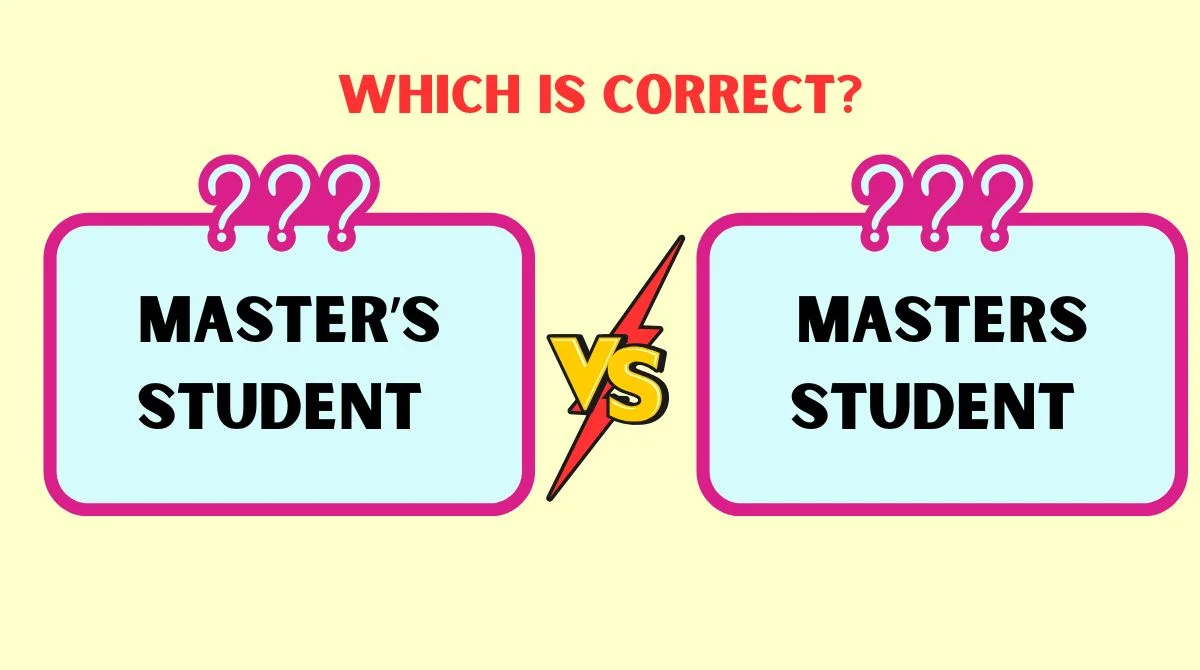
  • Master’s Student vs Masters Student vs MS Student 🎓: Which Is Correct?

    Master’s Student vs Masters Student vs MS Student 🎓: Which Is Correct?

    Language, especially in academic contexts, can be tricky.

    The terms Master’s Student, Masters Student, and MS Student are often used interchangeably, but are they all correct? What do they mean, and when should you use each?

    This guide will decode the grammar, usage, and nuances behind these terms, helping you navigate academic titles with precision.


    Decoding the Grammar: The Significance of the Apostrophe in ‘Master’s Degree’

    Master’s Student vs Masters Student vs MS Student

    The apostrophe in Master’s Degree is more than a punctuation mark—it denotes possession. The degree belongs to the field of study or mastery, which is why the possessive form is grammatically correct.

    • Correct: Master’s Degree (possessive form)
    • Incorrect: Masters Degree (missing the apostrophe)

    The omission of the apostrophe is a common mistake, but one that changes the grammatical meaning. Without the apostrophe, Masters Degree implies a plural rather than ownership or mastery of a subject.

    Is it “Master’s Student,” “Masters Student,” or “MS Student”? The correct term depends on grammar, possession, and context. This guide explains the differences, highlights common mistakes, and provides clear examples to ensure you use academic titles correctly. Read on to master the nuances!


    Navigating Academic Titles: Understanding ‘Master’s Student’ vs. ‘MS Student’

    Master’s Student refers to an individual pursuing a Master’s Degree. On the other hand, MS Student is an abbreviation that specifically refers to someone enrolled in a Master of Science program.

    Key Differences:

    TermMeaningUsage Example
    Master’s StudentGeneral term for anyone pursuing a Master’s Degree“She’s a Master’s Student in Education.”
    MS StudentSpecific to Master of Science programs“He’s an MS Student in Computer Science.”

    While Master’s Student is broad, MS Student applies exclusively to technical or scientific fields.


    The Definition of a ‘Master’s Student’

    A Master’s Student is someone currently enrolled in a postgraduate program to earn a Master’s Degree. This term applies to various disciplines, from arts and humanities to business and engineering.

    Key Characteristics of a Master’s Student:

    • Has already earned a Bachelor’s Degree.
    • Enrolled in a postgraduate program.
    • Works toward specialized knowledge in a specific field.

    Exploring the Term ‘MS Student’ and Its Usage

    The abbreviation MS stands for Master of Science, and an MS Student is specifically pursuing a Master of Science degree. This abbreviation is widely used in technical and scientific fields like:

    • Computer Science
    • Biology
    • Engineering

    Usage Example:
    “He’s an MS Student researching artificial intelligence.”

    It’s worth noting that in informal settings, MS Student may be used interchangeably with Master’s Student, but in formal writing, the distinction should be preserved.


    Common Misconceptions and Errors in Referring to Graduate Students

    Common Mistakes:

    1. Using Masters Student without the apostrophe.
    2. Referring to a general Master’s Student as an MS Student.
    3. Inconsistently capitalizing academic titles.

    Correct Examples:

    • She’s a Master’s Student in Business Administration.
    • The MS Student is focusing on renewable energy systems.

    Avoid These Errors:

    • Don’t write masters degree or masters student without the apostrophe.
    • Don’t confuse MS programs with MA (Master of Arts) or MBA (Master of Business Administration) programs.

    Capitalization and Formality: When to Use ‘Master of Science’ or ‘Master’s’

    Capitalization in academic titles often depends on formality:

    • Formal Usage: Use the full term Master of Science or Master’s Degree.
      Example: “She earned her Master of Science in Biology.”
    • Informal Usage: It’s acceptable to use MS or Master’s.
      Example: “He’s working toward his Master’s in Engineering.”

    When writing formal documents, stick to the full title, as it conveys professionalism.


    Master’s Student vs Masters Student vs MS Student

    Possession and Precision: The Case for ‘Master’s Degree’ Over ‘Masters Degree’

    The possessive form, Master’s Degree, is the universally accepted term. Why? Because the degree signifies mastery in a specific field. Without the apostrophe, the term becomes ambiguous.

    Examples:

    • Correct: “She completed her Master’s Degree in Psychology.”
    • Incorrect: “She completed her Masters Degree in Psychology.”

    The Rule of Possessive Form in Academic Degrees

    The possessive apostrophe applies to all postgraduate degrees:

    • Master’s Degree
    • Bachelor’s Degree
    • Doctor’s Degree (though this is less common, with Doctorate often used instead)

    Quick Rule: Always include the apostrophe when referencing academic degrees in their possessive form.


    Contextual Application: Using ‘Master’s’ and ‘MS’ in Sentences Correctly

    Here’s how to use these terms accurately in sentences:

    • Master’s Student: “The Master’s Student presented her thesis on climate change.”
    • MS Student: “The MS Student received funding for his robotics project.”
    • Master’s Degree: “He earned a Master’s Degree in Fine Arts.”
    • Master of Science: “Her Master of Science degree is in Astrophysics.”

    Mastering the Academic Lexicon: A Guide to Grammar and Abbreviations for Students

    When discussing academic degrees, precision is key. Here’s a quick guide to common abbreviations:

    Degree NameAbbreviationField Examples
    Master of ScienceMSBiology, Physics, Computer Science
    Master of ArtsMALiterature, History, Philosophy
    Master of Business AdminMBABusiness, Management

    Tip: Use abbreviations only when context makes them clear.


    Distinguishing Between ‘Master’s Candidate’ and ‘Master’s Student’

    While the terms Master’s Candidate and Master’s Student are often used interchangeably, there is a subtle difference:

    • Master’s Student: Enrolled in the program, typically in the coursework stage.
    • Master’s Candidate: Has completed most coursework and is focused on final requirements like a thesis or capstone project.

    Example:

    • “As a Master’s Candidate, she’s completing her thesis on renewable energy.”

    The Correct Abbreviations for Various Master’s Degrees

    Abbreviations vary based on degree type. Here are some commonly used ones:

    Degree Full NameAbbreviation
    Master of ScienceMS
    Master of ArtsMA
    Master of Fine ArtsMFA
    Master of Business AdminMBA
    Master of Public HealthMPH

    Note: Always capitalize abbreviations when used as a title.


    Closing the Book: Ensuring Clarity in Higher Education Terminology

    Academic terminology can be complex, but understanding the nuances of terms like Master’s Student, Masters Student, and MS Student can eliminate confusion. Whether you’re writing formally or casually, prioritize grammatical accuracy and context-appropriate usage.


    FAQs

    What is the correct term: Master’s Student or Masters Student?

    The correct term is “Master’s Student” because the apostrophe denotes possession, showing that the degree belongs to the field of mastery.

    When should I use “MS Student” instead of “Master’s Student”?

    Use “MS Student” when referring specifically to a student pursuing a Master of Science degree. “Master’s Student” is a more general term for anyone pursuing a Master’s Degree.

    Why is the apostrophe important in “Master’s Degree”?

    The apostrophe in “Master’s Degree” signifies possession, indicating the degree is related to the field of mastery. Omitting it (“Masters Degree”) is grammatically incorrect.

    Can I use “Master of Science” and “MS” interchangeably?

    Yes, but context matters. Use “Master of Science” in formal writing and “MS” in informal or space-limited contexts like resumes or notes.

    What’s the difference between a Master’s Student and a Master’s Candidate?

    A Master’s Student is enrolled in the program, while a Master’s Candidate has completed most coursework and is focused on final requirements like a thesis or project.

    How should academic titles be capitalized in formal writing?

    Always capitalize academic degree titles when used formally, such as “Master of Science” or “Master’s Degree.” Abbreviations like “MS” should also be capitalized.


    Conclusion

    Understanding the difference between Master’s Student, Masters Student, and MS Student is essential for clear communication in academic and professional contexts.

    Remember to use the possessive form (Master’s) when referring to degrees and titles, and reserve abbreviations like MS for specific fields of study. With these guidelines, you’ll master the language of academia effortlessly!

  • Pre vs Post ⏳: What’s the Real Difference in Prefixes?

    Pre vs Post ⏳: What’s the Real Difference in Prefixes?

    Prefixes are an essential part of the English language, helping us modify and extend the meanings of root words. Among the most common prefixes are pre- and post-, which relate to time and order.

    But how do they work, and what’s the difference between them?

    This comprehensive guide dives into the origins, meanings, and correct usage of pre- and post- to help you sharpen your language skills.


    Exploring the Roles of Prefixes in the English Language

    Prefixes are powerful linguistic tools that attach to the beginning of root words, altering their meanings in specific ways. They can:

    • Indicate time (e.g., prehistory = before history).
    • Show quantity (e.g., multitask = many tasks).
    • Change a word’s direction or state (e.g., undo = reverse an action).

    By learning how prefixes work, you can decode unfamiliar words, improve your vocabulary, and communicate more effectively.

    Are you confused about when to use “pre” and “post”? These prefixes indicate “before” and “after,” but understanding their nuances can make your communication clearer. Discover the key differences, examples, and tips to master these time-related prefixes. Read more to sharpen your language skills!


    Defining What Prefixes Are

    A prefix is a group of letters added to the beginning of a base or root word to create a new meaning. For example:

    • Un- in undo means “reverse or negate.”
    • Re- in rewrite means “again.”

    Prefixes don’t stand alone—they always modify another word. They’re a crucial part of English morphology, shaping how we understand and use language.


    The Significance of ‘Pre’ and ‘Post’ in Word Formation

    The prefixes pre- and post- are particularly important because they help us communicate ideas about time, sequence, and order.

    • Pre-: Denotes “before” in time or order.
      Example: Preview (to see something before others).
    • Post-: Indicates “after” in time or order.
      Example: Postscript (something added after the main text).

    Understanding these prefixes gives you a better grasp of how English words convey complex ideas efficiently.


    Common Misconceptions About Prefix Usage

    Even native English speakers sometimes misuse pre- and post-. Here are a few common errors:

    • Confusing “pre” with “pro”: Pre- refers to “before,” while pro- often indicates “in favor of” or “forward.”
      Example: Preempt ≠ Promote.
    • Overusing prefixes unnecessarily: Some people add prefixes where they aren’t needed, creating nonstandard words like pre-prepared.
    • Ignoring context: Prefixes can change meanings depending on their usage.
      Example: Post-: Does it refer to time (post-event) or a position (post-office)?

    To avoid these mistakes, always consider the root word and the context.


    The Origins of ‘Pre’ and ‘Post’

    Both pre- and post- have rich histories rooted in Latin, and their development sheds light on how English has evolved.


    The Latin Roots and Their Impact on Modern English

    Pre vs Post

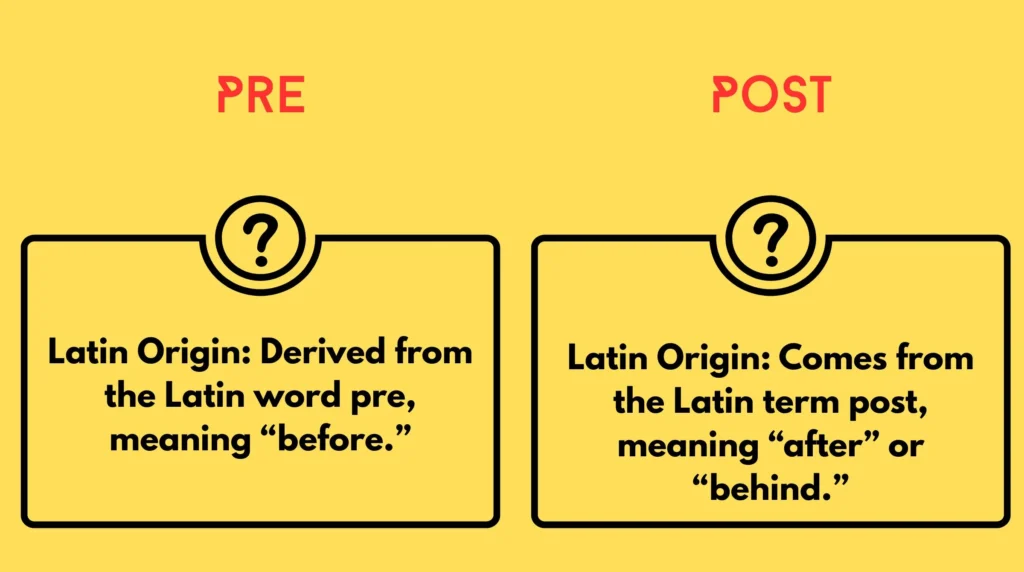
    Pre-

    • Latin Origin: Derived from the Latin word prae, meaning “before.”
    • Influence on English: Pre- has carried its original meaning into modern usage, showing up in words like prefix, prelude, and precaution.

    Post-

    • Latin Origin: Comes from the Latin term post, meaning “after” or “behind.”
    • Influence on English: It has remained consistent, forming words such as postpone, postgraduate, and postmortem.

    By borrowing these Latin terms, English gained precision and clarity in expressing temporal and sequential relationships.


    When and How to Use ‘Pre’

    The prefix pre- is used when referring to something that occurs earlier in time, sequence, or priority.

    Examples of Words with Pre-

    • Prehistoric: Relating to the time before recorded history.
    • Preview: A glimpse or demonstration of something before it’s officially released.
    • Precaution: An action taken beforehand to prevent harm.

    Contextual Tip: Use pre- when describing actions, events, or conditions that precede something else.


    Real-World Applications of ‘Post’

    The prefix post- applies to situations occurring after a specific point in time or order.

    Examples of Words with Post-

    • Postgraduate: A student who continues education after earning a degree.
    • Postwar: Referring to the period after a war has ended.
    • Postscript (P.S.): A note added at the end of a written document.

    Contextual Tip: Use post- to indicate actions, periods, or conditions following another event.


    Understanding ‘Post’ in Various Contexts

    The meaning of post- can shift depending on the field of study or usage.

    • Medical Terms:
      Postoperative refers to the period after surgery.
    • Social Media:
      In the digital age, a post refers to content shared online, like a blog post or tweet.
    • Historical Usage:
      Postcolonial refers to the era after a country gains independence from colonial rule.

    By recognizing the versatility of post-, you can better interpret its meaning in different contexts.


    Comparing ‘Pre’ and ‘Post’ with Time-Specific Examples

    PrefixMeaningExampleExplanation
    Pre-BeforePreflightActivities or checks done before a flight.
    Post-AfterPostflightActivities or analysis done after a flight.
    Pre-EarlierPrehistoricRefers to the period before recorded history.
    Post-LaterPostwarRefers to events occurring after a war.

    Key Insight: While pre- focuses on what comes earlier, post- highlights what follows. Both are indispensable for expressing time and sequence.


    Improving Language Proficiency with Correct Prefix Application

    Pre vs Post

    Mastering prefixes like pre- and post- can significantly enhance your language skills. Here’s how:

    1. Build Vocabulary: Learning prefixes helps you break down and understand unfamiliar words.
    2. Boost Clarity: Using precise prefixes ensures your writing is clear and effective.
    3. Avoid Errors: Understanding prefix meanings prevents common mistakes in communication.

    FAQs

    What does the prefix “pre” mean in English?

    The prefix “pre” means “before” in time or sequence, as seen in words like “preview” (to see before) or “precaution” (a measure taken beforehand).

    What is the meaning of the prefix “post”?

    The prefix “post” means “after” or “behind,” as in “postgraduate” (after graduation) or “postwar” (the period after a war).

    Can “pre” and “post” be used interchangeably?

    No, “pre” and “post” have opposite meanings. “Pre” indicates “before,” while “post” signifies “after.” Using them interchangeably would confuse the intended timeline.

    How do “pre-” and “post-” originate from Latin?

    The prefix “pre-” comes from the Latin “prae,” meaning “before,” while “post-” derives from the Latin “post,” meaning “after” or “behind.” Both retain their meanings in modern English.

    What are examples of common words with “pre” and “post”?

    Examples include “prehistoric” (before recorded history) and “postscript” (a note added after a text). Each prefix clearly defines its timeline.

    Why is it important to understand prefixes like “pre” and “post”?

    Understanding prefixes improves your vocabulary and helps you communicate ideas about time, sequence, and order more clearly and effectively.


    Conclusion

    Prefixes like pre- and post- are small but mighty tools in the English language. They allow us to express complex ideas about time, sequence, and order with just a few letters.

    By understanding their origins, meanings, and usage, you can use them confidently in your writing and speech.

    Whether you’re discussing prehistoric times or postmodern art, these prefixes help you communicate with precision and style. Start applying what you’ve learned today and watch your language skills improve!

  • Disloyal vs Unloyal 🤔: What’s the Real Difference?

    Disloyal vs Unloyal 🤔: What’s the Real Difference?

    Language is full of subtle nuances, and words like disloyal and unloyal exemplify this complexity. While they may appear to be interchangeable at first glance, their usage and acceptance in English vary widely.

    This article dives deep into the distinction between these two words, exploring their meanings, usage, and cultural perceptions.

    By the end, you’ll have a thorough understanding of when and why to choose one over the other.


    The Meaning Behind the Words “Disloyal” and “Unloyal”

    Disloyal vs Unloyal

    Both disloyal and unloyal share the common theme of a lack of loyalty. However, the differences lie in their formation and historical acceptance.

    • Disloyal: The prefix dis- indicates opposition, negation, or reversal, giving disloyal the meaning of actively betraying or being unfaithful.
      Example: “The soldier was punished for his disloyal actions toward his comrades.”
    • Unloyal: The prefix un- simply negates the root word, making unloyal mean not loyal or lacking loyalty without necessarily implying betrayal.
      Example: “The dog was described as unloyal, often wandering away from its owner.”

    Key takeaway: Disloyal often carries stronger emotional weight, suggesting betrayal, while unloyal feels less intense and is rarely used in modern English.

    Is “unloyal” correct, or should you always use “disloyal”? While both words suggest a lack of loyalty, only one is widely accepted in English. Discover the nuanced differences between these terms and learn when to use them effectively. Read more to master this subtle distinction!


    Common Usage: Why “Disloyal” Dominates the Conversation

    The word disloyal is far more prevalent in both written and spoken English. This dominance can be attributed to several factors:

    1. Historical Precedence: Disloyal has been a part of the English lexicon for centuries and is firmly entrenched in formal and informal usage.
    2. Cultural Norms: Society often emphasizes acts of betrayal over passive disloyalty, aligning more naturally with the connotations of disloyal.
    3. Dictionary Inclusion: Most major dictionaries define and list disloyal, while unloyal is often excluded or marked as less common.

    The Role of Language Trends in Word Preference

    Language is shaped by the way people communicate, and some words naturally rise to prominence while others fade away. The preference for disloyal over unloyal is an example of this phenomenon.

    Factors Driving Word Trends:

    • Ease of Use: Words that sound more familiar or natural are more likely to be used. Disloyal follows this pattern, as it aligns with other common dis- words like dishonest or disrespectful.
    • Perceived Formality: Unloyal might feel awkward or incomplete to speakers, leading to its avoidance in favor of disloyal.

    Insights from Google’s Ngram Viewer

    Google’s Ngram Viewer offers a fascinating glimpse into the popularity of words over time.

    WordFrequency in Literature (1800–2020)
    DisloyalConsistently high usage
    UnloyalMinimal and declining usage

    What Ngram Data Reveals:

    The data shows that disloyal has maintained steady usage across centuries, whereas unloyal has remained marginal, with no significant spikes.

    Conclusion from Data: English speakers have consistently preferred disloyal over unloyal, reinforcing the latter’s status as a rare or even non-standard word.


    Is “Unloyal” Grammatically Incorrect?

    Strictly speaking, unloyal is not grammatically incorrect. However, it is considered less conventional and may be seen as awkward or informal.

    Why It’s Rarely Used:

    • Lack of Familiarity: Speakers tend to avoid words that don’t feel established in common usage.
    • Alternative Options: Words like disloyal and unfaithful serve the same purpose and are more widely understood.

    Tip: While unloyal is not “wrong,” using disloyal will likely sound more polished and natural.


    The Nuances of Language: When to Use “Disloyal” Over “Unloyal”

    Use Disloyal When:

    1. Describing an act of betrayal.
      Example: “The employee’s disloyal behavior shocked the management team.”
    2. Conveying a sense of deliberate unfaithfulness.
      Example: “Her disloyalty to the cause was evident in her actions.”

    Use Unloyal When:

    1. Referring to a passive or less intentional lack of loyalty.
      Example: “The unloyal dog often followed strangers home.”

    However, even in these cases, other alternatives like not loyal or unfaithful may sound better.


    Context Matters: Examining Sentence Examples

    Examples with Disloyal:

    • “The politician’s disloyal comments created a media storm.”
    • “He was accused of disloyalty to his country.”

    Examples with Unloyal:

    • “The unloyal friend didn’t stand by her during tough times.”
    • “Unloyal behavior is uncommon in domesticated animals.”

    Observation: The examples with disloyal sound more natural and impactful, further highlighting its dominance in English.


    Perceptions of Loyalty: Exploring Cultural Influences on Language

    Cultural values shape how people perceive and express loyalty, influencing word choice.

    Key Cultural Insights:

    1. Western Norms: In Western cultures, loyalty is often associated with relationships and national identity, making disloyal a critical descriptor for betrayal.
    2. Eastern Perspectives: In collectivist societies, loyalty to family or community is paramount, and violations are often framed in strong terms like betrayal.
    3. Media Influence: Movies, books, and news headlines frequently use disloyal, reinforcing its dominance.

    Avoiding the Trap of Spellcheckers: Navigating “Unloyal” and “Disloyal”

    Spellcheck tools are designed to catch errors, but they might not always flag uncommon words like unloyal.

    Common Scenarios:

    • Autocorrect: May not recognize unloyal as a legitimate word, suggesting alternatives like disloyal or loyal.
    • Grammar Checkers: Tools like Grammarly might highlight unloyal as non-standard or suggest revisions.

    Best Practice: Trust your understanding of the context and use disloyal for clearer, more widely accepted communication.


    Unloyal in Digital Searches: Understanding Search Engine Behavior

    Search engines like Google provide insight into how often people look up terms like unloyal versus disloyal.

    Keyword Data:

    • Disloyal: High search volume, with people seeking definitions and examples.
    • Unloyal: Relatively low search volume, indicating less curiosity or usage.

    Implication: Opting for disloyal in your writing increases clarity and aligns better with user expectations.


    FAQs

    What is the difference between “disloyal” and “unloyal”?

    “Disloyal” implies betrayal or active unfaithfulness, while “unloyal” simply means lacking loyalty and is considered less conventional in modern usage.

    Is “unloyal” a real word in English?

    Yes, “unloyal” is a real word and not grammatically incorrect. However, it is rarely used and considered less formal or natural than “disloyal.”

    Why is “disloyal” more common than “unloyal”?

    “Disloyal” has historical precedence, stronger emotional weight, and wider acceptance in dictionaries, making it the preferred choice in English.

    Can I use “unloyal” in professional writing?

    It’s best to avoid “unloyal” in professional writing as it may seem awkward or informal. Opt for “disloyal” or “not loyal” instead.

    What are some examples of sentences with “disloyal”?

    Examples include: “The spy was disloyal to his country,” or “Her disloyalty to the team was shocking.”

    Is “disloyal” a stronger word than “unloyal”?

    Yes, “disloyal” carries a stronger connotation of betrayal, while “unloyal” feels passive and less emotionally charged.


    Conclusion

    The debate between disloyal and unloyal is less about correctness and more about preference and clarity. While unloyal isn’t technically wrong, disloyal has long been the favored choice in English, thanks to its historical roots and stronger emotional impact.

    If you want your writing to resonate and feel natural, stick with disloyal. It’s a word that carries weight, conveys intent, and aligns with both cultural and linguistic norms. By understanding the nuances outlined in this guide, you’ll always choose the right word with confidence.

  • Most Important or Most Importantly 🤔: Grammar Secrets Revealed!

    Most Important or Most Importantly 🤔: Grammar Secrets Revealed!

    Language evolves over time, and some debates in English grammar never truly fade. One such discussion revolves around the phrases most important and most importantly.

    While both expressions are commonly used, they serve slightly different purposes, and their usage often sparks controversy among grammarians and writers alike.

    This article dives deep into the distinctions, historical evolution, and modern applications of these phrases to help you use them with confidence and precision.


    Exploring the Historical Use of “Most Important” and “Most Importantly”

    Most Important or Most Importantly

    Historically, most important and most importantly have played different roles in English writing and speech.

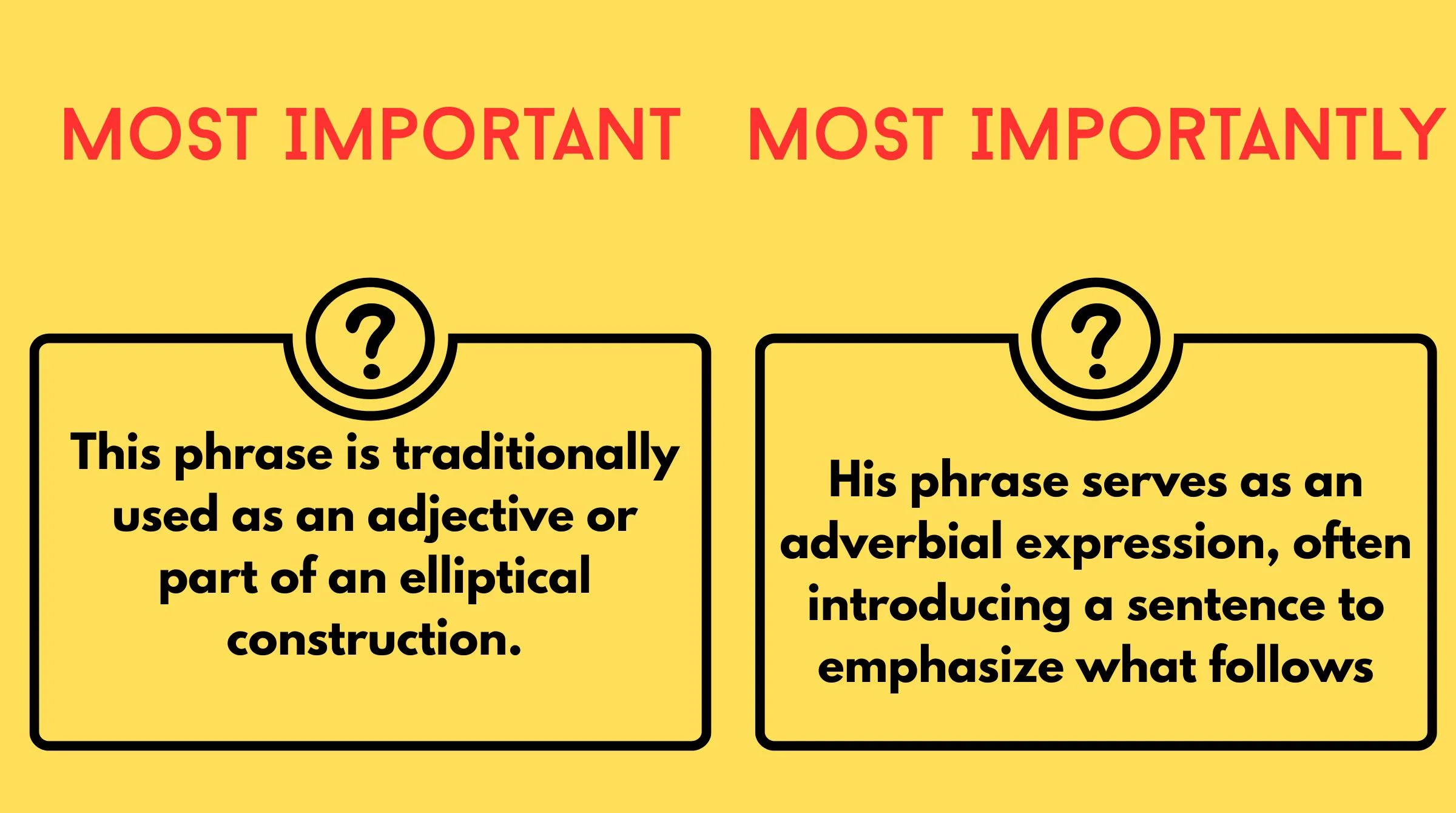
    • Most Important: This phrase is traditionally used as an adjective or part of an elliptical construction. For example, in the sentence “What is most important is honesty,” most important modifies the subject.
    • Most Importantly: This phrase serves as an adverbial expression, often introducing a sentence to emphasize what follows. For instance, “Most importantly, honesty builds trust.”

    The distinction lies in their grammatical functions: while one describes a noun (adjective), the other modifies the entire sentence (adverb).

    Confused between “most important” and “most importantly”? Both are correct, but they serve different purposes in grammar. Discover their unique uses and how to choose the right one in your writing. Read more to master this distinction!


    The Rise and Decline of “Most Important” in the 20th Century

    The use of most important in its elliptical form gained significant traction during the early 20th century. Writers began shortening sentences like “What is most important is…” to simply “Most important,” treating the adjective as an introductory phrase.

    However, the rise of adverbial constructions in the mid-20th century, influenced by stylistic shifts and evolving grammar rules, caused most importantly to gain popularity. This trend was further fueled by the belief that adverbs were better suited for introductory phrases.

    Key Insights from Usage Trends

    PhrasePeak PopularityContext of Usage
    Most ImportantEarly 20th C.Formal writing, concise sentence structures
    Most ImportantlyMid-20th C.Conversational tone, emphasis in speech

    Grammar Experts Debate on Adjective Versus Adverb Usage

    The debate over most important versus most importantly largely centers on grammatical precision and stylistic preference.

    • Proponents of “Most Important”: Some argue that the adjective form is more concise and elegant, particularly in formal writing. For example, “Most important, the plan must be feasible.”
    • Supporters of “Most Importantly”: Others claim that the adverbial form better aligns with traditional grammatical rules, as it clearly modifies the sentence rather than acting ambiguously.

    What Experts Say:

    • Strunk and White’s The Elements of Style: Advocates for simplicity, often favoring most important.
    • Garner’s Modern English Usage: Acknowledges both forms but leans toward most importantly for clarity.

    The truth is, neither phrase is grammatically incorrect. Instead, their usage often depends on style guides, audience expectations, and personal preference.


    Examples from Literature and Academic Sources

    To better understand how these phrases function, let’s explore examples from notable works.

    Examples Using “Most Important”

    1. “The most important thing is not to stop questioning.” – Albert Einstein
    2. “Most important, we must remember the value of education.” – Found in academic journals emphasizing brevity.

    Examples Using “Most Importantly”

    1. “Most importantly, the reforms will help reduce poverty.” – Common in modern newspapers and essays.
    2. “Most importantly, she believed in herself.” – Popular in motivational writing and speeches.

    These examples demonstrate how both forms are used effectively depending on the tone and context of the writing.


    “Most Important” vs. “Most Importantly”: Grammatical Perspectives

    Understanding the grammatical distinction can help clarify their appropriate use:

    • Most Important: Functions as an elliptical construction, where the subject is implied or understood. It avoids redundancy in formal writing.
    • Most Importantly: Operates as an adverbial phrase, modifying the entire sentence that follows. It’s often used to add emphasis or highlight a key point.

    Quick Tip:
    If you’re unsure which to use, consider the sentence structure. If it feels incomplete without a subject, most important may be your best choice. Otherwise, most importantly is likely more appropriate.


    Contemporary Usage: Which is More Acceptable Today?

    Most Important or Most Importantly

    In modern English, both most important and most importantly are widely accepted. However, usage trends show a preference based on formality and audience:

    • Formal Writing: Most important often appears in academic papers, legal documents, and professional reports for its brevity and directness.
    • Casual Writing/Speech: Most importantly is frequently used in conversations, blogs, and speeches where a more conversational tone is appropriate.

    Insights from Recent Linguistic Research

    Recent studies in linguistics shed light on how readers perceive these phrases. Researchers found that:

    • Most importantly tends to resonate more with readers due to its emphasis on the overall message.
    • Most important is seen as authoritative and concise, making it ideal for professional communication.

    Quote from a Linguist:
    “Both phrases hold value in modern English, but their impact depends on the audience and context. Clarity should always be the guiding principle.” – Dr. Emily Carter, Linguistic Researcher


    How Modern Usage Guides Address the Phrases

    Modern grammar guides take a flexible approach:

    • The Chicago Manual of Style: Allows both forms but recommends most importantly for introductory phrases.
    • The Associated Press Stylebook: Acknowledges both forms but suggests consistency in usage.

    These guidelines emphasize that there’s no universal “right” answer. Instead, context and clarity should drive your choice.


    The Role of Personal Preference and Context in Grammar

    Ultimately, your choice between most important and most importantly depends on factors like:

    • Audience: Who are you writing for? Formal audiences may prefer most important.
    • Tone: Are you aiming for a conversational or authoritative tone?
    • Sentence Structure: Does the phrase fit grammatically within your sentence?

    Tip: When in doubt, read your sentence aloud to see which phrase feels more natural.


    Understanding the Nuance Between Formal and Informal Writing

    The distinction between formal and informal writing often determines which phrase is more suitable.

    Writing StylePreferred PhraseReason
    FormalMost ImportantDirect, concise, aligns with professional tone.
    InformalMost ImportantlyEmphasizes the main point, conversational feel.

    Context is everything. Choose the phrase that aligns with your writing goals.


    Final Thoughts on Selecting Between “Most Importantly” and “Most Important”

    While both phrases are grammatically correct, their effectiveness depends on how you use them. Remember:

    • Most important is concise and formal.
    • Most importantly emphasizes the broader message and works well in casual contexts.

    Whichever you choose, clarity and context should guide your decision.


    FAQs

    What is the key difference between “most important” and “most importantly”?

    “Most important” functions as an adjective or part of a shortened sentence, while “most importantly” acts as an adverbial phrase emphasizing the whole sentence.

    When is it correct to use “most important”?

    Use “most important” in formal writing or when you need a concise expression, such as “Most important, honesty matters.”

    How does “most importantly” add emphasis?

    “Most importantly” emphasizes the key message or idea that follows, making it suitable for casual or conversational contexts.

    Can both phrases be used interchangeably?

    Not always. While both are correct, their usage depends on the sentence structure and the level of formality required.

    Which phrase is better for formal writing?

    “Most important” is better for formal writing due to its brevity and authoritative tone.

    Why do people often debate these two phrases?

    The debate arises because both phrases are grammatically correct, but their usage reflects different grammatical roles and writing styles.


    Conclusion

    The debate over most important versus most importantly boils down to style, audience, and intent. Both phrases are tools in your grammatical toolbox, and knowing when to use each can elevate your writing.

    Whether you prefer the brevity of most important or the emphasis of most importantly, mastering their nuances ensures clear and effective communication.

  • ✈️ On The Plane or In The Plane? Decoding the Correct Preposition

    ✈️ On The Plane or In The Plane? Decoding the Correct Preposition

    Prepositions can be tricky, especially when it comes to words we use every day like on and in.

    If you’ve ever wondered whether you should say on the plane or in the plane, you’re not alone. The English language is filled with subtle distinctions that affect both how we speak and how we understand one another.

    In this article, we’ll explore the nuances of these prepositions and help you master their correct usage when it comes to air travel.


    On The Plane or In The Plane

    Understanding “On The Plane” vs. “In The Plane”

    At first glance, on and in seem interchangeable, but the two prepositions convey different meanings depending on context. When we’re talking about air travel, the distinction becomes clearer.

    On the Plane

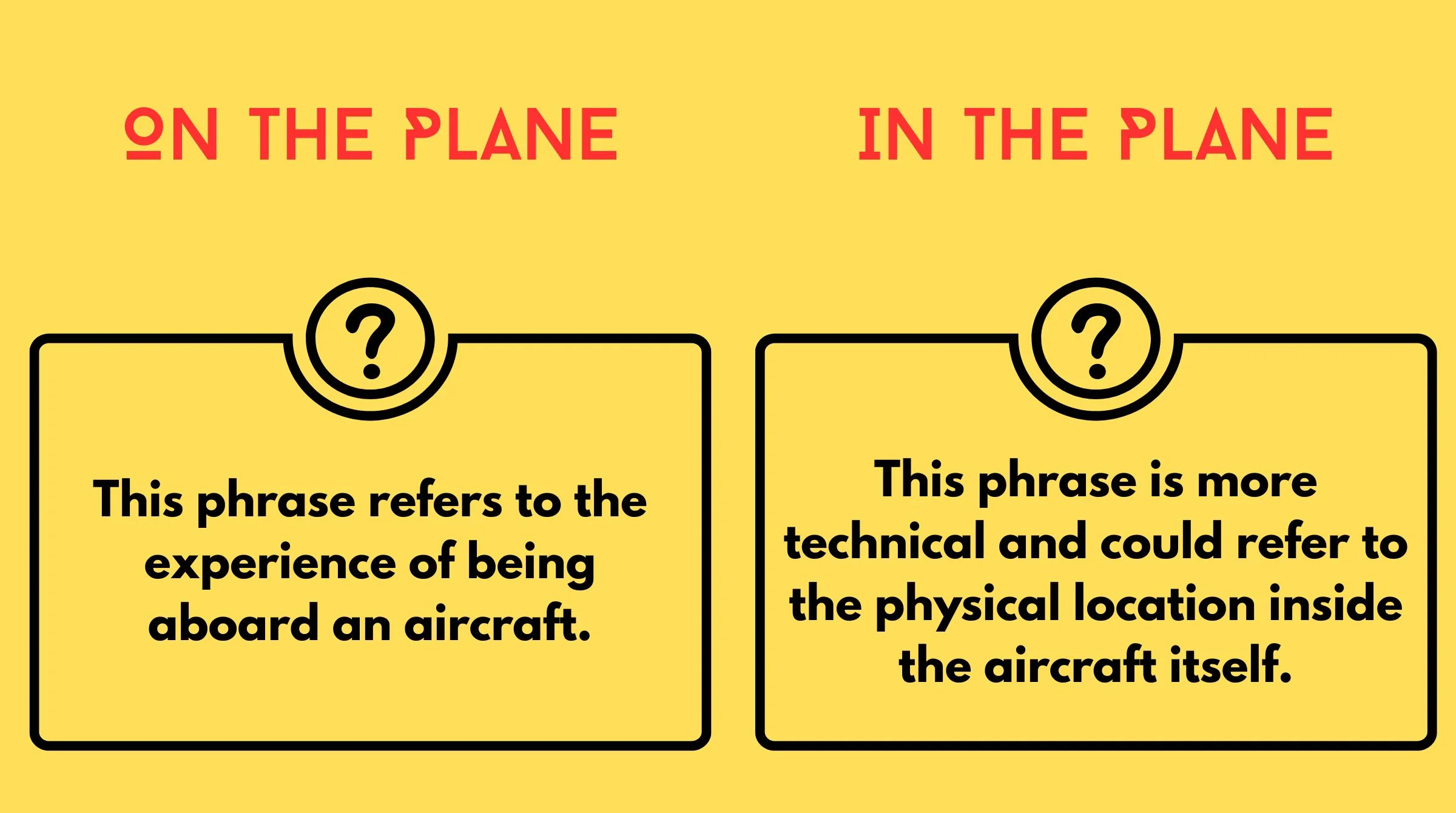
    • This phrase refers to the experience of being aboard an aircraft.
    • It emphasizes that you’re inside the space, but also that you’re part of a group or in a larger context, such as a flight.Example: “We’re on the plane, ready for takeoff.”

    In the Plane

    • This phrase is more technical and could refer to the physical location inside the aircraft itself.
    • It emphasizes being within the structure of the plane, focusing more on the physical boundaries of the aircraft.Example: “The pilot is in the plane, preparing for takeoff.”

    While both phrases can technically work, on the plane is the more natural and common choice when discussing air travel in everyday conversation.

    Ever wondered whether it’s “on the plane” or “in the plane”? This article decodes the subtle difference between these two prepositions in the context of air travel, making it easy to master correct usage.


    Exploring The Prepositions: When to Use “On” and “In”

    Understanding when to use on and when to use in isn’t just about the plane—it’s about how English speakers view objects and environments. Generally, we use on for surfaces, larger objects, or when something is attached to something else. On the other hand, we use in when something is enclosed or inside a boundary.

    • Use on when referring to a vehicle or transport that functions as a platform or a surface.
      Example: “I’m on the bus.” “She’s on the train.”
    • Use in when referring to smaller vehicles or enclosed spaces.
      Example: “I’m in the car.” “He’s in the taxi.”

    For air travel, on the plane follows the same logic: while you are physically inside the plane, you’re considered on the plane because it’s viewed as a platform for transportation.


    The General Rule of Thumb for Transportation

    When it comes to transportation, there’s a straightforward rule of thumb that can help you choose the correct preposition:

    • Larger or public vehicles (planes, trains, buses, ships): Use on.
    • Smaller, enclosed vehicles (cars, taxis, submarines): Use in.

    So, for air travel, since a plane is a large, public mode of transport, you’d say, “on the plane” rather than “in the plane,” which could be perceived as overly technical.


    Special Cases and Exceptions

    English is full of exceptions, and air travel vocabulary is no different. For example, there are situations where “in the plane” might be used:

    • Technical or precise contexts: When discussing the physical location inside the plane (e.g., the cockpit, or cabin).
      Example: “The engineer is in the plane fixing the radar.”
    • Metaphorical or figurative speech: If someone is metaphorically “inside” the journey or the experience, they might refer to in the plane.
      Example: “I was in the plane when the announcement was made.”

    While these cases are less common, they still occur depending on the context.


    Navigating the Subtleties of English Prepositions

    English prepositions often don’t follow strict logic, which is why native speakers don’t always have trouble with these subtleties. To understand prepositions better, it’s important to grasp the underlying concept of physical versus figurative meanings. Here’s a breakdown:

    • In: More common for enclosed spaces. You’re surrounded by something, such as “in the room” or “in the car.”
    • On: More common for surfaces or vehicles, as mentioned earlier. You’re positioned on something that has a surface you’re attached to, like “on the floor” or “on the boat.”

    When choosing between on and in for planes, it’s about whether you’re thinking of the plane as a space or a mode of transport.


    “On The Plane”: The Idiomatic Choice

    In most cases, on the plane is the idiomatic and natural way to talk about being aboard an aircraft. It’s an expression that has become deeply embedded in everyday language.

    • Idiom Usage:
      “On the plane” has been adopted widely in both informal and formal language. We use it in the context of flight schedules, experiences, or interactions aboard the aircraft. For example, “I was on the plane when the turbulence started.” It’s rare for anyone to say “in the plane” unless referring to the physical space.
    • Why “On” is Preferred:
      The term on the plane mirrors how we talk about other large transportation methods. People generally say on the bus, on the train, and on the ship, so it’s a linguistic pattern.

    Historical Usage and Current Trends

    Historically, both on and in were used to describe being aboard an aircraft, though on has become the dominant choice in modern times. Over the years, as air travel became more routine and mainstream, the phrase on the plane began to dominate in everyday language. There was a shift toward viewing the plane as a mode of transport that one was on, just like a bus or a train, rather than something one was in.

    • Past Trends: Early aviation terms often used in the plane, especially in more technical discussions about flight operations. However, with the rise of commercial air travel, on the plane became more commonplace.
    • Current Trends: Today, on the plane is the go-to phrase, used by pilots, flight attendants, passengers, and in nearly all airline communications.

    Grammatical Nuances of Air Travel Language

    The language of air travel also has its quirks. While you are “on the plane” for most purposes, other related terms use in or on based on context.

    Related Phrases:

    • In the cockpit: Refers to the pilot’s area inside the plane.
    • On the runway: Describes the plane before it takes off.
    • In the air: Refers to the flight being airborne.

    Notice how the use of prepositions shifts based on the part of the journey and what aspect of the plane you’re referring to.


    Additional Insights: “By Plane” and “Travel By Plane”

    Another related phrase is “by plane,” which means to travel using a plane as your mode of transport. This phrase is common when discussing travel routes or choices of transportation.

    • Example: “I prefer to travel by plane because it’s faster.”

    Key difference: While on the plane refers to being inside the aircraft during your journey, by plane focuses on the mode of transport.


    Cultural and Contextual Influences on Language

    On The Plane or In The Plane

    Language usage often varies across cultures, and English is no exception. Different English-speaking countries may have slightly different preferences for using on and in. However, across the board, on the plane is the most widely accepted and used term.

    In more technical settings, such as aviation or engineering, professionals might use in the plane to describe specific operations or locations inside the aircraft.


    Conclusion

    Understanding when to use on the plane vs. in the plane is a subtle but important aspect of English grammar.

    By following general rules about transportation prepositions and recognizing when exceptions apply, you can confidently use these phrases correctly.

    Whether you’re preparing for your next flight or explaining air travel to others, remember: it’s typically on the plane, and that’s the most idiomatic choice.

  • Its Self or Itself? Understand the Difference! 🤔

    Its Self or Itself? Understand the Difference! 🤔

    The English language is full of subtle nuances, and the distinction between “its self” and “itself” is no exception.

    While they might seem interchangeable at first glance, their correct usage depends on grammar, context, and even philosophical interpretation.

    This guide will break down their meanings, uses, and how to avoid common errors, ensuring your writing is precise and polished.


    Deciphering ‘Itself’ and ‘Its Self’: A Grammatical Exploration

    Its Self or Itself

    At first glance, “itself” and “its self” appear to be variations of the same idea. However, they are fundamentally different.

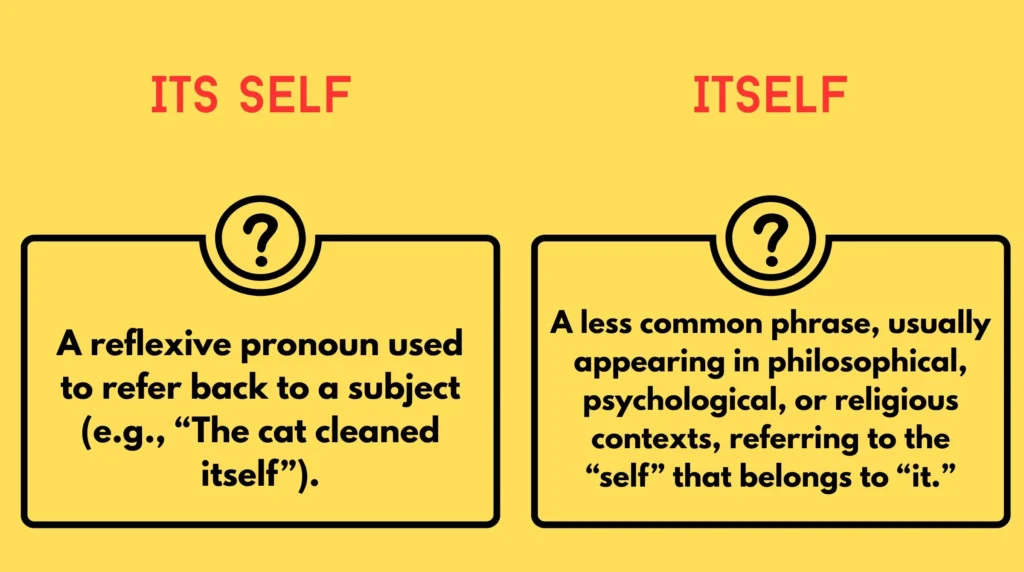
    • Itself: A reflexive pronoun used to refer back to a subject (e.g., “The cat cleaned itself”).
    • Its self: A less common phrase, usually appearing in philosophical, psychological, or religious contexts, referring to the “self” that belongs to “it.”

    Understanding when to use each depends largely on their grammatical function and intended meaning. Let’s dive deeper.

    Confused about “its self” vs. “itself”? Discover their differences, meanings, and correct usage with clear examples and expert tips!


    Defining Reflexive Pronouns in English

    Reflexive pronouns, like “itself,” are essential for expressing actions that the subject performs on itself. Other examples include “myself,” “yourself,” and “themselves.”

    Key Features of Reflexive Pronouns:

    1. Refer Back to the Subject:
      Example: “The robot fixed itself after the malfunction.”
    2. Show Emphasis:
      Example: “The dog itself opened the door!”
    3. Never Use Apostrophes: Reflexive pronouns are always written as one word without any apostrophes.

    Table of Reflexive Pronouns

    Subject PronounReflexive Pronoun
    IMyself
    YouYourself/Yourselves
    He/She/ItHimself/Herself/Itself
    WeOurselves
    TheyThemselves

    Contextual Usage of ‘Itself’ in Sentences

    The word “itself” is incredibly versatile. Here are some contexts where it shines:

    Examples in Everyday Usage

    1. Referring to Objects:
      Example: “The book fell off the shelf by itself.”
    2. Emphasizing Independence:
      Example: “The idea itself is brilliant.”
    3. Reflexive Actions:
      Example: “The machine started repairing itself automatically.”

    In all these cases, “itself” points back to the subject and provides clarity or emphasis.


    The Intricacies of ‘Its Self’ in Philosophical and Religious Texts

    Unlike the grammatical term “itself,” “its self” takes on a more abstract meaning. It is primarily found in discussions of identity, consciousness, or spirituality.

    Philosophical Usage

    1. The Concept of Self: In philosophy, “its self” may refer to an entity’s sense of identity.
      Example: “The organism understands its self as part of a larger ecosystem.”
    2. Existential Inquiry:
      Example: “The soul searches for its self in moments of reflection.”

    Religious and Psychological Contexts

    • In religious texts, “its self” often explores themes of the soul or inner being.
    • In psychology, it may describe an entity’s perception of its own identity.

    Note: Outside these specialized contexts, “its self” is rarely used in everyday English.


    Common Mistakes and Misconceptions in Using ‘Its’ and ‘It’s’

    The mix-up between “its” and “it’s” is one of the most frequent grammar mistakes. Let’s clarify their distinctions:

    • Its: A possessive pronoun, showing ownership.
      Example: “The dog wagged its tail.”
    • It’s: A contraction of “it is” or “it has.”
      Example: “It’s been a long day.”

    Quick Tip to Avoid Mistakes

    If you can replace the word with “it is” or “it has,” use “it’s.” Otherwise, use “its.”


    Identifying Contractions: When ‘It’s’ Is Not ‘Its’

    Contractions like “it’s” can trip up even seasoned writers. Remember:

    • It’s = It is/It has
      Example: “It’s raining today” = “It is raining today.”
    • Its = Possessive Pronoun
      Example: “The tree lost its leaves in the winter.”

    A helpful strategy is to reread your sentence and mentally expand “it’s” to “it is” or “it has.” If it doesn’t make sense, you’ve likely used the wrong form.


    Understanding Possessive Pronouns: When to Drop the Apostrophe

    Possessive pronouns like “its” don’t require apostrophes. This rule can seem counterintuitive since apostrophes often indicate possession, but possessive pronouns are an exception.

    Examples of Possessive Pronouns

    PronounExample Usage
    Its“The robot lost its battery.”
    His“The cat played with his toy.”
    Her“The bird built her nest.”
    Their“The students shared their notes.”

    The lack of an apostrophe helps distinguish possessive pronouns from contractions.


    Practical Examples: Strengthening Your Grammar with ‘Itself’

    Its Self or Itself

    To solidify your understanding, let’s look at practical examples of “itself” in action:

    1. Scientific Context:
      “The cell divides itself to form new cells.”
    2. Emphasis in Writing:
      “The painting itself is a masterpiece, even without the frame.”
    3. Everyday Scenarios:
      “The car locked itself automatically after five minutes.”

    By practicing with examples, you’ll gain confidence in using “itself” correctly.


    FAQs

    What does “itself” mean in grammar?

    “Itself” is a reflexive pronoun used to refer back to a subject, often emphasizing or showing an action performed on the subject by itself.

    When should you use “its self”?

    Use “its self” in philosophical, psychological, or religious contexts to describe an entity’s sense of identity or inner being. It’s not common in everyday grammar.

    What’s the difference between “its” and “it’s”?

    “Its” is a possessive pronoun showing ownership, while “it’s” is a contraction of “it is” or “it has.”

    How can I avoid mixing up “its” and “it’s”?

    If you can replace the word with “it is” or “it has,” use “it’s.” Otherwise, use “its.”

    Why is there no apostrophe in “its” for possession?

    Possessive pronouns like “its,” “his,” and “hers” do not require apostrophes to indicate ownership, unlike nouns.


    Conclusion: Mastering the Nuances of ‘Its Self’ and ‘Itself’

    Understanding the difference between “its self” and “itself” requires both grammatical knowledge and an appreciation for context.

    While “itself” serves as a reflexive pronoun, “its self” is reserved for abstract discussions of identity or consciousness.

    By mastering these distinctions and avoiding common pitfalls with “its” and “it’s,” you’ll improve your writing precision and clarity. Next time you encounter these terms, you’ll know exactly which one to use.

  • Copy That vs Roger That ✈️📻: Meaning, Origin & Real Usage Explained

    Copy That vs Roger That ✈️📻: Meaning, Origin & Real Usage Explained

    When someone says “Copy That” or “Roger That”, you instantly know they’re acknowledging a message. But are these phrases really the same? Not exactly.

    While both express understanding, their roots and nuances reveal subtle differences. To make sense of this, let’s break down their origins, meanings, and real-world usage.

    This article digs deep into Copy That vs Roger That, explores military communication protocols, and shows you when and how to use each phrase naturally in everyday conversation.


    Understanding “Copy That”

    ‘Copy That’ vs ‘Roger That’

    Meaning and Use

    “Copy That” means “I received and understood your message.” It’s short, clear, and practical. The phrase is often used in radio communication where brevity is critical.

    • Copy in this context comes from “to copy down a message,” just like a radio operator would jot notes during transmission.
    • That refers to the specific message received.

    In modern usage, you’ll hear people say it casually, almost like saying “Got it” or “Understood.”

    Example:

    Pilot: “Flight 271, maintain altitude 10,000 feet.”
    Copilot: “Copy That.”

    Here, “Copy That” confirms both receipt and comprehension.


    Origin

    The phrase grew out of 20th-century military and aviation communication. Early radio signals were often noisy and hard to hear. Operators needed a quick, unmistakable acknowledgment word.

    “Copy” was perfect: short, distinct, and easy to catch even in static. When paired with “That,” it became a concise acknowledgment tool.


    Everyday Use

    In civilian life, “Copy That” has shifted into casual slang. You might hear:

    • At work: “Meeting moved to 3 PM.” → “Copy That.”
    • Among friends: “Pick me up at 7.” → “Copy That.”
    • In texting: “Bring chips for the party.” → “Copy That.”

    It’s professional yet relaxed, which is why you see it in office chats, police shows, and even workplace jargon.


    Examples in Conversation

    • In the office:
      • Manager: “Deadline’s tomorrow at noon.”
      • Employee: “Copy That, I’ll send the draft.”
    • In casual talk:
      • Friend: “We’re meeting at Jake’s place.”
      • You: “Copy That.”
    • In emergency services:
      • Dispatcher: “Unit 4, proceed to Main Street for traffic control.”
      • Officer: “Copy That.”

    Understanding “Roger That”

    Meaning and Use

    “Roger That” means “Message received.” Unlike “Copy That,” it doesn’t explicitly say the message was understood. Instead, it signals receipt. However, in practice, both phrases are treated similarly.


    Origin

    The story of “Roger That” traces back to the NATO phonetic alphabet.

    • In 1927, the International Telecommunication Union created a spelling alphabet.
    • At that time, “Roger” represented the letter “R.”
    • In radio lingo, “R” = “Received.”

    So when a pilot or soldier said “Roger,” it literally meant “Received your transmission.” Adding “That” made it even clearer.

    Later, “Roger” was replaced by “Romeo” in the NATO alphabet, but by then, “Roger That” had already cemented itself in radio and military communication.


    Difference from “Copy That”

    The difference lies in nuance:

    • Copy That = Message received and understood.
    • Roger That = Message received (understanding implied, but not guaranteed).

    For critical communication, this distinction mattered. In fact, when action was required, operators often used “Wilco” (Will Comply) to show they not only received the order but also intended to carry it out.


    Everyday Use

    Today, “Roger That” often carries a military or retro feel. You’ll hear it in:

    • Movies like Top Gun or Black Hawk Down.
    • TV shows portraying police, military, or firefighters.
    • Casual slang among friends: “Be there at 9.” → “Roger That.”

    It’s slightly less common than “Copy That” in casual speech, but it packs more personality.


    Examples in Conversation

    • In aviation:
      • Tower: “Delta 319, cleared for landing runway 27.”
      • Pilot: “Roger That, runway 27.”
    • Among friends:
      • Friend: “Don’t forget the tickets.”
      • You: “Roger That.”
    • In military drills:
      • Commander: “Squad, hold position.”
      • Soldier: “Roger That.”

    Side-by-Side Comparison: Copy That vs Roger That

    Here’s a quick comparison for clarity:

    AspectCopy ThatRoger That
    Core MeaningMessage received + understoodMessage received
    OriginMilitary/aviation shorthandPhonetic alphabet “R” = received
    FormalitySlightly informalTraditional military phrase
    Common Use TodayCivilian + casualMilitary + casual
    ToneNeutral, practicalMilitary-flavored, emphatic

    Beyond “Copy” and “Roger”: Other Military Radio Terms

    Communication on radios follows strict protocol. A few related terms help put things in context:

    • Wilco → Short for Will Comply. Confirms not just receipt but also action.
    • Over → End of your message; expecting a reply.
    • Out → End of communication; no reply expected.
    • Break → Pause between messages or separating thoughts.
    • 10-4 → CB radio code for acknowledgment, still popular among truckers.

    Quote from WWII field manual:

    “Say ‘Roger’ to indicate message received. Say ‘Wilco’ when action will be carried out.”

    This shows how carefully each phrase was chosen to prevent deadly misunderstandings.


    Pronunciation and Radio Clarity

    Both “Copy That” and “Roger That” are designed for clarity.

    • Copy That uses hard consonants (“C,” “T”) that cut through static.
    • Roger That has a rolling “R” and sharp “T” ending, making it distinct on noisy channels.

    In radio protocol, brevity + clarity = survival. That’s why these phrases stuck around.


    Pop Culture and Civilian Influence

    Part of the reason these phrases feel familiar is Hollywood.

    • In Top Gun (1986), Tom Cruise’s Maverick made “Roger That” iconic.
    • Police shows like CSI and NCIS often use “Copy That” for realism.
    • Games like Call of Duty popularized both phrases among younger generations.

    In modern texting, both are shorthand for “Got it”—but “Roger That” often carries a playful, mock-military tone, while “Copy That” feels more natural and neutral.


    Common Mistakes and Misunderstandings

    Even though both phrases are straightforward, mistakes happen:

    • Assuming they’re identical. “Copy That” implies understanding, “Roger That” only acknowledgment.
    • Using Roger That when action is needed. For orders requiring compliance, “Wilco” is correct.
    • Mixing Over and Out. Hollywood often says “Over and Out,” but in real radio talk, it’s contradictory.

    Final Advice: Which One Should You Use?

    • Use “Copy That” in work chats, casual conversation, or when confirming instructions.
    • Use “Roger That” if you want to sound military-style, emphatic, or a little dramatic.
    • Use “Wilco” if you need to show you’ll act on the order.

    Key Takeaway:
    Both phrases mean acknowledgment. But Copy That = understood, while Roger That = received.


    Case Study: Communication Gone Wrong

    During WWII, unclear communication often cost lives. In one recorded incident, a unit misheard an order. They responded with “Roger” to acknowledge hearing it but didn’t act, assuming it was just confirmation. The commander expected compliance. The result? A critical delay that shifted the battle outcome.

    Lesson learned: every word in radio protocol matters. That’s why phrases like Copy That, Roger That, and Wilco became standardized.


    FAQs

    What does “Copy That” mean?

    “Copy That” means you’ve received and understood a message. It’s widely used in aviation, military, and casual conversations.

    What does “Roger That” mean?

    “Roger That” means the message has been received. It signals acknowledgment but doesn’t always guarantee full understanding.

    Is “Copy That” the same as “Roger That”?

    Not exactly. Copy That confirms both receipt and understanding, while Roger That confirms receipt only.

    When should I use “Copy That” vs “Roger That”?

    Use Copy That in casual or professional settings. Use Roger That if you want a more military-style acknowledgment or emphatic tone.

    What does “Wilco” mean in radio communication?

    “Wilco” stands for Will Comply. It means the message is received and the order will be carried out.

    Why do movies and TV use “Over and Out”?

    Hollywood popularized “Over and Out,” but in real communication, it’s incorrect. “Over” means expecting a reply, while “Out” ends the conversation.


    Conclusion

    The debate of Copy That vs Roger That boils down to nuance.

    • Copy That signals you both heard and understood.
    • Roger That signals you heard and acknowledged.

    Both serve as linguistic fossils of radio-era communication, now living on in everyday speech, workplace chats, and pop culture.

    So the next time someone asks you to confirm, you’ll know when to go with Copy That—and when to add a little flair with Roger That.

  • Disoriented vs Disorientated: Which One Should You Use? ✅

    Disoriented vs Disorientated: Which One Should You Use? ✅

    English is full of nuances, and choosing between words like disoriented and disorientated can leave even native speakers scratching their heads.

    While both words share a similar root and meaning, they’re used differently depending on context, geography, and personal preference.

    Let’s dive into the fascinating distinctions, origins, and practical applications of these terms to help you master their usage.


    Understanding ‘Disoriented’ in American English

    In American English, disoriented is the preferred term. It describes a state of confusion or losing one’s sense of direction—both literally and figuratively.

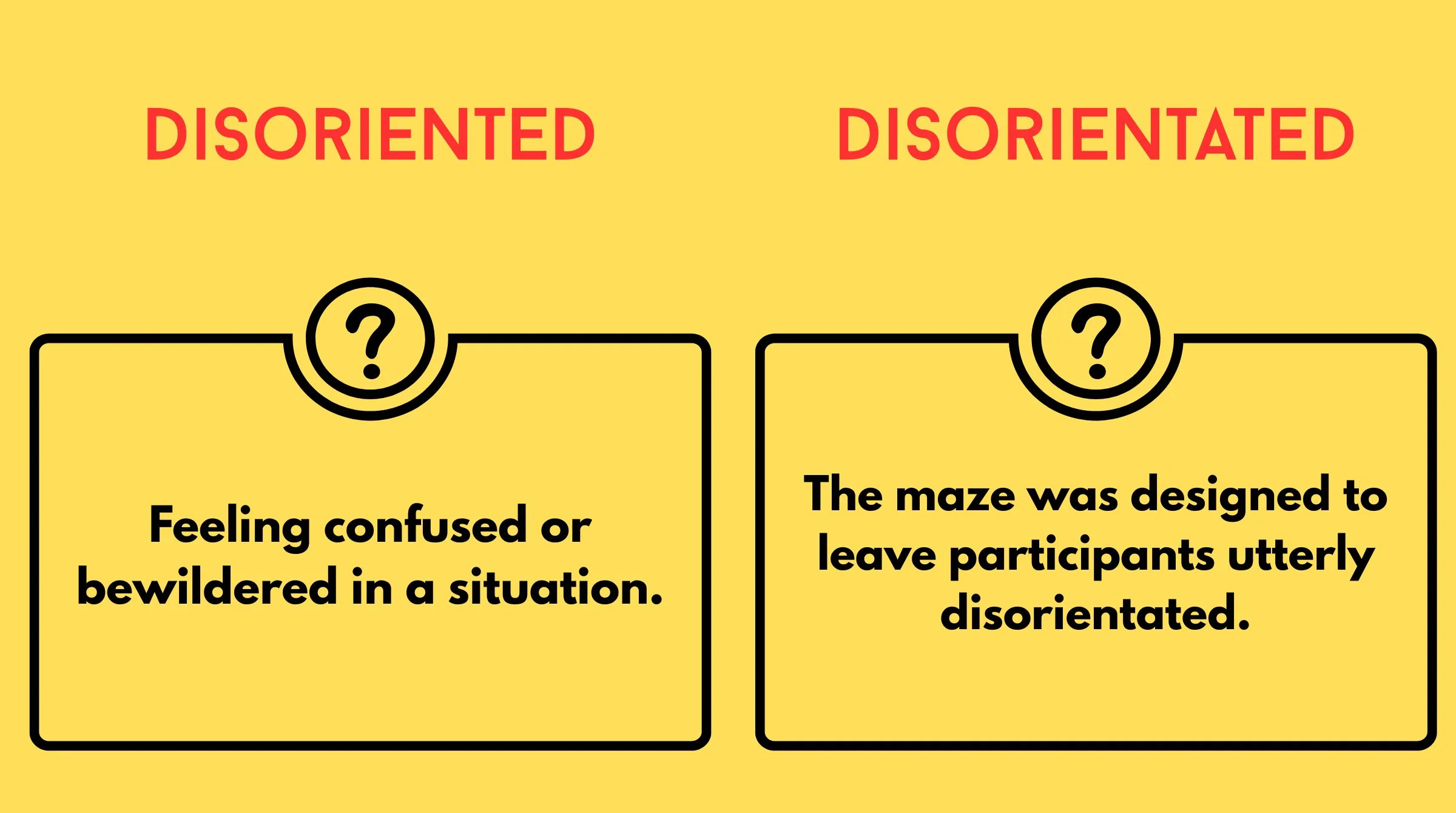
    Definition:

    • Lacking a sense of direction or clarity.
    • Feeling confused or bewildered in a situation.

    Examples in Context:

    • “After spinning on the amusement park ride, I felt completely disoriented.”
    • “She was disoriented by the sudden changes in her schedule.”

    Why Is ‘Disoriented’ Common in the U.S.?

    • Simplicity: American English tends to favor shorter, more streamlined words.
    • Efficiency: Dropping the additional syllable in disorientated makes the word quicker to use in conversation and writing.

    Key point: If you’re writing or speaking in American English, disoriented is almost always the better choice.

    Is it “disoriented” or “disorientated”? Learn the differences, origins, and how to choose the right term for your audience with confidence!


    Disoriented vs Disorientated

    Exploring ‘Disorientated’ in British English

    Across the pond, disorientated is more common, especially in formal British English. While it means the same thing as disoriented, the extra syllable is a nod to the word’s etymological roots.

    Definition:

    • The British English equivalent of disoriented, used to describe a state of confusion or loss of direction.

    Examples in Context:

    • “After the long flight, I was completely disorientated when I landed in London.”
    • “The maze was designed to leave participants utterly disorientated.”

    Why Do Brits Prefer ‘Disorientated’?

    • Tradition: British English often retains longer forms of words, reflecting historical spellings and pronunciations.
    • Regional Variation: Usage varies within British dialects, but disorientated is generally more accepted and widely used.

    Key point: If you’re addressing a British audience, disorientated might feel more natural and relatable.


    The Historical Roots of ‘Disorientated’

    The origins of these terms can be traced back to the same Latin root: orientare, meaning “to arrange” or “to direct.”

    • Disoriented: Emerged in American English in the mid-19th century. Its streamlined form aligns with the American preference for shorter words.
    • Disorientated: Evolved from the longer, more formal structures of British English. Its first recorded use dates back to the 17th century.

    Interestingly, both forms grew independently as English spread across the globe, reflecting the cultural and linguistic differences between British and American English.


    Usage of ‘Disorientated’ in Literature

    While disoriented dominates American writing, disorientated has found a place in British literature and formal texts.

    Examples from Notable Works:

    • In British novels, such as those by Charles Dickens or Jane Austen, disorientated is used to describe characters in states of confusion or unease.
    • Modern British writers, like Zadie Smith and Kazuo Ishiguro, also employ disorientated in their works, maintaining its presence in contemporary literature.

    This literary preference underscores how regional conventions shape the way words are written and perceived.


    Disoriented vs. Disorientated: Cultural Perspectives

    Cultural differences play a significant role in word choice. Beyond just British and American conventions, the usage of disoriented and disorientated can reveal deeper insights into language evolution.

    American Perspective

    • Focuses on simplicity and clarity.
    • Disoriented is the overwhelmingly dominant choice in both casual and formal contexts.

    British Perspective

    • Values traditional forms and richer phonetics.
    • Disorientated is viewed as more elegant and nuanced, particularly in academic or literary writing.

    This divergence reflects broader differences in how each culture approaches language and communication.


    Common Scenarios of Disorientation and Their Impact

    Physical Disorientation:

    • Situations: Getting lost in an unfamiliar place, experiencing vertigo, or recovering from anesthesia.
    • Example: “He was disoriented after coming out of the dark cave.”

    Mental Disorientation:

    • Situations: Encountering unfamiliar concepts or environments, such as starting a new job or moving to a foreign country.
    • Example: “She felt disorientated during her first week abroad.”

    Disorientation can have real-world implications, from mild confusion to severe stress, making it essential to communicate these states effectively.


    The Linguistic Evolution of Disorientation Terms

    Language is constantly evolving, and disoriented and disorientated are no exceptions.

    Key Developments:

    • Disoriented: Adopted for its simplicity and has largely overtaken disorientated in modern American English.
    • Disorientated: Maintains a foothold in British English, appealing to those who favor traditional structures.

    Linguistic Trend: As global communication grows, disoriented is becoming more common internationally, potentially bridging the gap between the two forms.


    Choosing the Right Term: Style, Rhythm, and Audience

    When deciding between disoriented and disorientated, consider the following:

    • Audience:
      • Use disoriented for an American audience.
      • Use disorientated for a British audience.
    • Style:
      • If brevity is important, opt for disoriented.
      • For a more formal or traditional tone, choose disorientated.
    • Rhythm:
      • In some sentences, the additional syllable in disorientated may improve the flow or cadence.

    Example:

    • “She was completely disoriented by the rapid turn of events.” (Shorter and punchier)
    • “He felt utterly disorientated after stepping off the spinning ride.” (Smoother and more rhythmic)

    Impact on Clarity in Communication

    Choosing the wrong term can confuse your audience or make your writing feel less natural. To ensure clarity:

    • Match the word to your target region or audience.
    • Be consistent in your usage throughout a document or conversation.
    • When in doubt, opt for disoriented, as it’s more widely recognized globally.

    Tip: Avoid mixing both terms in the same piece unless you’re explicitly comparing them.


    Final Thoughts: Embracing Linguistic Differences

    Disoriented vs Disorientated

    The debate between disoriented and disorientated highlights the richness of the English language. Rather than seeing these differences as a source of confusion, they should be embraced as a testament to the language’s diversity and adaptability.

    Whether you lean toward the streamlined American disoriented or the traditional British disorientated, understanding their distinctions will enhance your communication and appreciation of English’s global variations.


    FAQs

    What is the difference between “disoriented” and “disorientated”?

    “Disoriented” is preferred in American English for simplicity, while “disorientated” is common in British English, reflecting traditional language forms.

    Is “disorientated” incorrect?

    No, “disorientated” is correct in British English, but it’s less common in American English, where “disoriented” is the preferred term.

    Why does American English favor “disoriented”?

    American English often opts for shorter, more efficient words, making “disoriented” the popular choice.

    When should I use “disorientated”?

    Use “disorientated” if your audience is primarily British or if you’re aiming for a formal or traditional tone in your writing.

    Can both “disoriented” and “disorientated” be used interchangeably?

    Yes, they can be used interchangeably in meaning, but the choice depends on your audience’s region and the context of your writing.


    Conclusion

    At first glance, disoriented and disorientated may seem interchangeable, but they reflect unique linguistic and cultural preferences.

    By understanding their origins, usage, and regional nuances, you can confidently choose the right term for any situation.

    What’s your preference—disoriented or disorientated? Let us know in the comments and share your own examples of disorientation in daily life!

  • Sustain vs Substain: Clear the Confusion! ❌✅

    Sustain vs Substain: Clear the Confusion! ❌✅

    English is full of words that sound similar, but their meanings—or even their existence—can differ significantly. One common point of confusion arises with the words sustain and substain.

    While sustain is a valid English word with broad applications, substain doesn’t actually exist in the English language.

    This article will break down their usage, meanings, and the common mistakes people make, ensuring you never confuse the two again.


    Understanding the Correct Usage: Sustain vs Substain

    Sustain vs Substain

    The key to understanding the difference between sustain and substain lies in their very nature.

    Is it sustain or substain? Discover why sustain is correct, what it means, and how to use it effectively while avoiding common mistakes.

    • Sustain is a real English word, commonly used both as a verb and a noun.
    • Substain, on the other hand, is not a recognized word in the English language. It’s a misspelling or mispronunciation often made by mistake.

    This distinction is important because incorrect usage can confuse your audience and reduce the clarity of your communication.


    The Definition and Significance of Sustain in English

    Sustain has a rich and versatile meaning, making it an essential word in English vocabulary.

    Definition of Sustain

    • As a verb:
      To support, maintain, or keep something going over time.
      • Example: “She worked hard to sustain her family’s livelihood.”
    • As a noun (in music):
      A prolonged sound or note, often used in musical contexts.

    Why Is Sustain Important?

    The word sustain is crucial in various fields, from everyday communication to technical disciplines like music, engineering, and environmental studies. Its frequent use in different contexts highlights its adaptability and significance.


    The Role of Sustain as a Verb

    When used as a verb, sustain generally conveys the idea of supporting or maintaining something. Here are some specific examples:

    • To Support Physically:
      “The bridge is built to sustain heavy loads.”
    • To Maintain Over Time:
      “He couldn’t sustain the same level of performance throughout the game.”
    • To Endure or Withstand:
      “She sustained significant injuries during the accident but made a full recovery.”
    • To Uphold or Confirm:
      In legal contexts, sustain means to uphold or validate a decision.
      • Example: “The judge sustained the objection raised by the lawyer.”

    Common Synonyms for Sustain

    • Maintain
    • Support
    • Uphold
    • Prolong
    • Endure

    Using these synonyms can enhance your writing and avoid repetition.


    Sustain’s Meaning as a Noun in Music

    In the world of music, sustain takes on a specialized meaning.

    • Definition: The prolonged duration of a note or sound.
    • Usage in Context:
      • “The guitar pedal increases the sustain of the note, creating a richer sound.”
      • “The singer’s ability to sustain a high note captivated the audience.”

    This application is especially important in understanding how musical instruments and vocal techniques create emotional impact.


    The Nonexistence of ‘Substain’ in English Language

    Unlike sustain, the word substain has no place in the English language. It often appears due to:

    • Typos or Spelling Errors:
      People accidentally type “substain” when they mean “sustain.”
    • Phonetic Misunderstandings:
      In speech, the similarity of sounds might lead to confusion.
    • Lack of Awareness:
      Some learners of English might assume “substain” is a variation or related word.

    Key Point: Always double-check your spelling and use a trusted dictionary to avoid such errors.


    Common Mistakes and Confusions in English Vocabulary

    Mix-ups between sustain and substain are part of a larger pattern of English vocabulary mistakes. Here are some other commonly confused words:

    • Accept vs. Except:
      • Accept: To receive something.
      • Except: Excluding something.
    • Affect vs. Effect:
      • Affect: To influence (verb).
      • Effect: A result (noun).
    • Compliment vs. Complement:
      • Compliment: A kind remark.
      • Complement: Something that completes or goes well with something else.

    Avoiding such mistakes requires attention to detail and practice.


    Examples of How to Use Sustain in a Sentence

    Here are several examples to help solidify your understanding of sustain:

    1. In Everyday Conversation:
      • “Good nutrition is essential to sustain your energy throughout the day.”
    2. In Legal Contexts:
      • “The court sustained the previous ruling, maintaining the defendant’s sentence.”
    3. In Music:
      • “The sustain on the piano note gave the composition a hauntingly beautiful quality.”
    4. In Environmental Discussions:
      • “We must adopt sustainable practices to sustain our planet’s resources for future generations.”

    By using sustain correctly, you enhance the precision and professionalism of your communication.


    Remembering the Right Word: Tips to Avoid Misspellings

    Sustain vs Substain
    1. Visualize the Correct Word:
      Picture the word sustain in a sentence to reinforce its spelling and meaning.
    2. Practice with Mnemonics:
      • “Sustain is about support; substain is a mistake.”
    3. Leverage Spell-Check Tools:
      Use grammar-checking software, but always review suggestions critically.
    4. Read Aloud:
      Hearing the word in context can help you internalize its correct form.
    5. Learn Through Repetition:
      Write sentences using sustain to solidify your understanding.

    FAQs

    Is substain a real word?

    No, substain is not a recognized English word. It is often a misspelling or mispronunciation of sustain.

    What does sustain mean?

    Sustain means to support, maintain, or endure something over time. It is used in various contexts, including daily conversation, music, and legal terminology.

    How can I avoid confusing sustain with substain?

    To avoid confusion, remember that sustain is about support or endurance. Substain doesn’t exist, so use tools like spell-checkers and dictionaries for accuracy.

    What are some synonyms for sustain?

    Common synonyms for sustain include maintain, support, uphold, prolong, and endure.

    How is sustain used in music?

    In music, sustain refers to the prolonged duration of a sound or note. For example, a guitar pedal can enhance the sustain of a note.


    Conclusion

    The confusion between sustain and substain is a simple yet common mistake. While sustain is a versatile and meaningful word used across multiple disciplines, substain does not exist in English.

    By understanding the definitions, context, and correct usage of sustain, you can communicate more effectively and avoid embarrassing errors.

    Remember, clarity in language not only reflects your knowledge but also strengthens your message. So, the next time you write or speak, confidently choose sustain, and leave substain behind.