Category: Tricky Terms

  • Northeast vs North-East vs North East 🌍 Which One Is Correct?

    Northeast vs North-East vs North East 🌍 Which One Is Correct?

    Language often throws curveballs. One word looks right in one place but wrong in another. If you’ve ever stopped mid-sentence and wondered, Is it “Northeast,” “North-East,” or “North East”? you’re not alone.

    Writers, students, and even editors sometimes hesitate because different versions appear across books, maps, and official documents.

    Here’s the good news: there is a standard, modern answer — but the older forms haven’t completely vanished.

    This article unpacks the history, grammar, and correct usage of these variations so you’ll never second-guess yourself again.


    Understanding the Core Difference
    Northeast, North-East, or North East

    At first glance, “Northeast,” “North-East,” and “North East” all point to the same concept: the direction that sits between north and east on a compass. The confusion arises because:

    • English spelling wasn’t always standardized. Older texts often show “North-East.”
    • British vs. American usage differs. UK place names sometimes use “North East.”
    • Style guides modernized spelling. Dictionaries and writing authorities now recommend “Northeast.”

    Think of it like old vs. new spellings of words such as “to-day” (now “today”) or “good-bye” (now “goodbye”). All three spellings exist, but only one fits modern writing norms.


    Is “Northeast” One Word?

    Yes. “Northeast” as one word is the correct and modern spelling in both American and British English when used as a general term for the direction or a region.

    Dictionary Evidence

    • Merriam-Webster: Lists northeast as one word, used as noun, adjective, or adverb.
    • Oxford English Dictionary: Same treatment, one word, lowercase for direction, capitalized for region.
    • Cambridge Dictionary: Confirms “northeast” without a hyphen or space.

    Uses of “Northeast”

    1. As a noun: “Boston is in the Northeast of the United States.”
    2. As an adjective: “They built a house on the northeast side of the valley.”
    3. As an adverb: “We drove northeast for two hours.”

    American vs. British English

    • American English strongly prefers “northeast.”
    • British English also recognizes “northeast,” though you may still encounter “north-east” in older British publications.

    Example in US context:

    “The Northeast is famous for its fall foliage.”

    Example in UK context:

    “The train line runs northeast from London.”

    Bottom line: Northeast (one word) is standard English today.


    Is “North East” Two Words?

    Sometimes you’ll see “North East” written as two separate words, especially in British place names or official titles. While it looks unusual to American readers, it isn’t exactly wrong — it’s just limited to proper nouns.

    Examples in the UK

    • North East England – one of the nine official regions of England.
    • North East Derbyshire – a district in Derbyshire.
    • North East Scotland College – an education institution.

    In these cases, “North East” is capitalized because it’s part of a proper noun. But if you’re writing about general direction, “north east” (lowercase, two words) is not standard.

    Why Does It Exist?

    • British English historically kept “north” and “east” as separate words in compounds.
    • Over time, spelling merged into “northeast,” but some regional names stayed unchanged.

    Correct modern example:

    • “He moved to the northeast of London.”

    Official name exception:

    • “She studied at North East Scotland College.”

    Is “North-East” Hyphenated?

    If you’ve read older books, newspapers, or maps, chances are you’ve seen “North-East” with a hyphen. This was once the preferred spelling in the 19th and early 20th centuries, but it has largely fallen out of use.

    Historical Examples

    • Charles Dickens often wrote “North-East” in his novels.
    • Early 1900s atlases used “North-East” to mark compass directions.

    Style Guide Positions

    • Chicago Manual of Style: Uses “northeast,” no hyphen.
    • Associated Press (AP) Stylebook: Recommends “northeast.”
    • Oxford Style Guide: Modern usage is “northeast,” though “north-east” may still appear in UK regional contexts.

    Where It Lingers Today

    • British newspapers occasionally use “north-east” in lowercase for directions.
    • Some older institutions still publish with the hyphen.

    But in professional, modern writing, hyphenating “North-East” is considered outdated.


    Should “East” Be Capitalized in “North-East”?

    This is where many writers get tripped up. The answer depends on whether you’re writing about direction or region.

    General Rule of Capitalization

    • Lowercase when talking about direction:
      • “They traveled northeast to avoid traffic.”
    • Uppercase when referring to a recognized region:
      • “He grew up in the Northeast of the United States.”

    Examples Table

    Usage TypeCorrect FormExample Sentence
    Direction (general)lowercase northeast“The wind is blowing northeast.”
    Region (specific)uppercase Northeast“Winter storms often hit the Northeast first.”
    Outdated spelling“North-East”“The sun rises in the North-East.” (archaic)
    Proper nouns (UK)“North East”“She lives in North East England.”

    So yes, you capitalize “East” only when it’s part of a region or proper noun — not when writing about direction.


    Usage in Geography, Grammar, and Everyday Writing

    Understanding how to apply the word in different contexts clears up most of the confusion.

    Geography

    • United States: The Northeast refers to a cultural and geographical region (New England + Mid-Atlantic states).
    • UK: North East England is an official administrative region.
    • Asia: Northeast India includes Arunachal Pradesh, Assam, Manipur, Meghalaya, Mizoram, Nagaland, Sikkim, and Tripura.

    Grammar

    • Works as a noun, adjective, or adverb.
    • Follows the same capitalization rules as other compass directions.

    Everyday Writing

    • Use lowercase for direction: “Turn northeast at the next junction.”
    • Use uppercase for region: “I’m planning a trip to the Northeast.”

    Modern Usage Recommendation

    So which should you use today — “Northeast,” “North-East,” or “North East”?

    Here’s the final verdict:

    • Use “Northeast” (one word) for all modern writing unless you’re quoting an official name.
    • ⚠️ Use “North East” only in proper nouns like North East England.
    • Avoid “North-East” in modern texts unless you’re citing historical documents.

    Quick Reference Table

    FormStatus in Modern EnglishWhere It’s Used
    NortheastStandard, correctEverywhere (direction + regions)
    North EastLimited, proper nounsUK regional names, institutions
    North-EastOutdated, historicalOld books, some British media

    Practical Tip

    If in doubt, write “northeast.” It keeps your writing clean, modern, and correct.


    Conclusion

    “Northeast, North-East, or North East” may all point to the same place on a compass, but only one spelling belongs in modern writing. “Northeast” (one word) is the standard you should use for directions and regions alike.

    • Use lowercase northeast for directions.
    • Use uppercase Northeast for regions.
    • Save North East for official UK names.
    • Retire North-East except when quoting old texts.

    In short, when in doubt, stick with “Northeast.” It’s modern, widely accepted, and keeps your writing clear and professional.

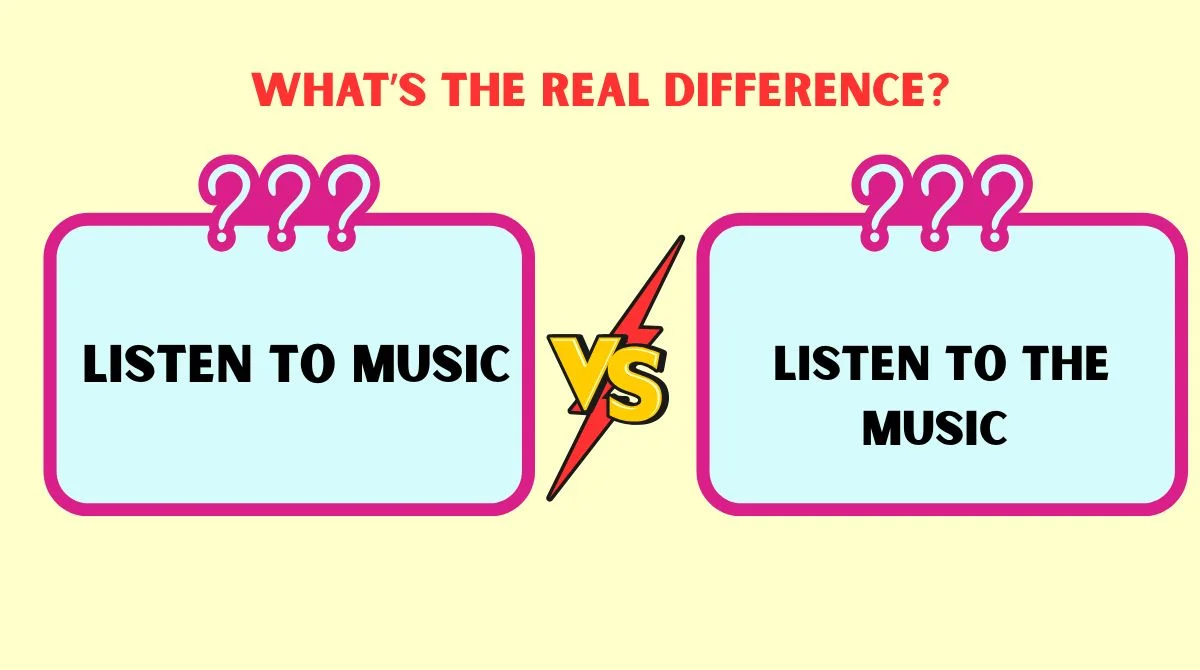
  • 🎶 Listen to Music vs Listen to the Music – What’s the Real Difference?

    🎶 Listen to Music vs Listen to the Music – What’s the Real Difference?

    English is a language where even a single word can change the entire meaning of a sentence. A perfect example is the subtle difference between “listen to music” and “listen to the music.” At first glance, they look nearly identical, yet they’re used in very different ways.

    This distinction often confuses English learners because both phrases feel correct, but the meaning shifts depending on whether you include the word “the.” In this guide, you’ll learn exactly what each phrase means, when to use it, and how to avoid common mistakes.

    Let’s dive in.


    Understanding the Core Difference

    Listen to Music vs Listen to the Music

    The heart of the difference lies in one small word: the definite article “the.”

    • Music without “the” refers to the concept of music in general.
    • The music refers to a specific piece or type of music that’s already known to both the speaker and the listener.

    Think of it like this:

    • If you say, “I love to listen to music,” you’re talking about music in a broad, general sense.
    • If you say, “Listen to the music playing in the background,” you’re pointing to a particular sound that’s happening right now.

    Quick Analogy

    It’s similar to the difference between:

    • “I enjoy reading books.” (books in general)
    • “I’m reading the book you recommended.” (a specific book).

    The definite article works the same way for music.


    What Does “Listen to Music” Mean?

    When someone says “listen to music,” they’re referring to the general act of enjoying music without pointing to any particular song, artist, or performance.

    Grammar Explanation

    • “Music” is an uncountable noun in English.
    • Without an article, it refers to the concept as a whole rather than an individual instance.

    Everyday Contexts for “Listen to Music”

    Here are some common situations where you’d naturally use this phrase:

    • Talking about hobbies:
      • “I like to listen to music when I’m stressed.”
    • Describing daily routines:
      • “She listens to music on her way to work.”
    • Discussing preferences:
      • “They would rather listen to music than watch TV.”

    Collocations with “Listen to Music”

    Some common collocations include:

    • listen to music online
    • listen to music while studying
    • listen to music all day
    • listen to music at night

    Cultural Note

    This phrase is especially common in casual conversation and often describes a person’s lifestyle or emotional state.


    What Does “Listen to the Music” Mean?

    The phrase “listen to the music” narrows the focus. It doesn’t talk about music in general but instead refers to specific music the speaker expects the listener to recognize.

    Situational Examples

    • At a concert:
      • “Listen to the music the band is playing—it’s incredible.”
    • At a party:
      • “Listen to the music coming from the neighbor’s house.”
    • Giving instructions:
      • “Close your eyes and listen to the music in this scene.”

    Why Use “the”?

    • The word “the” signals that the music is already understood in context.
    • Both speaker and listener know which music is being referenced.

    Nuanced Cases

    • In teaching:
      • “Listen to the music carefully and identify the instruments.”
    • In storytelling:
      • “He paused to listen to the music drifting through the window.”

    This phrase often carries a sense of specificity and immediacy.


    Contextual Usage: How to Choose the Right Phrase

    English learners often wonder when to use “listen to music” versus “listen to the music.” The rule is straightforward once you see it in action.

    Broad vs Specific

    • Use “listen to music” when you’re talking about the activity in general.
    • Use “listen to the music” when you’re pointing to something specific.

    Situational Breakdown

    Daily life and habits:

    • General: “I listen to music while cooking.”
    • Specific: “I listened to the music you sent me last night.”

    Events and environments:

    • General: “People often listen to music at weddings.”
    • Specific: “Everyone stopped to listen to the music played by the string quartet.”

    Academic or artistic settings:

    • General: “Students listen to music to relax before exams.”
    • Specific: “In this exercise, listen to the music and identify the rhythm.”

    Real-Life Examples and Sentences

    Examples of “Listen to Music”

    • “I usually listen to music before bed.”
    • “They listen to music every morning during their workout.”
    • “She prefers to listen to music instead of podcasts.”
    • “Listening to music helps me concentrate.”

    Examples of “Listen to the Music”

    • “Listen to the music that’s playing—it sets the mood.”
    • “He told her to listen to the music and follow the beat.”
    • “Listen to the music of the ocean waves.”
    • “The director asked us to listen to the music before rehearsing.”

    Quick Comparison Table

    Here’s a side-by-side breakdown to make the difference crystal clear:

    PhraseMeaningContext Example
    Listen to musicGeneral enjoyment of music as a concept“I like to listen to music while I study.”
    Listen to the musicRefers to specific, identifiable music“Listen to the music playing on the radio.”

    Common Misconceptions and Clarifications

    Misconception 1: They’re interchangeable

    Many learners assume these phrases can be swapped freely, but doing so changes the meaning.

    • Wrong: “I listen to the music every night before bed.”
    • Better: “I listen to music every night before bed.”

    Misconception 2: Adding “the” makes it sound formal

    “The” doesn’t add formality—it adds specificity. You’re not sounding fancy; you’re pointing to something particular.

    Misconception 3: “Music” always needs an article

    Not true. As an uncountable noun, “music” doesn’t require “the” unless the context demands it.


    Case Study: How Usage Changes Meaning

    Imagine two friends at a coffee shop.

    • Friend A: “What do you usually do when you’re relaxing at home?”
    • Friend B: “I listen to music.”
      (General activity, no specific music mentioned.)

    Later, the café begins playing a jazz track.

    • Friend A: “Listen to the music—it’s so smooth.”
      (Specific song currently playing in the environment.)

    This small change illustrates how articles shift the focus from general habits to specific experiences.


    🙋 FAQs

    What is the difference between “listen to music” and “listen to the music”?

    “Listen to music” means enjoying music in general, while “listen to the music” refers to a specific piece of music already understood in context.

    Is it correct to say “listen to the music”?

    Yes, it’s correct when you are referring to a particular sound or song, such as at a concert or when pointing out background music.

    Why don’t we say “the” in “listen to music”?

    Because “music” is an uncountable noun, it doesn’t need “the” when used in a general sense. Adding “the” narrows it to something specific.

    Can I use “listen music” without “to”?

    No, the correct form is always “listen to music” or “listen to the music.” The preposition “to” is required.

    Which is more common: “listen to music” or “listen to the music”?

    “Listen to music” is more common because people often talk about music as a general habit or activity. “Listen to the music” appears in specific contexts.

    How can I remember the difference easily?

    Think of it like books: “I like reading books” (general) vs “I’m reading the book you gave me” (specific). Music works the same way.


    Conclusion

    The difference between “listen to music” and “listen to the music” may seem small, but it’s an essential part of speaking natural English.

    • “Listen to music” = general activity, no specific piece identified.
    • “Listen to the music” = specific sound, context is already shared.

    A simple rule of thumb:
    👉 Use “listen to music” when you’re talking about music as a habit or concept.
    👉 Use “listen to the music” when you want someone to notice a particular sound.

    By paying attention to context and practicing with examples, you’ll quickly master when to use each phrase. Next time you’re enjoying a playlist or attending a concert, notice how naturally these distinctions appear in conversation.

  • Entwined vs Intertwined 🤔 What’s the Real Difference in Meaning & Usage?

    Entwined vs Intertwined 🤔 What’s the Real Difference in Meaning & Usage?

    Language thrives on nuance. Two words may look almost identical and even share roots, yet their meanings can diverge in subtle but important ways.

    That’s exactly the case with entwined and intertwined. Writers often hesitate when choosing between them, and it’s easy to see why—they both describe things being “twined together.”

    Still, they’re not complete synonyms. The distinction lies in tone, context, and the type of connection they describe.

    This article breaks down the differences between entwined and intertwined with examples, comparisons, and usage trends. By the end, you’ll know which word captures the meaning you want in your writing.


    Understanding the Core Meanings

    Entwined vs Intertwined

    Both words spring from the same root: twine, meaning to wind or twist together. But the prefixes and shades of connotation make each unique.

    • Entwined emphasizes a close, sometimes physical, wrapping or embracing. Think of vines curling around a post or two people holding each other tightly.
    • Intertwined highlights interconnectedness, often in a more abstract or structural sense. It goes beyond physical wrapping to suggest relationships, histories, or ideas woven together.

    At their heart, both terms deal with connection, but the kind of connection differs.


    Entwined: When and How It’s Used

    The word entwined carries a sense of embrace, intimacy, and closeness. You’ll often see it in poetry, romance novels, or descriptions of natural growth.

    Common Contexts for Entwined

    • Romantic imagery: “Their fingers were entwined as they walked along the beach.”
    • Nature: “The vines grew entwined, forming a canopy overhead.”
    • Symbolism of unity: “Two destinies entwined forever.”

    Connotations of Entwined

    • Suggests softness and intimacy.
    • Often implies deliberate closeness or binding.
    • Has a lyrical, emotional tone.

    Example Sentences

    • “Her hair became entwined with the delicate blossoms.”
    • “Their lives were entwined in ways they could never untangle.”
    • “The roots of the tree were so entwined with the rocks that they seemed inseparable.”

    Writers reach for entwined when they want to convey not just physical closeness but emotional warmth.


    Intertwined: When and How It’s Used

    The word intertwined carries a slightly different weight. It suggests complex interconnections, often extending beyond the physical into social, cultural, or intellectual realms.

    Common Contexts for Intertwined

    • Relationships: “Their fates were intertwined by history.”
    • Ideas: “The concepts of freedom and responsibility are deeply intertwined.”
    • Systems or histories: “The economies of the two countries are intertwined.”

    Connotations of Intertwined

    • Suggests complexity and depth.
    • Often broader and more abstract than entwined.
    • Has an intellectual or systemic tone.

    Example Sentences

    • “The traditions of the region are intertwined with its religious practices.”
    • “Science and ethics remain intertwined in modern debates.”
    • “Her career and personal life were so intertwined that separating them seemed impossible.”

    Intertwined feels analytical and is widely used in academic, journalistic, and professional writing.


    Subtle Distinctions Between the Two

    Although similar, these words diverge in important ways.

    • Emotional vs Structural
      • Entwined leans toward emotional or romantic connection.
      • Intertwined leans toward structural, intellectual, or systemic connection.
    • Tangible vs Abstract
      • Entwined: vines, arms, hair, destinies.
      • Intertwined: histories, economies, cultures, abstract ideas.
    • Tone
      • Entwined = lyrical, poetic, intimate.
      • Intertwined = analytical, broad, complex.

    Visual and Linguistic Comparison

    Here’s a side-by-side breakdown:

    AspectEntwinedIntertwined
    Root MeaningWrapped, twisted togetherInterconnected, woven together
    Common UsageRomance, nature, closenessSystems, ideas, histories
    TonePoetic, emotionalIntellectual, analytical
    TangibilityPhysical and emotionalAbstract and systemic
    Example“Their fingers were entwined.”“Their cultures are intertwined.”

    To visualize:

    • Entwined = two vines hugging each other.
    • Intertwined = a web of threads crossing in many directions.

    Which One Is More Common in Modern Usage?

    Usage trends show a clear difference. According to Google Ngram Viewer, which tracks words in published books:

    • Intertwined appears more frequently in modern writing, particularly in academic and professional contexts.
    • Entwined remains popular in literature, especially poetry and romance.

    Why the Shift?

    • Modern writers often favor precision and complexity, making intertwined a natural choice.
    • Entwined feels more old-fashioned and lyrical, though it’s still effective for artistic writing.

    In short, you’ll likely encounter intertwined more in news, essays, and research, while entwined shines in creative writing.


    Common Mistakes and Tips to Remember

    It’s easy to treat these words as interchangeable, but choosing the right one strengthens your writing.

    Mistakes to Avoid

    • Using entwined when describing abstract or systemic concepts.
    • Using intertwined when the context is personal, romantic, or poetic.

    Tips to Remember

    • Mnemonic:
      • Entwined = Embrace (think physical closeness).
      • Intertwined = Interconnected (think overlapping systems).
    • Quick Test:
      • Ask: “Am I describing closeness or interconnectedness?”
      • If closeness, use entwined.
      • If interconnectedness, use intertwined.

    Case Studies: Usage in Literature and Media

    Entwined in Literature

    • In Victorian poetry, lovers’ hands or lives are often described as “entwined,” underscoring the era’s romantic imagery.
    • Example: Thomas Hardy’s works frequently use entwined when describing natural growth or human intimacy.

    Intertwined in Modern Writing

    • Journalists often write about “intertwined economies” or “intertwined global challenges.”
    • Academic works prefer intertwined when discussing theory, culture, or politics.

    Popular Media Examples

    • Romance films: “Their destinies were entwined forever.”
    • News headlines: “Technology and privacy are increasingly intertwined in daily life.”

    These examples reflect the tone difference: one leans personal and artistic, the other analytical and societal.


    ✅ FAQs

    What does entwined mean in English?

    Entwined means wrapped or twisted closely together, often suggesting intimacy or closeness, like hands, vines, or destinies.

    What does intertwined mean in English?

    Intertwined means things are interconnected or woven together, often used for abstract ideas, relationships, or systems.

    Can entwined and intertwined be used interchangeably?

    They overlap, but not always. Entwined emphasizes closeness and intimacy, while intertwined stresses complexity and interconnection.

    Which word is more common: entwined or intertwined?

    Intertwined is more common in modern writing, especially academic or professional contexts, while entwined appears more in poetry and romance.

    How do I remember the difference between entwined and intertwined?

    Think of entwined as an embrace (physical closeness) and intertwined as interconnected (overlapping systems or ideas).

    Can I use entwined in academic writing?

    You can, but intertwined is usually more precise and widely accepted in academic or analytical writing.


    Final Thoughts

    Both entwined and intertwined deal with connection, but the nuances matter.

    • Choose entwined when you want to highlight closeness, intimacy, or physical/emotional binding.
    • Choose intertwined when you need to stress interconnection, complexity, or systemic overlap.

    Words carry weight, and picking the right one not only sharpens your message but also elevates your writing style. Use entwined for heart and intertwined for depth.

  • Sale vs Sail ⚓🛍️ – Meaning, Difference & Easy Examples

    Sale vs Sail ⚓🛍️ – Meaning, Difference & Easy Examples

    English is full of tricky word pairs that sound exactly the same but carry completely different meanings. Sale vs Sail is one of the most confusing examples.

    Both words are pronounced the same way (they’re homophones), yet they represent very different ideas—one belongs to the world of business, and the other belongs to the world of the sea.

    This article will take you through their definitions, usage, examples, synonyms, and memory tricks so you’ll never confuse them again. Along the way, you’ll see real-world applications, tables for quick reference, and helpful tips that make learning easier.


    What Does Sail Mean?

    Sale vs Sail

    The word sail can function both as a noun and a verb. Let’s explore both uses with examples and contexts.

    Sail as a Noun

    As a noun, sail usually refers to the large piece of fabric attached to a boat or ship that catches the wind and propels it forward.

    • Primary definition: a piece of material used to harness wind power for movement.
    • Example: “The sailor adjusted the sail to catch more wind.”

    But that’s not the only way “sail” appears as a noun. It can also describe:

    • A trip or voyage: “We went for a sail along the coast.”
    • The sport of sailing: “She took up sail as a hobby in college.”
    • Figurative expressions: phrases like to set sail mean to begin a journey or adventure.

    Key Fact: The noun “sail” comes from Old English segl, showing how deeply tied it is to maritime culture.


    Sail as a Verb

    When used as a verb, sail means to travel on water using sails or a boat.

    • Primary definition: to move across water with the help of wind in sails.
    • Example: “They sailed across the Atlantic in just two weeks.”

    But in everyday language, sail also has extended and figurative meanings:

    • To move smoothly or effortlessly: “She sailed across the dance floor.”
    • To succeed easily: “He sailed through the exam without much studying.”
    • To travel by ship: “We’re sailing from New York to London.”

    Fun Note: The verb “sail” isn’t limited to boats anymore. Thanks to figurative use, you’ll see it in everything from sports commentary to office conversations.


    What Does Sale Mean?

    The word sale functions only as a noun. It’s firmly rooted in the world of commerce and trade.

    Sale as a Noun

    The most common meaning of sale is the exchange of goods or services for money.

    • Example: “The sale of the house was finalized yesterday.”
    • Example: “The company reported record sales this quarter.”

    Other contexts where “sale” appears:

    • Discount or special price: “The store is having a sale on shoes.”
    • Legal transfer of ownership: “The sale of property requires official documentation.”
    • Marketing and promotions: “Holiday sales attract millions of shoppers.”

    Key Fact: The word “sale” comes from the Old English sala, meaning a transaction or exchange.


    Sale as an Event

    Beyond the transaction itself, sale often refers to large-scale events where prices are reduced to attract customers.

    • Example: “Black Friday Sale”
    • Example: “End-of-Season Sale”

    These events have become cultural phenomena, especially in retail. For instance, Black Friday in the United States generates billions of dollars in sales every year.


    Comparing Sail vs Sale

    Since these two words are homophones, they often confuse English learners. The best way to avoid mistakes is to compare them side by side.

    Here’s a clear breakdown:

    FeatureSail (Noun/Verb)Sale (Noun)
    MeaningMovement on water using sails; trip; voyageExchange of goods/services for money
    Part of SpeechNoun and VerbNoun only
    ContextBoating, ships, smooth movement, figurative usesBusiness, trade, shopping, legal exchange
    Example“We set sail at dawn.”“The car is up for sale.”

    Quick Reminder:

    • Sail → water, boats, journeys.
    • Sale → money, shopping, transactions.

    Synonyms and Related Words

    Knowing synonyms helps reinforce the difference between sale and sail.

    Synonyms for Sail

    Depending on context:

    • Noun: canvas, rigging, voyage, cruise.
    • Verb: navigate, drift, glide, cruise, float.

    Example: “They set off on a cruise” = “They set off on a sail.”


    Synonyms for Sale

    • Transaction
    • Bargain
    • Deal
    • Discount
    • Auction
    • Clearance

    Example: “The clearance event offered massive discounts” = “The sale offered massive discounts.”


    Common Mistakes with Sail and Sale

    Because both words sound identical, learners often swap them by accident. Here are typical mistakes:

    • ❌ “The boat raised its sale.”
    • ✅ “The boat raised its sail.”
    • ❌ “The store is having a sail on clothes.”
    • ✅ “The store is having a sale on clothes.”

    Tip: Always think about the subject. If it involves money, it’s sale. If it involves boats or smooth movement, it’s sail.


    Easy Trick to Remember the Difference

    A quick memory hack can save you from confusion:

    • Sail → Ship (both start with “S”).
    • Sale → Shopping (both start with “S”).

    So whenever you think of sail, imagine a ship catching wind.
    Whenever you think of sale, picture shopping bags at a store.


    Idioms and Expressions with Sail and Sale

    Both words appear in common idioms.

    Idioms with Sail

    • Plain sailing: something that is easy or straightforward.
      • “After the first round, the rest of the match was plain sailing.”
    • To sail close to the wind: to take risks or act dangerously.
      • “The politician was sailing close to the wind with his remarks.”
    • Set sail: to start a journey or new project.
      • “They set sail on a business venture overseas.”

    Idioms with Sale

    • For sale: available to buy.
      • “This land is for sale.”
    • Fire sale: goods sold at extremely low prices, often urgently.
      • “The company held a fire sale after closing down.”
    • Sell like hotcakes (related): although “sale” isn’t in the phrase, it ties to the same root idea of rapid selling.

    Real-World Applications

    Case Study: Sale in Business

    Amazon’s Prime Day Sale in 2024 generated over $12.9 billion in revenue globally. This shows the enormous economic weight behind the word “sale.”

    Case Study: Sail in Travel

    In contrast, sailing tourism contributes billions to coastal economies worldwide. The yacht industry alone is expected to reach $13 billion by 2030, driven by leisure sailing and luxury travel.


    Practical Exercises for Learners

    If you’re learning English, practice is the best way to master the difference between sale and sail. Try these:

    • Write 5 sentences with sale (focus on money, shopping, business).
    • Write 5 sentences with sail (focus on ships, journeys, or smooth actions).
    • Read your sentences aloud to hear the difference in context.

    FAQs on Sale vs Sail

    Can “sail” ever mean “sale”?

    No. They are homophones but have unrelated meanings. Sail relates to boats and journeys, while sale relates to trade.

    Is “sale” always about money?

    Mostly yes, but sometimes it refers to the event of selling, like “garage sale,” where money is implied but not always emphasized.

    Are there idioms with “sail”?

    Yes, such as “plain sailing” and “set sail.” These extend its meaning beyond boats.

    Are there idioms with “sale”?

    Yes, like “for sale” and “fire sale.” They’re common in business and everyday life.

    Which word appears more often, sale or sail?

    “Sale” is more frequent in modern English because of its use in commerce. “Sail” is more common in literature or travel writing.

    How do I avoid mixing them up?

    Think of the context. If money or trade is involved, it’s sale. If ships or movement are involved, it’s sail.


    Conclusion

    The words sale and sail may sound the same, but their meanings couldn’t be more different.

    • Sail connects to the sea, journeys, and movement—both literal and figurative.
    • Sale belongs to the world of business, commerce, and discounts.

    By keeping their contexts in mind, using memory tricks, and practicing with examples, you’ll never confuse them again.

    Here’s a quick final snapshot:

    • Sail → Ship, Journey, Smooth Motion
    • Sale → Shopping, Money, Transaction

    Next time you hear or read these words, you’ll know exactly which one to use.

  • Gluing vs Glueing ✂️🧴 Which Spelling Is Correct (and Why)?

    Gluing vs Glueing ✂️🧴 Which Spelling Is Correct (and Why)?

    English spelling can feel like a maze. Some words look like they should keep an extra letter, others drop it, and learners often wonder if both versions are valid.

    One of the most common examples is gluing vs glueing. Which spelling should you use? Why does the confusion even exist? And most importantly, how do you avoid making this mistake again?

    Let’s break it down in detail, with real-world examples, history, grammar rules, and a handy reference table that clears up the debate once and for all.


    What Do “Gluing” and “Glueing” Mean?

    Gluing or Glueing

    At their core, both gluing and glueing try to describe the same action: attaching or fastening something with glue.

    • Gluing: This is the standard and correct spelling accepted in modern English.
    • Glueing: While it looks logical—since the base word is “glue”—this version is outdated and not recognized by dictionaries today.

    Think of it this way: if you’re working on a craft project, fixing a broken vase, or sticking photos into an album, the word you want is always gluing, never glueing.


    Quick Examples of “Gluing” in Sentences

    Seeing the word in context makes it easier to remember. Here are a few natural examples:

    • She spent the afternoon gluing paper cutouts onto a poster board.
    • The carpenter is gluing the wooden panels together before nailing them.
    • Students were busy gluing their science models for the exhibition.
    • He regretted gluing the broken handle instead of replacing it.

    Notice how “gluing” fits smoothly in each sentence. If you were to replace it with “glueing,” the word would look awkward and distract the reader.


    The Origin of the Gluing vs Glueing Confusion

    The confusion comes from the silent final “e” rule in English spelling. When adding -ing to verbs that end with “e,” the final letter is often dropped.

    For example:

    • bake → baking
    • ride → riding
    • dance → dancing

    Because “glue” ends in an “e,” most learners assume “glueing” is correct. However, English spelling rules introduce exceptions when dropping the “e” would change the way the word is pronounced.

    Take a look:

    • dye → dyeing (to avoid confusion with dying = death)
    • singe → singeing (to avoid confusion with singing = vocalizing)

    For “glue,” no confusion exists when dropping the “e.” So the correct form is gluing, not glueing.


    Historical Snapshots: Where “Glueing” Appeared

    Although wrong today, “glueing” wasn’t always absent. Older texts sometimes used it before spelling conventions were standardized.

    A quick look at Google Books Ngram Viewer (which tracks word usage across millions of publications) shows that:

    • “Glueing” appeared sporadically in the 18th and 19th centuries.
    • Its usage declined sharply in the 20th century as dictionaries and style guides established gluing as the standard.
    • Today, “glueing” barely registers in print compared to “gluing.”

    This historical snapshot explains why you might stumble upon “glueing” in old manuals or scanned books—but it doesn’t make it correct anymore.


    American English vs British English: Is “Glueing” Ever Correct?

    Sometimes spelling differences are explained by American English vs British English. For instance:

    • color (US) vs colour (UK)
    • organize (US) vs organise (UK)

    But in this case, both American and British English agree: gluing is correct, while glueing is obsolete.

    Even Oxford English Dictionary (UK) and Merriam-Webster (US) only recognize gluing. That makes this one of the rare instances where there’s no transatlantic spelling fight—everyone is on the same page.


    What Major Style Guides Say

    Trusted references confirm the standard spelling:

    • Oxford English Dictionary: Only lists “gluing.”
    • Merriam-Webster Dictionary: Defines “gluing” as the sole present participle of “glue.”
    • Cambridge Dictionary: Shows examples with “gluing.”
    • Chicago Manual of Style: Recommends dropping the final “e” when forming “-ing” unless pronunciation is affected.
    • Associated Press (AP) Stylebook: Follows the same principle, recognizing only “gluing.”

    In short: if you want your writing to be taken seriously, stick with gluing.


    Grammar Rules Simplified: Dropping the “E” Before Adding “-ing”

    The rule is simple but powerful:

    • If a verb ends in a silent “e,” drop it before adding “-ing.”

    Examples:

    • bake → baking
    • ride → riding
    • hope → hoping

    Exceptions: When You Keep the “E”

    • If removing the “e” changes pronunciation, you keep it.
      • dye → dyeing (to separate from dying)
      • singe → singeing (to separate from singing)

    Since “glue” doesn’t cause confusion when the “e” is dropped, it becomes gluing.


    Why This Rule Exists

    The English language values phonetic clarity. Dropping or keeping the “e” helps avoid ambiguity and ensures words remain easy to read and pronounce.

    For “gluing,” dropping the “e”:

    • Prevents awkward vowel clusters.
    • Keeps pronunciation smooth.
    • Matches broader spelling patterns in English.

    Without this rule, readers might stumble when encountering verbs in different forms.


    Why “Glueing” Is Considered a Spelling Mistake Today

    There are several reasons why “glueing” doesn’t hold up:

    • Not recognized by major dictionaries.
    • Doesn’t follow grammar rules consistently.
    • Looks unprofessional in formal writing.
    • Rare in modern usage, which makes it confusing to readers.

    Using “glueing” in a professional document, academic paper, or published book signals a spelling mistake, not an alternative spelling.


    Real-World Case Study

    Let’s look at real-world data:

    A search on Google Books Ngram Viewer shows:

    • Gluing skyrockets in frequency after 1900.
    • Glueing peaks around 1850 but then falls almost completely out of use.

    In modern published works (2010 onward):

    • Gluing appears thousands of times across scientific research, craft guides, and textbooks.
    • Glueing appears so rarely it’s often flagged as a typo.

    Quote from Merriam-Webster’s online dictionary:

    “The present participle of glue is gluing. The form glueing is not in common use.”

    This makes it clear: in real-world usage, only one spelling has survived.


    Tips to Remember the Correct Spelling

    Want to avoid the mistake forever? Here are some tricks:

    • Mnemonic device: “Drop the ‘e’ to keep it neat.”
    • Think of similar verbs:
      • cue → cuing
      • argue → arguing
      • glue → gluing
    • Flashcard reminder: Write “gluing” three times and cross out “glueing.”
    • Practice sentences: Incorporate “gluing” into daily writing exercises.

    Consistency builds memory. Once you’ve written it correctly a few times, it’ll stick—just like glue.


    Related Words With Tricky “-ing” Forms

    English has several verbs that don’t follow the straightforward “drop the e” rule. Here are some that often confuse learners:

    • dye → dyeing
    • lie → lying
    • tie → tying
    • shoe → shoeing
    • singe → singeing

    Notice how exceptions usually occur to preserve meaning or clarify pronunciation. That’s why “gluing” stays simple—there’s no confusion to resolve.


    Quick Reference Table: Gluing vs Glueing

    Here’s a handy table for quick checks:

    Word FormCorrect?Region/UsageNotes
    Gluing✅ YesUS/UK/GlobalRecognized in all dictionaries
    Glueing❌ NoRare, outdatedConsidered a spelling mistake

    FAQs

    Is it gluing or glueing?

    The correct spelling is gluing. “Glueing” is outdated and not accepted in modern English.

    Why is glueing wrong?

    Because English grammar rules drop the final “e” before adding “-ing” unless it affects pronunciation. That’s why “gluing” is correct.

    Do Americans and Brits spell it differently?

    No. Both American and British English use gluing as the correct spelling.

    What do style guides say about gluing vs glueing?

    Major style guides like Oxford, Merriam-Webster, and Chicago Manual of Style only recognize gluing.

    Are there exceptions to dropping the “e” rule?

    Yes. Words like dye → dyeing or singe → singeing keep the “e” to avoid confusion in meaning or sound.

    How can I remember the correct spelling of gluing?

    Use this tip: “Drop the e to keep it neat.” Just like argue → arguing, glue becomes gluing.


    Conclusion

    The verdict is clear: gluing is the only correct spelling in modern English. While “glueing” appeared in older texts, it’s now obsolete and considered an error.

    Whenever you’re tempted to write “glueing,” remember the rule: drop the e before adding -ing unless it changes pronunciation. In this case, it doesn’t, so the choice is simple—stick with gluing.

    Like glue itself, this rule holds everything together neatly.

  • Segway or Segue? 🤔 Clear Up the Confusion Once and for All

    Segway or Segue? 🤔 Clear Up the Confusion Once and for All

    Confusing Segway and segue is more common than you might think. One is a futuristic, self-balancing scooter, and the other is a smooth transition in conversation or writing.

    Despite sounding similar, they belong in entirely different contexts.

    This article breaks down their meanings, origins, correct usage, and practical examples, so you’ll never mix them up again.


    What Does “Segue” Mean?

    Segway vs Segue

    The word segue comes from the Italian verb seguire, meaning “to follow.” In English, it has evolved to describe a smooth transition from one topic or section to another in speech, music, or writing.

    Think of it like a bridge connecting two ideas. If you’re presenting in a meeting, a good segue helps your audience follow your flow without noticing a jarring shift.

    Examples of Segue in Use

    • “She finished discussing marketing trends and smoothly segued into customer feedback strategies.”
    • In music, one song might segue into another without a pause.
    • Television hosts often segue between segments to maintain pacing and audience engagement.

    Common Mistakes With Segue

    • Writing “Segway” when you mean a conversational transition.
    • Overusing the word in writing, making sentences clunky.
    • Mispronouncing it as “seg-way” instead of “seg-way” with the emphasis on the first syllable.

    What Is a “Segway”?

    A Segway is a brand of self-balancing, two-wheeled electric personal transporters. Invented by Dean Kamen in 2001, it promised a futuristic revolution in urban commuting.

    Unlike a segue, a Segway is tangible—you can touch it, ride it, and even see it in action in city tours or police patrols.

    Key Facts About the Segway

    • Maximum speed: ~12.5 mph (20 km/h)
    • Battery life: ~24 miles (38 km) per charge
    • Weight: 100–120 lbs (45–55 kg) depending on the model
    • Original price: ~$5,000 at launch
    • Current status: Production of original models ceased in 2020, replaced by newer electric scooters and self-balancing vehicles

    Where People See Segways Today

    • Tourist attractions and guided city tours
    • Security and police patrols
    • Tech expos and futuristic demonstrations

    The Segway’s name has nothing to do with conversation. Confusing it with segue leads to amusing sentences like: “I Segway into my next topic,” which is clearly wrong.


    Key Differences Between Segway and Segue

    Here’s a handy comparison table to make things crystal clear:

    FeatureSegueSegway
    DefinitionSmooth transition in speech or writingElectric personal transporter
    OriginItalian seguire (“to follow”)Brand name (Dean Kamen, 2001)
    Usage ContextConversation, writing, musicTransportation, commuting, tours
    Pronunciation/ˈsɛɡ.weɪ//ˈsɛɡ.weɪ/
    Common MistakesUsing Segway insteadUsing Segue for transitions

    Tips to Remember

    • Segue starts with “seg,” think “segue to the next point.”
    • Segway is a vehicle—visualize riding it.
    • If you’re discussing a transition, always pick segue.

    Real-World Confusions

    • Social media posts often say: “I Segwayed into the next topic,” mixing the words.
    • Even journalists occasionally write “Segway” when they mean a smooth transition, highlighting how tricky homophones can be.

    How to Use “Segue” Correctly

    A proper segue can elevate your writing, speeches, or presentations. Here’s how to master it:

    1. Plan Ahead

    • Know the topic sequence.
    • Identify where one idea naturally leads to another.

    2. Use Transitional Phrases

    • Examples:
      • “Building on that point…”
      • “This naturally leads us to…”
      • “Speaking of which…”

    3. Keep It Natural

    • Don’t force a connection.
    • A segue should feel like a gentle bridge, not a leap.

    4. Practice in Conversation

    • Watch skilled speakers: TED Talks are full of smooth segues.
    • Try summarizing one topic and linking it to the next in casual dialogue.

    5. Use in Writing

    • Essays: “Having explored the causes of climate change, we can segue into potential solutions.”
    • Blogs: “After covering the main benefits of meditation, let’s segue into practical daily exercises.”

    Common Mistakes and How to Avoid Them

    Even experienced writers trip over segues. Avoid these pitfalls:

    • Using Segway instead of segue – remember, one is a vehicle, the other a transition.
    • Overcomplicating transitions – simple phrases often work best.
    • Dropping the segue altogether – abrupt topic jumps confuse readers.
    • Ignoring tone and pacing – a forced segue sounds unnatural.

    Quick mnemonic: Segue = smooth “flow,” Segway = “wheels.”


    Fun Facts & Interesting Tidbits

    • Segway origins: Dean Kamen hoped the Segway would revolutionize city transport, but it became more of a novelty.
    • Segue in pop culture:
      • The Tonight Show and late-night hosts use segues to keep interviews lively.
      • Musicians often segue between tracks during live concerts to maintain energy.
    • Funny mix-ups: One journalist wrote, “The president Segwayed to foreign policy,” causing online amusement.

    FAQs

    What is a segue?

    A segue is a smooth transition from one topic or idea to another in speech, writing, or music.

    What is a Segway?

    A Segway is a two-wheeled, self-balancing electric personal transporter, invented in 2001.

    Can I use Segway to mean transition?

    No. Segway is a vehicle. Use segue for smooth topic transitions.

    How do you pronounce segue?

    It’s pronounced /ˈsɛɡ.weɪ/, rhyming with “legway.”

    Where does segue come from?

    It comes from the Italian word seguire, meaning “to follow.”

    Are segues important in writing or speeches?

    Yes. They keep ideas connected, maintain flow, and prevent awkward topic jumps.


    Conclusion

    Understanding the difference between Segway and segue is simple once you remember:

    • Segway is a vehicle, a two-wheeled personal transporter.
    • Segue is a smooth transition in speech or writing.

    Next time you write an article, give a presentation, or chat casually, use this distinction confidently. Your audience will appreciate your clarity—and you’ll avoid any awkward vehicle-related mishaps in conversation.

  • ✅ On Tuesday Morning or In The Tuesday Morning? 🕰️ Grammar Made Simple

    ✅ On Tuesday Morning or In The Tuesday Morning? 🕰️ Grammar Made Simple

    English prepositions have a way of tripping people up. One small word can change the entire feel of a sentence. If you’ve ever paused before writing or saying “On Tuesday morning” or “In the Tuesday morning,” you’re not alone. Many English learners (and even native speakers) wonder which form sounds natural and which one doesn’t quite hit the mark.

    The quick answer? “On Tuesday morning” is the correct and natural choice. But there’s more to it than that. Different prepositions like in, on, and at follow specific grammar rules in English, and those rules explain why some expressions sound right while others don’t.

    This article breaks down the differences, clears away the confusion, and shows you exactly how to use these expressions correctly—with plenty of examples, comparisons, and a quick reference table you can use anytime.


    Understanding Prepositions of Time in English

    Before diving into specific phrases, let’s step back. English uses different prepositions of time depending on the level of specificity:

    • On → used with days and dates.
      • Example: on Monday, on July 4th, on Christmas Day.
    • In → used with longer periods of time.
      • Example: in the morning, in June, in 2025, in the 18th century.
    • At → used with precise clock times or short points of time.
      • Example: at 8:00 a.m., at noon, at night.

    Think of it as a scale:

    • At = exact moment (smallest).
    • On = days/dates (middle).
    • In = bigger periods (largest).

    This is why “on Tuesday morning” is correct. You’re talking about a specific part of a specific day, not just any morning in general.


    Is It Correct To Say “On Tuesday Morning”?

    Yes—this is the natural and correct way to phrase it. Native English speakers almost always say “on Tuesday morning” when referring to something scheduled, remembered, or planned for that time.

    Examples in everyday English:

    • I’ll meet you on Tuesday morning at the café.
    • The package should arrive on Tuesday morning before 10 a.m.
    • We had an important meeting on Tuesday morning, and everything went well.

    Notice how natural it sounds in context. If you were to replace “on” with “in” or “at,” the sentence suddenly feels awkward.

    Why is “on” correct?
    Because Tuesday is a day of the week, and English always pairs days with on. Adding “morning” just specifies which part of the day you’re talking about.


    Is “In The Tuesday Morning” Correct?

    This is where many learners get tripped up. The phrase “in the Tuesday morning” is not standard English. It sounds unnatural to a native speaker, even though it might look like it should work.

    Why? Because:

    • In is used with general times of day: “in the morning,” “in the evening,” “in the afternoon.”
    • But once you attach a day of the week, English grammar switches to on.

    So instead of saying:

    • She left in the Tuesday morning.
      You should say:
    • She left on Tuesday morning.

    Rare exceptions: In very formal, literary, or poetic writing, you might stumble across something like “in the Tuesday morning air.” Here, the phrase isn’t about time—it’s about describing the atmosphere of that morning. That’s why it works in a poetic sense but not in everyday conversation.


    Is “In Tuesday Morning” Ever Used?

    Dropping the article (the) doesn’t fix the problem. “In Tuesday morning” is still wrong in modern English.

    To understand why, let’s compare:

    ExpressionCorrect/IncorrectExplanationExample Sentence
    In the morning✅ CorrectGeneral part of the dayWe met in the morning.
    On Tuesday morning✅ CorrectSpecific day + part of the dayI’ll call you on Tuesday morning.
    In the Tuesday morning❌ IncorrectNot natural in modern usage(No valid example)
    In Tuesday morning❌ IncorrectDouble error: wrong preposition + missing article(No valid example)

    So the rule is simple:

    • Use in the morning when no day is mentioned.
    • Use on Tuesday morning when a day is specified.

    Is “In The Morning of Tuesday” Correct?

    This phrase looks grammatically possible, and in extremely formal or old-fashioned writing you might see it. For example:

    “The event took place in the morning of Tuesday, May 12, 1846.

    But while it’s grammatically fine, it’s not natural in modern English. People today would almost always say “on Tuesday morning.”

    Why does it feel stiff? Because English has shifted toward simpler preposition + day structures. Using “in the morning of Tuesday” sounds unnecessarily heavy unless you’re trying to sound very formal or historical.


    Is “At Tuesday Morning” Correct?

    The short answer: No.

    “At” doesn’t work with days of the week or times of day like morning, afternoon, or evening. Instead, at is used with:

    • Clock times: at 7:00 a.m., at midnight.
    • Short points in time: at sunrise, at lunch, at night.

    So instead of:

    • The train leaves at Tuesday morning.
      You should say:
    • The train leaves on Tuesday morning.
    • The train leaves at 7:00 a.m. on Tuesday morning.

    Notice: You can combine at with on Tuesday morning if you need both the clock time and the day.


    Common Mistakes and Quick Fixes

    Here’s a quick table you can keep in mind:

    Wrong UsageCorrect UsageWhy
    In the Tuesday morningOn Tuesday morning“In” works with general mornings, not specific days.
    In Tuesday morningOn Tuesday morningSame issue + missing article.
    In the morning of TuesdayOn Tuesday morningCorrect but overly formal and stiff.
    At Tuesday morningOn Tuesday morning“At” works with clock times, not days.

    This reference clears things up at a glance.


    Additional Examples in Context

    Let’s look at how “on Tuesday morning” naturally fits into real situations.

    • Work setting:
      • The weekly staff meeting is scheduled on Tuesday morning at 9 a.m.
      • We’ll review the quarterly numbers on Tuesday morning.
    • School setting:
      • My exam is on Tuesday morning, so I’ll be studying tonight.
      • We’re taking a class trip on Tuesday morning.
    • Everyday life:
      • I went for a run on Tuesday morning before work.
      • She called me on Tuesday morning to share the news.

    These examples show how natural the phrase feels in conversation.


    Quick Grammar Recap

    Here’s the golden rule set you can follow every time:

    • Use “on” with days and days + parts of day.
      • On Monday, on Friday night, on Tuesday morning.
    • Use “in” with general parts of the day, months, years, centuries.
      • In the morning, in July, in 2025, in the 18th century.
    • Use “at” with clock times and specific short moments.
      • At 7:30 a.m., at midnight, at sunrise, at night.

    Think of it this way:

    • In = big container of time (month, year, morning in general).
    • On = specific day/date (Tuesday, Tuesday morning).
    • At = pin-point time (7:00 a.m., noon, midnight).

    🙋 FAQs

    Is it correct to say “on Tuesday morning”?

    Yes, “on Tuesday morning” is the natural and correct phrase in English.

    Why is “in the Tuesday morning” wrong?

    It’s incorrect because English uses “on” with days of the week, not “in.”

    Can I say “in Tuesday morning”?

    No, this is not used in standard English. Always use “on Tuesday morning.”

    What about “in the morning of Tuesday”?

    It’s grammatically possible but sounds old-fashioned. Native speakers prefer “on Tuesday morning.”

    Is “at Tuesday morning” correct?

    No, “at” is used for clock times (at 7 a.m.) or short points in time, not for days of the week.

    What’s the difference between “on Tuesday” and “on Tuesday morning”?

    “On Tuesday” means anytime during Tuesday, while “on Tuesday morning” specifies the morning part of that day.


    Conclusion

    So, which is correct: On Tuesday morning or In the Tuesday morning?

    The clear answer is:

    • On Tuesday morning = natural, correct, widely used.
    • In the Tuesday morning = not correct in standard English.
    • In Tuesday morning = incorrect.
    • At Tuesday morning = incorrect.
    • ⚠️ In the morning of Tuesday = grammatically possible but stiff/old-fashioned.

    If you want to sound fluent and natural, always choose on Tuesday morning. It follows the basic preposition rules of English, it’s what native speakers use, and it works in any situation.

    The next time you schedule a meeting, plan a trip, or write a sentence about something happening, you’ll know exactly which phrase to pick.

  • Family & Friends or Friends & Family? Which Comes First? 🤔👨‍👩‍👧‍👦

    Family & Friends or Friends & Family? Which Comes First? 🤔👨‍👩‍👧‍👦

    Language is full of subtle nuances, and the order of words can carry hidden meanings.

    A common question people ask is whether to say “Family & Friends” or “Friends & Family.” Does the order matter? Is one more correct than the other?

    While both phrases are widely used, they have different connotations depending on context.

    In this article, we’ll break down the linguistic, cultural, and etiquette-based considerations behind these expressions.

    Should you say “Family & Friends” or “Friends & Family”? While both are correct, their order can subtly reflect cultural priorities, etiquette, and personal preferences. Learn which phrase to use and why!


    The Great Debate: Order of Importance in Relationships

    Family & Friends or Friends & Family

    The way we arrange words often reflects how we prioritize things. Many people instinctively say “Family & Friends” because family is traditionally considered the most important unit of society.

    Why Do People Say “Family & Friends” First?

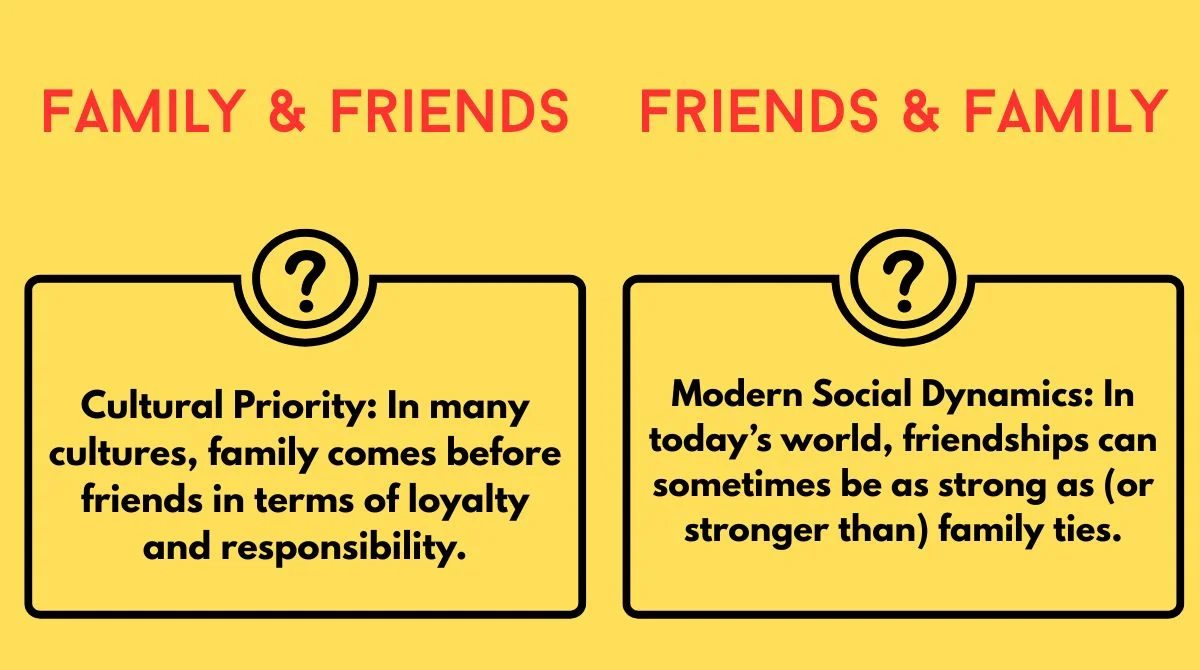
    1. Cultural Priority: In many cultures, family comes before friends in terms of loyalty and responsibility.
    2. Emotional Connection: Parents, siblings, and relatives are often seen as a lifelong support system.
    3. Legal & Social Importance: Family members usually have more legal and financial responsibilities toward each other than friends do.

    Why Do Some Prefer “Friends & Family”?

    1. Modern Social Dynamics: In today’s world, friendships can sometimes be as strong as (or stronger than) family ties.
    2. Marketing and Branding: Some businesses, particularly in hospitality, use “Friends & Family” because it sounds more inviting and inclusive.
    3. Personal Preference: Some people feel more emotionally connected to their friends and naturally put them first.

    Key Takeaway: The phrase you choose can subtly reflect how you perceive relationships.


    Grammatical Rules and Cultural Nuances

    From a grammatical standpoint, both “Family & Friends” and “Friends & Family” are correct. However, English often follows specific patterns when listing words.

    Does English Grammar Dictate the Order?

    English has a tendency to follow an euphonic order, meaning words are arranged based on how pleasing they sound. Often, shorter words or those with fewer syllables come first.

    • Example: “Salt and Pepper” (not “Pepper and Salt”)
    • Example: “Bread and Butter” (not “Butter and Bread”)

    However, “family” and “friends” have the same number of syllables, so euphony doesn’t play a major role here. Instead, cultural influence takes the lead.

    Regional Preferences

    • American English: “Family & Friends” is more common, emphasizing familial ties first.
    • British English: Both variations are used interchangeably.
    • Australian & Canadian English: Tends to follow American English but varies depending on context.

    Key Takeaway: While there’s no strict grammar rule, culture and tradition shape the common preference.


    Formal Salutations: How to Address Letters and Invitations

    When writing formal invitations, event announcements, or professional letters, the order of “Family & Friends” or “Friends & Family” can make a difference.

    Which One is More Appropriate?

    • Weddings & Family Gatherings: “Family & Friends” is typically preferred since family is often considered the primary focus.
    • Casual Events & Social Gatherings: “Friends & Family” may be used when the event is primarily social rather than family-centered.

    Examples of Formal Salutations:

    Event TypePreferred Greeting
    Wedding Invitations“Dear Family & Friends,”
    Corporate Events“Dear Friends & Family,”
    Funeral Announcements“To Our Beloved Family & Friends,”
    Birthday Invitations“To All Our Friends & Family,”

    Key Takeaway: The formality of the occasion influences the order of the phrase.


    Understanding Salutation Etiquette

    If you’re unsure which order to use in a salutation, consider the following etiquette tips:

    1. Prioritize Your Audience: If writing to family first, use “Family & Friends.” If addressing a friend-focused event, “Friends & Family” is acceptable.
    2. Consider the Occasion: Formal and traditional settings typically lean toward “Family & Friends.”
    3. Follow Social Norms: Look at common usage in similar invitations or documents to guide your choice.
    4. Personalize Your Greeting: When in doubt, address people by name for a more thoughtful touch.

    Example Personalized Greeting:
    “Dear Mom, Dad, and all our wonderful family & friends, we are excited to celebrate this special day with you!”


    The Impact of Capitalization in Greetings

    Capitalization plays a crucial role in clarity and professionalism when using “Family & Friends” or “Friends & Family” in written communication.

    Should You Capitalize Both Words?

    • Formal Writing (Invitations, Announcements): Yes.
      Example: “We are delighted to invite our Family & Friends to celebrate with us.”
    • Casual or Personal Notes: Not necessary.
      Example: “Looking forward to seeing all my family and friends soon!”

    Incorrect Capitalization Mistakes to Avoid:

    “family & Friends”
    “Friends & family”
    “family and friends” (when used as a formal greeting)

    Key Takeaway: Proper capitalization enhances readability and professionalism.


    Historical and Modern Usage Trends

    The order of “Family & Friends” vs. “Friends & Family” has evolved over time.

    Historical Perspective

    • In the 19th and early 20th centuries, traditional values emphasized the primacy of family, making “Family & Friends” the standard.
    • In the mid-20th century, social movements emphasizing individuality and chosen relationships made “Friends & Family” a more common alternative.

    Modern Usage Trends

    • Marketing & Advertising: Businesses often use “Friends & Family” (e.g., “Friends & Family Discount”) to appear more inclusive.
    • Social Media & Informal Settings: Both are used interchangeably, often depending on personal preference.

    Key Takeaway: Language adapts to societal changes, and both versions remain widely accepted.


    Alternatives to “Family & Friends” in Expressing Kinship

    If you want to avoid the debate altogether, consider using alternative phrases:

    Common Alternatives:

    1. Loved Ones (Example: “We invite all our loved ones to celebrate.”)
    2. Dear Ones (Example: “To our dear ones, we appreciate your support.”)
    3. Close Circle (Example: “Spending time with my close circle always brings joy.”)
    4. Community (Example: “Thank you to our community for being there.”)
    5. cohort (Example: “Grateful for my tribe and their unwavering love.”)

    Choosing an alternative phrase can add warmth and inclusivity without worrying about order.


    FAQs

    Is “Family & Friends” more common than “Friends & Family”?

    Yes, “Family & Friends” is more common, as family is traditionally considered more important in many cultures.

    Why do some people say “Friends & Family” instead?

    “Friends & Family” is often used in marketing, social events, and informal settings where friendships are emphasized.

    Which phrase is better for invitations?

    For weddings and formal gatherings, “Family & Friends” is preferred. For casual events, “Friends & Family” can work.

    Does English grammar dictate the order of words?

    Not strictly, but English often follows a natural order based on importance, euphony, or common usage.

    Should both “Family” and “Friends” be capitalized?

    Yes, in formal writing (e.g., invitations), both words should be capitalized: “Family & Friends.” In casual writing, lowercase is fine.

    What are some alternatives to “Family & Friends”?

    You can use “Loved Ones,” “Dear Ones,” “Close Circle,” or “Community” to avoid the debate and sound more inclusive.


    Conclusion

    So, should you say “Family & Friends” or “Friends & Family”? Ultimately, both are grammatically correct, but their usage depends on tradition, context, and personal preference.

    • If emphasizing tradition and formality → “Family & Friends”
    • If highlighting social bonds and inclusivity → “Friends & Family”
    • If in doubt → Use an alternative phrase like “Loved Ones”

    Understanding these nuances ensures you use the right phrase for the right situation, whether in invitations, greetings, or daily conversations.

    What’s your preference—“Family & Friends” or “Friends & Family”? Let us know in the comments!

  • ✅ Correct or Correctly? Easy Grammar Guide with Examples

    ✅ Correct or Correctly? Easy Grammar Guide with Examples

    English can be tricky. One small change in a word’s ending can completely shift its meaning. A common stumbling block for learners is the choice between “correct” and “correctly.” At first glance, they seem almost the same.

    In practice, however, they serve very different grammatical functions.

    In this article, we’ll dive into the actual difference between “correct” vs. “correctly.” You’ll see how to use each word properly, spot common mistakes, and learn easy memory tricks that make the choice second nature.


    Understanding the Core Difference: “Correct” vs. “Correctly”

    Correct or Correctly

    The key difference comes down to parts of speech.

    • Correct is an adjective. It describes nouns.
    • Correctly is an adverb. It describes verbs, adjectives, or other adverbs.

    Think of it like this:

    • Adjective (“correct”) → Answers “what kind?”
    • Adverb (“correctly”) → Answers “how?”

    Here’s a quick comparison table:

    WordPart of SpeechWhat It ModifiesExample
    CorrectAdjectiveNoun or pronounThat is the correct answer.
    CorrectlyAdverbVerb, adjective, adverbShe spelled the word correctly.

    👉 Shortcut memory tip: If you’re describing a thing, use correct. If you’re describing an action, use correctly.


    How to Use “Correct” in a Sentence

    Since correct is an adjective, it always attaches to nouns or pronouns. You’re labeling something as accurate, appropriate, or free from mistakes.

    Examples in everyday use:

    • The correct answer is B.
    • He followed the correct procedure.
    • This is not the correct time to bring it up.

    Notice how in each example, correct directly describes a noun (answer, procedure, time).

    When “correct” adds nuance

    The word correct doesn’t always mean “true.” It can also mean:

    • Appropriate for the situationThat’s the correct attire for a wedding.
    • Socially acceptableShe uses the correct form of address when writing formal letters.

    Common mistake learners make

    Many learners try to stick correct onto verbs, for example:
    You did it correct.
    This feels wrong to a native speaker, because “did” is a verb, and verbs need adverbs like “correctly,” not adjectives.


    How to Use “Correctly” in a Sentence

    Correctly is the adverb form. It answers how an action is done.

    Examples in everyday use:

    • She answered the question correctly.
    • He correctly identified the problem.
    • Make sure you’re pronouncing it correctly.

    Here, correctly modifies the verbs answered, identified, pronouncing.

    Why adverbs matter

    Without adverbs, sentences can sound vague. Compare:

    • He spoke. (basic fact)
    • He spoke correctly. (shows how he spoke — in the right way)

    Common mistake learners make

    Some learners overuse “correctly” when correct is better:
    That is correctly answer.
    ✔️ That is the correct answer.


    Common Confusions in Real Sentences

    Let’s tackle the sentences that cause the most confusion for English learners.

    “I did it correct” vs. “I did it correctly”

    • I did it correctly.
      This is grammatically right because “did” is a verb and verbs require adverbs.
    • I did it correct.
      Here “correct” is acting like an adjective, but there’s no noun to describe. It feels incomplete.

    👉 Rule: When explaining how something was done, always use correctly.


    “You got it correct” vs. “You got it correctly”

    This one is trickier. Both look reasonable, but only one works.

    • You got it correct.
      Why? Because “it” refers to the answer (a noun). “Correct” is describing the noun.
    • You got it correctly.
      This suggests that the action of “getting” was correct, which doesn’t fit standard grammar.

    👉 Rule: When referring back to a thing (like “it”), use correct.


    Quick comparison table

    SentenceCorrect or Incorrect?Why?
    I did it correct.❌ WrongNeeds an adverb for “did.”
    I did it correctly.✅ Right“Correctly” modifies the verb.
    You got it correct.✅ Right“Correct” describes “it.”
    You got it correctly.❌ Wrong“Correctly” doesn’t fit here.

    Grammar Breakdown: What Part of Speech Is “Correctly”?

    Correctly is an adverb formed by adding “-ly” to the adjective correct.

    Quick rules for spotting adverbs:

    1. Most adverbs end in “-ly.”
    2. They answer how, when, where, or to what degree.
    3. They often sit near verbs.

    Examples:

    • quick → quickly
    • happy → happily
    • correct → correctly

    Correctly specifically tells us how something was done.


    Is “Correctly” Always the Right Choice?

    Not always. Sometimes correct works better, depending on the sentence structure.

    When to use “correct” instead of “correctly”

    • With nouns: That’s the correct answer.
    • After linking verbs like be, seem, appear:
      • Your solution is correct.
      • It seems correct to me.

    When “correctly” sounds more natural

    • With action verbs: She spelled it correctly.
    • To emphasize method: He correctly followed the instructions.

    Formal vs. casual speech

    In casual English, people sometimes bend the rule:

    • You did it right. (instead of “correctly”)
    • That’s the right answer. (instead of “correct answer”)

    👉 “Right” often replaces “correct/correctly” in everyday conversation, but in formal writing or exams, stick with “correct” and “correctly.”


    Case Study: Classroom Example

    Imagine a teacher grading a test:

    • When she circles an answer and writes “Correct,” she’s describing the answer itself.
    • When she says, “You solved the equation correctly,” she’s praising the method used.

    The difference shows up clearly in real learning environments: correct = result, correctly = process.


    Memory Trick to Never Forget

    Think of it like baking a cake:

    • If the cake is “correct,” it looks and tastes as it should.
    • If you baked it correctly, you followed the recipe the right way.

    👉 Result = correct.
    👉 Process = correctly.


    ❓ FAQs

    What is the difference between “correct” and “correctly”?

    Correct is an adjective that describes nouns, while correctly is an adverb that describes actions.


    Can I say “I did it correct”?

    No. The right form is “I did it correctly” because adverbs modify verbs.


    Is it right to say “You got it correct”?

    Yes. In this case, “correct” describes the answer (a noun), so it’s grammatically fine.


    What part of speech is “correctly”?

    “Correctly” is an adverb formed from the adjective “correct.” It tells us how something was done.


    Is “correctly” always better than “correct”?

    Not always. Use “correct” with nouns (the correct answer) and “correctly” with verbs (she answered correctly).


    Can I use “right” instead of “correctly”?

    In casual English, yes. For example, you did it right. But in formal English, “correctly” is preferred.


    Conclusion

    The choice between correct and correctly is more than just a matter of adding “-ly.” It’s about whether you’re describing a thing or an action.

    • Use correct for nouns: the correct answer, a correct method.
    • Use correctly for verbs: he answered correctly, she typed it correctly.
    • Remember: result = correct, process = correctly.

    With practice, the distinction becomes second nature. Try writing your own examples with both words. The more you use them in context, the more natural they’ll feel.

  • Whichever vs Whatever 🤔 | Key Differences with Clear Examples

    Whichever vs Whatever 🤔 | Key Differences with Clear Examples

    English is full of words that look similar but carry different meanings depending on context. Two such words are whichever and whatever.

    At first glance, they may appear interchangeable, but in reality, they serve distinct roles in grammar and communication.

    If you’ve ever wondered whether to use whichever or whatever, this guide will clear up the confusion with detailed explanations, examples, and comparisons.


    Introduction

    You’ve probably heard both phrases:

    • “Take whichever book you like.”
    • “Take whatever book you like.”

    At first, they look the same. Both suggest freedom of choice. But dig deeper, and you’ll notice a subtle difference: whichever usually refers to a choice from a defined set, while whatever suggests no limits or restrictions at all.

    In this article, we’ll walk through grammar rules, real-world usage, common mistakes, and even a practice section so you’ll leave with a crystal-clear understanding of whichever vs. whatever.


    Understanding the Basics of “Whichever” and “Whatever”

    Whichever or Whatever

    Both words belong to the family of compound words with “-ever”. This group also includes whoever, whenever, wherever, however. They act as pronouns or determiners, and sometimes introduce dependent clauses.

    Here’s the quick breakdown:

    • Whichever = from among a limited or specific set.
    • Whatever = from an unlimited or unrestricted set.

    Think of whichever as pointing at a basket with a few apples and saying, “Pick any one of these.”
    Think of whatever as pointing at the entire orchard and saying, “Pick anything you want.”


    Whichever – Detailed Explanation

    Grammar Rules for “Whichever”

    • Functions as a determiner: modifies a noun to show choice.
      • Whichever option you choose, you’ll succeed.
    • Functions as a pronoun: replaces the noun while still referring to a set of options.
      • You may take whichever suits you best.
    • Used in subordinate clauses:
      • I’ll follow whichever path leads to success.

    Usage Context

    • Choosing among defined or limited options.
    • Expressing conditionality or preference within a group.
    • Suggesting flexibility, but only within a set boundary.

    Examples of “Whichever” in Sentences

    • Determiner: Choose whichever seat is free.
    • Pronoun: You can select whichever fits your style.
    • Clause: Whichever decision you make, I’ll support you.

    Table: Examples of “Whichever”

    SentenceExplanation
    Take whichever road you prefer.Choice from a fixed number of roads.
    She’ll accept whichever proposal gets approved.Restricted to submitted proposals.
    Whichever player wins, the trophy stays in Europe.Limited to the players in that game.

    Whatever – Detailed Explanation

    Grammar Rules for “Whatever”

    • Functions as a determiner: modifies nouns to show no restriction.
      • Wear whatever clothes you like.
    • Functions as a pronoun: refers broadly without boundaries.
      • Do whatever makes you happy.
    • Used in subordinate clauses:
      • Whatever happens, keep smiling.

    Usage Context

    • Refers to unlimited or unknown options.
    • Expresses indifference or lack of concern.
    • Often used informally to dismiss something.

    Examples of “Whatever” in Sentences

    • Determiner: Choose whatever topic you want for your essay.
    • Pronoun: Whatever you decide is fine with me.
    • Clause: Whatever the reason, he refused to join.

    Table: Examples of “Whatever”

    SentenceExplanation
    Eat whatever you find in the fridge.Unlimited food choices.
    Say whatever comes to your mind.No restriction on words or thoughts.
    Whatever mistakes you make, you’ll learn from them.Covers all possible mistakes.

    Key Differences Between “Whichever” and “Whatever”

    Although both indicate flexibility, they aren’t identical.

    Comparison Chart

    FeatureWhicheverWhatever
    ScopeLimited set of choicesUnlimited, unrestricted choices
    ToneNeutral, polite, specificBroader, sometimes indifferent
    Use CaseDefined situations (roads, seats, options)Open-ended or all-encompassing
    ExampleChoose whichever book from the shelf.Choose whatever book in the library.

    Side-by-Side Usage

    • Take whichever pen from this box. (Box = limited set)
    • Take whatever pen you find anywhere. (No restriction, any pen)

    Related Words That Learners Confuse

    The “-ever” family in English often creates confusion. Let’s break down a few:

    Whoever

    • Means any person who.
    • Example: Whoever calls first will get the ticket.

    Whenever

    • Means at any time that.
    • Example: Come whenever you like.

    Wherever

    • Means at any place that.
    • Example: Sit wherever you want.

    However

    • Means in whatever way.
    • Example: However you solve it, just get it done.

    Why This Matters

    Learners often assume these words are interchangeable. They’re not. Each combines a base word (who, when, where, how, which, what) with “-ever” to express openness or flexibility, but the scope differs.


    Common Mistakes and How to Avoid Them

    Mistake 1: Using whichever when no options are defined

    Take whichever you like (without showing options).
    Take whichever cookie from this plate.

    Mistake 2: Overusing whatever in formal writing

    Submit whatever assignment you want.
    Submit any assignment from the list.

    Mistake 3: Confusing tone in casual speech

    • Whatever is often used dismissively. Example: “Yeah, whatever.”
    • This is fine informally, but not in academic or professional contexts.

    Quick Quiz / Practice Section

    Try filling in the blanks with either whichever or whatever.

    1. ________ road you take, you’ll reach the city.
    2. Choose ________ movie you want to watch.
    3. I’ll support you in ________ choice you make.
    4. ________ student finishes first may leave early.
    5. Don’t eat ________ is in the bag; it might be spoiled.

    Answer Key

    1. Whichever
    2. Whatever
    3. Whatever
    4. Whichever
    5. Whatever

    Case Study: Real-Life Use in Speeches and Literature

    Writers and speakers often rely on subtle word choice to shape meaning:

    • Barack Obama, in his speeches, often used whichever to sound precise and inclusive, e.g., “Whichever path we take must be rooted in our values.”
    • In contrast, Shakespeare used forms of whatever to heighten drama, e.g., “Whatever may happen, fortune favors the bold.”

    This shows how the nuance between the two words can carry tone, intention, and emotional weight.


    FAQs

    What is the main difference between whichever and whatever?

    Whichever refers to a choice from a limited set, while whatever refers to an unlimited or unrestricted choice.

    Can I use whichever and whatever interchangeably?

    No. They aren’t interchangeable. Whichever works with specific options, and whatever works with broader, open-ended choices.

    Is whatever considered informal?

    Yes, especially when used dismissively (e.g., “Yeah, whatever”). In formal writing, it’s better to use alternatives like any or all that.

    When should I use whichever in a sentence?

    Use whichever when choices are clear or limited. Example: Pick whichever chair you prefer from the row.

    How is whatever used in daily conversation?

    It often shows indifference, permission, or openness. Example: Do whatever you like.

    What are other -ever words in English besides whichever and whatever?

    Other common ones include whoever, whenever, wherever, and however, each adding flexibility to the base word.


    Conclusion

    The difference between whichever vs. whatever boils down to scope:

    • Whichever = limited, defined set of options.
    • Whatever = unlimited, unrestricted choice.

    Both words are powerful tools for flexibility in English. By learning when to use each, you’ll avoid confusion, sound more natural, and express yourself with precision.

    Final takeaway: Whichever is for specific choices. Whatever is for all choices.

    So next time you face a decision, remember—your grammar depends on it.