Category: Tricky Terms

  • Eventhough vs Even Though ✨ Grammar Rule You Can’t Ignore

    Eventhough vs Even Though ✨ Grammar Rule You Can’t Ignore

    English is full of phrases that look like they should exist but don’t. One of the most common offenders is “eventhough.” At first glance, it feels like it belongs in the language. After all, we join words all the time—“everyday,” “anymore,” “nowadays.” So why not “eventhough”?

    Here’s the truth: “eventhough” is never correct. The correct form is always “even though.”

    That sounds simple, but there’s a reason so many people keep typing it wrong. In this article, we’ll dive deep into why “eventhough” is incorrect, how to use “even though” naturally, and practical tricks to avoid mistakes.


    Understanding the Confusion: Why “Eventhough” Looks Plausible
    Eventhough vs Even Though

    If you’ve ever typed “eventhough,” you’re not alone. The mistake happens because:

    • We often pronounce “even though” quickly, making it sound like one long word.
    • English already has examples of words that started as two words but fused together (e.g., “every day” → “everyday”).
    • People tend to trust their ears over their eyes when spelling.

    It doesn’t help that autocorrect sometimes misses the error. Add in casual texting culture, and “eventhough” spreads fast.

    Think of it like hearing a song lyric wrong and singing it confidently for years—until someone points out what it really says.


    Grammar Rule: Why “Even Though” Is the Only Correct Form

    Here’s the rule: “even though” is a concessive conjunction. That means it introduces a contrast or unexpected result, similar to “although” or “despite the fact that.”

    • Correct: Even though it was raining, we went hiking.
    • Incorrect: Eventhough it was raining, we went hiking.

    Unlike words such as “everyday,” which evolved into a single word, “even though” has never been accepted as one word in any dictionary, grammar book, or style guide.


    Origin & Historical Usage of “Even Though”

    The phrase “even though” dates back to Middle English. Both “even” and “though” were used separately long before they were paired.

    • “Though” has roots in Old English (þēah), meaning “nevertheless” or “however.”
    • “Even” has long been used for emphasis, meaning “just” or “exactly.”

    When combined, they formed a phrase that emphasizes contrast. Unlike “anymore” or “already,” this pair never fused into one word historically. That’s why “eventhough” has no linguistic basis.


    Why “Eventhough” Is Always Incorrect

    Every major English authority rejects “eventhough.” That includes:

    • Oxford English Dictionary
    • Merriam-Webster
    • Cambridge Dictionary
    • Chicago Manual of Style

    Type “eventhough” into Word, Google Docs, or Grammarly—you’ll get a red underline every time.

    Still, you’ll find it on social media, in casual chats, and sometimes even in blog posts. Just because it exists in writing doesn’t mean it’s right.


    The Cost of Using the Wrong Form

    Does it really matter if you type “eventhough”? Yes—context decides how serious the mistake looks.

    • In professional settings: Writing “eventhough” in a cover letter, report, or client email can make you look careless.
    • In academics: Professors and examiners mark down grammar mistakes in essays or theses.
    • In SEO writing: Google prefers clean, authoritative text. Misspellings reduce credibility and ranking potential.

    A small mistake can create a big impression. Think of it like showing up to a job interview with mismatched shoes.


    Myths and Misconceptions About “Eventhough”

    Some people argue, “Language evolves—maybe one day ‘eventhough’ will be correct.” That’s unlikely.

    Why? Because:

    • No dictionary or style guide shows evidence of adoption.
    • The phrase isn’t simplifying language. Writing “even though” is already short and clear.
    • Similar phrases (“as if,” “in spite of”) remain separate words despite centuries of use.

    So while texting slang like “gonna” or “lemme” may gain informal acceptance, “eventhough” stays outside the rules.


    Usage in Context: How to Use “Even Though” Naturally

    “Even though” introduces contrast. Here’s how it looks in real life:

    • Even though I was tired, I finished the project.
    • She smiled, even though she was nervous.
    • He kept playing, even though it started raining.

    To make it crystal clear, here’s a comparison table:

    Incorrect (❌)Correct (✅)
    Eventhough I studied, I failed the test.Even though I studied, I failed the test.
    She came late eventhough she promised.She came late, even though she promised.
    Eventhough it’s cheap, I won’t buy it.Even though it’s cheap, I won’t buy it.

    Common Mistakes and Fixes

    Here are the most frequent errors:

    • Writing it as one word → Fix: Always two words.
    • Dropping “even”Though it rained, we went out is fine, but it’s not the same as “even though.”
    • Overusing it → Too many “even though” sentences can make writing clunky.

    Before-and-after example:

    • Eventhough I wanted coffee, I drank tea. Eventhough it was late, I stayed up. Eventhough I was tired, I worked.
    • Even though I wanted coffee, I drank tea. Later, even though it was late, I stayed up. Eventually, despite being tired, I kept working.

    Notice how variety keeps the flow natural.


    Pronunciation vs. Spelling: Why the Ear Tricks the Eye

    Say this quickly: “Even though it’s cold, I’ll go outside.”

    Sounds like one long word, right? That’s why “eventhough” pops up so often. Our ears merge sounds when we speak fast.

    But spelling must follow grammar rules, not pronunciation. Otherwise, we’d also write:

    • “gonnago” instead of “going to go”
    • “dunno” instead of “don’t know”

    Those spellings belong in informal texting, not standard English.


    Global Perspective: Do Other Languages Combine Similar Phrases?

    Yes, but English works differently.

    • In German, long words are often merged: obwohl (although) literally means “whether-though.”
    • In Spanish, phrases like aunque combine “aunque” (although) into one word.
    • In French, bien que stays separate, just like English “even though.”

    So while other languages sometimes merge, English hasn’t with “even though.”


    The Digital Factor: Autocorrect, Spellcheck & Internet Language

    Technology plays a role in spreading errors:

    • Autocorrect: Sometimes ignores “eventhough” because it looks similar to “although.”
    • Predictive text: Phones suggest “eventhough” based on frequent typing patterns.
    • Internet culture: Social media rewards speed over accuracy. If you’re typing fast, mistakes spread.

    Ironically, the very tools designed to help us sometimes reinforce errors.


    Tricks to Remember the Correct Form

    Want a quick way to stop writing “eventhough”? Try these mnemonics:

    • Think of “even if, even when, even though” → all two words.
    • Imagine the word “evening.” You wouldn’t write “eventing.” Same logic applies.
    • Visual trick: Write it as EVEN + THOUGH in bold or uppercase when practicing.

    The more you train your eyes, the less your ears will trick you.


    Quick Grammar Check: Alternatives to “Even Though”

    Sometimes, you don’t need “even though.” Other options include:

    PhraseUsage Example
    AlthoughAlthough it rained, we played soccer.
    ThoughThough he was late, he apologized.
    DespiteDespite the cold, she went swimming.
    In spite ofIn spite of the delay, we arrived on time.

    Tip: “Even though” adds stronger emphasis than “although” or “though.”


    Real-Life Applications: Fixing Your Writing Instantly

    If you catch yourself typing “eventhough,” here’s how to fix it:

    1. Search your document for “eventhough.”
    2. Replace all with “even though.”
    3. Read aloud to make sure it flows naturally.

    Example fix:

    • Original: Eventhough it was snowing, they went outside.
    • Fixed: Even though it was snowing, they went outside.

    Simple, effective, and instantly correct.


    Why It Pays to Get It Right

    Mastering small details like this makes a big difference. When you consistently write “even though” correctly:

    • You sound professional and credible.
    • Readers trust your message.
    • Employers, teachers, and clients see you as detail-oriented.

    Correct grammar isn’t about being a perfectionist—it’s about showing respect for your audience.


    🙋 FAQs

    What is the difference between “eventhough” and “even though”?

    “Eventhough” is always incorrect, while “even though” is the only correct form used to express contrast.

    Is “eventhough” ever accepted in English?

    No, dictionaries and grammar authorities do not recognize “eventhough” as a valid word.

    Can I use “even though” in formal writing?

    Yes, “even though” works in both formal and informal writing to show contrast.

    What are some alternatives to “even though”?

    You can use “although,” “though,” “despite,” or “in spite of,” depending on the context.

    Why do people mistakenly write “eventhough”?

    It happens because in fast speech, “even though” sounds like one word, tricking the ear and influencing spelling.

    How can I remember to write “even though” correctly?

    Use memory tricks like “even if, even when, even though” — all are always two words.


    Conclusion

    At the end of the day, the Eventhough vs Even Though debate isn’t really a debate at all. One is a common mistake, and the other is the only correct choice.

    Remember:

    • Always two words → even though.
    • Use it when showing contrast.
    • Avoid the trap of letting your ears decide your spelling.

    So next time your fingers want to type “eventhough,” pause, separate the words, and keep your writing sharp.

  • “My Wife and I” or “My Wife and Me” 🤔 The Clear Grammar Rule Explained

    “My Wife and I” or “My Wife and Me” 🤔 The Clear Grammar Rule Explained

    If you’ve ever paused mid-sentence wondering whether to say “my wife and I” or “my wife and me,” you’re not alone. Even native speakers trip over this choice because both sound familiar in everyday speech.

    One version is grammatically correct in certain contexts, while the other works in different situations. And then there’s “me and my wife,” which adds another wrinkle.

    This guide cuts through the confusion with clear rules, examples, and memory tricks. By the end, you’ll know exactly which phrase to use, why it matters, and how to avoid common mistakes.


    Understanding the Basics: “I” vs. “Me”

    My Wife and I or My Wife and Me

    The whole debate comes down to the roles words play in a sentence. English grammar divides pronouns into two camps:

    • Subject pronouns (I, he, she, we, they)
    • Object pronouns (me, him, her, us, them)

    Subjects perform the action. Objects receive the action.

    Examples without “wife” for clarity:

    • I went to the store. (I = subject)
    • He gave it to me. (Me = object)

    Now let’s add “my wife” into the mix:

    • My wife and I went to the store. (We = subject)
    • He gave the tickets to my wife and me. (Us = object)

    Already, you can see the difference. But word order and tone also shape how natural each phrase sounds.


    Word Order and Politeness Rules

    English speakers usually list the other person before themselves in sentences. It’s considered polite and less self-centered.

    • My wife and I are traveling this summer.
    • I and my wife are traveling this summer.

    That’s why “my wife and I” sounds smoother than “I and my wife.”

    As for “me and my wife,” people use it often in casual conversation. While not technically wrong in some cases, it can sound informal or careless in writing or professional contexts.

    Think of it like table manners: eating with your hands at a picnic is fine, but at a wedding dinner, it feels out of place.


    Case Study 1: “My Wife and I” as the Subject

    “My wife and I” should be used when the phrase functions as the subject—the doers of the action.

    Examples:

    • My wife and I are planning a trip.
    • My wife and I baked a cake.
    • He invited my wife and I to dinner. (wrong: “I” is not an object)

    Common mistakes to avoid:

    • Using “I” as an object just because it “sounds more formal.”
    • Overcorrecting in professional settings by saying “I” when “me” is right.

    👉 Quick check: Remove “my wife.” If the sentence still works with “I,” you’ve got it right.

    • I baked a cake.
    • He invited I.

    Case Study 2: “My Wife and Me” as the Object

    Use “my wife and me” when the phrase receives the action—the object of the sentence.

    Examples:

    • He invited my wife and me to the party.
    • The manager spoke to my wife and me about the policy.
    • My wife and me went to the concert. (wrong: “me” isn’t a subject)

    Why mistakes happen:
    People often assume “I” always sounds smarter or more formal. This leads to hypercorrection—using “I” in places where “me” is actually right.

    👉 Memory trick: Remove “my wife.” If “me” fits, then “my wife and me” is correct.

    • He invited me.
    • Me went to the concert.

    Is “Me and My Wife” Always Wrong?

    Not always. Grammatically, “me and my wife” can be correct when used as an object:

    • He invited me and my wife to dinner.

    But when it’s the subject, it sounds informal—even though many people use it:

    • Me and my wife went shopping. (common but not polished)

    The issue isn’t grammar alone—it’s perception. Saying “me and my wife” at a job interview or in formal writing gives an uneducated impression. Among friends, though, no one will blink.


    The Awkward Option: “I and My Wife”

    Technically, “I and my wife” is grammatically correct as a subject. But it sounds stilted and unnatural. English prefers the other person first, yourself second.

    • I and my wife are going to the event. (grammatical but clumsy)
    • My wife and I are going to the event. (natural and polished)

    Think of it as the linguistic version of holding the door open—it just feels right.


    The Reflexive Trap: “My Wife and Myself”

    One of the most common professional email blunders is writing “my wife and myself” when “my wife and me” is correct.

    Examples:

    • He invited my wife and myself. (wrong)
    • He invited my wife and me.

    Reflexive pronouns like “myself” are only correct when:

    • You reflect the subject back on itself: I made myself a sandwich.
    • You emphasize: I’ll do it myself.

    Outside those uses, “myself” doesn’t belong.


    Language in the Real World: Pop Culture & Everyday Speech

    Everyday language often bends rules. Pop culture cements these habits.

    Examples from movies and songs:

    • “Me and Bobby McGee” (Kris Kristofferson/Janis Joplin)
    • “Me and You” (Kenny Chesney)

    While catchy, they don’t showcase formal grammar. In professional or academic writing, those patterns don’t fly.

    But in casual speech, no one pulls out a grammar book. Context dictates whether you stick to rules or let them slide.


    Practical Grammar Test

    Try this quick test. Fill in the blanks before checking the answers.

    1. _____ are going to the beach.
    2. He invited _____ to the ceremony.
    3. The teacher spoke to _____ about the project.
    4. _____ baked cookies for the bake sale.

    Answers:

    1. My wife and I are going to the beach.
    2. He invited my wife and me to the ceremony.
    3. The teacher spoke to my wife and me about the project.
    4. My wife and I baked cookies for the bake sale.

    Common Mistakes and Why They Happen

    Why do people stumble over this? Three main reasons:

    • Hypercorrection: Thinking “I” always sounds smarter.
    • Speech habits: Casual talk influences writing.
    • Reflexive misuse: Overusing “myself” to avoid choosing between “I” and “me.”

    These errors are so common that most people overlook them in conversation. But in writing, especially formal contexts, they stand out.


    Expert Insights

    Grammar authorities agree: follow the subject-object rule.

    • Chicago Manual of Style: Always use “I” as a subject and “me” as an object.
    • Merriam-Webster: Notes that “me and my wife” is widespread in speech but not recommended in formal writing.

    Quote from linguist Steven Pinker:

    “Correct grammar is less about prestige and more about clarity. When in doubt, choose the option that makes the sentence easiest to process.”


    Formal vs. Informal: Which Form to Use Where

    Formal contexts (resume, academic paper, work email):

    • Always stick with “my wife and I” (subject) or “my wife and me” (object).

    Informal contexts (texts, casual conversations, social media):

    • “Me and my wife” won’t raise eyebrows, but it’s less polished.

    Rule of thumb: When your reputation matters, follow strict grammar rules. When chatting casually, focus on sounding natural.


    Visual Aid: Summary Table

    UsageCorrect FormExampleNotes
    SubjectMy wife and IMy wife and I are hosting dinner.Always correct in subject position.
    ObjectMy wife and meThe gift was for my wife and me.Correct object form.
    InformalMe and my wifeMe and my wife went shopping.Common in speech but not formal.
    WrongMy wife and myselfHe gave it to my wife and myself.Reflexive misuse.

    Native Speaker Tips to Sound Polished

    Here are three quick tips to always get it right:

    1. Drop “my wife.”
      • If “I” works, use “my wife and I.”
      • If “me” works, use “my wife and me.”
    2. Put your partner first.
      • Say “my wife and I,” not “I and my wife.”
    3. Avoid reflexives unless necessary.
      • Skip “myself” unless it’s reflecting back on “I.”

    With practice, this choice becomes second nature.


    🙋 FAQs

    What is the difference between “my wife and I” and “my wife and me”?

    Use “my wife and I” as the subject of the sentence and “my wife and me” as the object.

    Is it wrong to say “me and my wife”?

    It’s not strictly wrong, but it sounds informal. In formal writing, always use “my wife and I” or “my wife and me.”

    Why does “I and my wife” sound awkward?

    English places the other person first out of politeness, so “my wife and I” sounds natural while “I and my wife” feels clumsy.

    Can I use “my wife and myself” instead?

    No, unless the sentence truly requires a reflexive pronoun. “Myself” is often misused in place of “me.”

    How can I easily check if I should use “I” or “me”?

    Remove “my wife” from the sentence. If “I” works, use “my wife and I.” If “me” works, use “my wife and me.”

    Do people care if I use the wrong one in casual speech?

    Most people won’t notice in conversation, but in professional or formal writing, the mistake stands out.


    Conclusion

    So, should you say “my wife and I” or “my wife and me”? The answer depends entirely on the role the phrase plays in the sentence. Use “my wife and I” when it’s the subject.

    Use “my wife and me” when it’s the object. Skip “I and my wife” unless you enjoy sounding robotic, and avoid “my wife and myself” unless the grammar truly calls for a reflexive.

    Language is fluid, and in casual speech people bend rules without consequence. But when you want to sound polished and professional, sticking to subject-object grammar keeps your message clear and confident.

  • Assist With or Assist In? Grammar Rules & Examples Explained! ✅

    Assist With or Assist In? Grammar Rules & Examples Explained! ✅

    When it comes to using “assist with” and “assist in,” many English learners and even native speakers find themselves second-guessing which preposition is correct.

    While both phrases convey a similar meaning, they are not always interchangeable. The difference lies in context, grammatical nuances, and usage patterns in modern English.

    This article will break down the distinctions between assist with and assist in, explore their historical roots, and analyze dictionary definitions, linguistic data, and real-world applications.

    By the end, you’ll have a solid understanding of when and how to use each phrase correctly.

    Should you use “assist with” or “assist in”? The difference depends on whether you’re referring to a specific task (assist with) or a broader process (assist in). Learn the grammar rules, examples, and expert insights to always use the right phrase!


    Understanding “Assist With” Through Historical Usage

    Assist With or Assist In

    The phrase assist with has been in use for centuries, primarily appearing in contexts where one provides help with a tangible task, object, or process.

    Historically, assist with gained traction in the 19th and 20th centuries, especially in professional, technical, and casual conversations. The preposition with naturally connects to things, making assist with the preferred choice for handling objects, tasks, or responsibilities.

    Examples from Historical Texts

    • 19th Century Usage: “He was asked to assist with the preparation of legal documents.”
    • 20th Century Literature: “Nurses assist with patient care by managing daily treatments.”

    In both examples, assist with is used when referring to tangible, specific tasks that require direct involvement.


    Exploring “Assist In” Across Modern Dictionaries

    Unlike assist with, which often relates to objects or tasks, assist in is typically used for ongoing processes, activities, or abstract actions. Modern dictionaries, including Oxford, Macmillan, and Cambridge, highlight this distinction by showing different contexts for each phrase.

    Let’s examine their definitions and examples.


    Oxford and Macmillan’s Take on Assisting In Actions

    Oxford Dictionary Definition

    Oxford defines assist in as helping to bring about or facilitate a particular action or process.

    Example Usage:

    • “He assisted in organizing the charity event.”
    • “She assists in developing new marketing strategies.”

    In these examples, assist in refers to participation in an ongoing process or activity rather than a singular, tangible task.

    Macmillan Dictionary’s Insights

    Macmillan reinforces this perspective, describing assist in as helping with actions that involve processes, events, or decision-making.

    Example Usage:

    • “Volunteers assist in the rebuilding efforts after natural disasters.”
    • “Teachers assist in shaping young minds.”

    The key takeaway is that assist in typically precedes an -ing verb, signaling involvement in something continuous or procedural.


    Merriam-Webster’s Learner’s Dictionary Insights

    Merriam-Webster takes a more practical approach by categorizing assist with and assist in based on common usage:

    PhraseMeaning & Usage Example
    Assist WithUsed when referring to objects, tasks, or tangible things. Example: “She assisted with the event decorations.”
    Assist InUsed for abstract or procedural actions. Example: “He assisted in planning the conference.”

    This confirms the functional difference: assist with relates to things, while assist in relates to processes.


    Cambridge Dictionary’s Contribution

    The Cambridge Dictionary further clarifies the distinction, listing assist in for broader participation and assist with for specific elements.

    Key Definitions & Examples:

    • Assist With:Providing help with a particular thing or task.
      • “Can you assist with the report formatting?”
    • Assist In:Taking part in a broader process or effort.
      • “She assisted in drafting the company’s annual budget.”

    Cambridge’s explanation aligns with the previous dictionaries—assist with deals with specific tasks, while assist in involves participation in a broader action.


    Dissecting Grammatical Nuances in Everyday Language

    English grammar often follows patterns that help determine the right preposition:

    1. “Assist With” + Noun
      • Used when referring to an object or task.
      • “Can you assist with my luggage?”
      • “He assisted with the software installation.”
    2. “Assist In” + Verb (-ing form) or Process
      • Used when referring to participation in an ongoing action.
      • “They assisted in resolving the issue.”
      • “She assisted in coordinating the event.”

    Grammatical Tip: If the sentence involves an action, assist in is preferred. If it involves a tangible task, assist with is more appropriate.


    Merriam-Webster’s Usage Notes on “Assist”

    Merriam-Webster also notes that while assist with and assist in are distinct, they sometimes overlap in casual usage.

    For example:

    • “He assisted in the project.” (Correct)
    • “He assisted with the project.” (Also correct, but leans toward handling specific tasks within the project.)

    This minor overlap means that in some informal contexts, assist with may be used interchangeably with assist in, but the distinctions hold in formal writing.


    Data-Driven Linguistics: The Ngram Viewer’s Findings

    Google Ngram Viewer, a tool that analyzes language trends in published books, provides insight into which phrase is more commonly used.

    Findings:

    • Assist with appears more frequently in business, technical, and medical contexts.
    • Assist in is often found in legal, educational, and strategic planning discussions.
    PhraseCommon Usage Domains
    Assist WithBusiness tasks, event planning, hands-on work
    Assist InPolicy development, academic research, strategic actions

    These trends highlight that assist with is practical, while assist in is conceptual.


    Real-World Applications: Distinguishing “Assist With” and “Assist In”

    Assist With or Assist In

    Business & Workplace

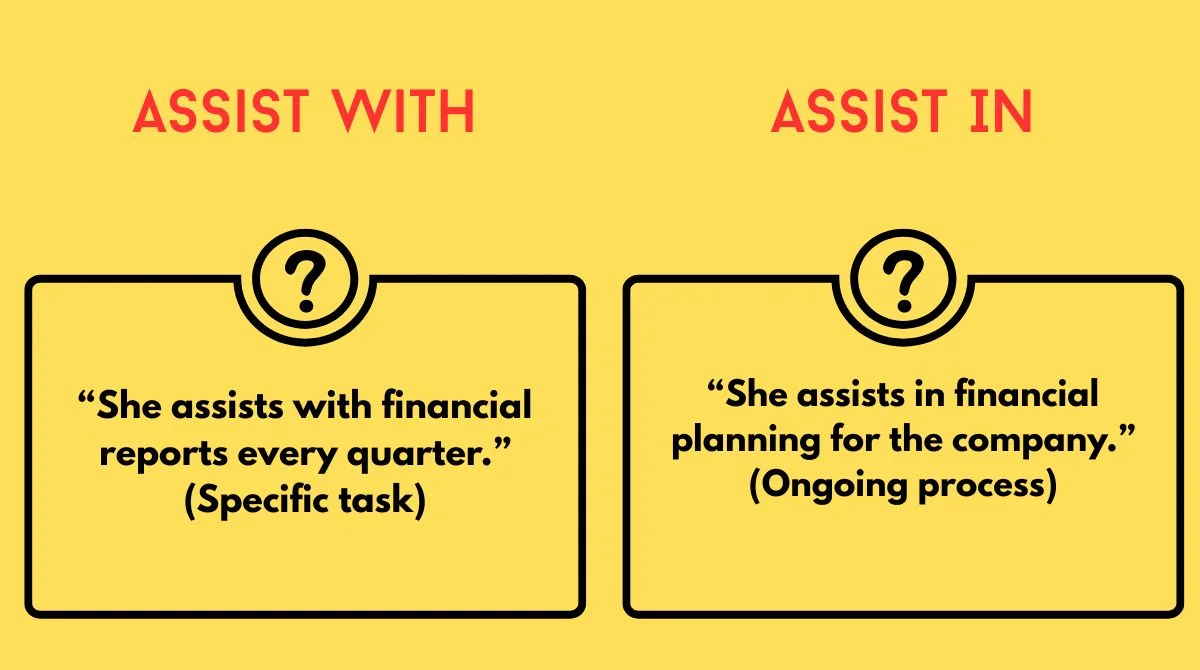
    • Assist With:
      • “She assists with financial reports every quarter.” (Specific task)
    • Assist In:
      • “She assists in financial planning for the company.” (Ongoing process)

    Education & Learning

    • Assist With:
      • “The tutor assisted with math homework.”
    • Assist In:
      • “The tutor assisted in developing a better curriculum.”

    Medical Field

    • Assist With:
      • “The nurse assisted with wound dressing.”
    • Assist In:
      • “The nurse assisted in surgical procedures.”

    By identifying the right context, you’ll always choose the correct phrase.


    FAQs

    1. When should I use “assist with”?

    Use “assist with” when referring to specific tasks, objects, or responsibilities.
    Example: “She assisted with the event decorations.”

    2. When should I use “assist in”?

    Use “assist in” when referring to participation in a process, action, or ongoing effort.
    Example: “He assisted in planning the conference.”

    3. Can “assist with” and “assist in” be used interchangeably?

    Not always. While there is some overlap in informal speech, in formal writing, it’s best to use:

    • “Assist with” for tangible tasks (e.g., reports, equipment, schedules).
    • “Assist in” for abstract processes (e.g., decision-making, policy development).

    4. What’s the grammatical difference between “assist with” and “assist in”?

    • “Assist with” is followed by a noun (task, object, thing).
      • Example: “He assisted with the installation.”
    • “Assist in” is followed by a verb (-ing form) or process.
      • Example: “She assisted in coordinating the event.”

    5. Which phrase is more common in professional settings?

    • “Assist with” is often used in business, healthcare, and technical fields (e.g., “assisting with patient care”).
    • “Assist in” is common in education, legal, and strategic planning (e.g., “assisting in curriculum development”).

    6. How can I quickly decide whether to use “assist with” or “assist in”?

    Use this trick:

    • If it involves a task or object, use “assist with.”
    • If it involves an ongoing action, use “assist in.”
      Example:
      “Can you assist in the report?” → Sounds unnatural.
      “Can you assist with the report?” → Correct!

    Conclusion

    Though assist with and assist in are closely related, they serve distinct purposes in the English language. Assist with applies to specific, tangible tasks, while assist in relates to broader processes and actions.

    Key Takeaways:

    • Use assist with when referring to objects or tasks.
    • Use assist in when discussing participation in a process or event.
    • Dictionaries and linguistic data support these distinctions.
    • Context matters—choose the right phrase based on what you’re describing.
  • ⏳ Time Has Flew By or Time Has Flown By? ✅ Grammar Explained Simply

    ⏳ Time Has Flew By or Time Has Flown By? ✅ Grammar Explained Simply

    Have you ever caught yourself saying “Time has flew by” and then paused, wondering if it actually sounds right? You’re not alone. Many English learners—and even native speakers—struggle with irregular verbs, especially when it comes to the tricky difference between “flew” and “flown.”

    The correct phrase is “Time has flown by.” But why is it correct? And why does “Time has flew by” feel so natural in casual speech, even though it’s grammatically wrong?

    This guide will break it all down for you. We’ll explore grammar rules, meanings, synonyms, common mistakes, and even ways to avoid confusion in the future. By the end, you’ll never mix up “flew” and “flown” again.


    Breaking Down the Grammar

    To understand why one version is correct and the other isn’t, let’s look at the verb to fly.

    The Three Main Forms of “Fly”

    Verb FormExample in a SentenceUsage
    Fly (base form)Birds fly across the sky.Present tense
    Flew (simple past)The plane flew over the mountains.Past tense
    Flown (past participle)The birds have flown south for the winter.Used with has/have/had

    The confusion starts when people forget the rule:

    • Simple past (flew) stands alone without helpers.
    • Past participle (flown) always works with has, have, or had.

    So, in the sentence “Time has … by” you need the past participle because you’re pairing it with has.

    👉 Correct: Time has flown by.
    👉 Incorrect: Time has flew by.

    Think of it this way: whenever you use has, your verb must wear its “past participle outfit.”


    What Does “Time Has Flown By” Mean?

    Time Has Flew By or Time Has Flown By

    The phrase is usually figurative—you’re not talking about time literally flying like a bird or an airplane. Instead, you’re expressing how quickly it seems to have passed.

    • When you look back at summer vacation and say, “Wow, time has flown by,” you mean it went by faster than you realized.
    • Parents often use it when watching kids grow up: “It feels like just yesterday you were a baby—time has flown by.”

    Literal vs. Figurative

    • Literal: Birds have flown by the window. (Real physical action)
    • Figurative: Time has flown by this year. (Impression of speed or brevity)

    The figurative version is far more common and is almost always the one people mean.

    Example Sentences

    • “The last three years have flown by since I started this job.”
    • “Summer always feels like it has flown by too quickly.”
    • “The weekend flew by, and now it’s Monday again.”

    Notice how the phrase carries a touch of nostalgia or surprise. It highlights how moments slip away before you even notice.


    Is “Time Has Flew By” Correct?

    In short: No, it’s not correct.

    But here’s why so many people say it anyway:

    Why People Make This Mistake

    • Spoken English feels looser. Many speakers use the past tense in place of the participle without realizing it.
    • Irregular verbs are tricky. English has many verbs like go → went → gone and eat → ate → eaten. If you’ve ever heard someone say “I have went” instead of “I have gone,” it’s the same mistake.
    • Regional influence. Some dialects are more forgiving about swapping verb forms, especially in casual conversation.

    Correct vs. Incorrect in Action

    • Time has flew by since we last met.
    • Time has flown by since we last met.

    Grammar rules don’t bend here. If you’re writing, always stick with flown. In casual speech, you might hear “flew,” but that doesn’t make it right.


    Common Confusions and Misspellings

    This expression brings up a few more mistakes worth clearing up.

    Flown Bye vs. Flown By

    Some writers mistakenly type “flown bye” instead of “flown by.”

    • By means “past” or “near.”
    • Bye means “goodbye.”

    So, “Time has flown bye” is completely wrong—it sounds like time is waving at you as it leaves!

    👉 Correct: Time has flown by.

    Similar Mistakes with Irregular Verbs

    Here’s a quick table with other verbs that cause the same type of error:

    VerbSimple PastPast ParticipleWrong ExampleCorrect Example
    GoWentGoneI have went home.I have gone home.
    EatAteEatenShe has ate dinner.She has eaten dinner.
    WriteWroteWrittenHe has wrote a book.He has written a book.
    FlyFlewFlownTime has flew by.Time has flown by.

    The pattern is clear: if you see “has/have/had,” always use the past participle.


    Synonyms and Alternatives for “Time Has Flown By”

    You don’t always need to use this exact phrase. There are plenty of ways to express the same idea depending on your tone.

    Casual Alternatives

    • Time has gone by
    • Time has slipped away
    • The days flew past
    • The months raced by

    Formal Alternatives

    • Time has elapsed
    • Time has passed quickly
    • A significant period has gone by

    Poetic or Figurative Alternatives

    • Time has vanished in the blink of an eye
    • The years melted away
    • Hours dissolved into memories

    Example in Context

    • Formal: “A decade has elapsed since the company’s founding.”
    • Casual: “This summer has slipped away so fast.”
    • Poetic: “The years have melted away like snow in spring.”

    By using synonyms, you can tailor your writing for different audiences—whether it’s a heartfelt message, a professional report, or a piece of creative writing.


    Real-Life Examples of Usage

    This phrase isn’t just for grammar textbooks—it shows up everywhere.

    In Literature

    • “Time has flown by, leaving only the echoes of yesterday.” (Common in reflective writing)

    In Speeches

    • Graduation speeches often include it: “These four years have flown by, but the memories will last forever.”

    In Everyday Conversations

    • Friends catching up: “Can you believe it’s been ten years? Time has flown by.”

    This variety shows how versatile the phrase is—it works in casual, formal, and emotional contexts.


    Quick Recap: Which Should You Use?

    Here’s the takeaway:

    • Correct: Time has flown by.
    • Incorrect: Time has flew by.
    • “Has” demands the past participle, not the simple past.
    • Remember the rule: “has/have/had” → past participle only.

    Think of it like a math formula:

    Has + (Past Participle) = Correct Grammar

    That simple tip will save you from making the same mistake with dozens of irregular verbs.


    ❓ FAQs

    What is correct: Time has flew by or time has flown by?

    The correct form is “Time has flown by.” “Has” requires the past participle “flown,” not the simple past “flew.”

    Why do people say Time has flew by?

    Many people use it in casual speech, but it’s a grammar mistake caused by mixing up the past tense with the past participle.

    What does Time has flown by mean?

    It means time passed quickly, often faster than expected, leaving you surprised at how fast events or moments ended.

    Is Time has flew by ever acceptable?

    No. It may appear in informal speech, but it is never correct in formal writing or standard English grammar.

    What are synonyms for Time has flown by?

    Common alternatives include “time has passed quickly,” “time has slipped away,” “time has raced by,” and “time has gone by.”

    What is the difference between flew and flown?

    Flew is the simple past (The bird flew away), while flown is the past participle used with “has/have/had” (The bird has flown away).


    Conclusion

    Language changes over time, but some grammar rules hold steady. “Time has flown by” is the correct phrase, and it captures a feeling we’ve all experienced—how quickly moments slip away.

    Next time you’re tempted to say “time has flew by,” remember the grammar table, think of other irregular verbs, and you’ll land on the right choice.

    After all, as the saying goes: Time waits for no one, and it certainly flies.

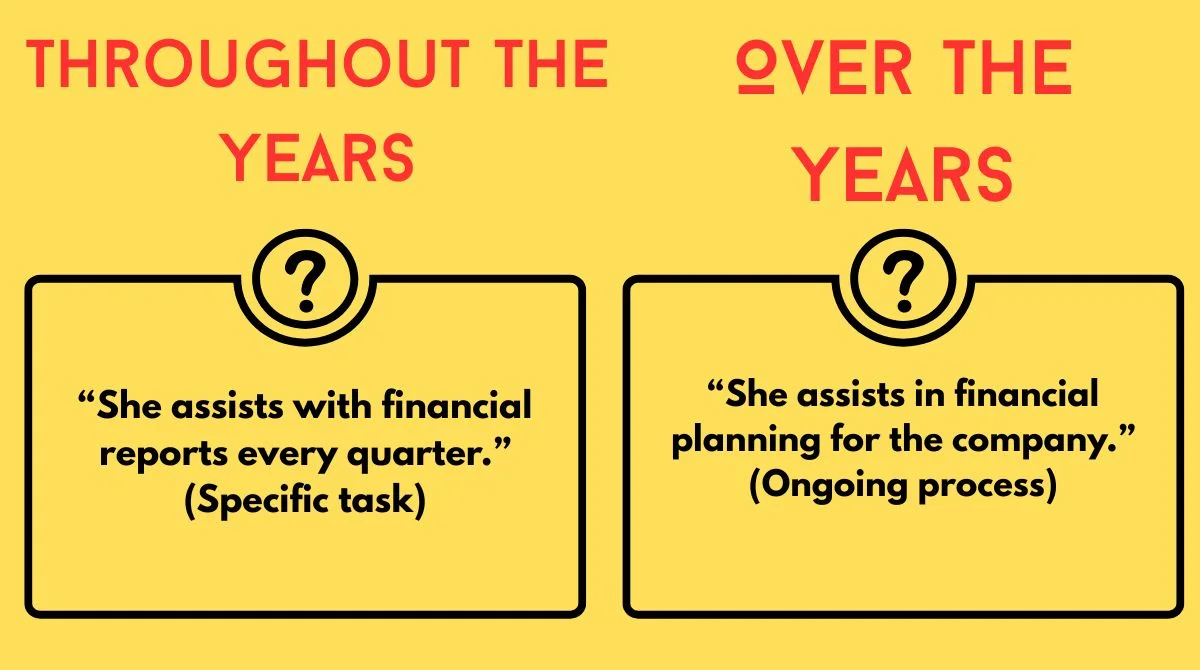
  • Throughout the Years vs Over the Years – What’s the Difference? 🤔📖

    Throughout the Years vs Over the Years – What’s the Difference? 🤔📖

    Language is full of subtle distinctions, and the phrases throughout the years and over the years exemplify this beautifully.

    Though often used interchangeably, these expressions carry nuanced meanings that can impact clarity and emphasis in writing and speech.

    Understanding the differences will refine your linguistic skills and enhance communication.

    Should you say “throughout the years” or “over the years”? While both refer to time, “over the years” suggests gradual change, while “throughout the years” emphasizes consistency. Learn how to use them correctly!

    Throughout the Years vs Over the Years

    The Evolving Story: What Does “Over the Years” Really Mean?

    The phrase over the years suggests a gradual progression or accumulation of events across time. It implies changes, developments, or trends occurring in a broad temporal span.

    Key Characteristics:

    • Implies progression or accumulation over a period.
    • Emphasizes change rather than continuity.
    • Commonly used in narratives discussing evolution or growth.

    Examples:

    1. Over the years, technology has significantly transformed the way we communicate.
    2. Her writing skills improved over the years as she gained more experience.
    3. The city expanded over the years, turning into a bustling metropolis.

    Key Takeaway:

    Use over the years when referring to gradual developments, trends, or accumulated experiences.


    Unchanging Echoes: Understanding “Throughout the Years”

    Unlike over the years, throughout the years emphasizes consistency and persistence rather than change. It denotes something that remained steady across a given time span.

    Key Characteristics:

    • Implies constancy and continuity from the beginning to the end of a period.
    • Best for describing stability, endurance, or recurring events.
    • Often used when emphasizing tradition or persistence.

    Examples:

    1. Throughout the years, she remained dedicated to her craft.
    2. Their friendship endured throughout the years despite many challenges.
    3. The company maintained its high standards throughout the years.

    Key Takeaway:

    Use throughout the years when highlighting consistency, endurance, or sustained presence across time.


    Defining the Constant Nature of “Throughout the Years”

    One way to clearly understand throughout the years is by considering its application in different contexts. It signifies that something persisted over time rather than evolving.

    PhraseImplicationExample
    Throughout the yearsContinuity, endurance“She supported him throughout the years.”
    Over the yearsChange, evolution“His opinions changed over the years.”

    The table highlights that throughout the years keeps its subject in an unbroken timeline, whereas over the years conveys an evolving narrative.


    Usage in American English: Distinguishing Scenarios for “Throughout the Years”

    In American English, both phrases appear in various contexts, but their usage depends on what aspect of time you want to emphasize.

    • Use throughout the years when talking about something that remained constant.
      • Example: “Throughout the years, she has always been a leader.”
    • Use over the years when discussing changes or trends.
      • Example: “Over the years, leadership styles have evolved.”

    Understanding this distinction allows for more precise communication, ensuring that your message aligns with your intended meaning.


    Why “Throughout the Years” Can Still Be Relevant Today

    Some might argue that throughout the years is less commonly used in casual speech compared to over the years. However, it remains highly relevant in certain scenarios:

    1. Historical Narratives: Used when emphasizing a tradition or ongoing presence.
    2. Formal Writing: Found in literature, speeches, and historical discussions.
    3. Emotional Contexts: Emphasizing loyalty, endurance, and consistency.

    While over the years might be more prevalent in casual conversations, throughout the years carries a deeper, more enduring tone suitable for emphasizing steadfastness.


    Comparative Insights: When to Use Each Phrase Correctly

    Let’s break it down further with some practical examples:

    ScenarioUse “Throughout the Years”Use “Over the Years”
    Describing loyalty“She has been a great friend throughout the years.”“She has changed a lot over the years.”
    Discussing historical patterns“Throughout the years, the town has celebrated the same traditions.”“Over the years, the town has modernized.”
    Talking about achievements“His passion for music remained strong throughout the years.”“His musical style evolved over the years.”

    These examples reinforce that throughout is about continuity, while over emphasizes transformation.


    Cultural Reflections: How Phrasing Evolves with Society

    Language changes over time, and certain expressions fall in and out of favor. In modern usage, over the years has become the dominant phrase due to its flexibility in conversations about trends and change. However, throughout the years still holds weight in formal and literary contexts.

    • Pop Culture: You’ll find “over the years” used in news articles, TV shows, and everyday discussions.
    • Literature and History: “Throughout the years” is more commonly seen in books, speeches, and historical narratives.

    Understanding these cultural preferences helps you tailor your phrasing to your audience.


    Analyzing Trends in Language: The Google Ngram Viewer Perspective

    A great way to visualize language trends is through Google Ngram Viewer, which tracks the frequency of words and phrases in published books.

    • A quick search on Google Ngram Viewer shows that over the years has increased significantly in usage since the mid-20th century.
    • Throughout the years, while still in use, has remained relatively stable and is less frequently used in contemporary texts.

    This data supports the idea that over the years is the more commonly used phrase today, yet throughout the years remains valuable in specific contexts.


    Synonyms and Variations: Expanding Your Linguistic Toolkit

    Throughout the Years vs Over the Years

    If you want to avoid repetition, here are some alternative expressions:

    PhraseAlternative Synonyms
    Over the yearsOver time, as time passed, in the past decades
    Throughout the yearsThrough the decades, during this period, from start to finish

    Using these variations can make your writing richer and more engaging.


    FAQs

    What is the difference between “throughout the years” and “over the years”?

    “Throughout the years” emphasizes consistency and persistence, while “over the years” suggests gradual changes or developments over time.

    When should I use “over the years”?

    Use “over the years” when referring to something that has evolved or changed gradually, such as skills, technology, or trends. Example: “Over the years, technology has advanced rapidly.”

    When is “throughout the years” more appropriate?

    Use “throughout the years” when talking about something that has remained constant or persisted over time. Example: “Throughout the years, she has been a dedicated leader.”

    Is “over the years” more common than “throughout the years”?

    Yes, “over the years” is more commonly used in modern conversation and writing, while “throughout the years” is more formal and often appears in literature or historical contexts.

    Can “throughout the years” and “over the years” be used interchangeably?

    Not always. While both refer to time, “throughout the years” implies continuity, whereas “over the years” indicates progression or gradual change.

    Are there synonyms for these phrases?

    Yes! For “over the years,” you can use “over time” or “as time passed.” For “throughout the years,” alternatives include “through the decades” or “from start to finish.”


    Conclusion

    While throughout the years and over the years may seem similar, they serve distinct linguistic functions.

    • Use throughout the years for continuity and endurance.
    • Use over the years for change and evolution.

    By mastering these distinctions, you’ll enhance your precision in writing and speaking, ensuring that your message resonates exactly as intended.

  • Here Is or Here Are 🤔 Which One Is Correct in English Grammar?

    Here Is or Here Are 🤔 Which One Is Correct in English Grammar?

    English grammar can feel like a puzzle, especially when small words make a big difference.

    One of the most common questions learners ask is whether they should say “Here is” or “Here are.” Both are correct, but the trick lies in knowing when to use each one.

    If you’ve ever hesitated before speaking or second-guessed yourself while writing, this guide will clear everything up once and for all.


    Understanding “Here Is” and “Here Are”

    Here Is or Here Are

    At the heart of this question is subject–verb agreement. The word “here” functions as an introductory adverb, pointing to something nearby or calling attention to something. What really determines the verb choice is the subject that follows.

    • “Here is” introduces a singular noun or an uncountable noun.
    • “Here are” introduces a plural noun.

    Think of it like this: the noun after “here” decides the verb.

    Examples:

    • Correct: Here is the book. (singular)
    • Correct: Here are the books. (plural)
    • Correct: Here is the water. (uncountable)

    It’s simple when you see it laid out — but in everyday speech, confusion creeps in. Let’s look at why.


    Why Do People Get Confused?

    Even native speakers sometimes stumble here. Why? A few common reasons:

    • Contractions muddy the waters. “Here’s” is short for “Here is.” People use it in front of plural nouns without noticing: Here’s the keys.
    • Spoken rhythm favors shortcuts. The phrase Here’s the pens rolls off the tongue more easily than Here are the pens.
    • Focus on the first word. Many people look only at “here” instead of the subject that follows.

    This mismatch between grammar rules and natural speech creates the confusion. In writing, especially in formal contexts, the correct version matters more.


    Subject–Verb Agreement Refresher

    Before diving deeper, let’s revisit the rule:

    • A singular subject requires a singular verbis.
    • A plural subject requires a plural verbare.
    • An uncountable noun acts like a singular → is.

    Here’s a quick table to make it crystal clear:

    Subject TypeCorrect FormExample
    Singular nounHere isHere is the key.
    Plural nounHere areHere are the keys.
    Uncountable nounHere isHere is the information.
    Collective nounUsually “is”Here is the team.

    Notice how uncountable nouns behave like singulars. You wouldn’t say Here are the water — it’s always Here is the water.


    Countable and Uncountable Nouns in Action

    The difference between countable and uncountable nouns is what really shapes the use of “is” and “are.”

    Countable nouns

    These are items you can count individually. They can be singular or plural.

    • Singular → Here is a cookie.
    • Plural → Here are two cookies.

    Uncountable nouns

    These are things you cannot separate into individual units easily. They take singular verbs.

    • Here is the rice.
    • Here is the advice.

    Edge cases

    • Collective nouns (like team, group, or family) usually take “is” in American English: Here is the team ready to play.
    • But in British English, plural usage is sometimes allowed: Here are the team celebrating their win.

    So, your choice may also depend on which variety of English you’re using.


    Everyday Usage and Style Considerations

    Language in the real world doesn’t always follow strict rules. People bend grammar for speed and convenience.

    The “Here’s” problem

    You’ve probably heard sentences like:

    • Here’s the details you asked for.
    • Here’s my car keys.

    Both are technically wrong, because “details” and “keys” are plural. The correct form should be Here are the details and Here are my car keys.

    Formal vs. informal

    • In formal writing (emails, reports, academic work), always follow the rule.
    • In casual conversation, contractions and shortcuts are widely accepted.

    Think of it this way: a boss reading your email expects “Here are the documents,” not “Here’s the documents.”

    Tip to avoid mistakes

    • Expand contractions in your head. If “Here’s” = “Here is,” you’ll notice when it doesn’t fit.

    Special Cases and Exceptions

    English loves exceptions. Let’s look at some tricky spots.

    “There is / There are” vs. “Here is / Here are”

    Both work the same way, but “there” introduces existence while “here” points to location or immediacy.

    • There is a problem with the engine.
    • Here is the problem we must fix.
    • There are several reasons to reconsider.
    • Here are the reasons we need to talk.

    Lists of nouns

    When a list follows, the first noun matters less than the whole phrase.

    • Here are the pen, notebook, and ruler you requested.
    • Here is the pen and the notebook. (if treated as a single package)

    Pronoun cases

    “Here are they” sounds unnatural. Instead, we usually flip the order: Here they are. Similarly, we say Here it is rather than Here is it.


    Quick Checklist for Writers and Learners

    When you’re unsure, run through this mental checklist:

    • Look at the noun after “here.”
    • Is it singular? Use is.
    • Is it plural? Use are.
    • Is it uncountable? Use is.
    • Collective noun? Usually is in American English, sometimes are in British English.

    Quick examples

    • Here is the report.
    • Here are the reports.
    • Here is the sugar.
    • Here are my friends.
    • Here is the team ready to start.

    Having this checklist in mind will save you from second-guessing yourself.


    Case Study: Common Mistakes in Professional Writing

    Imagine you’re sending an email at work:

    Here’s the documents you asked for.
    This mistake instantly makes your writing look less polished.

    Here are the documents you asked for.
    This version shows attention to detail and grammar.

    The difference may feel small, but in professional settings, grammar choices affect how credible and careful you appear. Employers, clients, and colleagues notice these details.


    Memorable Quotes About Grammar

    Sometimes it helps to lighten grammar with a bit of wisdom:

    • “Grammar is the logic of speech, even as logic is the grammar of reason.” — Richard C. Trench
    • “Let’s eat, Grandma!” vs. “Let’s eat Grandma!” — punctuation saves lives. (Popular grammar joke that applies to subject–verb agreement too.)

    These reminders reinforce why correctness matters — it’s about clarity, not nitpicking.


    🙋‍♂️ FAQs

    What is the difference between “here is” and “here are”?

    “Here is” introduces singular or uncountable nouns, while “here are” introduces plural nouns.

    Can I use “here’s” with plural nouns?

    Technically no. “Here’s” = “Here is,” so it should only be used with singular or uncountable nouns, not plurals.

    Why do people say “here’s the keys” if it’s wrong?

    Because in casual speech contractions flow more naturally, even if they break grammar rules.

    Which is correct: “here are the information” or “here is the information”?

    The correct form is “here is the information,” since “information” is an uncountable noun.

    Do British and American English treat “here is” and “here are” differently?

    Mostly no, but in British English, collective nouns sometimes take plural verbs, so you might see “Here are the team.”

    How can I quickly decide whether to use “is” or “are”?

    Look at the noun after “here.” If it’s singular or uncountable, use is. If it’s plural, use are.


    Conclusion: To Wrap Up

    So, which is correct: “Here is” or “Here are”? Both. The choice depends entirely on the subject that follows.

    • Use “Here is” for singular and uncountable nouns.
    • Use “Here are” for plural nouns.

    While casual speech often bends the rule with phrases like Here’s the keys, formal writing demands precision. Mastering this difference will not only sharpen your grammar but also boost your confidence in both professional and personal communication.

    Next time you face this choice, remember: look at the subject, not just the word “here.”

  • ✅ Double Check or Double Confirm – Which Is Correct in English? 🤔

    ✅ Double Check or Double Confirm – Which Is Correct in English? 🤔

    English often trips people up with phrases that sound similar but carry different weight. Two such expressions are “double check” and “double confirm.” You’ve probably heard both, but which one is correct? More importantly, which should you use in professional writing, business communication, or casual conversation?

    The short answer: “double check” is standard and widely accepted in English, while “double confirm” is regional, informal, and sometimes considered slang.

    That said, the story is more interesting than it looks on the surface. Let’s dive deeper to untangle the difference, see where each phrase fits, and explore how culture shapes their usage.


    Understanding “Double Check”

    Double Check or Double Confirm

    “Double check” is the phrase you’ll encounter in English textbooks, business emails, and professional settings. It’s standard English, accepted globally, and has a straightforward meaning:

    Double check = to verify something again, to be extra sure it is correct.

    Origins and Usage

    The verb “check” dates back centuries, meaning to examine or verify. Adding “double” intensifies the action, emphasizing extra care. In modern English, “double check” is used across industries — from aviation and medicine to office work — whenever accuracy matters.

    Examples in Sentences

    • Let me double check the report before we send it out.
    • The nurse double checked the patient’s dosage.
    • I’ll double check the address so the package doesn’t get lost.

    Tone and Nuance

    When someone says they’ll double check, it signals diligence, thoroughness, and responsibility. It’s neither slangy nor overly casual; instead, it works well in both formal and informal settings.


    Understanding “Double Confirm”

    Now let’s talk about the more unusual cousin: “double confirm.”

    At face value, it looks similar to “double check.” After all, confirm means to verify. So why do some people insist on saying “double confirm”?

    Definition

    Double confirm = to re-confirm something with extra emphasis, usually for clarity or certainty.

    It isn’t considered standard English in US or UK contexts, but it thrives in some regions.

    Regional Usage

    “Double confirm” is especially common in parts of Southeast Asia — notably Singapore, Malaysia, and Hong Kong. It shows up in everyday speech, especially informal or semi-formal conversations.

    In Singapore’s Singlish, “double confirm” is often used playfully or emphatically. It’s not about grammar, but about communication style. For example:

    • You’re coming to the party, right? Double confirm ah?
    • Boss said tomorrow’s deadline, double confirm already.

    Examples in Sentences

    • Can you double confirm the flight time?
    • She wanted to double confirm the guest list before sending invites.

    Tone and Nuance

    Outside Asia, “double confirm” can sound slangy or redundant. But in regional English, it carries a sense of emphasis and urgency. People use it to stress that something needs to be absolutely certain.


    Key Differences Between “Double Check” and “Double Confirm”

    The two phrases may look alike, but they’re not interchangeable in all contexts.

    Here’s a side-by-side comparison:

    AspectDouble CheckDouble Confirm
    GrammarStandard EnglishNon-standard / regional
    MeaningTo verify again for accuracyTo reconfirm with emphasis
    Common RegionsGlobal (US, UK, worldwide)Singapore, Malaysia, Hong Kong
    FormalityWorks in both formal and informal contextsInformal, often avoided in formal writing
    ToneProfessional, careful, thoroughEmphatic, casual, slangy
    Professional WritingWidely acceptedConsidered unprofessional outside regional contexts

    Example Contrast

    • Professional: Please double check the financial figures before submission.
    • Casual, regional: We’re meeting at 6 pm, double confirm first, okay?

    Which One Should You Use?

    The golden rule is simple: context matters.

    • In global English (US, UK, international business):
      Always use “double check.” It’s clear, professional, and universally understood.
    • In regional English (Singapore, Malaysia, Hong Kong):
      “Double confirm” is fine in casual speech, especially when speaking with locals. It can even add cultural flavor.
    • In professional or academic communication:
      Stick with “double check.” Using “double confirm” in a résumé, research paper, or business proposal could raise eyebrows.

    Practical Communication Tip

    When in doubt, go with “double check.” It avoids confusion and ensures your message is taken seriously.


    Common Mistakes to Avoid

    Even though both phrases exist, people often make slip-ups that weaken their communication.

    Mistakes with “Double Confirm”

    • Using it in formal writing (The CEO would like to double confirm the meeting agenda.)
    • Relying on it when “reconfirm” or “verify” would sound more professional.

    Mistakes with “Double Check”

    • Overusing it where a single “check” would be enough.
      • Example: I’ll double check the time (okay).
      • Example: I’ll double check if the light is on (unnecessary — just say “check”).

    Mixing Them Up

    Switching between the two phrases in the same context can confuse your audience. For consistency, choose one that fits the tone and stick with it.


    Real-Life Usage Examples

    Let’s make this practical.

    Workplace Scenarios

    • Project Reports:
      Before you submit the final draft, double check your sources to avoid errors.
    • Team Meetings:
      Can we double confirm the client’s arrival time? (works regionally but sounds casual in global English).

    Travel and Logistics

    • I’ll double check the train schedule before we leave.
    • The travel agent called to double confirm the hotel reservation.

    Academic and Research

    • Researchers must double check their data before publishing results.

    Regional Anecdote

    In Singapore, “double confirm” is almost cultural. It’s part of the rhythm of Singlish, often paired with the word “ah” for emphasis:

    • You really free tomorrow? Double confirm ah?

    This shows how language bends to local identity, even when it strays from “proper” grammar.


    Related Phrases and Synonyms

    If you want to avoid confusion or overuse, here are some alternatives.

    Alternatives to “Double Check”

    • Verify
    • Recheck
    • Review
    • Cross-check
    • Inspect

    Alternatives to “Double Confirm”

    • Reconfirm
    • Make sure
    • Ensure
    • Affirm

    Choosing the Right Word

    • In business emails: Please verify the schedule sounds sharper than Please double confirm the schedule.
    • In casual chats: Just double check with him works better than Double confirm with him if you’re writing internationally.

    Case Study: Why One Word Can Change Perception

    Imagine you’re applying for a job with an international company. You write in your email:

    • I would like to double confirm the interview time.

    To a hiring manager in New York, this may feel awkward or unpolished. Swap it to:

    • I would like to double check the interview time.

    Now it feels professional, clear, and correct.

    This small difference can shape how people perceive your attention to detail.


    🙋 FAQs

    What does “double check” mean?

    It means verifying something again to ensure accuracy.

    Is “double confirm” correct English?

    No, it’s not standard English. It’s mostly used in Singapore, Malaysia, and Hong Kong.

    Can I use “double confirm” in formal writing?

    No, you should avoid it in professional or academic writing.

    What’s the difference between “double check” and “double confirm”?

    “Double check” is standard English, while “double confirm” is informal and regional.

    Is “reconfirm” the same as “double confirm”?

    Yes, in meaning they’re similar, but “reconfirm” is grammatically correct and more professional.

    Which phrase should I use in business emails?

    Always use “double check” in global business communication.


    Conclusion

    So, which is correct: double check or double confirm?

    • Double check is the clear winner. It’s correct, standard, and widely respected in English communication.
    • Double confirm has its place in regional, informal speech, particularly in parts of Asia. It adds cultural flair but doesn’t belong in professional settings.

    Practical takeaway:
    If you’re writing for a global audience, always use “double check.” Save “double confirm” for informal conversations where regional expressions are welcome.

  • 🔄 Swap vs Swop: What’s the Difference in English Usage?

    🔄 Swap vs Swop: What’s the Difference in English Usage?

    English has a fascinating way of evolving across time and geography. Words often develop alternate spellings, pronunciations, and usages depending on where you are.

    One such case is “swap vs swop.” At first glance, both spellings look legitimate. They even sound the same. Yet when you dig deeper, you discover that one dominates modern English while the other is now little more than a regional variant.

    This article takes you through the meaning, history, and practical usage of swap and swop. By the end, you’ll know exactly which one to use in your writing and why.


    What Do Swap and Swop Mean?

    Swap vs Swop

    Both swap and swop are verbs meaning “to exchange one thing for another.” For example:

    • Let’s swap seats so you can see better.
    • He decided to swop his sandwich for a slice of pizza.

    Although the action is identical, the spelling tells the real story.

    • Swap: This is the standard spelling in modern English worldwide.
    • Swop: This is an older variant still recognized in some dictionaries, but rarely used outside the UK or older British texts.

    Historical Roots

    The word traces back to Middle English swappen, meaning to strike, hit, or exchange. Over time, the meaning shifted toward “exchange,” which stuck. Early English often allowed multiple spelling variations. Just as “color” and “colour” coexisted, so did “swap” and “swop.”

    By the 20th century, however, swap became the dominant spelling. The “o” form (swop) remained in circulation but began to feel old-fashioned. Today, you’ll see swop mostly in older British books, nostalgic writing, or niche regional use.


    Swap vs Swop: Key Differences at a Glance

    To help you quickly see the contrast, here’s a comparison table:

    FeatureSwap (Standard)Swop (Variant)
    MeaningExchange one thing for anotherSame meaning (exchange)
    Spelling StatusModern, dominant, widely acceptedVariant, outdated in most contexts
    DictionariesFully recognized and preferredListed as British variant or archaic
    Usage in WritingCommon in all professional settingsRare; appears in British/older texts
    RegionsGlobal (US, UK, Australia, worldwide)Mostly UK; little to no US recognition

    Usage in Different English-Speaking Regions

    Even though both forms exist, regional preferences shape which spelling you’ll actually see.

    United Kingdom

    In the UK, swop enjoyed stronger presence during the 19th and early 20th centuries. Newspapers, novels, and children’s stories often used it. However, by the late 20th century, swap overtook swop as the preferred form.

    Today, British dictionaries like Collins and Oxford still list swop, but always mark it as a variant. British teachers, publishers, and editors almost exclusively recommend swap for clarity and consistency.

    United States

    In the US, the case is clear-cut. Americans never really embraced swop. From the start, swap became the only accepted spelling. American dictionaries such as Merriam-Webster and American Heritage don’t even list swop as a valid option in modern editions.

    So if you’re writing for a US audience, the answer is simple: always go with swap.

    Australia & New Zealand

    Australians and New Zealanders tend to follow British usage more closely than American. Historically, swop appeared in Australian children’s literature and newspapers. But just like the UK, the tide shifted toward swap.

    In everyday speech and writing, swap dominates modern Australian English. You might still come across swop in informal or nostalgic contexts, but it’s not the norm.

    Other Regions

    Across other parts of the English-speaking world — including Canada, South Africa, and India — swap is standard. Swop is so rare outside the UK that most readers wouldn’t recognize it as a legitimate spelling.


    Real-Life Examples

    Seeing words in context helps cement their differences. Let’s look at both spellings in action:

    Examples with Swap (Modern Standard):

    • The two students decided to swap books after class.
    • I’ll swap you my chocolate bar for your bag of chips.
    • They swapped stories about their childhood adventures.

    Examples with Swop (Variant):

    • He offered to swop his marble for a shiny coin.
    • In the old tale, the children swopped places to trick their teacher.
    • Grandma laughed as she recalled swopping letters with her pen pal.

    Notice how swop feels old-fashioned in modern writing. Readers may pause, wondering if it’s a typo. Swap, on the other hand, feels smooth and natural.


    Dictionaries & Style Guides on Swap vs Swop

    When deciding which spelling to use, it helps to know what trusted authorities say.

    • Oxford English Dictionary (OED): Lists swop as a variant of swap, but marks swap as the preferred spelling.
    • Collins English Dictionary: Recognizes swop as chiefly British, labeling it less common than swap.
    • Merriam-Webster (US): Only lists swap, no mention of swop.
    • Cambridge English Dictionary: Includes swop but notes that swap is standard.

    Style Guide Recommendations

    • The Chicago Manual of Style (US): Always swap.
    • Oxford Style Guide (UK): Prefers swap for modern usage.
    • Associated Press (AP): Swap only.

    In short, if you’re writing in any professional, academic, or journalistic context, style guides tell you: use swap.


    Which One Should You Use Today?

    Here’s the bottom line:

    • For professional, academic, or international writing: Always use swap.
    • For casual or nostalgic writing (especially in the UK): You may use swop, but be aware it looks old-fashioned.
    • For learners of English: Stick to swap to avoid confusion and ensure your writing feels natural everywhere.

    Why Clarity Matters

    Language evolves, but communication is the end goal. Using an outdated spelling like swop can distract readers. They may question your credibility, think it’s a typo, or misunderstand the level of formality you intend. Swap avoids all those problems.

    As the linguist David Crystal once noted:

    “Variation is natural in language, but clarity comes from following the conventions your audience expects.”

    So unless you’re deliberately aiming for a nostalgic or British-localized tone, swap is the smart choice.


    ❓ FAQs

    What is the difference between swap and swop?

    Both mean “to exchange,” but swap is the modern standard, while swop is an older British variant.

    Is swop still used in the UK?

    Yes, but rarely. Swop appears in older British texts, though swap is now the preferred spelling.

    Do swap and swop mean the same thing?

    Yes, they carry the same meaning. The difference lies in spelling and regional acceptance.

    Which is correct: swap or swop?

    Swap is correct in modern English worldwide. Swop is outdated and not recommended for formal writing.

    Is swop used in American English?

    No. American English only uses swap. Swop is not recognized in US dictionaries.

    Should English learners use swap or swop?

    Learners should always use swap since it’s standard across all regions and contexts.


    Conclusion

    The debate of swap vs swop is really no debate at all. Both words mean the same thing, but one (swap) has become the dominant, modern spelling across the English-speaking world. Swop lingers as a quaint relic of British English, occasionally spotted in older literature or nostalgic writing.

    If your goal is clarity, professionalism, and global recognition, the answer is simple: always choose swap.

  • In the Street vs On the Street 🚦 A Clear Guide with Examples

    In the Street vs On the Street 🚦 A Clear Guide with Examples

    English learners often stumble when deciding whether to say “in the street” or “on the street.” At first glance, both look correct, and in many cases, you’ll hear native speakers use them interchangeably. But here’s the catch: the choice of preposition changes the meaning, sometimes in subtle ways and other times in major ways.

    If you’ve ever wondered which is correct—or why a native speaker used one instead of the other—this guide will walk you through the difference step by step. By the end, you’ll know when to confidently use in the street and when on the street is your best option.


    Why Prepositions Shape Meaning in Everyday English

    In the Street vs On the Street

    Prepositions are small words with big jobs. They connect nouns and verbs, showing relationships of place, direction, and context. In the case of “in” and “on,” the difference might seem tiny, but it’s actually crucial:

    • In suggests being enclosed or surrounded by something.
    • On suggests contact with or position upon a surface.

    Now, apply that to streets. Saying someone is in the street gives the picture of a person standing in the middle of the road, surrounded by asphalt and traffic. Saying someone is on the street could mean they’re positioned along the street, living there, or even that you heard some gossip that’s “on the street.”


    Quick Comparison: In the Street vs On the Street

    Here’s a side-by-side comparison for instant clarity:

    ExpressionLiteral MeaningFigurative/Idiomatic UseExample Sentence
    In the streetInside the street space, between sidewalks and curbsPublic events, accidents, demonstrations“The children were playing in the street.”
    On the streetLocated on/along the surface of the streetHomelessness, rumors, general place“He lives on the street.” / “The word on the street is that prices are going up.”

    Key takeaway: In the street emphasizes being within the boundaries of the roadway, while on the street emphasizes location along or upon it—and expands into idiomatic uses.


    What Does “In the Street” Really Mean?

    The phrase “in the street” almost always paints a picture of being inside the roadway. Imagine children kicking a soccer ball between parked cars, or a protest blocking traffic. You wouldn’t say they’re “on the street” because they’re not merely beside it—they’re physically occupying it.

    Common Uses of “In the Street”

    • Play and movement: “The kids were riding their bikes in the street.”
    • Traffic or accidents: “The car broke down in the street.”
    • Demonstrations and parades: “Thousands marched in the street demanding change.”

    Example Sentences

    • “The cat lay injured in the street, and cars slowed down to avoid it.”
    • “We celebrated the victory in the street with fireworks.”
    • “There were people dancing in the street during the festival.”

    Visual Cue

    Picture a street as a rectangular space bounded by sidewalks. Being in the street means entering that space. It’s like standing in a box that happens to be paved with asphalt.

    Key Insight

    Use “in the street” when the subject is inside the roadway itself—often with the sense of risk, activity, or public gathering.


    What Does “On the Street” Mean? A Closer Look

    The phrase “on the street” broadens the idea. It can describe physical presence, general location, or even abstract concepts like rumors. Unlike “in the street,” it doesn’t lock someone into the middle of the road.

    Common Uses of “On the Street”

    • Physical placement along a street: “There’s a café on the street corner.”
    • Homelessness: “After losing his job, he ended up living on the street.”
    • Rumors or gossip: “The word on the street is that she’s moving abroad.”
    • General location: “You’ll find lots of musicians on the street during the festival.”

    Example Sentences

    • “Vendors set up stalls on the street during the holiday market.”
    • “I heard on the street that tickets are already sold out.”
    • “They found him sleeping on the street last night.”

    Broader Meanings

    Notice how on the street moves from literal placement to idiomatic power. It’s not just about where something happens but also about community perception and culture.

    Visual Cue

    Imagine “on” as resting upon the surface or alongside. Something placed “on the street” could be touching it, standing by it, or metaphorically tied to it.


    Grammatical Guidelines for Using “In” vs “On” with Streets

    To keep it simple, here’s a practical breakdown:

    Use “In the street” when…Use “On the street” when…
    Someone or something is physically inside the roadway.Referring to general location along a street.
    You want to emphasize activity happening between curbs.Talking about homelessness or survival situations.
    Events, protests, or gatherings block the road.Using idioms about information, gossip, or general scene.

    Verb Influence on Preposition Choice

    The verb often dictates which preposition sounds natural.

    • Stand in the street → the person is literally there, blocking traffic.
    • Live on the street → describes homelessness, not someone pitching a tent in the middle of the road.
    • Celebrate in the street → emphasizes communal festivity.
    • Perform on the street → typical of musicians or street artists.

    Can “In the Street” and “On the Street” Be Used Interchangeably?

    Yes, but with caution.

    • Similar meaning: In some casual contexts, natives might use both without confusion. For example, “I saw kids in/on the street.”
    • Nuanced difference: “Kids in the street” highlights them physically playing in the road. “Kids on the street” might suggest they were hanging around along the sidewalks.

    Tip: If safety or activity inside the roadway is the focus, choose in the street. If you’re describing general presence, choose on the street.


    What About “At the Street”? Is That Ever Correct?

    Yes, but rarely. “At the street” is used when you want to pinpoint a specific location, usually at an intersection or address.

    Examples

    • “Meet me at the street corner.”
    • “The bus stops at the street across from the mall.”

    When to Avoid It

    Don’t use “at the street” for broad activities or general placement. It sounds incomplete unless tied to a specific point.


    British vs American English: Key Differences

    While both dialects use in the street and on the street, preferences shift slightly:

    • British English leans toward in the street when describing physical location. Example: “The children were playing in the street.”
    • American English often favors on the street for the same situation: “The children were playing on the street.”

    Both are correct, but context and regional usage matter. Learners should be aware of this variation, especially when consuming media from both sides of the Atlantic.


    Real-Life Examples from News and Pop Culture

    Prepositions come alive in real-world language. Let’s look at how they appear in media and culture.

    Headlines

    • “Protesters Gather In the Street After Court Ruling” (NY Times).
    • “More Families Forced to Live On the Street as Housing Costs Rise” (BBC).

    Pop Culture References

    • Song: Dancing in the Street (Martha and the Vandellas, later covered by David Bowie and Mick Jagger).
    • Common phrase: Word on the street—a popular idiom for rumors.
    • TV: Characters often described as “living on the street” in shows about urban struggles.

    These examples reinforce how native speakers use these phrases naturally in storytelling, music, and conversation.


    Summary Table: When to Use “In,” “On,” or “At” with Streets

    PrepositionUse CaseExample
    In the streetInside the road, between curbs, often involving movement or events“Cars parked in the street blocked traffic.”
    On the streetAlongside or upon the street; idiomatic uses like rumors or homelessness“Street artists performed on the street.” / “He lives on the street.”
    At the streetSpecific point, usually intersection or address“We met at the street corner.”

    🙋 FAQs

    What does “in the street” mean?

    It means being physically inside the roadway, often used for activities, accidents, or public events happening between curbs.

    When should I use “on the street”?

    Use it for general location, homelessness, surface placement, or idiomatic expressions like “word on the street.”

    Can I use “in the street” and “on the street” interchangeably?

    Sometimes yes, but nuance matters. “In the street” suggests being inside the road, while “on the street” is broader and includes figurative uses.

    Is “at the street” ever correct?

    Yes, it works for specific points like intersections or street corners, but not for general activities.

    Do British and American English use these phrases differently?

    Yes. British English often prefers “in the street,” while American English leans toward “on the street” in everyday speech.

    What’s an idiom with “on the street”?

    A common one is “word on the street,” which means gossip or rumors circulating among people.


    Conclusion

    Choosing between in the street and on the street isn’t just a grammar technicality—it shapes how your message is understood.

    • Use in the street for activities inside the roadway.
    • Use on the street for location, idioms, or surface-level meaning.
    • Reserve at the street for pinpoint locations.

    By mastering these subtle distinctions, you’ll sound more natural, avoid awkward phrasing, and understand cultural references instantly. So the next time you hear music, protests, or even gossip, you’ll know whether it belongs in the street or on the street.

  • “It Worth It” or “It Is Worth It” 🤔 Grammar Explained Clearly

    “It Worth It” or “It Is Worth It” 🤔 Grammar Explained Clearly

    English can be tricky. Small words like “is” sometimes make the difference between a correct phrase and a glaring mistake. Many learners wonder whether to say “It worth it” or “It is worth it.”

    The truth is simple: only one of them is grammatically correct. But understanding why one works and the other doesn’t will help you avoid similar mistakes in the future.

    This article breaks down the grammar, meanings, common errors, and professional alternatives of these expressions.

    By the end, you’ll not only know the right phrase but also how to use it naturally in different contexts.


    Understanding the Confusion: “It Worth It” vs. “It Is Worth It”

    It Worth It or It Is Worth It

    At first glance, “It worth it” and “It is worth it” look almost the same. The only difference is the word “is.” But that little word makes or breaks the grammar.

    • “Worth” is not a verb. It’s an adjective or sometimes a noun.
    • In English, adjectives usually need a linking verb (be, is, was, are) to connect them to the subject.
    • Without “is,” the sentence feels incomplete.

    Correct form:

    • It is worth it.

    Incorrect form:

    • It worth it.

    Think of it this way: would you ever say “She happy” instead of “She is happy”? Probably not. The same rule applies here.


    The Meaning of “It Is Worth It”

    The phrase “It is worth it” means something deserves the effort, cost, or time you invest. People use it when weighing benefits against sacrifices.

    Everyday Examples

    • After running five miles: “I’m exhausted, but the fresh air made it worth it.”
    • After buying an expensive phone: “The price was high, but the quality makes it worth it.”
    • Talking about studying: “It takes discipline, but education is always worth it.”

    The phrase works in both emotional and practical contexts. Sometimes it’s about feelings (like joy or pride). Other times it’s about tangible returns (like money or results).


    Why “It Worth It” Is Incorrect

    The problem with “It worth it” is the missing verb. English sentences need a subject and a verb.

    Let’s compare side by side:

    PhraseCorrect/IncorrectExample
    It worth it❌ IncorrectIt worth it to travel there.
    It is worth it✅ CorrectIt is worth it to travel there.

    Without “is,” the phrase breaks English grammar. It may sound close, but it will never be accepted as correct in formal or even casual writing.


    Common Variations and Related Forms

    English learners often come across different versions of the phrase. Some are correct, others aren’t. Let’s clear them up.

    “Is It Worth It?” ✅

    This is the question form of the phrase. It’s correct and widely used.

    • Example: “Is it worth it to invest in that stock?”

    “Worth It” (informal) ✅

    Sometimes people drop the subject and verb, especially in casual speech.

    • Example: “That movie was amazing—totally worth it!”
      This works as a short response, but not as a full sentence.

    “Is It Worth” ❌ / ✅ (depends)

    On its own, “Is it worth” is incomplete. It must be followed by a noun.

    • Incorrect: “Is it worth?”
    • Correct: “Is it worth the price?”

    “Does It Worth It?” ❌

    This is a common mistake. “Worth” cannot follow “does.”

    • Wrong: “Does it worth it?”
    • Correct: “Is it worth it?”

    “Worth” vs. “Worthy” – Spotting the Difference

    Another confusion arises between “worth” and “worthy.” While they sound related, they’re not interchangeable.

    • Worth it = something gives enough value for the effort, cost, or time.
      • Example: “That long wait was worth it.”
    • Worthy = deserving admiration, respect, or honor.
      • Example: “He is worthy of our trust.”

    Think of it this way:

    • Use “worth it” when talking about value.
    • Use “worthy” when talking about character or qualities.

    Common Mistake: “Worthed”

    You may have seen learners say “It worthed it.” This is incorrect because “worthed” is not a word in English.

    • “Worth” never takes -ed.
    • To talk about the past, simply change “is” to “was.”

    Correct Past Tense Forms

    • It was worth it.
    • Was it worth it?

    So instead of inventing “worthed,” just use the past tense of “be.”


    Synonyms & Professional Alternatives to “Worth It”

    Sometimes repeating “worth it” gets boring, or you need a more formal expression. Luckily, there are plenty of synonyms.

    Casual Synonyms

    • worthwhile
    • rewarding
    • valuable
    • satisfying

    Examples:

    • “That hike was really rewarding.”
    • “The book is worthwhile if you enjoy history.”

    Professional Alternatives

    • beneficial
    • justified
    • cost-effective
    • advantageous

    Examples:

    • “The investment is justified by the long-term growth.”
    • “Remote work has proven cost-effective for many companies.”

    Here’s a quick comparison table:

    ToneAlternativeExample
    CasualRewardingVolunteering is rewarding.
    CasualWorthwhileIt’s worthwhile to visit the museum.
    ProfessionalCost-effectiveSolar energy is cost-effective in the long run.
    ProfessionalJustifiedThe expense is justified by the results.

    Quick Reference Table: Correct vs. Incorrect Usage

    Here’s a simple chart to keep handy.

    ExpressionCorrect?Example
    It worth it❌ NoIt worth it to go.
    It is worth it✅ YesIt is worth it to go.
    Is it worth it?✅ YesIs it worth it to go?
    Does it worth it?❌ NoDoes it worth it to go?
    Worth it!✅ InformalThat concert was worth it!

    Case Studies: Using “Worth It” in Real Life

    Sometimes the best way to understand a phrase is to see how it’s used in real situations.

    Case Study 1: Education

    A student spends four years and thousands of dollars on a degree. Was it worth it? Yes—if the degree leads to better career opportunities.

    Case Study 2: Fitness

    Training for a marathon requires months of preparation and sacrifice. On race day, crossing the finish line makes every mile worth it.

    Case Study 3: Business Investment

    A company spends heavily on marketing. If the campaign brings more sales than the cost, then the investment was worth it.

    These examples show how the phrase captures value, whether emotional, financial, or practical.


    FAQs

    What is correct: It worth it or It is worth it?

    The correct phrase is “It is worth it.” The verb “is” is necessary for correct grammar.

    Can I say just “worth it”?

    Yes, you can say “worth it” informally, but it works best as a short response, not a full sentence.

    Is “Does it worth it?” correct?

    No, it’s incorrect. The right way is “Is it worth it?”

    What is the past tense of “It is worth it”?

    The past tense is “It was worth it.” The word “worthed” does not exist.

    What’s the difference between “worth it” and “worthy”?

    Worth it means something has enough value. Worthy means someone or something deserves respect or admiration.

    What are professional alternatives to “worth it”?

    Professional options include beneficial, justified, cost-effective, and advantageous.


    Conclusion

    So, is it “It worth it” or “It is worth it”? The answer is simple: Always use “It is worth it.”

    Here’s the quick takeaway:

    • “It worth it” ❌ Wrong.
    • “It is worth it” ✅ Correct.
    • Drop “is” only in casual expressions like “Worth it!”
    • Never use “worthed” or “Does it worth it?”

    A memory trick: imagine saying “She happy.” You’d never say that without “is.” The same rule applies here.

    At the end of the day, your time, money, and effort are precious. So before you commit to anything, it’s natural to ask: “Is it worth it?”