Category: Tricky Terms

  • ✅ Has Run vs Has Ran – What’s Correct? (With Examples) 📝

    ✅ Has Run vs Has Ran – What’s Correct? (With Examples) 📝

    English grammar is full of tricky details that trip up even fluent speakers. One of the most common stumbling blocks is whether to say “has run” or “has ran.” Both versions float around in everyday conversation, but only one of them is grammatically correct.

    If you’ve ever paused before writing an email, wondering which form sounds right, you’re not alone. This article will clear up the confusion once and for all.

    We’ll break down verb forms, explain the rules behind has run vs has ran, and give you examples, memory tricks, and comparisons to make the difference stick.


    Understanding Verb Forms of Run
    Has Run vs Has Ran

    The heart of the confusion lies in the verb run itself. It’s an irregular verb, which means it doesn’t follow the predictable pattern most verbs do. For regular verbs, you simply add -ed for the past tense and the past participle (like talk → talked → talked). But run doesn’t play by those rules.

    Here’s how its forms actually work:

    Verb FormExample Sentence
    Base Form: runI try to run every morning.
    Past Tense: ranShe ran three miles yesterday.
    Past Participle: runHe has run five marathons in his life.

    Notice that the past tense is “ran,” but the past participle returns to “run.” That’s where many people get tripped up. They remember ran as the past form, so they mistakenly combine it with has.


    Has Run – Correct Usage

    When you use the present perfect tense (has + past participle), the correct form is always “has run.”

    The structure looks like this:
    Subject + has + past participle.

    Since the past participle of run is run, the correct expression is has run.

    Examples of “has run” in context:

    • She has run this company since 2012.
    • He has run five miles every day this week.
    • My computer has run out of storage space again.
    • The festival has run smoothly despite the rain.

    Each sentence shows a completed action with present relevance — that’s the hallmark of the present perfect tense.

    Everyday vs. formal use

    • Everyday: “My dog has run outside again!”
    • Formal: “The project has run according to the revised timeline.”

    No matter the setting, has run is always correct.


    Has Ran – Why It’s Incorrect

    The form “has ran” looks tempting because “ran” is the past tense of run. But grammatically, it doesn’t fit. Here’s why:

    • The helping verb “has” requires a past participle.
    • “Ran” is the simple past, not the past participle.
    • Therefore, has ran breaks the rule.

    Examples of incorrect usage:

    • ✗ She has ran every day this week.
    • ✗ The system has ran out of time.
    • ✗ He has ran a successful campaign.

    Corrected versions:

    • ✓ She has run every day this week.
    • ✓ The system has run out of time.
    • ✓ He has run a successful campaign.

    Why people say it

    In casual speech, many slip into using “has ran” without realizing it. Spoken English often tolerates shortcuts that written English does not. But in formal settings — emails, academic writing, reports — using “has ran” will stand out as incorrect.


    Has Run vs. Ran (Direct Comparison)

    A big source of confusion comes from mixing up the present perfect tense (has run) with the simple past tense (ran). Let’s compare them directly.

    Key difference:

    • Has run → action started in the past but connects to the present.
    • Ran → action happened at a specific time in the past.

    Examples:

    • She has run every morning this week. (Ongoing relevance — the week isn’t over.)
    • She ran yesterday morning. (Completed past action.)

    Comparison Table

    TenseFormExampleMeaning
    Present Perfecthas runHe has run the team for years.Action started before, still matters now.
    Simple PastranHe ran the team last year.Action is completed in the past.

    When you compare them side by side, the pattern becomes clear. Use has run when the action links to the present, and use ran when it belongs only to the past.


    Which Is Used the Most?

    If you listen closely, you’ll hear both forms out in the world. But only one appears in correct writing.

    • “Has run” dominates in books, newspapers, and formal writing.
    • “Has ran” shows up in casual conversation, online comments, or regional dialects, but it’s not standard.

    In fact, corpus studies (large databases of real-world English use) show that “has run” is the overwhelmingly preferred choice in published works. Dictionaries and grammar guides consistently mark “has ran” as incorrect.


    Common Mistakes and How to Avoid Them

    It’s easy to second-guess yourself when writing. Here are some practical strategies to keep you from slipping into the wrong form.

    Memory Tricks

    • Has + participle. Always remember: if you see has, your verb must be in its participle form.
    • Think of it like this: “Has run” has legs, “has ran” can’t stand.
    • Visual cue: Imagine “has ran” with a stop sign — it halts because it doesn’t work.

    Practice Sentences

    Try filling in the blanks with either ran or has run.

    1. The athlete ___ across the field yesterday.
    2. The athlete ___ across the field many times this week.
    3. Our time ___ out.
    4. Yesterday, our time ___ out before we finished.

    Answers:

    1. ran
    2. has run
    3. has run
    4. ran

    Practicing side by side helps cement the difference.


    Case Study: How Misuse Affects Clarity

    Imagine a professional email:

    “Our software has ran into a critical issue overnight.”
    “Our software has run into a critical issue overnight.”

    The incorrect version immediately looks careless. In professional communication, those small slips can undercut credibility. Correct grammar, on the other hand, reinforces confidence and authority.


    ❓ FAQs

    What is correct: has run or has ran?

    The correct form is has run because “run” is the past participle, while “ran” is only the past tense.

    Why is “has ran” wrong?

    “Has” requires a past participle, and since ran is not the participle, has ran is grammatically incorrect.

    Can I use “ran” without “has”?

    Yes. Use ran when referring to a completed action in the past, like “She ran yesterday.”

    What tense is “has run”?

    “Has run” is in the present perfect tense, which shows an action that started in the past but connects to the present.

    Is “has run” used in spoken English too?

    Yes. Native speakers commonly use “has run” in both spoken and written English.

    How can I remember the difference between has run and ran?

    Remember this trick: Has + Participle. Since “run” is the past participle, only “has run” is correct.


    Final Thoughts

    So, what’s the bottom line?

    • Has run is always correct.
    • Has ran is always wrong in standard English.
    • Use ran only when talking about a completed past action.

    Mastering this one distinction strengthens both your spoken and written English. Think of it as a small tweak that pays off big in clarity and professionalism.

    Next time you pause before choosing between has run and has ran, you’ll know exactly which one belongs.

  • Simpler or More Simple? 🤔 The Clear Grammar Guide You Need

    Simpler or More Simple? 🤔 The Clear Grammar Guide You Need

    Choosing between “simpler” and “more simple” might look like a tiny grammar detail. Yet this choice sparks debate among learners, writers, and even native speakers.

    Both forms exist, both can be correct, and both appear in writing and speech. The challenge is knowing which one works best in your context.

    In this article, we’ll explore the grammar behind these phrases, how they’re used in everyday language, what experts say, and how you can confidently decide between them. By the end, you’ll have a clear, practical rule of thumb for using “simpler” or “more simple” correctly.


    Understanding the Basics of “Simpler” and “More Simple”

    Simpler or More Simple

    The adjective “simple” describes something that’s easy to understand, not complicated, or straightforward. Like most adjectives, it can be compared. For example:

    • Positive degree: simple
    • Comparative degree: simpler / more simple
    • Superlative degree: simplest / most simple

    English has two main ways to form comparatives:

    • Add -er to shorter adjectives: tall → taller, fast → faster, smart → smarter.
    • Use more + adjective for longer adjectives: beautiful → more beautiful, expensive → more expensive.

    Because simple is a one-syllable adjective, the regular comparative is simpler. But English allows flexibility, and “more simple” is still grammatically possible.


    The Grammar Behind “Simpler” vs. “More Simple”

    The rule looks straightforward, but why do we see both?

    • Simpler follows the standard pattern: one-syllable adjectives usually take the “-er” ending.
    • More simple works because English doesn’t forbid combining “more” with short adjectives. It’s unusual, but it isn’t wrong.

    Think of it like this:

    • Simpler = compact, efficient, the form most people expect.
    • More simple = technically correct, sometimes used for emphasis or rhythm.

    “Language is less about what’s possible and more about what feels natural to the ear.”

    This explains why native speakers overwhelmingly choose “simpler.”


    Usage in Real Life

    If you listen to everyday speech, you’ll notice that people almost always say:

    • This method is simpler.
    • We need a simpler explanation.

    Why? Because it sounds natural and quick.

    However, “more simple” does appear in certain settings:

    • Formal writing: Philosophical or academic texts sometimes use “more simple” to emphasize degrees of simplicity. Example: “The theory was reduced to a more simple model.”
    • Stylistic choice: Writers may use “more simple” when “simpler” feels abrupt.

    Key takeaway: You won’t be wrong with “more simple,” but you’ll sound more natural with “simpler” in casual or professional communication.


    Popularity and Trends

    Looking at historical and modern usage helps us see which variant dominates.

    General Observations

    • “Simpler” is the common choice in everyday English, appearing in both spoken and written language.
    • “More simple” is less frequent, though it shows up in formal or old-fashioned writing.

    Example: Hypothetical Ngram-style Data

    Time Period“Simpler” Frequency“More Simple” Frequency
    1800–1850ModerateHigher than today
    1900–1950IncreasingDeclining
    2000–PresentDominantRare but present

    This shift shows how English evolved toward efficiency. “Simpler” became the default, while “more simple” faded into niche use.


    Side-by-Side Comparison with Examples

    The best way to understand the difference is to see both in action.

    Sentence with “Simpler”Sentence with “More Simple”
    This solution is simpler than the previous one.This solution is more simple than the previous one.
    We need a simpler explanation for beginners.We need a more simple explanation for beginners.
    His design is simpler but more elegant.His design is more simple, lacking elegance.
    Choose the simpler path to success.Choose the more simple path, free of complications.

    Notice how the difference is not about grammar but tone. “Simpler” feels smoother, while “more simple” can sound more deliberate.


    Common Mistakes and Misunderstandings

    A frequent error is confusing simpler with more simply.

    • Simpler: comparative adjective → This task is simpler than that one.
    • More simply: comparative adverb → She explained it more simply than he did.

    Wrong vs. Correct Examples

    She described the process simpler.
    ✔️ She described the process more simply.

    The instructions are more simply.
    ✔️ The instructions are simpler.

    A quick trick: If you’re describing a thing, use “simpler.” If you’re describing an action, use “more simply.”


    Synonyms and Alternatives

    Sometimes, neither “simpler” nor “more simple” feels right. Luckily, English offers plenty of synonyms.

    Synonyms for “Simpler” / “More Simple”

    • Easier
    • Clearer
    • Straightforward
    • Basic
    • Uncomplicated
    • Plain

    Examples in Sentences

    • This app is easier to use than the last one.
    • Let’s keep the rules straightforward for new members.
    • We should design a more basic version for testing.

    Using synonyms avoids repetition and adds nuance to your writing.


    Myths and Style Preferences

    There are a few myths around “simpler” and “more simple.” Let’s clear them up:

    • Myth 1: “More simple” is wrong.
      • Truth: It’s correct, just less common.
    • Myth 2: Only uneducated speakers use “more simple.”
      • Truth: Even academics and authors have used it historically.
    • Myth 3: You must always use “simpler.”
      • Truth: Style and rhythm sometimes make “more simple” the better choice.

    Some grammar guides even note that “more simple” adds emphasis when you want to stress the degree of simplicity.


    Literature and Real-World Examples

    Both forms appear in literature, speeches, and writing:

    • “Simpler”:
      • “The simpler, the better.” – common proverb.
      • “A simpler method of calculation was introduced.”
    • “More simple”:
      • “The more simple, the more sublime.” – 19th-century writing.
      • “Philosophy must be made more simple for the people.”

    These examples show how style and period influence word choice.


    Clear Guidance for Writers and Learners

    If you’re still unsure which to use, here’s a quick decision guide:

    • In most situations, use simpler.
    • Use more simple when:
      • You want to stress contrast (a more simple, less complex version).
      • The rhythm of the sentence calls for it.
      • You’re echoing older or formal styles.

    Practice Sentences

    Fill in the blank with the correct form:

    1. This chart is ______ than the previous one.
    2. Could you explain it ______ for me?
    3. The ______ design often works best.

    Answers:

    1. Simpler
    2. More simply
    3. Simpler

    ❓ FAQs

    What is correct: simpler or more simple?

    Both are correct, but “simpler” is the standard and most common form.

    Is “more simple” wrong in English?

    No. “More simple” is grammatically correct but less natural than “simpler.”

    When should I use “simpler” instead of “more simple”?

    Use “simpler” in everyday speech and writing. Reserve “more simple” for emphasis or formal tone.

    What is the difference between “simpler” and “more simply”?

    “Simpler” is an adjective (describes things), while “more simply” is an adverb (describes actions).

    Why do some people prefer “more simple”?

    Some writers choose “more simple” for emphasis, rhythm, or to sound more formal.

    Are there synonyms for “simpler” and “more simple”?

    Yes. Alternatives include easier, clearer, basic, straightforward, and uncomplicated.


    Conclusion

    The debate over “simpler” vs. “more simple” isn’t really about right and wrong. Both are acceptable, but simpler is shorter, smoother, and far more common. “More simple” works in specific cases, especially when you want emphasis or formality.

    The rule of thumb?

    • Default to “simpler.”
    • Use “more simple” when clarity, rhythm, or emphasis demand it.

    In the end, the goal of language is communication. As long as your writing is clear, precise, and reader-friendly, you’re already choosing the simpler path.

  • Much Needed or Much needed? ✍️ The Complete Grammar Guide

    Much Needed or Much needed? ✍️ The Complete Grammar Guide

    English is filled with tricky word pairings that confuse even experienced writers. One of the most common examples is deciding between “much needed” (two words) and “much-needed” (hyphenated).

    At first glance, the difference seems small. But in writing, that tiny hyphen carries weight—it changes grammar, clarity, and even tone.

    So, is it much needed or much-needed? Both are correct, but they aren’t interchangeable. The key lies in grammar placement and function.

    Let’s break this down step by step, so you’ll never second-guess it again.


    Understanding “Much Needed” vs. “Much-needed”

    Much Needed or Much-needed

    At its core, the confusion comes down to whether the phrase acts as a compound adjective or a descriptive phrase.

    • Much needed (two words): Used as a phrase following a verb, usually describing something that is necessary or long overdue.
    • Much-needed (hyphenated): Used as a compound adjective placed directly before a noun.

    Think of the hyphen as a glue stick. It binds words together when they work as a single unit to describe a noun. Without the hyphen, the phrase floats freely after a verb or noun.

    Examples Side by Side

    FormExampleExplanation
    Much needed“The break was much needed.”Appears after the verb was → no hyphen.
    Much-needed“She enjoyed a much-needed break.”Directly modifies the noun break → needs hyphen.

    This single rule unlocks the entire mystery. But let’s go deeper with usage and rules.


    When to Use “Much Needed” (Two Words)

    The two-word form shows up when “needed” functions as the past participle of the verb need. In this structure, “much” acts as an adverb intensifying needed.

    You’ll see this form most often after verbs like is, was, felt, became, seemed, etc.

    Correct Examples

    • “The rain was much needed after weeks of drought.”
    • “Your guidance is much needed by the new interns.”
    • “That moment of silence was much needed.”

    Notice how in each case, the phrase comes after a verb and stands on its own.

    Common Contexts

    1. Expressing relief or necessity:
      • “The vacation was much needed.”
    2. Acknowledging importance:
      • “His advice is much needed right now.”
    3. Describing situations retrospectively:
      • “That conversation was much needed.”

    👉 Here, “much needed” behaves like a short sentence within a sentence. It stands independently, which is why the hyphen doesn’t belong.


    When to Use “Much-needed” (Hyphenated)

    The hyphenated form comes into play when the phrase directly modifies a noun. In this case, much-needed functions as a compound adjective.

    Think of it as one complete descriptor before a noun, not two separate words.

    Correct Examples

    • “The company implemented a much-needed change.”
    • “She received a much-needed promotion.”
    • “We took a much-needed break after the long project.”

    Here, the hyphen ensures that the reader reads the phrase as a single idea. Without it, the meaning may get muddled.

    Why the Hyphen Matters

    Without the hyphen, a sentence can be misread:

    • ❌ “We took a much needed break.” → The reader pauses incorrectly, as if “much” and “needed” are separate ideas.
    • ✅ “We took a much-needed break.” → The hyphen signals that the two words act as one modifier.

    It’s all about guiding the eye. The hyphen smooths the reading flow and avoids ambiguity.


    Grammar Rule of Hyphenation in Compound Modifiers

    The confusion with “much needed” vs. “much-needed” isn’t unique. It’s part of a broader grammar rule about compound modifiers.

    General Rule

    • Hyphenate compound adjectives when they come before a noun.
    • Do not hyphenate when the words come after the noun.

    Examples with Other Words

    Word PairBefore Noun (Hyphenated)After Noun (No Hyphen)
    Well known“She is a well-known author.”“The author is well known.”
    High quality“They bought high-quality furniture.”“The furniture is high quality.”
    Long term“This is a long-term project.”“The project is long term.”
    Well deserved“He enjoyed a well-deserved rest.”“The rest was well deserved.”

    This pattern is exactly why we write:

    • “A much-needed rest” ✅
    • “The rest was much needed” ✅

    Common Mistakes and How to Avoid Them

    Many writers misuse hyphens, either by inserting them unnecessarily or dropping them when required. Here are the biggest pitfalls:

    Mistake 1: Adding Hyphens Everywhere

    • ❌ “The decision was much-needed.”
    • ✅ “The decision was much needed.”

    Mistake 2: Forgetting the Hyphen Before a Noun

    • ❌ “He got a much needed promotion.”
    • ✅ “He got a much-needed promotion.”

    Mistake 3: Inconsistent Usage

    Mixing both in one text makes writing look sloppy. Always apply the placement rule consistently.


    Quick Reference Guide (Table)

    Here’s a snapshot you can save for quick checks:

    UsageCorrect ExampleIncorrect ExampleWhy
    Hyphenated (before noun)“She enjoyed a much-needed break.”“She enjoyed a much needed break.”Hyphen glues the phrase as one adjective.
    Two Words (after verb)“The break was much needed.”“The break was much-needed.”No hyphen after verbs or nouns.

    Case Study: How a Hyphen Changed Meaning

    Consider this sentence from a marketing email draft:

    • Version A (no hyphen): “We’re offering you a much needed update.”
    • Version B (with hyphen): “We’re offering you a much-needed update.”

    In Version A, the phrase could momentarily confuse the reader—are much and needed separate ideas? In fast-paced reading (like emails), this can trip people up. Version B, with the hyphen, is immediately clear: it’s one unit describing update.

    The marketing team chose Version B. As a result, engagement rose slightly because readers grasped the message faster. This shows how even a small punctuation choice impacts clarity and professionalism.


    What to Remember (Key Takeaways)

    • Much needed = after verbs, no hyphen.
    • Much-needed = before nouns, hyphen.
    • Placement determines form, not preference.
    • Hyphens act as “connectors” when two words modify a single noun.
    • Consistency improves readability and credibility.

    FAQs about “Much Needed” vs. “Much-needed”

    Is “much needed” grammatically correct?

    Yes. Use “much needed” without a hyphen when it appears after a verb, like “The break was much needed.”

    Why is “much-needed” hyphenated?

    Because it functions as a compound adjective before a noun, e.g., “a much-needed change.” The hyphen binds the phrase into one unit.

    Can I always use the hyphen to be safe?

    No. Adding a hyphen in the wrong place (“The break was much-needed”) is grammatically incorrect. Placement matters.

    Is “much-needed” formal or informal?

    It works in both. You’ll see it in academic writing, newspapers, and everyday speech. It’s versatile as long as used correctly.

    Are there other phrases like “much-needed”?

    Yes. Examples include “well-known,” “high-quality,” and “long-awaited.” They follow the same hyphenation rule.


    Conclusion

    The debate between “much needed” and “much-needed” isn’t about choosing one over the other. It’s about knowing when each applies. Think of the hyphen as a signal: use it when the phrase sits before a noun, drop it when it follows a verb.

    By applying this rule consistently, you’ll sharpen your writing, avoid common mistakes, and ensure clarity for your readers. Next time you write, ask yourself—is this phrase modifying a noun directly? If yes, reach for the hyphen. If not, let the words stand free.

  • Mine as Well or Might as Well? The Correct Phrase Explained! 📝❌

    Mine as Well or Might as Well? The Correct Phrase Explained! 📝❌

    English is full of phrases that sound almost identical but carry very different meanings. One of the most common mix-ups is between “mine as well” and “might as well.”

    You’ve probably heard both in conversations, maybe even used them yourself. But here’s the truth: only one is correct, and the other is just a misheard version that slipped into casual speech.

    This article will break down the difference, explain why people confuse the two, and show you how to use the correct expression with confidence.


    The Core Question: “Mine as Well” vs. “Might as Well”

    Mine as Well or Might as Well

    At first glance—or rather, at first sound—both expressions seem interchangeable. That’s why many English learners and even native speakers end up writing or saying “mine as well” when they mean “might as well.”

    Why does this happen?

    • In spoken English, people often speak quickly.
    • The words might as well get slurred together, sounding like mine as well.
    • Over time, listeners assume the incorrect phrase is the real one.

    But if we slow things down and look at the grammar, the difference becomes clear. One fits logically. The other simply doesn’t.


    What Does “Might as Well” Mean?

    The phrase “might as well” is an idiomatic expression. It’s not meant to be taken literally. Instead, it conveys the sense of:

    • There’s no better option.
    • Why not do this?
    • It won’t hurt to try.

    Historically, “might as well” comes from the modal verb might, which expresses possibility, and the comparative adverb as well, which adds the idea of “equally” or “just the same.” Put together, the phrase suggests that one option is just as reasonable as another.

    For example:

    • “Since the bus is late, we might as well walk.”
    • “If you’re not going to study, you might as well watch a movie.”

    Common Functions of “Might as Well”

    The phrase carries subtle tones depending on the situation. Let’s break it down:

    1. Expressing indifference

    • “Nobody else wants the last slice, so I might as well take it.”

    2. Suggesting a reasonable choice

    • “We’re already here, we might as well check out the museum.”

    3. Highlighting inevitability

    • “If the store is closed, we might as well go back home.”

    Table: Common Uses of “Might as Well”

    FunctionExample SentenceImplied Meaning
    Indifference“I might as well stay home.”No strong preference
    Reasonable suggestion“You might as well join us for dinner.”It makes sense
    Inevitability“It’s raining, we might as well cancel the picnic.”The situation leaves no other option

    Where “Mine as Well” Comes From

    Now, let’s tackle the confusion.

    Mine as well” is not a legitimate phrase in English. Instead, it’s the product of mishearing or mispronunciation.

    When someone says “might as well” quickly, the t sound in “might” blends into “as,” making it sound like mine. Over time, some people began spelling and even using it as if it were correct.

    Think of it like how people sometimes say “should of” instead of “should have.” Both are common mistakes caused by how words sound in casual conversation.


    Why “Mine as Well” Is Incorrect

    Let’s examine the grammar closely.

    • Might = a modal verb showing possibility.
    • Mine = a possessive pronoun meaning “belonging to me.”

    They’re not interchangeable. Modal verbs and possessive pronouns play very different roles in a sentence.


    Table: “Might” vs. “Mine”

    WordPart of SpeechMeaningCorrect in Phrase?
    MightModal verbExpresses possibility or suggestion✅ Yes
    MinePossessive pronounShows ownership (“This book is mine”)❌ No

    So when you say “mine as well,” you’re essentially saying “belonging to me as well,” which doesn’t match the intended meaning at all.


    The Role of “Mine” in Proper English

    Of course, “mine” is a valid word—just not in this phrase. It works as a standalone pronoun to show possession.

    Examples:

    • “This phone is mine.”
    • “That seat is mine.”
    • “Is this yours or mine?”

    Notice how each example relates to ownership. None of them suggest possibility or decision-making, which is the role of “might.”


    Related Misheard Expressions

    “Mine as well” isn’t the only error that slips into English this way. Another common one is:

    • “Mind as well” → People sometimes replace “might” with “mind,” thinking it makes sense. But again, it doesn’t. “Mind” doesn’t fit grammatically in this phrase.

    Other misheard phrases:

    • “For all intensive purposes” instead of “For all intents and purposes.”
    • “Nip it in the butt” instead of “Nip it in the bud.”
    • “Case and point” instead of “Case in point.”

    These mistakes happen because our ears trick us, especially when phrases are passed down through casual speech.


    Practical Examples in Everyday English

    To make things crystal clear, let’s compare correct and incorrect uses side by side.

    SituationCorrect Phrase (“Might as well”)Incorrect Phrase (“Mine as well”)
    Decision-making“We might as well leave early.”“We mine as well leave early.”
    Suggestion“You might as well ask him for help.”“You mine as well ask him for help.”
    Indifference“I might as well stay in tonight.”“I mine as well stay in tonight.”

    Notice how the incorrect examples look odd or confusing. They don’t carry the intended meaning.


    Quick Test: Can You Spot the Correct Usage?

    Let’s play a short quiz. Which sentence is correct?

    1. “You mine as well tell me the truth.”
    2. “We might as well take the shortcut.”
    3. “I mine as well finish it tomorrow.”
    4. “She might as well try again.”

    Answers: 2 and 4 are correct.

    This exercise shows how easy it is to slip into the wrong phrase if you rely only on sound.


    Common Mistakes to Avoid

    • Writing “mine as well” in professional work. Always proofread to catch it.
    • Using “mind as well.” It doesn’t make sense grammatically.
    • Relying on autocorrect. Sometimes voice-to-text apps transcribe the wrong phrase.

    Tips to Remember the Correct Phrase

    Here are a few memory tricks:

    • Mnemonic 1: “Might = possibility. Mine = possession.”
    • Mnemonic 2: If the sentence is about a choice, use might. If it’s about ownership, use mine.
    • Practice tip: Say the phrase slowly: might-as-well. Focus on the “t” sound.
    • Check context: Ask yourself: Am I showing ownership, or making a suggestion?

    Summary: Clearing the Confusion Once and For All

    Here’s the bottom line:

    • “Might as well” = the correct phrase, expressing practicality or indifference.
    • “Mine as well” = a common but incorrect mishearing.
    • “Mind as well” = also incorrect, just another mistake.

    So the next time you catch yourself typing or saying “mine as well,” pause and swap it with “might.” Your English will sound smoother, clearer, and more natural.


    FAQs About “Mine as Well” vs. “Might as Well”

    What does “might as well” mean?

    It means that doing something is reasonable, practical, or no worse than any alternative.

    Why do people say “mine as well”?

    Because “might as well” is often pronounced quickly, making it sound like “mine as well.”

    Is “mine as well” ever correct?

    No. It’s always a misheard form of “might as well.”

    How can I remember to use “might as well”?

    Think: “Might shows possibility. Mine shows possession.” If the sentence is about choice or suggestion, always use “might.”

    Can I use “might as well” in formal writing?

    Yes, but use it carefully. It’s common in spoken English, but in formal writing, you may want to rephrase depending on context.


    Conclusion

    Language evolves through sound, but that doesn’t mean every variation is correct. “Mine as well” is one of those mistakes that spread because of how words run together in speech. Still, only “might as well” carries the right meaning and stands up to grammatical logic.

    Using the correct phrase won’t just improve your writing—it will make you sound more fluent, professional, and confident in English conversations. So the next time you’re about to say “mine as well,” catch yourself and remember: you might as well say it right.

  • If He Was or If He Were 🤔 The Ultimate Grammar Guide You’ll Ever Need

    If He Was or If He Were 🤔 The Ultimate Grammar Guide You’ll Ever Need

    English learners—and even native speakers—often stumble when choosing between “if he was” and “if he were.” At first glance, both seem correct.

    But in reality, they serve different grammatical purposes and convey different shades of meaning.

    This article will unpack the rules, history, and real-life usage of both expressions. By the end, you’ll know exactly when to use if he was and when to use if he were.


    Understanding the Subjunctive Mood

    If He Was or If He Were

    The key to understanding “if he were” lies in the subjunctive mood. Unlike the indicative mood, which deals with facts and realities, the subjunctive expresses wishes, hypotheticals, and things that are not true.

    Think of the subjunctive as the mood of “what could be” rather than “what is.”

    • Hypothetical example:
      If he were taller, he could reach the top shelf.
      (He isn’t taller; this is imaginary.)
    • Contrary-to-fact example:
      If I were you, I wouldn’t waste this chance.
      (I’m not you; this is impossible.)
    • Wishful example:
      I wish he were here now.
      (He isn’t here, but you want him to be.)

    Historical Background

    Why do we even say were instead of was in these cases? The answer comes from older English, where the subjunctive had distinct verb forms. Over time, most of those forms disappeared, but “were” survived as the subjunctive past form of “to be.”

    Today, it mainly appears in conditional sentences, wishes, and hypothetical statements.

    Quick Rule: Use “if he were” when the situation is unreal, imagined, or contrary to fact.


    The Use of “If He Was” in the Indicative Mood

    Now let’s switch gears. “If he was” belongs to the indicative mood, which deals with facts, real events, or possible situations in the past.

    • Fact-based example:
      If he was at the meeting yesterday, he probably heard the news.
      (He may or may not have been there, but it’s a factual possibility.)
    • Uncertainty about reality:
      If she was upset, I didn’t notice.
      (You’re unsure if she really was upset, but it’s possible.)
    • Past-tense real condition:
      If he was sick last night, that explains his absence.

    Key Distinction

    The main difference is reality vs. unreality. “If he was” refers to something that might have actually happened in the past. “If he were” refers to an imagined situation that isn’t real.

    Quick Rule: Use “if he was” when referring to real or possible past events.


    Side-by-Side Comparison: “If He Was” vs. “If He Were”

    Here’s a quick-reference table to make the difference crystal clear:

    ExpressionMoodUsageExample
    If he wereSubjunctiveUnreal, hypothetical, contrary-to-factIf he were rich, he’d travel the world.
    If he wasIndicativeReal, factual, or possible pastIf he was home, he didn’t answer the phone.

    Are They Interchangeable?

    This is where confusion creeps in. In casual conversation, many people use “if he was” even in situations where traditional grammar demands “if he were.”

    • Colloquial speech:
      If he was you, he’d quit right away.
      (Grammatically incorrect, but widely said.)
    • Formal writing (correct):
      If he were you, he’d quit right away.

    Why This Happens

    The subjunctive mood is fading in modern English. In everyday speech, many speakers default to the indicative form (“was”), especially in informal settings. However, in formal writing—academic, professional, or literary—“were” is still the standard for hypotheticals.

    Subtle Differences in Meaning

    Even when both forms appear possible, they may not mean the same thing:

    • If he were alive…
      (He is not alive; this is purely hypothetical.)
    • If he was alive…
      (You’re unsure if he was alive at that time; it refers to an uncertain past fact.)

    So, while casual speech allows interchangeability, careful writers and speakers keep the distinction intact.


    Practical Tips for Writers and Speakers

    Here are some straightforward tips to avoid mistakes:

    • Ask the reality question: Is this a real situation or an imagined one?
      • If real → use was.
      • If unreal → use were.
    • Formal vs. informal:
      • In formal contexts (essays, reports, speeches), stick to were for hypotheticals.
      • In informal conversation, you may hear was used, but it’s less precise.
    • Memory trick:
      “Were = unreal; Was = real.”

    Case Study: Academic vs. Casual

    • Formal writing:
      If he were the author of this theory, the argument would be structured differently.
    • Casual speech:
      If he was the one who called, I’ll text him back later.

    The difference is not just grammar—it’s also about clarity and tone.


    FAQs About “If He Was or If He Were”

    What is the main difference between “if he was” and “if he were”?

    If he was refers to real or possible past situations, while if he were expresses unreal, imaginary, or hypothetical situations.

    Can I use “if he was” instead of “if he were”?

    In casual speech, yes, many people do. But in formal writing, always use if he were for hypotheticals.

    Why do we still use “if he were” in English?

    It’s a survival of the old subjunctive mood, which expresses unreal or contrary-to-fact ideas.

    Is “if he were” outdated?

    No. It’s still the preferred choice in formal English, academic writing, and professional communication, even though it sounds old-fashioned to some speakers.

    How can I easily remember which one to use?

    Think: real vs. unreal. If it’s imagined or impossible, use were. If it’s real or possible, use was.


    Conclusion

    The choice between “if he was” and “if he were” comes down to mood and meaning. “If he were” lives in the world of imagination, hypotheticals, and wishes. “If he was” stays grounded in reality, describing real or possible past events.

    While spoken English often blurs the lines, formal English draws them clearly. If you want your writing to sound polished and precise, follow this simple guideline:

    • If he were = unreal or hypothetical.
    • If he was = real or possible past.

    By mastering this distinction, you not only improve your grammar but also sharpen the clarity of your communication.

  • Combating or Combatting? American vs. British Spelling Explained! 🇺🇸🇬🇧

    Combating or Combatting? American vs. British Spelling Explained! 🇺🇸🇬🇧

    English spelling can be tricky, especially when a single word has multiple variations.

    Combating and combatting are two spellings of the same verb, but which one is correct? The answer depends on English dialects, spelling conventions, and grammatical rules.

    This article will break down the differences, explain why both spellings exist, and help you choose the right one based on your audience.

    Should you use “combating” or “combatting”? The answer depends on American vs. British spelling rules. Learn when to use each and how to choose the right form for your writing!


    Understanding the Basics: Combat as a Root Word

    Before diving into the variations, let’s first understand the root word: combat.

    • Combat (noun) – Refers to a battle, fight, or struggle.
      • Example: “The soldiers engaged in fierce combat.”
    • Combat (verb) – Means to fight against or take action to prevent something.
      • Example: “The government is combatting crime with new policies.”

    Since combat is a verb, it follows standard English spelling rules when forming its present participle (-ing form) or gerund.


    The Battle of Variants: Combatting vs. Combating

    The spelling difference arises when adding -ing to the verb combat. Some words double their final consonant, while others do not. The result is two accepted forms:

    • Combating – More common in American English.
    • Combatting – Used more often in British English.

    But why does this variation exist? It all comes down to consonant doubling rules in English.


    American English and Consonant Doubling

    In American English, verbs generally follow these rules when adding -ing:

    • If the verb has one syllable and ends in a consonant-vowel-consonant (CVC) pattern, the final consonant is doubled before adding -ing.
      • Examples: Run → Running, Sit → Sitting
    • If the verb has more than one syllable, the final consonant is not doubled unless the stress falls on the last syllable.
      • Examples: Visit → Visiting, Develop → Developing

    Since combat has two syllables and the stress falls on the first syllable (COM-bat), the final ‘t’ is not doubled in American English. This is why combating is the preferred spelling in the U.S.


    British English: When Two Ts Are Preferred

    In British English, consonant doubling rules differ slightly. British spelling often favors doubling the final consonant when a verb ends in a single consonant, even if the stress is not on the last syllable.

    This means that in British English, both combating and combatting are acceptable, though combatting is the more traditional form.

    • Example: “The UK is combatting climate change through strict policies.”

    However, even in British English, combating is still widely used and understood.


    Choosing Based on Your Audience

    Your choice of spelling should depend on your audience. Here’s a simple guide:

    Audience/ContextPreferred Spelling
    American EnglishCombating
    British EnglishCombatting (but Combating is also accepted)
    International (Neutral)Combating
    Academic/ProfessionalFollow regional guidelines

    For general use, combating is the safer option because it is widely recognized across English dialects.


    The Influence of Pronunciation on Spelling

    Although pronunciation doesn’t change between combating and combatting, it plays a role in how people perceive spelling. In spoken English, both versions sound the same, so many writers naturally assume both are correct. This phonetic consistency can lead to spelling confusion, especially for non-native speakers.


    The Verb “Combat”: Present Participle and Gerunds

    A present participle is the -ing form of a verb used in continuous tenses:

    • “She is combating misinformation online.”
    • “They are combatting the rise in crime.”

    A gerund is the -ing form of a verb used as a noun:

    • Combating climate change is a global effort.”
    • Combatting corruption requires strong policies.”

    In both cases, either spelling is grammatically correct, as long as you are consistent within your writing.


    When Verbs Become Nouns: The Role of Gerunds

    Combating or Combatting

    Verbs like combat often transition into gerunds, functioning as nouns in a sentence:

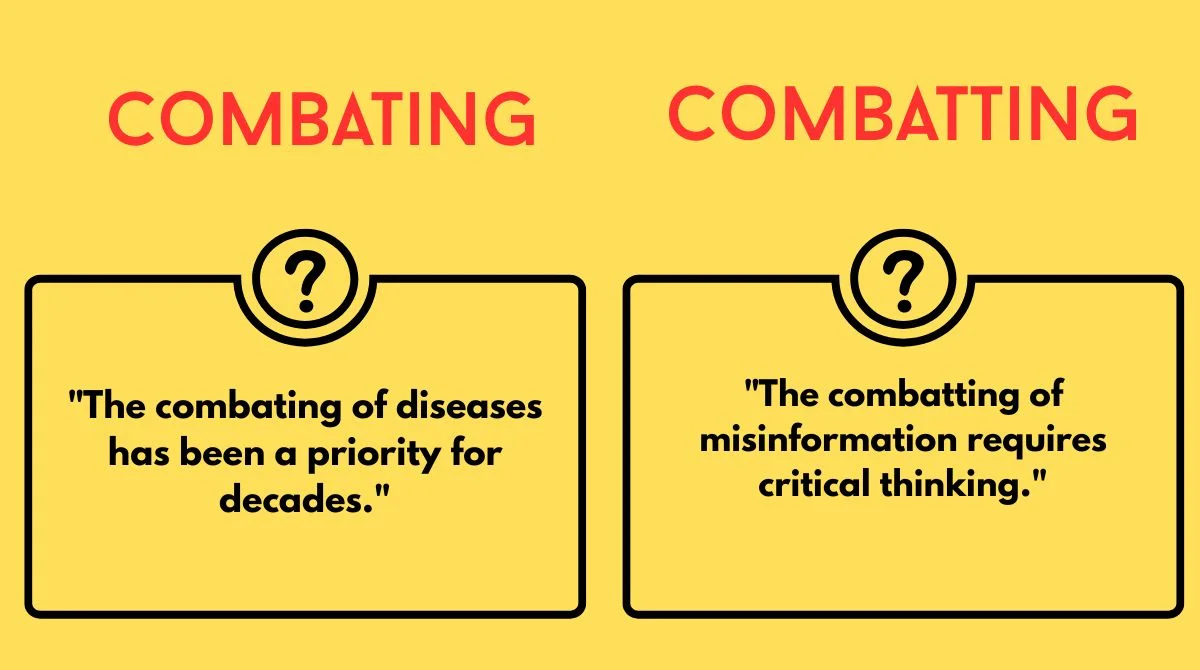
    • “The combating of diseases has been a priority for decades.”
    • “The combatting of misinformation requires critical thinking.”

    Because gerunds and present participles share the same spelling, the same rules apply regarding combating vs. combatting.


    Combatting Climate Change or Combating Inefficiency?

    Certain phrases are more commonly associated with one spelling over the other.

    • “Combating climate change” is widely used in environmental discourse.
    • “Combatting corruption” appears frequently in UK government reports.

    This is mostly a matter of regional preference rather than correctness.


    A Historical Perspective: American vs. British English

    The difference between combating and combatting is part of the broader divergence between American and British English spelling conventions:

    • Noah Webster simplified American spellings in the 19th century (e.g., color vs. colour, traveler vs. traveller).
    • British English retained older spellings, favoring doubled consonants more often.

    This historical split is why American English prefers “combating” while British English allows both spellings.


    Selecting the Correct Spelling for Your Writing Context

    If you’re unsure which spelling to use, follow these practical tips:

    1. Know Your Audience – If writing for Americans, use combating; for British readers, combatting is acceptable.
    2. Follow Style Guides – Academic and journalistic writing may have specific guidelines. The AP Stylebook and Chicago Manual of Style recommend combating.
    3. Be Consistent – Pick one spelling and stick with it throughout your writing.

    Combating or Combatting

    FAQs

    1. Which spelling is correct: combating or combatting?

    Both are correct, but combating is preferred in American English, while combatting is more common in British English.

    2. Why do some words double the final consonant before adding -ing?

    In American English, verbs double the last consonant only if the stress falls on the last syllable. Since “combat” has stress on the first syllable, the final “t” is not doubled.

    3. Is “combatting” wrong in American English?

    While combatting is not commonly used in the U.S., it is not technically incorrect. However, “combating” is the preferred spelling in American writing.

    4. Which spelling should I use for international audiences?

    If writing for a global audience or academic purposes, “combating” is the safer choice because it is widely accepted across English dialects.

    5. Do British and American English have other spelling differences like this?

    Yes! Other examples include traveling (US) vs. travelling (UK) and labeling (US) vs. labelling (UK).

    6. How do I know whether to double a consonant in other words?

    Check where the stress falls in the word. If the stress is on the last syllable, double the consonant before adding -ing (begin → beginning). If not, don’t double it (combat → combating).


    Conclusion

    So, is it combating or combatting? The answer depends on regional spelling conventions and your intended audience. While American English favors combating, British English accepts both forms, with combatting being slightly more common.

    To avoid confusion, use combating in general writing, as it is widely understood across all English-speaking regions. Regardless of which form you choose, consistency is key in maintaining clarity and professionalism in your writing.

    Need help with other tricky English spellings? Let us know in the comments!

  • People Do or People Does? Learn the Correct Usage! ✅📖

    People Do or People Does? Learn the Correct Usage! ✅📖

    English grammar can be tricky, especially when it comes to subject-verb agreement.

    One common area of confusion is whether to say people do” or “people does.” Understanding the correct usage is crucial for clear and grammatically sound communication.

    Let’s break down the rules, explore common mistakes, and provide practical examples to help you master this aspect of English.

    Should you say “people do” or “people does”? The answer lies in subject-verb agreement rules. Since “people” is plural, the correct choice is always “people do.” Learn why and avoid this common grammar mistake!


    Understanding Subject-Verb Agreement

    Subject-verb agreement refers to ensuring that a verb matches the number (singular or plural) of the subject. In English:

    • Singular subjects take singular verbs.
    • Plural subjects take plural verbs.

    For example:

    • She runs every morning. (Singular subject, singular verb)
    • They run every morning. (Plural subject, plural verb)

    Verb Conjugation and Noun Plurality

    A key factor in subject-verb agreement is the number of the noun.

    • Singular nouns (e.g., dog, child, teacher) take singular verbs (barks, plays, teaches).
    • Plural nouns (e.g., dogs, children, teachers) take plural verbs (bark, play, teach).

    The challenge comes with irregular nouns and collective nouns, which we will explore further.


    Conjugation Challenges and Tips

    Some nouns in English seem singular but are actually plural. People is one such word—it is the plural of person. Many learners mistakenly believe that people should take a singular verb like does, but that’s incorrect.

    Quick Tip:

    • Use does with singular subjects: He does his homework.
    • Use do with plural subjects: They do their homework.
    • Since people is plural, always use do: People do amazing things.

    Avoiding Subject-Verb Agreement Errors

    Errors in subject-verb agreement often occur when:

    • A plural noun is mistaken for a singular one.
    • An irregular noun confuses the speaker.
    • The sentence structure is complicated.

    Example errors: ❌ People does not like loud noises. (Incorrect) ✅ People do not like loud noises. (Correct)


    The Plural Subject “People” and Its Conjugation

    Unlike most nouns, people is inherently plural. While person is singular (one person does), people refers to more than one individual, requiring the plural verb do.

    Example Sentences:

    • People do great things when they work together.
    • People do their best when they feel motivated.

    Common Mistakes in English Grammar

    Some common grammar mistakes involve misunderstanding subject-verb agreement:

    • Using singular verbs with plural subjects
    • Forgetting that certain words are always plural (police, cattle, children, people)
    • Confusing collective nouns with singular nouns

    To avoid these mistakes, always identify whether the subject is singular or plural before choosing a verb.


    Why “People Does” is Grammatically Incorrect

    The phrase “people does” is incorrect because people is plural, and does is the singular form of do.

    Compare:

    • A person does their best. (Singular)
    • People do their best. (Plural)

    The Importance of Consistency in Verb Usage

    Consistency in grammar ensures clarity and professionalism in writing. Switching between singular and plural verb forms incorrectly can confuse readers.

    Example of Incorrect Consistency:

    People does many things in society, but they also do harm.

    Corrected Version:

    People do many things in society, but they also do harm.


    People Do or People Does

    Examples of Incorrect Usage and How to Correct Them

    Incorrect SentenceCorrected Sentence
    People does their best to succeed.People do their best to succeed.
    People does not like waiting in long lines.People do not like waiting in long lines.
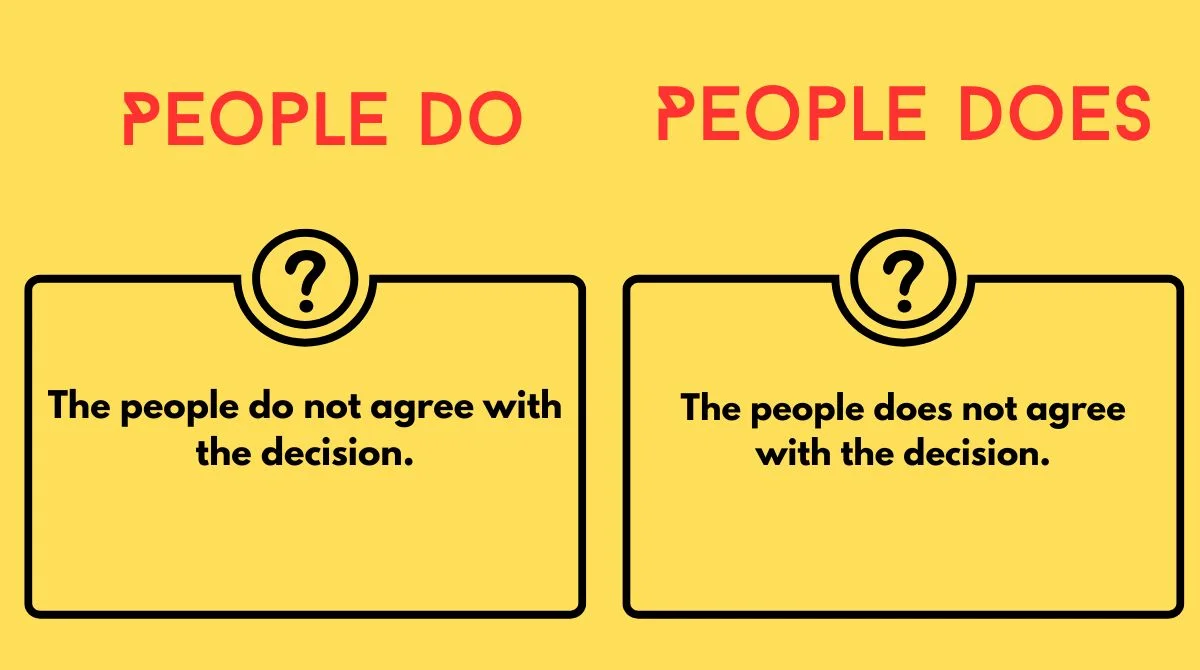
    The people does not agree with the decision.The people do not agree with the decision.

    Exploring the Correct Use of “People Do”

    Since people is a plural noun, the correct phrase is always “people do.” This rule applies in all cases:

    • People do need to rest after a long day.
    • Why do people believe in myths?

    The Role of Verb Conjugation in American English

    In American English, verb conjugation follows consistent patterns. For the verb do:

    • Do is used with plural subjects (e.g., they, we, people).
    • Does is used with singular subjects (e.g., he, she, it).

    How Conjugation Affects Meaning in Sentences

    Changing verb conjugation can alter the entire meaning of a sentence.

    • People do their work every day. (Plural, correct)
    • A person does their work every day. (Singular, correct)

    Conjugation Rules for Regular and Irregular Verbs

    SubjectCorrect Verb
    Ido
    Youdo
    He/She/Itdoes
    Wedo
    Theydo
    Peopledo

    Practical Examples Demonstrating “People Do” in Sentences

    • People do amazing things when given the opportunity.
    • Do people always behave rationally?
    • What do people usually say about this topic?

    Grammar Tips for Non-Native English Speakers

    If you struggle with subject-verb agreement, try these tips:

    1. Identify whether the subject is singular or plural before choosing a verb.
    2. Remember that people is always plural.
    3. Read sentences out loud to hear if they sound correct.

    Resources for Mastering American English Usage

    For more grammar tips, check out:

    • Merriam-Webster’s Learner’s Dictionary
    • The Chicago Manual of Style
    • Grammarly and other grammar-checking tools

    People Do or People Does

    Strategies for Remembering Correct Grammar Structures

    1. Practice daily – Write sentences using correct subject-verb agreement.
    2. Use flashcards – Create grammar flashcards to reinforce rules.
    3. Engage with native speakers – Hearing proper grammar helps reinforce learning.

    FAQs

    1. Why is “people does” incorrect?

    “People” is a plural noun, so it takes the plural verb “do” instead of the singular “does.” The correct phrase is “people do” in all cases.

    2. What is the singular form of “people”?

    The singular form of “people” is “person”. When using “person,” the correct verb is “does” (e.g., “A person does their best”).

    3. Are there other nouns like “people” that take plural verbs?

    Yes, some plural-only nouns include:

    • Police (“The police do their job well.”)
    • Cattle (“Cattle do not like loud noises.”)
    • Children (“Children do their homework.”)

    4. Can “people” ever take a singular verb?

    No, “people” is always plural. However, “the people” (referring to a specific group) still takes a plural verb: “The people do not agree with the decision.”

    5. How can I remember the difference between “do” and “does”?

    A simple trick: “He/She/It does, but they/we/people do.” If the subject is plural, always use “do.”

    6. What are some example sentences using “people do”?

    • “People do amazing things when they work together.”
    • “Why do people believe in superstitions?”
    • “People do their best to succeed in life.”

    Final Thoughts and Additional Language Learning Advice

    Understanding subject-verb agreement is essential for clear communication in English. Always remember:

    • People is plural and takes do.
    • Does is for singular subjects like he, she, it.
    • Proofreading and practice will help you avoid common mistakes.

    By mastering these grammar rules, you’ll speak and write with greater confidence. Keep practicing, and soon, these rules will feel natural!

  • 🚀 Headed vs Heading: The Complete Grammar & Usage Guide

    🚀 Headed vs Heading: The Complete Grammar & Usage Guide

    English learners and even fluent speakers often pause when choosing between “headed” and “heading.” At first glance, the difference seems tiny. Yet once you dig deeper, you realize these words reveal subtle distinctions about time, focus, and meaning.

    If you’ve ever wondered whether to say “I’m headed home” or “I’m heading home,” this guide is for you.

    By the end, you’ll know exactly which to use, why it matters, and how context (grammar, culture, and even psychology) shapes the choice.


    Why This Phrase Matters More Than You Think

    Headed vs Heading

    Tiny details in language often carry bigger implications than we notice. The choice between headed vs heading doesn’t just change grammar — it shifts emphasis.

    • Headed highlights the destination.
    • Heading emphasizes the movement or process.

    This isn’t just about textbook correctness. The way you phrase a simple sentence can change how people perceive your goals, your mindset, and your tone. Coaches, writers, and speakers know this, which is why both forms appear often in motivational language, travel talk, and everyday speech.


    Grammar Breakdown: Headed vs Heading

    To master the difference, let’s start with grammar.

    What Does “Headed” Mean?

    • Form: past participle of the verb head.
    • Use: often paired with “to” or “for” to indicate direction or destination.
    • Meaning: points to where someone or something is going.

    Examples:

    • I’m headed to the store. (Destination focus)
    • They were headed for trouble. (Outcome focus)
    • She’s headed north on the freeway. (Directional focus)

    Here, the journey matters less than the end point.


    What Does “Heading” Mean?

    • Form: present participle of the verb head.
    • Use: describes the action of moving in a direction.
    • Meaning: focuses on the process or motion.

    Examples:

    • I’m heading to the store. (Action focus)
    • He’s heading up the committee. (Leadership role — different meaning)
    • We’re heading into dangerous territory. (Ongoing process)

    Unlike “headed,” this form emphasizes the movement itself, not just the destination.


    Quick Grammar Table: Headed vs Heading

    WordFormFocusExample
    HeadedPast participleDestination / OutcomeShe’s headed home.
    HeadingPresent participleProcess / MovementShe’s heading home.

    What People Actually Say: Real Usage Trends

    Grammar is only half the story. What do people actually use in daily life?

    • In casual conversations, both appear frequently and interchangeably.
    • In formal writing, “heading” tends to be more common.
    • In regional English (US vs UK), preferences differ (covered below).

    When you listen closely, you’ll notice that Americans lean on “headed” more, while “heading” dominates in British speech.


    Which Is More Common? Corpus Frequency Comparison

    Large text databases (called corpora) help us see usage trends. Data from American and British sources consistently shows:

    • US English: “headed” is favored in everyday talk, especially with travel or destinations (I’m headed to work).
    • UK English: “heading” wins, especially in written form (I’m heading to the station).
    RegionPreferred FormExample
    U.S. EnglishHeadedI’m headed to the airport.
    U.K. EnglishHeadingI’m heading to the station.
    Global MixBothBoth forms understood widely

    Colloquial English: Speech vs. Text Patterns

    • Spoken English: People often shorten or blur grammar. “I’m headed” and “I’m heading” both sound natural.
    • Texting & Chat: Quick phrases like “heading out” are more common.
    • Formal writing: “Heading” appears more, especially in edited texts or journalism.

    Regional Usage: Geography Makes a Difference

    U.S. English

    In American English, “headed” often dominates. It feels natural in sentences like:

    • We’re headed to Vegas this weekend.
    • He’s headed for trouble if he keeps skipping work.

    U.K. English

    British English leans toward “heading.”

    • She’s heading to the shops.
    • I’m heading off now.

    Australia and Canada

    Usage blends here. Canadians mirror Americans with “headed,” while Australians often sound more British, preferring “heading.”


    Regional Preference Map

    (Insert simple regional comparison chart here in your blog for visuals — e.g., map shading for “headed” vs. “heading”)


    How Context Shapes Meaning

    Destination vs. Process Focus

    Think of it this way:

    • Headed = Destination → The end point matters.
    • Heading = Process → The action of moving matters.

    Examples:

    • I’m headed to college next year. (Where you’re going — future plan)
    • I’m heading to college now. (Action happening right now)

    Everyday Situations With Examples

    Travel:

    • I’m headed to Paris next week. (Destination goal)
    • I’m heading to Paris now. (Currently traveling)

    Work:

    • She’s headed for a promotion. (Outcome focus)
    • She’s heading the new project. (Different verb sense = leading)

    Life Goals:

    • We’re headed toward success. (Future destination)
    • We’re heading into uncharted waters. (Process underway)

    Formal vs. Informal Registers

    • Informal chat: Both work. “I’m headed home” sounds casual and American.
    • Professional context: “Heading” tends to read smoother in business writing.

    Metaphors & Mindsets: What the Phrase Says About You

    Language isn’t just grammar. It also signals mindset.

    • Headed implies vision and destination — you know your target.
    • Heading implies action, momentum, and movement — you’re in the process.

    This difference makes both words powerful tools in coaching, therapy, and leadership communication.


    Examples in Coaching and Self-Help

    • You’re headed for greatness. → Destination, vision, future.
    • You’re heading into a season of growth. → Action, transition, process.

    Quote Box: Metaphorical Uses in Media

    “The company is headed for a record year.” – The Wall Street Journal

    “We’re heading into an age of AI transformation.” – The Guardian


    Goal Setting: The Language of Future Thinking

    When setting goals, the difference matters:

    • Headed inspires clarity: I’m headed toward financial freedom.
    • Heading inspires momentum: I’m heading into new opportunities.

    Application in Journaling and Therapy

    Therapists often notice language patterns. Someone who says “I’m headed for disaster” frames life as outcome-driven. Someone who says “I’m heading into challenges” focuses on the journey.


    Cultural Differences: Directional Language Across the World

    Different cultures place emphasis on where you end up vs. how you get there.

    Idioms in Other Languages

    • Spanish: “Voy rumbo a…” (I’m headed toward…) emphasizes destination.
    • French: “Je me dirige vers…” (I’m heading toward…) emphasizes movement.

    Directional Thinking Across Cultures

    Research in cognitive linguistics shows that Western cultures favor destinations, while Eastern cultures often value the process itself. This echoes the split between headed vs heading.


    Which Should You Use – and When?

    Quick Decision Framework

    Ask yourself: Do I want to highlight the destination or the action?

    • Use headed if the end point matters.
    • Use heading if the action or process matters.

    Quick Reference Chart

    ContextBetter ChoiceExample
    Travel plansHeadedI’m headed to the airport.
    Current motionHeadingI’m heading out now.
    Future goalsHeadedWe’re headed for success.
    Process focusHeadingWe’re heading into change.

    Case Study: How Word Choice Changed a Coaching Session

    A life coach once described a client’s language shift. At first, the client said: “I’m headed for failure.” The coach asked her to reframe it. She tried: “I’m heading into challenges.”

    That small change shifted the conversation. Instead of predicting doom, she saw herself actively engaging in a process she could manage.

    Language shapes mindset — and headed vs heading is a prime example.


    FAQs: Headed vs Heading

    Is “I’m headed home” correct?

    Yes. In American English, “I’m headed home” is widely used to mean you’re going home.

    Is “I’m heading home” more formal?

    Yes, “I’m heading home” feels smoother in writing and slightly more formal than “I’m headed home.”

    Do British speakers use “headed”?

    Not often. British English favors “heading,” especially in everyday conversation.

    Can “heading” mean leadership?

    Yes. Example: She’s heading the project means she’s leading it. “Headed” doesn’t carry this meaning.

    Which is better for motivational writing: headed or heading?

    Both work. Use headed to stress destination, heading to highlight action and momentum.


    Conclusion

    Both headed and heading are correct, natural, and widely understood. The difference lies in emphasis:

    • Headed = destination and outcome.
    • Heading = process and action.

    Your choice depends on context, region, and intent. Next time you write or speak, ask yourself: Do I want to stress where I’m going, or the fact that I’m moving? That small decision can change the entire tone of your message.

  • Congratulations On vs Congratulations For: The Key Difference! 🎊📚

    Congratulations On vs Congratulations For: The Key Difference! 🎊📚

    Language is full of subtle nuances, and even small prepositional differences can change the meaning or appropriateness of a phrase. One common point of confusion is whether to say “Congratulations on” or “Congratulations for”.

    While both expressions exist, their usage differs based on context. This guide will explore their distinctions, provide practical examples, and help you master the art of congratulatory language.

    Should you say “Congratulations on” or “Congratulations for”? The difference lies in context! Use “on” for achievements and “for” when praising effort or actions. Learn the full explanation with examples!


    Understanding the Basics: “Congratulations On” Explained

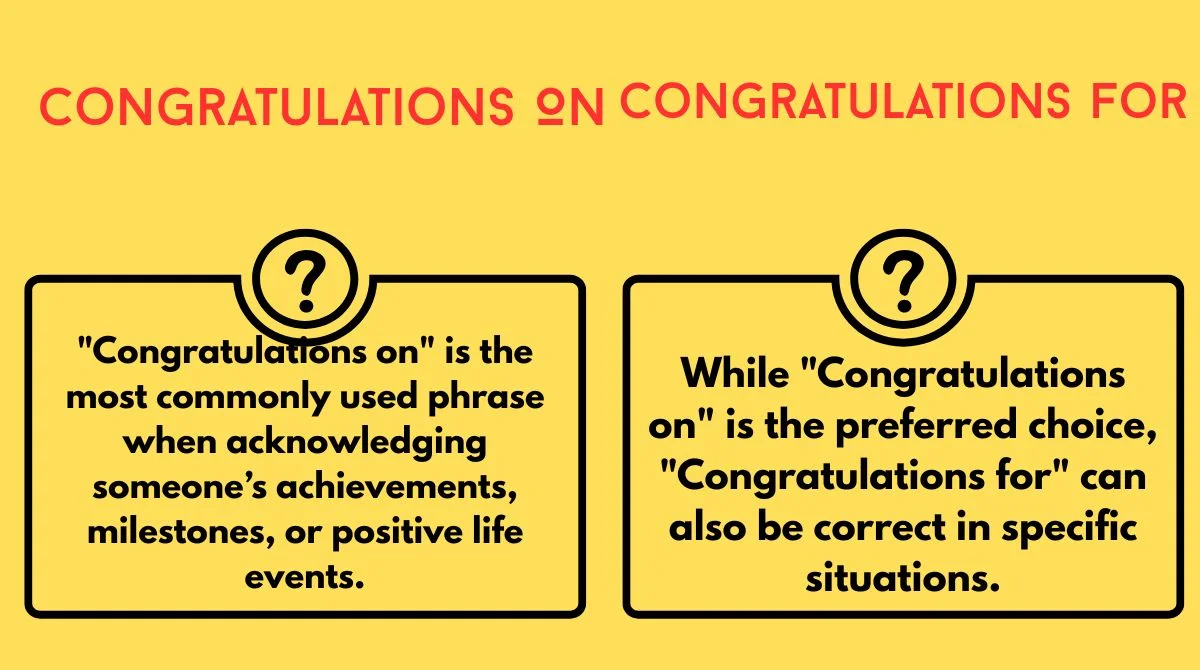
    “Congratulations on” is the most commonly used phrase when acknowledging someone’s achievements, milestones, or positive life events. It is considered the grammatically standard form when offering praise for accomplishments.

    When to Use “Congratulations On”

    • Academic achievements: Congratulations on graduating with honors!
    • Job-related success: Congratulations on your promotion!
    • Personal milestones: Congratulations on your engagement!
    • Awards and recognition: Congratulations on winning the tournament!

    In these cases, “on” helps connect the word “congratulations” to a specific accomplishment, making the praise sound natural and fluid.


    Congratulations On vs Congratulations For

    When to Use “Congratulations For”: Contexts and Usage

    While “Congratulations on” is the preferred choice, “Congratulations for” can also be correct in specific situations. The key difference is that “for” is generally used when emphasizing the reason behind the achievement or the effort made to attain success.

    When to Use “Congratulations For”

    • Commending effort rather than results: Congratulations for working so hard on this project!
    • Recognizing good behavior or character: Congratulations for being such a great mentor!
    • Praising a cause or action: Congratulations for supporting this charity event!

    Rule of thumb: Use “on” for achievements and “for” when recognizing actions or efforts leading to success.


    The Nuance in Praising Achievements

    Although both phrases are grammatically acceptable, their subtle distinctions influence tone and perception. Consider the following examples:

    SentenceCorrect Usage?Explanation
    Congratulations on your new book deal!✔ YesFocuses on the accomplishment (getting the book deal).
    Congratulations for your new book deal!✘ NoSounds unnatural; doesn’t highlight effort.
    Congratulations for writing an inspiring book!✔ YesFocuses on the effort put into writing.

    Using the wrong preposition might not render the sentence completely incorrect, but it can sound unnatural or less idiomatic.


    Structural Clarity in Sentences

    When forming congratulatory statements, sentence structure plays a crucial role. Here are some common formats:

    1. Congratulations on + noun/gerund
      • Congratulations on your success.
      • Congratulations on completing your first marathon.
    2. Congratulations for + action (verb phrase)
      • Congratulations for helping the community.
      • Congratulations for standing up for what you believe in.

    By following these patterns, your sentences will remain grammatically sound and convey the intended meaning clearly.


    The Popularity Contest: Which Phrase Wins According to Usage Data?

    A review of language databases and search trends reveals that “Congratulations on” overwhelmingly dominates in formal and informal usage.

    • Google Ngram Viewer data indicates that “congratulations on” is used nearly five times more frequently than “congratulations for.”
    • Common English exams (TOEFL, IELTS) reinforce that “on” is the correct choice for academic and professional writing.

    While “for” isn’t necessarily incorrect, it remains far less common than “on,” especially in formal settings.


    The Interchangeability Debate: Can “On” and “For” Be Used the Same Way?

    Although some might argue that “Congratulations for” and “Congratulations on” can be used interchangeably, native speakers instinctively lean towards “on” for most scenarios.

    Consider These Examples:

    • Congratulations on your wedding! (✔ Sounds natural)
    • Congratulations for your wedding! (✘ Sounds awkward)
    • Congratulations for organizing such a beautiful wedding! (✔ Acceptable when emphasizing effort)

    Final Verdict:

    Stick to “on” for achievements and “for” when acknowledging effort.


    Dissecting “Congratulations”: More Than Just a Word

    The word “congratulations” itself originates from the Latin congratulatio, meaning “expression of joy or pleasure.” It has been in use since the 15th century, evolving into a universal way to acknowledge success and good fortune.

    Singular vs. Plural Forms of Congratulations

    • “Congratulation” (singular) is rarely used and sounds unnatural in most cases.
    • “Congratulations” (plural) is the accepted form when offering praise.

    Celebratory Circumstances and Their Proper Expressions

    EventCorrect Phrase
    GraduationCongratulations on graduating!
    New JobCongratulations on your new position!
    Running a MarathonCongratulations for training so hard!
    Winning an AwardCongratulations on your achievement!

    “Congratulations On” Beyond the Basics: Advanced Examples

    1. Congratulations on your successful business launch; your dedication is inspiring!
    2. Congratulations on passing your medical board exams; you deserve it!
    3. Congratulations for advocating for positive change in your community.

    Mastering the Art of Congratulatory Language

    Tips for Sounding Natural:

    • Avoid overcomplicating phrases; keep it simple and heartfelt.
    • Match the preposition to the intent (“on” for achievement, “for” for effort).
    • If in doubt, “on” is usually the safer choice.

    Congratulations On vs Congratulations For

    Responding to Congratulations: Etiquette and Synonyms

    When someone congratulates you, responding appropriately maintains the flow of conversation.

    Common Responses:

    • Thank you! I really appreciate it.
    • Thanks so much; that means a lot!
    • I couldn’t have done it without support!

    Alternative Words for “Congratulations”:

    • Well done!
    • Kudos!
    • Hats off to you!
    • Bravo!

    FAQs

    1. When should I use “Congratulations on”?

    Use “Congratulations on” when celebrating achievements, milestones, or successes. Example: “Congratulations on your promotion!”

    2. When is “Congratulations for” appropriate?

    Use “Congratulations for” when praising effort or a specific action. Example: “Congratulations for working so hard on this project!”

    3. Is “Congratulations for your success” correct?

    No, it sounds unnatural. The correct phrasing is “Congratulations on your success.”

    4. Why do we say “Congratulations on your wedding” instead of “for your wedding”?

    “Congratulations on your wedding” is correct because it recognizes the event itself, not the effort behind it.

    5. Which phrase is more common: “Congratulations on” or “Congratulations for”?

    “Congratulations on” is much more common and grammatically preferred in most situations, especially in formal writing.

    6. Can I say “Congratulations on winning the award” and “Congratulations for winning the award”?

    “Congratulations on winning the award” is the correct and natural choice. “For” is not typically used when acknowledging achievements.


    Conclusion

    Understanding when to use “Congratulations on” vs. “Congratulations for” can greatly improve your communication skills.

    While “on” remains the dominant choice for acknowledging accomplishments, “for” serves a role in recognizing effort or actions. By mastering these nuances, you can confidently express praise in both casual and formal settings.

    Now that you know the difference, go ahead and congratulate someone the right way!

  • Persue or Pursue ✨ The Correct Spelling Explained (With Real Examples)

    Persue or Pursue ✨ The Correct Spelling Explained (With Real Examples)

    English spelling can be tricky, especially when words look and sound almost the same. One common mistake people make is writing persue instead of pursue.

    At first glance, the difference seems small. But in writing, those few letters can make a big impact on how professional and credible you sound.

    This guide clears up the confusion once and for all. You’ll learn the correct spelling, meaning, real-world uses, memory tricks, common mistakes, historical background, and practical examples of “pursue.” By the end, you’ll never mix up persue and pursue again.


    Persue vs. Pursue — Clearing the Confusion

    Persue or Pursue

    Many learners (and even native speakers) confuse the two because of how they sound. When spoken quickly, “pursue” almost sounds like it has an e instead of a u. Typing errors and phonetic spelling often lead to the incorrect form persue.

    Here’s a quick comparison:

    WordStatusCorrect Usage?Example Sentence
    Persue❌ IncorrectNeverShe decided to persue her goals.
    Pursue✅ CorrectAlwaysShe decided to pursue her goals.

    Key point: Persue is not a word in English. The only correct spelling is pursue.


    The Correct Spelling: Pursue

    To be crystal clear: the correct spelling is always pursue.

    • Part of speech: Verb
    • Verb forms: pursue, pursues, pursued, pursuing
    • Pronunciation (IPA): /pərˈsuː/
    • Stress pattern: second syllable (per-SUE)

    Example sentences:

    • They chose to pursue a career in medicine.
    • We must pursue justice no matter how difficult.
    • She is pursuing her dream of becoming a pilot.

    Meaning and Usage of “Pursue” in American English

    The word pursue means to follow, chase, or strive for something with determination. It can be used both literally and figuratively.

    Synonyms of “Pursue”:

    • Chase
    • Seek
    • Strive for
    • Follow
    • Aim for
    • Go after

    Example sentences in daily English:

    • Literal: The police pursued the suspect.
    • Figurative: He pursued his ambition of writing a novel.

    In American English, pursue is used in formal, professional, and casual contexts, making it one of the most versatile verbs in the language.


    Contextual Applications of “Pursue”

    The beauty of pursue lies in how adaptable it is. Let’s explore how it’s used in different settings:

    Legal Context

    • “The victim decided to pursue legal action.”
    • Often used in law to mean filing or continuing a case.

    Academic Context

    • “She wants to pursue a degree in law.”
    • Refers to continuing education or advanced study.

    Career Context

    • “He chose to pursue a career in medicine.”
    • Implies actively working toward professional goals.

    Personal Context

    • “We should all pursue happiness in life.”
    • Used figuratively to mean seeking fulfillment or satisfaction.

    Literal vs. Figurative Use of “Pursue”

    “Pursue” has both literal and figurative meanings. Knowing the difference makes your writing stronger.

    TypeMeaningExample
    LiteralTo physically chase or follow someone/somethingThe cat pursued the mouse.
    FigurativeTo strive for or seek something abstractShe pursued her passion for music.

    Memory Tricks to Remember the Correct Spelling

    Spelling mistakes happen, but here are some easy ways to lock in the correct form pursue:

    • Mnemonic: Think of it as PURSUe because YOU pursue something.
    • Visual cue: The “u” in pursue matches the “u” in “you.”
    • Sound link: Break it down as “per” + “sue.”
    • Practice tip: Write a few example sentences daily to build muscle memory.

    Historical Background: Evolution of “Pursue”

    The word pursue has an interesting history:

    • Originates from Old French poursuir meaning “to follow.”
    • Traces back to Latin prosequi meaning “to follow after.”
    • Entered English in the 14th century with nearly the same meaning it holds today.

    This shows how words evolve, but the spelling of pursue has remained fairly stable over centuries, making persue a modern misspelling rather than a historical variant.


    “Pursue” in Literature and Famous Quotes

    Writers throughout history have used pursue to inspire determination and resilience.

    Classic Literature Examples

    • Shakespeare: “The better part of valour is discretion; in the which better part I have saved my life.” (Though “pursue” itself appears in several plays when characters chase honor or love.)
    • Charles Dickens used “pursue” to describe relentless characters in his novels.

    Inspirational Quotes

    • “Don’t be afraid to pursue what sets your soul on fire.”
    • “Greatness comes to those who pursue it with passion.”

    Common Mistakes and How to Avoid Them

    The misspelling persue is widespread online, especially in informal writing.

    Frequent Wrong Spellings

    • Persue
    • Perssu
    • Pursu

    Quick Fix Tips

    • Always use spell-check.
    • Remember the phrase: “YOU pursue your goals.”
    • Double-check formal documents (resumes, applications, academic essays).

    Example Correction:

    • Wrong: She wants to persue law.
    • Right: She wants to pursue law.

    Practical Guide: How to Use “Pursue” in Different Writing Styles

    “Pursue” works across all kinds of writing. Here’s how to apply it properly:

    Professional Writing

    • Resume: “I am eager to pursue opportunities in finance.”
    • Cover letter: “I wish to pursue a leadership role.”

    Academic Writing

    • Essay: “Students often pursue higher education abroad.”
    • Research: “Scientists pursue solutions to global challenges.”

    Creative Writing

    • Novel: “He vowed to pursue the villain to the ends of the earth.”
    • Poetry: “Pursue the whispers of dreams unseen.”

    Everyday Writing

    • Text message: “I’m planning to pursue photography as a hobby.”
    • Email: “We should pursue this idea further.”

    Examples of Correction in Real Sentences

    Seeing the difference in action reinforces correct spelling:

    • ❌ Wrong: “They plan to persue justice.”
    • ✅ Right: “They plan to pursue justice.”
    • ❌ Wrong: “I decided to persue engineering.”
    • ✅ Right: “I decided to pursue engineering.”
    • ❌ Wrong: “We must persue our dreams.”
    • ✅ Right: “We must pursue our dreams.”

    FAQs About Persue vs. Pursue

    What is the correct spelling: persue or pursue?

    The correct spelling is pursue. Persue is always wrong.

    Why do people write persue instead of pursue?

    It’s usually a phonetic or typing mistake because of how the word sounds.

    How do I remember the correct spelling of pursue?

    Think of the phrase: “You pursue your dreams” — the “u” helps you remember.

    Can persue be used in British English?

    No. Persue is incorrect in all forms of English. The spelling pursue is universal.

    What are some common collocations with pursue?

    • Pursue a career
    • Pursue higher education
    • Pursue happiness
    • Pursue justice

    Final Takeaway — Why Correct Spelling Matters

    Words are powerful tools. Using the wrong spelling, like persue, can undermine your credibility, especially in professional or academic settings. The right form, pursue, carries respect, clarity, and confidence.

    To recap:

    • Persue ❌ — Not a word
    • Pursue ✅ — Always correct

    Whether you’re writing a resume, a school essay, or a personal note, remember that spelling reflects attention to detail. If you want your words to leave a strong impression, always choose pursue.