Category: Tricky Terms

  • Tomatoes or Tomatos? The Correct Spelling Explained! 🍅✅

    Tomatoes or Tomatos? The Correct Spelling Explained! 🍅✅

    Language can be tricky, especially when it comes to spelling and pluralization. One common source of confusion is the correct plural form of tomato.

    Is it tomatoes or tomatos? If you’ve ever hesitated while writing or typing this word, you’re not alone.

    This article will clear up the confusion once and for all while diving into the fascinating linguistic, cultural, and culinary aspects of the beloved tomato.

    Is it “tomatoes” or “tomatos”? The correct plural of tomato follows a simple English spelling rule, but many people get confused. Learn the reason behind the correct spelling and never make this mistake again!


    The Tomato Debate: Understanding Pluralization in American English

    English has many rules for forming plurals, but it also has exceptions that trip up even native speakers. The word tomato is one of those words that follows a specific pluralization rule.

    Unlike simple nouns that only require an -s at the end to become plural (e.g., cats, dogs), tomato belongs to a group of words that take -es instead.

    Understanding why tomatoes is correct requires examining English pluralization patterns and linguistic influences.


    Tomato: More Than a Culinary Staple

    The tomato is more than just a kitchen ingredient; it plays a crucial role in global cuisines and nutrition. This vibrant fruit (yes, botanically a fruit!) is packed with flavor and versatility. From sauces to salads, the tomato is a staple in many diets worldwide.


    The Nutritional Benefits of Tomatoes

    Beyond their culinary appeal, tomatoes offer numerous health benefits:

    • Rich in Vitamins: High in Vitamin C, Vitamin K, and folate.
    • Packed with Antioxidants: Contains lycopene, known for its cancer-fighting properties.
    • Heart Health: Helps reduce the risk of heart disease by lowering blood pressure and cholesterol.
    • Supports Vision: Contains lutein and beta-carotene, which support eye health.
    • Aids Digestion: High in fiber, aiding in healthy digestion.

    With all these benefits, it’s no wonder tomatoes are a dietary staple across the world.


    Tomatoes in Global Cuisines

    From Italian pasta sauces to Mexican salsas, tomatoes are a key ingredient in many global dishes. Some popular tomato-based dishes include:

    • Italy: Tomato-based pasta sauces, Margherita pizza, and bruschetta.
    • Mexico: Salsa, pico de gallo, and enchilada sauces.
    • India: Tomato-based curries such as butter chicken and tikka masala.
    • United States: Ketchup, tomato soup, and BLT sandwiches.

    This global appeal further emphasizes the importance of getting the word tomatoes right!


    The Origins and Evolution of the Word ‘Tomato’

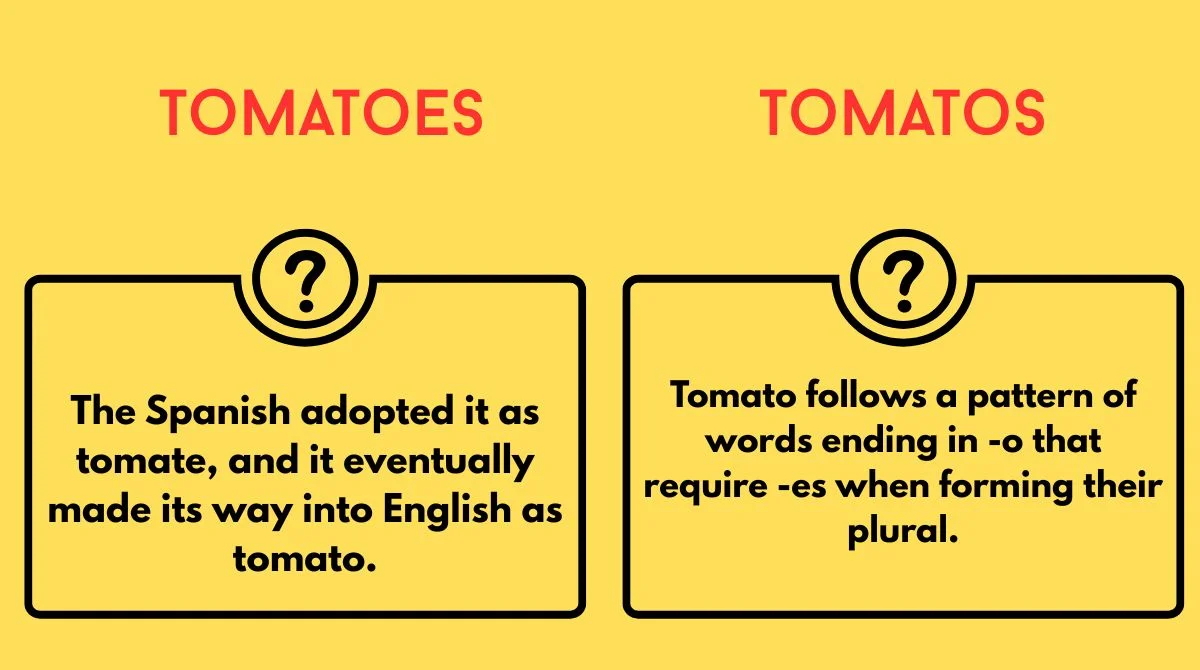
    The word tomato originates from the Nahuatl word tomatl, used by the Aztecs to describe the fruit. The Spanish adopted it as tomate, and it eventually made its way into English as tomato.

    Over time, the spelling and pronunciation evolved, but the plural form has remained consistent in accordance with standard English rules.


    Dissecting the Plural Forms of Words Ending in ‘O’

    In English, nouns ending in -o can be pluralized in two different ways:

    • Adding -s (e.g., pianos, photos, logos)
    • Adding -es (e.g., potatoes, heroes, tomatoes)

    The tricky part? There’s no single rule that applies to all words ending in -o.

    Tomatoes or Tomatos

    Why ‘Tomatoes’ is the Grammatically Correct Plural Form

    Tomato follows a pattern of words ending in -o that require -es when forming their plural. This rule generally applies to words borrowed from other languages, especially those ending in a consonant followed by -o.

    Other words that follow this pattern include:

    • Potato ➔ Potatoes
    • Hero ➔ Heroes
    • Echo ➔ Echoes
    • Veto ➔ Vetoes

    Understanding this rule can help eliminate confusion when writing plural forms of similar words.


    Examples of ‘Tomatoes’ Used in Sentences

    To reinforce the correct spelling, here are some examples:

    • “She bought fresh tomatoes from the farmers’ market.”
    • “The pasta sauce requires a handful of tomatoes.”
    • “We grew a variety of tomatoes in our backyard garden.”
    • “He sliced the tomatoes for the sandwich.”
    • “Canned tomatoes are useful for cooking in winter.”

    Common Misconceptions and Spelling Errors

    Many people mistakenly write tomatos instead of tomatoes. Some of the common reasons for this mistake include:

    • Influence of words like “photo” and “piano” that take only an -s in plural form.
    • Autocorrect errors that don’t always flag “tomatos” as incorrect.
    • Phonetic spelling leading to the assumption that -es isn’t necessary.

    However, tomatos is incorrect, and using it in formal writing can be considered a spelling mistake.


    Other English Words Following the Same Pluralization Rule

    Here are more words that, like tomato, add -es in their plural form:

    SingularPlural
    PotatoPotatoes
    HeroHeroes
    EchoEchoes
    VetoVetoes
    MosquitoMosquitoes

    By remembering these patterns, you can avoid making common pluralization mistakes.


    The Influence of Spanish on Plural Forms in English

    Since tomato was borrowed from Spanish, its pluralization follows a pattern influenced by Spanish linguistic rules. In Spanish, tomate (singular) becomes tomates (plural). This aligns closely with the English pluralization rule requiring -es for words ending in -o.

    Other Spanish-origin words in English that follow this pattern include:

    • Tornado ➔ Tornadoes
    • Mosquito ➔ Mosquitoes
    • Embargo ➔ Embargoes

    Memory Tricks to Help You Remember the Correct Spelling

    Here are some easy ways to remember that tomatoes is the correct plural form:

    1. Think of Potatoes — If potato becomes potatoes, so does tomato.
    2. Sing the “Tomatoes” Song — Remember the phrase from the song “You say tomato, I say tomato…”
    3. Mnemonic Device: Add “-es” to a tomato, so you don’t sound loco!

    Using these tricks, you’ll never second-guess your spelling again.

    Tomatoes or Tomatos

    FAQs

    1. Is “tomatos” a correct spelling?

    No, “tomatos” is incorrect. The correct plural form of “tomato” is “tomatoes”, following English pluralization rules for words ending in -o.

    2. Why do we add -es to “tomato” instead of just -s?

    English grammar requires adding -es to certain nouns ending in -o, especially those borrowed from other languages. This includes potatoes, heroes, and echoes.

    3. What other words follow the same pluralization rule?

    Similar words that take -es in their plural forms include:

    • Potato ➔ Potatoes
    • Hero ➔ Heroes
    • Echo ➔ Echoes
    • Veto ➔ Vetoes

    4. Why do some words ending in -o only take -s?

    Not all words ending in -o follow the same rule. Words like piano, photo, and memo take only -s because they were adopted differently into English.

    5. Does British and American English differ in spelling “tomatoes”?

    No, both British and American English use “tomatoes” as the correct plural form. There is no variation in this case.

    6. How can I remember the correct spelling?

    Use this simple trick: If potato becomes potatoes, then tomato becomes tomatoes! 🍅✅


    Conclusion

    Now you know: tomatoes is the correct plural form, while tomatos is simply a mistake.

    English pluralization rules can be confusing, but once you recognize patterns like adding -es to certain words ending in -o, spelling becomes much easier.

    Next time you’re writing about these delicious red fruits, you can be confident that tomatoes is the way to go. Happy writing—and happy eating!

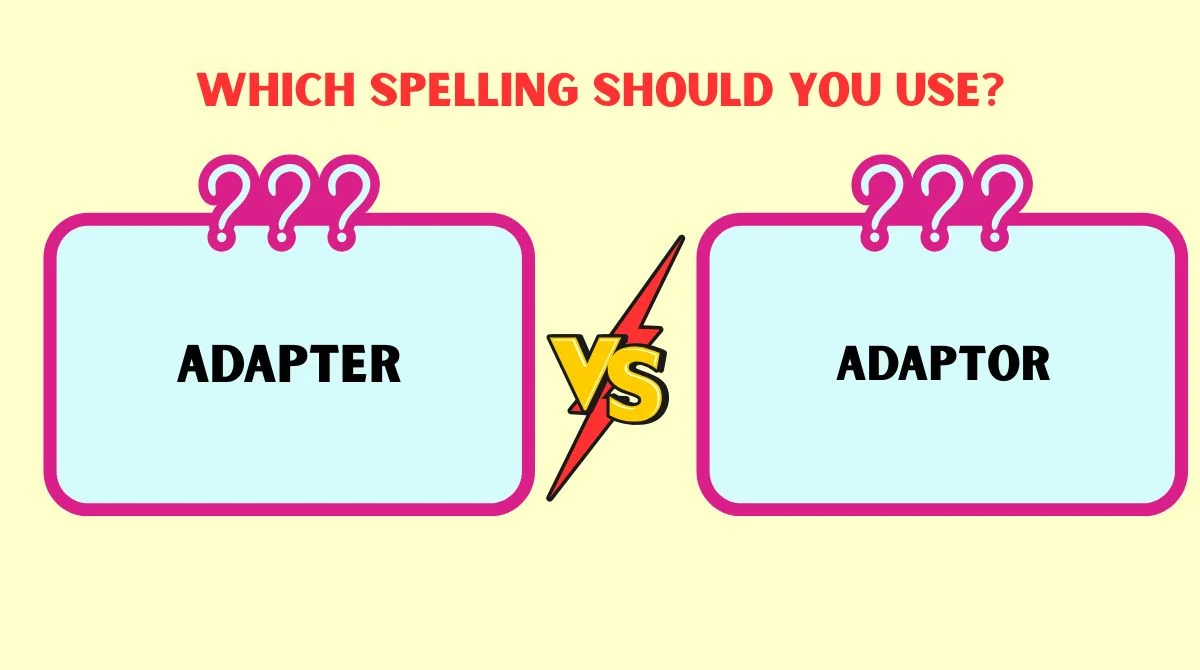
  • Adapter vs Adaptor 🔌 – Which Spelling Should You Use?

    Adapter vs Adaptor 🔌 – Which Spelling Should You Use?

    English can be tricky. Some words look almost identical but leave writers wondering which form is correct. A classic example is adapter vs adaptor.

    If you’ve ever stared at a product box or instruction manual and noticed both versions floating around, you’re not alone.

    So, what’s the difference? The short answer: both spellings are correct, but usage depends on region, industry, and context. Let’s break down the history, meaning, and everyday use of these two words to settle the confusion once and for all.


    Understanding “Adapter” vs “Adaptor”

    Adapter or Adaptor

    At first glance, “adapter” and “adaptor” seem like separate words, but they actually refer to the same thing: a device or tool that connects, modifies, or allows compatibility between different systems.

    The only difference lies in spelling preference.

    • Adapter – The American English spelling, overwhelmingly used in the US and globally in technical industries.
    • Adaptor – The British English spelling, still common in the UK and some Commonwealth countries, though “adapter” is gaining ground there too.

    In modern English, “adapter” dominates in terms of frequency. If you’re writing for an international audience, this spelling is usually the safest choice.


    Etymology and History of the Word

    The root of both words comes from the Latin verb adaptāre, meaning to fit, adjust, or modify. Over time, this passed into Old French as adapter and then into English.

    The two spellings emerged as English standardized spelling during the 17th–18th centuries. The suffix –er was more natural in American English, while British English often kept –or endings (similar to valor/valour or humor/humour).

    Historical dictionaries and literary works show both versions in circulation. However, by the 20th century, “adapter” had become the dominant spelling in most global technical contexts, especially with the rise of electronics.

    Fun fact: Thomas Edison, who often wrote about connectors and plugs, consistently used “adapter” in his patent descriptions. That early technical adoption helped cement the spelling in engineering and electronics.


    Usage in Modern English

    Today, both spellings are correct, but they’re not equally popular. Usage depends on where you are and who you’re writing for:

    • American English (US): “Adapter” is standard. You’ll almost never see “adaptor” in American textbooks or electronics packaging.
    • British English (UK): Both forms are accepted, but “adaptor” shows up more in general writing. Technical industries, however, lean toward “adapter.”
    • International English: With globalization, “adapter” has become more common worldwide, especially in computer and travel-related products.

    Here’s a quick usage snapshot:

    SpellingRegion/Common UsePopularity
    AdapterUS, global tech, electronics, computingVery common
    AdaptorUK, Commonwealth countries, older textsLess common, but not obsolete

    Technical Context: Where You’ll See Each Spelling

    Language choice often depends on industry. If you’ve ever shopped online for electronics or travel gadgets, you’ve probably noticed both spellings on packaging.

    • Computers and electronics: “Adapter” is the global standard (USB adapter, HDMI adapter, power adapter).
    • Travel gear: “Travel adaptor” still appears widely in UK and European markets.
    • Engineering and mechanics: Both spellings are seen, but “adapter” is preferred in international technical documents.
    • Marketing materials: Companies often choose the spelling that best matches their target audience (UK vs US).

    Different Types of Adapters (with Examples)

    The word “adapter/adaptor” isn’t tied to just one device. It’s a versatile term for any tool that bridges a gap between incompatible systems.

    Here are the most common types you’ll encounter:

    Power Adapters

    • Wall chargers for phones and laptops.
    • AC-to-DC converters for appliances.
    • Example: The square charger that comes with your MacBook is a power adapter.

    Travel Adapters

    • Plug converters for international travel.
    • Example: A traveler from the US visiting Europe needs a travel adaptor to plug a laptop charger into EU sockets.

    Computer and Electronic Adapters

    • USB-to-HDMI adapters.
    • Ethernet-to-USB adapters.
    • Wireless Bluetooth adapters.
    • Example: Gamers often use a controller adapter to connect older devices to modern consoles.

    Mechanical Adapters

    • Used in cars, plumbing, and industrial machines.
    • Example: A camera lens mount adapter allows you to fit lenses across different brands.

    Common Mistakes and Misconceptions

    Despite being simple spelling variants, people often assume one form is “wrong.” Here are the most common errors:

    • Believing only “adapter” is correct. Truth: both are correct.
    • Switching spellings mid-text. This creates inconsistency and looks unprofessional.
    • Assuming regional rules are strict. Truth: even in the UK, “adapter” appears in plenty of contexts.

    Consistency matters more than the actual choice. Pick one and stick with it.


    Which One Should You Use?

    If you’re a writer, student, or professional, here’s how to decide:

    • Writing for American readers: Use “adapter.”
    • Writing for British readers: Either is fine, but “adapter” is still safer in technical writing.
    • Writing for a global audience: Stick with “adapter” for clarity and consistency.

    The rule of thumb: audience first, consistency second.


    Quick Comparison Table

    FeatureAdapter (–er)Adaptor (–or)
    OriginAmerican EnglishBritish English
    Modern popularityVery common globallyLess common, but valid
    Common fieldsElectronics, computingTravel gear, UK writing
    ExampleUSB adapter, power adapterTravel adaptor, plug adaptor

    FAQs About Adapter vs Adaptor

    Is adapter or adaptor more correct?

    Both are correct. “Adapter” is the dominant spelling worldwide, especially in technology.

    Do Americans use “adapter” or “adaptor”?

    Americans exclusively use “adapter.” You’ll almost never see “adaptor” in the US.

    Is adaptor outdated?

    Not outdated, but less common. It survives in UK writing and product labeling.

    Can I use both spellings in one document?

    It’s better not to. Pick one spelling and stay consistent.

    Are adapter and converter the same thing?

    Not always. A converter changes the electrical voltage, while an adapter changes the plug shape or connection type.


    Conclusion

    The debate between adapter vs adaptor isn’t really about right or wrong. It’s about spelling preference shaped by region and industry. While both are correct, “adapter” has become the global standard, especially in technical writing and consumer electronics.

    If you want to look polished and professional, choose one spelling that fits your audience and stick with it. In most cases, “adapter” is the safe bet.

    So the next time you’re packing for a trip or buying computer gear, don’t stress—whether it says “adapter” or “adaptor,” you’ll know it means the same thing.

  • Setup vs Set Up ✨ – The Complete Grammar Guide with Examples

    Setup vs Set Up ✨ – The Complete Grammar Guide with Examples

    English can be tricky, especially when two forms of the same phrase look almost identical but function differently. One of the most common examples is setup vs set up.

    People often use them interchangeably, but in reality, these two have very different grammatical roles.

    If you’ve ever wondered whether to write “setup” or “set up” in an email, business document, or exam, this guide will clear up the confusion. By the end, you’ll know exactly which form to use — and why.


    Core Difference Between “Setup” and “Set Up”

    Setup vs Set Up

    At its simplest:

    • Setup is usually a noun (and sometimes an adjective) → It names a thing, an arrangement, or a configuration.
    • Set up is always a verb phrase → It describes an action of arranging, preparing, or organizing.

    👉 Think of it this way:

    • If you’re talking about the process, use set up.
    • If you’re talking about the result, use setup.

    Example:

    • “I need to set up my computer.” (verb/action)
    • “The setup of my computer is complete.” (noun/result)

    Set Up – As a Verb

    The phrase set up functions as a verb phrase made of the base verb set + the particle up. It conveys the idea of preparing, arranging, or making something ready.

    Common Uses of “Set Up”

    • Arranging or organizing
      • “She set up the chairs before the event.”
    • Installing or assembling
      • “He set up the new printer in his office.”
    • Establishing
      • “They set up a new company in New York.”
    • Preparing someone
      • “He set me up on a blind date.”

    Sentence Examples

    • The team will set up the stage tomorrow.
    • Can you help me set up my email account?
    • They plan to set up a scholarship fund for students.
    • She was set up to fail by her competitors.

    Notice how each example focuses on the action of arranging or preparing.


    Synonyms for Set Up

    Here are common synonyms for “set up” depending on context:

    ContextSynonymsExample Sentence
    Arrange / Organizearrange, plan, schedule“Let’s arrange a meeting.”
    Establish / Startlaunch, found, establish“They established a charity.”
    Assemble / Buildconstruct, install, put together“He installed a new sound system.”
    Frame / Trickentrap, frame, deceive“She was framed for the crime.”

    👉 As a verb phrase, set up is flexible, and its synonyms depend heavily on the sentence’s meaning.


    Setup – As a Noun

    Now let’s shift gears. Setup is a noun that refers to the arrangement, configuration, or structure of something. It names the end result, not the process.

    Common Uses of “Setup”

    • Configuration or arrangement
      • “The computer setup was complex.”
    • Structure or system
      • “The business setup in this country is tough.”
    • Situation or scheme
      • “The entire meeting felt like a setup.”
    • Sports
      • “That was the perfect setup for the winning goal.”

    Sentence Examples

    • The classroom setup makes it easier for students to work in groups.
    • I wasn’t impressed with the hotel room setup.
    • The new company has a solid setup with modern infrastructure.

    Setup – As an Adjective

    “Setup” can also work as an adjective, describing something related to an arrangement or configuration.

    Examples

    • Setup cost → “The setup cost for this machine is high.”
    • Setup process → “The setup process only takes 10 minutes.”
    • Setup guide → “Refer to the setup guide for instructions.”

    In each case, setup modifies the noun that follows, acting like an adjective.


    Synonyms for Setup

    Depending on the context, here are common alternatives to “setup”:

    MeaningSynonymsExample Sentence
    Arrangement / Layoutconfiguration, design“The layout of the office is modern.”
    Situation / Planscheme, trap“It was all a scheme to get him fired.”
    Structure / Systemframework, organization“The framework of the project is clear.”

    Common Confusions and FAQs

    Is “Set Up” Ever Hyphenated?

    No. The correct forms are only setup (noun/adjective) and set up (verb). The form “set-up” is outdated and rarely used in modern English.

    Do You Say “Setup” or “Set Up” a Meeting?

    You set up a meeting because it’s an action (verb phrase). However, you might talk about “the meeting setup” later, referring to its arrangement.

    Other Tricky Contexts

    • Technology → “I need to set up my laptop” vs. “The laptop setup is complete.”
    • Business → “They set up a new branch” vs. “The branch’s setup is impressive.”
    • Everyday use → “He set me up on a date” vs. “It was a complete setup.”

    Side-by-Side Examples for Clarity

    Here’s a quick comparison table:

    Correct FormUsage TypeExample Sentence
    Set upVerb/action“She will set up the presentation.”
    SetupNoun/result“The setup of the presentation was flawless.”
    SetupAdjective“He bought a setup guide for the software.”

    Quick Grammar Breakdown

    To make it simple, here’s a visual grammar reminder:

    SET UP → Verb (action)  
    Example: “I will set up the chairs.”  
    
    SETUP → Noun / Adjective (thing/result)  
    Example: “The setup was perfect.”  
    

    👉 If you can replace it with another verb, use set up.
    👉 If you can replace it with another noun, use setup.


    FAQs

    What is the basic difference between setup and set up?

    Setup is a noun/adjective meaning an arrangement or configuration, while set up is a verb phrase meaning to arrange or prepare something.

    Can “setup” ever replace “set up”?

    No. “Setup” names a result or arrangement, while “set up” always expresses an action. They aren’t interchangeable.

    Do Americans and Brits use “setup” differently?

    Not really. Both American and British English use the same distinction, though “set-up” with a hyphen is more common in older British writing.

    Is “setup” formal or informal?

    “Setup” works in both formal and informal writing. For example, you can use it in a tech manual (“system setup”) or in casual speech (“That was a weird setup”).

    What’s an easy trick to remember the difference?

    If you’re describing doing something, use set up. If you’re describing the thing itself, use setup.


    Final Summary

    The battle of setup vs set up is easier once you remember this golden rule:

    • Set up = an action (verb phrase).
    • Setup = the thing created or the result (noun/adjective).

    So the next time you write an email, prepare a meeting, or explain a process, you’ll know exactly when to choose “setup” and when to choose “set up.” Practicing with examples is the best way to lock it into memory.

  • To Fast or Too Fast? ✨ A Complete Guide to Getting It Right

    To Fast or Too Fast? ✨ A Complete Guide to Getting It Right

    English can be tricky, especially when two phrases look almost the same but mean completely different things. “To fast” and “too fast” are perfect examples.

    At first glance, you might think they’re just spelling variations. But the truth is, each carries a very different meaning—and using the wrong one can confuse your reader.

    This guide clears up the confusion once and for all. We’ll explore the difference between “to” and “too”, the multiple meanings of “fast”, and how context makes or breaks these phrases.

    Along the way, you’ll see examples, a case study on fasting, real-world applications, a quick-reference table, and even a short quiz to test your skills.

    Let’s start by breaking down the basics.


    The Real Difference Between “To” and “Too”

    To Fast or Too Fast

    Before tackling “to fast” and “too fast,” you need to understand how “to” and “too” work individually. They sound alike but play very different roles in English.

    What Does “To” Mean?

    “To” is one of the most versatile words in English. It’s used in countless ways, but the two most important roles are:

    • As a preposition – It shows direction, recipient, or relationship.
      • I’m going to the store.
      • She gave the book to her friend.
    • As part of an infinitive verb – It links with a verb to express action.
      • I want to learn Spanish.
      • He decided to run.

    So when you see “to fast,” it falls under this second role: the infinitive form of the verb fast (meaning to abstain from food).


    What Does “Too” Mean?

    Unlike “to,” the word “too” usually works as an adverb. It has two main meanings:

    • Also / in addition
      • I want to come too.
      • She likes coffee, and I do too.
    • Excessively / more than necessary
      • He’s driving too fast.
      • This coffee is too hot.

    When you see “too fast,” it’s always about something happening more quickly than is appropriate or safe.


    What Does “Fast” Mean in Grammar?

    Now, let’s clear up the other half of the confusion. The word “fast” is unique because it can serve as an adjective, an adverb, or even a verb.

    • As an adjective – It describes something that moves quickly.
      • A fast train, a fast car.
    • As an adverb – It tells you how an action is done.
      • He runs fast.
      • The colors won’t wash out—they’re fast.
    • As a verb – It means abstaining from food or drink, often for religious or health reasons.
      • Many people fast during Ramadan.
      • She plans to fast for 24 hours.

    👉 This third meaning is where “to fast” comes into play.


    When “To Fast” is Correct

    “To fast” is grammatically correct when it functions as an infinitive verb phrase. It usually appears in sentences about religion, health, or lifestyle choices.

    • I want to fast tomorrow for health reasons.
    • She decided to fast during Lent.
    • Doctors sometimes ask patients to fast before surgery.

    Case Study: Intermittent Fasting

    In recent years, intermittent fasting has become a global health trend. Millions practice it as a way to manage weight and improve metabolism.

    Example sentences:

    • He chooses to fast for 16 hours a day and eat during an 8-hour window.
    • Athletes sometimes decide to fast to improve discipline and body control.

    Notice how “to fast” always links an action (abstaining from food) with a purpose.


    When “Too Fast” is Correct

    On the other hand, “too fast” is not about eating habits at all—it’s about speed or excessiveness. It means something is happening quicker than it should.

    • She was speaking too fast for me to understand.
    • The driver was going too fast and got a ticket.
    • Don’t eat too fast—you’ll get a stomachache.

    Real-World Application: Traffic Laws

    Governments often warn drivers about going too fast. Speed limits are set to keep roads safe. For example:

    • Exceeding 80 mph is driving too fast for most highways.
    • Cameras catch drivers going too fast in school zones.

    “Too fast” always relates to excess, overdoing it, or unsafe quickness.


    Common Mistakes and How to Avoid Them

    Because “to” and “too” sound identical, many learners confuse them in writing.

    Common Errors

    • Writing to fast when they mean too fast.
    • Writing too eat instead of to eat.
    • Using to instead of too in “me too.”

    Why the Confusion Happens

    The root cause is phonetics. Both words are pronounced the same, so writers often rely on sound rather than meaning.

    Tips to Catch Mistakes

    • If you mean excessive → choose too.
    • If you mean direction or infinitive → choose to.
    • Double-check by swapping with “also.” If the sentence works, use too.

    Quick Reference Tools

    Simple Trick to Remember

    • Too has an extra “o” → think of it as “extra, more than needed.”
    • To is the standard, basic form → direction, recipient, or infinitive.

    Comparison Table

    PhraseMeaningExample
    To fastInfinitive verb = abstain from food/drinkShe wants to fast during Ramadan.
    Too fastExcessive speed / over-quickHe drives too fast on highways.

    Mini Quiz

    Fill in the blanks with either to fast or too fast:

    1. The car was moving ____ for me to catch the number plate.
    2. Muslims choose ____ during Ramadan as a form of worship.
    3. You eat way ____ and it upsets your stomach.
    4. He decided ____ before his medical check-up.

    Answers:

    1. Too fast
    2. To fast
    3. Too fast
    4. To fast

    Advanced Usage: When Both Appear in the Same Sentence

    Sometimes, both phrases show up together.

    • She decided to fast because she was gaining weight too fast.
    • He wants to fast, but he breaks his fast too fast.

    This creates a clever play on meanings—one about not eating and the other about excessive speed.


    Related Confusing Word Pairs

    “To fast” vs. “too fast” isn’t the only trap. Here are a few other pairs that confuse learners:

    • To / Too / Two
      • I’m going to the park.
      • I’m going too.
      • I have two dogs.
    • Their / There / They’re
      • Their house is big.
      • The book is over there.
      • They’re going to the party.
    • So / Sow / Sew
      • So what?
      • Farmers sow seeds in spring.
      • She can sew a dress.

    FAQs

    When should I use “to fast” and “too fast”?

    Use to fast when referring to the verb meaning abstaining from food. Use too fast when describing excessive speed.

    What does “fast” mean in grammar?

    It can be an adjective (quick), an adverb (quickly), or a verb (abstain from food).

    Is “to fast” ever wrong?

    Yes, if you use it to describe speed. For speed, always use “too fast.”

    Which is correct: “I love you to” or “I love you too”?

    The correct form is I love you too (meaning “also”).

    Can I use “fast” to describe not eating?

    Yes. As a verb, “fast” means abstaining from food or drink.


    Conclusion

    The difference between “to fast” and “too fast” boils down to purpose vs. excess.

    • To fast → the act of abstaining from food (verb phrase).
    • Too fast → more speed or intensity than needed (adverb phrase).

    With examples, tricks, and practice, this confusion disappears. Just remember: if it’s about not eating, it’s to fast. If it’s about speed, it’s too fast.

  • Sweet vs Sweat 🍬💦 – Mastering the Difference with Ease

    Sweet vs Sweat 🍬💦 – Mastering the Difference with Ease

    Confused between sweet and sweat? You’re not alone. These two words look surprisingly similar, but their meanings couldn’t be further apart.

    One makes you think of desserts, compliments, and kindness, while the other brings up images of exercise, hard work, or hot summer days.

    This guide will clear the confusion once and for all. We’ll break down definitions, pronunciation, grammar roles, real-life usage, idioms, and memory tricks to help you remember the difference between sweet and sweat—forever.


    Understanding the Basics of Sweet vs Sweat

    Suite vs Sweet vs Sweat

    At first glance, the difference seems small: only one extra letter. But in English, a single vowel can completely change the meaning of a word.

    • Sweet: relates to taste, kindness, or something pleasant.
    • Sweat: relates to perspiration (the liquid your body produces when hot or working hard).

    Let’s define each one clearly.

    Sweet

    • Part of speech: adjective (most common), noun (less common).
    • Meaning: pleasant-tasting, delightful, or affectionate.
    • Examples:
      • This cake is very sweet.
      • You’re so sweet for helping me.
      • She bought some sweets at the store.

    Sweat

    • Part of speech: noun and verb.
    • Meaning: moisture from the skin caused by heat, stress, or exertion; or the act of producing it.
    • Examples:
      • He wiped the sweat from his forehead.
      • They sweat a lot during the football match.
      • Don’t sweat it—it’s not a big deal.

    Key takeaway: Sweet = taste/affection. Sweat = perspiration/effort.


    Pronunciation Guide: Sweet vs Sweat

    Even though the words look alike, their vowel sounds separate them.

    WordIPASimple PronunciationRhyme With
    Sweet/swiːt/“s-weet” (long ee sound)meet, seat, treat
    Sweat/swɛt/“sw-et” (short e sound)get, wet, set

    Tips for learners:

    • Stretch the sound in sweet—imagine savoring candy.
    • Keep sweat short and sharp, like a quick gasp when you’re tired.

    Minimal pair practice:

    • Sweet food makes me smile.
    • Sweat dripped down his face.

    Say them out loud back-to-back. The difference becomes clear.


    Grammar and Word Forms of Sweet and Sweat

    Both words shift depending on context. Here’s how they flex in grammar.

    Sweet

    • Adjective: That’s a sweet song.
    • Noun: I love Indian sweets.
    • Comparative: sweeter
    • Superlative: sweetest

    Sweat

    • Noun: Drops of sweat covered his shirt.
    • Verb: She sweats when she runs.
    • Past tense: sweated (US standard; though sweat as past is also accepted in informal use).
    • Present participle: sweating

    Quick comparison table:

    WordFormsExample
    Sweetsweeter, sweetestThis dessert is sweeter than the last one.
    Sweatsweated/sweat, sweatingHe sweated all night due to the heat.

    Usage in Everyday Contexts

    Sweet in daily life

    1. Food and taste: desserts, fruits, drinks.
      • This mango is naturally sweet.
    2. Compliment: expressing kindness or affection.
      • It’s sweet of you to visit.
    3. Slang/Informal: expressing approval.
      • You got free tickets? Sweet!

    Sweat in daily life

    1. Exercise and physical exertion:
      • The players were drenched in sweat after practice.
    2. Heat-related:
      • She began to sweat under the sun.
    3. Idiomatic/figurative:
      • Don’t sweat the small stuff.
      • He was sweating bullets before the interview.

    Comparison in sentences:

    SweetSweat
    That’s such a sweet gesture.He wiped the sweat from his brow.
    She gave me a sweet smile.The workers sweat all day in the factory.
    Kids love sweet candy.The nervous student sweated during the test.

    Idioms and Expressions with Sweet vs Sweat

    Idioms highlight cultural meanings.

    Sweet Idioms

    • Sweet tooth – a love for sugary foods.
    • Sweet spot – the best or most effective point.
    • Revenge is sweet – satisfaction in payback.
    • Home sweet home – affection for one’s home.

    Sweat Idioms

    • Break a sweat – to put in effort (sometimes used sarcastically for little effort).
    • Sweat bullets – to be extremely nervous.
    • No sweat – it’s easy, no problem.
    • Sweat the small stuff – worry unnecessarily about minor things.

    Idioms not only expand vocabulary but also help you differentiate meanings naturally.


    Common Mistakes Learners Make

    • Spelling confusion: Many learners type “sweat” instead of “sweet” because the letters look alike.
    • Pronunciation slip: Using the long ee sound in sweat (wrong).
    • Wrong usage in compliments: Saying You’re sweat instead of You’re sweet (major meaning error).

    Tip: Double-check spelling before sending messages. Small mix-ups can cause embarrassment.


    Tips to Remember the Difference

    Memory aids work wonders.

    • Mnemonic: Sweet has a treat, Sweat has heat.
    • Visual cue: Imagine candy for sweet 🍭, a workout for sweat 🏋️.
    • Practice sentences:
      • Sweet desserts bring joy.
      • Sweat proves hard work.

    The more you use both words in context, the faster your brain will separate them.


    FAQs about Sweet vs Sweat

    Is “sweet” a compliment?

    Yes. When you call someone “sweet,” you mean they are kind, thoughtful, or caring.

    Can “sweat” be used figuratively?

    Absolutely. Phrases like “Don’t sweat it” mean “don’t worry about it.”

    What’s the difference between “sweetie” and “sweaty”?

    “Sweetie” is a term of endearment. “Sweaty” describes someone covered in sweat.

    Why do “sweet” and “sweat” look similar but sound different?

    Because English spelling doesn’t always reflect pronunciation. The vowel patterns “ee” and “ea” follow different sound rules.

    Is “sweat” ever plural?

    Yes, but rarely. You may see “sweats” to mean sweatpants (clothing), not multiple drops of perspiration.


    Conclusion

    Sweet vs Sweat may share four letters, but their meanings live in different worlds. Sweet belongs to desserts, kindness, and pleasure. Sweat belongs to hard work, heat, and effort. One makes life enjoyable, while the other proves you’ve worked for it.

    Now that you understand pronunciation, grammar, idioms, and memory tricks, you’ll never confuse them again. Next time you enjoy a sweet treat, or break a sweat at the gym, you’ll know exactly which word belongs where.

  • Informational vs Informative: Learn the Key Differences! 📖✨

    Informational vs Informative: Learn the Key Differences! 📖✨

    Language can be tricky, especially when two words seem almost identical. Informational and informative are often used interchangeably, but they serve different functions. While both relate to knowledge and learning, their meanings, usage, and contexts differ.

    This article will break down the distinctions between informational and informative, explore their applications in writing, education, and social media, and provide real-world examples to help you understand when to use each term correctly.

    Is something informational or informative? “Informational” refers to presenting facts and data objectively, while “informative” enhances understanding with explanations and insights. Learn the key differences here!


    Informational vs Informative

    Understanding the Basics: Informational vs. Informative Texts

    At first glance, informational and informative may seem like synonyms, but there are subtle differences in how they function.

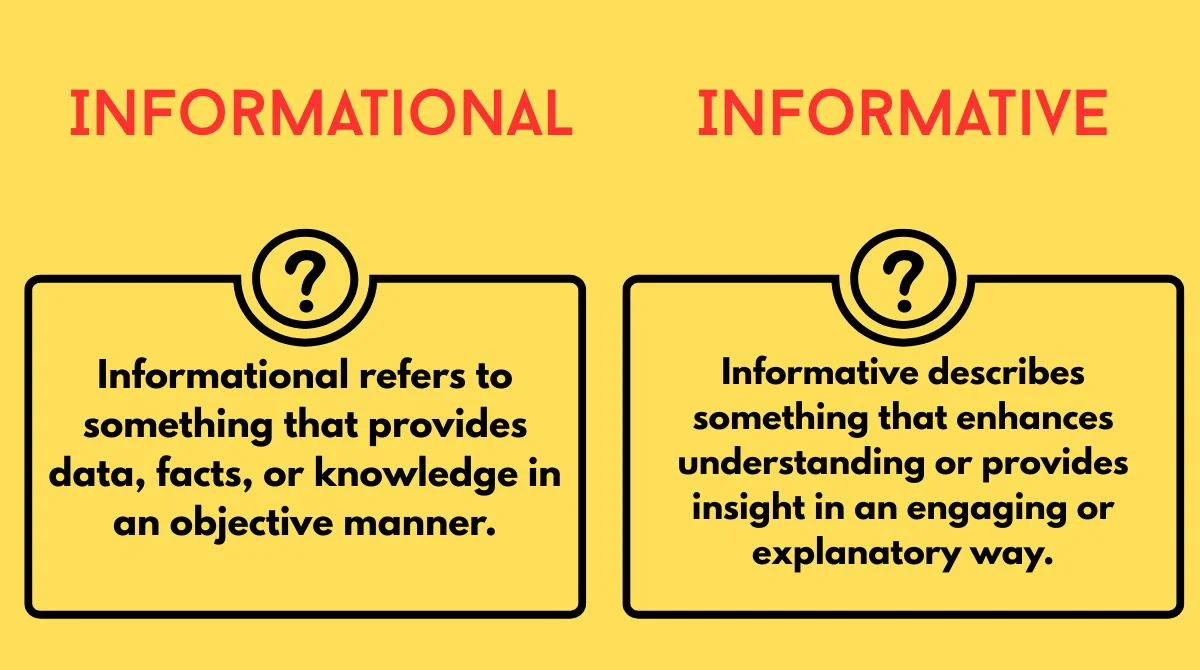
    • Informational refers to something that provides data, facts, or knowledge in an objective manner.
    • Informative describes something that enhances understanding or provides insight in an engaging or explanatory way.

    Quick Comparison Table

    AspectInformationalInformative
    DefinitionProvides factual data, raw informationProvides knowledge with added clarity, depth, or analysis
    PurposeTo present details in a structured wayTo educate, explain, or enhance understanding
    ExamplesResearch reports, data sheets, instruction manualsBlog posts, documentaries, news articles
    ToneNeutral, objective, data-drivenEngaging, explanatory, educational

    Understanding these differences is key when choosing the right term in your writing.


    Characterizing Informational Text

    Informational text is designed to present facts, statistics, and details without personal opinion or subjective analysis. It is often structured logically and follows a clear format to make data easily accessible.

    Features of Informational Text:

    • Objective Tone: Lacks opinion, emotion, or persuasion.
    • Fact-Based Content: Includes verified facts, figures, and statistics.
    • Clear Structure: Often formatted with headings, bullet points, and lists for easy comprehension.
    • Technical or Formal Language: Uses precise terminology suited to the subject matter.

    Examples of Informational Text:

    • Encyclopedias
    • Government reports
    • Scientific studies
    • Instruction manuals

    These texts exist purely to inform rather than to engage or persuade.


    The Purpose and Style of Informative Writing

    Informative writing, on the other hand, aims to present information in a way that enhances understanding and makes the content more engaging. Unlike informational text, informative writing often includes explanations, examples, and interpretations to help the reader grasp the subject.

    Characteristics of Informative Writing:

    • Clarity and Engagement: Focuses on making complex information digestible.
    • Educational Purpose: Helps readers understand a topic rather than just listing facts.
    • Explanatory Tone: Uses analogies, case studies, and examples to clarify concepts.
    • More Accessible Language: Written for general audiences, often avoiding technical jargon.

    Examples of Informative Writing:

    • Blog posts
    • Explainer articles
    • Documentaries
    • How-to guides

    While both informational and informative texts provide knowledge, informative writing is crafted to be more engaging and educational.


    Types of Informative Texts: Exploring the Variety

    Informative content appears in many forms, each designed to serve a specific audience. Here are some common types:

    1. Expository Essays – Provide explanations on a topic without personal opinions.
    2. News Articles – Present facts while also adding context and background information.
    3. How-to Guides & Tutorials – Teach readers how to perform a task step by step.
    4. Scientific and Educational Articles – Explain findings in a way that makes them understandable.
    5. FAQs (Frequently Asked Questions) – Provide detailed answers to common queries.

    Each of these forms aims to educate and engage, making learning more effective.


    Utilizing Visual Aids: Graphics and Illustrations in Informational Content

    Informational texts often include visual aids to enhance comprehension. Because these texts prioritize factual accuracy and clarity, adding charts, diagrams, and graphs helps to:

    • Present complex data in a digestible format
    • Highlight trends and relationships
    • Improve retention of information

    Examples of Visual Aids in Informational Content:

    Type of VisualPurposeExample Usage
    GraphsShow numerical data trendsPopulation growth trends
    ChartsCompare and organize informationProduct feature comparison
    DiagramsExplain processes visuallyHuman anatomy diagram
    TablesProvide structured dataMonthly expense breakdown

    In technical, academic, and research-based content, visual aids are essential tools for simplifying information.


    Visual Aids in Education: The Path to Better Learning

    Visuals play a crucial role in educational content, whether it is informational or informative. Studies show that people retain information 65% better when it’s paired with images, compared to just text alone.

    Benefits of Using Visuals in Learning:

    • Increases Retention: Visual memory is stronger than text-based memory.
    • Enhances Understanding: Complex ideas become more accessible.
    • Engages Learners: Keeps readers interested and focused.

    For example, infographics in informative articles make content easier to understand by combining facts with engaging design elements.


    Real-World Examples of Informative Content on Social Media Platforms

    Social media is full of informative content, ranging from educational videos to explainer posts. Here’s how platforms use it effectively:

    • YouTube: Educational channels like TED-Ed provide engaging informative content.
    • Instagram & TikTok: Short-form videos breaking down science, finance, and language topics.
    • LinkedIn Articles: Professionals share industry insights and career tips.

    These platforms show that informative content isn’t limited to books and blogs—it thrives in digital spaces, too.


    Keywords and Intent: Tailoring Content for Information-Seeking Audiences

    In SEO (Search Engine Optimization), understanding search intent is crucial when choosing between informational and informative content.

    Keyword TypeSearch IntentExample Searches
    InformationalUsers want raw data or factual content“List of U.S. presidents”
    InformativeUsers seek detailed explanations“What is the difference between effect and affect?”

    When creating content, knowing the intent behind keywords helps tailor it to what the audience is looking for.\


    Informational vs Informative

    FAQs

    1. What does “informational” mean?

    “Informational” describes content that presents raw facts and data without opinions or analysis. Examples include research reports, instruction manuals, and encyclopedias.

    2. What does “informative” mean?

    “Informative” refers to content that enhances understanding by explaining, analyzing, or engaging the audience. Examples include blog posts, documentaries, and how-to guides.

    3. Can “informational” and “informative” be used interchangeably?

    Not always. Informational content provides data objectively, while informative content explains and educates the reader. For example, a research paper is informational, but a TED Talk is informative.

    4. How do businesses use informational and informative content?

    • Informational content: Data sheets, reports, and policies to provide essential details.
    • Informative content: Blog posts, tutorials, and explainer videos to educate and engage customers.

    5. What type of content benefits from visual aids?

    Both informational and informative content benefit from visuals like charts, graphs, infographics, and diagrams. These tools make data easier to understand and retain.

    6. How do search engines treat informational vs. informative content?

    • Informational searches look for raw data (e.g., “list of U.S. presidents”).
    • Informative searches seek explanations (e.g., “difference between effect and affect”).
      Optimizing content based on search intent improves SEO and ranking.

    Conclusion

    While informational and informative both relate to knowledge and learning, their uses differ significantly.

    • Informational texts provide raw facts and objective data.
    • Informative writing enhances understanding through explanations and engagement.

    Whether you’re writing a research report, crafting a blog post, or creating educational materials, choosing the right term can make all the difference in clarity and accuracy.

    Which type of content do you use most often? Let us know in the comments!

  • Froze or Frozen? Learn the Right Usage with Examples! ✅❄️

    Froze or Frozen? Learn the Right Usage with Examples! ✅❄️

    Understanding verb conjugations in English can be tricky, especially when it comes to irregular verbs like “freeze.” Many learners struggle with choosing between froze and frozen in sentences.

    In this guide, we’ll break down the correct usage of these terms with clear explanations, examples, and grammatical rules to help you master them once and for all.

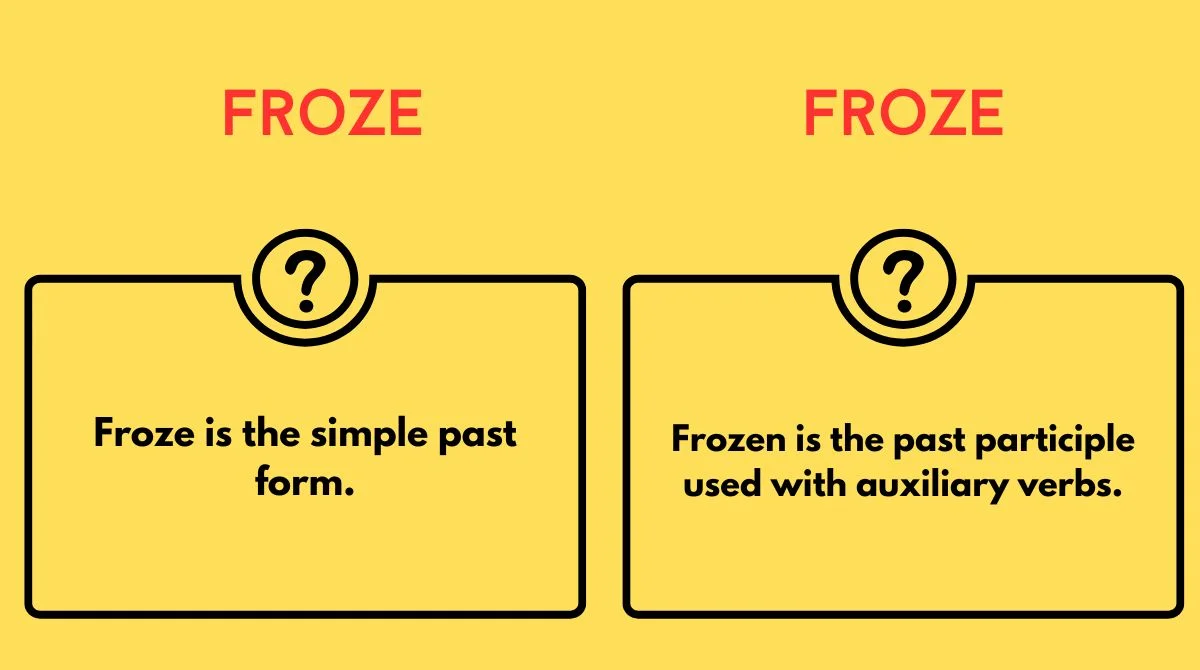
    Confused about “froze” vs. “frozen”? “Froze” is the simple past tense, while “frozen” is the past participle used with auxiliary verbs. Learn the difference with clear examples!


    Exploring the Verb “Freeze” – Present, Past, and Past Participle

    Froze or Frozen

    Before diving into froze and frozen, let’s examine how the verb “freeze” is conjugated in different tenses:

    TenseVerb Form
    Presentfreeze
    Pastfroze
    Past Participlefrozen
    • Freeze is the base form (present tense).
    • Froze is the simple past form.
    • Frozen is the past participle used with auxiliary verbs.

    Understanding this breakdown is crucial for using each form correctly in sentences.


    When to Use “Froze” – Simple Past Tense Illustrated

    Froze is the simple past form of freeze, used when describing an action that happened at a specific time in the past.

    Examples:

    • The lake froze overnight due to the extreme cold.
    • I froze when I heard the unexpected news.
    • She froze in fear during the scary movie.

    A key rule to remember: Froze never needs an auxiliary verb like “has” or “had.”


    The Right Contexts for “Frozen” – Understanding the Past Participle

    Frozen is the past participle form of freeze. It cannot function alone as a verb in a sentence; it requires an auxiliary verb (like “has,” “had,” or “was”).

    Examples:

    • The pond has frozen for the first time this winter.
    • By morning, the pipes had frozen completely.
    • The vegetables were frozen for preservation.

    If the sentence needs “has,” “had,” or “was,” then frozen is the correct choice.


    Using “Frozen” in Perfect Tense Constructions

    The perfect tense uses “frozen” with auxiliary verbs to show completed actions.

    Present Perfect:

    • The river has frozen solid.
    • She has frozen her leftover food.

    Past Perfect:

    • By the time we arrived, the ground had frozen.
    • He had frozen all his assets before the lawsuit.

    Future Perfect:

    • By next winter, the lake will have frozen.
    • They will have frozen all perishable items before leaving.

    Examples of “Frozen” with Auxiliary Verbs

    Auxiliary VerbExample Sentence
    HasThe water has frozen overnight.
    HadThe roads had frozen before sunrise.
    WasThe fish was frozen before shipment.
    Will haveThe lake will have frozen by January.

    This table highlights the key role auxiliary verbs play when using frozen.


    Common Mistakes with “Froze” and “Frozen”

    Learners often confuse these forms. Here are some common mistakes and corrections:

    The lake has froze overnight.
    ✔️ The lake has frozen overnight.

    She had froze all the food before leaving.
    ✔️ She had frozen all the food before leaving.

    The vegetables were froze for storage.
    ✔️ The vegetables were frozen for storage.

    A simple rule to avoid mistakes: If you see an auxiliary verb, use “frozen.” If not, use “froze.”


    Tips to Prevent Tense Misuse

    To avoid errors with “froze” and “frozen”:

    • Remember the auxiliary verb rule – Use “frozen” only with “has,” “had,” or “was.”
    • Think about timing – If the action happened at a specific past time, use “froze.”
    • Practice with sentences – Create your own examples to reinforce proper usage.

    The Grammatical Rules Behind “Freeze” Conjugations

    The verb “freeze” follows an irregular conjugation pattern, meaning it doesn’t follow the standard “-ed” ending rule. Instead, it changes form entirely from “freeze” → “froze” → “frozen.”

    This pattern is common among strong verbs in English, such as:

    • Speak → Spoke → Spoken
    • Drive → Drove → Driven
    • Break → Broke → Broken

    Memorizing these patterns can help solidify correct usage.


    Ablaut Patterns in English Verbs

    The conjugation of “freeze” follows an ablaut pattern, a linguistic process where vowel sounds shift to indicate tense.

    • Base Form: “freeze” (long ee sound)
    • Past Tense: “froze” (long o sound)
    • Past Participle: “frozen” (long o sound with “-en” ending)

    Similar verbs following this pattern include:

    • Choose → Chose → Chosen
    • Write → Wrote → Written

    Recognizing these shifts can make it easier to remember irregular verb forms.


    Practical Tips for Remembering the Past Tense of “Freeze”

    1. Use rhyming verbs – Think of “choose, chose, chosen” when recalling “freeze, froze, frozen.”
    2. Create a mnemonic – “If it’s done, it’s frozen. If it’s past, it’s froze fast.”
    3. Repeat sentences aloud – Speaking phrases like “The lake froze yesterday” and “The lake has frozen today” reinforces correct usage.

    Frozen in Time – Historical Origins of the Verb “Freeze”

    The word freeze comes from the Old English “frēosan”, which meant “to turn to ice.”

    • It shares roots with Old Norse “frjósa” and Gothic “frius” (meaning “frosty”).
    • The past participle “frozen” developed in Middle English, influenced by Germanic languages.

    Understanding its etymology helps appreciate how language evolves over time.


    Froze or Frozen

    FAQs

    1. What is the past tense of “freeze”?

    The past tense of “freeze” is “froze” (e.g., “The lake froze overnight”). The past participle is “frozen” (e.g., “The lake has frozen”).

    2. When should I use “froze” instead of “frozen”?

    Use “froze” when describing a past action without an auxiliary verb (e.g., “She froze in fear”). Use “frozen” with “has,” “had,” or “was” (e.g., “The pipes had frozen”).

    3. Why do people confuse “froze” and “frozen”?

    Many learners mistake “froze” for the past participle or use “frozen” without an auxiliary verb. A key rule: If there’s ‘has’ or ‘had,’ use ‘frozen.’ Otherwise, use ‘froze.’

    4. What are some common mistakes with “froze” and “frozen”?

    • ❌ “The lake has froze.” → ✔️ “The lake has frozen.”
    • ❌ “She had froze the meat.” → ✔️ “She had frozen the meat.”
    • ❌ “The vegetables were froze.” → ✔️ “The vegetables were frozen.”

    5. What are some other verbs that follow this pattern?

    Similar irregular verbs include:

    • Break → Broke → Broken
    • Drive → Drove → Driven
    • Choose → Chose → Chosen

    6. How can I remember the difference between “froze” and “frozen”?

    Try this mnemonic: “If it’s done, it’s frozen. If it’s past, it’s froze fast.” Also, compare it to verbs like “choose, chose, chosen” for better recall.


    Conclusion

    Mastering “froze” and “frozen” comes down to knowing when to use each form correctly:

    • Use froze for simple past actions (“The lake froze last night.”)
    • Use frozen with auxiliary verbs (“The lake has frozen.”)

    By practicing with examples and remembering the key grammar rules, you’ll avoid common mistakes and use these words naturally in conversation and writing. If you found this guide helpful, share it with others who might be struggling with English verb tenses!

  • Me Too vs Me as Well vs I as Well: What’s Correct? 🤔📖

    Me Too vs Me as Well vs I as Well: What’s Correct? 🤔📖

    When speaking or writing in English, expressing agreement is a common necessity. However, the correct phrasing can sometimes be confusing.

    Phrases like “Me too,” “Me as well,” and “I as well” may seem interchangeable, but they have distinct uses, levels of formality, and grammatical correctness. Understanding these differences is key to sounding natural and fluent in English.

    This guide breaks down the proper usage of each expression, providing clear explanations, examples, and comparisons to help you use them correctly in any context.

    Should you say “Me too” or “Me as well”? 🤔 “Me too” is casual, “Me as well” is slightly more formal, and “I as well” is incorrect. Learn the key differences with examples!


    The Correct Usage of “Me Too” in American English

    Me Too vs Me as Well vs I as Well

    Definition and Standalone Nature of “Me Too”

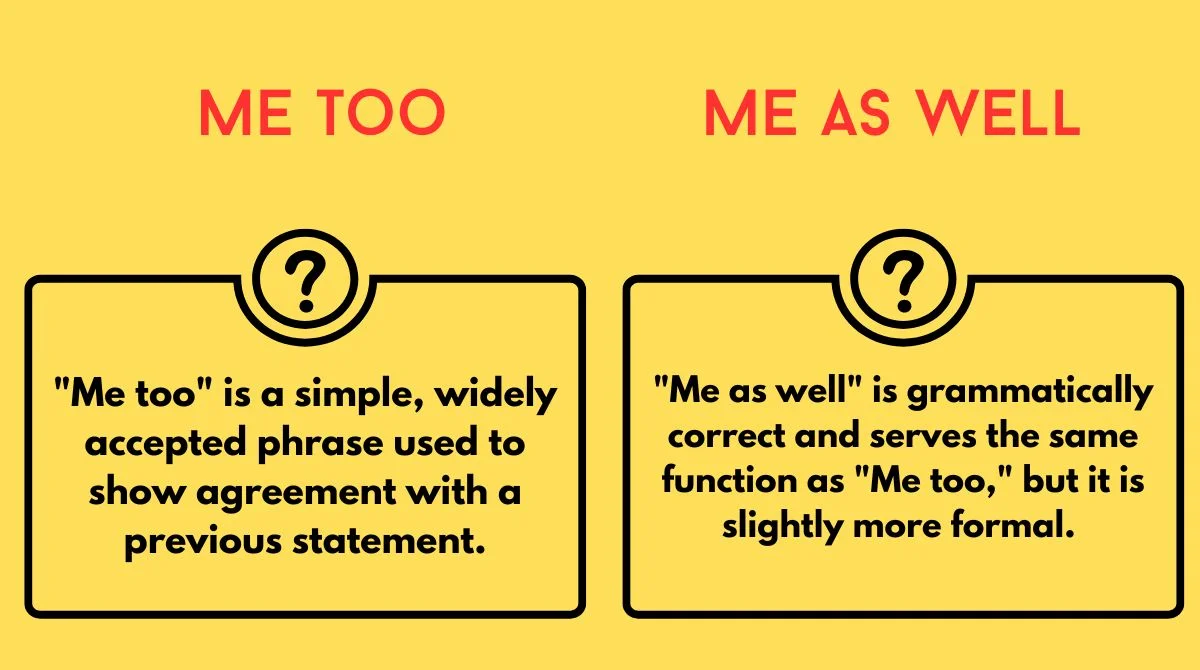
    “Me too” is a simple, widely accepted phrase used to show agreement with a previous statement. It is typically used in casual conversation and works best when responding to affirmative statements.

    • Correct example:
      • A: “I love chocolate.”
      • B: “Me too!” (This means B also loves chocolate.)

    Unlike other agreement expressions, “Me too” can stand alone as a complete response, making it particularly useful in spoken English.

    Examples Demonstrating “Me Too” in Sentences

    Here are some scenarios where “Me too” is the most natural choice:

    • “I enjoy hiking.”“Me too!”
    • “She is going to the concert.”“Me too!”
    • “I have a dog.”“Me too!”

    Informality and Appropriateness of “Me Too” in Various Contexts

    “Me too” is commonly used in informal speech and casual writing. It is rarely found in formal contexts such as academic writing or business emails. In such cases, alternatives like “I also do” or “So do I” are preferred.

    • Informal:
      • “I finished my homework early.”“Me too!”
    • Formal:
      • “I completed my assignment ahead of schedule.”“So did I.”

    When to Use “Me as Well” Over “Me Too”

    “Me as well” is grammatically correct and serves the same function as “Me too,” but it is slightly more formal. While still used in spoken English, it is less common in casual conversation.

    • Correct example:
      • A: “I enjoy reading.”
      • B: “Me as well.” (Equivalent to “Me too,” but slightly more formal.)

    It is often used in situations where a smoother, more neutral tone is preferred.

    • “I am looking forward to the event.”“Me as well.”
    • “She plans to attend the seminar.”“Me as well.”

    Comparison of “Me Too” and “Me as Well”

    ExpressionFormalityCommon Usage
    Me tooInformalEveryday speech, casual conversations
    Me as wellNeutral/FormalMore polished speech, some formal settings

    While both are grammatically correct, “Me too” is more common in everyday English.


    Navigating the Incorrect Usage of “I as Well”

    The Grammatical Inaccuracy of “I as Well”

    Unlike “Me too” and “Me as well,” the phrase “I as well” is not grammatically correct in standard English. The reason is that “I” is a subject pronoun, while “me” is an object pronoun.** The phrase “Me too” works because “me” is the correct pronoun in response to most affirmative statements.

    • Incorrect example:
      • A: “I love traveling.”
      • B: “I as well.” ❌ (Incorrect!)

    Instead, the correct phrase would be:

    • “I do as well.”
    • “So do I.”
    • “Me too.”

    Proper Alternatives to “I as Well” with Examples

    To avoid incorrect usage, try these grammatically correct alternatives:

    Incorrect UsageCorrect Alternative
    “I as well love coffee.”“I love coffee as well.”
    “I as well am excited.”“I am excited as well.”
    “I as well agree.”“I agree as well.”

    Using these alternatives ensures your English sounds natural and grammatically correct.

    Comparison and Popularity: “Me as Well” vs. “I as Well”

    A quick comparison shows why “Me as well” is preferred over “I as well”:

    PhraseCorrect UsageCommon in Spoken English?
    Me as wellCorrectSometimes used, but less than “Me too”
    I as wellIncorrectRarely, if ever, used

    Me Too vs Me as Well vs I as Well

    FAQs

    1. Is “Me too” grammatically correct?

    Yes! “Me too” is a widely accepted phrase for agreement in casual conversations. Example:
    A: “I love coffee.”
    B: “Me too!”

    2. When should I use “Me as well” instead of “Me too”?

    “Me as well” is more formal than “Me too” but has the same meaning. Example:
    A: “She is attending the meeting.”
    B: “Me as well.”

    3. Why is “I as well” incorrect?

    “I as well” is grammatically wrong because “I” is a subject pronoun, not an object pronoun. Use alternatives like “I do as well” or “So do I.”

    4. Can I use “Me too” in formal writing?

    Not usually. In formal contexts, use “So do I,” “I also do,” or “I agree as well” instead.

    5. What’s the difference between “Me too” and “Me as well”?

    • “Me too” → Informal, common in everyday speech
    • “Me as well” → Slightly more formal, less commonly used

    6. What’s a good alternative to “I as well”?

    Instead of “I as well,” say:
    “I as well love reading.” (Incorrect)
    “I love reading as well.” (Correct)


    Conclusion: Choosing the Right Expression for Clarity and Correctness

    When expressing agreement in English, it is essential to use the correct phrase for the context:

    • Use “Me too” in casual conversations as a quick response to show agreement.
    • Use “Me as well” in slightly more formal situations when a polished tone is required.
    • Avoid “I as well” entirely, and instead use proper alternatives like “I do as well” or “So do I.”

    By understanding these distinctions, you can communicate more naturally and confidently in English. Whether you are speaking casually with friends or writing in a professional setting, using the right expression ensures clarity and correctness.

  • Recurring vs Reoccurring: What’s the Difference? 🤔📖

    Recurring vs Reoccurring: What’s the Difference? 🤔📖

    The English language is full of words that seem almost identical yet carry subtle differences in meaning.

    Recurring and reoccurring are two such words that often confuse even native speakers. While both relate to events happening more than once, their nuances set them apart.

    This guide will explore their definitions, historical roots, and practical applications to help you use them correctly in your writing and speech.

    “Recurring” and “reoccurring” may seem similar, but they have distinct meanings. “Recurring” refers to regular repetition, while “reoccurring” means something happens again without a set pattern. Learn how to use them correctly!


    Decoding the Definitions: Recur vs. Reoccur

    At first glance, recur and reoccur may appear interchangeable, but they have distinct meanings:

    • Recur (verb): To happen repeatedly or at regular intervals.
      • Example: “The meetings recur every Monday.”
    • Reoccur (verb): To happen again, but without any implication of regularity.
      • Example: “The power outage reoccurred last night.”

    The key distinction lies in frequency and expectation. Recurring events happen periodically, whereas reoccurring events happen again but not necessarily in a repeated pattern.


    The Original Latin Roots and English Evolutions

    Understanding the etymology of words often sheds light on their meanings. Here’s how these terms evolved:

    WordLatin OriginMeaning in LatinEvolution in English
    Recurrecurrere“To run back”Implies repetition or returning at intervals
    Reoccuroccurrere“To happen”Implies happening again without set frequency

    Since recurrere means “to run back,” it makes sense that recurring events cycle back periodically. Meanwhile, reoccur simply stems from occurrere, which means “to happen,” reinforcing the idea that it just means “to happen again.”


    Breaking Down the Frequency Factor

    One of the most significant distinctions between these terms lies in how often the event happens:

    • Recurring: Happens regularly and predictably.
    • Reoccurring: Happens again, but without a set pattern.

    Examples in Context

    ScenarioCorrect WordExplanation
    A monthly subscription billing cycleRecurringIt happens at a fixed interval.
    A random earthquake in the same regionReoccurringIt happens again but unpredictably.
    A seasonal flu outbreakRecurringIt follows a seasonal pattern.
    A car breaking down unexpectedlyReoccurringIt happens more than once but randomly.

    By examining these examples, you can see why choosing the right term matters in clear communication.


    The Nuances of Usage in American English

    Both words exist in American English, but recurring is significantly more common. You’re far more likely to encounter it in various contexts, such as:

    • Finance & Business: “Recurring revenue streams”
    • Medicine & Health: “Recurring migraines”
    • Entertainment & Media: “A recurring guest star on a TV show”
    • Technology & Software: “Recurring payments on a subscription plan”

    On the other hand, reoccurring is less frequently used and mainly appears in contexts where something happens multiple times without a clear schedule:

    • “Flooding in the area has been reoccurring due to climate change.”
    • “His headaches have been reoccurring for the past few months.”

    Recurring vs Reoccurring

    When to Opt for ‘Recurring’ Over ‘Reoccurring’

    If you’re unsure which word to use, follow these simple guidelines:

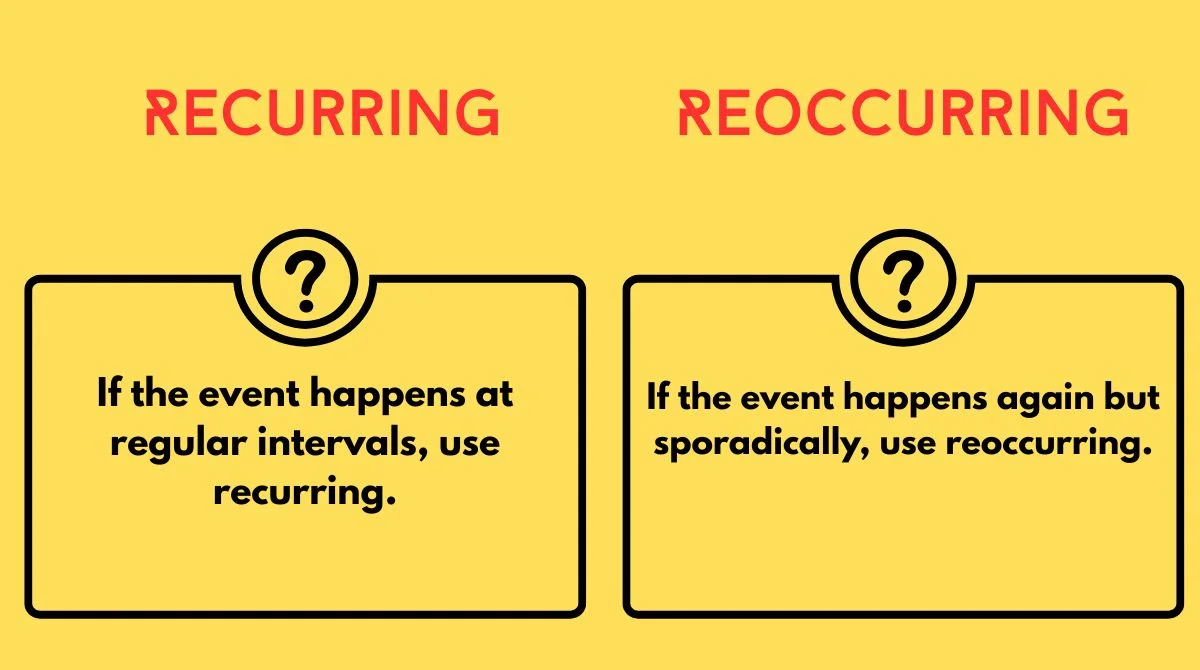
    • If the event happens at regular intervals, use recurring.
    • If the event happens again but sporadically, use reoccurring.

    Quick Trick to Remember:

    • Recurring = Regular (Both start with “R”)
    • Reoccurring = One-off reappearance

    Exploring Examples to Highlight Differences

    Common Phrases with “Recurring”

    • Recurring dream
    • Recurring theme in literature
    • Recurring expenses
    • Recurring subscriptions

    Common Phrases with “Reoccurring”

    • A reoccurring technical glitch
    • A reoccurring software bug
    • A reoccurring allergy reaction

    If the event follows a predictable cycle, recurring is correct. If it happens again but randomly, reoccurring fits better.


    Linguistic Insights: Recurrence and Reoccurrence Compared

    These two nouns follow the same distinction:

    • Recurrence: The act of happening regularly.
      • Example: “The recurrence of the flu each winter is expected.”
    • Reoccurrence: The act of happening again, without frequency.
      • Example: “The reoccurrence of a security breach surprised the company.”
    Noun FormMeaning
    RecurrenceHappens regularly, expected
    ReoccurrenceHappens again but unpredictably

    Common Misconceptions and Clarifications

    1. Can reoccurring be used instead of recurring?

    Technically, yes—but it’s less common and might sound awkward. Stick to recurring when discussing regular cycles.

    2. Is reoccur a proper word?

    Yes, but it’s much rarer in usage compared to recur. Many style guides recommend using recur instead.

    3. Do British and American English treat these words differently?

    No, the distinction remains the same in both varieties of English.

    4. Can an event be both recurring and reoccurring?

    Not at the same time! An event is either regular (recurring) or sporadic (reoccurring).


    Recurring vs Reoccurring

    Conclusion

    The difference between recurring and reoccurring may be subtle, but it’s important for clarity in communication. Remember:

    • Use “recurring” for events that repeat in a predictable manner.
    • Use “reoccurring” for events that happen again but irregularly.

    By keeping this distinction in mind, you’ll ensure your writing is precise, professional, and grammatically accurate. If in doubt, recurring is almost always the safer choice!

  • Mother Tongue vs Native Language 🌍 – Key Differences Explained with Real-Life Examples

    Mother Tongue vs Native Language 🌍 – Key Differences Explained with Real-Life Examples

    Language is more than just words. It shapes identity, connects us to our roots, and determines how we interact with the world. Two terms often used interchangeably — mother tongue and native language — actually carry different meanings.

    While both describe a person’s primary language, the context, emotional weight, and usage behind each word vary significantly.

    So, what’s the real difference between your mother tongue and your native language? Let’s break it down in detail.


    Defining the Terms Clearly

    What is Mother Tongue?

    The phrase mother tongue comes from the idea of learning the first language through one’s family, especially the mother. It’s the language that surrounds a child from birth — the one spoken at home, in lullabies, or in bedtime stories.

    • Early exposure: It’s usually the first language a child hears and absorbs naturally.
    • Family bond: It represents cultural roots and family heritage.
    • Identity marker: It stays linked to where you come from, even if you don’t use it daily.

    For example, a child born to Urdu-speaking parents in Pakistan may consider Urdu their mother tongue, even if they later grow up speaking mostly English.


    What is Native Language?

    The native language refers to the language in which a person is most fluent and comfortable. It may be the same as the mother tongue, but not always. The native language reflects usage, not just origin.

    • Fluency focus: It’s the language you use naturally in thinking, speaking, and expressing yourself.
    • Social environment: Often shaped by where you grow up, your schooling, and your peer circle.
    • May shift over time: Unlike the mother tongue, your native language can change if another language dominates your daily life.

    For example, a child whose parents speak Spanish at home but who grows up in the US might end up with English as their native language.


    Key Differences Between Mother Tongue and Native Language

    Mother Tongue vs Native Language

    Though they often overlap, mother tongue and native language are not identical. The chart below highlights the differences clearly:

    FeatureMother TongueNative Language
    OriginLearned from parents/family at birthLearned through immersion in environment
    First ExposureEarly childhood, usually at homeChildhood or later, shaped by society
    Emotional LinkStrong tie to culture and familyStrong tie to daily use and fluency
    UsageMay fade if not practicedUsually the dominant spoken language
    Change Over TimeRarely changesCan shift due to migration or adaptation

    Think of the mother tongue as your roots and the native language as your daily ground. One shows where you came from, the other shows where you stand today.


    Overlaps and Grey Areas

    Language identity isn’t always black and white. Many people experience overlaps or even conflicts between their mother tongue and native language.

    • Same language: For many, both are identical. Example: A child born and raised in France, with French spoken at home and school.
    • Different languages: Migration often creates a split. Example: A Punjabi-speaking child raised in Canada may adopt English as their native language while Punjabi remains their mother tongue.
    • Bilingual households: Children exposed to two languages from birth may consider both their mother tongues but later identify only one as their dominant native language.

    These grey areas highlight why the terms shouldn’t be confused — they describe different layers of identity.


    Real-Life Scenarios

    To understand better, let’s look at practical situations:

    Case Study 1: Punjabi Mother Tongue, English Native Language

    Ali was born in Lahore, where Punjabi was the family language. But after moving to Toronto at age 3, he grew up speaking English in school and with friends. By the time he turned 20, English had become his native language, while Punjabi remained his cultural mother tongue.


    Case Study 2: Spanish at Home, English in School

    Maria’s parents are immigrants from Mexico. At home, she spoke Spanish exclusively until age 6. But after starting school in Los Angeles, English became her dominant language. Today, Spanish is her mother tongue, but English is her native language.


    Case Study 3: Adopted Child and Language Shift

    Jin, born in Korea, was adopted by American parents at age 2. His mother tongue is Korean, but since he lost exposure early, his native language is English. For him, the connection to Korean is cultural rather than linguistic.


    Why the Distinction Matters

    Understanding the difference between mother tongue and native language is not just linguistic hair-splitting. It has practical and cultural consequences:

    • Education systems: Schools often use the native language as the medium of instruction. Confusing it with mother tongue can lead to poor policy decisions.
    • Cultural identity: Many people strongly identify with their mother tongue, even if it’s not the language they speak daily.
    • Census and documentation: Governments collect data on both to shape language policies.
    • Personal growth: Knowing the distinction helps bilinguals and multilinguals understand their own identity better.

    As one linguist once said, “Your mother tongue is the echo of your ancestry, while your native language is the voice of your present.”


    Common Misconceptions

    Several myths surround these terms. Let’s debunk them:

    • Myth 1: Mother tongue and native language are always the same.
      Reality: They often overlap but can differ due to migration, adoption, or bilingualism.
    • Myth 2: The language you speak best is always your mother tongue.
      Reality: Fluency doesn’t define mother tongue — origin does.
    • Myth 3: Once you have a native language, it never changes.
      Reality: Native language can shift over time if exposure changes.

    Mother Tongue and Native Language in a Globalized World

    In today’s interconnected world, millions grow up in environments where their mother tongue isn’t their dominant language.

    • Migration effect: Families moving abroad often pass down their mother tongue, but children adopt the local language as their native one.
    • Global English dominance: English increasingly becomes the native language for children in non-English-speaking countries if it dominates education and entertainment.
    • Cultural preservation: UNESCO emphasizes the need to preserve mother tongues, as thousands of languages are at risk of extinction.

    Globalization expands opportunities but also challenges the survival of many mother tongues.


    Practical Guidance for Readers

    Confused when filling forms or explaining your language background? Here’s some practical advice:

    • On official forms:
      • Mother tongue: Write the language spoken by your parents/family at home.
      • Native language: Write the language you are most fluent and comfortable in.
    • For parents raising bilingual kids:
      • Speak the mother tongue at home consistently.
      • Encourage exposure to the community/native language outside.
      • Balance helps children retain both cultural identity and fluency.
    • For learners: Remember that mastering a native-like command of a second language doesn’t erase your mother tongue — it adds to your linguistic wealth.

    FAQs About Mother Tongue vs Native Language

    What is the difference between mother tongue and native language?

    Mother tongue refers to the first language learned at home, while native language refers to the language a person is most fluent and comfortable using.

    Can you have more than one mother tongue?

    Yes. Children raised in bilingual households may have two mother tongues if they learn both from birth.

    Can a person’s native language change over time?

    Yes. A native language can shift if another language becomes dominant due to schooling, work, or migration.

    Is the first language always considered the mother tongue?

    Usually, but not always. If a child is exposed to multiple languages from birth, more than one can be considered a mother tongue.

    Why do official forms ask about both mother tongue and native language?

    Because they serve different purposes: mother tongue data reflects cultural background, while native language reflects current fluency.


    Conclusion

    Mother tongue and native language are like two sides of the same coin — connected but not identical. One links you to your family, roots, and ancestry; the other defines your fluency, environment, and present-day identity.

    In a globalized world, many people juggle both, sometimes even switching between them.

    Recognizing the difference isn’t just about words — it’s about understanding who you are, where you come from, and how you engage with the world.