Category: Tricky Terms

  • A MA or An MA Degree? Here’s the Right Way to Say It! 🎓🗣️

    A MA or An MA Degree? Here’s the Right Way to Say It! 🎓🗣️

    Ever found yourself hesitating before saying “a MA” or “an MA” degree? You’re not alone.

    This tiny grammar puzzle trips up native and non-native speakers alike. It’s all about how we use indefinite articles with acronyms—and more specifically, what we hear rather than what we see.

    In this guide, we’ll break it all down: when to use “a” vs. “an,” how pronunciation changes the rules, and how to refer to your degree accurately across writing styles.

    By the end, you’ll have full confidence saying (and writing) your MA degree the right way.

    The correct usage is “an MA” degree, because “MA” is pronounced “em-ay,” starting with a vowel sound. In English, article choice depends on pronunciation, not spelling—so “an MA” is grammatically correct.


    A MA or An MA Degree

    Understanding Indefinite Articles in English Grammar

    In English, the indefinite articles a and an are used before singular countable nouns when the specific identity of the noun isn’t important or known.

    • “A” is used before words that begin with a consonant sound.
      Example: a cat, a university, a user.
    • “An” is used before words that begin with a vowel sound.
      Example: an apple, an hour, an honor.

    Notice we said sound, not letter. This distinction is key when dealing with acronyms and abbreviations like “MA.”


    The Role of Vowel Sounds in Article Usage

    The article choice hinges on how the word sounds when spoken, not how it’s spelled. That’s why we say:

    • “an honor” even though honor starts with the consonant h—because the h is silent.
    • “a university” even though university starts with a vowel—because the u sounds like you.

    So, what about “MA”?

    When we say “MA” aloud, we pronounce it as “em-ay”. It starts with the vowel sound ‘e’, not the consonant m. That makes “an MA degree” the correct form.

    Correct: She earned an MA in English Literature.
    Incorrect: She earned a MA in English Literature.


    Exceptions to the Consonant Rule with Abbreviations

    Abbreviations and acronyms can throw a wrench into the article rules if you go by spelling rather than sound.

    Examples of correct article usage with abbreviations:

    AbbreviationPronunciationCorrect ArticleExample
    MA“em-ay”anan MA in Psychology
    MBA“em-bee-ay”anan MBA from Stanford
    PhD“pee-aych-dee”aa PhD in Mathematics
    BA“bee-ay”aa BA in Sociology

    The key: listen to the first sound of the abbreviation—not the first letter.


    The Correct Way to Refer to Your MA Degree

    When you’re writing about your academic qualifications, it’s important to use correct grammar and consistent style. Here’s how you should refer to your MA degree:

    • Correct: an MA degree, an MA in Political Science, an MA holder
    • Correct (full form): a Master of Arts degree

    Remember, when you spell it out—“Master of Arts”—you use “a” because “Master” begins with a consonant sound.


    Pronunciation Matters: A or An Before Acronyms

    Pronunciation is often overlooked in written communication, but it determines the use of “a” vs. “an” before acronyms and initialisms.

    Let’s look at some common acronyms and how article choice depends on their spoken form:

    AcronymSpoken AsUse “a” or “an”?Example Sentence
    MAem-ayanShe earned an MA in History.
    MBAem-bee-ayanHe pursued an MBA in Finance.
    M.Edem-edanShe holds an M.Ed in Counseling.
    JDjay-deeaHe earned a JD from Harvard.

    Tip: Always read your sentence aloud. If it starts with a vowel sound, go with “an.”


    Common Mistakes in Pronouncing Educational Degrees

    Some speakers misapply article rules by focusing on spelling instead of sound. Common errors include:

    • Saying “a MA” instead of “an MA”
    • Using “an university” because u is a vowel, even though it sounds like you

    How to Avoid These Mistakes:

    • Speak it out loud first.
    • Focus on how the abbreviation sounds, not how it’s written.
    • Practice with common educational degree acronyms.

    Mastering Academic Degrees: Capitalization and Possessiveness

    Knowing when and how to capitalize degree names can also be tricky.

    Capitalization Rules:

    • Use lowercase when describing a degree generally:
      She has a master’s degree in education.
    • Use uppercase when using the full, formal name:
      She earned a Master of Arts in Linguistics.

    Possessive Form:

    • Use apostrophe-s when writing “master’s” or “bachelor’s” in a general sense.
      Example: She holds a master’s degree, not a masters degree.

    When to Use Apostrophes in Academic Degrees

    This is one of the most overlooked grammar points in resumes and bios.

    General Rule:

    • Use an apostrophe when the degree is possessive in nature:
      a bachelor’s degree, a master’s degree
    • No apostrophe when referring to the formal title:
      Bachelor of Arts, Master of Arts

    Incorrect: She has a masters in Psychology.
    Correct: She has a master’s in Psychology.


    Distinguishing Between Degrees and Fields of Study

    Clarity is key when listing qualifications. Confusing the degree with the field of study can make your sentence sound awkward.

    Examples:

    • Correct: He earned an MA in Economics.
    • Incorrect: He earned an MA Economics.
    • Correct (formal): He earned a Master of Arts in Economics.

    Avoid shortening too aggressively or omitting necessary prepositions like “in.”


    Abbreviating Your Degree: MA, M.A., or Master’s?

    You might see your degree written in different ways. So which one’s right?

    FormatUsage ContextExample
    MAMost common, especially in the USan MA in English
    M.A.Slightly more formal or traditionalan M.A. in History
    Master’sInformal/generala master’s in Psychology

    Note: Always follow the preferred style guide of your institution, publisher, or employer.


    Global Variations in Abbreviating Degrees

    Academic degree abbreviations vary around the world. Here are a few distinctions:

    CountryCommon FormatExample Usage
    United StatesMA or M.A.an MA in Philosophy
    United KingdomMA (Oxbridge may imply undergrad)an MA from Oxford
    AustraliaMAan MA in Journalism
    CanadaMA or M.A.an MA in History

    In the UK, some MA degrees (especially from Oxford or Cambridge) are honorary or automatic upgrades from BA degrees.


    Consistency in Writing: Adhering to Style Guides

    When writing professionally, your style should stay consistent throughout. Depending on the guide, article usage and abbreviation formats may vary.

    Popular Style Guides and Their Preferences:

    Style GuideDegree AbbreviationNotes
    APAM.A. (with periods)Use consistent formatting
    MLAMA (no periods)Common in modern formatting
    ChicagoMA or M.A.Accepts both, prefer consistency
    APmaster’s degreeUse lowercase and possessive

    Tip: If you’re writing a resume, academic paper, or publication, check which guide is being followed and match it across the board.


    A MA or An MA Degree

    6 FAQs

    Is it correct to say “a MA degree”?

    No. The correct form is “an MA degree” because “MA” starts with a vowel sound (“em-ay”), which requires “an.”

    Why do we use “an” before acronyms like MA?

    We use “an” when the acronym begins with a vowel sound, not necessarily a vowel letter. “MA” begins with the sound “e,” so “an” is correct.

    Is it “a Master of Arts” or “an Master of Arts”?

    It’s “a Master of Arts” since “Master” starts with the consonant “M” sound. Use “a” with full degree names.

    What’s the difference between “MA” and “M.A.”?

    Both refer to the same degree—Master of Arts. “MA” is common in modern writing, while “M.A.” is a more traditional or formal variant.

    Should I say “a master’s degree” or “an master’s degree”?

    Say “a master’s degree” because “master’s” starts with a consonant sound. Use “a,” not “an.”

    Can I say “an MA Economics”?

    No. It should be “an MA in Economics.” Always include “in” when mentioning the field of study.


    Final Thoughts: So, Is It “A MA” or “An MA”?

    Let’s settle it once and for all.

    The correct form is “an MA” because “MA” is pronounced “em-ay,” which begins with a vowel sound. This follows the standard grammar rule for using an before vowel sounds, not letters.

    Whether you’re applying for grad school, listing your credentials, or writing a professional bio, knowing this rule ensures your writing sounds polished, credible, and grammatically correct.

  • “Was There” or “Were There”? Know Which One to Use! 🤔🔍

    “Was There” or “Were There”? Know Which One to Use! 🤔🔍

    Understanding when to use was and were can be tricky, especially for non-native English speakers.

    Whether you’re forming simple past tense sentences or diving into more complex constructions, getting these verbs right is crucial for clear communication.

    This guide will break down the difference between “was” and “were,” explain their usage in various moods, and offer tips to help you master this important aspect of English grammar.

    Was and were are both past forms of “to be,” but they are used in different contexts. Use “was” with singular subjects (I, he, she, it), and “were” with plural subjects (we, they) and the second-person singular (you). The tricky part comes in the subjunctive mood, where we always use “were” even with singular subjects (e.g., If I were you…).


    Breaking Down the Basics of “Was” and “Were”

    "Was There” or “Were There"

    Before diving deep into the specifics, it’s essential to understand the basic role of was and were. Both words are the past tense forms of the verb to be, but they are used differently depending on the subject of the sentence.

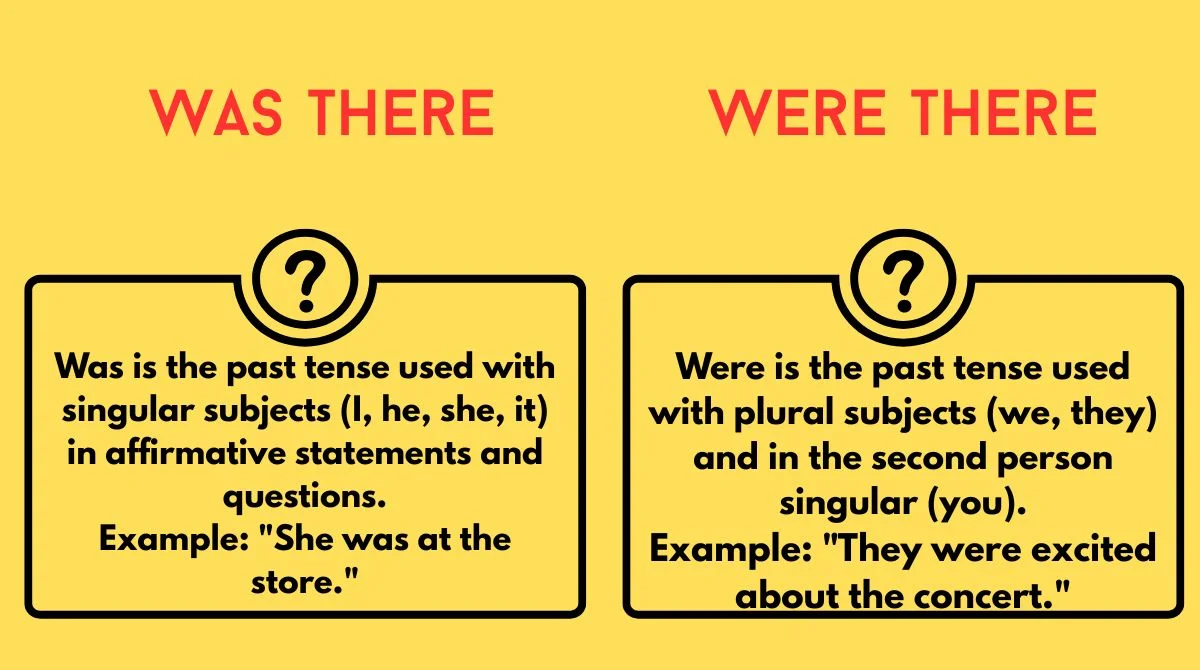
    • Was is the past tense used with singular subjects (I, he, she, it) in affirmative statements and questions.
      Example: “She was at the store.”
    • Were is the past tense used with plural subjects (we, they) and in the second person singular (you).
      Example: “They were excited about the concert.”
      Example: “You were always on time.”

    The real challenge comes when these words are used in more complex grammatical structures. That’s where understanding the mood and context comes into play.


    The Past Tense of “To Be”: Singular and Plural Distinctions

    The fundamental rule of past tense conjugation for the verb to be revolves around singular and plural distinctions.

    Singular Subjects

    • I was
    • He/She/It was

    Examples:

    • “I was tired after the long journey.”
    • “He was happy with the results.”

    Plural Subjects

    • We were
    • You were (for both singular and plural “you”)
    • They were

    Examples:

    • “We were planning a surprise party.”
    • “You were very helpful during the meeting.”
    • “They were in the park when it started raining.”

    This straightforward rule applies to most cases, but the use of was and were can get a bit more nuanced in certain contexts, especially when dealing with the subjunctive mood or specific constructions like there was/were.


    When “Was” Meets Reality: Indicative Mood in Use

    The indicative mood is used for making factual statements or asking questions about reality. It’s the most common mood in English and is where was and were are typically used in simple past tense.

    • Was is used when referring to a singular subject in statements and questions about reality.
      Example: “I was at the store yesterday.”
    • Were is used with plural subjects or with the second-person singular subject (you).
      Example: “They were at the party last night.”

    In this case, the choice between was and were is dictated by whether you’re speaking about something singular or plural in the past.


    Exploring “Were” in the Imaginary: The Subjunctive Mood

    The subjunctive mood is used to express hypothetical or unreal situations—things that aren’t necessarily true but are imagined, wished, or proposed. Here’s where the difference between was and were gets tricky.

    When using the subjunctive mood, we always use were even with singular subjects like I and he. This is often seen in conditional sentences or hypothetical situations.

    • If I were
    • If he/she were
    • If they were

    Example: “If I were you, I’d study harder.”
    Example: “If she were here, she would help.”

    You may have heard the phrase “If I was you,” but this is technically incorrect in formal English. The subjunctive were is the correct choice in these types of situations, even though it sounds a bit counterintuitive.


    If I Was Versus If I Were: Choosing the Correct Form

    One of the most common points of confusion between was and were is in conditional statements—specifically, the difference between “if I was” and “if I were.”

    The Correct Usage:

    • If I were: This is the correct form when discussing hypothetical or unreal situations.
      Example: “If I were rich, I would travel the world.”

    The Common Mistake:

    • If I was: While many native speakers use was in informal speech, this is grammatically incorrect in formal contexts where the subjunctive mood should apply.
      Example (Incorrect): “If I was you, I would not go.” (This should be “If I were you.”)

    This distinction is essential for sounding fluent and formal in English, especially in writing or formal speech.


    How Context Influences the Use of “Was” and “Were”

    The context of a sentence plays a significant role in choosing whether to use was or were. Let’s look at how different contexts guide the choice:

    1. Statements About Reality

    • Was: “I was at the store earlier today.”
    • Were: “They were at the party last night.”

    2. Hypothetical or Unreal Situations

    • Was (incorrect in formal situations): “If I was the boss, I would change things.”
    • Were (correct in formal situations): “If I were the boss, I would change things.”

    Context dictates whether you’re discussing something factual (indicative) or hypothetical (subjunctive).


    “There Was” or “There Were”: Matching the Verb to the Subject

    One of the most frequent mistakes comes with the construction there was and there were. In these cases, you must match the verb to the subject of the sentence, not the word “there.”

    • There was is used when the subject is singular.
      Example: “There was a cat on the roof.”
    • There were is used when the subject is plural.
      Example: “There were many people at the concert.”

    The key is to identify the subject (the noun that comes after “there”) to choose the correct form.


    Understanding Singular versus Plural Subjects

    It’s important to note that subjects play a crucial role in determining whether was or were should be used. Here’s a breakdown:

    Singular Subjects:

    • I was
    • He was
    • She was
    • It was

    Example: “She was the only person who showed up.”

    Plural Subjects:

    • We were
    • You were
    • They were

    Example: “They were all excited about the concert.”


    The Role of “There” in Sentences: Expletive Constructions Explained

    In certain constructions like there is/there are, was and were are used to indicate the existence of something. These are called expletive constructions, where the word “there” acts as a placeholder subject.

    • There was: Use for singular nouns.
      Example: “There was a book on the table.”
    • There were: Use for plural nouns.
      Example: “There were three books on the table.”

    "Was There” or “Were There"

    Common Mistakes and Tips to Remember

    1. Don’t confuse reality and imagination:
      • Use was for statements about reality with singular subjects.
      • Use were for hypothetical or unreal situations in the subjunctive mood.
    2. Check subject-verb agreement:
      • Singular subject = was.
      • Plural subject = were.
    3. Watch for conditional statements:
      • If I were you… (subjunctive, not was).
    4. Practice with examples:
      • Create your own sentences using both was and were to help solidify the rules in your mind.

    6 FAQs

    When should I use “was” and “were”?

    Use “was” for singular subjects (I, he, she, it), and “were” for plural subjects (we, they) or the second person (you).

    Is it correct to say “If I was you”?

    No. The correct form is “If I were you”. In hypothetical situations, the subjunctive mood requires “were,” not “was.”

    What’s the difference between “there was” and “there were”?

    “There was” is used for singular subjects, and “there were” is used for plural subjects.
    Example: “There was a cat.” vs. “There were three cats.”

    Can I say “If I was rich”?

    While common in informal speech, “If I was rich” is technically incorrect in formal English. The correct phrase is “If I were rich” (subjunctive mood).

    What is the subjunctive mood, and how does it affect “was” and “were”?

    The subjunctive mood expresses hypothetical or unreal situations. In these cases, always use “were”, even for singular subjects.
    Example: “If I were you, I would go.”

    Why do we use “were” with the second person singular?

    In English, “were” is used for both singular and plural “you,” as in: “You were at the party.”


    Conclusion

    Mastering the difference between was and were is crucial for speaking and writing correctly in English. Whether you’re talking about past events, making hypothetical statements, or describing existence, knowing which verb to use will make your communication clearer and more accurate. Keep practicing, and soon choosing the right form will become second nature!

    If you found this guide helpful, share it with friends who may also benefit from a little clarity on the difference between was and were.

  • How Can I vs How I Can: Master the Right Usage for Perfect Grammar! ✍️🧐

    How Can I vs How I Can: Master the Right Usage for Perfect Grammar! ✍️🧐

    English is a language that thrives on its ability to express ideas in numerous ways, but with that flexibility comes the potential for confusion.

    One common point of confusion for many English learners is the difference between “How I can” and “How can I?” While they may seem similar, their correct usage depends on context and sentence structure.

    This article will break down these two expressions, explore the rules behind their use, and guide you through their proper application.

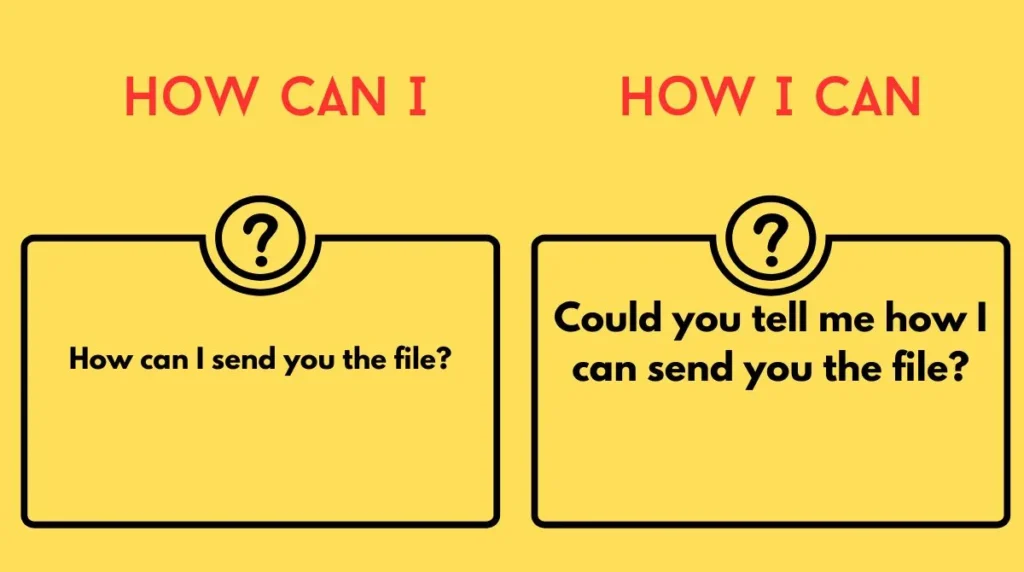
    The difference between “How I can” and “How can I?” lies in sentence structure. “How can I?” is used in direct questions (subject-verb inversion), while “How I can” is used in indirect speech or embedded questions. For example, “How can I assist you?” (direct) vs. “Can you tell me how I can assist you?” (indirect).


    The Essentials of Direct Questions in English

    How Can I vs How I Can

    In English, direct questions are typically structured with an auxiliary verb, followed by the subject, and then the main verb. This structure allows the speaker to clearly signal that they are asking for information, rather than making a statement.

    Key Elements of Direct Questions:

    1. Auxiliary Verb: The helper verb that supports the main verb in forming questions (e.g., “can,” “do,” “will”).
    2. Subject: The person or thing performing the action.
    3. Main Verb: The action or state of being.

    For example, in the question, “How can I help you?”, the structure follows the pattern:
    Auxiliary verb (can) + subject (I) + main verb (help).

    Direct questions are often used in both formal and informal settings to seek specific answers.


    Question Words

    Question words like “how,” “what,” “where,” “when,” and “why” are used to elicit detailed responses. They appear at the beginning of a sentence to indicate the type of information being requested. These words play an important role in forming questions, including in the case of “How can I?”

    Common Question Words:

    • How: Used for asking about the manner, method, or process.
    • What: Used to ask for specific information.
    • Where: Used for asking about a location or place.
    • When: Used for asking about time.
    • Why: Used for asking reasons or causes.

    In the case of “How can I?”, how is the question word indicating that the speaker wants to know the method or manner in which something is possible.


    Auxiliary Verbs

    Auxiliary verbs are crucial to the structure of English questions. These verbs help convey the tense, aspect, or mood of the main verb. When asking a question in English, an auxiliary verb is typically placed before the subject.

    Examples of Auxiliary Verbs:

    • Can: “Can I help you?”
    • Do: “Do you understand?”
    • Will: “Will you join us?”
    • Would: “Would you like some coffee?”

    The auxiliary verb “can” is commonly used in questions to express ability or possibility. In the case of “How can I?” the verb “can” introduces the ability to perform an action.


    Subject-Verb Inversion

    In English, subject-verb inversion occurs when the auxiliary verb precedes the subject in a question. This inversion is a key feature of direct questions and is one of the reasons we use the structure “How can I?” instead of “How I can?”

    Example of Inversion:

    • Statement: “I can help you.”
    • Question: “How can I help you?”

    Here, the subject (“I”) and auxiliary verb (“can”) are inverted to create a question.


    Indirect Questions: Politeness in English Queries

    Indirect questions are used to ask questions more politely or formally. These types of questions do not follow the standard inversion structure seen in direct questions. Instead, they tend to be embedded within a larger sentence. Using indirect questions allows speakers to sound more respectful, especially in formal situations.

    How to Form Indirect Questions:

    • Start with a polite phrase: “Could you tell me…,” “I wonder…,” or “I’d like to know…”
    • Follow with the indirect question: “how I can help you” (not “how can I help you”).

    For example:
    Direct Question: “How can I assist you?”
    Indirect Question: “Could you tell me how I can assist you?”


    The Role of Additional Words in Indirect Questions

    How Can I vs How I Can

    In indirect questions, additional words like “could,” “would,” or “tell me” are used to soften the request or inquiry. These words make the question less direct and more courteous, which is especially useful in formal or professional settings.

    Example of Indirect Question with Softening Phrases:

    • Direct: “How can I send you the file?”
    • Indirect: “Could you tell me how I can send you the file?”

    By using phrases like “could you tell me,” the question is softened, showing respect for the listener’s time and attention.


    Using Indirect Questions to Soften Requests

    One of the key advantages of using indirect questions is that they soften the tone of requests, making them sound more polite. This is particularly useful when asking someone to do something or when you don’t want to sound demanding.

    Example of Indirect Question for Requests:

    • Direct Request: “How can I help you?”
    • Indirect Request: “I wonder how I can assist you with this.”

    This approach is ideal for professional environments, interviews, or when you want to maintain a polite and respectful tone.


    Understanding “How Can I” in Interrogative Sentences

    The phrase “How can I” is commonly used when asking for help, offering assistance, or seeking clarification. It is part of the direct question structure and follows the subject-verb inversion rule.

    Example Usage:

    • Question for Help: “How can I help you today?”
    • Question for Understanding: “How can I improve my writing skills?”

    In these examples, “How can I?” is used to inquire about the manner or method of doing something.


    Deciphering the Structure of “How I Can” in Statements

    In contrast to “How can I?”, the phrase “How I can” appears in statements, not questions. This structure is used in indirect speech or when embedding a question inside a larger sentence. It is not used to ask a direct question.

    Example:

    • Correct Statement: “I know how I can improve my skills.”
    • Incorrect Question: “How I can help you?”

    In statements, the word order remains subject-verb-object, with no inversion of the subject and auxiliary verb.


    Embedded Questions within Larger Sentences

    Embedded questions are questions that are part of a larger sentence. They do not follow the inversion pattern of direct questions and often appear in indirect speech. The structure of these questions uses how I can or other variations, depending on the sentence.

    Example of an Embedded Question:

    • Direct Question: “How can I get to the station?”
    • Embedded Question: “Can you tell me how I can get to the station?”

    The embedded question is part of the larger sentence, and the word order is not inverted.


    Expanding Knowledge with Examples of “How Can I”

    Here are some additional examples of how to use “How can I” in various contexts. These examples will help solidify your understanding of when to use this structure.

    Examples:

    1. How can I improve my English skills?
    2. How can I make a reservation at the restaurant?
    3. How can I support you in this project?

    In each case, “How can I” is used to ask about the method, process, or ability to perform a task.


    Delving Deeper: Variations with “Why Can I” and “When Can I”

    While “How can I” is the most common structure, variations such as “Why can I” and “When can I” are also used in questions. These variations follow similar rules and are used to inquire about reasons or time-related matters.

    Examples:

    • Why can I not access the website?
    • When can I expect your response?

    In both of these questions, the word order follows the standard direct question format, with the auxiliary verb (“can”) placed before the subject (“I”).


    Direct vs. Indirect Usage with “Why Can I” and “When Can I”

    Both “Why can I” and “When can I” are also used in both direct and indirect questions, with the difference lying in the structure of the sentence.

    Direct Questions:

    • “Why can I not open this file?”
    • “When can I start the new project?”

    Indirect Questions:

    • “Could you explain why I can’t access the file?”
    • “Can you tell me when I can begin the project?”

    In indirect questions, the subject-verb inversion is not used, and the structure shifts to a more polite tone.


    The Significance of Word Order in English Questions

    In English, word order is crucial for creating correct questions. In direct questions, subject-verb inversion is required, while in indirect questions, this inversion is absent. Understanding the difference between these two structures is essential for using “How I can” and “How can I” correctly.

    Summary of Word Order in Questions:

    • Direct Questions: “How can I help you?”
    • Indirect Questions: “Can you tell me how I can help you?”

    By mastering word order, you can ensure your questions are clear and grammatically correct.


    6 FAQs

    What’s the difference between “How I can” and “How can I”?

    “How can I” is used for direct questions with subject-verb inversion (e.g., “How can I help you?”). “How I can” is used in indirect questions or statements (e.g., “I know how I can help you.”).

    Is it correct to say “How I can help you”?

    No, this is incorrect in a direct question. The correct structure is “How can I help you?”, following subject-verb inversion for direct questions.

    When do I use indirect questions like “How I can”?

    Use “How I can” in indirect questions, often embedded in polite requests or formal speech. Example: “Could you tell me how I can improve my English?”

    What is subject-verb inversion in English questions?

    Subject-verb inversion means the auxiliary verb (like “can”) comes before the subject (like “I”) in questions. Example: “How can I help you?” (not “How I can help you?”).

    How do indirect questions sound more polite?

    Indirect questions soften the tone and sound more respectful. Example: “Could you tell me how I can assist you?” sounds more polite than “How can I assist you?”

    Can I use “How can I” to ask for help?

    Yes, “How can I” is commonly used to offer or request help. Example: “How can I help you today?”


    Conclusion

    The difference between “How I can” and “How can I?” may seem subtle, but it’s an important distinction to grasp for proper English usage.

    By understanding the principles of subject-verb inversion, auxiliary verbs, and indirect questions, you can communicate more effectively and politely in both spoken and written English.

    So, the next time you’re wondering which structure to use, refer back to this guide for clarity!

  • Install In vs Install On: Which Preposition Should You Use? 🖥️🔧

    Install In vs Install On: Which Preposition Should You Use? 🖥️🔧

    Prepositions can be tricky, especially when two similar ones—like in and on—create confusion in common phrases.

    If you’ve ever wondered whether to say install in or install on, you’re not alone!

    This guide will clear up the confusion, showing you exactly when and why to use each one in different contexts, especially in the world of technology.

    Let’s dive into the details and help you master the proper usage of these prepositions.

    When choosing between “install in” and “install on,” remember that “install in” refers to placing something inside a specific area, like a directory, whereas “install on” refers to placing something onto the surface of a device or operating system, such as an app on a phone.


    Unlocking the Confusion: “Install In” vs “Install On”

    Install In vs Install

    At first glance, install in and install on seem similar. They both refer to placing something into a system, but they apply to different scenarios. Here’s the quick breakdown:

    • Install in is typically used when something is placed inside a confined space, or when software is placed in specific directories within a system.
    • Install on refers to placing something on the surface of something else or onto a system as a whole.

    But why do we use these specific prepositions? The subtle differences between these two terms hinge on the context in which the installation happens. Let’s explore each preposition further.


    Robust Examples: Using “Install In” in Context

    Installing Hardware Inside Devices

    When it comes to hardware, you often install in a device, as the hardware is typically placed inside the casing or structure. For example:

    • “I installed the RAM in my laptop.”
    • “The technician installed a new hard drive in the computer.”

    In these cases, the hardware physically enters the device, fitting inside its components. This is where in makes sense because it suggests placement within an enclosed space.

    Placing Software in Specific Directories

    Software can also be installed in certain locations within a system. Often, we refer to software being placed in specific directories or folders on a computer or server. For example:

    • “The program was installed in the C:\ drive folder.”
    • “Make sure to install the software in the correct directory for better organization.”

    Here, in is used to describe placing something inside a directory or folder, which is technically a “container” within the system.


    When to Use “Install On” – Real Life Applications

    While install in is great for hardware and software in confined spaces, install on is more commonly used in other situations. Let’s look at when it’s appropriate to use install on.

    Installing Software on Operating Systems or Devices

    You would typically say install on when referring to the device as a whole or an operating system. For example:

    • “I installed the app on my phone.”
    • “You need to install the software on your Windows PC.”

    Here, on implies that you’re putting something on top of or within the context of an operating system, rather than inside specific folders or components. This usage is common when discussing devices like phones, tablets, or PCs, as they represent the broader surface where the installation occurs.

    Installing Apps on Smart Devices

    When talking about smartphones or tablets, the phrase install on is most frequently used. Apps are installed on the device, but they don’t get placed “in” any particular compartment of the device itself. For example:

    • “You can install Instagram on your iPhone.”
    • “I just installed a new game on my Android.”

    In these examples, install on emphasizes the device as a platform or surface, rather than a physical location within the device.


    “Install On” Rising: How Tech Language Is Evolving

    As technology continues to evolve, the usage of prepositions like install on has grown, especially in the realm of software and devices. Originally, install in was more common, especially for traditional software installed on computers, where it referred to directories or specific locations. However, with the rise of mobile devices, cloud computing, and app ecosystems, install on has become more prominent.

    The Shift in Language Patterns

    In the past, it was common to say install in when referring to software on a computer. Today, with the proliferation of mobile apps and cloud-based software, install on has gained more traction because it aligns with how we think about apps on devices like smartphones, smartwatches, and even TVs.

    For example:

    • “Install the app on your smartphone.”
    • “Install the program on your tablet.”

    This shift reflects a broader understanding of software as something that exists on the device as a whole, rather than in specific folders or directories.


    Historical Usage Patterns

    Historically, the choice of in or on for installation largely depended on the device and the type of installation being discussed. Early computing language favored install in because software was physically placed within specific directories on hard drives. As software installations have evolved, especially with the advent of cloud storage and mobile apps, the preposition on has increasingly been used.

    The Early Days of Computing

    In the early days of personal computers, software installation was a much more physical process, often involving placing software in specific system folders or drives. This resulted in the common usage of install in, especially for programs on desktop systems.

    However, as software moved into the cloud, the preposition on started becoming more popular due to its broad association with the devices or platforms where the software operates.


    The Influence of Technology and Software

    The language surrounding installation has evolved alongside technology, and it’s essential to keep up with these changes to communicate effectively. As smartphones, tablets, and other devices gain more prominence, the language surrounding software installation also adapts.

    For instance, when talking about apps, we almost always say we “install on” devices like phones or tablets. This is because the word on fits the context of installing something on a platform or operating system, whereas in still carries connotations of placing something physically inside.


    Navigating Installation Terms for Devices: Phones and Computers

    In everyday usage, the differences between install in and install on become particularly relevant when we discuss common devices. Understanding when to use each preposition can help clarify your language and avoid confusion.

    Smartphones and Tablets

    When referring to mobile devices like smartphones and tablets, install on is the standard phrase. Apps are installed on the phone or tablet’s operating system, not inside a specific component or directory.

    • “You should install this app on your phone.”
    • “I’m installing this game on my tablet.”

    Laptops and Desktop Computers

    With traditional computers, you might still hear both install in and install on, but install on is typically used when referring to the device as a whole. However, install in is more common when specifying a directory or folder.

    • “Install the software on your computer.”
    • “Install the program in the C:\ drive.”

    6 FAQs

    What’s the difference between “Install In” and “Install On”?

    “Install in” is used when something is placed inside a confined space or directory, while “install on” refers to placing something on a device or operating system, like apps on a smartphone or software on a computer.

    Can I use “Install In” for software on my computer?

    Yes, when referring to specific directories or drives, you use “install in” (e.g., “Install the software in the C:\ drive”).

    Why do we say “Install On” for apps?

    We say “install on” for apps because they are placed on the device’s operating system as a whole, not inside a specific component.

    When should I use “Install In” for hardware?

    Use “install in” when hardware is physically placed inside a device, such as installing RAM in a laptop or a hard drive in a computer.

    How has the language around “Install In” and “Install On” evolved?

    As mobile devices and cloud-based software became more popular, “install on” became the more common term, especially for apps installed on smartphones, tablets, and PCs.

    Is it still correct to say “Install In” for software on a PC?

    Yes, when specifying a location within the computer’s system (like a directory), you use “install in” (e.g., “Install the program in the directory”).


    Conclusion

    Understanding when to use install in versus install on isn’t just a matter of grammar—it’s about improving clarity and precision in communication, especially in the tech world.

    While install in tends to be used when referring to placing something inside a system or a specific directory, install on is more appropriate for installing software or apps onto a device or platform as a whole.

    By mastering these distinctions, you’ll enhance your writing and communication skills, whether you’re dealing with tech topics or everyday scenarios.

    The evolution of language in the tech world continues to shape how we speak, so staying updated will always serve you well.

    Do you have any additional questions about prepositions in tech language? Feel free to share your thoughts in the comments!

  • Unselect vs Deselect: Which Term Should You Use in Tech? 🖱️💡

    Unselect vs Deselect: Which Term Should You Use in Tech? 🖱️💡

    When navigating the world of technology, language can sometimes get a little fuzzy.

    For instance, unselect and deselect often pop up as interchangeable terms, yet there are subtle differences in their usage.

    This article will dive into the debate, offering clear distinctions and real-world examples to guide you in selecting the right term in various contexts.

    The terms “unselect” and “deselect” are often confused, but “deselect” is the preferred choice in technical and professional settings. While unselect is informal, deselect is widely used in software interfaces and documentation for reversing selections.


    Understanding the Debate: Unselect Versus Deselect

    Unselect vs Deselect

    At first glance, unselect and deselect might seem like synonyms. Both seem to imply the action of reversing a selection, particularly in software and digital interfaces. However, a deeper examination reveals some key differences that affect when and how they should be used.

    The core of the debate lies in how these terms are perceived in everyday language versus their technical usage.

    While unselect might feel like a natural extension of the verb “select,” deselect is widely accepted as the correct term in most professional and technical environments. But why is this the case, and when should each term be used? Let’s dive deeper into the definitions and usage.


    Defining the Terms: A Linguistic Overview

    What Does Unselect Mean?

    Unselect is a verb that means to reverse a previous selection. It’s formed by combining the prefix “un-” (which implies undoing or reversing) with “select.” The word makes intuitive sense, but it is rarely used in formal or technical contexts.

    Example:

    • “I unselected all the boxes after completing the form.”

    While this feels natural in everyday speech, it’s not the preferred term in professional writing or technical documentation.

    What Does Deselect Mean?

    Deselect is the more established and widely accepted term. It also means to reverse or cancel a selection, but it’s considered the more precise, formal choice in most professional settings.

    Example:

    • “To remove the filter, deselect the ‘Apply filter’ option.”

    In contrast to unselect, deselect is the preferred term in software documentation, user interfaces, and coding environments. It sounds more technical, but it’s also more universally understood in these contexts.


    The Evolution of Language: How Tech Shapes Our Words

    As technology has evolved, so too has the language used to describe it. Deselect has been entrenched in the language of software development, user interfaces, and digital workflows.

    Over time, terms like this become standard because they’re clear, concise, and easily understood by the end-user.

    While unselect is a perfectly logical word, it hasn’t gained the same level of usage in the tech world. This is partially because terms like deselect are more consistent with established jargon.

    The preference for certain words often arises from their consistent application across various software platforms and user interfaces.

    In the case of deselect, software developers and designers have used it for years as the standard term for clearing or reversing a selection. It’s simpler, clearer, and less likely to confuse users.

    As a result, deselect has become synonymous with the process of removing a selection in almost all technical contexts.


    Dictionary Presence: The Legitimacy of Tech Jargon

    You might wonder: Is “unselect” even a real word? In fact, unselect is technically recognized by some dictionaries, but it doesn’t have the same level of legitimacy as deselect. The latter is well-documented in dictionaries and technical resources, whereas unselect is often categorized as a colloquialism or informal term.

    Here’s a quick look at the dictionary entries for both terms:

    TermDictionary PresenceDefinition
    UnselectRecognized but rareTo reverse a selection (informally used).
    DeselectWell-establishedTo cancel or remove a selection (commonly used in tech).

    While both terms are understood, deselect is the preferred choice in most professional, technical, and software-related contexts.


    Exploring the Correct Usage in Technology Contexts

    When it comes to technology, using the correct terminology is crucial for clear communication. Most software applications, from word processors to complex databases, rely on precise terms to describe user actions. Here’s why deselect has become the go-to choice for canceling selections in digital environments.

    • Clarity and Consistency: Deselect aligns better with the consistent language already used in most software interfaces.
    • Standardization: From programming languages to user guides, deselect is consistently applied across various tech-related documentation and instructions.
    • Ease of Use: Users are accustomed to the term deselect, making it more intuitive in software interactions.

    Correct Usage in Software:

    • Example 1: “Deselect all checkboxes before submitting your form.”
    • Example 2: “Click the button to deselect this option from the list.”

    The Nuances of Unselect and Deselect in Sentences

    While both unselect and deselect can convey the same action, the tone and setting can change how they are perceived. Let’s break down some key examples:

    • Unselect:
      • Example 1: “She unselected all the items in her shopping cart.”
      • Example 2: “I accidentally unselected the wrong file in the folder.”

    In these sentences, unselect feels more informal. It works in casual conversations or less technical contexts but may not be appropriate in professional documentation.

    • Deselect:
      • Example 1: “To remove your filter settings, simply deselect the options in the menu.”
      • Example 2: “Deselecting the ‘Accept terms and conditions’ box is mandatory.”

    In these cases, deselect feels more authoritative and is the preferred choice in professional or technical writing.


    How to Properly Unselect Items: Real-World Examples

    Even if unselect is not the most technically correct term, it’s still commonly used in everyday language, especially by non-tech-savvy individuals. Here are a few examples of how unselect might be used in real-world scenarios:

    • Example 1: “I unselected the first option because it wasn’t relevant.”
    • Example 2: “Please unselect the files you no longer want to keep in the folder.”

    While these sentences are understandable, it’s important to note that, in formal technical documentation or professional settings, deselect would be the preferred term.


    Deselecting Items: Usage and Clarity in Communication

    In contrast, deselect is the word of choice in most official software interfaces. Using it improves clarity and consistency.

    For example:

    • Software Interface Example: “Deselect any items you no longer wish to include in the report.”
    • Code Documentation Example: “To deselect a checkbox, use the ‘deselect’ method in your script.”

    Using deselect ensures that your instructions are precise, and they align with industry-standard terminology.


    Maximizing Clarity: More Sentences Demonstrating Proper Use

    To further clarify the correct usage, here are more sentences illustrating how to properly use unselect and deselect in context:

    • Unselect:
      • “Please unselect the duplicate entries before finalizing the list.”
      • “The program automatically unselected all outdated options.”
    • Deselect:
      • “Click on the ‘Deselect All’ button to clear all selected items.”
      • “Deselect the box if you don’t wish to receive notifications.”

    These examples show how deselect enhances the professionalism and clarity of your instructions, especially in tech environments.


    Industry Insights: How Software Documentation Differs

    In the software industry, language precision is paramount. Terms like deselect are carefully chosen to avoid confusion and ensure that users can quickly understand how to interact with the system.

    Documentation guidelines often prioritize words that are already familiar to users, ensuring that there’s no ambiguity. This is why deselect is favored over unselect in most technical documentation.


    Documentation Best Practices: Alternative Terms

    While deselect is the gold standard in many tech environments, there are alternative terms you can use depending on the context:

    • Clear Selection: In some cases, “clear selection” or “clear all” might be used to indicate the reversal of a selection.
    • Uncheck: Often used in the context of checkboxes. “Uncheck the box to opt out of notifications.”
    • Remove Selection: Another alternative when describing the action of clearing or reversing a choice.

    Common Misconceptions and How to Avoid Them

    It’s easy to mix up unselect and deselect, especially since they both seem to suggest the same action. However, as we’ve seen, understanding the context in which they’re used is key.

    Misconceptions to Avoid:

    • Unselecting is universally accepted: In most technical fields, deselect is preferred.
    • Unselecting is a newer, trendier term: Actually, deselect has been around longer and is more widely recognized in formal settings.

    By using the right terminology and following established guidelines, you’ll ensure your communication is clear, concise, and professional.


    6 FAQs with Answers

    What’s the difference between “unselect” and “deselect”?

    “Unselect” is informal and typically used in casual conversation, while “deselect” is the correct term in technical and software contexts, referring to the action of reversing a selection.

    Is “unselect” a real word?

    Yes, unselect is recognized by some dictionaries but is less commonly used in professional or technical language compared to deselect, which is widely accepted in software documentation.

    When should I use “deselect” in tech writing?

    Use “deselect” when writing software documentation, user guides, or coding instructions. It’s the standard term for canceling or removing a selection in most tech environments.

    Can I use “unselect” in professional contexts?

    While unselect might feel natural, it is better to use deselect in professional or technical settings to maintain clarity and align with industry standards.

    What are some alternatives to “deselect”?

    Alternatives to deselect include “clear selection”, “remove selection”, or “uncheck” when referring to checkboxes in forms.

    How can using the wrong term affect my documentation?

    Using the wrong term, like unselect, can confuse your audience. In tech writing, deselect is the preferred term, ensuring clear communication and consistency in documentation.


    Conclusion

    Now that you have a better understanding of the unselect versus deselect debate, you can make informed choices about which term to use.

    While both might seem interchangeable in casual conversation, deselect is the preferred and more professional option in technical and software contexts.

    Always consider your audience and the setting in which you’re communicating—whether it’s a user manual, a programming guide, or a casual email. By doing so, you’ll ensure your language is both precise and appropriate.

  • Awaiting Approval vs Pending Approval: What’s the Difference? 📝❓

    Awaiting Approval vs Pending Approval: What’s the Difference? 📝❓

    The phrases awaiting approval and pending approval often appear to be interchangeable, but a closer look at their usage reveals subtle differences.

    Whether you’re drafting an email, a business proposal, or a formal letter, understanding which phrase to use in the right context can significantly improve clarity and professionalism.

    In this article, we’ll explore the nuances between awaiting approval and pending approval, how they’re used in different scenarios, and provide tips for choosing the right phrase.

    The phrases “awaiting approval” and “pending approval” are often used interchangeably but have subtle differences. “Awaiting approval” emphasizes the act of waiting with a sense of anticipation, while “pending approval” focuses on the formal process and indicates a document or decision is in progress but not yet finalized.


    Understanding the Context of Approval in Language

    Awaiting Approval vs Pending Approval

    Before diving into the specifics of each phrase, it’s important to understand the broader context of approval. In communication, approval refers to formal permission or acceptance, often in business, legal, or administrative settings.

    The act of approval can pertain to anything from a project proposal to a job application or even a simple request.

    In formal language, the phrase you choose—whether awaiting approval or pending approval—can influence the tone and perceived urgency of the approval process. Let’s explore each phrase and how context affects their usage.


    The Nuances of ‘Awaiting Approval’

    The phrase awaiting approval is typically used when something is in a state of waiting, with an emphasis on the act of waiting itself. It conveys a sense of expectation and suggests that the decision-making process is ongoing.

    Example:
    “The new marketing strategy is awaiting approval from the board.”

    Here, awaiting approval emphasizes that the strategy is still under consideration, and the next steps are dependent on the approval process.

    This phrase can also imply a certain level of passive anticipation, where the person or entity seeking approval has no active control over the timing of the decision.


    Examples Where ‘Awaiting Approval’ Fits Best

    1. Project Proposals:
      In corporate environments, when a proposal is submitted for review and approval, it’s common to say the project is awaiting approval. This suggests that the proposal is pending the decision but isn’t actively being worked on until it’s approved.
      Example: “Our software development proposal is awaiting approval from the finance department.”
    2. Job Applications:
      When a candidate has completed their interview but is still waiting for the final decision, the phrase awaiting approval is often used.
      Example: “The candidate’s application is awaiting approval by the hiring manager.”
    3. Legal Documents:
      Legal documents that require sign-off or review from higher authorities may be referred to as awaiting approval.
      Example: “The new contract is awaiting approval from the legal team.”

    In these examples, awaiting approval emphasizes that something is still under review and the outcome is yet to be determined.


    Variances in the Phrase ‘Awaiting Approval’

    The phrase awaiting approval can have different tones depending on how it’s used. For example:

    • Passive voice: “The document is awaiting approval” focuses on the document, not the person doing the approving.
    • Active voice: “We are awaiting approval” personalizes the waiting process, making it more immediate and human.

    In corporate environments, the tone of awaiting approval can communicate varying levels of urgency. If a deadline is involved, the phrase may imply impatience or frustration. However, if there’s no rush, it can simply express the status quo.


    Deciphering ‘Pending Approval’

    On the other hand, pending approval suggests something is in progress but hasn’t been finalized yet. It implies that approval is part of a process and that the outcome is not guaranteed. This phrase tends to emphasize the procedural or technical aspect of the approval, rather than the emotional or anticipatory aspect.

    Example:
    “The contract is pending approval from the senior manager.”

    This usage of pending approval communicates that the approval is an expected formality that will eventually occur, provided everything meets the necessary criteria. It’s often seen as a more formal, neutral term that focuses on the status of a document or process.


    Common Scenarios for Using ‘Awaiting Approval’ and ‘Pending Approval’

    Both awaiting approval and pending approval can be used in professional, legal, and corporate communication. However, the context in which they’re used makes all the difference.

    Situations for ‘Awaiting Approval’

    • Ongoing processes: When a project or document is waiting for a decision but the timeline is uncertain.
      Example: “The design draft is awaiting approval from the creative director.”
    • Anticipation or expectation: When there’s an emphasis on waiting for approval rather than the process itself.

    Situations for ‘Pending Approval’

    • Formal processes: Where the approval process is part of a system that is expected to happen.
      Example: “The new hire is pending approval from HR.”
    • Document status: When documents or actions are at a stage where they’re not yet finalized, and further steps are needed before finalization.

    Corporate Communication and Approval Processes

    In corporate communication, the choice between awaiting approval and pending approval often depends on the formality of the communication. Both phrases are common in emails, project updates, and internal memos. However, they serve slightly different functions in a business context.

    • Awaiting approval is used more when emphasizing the anticipation or uncertainty surrounding a decision. It could be used in emails to clients or in informal internal communications where the approval is a pending formality, but there’s no set date for when it will happen.
    • Pending approval is used in more formal, procedural contexts, such as when a document or action is in the queue and waiting to be processed as part of an approval workflow.

    Example of Corporate Email:

    “Dear Team, the project plan is awaiting approval from the executive team. I’ll follow up as soon as I receive their response.”
    Here, the focus is on the waiting period, highlighting that the decision is out of the sender’s hands.


    Real-World Applications of Approval Terminology

    The language we use to discuss approval can have significant consequences in professional settings. For example, awaiting approval may imply a delay in decision-making, which could affect project timelines or customer relations.

    On the other hand, pending approval suggests a formal process is in place, which might communicate a greater level of formality and control.

    Case Study 1:
    In a legal context, a pending approval status is common for contracts that are under review but not yet finalized. It’s often used in transactions, mergers, or legal agreements where approval from one or more parties is required before proceeding.

    Case Study 2:
    In government or public sector communications, awaiting approval can imply that a decision is expected but hasn’t yet been made, possibly leading to a delay in public services or projects.


    Grammatical Insights on ‘Awaiting’ vs. ‘Pending’

    Let’s break down the grammatical differences between awaiting and pending.

    • Awaiting is a present participle that typically indicates an ongoing action, where something is in the state of being awaited. It often involves a sense of expectation.
    • Pending is an adjective or noun that refers to something that is not yet decided, often used in formal or legal contexts. It doesn’t convey as much immediacy or anticipation as awaiting.

    Examples:

    • “The proposal is awaiting approval.” (Present participle)
    • “The proposal is pending approval.” (Adjective, indicates status in a formal process)

    Expert Tips on Choosing the Right Approval Phrase

    1. Consider the formality: Pending approval is more formal and procedural, making it ideal for legal documents or corporate settings.
    2. Focus on the context: Use awaiting approval when you want to convey the sense of waiting or anticipation, such as in customer service or informal business communications.
    3. Be aware of tone: If you want to sound more urgent or concerned, awaiting approval might better reflect that tone. If you’re simply informing someone of a status, pending approval can sound more neutral.
    4. Match your audience: Consider who you’re speaking to. Clients might appreciate the more approachable tone of awaiting approval, while higher-ups might prefer the more formal pending approval.

    6 FAQs with Answers

    What’s the difference between “awaiting approval” and “pending approval”?

    “Awaiting approval” emphasizes the state of waiting and anticipation, often used informally. “Pending approval” focuses on the formal process, typically in legal or corporate contexts, indicating that the approval is in progress but not yet finalized.

    Which phrase should I use in business emails?

    Use “awaiting approval” when you want to convey a sense of waiting or expectation, especially in less formal contexts. Use “pending approval” for more formal situations where the approval process is part of a workflow.

    Can “pending approval” be used in casual settings?

    “Pending approval” is more formal and used in legal, corporate, or administrative contexts. For casual settings, “awaiting approval” may feel more natural and less rigid.

    Are both phrases grammatically correct?

    Yes, both “awaiting approval” and “pending approval” are grammatically correct. The key difference lies in their usage and tone: awaiting approval conveys a sense of anticipation, while pending approval focuses on the process.

    Which phrase is more common in legal documents?

    “Pending approval” is more commonly used in legal documents because it emphasizes the formal, procedural aspect of the approval process.

    How do I choose between the two phrases in my writing?

    Consider the formality of the context and the tone you wish to convey. Use “awaiting approval” for more informal, expectation-driven situations, and “pending approval” for more neutral, procedural contexts.


    Closing Thoughts on ‘Awaiting Approval’ vs. ‘Pending Approval’

    Understanding when to use awaiting approval and pending approval is essential for clear and professional communication. Both phrases are useful, but their subtle differences can change the tone and clarity of your message.

    By keeping the context and audience in mind, you can confidently use these terms to convey the appropriate meaning.

    So, the next time you’re drafting an email, report, or proposal, remember the key differences between awaiting approval and pending approval—and choose the one that best fits your situation.

  • Rend or Rent? Learn the Key Differences with Examples! 📖

    Rend or Rent? Learn the Key Differences with Examples! 📖

    Understanding the differences between “rend” and “rent” is crucial for effective communication.

    These words may seem similar, but their meanings and usages are distinct.

    “Rend” vs. “Rent” – What’s the difference? 🤔 “Rend” means to tear apart violently, while “rent” can mean a lease payment or a tear. Learn the key distinctions with examples!

    This article will delve into the definitions, common confusions, practical examples, and tips to remember when to use “rend” or “rent.”

    Understanding the Meaning of “Rend”

    Rend or Rent

    Definition of “Rend”

    Rend” is a verb that means to tear something into pieces with force or violence. It can also imply causing great emotional distress or splitting something apart.

    The word “rend” originates from Old English “rendan,” which carries the same meaning of tearing or splitting.

    Usage of “Rend” in Sentences

    “Rend” is often used in literary and dramatic contexts. Here are some examples to illustrate its usage:

    • The fierce storm rent the sails of the ship, leaving it adrift.
    • Her heart was rended by the tragic news of his passing.
    • The sound of the explosion rent the air, causing everyone to duck for cover.

    These sentences show “rend” in different tenses, demonstrating its versatility.

    Understanding the Meaning of “Rent”

    Definition of “Rent”

    “Rent” is a noun and a verb with multiple meanings. As a noun, it refers to a regular payment made for the use of property, land, or a service. As a verb, it means to lease property or cause a tear or split in something. The term “rent” comes from the Latin word “redditus,” meaning a return or payment.

    Usage of “Rent” in Sentences

    “Rent” is commonly used in real estate and physical damage contexts. Here are some examples:

    • Noun: The monthly rent for the apartment is due on the first of each month.
    • Verb: We decided to rent a car for our vacation.
    • Verb: The fabric was rent by the sharp edge of the table.

    These examples highlight the different uses of “rent” as both a noun and a verb.

    Rend vs. Rent: Differences and Common Confusions

    Key Differences

    Understanding the key differences between “rend” and “rent” helps to avoid confusion. Here’s a breakdown:

    AspectRendRent
    Part of SpeechVerbNoun and Verb
    DefinitionTear apart, split violentlyPayment for property (noun); lease, tear (verb)
    Usage ContextDramatic, emotional, violentReal estate, agreements, physical damage
    EtymologyOld English “rendan”Latin “redditus”

    Common Confusions

    People often confuse “rend” and “rent” due to their similar spellings and the overlap in the meaning of “tear” for both words. However, their usage contexts are quite different:

    • Rend is used in more dramatic or violent contexts.
    • Rent is used in everyday situations like leasing property or describing physical damage.

    Practical Examples to Clarify Usage

    Examples Showing Correct Usage of “Rend”

    • Literature: “He rent his clothes in sorrow.” – This shows a dramatic expression of grief.
    • Modern Usage: “The earthquake rent the ground open, creating a massive fissure.”

    Examples Showing Correct Usage of “Rent”

    • Real Estate: “We signed a lease to rent the office space downtown.”
    • Physical Damage: “The curtain was rent apart by the cat’s claws.”

    Tips for Remembering When to Use “Rend” or “Rent”

    Memory Aids and Mnemonics

    Here are some simple tricks to remember the difference:

    • Rend: Think of “rend” as rip and end – it involves tearing something apart.
    • Rent: Remember “rent” as a regular payment or a lease – it involves an ongoing agreement or a physical tear.

    Practice Exercises

    Try these exercises to reinforce your understanding:

    1. Fill in the blanks with “rend” or “rent”:
      • The lion’s roar ___ the silence of the night.
      • They decided to ___ out their beach house for the summer.
    2. Match the word with its correct context:
      • Rend: a) Lease a car, b) Tear apart in anger
      • Rent: a) Lease a car, b) Tear apart in anger

    Answers:

    1. rend, rent
    2. b, a

    Examples from Literature and News Reports

    Literary Examples

    • Rend: “To rend one’s garments was a common expression of sorrow in ancient times.”
    • Rent: “The rent in the fabric of society was evident in the rising inequalities.”

    News Reports

    • Rend: “The explosion rent the air, causing widespread panic in the city.”
    • Rent: “The monthly rent for commercial properties has increased by 5% this year.”

    🧐 FAQs

    1. What does “rend” mean?

    “Rend” means to tear apart violently or cause emotional distress. Example: The explosion rent the air with a deafening sound.

    2. How is “rent” used as a noun and verb?

    As a noun, “rent” means a payment for using property (The rent is due tomorrow). As a verb, it can mean to lease something or tear apart (The fabric was rent by the sharp edge).

    3. Can “rent” and “rend” be used interchangeably?

    No. “Rend” always means to tear forcefully, while “rent” is mainly used for leasing or physical damage.

    4. What are common mistakes with “rend” and “rent”?

    Wrong: He rent his clothes in grief.
    Correct: He rent his apartment to a tenant.
    Correct: He rent his clothes in grief. (past tense of rend)

    5. Is “rent” the past tense of “rend”?

    Yes! “Rent” is both the past tense and past participle of “rend”. Example: She rent her dress in anger.

    6. How can I easily remember “rend” vs. “rent”?

    Think of “rend” = rip and end (it destroys something). “Rent” = recurring payment (like renting a house).

    Conclusion

    Understanding the differences between “rend” and “rent” is essential for clear communication.

    “Rend” is used in contexts involving tearing or splitting with force, often conveying dramatic or emotional undertones. “Rent,” on the other hand, primarily refers to leasing property or physical damage but can also mean causing a tear.

    By remembering the definitions, usage contexts, and practical examples provided, you can confidently use these words correctly.

    Additional Resources

    By referring to these resources, you can further enhance your understanding and application of “rend” and “rent.”

  • Where vs In Which vs Wherein – What’s the Difference? (With Examples) 📍

    Where vs In Which vs Wherein – What’s the Difference? (With Examples) 📍

    Mastering English grammar can be challenging, especially when it comes to understanding subtle differences between words that seem similar.

    One common area of confusion is the use of “where,” “in which,” and “wherein.” While these terms may appear interchangeable, each has distinct uses and connotations.

    “Where” vs. “In which” vs. “Wherein”—which one should you use? 🤔 “Where” is for places and situations, “in which” is for formal writing, and “wherein” is for legal or academic contexts. Learn when to use each with easy examples!

    In this article, we’ll dive into the definitions, proper usage, and contexts for these terms, providing clear examples and practical advice to help you master them.

    Understanding the Definitions and Uses of “Where”

    Where vs In Which vs Wherein

    The word “where” is a versatile term in English grammar, serving as both an adverb and a conjunction.

    Its primary function is to indicate a place or location. However, it can also refer to situations and conditions.

    Using “Where” as an Adverb and Conjunction

    Adverb Use: “Where” as an adverb typically answers the question “at what place?” For example:

    • “Where did you go on vacation?”
    • “This is the place where we first met.”

    Conjunction Use: As a conjunction, “where” introduces clauses that provide more information about a location or situation:

    • “He moved to a city where the cost of living is lower.”
    • “I remember a time where life was simpler.”

    When “Where” Applies to Situations and Circumstances

    “Where” can also refer to abstract situations or conditions, not just physical locations. For example:

    • “There are moments where you feel completely lost.”
    • “We reached a point where we had no choice but to continue.”

    In these examples, “where” links to broader circumstances, making it a versatile and powerful word in the English language.

    Demystifying “In Which” as a Relative Pronoun

    “In which” is a relative pronoun phrase used to introduce a clause that adds information about a noun. It is often used in more formal writing and can replace “where” in certain contexts for clarity and precision.

    How “In Which” Connects Clauses and Provides Additional Information

    “In which” typically follows a preposition and is used to add detail to the noun it modifies:

    • “This is the book in which I found the answer.”
    • “The house in which they lived was old and charming.”

    By using “in which,” the writer specifies the relationship between the noun and the additional information, making the sentence clearer.

    Comparative Analysis with “Where”

    While “where” can be more casual and straightforward, “in which” provides a level of formality and precision. Compare these sentences:

    • “This is the library where I study.” (Casual)
    • “This is the library in which I study.” (Formal)

    Both sentences are correct, but the choice depends on the desired tone and clarity.

    Exploring “Wherein” in Modern English Usage

    “Wherein” is a somewhat archaic term that combines “where” and “in,” meaning “in which” or “within which.” It’s less common in everyday speech but still appears in legal, academic, and historical texts.

    Evolution of “Wherein” from Historical to Modern Usage

    Historically, “wherein” was more commonly used in formal and legal documents. Today, its usage is rare outside of specific contexts. Here are some examples:

    • Historical: “The contract specifies the terms wherein the parties agree.”
    • Modern: “The paper discusses the methodology wherein the results were obtained.”

    Differences Between “Wherein” and “Where” or “In Which”

    “Wherein” provides a formal tone and is often used in contexts requiring precision and clarity. In contrast, “where” and “in which” are more flexible and widely used.

    The Historical and Legal Context of “Wherein”

    “Wherein” holds particular significance in legal and historical texts. Its precision makes it ideal for legal documents where exact language is crucial.

    Examples from Legal Documents and Historical Writings

    • Legal: “The clause specifies the conditions wherein the contract may be terminated.”
    • Historical: “The decree outlined the territories wherein the laws would apply.”

    These examples highlight the specificity and formality of “wherein,” making it suitable for legal and historical contexts.

    Why “Wherein” is Rarely Used in Everyday Conversation

    In everyday conversation, “wherein” is often replaced by simpler terms like “where” or “in which.” Its formality can make it sound out of place in casual dialogue.

    Contexts Where “Wherein” Might Still Be Appropriate

    While rare, “wherein” can still be appropriate in certain formal contexts, such as academic writing, legal documents, or historical discussions. For example:

    • Academic: “The study explores the framework wherein these theories are applied.”
    • Legal: “The agreement details the circumstances wherein the tenant may terminate the lease.”

    Real-Life Examples to Illustrate “Where” vs. “In Which” vs. “Wherein”

    Examples of “Where” Usage

    1. “This is the park where we play soccer every weekend.”
    2. “I can’t remember where I put my keys.”

    Examples of “In Which” Usage

    1. “The office in which she works is located downtown.”
    2. “The chapter in which the author discusses this topic is particularly enlightening.”

    Examples of “Wherein” Usage

    1. “The treaty outlines the conditions wherein peace shall be maintained.”
    2. “The report details the scenarios wherein the policy will be effective.”

    Choosing Between “Where” and “In Which” for Clarity and Precision

    Guidelines for Selecting the Right Term Based on Context

    1. Formality: Use “in which” or “wherein” for more formal contexts.
    2. Clarity: “In which” can provide clarity by explicitly linking the clause to the noun.
    3. Simplicity: “Where” is often simpler and more conversational.

    Importance of Clarity in Writing

    Choosing the right connector can enhance the readability and professionalism of your writing. Clear communication is key to effective writing.

    Examples Demonstrating Improved Sentence Structure

    1. Casual: “This is the museum where you can see the exhibit.”
    2. Formal: “This is the museum in which the exhibit is displayed.”

    Improving Writing Style by Selecting the Appropriate Connector

    How the Right Choice Between “Where,” “In Which,” and “Wherein” Enhances Readability

    The appropriate connector can make sentences flow better and improve understanding. For instance:

    • “The city where I grew up has changed a lot.” (Casual, conversational)
    • “The city in which I grew up has changed significantly.” (Formal, precise)

    Tips for Identifying the Most Suitable Connector

    1. Audience: Consider your audience’s familiarity with formal language.
    2. Purpose: Match the connector to the purpose of your writing.
    3. Tone: Ensure the tone of your writing is consistent.

    Common Pitfalls and How to Avoid Them

    1. Overuse of Formal Terms: Avoid overusing “in which” or “wherein” in casual writing.
    2. Misplacement: Ensure connectors are placed correctly to maintain clarity.
    3. Redundancy: Avoid redundant phrases like “where at” or “in which at.”

    Tips to Avoid Common Mistakes with “Where” and “In Which”

    List of Frequent Errors and Misconceptions

    1. Incorrect Substitution: Using “where” when “in which” is needed for clarity.
    2. Misleading Context: Misusing “wherein” in casual contexts.
    3. Over-Formality: Making writing sound overly formal by overusing “in which.”

    Strategies for Proofreading and Self-Editing

    1. Read Aloud: Reading your writing aloud helps catch awkward phrasing.
    2. Peer Review: Have someone else review your work for clarity.
    3. Use Tools: Utilize grammar check tools to identify potential issues.

    Practice Exercises for Reinforcement

    1. Rewrite sentences replacing “where” with “in which” where appropriate.
    2. Identify the correct usage of “where,” “in which,” and “wherein” in given sentences.

    “Wherein”: Is It Ever the Right Choice?

    Scenarios Where “Wherein” Might Be Preferable

    “Wherein” might be the best choice in contexts requiring formality and precision. For example:

    • Legal Writing: “The agreement specifies the conditions wherein the contract is valid.”
    • Academic Papers: “The study examines the process wherein the phenomenon occurs.”

    Balancing Formality and Readability

    While “wherein” adds formality, it’s essential to balance it with readability. Overusing formal terms can make writing cumbersome.

    Final Thoughts on Using “Wherein” Effectively

    Use “wherein” sparingly and only when it enhances clarity and formality. In most cases, “where” or “in which” will suffice.

    FAQs

    1. What is the difference between “where” and “in which”?

    “Where” is more casual and often used in everyday speech, while “in which” is more formal and precise, typically used in academic or professional writing.

    2. When should I use “wherein”?

    “Wherein” is an older, formal term often found in legal, academic, or historical texts. It means “in which” or “within which” but is rarely used in everyday language.

    3. Can “where” and “in which” be used interchangeably?

    Yes, but “in which” is preferred in formal writing. For example:
    ✅ “This is the house where I grew up.” (Casual)
    ✅ “This is the house in which I grew up.” (Formal)

    4. Is “wherein” outdated?

    Yes, “wherein” is not common in modern speech but still appears in legal contracts, research papers, and historical documents.

    5. Which is correct: “the situation where” or “the situation in which”?

    “The situation in which” is grammatically correct and more precise, especially in formal writing.

    6. How can I remember the difference?

    Use this simple trick:
    📍 Where = Everyday places & situations
    📍 In Which = Formal, written English
    📍 Wherein = Legal & academic texts

    Conclusion

    Mastering the use of “where,” “in which,” and “wherein” can significantly enhance your writing clarity and precision.

    By understanding the distinct roles and appropriate contexts for each term, you can improve your communication and make your writing more effective.

    Remember to consider the formality, clarity, and tone of your writing when choosing between these connectors. Practice and review are key to mastering these subtleties in English grammar.

    Additional Resources

    • Books: “The Elements of Style” by Strunk and White, “Eats, Shoots & Leaves” by Lynne Truss.
    • Websites: Grammarly, Purdue OWL.
    • Tools: Grammar check tools like Grammarly and Hemingway App.

    By following these guidelines and practicing regularly, you’ll be well on your way to mastering the use of “where,” “in which,” and “wherein.” Happy writing!

  • Expiry vs Expiration: 🚨 What’s the Real Difference?

    Expiry vs Expiration: 🚨 What’s the Real Difference?

    Understanding the terms expiry and expiration can often be confusing.

    While they might seem interchangeable, they have distinct meanings and implications for product safety and consumer behavior.

    Expiry vs. Expiration—What’s the difference? 🤔 While both refer to product safety, expiry is for perishable goods, and expiration applies to long-term effectiveness. Learn more now!

    This article delves into the nuances of these terms, examining their origins, legal definitions, global practices, and their impact on consumer decisions.

    Introduction to Expiry and Expiration Dates

    Expiry vs Expiration

    Expiry and expiration dates are crucial for ensuring the safety and effectiveness of products we use daily.

    The difference between these terms might appear subtle, but understanding them can help you make more informed choices about the products you consume and use.

    Expiry Date: Often used for perishable items, such as food and medicine, indicating the last date on which the product is safe to use or consume.

    Expiration Date: Generally applied to non-perishable items, including certain medications and cosmetics, marking the end of the period during which the product is guaranteed to be effective or safe.

    Purpose of Date Labels

    Date labels serve several important functions:

    • Safety: Prevents consumption of spoiled or degraded products.
    • Quality: Ensures that products perform as intended.
    • Regulation: Complies with legal requirements for product safety.

    Origins and Evolution of Expiry and Expiration

    The terms expiry and expiration have evolved over time, influenced by historical practices and regulatory developments.

    Historical Background:

    • Early Practices: Initially, expiry dates were more about food preservation methods rather than strict labeling.
    • Modern Regulations: With advances in food safety and medicine, regulations now mandate clear date labeling to protect consumer health.

    Key Milestones:

    • 1930s: Early food safety regulations began in the U.S., leading to the introduction of date labeling.
    • 1960s: The FDA and other agencies started formalizing expiration date regulations for pharmaceuticals.
    • 2000s: Increased global standardization of date labeling practices to enhance international trade and consumer safety.

    Legal Definitions and Usage

    The legal definitions of expiry and expiration dates vary by jurisdiction, affecting how they are applied and enforced.

    Legal Definitions

    Expiry Date:

    • Food Safety: In many countries, expiry dates are legally required for perishable food items. For instance, the European Union mandates expiry dates for products that may pose health risks if consumed after the date.

    Expiration Date:

    • Pharmaceuticals and Cosmetics: These dates are crucial for ensuring that medications and cosmetic products are effective and safe. In the U.S., the FDA requires expiration dates on prescription and over-the-counter drugs.

    Case Studies

    Case Study 1: Food Safety Regulation

    • Country: France
    • Detail: France mandates expiry dates on perishable foods like dairy products to ensure consumer safety. Failure to comply can result in significant fines and product recalls.

    Case Study 2: Pharmaceutical Expiration

    • Country: United States
    • Detail: The FDA’s expiration date regulations for medications are stringent. A well-known case involved the recall of a popular over-the-counter drug due to expiration date mismanagement, highlighting the importance of strict compliance.

    Global Differences in Date Labeling Practices

    Date labeling practices differ significantly around the world, influencing international trade and consumer perception.

    Overview of Date Labeling Practices

    United States:

    • Food Products: Labels often read “Use By,” “Sell By,” or “Best Before,” indicating different aspects of product freshness.
    • Pharmaceuticals: “Expiration Date” is used for medications, ensuring they remain effective.

    European Union:

    • Food Products: “Use By” dates are mandatory for perishable goods, while “Best Before” dates are used for non-perishable items.
    • Pharmaceuticals: Expiration dates are required, with strict guidelines on storage conditions.

    Japan:

    • Food Products: Labels include “Best Before” dates and “Expiration Date” for certain products.
    • Pharmaceuticals: Expiration dates are mandatory, with clear instructions on storage to maintain product efficacy.

    Comparison Chart

    CountryFood ProductsPharmaceuticals
    United States“Use By,” “Sell By,” “Best Before”“Expiration Date”
    European Union“Use By,” “Best Before”“Expiration Date”
    Japan“Best Before,” “Expiration Date”“Expiration Date”

    Significance of Expiry Dates in Food Safety

    Expiry dates play a vital role in food safety, ensuring that products are consumed while still safe.

    Determining Expiry Dates

    Expiry dates are determined based on:

    • Microbial Growth: Risk of harmful bacteria increasing over time.
    • Chemical Changes: Degradation of food components that can affect taste and safety.
    • Packaging: Integrity of packaging that protects food from contamination.

    Examples of Strict Regulations

    • Dairy Products: In the U.S., milk has a short expiry date due to rapid spoilage.
    • Packaged Foods: Items like canned goods have longer expiry dates but still require careful monitoring.

    Understanding Expiration Dates in Product Shelf Life

    Expiration dates are crucial for non-perishable items, ensuring they remain effective and safe.

    Calculating Expiration Dates

    Expiration dates are based on:

    • Product Stability: How long the product maintains its intended effectiveness.
    • Storage Conditions: Temperature, humidity, and light exposure affecting product longevity.
    • Chemical Composition: Degradation of active ingredients over time.

    Expert Insights

    • Pharmaceuticals: Dr. Jane Smith, a pharmacist, notes that medications should always be used before their expiration date to avoid reduced efficacy and potential health risks.
    • Cosmetics: Dr. Emily Brown, a dermatologist, emphasizes that expired cosmetics can cause skin irritation and should be avoided.

    Common Misconceptions About Product Safety Beyond Expiration Dates

    There are several misconceptions about using products past their expiration or expiry dates. Let’s debunk some of these myths.

    Myths vs. Facts

    Myth 1: “Expired food is always unsafe.”

    • Fact: Many products remain safe past their expiry date, but their quality might decline. However, perishable items should not be consumed after their expiry date.

    Myth 2: “Expired medications are harmless.”

    • Fact: Medications can lose their effectiveness or even become harmful past their expiration date. Always check with a healthcare provider before using expired medications.

    Real-Life Consequences

    • Food Poisoning: Cases of foodborne illnesses often result from consuming products past their expiry date.
    • Medication Failure: There have been instances where expired medications failed to treat conditions effectively, leading to health complications.

    Impact of Expiry and Expiration Dates on Consumer Behavior

    Expiry and expiration dates significantly influence consumer behavior, affecting purchasing decisions and usage patterns.

    Influence on Purchasing Decisions

    • Perceived Freshness: Products with recent dates are often perceived as fresher and of higher quality.
    • Trust in Safety: Clear and accurate date labels enhance consumer trust in product safety.

    Psychological Effects

    • Confidence in Quality: Consumers feel more confident purchasing products with well-defined dates.
    • Avoidance Behavior: Many consumers avoid products with approaching or past dates, regardless of actual safety.

    Studies and Surveys

    • Survey Findings: A survey by the Food Marketing Institute revealed that 60% of consumers check expiry dates before purchasing food products.
    • Behavioral Study: Research published in the Journal of Consumer Research shows that date labels significantly impact consumer choices and perceptions of product quality.

    Consumer Trust and the Psychology of Date Labels

    Consumer trust in date labels is crucial for brand reputation and consumer satisfaction.

    Building Consumer Trust

    • Transparency: Brands that provide clear and accurate date labels are more likely to build consumer trust.
    • Compliance: Adhering to regulatory standards demonstrates commitment to product safety and quality.

    Impact on Brand Loyalty

    • Positive Perception: Brands with reliable date labeling practices are perceived as more trustworthy.
    • Customer Retention: Effective date labeling can lead to higher customer retention and repeat purchases.

    Case Studies

    Case Study 1: Brand Transparency

    • Company: FreshFoods Inc.
    • Detail: Known for its clear expiry dates and high-quality products, FreshFoods Inc. has built a loyal customer base through transparent labeling practices.

    Case Study 2: Regulatory Compliance

    • Company: PharmaCare Ltd.
    • Detail: PharmaCare Ltd. strictly adheres to expiration date regulations, resulting in high consumer trust and a strong market presence.

    Making Informed Decisions About Product Freshness

    Understanding expiry and expiration dates helps consumers make informed decisions about product freshness and safety.

    Practical Tips

    • Check Labels: Always check expiry or expiration dates before purchasing or using products.
    • Follow Storage Instructions: Proper storage can extend the life of products.
    • Dispose of Expired Items: Safely dispose of products past their expiry or expiration date to avoid potential risks.

    Recommendations

    • Food Products: Buy products with dates that align with your consumption plans.
    • Medications: Dispose of expired medications and consult with a healthcare provider for replacements.
    • Cosmetics: Replace expired cosmetics to avoid skin issues and ensure product effectiveness.

    🧐 FAQs

    1. What is the main difference between expiry and expiration?

    Expiry refers to the last safe date for perishable items (food, medicine), while expiration indicates the period a product remains effective (cosmetics, drugs).

    2. Are expiry and expiration dates legally required?

    Yes! Many countries mandate expiry dates for food safety and expiration dates for pharmaceuticals to ensure consumer protection.

    3. Can you use products after their expiry or expiration date?

    • Perishables (Expiry Date): 🚫 Not safe to consume.
    • Non-Perishables (Expiration Date): May lose effectiveness but aren’t always harmful.

    4. Why do food and medicine have different date labels?

    Food can spoil and become dangerous, while medicine and cosmetics lose potency but may not be immediately harmful.

    5. How do different countries label expiry and expiration dates?

    • US: Uses “Sell By,” “Use By,” and “Expiration Date.”
    • EU: Uses “Use By” (perishables) and “Best Before” (quality-related).
    • Japan: Has strict “Best Before” and “Expiration Date” labels.

    6. How can I safely handle expired products?

    Dispose of expired medicine safely, avoid consuming expired perishables, and store items properly to extend shelf life.

    Conclusion

    In summary, while expiry and expiration dates may seem similar, they have distinct meanings and implications.

    Expiry dates are critical for perishable items, ensuring safety and quality, while expiration dates are essential for non-perishable products, maintaining effectiveness and safety.

    Understanding these terms helps you make better choices about the products you use and consume.

    By being informed about expiry vs. expiration, you can ensure that you are using products that are both safe and effective, ultimately contributing to better health and well-being.

  • ✅ Each Is or Each Are? The Correct Usage Explained! 📖🔍

    ✅ Each Is or Each Are? The Correct Usage Explained! 📖🔍

    In English grammar, subject-verb agreement is crucial for clarity and correctness. One common area of confusion is whether to use “each is” or “each are.”

    Confused about “Each is” vs. “Each are”? The correct phrase is “Each is” because “each” is a singular pronoun that requires a singular verb.

    This comprehensive guide will delve into the nuances of using “each” correctly, ensuring your writing remains clear and grammatically accurate.

    Understanding “Each” in American English

    Each Is or Each Are

    Definition and Usage

    “Each” is a singular pronoun used to refer to every individual item or person in a group, considered separately.

    For example, in the sentence, “Each of the students has a book,” “each” emphasizes that every student individually possesses a book.

    Historical Context

    Historically, “each” has consistently been treated as a singular pronoun in English. This usage has been rooted in both formal and informal contexts, maintaining its role in ensuring precise subject-verb agreement.

    Grammatical Role

    “Each” functions as a determiner or a pronoun, affecting the verb form it accompanies. When “each” precedes a singular noun, it necessitates a singular verb. This adherence to subject-verb agreement is fundamental in maintaining grammatical correctness in both spoken and written English.

    Distinguishing Between “Each Is” and “Each Are”

    Basic Rules

    The basic rule is straightforward: “each” is singular, so it should be followed by a singular verb. Therefore, “each is” is correct, while “each are” is incorrect.

    Common Confusions

    A common confusion arises when “each” follows a plural noun. For example, “The cookies each are delicious” is incorrect because “each” should be followed by “is” despite the plural noun “cookies.”

    Examples

    • Correct: “Each of the flowers is blooming beautifully.”
    • Incorrect: “Each of the flowers are blooming beautifully.”

    The Role of Subject-Verb Agreement

    Importance

    Subject-verb agreement ensures that sentences are grammatically correct and easily understood. Inconsistent subject-verb agreement can lead to confusion and misunderstandings.

    Rule Application

    When “each” is used as a subject, the verb must be singular. This rule applies universally in English grammar.

    Examples

    • Correct: “Each student is responsible for their own assignments.”
    • Incorrect: “Each student are responsible for their own assignments.”

    Clarifying with Singular and Plural Nouns

    Usage with Singular Nouns

    When “each” precedes a singular noun, it highlights individual items or people within a group. For instance, “Each book on the shelf is valuable” refers to every single book individually.

    Usage with Plural Nouns

    Even when “each” follows a plural noun, the verb remains singular. For example, “The members of the team each has a role to play” emphasizes individual responsibility within the group.

    Examples

    • Singular Noun: “Each child is unique.”
    • Plural Noun: “The children each has a unique quality.”

    Exceptions in Informal Speech

    Colloquial Usage

    In informal speech, people sometimes use “each are” due to colloquial habits. While this may be accepted in casual conversation, it remains grammatically incorrect.

    Examples

    • Informal: “Each of the cookies are tasty.”
    • Formal: “Each of the cookies is tasty.”

    Analysis

    While informal exceptions occur, adhering to correct grammar in formal writing and speech is essential for clarity and professionalism.

    Examples of “Each Is” in Formal Writing

    Literary Examples

    Literature often provides clear examples of correct grammar. For instance, in Jane Austen’s “Pride and Prejudice,” the sentence “Each of the sisters is well-mannered” follows the rule perfectly.

    Academic Writing

    Scholarly articles also adhere to grammatical precision. A sentence like “Each participant is required to complete the survey” demonstrates proper usage.

    Professional Documents

    Business and legal documents maintain strict grammatical standards. “Each clause in the contract is binding” is an example from legal writing.

    “Each Of” Explained: Singular or Plural?

    Grammatical Rule

    “Each of” should always be followed by a singular verb, even though it may refer to a group of items or people. For example, “Each of the players is ready for the game” is correct.

    Examples

    • Correct: “Each of the members is invited.”
    • Incorrect: “Each of the members are invited.”

    Common Mistakes

    People often mistakenly use a plural verb due to the plural noun following “each of.” It’s crucial to remember that “each” governs the verb, not the plural noun.

    Using “Each Of” with Collective Nouns

    Definition of Collective Nouns

    Collective nouns refer to a group of individuals or items considered as a single entity, such as “team,” “family,” or “audience.”

    Rules for “Each Of”

    When using “each of” with collective nouns, the verb remains singular. For example, “Each of the team members is talented.”

    Examples

    • Correct: “Each of the family members is attending the reunion.”
    • Incorrect: “Each of the family members are attending the reunion.”

    The Influence of British and American Usage

    Differences

    While both British and American English treat “each” as singular, there are subtle differences in other grammatical areas. However, the usage of “each is” remains consistent across both dialects.

    Examples

    • American English: “Each of the cookies is delicious.”
    • British English: “Each of the cookies is delicious.”

    Analysis

    Understanding these differences helps in recognizing that “each is” is universally accepted in English grammar.

    Common Pitfalls: When to Use “Each Is”

    Identifying Pitfalls

    Common pitfalls include confusing “each” with plural subjects or misplacing the verb. For example, “Each of the cars are new” is incorrect.

    Examples

    • Correct: “Each of the cars is new.”
    • Incorrect: “Each of the cars are new.”

    Tips

    To avoid pitfalls, always remember that “each” governs the verb, ensuring it remains singular regardless of the noun that follows.

    The Pronoun “Each” with Gender-Neutral Pronouns

    Modern Grammar

    Incorporating gender-neutral pronouns like “they” can be tricky with “each.” The rule remains that “each” takes a singular verb, but the pronoun can be plural.

    Examples

    • Correct: “Each of the participants is bringing their own equipment.”
    • Incorrect: “Each of the participants are bringing their own equipment.”

    Discussion

    Balancing grammatical rules with modern inclusivity can be challenging but adhering to subject-verb agreement ensures clarity.

    Modern Usage and Acceptability

    Current Trends

    Modern English usage tends to be more flexible, but formal writing still requires strict adherence to grammatical rules. “Each is” remains the correct form in formal contexts.

    Language Evolution

    While language evolves, core grammatical rules like subject-verb agreement with “each” persist.

    Examples

    • Modern Media: “Each of the apps is user-friendly.”
    • Everyday Speech: “Each of the apps is user-friendly.”

    Each in Context: Relative Clauses and Group References

    Relative Clauses

    Relative clauses add more information about the noun. When “each” is used, it must still follow the singular verb rule.

    Group References

    Using “each” to refer to group members individually requires a singular verb. For instance, “Each of the team members is contributing.”

    Examples

    • Relative Clause: “Each of the students, who is participating in the project, will receive credit.”
    • Group Reference: “Each of the athletes is ready for the competition.”

    Understanding Relative Clauses with “Who” and “That”

    Defining Clauses

    Relative clauses beginning with “who” or “that” provide essential information about the noun they follow.

    Usage with “Each”

    When “each” is the subject, the verb in the relative clause must be singular. For example, “Each of the authors who is nominated will attend.”

    Examples

    • Correct: “Each of the members who is attending will receive a badge.”
    • Incorrect: “Each of the members who are attending will receive a badge.”

    Real-World Examples: “Each Is” in Literature and Media

    Literature

    In classic literature, authors consistently use “each is” to maintain grammatical accuracy. For example, in Charles Dickens’ “A Tale of Two Cities,” “Each of the characters is well-developed” follows this rule.

    Media

    Modern media, including news articles and blogs, adhere to this rule for clarity and professionalism. For instance, “Each of the nominees is expected to attend” is a correct usage.

    Analysis

    Analyzing real-world examples helps in understanding the consistent application of “each is” across different contexts.

    FAQs

    1. Why is “Each is” correct instead of “Each are”?

    “Each” is singular, so it must be followed by a singular verb like “is” instead of “are.”

    2. Can “Each are” ever be correct?

    No, “Each are” is grammatically incorrect because “each” always takes a singular verb.

    3. How do you use “Each is” in a sentence?

    Example: “Each of the students is responsible for their assignments.”

    4. Does “Each of” change the verb form?

    No, even if “each of” is followed by a plural noun, the verb remains singular. Example: “Each of the players is ready.”

    5. What is the difference between “Each one is” and “Each one are”?

    “Each one is” is correct because “each one” refers to an individual, requiring a singular verb.

    6. Is “Each has” correct?

    Yes, “Each has” is correct because “each” is singular and must match a singular verb. Example: “Each of them has a role to play.”

    Conclusion

    Understanding the correct usage of “each is” versus “each are” is essential for mastering English grammar.

    By recognizing that “each” is a singular pronoun and should be followed by a singular verb, you can avoid common pitfalls and ensure clarity in your writing.

    Whether in literature, academic writing, or everyday conversation, adhering to this rule will enhance your grammatical accuracy and communication effectiveness.

    By following these guidelines and examples, you can confidently use “each is” correctly, ensuring your writing remains precise and professional.