Category: Tricky Terms

  • Me Too vs Me as Well vs I as Well: What’s Correct? 🤔📖

    Me Too vs Me as Well vs I as Well: What’s Correct? 🤔📖

    When speaking or writing in English, expressing agreement is a common necessity. However, the correct phrasing can sometimes be confusing.

    Phrases like “Me too,” “Me as well,” and “I as well” may seem interchangeable, but they have distinct uses, levels of formality, and grammatical correctness. Understanding these differences is key to sounding natural and fluent in English.

    This guide breaks down the proper usage of each expression, providing clear explanations, examples, and comparisons to help you use them correctly in any context.

    Should you say “Me too” or “Me as well”? 🤔 “Me too” is casual, “Me as well” is slightly more formal, and “I as well” is incorrect. Learn the key differences with examples!

    Me Too vs Me as Well

    The Correct Usage of “Me Too” in American English

    Definition and Standalone Nature of “Me Too”

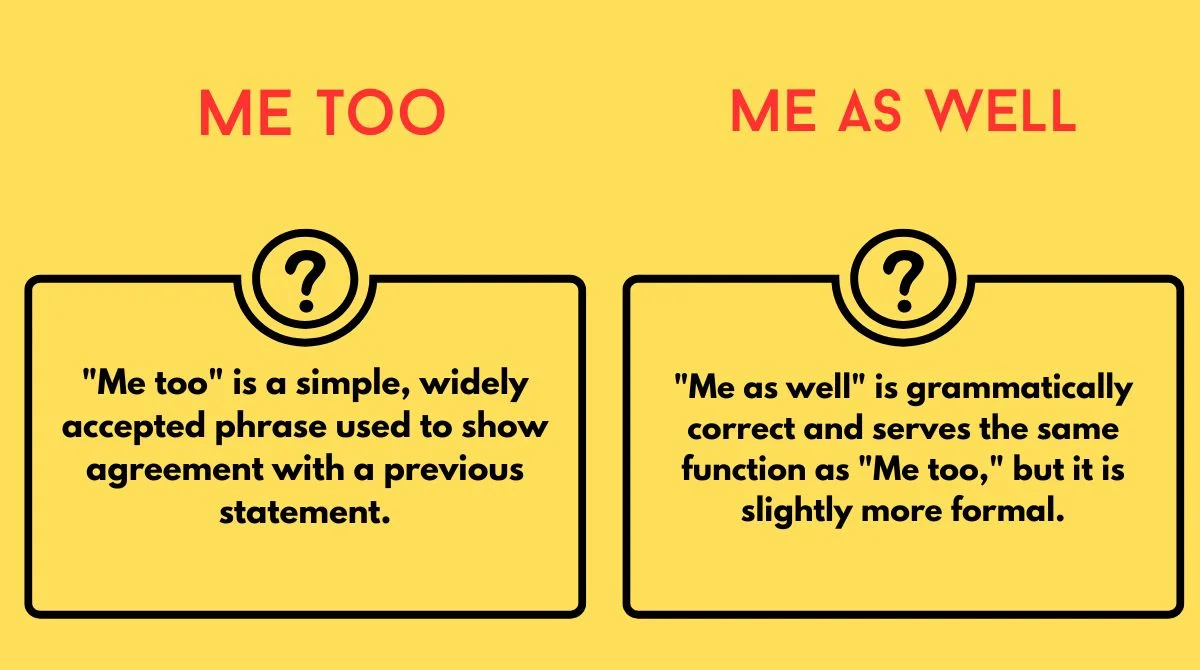
    “Me too” is a simple, widely accepted phrase used to show agreement with a previous statement. It is typically used in casual conversation and works best when responding to affirmative statements.

    • Correct example:
      • A: “I love chocolate.”
      • B: “Me too!” (This means B also loves chocolate.)

    Unlike other agreement expressions, “Me too” can stand alone as a complete response, making it particularly useful in spoken English.

    Examples Demonstrating “Me Too” in Sentences

    Here are some scenarios where “Me too” is the most natural choice:

    • “I enjoy hiking.”“Me too!”
    • “She is going to the concert.”“Me too!”
    • “I have a dog.”“Me too!”

    Informality and Appropriateness of “Me Too” in Various Contexts

    “Me too” is commonly used in informal speech and casual writing. It is rarely found in formal contexts such as academic writing or business emails. In such cases, alternatives like “I also do” or “So do I” are preferred.

    • Informal:
      • “I finished my homework early.”“Me too!”
    • Formal:
      • “I completed my assignment ahead of schedule.”“So did I.”

    When to Use “Me as Well” Over “Me Too”

    “Me as well” is grammatically correct and serves the same function as “Me too,” but it is slightly more formal. While still used in spoken English, it is less common in casual conversation.

    • Correct example:
      • A: “I enjoy reading.”
      • B: “Me as well.” (Equivalent to “Me too,” but slightly more formal.)

    It is often used in situations where a smoother, more neutral tone is preferred.

    • “I am looking forward to the event.”“Me as well.”
    • “She plans to attend the seminar.”“Me as well.”

    Comparison of “Me Too” and “Me as Well”

    ExpressionFormalityCommon Usage
    Me tooInformalEveryday speech, casual conversations
    Me as wellNeutral/FormalMore polished speech, some formal settings

    While both are grammatically correct, “Me too” is more common in everyday English.


    Navigating the Incorrect Usage of “I as Well”

    The Grammatical Inaccuracy of “I as Well”

    Unlike “Me too” and “Me as well,” the phrase “I as well” is not grammatically correct in standard English. The reason is that “I” is a subject pronoun, while “me” is an object pronoun.** The phrase “Me too” works because “me” is the correct pronoun in response to most affirmative statements.

    • Incorrect example:
      • A: “I love traveling.”
      • B: “I as well.” ❌ (Incorrect!)

    Instead, the correct phrase would be:

    • “I do as well.”
    • “So do I.”
    • “Me too.”

    Proper Alternatives to “I as Well” with Examples

    To avoid incorrect usage, try these grammatically correct alternatives:

    Incorrect UsageCorrect Alternative
    “I as well love coffee.”“I love coffee as well.”
    “I as well am excited.”“I am excited as well.”
    “I as well agree.”“I agree as well.”

    Using these alternatives ensures your English sounds natural and grammatically correct.

    Comparison and Popularity: “Me as Well” vs. “I as Well”

    A quick comparison shows why “Me as well” is preferred over “I as well”:

    PhraseCorrect UsageCommon in Spoken English?
    Me as wellCorrectSometimes used, but less than “Me too”
    I as wellIncorrectRarely, if ever, used

    Me Too vs Me as Well vs I as Well

    FAQs

    1. Is “Me too” grammatically correct?

    Yes! “Me too” is a widely accepted phrase for agreement in casual conversations. Example:
    A: “I love coffee.”
    B: “Me too!”

    2. When should I use “Me as well” instead of “Me too”?

    “Me as well” is more formal than “Me too” but has the same meaning. Example:
    A: “She is attending the meeting.”
    B: “Me as well.”

    3. Why is “I as well” incorrect?

    “I as well” is grammatically wrong because “I” is a subject pronoun, not an object pronoun. Use alternatives like “I do as well” or “So do I.”

    4. Can I use “Me too” in formal writing?

    Not usually. In formal contexts, use “So do I,” “I also do,” or “I agree as well” instead.

    5. What’s the difference between “Me too” and “Me as well”?

    • “Me too” → Informal, common in everyday speech
    • “Me as well” → Slightly more formal, less commonly used

    6. What’s a good alternative to “I as well”?

    Instead of “I as well,” say:
    “I as well love reading.” (Incorrect)
    “I love reading as well.” (Correct)


    Conclusion: Choosing the Right Expression for Clarity and Correctness
    Me Too vs Me as Well

    When expressing agreement in English, it is essential to use the correct phrase for the context:

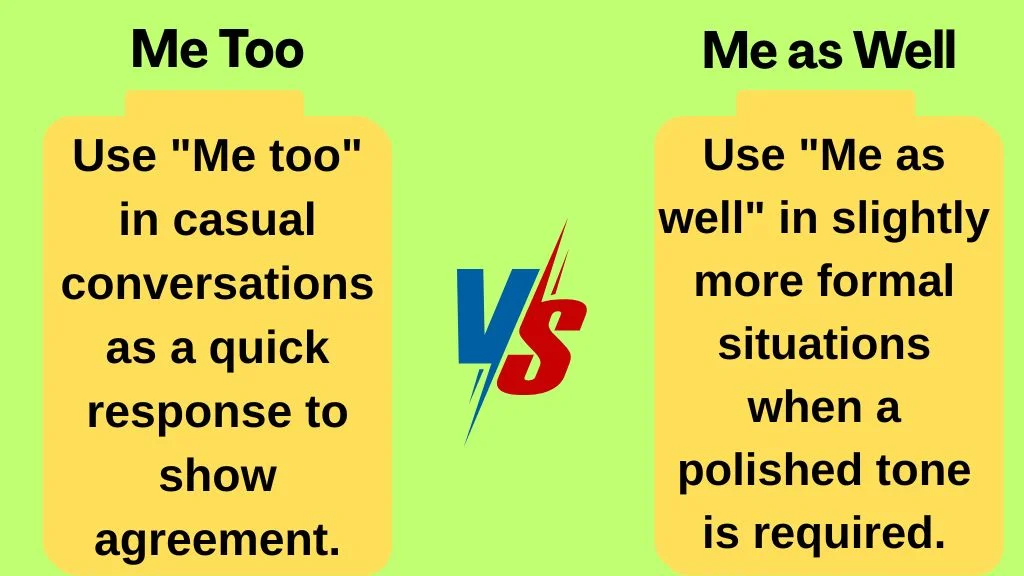
    • Use “Me too” in casual conversations as a quick response to show agreement.
    • Use “Me as well” in slightly more formal situations when a polished tone is required.
    • Avoid “I as well” entirely, and instead use proper alternatives like “I do as well” or “So do I.”

    By understanding these distinctions, you can communicate more naturally and confidently in English. Whether you are speaking casually with friends or writing in a professional setting, using the right expression ensures clarity and correctness.

  • Froze or Frozen? Learn the Right Usage with Examples! ✅❄️

    Froze or Frozen? Learn the Right Usage with Examples! ✅❄️

    Understanding verb conjugations in English can be tricky, especially when it comes to irregular verbs like “freeze.” Many learners struggle with choosing between froze and frozen in sentences.

    In this guide, we’ll break down the correct usage of these terms with clear explanations, examples, and grammatical rules to help you master them once and for all.

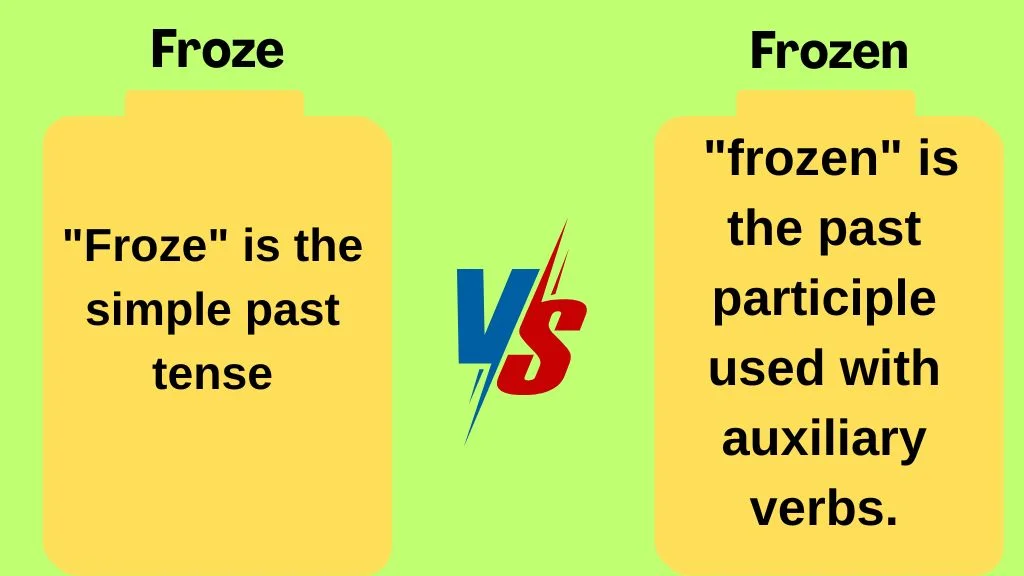
    Confused about “froze” vs. “frozen”? “Froze” is the simple past tense, while “frozen” is the past participle used with auxiliary verbs. Learn the difference with clear examples!


    Froze or Frozen

    Exploring the Verb “Freeze” – Present, Past, and Past Participle

    Before diving into froze and frozen, let’s examine how the verb “freeze” is conjugated in different tenses:

    TenseVerb Form
    Presentfreeze
    Pastfroze
    Past Participlefrozen
    • Freeze is the base form (present tense).
    • Froze is the simple past form.
    • Frozen is the past participle used with auxiliary verbs.

    Understanding this breakdown is crucial for using each form correctly in sentences.


    When to Use “Froze” – Simple Past Tense Illustrated

    Froze is the simple past form of freeze, used when describing an action that happened at a specific time in the past.

    Examples:

    • The lake froze overnight due to the extreme cold.
    • I froze when I heard the unexpected news.
    • She froze in fear during the scary movie.

    A key rule to remember: Froze never needs an auxiliary verb like “has” or “had.”


    The Right Contexts for “Frozen” – Understanding the Past Participle

    Frozen is the past participle form of freeze. It cannot function alone as a verb in a sentence; it requires an auxiliary verb (like “has,” “had,” or “was”).

    Examples:

    • The pond has frozen for the first time this winter.
    • By morning, the pipes had frozen completely.
    • The vegetables were frozen for preservation.

    If the sentence needs “has,” “had,” or “was,” then frozen is the correct choice.


    Using “Frozen” in Perfect Tense Constructions

    The perfect tense uses “frozen” with auxiliary verbs to show completed actions.

    Present Perfect:

    • The river has frozen solid.
    • She has frozen her leftover food.

    Past Perfect:

    • By the time we arrived, the ground had frozen.
    • He had frozen all his assets before the lawsuit.

    Future Perfect:

    • By next winter, the lake will have frozen.
    • They will have frozen all perishable items before leaving.

    Examples of “Frozen” with Auxiliary Verbs

    Auxiliary VerbExample Sentence
    HasThe water has frozen overnight.
    HadThe roads had frozen before sunrise.
    WasThe fish was frozen before shipment.
    Will haveThe lake will have frozen by January.

    This table highlights the key role auxiliary verbs play when using frozen.


    Common Mistakes with “Froze” and “Frozen”

    Learners often confuse these forms. Here are some common mistakes and corrections:

    The lake has froze overnight.
    ✔️ The lake has frozen overnight.

    She had froze all the food before leaving.
    ✔️ She had frozen all the food before leaving.

    The vegetables were froze for storage.
    ✔️ The vegetables were frozen for storage.

    A simple rule to avoid mistakes: If you see an auxiliary verb, use “frozen.” If not, use “froze.”


    Tips to Prevent Tense Misuse

    To avoid errors with “froze” and “frozen”:

    • Remember the auxiliary verb rule – Use “frozen” only with “has,” “had,” or “was.”
    • Think about timing – If the action happened at a specific past time, use “froze.”
    • Practice with sentences – Create your own examples to reinforce proper usage.

    The Grammatical Rules Behind “Freeze” Conjugations

    The verb “freeze” follows an irregular conjugation pattern, meaning it doesn’t follow the standard “-ed” ending rule. Instead, it changes form entirely from “freeze” → “froze” → “frozen.”

    This pattern is common among strong verbs in English, such as:

    • Speak → Spoke → Spoken
    • Drive → Drove → Driven
    • Break → Broke → Broken

    Memorizing these patterns can help solidify correct usage.


    Ablaut Patterns in English Verbs

    The conjugation of “freeze” follows an ablaut pattern, a linguistic process where vowel sounds shift to indicate tense.

    • Base Form: “freeze” (long ee sound)
    • Past Tense: “froze” (long o sound)
    • Past Participle: “frozen” (long o sound with “-en” ending)

    Similar verbs following this pattern include:

    • Choose → Chose → Chosen
    • Write → Wrote → Written

    Recognizing these shifts can make it easier to remember irregular verb forms.


    Practical Tips for Remembering the Past Tense of “Freeze”

    1. Use rhyming verbs – Think of “choose, chose, chosen” when recalling “freeze, froze, frozen.”
    2. Create a mnemonic – “If it’s done, it’s frozen. If it’s past, it’s froze fast.”
    3. Repeat sentences aloud – Speaking phrases like “The lake froze yesterday” and “The lake has frozen today” reinforces correct usage.

    Froze or Frozen

    Frozen in Time – Historical Origins of the Verb “Freeze”

    The word freeze comes from the Old English “frēosan”, which meant “to turn to ice.”

    • It shares roots with Old Norse “frjósa” and Gothic “frius” (meaning “frosty”).
    • The past participle “frozen” developed in Middle English, influenced by Germanic languages.

    Understanding its etymology helps appreciate how language evolves over time.


    FAQs

    1. What is the past tense of “freeze”?

    The past tense of “freeze” is “froze” (e.g., “The lake froze overnight”). The past participle is “frozen” (e.g., “The lake has frozen”).

    2. When should I use “froze” instead of “frozen”?

    Use “froze” when describing a past action without an auxiliary verb (e.g., “She froze in fear”). Use “frozen” with “has,” “had,” or “was” (e.g., “The pipes had frozen”).

    3. Why do people confuse “froze” and “frozen”?

    Many learners mistake “froze” for the past participle or use “frozen” without an auxiliary verb. A key rule: If there’s ‘has’ or ‘had,’ use ‘frozen.’ Otherwise, use ‘froze.’

    4. What are some common mistakes with “froze” and “frozen”?

    • ❌ “The lake has froze.” → ✔️ “The lake has frozen.”
    • ❌ “She had froze the meat.” → ✔️ “She had frozen the meat.”
    • ❌ “The vegetables were froze.” → ✔️ “The vegetables were frozen.”

    5. What are some other verbs that follow this pattern?

    Similar irregular verbs include:

    • Break → Broke → Broken
    • Drive → Drove → Driven
    • Choose → Chose → Chosen

    6. How can I remember the difference between “froze” and “frozen”?

    Try this mnemonic: “If it’s done, it’s frozen. If it’s past, it’s froze fast.” Also, compare it to verbs like “choose, chose, chosen” for better recall.


    Conclusion

    Mastering “froze” and “frozen” comes down to knowing when to use each form correctly:

    • Use froze for simple past actions (“The lake froze last night.”)
    • Use frozen with auxiliary verbs (“The lake has frozen.”)

    By practicing with examples and remembering the key grammar rules, you’ll avoid common mistakes and use these words naturally in conversation and writing. If you found this guide helpful, share it with others who might be struggling with English verb tenses!

  • Shown vs Showed: What’s the Difference? (With Examples) 🤔📚

    Shown vs Showed: What’s the Difference? (With Examples) 🤔📚

    The English language is filled with tricky verb forms, and “show” is no exception.

    Many learners (and even native speakers) often find themselves questioning whether to use “shown” or “showed.” Understanding the difference between these two forms is essential for proper grammar and clear communication.

    This guide will break down their meanings, usage, and provide practical examples to help you master the distinction.

    Confused about “shown” vs. “showed”? “Showed” is the simple past tense, while “shown” is the past participle used with helping verbs like “has” or “had.” Learn the key differences, grammar rules, and examples to perfect your English!

    The Basics of “Show”: Unraveling the Irregular Verb

    Before diving into “showed” and “shown,” it’s important to understand that “show” is an irregular verb. Unlike regular verbs that follow predictable patterns, irregular verbs have unique conjugations that must be memorized.

    Base FormPast TensePast Participle
    ShowShowedShown

    Since “show” is irregular, it does not follow the typical -ed rule for past participles, which leads to confusion between “showed” and “shown.”


    When to Use “Showed”: Diving Into Past Tense

    “Showed” is the simple past tense of “show.” It is used when referring to a completed action that happened in the past.

    Examples:

    • She showed me her new dress yesterday.
    • The teacher showed the students how to solve the equation.
    • He showed no interest in the conversation.

    The key takeaway: Use “showed” when describing an event that took place in the past without needing a helping verb (e.g., “has,” “have,” or “had”).


    Identifying the Past Tense in Action

    To determine whether “showed” is correct in a sentence, look at the time reference:

    • If the action happened at a specific time in the past, use “showed.”
    • If the action is connected to the present or another past event, consider using “shown.”
    Shown vs Showed

    Incorrect vs. Correct Usage:

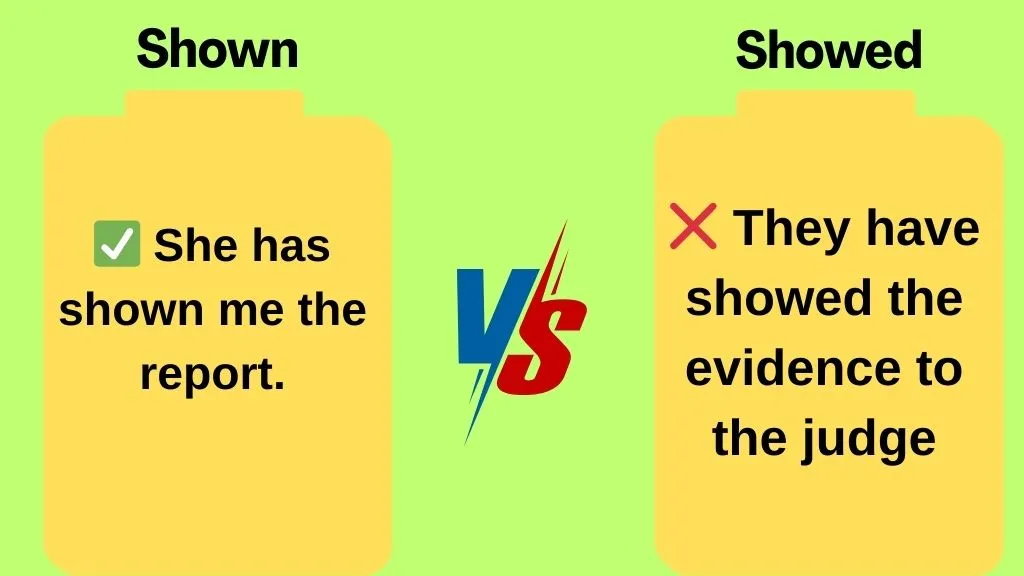
    ❌ She has showed me the report.
    ✅ She has shown me the report.

    ❌ They have showed the evidence to the judge.
    ✅ They have shown the evidence to the judge.


    Common Mistakes and How to Avoid Them

    A common mistake is using “showed” when a past participle is needed. This often happens when forming the present perfect, past perfect, or future perfect tenses, which require a helping verb (e.g., “has,” “have,” or “had”).

    To avoid this mistake, remember:

    • Showed = simple past (no helping verb needed)
    • Shown = past participle (needs a helping verb)

    “Shown”: Breaking Down the Past Participle Form

    “Shown” is the past participle of “show” and is always used with a helping verb. It appears in:

    • Present perfect: She has shown great progress.
    • Past perfect: They had shown their tickets at the gate.
    • Future perfect: By tomorrow, he will have shown the results.

    Comparing “Showed” and “Shown” in Sentences

    Let’s see both words in context:

    Sentence with “Showed”Sentence with “Shown”
    He showed me his artwork.He has shown me his artwork before.
    The manager showed us the new office.The manager had shown us the new office earlier.
    She showed great enthusiasm.She has shown great enthusiasm in her work.

    Tip: If you’re using “has,” “have,” or “had,” “shown” is almost always the correct choice!


    Dissecting Sentence Structure With “Showed”

    When using “showed,” the sentence structure follows:

    • Subject + verb + object
    • Example: The guide showed us the museum.

    With “shown,” the structure often includes a helping verb:

    • Subject + helping verb + past participle + object
    • Example: The guide has shown us the museum.

    Examples of “Shown” in Complex Tenses

    “Shown” appears in various perfect tenses:

    • Present Perfect: She has shown great leadership skills.
    • Past Perfect: The report had shown a rise in sales.
    • Future Perfect: By next week, they will have shown all the new features.

    Active vs. Passive Voice: Choosing “Shown” or “Showed”

    The choice between “showed” and “shown” can also depend on whether a sentence is active or passive.

    VoiceExample
    Active (uses “showed”)The professor showed us a new technique.
    Passive (uses “shown”)A new technique was shown to us by the professor.

    If the focus is on the doer of the action, use “showed.” If the focus is on the recipient of the action, use “shown.”


    Language Nuances: Understanding When “Showed” Can Be Used as a Past Participle

    Although rare, some dialects and older English texts use “showed” as a past participle. However, in modern Standard English, “shown” is preferred in perfect tenses.

    Example:

    • Older usage: He has showed great skill. ❌
    • Modern usage: He has shown great skill. ✅

    Enhancing Your Grammar: Tips for Remembering the Difference

    1. Memorize the rule: “Showed” is the past tense, “shown” is the past participle.
    2. Look for helping verbs: If “has,” “have,” or “had” is present, use “shown.”
    3. Test the sentence aloud: Does “has showed” sound awkward? If so, “shown” is likely correct.
    4. Practice with examples: Create sentences using both forms to reinforce learning.

    Shown vs Showed

    FAQs

    1. What is the difference between “shown” and “showed”?

    “Showed” is the simple past tense of “show” (e.g., “She showed me the book”), while “shown” is the past participle, used with “has,” “have,” or “had” (e.g., “She has shown me the book”).

    2. Can “shown” be used without a helping verb?

    No, “shown” always requires a helping verb like has, have, or had (e.g., “They have shown great skill”). Without a helping verb, use “showed” instead.

    3. Is “has showed” ever correct?

    No, the correct phrase is “has shown.” “Showed” is only used in simple past tense, not with perfect tenses.

    4. How can I tell if I should use “shown” or “showed”?

    Check for a helping verb: If “has,” “have,” or “had” is present, use “shown.” If not, “showed” is likely correct.

    5. Is “showed” ever used as a past participle?

    In some old English texts or dialects, “showed” was occasionally used as a past participle, but in modern English, “shown” is preferred in perfect tenses.

    6. What is an example of “shown” in passive voice?

    Active: “The teacher showed us the answer.”
    Passive: “The answer was shown to us by the teacher.”


    Conclusion

    Understanding the difference between “shown” and “showed” is crucial for proper grammar. Remember:

    • Use showed for simple past tense.
    • Use shown with “has,” “have,” or “had.”
    • In passive voice, “shown” is typically the correct choice.

    By keeping these guidelines in mind, you’ll confidently use “shown” and “showed” in any context. Keep practicing, and soon, these distinctions will become second nature!

  • Become vs Became: What’s the Difference? (With Examples) 🤔📚

    Become vs Became: What’s the Difference? (With Examples) 🤔📚

    Understanding verb tenses in English can be tricky, especially with words that seem similar but function differently.

    Become and became often cause confusion because they both refer to change or transformation, but they are used in different tenses.

    This guide will break down their meanings, uses, and common mistakes so you can use them confidently in your writing and speech.

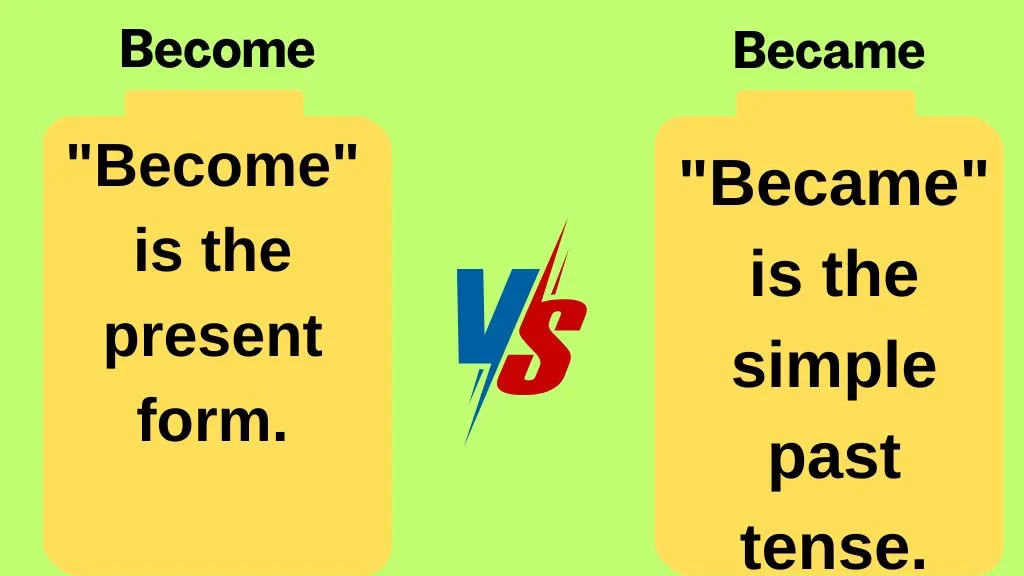
    Confused about become vs. became? “Become” is the present form, while “became” is the simple past tense. Learn when to use each, plus grammar rules and examples to master these tricky verb forms!


    Understanding the Basics: Present and Past Tense

    Become vs Became

    In English grammar, verbs change form based on tense. The verb become is an irregular verb, meaning it does not follow the standard pattern of adding -ed to form the past tense. Instead, its conjugation is:

    TenseVerb Form
    PresentBecome
    PastBecame
    Past ParticipleBecome
    • Become is the present tense form.
    • Became is the simple past tense form.
    • Become is also used as the past participle (e.g., has become, have become).

    Defining “Become” and “Became”

    What Does It Mean to “Become” Something?

    The verb become means to start to be something or undergo a change. It refers to an ongoing transformation or the start of a process.

    Examples:

    • She becomes more confident every day. (Present tense – happening now)
    • Over time, he will become a great leader. (Future tense – will happen in the future)

    The Transformation Indicated by “Became”

    The word became is the past tense of become. It indicates that the transformation has already happened.

    Examples:

    • He became a doctor after years of studying. (Past event – already completed)
    • The weather became colder last night. (Past action – already happened)

    Practical Usage of “Become” in Sentences

    Since become is used in the present tense, it applies to situations where something is changing now or in the future.

    Correct Examples:

    • She becomes happier when she listens to music.
    • If you study hard, you will become successful.
    • This city is rapidly becoming a tech hub.

    Incorrect Example:

    ❌ She become tired after the long day. (Incorrect because the past tense should be “became”)


    How “Became” Fits into Past Narratives

    Since became is the past tense, it is used when describing events that have already happened.

    Correct Examples:

    • He became famous after his first book was published.
    • The sky became dark before the storm.
    • They became friends after meeting at a conference.

    Incorrect Example:

    ❌ She becomes nervous before her speech yesterday. (Incorrect because “becomes” is present tense, but “yesterday” indicates past tense)


    Distinguishing “Become” from “Becomes” in Context

    While become is the base form, becomes is its third-person singular present tense form, used with he, she, it.

    Examples:

    • He becomes frustrated when people interrupt him.
    • The weather becomes colder in December.

    Become is used with plural subjects or in future tense:

    • They become tired after work.
    • If you practice, you will become better.

    Exploring Present Perfect Tense: “Has Become” and “Have Become”

    The present perfect tense describes actions that started in the past and continue into the present. It is formed with has/have + become (not became).

    SubjectPresent Perfect Form
    He/She/ItHas become
    I/You/We/TheyHave become

    Examples:

    • She has become more confident over the years.
    • They have become good friends.

    When to Use “Have Become” in Present Perfect Tense

    Use have become with plural subjects (I, you, we, they) to describe a gradual transformation.

    Examples:

    • We have become better at teamwork.
    • You have become a skilled musician.

    Why “Has Became” Is Grammatically Incorrect

    One common mistake is using has became instead of has become. The word became is a past tense verb and cannot be used with has or have.

    ❌ He has became stronger. (Incorrect)
    ✅ He has become stronger. (Correct)

    Remember: has/have + past participle (become), never became.


    The Subtleties of “Would Become” and Frequency

    Would become is used for hypothetical situations, future possibilities, or repeated past actions.

    Examples:

    • If she had studied more, she would become a doctor. (Hypothetical past event)
    • Over time, he would become a mentor to many students. (Repeated past action)

    Use would become when discussing repeated actions in the past or hypothetical situations.


    Become vs Became

    FAQs

    1. What is the difference between “become” and “became”?

    “Become” is the present tense and refers to an ongoing or future transformation (e.g., “She will become a doctor”). “Became” is the past tense and describes changes that have already happened (e.g., “She became a doctor last year”).

    2. Can “became” be used in present perfect tense?

    No, “became” is only for simple past tense. In present perfect tense, use “has become” or “have become” (e.g., “She has become more confident”).

    3. Is “has became” grammatically correct?

    No, the correct phrase is “has become.” “Became” is the past tense and cannot be used with “has” or “have.”

    4. When should I use “becomes” instead of “become”?

    “Becomes” is the third-person singular present tense (e.g., “He becomes happy when he listens to music”). “Become” is used for plural subjects or in future tense (e.g., “They become friends quickly”).

    5. How can I remember when to use “became”?

    Use became when describing a completed past event. If you’re talking about something happening now or in the future, use become.

    6. What is an example of “would become” in a sentence?

    “Would become” is used for hypothetical or past habitual actions:

    • “If she had studied more, she would become a scientist.”
    • “Over time, he would become a respected leader.”

    Conclusion

    Understanding the difference between become and became is essential for using them correctly in speech and writing:

    • Use “become” for present and future actions.
    • Use “became” for past actions.
    • Use “has/have become” for present perfect tense.
    • Avoid using “has became”—it is incorrect.

    By mastering these distinctions, you’ll avoid common grammar mistakes and express transformations clearly and accurately!

  • Incoming vs Upcoming vs Oncoming: What’s the Difference? 🤔📚

    Incoming vs Upcoming vs Oncoming: What’s the Difference? 🤔📚

    Language can sometimes be tricky, especially when words appear similar but have distinct meanings.

    Incoming, upcoming, and oncoming are three such words that often confuse English learners. While they all relate to things approaching or moving towards a certain point, their meanings and contexts differ significantly.

    In this guide, we’ll break down their definitions, typical uses, and key distinctions to ensure you use them correctly in everyday conversations and writing.

    Confused about incoming, upcoming, and oncoming? These words all relate to things approaching, but they have distinct meanings! Learn their differences, proper usage, and common mistakes to improve your English.


    Understanding “Incoming”: A Matter of Arrival

    The word incoming primarily refers to something that is arriving or about to arrive. It often describes messages, calls, shipments, or people moving toward a specific destination.

    Common Uses of “Incoming”:

    • Messages and Communication: “I have an incoming call from my manager.”
    • Physical Movement: “The incoming train will arrive in five minutes.”
    • Military or Defense Situations: “The soldiers took cover due to incoming fire.”

    Key Takeaway:

    Incoming emphasizes something that is actively in the process of arriving, whether it’s a phone call, email, or physical object.


    Diving into “Upcoming”: Events on The Horizon

    Upcoming is used to refer to events, occasions, or situations that are scheduled to happen in the future. It suggests that something is planned but has not yet occurred.

    Common Uses of “Upcoming”:

    • Events and Appointments: “I have an upcoming meeting with my supervisor.”
    • Entertainment and Releases: “The upcoming movie has generated a lot of excitement.”
    • Deadlines and Due Dates: “Don’t forget about the upcoming exam.”

    Key Takeaway:

    Upcoming refers to future occurrences that are scheduled, anticipated, or expected.


    Typical Uses of “Upcoming” in Daily Language

    Because upcoming is closely tied to time, you’ll frequently see it in event announcements, schedules, and conversations about plans. Here are some example sentences:

    • “We should start preparing for the upcoming holiday season.”
    • “The upcoming election will determine the country’s future direction.”
    • “The upcoming weather forecast suggests rain, so bring an umbrella.”

    This word is common in both formal and informal contexts, making it a staple in event planning and personal schedules.


    Anticipating “Upcoming” Moments: A Closer Look

    Understanding the nuances of upcoming can help in planning and organization. When using the word:

    • Be specific about what is upcoming: e.g., “My upcoming flight is at 10 AM.”
    • Use it when referring to the near future: e.g., “In the upcoming weeks, we will see major changes.”
    • Avoid using it for distant future events: e.g., “The upcoming Olympics in 2050” sounds unnatural.

    By keeping these guidelines in mind, you’ll always use upcoming correctly.


    “Oncoming”: When Things Move Towards You

    Unlike incoming and upcoming, oncoming specifically refers to movement in a direction toward the speaker or a particular point. It is frequently used to describe traffic, dangers, or physical motion.

    Common Uses of “Oncoming”:

    • Traffic and Vehicles: “Be careful of the oncoming cars when crossing the street.”
    • Impending Dangers or Threats: “She braced herself for the oncoming storm.”
    • Physical Confrontations: “The knight prepared to fight the oncoming enemy.”

    Key Takeaway:

    Oncoming refers to things moving toward a specific position, often in an observable, physical sense.


    Comparing “Incoming”, “Upcoming”, and “Oncoming”

    Upcoming vs Oncoming
    WordMeaningExample Usage
    IncomingArriving soon“I received an incoming call.”
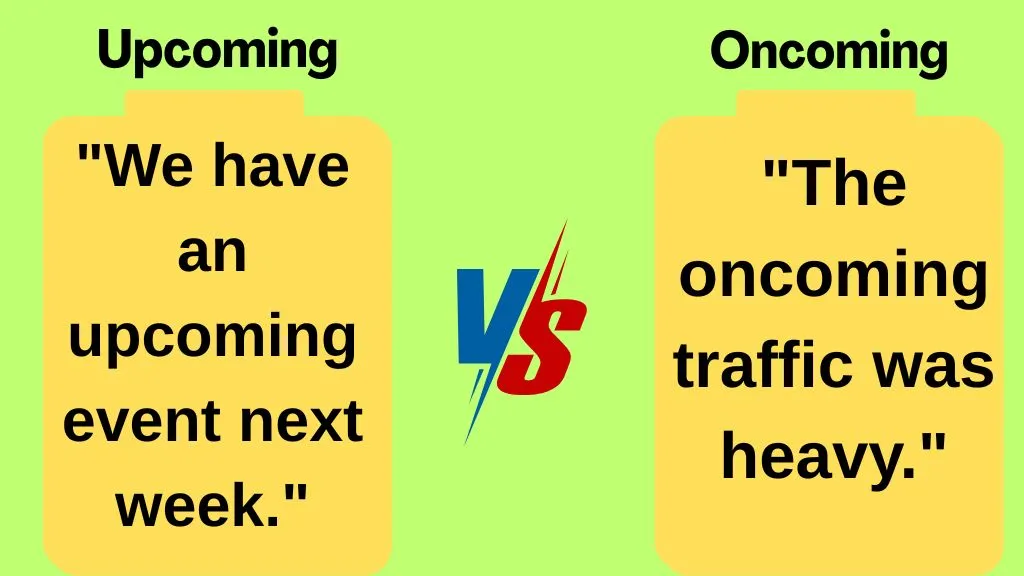
    UpcomingScheduled to happen in the future“We have an upcoming event next week.”
    OncomingMoving towards a specific point“The oncoming traffic was heavy.”

    Each word has a specific use case, making it essential to choose the right one based on the context.


    The Significance of Context in Using “Incoming”, “Upcoming”, “Oncoming”

    To reinforce understanding, consider these contextual differences:

    • If something is arriving soon, use incoming. Example: “I dodged the incoming ball.”
    • If an event is set for the future, use upcoming. Example: “She is excited about the upcoming concert.”
    • If something is physically moving toward a place or person, use oncoming. Example: “The oncoming truck swerved to avoid a collision.”

    Mastering these distinctions ensures clarity in speech and writing.


    Examples from Everyday Conversations

    Here are real-life examples demonstrating correct usage:

    1. Incoming:
      • “Check your inbox for the incoming email.”
      • “There’s an incoming storm; let’s stay inside.”
    2. Upcoming:
      • “I’m preparing for my upcoming vacation.”
      • “Are you free for the upcoming webinar?”
    3. Oncoming:
      • “He stepped out of the way of the oncoming bus.”
      • “The oncoming waves crashed against the shore.”

    These examples illustrate how context dictates the appropriate word choice.


    Mistakes to Avoid: Common Misuses of the Terms

    Mistakes often arise when these words are used interchangeably. Below are some common errors and their corrections:

    • Incorrect: “I have an oncoming exam next week.”
      • Correct: “I have an upcoming exam next week.”
    • Incorrect: “Beware of upcoming traffic.”
      • Correct: “Beware of oncoming traffic.”
    • Incorrect: “She is waiting for an oncoming message.”
      • Correct: “She is waiting for an incoming message.”

    By paying attention to these subtle differences, you can avoid errors and improve communication.


    Enhancing Your Vocabulary: Tips for Remembering the Differences

    Here are some memory aids to help:

    • Incoming = Arriving (Think of an incoming call on your phone)
    • Upcoming = Future event (Think of an upcoming birthday)
    • Oncoming = Moving towards (Think of oncoming traffic)

    Reinforcing these associations will make it easier to recall the right term.


    FAQs

    1. What is the difference between “incoming” and “upcoming”?

    “Incoming” refers to something that is actively arriving (e.g., “Incoming call”). “Upcoming” refers to an event that is scheduled to happen in the near future (e.g., “Upcoming meeting”).

    2. When should I use “oncoming” instead of “incoming”?

    Use oncoming for things physically moving toward a person or place (e.g., “Oncoming traffic”). Incoming is used for things that are arriving soon (e.g., “Incoming email”).

    3. Can “upcoming” be used for things that are already happening?

    No, upcoming is only used for future events. If something is happening now, use present-tense words like ongoing instead.

    4. Why is “oncoming event” incorrect?

    “Oncoming” refers to movement toward a location, not time-based events. Instead, use “upcoming event” for future occurrences.

    5. Is “incoming message” the same as “oncoming message”?

    No, incoming message is correct because incoming refers to something arriving, like emails or texts. Oncoming is not used for messages.

    6. How can I easily remember the difference between these words?

    • Incoming = Arriving soon (incoming call, incoming email)
    • Upcoming = Scheduled for the future (upcoming holiday, upcoming exam)
    • Oncoming = Moving toward you (oncoming traffic, oncoming storm)

    Incoming vs Upcoming vs Oncoming

    Conclusion

    While incoming, upcoming, and oncoming share similarities, their meanings and applications are distinct. Using them correctly will enhance clarity in both written and spoken English.

    The key to mastering these words lies in understanding their nuances and applying them in the right contexts. Keep practicing, and soon, choosing between them will become second nature!


    Did you find this guide helpful? Let us know in the comments below or share it with someone who might benefit from it!

  • Quaff or Coif? Homophones Explained! 🗣️📚

    Quaff or Coif? Homophones Explained! 🗣️📚

    Language can be tricky, especially when it comes to homophones—words that sound alike but have different meanings and spellings.

    Quaff and coif are perfect examples of this. Though they may sound similar, they have distinct definitions and uses.

    This guide will help you understand their meanings, origins, and correct usage.

    Confused between quaff and coif? These homophones sound alike but have completely different meanings! Learn the definitions, origins, and correct usage of each to avoid mix-ups in writing and speech.


    Understanding Homophones: What Are They?

    Definition of Homophones

    Homophones are words that have the same pronunciation but differ in meaning, spelling, or both. This linguistic phenomenon often causes confusion in writing and speech.

    Why Homophones Can Be Confusing

    Many homophones, including quaff and coif, are challenging because they:

    • Sound identical or very similar.
    • Have meanings that don’t relate to one another.
    • Often get autocorrected incorrectly in digital communication.

    Examples of Common Homophones

    To better understand homophones, here are a few common examples:

    HomophonesMeaning 1Meaning 2
    Their / There / They’rePossessive formPlace
    Flour / FlowerBaking ingredientA plant bloom
    Two / To / TooNumber 2Preposition
    Quaff / CoifTo drink deeplyA hairstyle or head covering

    What Does Quaff Mean?

    Quaff as a Verb

    The most common use of quaff is as a verb. It means to drink deeply, often with enjoyment or enthusiasm.

    Example: “After a long hike, he quaffed a refreshing glass of water.”

    Quaff as a Noun

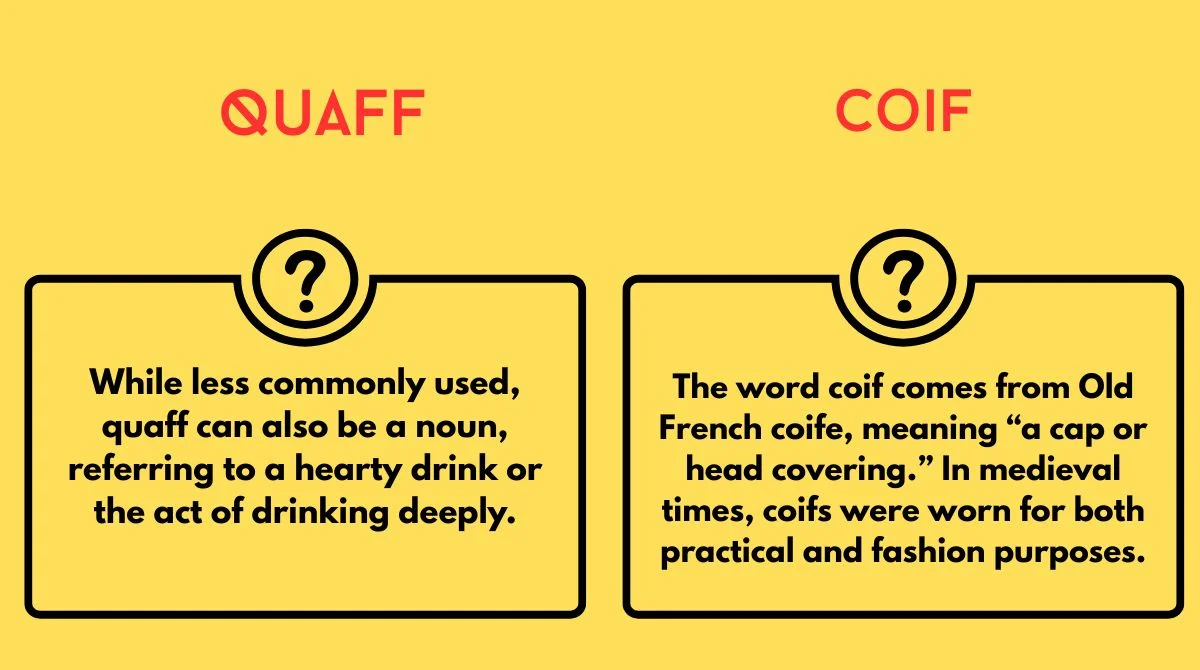
    While less commonly used, quaff can also be a noun, referring to a hearty drink or the act of drinking deeply.

    Example: “He took a final quaff before setting the mug down.”

    Origin of the Word Quaff

    The word quaff dates back to the 16th century, though its precise origins are uncertain. Some linguists suggest it may be imitative in nature, mimicking the sound of gulping down a drink.


    Quaff or Coif

    What Does Coif Mean?

    Coif as a Noun

    Coif can be a noun referring to:

    • A hairstyle, particularly one that is neatly arranged.
      • Example: “Her coif was styled elegantly for the gala.”
    • A close-fitting cap or head covering, historically worn under helmets or by nuns.
      • Example: “The knight wore a coif beneath his armor.”

    Coif as a Verb

    As a verb, coif means to style or arrange hair carefully.

    Example: “She spent an hour coifing her hair before the event.”

    Historical Context of Coif

    The word coif comes from Old French coife, meaning “a cap or head covering.” In medieval times, coifs were worn for both practical and fashion purposes. Over time, the meaning evolved to include hairstyling.


    Quaff vs Coif: Detailed Comparison

    Quaff or Coif

    Though these words sound similar, their meanings and usage are completely different. Let’s compare them side by side:

    FeatureQuaffCoif
    Part of SpeechVerb, NounNoun, Verb
    MeaningTo drink deeplyA hairstyle or head covering / To style hair
    Example Sentence“He quaffed a pint of ale.”“Her coif was impeccably styled.”
    Historical Origin16th century, uncertain originOld French coife

    Example Sentences Using Quaff

    Quaff in Everyday Use

    • “She quaffed a large glass of lemonade after her workout.”
    • “The festival-goers quaffed their drinks with joy.”

    Quaff in Historical Texts

    • “The soldiers quaffed wine to celebrate their victory.”
    • “He quaffed mead as was custom in olden days.”

    Example Sentences Using Coif

    Coif in Modern Language

    • “The bride’s coif was styled by a professional.”
    • “The actor’s coif was admired on the red carpet.”

    Coif in Historical Context

    • “In medieval Europe, men wore a coif under their helmets.”
    • “The nun’s coif signified her devotion.”

    Common Mistakes: Interchanging Quaff and Coif

    Many people mistakenly use quaff when they mean coif, or vice versa, simply due to their similar sounds. Here’s how to avoid this mistake:

    • If it relates to drinking, use quaff.
    • If it involves hair or head coverings, use coif.

    Incorrect Example: “He coifed his beer in one gulp.” (Should be “quaffed”) Correct Example: “He quaffed his beer in one gulp.”

    Incorrect Example: “She quaffed her hair for the party.” (Should be “coifed”) Correct Example: “She coifed her hair for the party.”


    Quaff or Coif

    FAQs

    1. What does “quaff” mean?

    Quaff means to drink deeply and enthusiastically, often referring to beverages like water, ale, or wine. Example: “He quaffed a pint of beer after work.”

    2. What does “coif” mean?

    Coif refers to a hairstyle or a head covering. As a verb, it means to style hair neatly. Example: “Her coif was styled beautifully for the party.”

    3. Are “quaff” and “coif” pronounced the same way?

    Yes, quaff and coif are pronounced similarly in many dialects, making them homophones, which can cause confusion in writing.

    4. How can I remember the difference between “quaff” and “coif”?

    • Quaff → Think of drinking quickly (like gulping a drink).
    • Coif → Think of a coiffure (a fancy hairstyle).

    5. Can “coif” be used as a verb?

    Yes! Coif as a verb means to carefully style or arrange hair. Example: “She coifed her hair for the special event.”

    6. What are some common mistakes with “quaff” and “coif”?

    People often mix them up in writing. Example:
    🚫 Incorrect: “He coifed his beer in one gulp.”
    ✅ Correct: “He quaffed his beer in one gulp.”


    Conclusion

    Though quaff and coif sound alike, their meanings couldn’t be more different. One involves drinking deeply, while the other relates to hairstyling or head coverings.

    By understanding their definitions, origins, and usage, you can confidently use these words correctly in speech and writing.

    Next time you raise a glass, you’ll know you’re quaffing. And when you get a fancy new haircut, you’ll recognize it as a well-styled coif!

  • Did You Had or Did You Have? Grammar Explained! 📝✅

    Did You Had or Did You Have? Grammar Explained! 📝✅

    English grammar can sometimes feel like a puzzle, especially when it comes to forming past tense questions. One common source of confusion is whether to say “Did you have” or “Did you had.”

    If you’ve ever found yourself second-guessing which is correct, this guide will provide a clear and comprehensive explanation.

    Should you say Did you have or Did you had? Understanding past tense questions can be tricky, but there’s a simple rule to follow! Learn why “Did you had” is incorrect and how to use “Did you have” properly.


    Understanding the Basics of Auxiliary Verbs and Past Tense

    Did You Have or Did You Had

    Before we dive into the specifics of “Did you have” vs. “Did you had,” it’s essential to understand how auxiliary verbs work in the past tense. In English, auxiliary verbs (also called helping verbs) are used to form different tenses, questions, and negatives.

    The auxiliary verb do (which changes to did in the past tense) plays a crucial role in forming questions. When did is used, it signals that the sentence is in the past tense, meaning the main verb should remain in its base form. This rule helps maintain consistency in tense structure.

    Auxiliary VerbBase Form of the Main VerbExample Sentence
    Do (present)HaveDo you have a pen?
    Did (past)HaveDid you have fun yesterday?

    The Role of “Did” in Forming Questions

    In past tense questions, “Did” serves as the past tense marker. Since it already indicates that the action happened in the past, the main verb that follows must stay in its base form (infinitive without “to”).

    Example Sentences:

    • Correct: “Did you have a good time at the party?”
    • Incorrect: “Did you had a good time at the party?”

    The reason “Did you had” is incorrect is that had is the past tense form of have. Since “Did” already conveys the past tense, adding “had” would create a tense redundancy.


    Why “Had” Doesn’t Follow “Did”

    To put it simply, a sentence should not contain two past tense markers together in this structure. The word did already indicates that the question is in the past tense, so using had (which is also past tense) would be grammatically incorrect.

    More Examples:

    IncorrectCorrect
    Did you had breakfast?Did you have breakfast?
    Did she had a pet as a child?Did she have a pet as a child?

    The correct form keeps “Did” as the past tense marker and retains “have” in its base form.


    Common Mistakes with “Did You Have” and How to Avoid Them

    Many English learners make mistakes when forming past tense questions. Here are some common errors and how to correct them:

    1. Using “Did” and “Had” Together

    Wrong: “Did you had dinner?” Right: “Did you have dinner?”

    2. Forgetting to Use “Did” in a Question

    Wrong: “You had a nice trip?” Right: “Did you have a nice trip?”

    3. Using “Had” Instead of “Have” in Negative Sentences

    Wrong: “I didn’t had time.” Right: “I didn’t have time.”

    To avoid these mistakes, remember that whenever you use did, the main verb must stay in its base form.


    “Did You Have” Versus “Have You Had”: Decoding the Difference

    Did You Have or Did You Had

    Another area of confusion is the difference between “Did you have” and “Have you had”. While they may look similar, they serve different grammatical functions.

    Key Differences:

    PhraseTenseUsage Example
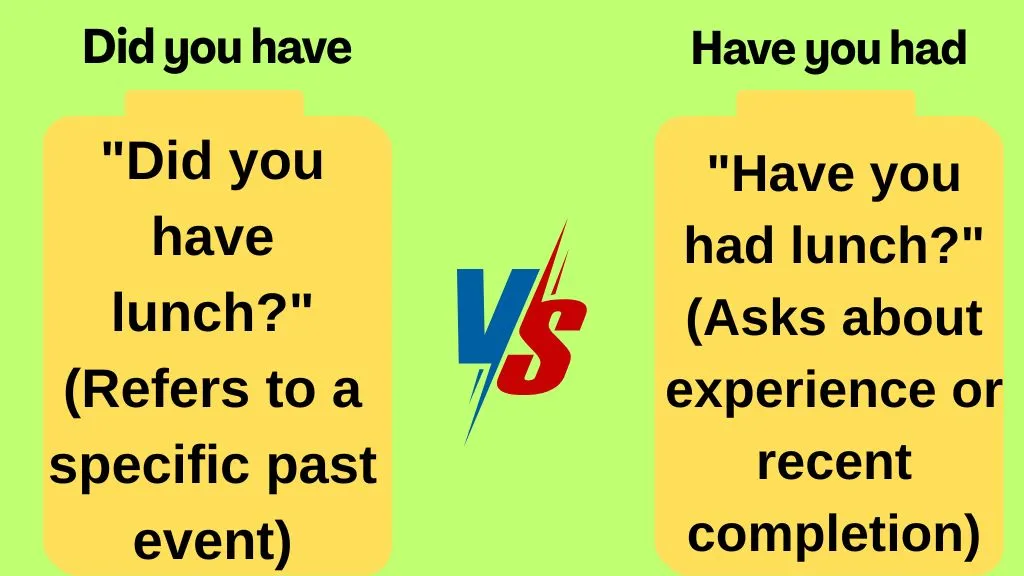
    Did you haveSimple past“Did you have lunch?” (Refers to a specific past event)
    Have you hadPresent perfect“Have you had lunch?” (Asks about experience or recent completion)

    Use “Did you have” when asking about a specific moment in the past. Use “Have you had” when asking whether something has happened at any point up to now.


    Correct Use in Everyday Situations

    Asking About Past Events

    When inquiring about past actions, always use “Did you have”:

    • Did you have fun at the concert last night?
    • Did you have a good vacation?

    Inquiring About Past Possessions or Experiences

    When asking about past possessions or experiences, “Did you have” is also correct:

    • Did you have a dog when you were younger?
    • Did you have a bicycle as a child?

    Strengthen Your Grammar: Practice Examples and Tips

    Practice Sentences:

    Fill in the blanks with “Did you have” or “Have you had”:

    1. ___ a chance to visit Paris before?
    2. ___ time to complete your homework last night?
    3. ___ any experience working in a restaurant?
    4. ___ breakfast this morning?

    Quick Tips to Remember:

    ✔ Always use “Did you have” for past events.
    ✔ Never say “Did you had.”
    ✔ Use “Have you had” for asking about past experiences or recent actions.


    FAQs

    1. Why is “Did you had” incorrect?

    “Did” is already in the past tense, so the main verb must stay in its base form. Saying “Did you had” adds an unnecessary past tense marker. The correct form is “Did you have?”

    2. When should I use “Did you have”?

    Use “Did you have” when asking about a specific past event. Example: “Did you have a good time yesterday?”

    3. What’s the difference between “Did you have” and “Have you had”?

    “Did you have” refers to a specific event in the past, while “Have you had” is used for experiences or something that happened recently.

    4. How do I form negative sentences with “Did you have”?

    For negatives, use didn’t and keep have in its base form: “I didn’t have time,” not “I didn’t had time.”

    5. Can “Did you have” be used in formal writing?

    Yes! “Did you have” is grammatically correct and can be used in both formal and informal English.

    6. How can I practice using “Did you have” correctly?

    Try writing sentences using “Did you have” for past events. Example: “Did you have breakfast this morning?” Avoid using “Did you had.”


    Conclusion

    The difference between “Did you have” and “Did you had” is simple once you understand the rules of auxiliary verbs and past tense questions. Remember:

    • “Did” already marks the past, so the main verb should remain in its base form (have).
    • “Did you had” is always incorrect.
    • “Did you have” is used for specific past events, while “Have you had” refers to past experiences.

    By practicing these structures, you’ll improve your fluency and confidence in English. Keep learning and applying these rules, and soon, using correct grammar will become second nature!

  • Felt or Feel ? Learn the Right Usage! ✅✨

    Felt or Feel ? Learn the Right Usage! ✅✨

    Language can be tricky, especially when two words seem closely related yet serve different purposes.

    Feel and felt are two such words that often cause confusion. Though they share the same root, they operate in different grammatical contexts.

    Understanding when to use feel versus felt is key to clear and effective communication. Let’s break it down in detail.

    Should you say feel or felt? The difference lies in verb tense—feel is present, while felt is past. Learn when to use each correctly with examples and grammar tips!


    Unveiling the Verbs: Understanding ‘Feel’ and ‘Felt’

    Feel or Felt

    At their core, feel and felt both relate to sensory perception, emotions, and states of being. However, they differ in terms of verb tense and application.

    • Feel is the present tense form of the verb.
    • Felt is the past tense and past participle form of the verb.

    By keeping this fundamental difference in mind, you can ensure you’re using the correct word for the appropriate time frame.


    Usage in Context: When to Use ‘Feel’ for Present Experiences

    We use feel when describing:

    • Current emotions or sensations
    • General truths
    • Ongoing states

    Examples of ‘Feel’ in Sentences

    ContextSentence Example
    Physical sensation“I feel cold in this air-conditioned room.”
    Emotional state“I feel happy when I listen to music.”
    Opinion or impression“I feel that this book is too long.”
    State of being“I feel tired after working all day.”

    By using feel, you indicate that the experience or emotion is happening right now or applies generally.


    Conveying Current Sensations and Emotions

    The verb feel is commonly used to describe:

    • Sensory perceptions (I feel the soft fabric.)
    • Emotional states (I feel excited about my vacation.)
    • Physical conditions (I feel dizzy after spinning in circles.)

    Because feel connects directly to personal experience, it plays a crucial role in expressing how we relate to the world around us.


    Exploring Idiomatic Expressions with ‘Feel’

    The word feel appears in numerous idiomatic expressions that enhance everyday speech. Here are some popular ones:

    • “Feel under the weather” – To feel sick or unwell.
    • “Feel out of place” – To feel uncomfortable in a situation.
    • “Feel the pinch” – To experience financial difficulty.
    • “Feel free” – To give permission or encouragement (Feel free to ask questions).

    These expressions show how feel extends beyond literal meanings into figurative speech.


    The Past Tense Puzzle: Knowing When ‘Felt’ Fits

    Now that we understand feel, let’s dive into felt.

    Felt is the past tense form of feel and is used when describing something that happened before the present moment.

    Examples of ‘Felt’ in Sentences

    ContextSentence Example
    Past physical sensation“I felt a sharp pain in my leg yesterday.”
    Past emotional state“She felt nervous before the exam.”
    Past opinion or impression“I felt that he was being rude at dinner.”
    Past experience“We felt relieved when we heard the good news.”

    Because felt refers to past events, it establishes a clear time frame that is different from feel.


    Grammar Deep Dive: Syntax and Sentiment in ‘Feel’ vs ‘Felt’

    Understanding the grammatical placement of these verbs helps prevent mistakes.

    Sentence Structures with Feel and Felt

    1. Subject + feel/felt + adjective
      • I feel happy today. (present)
      • She felt exhausted after the marathon. (past)
    2. Subject + feel/felt + like + noun/phrase
      • I feel like a winner! (present)
      • He felt like a failure after losing the match. (past)
    3. Subject + feel/felt + that + clause
      • I feel that this is the right decision. (present)
      • She felt that he was hiding something. (past)

    By following these structures, you ensure correct verb usage in different sentence formats.


    The Importance of Tense Consistency

    One common mistake is mixing tenses within the same sentence when using feel and felt. For instance:

    I feel exhausted yesterday. (Incorrect) ✅ I felt exhausted yesterday. (Correct)

    Keeping your verbs in the correct tense ensures clarity and grammatical accuracy.


    Mood and Modality: How ‘Feel’ and ‘Felt’ Express Nuances

    Both feel and felt interact with modal verbs like can, should, and might, adding layers of meaning.

    Modal VerbExample Sentence
    Can“I can feel the wind on my face.”
    Should“You should feel proud of yourself.”
    Might“He might have felt embarrassed.”

    These variations allow for different shades of meaning, from certainty to possibility.


    Nailing the Pronunciation and Common Confusions

    The pronunciation of feel and felt is straightforward:

    • Feel (/fiːl/): Rhymes with “reel.”
    • Felt (/fɛlt/): Rhymes with “belt.”

    However, some English learners confuse felt with “felt fabric,” which refers to a kind of textile material. Always consider context to determine meaning.


    ‘Feel’ and ‘Felt’ Across Variants: Regional Differences in Use

    While feel and felt are standard in both American and British English, some minor variations exist:

    • In American English, people often say “I feel like…” to introduce opinions.
    • In British English, “I feel as though…” is slightly more common in formal contexts.

    Despite these nuances, the fundamental grammar remains the same worldwide.


    FAQs

    1. What is the main difference between “feel” and “felt”?

    “Feel” is the present tense form, while “felt” is the past tense. Example: “I feel happy today” (present), “I felt happy yesterday” (past).

    2. Can “feel” be used in the past tense?

    No, feel is only for the present. To talk about the past, use felt. Example: “I felt tired after the trip.”

    3. What are common sentence structures using “feel” and “felt”?

    You can use feel/felt in these ways:

    • I feel tired. (Present state)
    • She felt tired after the race. (Past state)
    • I feel like going out tonight. (Opinion)

    4. Is “felt” always used in the past?

    Yes, felt is strictly for past tense. However, it can be used with perfect tenses, e.g., “I have felt this way before.”

    5. What are some idioms using “feel”?

    Common expressions include:

    • Feel under the weather (to be sick)
    • Feel out of place (to be uncomfortable)
    • Feel free (to give permission)

    6. Can “feel” be used with modal verbs like “can” or “should”?

    Yes! Example:

    • I can feel the wind on my face.
    • You should feel proud of your achievements.

    Conclusion

    Mastering feel and felt is essential for fluent and accurate English communication. Remember:

    • Use feel for present sensations, emotions, and opinions.
    • Use felt for past experiences, emotions, and states.
    • Keep verb tense consistent for clarity.
    • Watch for idiomatic expressions that use feel naturally.

    By applying these principles, you’ll never second-guess your choice between feel and felt again!

    Want more grammar tips? Stay tuned for our next in-depth language breakdown!

  • Brief vs Debrief 🧠💬 – Know the Real Difference Before and After Any Event!

    Brief vs Debrief 🧠💬 – Know the Real Difference Before and After Any Event!

    In communication, especially in professional settings, understanding the difference between terms like brief and debrief can significantly improve clarity.

    While they might seem similar, they serve very distinct roles across various fields. Whether in legal, military, corporate, or even casual contexts, these two terms have unique meanings and applications.

    Let’s break them down thoroughly to ensure you know when to use each correctly.

    The key difference between brief and debrief lies in timing and purpose. A brief prepares someone before an event by providing essential information, while a debrief occurs after the event to review what happened and extract lessons learned.


    Understanding the Term ‘Brief’ in Communication

    The word brief is often used to describe a concise communication that presents only the essential points without unnecessary details. It serves to inform, instruct, or give a quick overview of a situation, task, or event.

    What Does ‘Brief’ Mean?

    • Noun: A summary or outline, often a short written report.
      Example: “He gave me a brief about the meeting agenda.”
    • Verb: To inform someone quickly and clearly about something.
      Example: “She briefed the team on the new project updates.”

    In everyday communication, briefing is vital when you need to quickly share critical information or instructions. The goal is to avoid overwhelming the listener or reader with excessive details, instead focusing on the key points.


    Exploring the Origins and Uses of ‘Brief’ in Legal Contexts

    In the legal world, brief has a very specific meaning. It refers to a formal document or a written summary that presents the key facts, arguments, and legal precedents of a case. Lawyers and legal professionals use briefs to make their cases more concise and effective in court.

    Legal Briefs:

    • Purpose: To summarize and present the arguments and evidence in a case.
    • Types: Case briefs (summaries of case facts) and legal briefs (documents submitted to courts or clients).

    Example:
    A lawyer may submit a brief to the court before a trial, outlining the case’s main points and legal grounds for the lawsuit.


    Brief vs Debrief

    ‘Debrief’: Its Definition and Application in Various Fields

    Now, let’s take a look at the term debrief. Unlike a brief, which is used to inform, a debrief involves reviewing or discussing events after they’ve happened. It is the process of analyzing and reflecting on the information collected during an event or situation, typically to improve future performance or decisions.

    What Does ‘Debrief’ Mean?

    • Verb: To discuss the details of a completed task or event.
      Example: “After the operation, the team debriefed to discuss what went well and what could be improved.”
    • Noun: A meeting where information is reviewed and analyzed after an event.
      Example: “The team had a debriefing session after the project was completed.”

    A debrief can happen after any activity where reviewing the actions and results is essential for learning and future improvement.


    The Role of Debriefing in Intelligence and Military Operations

    In intelligence and military contexts, debriefing is a crucial process. It involves gathering and analyzing information from missions, operations, or intelligence reports to understand successes, failures, and potential improvements. This helps prepare for future operations and ensures that teams learn from their experiences.

    Military Debriefing:

    • Purpose: To evaluate the effectiveness of an operation or mission.
    • Process: Reviewing the mission’s outcomes, assessing performance, and discussing lessons learned.

    Example:
    After a covert operation, military personnel debrief to assess the success of the mission, discuss any unforeseen challenges, and prepare for future operations.


    Debriefing Procedures in Corporate and Project Management

    In business and project management, debriefing serves a similar purpose: reflection and review. After completing a project, teams debrief to discuss what went well and what could have been done differently. This is an essential part of post-project evaluation and continuous improvement.

    Debriefing in Business:

    • Purpose: To reflect on project outcomes and refine strategies.
    • Process: Gathering team members to analyze the project, identify challenges, and brainstorm solutions for the future.

    Example:
    After completing a marketing campaign, a company might hold a debriefing session to review the results, discuss what strategies worked, and refine their approach for next time.


    The Linguistic Relationship Between Briefing and Debriefing

    While brief and debrief are opposites in function, they are linguistically connected. Briefing sets the stage for action or an event, providing the necessary information to proceed. On the other hand, debriefing takes place afterward, serving as a reflective process to analyze and learn from what happened.

    Key Difference:

    • Briefing prepares you for what’s ahead.
    • Debriefing reflects on what’s already happened.

    This progression—briefing followed by debriefing—is common in fields where performance, analysis, and improvement are critical.


    Practical Scenarios: When to Brief and When to Debrief

    Knowing when to brief and when to debrief is crucial in ensuring effective communication. Here are a few scenarios to help clarify when to use each term:

    • Briefing:
      • Before a meeting to outline the agenda.
      • Prior to a project launch to inform the team of roles and expectations.
      • Before a military mission to prepare personnel with critical information.
    • Debriefing:
      • After a presentation to evaluate what went well and what could be improved.
      • After a project’s completion to review the results and discuss what worked.
      • After a military or intelligence operation to analyze outcomes and lessons learned.

    Quick Tip: If the event is upcoming, it’s time to brief. If it’s already completed, then it’s time to debrief.


    Preparing for Decision-Making: The Importance of Briefings

    Effective decision-making in business, military, and legal fields often hinges on a solid briefing. Without a clear understanding of the facts, challenges, and objectives, decisions can be misguided or inefficient.

    Key Benefits of a Good Briefing:

    • Clarity: Provides clear, concise, and actionable information.
    • Focus: Helps direct attention to key issues.
    • Preparedness: Ensures everyone involved is on the same page before moving forward.

    For example, before a key business presentation, a well-prepared briefing ensures the team knows their objectives, roles, and the important points to address.


    Learning from Experience: The Benefits of Effective Debriefing

    Just as a good briefing sets the stage for success, an effective debrief helps teams learn from past experiences. Debriefing is an essential tool for continuous improvement in many fields, especially those involving complex tasks or high stakes.

    Why Debriefing Matters:

    • Reflection: It provides a structured environment to think critically about the outcomes.
    • Improvement: Helps teams identify what went wrong and refine future strategies.
    • Team Collaboration: Encourages open communication and learning within the team.

    In a corporate setting, a project debrief can lead to significant improvements in future campaigns, while in a military context, it can be the difference between success and failure in future operations.


    Brief vs Debrief

    6 FAQs with Answers

    What is the main difference between brief and debrief?

    A brief happens before an event to inform or prepare participants, while a debrief takes place after the event to analyze results, outcomes, and improvements.

    Is “debrief” just the opposite of “brief”?

    Yes, in function and sequence. A brief is forward-looking (preparation), and a debrief is backward-looking (reflection).

    Where are briefings and debriefings commonly used?

    They are commonly used in military, corporate, legal, intelligence, and project management settings, where planning and evaluation are essential.

    Can you use ‘brief’ as both a noun and a verb?

    Yes. As a noun, it refers to a summary or report. As a verb, it means to inform someone about key points.
    Example (verb): “She briefed the team.”
    Example (noun): “He gave a legal brief.”

    Why is debriefing important in business and project management?

    Debriefing allows teams to reflect on successes and failures, promote transparency, and improve future performance by learning from experience.

    Do briefings and debriefings always have to be formal?

    Not always. While often formal in professional contexts, both can be informal, like a quick team huddle before or after an event or task.


    Key Differences Between Brief and Debrief – Summary

    In summary, while brief and debrief might sound similar, their functions are quite distinct. A brief is used to inform and prepare someone for an event, while a debrief occurs afterward to reflect and analyze the results.

    Understanding when to use each term is vital for effective communication, whether in legal, military, corporate, or everyday settings.

    • Briefing: Used to prepare, inform, or outline before an event.
    • Debriefing: Used to review, analyze, and reflect after an event.

    By mastering these terms, you’ll ensure your communication remains clear and precise, no matter the context.

  • Analysis vs Analyses 🧪📚 – What’s the Real Difference? Find Out Here!

    Analysis vs Analyses 🧪📚 – What’s the Real Difference? Find Out Here!

    It’s easy to get tripped up by words that look similar—especially when the only difference is a single letter. “Analyses” vs “Analysis” is one of those common confusion points in both academic and everyday writing.

    One is singular, the other is plural—but there’s more to the story.

    This guide breaks it all down in plain English, with examples, tips, and expert insights to help you use the right word every time.

    Analysis is the singular form meaning one in-depth examination, while analyses is the plural, referring to multiple studies or evaluations. Their usage depends on how many items are being reviewed—one analysis or several analyses.


    Understanding the Basics: ‘Analysis’ Explained

    Let’s start with the foundation.

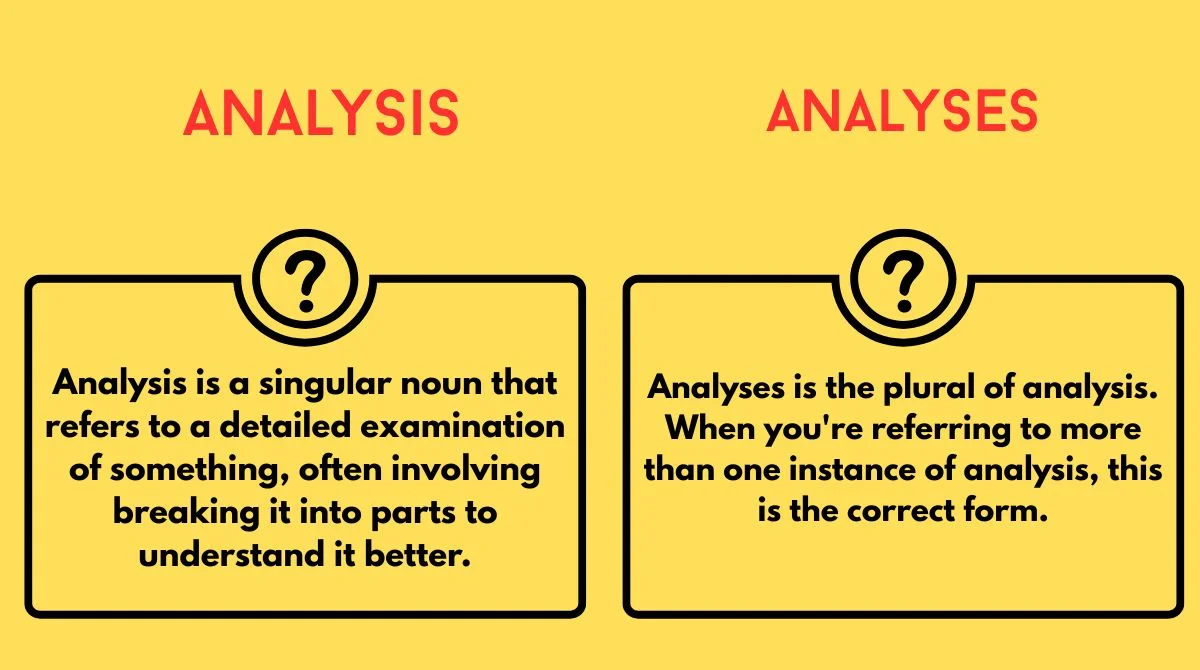
    Analysis is a singular noun that refers to a detailed examination of something, often involving breaking it into parts to understand it better.

    Examples:

    • “Her analysis of the data was insightful.”
    • “The company hired experts to conduct an environmental impact analysis.”

    In each case, we’re talking about one in-depth study or evaluation. Whether it’s text, data, behavior, or systems, analysis means digging deep to uncover meaning or patterns.

    Pronunciation tip: /ə-ˈna-lə-səs/ — emphasis on the second syllable.


    Analysis vs Analyses

    The Plural Confusion: When to Use ‘Analyses’

    Here’s where the confusion starts.

    Analyses is the plural of analysis. When you’re referring to more than one instance of analysis, this is the correct form.

    Examples:

    • “Multiple analyses were conducted to confirm the results.”
    • “The student compared various literary analyses of the novel.”

    It may look odd at first glance, but it follows a Greek-derived pluralization pattern (we’ll get to that soon).

    Pronunciation tip: /ə-ˈna-lə-ˌsēz/ — ends with a long “z” sound.


    Grammar Deep Dive: Singular and Plural Nouns in English

    English loves to break its own rules.

    Most English nouns form their plurals by simply adding -s or -es (cat → cats, box → boxes). But when a word is borrowed from another language, especially Latin or Greek, the plural rules often follow the original language’s form.

    Analysis falls into this category.
    Here’s a quick grammar check:

    WordSingularPlural
    CrisisCrisisCrises
    ThesisThesisTheses
    DiagnosisDiagnosisDiagnoses
    AnalysisAnalysisAnalyses

    These endings (-is to -es) are especially common in scientific, academic, and technical writing.


    The Greek Origin of ‘Analysis’

    Both “analysis” and “analyses” trace back to Ancient Greek.

    • The root word is ἀνάλυσις (analysis), which means “a breaking up” or “loosening.”
    • It combines ana- (up) and lysis (a loosening).

    That explains why the plural form doesn’t just add an “s.” It’s a legacy from Greek grammar, preserved in English due to its use in fields like philosophy, medicine, and science.

    This historical influence makes analyses the correct and formal plural—not “analysises.”


    Special Plural Forms in English

    English includes a handful of other Greek-derived words that pluralize like “analysis.” It’s worth knowing them if you write in academic or technical fields.

    Other examples:

    SingularPlural
    HypothesisHypotheses
    AxisAxes
    BasisBases
    ParenthesisParentheses

    Pro tip: When in doubt, don’t rely on spell-check alone. Autocorrect might not catch a wrong plural if the word still technically exists in another form.


    American vs. British English: Spelling Variations

    While American and British English often vary in spelling (think “color” vs. “colour”), the difference between analysis and analyses remains the same on both sides of the Atlantic.

    • In both dialects:
      • Analysis = singular
      • Analyses = plural

    No regional variation exists here. So whether you’re writing for an American journal or a British newspaper, the rule holds true.


    Common Mistakes and How to Avoid Them

    Let’s break down the slip-ups that happen most often—and how to dodge them.

    Mistake 1: Using “analyses” as a singular

    ❌ “Her analyses of the problem is very helpful.”
    ✅ “Her analysis of the problem is very helpful.”

    Mistake 2: Using “analysis” for multiple cases

    ❌ “The study included several analysis of the issue.”
    ✅ “The study included several analyses of the issue.”

    Mistake 3: Pronouncing both words the same

    • Analysis ends with a soft -sis sound.
    • Analyses ends with a -sees sound.

    Fixes:

    • Say the sentence out loud. Does it refer to one or multiple evaluations?
    • Match your verb form correctly (e.g., “is” vs “are”).

    Practical Examples in Academic Writing

    This word pair appears frequently in academic contexts, especially in:

    • Literature reviews
    • Research methodology
    • Data interpretation
    • Case studies

    Example Sentences from Academic Writing:

    • “This chapter presents an analysis of the key themes in postmodern fiction.”
    • “Previous analyses by Smith (2018) support this theoretical framework.”
    • “Quantitative and qualitative analyses were employed for comprehensive results.”

    These contexts demand precision, so using the wrong form can affect your credibility.


    Using ‘Analysis’ in Research Papers

    In scholarly writing, clarity is everything. Misusing singular and plural forms can weaken your argument—or confuse your readers.

    Where you’ll see “analysis”:

    • In methods sections to explain how data is examined.
    • In results sections when presenting one set of findings.
    • In discussion sections where a single perspective is explored.

    Example:

    “Our analysis of survey data shows a significant trend among first-time buyers.”

    Make sure you pair the right article or determiner:

    • “An analysis” (singular)
    • “Several analyses” (plural)

    Importance of Pluralization in Scholarly Work

    In formal research, getting the grammar right isn’t just about style—it’s about accuracy.

    If your work involves:

    • Comparing multiple studies
    • Conducting tests on various samples
    • Discussing findings from different models

    …then “analyses” will be your go-to form.

    Proper pluralization shows:

    • You understand your subject deeply.
    • You respect academic norms.
    • You can communicate ideas clearly and precisely.

    It might seem small, but it contributes to the overall credibility of your writing.


    Getting It Right: Tips for ESL Students

    For English learners, this word pair can be particularly tricky. But don’t worry—here are smart strategies to remember which one to use.

    Simple Memory Tricks:

    • Singular = Ends in -sisone analysis
    • Plural = Ends in -sesmany analyses

    Visual Cue:

    Think of the letter “e” in analyses as extra evidence—multiple studies, multiple evaluations.

    Grammar Tip:

    Use is with analysis
    Use are with analyses

    Examples:

    • “This analysis is compelling.”
    • “These analyses are consistent with past research.”

    Practice Makes Perfect:

    Try writing your own sentences with both words. Then swap them and read them aloud—you’ll quickly hear when something sounds off.


    Analysis vs Analyses

    6 FAQs with Answers

    What is the difference between analysis and analyses?

    Analysis refers to a single, detailed examination, while analyses is the plural form, used when discussing multiple examinations or evaluations.

    Is ‘analyses’ a correct word in English?

    Yes, analyses is the grammatically correct plural of analysis, commonly used in academic, scientific, and research writing.

    How do you pronounce ‘analysis’ and ‘analyses’?

    • Analysis: /ə-ˈna-lə-səs/
    • Analyses: /ə-ˈna-lə-ˌsēz/
      They are pronounced differently and should not be confused.

    Why is the plural of ‘analysis’ not ‘analysises’?

    Because analysis comes from Greek, its plural follows Greek grammar rules, changing -is to -es, resulting in analyses.

    Can I use ‘analysis’ to refer to multiple studies?

    No, if you’re referring to more than one study, the correct word is analyses. Use analysis only when speaking of a single instance.

    Are there other words that change like analysis and analyses?

    Yes! Similar examples include:

    • Thesis → Theses
    • Diagnosis → Diagnoses
    • Hypothesis → Hypotheses

    Final Thoughts

    So, what’s the difference between analyses and analysis?
    In a nutshell:

    • Analysis is singular: one in-depth examination.
    • Analyses is plural: more than one.

    They’re not interchangeable—and using the wrong one can change the meaning of your sentence or muddle your message. Whether you’re an ESL student, a university researcher, or just someone looking to level up their grammar, mastering the difference is a small step with a big payoff.


    Want more grammar deep-dives like this? Let us know in the comments, or explore more on commonly confused words like “datum vs. data” or “phenomenon vs. phenomena”.