Category: Tricky Terms

  • 🔎 Constant vs Consistent: A Deep Dive into Their Meanings

    🔎 Constant vs Consistent: A Deep Dive into Their Meanings

    Words can be tricky. Some sound alike or share similar ideas yet mean very different things. Two such words are “constant” and “consistent.”

    People often swap them without realizing they describe different qualities. This article unpacks their meanings, shows you how to use each word correctly, and gives practical tips to avoid confusion.


    Quick Takeaway

    If you’re in a hurry, here’s the simplest way to remember:

    Constant means something that doesn’t change or continues without interruption.
    Consistent means something that is regular, reliable, or behaves in the same way over time.

    Think of constant as a fixed state, while consistent is about a steady pattern of action.


    Why This Distinction Matters

    Choosing the wrong word can change your message’s meaning.
    Imagine a fitness coach telling you to maintain constant effort. That implies never-ending, without rest, which isn’t realistic.
    Instead, they should say consistent effort, which means repeating healthy habits over time.

    Understanding the difference matters because:

    • It improves your writing and speaking clarity.
    • It helps avoid misunderstandings in education, business, and relationships.
    • It builds credibility in professional settings—especially in reports, research, and marketing.

    📝 Language Tip: Misusing these words can subtly shift meaning and confuse your audience.


    Core Difference at a Glance

    Here’s a quick comparison table:

    AspectConstantConsistent
    DefinitionSomething that does not change, remains the same over timeSomething that happens in a regular, reliable, steady way
    NatureFixed, unchanging, continuousRepeated, dependable, patterned
    Typical UseDescribes states, conditions, or valuesDescribes actions, behavior, or performance
    ExamplesConstant speed of light, constant background noiseConsistent study habits, consistent growth
    ToneOften static or unvaryingSuggests reliability and progress

    Understanding “Consistent”

    Definition and Nuances

    The word consistent refers to something that happens in the same way, reliably, or regularly over a period of time.
    It doesn’t mean unchanging—rather, it suggests a steady pattern.

    For example:

    • A student who studies two hours every evening is consistent.
    • A company that delivers high-quality service month after month is consistent.

    💡 Key Insight: Consistency is about repetition and dependability, not permanence.


    Examples in Context

    • Everyday life: A parent who consistently wakes up early to prepare breakfast.
    • Education: A learner who consistently scores above 85% in math tests.
    • Work: A designer who consistently meets deadlines.
    • Science: An experiment that consistently produces the same result under similar conditions.

    Common Synonyms and Related Terms

    • Reliable
    • Dependable
    • Steady
    • Regular
    • Predictable

    👉 These words often work as substitutes, but not always. For instance, steady may describe speed, while consistent often relates to performance or behavior.


    Common Misuses of “Consistent”

    A frequent mistake is using “consistent” for things that don’t involve regular actions.

    ❌ Incorrect: “The region experienced consistent rain for two weeks.”
    ✅ Correct: “The region experienced constant rain for two weeks.”

    Rain isn’t about a repeated behavior. It’s an ongoing state—so constant is correct.


    Understanding “Constant”

    Definition and Nuances

    The word constant describes something that remains the same or continues without pause or change.
    It implies permanence or unbroken presence.

    For example:

    • The constant speed of light is about an unchanging value.
    • A clock’s constant ticking highlights unending occurrence.
    • A person’s constant headache signals ongoing pain.

    🧠 Remember: Constant relates to unchanging states, not repeated actions.


    Examples in Context

    • Science: The gravitational constant or a constant chemical property.
    • Everyday life: A constant hum of traffic outside an apartment.
    • Health: Constant fatigue during stressful weeks.
    • Emotions: A constant feeling of gratitude.

    Common Synonyms and Related Terms

    • Unchanging
    • Perpetual
    • Continuous
    • Fixed
    • Steady

    These terms capture the idea of no interruption or variation.


    Common Misuses of “Constant”

    Many people use “constant” when they mean “consistent.”

    ❌ Incorrect: “She showed constant effort in improving her skills.”
    ✅ Correct: “She showed consistent effort in improving her skills.”

    Effort is not about unbroken presence; it’s about repeated dedication over time.


    Constant vs Consistent: Direct Comparison

    Key Distinctions Explained Simply

    • Constant = describes something unchanging and ongoing.
    • Consistent = describes something regular and dependable in pattern.

    👉 Grammar often reflects this difference:

    • Constant typically pairs with nouns describing states or conditions (e.g., constant noise, constant temperature).
    • Consistent usually pairs with actions, efforts, or behaviors (e.g., consistent training, consistent output).

    Overlapping Situations That Confuse Learners

    Some scenarios invite confusion:

    PhraseBetter ChoiceReason
    Constant practiceConsistent practicePractice involves repeated action over time
    Consistent painConstant painPain describes an ongoing state
    Constant progressConsistent progressProgress builds steadily through repeated effort

    🟢 Rule of Thumb: If it describes a stable condition → use constant.
    If it describes regular effort or pattern → use consistent.


    Real-World Applications and Examples

    Daily Life

    • Consistent: Going to the gym three times a week.
    • Constant: The city’s constant traffic noise.

    Education and Learning

    • Consistent: A teacher’s consistent grading method helps students understand expectations.
    • Constant: A student’s constant curiosity fuels their desire to explore new topics.

    Business and Productivity

    • Consistent: A business that consistently delivers quality builds customer trust.
    • Constant: Constant market demand pushes businesses to innovate.

    💬 Quote: “Success doesn’t come from what you do occasionally. It comes from what you do consistently.” – Marie Forleo


    Relationships and Personal Growth

    • Consistent: Being consistently supportive strengthens trust in friendships.
    • Constant: Having constant communication can sometimes feel overwhelming rather than supportive.

    How to Choose the Right Word Every Time

    Use this quick decision guide:

    QuestionIf Yes → Use
    Does it describe something unchanging, continuous, or ever-present?Constant
    Does it describe something repeated, reliable, or regular in action?Consistent

    🟩 Tip for Writers: When editing, pause at each use of “constant” or “consistent” and ask yourself this question. This habit sharpens your word choice over time.


    Frequently Asked Questions (FAQs)

    Can something be both constant and consistent?

    Yes. For example, the constant laws of physics lead to consistent outcomes in experiments.
    The law itself is unchanging, but the repeated outcomes show consistency.


    Which term is better for describing ongoing improvement?

    Use consistent. Improvement happens over time through repeated effort.
    Saying “constant improvement” implies improvement never stops, which is rarely realistic.


    Are these terms interchangeable in any context?

    Almost never. The few overlaps occur when describing patterns that are both continuous and regular, but usually, one fits better depending on whether you mean unchanging state or steady pattern.


    Is “constent” a word or just a typo?

    It’s a typo. The correct spelling is constant.


    Can consistent behavior lead to constant results?

    Yes, often. For example, consistent studying can lead to a constant high grade if conditions remain stable.


    Conclusion

    The difference between constant vs consistent lies in what they describe:

    • Constant = unchanging, continuous, fixed.
    • Consistent = steady, regular, reliable over time.

    Mastering this distinction not only improves your vocabulary but also sharpens your communication.
    Whether you’re writing essays, emails, or speaking in meetings, using the right word shows precision and credibility.

  • Smoothe vs Smooth: Which One Is Correct? 🤔 | Clear Grammar Tips

    Smoothe vs Smooth: Which One Is Correct? 🤔 | Clear Grammar Tips

    English is full of confusing words that look and sound alike, and smooth and smoothe are prime examples.

    Despite the fact that many people mistakenly add an “e” to smooth, the correct term is always smooth.

    This article will break down the differences, explore common misconceptions, and ensure you leave with a solid understanding of how to use smooth in your writing and speech.

    The correct spelling is always smooth, not smoothe. While many mistakenly add an “e” to soften the word, smooth is both the adjective and verb form, describing something even, glossy, or free from roughness. Smoothe is a common error with no basis in modern English.


    Understanding the Proper Spelling and Use of Smooth

    Let’s start by addressing the elephant in the room: smooth is the correct spelling, and smoothe is not recognized as a standard word in the English language.

    Many people mistakenly believe that adding an “e” makes the word sound softer or more refined, but in reality, the “e” at the end of smoothe is simply an error.

    Smooth as a Standard Word

    • Adjective: Describes something that is even, without bumps, or free of roughness.
      Example: “The surface of the table is smooth.”
    • Verb: Refers to the action of making something smooth, usually by rubbing or polishing.
      Example: “She smoothed out the wrinkles in her dress.”

    Defining Smooth as a Verb and an Adjective

    Smooth as a Verb

    As a verb, smooth means to make something more even or to remove imperfections. The action of smoothing often involves physical effort, such as rubbing or polishing. It can also refer to actions that reduce tension or conflict.

    Examples of Smooth as a Verb:

    • “She smoothed the fabric with her hands to remove the wrinkles.”
    • “He tried to smooth things over after the argument.”

    Smooth as an Adjective

    When used as an adjective, smooth describes the texture or appearance of something. It suggests an absence of roughness or unevenness.

    Examples of Smooth as an Adjective:

    • “The road was smooth, making the drive very comfortable.”
    • “Her skin felt smooth after using the lotion.”

    The Correct Conjugations of Smooth

    Unlike some irregular verbs, smooth is conjugated in a predictable and simple way. Let’s take a closer look at its various forms.

    • Base form: smooth
    • Past tense: smoothed
    • Past participle: smoothed
    • Present participle/gerund: smoothing

    The correct conjugations follow the standard pattern of regular verbs, adding “-ed” in the past tense and present participle. This makes smooth straightforward to use in various tenses.

    Examples:

    • “She smoothed the surface of the wood yesterday.”
    • “He is smoothing the edges of the paper right now.”

    The Common Misconception: Smoothe Revealed

    The word smoothe has been circulating in modern English, often as a mistake for smooth. However, this is simply a misconception based on a misunderstanding of English spelling conventions.

    Why the ‘E’ Is Unnecessary

    The idea that smoothe might be a valid spelling likely comes from old English forms or confusion with similar-sounding words that do end with an “e.” In the 16th and 17th centuries, some words, like love, were often written with an “e” at the end, but this was a feature of older English spelling. The addition of “e” in smoothe does not fit modern grammatical standards.

    Smoothe in Modern Usage

    Though some may use smoothe in an attempt to soften the word, it is not recognized in standard dictionaries. The correct and widely accepted form is smooth.


    Exploring the English Language: Smooth vs. Other Similar Words

    In English, smooth has a few close relatives that might lead to confusion, especially when comparing them in certain contexts. Let’s take a look at some of these terms:

    Smooth vs. Sleek

    While both words can describe something that is even or glossy, sleek often refers to something that looks stylish or well-groomed, especially in the context of people, animals, or even vehicles.

    • Smooth: Refers more to texture and physical sensation.
      Example: “The countertop is smooth to the touch.”
    • Sleek: Often used to describe something aesthetically pleasing and shiny.
      Example: “The car had a sleek design with a shiny finish.”

    Smooth vs. Polished

    Polished implies a high level of finish or refinement, often associated with skill or effort.

    • Smooth: More about the texture or surface quality.
    • Polished: Refers to something that has been refined to a high standard, often used metaphorically.
      Example: “Her polished performance earned her a standing ovation.”

    Conjugation of Smooth

    We’ve touched on this in an earlier section, but let’s take a moment to dive deeper into the conjugations of smooth to ensure you can use it with precision.

    Present Tense

    • “I smooth the edges of the paper every time I cut it.”
    • “They smooth the fabric before stitching it together.”

    Past Tense

    • “She smoothed the surface of the table last night.”
    • “He smoothed out the situation with a simple apology.”

    Future Tense

    • “I will smooth the wrinkles out of my shirt before the meeting.”

    Present Participle

    • “She is smoothing out the rough patches in her relationship.”

    Smooth in Action: Examples of Correct Usage in Sentences

    To further clarify the usage of smooth, here are some real-world examples that demonstrate its proper application.

    Correct Usage as an Adjective:

    • “The river was smooth, and the boat glided effortlessly.”
    • “After the haircut, his hair looked sleek and smooth.”

    Correct Usage as a Verb:

    • “She smoothed her hands over the fabric to remove any creases.”
    • “He worked hard to smooth out the wrinkles in their communication.”

    Smoothe and Smoothen: Misuses in Modern Writing

    In addition to smoothe, some people mistakenly use smoothen as a verb, which is unnecessary and incorrect.

    The Nonexistent “Smoothen”

    In standard English, smooth is both the noun and verb form, and there is no need to add an “en” to the verb. Smoothen might seem to be a logical verb form, but it is not grammatically accepted.

    Incorrect: “She will smoothen the paper before folding it.”
    Correct: “She will smooth the paper before folding it.”


    Ensuring Linguistic Accuracy: The Importance of Correct Spelling in Communication

    Correct spelling isn’t just about following grammatical rules—it’s crucial for clear, effective communication. Using words like smooth correctly ensures that your message is not only accurate but also professional and easy to understand.

    Why Correct Spelling Matters:

    • Credibility: Consistent, accurate spelling shows attention to detail.
    • Clarity: Mistakes like using smoothe instead of smooth can confuse your audience.
    • Professionalism: Proper spelling reflects well on your writing skills, whether it’s a casual blog post or a formal business email.

    By mastering the correct usage of smooth, you’ll improve both your writing and your ability to communicate effectively.


    Faqs

    What’s the difference between “smooth” and “smoothe”?

    “Smooth” is the correct spelling. “Smoothe” is an incorrect variation that many mistakenly use but is not recognized in modern English dictionaries.

    When should I use “smooth” as a verb?

    Use “smooth” as a verb when describing the action of making something even or free from wrinkles, such as smoothing a surface or smoothing out a problem.

    Can “smoothe” be used in modern English?

    No, “smoothe” is not recognized as a correct word in standard English. The proper term is always “smooth.”

    Is “smoothen” a correct form of the verb “smooth”?

    No, “smoothen” is incorrect. The verb form is simply “smooth,” with no “en” added.

    What does “smooth” mean as an adjective?

    As an adjective, “smooth” describes something that is even, glossy, or free from roughness, such as smooth skin or a smooth road.

    Why do people mistakenly use “smoothe”?

    The confusion likely arises from old English spelling conventions or the mistaken belief that the “e” softens the word, but modern English does not include “smoothe.”


    Conclusion

    In conclusion, smooth is the correct spelling, and smoothe is nothing more than a common mistake. Understanding the proper use of smooth, both as a verb and an adjective, will help you write and speak more clearly and accurately.

    Remember, language is all about precision, and knowing when and how to use words like smooth can make all the difference in your communication.

    Now that you have a deeper understanding of smooth, keep an eye out for other commonly confused words and continue to refine your language skills. If you have any questions or want to share your thoughts, feel free to leave a comment below!

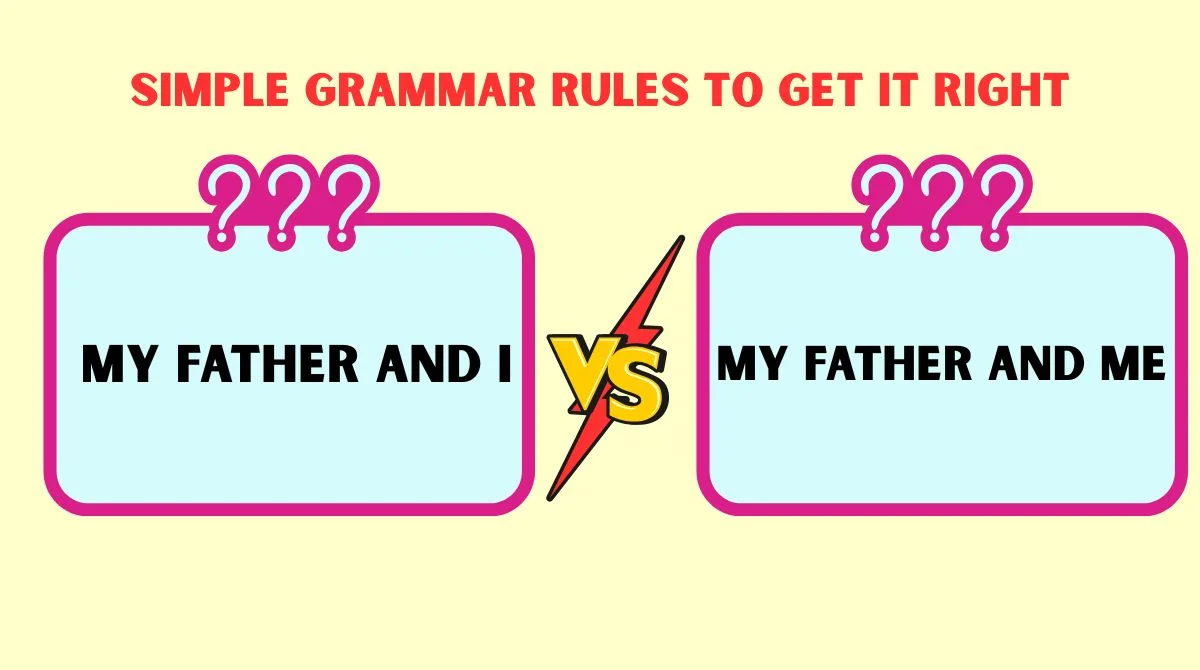
  • My Father and I vs My Father and Me 🤔 | Simple Grammar Rules to Get It Right

    My Father and I vs My Father and Me 🤔 | Simple Grammar Rules to Get It Right

    It’s a grammar question that trips up even native English speakers: Should you say “My father and I” or “My father and me”?

    While it might sound subtle, choosing the right phrase can make a huge difference in how polished and correct your English sounds.

    Don’t worry—this guide will break it all down with simple explanations, helpful tips, and plenty of real-life examples.

    The correct choice between “My father and I” and “My father and me” depends on grammar rules. Use “My father and I” when the phrase is the subject of the sentence (doing the action), and “My father and me” when it’s the object (receiving the action). Check by removing “my father”—if “I” or “me” sounds correct, you’ve got the right answer!


    Understanding Subject and Object Pronouns in English

    Before we get into “my father and I” vs. “my father and me,” let’s zoom out and look at how pronouns work in English grammar.

    There are two types of pronouns involved in this discussion:

    TypeExample PronounsRole in the Sentence
    Subject PronounsI, he, she, we, theyDo the action in a sentence (subject)
    Object PronounsMe, him, her, us, themReceive the action (object of a verb or preposition)

    Example Sentences:

    • Subject: I called the doctor.
    • Object: The doctor called me.

    The rule is simple: Use subject pronouns when the person is doing the action, and object pronouns when they’re receiving the action.


    My Father and I vs My Father and Me

    The Correct Cases: “My Father and I” Versus “My Father and Me”

    The trickiest part is knowing when to use “I” and when to use “me.” Most people stumble when combining another person with themselves in a sentence.

    Let’s break it down:

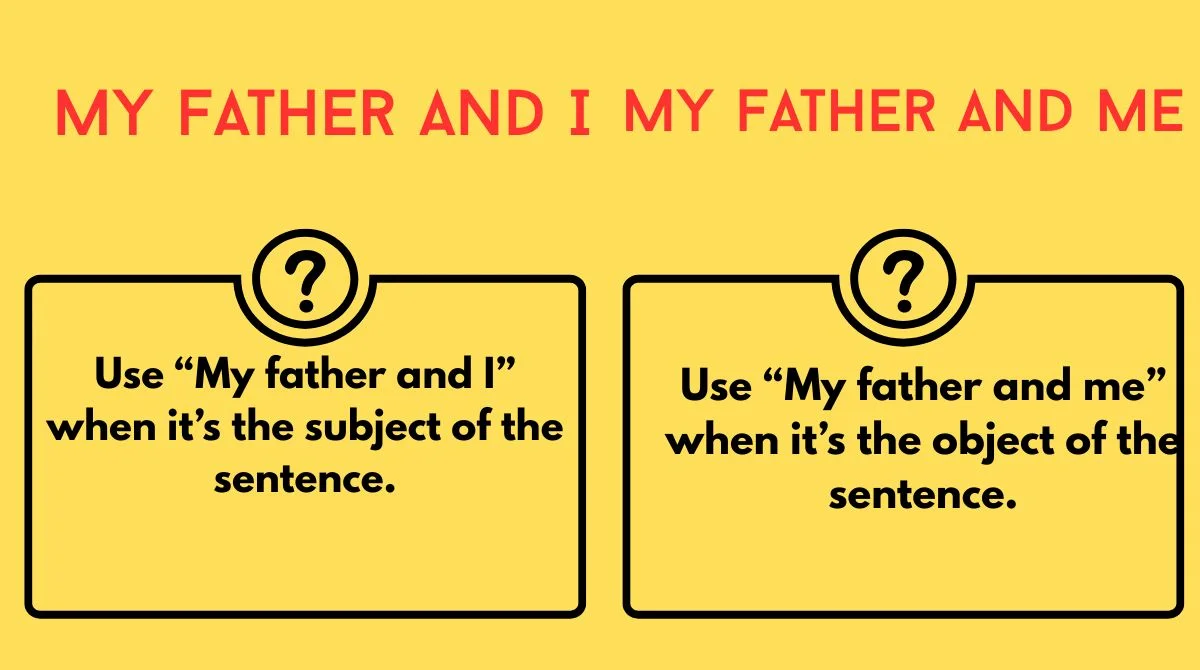
    • Use “My father and I” when it’s the subject of the sentence.
    • Use “My father and me” when it’s the object of the sentence.

    Quick Test:

    If you remove “my father and” from the sentence, would you say “I” or “me”?

    ✅ Correct:

    • My father and I went to the game. → I went to the game.
    • The teacher gave my father and me a gift. → The teacher gave me a gift.

    ❌ Incorrect:

    • My father and me went to the game. → Me went to the game? (Nope.)
    • The teacher gave my father and I a gift. → The teacher gave I a gift? (Wrong.)

    When to Properly Use “My Father and I”

    You use “My father and I” when the two of you are doing something together—when you’re the subject of the sentence.

    Correct Examples:

    • My father and I are going to the store.
    • My father and I built a treehouse last summer.
    • My father and I love fishing on weekends.

    In each case, “I” is acting in the sentence. If you removed “my father,” it would still make sense:

    • I am going to the store.
    • I built a treehouse.
    • I love fishing.

    Pro Tip:

    Always mention the other person before yourself in formal writing:
    ✔️ My father and I
    I and my father


    Appropriate Usage of “My Father and Me”

    Use “My father and me” when the two of you are receiving an action—either from a verb or a preposition.

    Correct Examples:

    • The photographer took a picture of my father and me.
    • She invited my father and me to the ceremony.
    • The award was given to my father and me.

    Again, test it by removing “my father”:

    • The photographer took a picture of me.
    • She invited me.
    • The award was given to me.

    These all work perfectly. If “me” fits alone, then “my father and me” is the right choice.


    Polishing Your Grammar: Tips for Remembering the Rules

    Here are some simple ways to avoid confusion and sound more confident in your writing and speech:

    Quick Grammar Tips:

    • Drop the other person temporarily: Would you say “I” or “me” if you were alone?
    • Use your ear: Often, incorrect usage just sounds wrong.
    • Read aloud: If it sounds awkward, it probably is.
    • Remember the role: Are you doing something (subject)? Use “I.” Is something happening to you (object)? Use “me.”

    Common Misconceptions and Correcting Common Errors

    Many people wrongly believe that “my father and I” is always the correct and more polite choice. This has led to overcorrection—using “I” where “me” is needed.

    Examples of Misuse:

    • He gave the tickets to my father and I.
      He gave the tickets to my father and me.
    • The teacher spoke to my father and I about my grades.
      The teacher spoke to my father and me about my grades.

    Using “I” just to sound more formal often backfires and makes the sentence grammatically incorrect.


    Why “Me and My Father” Is Often Misused

    People commonly say “me and my father” in casual speech, but that order is considered informal and grammatically questionable, especially in writing.

    What’s the issue?

    • It’s impolite to mention yourself first.
    • It’s often grammatically wrong depending on the sentence.

    Better Alternatives:

    • My father and I went to the park.
    • She called my father and me.

    It’s okay to say “me and my father” in casual conversations with friends, but it’s best avoided in writing, interviews, or professional settings.

    Grammar Tip: In formal situations, always place the other person first and double-check the case of the pronoun.


    The Role of Context in Choosing ‘I’ or ‘Me’ With Family References

    Context is everything in grammar. Whether you use “I” or “me” depends entirely on how the phrase functions within the sentence.

    Let’s look at some examples to see how context changes the usage:

    SentenceSubject or Object?Correct Phrase
    My father and I are taking a road trip.SubjectMy father and I
    The gift was from my father and me.Object (preposition)My father and me
    She saw my father and me at the mall.ObjectMy father and me
    My father and I made breakfast together.SubjectMy father and I
    They waved at my father and me from the car.ObjectMy father and me

    Always check who is doing what in the sentence. That’s the best way to avoid mistakes.


    My Father and I vs. My Father and Me

    Faqs

    When do you use “My father and I”?

    Use “My father and I” when the phrase is the subject of the sentence, meaning you and your father are doing something together.

    When do you use “My father and me”?

    Use “My father and me” when the phrase is the object of the sentence, meaning you and your father are receiving the action or being affected by it.

    What’s the best way to check whether to use “I” or “me”?

    Test the sentence by removing “my father.” If “I” or “me” sounds correct alone, that’s your answer.

    Is it wrong to say “Me and my father”?

    In formal writing and speech, yes. It’s better to say “My father and I.” In casual conversations, it’s okay but still avoid it in professional settings.

    Can you say “My father and I” in the object position?

    No, use “My father and me” when it’s the object of the sentence, as “I” is for subjects and “me” is for objects.

    Why is “My father and I” used so often?

    People overcorrect by using “I” to sound more formal. However, using it incorrectly can make the sentence grammatically wrong.


    Final Thoughts: Mastering the “My Father and I” vs. “My Father and Me” Dilemma

    The difference between “my father and I” and “my father and me” comes down to subject vs. object, and mastering this can make your English sound more fluent and polished.

    Here’s your cheat sheet:

    • Use “My father and I” when you’re the subject (doing something).
    • Use “My father and me” when you’re the object (something is being done to you).
    • 🚫 Avoid “Me and my father” in formal speech or writing.
    • 🧠 Use the solo pronoun test: remove “my father” to figure out if it should be “I” or “me.”

    Final Tip:

    If you’re ever unsure, say the sentence aloud without the other person’s name. If it sounds right with just “I” or “me,” you’ve got your answer!

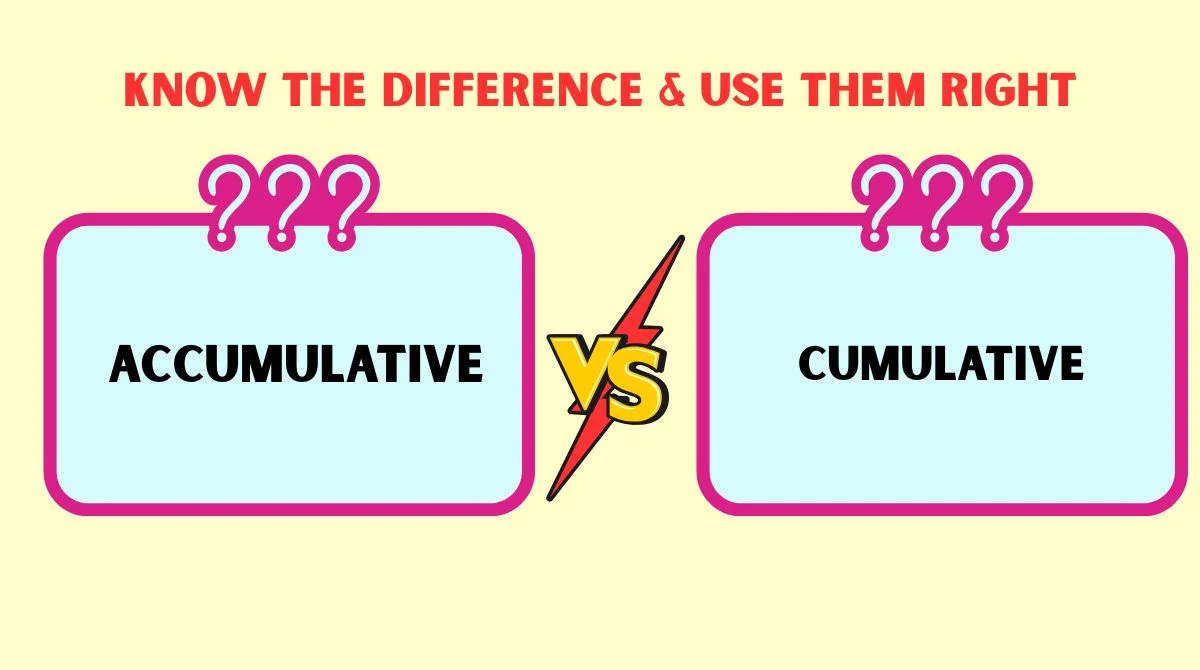
  • Accumulative vs Cumulative 📚 | Know the Difference & Use Them Right

    Accumulative vs Cumulative 📚 | Know the Difference & Use Them Right

    Words like accumulative and cumulative often trip people up because they seem interchangeable. But here’s the catch—they’re not.

    While they share a root and both deal with growth or increase over time, they differ in nuance, tone, and usage across fields like education, finance, and even environmental science.

    So what really sets these two apart? In short: accumulative focuses more on acquisition, while cumulative emphasizes sequence and progression.

    Let’s dig into the details, clear up the confusion, and explore their real-world usage so you never second-guess them again.

    “Accumulative” and “cumulative” both relate to growth, but they aren’t the same. Use accumulative when referring to the act of collecting or gathering (e.g., wealth or data), and cumulative when describing the build-up or result of a process over time (e.g., cumulative GPA or cumulative effects). Learn how to distinguish them clearly with real-world examples.


    Accumulative vs Cumulative

    Understanding the Basics of Accumulative and Cumulative

    At first glance, accumulative and cumulative both appear to describe something growing larger through additions. And yes—they do. But here’s the twist:

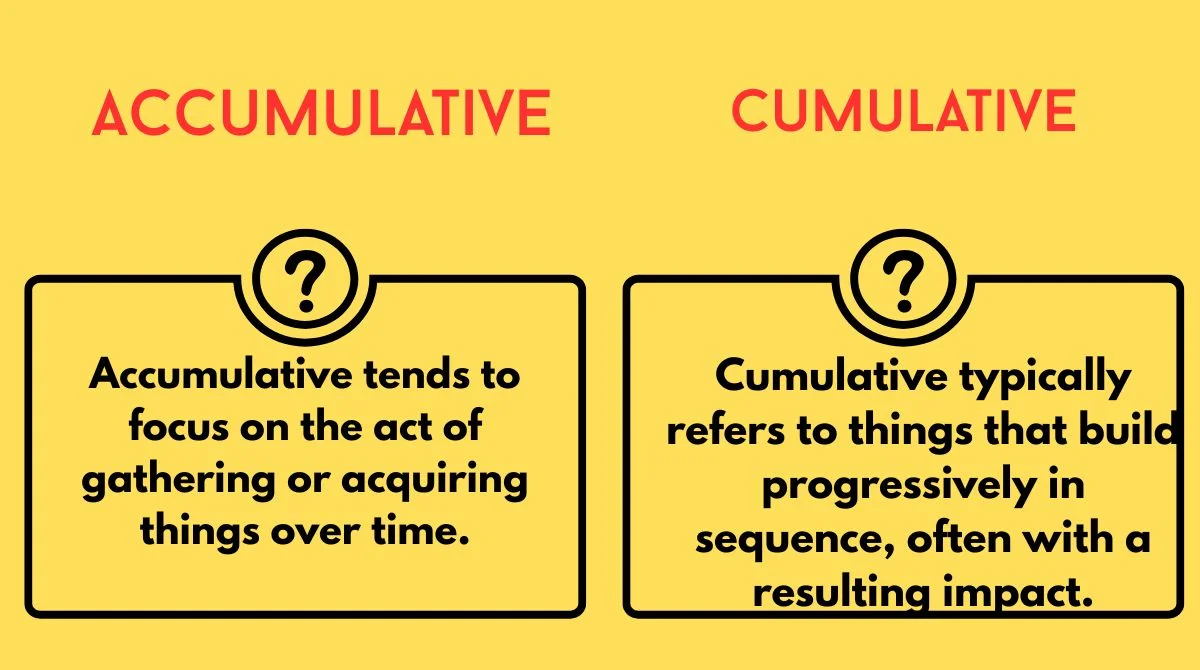
    • Accumulative tends to focus on the act of gathering or acquiring things over time.
    • Cumulative typically refers to things that build progressively in sequence, often with a resulting impact.

    These words share a Latin origin—cumulare, meaning to heap up—but their modern usage has diverged in subtle yet significant ways.


    Defining Accumulative: A Closer Look at Acquisitive Growth

    Accumulative is an adjective used to describe a gradual gathering or acquisition of something, usually in a way that emphasizes the act of collecting or hoarding.

    Characteristics of “Accumulative”:

    • Implies intentional or organic collection.
    • Often has a sense of ownership or control over what’s gathered.
    • Common in psychology, behavior, and informal economics.

    Examples:

    • He developed an accumulative habit of saving coins from every country he visited.
    • Her accumulative wealth grew steadily through smart investments.

    Synonyms:

    • Acquisitive
    • Gathering
    • Collecting

    Breaking Down Cumulative: Successive Additions Over Time

    Cumulative, on the other hand, speaks to a build-up over time—layered effects that often compound and result in an outcome or impact. It’s frequently used in scientific, educational, and technical contexts.

    Characteristics of “Cumulative”:

    • Implies ongoing sequence or progression.
    • Focuses on the total result of successive steps or events.
    • Often carries a quantifiable effect or consequence.

    Examples:

    • The cumulative effect of poor nutrition can lead to serious health problems.
    • The student’s final grade was based on cumulative assessments.

    Synonyms:

    • Increasing
    • Aggregated
    • Compound

    The Common Misconceptions and Misuses

    Here’s where people get tripped up: they use these words interchangeably—but context is everything.

    Common Errors:

    • Saying “cumulative savings” when the emphasis is on intentional collection—better to use accumulative.
    • Using “accumulative damage” in scientific contexts—cumulative is the correct term when referring to effects that build up over time.

    Quick Fix Tip:

    If you’re talking about the outcome of a process, use cumulative.
    If you’re talking about the act of collecting, use accumulative.


    The Nuances of Usage in Different Contexts

    Let’s break down how each word shows up across different domains:

    DomainAccumulativeCumulative
    FinanceAcquiring assetsCompounding returns
    EducationLearning habitsTest formats
    ScienceBehavioral traitsEnvironmental impacts
    TechnologyUser data collectionSoftware updates/effects
    PsychologyHoarding behaviorStress buildup

    The takeaway? Accumulative often has a qualitative focus, while cumulative leans quantitative.


    Exploring Examples in Real-World Scenarios

    Understanding these words becomes easier when we apply them to relatable situations.

    Example 1: Personal Growth

    • Accumulative: Over the years, she developed accumulative knowledge from her travels.
    • Cumulative: Her insights were the cumulative result of years of experience.

    Example 2: Workplace Performance

    • Accumulative: He gained accumulative respect through consistent leadership.
    • Cumulative: His bonus reflected cumulative achievements over four quarters.

    Example 3: Health & Lifestyle

    • Accumulative: An accumulative diet of processed foods can change eating habits.
    • Cumulative: The cumulative impact of lack of sleep is often underestimated.

    Accumulative vs. Cumulative in Financial Terms

    This is a domain where clarity matters most. Misusing these words could result in miscommunication or financial misunderstanding.

    Accumulative in Finance:

    Refers to gathering assets over time, often deliberately.

    Examples:

    • Accumulative savings account
    • Accumulative investment strategy

    Cumulative in Finance:

    Refers to returns, interest, or impact over time.

    Examples:

    • Cumulative interest
    • Cumulative return on investment

    Tip: Use accumulative when referring to what’s being built up; use cumulative when referring to how it’s grown over time.


    Educational Applications: Exam Types and Learning Processes

    In education, the two terms are used very precisely, especially when describing testing styles and learning development.

    Cumulative Testing:

    Tests that cover all prior material up to the present.

    • Encourages retention and integration of knowledge.
    • Used in final exams, standardized testing.

    Example:
    The biology final was cumulative, testing everything from the first day of class onward.

    Accumulative Learning:

    Describes the gathering of skills and understanding over time.

    • Implies a growing base of knowledge.
    • Often informal or self-directed.

    Example:
    Her accumulative learning process helped her master coding outside of school.


    Cumulative Effects and Sequences in Nature and Technology

    In both environmental science and tech, cumulative effects are crucial to understanding large-scale patterns.

    Cumulative Effects in Nature:

    • Greenhouse gases contribute to cumulative climate change.
    • Pollution has cumulative effects on marine life.

    Cumulative Sequences in Tech:

    • Software errors that build up over updates.
    • Memory usage that causes cumulative slowdowns.

    Meanwhile, accumulative might apply to how data is gathered or resources are compiled, but the lasting impact is cumulative.


    Case Studies: Environmental and Data Progressions

    Case Study 1: Environmental Impact

    Scenario: An industrial plant emits low levels of toxins.

    Accumulative: The company tracks accumulative emissions for compliance.
    Cumulative: Over 10 years, the toxins create a cumulative health risk for nearby residents.

    Case Study 2: Data Science

    Scenario: A machine learning model processes user behavior.

    Accumulative: The model collects accumulative data from multiple platforms.
    Cumulative: The algorithm’s accuracy improves cumulatively as more data is analyzed.


    Language Mastery: Tips for Remembering the Difference

    Still not confident? Here are some quick memory tricks and tools:

    Mnemonic Devices:

    • Accumulative = Acquiring intentionally
    • Cumulative = Compounding over time

    Word Associations:

    WordThink of…
    AccumulativeHoarding coins, growing a collection
    CumulativeBuilding blocks, a snowball effect

    Quick Quiz:

    Choose the correct word:
    The ___ GPA reflects your entire academic performance.
    Cumulative

    She has an ___ habit of collecting antique watches.
    Accumulative


    Accumulative vs Cumulative

    Faqs

    What is the difference between accumulative and cumulative?

    Accumulative refers to gathering or acquiring things over time, while cumulative refers to the increasing result or total impact of additions made over a period.

    Can “accumulative” and “cumulative” be used interchangeably?

    No, they are not truly interchangeable. While both involve growth, “accumulative” focuses on collection, and “cumulative” emphasizes resulting impact or total effect.

    What does accumulative mean in finance?

    In finance, “accumulative” refers to strategies focused on acquiring assets or savings over time, such as an accumulative savings plan.

    What does cumulative mean in education?

    “Cumulative” in education refers to assessments or grades that reflect the total performance across an entire course or curriculum.

    Is it correct to say “cumulative savings”?

    It depends on the context. If the emphasis is on gathered savings, “accumulative savings” is more precise. If highlighting total savings impact over time, “cumulative savings” may fit.

    How can I remember the difference between accumulative and cumulative?

    Think “accumulative = acquiring” and “cumulative = compounding.” Accumulative relates to what’s being gathered; cumulative relates to the final effect.


    Final Thoughts: Why Word Precision Matters

    Whether you’re writing a thesis, managing investments, or explaining climate change, the difference between accumulative and cumulative matters. One highlights the gathering, the other emphasizes the impact.

    Use them precisely to sound more professional, avoid misunderstandings, and sharpen your writing.

    If you’ve ever confused these two before, you’re not alone—but now, you’ve got the tools to keep them straight for good.

  • “Wish You” vs “Wishing You” 💌 | Which Is Correct & When to Use Each

    “Wish You” vs “Wishing You” 💌 | Which Is Correct & When to Use Each

    You’ve probably written a card or sent a message that started with “Wish you…” or “Wishing you…” But have you ever stopped and wondered—which one is correct?

    Are they interchangeable, or does one fit better depending on the context?

    Let’s dig into the differences between “wish you” and “wishing you,” with clear explanations, examples, and usage tips so you can always send your well-wishes with confidence.

    Both “wish you” and “wishing you” are correct, but they aren’t interchangeable. Use “wish you” in complete, formal sentences with a subject (“I wish you success”), and use “wishing you” in casual, standalone messages (“Wishing you all the best!”). Context determines the right choice—read on to see how to use each properly.


    Understanding “Wish You” in Everyday Expressions

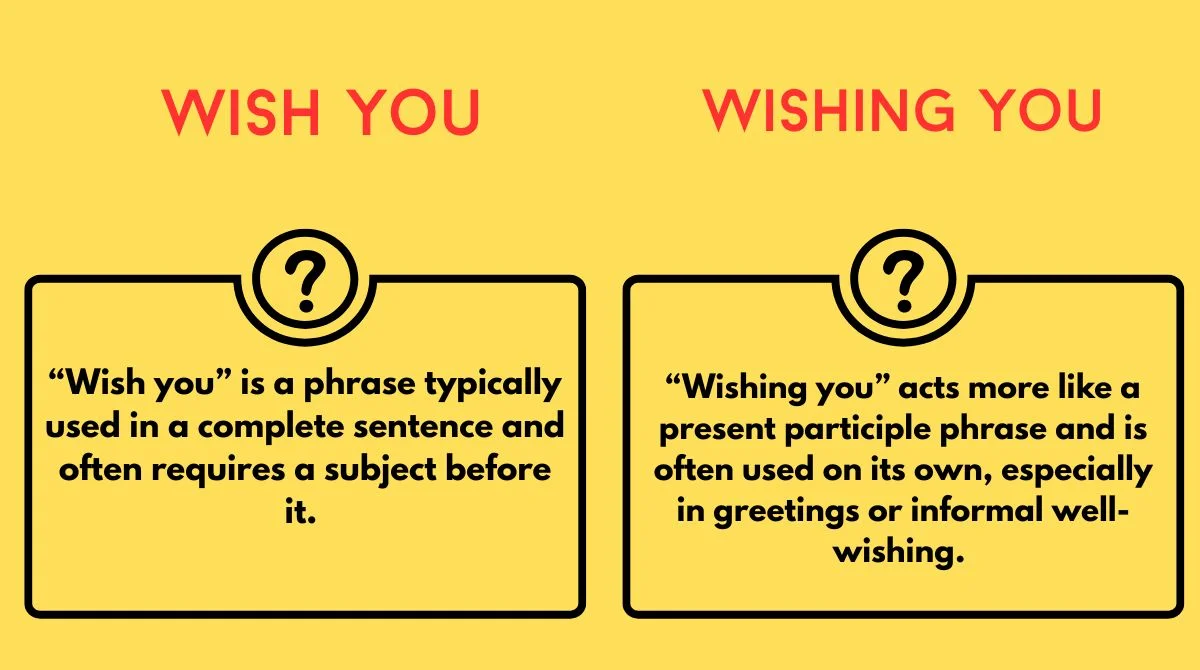
    “Wish you” is a phrase typically used in a complete sentence and often requires a subject before it. It is the base form of the verb “wish,” and it generally conveys a formal or direct tone.

    Common Uses:

    • “I wish you success in your new role.”
    • “We wish you a safe journey.”
    • “They wish you all the best.”

    Key structure:

    Subject + wish + object (you) + complement

    This structure is straightforward and commonly used in speech and writing. It appears more formal, making it a better fit for business communication or serious contexts.

    Important Tip:

    • Without a subject, “wish you” often feels incomplete or grammatically awkward.
      • Wish you a happy birthday. (Incorrect without context)
      • I wish you a happy birthday.

    “Wish You” vs “Wishing You”

    The Nuances and Uses of “Wishing You”

    “Wishing you” acts more like a present participle phrase and is often used on its own, especially in greetings or informal well-wishing. It doesn’t always need a clear subject because it implies one (often “I” or “we”).

    Common Uses:

    • “Wishing you all the best!”
    • “Wishing you a wonderful weekend.”
    • “Wishing you peace and happiness.”

    It’s often used in writing where warmth and brevity matter, such as:

    • Greeting cards
    • Email sign-offs
    • Social media posts
    • Wedding or birthday messages

    Tone and Style:

    • “Wishing you” is warmer and more emotionally expressive.
    • Ideal for personal communication or when you want to sound more heartfelt.

    Formal Celebrations and Toasts

    When you’re writing or speaking at formal events—like weddings, anniversaries, graduations—choosing between wish you and wishing you depends on tone and sentence structure.

    Formal Examples with “Wish You”:

    • “We wish you a lifetime of happiness together.”
    • “On behalf of the company, I wish you continued success.”

    More Casual, Toast-style Examples with “Wishing You”:

    • “Wishing you joy, love, and laughter today and always.”
    • “Wishing you a night to remember!”

    Quick tip: When giving a toast or writing a short, emotional message, “wishing you” often feels more natural and celebratory.


    Closing Statements in Correspondence

    In business or friendly email endings, both phrases can work—but with slightly different vibes.

    StylePreferred PhraseExample
    Professional/FormalWish you“I wish you success in your upcoming interview.”
    Warm/PersonalWishing you“Wishing you all the best for the weekend!”

    Email Sign-off Tips:

    • Use “Wishing you” to express positivity without sounding stiff.
    • Use “Wish you” when your message includes a clear subject and feels more formal.

    “Wish You” vs “Wishing You” in Common Greetings

    Let’s break down how these two phrases show up in real-world greetings.

    Greeting TypeWish YouWishing You
    Birthday“I wish you a happy birthday.”“Wishing you a happy birthday!”
    New Year“We wish you a prosperous New Year.”“Wishing you joy and success in the New Year.”
    Holiday“I wish you a Merry Christmas.”“Wishing you peace and joy this holiday season.”
    Farewell“They wish you a safe journey.”“Wishing you all the best on your travels!”

    Takeaway:
    Use “wish you” when the sentence includes a subject. Use “wishing you” when writing a standalone wish or greeting.


    The Popularity and Appropriateness of “Wish You” and “Wishing You”

    You might wonder: Which one do people use more often? And Which one sounds more natural today?

    Here’s what usage trends and stylistic preferences suggest:

    “Wishing You”:

    • More commonly used in cards, emails, and spoken well-wishes.
    • Seen as more emotionally resonant and casual-friendly.

    “Wish You”:

    • More structured and found in formal writing or professional settings.
    • Slightly less common in modern informal language.

    Expert quote:

    “Wishing you has become the go-to for personal messages because it feels more open, hopeful, and emotionally in tune with modern communication.” — LanguageStyle.org


    Insights From Google Ngram Viewer

    Using the Google Ngram Viewer, we can analyze how frequently “wish you” and “wishing you” have been used in published books over time.

    Key Findings:

    • “Wish you” had higher usage throughout the 19th and early 20th centuries.
    • “Wishing you” began gaining popularity in the late 20th century.
    • Today, both are still in use, but “wishing you” is increasingly favored for informal, expressive writing.

    Contextualizing Your Well-Wishes

    Choosing between wish you and wishing you depends entirely on the situation. Ask yourself:

    • Who am I writing or speaking to?
    • Is the tone formal or casual?
    • Is it part of a complete sentence or a standalone greeting?

    Here’s a quick-reference guide:

    ContextUse “Wish You”Use “Wishing You”
    Business Emails✔️✔️ (if warm/friendly)
    Wedding Toast✔️ (structured speech)✔️ (for personal touch)
    Greeting Card✔️
    Social Media Post✔️
    Academic/Professional Writing✔️

    Different Scenarios and How to Choose the Right Phrase

    Let’s walk through a few real-life situations:

    Scenario 1: Job Interview Follow-Up

    • ✅ “I wish you all the best in your interview.” (formal)
    • ✅ “Wishing you good luck tomorrow!” (friendly and supportive)

    Scenario 2: Holiday Card

    • ❌ “Wish you a Merry Christmas.” (missing subject)
    • ✅ “Wishing you a Merry Christmas and a joyful New Year!” (perfectly warm)

    Scenario 3: Office Farewell Email

    • ✅ “I wish you every success in your next role.” (professional tone)
    • ✅ “Wishing you all the best in your new adventure!” (collegial and upbeat)

    Scenario 4: Wedding Message

    • ✅ “We wish you both a lifetime of love and laughter.”
    • ✅ “Wishing you endless joy and unforgettable memories.”

    Both phrases work—you just have to match the vibe to the occasion.


    Wish You” vs “Wishing You”

    Faqs

    Which is correct: “wish you” or “wishing you”?

    Both are grammatically correct, but the usage depends on the sentence structure. “Wish you” needs a subject (e.g., “I wish you well”), while “wishing you” is often used in standalone greetings.

    When should I use “wish you”?

    Use “wish you” in formal or complete sentences where the subject is stated. It fits best in business communication, speeches, and structured writing.

    What does “wishing you” mean?

    “Wishing you” is a participial phrase commonly used to express heartfelt sentiments in cards, messages, or greetings. It implies a subject like “I” or “we” and doesn’t need to be part of a full sentence.

    Is “wish you a happy birthday” correct?

    Not on its own. It needs a subject to be complete: “I wish you a happy birthday.” Alternatively, you can say “Wishing you a happy birthday!” as a standalone message.

    Is “wishing you” formal or informal?

    “Wishing you” is generally more informal and warm. It’s great for personal communication, cards, or social media posts, but not typically used in academic or very formal writing.

    Can I use “wishing you” in business emails?

    Yes, especially in friendly sign-offs. It adds warmth without being unprofessional—for example, “Wishing you a productive week ahead!”


    Final Thoughts: Say It Right, Every Time

    So, which one is correct—wish you or wishing you?

    The answer is: both are correct, but they serve different purposes. Use wish you when writing a full, formal sentence with a clear subject. Use wishing you for personal messages, casual greetings, or heartfelt expressions.

    Now that you know the difference, you’ll never hesitate to choose the right phrase in cards, emails, or conversations.

  • Oftentimes vs Often Times: What’s Correct? 🤓📝

    Oftentimes vs Often Times: What’s Correct? 🤓📝

    Have you ever written “often times” in an email or essay and wondered if it’s actually correct? Or maybe you’ve spotted “oftentimes” in an older novel and thought, wait… is that even a real word? You’re not alone.

    “Often times” and “oftentimes” have puzzled writers and readers for generations, and the confusion doesn’t seem to be going away anytime soon.

    So, what’s the difference between often times and oftentimes? Which one should you use—and when?

    Let’s dig into the origin, usage, and modern preferences for both, so you can write with confidence and avoid this common grammatical misstep.

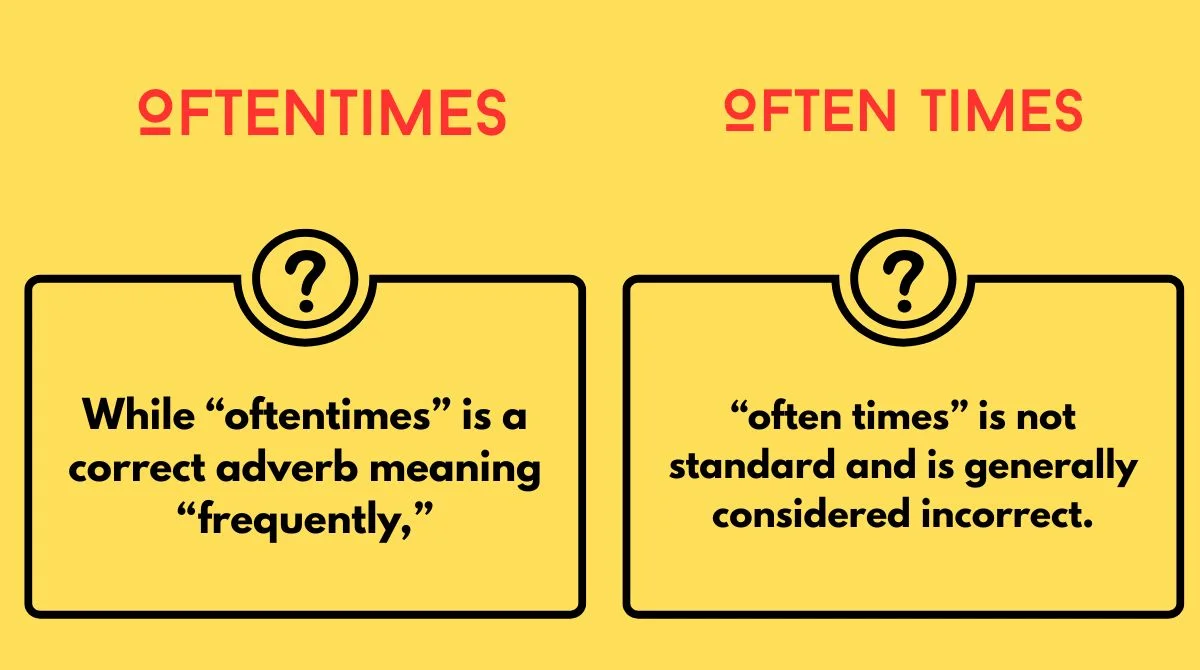
    Is it “often times” or “oftentimes”? While “oftentimes” is a correct adverb meaning “frequently,” “often times” is not standard and is generally considered incorrect. Discover why—and when to use which.


    Oftentimes vs Often Times

    Introduction to Oftentimes and Often Times

    Let’s set the record straight early on:

    • Oftentimes is a legitimate, recognized adverb.
    • Often times (two separate words) is not standard and is generally considered a mistake or a misinterpretation of “oftentimes.”

    You might see “often times” pop up in informal writing, but that doesn’t make it correct. In fact, grammar purists and style guides alike agree—“oftentimes” is the only form you should be using, if you’re not just sticking with “often.”


    The Historical Origins of Often and Oftentimes

    To understand the confusion, we need to go back—way back.

    The word often traces its roots to Old English “oft,” meaning frequently. As English evolved, oft gave way to often, and for a while, both coexisted in literature and speech.

    Then came oftentimes—a compound that essentially means frequently, just like often does. It’s formed by combining:

    • Oft (frequent)
    • en (an adverbial suffix)
    • times (occurrences)

    It’s a little redundant, sure. But in earlier centuries, redundancy was emphasis.


    Dissecting Middle English: Unearthing the Roots

    In Middle English (1100–1500), you’ll find plenty of examples of oftentimes used in poetry and prose. Authors of the time leaned heavily on repetition and rhythm. Adding -times to an adverb wasn’t seen as redundant—it was just good style.

    Consider Chaucer, who frequently used constructions like “oftentimes” and “seldomtimes.” These added musicality to the language and made meaning crystal clear.

    “Oftentimes, the knight would ride alone…”
    The Canterbury Tales (paraphrased)

    By contrast, “often times” as two words rarely—if ever—appeared in writing until modern typographical or autocorrect errors started creeping in.


    The Evolution of Adverbial Use in American English

    American English, compared to British English, tends to favor shorter, more efficient expressions. This is likely why oftentimes started falling out of favor in the U.S. by the mid-20th century, with writers preferring the simpler often.

    That said, oftentimes hasn’t disappeared completely.

    Frequency of Usage in American English

    TermFrequency (Google Books Ngram 2000–2020)
    OftenExtremely high
    OftentimesModerate
    Often timesRare and nonstandard

    Writers like Mark Twain and Ralph Waldo Emerson used oftentimes unapologetically, proving it has held its place—even if it’s no longer fashionable in academic circles.


    Oftentimes: Understanding Its Use and Context

    Oftentimes is an adverb meaning “frequently” or “on many occasions.” It is interchangeable with often, but tends to be more formal or literary.

    Examples:

    • “Oftentimes, people ignore advice until it’s too late.”
    • “She oftentimes reflects on her childhood memories.”

    You’ll most likely see it:

    • In literature
    • In academic essays
    • In formal speeches

    It adds a poetic or reflective tone, which can be effective when used sparingly.


    The Grammatical Nuances of Often Times

    Now let’s talk about “often times”—with the space in between.

    This version is not grammatically correct as an adverbial phrase. It’s an incorrect attempt to separate a compound word that isn’t meant to be broken apart.

    Why It Happens:

    • Autocorrect errors
    • Misunderstanding the structure of “oftentimes”
    • Overgeneralizing patterns like “sometimes,” “many times,” or “at times”

    How It Can Be Misused:

    • ❌ “Often times I go running in the morning.”
    • ✅ “Oftentimes I go running in the morning.”
    • ✅ “Many times I go running in the morning.”
    • ✅ “Often, I go running in the morning.”

    While “often times” may occasionally appear in blogs or casual writing, most style guides (APA, MLA, Chicago) advise avoiding it completely.


    When Two Words Don’t Make a Right: The Misconception

    Let’s be clear: Just because “many times” and “some times” are valid doesn’t mean “often times” is.

    Here’s a quick comparison:

    PhraseStandard?Meaning
    Oftentimes✅ YesFrequently
    Often times❌ NoNonstandard (avoid it)
    Many times✅ YesNumerous occasions
    At times✅ YesOccasionally

    Lesson: Not all combinations of adverb + “times” are grammatically valid.


    The Modern Preference: Is Brevity the Soul of Wit?

    William Shakespeare once wrote, “Brevity is the soul of wit.” That sentiment rings true in modern English.

    Most editors, writing coaches, and even grammar apps prefer:

    • “Often” for everyday writing
    • “Oftentimes” for formal, poetic, or rhetorical use

    When to Choose “Oftentimes”:

    • When you want to sound reflective or literary
    • When writing a formal speech or narrative
    • When variety in tone is important

    For most modern purposes, though, often is all you need.


    Cultural Usage: Oftentimes in American versus British English

    Interestingly, oftentimes is more common in American English than British English. British writers and speakers often avoid it entirely, opting instead for:

    • Often
    • Frequently
    • Usually

    Comparison Table

    RegionPreferred Usage
    United StatesOften, Oftentimes (both valid)
    United KingdomOften, rarely Oftentimes

    Even in the U.S., some consider oftentimes a bit archaic—but that doesn’t make it incorrect.


    Adopting Oftentimes: Linguistic Quirks

    Language isn’t just about rules—it’s about rhythm, tone, and style. Oftentimes may sound old-fashioned, but it still has a place in modern writing when used thoughtfully.

    Use it:

    • To create emphasis
    • To establish a reflective tone
    • As a stylistic variation in formal essays or narratives

    But don’t overuse it. Overusing archaisms can make your writing sound forced or unnatural.


    Synonyms and Antonyms: Expanding Your Vocabulary

    To avoid repetition, try swapping often or oftentimes with these alternatives.

    Synonyms:

    • Frequently
    • Regularly
    • Repeatedly
    • Routinely
    • From time to time (less frequent)
    • On occasion

    Antonyms:

    • Rarely
    • Seldom
    • Hardly ever
    • Infrequently

    6 FAQs

    Is “oftentimes” grammatically correct?

    Yes, “oftentimes” is a legitimate adverb meaning “frequently” or “on many occasions.” It’s slightly formal and more common in literature or academic writing.

    Is “often times” correct to use?

    No, “often times” is a nonstandard form and should be avoided in formal writing. It likely results from misunderstanding the correct term “oftentimes.”

    Can I use “often” instead of “oftentimes”?

    Absolutely. “Often” is simpler, more modern, and widely accepted in both casual and formal writing.

    Why does “often times” appear online if it’s wrong?

    It often shows up due to autocorrect errors or confusion with valid phrases like “many times” or “at times,” but it’s still not grammatically correct.

    Is “oftentimes” outdated or too formal?

    Not necessarily. It’s more literary or rhetorical, but still valid. Use it to add emphasis or a reflective tone—but don’t overuse it.

    How can I remember which form is correct?

    Just remember: “Oftentimes” is one word and correct. “Often times” (two words) isn’t standard. When in doubt, stick with “often.”


    Oftentimes vs Often Times

    Conclusion: Clarifying Frequency in Your Writing

    So, what’s the takeaway?

    • “Oftentimes” is correct, though somewhat formal or literary.
    • “Often times” is not standard and should be avoided in professional or academic writing.
    • When in doubt, just use often. It’s clean, simple, and universally accepted.

    Mastering this subtle distinction between oftentimes and often times will not only improve your grammar—it’ll elevate the clarity and credibility of your writing.

    Keep it sharp, keep it simple, and let context guide your choice.

  • No Difference vs No Different — Meaning, Difference & Easy Examples (2025 Guide)

    No Difference vs No Different — Meaning, Difference & Easy Examples (2025 Guide)

    Have you ever paused mid-sentence wondering whether to say “there is no difference” or “it is no different”? 🤔 You’re not alone! These two phrases sound almost the same, but they actually work in different grammatical roles and can change the tone or clarity of your sentence.

    English learners, students, and even professionals often get confused between these two because they look and sound so close. But using the wrong one can make your sentence feel slightly off or even ungrammatical.

    That’s why understanding the difference between “no difference” and “no different” is so important.

    In this guide, we’ll break it down in simple language, give you clear examples, memory tricks, a quick comparison table, and even a grammar quiz to test yourself. By the end, you’ll feel confident knowing when to use each one in everyday conversation or writing.


    No Difference vs No Different: Quick Answer

    No Difference vs No Different
    • No difference → a noun phrase (used to show that two or more things are the same).
      Example: There is no difference between the two brands.
    • No different → an adjective phrase (used to describe something as being the same as something else).
      Example: This phone is no different from the last model.

    👉 In short: “No difference” = thing (noun), “No different” = description (adjective).


    In-depth Explanation of “No Difference”

    Meaning & Part of Speech

    • “No difference” is a noun phrase.
    • It means there is no distinction, variation, or change between two or more things.
    • It is often used after verbs like make, see, find, notice, show, or mean.

    Examples in Sentences

    1. There is no difference between American and British spelling here.
    2. Changing the font size made no difference to the design.
    3. Whether you come today or tomorrow makes no difference to me.
    4. The medicine showed no difference in results compared to the placebo.
    5. She acts as if money makes no difference in her happiness.
    6. Online or offline shopping—sometimes it makes no difference.

    In-depth Explanation of “No Different”

    Meaning & Part of Speech

    • “No different” is an adjective phrase.
    • It describes something as being the same as something else.
    • It is often followed by “from” to compare two things.

    Examples in Sentences

    1. This cake tastes no different from the one we had yesterday.
    2. The new rules are no different from the old ones.
    3. His attitude is no different now than it was last year.
    4. The latest update is no different from the previous version.
    5. Wearing expensive clothes makes him no different from anyone else.
    6. The movie remake was no different from the original.

    Key Differences Between “No Difference” and “No Different”

    No Difference (Noun Phrase)No Different (Adjective Phrase)Example Sentence
    Refers to the lack of variationDescribes something as being the same“There is no difference in quality.”
    Used after verbs like make, see, noticeUsually followed by from“This book is no different from the other.”
    Focuses on the concept of samenessFocuses on describing equality“It makes no difference to me.”
    Functions as a thing (noun)Functions as a description (adjective)“His answer was no different from hers.”

    Common Mistakes Learners Make

    • ❌ Saying “There is no different between them” → ✅ Correct: “There is no difference between them.”
    • ❌ Using “makes no different” → ✅ Correct: “makes no difference.”
    • ❌ Writing “This is no difference from that” → ✅ Correct: “This is no different from that.”
    • ❌ Confusing part of speech: “difference” is a noun, “different” is an adjective.

    Easy Memory Tricks to Remember

    • Trick 1: “Difference” ends with “-nce” → noun.
    • Trick 2: “Different” ends with “-ent” → adjective.
    • Trick 3: If you can replace it with “the same”, use no different. If you’re talking about a thing, use no difference.

    Examples in Everyday Life

    Dialogue 1
    A: “Should we take the train or the bus?”
    B: “It makes no difference—both take the same time.”

    Dialogue 2
    A: “How’s the new software update?”
    B: “Honestly, it’s no different from the last version.”

    Dialogue 3
    A: “Did the discount change the price much?”
    B: “No, it made no difference at all.”


    Grammar Quiz: Test Yourself

    Q1. Choose the correct option:
    “There is ___ between the two paintings.”
    a) no different
    b) no difference ✅

    Q2. Correct usage:
    a) This laptop is no difference from that one.
    b) This laptop is no different from that one. ✅

    Q3. “Her answer was ___ from his.”
    a) no different ✅
    b) no difference

    Q4. “The extra practice made ___ in his performance.”
    a) no difference ✅
    b) no different

    Q5. Which is correct?
    a) The movie was no different from the book. ✅
    b) The movie was no difference from the book.


    Frequently Asked Questions (FAQs)

    Q1. Is “no difference” a noun or a verb?
    “No difference” is a noun phrase. It refers to the absence of variation.

    Q2. Is “no different” an adjective?
    Yes, “no different” is an adjective phrase used to describe similarity.

    Q3. Can I say “there is no different”?
    No ❌. Always say “there is no difference.”

    Q4. What’s the difference between “no difference” and “no different”?
    “No difference” = noun (thing). “No different” = adjective (description).

    Q5. Can “no different” be used without “from”?
    Yes, but less common. Example: “His behavior is no different now.”

    Q6. Which is more formal: “no difference” or “no different”?
    Both are neutral and common in everyday English. Context matters more.

    Q7. Do native speakers mix them up?
    Sometimes, but usually in speech. In writing, people prefer the correct form.

    Q8. Are “no difference” and “no different” interchangeable?
    No. They serve different grammatical functions.


    Conclusion

    To wrap it up:

    • Use “no difference” when talking about the lack of variation (noun).
    • Use “no different” when describing sameness (adjective).

    These small differences matter for clear and professional English. With a little practice, you’ll naturally choose the right one.

    👉 Bookmark this page for quick reference whenever you’re confused between “no difference” and “no different.”

  • Maximal vs Maximum – What’s the Real Difference?

    Maximal vs Maximum – What’s the Real Difference?

    Understanding the difference between maximal and maximum can feel like parsing a riddle. You might think they’re interchangeable.

    They’re not. In math, language, and daily life, using one instead of the other could change your meaning entirely—or even render your statement incorrect.

    Let’s dig deep into what these terms truly mean. I’ll keep it conversational, break up complex ideas, and mix in analogies, tables, quotes, and case studies.

    You’ll walk away knowing exactly when to use maximum and when maximal fits best.


    Introduction to Maximal vs Maximum

    Words matter—especially those that look and sound so similar. You might shrug and choose one based on gut feel. But these two subtle siblings play very different roles. In math, a “maximum” means the highest point.

    A “maximal” element simply means there’s nothing larger within a given set—but it might not be the absolute highest. In casual speech Americans default to maximum almost every time, while maximal hides mostly in academic corners.

    Imagine this teaser:

    “You hit your maximum speed on the highway—but you found a maximal route after detouring around roadwork.”

    See? Similar vibes, different meanings.


    Maximal vs Maximum

    Core Definitions with Context

    Maximum – The Highest Value

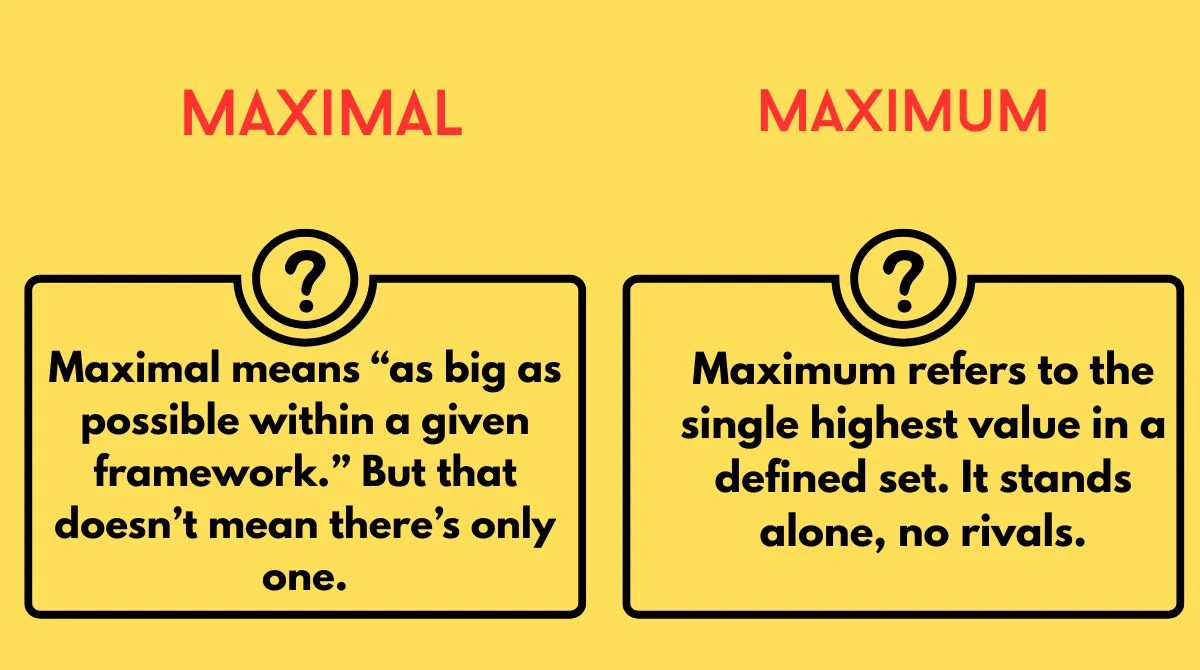
    Maximum refers to the single highest value in a defined set. It stands alone, no rivals.

    • Everyday example: “The maximum speed limit on this highway is 70 mph.” That means you can’t legally drive faster than 70 mph.
    • In a dataset: if heights are 5′, 6′, 6’2″, the maximum height is 6’2″.

    Maximum often flags absolute top value, clear cut.

    Maximal – Greatest Under Constraints

    Maximal means “as big as possible within a given framework.” But that doesn’t mean there’s only one.

    • In mathematics, a maximal element in a set with a partial order means: there’s no bigger element, but there might be several ‘largest’ ones.
    • Example: in a family tree, siblings might each be maximal in age if none is older than the other, but no single “oldest” exists.

    Maximal implies relative, not absolute.


    Mathematical Foundations

    These terms often trip students and professionals. Let’s unpack them clearly.

    Maximum in Mathematics

    In mathematics, maximum has a clean meaning:

    • Calculus: A function f(x)f(x)f(x)’s maximum is its highest point on an interval.
    • Statistics: If you collect test scores—and the highest score is 98—that’s the maximum.
    • Algebra/Data: In set theory, maximum of {1, 3, 5} equals 5.

    Clear. Absolute. Singular.

    Maximal in Mathematics

    Maximal introduces nuance:

    • Abstract algebra: A maximal subgroup of a group GGG is a subgroup HHH so there’s no subgroup strictly between HHH and GGG. Yet other such H′H’H′ may exist.
    • Order theory: In a partially ordered set, an element is maximal if no other element is strictly greater—but it might not be the ‘greatest’ because the set lacks a single top value.

    Partial Orders vs Total Orders

    Understanding the difference clarifies everything. Here’s a quick visual:

    Type of OrderDefinitionMaximum exists?Unique maximal element?
    Total OrderEvery pair is comparable (like ≤ on real numbers)Yes, a single maximumYes
    Partial OrderSome pairs not comparableNot alwaysPossibly multiple maximals

    Total Order Example: In numbers {1, 2, 3}, 3 is maximum because every number compares.
    Partial Order Example: Consider subsets of {a, b}:

    • Subsets are {}, {a}, {b}, {a, b}.
    • The maximal elements are {a, b} (it’s the greatest). But if we considered subsets without {a, b}, {a} and {b} both are maximal—neither is the absolute largest since they’re incomparable.

    Everyday Language vs Technical Language

    How often does daily chatter use maximal? Rarely. Americans almost always default to maximum.

    Everyday Usage

    • Maximum: “The maximum weight this elevator can hold is 2,000 lbs.”
    • Maximal is awkward: “The maximal weight…” sounds formal or technical.

    Academic & Technical Usage

    • Maximal subgroup is common in algebra.
    • In optimization: “local maximum” vs “global maximum.” Maximal pops up when discussing theoretical constructs, like chains or ideals.

    You’d rarely say, “I reached my maximal budget limit,” unless in philosophical tone.


    Real-World Applications of Maximal vs Maximum

    Everyday Life Examples

    • Maximum capacity on a bus: you’ve hit the very top.
    • Maximal effort: you’re pushing all you can, but that doesn’t mean you’re the strongest on earth—just in your own limits.

    Professional & Academic Usage

    In fields like law and finance, you’ll see maximum:

    • “Maximum liability.”
    • “Maximum allowed deduction.”

    Maximal stays in advanced theory:

    • In law, “maximal compliance” may mean doing the most you can under regulations.
    • Researchers talk about “maximal models” in logic.

    Specialized Fields Breakdown

    • Graph Theory:
      • Maximal clique: cannot add another vertex to still have a clique—but not necessarily the largest clique.
      • Maximum clique: the largest clique in the graph.
    • Calculus & Optimization:
      • Local maximum: highest point in a small interval.
      • Global maximum: highest across the whole domain.
    • Order Theory:
      • Maximal chains of elements: no larger chain exists beyond.
    • Computer Science:
      • Maximal matching in a graph: you can’t add an edge without breaking the matching, but there might be a maximum matching that’s larger.

    Common Misconceptions and Mistakes

    We often assume maximal = maximum. That slip can derail math logic or create misunderstandings.

    • Claim: “Every maximal element is maximum.” That’s true only in total orders—not in partial orders.
    • Confusion in casual contexts: Saying “maximal limit” when “maximum limit” is intended misleads others.

    Example of Wrong vs Correct Usage

    • Wrong: “This subset is maximal—it’s the biggest one.”
    • Better: “This subset is maximal—it can’t grow further under current rules, though there may be others just as large.”

    Comparison Table: Maximal vs Maximum

    AspectMaximumMaximal
    MeaningAbsolute highest valueLargest possible under constraints
    UniquenessAlways unique in total ordersMultiple maximal elements possible in partial orders
    Common UsageEveryday language, business, engineeringAdvanced mathematics, theoretical contexts
    Example (Everyday)“Maximum capacity = 50”“Maximal effort” meaning full effort—not absolute best
    Example (Math)In {1,2,3}, max = 3In a poset, multiple incomparable elements may be maximal
    Technical FieldsCalculus, statistics, general usageAlgebra, graph theory, order theory, logic languages

    Case Study: VO₂ Max in Sports Science

    Understanding VO₂ max brings clarity—and a good real-life example.

    VO₂ max (Volume of Oxygen Maximum) is the greatest volume of oxygen your body can use during intense exercise. It’s very specifically named. Maximum is correct because you’re measuring an absolute physiological limit.

    Why not maximal? Because researchers aren’t saying “under these constraints it’s as big as possible.” They’re measuring your absolute peak capacity.

    In elite athletes, average VO₂ max values range between 60–84 ml/kg/min for men and 50–72 ml/kg/min for women. These are actual data points, not theoretical bounds.

    Using maximal here would muddy the meaning. It’s specific. It’s absolute.


    Language Nuances and Regional Usage

    American and British English lean hard on maximum in business, contracts, and everyday chat. Maximal tends to sneak in only in academic or scientific texts.

    • American English: “Maximum efficiency,” “Maximum yield,” “Maximum coverage.”
    • British English: Similar, though “maximal” might appear slightly more often in technical prose—but still rare outside maths.

    In everyday talk, you’ll almost always hear “maximum.”


    Summary and Key Takeaways

    Let’s wrap everything up—short and helpful:

    • Maximum = the absolute highest value. Unique, clear, most common.
    • Maximal = the greatest within constraints. Could be many. Mostly technical.
    • In total orders, maximal = maximum; in partial orders, they diverge.
    • In daily speech, stick with maximum unless discussing technical structures in math.
    • Remember: maximum for peaks, maximal for local—but fully-grown limits under specific rules.

    Memory tip:

    Max-imum = Most.
    Max-imal = Most within a set.


    Maximal vs Maximum

    FAQs

    What’s the core difference between maximal and maximum?

    • Maximum denotes the single highest value in a set. Maximal signals there’s no larger element, but there may be more than one.

    Can something be maximal but not maximum?
    Yes—especially in partial orders. Multiple elements may be maximal without any being the absolute biggest.

    Why do mathematicians prefer ‘maximal’?
    Because they work with structures where not every pair is comparable—like subgroups or graph subsets.

    Is ‘maximal’ outdated?
    Not at all. It persists strongly in advanced math, logic, and theory. You just don’t see it much in casual speech.

    How do you know when to use which term?
    Ask yourself: am I naming “the highest overall” or “as high as possible under rules”? Use maximum for the former, maximal for the latter.

    Are there fields that use both regularly?
    Absolutely. Graph theory, optimization, and abstract algebra rely on both—and misuse can lead to errors.


    Final Thoughts

    You’ve embarked on a journey from everyday chatter to deep mathematics and physiology. You now know when to say maximum and when maximal fits the bill. That nuance adds clarity and precision to your writing and speaking.

    Next time you see these terms, you’ll recognize the subtle—but powerful—difference. And you’ll choose the right one, with confidence.

  • Mother Tongue vs Native Language: What’s the Difference? 🤔🌍

    Mother Tongue vs Native Language: What’s the Difference? 🤔🌍

    Language plays a crucial role in shaping our identity, culture, and communication.

    However, terms like “mother tongue” and “native language” are often used interchangeably, leading to confusion. While they may seem similar, they have distinct meanings and implications.

    This article explores their differences, historical origins, cultural significance, and practical applications in education and communication.

    Mother Tongue vs Native Language

    “Mother tongue” and “native language” may sound similar, but they have distinct meanings. Mother tongue refers to the first language learned at home, while native language is the language a person is most proficient in. Learn how these terms differ in culture, education, and identity!

    Understanding the Basics: Defining Mother Tongue and Native Language

    Mother Tongue

    The term mother tongue typically refers to the first language a person learns from birth. It is the language spoken at home, usually passed down by parents or caregivers. This language is deeply embedded in a person’s early experiences and cultural identity.

    Native Language

    Native language, on the other hand, is often used to denote the language a person is most proficient in or the primary language spoken in their community. It can sometimes differ from the mother tongue, especially in multilingual societies where a different language is dominant in education and public life.

    Key Differences

    AspectMother TongueNative Language
    DefinitionFirst language learned from parentsLanguage one is most proficient in
    AcquisitionAcquired naturally at homeCan be acquired through society or education
    UsageUsed within the family and cultural traditionsUsed for communication in broader society
    ChangeabilityLess likely to changeCan change based on environment

    The Emotional and Cultural Connotations of Mother Tongue

    A person’s mother tongue is more than just a mode of communication—it is a carrier of emotions, traditions, and heritage. This is why:

    • People often express emotions more naturally in their mother tongue.
    • Cultural traditions, folk stories, and familial bonds are tightly connected to the mother tongue.
    • Many people associate their mother tongue with a sense of belonging and identity.

    For example, a person born to French-speaking parents but raised in an English-speaking country may still feel emotionally connected to French, even if they are more proficient in English.

    The Geographic and Sociopolitical Implications of Native Language

    A person’s native language is often tied to the region they grow up in. Governments, educational systems, and official institutions influence what is considered the native language in a specific area.

    • In India, many people have a mother tongue spoken at home (e.g., Tamil or Bengali) but consider English or Hindi their native language due to their education and work environment.
    • In Canada, a person might speak Punjabi at home (mother tongue) but use English or French as their native language in daily life.

    Cambridge Dictionary Definitions and Interpretations

    According to the Cambridge Dictionary:

    • Mother tongue: “The first language that you learn when you are a baby, rather than a language learned at school or as an adult.”
    • Native language: “The first language that a person learns and speaks best.”

    These definitions highlight the subtle difference: the mother tongue is the first language learned, while the native language is the one a person is most proficient in.

    Historical Origins and Modern Usage of the Terms

    The concept of mother tongue dates back centuries and is rooted in the idea of linguistic heritage passed down maternally. Meanwhile, native language has been used more recently in academic and governmental contexts to describe language proficiency and national identity.

    Historical Evolution

    • Middle Ages: Latin was the dominant scholarly language, while people’s mother tongues remained local dialects.
    • Colonial Era: Native languages were suppressed in favor of colonial languages (e.g., English, Spanish, and French).
    • Modern Times: Globalization has blurred the lines between mother tongues and native languages, as people move and adapt to new linguistic environments.

    The Role of Family Structure and Caregivers in Language Development

    A child’s early linguistic environment plays a crucial role in language acquisition:

    • Parents and caregivers primarily shape the mother tongue.
    • Multilingual households can result in a child having multiple mother tongues.
    • A child may acquire a different native language if their educational environment differs from their home language.

    Examining ‘Father Tongue’ and the Evolution of Familial Language Transmission

    While “mother tongue” is the commonly used term, some linguistic researchers argue that a child’s first language is influenced equally by both parents. The term father tongue has emerged to describe cases where the paternal language plays a more dominant role in a child’s upbringing.

    • In patriarchal societies, children may adopt the father’s language for social mobility.
    • In multicultural families, children often become bilingual, balancing both languages.

    The Impact of Adoption and Non-Traditional Care on Language Identity

    For children raised in adoptive or non-traditional families, their mother tongue and native language may differ:

    • A child adopted from China but raised in the U.S. may have Mandarin as a birth language but English as their native language.
    • Foster care environments may introduce multiple languages, shaping linguistic development differently.

    Geographic Variations: How the UK and US Differ in Usage

    While the terms “mother tongue” and “native language” are widely used, their meanings can vary across regions:

    CountryPreferred TermCommon Usage Example
    UKMother Tongue“His mother tongue is Welsh.”
    USNative Language“Her native language is Spanish.”

    In the U.K., “mother tongue” is more commonly used in cultural and educational contexts, whereas in the U.S., “native language” is preferred in official documents and academia.

    Google Ngram Viewer Insights: Analyzing Language Trends Over Time

    By analyzing trends in language usage, we can see shifts in preference for “mother tongue” and “native language.”

    • “Mother tongue” was more commonly used in the 19th and early 20th centuries.
    • “Native language” gained popularity in the mid-20th century, especially in academic contexts.
    • In recent years, both terms have seen widespread usage, though “native language” is slightly more prevalent in global discourse.

    Implications of Language Preference in Education and Communication

    Educational policies often distinguish between mother tongue and native language when designing curricula:

    • Mother Tongue-Based Education: Some countries prioritize early education in a child’s first language to enhance learning outcomes.
    • Native Language Education: Many schools prioritize the language most widely spoken in a region to ensure integration into society.

    Choosing the Right Term: Native Language, Mother Tongue, or First Language?

    When deciding which term to use, consider:

    • For personal identity: Use mother tongue.
    • For proficiency and official contexts: Use native language.
    • For academic discussions: First language is a neutral alternative.

    FAQs

    1. What is the difference between mother tongue and native language?

    Mother tongue is the first language learned at home, usually from parents, while native language refers to the language a person is most proficient in, which may change over time due to education and environment.

    2. Can someone have a different mother tongue and native language?

    Yes. A child may learn one language at home (mother tongue) but become more proficient in another due to schooling or migration, making it their native language.

    3. What does the Cambridge Dictionary say about mother tongue vs. native language?

    According to Cambridge Dictionary:

    • Mother tongue: “The first language you learn as a baby.”
    • Native language: “The first language you learn and speak best.”

    4. How does multilingualism affect mother tongue and native language?

    In multilingual societies, a child may grow up speaking multiple languages at home but primarily use a different language in school or work, leading to different mother tongues and native languages.

    5. Is “mother tongue” or “native language” more commonly used?

    It depends on the region. “Mother tongue” is more common in the UK and cultural discussions, while “native language” is preferred in the US, academia, and official contexts.

    6. How does language preference impact education?

    Some education systems emphasize mother tongue-based learning to enhance comprehension, while others prioritize native language education to align with regional and global communication.

    Conclusion

    Understanding the difference between mother tongue and native language helps in appreciating linguistic identity, cultural heritage, and communication dynamics.

    Whether you’re discussing personal experiences, educational policies, or historical trends, using the right term enhances clarity and accuracy in conversations about language.

  • Recurring vs Reoccurring: What’s the Difference? 🤔📖

    Recurring vs Reoccurring: What’s the Difference? 🤔📖

    The English language is full of words that seem almost identical yet carry subtle differences in meaning.

    Recurring and reoccurring are two such words that often confuse even native speakers. While both relate to events happening more than once, their nuances set them apart.

    This guide will explore their definitions, historical roots, and practical applications to help you use them correctly in your writing and speech.

    “Recurring” and “reoccurring” may seem similar, but they have distinct meanings. “Recurring” refers to regular repetition, while “reoccurring” means something happens again without a set pattern. Learn how to use them correctly!


    Decoding the Definitions: Recur vs. Reoccur

    At first glance, recur and reoccur may appear interchangeable, but they have distinct meanings:

    • Recur (verb): To happen repeatedly or at regular intervals.
      • Example: “The meetings recur every Monday.”
    • Reoccur (verb): To happen again, but without any implication of regularity.
      • Example: “The power outage reoccurred last night.”

    The key distinction lies in frequency and expectation. Recurring events happen periodically, whereas reoccurring events happen again but not necessarily in a repeated pattern.


    The Original Latin Roots and English Evolutions

    Understanding the etymology of words often sheds light on their meanings. Here’s how these terms evolved:

    WordLatin OriginMeaning in LatinEvolution in English
    Recurrecurrere“To run back”Implies repetition or returning at intervals
    Reoccuroccurrere“To happen”Implies happening again without set frequency

    Since recurrere means “to run back,” it makes sense that recurring events cycle back periodically. Meanwhile, reoccur simply stems from occurrere, which means “to happen,” reinforcing the idea that it just means “to happen again.”


    Breaking Down the Frequency Factor

    Recurring vs Reoccurring

    One of the most significant distinctions between these terms lies in how often the event happens:

    • Recurring: Happens regularly and predictably.
    • Reoccurring: Happens again, but without a set pattern.

    Examples in Context

    ScenarioCorrect WordExplanation
    A monthly subscription billing cycleRecurringIt happens at a fixed interval.
    A random earthquake in the same regionReoccurringIt happens again but unpredictably.
    A seasonal flu outbreakRecurringIt follows a seasonal pattern.
    A car breaking down unexpectedlyReoccurringIt happens more than once but randomly.

    By examining these examples, you can see why choosing the right term matters in clear communication.


    The Nuances of Usage in American English

    Both words exist in American English, but recurring is significantly more common. You’re far more likely to encounter it in various contexts, such as:

    • Finance & Business: “Recurring revenue streams”
    • Medicine & Health: “Recurring migraines”
    • Entertainment & Media: “A recurring guest star on a TV show”
    • Technology & Software: “Recurring payments on a subscription plan”

    On the other hand, reoccurring is less frequently used and mainly appears in contexts where something happens multiple times without a clear schedule:

    • “Flooding in the area has been reoccurring due to climate change.”
    • “His headaches have been reoccurring for the past few months.”

    When to Opt for ‘Recurring’ Over ‘Reoccurring’

    If you’re unsure which word to use, follow these simple guidelines:

    • If the event happens at regular intervals, use recurring.
    • If the event happens again but sporadically, use reoccurring.

    Quick Trick to Remember:

    • Recurring = Regular (Both start with “R”)
    • Reoccurring = One-off reappearance

    Exploring Examples to Highlight Differences

    Common Phrases with “Recurring”

    • Recurring dream
    • Recurring theme in literature
    • Recurring expenses
    • Recurring subscriptions

    Common Phrases with “Reoccurring”

    • A reoccurring technical glitch
    • A reoccurring software bug
    • A reoccurring allergy reaction

    If the event follows a predictable cycle, recurring is correct. If it happens again but randomly, reoccurring fits better.


    Linguistic Insights: Recurrence and Reoccurrence Compared

    These two nouns follow the same distinction:

    • Recurrence: The act of happening regularly.
      • Example: “The recurrence of the flu each winter is expected.”
    • Reoccurrence: The act of happening again, without frequency.
      • Example: “The reoccurrence of a security breach surprised the company.”
    Noun FormMeaning
    RecurrenceHappens regularly, expected
    ReoccurrenceHappens again but unpredictably

    Common Misconceptions and Clarifications

    1. Can reoccurring be used instead of recurring?

    Technically, yes—but it’s less common and might sound awkward. Stick to recurring when discussing regular cycles.

    2. Is reoccur a proper word?

    Yes, but it’s much rarer in usage compared to recur. Many style guides recommend using recur instead.

    3. Do British and American English treat these words differently?

    No, the distinction remains the same in both varieties of English.

    4. Can an event be both recurring and reoccurring?

    Not at the same time! An event is either regular (recurring) or sporadic (reoccurring).


    Conclusion

    The difference between recurring and reoccurring may be subtle, but it’s important for clarity in communication. Remember:

    • Use “recurring” for events that repeat in a predictable manner.
    • Use “reoccurring” for events that happen again but irregularly.

    By keeping this distinction in mind, you’ll ensure your writing is precise, professional, and grammatically accurate. If in doubt, recurring is almost always the safer choice!