Category: Tricky Terms

  • Disbalanced vs Unbalanced or Imbalanced? 🤔 Which One’s Correct?

    Disbalanced vs Unbalanced or Imbalanced? 🤔 Which One’s Correct?

    Have you ever paused mid-sentence wondering whether to say imbalanced, unbalanced, or disbalanced? You’re not alone.

    These terms may seem interchangeable, but they carry subtle—yet important—differences in meaning, tone, and usage. Some are far more common and widely accepted, while others raise a few linguistic eyebrows.

    In this guide, we’ll unpack the differences, trace their origins, and look at how each is used in real-world contexts. Plus, we’ll dive into how prefixes like im-, un-, and dis- shape meaning in English.

    Let’s get into it and settle this once and for all.

    “Imbalanced” is used in formal and technical contexts to describe a lack of proportion or symmetry. “Unbalanced” leans more toward instability or irregularity in everyday language. “Disbalanced” is rare and often considered nonstandard.


    Understanding Imbalance in Language: Definitions and Usage
    Disbalanced vs Unbalanced or Imbalanced

    The idea of imbalance comes from the root word balance, which refers to a state of equilibrium or stability. When something lacks that balance—whether physically, mentally, emotionally, or structurally—we say it’s not balanced.

    But here’s where things get tricky: English gives us multiple negative prefixes, and not all of them function the same way.

    • Imbalanced generally describes something that lacks proper proportions or symmetry.
    • Unbalanced often leans toward describing instability or erratic conditions.
    • Disbalanced is rarely used and often flagged as incorrect or nonstandard.

    Here’s a quick comparison table to give you a snapshot:

    TermCommon UsagePart of SpeechTypical Contexts
    ImbalancedFormal and technicalAdjectivePsychology, health, society
    UnbalancedConversationalAdjectiveEmotions, behavior, structure
    DisbalancedRare, nonstandardAdjectiveOccasionally in niche writing

    An Overview of “Imbalanced”, “Unbalanced”, and “Disbalanced”

    These three terms all attempt to express a lack of balance, but the way they do it—and how often we see them—differs.

    Imbalanced

    Used in professional, clinical, or academic contexts. You’re more likely to hear this term in reports, articles, and diagnostics.

    • Example: “An imbalanced diet can lead to nutritional deficiencies.”

    Unbalanced

    This one feels more personal or colloquial. It’s used to describe mental states, structural problems, and anything that feels off-kilter.

    • Example: “After losing his job, he seemed emotionally unbalanced.”

    Disbalanced

    Although technically understandable, this variant isn’t widely accepted in modern English. It appears in non-native usage or in niche or outdated texts.

    • Example: “The disbalanced scale tilted to one side.” (less preferred)

    Note: Most style guides and dictionaries consider disbalanced incorrect or archaic.


    How Prefixes Affect Meaning in English Vocabulary

    English loves its prefixes. But they aren’t interchangeable. Each prefix adds a different flavor to the root word:

    PrefixMeaningCommon Usage Example
    un-Not / Opposite ofUnfair, untrue
    im-Not / WithoutImpossible, immature
    dis-Apart / ReverseDisconnect, disagree

    So why imbalanced and unbalanced but not disbalanced?

    • “Unbalanced” is logical—it simply means not balanced.
    • “Imbalanced” conveys a lack or deficiency in balance, especially in composition or systems.
    • “Disbalanced” seems like it should mean disrupted balance, but it’s not idiomatic in modern English.

    That’s why disbalanced remains on the fringe.


    Historical Usage Trends of Imbalance Terms in Literature

    Let’s take a peek at how these words have been used over time. Thanks to Google Books Ngram Viewer, we can see their relative popularity.

    📈 Google Ngram Insights

    WordFirst Major UsePeak Usage PeriodCurrent Trend
    Imbalanced~1950s1980s–2000sSteady
    Unbalanced~1800s1900sStill widely used
    DisbalancedScarcely usedNever peakedNear-zero usage

    Observation:
    Unbalanced has a longer history, but imbalanced gained traction in technical fields over the past few decades. Disbalanced remains obscure.


    Examples of “Imbalanced” in Various Contexts

    Let’s explore how imbalanced fits into modern communication. This word shines in formal, clinical, and diagnostic contexts:

    🔬 In Science and Health

    • “An imbalanced hormone level can affect your mood and energy.”
    • “This imbalanced dataset skews the machine learning results.”

    🌍 In Society and Economics

    • “The imbalanced power dynamics in the workplace caused tension.”
    • “An imbalanced trade agreement may harm local industries.”

    🧠 In Psychology

    • “Therapists may address imbalanced emotional responses caused by trauma.”

    Summary:
    Use imbalanced when you want to describe a lack of symmetry, proportion, or equity, especially in serious or academic discussions.


    Delving into the Meaning and Use of “Unbalanced”

    Unlike imbalanced, the word unbalanced often feels more dynamic—or even unstable. It’s commonly used to describe mental, emotional, or structural instability.

    ⚙️ Physical or Structural

    • “The unbalanced load caused the washing machine to shake violently.”
    • “The bridge collapsed due to an unbalanced foundation.”

    😟 Emotional or Psychological

    • “She became unbalanced after the loss of her loved one.”
    • “His unbalanced behavior raised concerns.”

    🗣️ In Arguments or Viewpoints

    • “The article presented an unbalanced view of the political situation.”

    Tip:
    Use unbalanced when the issue is more about instability or irregularity, rather than a measurable inequality.


    Verbal Illustrations of “Unbalanced” in Everyday Speech

    To understand how unbalanced is used in everyday language, check out these conversational examples:

    • “Don’t walk on that! It’s unbalanced and might tip over.”
    • “He went a little unbalanced after the breakup.”
    • “That opinion seems totally unbalanced. You need both sides.”

    These examples show how common unbalanced is in informal speech. It communicates instability in a relatable way.


    “Disbalanced”: A Rare Variant in the Balance Lexicon

    Let’s address the outlier: disbalanced. While it technically could make sense—just like disagree or disassemble—it’s almost never used by native speakers or major publications.

    Why Isn’t It Accepted?

    • It doesn’t appear in most major dictionaries like Merriam-Webster or Oxford.
    • It feels awkward and unidiomatic to native English speakers.
    • It lacks historical and literary backing.

    Where Might You See It?

    • Occasionally in non-native writing
    • Translations or technical texts where “disbalance” was rendered literally
    • Rare online forums or scientific articles (usually with corrections)

    Bottom line:
    Stick to imbalanced or unbalanceddisbalanced is rarely, if ever, the right choice.


    Special Cases: Dietary and Data Specifics

    Let’s look at situations where people often mix these terms up.

    🥗 Dietary Language

    CorrectIncorrect
    “An imbalanced diet leads to health issues.”“An unbalanced diet…” (still acceptable, but less precise)
    “Too many processed foods create nutritional imbalance.”“Disbalanced nutrients…” (awkward usage)

    While both imbalanced and unbalanced are used for food, imbalanced is preferred in health-related writing.

    💾 Data Science and AI

    In technical fields like machine learning, imbalanced is standard.

    • “An imbalanced dataset has more negative than positive cases.”
    • “Unbalanced data can skew results” – less common phrasing, but still understood.

    Pro Tip:
    When writing for scientific or technical audiences, use imbalanced to sound accurate and professional.


    Faqs

    What is the difference between imbalanced and unbalanced?

    “Imbalanced” is typically used in technical or clinical contexts to describe a lack of proportion or equality, while “unbalanced” refers to instability or irregular behavior in everyday speech.

    Is ‘disbalanced’ a real word?

    While technically understandable, “disbalanced” is not commonly accepted in standard English and is rarely used in professional writing. Stick to “imbalanced” or “unbalanced” instead.

    Can I use ‘imbalanced’ in casual conversation?

    Yes, but it’s more common in formal or academic contexts. In casual speech, “unbalanced” is more natural and widely used.

    Which is correct: an unbalanced diet or an imbalanced diet?

    Both are used, but “imbalanced diet” is more precise and preferred in health and nutrition writing.

    Is ‘unbalanced’ the same as unstable?

    Often, yes. “Unbalanced” can suggest physical, emotional, or mental instability depending on the context.

    How can I remember when to use imbalanced vs unbalanced?

    Use “imbalanced” when discussing measurable inequality or proportion (like data or hormones), and “unbalanced” for mental, emotional, or physical instability.


    Conclusion: Mastering the Difference Between Imbalanced, Unbalanced, and Disbalanced

    Choosing between imbalanced, unbalanced, and disbalanced is all about context and tone.

    Here’s your quick takeaway:

    • Use imbalanced for formal, academic, or technical contexts.
    • Choose unbalanced for everyday speech and emotional or structural issues.
    • Avoid disbalanced—it’s not recognized or widely accepted.

    Remember: Just because two words look similar doesn’t mean they’re used the same way.

    Now that you know the difference, you’ll never second-guess yourself when writing or speaking about balance again.

  • “What It Looks Like” vs “How It Looks Like” 🤯 | Which One Is Right?

    “What It Looks Like” vs “How It Looks Like” 🤯 | Which One Is Right?

    The English language is full of phrases that sound right but aren’t. One of the most common examples is the confusion between “what it looks like” and “how it looks like.”

    At first glance, both may seem acceptable—but only one is grammatically correct. If you’ve ever paused before writing or saying either phrase, this guide will clear things up once and for all.

    Let’s break it down, explore the grammar rules, and look at real-world usage to master the difference with confidence.

    The correct phrase is “what it looks like,” which uses “what” to introduce a noun clause describing appearance. “How it looks like” is incorrect because it combines two conflicting structures—”how” (manner) and “like” (preposition)—making it grammatically invalid.


    Introduction to Common English Phrases

    “What It Looks Like” vs “How It Looks Like”

    Everyday English is packed with idiomatic expressions that are used so often, they feel automatic. But when phrases sound similar—like “what it looks like” and “how it looks like”—even native speakers stumble.

    Why? Because conversational habits sometimes override grammar rules. This is especially common when sentence rhythm or word patterns seem familiar, even if they’re incorrect.


    Exploring the Grammar Behind “What It Looks Like”

    Let’s start with the correct phrase: “what it looks like.”

    This expression works because “what” acts as a noun clause—it represents a thing or an idea. In this case, “what it looks like” means “the appearance of something.”

    Structure Breakdown:

    • Subject: what
    • Verb: looks
    • Complement: like (used correctly with “what”)

    Example:

    • “I don’t know what it looks like, but I’ll recognize it when I see it.”

    Here, the entire clause “what it looks like” functions as a noun—something you don’t know.


    Why “What” Is the Right Choice

    The word “what” introduces indirect questions or embedded statements. It asks for a description, object, or thing.

    Key Functions of “What”:

    • Identifies something specific
    • Introduces a noun clause
    • Acts as the object of the verb

    More Examples:

    • “She explained what it looks like to the police.”
    • “Can you tell me what it looks like?”

    These are grammatically correct because the verb “looks” requires an object, and “what” fulfills that role properly.


    Examples in Context

    Let’s look at how “what it looks like” fits naturally into sentences:

    SituationCorrect Usage Example
    Description“He drew what it looks like from memory.”
    Inquiry“Do you remember what it looks like?”
    Explanation“That’s exactly what it looks like.”

    Notice how all of these examples treat “what it looks like” as a unit—a noun clause describing a thing.


    Prepositions and Their Objects

    The word “like” is a preposition. And prepositions must be followed by a noun or pronoun, not a clause that begins with “how.”

    That’s the key issue with “how it looks like.” Grammatically, it tries to jam two different structures together—and it just doesn’t work.

    Wrong construction:

    • ❌ “I don’t know how it looks like.”

    Here, “how” introduces a manner, while “like” is looking for a noun. But there’s no proper noun or pronoun between them. That makes the sentence ungrammatical.


    The Incorrect Phrase: “How It Looks Like”

    The phrase “how it looks like” may sound right because of casual conversation, but it’s grammatically incorrect in standard English.

    Why it’s wrong:

    • “How” implies manner (e.g., “how it works”).
    • “Like” implies similarity or appearance (e.g., “looks like a car”).
    • Using both in the same phrase results in redundancy and conflict.

    Correct Alternatives:

    • ✅ “How it looks”
    • ✅ “What it looks like”

    Understanding “How” in English Questions

    While “how” is not correct in “how it looks like,” it is correct in other contexts where you’re asking about the manner in which something happens.

    Examples of Correct Usage:

    • “How does it look?” (asking about appearance)
    • “I’m not sure how it looks after the redesign.”

    Here, there’s no “like” because “how” already implies the question of appearance or manner.


    Distinguishing Between “How It Looks” and “What It Looks Like”

    These two phrases are both grammatically correct—but they serve different purposes.

    PhraseUsageMeaning
    How it looksManner or condition“I don’t like how it looks now.”
    What it looks likeIdentity or description“That’s not what it looks like.”

    Quick Tip:

    • Use “how” when focusing on quality or condition.
    • Use “what” when referring to identity or visual appearance.

    Asking for Descriptions versus Value Judgments

    When someone says:

    • “Tell me what it looks like,” they want a description.
    • “Tell me how it looks,” they want a judgment or evaluation.

    Think of it this way:

    • What = physical details
    • How = opinion or manner

    Examples:

    • “Describe what it looks like so I can find it.” (detail)
    • “How does it look on me?” (judgment)

    Correcting Common Mistakes with “How” and “What”

    Common Mistake:

    • ❌ “Can you tell me how it looks like?”

    Correct Versions:

    • ✅ “Can you tell me how it looks?”
    • ✅ “Can you tell me what it looks like?”

    Correction Strategy:

    1. Identify what you’re asking: a description or a judgment.
    2. Choose “what” for things and descriptions.
    3. Choose “how” for manners and evaluations.
    4. Never use “like” with “how” in this context.

    Misconceptions Among Native and Non-Native Speakers

    Even native English speakers fall into the trap of using “how it looks like” due to regional dialects or conversational shortcuts. For non-native speakers, the confusion often comes from direct translations.

    For example:
    In some languages, both “how” and “what” might be translated from the same word, leading to structural mix-ups in English.

    Common Non-Native Pitfall:

    • Translating from a language that uses “how” for “what”
    • Applying patterns from casual speech or movies without grammar awareness

    Solution: Focus on the structure of English noun clauses and prepositional rules.


    Practical Tips for Mastering English Phraseology

    1. Read native-level writing. Notice how phrases like “what it looks like” are used in articles, books, and dialogue.
    2. Practice substitution. Replace “what it looks like” with “the appearance of it.” If it makes sense, you’re using it right.
    3. Avoid double constructions. Don’t mix “how” with “like” unless “like” is part of a different clause.
    4. Use grammar tools wisely. Grammarly, Hemingway Editor, and similar platforms can highlight these errors.
    5. Listen actively. Pay attention to how fluent speakers form questions and make descriptions.

    Faqs

    Which is correct: “what it looks like” or “how it looks like”?

    “What it looks like” is the correct phrase. “How it looks like” is ungrammatical because it incorrectly combines “how” (manner) with “like” (a preposition).

    Why is “how it looks like” incorrect?

    Because “how” introduces manner, and “like” requires a noun object. Using them together without proper structure leads to redundancy and incorrect grammar.

    What does “what it looks like” mean?

    It refers to the visual appearance or description of something, functioning as a noun clause in a sentence.

    Can I say “how it looks”?

    Yes. “How it looks” is grammatically correct when referring to evaluation or condition—for example, “I don’t like how it looks now.”

    How do I know when to use “what” vs “how”?

    Use “what” when asking for a description (identity). Use “how” when asking for a condition, opinion, or manner of something.

    Is “how it looks like” ever used by native speakers?

    Yes, but it’s considered incorrect. It may appear in informal speech or regional dialects, but it’s not accepted in standard grammar.


    Conclusion: Simplifying Complex English Language Rules

    In the battle between “what it looks like” and “how it looks like,” only one emerges grammatically correct—and that’s “what it looks like.”

    While both “what” and “how” are valuable tools in English, they serve distinct grammatical functions. Understanding when to use each helps improve clarity, fluency, and confidence in communication.

    So next time you find yourself second-guessing the phrase, just remember:
    Use “what it looks like” when describing something. Use “how it looks” when giving an opinion. Never use “how it looks like.”

  • “Wish You” vs “Wishing You” 💌 | Which Is Correct & When to Use Each

    “Wish You” vs “Wishing You” 💌 | Which Is Correct & When to Use Each

    You’ve probably written a card or sent a message that started with “Wish you…” or “Wishing you…” But have you ever stopped and wondered—which one is correct?

    Are they interchangeable, or does one fit better depending on the context?

    Let’s dig into the differences between “wish you” and “wishing you,” with clear explanations, examples, and usage tips so you can always send your well-wishes with confidence.

    Both “wish you” and “wishing you” are correct, but they aren’t interchangeable. Use “wish you” in complete, formal sentences with a subject (“I wish you success”), and use “wishing you” in casual, standalone messages (“Wishing you all the best!”). Context determines the right choice—read on to see how to use each properly.


    Understanding “Wish You” in Everyday Expressions

    “Wish you” is a phrase typically used in a complete sentence and often requires a subject before it. It is the base form of the verb “wish,” and it generally conveys a formal or direct tone.

    Common Uses:

    • “I wish you success in your new role.”
    • “We wish you a safe journey.”
    • “They wish you all the best.”

    Key structure:

    Subject + wish + object (you) + complement

    This structure is straightforward and commonly used in speech and writing. It appears more formal, making it a better fit for business communication or serious contexts.

    Important Tip:

    • Without a subject, “wish you” often feels incomplete or grammatically awkward.
      • Wish you a happy birthday. (Incorrect without context)
      • I wish you a happy birthday.
    “Wish You” vs “Wishing You”

    The Nuances and Uses of “Wishing You”

    “Wishing you” acts more like a present participle phrase and is often used on its own, especially in greetings or informal well-wishing. It doesn’t always need a clear subject because it implies one (often “I” or “we”).

    Common Uses:

    • “Wishing you all the best!”
    • “Wishing you a wonderful weekend.”
    • “Wishing you peace and happiness.”

    It’s often used in writing where warmth and brevity matter, such as:

    • Greeting cards
    • Email sign-offs
    • Social media posts
    • Wedding or birthday messages

    Tone and Style:

    • “Wishing you” is warmer and more emotionally expressive.
    • Ideal for personal communication or when you want to sound more heartfelt.

    Formal Celebrations and Toasts

    When you’re writing or speaking at formal events—like weddings, anniversaries, graduations—choosing between wish you and wishing you depends on tone and sentence structure.

    Formal Examples with “Wish You”:

    • “We wish you a lifetime of happiness together.”
    • “On behalf of the company, I wish you continued success.”

    More Casual, Toast-style Examples with “Wishing You”:

    • “Wishing you joy, love, and laughter today and always.”
    • “Wishing you a night to remember!”

    Quick tip: When giving a toast or writing a short, emotional message, “wishing you” often feels more natural and celebratory.


    Closing Statements in Correspondence

    In business or friendly email endings, both phrases can work—but with slightly different vibes.

    StylePreferred PhraseExample
    Professional/FormalWish you“I wish you success in your upcoming interview.”
    Warm/PersonalWishing you“Wishing you all the best for the weekend!”

    Email Sign-off Tips:

    • Use “Wishing you” to express positivity without sounding stiff.
    • Use “Wish you” when your message includes a clear subject and feels more formal.

    “Wish You” vs “Wishing You” in Common Greetings

    Let’s break down how these two phrases show up in real-world greetings.

    Greeting TypeWish YouWishing You
    Birthday“I wish you a happy birthday.”“Wishing you a happy birthday!”
    New Year“We wish you a prosperous New Year.”“Wishing you joy and success in the New Year.”
    Holiday“I wish you a Merry Christmas.”“Wishing you peace and joy this holiday season.”
    Farewell“They wish you a safe journey.”“Wishing you all the best on your travels!”

    Takeaway:
    Use “wish you” when the sentence includes a subject. Use “wishing you” when writing a standalone wish or greeting.


    The Popularity and Appropriateness of “Wish You” and “Wishing You”

    You might wonder: Which one do people use more often? And Which one sounds more natural today?

    Here’s what usage trends and stylistic preferences suggest:

    “Wishing You”:

    • More commonly used in cards, emails, and spoken well-wishes.
    • Seen as more emotionally resonant and casual-friendly.

    “Wish You”:

    • More structured and found in formal writing or professional settings.
    • Slightly less common in modern informal language.

    Expert quote:

    “Wishing you has become the go-to for personal messages because it feels more open, hopeful, and emotionally in tune with modern communication.” — LanguageStyle.org


    Insights From Google Ngram Viewer

    Using the Google Ngram Viewer, we can analyze how frequently “wish you” and “wishing you” have been used in published books over time.

    Key Findings:

    • “Wish you” had higher usage throughout the 19th and early 20th centuries.
    • “Wishing you” began gaining popularity in the late 20th century.
    • Today, both are still in use, but “wishing you” is increasingly favored for informal, expressive writing.

    Contextualizing Your Well-Wishes

    Choosing between wish you and wishing you depends entirely on the situation. Ask yourself:

    • Who am I writing or speaking to?
    • Is the tone formal or casual?
    • Is it part of a complete sentence or a standalone greeting?

    Here’s a quick-reference guide:

    ContextUse “Wish You”Use “Wishing You”
    Business Emails✔️✔️ (if warm/friendly)
    Wedding Toast✔️ (structured speech)✔️ (for personal touch)
    Greeting Card✔️
    Social Media Post✔️
    Academic/Professional Writing✔️

    Different Scenarios and How to Choose the Right Phrase

    Let’s walk through a few real-life situations:

    Scenario 1: Job Interview Follow-Up

    • ✅ “I wish you all the best in your interview.” (formal)
    • ✅ “Wishing you good luck tomorrow!” (friendly and supportive)

    Scenario 2: Holiday Card

    • ❌ “Wish you a Merry Christmas.” (missing subject)
    • ✅ “Wishing you a Merry Christmas and a joyful New Year!” (perfectly warm)

    Scenario 3: Office Farewell Email

    • ✅ “I wish you every success in your next role.” (professional tone)
    • ✅ “Wishing you all the best in your new adventure!” (collegial and upbeat)

    Scenario 4: Wedding Message

    • ✅ “We wish you both a lifetime of love and laughter.”
    • ✅ “Wishing you endless joy and unforgettable memories.”

    Both phrases work—you just have to match the vibe to the occasion.

    Wish You” vs “Wishing You”

    Faqs

    Which is correct: “wish you” or “wishing you”?

    Both are grammatically correct, but the usage depends on the sentence structure. “Wish you” needs a subject (e.g., “I wish you well”), while “wishing you” is often used in standalone greetings.

    When should I use “wish you”?

    Use “wish you” in formal or complete sentences where the subject is stated. It fits best in business communication, speeches, and structured writing.

    What does “wishing you” mean?

    “Wishing you” is a participial phrase commonly used to express heartfelt sentiments in cards, messages, or greetings. It implies a subject like “I” or “we” and doesn’t need to be part of a full sentence.

    Is “wish you a happy birthday” correct?

    Not on its own. It needs a subject to be complete: “I wish you a happy birthday.” Alternatively, you can say “Wishing you a happy birthday!” as a standalone message.

    Is “wishing you” formal or informal?

    “Wishing you” is generally more informal and warm. It’s great for personal communication, cards, or social media posts, but not typically used in academic or very formal writing.

    Can I use “wishing you” in business emails?

    Yes, especially in friendly sign-offs. It adds warmth without being unprofessional—for example, “Wishing you a productive week ahead!”


    Final Thoughts: Say It Right, Every Time

    So, which one is correct—wish you or wishing you?

    The answer is: both are correct, but they serve different purposes. Use wish you when writing a full, formal sentence with a clear subject. Use wishing you for personal messages, casual greetings, or heartfelt expressions.

    Now that you know the difference, you’ll never hesitate to choose the right phrase in cards, emails, or conversations.

  • Accumulative vs Cumulative 📚 | Know the Difference & Use Them Right

    Accumulative vs Cumulative 📚 | Know the Difference & Use Them Right

    Words like accumulative and cumulative often trip people up because they seem interchangeable. But here’s the catch—they’re not.

    While they share a root and both deal with growth or increase over time, they differ in nuance, tone, and usage across fields like education, finance, and even environmental science.

    So what really sets these two apart? In short: accumulative focuses more on acquisition, while cumulative emphasizes sequence and progression.

    Let’s dig into the details, clear up the confusion, and explore their real-world usage so you never second-guess them again.

    “Accumulative” and “cumulative” both relate to growth, but they aren’t the same. Use accumulative when referring to the act of collecting or gathering (e.g., wealth or data), and cumulative when describing the build-up or result of a process over time (e.g., cumulative GPA or cumulative effects). Learn how to distinguish them clearly with real-world examples.


    Accumulative vs Cumulative

    Understanding the Basics of Accumulative and Cumulative

    At first glance, accumulative and cumulative both appear to describe something growing larger through additions. And yes—they do. But here’s the twist:

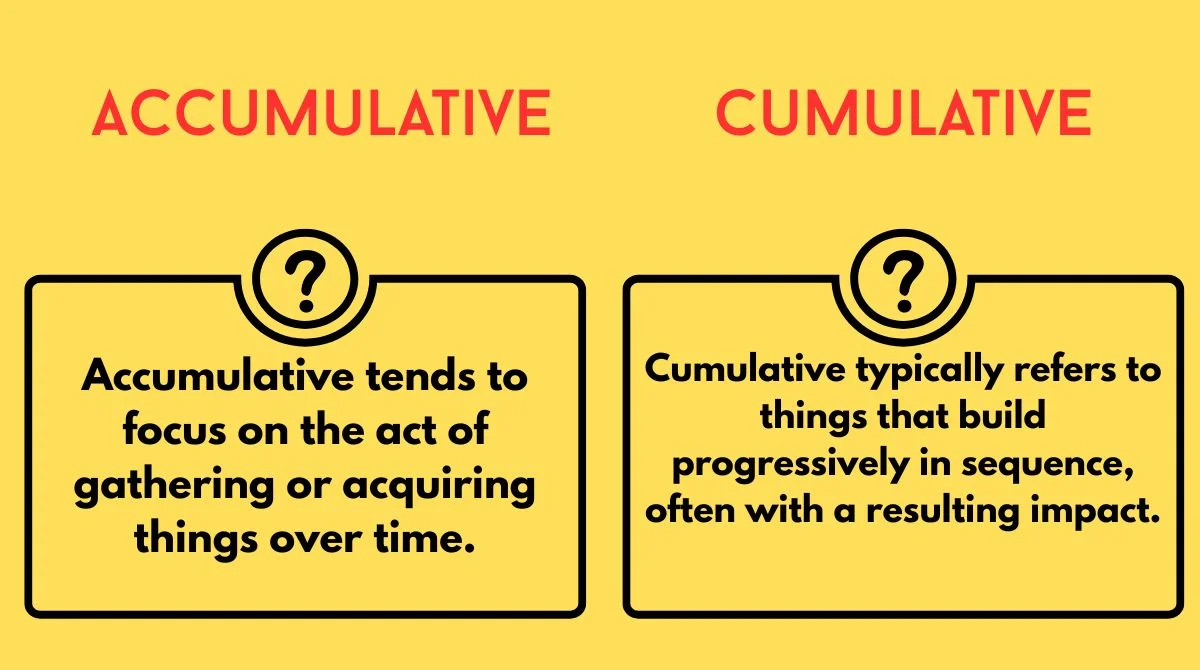
    • Accumulative tends to focus on the act of gathering or acquiring things over time.
    • Cumulative typically refers to things that build progressively in sequence, often with a resulting impact.

    These words share a Latin origin—cumulare, meaning to heap up—but their modern usage has diverged in subtle yet significant ways.


    Defining Accumulative: A Closer Look at Acquisitive Growth

    Accumulative is an adjective used to describe a gradual gathering or acquisition of something, usually in a way that emphasizes the act of collecting or hoarding.

    Characteristics of “Accumulative”:

    • Implies intentional or organic collection.
    • Often has a sense of ownership or control over what’s gathered.
    • Common in psychology, behavior, and informal economics.

    Examples:

    • He developed an accumulative habit of saving coins from every country he visited.
    • Her accumulative wealth grew steadily through smart investments.

    Synonyms:

    • Acquisitive
    • Gathering
    • Collecting

    Breaking Down Cumulative: Successive Additions Over Time

    Cumulative, on the other hand, speaks to a build-up over time—layered effects that often compound and result in an outcome or impact. It’s frequently used in scientific, educational, and technical contexts.

    Characteristics of “Cumulative”:

    • Implies ongoing sequence or progression.
    • Focuses on the total result of successive steps or events.
    • Often carries a quantifiable effect or consequence.

    Examples:

    • The cumulative effect of poor nutrition can lead to serious health problems.
    • The student’s final grade was based on cumulative assessments.

    Synonyms:

    • Increasing
    • Aggregated
    • Compound

    The Common Misconceptions and Misuses

    Here’s where people get tripped up: they use these words interchangeably—but context is everything.

    Common Errors:

    • Saying “cumulative savings” when the emphasis is on intentional collection—better to use accumulative.
    • Using “accumulative damage” in scientific contexts—cumulative is the correct term when referring to effects that build up over time.

    Quick Fix Tip:

    If you’re talking about the outcome of a process, use cumulative.
    If you’re talking about the act of collecting, use accumulative.


    The Nuances of Usage in Different Contexts

    Let’s break down how each word shows up across different domains:

    DomainAccumulativeCumulative
    FinanceAcquiring assetsCompounding returns
    EducationLearning habitsTest formats
    ScienceBehavioral traitsEnvironmental impacts
    TechnologyUser data collectionSoftware updates/effects
    PsychologyHoarding behaviorStress buildup

    The takeaway? Accumulative often has a qualitative focus, while cumulative leans quantitative.


    Exploring Examples in Real-World Scenarios

    Understanding these words becomes easier when we apply them to relatable situations.

    Example 1: Personal Growth

    • Accumulative: Over the years, she developed accumulative knowledge from her travels.
    • Cumulative: Her insights were the cumulative result of years of experience.

    Example 2: Workplace Performance

    • Accumulative: He gained accumulative respect through consistent leadership.
    • Cumulative: His bonus reflected cumulative achievements over four quarters.

    Example 3: Health & Lifestyle

    • Accumulative: An accumulative diet of processed foods can change eating habits.
    • Cumulative: The cumulative impact of lack of sleep is often underestimated.

    Accumulative vs. Cumulative in Financial Terms

    This is a domain where clarity matters most. Misusing these words could result in miscommunication or financial misunderstanding.

    Accumulative in Finance:

    Refers to gathering assets over time, often deliberately.

    Examples:

    • Accumulative savings account
    • Accumulative investment strategy

    Cumulative in Finance:

    Refers to returns, interest, or impact over time.

    Examples:

    • Cumulative interest
    • Cumulative return on investment

    Tip: Use accumulative when referring to what’s being built up; use cumulative when referring to how it’s grown over time.


    Educational Applications: Exam Types and Learning Processes

    In education, the two terms are used very precisely, especially when describing testing styles and learning development.

    Cumulative Testing:

    Tests that cover all prior material up to the present.

    • Encourages retention and integration of knowledge.
    • Used in final exams, standardized testing.

    Example:
    The biology final was cumulative, testing everything from the first day of class onward.

    Accumulative Learning:

    Describes the gathering of skills and understanding over time.

    • Implies a growing base of knowledge.
    • Often informal or self-directed.

    Example:
    Her accumulative learning process helped her master coding outside of school.


    Cumulative Effects and Sequences in Nature and Technology

    In both environmental science and tech, cumulative effects are crucial to understanding large-scale patterns.

    Cumulative Effects in Nature:

    • Greenhouse gases contribute to cumulative climate change.
    • Pollution has cumulative effects on marine life.

    Cumulative Sequences in Tech:

    • Software errors that build up over updates.
    • Memory usage that causes cumulative slowdowns.

    Meanwhile, accumulative might apply to how data is gathered or resources are compiled, but the lasting impact is cumulative.


    Case Studies: Environmental and Data Progressions

    Case Study 1: Environmental Impact

    Scenario: An industrial plant emits low levels of toxins.

    Accumulative: The company tracks accumulative emissions for compliance.
    Cumulative: Over 10 years, the toxins create a cumulative health risk for nearby residents.

    Case Study 2: Data Science

    Scenario: A machine learning model processes user behavior.

    Accumulative: The model collects accumulative data from multiple platforms.
    Cumulative: The algorithm’s accuracy improves cumulatively as more data is analyzed.


    Language Mastery: Tips for Remembering the Difference

    Still not confident? Here are some quick memory tricks and tools:

    Mnemonic Devices:

    • Accumulative = Acquiring intentionally
    • Cumulative = Compounding over time

    Word Associations:

    WordThink of…
    AccumulativeHoarding coins, growing a collection
    CumulativeBuilding blocks, a snowball effect

    Quick Quiz:

    Choose the correct word:
    The ___ GPA reflects your entire academic performance.
    Cumulative

    She has an ___ habit of collecting antique watches.
    Accumulative


    Accumulative vs Cumulative

    Faqs

    What is the difference between accumulative and cumulative?

    Accumulative refers to gathering or acquiring things over time, while cumulative refers to the increasing result or total impact of additions made over a period.

    Can “accumulative” and “cumulative” be used interchangeably?

    No, they are not truly interchangeable. While both involve growth, “accumulative” focuses on collection, and “cumulative” emphasizes resulting impact or total effect.

    What does accumulative mean in finance?

    In finance, “accumulative” refers to strategies focused on acquiring assets or savings over time, such as an accumulative savings plan.

    What does cumulative mean in education?

    “Cumulative” in education refers to assessments or grades that reflect the total performance across an entire course or curriculum.

    Is it correct to say “cumulative savings”?

    It depends on the context. If the emphasis is on gathered savings, “accumulative savings” is more precise. If highlighting total savings impact over time, “cumulative savings” may fit.

    How can I remember the difference between accumulative and cumulative?

    Think “accumulative = acquiring” and “cumulative = compounding.” Accumulative relates to what’s being gathered; cumulative relates to the final effect.


    Final Thoughts: Why Word Precision Matters

    Whether you’re writing a thesis, managing investments, or explaining climate change, the difference between accumulative and cumulative matters. One highlights the gathering, the other emphasizes the impact.

    Use them precisely to sound more professional, avoid misunderstandings, and sharpen your writing.

    If you’ve ever confused these two before, you’re not alone—but now, you’ve got the tools to keep them straight for good.

  • My Father and I vs. My Father and Me 🤔 | Simple Grammar Rules to Get It Right

    My Father and I vs. My Father and Me 🤔 | Simple Grammar Rules to Get It Right

    It’s a grammar question that trips up even native English speakers: Should you say “My father and I” or “My father and me”?

    While it might sound subtle, choosing the right phrase can make a huge difference in how polished and correct your English sounds.

    Don’t worry—this guide will break it all down with simple explanations, helpful tips, and plenty of real-life examples.

    The correct choice between “My father and I” and “My father and me” depends on grammar rules. Use “My father and I” when the phrase is the subject of the sentence (doing the action), and “My father and me” when it’s the object (receiving the action). Check by removing “my father”—if “I” or “me” sounds correct, you’ve got the right answer!


    Understanding Subject and Object Pronouns in English

    Before we get into “my father and I” vs. “my father and me,” let’s zoom out and look at how pronouns work in English grammar.

    There are two types of pronouns involved in this discussion:

    TypeExample PronounsRole in the Sentence
    Subject PronounsI, he, she, we, theyDo the action in a sentence (subject)
    Object PronounsMe, him, her, us, themReceive the action (object of a verb or preposition)

    Example Sentences:

    • Subject: I called the doctor.
    • Object: The doctor called me.

    The rule is simple: Use subject pronouns when the person is doing the action, and object pronouns when they’re receiving the action.


    The Correct Cases: “My Father and I” Versus “My Father and Me”

    My Father and I vs. My Father and Me

    The trickiest part is knowing when to use “I” and when to use “me.” Most people stumble when combining another person with themselves in a sentence.

    Let’s break it down:

    • Use “My father and I” when it’s the subject of the sentence.
    • Use “My father and me” when it’s the object of the sentence.

    Quick Test:

    If you remove “my father and” from the sentence, would you say “I” or “me”?

    ✅ Correct:

    • My father and I went to the game. → I went to the game.
    • The teacher gave my father and me a gift. → The teacher gave me a gift.

    ❌ Incorrect:

    • My father and me went to the game. → Me went to the game? (Nope.)
    • The teacher gave my father and I a gift. → The teacher gave I a gift? (Wrong.)

    When to Properly Use “My Father and I”

    You use “My father and I” when the two of you are doing something together—when you’re the subject of the sentence.

    Correct Examples:

    • My father and I are going to the store.
    • My father and I built a treehouse last summer.
    • My father and I love fishing on weekends.

    In each case, “I” is acting in the sentence. If you removed “my father,” it would still make sense:

    • I am going to the store.
    • I built a treehouse.
    • I love fishing.

    Pro Tip:

    Always mention the other person before yourself in formal writing:
    ✔️ My father and I
    I and my father


    Appropriate Usage of “My Father and Me”

    Use “My father and me” when the two of you are receiving an action—either from a verb or a preposition.

    Correct Examples:

    • The photographer took a picture of my father and me.
    • She invited my father and me to the ceremony.
    • The award was given to my father and me.

    Again, test it by removing “my father”:

    • The photographer took a picture of me.
    • She invited me.
    • The award was given to me.

    These all work perfectly. If “me” fits alone, then “my father and me” is the right choice.


    Polishing Your Grammar: Tips for Remembering the Rules

    Here are some simple ways to avoid confusion and sound more confident in your writing and speech:

    Quick Grammar Tips:

    • Drop the other person temporarily: Would you say “I” or “me” if you were alone?
    • Use your ear: Often, incorrect usage just sounds wrong.
    • Read aloud: If it sounds awkward, it probably is.
    • Remember the role: Are you doing something (subject)? Use “I.” Is something happening to you (object)? Use “me.”

    Common Misconceptions and Correcting Common Errors

    Many people wrongly believe that “my father and I” is always the correct and more polite choice. This has led to overcorrection—using “I” where “me” is needed.

    Examples of Misuse:

    • He gave the tickets to my father and I.
      He gave the tickets to my father and me.
    • The teacher spoke to my father and I about my grades.
      The teacher spoke to my father and me about my grades.

    Using “I” just to sound more formal often backfires and makes the sentence grammatically incorrect.


    Why “Me and My Father” Is Often Misused

    People commonly say “me and my father” in casual speech, but that order is considered informal and grammatically questionable, especially in writing.

    What’s the issue?

    • It’s impolite to mention yourself first.
    • It’s often grammatically wrong depending on the sentence.

    Better Alternatives:

    • My father and I went to the park.
    • She called my father and me.

    It’s okay to say “me and my father” in casual conversations with friends, but it’s best avoided in writing, interviews, or professional settings.

    Grammar Tip: In formal situations, always place the other person first and double-check the case of the pronoun.


    The Role of Context in Choosing ‘I’ or ‘Me’ With Family References

    Context is everything in grammar. Whether you use “I” or “me” depends entirely on how the phrase functions within the sentence.

    Let’s look at some examples to see how context changes the usage:

    SentenceSubject or Object?Correct Phrase
    My father and I are taking a road trip.SubjectMy father and I
    The gift was from my father and me.Object (preposition)My father and me
    She saw my father and me at the mall.ObjectMy father and me
    My father and I made breakfast together.SubjectMy father and I
    They waved at my father and me from the car.ObjectMy father and me

    Always check who is doing what in the sentence. That’s the best way to avoid mistakes.


    Faqs

    When do you use “My father and I”?

    Use “My father and I” when the phrase is the subject of the sentence, meaning you and your father are doing something together.

    When do you use “My father and me”?

    Use “My father and me” when the phrase is the object of the sentence, meaning you and your father are receiving the action or being affected by it.

    What’s the best way to check whether to use “I” or “me”?

    Test the sentence by removing “my father.” If “I” or “me” sounds correct alone, that’s your answer.

    Is it wrong to say “Me and my father”?

    In formal writing and speech, yes. It’s better to say “My father and I.” In casual conversations, it’s okay but still avoid it in professional settings.

    Can you say “My father and I” in the object position?

    No, use “My father and me” when it’s the object of the sentence, as “I” is for subjects and “me” is for objects.

    Why is “My father and I” used so often?

    People overcorrect by using “I” to sound more formal. However, using it incorrectly can make the sentence grammatically wrong.


    My Father and I vs. My Father and Me

    Final Thoughts: Mastering the “My Father and I” vs. “My Father and Me” Dilemma

    The difference between “my father and I” and “my father and me” comes down to subject vs. object, and mastering this can make your English sound more fluent and polished.

    Here’s your cheat sheet:

    • Use “My father and I” when you’re the subject (doing something).
    • Use “My father and me” when you’re the object (something is being done to you).
    • 🚫 Avoid “Me and my father” in formal speech or writing.
    • 🧠 Use the solo pronoun test: remove “my father” to figure out if it should be “I” or “me.”

    Final Tip:

    If you’re ever unsure, say the sentence aloud without the other person’s name. If it sounds right with just “I” or “me,” you’ve got your answer!

  • Smooth vs Smoothe: Which One Is Correct? 🤔 | Clear Grammar Tips

    Smooth vs Smoothe: Which One Is Correct? 🤔 | Clear Grammar Tips

    English is full of confusing words that look and sound alike, and smooth and smoothe are prime examples.

    Despite the fact that many people mistakenly add an “e” to smooth, the correct term is always smooth.

    This article will break down the differences, explore common misconceptions, and ensure you leave with a solid understanding of how to use smooth in your writing and speech.

    The correct spelling is always smooth, not smoothe. While many mistakenly add an “e” to soften the word, smooth is both the adjective and verb form, describing something even, glossy, or free from roughness. Smoothe is a common error with no basis in modern English.


    Understanding the Proper Spelling and Use of Smooth

    Let’s start by addressing the elephant in the room: smooth is the correct spelling, and smoothe is not recognized as a standard word in the English language.

    Many people mistakenly believe that adding an “e” makes the word sound softer or more refined, but in reality, the “e” at the end of smoothe is simply an error.

    Smooth as a Standard Word

    • Adjective: Describes something that is even, without bumps, or free of roughness.
      Example: “The surface of the table is smooth.”
    • Verb: Refers to the action of making something smooth, usually by rubbing or polishing.
      Example: “She smoothed out the wrinkles in her dress.”

    Smooth vs Smoothe

    Defining Smooth as a Verb and an Adjective

    Smooth as a Verb

    As a verb, smooth means to make something more even or to remove imperfections. The action of smoothing often involves physical effort, such as rubbing or polishing. It can also refer to actions that reduce tension or conflict.

    Examples of Smooth as a Verb:

    • “She smoothed the fabric with her hands to remove the wrinkles.”
    • “He tried to smooth things over after the argument.”

    Smooth as an Adjective

    When used as an adjective, smooth describes the texture or appearance of something. It suggests an absence of roughness or unevenness.

    Examples of Smooth as an Adjective:

    • “The road was smooth, making the drive very comfortable.”
    • “Her skin felt smooth after using the lotion.”

    The Correct Conjugations of Smooth

    Unlike some irregular verbs, smooth is conjugated in a predictable and simple way. Let’s take a closer look at its various forms.

    • Base form: smooth
    • Past tense: smoothed
    • Past participle: smoothed
    • Present participle/gerund: smoothing

    The correct conjugations follow the standard pattern of regular verbs, adding “-ed” in the past tense and present participle. This makes smooth straightforward to use in various tenses.

    Examples:

    • “She smoothed the surface of the wood yesterday.”
    • “He is smoothing the edges of the paper right now.”

    The Common Misconception: Smoothe Revealed

    The word smoothe has been circulating in modern English, often as a mistake for smooth. However, this is simply a misconception based on a misunderstanding of English spelling conventions.

    Why the ‘E’ Is Unnecessary

    The idea that smoothe might be a valid spelling likely comes from old English forms or confusion with similar-sounding words that do end with an “e.” In the 16th and 17th centuries, some words, like love, were often written with an “e” at the end, but this was a feature of older English spelling. The addition of “e” in smoothe does not fit modern grammatical standards.

    Smoothe in Modern Usage

    Though some may use smoothe in an attempt to soften the word, it is not recognized in standard dictionaries. The correct and widely accepted form is smooth.


    Exploring the English Language: Smooth vs. Other Similar Words

    In English, smooth has a few close relatives that might lead to confusion, especially when comparing them in certain contexts. Let’s take a look at some of these terms:

    Smooth vs. Sleek

    While both words can describe something that is even or glossy, sleek often refers to something that looks stylish or well-groomed, especially in the context of people, animals, or even vehicles.

    • Smooth: Refers more to texture and physical sensation.
      Example: “The countertop is smooth to the touch.”
    • Sleek: Often used to describe something aesthetically pleasing and shiny.
      Example: “The car had a sleek design with a shiny finish.”

    Smooth vs. Polished

    Polished implies a high level of finish or refinement, often associated with skill or effort.

    • Smooth: More about the texture or surface quality.
    • Polished: Refers to something that has been refined to a high standard, often used metaphorically.
      Example: “Her polished performance earned her a standing ovation.”

    Conjugation of Smooth

    We’ve touched on this in an earlier section, but let’s take a moment to dive deeper into the conjugations of smooth to ensure you can use it with precision.

    Present Tense

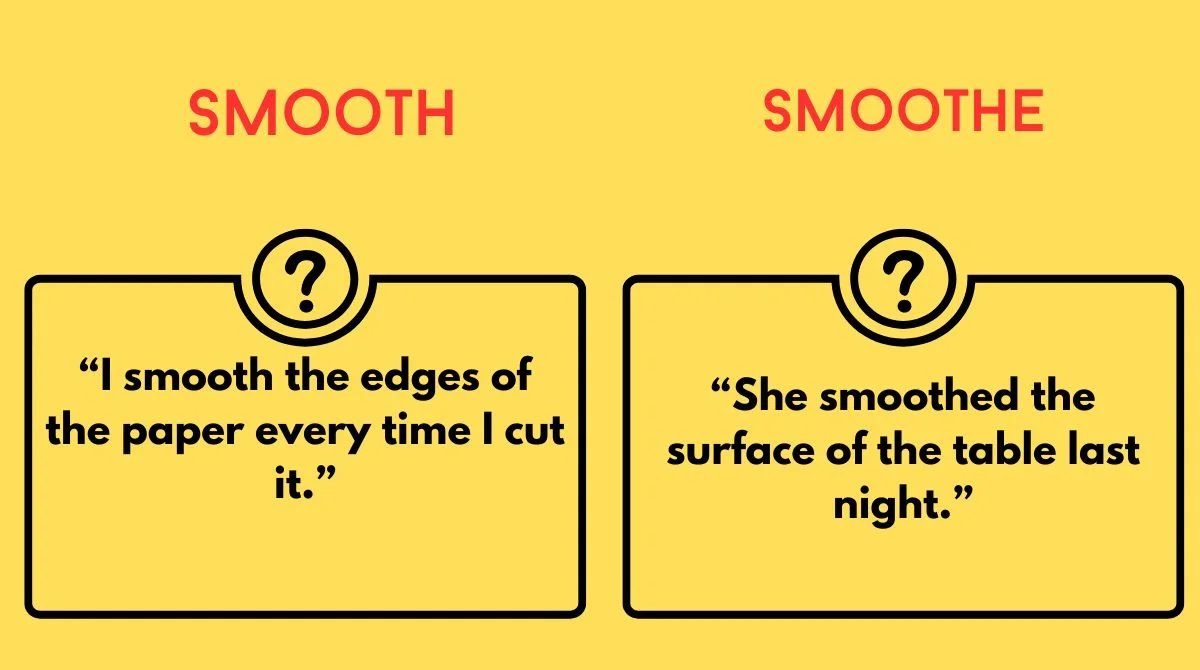
    • “I smooth the edges of the paper every time I cut it.”
    • “They smooth the fabric before stitching it together.”

    Past Tense

    Smooth vs Smoothe
    • “She smoothed the surface of the table last night.”
    • “He smoothed out the situation with a simple apology.”

    Future Tense

    • “I will smooth the wrinkles out of my shirt before the meeting.”

    Present Participle

    • “She is smoothing out the rough patches in her relationship.”

    Smooth in Action: Examples of Correct Usage in Sentences

    To further clarify the usage of smooth, here are some real-world examples that demonstrate its proper application.

    Correct Usage as an Adjective:

    • “The river was smooth, and the boat glided effortlessly.”
    • “After the haircut, his hair looked sleek and smooth.”

    Correct Usage as a Verb:

    • “She smoothed her hands over the fabric to remove any creases.”
    • “He worked hard to smooth out the wrinkles in their communication.”

    Smoothe and Smoothen: Misuses in Modern Writing

    In addition to smoothe, some people mistakenly use smoothen as a verb, which is unnecessary and incorrect.

    The Nonexistent “Smoothen”

    In standard English, smooth is both the noun and verb form, and there is no need to add an “en” to the verb. Smoothen might seem to be a logical verb form, but it is not grammatically accepted.

    Incorrect: “She will smoothen the paper before folding it.”
    Correct: “She will smooth the paper before folding it.”


    Ensuring Linguistic Accuracy: The Importance of Correct Spelling in Communication

    Correct spelling isn’t just about following grammatical rules—it’s crucial for clear, effective communication. Using words like smooth correctly ensures that your message is not only accurate but also professional and easy to understand.

    Why Correct Spelling Matters:

    • Credibility: Consistent, accurate spelling shows attention to detail.
    • Clarity: Mistakes like using smoothe instead of smooth can confuse your audience.
    • Professionalism: Proper spelling reflects well on your writing skills, whether it’s a casual blog post or a formal business email.

    By mastering the correct usage of smooth, you’ll improve both your writing and your ability to communicate effectively.


    Faqs

    What’s the difference between “smooth” and “smoothe”?

    “Smooth” is the correct spelling. “Smoothe” is an incorrect variation that many mistakenly use but is not recognized in modern English dictionaries.

    When should I use “smooth” as a verb?

    Use “smooth” as a verb when describing the action of making something even or free from wrinkles, such as smoothing a surface or smoothing out a problem.

    Can “smoothe” be used in modern English?

    No, “smoothe” is not recognized as a correct word in standard English. The proper term is always “smooth.”

    Is “smoothen” a correct form of the verb “smooth”?

    No, “smoothen” is incorrect. The verb form is simply “smooth,” with no “en” added.

    What does “smooth” mean as an adjective?

    As an adjective, “smooth” describes something that is even, glossy, or free from roughness, such as smooth skin or a smooth road.

    Why do people mistakenly use “smoothe”?

    The confusion likely arises from old English spelling conventions or the mistaken belief that the “e” softens the word, but modern English does not include “smoothe.”


    Conclusion

    In conclusion, smooth is the correct spelling, and smoothe is nothing more than a common mistake. Understanding the proper use of smooth, both as a verb and an adjective, will help you write and speak more clearly and accurately.

    Remember, language is all about precision, and knowing when and how to use words like smooth can make all the difference in your communication.

    Now that you have a deeper understanding of smooth, keep an eye out for other commonly confused words and continue to refine your language skills. If you have any questions or want to share your thoughts, feel free to leave a comment below!

  • Oftentimes vs Often Times: What’s Correct? 🤓📝

    Oftentimes vs Often Times: What’s Correct? 🤓📝

    Have you ever written “often times” in an email or essay and wondered if it’s actually correct? Or maybe you’ve spotted “oftentimes” in an older novel and thought, wait… is that even a real word? You’re not alone.

    “Often times” and “oftentimes” have puzzled writers and readers for generations, and the confusion doesn’t seem to be going away anytime soon.

    So, what’s the difference between often times and oftentimes? Which one should you use—and when?

    Let’s dig into the origin, usage, and modern preferences for both, so you can write with confidence and avoid this common grammatical misstep.

    Is it “often times” or “oftentimes”? While “oftentimes” is a correct adverb meaning “frequently,” “often times” is not standard and is generally considered incorrect. Discover why—and when to use which.


    Introduction to Oftentimes and Often Times

    Let’s set the record straight early on:

    • Oftentimes is a legitimate, recognized adverb.
    • Often times (two separate words) is not standard and is generally considered a mistake or a misinterpretation of “oftentimes.”

    You might see “often times” pop up in informal writing, but that doesn’t make it correct. In fact, grammar purists and style guides alike agree—“oftentimes” is the only form you should be using, if you’re not just sticking with “often.”


    Oftentimes vs Often Times

    The Historical Origins of Often and Oftentimes

    To understand the confusion, we need to go back—way back.

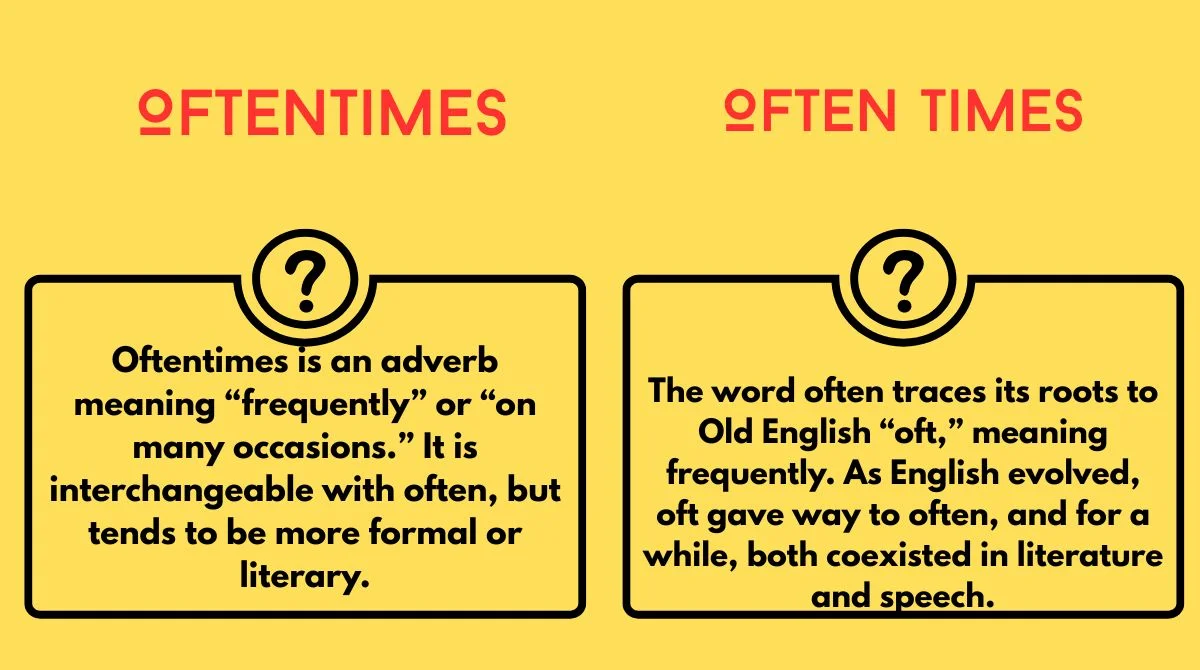
    The word often traces its roots to Old English “oft,” meaning frequently. As English evolved, oft gave way to often, and for a while, both coexisted in literature and speech.

    Then came oftentimes—a compound that essentially means frequently, just like often does. It’s formed by combining:

    • Oft (frequent)
    • en (an adverbial suffix)
    • times (occurrences)

    It’s a little redundant, sure. But in earlier centuries, redundancy was emphasis.


    Dissecting Middle English: Unearthing the Roots

    In Middle English (1100–1500), you’ll find plenty of examples of oftentimes used in poetry and prose. Authors of the time leaned heavily on repetition and rhythm. Adding -times to an adverb wasn’t seen as redundant—it was just good style.

    Consider Chaucer, who frequently used constructions like “oftentimes” and “seldomtimes.” These added musicality to the language and made meaning crystal clear.

    “Oftentimes, the knight would ride alone…”
    The Canterbury Tales (paraphrased)

    By contrast, “often times” as two words rarely—if ever—appeared in writing until modern typographical or autocorrect errors started creeping in.


    The Evolution of Adverbial Use in American English

    American English, compared to British English, tends to favor shorter, more efficient expressions. This is likely why oftentimes started falling out of favor in the U.S. by the mid-20th century, with writers preferring the simpler often.

    That said, oftentimes hasn’t disappeared completely.

    Frequency of Usage in American English

    TermFrequency (Google Books Ngram 2000–2020)
    OftenExtremely high
    OftentimesModerate
    Often timesRare and nonstandard

    Writers like Mark Twain and Ralph Waldo Emerson used oftentimes unapologetically, proving it has held its place—even if it’s no longer fashionable in academic circles.


    Oftentimes: Understanding Its Use and Context

    Oftentimes is an adverb meaning “frequently” or “on many occasions.” It is interchangeable with often, but tends to be more formal or literary.

    Examples:

    • “Oftentimes, people ignore advice until it’s too late.”
    • “She oftentimes reflects on her childhood memories.”

    You’ll most likely see it:

    • In literature
    • In academic essays
    • In formal speeches

    It adds a poetic or reflective tone, which can be effective when used sparingly.


    The Grammatical Nuances of Often Times

    Now let’s talk about “often times”—with the space in between.

    This version is not grammatically correct as an adverbial phrase. It’s an incorrect attempt to separate a compound word that isn’t meant to be broken apart.

    Why It Happens:

    • Autocorrect errors
    • Misunderstanding the structure of “oftentimes”
    • Overgeneralizing patterns like “sometimes,” “many times,” or “at times”

    How It Can Be Misused:

    • ❌ “Often times I go running in the morning.”
    • ✅ “Oftentimes I go running in the morning.”
    • ✅ “Many times I go running in the morning.”
    • ✅ “Often, I go running in the morning.”

    While “often times” may occasionally appear in blogs or casual writing, most style guides (APA, MLA, Chicago) advise avoiding it completely.


    When Two Words Don’t Make a Right: The Misconception

    Let’s be clear: Just because “many times” and “some times” are valid doesn’t mean “often times” is.

    Here’s a quick comparison:

    PhraseStandard?Meaning
    Oftentimes✅ YesFrequently
    Often times❌ NoNonstandard (avoid it)
    Many times✅ YesNumerous occasions
    At times✅ YesOccasionally

    Lesson: Not all combinations of adverb + “times” are grammatically valid.


    The Modern Preference: Is Brevity the Soul of Wit?

    William Shakespeare once wrote, “Brevity is the soul of wit.” That sentiment rings true in modern English.

    Most editors, writing coaches, and even grammar apps prefer:

    • “Often” for everyday writing
    • “Oftentimes” for formal, poetic, or rhetorical use

    When to Choose “Oftentimes”:

    • When you want to sound reflective or literary
    • When writing a formal speech or narrative
    • When variety in tone is important

    For most modern purposes, though, often is all you need.


    Cultural Usage: Oftentimes in American versus British English

    Interestingly, oftentimes is more common in American English than British English. British writers and speakers often avoid it entirely, opting instead for:

    • Often
    • Frequently
    • Usually

    Comparison Table

    RegionPreferred Usage
    United StatesOften, Oftentimes (both valid)
    United KingdomOften, rarely Oftentimes

    Even in the U.S., some consider oftentimes a bit archaic—but that doesn’t make it incorrect.


    Adopting Oftentimes: Linguistic Quirks

    Language isn’t just about rules—it’s about rhythm, tone, and style. Oftentimes may sound old-fashioned, but it still has a place in modern writing when used thoughtfully.

    Use it:

    • To create emphasis
    • To establish a reflective tone
    • As a stylistic variation in formal essays or narratives

    But don’t overuse it. Overusing archaisms can make your writing sound forced or unnatural.


    Synonyms and Antonyms: Expanding Your Vocabulary

    To avoid repetition, try swapping often or oftentimes with these alternatives.

    Synonyms:

    • Frequently
    • Regularly
    • Repeatedly
    • Routinely
    • From time to time (less frequent)
    • On occasion

    Antonyms:

    • Rarely
    • Seldom
    • Hardly ever
    • Infrequently

    Oftentimes vs Often Times

    6 FAQs

    Is “oftentimes” grammatically correct?

    Yes, “oftentimes” is a legitimate adverb meaning “frequently” or “on many occasions.” It’s slightly formal and more common in literature or academic writing.

    Is “often times” correct to use?

    No, “often times” is a nonstandard form and should be avoided in formal writing. It likely results from misunderstanding the correct term “oftentimes.”

    Can I use “often” instead of “oftentimes”?

    Absolutely. “Often” is simpler, more modern, and widely accepted in both casual and formal writing.

    Why does “often times” appear online if it’s wrong?

    It often shows up due to autocorrect errors or confusion with valid phrases like “many times” or “at times,” but it’s still not grammatically correct.

    Is “oftentimes” outdated or too formal?

    Not necessarily. It’s more literary or rhetorical, but still valid. Use it to add emphasis or a reflective tone—but don’t overuse it.

    How can I remember which form is correct?

    Just remember: “Oftentimes” is one word and correct. “Often times” (two words) isn’t standard. When in doubt, stick with “often.”


    Conclusion: Clarifying Frequency in Your Writing

    So, what’s the takeaway?

    • “Oftentimes” is correct, though somewhat formal or literary.
    • “Often times” is not standard and should be avoided in professional or academic writing.
    • When in doubt, just use often. It’s clean, simple, and universally accepted.

    Mastering this subtle distinction between oftentimes and often times will not only improve your grammar—it’ll elevate the clarity and credibility of your writing.

    Keep it sharp, keep it simple, and let context guide your choice.

  • “In Process” vs “In Progress”: Clear Up the Confusion ⚙️🧠

    “In Process” vs “In Progress”: Clear Up the Confusion ⚙️🧠

    Ever stopped mid-sentence, unsure whether to say “in process” or “in progress”? You’re not alone.

    These two phrases seem interchangeable at first glance, but they carry subtle distinctions that can shift your sentence’s meaning entirely—especially in business, manufacturing, or day-to-day communication.

    In this guide, we’ll break down the true differences, where each phrase fits, and how to use them correctly.

    “In process” and “in progress” both describe something ongoing—but they’re not the same. “In process” refers to structured procedures or steps, while “in progress” describes general development. Learn when to use each for clarity and professionalism.


    The Similarity in Meaning: Breaking Down ‘In Process’ and ‘In Progress’

    Let’s start with the obvious: both in process and in progress refer to something that’s not finished yet.

    But here’s the twist—they don’t always mean the same thing.

    At a glance:

    PhraseMeaningTypical Use Cases
    In ProcessSomething is actively undergoing a defined series of stepsManufacturing, business workflows, transactions
    In ProgressSomething is underway, often in a general or ongoing senseProjects, tasks, events, creative work

    Examples:

    • Correct: “Your order is in process and will ship soon.”
    • Correct: “The renovation is in progress and should finish by June.”
    • Incorrect: “The book writing is in process.” → In progress fits better here.

    While both phrases describe ongoing action, the nuance lies in how structured that action is.


    Historical Usage: Tracing the Roots of ‘In Process’ and ‘In Progress’

    The words may sound modern, but their roots stretch back centuries.

    ‘Process’

    • Originates from Latin processus, meaning “a going forward” or “advancement.”
    • First used in English around the 14th century, often in legal or scientific contexts.
    • Implies a structured series of steps with a defined outcome.

    ‘Progress’

    • From Latin progressus, meaning “an advance.”
    • By the 15th century, progress evolved to describe movement or development in a broader, more general sense.

    Fun Fact:

    In medieval English courts, “in process” often referred to legal proceedings, while “in progress” was more common in descriptions of royal tours and public events.


    The Common Choice: Why ‘In Progress’ Prevails in Modern Usage

    Take a look at most modern content—from tech startups to academic reports—and you’ll spot a trend:

    “In progress” dominates.

    Why?

    • It sounds more natural in casual and professional settings.
    • It carries fewer technical connotations, making it more accessible to general audiences.
    • It aligns with project management language, like “project in progress” or “work in progress.”

    Google Trends Snapshot:

    Over the last decade, “in progress” has consistently outperformed “in process” in global search interest.


    Context Matters: When to Prefer ‘In Progress’ Over ‘In Process’

    Using the wrong phrase won’t always confuse your reader, but it could make your writing sound awkward—or worse, incorrect in a business setting.

    Use “In Progress” when:

    • Talking about general development or ongoing tasks.
    • Describing work with no fixed structure or path.
    • Referring to something creative, academic, or project-based.

    Examples:

    • “The website redesign is in progress.”
    • “Negotiations are in progress between the two firms.”

    Use “In Process” when:

    • Referring to mechanical, transactional, or procedural steps.
    • Talking about systematic workflows—especially in business or legal contexts.

    Examples:

    • “The refund is in process.”
    • “This claim is in process and awaiting final approval.”

    The Role of ‘In Progress’ in Contemporary Language

    “In progress” has become the default choice in most conversations and writing. It feels natural, flexible, and clear.

    In Tech and Agile Teams:

    • “Sprint in progress”
    • “Deployment in progress”

    In Academia:

    • “Research in progress”
    • “Thesis in progress”

    In Art & Design:

    • “Work in progress” (WIP) is a standard term.

    This phrase has also become a part of motivational language:

    “Progress, not perfection.”

    It’s familiar, friendly, and productive—perfect for modern communication.


    Navigating Professional Contexts: Work ‘In Process’ vs. Work ‘In Progress’

    Here’s where it gets a bit more technical. In industries like manufacturing, finance, and law, “work in process” and “work in progress” are not interchangeable.

    Breakdown:

    TermIndustryMeaning
    Work in ProcessManufacturingProducts that are partially completed, often in a production line
    Work in ProgressCreative/GeneralOngoing work not yet finalized, especially in design or development

    Accounting Example:

    • A car being assembled is work in process.
    • A novel being written is work in progress.

    Industry-Specific Terminology: Understanding the Distinctions in Business

    Each industry adopts its own preferred terminology. Let’s break down where each phrase shines:

    Manufacturing:

    • In Process: Refers to materials or products currently moving through the production chain.
    • Used in inventory management and quality assurance.

    Customer Service:

    • “Your request is in process” implies it’s being handled step-by-step.
    • “Your issue is in progress” could feel vague or noncommittal.

    Software Development:

    • Agile and Scrum teams use “In Progress” to indicate items on a sprint board.
    • Tools like Jira or Trello default to columns like To Do → In Progress → Done.

    Legal:

    • “Case in process” is more formal and procedural.
    • “Discussions in progress” softens the tone and broadens scope.

    Grammatical Considerations: Crafting Correct Sentences with Each Phrase

    Let’s go practical for a moment. You need more than theory—you need solid grammar application.

    Sentence Construction:

    • In progress = Used as predicate adjectives after to be verbs.
      • “The project is in progress.”
    • In process = Often follows passive voice.
      • “The application is in process.” (vs. “The application is being processed.”)

    Verb + Phrase Examples:

    PhraseCorrect Usage
    Is in progress“The upgrade is in progress.”
    Is in process“The transaction is in process.”
    Being processed“Your refund is being processed.” (preferred over “in process” in casual usage)

    Tips for Remembering When to Use ‘In Process’ and ‘In Progress’

    Struggling to keep them apart? These memory tricks can help.

    Mnemonics:

    • In Process = Procedural steps (P for Process, P for Procedure)
    • In Progress = Gradual growth (G for Growth, G for General motion)

    Quick Test:

    Ask yourself—Is it a system of steps or general activity?

    If steps → In Process
    If activity → In Progress


    6 FAQs

    Is “in process” the same as “in progress”?

    Not exactly. “In process” implies a structured sequence of steps, while “in progress” refers to general ongoing activity. They overlap slightly, but context determines correctness.

    When should I use “in process”?

    Use “in process” for procedural or transactional contexts—like legal cases, manufacturing steps, or business workflows. Example: “Your application is in process.”

    Is “in progress” more common than “in process”?

    Yes. “In progress” is more frequently used, especially in creative, academic, and casual settings, because it sounds more natural and less technical.

    What does ‘work in progress’ mean?

    It means a task or project that’s currently underway but not yet finished. It’s common in design, writing, software development, and other creative fields.

    Can I say ‘in progress’ for a refund?

    It’s better to say “in process” for structured actions like refunds or payments, as it implies the steps are actively being taken.

    How do I know which phrase to use?

    Use this rule: If it’s a defined process or workflow, say “in process.” If it’s general ongoing development, say “in progress.”


    Conclusion: Embracing the Subtleties of English Phrasing

    English is full of phrases that look alike but carry entirely different meanings depending on context. In process and in progress might seem like harmless variations, but their correct usage can signal professionalism, clarity, and attention to detail.

    Whether you’re managing a creative project, filing paperwork, or writing a customer email, choosing the right phrase adds polish to your language—and ensures your message lands just right.

    Next time you’re stuck between “in process” and “in progress,” pause and ask: Is it a path or a project? A system or a situation?

    Now you know the difference. Use it with confidence.

  • There Is No vs There Are No: What’s Right and Why? ❌✅

    There Is No vs There Are No: What’s Right and Why? ❌✅

    Ever paused mid-sentence wondering whether to say “there is no” or “there are no”? You’re not alone.

    These two phrases often cause confusion, especially when grammar meets tricky nouns like data, information, or apples. The good news? It’s not as complex as it seems—once you understand the grammar behind singular and plural usage.

    This guide will walk you through the difference between “there is no” and “there are no,” so you can use them confidently in writing and speech.

    Let’s break it down piece by piece.

    The choice between “there is no” and “there are no” depends on the noun that follows. Use “there is no” for singular or uncountable nouns (e.g., water, hope), and “there are no” for plural nouns (e.g., books, apples). Get the full breakdown inside!


    Understanding the Basics of Singular and Plural Forms

    Before diving into the specifics, you need to grasp the fundamental building blocks of grammar: singular vs. plural nouns.

    • Singular nouns refer to one item or concept.
      Example: book, chair, hope
    • Plural nouns refer to more than one.
      Example: books, chairs, ideas

    In English, verbs must agree with their subjects in number. That’s where the phrases there is no and there are no come into play.

    PhraseUse WithExample
    There is noSingular or uncountable nouns“There is no milk left.”
    There are noPlural nouns“There are no cookies in the jar.”

    Seems simple, right? But let’s explore each one in more depth.


    Exploring “There Is No” in Depth

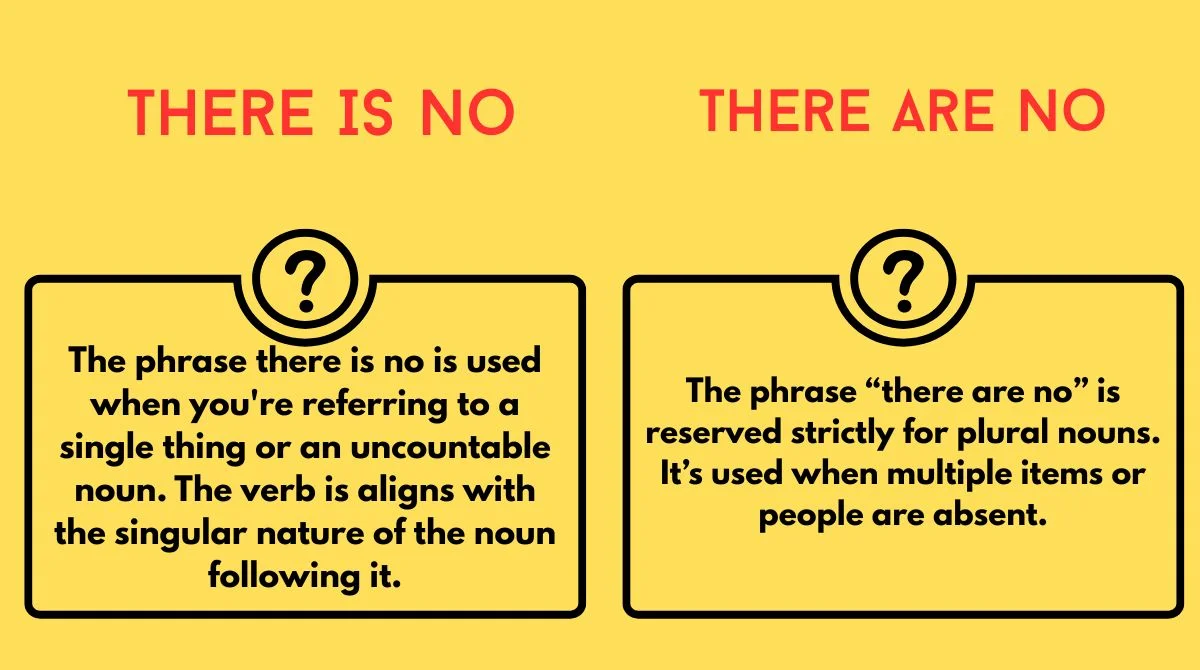
    The phrase there is no is used when you’re referring to a single thing or an uncountable noun. The verb is aligns with the singular nature of the noun following it.

    Examples:

    • “There is no solution to the problem yet.”
    • “There is no water in the bottle.”
    • “There is no hope of winning.”

    Notice how each noun here—solution, water, hope—is either singular or uncountable. These forms call for the singular verb is.

    There Is No vs There Are No

    When to Use “There is No” with Singular Nouns

    Using “there is no” makes perfect sense when you’re referring to the absence of a single item.

    Here’s a simple rule of thumb:

    If the noun is singular, use “there is no.”

    Correct Usage Examples:

    • “There is no dog in the yard.”
    • “There is no email from the manager.”
    • “There is no winner in this game.”

    Using “there are no” in these cases would be grammatically incorrect.


    The Role of Uncountable Nouns in Defining “There Is No”

    Uncountable nouns (also known as mass nouns) don’t have a plural form and can’t be counted individually. Common examples include: water, sugar, money, furniture, information, advice.

    “There is no” fits naturally with these because they’re grammatically singular.

    Examples:

    • “There is no money in my account.”
    • “There is no furniture in the room.”
    • “There is no sugar left.”

    Even though some of these things may seem plural in meaning (like furniture), grammatically, they are treated as singular.


    Deciphering “There Are No” for Plural Usage

    The phrase “there are no” is reserved strictly for plural nouns. It’s used when multiple items or people are absent.

    Examples:

    • “There are no apples in the basket.”
    • “There are no tickets left.”
    • “There are no children in the playground.”

    The key here is that the subject of the sentence is more than one item. That plural subject demands the verb are.

    Singular NounUse “There is no…”
    book“There is no book on the desk.”
    Plural NounUse “There are no…”
    books“There are no books on the desk.”

    Common Pitfalls and How to Avoid Them

    It’s easy to make mistakes with these phrases, especially when nouns are tricky or deceptive. Let’s clear up some of the most common mix-ups.

    Mistake #1: Using “there is no” with plural nouns

    ❌ “There is no bananas in the bowl.”
    ✅ “There are no bananas in the bowl.”

    Mistake #2: Treating uncountable nouns as plural

    ❌ “There are no information available.”
    ✅ “There is no information available.”

    Mistake #3: Misidentifying collective nouns

    More on that next.


    Tricky Contexts: Collective, Mass, and Quantified Nouns

    Some nouns are sneaky. They look singular but can behave like plurals, and vice versa.

    Collective Nouns

    Words like team, family, and audience refer to groups but are treated as singular in American English.

    • “There is no team like ours.” ✅ (Correct)
    • “There are no team like ours.” ❌ (Incorrect)

    Mass Nouns

    These refer to uncountable substances or concepts.

    • “There is no love like hers.”
    • “There is no rice left.”

    Even though rice might contain many grains, it’s uncountable—thus singular.

    Quantified Expressions

    When dealing with numbers or quantities, follow the noun after the number.

    • “There are no two ways about it.” ✅
    • “There is no one good answer.” ✅

    “There Is No” vs. “There Are No” with Fractions and Numbers

    Fractions and numbers can be confusing, but here’s the trick:

    👉 Look at the actual noun being quantified, not just the number.

    Examples:

    • “There is no half of the cake left.” ✅ (Singular: half of one cake)
    • “There are no three options available.” ✅ (Plural: three options)

    A single percentage can take either verb depending on the noun:

    • “There is no 50% of the water remaining.” ✅
    • “There are no 50% of the files available.” ✅

    Golden Rule:

    Always match the verb to the noun being quantified, not the number itself.


    Real-World Examples: Applying the Correct Usage in Various Situations

    Let’s look at how “there is no” and “there are no” show up in real life—from business writing to casual conversations.

    ScenarioCorrect PhraseExample
    At the officeThere is no“There is no internet connection.”
    In a restaurantThere are no“There are no free tables available.”
    ShoppingThere are no“There are no discounts this week.”
    TravelThere is no“There is no flight until tomorrow.”
    Online conversationThere is no“There is no need to panic.”

    Emphasizing the Difference Through Examples

    Sometimes, just looking at contrast can make things click.

    IncorrectCorrect
    “There is no books on the shelf.” ❌“There are no books on the shelf.” ✅
    “There are no water in the jug.” ❌“There is no water in the jug.” ✅
    “There is no chairs in the room.” ❌“There are no chairs in the room.” ✅

    Use this quick checklist when in doubt:

    • Is the noun singular or uncountable? 👉 Use is
    • Is the noun plural? 👉 Use are

    The Impact of Language Trends on “There Is No” and “There Are No”

    Modern usage is becoming increasingly casual, and you’ll often hear people say things like:

    “There’s no rules anymore.” ❌

    Technically, that’s wrong—rules is plural, so the correct form is:

    “There are no rules anymore.” ✅

    But spoken English is full of contractions like “there’s” even when referring to plurals. While that might be acceptable in informal speech, it’s best to keep your grammar sharp in writing and formal settings.

    Pro Tip:

    In writing, avoid “there’s” with plural nouns even if it sounds natural when spoken.


    There Is No vs There Are No

    6 FAQs

    Is it “there is no” or “there are no”?

    It depends on the noun. Use “there is no” with singular or uncountable nouns, and “there are no” with plural nouns.

    Can “there is no” be used with plural nouns?

    No. Plural nouns require the verb “are,” so the correct phrase is “there are no” (e.g., “There are no chairs”).

    What are uncountable nouns and how do they affect this choice?

    Uncountable nouns (like sugar, information, furniture) take “there is no” because they’re grammatically singular, even if they refer to things in bulk.

    Why do people say “there’s no rules” in speech?

    It’s a common informal contraction, but it’s incorrect in writing. The correct form is “there are no rules” because rules is plural.

    How do I know which phrase to use quickly?

    Ask yourself if the noun is singular/uncountable or plural. Singular/uncountable = “there is no”. Plural = “there are no.”

    Can I use “there is no” with collective nouns?

    Yes, in American English, collective nouns like team or family are treated as singular, so “there is no team like ours” is correct.


    Conclusion: Trust the Grammar, Not the Gut

    If you’ve ever wondered whether to say “there is no” or “there are no,” now you know: it all comes down to the number and type of noun you’re referring to.

    ✅ Use “there is no” with singular or uncountable nouns.
    ✅ Use “there are no” with plural nouns.

    Language evolves, but clear grammar never goes out of style. Bookmark this guide, refer back to the tables, and next time you’re stuck mid-sentence—you’ll know exactly what to say.

  • “More Friendly” vs “Friendlier”: Which One’s Right? 🤔✅

    “More Friendly” vs “Friendlier”: Which One’s Right? 🤔✅

    Choosing between “more friendly” and “friendlier” might seem like splitting hairs, but in English grammar, small differences can make a big impact.

    Whether you’re writing a professional email or just chatting with a friend, knowing the correct comparative form helps you sound polished and confident.

    So, which one is grammatically correct—“more friendly” or “friendlier”? The short answer is: both can be correct, depending on context. But don’t stop here—the rules, usage trends, and exceptions are worth exploring.

    Let’s break them down with examples, comparisons, and a few rule-breaking surprises.

    Both “more friendly” and “friendlier” are grammatically correct. Use “friendlier” in casual speech or when comparing one trait. Use “more friendly” in formal writing, technical contexts, or when comparing multiple qualities. Keep reading to discover when each is best.


    Understanding the Basics of Comparative Adjectives in American English

    In American English, comparative adjectives are used to compare differences between two nouns. They’re formed in two primary ways:

    • Add “-er” to the end of short adjectives (typically one syllable or some two-syllable adjectives).
      Example:
      • tall → taller
      • kind → kinder
    • Use “more” before longer adjectives (typically two syllables or more).
      Example:
      • beautiful → more beautiful
      • interesting → more interesting

    But here’s the twist: Some two-syllable adjectives, like friendly, can go either way, which is why confusion arises.


    The Intricacies of “More Friendly” and “Friendlier”: A Detailed Analysis

    Let’s take a closer look at the word friendly.

    • It’s a two-syllable adjective.
    • It ends in -ly, which usually signals an adverb (like quickly), but not in this case—it’s still an adjective.
    • It’s a classic “borderline” word that allows both forms: “friendlier” and “more friendly.”

    But there’s a nuanced difference in tone and rhythm that influences usage:

    FormCommon UsageTone / Context
    FriendlierMore traditional, concise, conversationalUsed in speech or casual writing
    More friendlySlightly more formal or deliberateOften used in professional or written contexts

    When to Use “More Friendly” in Everyday Language

    “More friendly” often shows up when writers want to be a bit more deliberate or measured in tone. It’s also frequently used when clarity is needed—especially in sentences where the rhythm favors two words instead of a suffix.

    Examples of Correct Usage:

    • The customer service team is becoming more friendly over time.
    • I found the new software interface more friendly and intuitive.
    • Our school environment is getting more friendly to new students.

    Pro tip: If friendly is paired with another adjective or idea, “more friendly” usually flows better.

    The app is more friendly and more helpful than the old version.


    Comparing Multiple Personalities: The Use of “More Friendly”

    When comparing multiple traits or personalities at once, using “more friendly” keeps things clearer and avoids tongue-twisting adjectives.

    Compare these:

    • John is friendlier and more helpful than Paul.
    • John is more friendly and more helpful than Paul.

    Why? The consistent structure (more X and more Y) improves rhythm and clarity.

    Use “more friendly” when:

    • Comparing multiple characteristics.
    • Maintaining parallel sentence structure.
    • You’re writing in a more formal or technical tone.

    Creating More Impact: Instances Where “More Friendly” Shines

    Here are a few places where “more friendly” adds more impact:

    • Marketing and branding:
      “This brand is more friendly to the environment.”
    • Technology and design:
      “The new dashboard is more user-friendly.”
    • Educational content:
      “We’re working on creating more friendly material for beginners.”

    In many of these, “friendly” works more like part of a compound modifier (like user-friendly or eco-friendly), which explains why “more friendly” fits better.

    “More Friendly” vs “Friendlier”

    Exploring the Use of “Friendlier” in American English

    Friendlier” is often the go-to choice in spoken English or informal writing. It feels conversational, lighter, and more relaxed. It’s also shorter and snappier—a plus in everyday speech.

    Examples of “Friendlier” in Action:

    • She seems friendlier now that we’ve talked more.
    • Dogs are usually friendlier than cats.
    • My neighbor is friendlier than he used to be.

    Bonus tip: If you’re keeping your sentence short and comparing just one thing, “friendlier” sounds smoother and more natural.


    Illustrative Examples: “More Friendly” vs “Friendlier” in Context

    Let’s break down when to use each with real-life sentence comparisons:

    Scenario“Friendlier”“More Friendly”
    Casual conversation✅ “He’s friendlier than before.”Possible but less common
    Formal writingLess common✅ “Our interface is more friendly to non-technical users.”
    Comparing traits❌ “He’s friendlier and more helpful.”✅ “He’s more friendly and more helpful.”
    Tone requiredLight, informalFormal, structured

    “More Friendly” or “Friendlier”: Special Cases and Exceptions

    Some adjectives defy the usual rules and vary by usage or personal style.

    For friendly, both forms are grammatically correct, but mixing them within the same sentence can sound awkward.

    Avoid this:

    • This version is friendlier and more easy to use.

    Better:

    • This version is more friendly and more easy to use.

    Other similar adjectives with flexible comparative forms:

    • Lovely → more lovely / lovelier
    • Lonely → more lonely / lonelier
    • Silly → more silly / sillier

    Just like friendly, these can shift based on rhythm, tone, or context.


    Eco-Friendly Conversations: A Rule-breaking Exception

    You’ve probably heard the phrase eco-friendly, right? Now let’s test it:

    • “Our packaging is friendlier to the environment.”
    • “Our packaging is more eco-friendly.”

    In this case, “more eco-friendly” is the preferred form.

    That’s because eco-friendly behaves as a compound adjective, and grammar rules shift slightly. When using compound adjectives with friendly, “more” becomes the dominant comparative tool.

    Other common phrases:

    • More user-friendly
    • More budget-friendly
    • More beginner-friendly

    So in branding or environmental language, “more friendly” is often the smarter choice—even if “friendlier” is technically okay.


    The Interchangeable Use of “More Friendly” and “Friendlier” in Informal Speech

    In spoken American English, both forms are widely accepted and often used interchangeably, especially when the context is casual.

    Real-world examples:

    “I think she’s gotten a lot more friendly lately.”
    “He’s definitely friendlier than his brother.”

    Do either sound wrong? Not really. That’s why grammar purists still allow both, but context always matters.

    In professional writing, err on the side of structure: use more friendly when there’s any doubt. In everyday chat, friendlier rolls off the tongue.


    “More Friendly” vs “Friendlier”

    6 FAQs

    Is “friendlier” grammatically correct?

    Yes, “friendlier” is correct and often preferred in informal or spoken English when making simple comparisons.

    When should I use “more friendly”?

    Use “more friendly” in formal writing, technical content, or when comparing multiple traits (e.g., “more friendly and more helpful”).

    Is “more friendly” more formal than “friendlier”?

    Yes. “More friendly” is generally seen as more deliberate and is commonly used in professional, structured, or branding contexts.

    Can I use “friendlier” in academic writing?

    It’s better to use “more friendly” in academic or formal writing to maintain a consistent and professional tone.

    Why does “friendly” allow both forms?

    Because “friendly” is a two-syllable adjective, and certain two-syllable words allow both comparative structures depending on rhythm and context.

    Is “more eco-friendly” better than “eco-friendlier”?

    Yes. In compound adjectives like eco-friendly, user-friendly, and beginner-friendly, “more” is the preferred comparative form.


    Final Verdict: Tips on Choosing the Right Form for Clear Communication

    To wrap it up, here’s a quick cheat sheet to help you choose the right form:

    ✅ Use “Friendlier” when:

    • You’re keeping things casual or conversational.
    • The comparison is simple and involves just one adjective.
    • You want a quicker, smoother sentence.

    ✅ Use “More Friendly” when:

    • You’re combining traits or using complex comparisons.
    • You’re writing in a formal or professional context.
    • You’re using compound adjectives (eco-friendly, user-friendly).

    In Summary:

    Use CaseBest Form
    Casual conversationFriendlier
    Formal writingMore Friendly
    Comparing multiple traitsMore Friendly
    Branding or design languageMore Friendly
    Fast and simple statementsFriendlier

    Grammar is flexible, but clarity is not. Let your audience, tone, and structure guide your choice.


    Let us know in the comments: Do you use “more friendly” or “friendlier” more often? Want help with other tricky grammar choices? Drop your suggestions below!