Blog

  • ✨ Excel vs Accel: Can You Spell It Right?

    ✨ Excel vs Accel: Can You Spell It Right?

    When you first hear “Excel” and “Accel”, you might think they’re just two ways to spell the same thing.

    But in reality, confusing these two words can lead to mistakes in professional writing, technical contexts, and even everyday communication.

    In this article, we’ll break down their meanings, origins, correct usage, common mistakes, and practical tips so you’ll never mix them up again.


    Quick Overview

    Many people stumble when writing Excel vs Accel. It’s easy to assume they’re interchangeable because they sound similar. However:

    • Excel relates to performance, skill, and achievement.
    • Accel is short for accelerate or a term used in specialized fields like technology, sports, or company names.

    Understanding the subtle differences can save you from embarrassing errors in emails, reports, or social media posts.


    Understanding “Excel” and “Accel”

    What Does “Excel” Mean?

    The word Excel is a verb and sometimes a noun, meaning:

    To perform exceptionally well or surpass others in a particular field or task.

    Examples:

    • “She excels in data analysis.”
    • “Our team’s excel in customer service sets us apart.”

    Origin and Etymology

    Excel comes from the Latin word excellere, which means to rise up or surpass. Over time, it became a standard English word associated with skill and outstanding performance.


    What Does “Accel” Mean?

    Accel is generally an abbreviation for accelerate, referring to speed or quick progression. It’s commonly seen in:

    • Technology & Software: Buttons, commands, or software shortcuts.
    • Sports & Racing: “Press the accel pedal to reach maximum speed.”
    • Business/Brand Names: Many startups or venture capital firms use “Accel” as part of their name.

    Origin and Etymology

    “Accel” is derived from the word accelerate, which comes from the Latin accelerare, meaning to hasten. While “Excel” emphasizes performance, Accel emphasizes motion, speed, or rapid progress.


    Key Differences Between Excel vs Accel

    FeatureExcelAccel
    MeaningTo perform exceptionallyShort for accelerate / speed
    Part of SpeechVerb / NounAbbreviation / Brand Name
    ContextWorkplace, personal growth, academicsTechnology, sports, racing, companies
    Example“She excels in marketing.”“Press the accel pedal.”

    Key takeaway: Excel is about skill, Accel is about speed. Confusing them can distort the meaning of a sentence.


    Using “Excel” and “Accel” Correctly

    Examples of “Excel” in Sentences

    • “He excels at solving complex math problems.”
    • “Companies that excel in customer service gain loyal clients.”
    • “Students who excel academically often receive scholarships.”

    Examples of “Accel” in Sentences

    • “Push the accel pedal carefully around the curve.”
    • “Software engineers use accel shortcuts to speed up coding.”
    • “The startup, Accel Technologies, is expanding rapidly.”

    Common Mistakes and Misconceptions

    Many people mix these words, which leads to errors in writing. Here are the top mistakes:

    Mistake 1: Using “Accel” Instead of “Excel”

    • Incorrect: “She really accels in her studies.”
    • Correct: “She really excels in her studies.”

    Mistake 2: Assuming “Accel” Is Formal Writing

    • Accel is mostly informal or technical. Using it in formal essays or reports can confuse readers.

    Mistake 3: Confusing Their Meanings

    • Remember: Excel = skill/performance, Accel = speed/progression.

    Comparative Table: Excel vs Accel in Context

    Usage ContextExcel ExampleAccel Example
    Workplace“Our team excels in project delivery.”“The software accel function saves time.”
    Education“She excels in mathematics.”Not commonly used in education
    Sports/Racing“Athletes excel under pressure.”“Push the accel pedal for top speed.”
    Technology/Software“We excel in software solutions.”“Enable the accel feature in settings.”
    Business/Brand Names“Excel Corp specializes in analytics.”“Accel Ventures invests in startups.”

    Synonyms and Related Words

    Excel Synonyms

    • Outperform
    • Surpass
    • Shine
    • Thrive

    Accel (Accelerate) Synonyms

    • Speed up
    • Hasten
    • Quicken
    • Step on the gas

    Real-World Use Cases

    Excel in Professional Settings

    Example: Companies often say:

    “Employees who excel in communication skills are fast-tracked for promotion.”

    Case Study:
    A marketing agency measured employee performance metrics and found that team members who excelled in client interactions contributed to 30% higher customer retention rates.

    Accel in Specialized Fields

    Technology: Shortcuts or speed-enhancing features are labeled as “Accel” in software like graphics design tools.
    Sports: Racing games or cars frequently use accel indicators.
    Startups: Companies like Accel Partners invest in high-growth tech startups worldwide.


    Common Spelling Mistakes & How to Avoid Them

    Excel-Related Mistakes

    • Exel
    • Exsel
    • Eksel

    Accel-Related Mistakes

    • Aksel
    • Axcel
    • Accell

    Tips:

    • Associate Excel with achieve or skill.
    • Associate Accel with speed or motion.

    Practical Tips for Correct Usage

    1. Context Check: Ask yourself, does the sentence imply skill (Excel) or speed (Accel)?
    2. Memory Trick: Excel = “Exceed expectations”; Accel = “Accelerate forward.”
    3. Proofread: If unsure, replace the word with a synonym to see if the meaning still fits.
    4. Practice: Write 10 sentences each using Excel and Accel.

    Frequently Asked Questions (FAQs)

    What is the correct usage of “Accel” in formal writing?

    Answer: Generally, Accel is not used in formal writing unless it is a brand or technical term. For formal contexts, use accelerate instead.

    Can “Excel” and “Accel” be used interchangeably?

    Answer: No. Excel refers to performance or skill, while Accel refers to speed. Interchanging them changes the meaning.

    How can I remember which word to use?

    Answer: Associate Excel with achievement and Accel with movement or speed. Memory triggers help.

    Is “Excel” only a verb?

    Answer: No. Excel can also function as a noun, referring to outstanding performance in general.

    Are there industries where “Accel” is more common?

    Answer: Yes. Accel is frequently used in technology, racing, sports, and as brand names.


    Final Thoughts

    Confusing Excel vs Accel is more common than you think. Understanding their origins, meanings, and correct contexts ensures clear communication. Remember: Excel is about performing well, while Accel is about moving fast. By following the tips, practicing with sentences, and using memory tricks, you’ll never mix these words up again.

    Use the comparative table, synonyms, and examples in this guide as a reference whenever you write, and your writing will be precise, professional, and mistake-free.
  • 🌟 Of Course or Ofcourse: Which One Should You Use?

    🌟 Of Course or Ofcourse: Which One Should You Use?

    Choosing the right spelling can feel like a small detail — until it shows up in your professional email or an important exam. The confusion between “of course” and “ofcourse” is surprisingly common, especially online.

    This article clears up the confusion with examples, history, and practical tips. By the end, you’ll know exactly when and how to use “of course” with confidence.


    Introduction: Why the Confusion Exists

    It’s easy to see why people get tripped up. The internet moves fast. People text in a hurry. Spellcheck sometimes “learns” wrong habits.

    The result? A simple two-word phrase — “of course” — often gets fused into one: “ofcourse.”

    But here’s the key takeaway: “of course” is the correct spelling in every standard English context. Writing it as one word is a mistake, no matter how common it looks in informal chats.

    “Language evolves, but standard grammar still matters when clarity and professionalism are at stake.”

    Understanding why this mix-up happens is the first step to avoiding it.


    The Correct Spelling: “Of Course”

    At its core, “of course” is an adverbial phrase. It combines:

    • “of” – a preposition
    • “course” – a noun

    Together, they convey agreement, certainty, or something expected.

    Meaning

    “Of course” expresses:

    • Agreement: “Of course, I’ll help you.”
    • Obviousness: “Of course, water boils at 100°C.”
    • Reassurance: “Of course, you’re welcome anytime.”

    Fun Fact

    The phrase first appeared in English during the 16th century. Back then, “course” referred to a natural or expected order of events. Saying something happened “of course” meant it happened as naturally as a river follows its course.


    “Ofcourse”: A Common Mistake

    Despite frequent online use, “ofcourse” is not a real word in English.

    Why People Mistakenly Join the Words

    • Speed typing: When texting quickly, people skip the space.
    • Influence of compounds: Words like “anymore” or “into” make learners think similar phrases should merge.
    • Autocorrect errors: Some messaging apps fail to flag “ofcourse.”

    Most dictionaries — including Oxford, Cambridge, and Merriam-Webster — list only “of course.”


    Grammar and Style Behind the Phrase

    Understanding how the phrase functions can help you use it correctly.

    Part of Speech

    “Of course” acts as an adverbial phrase. It modifies the whole sentence rather than a single verb.

    Example:

    “Of course, I’ll attend the meeting.”

    Here, the phrase modifies the speaker’s attitude — showing agreement or readiness.

    Placement in Sentences

    • At the start: “Of course, we’ll arrive on time.”
    • In the middle: “We will, of course, prepare everything in advance.”
    • At the end: “I’ll help you, of course.”

    Punctuation Tips

    In formal writing, use a comma after “of course” when it begins a sentence or when it appears mid-sentence as an aside.


    Synonyms and Alternative Expressions

    Sometimes, you may want to replace “of course” with another phrase to fit tone or context.

    ToneSynonym/AlternativeExample Sentence
    FormalCertainly“Certainly, I’ll provide the report.”
    FormalIndeed“Indeed, the results support the theory.”
    NeutralNaturally“Naturally, he was chosen for the role.”
    NeutralWithout a doubt“Without a doubt, she’s the best candidate.”
    InformalSure / Yep“Sure, I can help you out.”
    Warm/ReassuringAbsolutely“Absolutely, you can trust this source.”

    Choose a synonym based on tone: “Certainly” for business writing, “Sure” for casual chats, and “Absolutely” for friendly reassurance.


    Correct Usage in Real-Life Contexts

    Learning through examples is the easiest way to internalize proper usage.

    Everyday Conversations

    • “Of course, I’ll meet you at the café.”
    • “You remembered my birthday!”
      “Of course, I wouldn’t forget.”

    Professional Writing

    • “Of course, we’ll ensure your order is delivered on time.”
    • “You can, of course, contact our support team anytime.”

    Social Media and Texting

    • “Of course, I watched that new show!”
    • “It’s raining again… of course.”

    Common Mistakes to Avoid

    Here’s how to stay on the right side of English grammar:

    • ❌ Misspelling: Writing “ofcourse” instead of “of course.”
    • ❌ Overuse: Using it too often makes you sound sarcastic.
    • ❌ Misplacement: Forgetting commas when it appears mid-sentence.
    • ❌ Inappropriate tone: Using it in formal documents where “certainly” may be better.

    Tip: If you want to emphasize certainty in a formal letter, pick “certainly” or “undoubtedly” instead.


    Historical Background

    The phrase “of course” evolved from Middle English expressions that described something happening in the natural course of events.

    By the 1800s, it had shifted to express assurance or agreement. Today, it’s one of the most common phrases in both spoken and written English.


    Quick Reference Table

    Here’s a handy table to settle the confusion at a glance:

    FormCorrect?Usage Notes
    Of course✅ YesUse in all formal and informal English contexts.
    Ofcourse❌ NoAvoid. Not recognized by any major dictionary.

    ⚡ Quick Summary (Cheat Sheet)

    • ✅ “Of course” is the correct spelling.
    • ❌ “Ofcourse” is a misspelling — avoid it in all forms of writing.
    • Use “of course” to express agreement, obviousness, or reassurance.
    • Watch tone; overuse can sound sarcastic.
    • In formal writing, consider synonyms like “certainly” or “indeed.”

    FAQs About “Of Course vs Ofcourse”

    What is the meaning of “of course”?

    It means something is obvious, expected, or done with agreement. For example:

    “Of course, I’ll help you with your project.”

    Is “ofcourse” ever correct in English?

    No. “Ofcourse” is a common typo but not recognized as correct in English grammar or dictionaries.

    Can I use “of course” in professional emails?

    Yes. However, use it thoughtfully. For formal tone, you can opt for “certainly” or “absolutely.”

    Does “of course” always need a comma?

    Not always. Add a comma when it’s at the beginning of a sentence or used as an aside mid-sentence.

    “Of course, we can discuss it later.”
    “We will, of course, finish on time.”

    What are some polite alternatives to “of course”?

    In formal settings, consider using “certainly,” “naturally,” or “without a doubt.”


    Conclusion

    The confusion between “of course” and “ofcourse” is common but easy to fix.
    Stick with “of course” in all writing and speech. It’s the standard recognized form across dictionaries, schools, and workplaces.

    Using the right spelling not only improves clarity but also signals attention to detail — a skill that never goes unnoticed in communication.

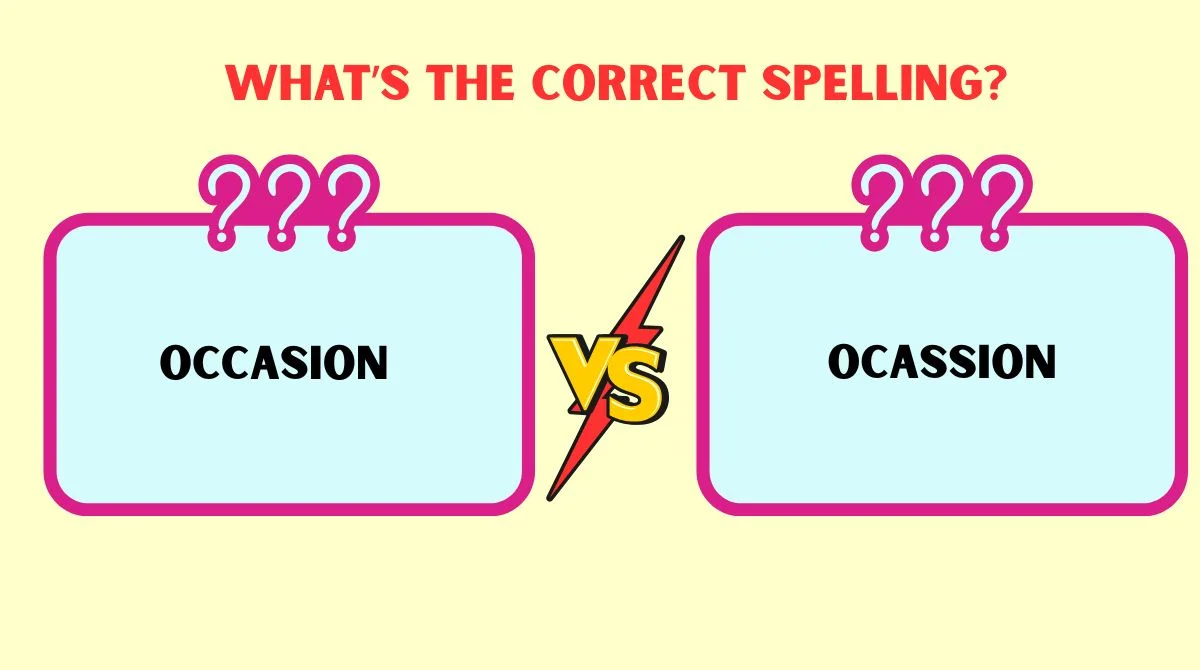
  • ✍️ Occasion or Ocassion: What’s the Correct Spelling?

    ✍️ Occasion or Ocassion: What’s the Correct Spelling?

    Spelling mistakes can sneak into even the most polished writing. One of the most common mix-ups in English is between “Occasion” and “Ocassion.”
    If you’ve ever paused mid-sentence, wondering which one is right, you’re not alone.

    This article clears up the confusion once and for all. You’ll learn the correct spelling, why the mistake happens, how to use “Occasion” correctly, and practical ways to remember it.


    ⚡ Quick Answer: Occasion is Correct ✅

    The correct spelling is “Occasion.”
    The variant “Ocassion” is always incorrect and doesn’t appear in any recognized English dictionary.

    Quick tip:

    Remember: OccaSion has a Single S.

    Many writers double the wrong consonant by instinct, but English has its quirks. In this case, it’s the C that doubles, not the S.


    Understanding the Confusion

    English spelling often trips people up because it isn’t always phonetic. Words like “occasion,” “accommodate,” and “professional” have double consonants, but not always in the same position.

    Here’s why the confusion arises:

    • Sound similarity: Both c and s produce a soft /s/ sound in “occasion,” tempting writers to double the S.
    • Pattern interference: Many words with similar endings use double S, like “session” or “possession.”
    • Autocorrect dependency: Some spell-checkers might fail to catch the mistake in informal settings like social media.

    Fact:
    A 2023 survey of common English spelling mistakes ranked “Ocassion” among the top 50 errors made by native speakers.


    ✅ Correct Spelling: “Occasion”

    Let’s set the record straight.

    • Spelling: O-C-C-A-S-I-O-N
    • Pronunciation: /əˈkeɪʒən/
    • Part of Speech: Primarily a noun, sometimes used as a verb.

    Key Forms:

    • Occasion (noun)
    • Occasions (plural noun)
    • Occasional (adjective)
    • Occasionally (adverb)

    Tip:
    Visualize the word: Occa-Sion → Double C, single S.


    📖 Meaning and Uses of “Occasion”

    The word “occasion” is versatile. Its meaning changes slightly depending on context.

    General Meaning

    An event or a particular time when something happens.

    “I met her on that memorable occasion.”

    Formal Meaning

    A special or important event, often celebratory.

    “The wedding was a grand occasion.”

    As a Verb

    Less common, but it means to cause or bring about.

    “The announcement occasioned a lot of excitement.”

    Additional Nuances

    • Refers to opportunities or reasons: “He had no occasion to complain.”
    • Indicates specific instances: “On several occasions, we discussed the project.”

    Case Study:
    The term special occasion drives one of the highest search volumes on e-commerce sites, as consumers often look for gifts, cards, and outfits tied to important dates.


    🚀 Common Contexts and Phrases with “Occasion”

    You’ll see “occasion” in both formal and informal settings.
    Here are the most common phrases:

    • On special occasions – birthdays, anniversaries, weddings.
    • Mark the occasion – to commemorate an event.
    • On this/that occasion – referring to a specific moment in time.
    • Occasion for celebration – highlighting a happy event.
    • On rare occasions – something that happens infrequently.
    • No occasion to worry – used to indicate lack of necessity.

    Real-life examples:

    • “The graduation ceremony was an unforgettable occasion.”
    • “On this occasion, we honor our veterans.”
    • “The mistake gave him no occasion for complaint.”

    🔍 Etymology: Where “Occasion” Comes From

    The journey of the word tells us why it looks the way it does today.

    • Originates from Latin occasio, meaning a happening or opportunity.
    • Passed into Old French as occasion.
    • Adopted into Middle English in the 14th century.

    Originally, it conveyed the sense of something that “falls toward” or “befalls” — which makes sense because an occasion is often something that comes to pass.


    ❌ Why “Ocassion” is Incorrect

    The incorrect form, “Ocassion,” is a result of:

    • Doubling the wrong consonant (S instead of C).
    • Overgeneralizing English spelling patterns.

    Note:
    Neither Oxford English Dictionary nor Merriam-Webster recognizes “Ocassion.”

    In formal writing—whether for work, academia, or publication—using “Ocassion” could undermine credibility.


    🤯 Common Mistakes and Memory Aids

    Here are some frequent misspellings you should watch out for:

    • Ocassion
    • Occation
    • Ocassional
    • Ocassionally

    Simple memory aids:

    • Mnemonic: “OccaSion has a Single S.”
    • Link it to “Session” → Session has double S, Occasion doesn’t.
    • Write it out three times when practicing new vocabulary.

    📊 Side-by-Side Comparison: Occasion vs. Ocassion

    FeatureOccasion ✅ (Correct)Ocassion ❌ (Incorrect)
    Recognized by dictionariesYesNo
    Correct spelling ruleDouble C, single SDouble S (wrong)
    Common in formal writingYesNo
    Appears in academic sources✓✗
    Example sentence“The award ceremony was a proud occasion.”(Never use)

    ✍️ Real-Life Examples of “Occasion”

    Contextual usage helps internalize correct spelling.

    1. Everyday Usage: “We met on more than one occasion to finalize the design.”
    2. Formal Settings: “The ambassador’s visit was a historic occasion for the city.”
    3. Literary Use: “On that solemn occasion, silence filled the room.”
    4. Idiomatic Expression: “Dress appropriately for the occasion.”

    🧠 How to Avoid Spelling Errors

    Practical strategies for error-free writing:

    • Use Spell-Check Tools: Don’t rely solely on memory.
    • Read Aloud: You may catch mistakes that eyes skim over.
    • Learn by Repetition: Writing the correct word builds muscle memory.
    • Flashcards or Apps: Use them to reinforce tricky spellings.
    • Contextual Practice: Write sentences using “occasion” in various contexts.

    Quote:
    “Correct spelling is not just about accuracy — it’s about clear communication.” – Language Educator, 2022


    🧐 FAQs About Occasion vs. Ocassion

    Is “Ocassion” ever correct?

    No. It’s always a misspelling. English dictionaries universally list “Occasion” as the only accepted form.

    How do you pronounce “Occasion”?

    Pronounced as /əˈkeɪʒən/ — the “sion” part sounds like “zhun.”

    What’s the difference between “Occasion” and “Occasional”?

    • Occasion: a particular event or time.
    • Occasional: describes something that happens from time to time.

    Can “Occasion” be used as a verb?

    Yes, though less common. It means to cause or bring about.

    “The power outage occasioned significant delays.”

    How can I remember the correct spelling?

    Think: OccaSion → One S.
    Also, visualize the phrase: “Double the C for the correct word.”


    🏁 Conclusion: Master the Spelling of Occasion

    English is full of tricky spellings, but “Occasion” shouldn’t be one of them anymore.
    The key takeaway is simple: Always spell it with double C and single S.

    By understanding the history, meaning, and usage of the word—and by applying memory aids—you can avoid this common error.
    Make every writing occasion a confident and correct one.

  • 🌟 Privilege or Priviledge: What Is the Correct Spelling?

    🌟 Privilege or Priviledge: What Is the Correct Spelling?

    Choosing the right word can shape how people perceive your writing. A single letter often separates correct spelling from a glaring mistake. One of the most common examples is the mix-up between “privilege” and “priviledge.”

    This article digs deep into the confusion. You’ll learn why “privilege” is the only correct spelling, why “priviledge” persists as a mistake, and how to avoid it in your writing.


    ✅ Quick Answer: Privilege Is Correct

    The word “privilege” (with no ‘d’ before the ‘g’) is the correct spelling.
    The misspelled form “priviledge” doesn’t exist in standard English dictionaries.

    Quote: “Correct spelling reflects attention to detail — a privilege few take lightly.”

    Here’s a quick overview:

    WordCorrect/IncorrectMeaning
    Privilege✅ CorrectA special right, advantage, or immunity granted to a person or group.
    Priviledge❌ IncorrectCommon misspelling, not accepted in standard English.

    You’ll often see “priviledge” in casual online writing or social posts, but in professional, academic, or legal contexts, it’s always wrong.


    🔎 Understanding the Confusion: Privilege vs. Priviledge

    English spelling can be tricky because words are not always spelled the way they sound.
    When people pronounce “privilege,” the middle syllable sounds soft, almost like “pri-vi-lij.”
    That soft “i” sound makes some writers mistakenly insert a “d,” producing “priviledge.”

    This is known as phonetic confusion — when spelling choices are guided by how a word sounds rather than how it’s historically written.


    📚 Definition and Correct Usage of “Privilege”

    The word “privilege” dates back to Middle English from Old French privilege, which came from Latin privilegium (a law for an individual).

    Today, it serves both as a noun and a verb:

    • As a noun:
      “A special right, advantage, or immunity granted to a particular person or group.”
      Example: “Access to clean water is a basic privilege in many countries.”
    • As a verb:
      “To grant a special right or advantage to someone.”
      Example: “The law privileges local producers over foreign competitors.”

    It’s also used in common phrases like:

    • Legal privilege: attorney–client privilege
    • Social privilege: such as socioeconomic advantages
    • Digital privilege: admin privileges in software

    ✍️ Breaking Down Common Variants

    🟢 How to Spell “Privileged” Correctly

    The adjective and past participle form is “privileged.”

    • Rule: Drop the final “e” in “privilege” before adding the suffix –ed.
    • Example:
      • Correct: “She felt privileged to be part of the team.”
      • Incorrect: “She felt priviledged to be part of the team.”

    Tip: There’s no extra ‘d’ in the root word, so there’s no ‘d’ in its derivatives.


    🟢 How to Spell “Privileges” Correctly

    The plural form is “privileges.”

    • Example:
      • Correct: “Students enjoy many privileges in the library.”
      • Incorrect: “Students enjoy many priviledges in the library.”

    🚫 What Does “Priviledge” Mean? (Spoiler: Nothing)

    The form “priviledge” does not appear in any reputable English dictionary like Merriam-Webster, Oxford, or Cambridge.
    It is purely a spelling mistake.

    Many people assume it’s acceptable because of its frequent appearance online, but relying on that misconception can hurt the credibility of your writing.

    Fact: Microsoft Word and Grammarly flag “priviledge” as a misspelling.


    🤔 Why “Priviledge” Became a Common Misspelling

    The persistence of “priviledge” can be traced to several factors:

    📌 Phonetic Confusion

    The pronunciation /ˈprɪv.ə.lɪdʒ/ tempts writers to include a “d.”

    📌 Influence of Similar Words

    Words like “knowledge,” “college,” “allege” end with a –ledge pattern, misleading writers to mimic it.

    📌 Historical Spelling Variants

    Early English sometimes had inconsistent spellings.
    For example, in 17th-century texts, you might find archaic forms that no longer apply today.
    Modern English has standardized the spelling as “privilege.”

    📌 Typing Habits & Auto-correct Errors

    Misspellings spread quickly online.
    When enough people use the wrong form, it looks “normal,” perpetuating the mistake.


    📊 Side-by-Side Comparison Chart

    AspectPrivilege (✅ Correct)Priviledge (❌ Incorrect)
    Dictionary StatusRecognized worldwideNot recognized
    OriginFrom Latin privilegiumNone
    Accepted in Academic & Legal WritingYesNo
    Example Sentence“Education is a privilege.”–
    Pronunciation/ˈprɪv.ə.lɪdʒ/–

    🧠 How to Avoid the Spelling Mistake

    💡 Memorization Tips

    • Mnemonic: “There’s no ‘ledge’ in privilege.”
    • Break it into syllables: pri-vi-lege.
    • Visualize the correct ending: –lege, not –ledge.

    🔎 Proofreading & Editing Strategies

    • Use trusted writing tools (Grammarly, ProWritingAid).
    • Read your text aloud to catch phonetic traps.
    • Keep a personal list of commonly misspelled words.

    🌍 Tips for Non-Native English Writers

    • Understand that English often defies phonetic rules.
    • Practice spelling with flashcards or spaced-repetition apps.
    • Review sentences in context rather than in isolation.

    📝 Practical Examples in Sentences

    ✅ Correct Usage of “Privilege”

    • “Voting is a privilege and a responsibility.”
    • “She felt privileged to attend the ceremony.”
    • “The attorney claimed client-attorney privilege.”

    ❌ Common Mistakes with “Priviledge”

    • Wrong: “It was a priviledge to meet you.”
    • Right: “It was a privilege to meet you.”

    ❓ Frequently Asked Questions About Privilege vs. Priviledge

    Why is “Priviledge” so common in writing?

    Because the word’s pronunciation sounds as though it has a “d,” many writers rely on phonetics instead of memorizing the correct spelling.

    Is “Priviledge” ever acceptable in informal or dialect writing?

    No. It has never been a recognized variant in standard English. Even informal writing benefits from correct spelling.

    How can I correct my spelling habits?

    By practicing the word in context, using memory aids, and relying on spellcheck tools.
    Also, consciously proofread emails and posts before sending or publishing.

    Does autocorrect always catch this error?

    Usually yes, but not always. Some apps miss the error if the word has been saved in a personal dictionary or if it appears in older texts.

    Is “Privilege” used differently in legal and everyday contexts?

    Yes. In law, it refers to specific protected rights (like attorney–client privilege).
    In everyday usage, it means an advantage or special opportunity.


    🏁 Final Thoughts: Mastering “Privilege” Once and for All

    “Privilege” is the only correct spelling.
    Its misspelled twin, “priviledge,” is a linguistic pitfall that undermines writing quality.

    Attention to detail in spelling builds trust. Whether you’re drafting an email, a report, or an academic essay, use the correct form.
    Remember the simple rule: there’s no ‘d’ in privilege.

  • 🌟 Drier vs Dryer: What’s The Real Difference?

    🌟 Drier vs Dryer: What’s The Real Difference?

    Language can be tricky. Some words look almost identical yet have completely different meanings.
    “Drier” and “dryer” are perfect examples. Many people use them interchangeably, but that’s a mistake.
    Knowing the difference will make your writing clearer and save you from embarrassing errors.

    This guide breaks down everything you need to know — definitions, history, examples, tips, and even a quick quiz.


    🏆 Quick Takeaway

    • Dryer is always a noun. It refers to a machine or device that removes moisture. Example: The clothes dryer isn’t working today.
    • Drier is the comparative form of “dry.” It’s used as an adjective to describe something less wet or more dry than something else. Example: The desert is much drier than the rainforest.

    Quick Tip to Remember:

    If you can replace the word with “machine”, use dryer.
    If you can replace it with “more dry”, use drier.


    🔎 Understanding “Dryer”

    Definition and Origin

    The word dryer entered English in the late 16th century.
    It comes from the verb “to dry” plus the suffix “-er”, which often indicates a tool or agent that performs an action.

    In simple terms:

    Dryer = a device or person that dries something.

    Today, the word is almost always used for machines.


    Core Usage

    You’ll encounter dryer in these common contexts:

    • Laundry appliances: clothes dryer, tumble dryer
    • Personal care devices: hair dryer, hand dryer
    • Industrial equipment: grain dryer, paint dryer

    A dryer removes moisture through heat, air circulation, or other processes.


    Real-World Examples

    Here are sentences that show correct use of dryer:

    • She bought a new energy-efficient clothes dryer last week.
    • The salon invested in high-quality hair dryers for faster styling.
    • Public restrooms often use automatic hand dryers instead of paper towels.

    Notice how each example refers to a device or machine.


    💧 Understanding “Drier”

    Definition and Origin

    Drier is simply the comparative form of the adjective “dry.”
    It means “less wet” or “more dry.”

    Example: This shirt is drier than the one we just washed.

    The term dates back to Old English usage and has always served a descriptive, grammatical role.


    Grammatical Role

    Unlike dryer, the word drier:

    • Is an adjective, not a noun.
    • Describes the condition or state of something.
    • Cannot be used to refer to a machine or device.

    Incorrect: I bought a new drier for the laundry.
    Correct: This region is much drier in summer than in winter.


    Real-World Examples

    Here’s how to use drier properly in sentences:

    • The air in the mountains is usually drier than at sea level.
    • After two hours in the sun, the towel was much drier.
    • This year’s spring has been drier than last year’s.

    ⚖️ Key Differences at a Glance

    Side-by-Side Comparison Table

    FeatureDryerDrier
    Part of SpeechNounComparative adjective
    MeaningA device that removes moistureMore dry or less wet
    UsageHair dryer, clothes dryer, hand dryerA drier season, a drier surface
    Common MistakeUsing it to describe drynessUsing it for machines

    Short Mnemonics and Memory Aids

    • Think: “Dryer = device”
    • Think: “Drier = more dry”

    Visual Tip: Picture a dryer machine next to a drier towel.


    🚫 Avoiding Common Mistakes

    Typical Misuses

    Many people confuse the two words, especially in writing.

    Common errors include:

    • Saying “The climate here is dryer” (wrong).
    • Writing “Please put the wet clothes in the drier” (wrong).

    How to Correct Them

    Here’s a quick test:

    • If the word refers to a thing that dries, use dryer.
    • If it describes the state of being less wet, use drier.

    Before and After Examples:

    • ❌ The Sahara Desert is the world’s largest dryer place.
    • ✅ The Sahara Desert is one of the world’s drier places.
    • ❌ I bought a new drier for my hair.
    • ✅ I bought a new hair dryer.

    📝 Pop Quiz — Test Your Knowledge!

    Choose the correct word in each sentence:

    1. This summer has been much ____ than last year.
    2. I need to replace the old ____ in my laundry room.
    3. Towels dry faster in a ____ climate.
    4. The salon installed new high-powered ____ for customers.
    5. The desert is far ____ than the rainforest.

    ✅ Pop Quiz Answers and Explanations

    1. Drier — it describes the climate’s condition.
    2. Dryer — it refers to a machine.
    3. Drier — it describes the climate.
    4. Dryers — refers to devices.
    5. Drier — describes dryness.

    🌍 Practical Usage in Everyday Scenarios

    • Home and appliances:
      “The clothes dryer saves time compared to air-drying.”
    • Climate and geography:
      “Northern regions tend to be drier than coastal areas.”
    • Writing and communication:
      Always pick the word that matches either a device or the state of dryness.

    🔗 Related Words and Confusing Variants

    • Driest: The superlative form of “dry.” The Atacama Desert is one of the driest places on Earth.
    • Air-dry: A verb meaning to dry naturally in air.
    • Air-drier: Incorrect — avoid this mix-up.
    • Dryness: A noun describing the condition of being dry.

    ❓ FAQs About Drier vs Dryer

    Is “dryer” ever an adjective?

    No. Dryer is always a noun referring to a machine or device.

    Which is more common in American vs British English?

    Both forms are used the same way in both dialects.
    Some regions may use “tumble dryer” more often for clothes-drying machines.

    Can “dryer” describe weather in informal speech?

    Grammatically, no. You should use drier to talk about climate or dryness.

    Is “drier” ever acceptable in product names?

    Sometimes brands play with language, but grammatically dryer is correct for machines.

    What’s the quickest way to decide between the two?

    Do the substitution test:
    If you can swap it with “more dry,” use drier.
    If you can swap it with “machine,” use dryer.


    🏁 Recap and Final Thoughts

    The difference between drier and dryer is simple yet crucial:

    • Dryer = machine or device.
    • Drier = more dry (comparative adjective).

    Knowing the distinction improves your writing and avoids confusion.
    Remember the quick check — if it describes a thing that dries, it’s a dryer.
    If it describes the degree of dryness, it’s drier.

  • ✨ Other Than or Other Then: Which One Is Correct?

    ✨ Other Than or Other Then: Which One Is Correct?

    Confused about whether to write other than or other then? You’re not alone. Many writers, both native and non-native English speakers, stumble over these two similar-sounding phrases.

    While one is grammatically correct and widely used, the other is a common mistake. By the end of this article, you’ll master the difference and never mix them up again.


    Understanding the Confusion

    English can be tricky. Words that sound alike often lead to mistakes, and “other than” vs “other then” is a perfect example.

    The confusion mainly arises because:

    • They sound almost identical when spoken.
    • Writers confuse prepositions with adverbs, thinking “then” can replace “than.”
    • Casual writing often ignores grammar rules, which spreads the mistake further.

    For instance, someone might write:

    “I don’t have any plans other then studying.”

    This is incorrect, but it’s common in emails, text messages, and social media posts. Understanding why it’s wrong requires a closer look at each phrase.


    What “Other Than” Means and How to Use It

    “Other than” is a preposition. Its primary function is to mean:

    • Except
    • Besides

    Think of it as a way to separate one thing from the rest in a sentence.

    Proper Usage in Sentences

    Here are some examples to make it clear:

    • Negative context: “No one other than you can solve this problem.”
      This means: You are the only person who can solve this problem.
    • Additive context: “I have no hobbies other than reading and writing.”
      This shows inclusion of only specific items.
    • Comparative or alternative context: “Other than the weather, everything went perfectly.”
      This points out a single exception in an otherwise normal situation.

    Tips for identifying correct usage:

    1. Ask yourself: Am I listing exceptions or additions? If yes, use other than.
    2. Replace “other than” with “except” or “besides.” If it still makes sense, you’re correct.

    Why “Other Then” Is Incorrect

    “Other then” is grammatically incorrect in almost every situation. Here’s why:

    • Then is an adverb of time. It refers to what comes next or at that time.
    • Using then in place of than doesn’t make logical or grammatical sense.

    Examples of Incorrect Usage

    • ❌ “I like all fruits other then apples.”
    • ❌ “No one other then John attended the meeting.”

    Both should be written as:

    • ✅ “I like all fruits other than apples.”
    • ✅ “No one other than John attended the meeting.”

    Trying to use “other then” confuses readers and makes sentences sound unprofessional.


    Direct Comparison: “Other Than” vs “Other Then”

    Sometimes, seeing things side by side helps. Here’s a quick comparison:

    PhraseCorrect/IncorrectMeaningExample
    Other than✅ CorrectExcept / besides“I like all pets other than snakes.”
    Other then❌ IncorrectN/A“I like all pets other then snakes.”

    Quick memory tip:

    • If it expresses exception, always use than.
    • If it expresses time, “then” is correct, but rarely used after “other.”

    Real-Life Examples and Scenarios

    Understanding examples from real-life writing will make this easier to remember.

    • Emails and messages: “Other than the delay, your report is perfect.” ✅
      “Other then the delay, your report is perfect.” ❌
    • Social media captions: “I enjoy all movies other than horror.” ✅
      “I enjoy all movies other then horror.” ❌
    • Casual writing: “No one other than Sarah came to the party.” ✅
      “No one other then Sarah came to the party.” ❌

    Notice how small mistakes can change readability and credibility instantly.


    Common Writing Mistakes

    Writers often make recurring errors with other than:

    1. Adding “that” incorrectly:
      • ❌ “Other then that, everything is fine.”
      • ✅ “Other than that, everything is fine.”
    2. Mixing with “then” for time:
      • ❌ “I have no hobbies other then painting.”
      • ✅ “I have no hobbies other than painting.”
    3. Overcomplicating sentences:
      • ❌ “I don’t have any other then reading.”
      • ✅ “I don’t have any other than reading.”

    Being aware of these mistakes prevents frequent errors in both casual and professional writing.


    Quick Comparison Table

    Here’s a simple table to remember the correct usage instantly:

    Use CaseCorrect FormIncorrect FormNotes
    Expressing exceptionOther thanOther thenUse in prepositional phrases
    Time-related statementsThen (standalone)Other thenRarely appears after “other”
    Adding “that”Other than thatOther then that“Than” always fits here

    Why Do People Mix Up “Other Than” and “Other Then”?

    The confusion often stems from:

    • Phonetic similarity: Both sound almost identical in fast speech.
    • Auto-correct mistakes: Phones and word processors often change “than” to “then.”
    • Lack of grammar awareness: Writers rely on intuition rather than rules.
    • Influence of spoken English: Casual speech can normalize mistakes over time.

    By understanding the root cause, you’ll be less likely to repeat the mistake.


    Tips to Always Use “Other Than” Correctly

    Here are some practical tips and memory hacks:

    • Substitute “except” or “besides.” If it works, use other than.
    • Avoid “then” after other unless talking about time.
    • Read aloud: Mistakes often become obvious when spoken.
    • Use online grammar tools to double-check tricky sentences.
    • Create a mental trigger: “Than = exception; Then = time.”

    Practical Exercises

    Practice makes perfect. Try these fill-in-the-blank exercises:

    1. I don’t eat any meat ___ fish.
    2. No one ___ Anna can solve this puzzle.
    3. ___ the rain, the picnic was enjoyable.
    4. She likes all sports ___ tennis.
    5. Other ___ that, everything is ready.

    Answers:

    1. other than
    2. other than
    3. Other than
    4. other than
    5. than

    By doing these exercises, your brain starts automatically choosing the correct form.


    Frequently Asked Questions (FAQs)

    Can “Other Then” Ever Be Correct?

    Almost never. “Other then” is almost always a grammatical error. Use “other than” for exceptions.

    How Can I Remember the Difference?

    Think: Than = exception, Then = time. Replace with “except” or “besides” to check correctness.

    Why Do Native Speakers Make This Mistake?

    It’s usually due to casual speech, typing errors, or auto-correct changing “than” to “then.”

    Is “Other Than That” Correct?

    Yes. Example: “Other than that, everything is fine.” Never replace “than” with “then.”

    Can This Mistake Affect Professional Writing?

    Absolutely. Misusing “other than” can make reports, emails, or essays look careless or unprofessional.


    Conclusion

    In summary:

    • Use “other than” to express exceptions or additions.
    • Never use “other then” in these contexts.
    • Read, practice, and apply memory hacks to avoid mistakes.
    • Side-by-side comparison and exercises can solidify understanding.

    Mastering this small detail in grammar improves credibility, clarity, and confidence in writing. Now, you can write without second-guessing, whether in emails, essays, or social posts.

  • 📝 Excell or Excel: Which Spelling is Accurate?

    📝 Excell or Excel: Which Spelling is Accurate?

    Are you confused about whether to write Excell or Excel? You’re not alone. Many people struggle with this seemingly small difference, but it can make a big impact in writing, professional communication, and even software references.

    This guide dives deep into the differences, origins, common mistakes, and correct usage of Excel so you can write with confidence.


    Quick Overview

    Many people mistakenly add an extra ‘l’ and write Excell instead of Excel. The confusion often arises due to similar words, software branding, or verb conjugation patterns in English.

    Here’s what you’ll learn in this post:

    • The meaning and correct spelling of Excel
    • Why Excell is incorrect
    • Historical and linguistic origins of Excel
    • Correct grammar, capitalization, and conjugation
    • Real-life examples of usage

    By the end, you’ll never second-guess yourself again when deciding between Excell or Excel.


    Understanding the Confusion: “Excell vs Excel”

    People often add an extra ‘l’ in English words when they think it looks right. Consider words like “travelled” (British spelling) or “cancelled” — this trick doesn’t apply to Excel.

    Here’s why the confusion happens:

    • Pronunciation: “Excel” is pronounced with a single ‘l’ sound at the end, but some hear it as “Excell.”
    • Software influence: Microsoft Excel is a globally recognized tool, but people sometimes think the double ‘l’ looks “official.”
    • Autocorrect and typing habits: Phones and computers sometimes mistakenly suggest “Excell” as a spelling.

    Fact: According to the Oxford English Dictionary, Excel is the only correct spelling in all formal and dictionary-approved contexts.


    What Does “Excell” Mean?

    Short answer: nothing official.

    Excell is a common typo or informal misspelling. It does not appear in any reputable English dictionary. When you use “Excell,” readers may assume you are careless or unaware of proper spelling.

    Key takeaway: Avoid using Excell in professional writing.


    Why People Use “Excell”

    Several factors contribute to the popularity of Excell as a mistaken form:

    • Overgeneralization of double letters: Words like “cancelled” or “controlled” make writers think doubling ‘l’ is standard.
    • Phonetics: The ending sound can be misleading for non-native speakers.
    • Brand perception: Some think adding an extra ‘l’ looks more “formal” or branded.

    Example:

    “I’ll Excell at this task” — Incorrect.
    Correct version: “I’ll excel at this task.”


    Examples of Incorrect Usage

    Here are some common mistakes:

    • Excell in emails: “Please see the attached file to Excell in your reports.”
    • Excell in social media posts: “I want to Excell in all my exams.”
    • Excell in blogs or articles: “Learn how to Excell in Excel software.”

    These mistakes often reduce credibility and confuse readers.


    What Does “Excel” Mean?

    The word Excel has two main contexts:

    Definition as a Verb

    Excel means to surpass others, to perform exceptionally well, or to achieve outstanding results.

    Examples:

    • She excels in mathematics.
    • Athletes who excel often train relentlessly.
    • Your business can excel with proper strategy.

    Definition as a Proper Noun

    Excel is also a proper noun referring to Microsoft Excel, the world-famous spreadsheet software.

    Examples:

    • “I created a budget in Excel.”
    • “Excel can perform complex calculations and data visualization.”

    Origins and Etymology of “Excel”

    Understanding the history helps clarify why Excel is correct:

    • Latin Roots: From the Latin verb excellere, meaning “to rise above” or “to surpass.”
    • Historical Usage: Entered English in the late 14th century with the same meaning.
    • Microsoft Adoption: Chosen as a brand name to signify efficiency, performance, and superiority in data management.

    Quote:

    “Excel is named for its ability to help users rise above the rest in data handling.” — Microsoft Branding Guide


    Comparing “Excell vs Excel”

    Here’s a side-by-side look:

    FeatureExcellExcel
    Dictionary recognition❌ Not recognized✅ Correct
    Usage as a verb❌ Incorrect✅ Correct
    Usage as a proper noun❌ Incorrect✅ Correct
    Conjugation❌ Wrong forms✅ Excelled, Excelling
    Professional credibility❌ Damages trust✅ Builds trust

    Key point: If in doubt, always write Excel.


    Spelling Rules for “Excel”

    Correct Verb Conjugation

    • Base form: Excel
    • Past tense: Excelled
    • Present participle: Excelling

    Notice the double ‘l’ only appears in conjugated forms like excelled or excelling — not in the base form.

    Why the Extra ‘L’ in Conjugations?

    English spelling rules often double the final consonant when adding suffixes like -ed or -ing if the last syllable is stressed.

    Examples:

    • “I excelled in my studies.”
    • “She is excelling at work.”

    Examples in Context

    Incorrect: “Excell”

    • I want to excell in my exams. ❌
    • Let’s excell at this project. ❌

    Correct: “Excel”

    • I want to excel in my exams. ✅
    • Let’s excel at this project. ✅
    • Microsoft Excel makes budgeting easier. ✅

    Quick Comparison Table: “Excell vs Excel”

    AspectExcellExcel
    Dictionary❌✅
    Verb usage❌✅
    Proper noun❌✅
    Common misspellings✅❌
    Conjugation❌✅

    Synonyms and Alternatives for “Excel”

    If you want to diversify your writing:

    Synonyms for the verb ‘excel’:

    • Surpass
    • Outperform
    • Shine
    • Thrive
    • Lead

    Example sentence:

    “She continues to thrive in competitive environments, proving she can excel anywhere.”


    Common Misspellings Related to “Excel”

    MisspellingReason
    ExcellExtra ‘l’ added mistakenly
    ExelTypo or phonetic error
    XcelAbbreviated form or brand shorthand
    ExcelleFrench-influenced misspelling

    Tip: Always check autocorrect before sending emails or publishing documents.


    Grammar and Capitalization Rules

    • Verb usage: Always lowercase unless starting a sentence: “I excel in coding.”
    • Proper noun: Capitalize Microsoft Excel: “I use Excel daily for work.”
    • Conjugation: Follow doubling rules carefully for “excelled” and “excelling.”

    FAQs

    Is “Excell” ever correct?

    No, Excell is not correct in English. Always use Excel.

    Can “Excel” be plural?

    No, “Excel” as a verb or software name is not pluralized. You can say “Excel files” when referring to multiple documents.

    How to remember the correct spelling?

    Think of Excel as “one ‘l’ to rule them all.” Always check dictionary references.

    Why do people still write “Excell”?

    It’s often a mix of habit, phonetics, and influence from words that double the final consonant.

    What’s the difference between “Excel” the verb and “Excel” the software?

    • Verb: To perform exceptionally.
    • Software: Microsoft Excel, a spreadsheet tool. Context usually makes it clear.

    Conclusion

    The correct spelling is always Excel — with one ‘l’ — whether you’re using it as a verb or referring to Microsoft’s software. Excell is a common but incorrect misspelling.

    Remember the historical roots, grammar rules, and proper conjugation, and you’ll never make this mistake again. Always trust the dictionary and your knowledge: Excel with confidence!

  • 🗣️ Pronounciation or Pronunciation: Which Is Correct?

    🗣️ Pronounciation or Pronunciation: Which Is Correct?

    Discover the difference between Pronounciation and Pronunciation. Learn correct usage, historical origins, common mistakes, dialect influences, and tips for proper pronunciation.


    ⚡ Quick Summary

    Many people wonder whether to write pronounciation or pronunciation. While “pronounciation” appears in everyday speech, it is incorrect. The correct spelling is pronunciation, reflecting both historical etymology and modern English usage.

    This guide will cover everything you need to know: from origins and historical usage to common mistakes, dialect differences, pronunciation tips, and FAQs. By the end, you’ll confidently use the correct form in writing and speech.


    Understanding the Confusion

    The confusion between pronounciation and pronunciation arises because the spoken form of “pronunciation” sounds like it contains an extra “o” – “pronoun-ciation.” Many English speakers naturally add this vowel when they speak.

    This error has persisted over centuries due to:

    • Phonetic assumptions: People often spell words how they hear them.
    • Influence of informal speech: Casual conversation encourages approximate spellings.
    • Lack of awareness of etymology: Few know the historical roots of the word.

    Understanding why this mistake occurs helps prevent it.


    What Is Pronounciation?

    Pronounciation is technically incorrect, but it is commonly recognized as a misspelling. It is often found in informal contexts or typing errors.

    Example of incorrect usage:

    • ❌ “Her pronounciation of French words was flawless.”
    • ✅ Correct: “Her pronunciation of French words was flawless.”

    Despite being wrong, “pronounciation” is widely seen because it mirrors the way the word is pronounced.


    What Is Pronunciation?

    Pronunciation is the correct spelling and refers to the act of speaking a word correctly. It covers both the way a word sounds and the accepted standard of speech in a language.

    Definition:

    Pronunciation (noun): The way in which a word is pronounced.

    Examples:

    • “British and American English have differences in pronunciation.”
    • “Learning the correct pronunciation is essential for language learners.”

    Using pronunciation correctly ensures clarity in writing and professional communication.


    Which Is Correct: Pronounciation or Pronunciation?

    The correct choice is pronunciation. While “pronounciation” may seem logical, it is not accepted in dictionaries or formal writing.

    Quick Tip: Think of the word pronounce – the noun form drops the ‘o’:

    • Verb: pronounce
    • Noun: pronunciation

    This connection is key to remembering the correct spelling.


    Side-by-Side Comparison: Pronounciation vs Pronunciation

    FeaturePronounciationPronunciation
    SpellingIncorrectCorrect
    RecognitionCommonly mistakenAccepted in dictionaries
    UsageInformal or incorrect contextsStandard English
    Pronunciation/prəˌnaʊnsiˈeɪʃən/ (misheard)/prəˌnʌnsiˈeɪʃən/
    OriginMisinterpreted from “pronounce”Derived from Latin and Old French roots

    Frequency of Usage

    Analysis of language data shows a stark difference in usage:

    • Pronunciation: Appears in millions of published texts, dictionaries, and educational materials.
    • Pronounciation: Rare, mostly in informal writings, blogs, and personal messages.

    Insight: The persistent use of “pronounciation” comes mainly from spoken language errors, not formal writing.


    Origins and History of “Pronunciation”

    Etymology

    The word “pronunciation” originates from:

    • Latin: pronuntiare (to proclaim or announce)
    • Old French: prononciation
    • Middle English: pronunciation

    Notice how the Latin and French forms skip the “o” in the noun form, explaining the correct spelling.

    Historical Usage

    • Writers from the 16th and 17th centuries sometimes recorded “pronounciation” in manuscripts, but it was considered incorrect.
    • Modern dictionaries have standardized “pronunciation” as the only correct form.

    Quote:

    “Language changes, but certain conventions like spelling help maintain clarity.” – Linguistic scholar


    Why People Often Say “Pronounciation”

    The reason many use pronounciation includes:

    1. Sound similarity: It mimics how people speak.
    2. Cognitive bias: The brain associates “noun” in pronunciation with “pronounce,” adding an extra vowel.
    3. Educational gaps: Lack of awareness in spelling rules.

    Example:

    A learner might hear “pronunciation” and spell it phonetically as pronounciation, thinking it is correct.


    Pronunciation in Different English Dialects

    English dialects influence how the word is spoken:

    DialectPronunciationNotes
    British/prəˌnʌnsiˈeɪʃən/Standard RP accent
    American/prəˌnʌnsiˈeɪʃən/Slight variation in stress, same spelling
    CanadianSimilar to AmericanConsistency in spelling
    Indian/prəˌnaʊnsiˈeɪʃən/Influence of local accents may add “o” sound

    Tip: Despite accent differences, spelling stays the same: pronunciation.


    Common Questions About Pronunciation

    Is It Pronunciation or Pronounciation?

    • ✅ Correct: Pronunciation
    • ❌ Incorrect: Pronounciation

    How Do You Pronounce Pronunciation Correctly?

    • Phonetic: /prəˌnʌnsiˈeɪʃən/
    • Stress falls on the third syllable: “nun.”

    Why Does “Pronounciation” Persist?

    • Casual speech, phonetic spelling, and influence of accents keep it alive.

    What Are Common Mispronunciations of Pronunciation?

    • Adding extra syllables: /prəˌnaʊnsiˈeɪʃən/
    • Omitting sounds: /prəˌnʌnsˈeɪʃən/

    Is Pronunciation Different in British vs American English?

    • Slight differences in vowel sounds, but spelling is identical.

    Tips for Correct Pronunciation

    Practical strategies to avoid errors:

    1. Break it down syllable by syllable: pro-nun-ci-a-tion
    2. Use mnemonics: Remember “pronounce” → “pronunciation”
    3. Listen to native speakers: YouTube, dictionaries, or language apps
    4. Practice aloud: Repetition helps imprint correct spelling and sound
    5. Visual memory: Write the word correctly multiple times

    Example Exercise:

    • Write 10 sentences using pronunciation correctly.
    • Record yourself saying each sentence.
    • Compare with a dictionary’s audio.

    Useful Resources


    Related Misspellings and Errors

    Other words commonly misspelled due to similar phonetic confusion:

    • Accommodation → Acommodation
    • Definitely → Definately
    • Separate → Seperate
    • Occurrence → Occurence
    • Embarrassment → Embarassment

    Fact: Correct spelling ensures credibility, especially in academic and professional writing.


    Quick Reference FAQ

    How do I remember the correct spelling?

    • Link it to the verb pronounce → noun is pronunciation.

    Is “pronounciation” ever acceptable?

    • Only in casual, informal writing. Dictionaries mark it as incorrect.

    Can accents change the correct spelling?

    • Accents may influence pronunciation but not spelling.

    How often do native speakers make this mistake?

    • Commonly in casual speech, rare in formal writing.

    Are there other tricky English words like this?

    • Yes, English has many words where spoken form differs from spelling (e.g., Wednesday, February).

    Summary & Key Takeaways

    • Pronunciation is correct; pronounciation is a common error.
    • Phonetic assumptions and accents often lead to mistakes.
    • Historical usage and etymology clarify why the “o” is dropped in the noun form.
    • Practicing correct pronunciation and spelling improves clarity and confidence.
    • Use resources, exercises, and repetition to master this word.

    Conclusion

    Understanding the difference between pronounciation and pronunciation is more than an academic exercise—it helps you communicate clearly and professionally.

    By remembering the link to the verb pronounce, practicing aloud, and being aware of dialect influences, you can avoid common mistakes.

    Next time you write or speak, confidently choose pronunciation and set yourself apart as precise and knowledgeable in English.

  • Momma or Mama? 🧡 Clearing Up the Confusion

    Momma or Mama? 🧡 Clearing Up the Confusion

    When it comes to maternal affection, few words carry as much warmth as “Momma” and “Mama.” Yet, these two words often cause confusion, especially when it comes to usage, tone, and emotional resonance.

    Are they the same? Are there cultural differences? And which one should you use? In this article, we’ll break down everything you need to know about Momma or Mama—from definitions, cultural significance, and emotional connections to practical examples in literature, pop culture, and everyday life.


    Quick Overview

    At first glance, “Momma” and “Mama” seem interchangeable. Both are affectionate terms for a mother. However, subtle differences in tone, region, culture, and emotional context set them apart. Knowing the distinctions can enrich your writing, help you express warmth, and even influence how family members perceive your words.

    Think of it this way: a song lyric, a storybook, or a heartfelt conversation can carry entirely different feelings depending on whether the speaker says “Momma” or “Mama.”


    Understanding the Basics

    Both words share the same root, the Latin mamma, meaning breast or mother, which entered English centuries ago. Over time, English speakers adapted it into Momma, Mama, Mommy, Mum, and other variations.

    • Momma: Primarily used in the Southern United States and rural areas.
    • Mama: Universal across regions and languages, often considered gentler and more intimate.

    Key takeaway: While both words denote a mother, context, region, and tone make a significant difference.


    What Does “Momma” Mean?

    Momma is often used to express affection, strength, and authority. It’s informal yet deeply emotional. In literature, songs, and oral storytelling, Momma often evokes nostalgia, maternal care, and protective instincts.

    Regional Usage

    • Southern U.S.: High prevalence in colloquial speech.
    • Rural communities: Commonly used to address one’s mother.
    • Black American Vernacular English: “Momma” frequently appears in family narratives.

    Tone and Connotation

    • Warm, nurturing, and sometimes authoritative.
    • Can imply familiarity and closeness without formalities.

    Example: In Harper Lee’s To Kill a Mockingbird, Scout often refers to maternal figures in ways reminiscent of “Momma”—expressing love and guidance.


    Key Characteristics of “Momma”

    • Protective and nurturing: Often implies a mother who is the family’s emotional anchor.
    • Informal yet respected: Used casually, yet carries weight in family dynamics.
    • Embedded in storytelling: Literature and music often depict “Momma” as a figure of strength.

    Table: Momma vs Mama Characteristics

    FeatureMommaMama
    ToneStrong, protectiveGentle, tender
    Regional UsageSouthern U.S., rural areasUniversal
    Cultural ConnotationFamiliar, nostalgicIntimate, soft
    Common ExamplesMusic, literatureEveryday speech, pop culture

    What Does “Mama” Mean?

    Mama is the softer, universal term for mother. It’s affectionate, intimate, and widely used across cultures. Many languages adopt “Mama” or similar variants:

    • French: Maman
    • Spanish: Mamá
    • German: Mama
    • Swahili: Mama

    Tone and Connotation

    • Gentle, nurturing, and emotionally intimate.
    • Often used by younger children or in tender moments.

    Example: The phrase “I love you, Mama” carries warmth and universality, making it a common choice in songs and letters.


    Key Characteristics of “Mama”

    • Tenderness: Evokes soft, intimate connections.
    • Universality: Recognized in almost every culture.
    • Everyday Usage: Suitable in casual and formal conversations alike.

    Anecdote: In many households, a child’s first words are often “Mama,” highlighting the early bond between mother and child.


    Emotional Connections: Mama or Momma

    Words shape relationships. Choosing Momma or Mama can subtly influence the emotional tone.

    • Momma often evokes authority and warmth, ideal for stories emphasizing guidance and protection.
    • Mama leans toward intimacy and tenderness, perfect for songs, letters, or heartfelt messages.

    Psychological Insight: Research in child development suggests that familiar and affectionate terms like “Mama” and “Momma” strengthen parent-child bonds and contribute to emotional security.


    Childhood Memories and Family Bonds

    Think of your earliest memories. What did you call your mother? Momma or Mama?

    • Momma: Often linked to structured, nurturing environments with clear rules.
    • Mama: Linked to comfort, softness, and emotional closeness.

    These words can trigger nostalgia. They remind us of bedtime stories, morning routines, and family rituals.


    Why These Words Matter

    The words we choose to describe our mothers carry linguistic, cultural, and emotional weight.

    • Identity and culture: Family preferences and regional norms shape which word feels “right.”
    • Memory and emotion: Certain words evoke specific childhood memories.
    • Communication: Writers and speakers convey tone by choosing carefully.

    Fact: Linguists say even minor differences in maternal terms influence emotional reception in literature, media, and speech.


    Common Confusions and Variations

    Many people confuse Momma, Mama, Mamma, and Mommy. Here’s a simple breakdown:

    TermUsageTone
    MommaSouthern/rural U.S.Warm, authoritative
    MamaUniversalGentle, intimate
    MammaOlder English/ItalianFormal/poetic
    MommyChildren/modern U.S.Cute, childlike

    Pro Tip: Always consider audience and context before choosing a term.


    Cultural Significance Across Communities

    Momma and Mama are more than words; they reflect culture and tradition.

    • Black Communities: Mama conveys respect for elders and authority.
    • Asian Communities: Mama is used in affectionate, familial contexts.
    • Western Communities: Momma often appears in regional storytelling and music.

    Case Study: In Black-American literature, “Momma” frequently represents resilience and familial strength, while “Mama” highlights tenderness and nurturing.


    Synonyms and Related Terms

    Other words for mother provide subtle tonal shifts:

    • Mom – Casual, everyday use in American English.
    • Mother – Formal, neutral, used in official contexts.
    • Ma – Short, affectionate, often rural or historical.
    • Mum – Common in British English.

    Quick Tip: When writing or speaking, think about tone, audience, and cultural background.


    How “Mama” Is Used in Muslim Communities

    • Mama is widely used in South Asian Muslim households as a term of respect and affection.
    • Often paired with honorifics like “Bibi” or “Jaan” for deeper emotional connection.
    • Common in storytelling, poetry, and traditional songs.

    Example: Children often sing songs starting with “Mama jaan” to show love and respect.


    Quotes About Momma and Mama

    • “All that I am, or hope to be, I owe to my mother.” – Abraham Lincoln
    • “Mama always said life was like a box of chocolates; you never know what you’re gonna get.” – Forrest Gump
    • “Momma, you taught me how to love, how to fight, and how to dream.” – Anonymous

    Quotes show the emotional power of these words.


    Side-by-Side Comparison: Mama vs Momma

    AspectMommaMama
    OriginSouthern U.S./ColloquialUniversal / Global
    ToneStrong, protectiveGentle, tender
    Emotional ConnectionAuthority, guidanceIntimacy, comfort
    Cultural UseLiterature, music, storiesEveryday speech, pop culture
    Ideal For WritingStorytelling, family historySongs, letters, dialogues

    Practical Usage in Everyday Life

    Tips for choosing which term to use:

    • Use Momma in storytelling, nostalgic conversations, or when emphasizing maternal strength.
    • Use Mama in intimate, tender moments or global communication.
    • Consider your audience, region, and emotional tone.

    Example List:

    • Greeting card: “Happy Mother’s Day, Mama!”
    • Song lyric: “I love you, Momma, you’re my heart.”
    • Storytelling: “Momma held my hand through every storm.”

    Examples in Literature and Pop Culture

    • Songs: “Momma’s Song” by Britney Spears, “Dear Mama” by 2Pac.
    • Books: To Kill a Mockingbird, The Color Purple.
    • Movies/TV: Characters often choose Momma to convey Southern roots; Mama appears in tender dialogues.

    Beyond the Words: A Deeper Look

    Words carry layers of emotion, culture, and psychology. Choosing between Momma or Mama isn’t just about preference; it reflects:

    • Childhood experiences
    • Regional upbringing
    • Cultural norms
    • Emotional depth in relationships

    Language is powerful. Even a single syllable shapes perception, memory, and emotional resonance.


    FAQs: Momma vs Mama

    What is the difference between Momma and Mama?

    Momma often conveys authority and regional roots (Southern U.S.), while Mama is universal, gentle, and intimate.

    Can Momma and Mama be used interchangeably?

    Yes, in informal speech or writing, but context, tone, and culture influence the choice.

    Is Momma more formal than Mama?

    No, Momma is informal but carries authority, whereas Mama is softer and affectionate.

    How do cultural differences affect usage?

    Different regions, languages, and traditions favor one term over the other, shaping emotional perception.

    Which term should I use in writing?

    Use Momma for storytelling and nostalgic tones; Mama for tender, emotional, or universal contexts.


    Conclusion

    Choosing between Momma or Mama may seem small, but the emotional, cultural, and linguistic implications are profound.

    Momma evokes strength and protection, often tied to heritage or region. Mama carries tenderness, intimacy, and universal warmth. Understanding these nuances can make your writing, speech, or family interactions more meaningful.

    So next time you write a letter, sing a song, or tell a story, think about which word best conveys the love, respect, and emotion you feel.

  • 🔌 Connecter or Connector: What’s the Correct Spelling?

    🔌 Connecter or Connector: What’s the Correct Spelling?

    Choosing the correct spelling between Connecter or Connector can be confusing, especially in technical, academic, and everyday contexts.

    While the difference might seem small, spelling it right reflects professionalism, precision, and understanding of the language.

    In this article, we dive deep into the history, usage, and evolution of the word to answer this question definitively.


    Quick Summary

    The correct modern spelling is Connector. The variant Connecter is largely outdated and rarely used in contemporary English. Most dictionaries, style guides, and professional industries prefer Connector for consistency and clarity.

    Here’s a quick snapshot:

    VariantStatusUsage Context
    ConnectorCorrectModern English, technical writing, general use
    ConnecterOutdated/archaicHistorical texts, very old references

    Using Connector ensures your writing aligns with modern standards, whether in emails, reports, technical manuals, or academic work.


    Understanding the Basics

    English has a history of multiple spellings for words, often influenced by regional differences, historical usage, or industry jargon. Understanding why both Connecter and Connector exist requires looking at language evolution and functional differences in writing.

    • Connecter: An older form, appearing in some historical texts.
    • Connector: Standard modern form adopted in dictionaries and professional style guides.

    Key takeaway: When in doubt, choose Connector.


    Spelling Overview

    Spelling in English can evolve based on usage trends, phonetics, and standardization by dictionaries. Here’s how Connecter vs Connector compares:

    • Connector
      • Pronounced: /kəˈnɛktər/
      • Preferred in technical writing (electronics, IT, networking)
      • Recommended by major dictionaries
    • Connecter
      • Rarely used today
      • Seen in historical documents or older literature
      • Considered archaic in modern writing

    Quick Tip: In professional communication, using Connector improves readability and prevents errors.


    Historical Background and Etymology

    Origins of the Word

    The word comes from the Latin verb connectere, meaning “to bind together.” From Latin, it transitioned into Middle English as connecter, and over time the “or” ending became standardized.

    Early Usage Examples

    In older texts from the 16th–18th centuries, connecter appears occasionally. Example:

    “The connecter of these two instruments must be strong to maintain the bond.” – 17th Century Manuscript

    Over time, the spelling shifted to connector for clarity and simplicity.

    Modern Usage Insights

    By the 20th century, connector dominated print, technical writing, and dictionaries. The change reflects a broader trend of simplifying English spelling.


    Regional Differences

    English spelling sometimes varies by region, but Connector is universally accepted.

    RegionPreferred SpellingNotes
    United StatesConnectorStandardized in dictionaries & style guides
    United KingdomConnectorSame as US; consistent in technical contexts
    Other English-speaking regionsConnectorGlobally recognized standard spelling

    Insight: Even where historical texts may show Connecter, professional and academic contexts now exclusively use Connector.


    Industry-Specific Usages

    In professional fields, using the correct spelling is crucial.

    Technical and Engineering Contexts

    • Electronics: “The USB connector attaches peripherals to the computer.”
    • Networking: “Fiber optic connectors ensure high-speed data transmission.”
    • Electrical Engineering: “Proper connectors prevent short circuits and signal loss.”

    Everyday Usage

    • Business: “Team collaboration acts as a connector between departments.”
    • Writing: “A comma can serve as a connector between clauses.”

    Pro Tip: If writing for tech manuals, software documentation, or engineering reports, always use Connector.


    Linguistic Shifts Over Time

    Language evolves naturally. Some spelling variants disappear due to simplification or standardization.

    • Connecter fell out of use due to:
      • Standardization by dictionaries
      • Simplification trends in modern English
      • Professional and technical writing preferences

    Quote:
    “Language is a living entity; it adapts to how people communicate effectively.” – Linguistics Research Journal


    Meanings Behind “Connecter or Connector”

    Definitions and Applications

    • Connector (noun): A device or element that links two or more components together.
    • Connecter (historical noun): Same meaning, but now considered archaic.

    Examples of Use

    • Technical: “Ensure the HDMI connector is securely attached.”
    • Everyday: “Networking events act as a connector between professionals.”

    Preferred Usage

    • Modern English favors Connector in both spoken and written contexts.
    • Connecter is largely historical and may confuse contemporary readers.

    Comparative Analysis

    Influence of Dictionaries

    DictionaryPreferred FormNotes
    Merriam-WebsterConnectorConnecter not listed as standard
    Oxford EnglishConnectorHistorical note: connecter existed
    CambridgeConnectorRecommended for modern writing

    Professional Writing Guides

    • APA, Chicago, and MLA all standardize Connector.
    • Using Connecter in academic work can be flagged as an error.

    Modern Context Examples

    • Everyday English: “The bridge acts as a connector between neighborhoods.”
    • Technical writing: “The RJ45 connector is essential for Ethernet networks.”

    Synonyms and Alternatives

    Knowing related words helps diversify writing:

    WordUse Case
    LinkGeneral connection between items
    CouplingTechnical/Mechanical applications
    JoinerCarpentry or structural contexts
    InterfaceSoftware or hardware integration

    Example Sentences:

    • “The link between the modules is crucial.”
    • “Use a proper coupling to ensure safety.”

    Timeline of the Word’s Evolution

    CenturySpelling UsedNotes
    16th–17thConnecterEarly English texts
    18th–19thConnectorGradual adoption in dictionaries
    20th CenturyConnectorDominates technical and academic usage
    21st CenturyConnectorStandardized worldwide; connecter nearly obsolete

    The Digital Age Impact

    Technology influences how words are spelled, standardized, and adopted.

    • Software manuals, online documentation, and coding guides exclusively use Connector.
    • Spellcheckers, grammar tools, and digital style guides reinforce this spelling.
    • Blogs, e-books, and technical articles now avoid Connecter, ensuring clarity for global audiences.

    Example:

    In a software manual: “Attach the network connector before powering on the system.”


    Real-World Examples

    Published Works

    • Tech manuals (Cisco, Microsoft) consistently use Connector.
    • Engineering textbooks favor Connector over Connecter.

    Regional Publications

    • US & UK technical journals: 100% Connector usage.
    • Historical newspapers may still show Connecter, but it’s marked as archaic.

    FAQs About Connecter or Connector

    What is the difference between Connecter and Connector?

    Connector is the modern and standard spelling, while Connecter is outdated and rarely used today.

    Can I use Connecter in professional writing?

    No. Most style guides and dictionaries recommend Connector. Using Connecter may be considered incorrect.

    Why did Connecter fall out of use?

    It disappeared due to language simplification, dictionary standardization, and consistent professional usage.

    Are there technical fields where Connecter is still used?

    Virtually no modern technical field uses Connecter. Historical documents may contain it, but current manuals use Connector exclusively.

    What are synonyms for Connector?

    Common alternatives include link, coupling, joiner, interface, depending on context.


    Conclusion

    The correct spelling is clearly Connector. Using Connecter can confuse readers and make your writing appear outdated.

    Across technical fields, academic writing, and everyday communication, Connector is universally recognized and preferred.

    Understanding its history, evolution, and professional standards ensures that you communicate clearly and effectively.

    By following modern spelling standards, you maintain credibility, clarity, and precision in writing. Always remember: when in doubt, choose Connector.