Blog

  • 📝 Pick Up vs Pickup vs Pick-Up: How to Use Them Correctly

    📝 Pick Up vs Pickup vs Pick-Up: How to Use Them Correctly

    English often confuses even native speakers when it comes to words that look similar but serve different roles. One of the most debated pairs is “pick up” vs “pickup” vs “pick-up.”

    If you’ve ever wondered whether to write “I’ll pick up the order” or “I’ll pickup the order,” this article will settle the debate for good. We’ll explore the history, rules, and practical usage in detail—so you’ll never hesitate again.


    ✅ Quick Answer at a Glance

    Here’s the golden rule you can remember:

    FormPart of SpeechCorrect UsageExample Sentence
    pick upVerb (phrasal)Describes an action—to lift, collect, improve, acquire“I’ll pick up the kids after school.”
    pickupNoun / AdjectiveRefers to a thing, event, or concept“We arranged a pickup at the airport.”
    pick-upHyphenated FormRare today; mostly historical or niche use“They joined a weekend pick-up game.”

    👉 Key takeaway:

    • Action = pick up
    • Thing or concept = pickup
    • Historical or limited use = pick-up

    Why There’s Confusion

    English constantly evolves. Phrasal verbs often transform into nouns over time. For example:

    • Set up → setup
    • Break down → breakdown
    • Check in → check-in

    The same shift happened with pick up → pickup.
    However, old spellings and mixed usage online keep the confusion alive.

    Three main reasons for the mix-up:

    1. Language Evolution: Writers in earlier decades used “pick-up” widely.
    2. Style Guide Variations: Different guides (AP, Chicago, Oxford) modernized at different times.
    3. Brand Names and Marketing: Businesses often capitalize or merge words for branding—e.g., “Curbside Pickup.”

    A Brief History of the Words

    Understanding history helps explain current usage.

    • Middle English (14th–15th century):
      “Pick up” first appeared as a phrasal verb meaning “to lift something.”
    • Industrial Age (19th century):
      The phrase expanded to include “to collect, to acquire.”
    • Automotive Era (1930s–1940s):
      With the rise of light-duty trucks, the single-word noun “pickup” became widely recognized.
    • Mid-20th Century Print:
      Newspapers and magazines often used “pick-up” with a hyphen, reflecting older spelling norms.
    • Late 20th Century Onward:
      Style guides and dictionaries favored “pickup” as the standard noun and adjective.
      The hyphenated form declined except in specific or historical contexts.

    Note: Modern dictionaries like Merriam-Webster and Oxford recognize pickup as the standard noun/adjective. The hyphenated form is mostly found in older texts.


    Regional and Style Guide Differences

    While the basic rule holds, there are slight regional and editorial preferences.

    • American English:
      Strongly favors pickup for nouns and adjectives.
    • British English:
      Mostly follows the same pattern but historically used pick-up longer.
    • AP Stylebook:
      Uses pickup for noun/adjective, pick up for verb.
    • Chicago Manual of Style:
      Same as AP—consistent use of the single word for noun/adjective.
    • Oxford English Dictionary:
      Notes both “pickup” and “pick-up” but marks the latter as older.

    Detailed Usage of “Pick Up” (Verb)

    The verb “pick up” is flexible and common in everyday English. It describes an action—often involving motion, acquisition, or improvement.

    Core Meanings

    • To lift or collect something:
      • “Please pick up your clothes from the floor.”
      • “I’ll pick up the documents tomorrow.”
    • To acquire or learn informally:
      • “He picked up French while traveling.”
      • “She quickly picked up new coding skills.”
    • To improve or increase:
      • “Sales have started to pick up after the holiday season.”
      • “The wind is beginning to pick up.”
    • To resume an interrupted action:
      • “Let’s pick up where we left off.”

    Grammar Notes

    • “Pick up” is a phrasal verb.
    • The object can come between the words:
      • “I’ll pick the kids up after school.”
      • Both “pick up the kids” and “pick the kids up” are correct.

    Detailed Usage of “Pickup” (Noun / Adjective)

    When you’re referring to a thing, event, or concept, use the single word “pickup.”

    Common Senses

    • Vehicle:
      • “He drives a red pickup truck.”
    • Collection or retrieval:
      • “We scheduled a pickup for the furniture.”
      • “Curbside pickup became popular during the pandemic.”
    • Improvement or boost:
      • “The economy showed signs of a quick pickup.”
      • “She needs a little emotional pickup.”
    • Sports and recreation:
      • “They played a weekend pickup basketball game.”
    • Music and audio:
      • “The guitar’s pickup wasn’t working properly.”
    • Business and logistics:
      • “The courier arranged a pickup for the shipment.”

    Grammar Notes

    • Plural: pickups
    • Often used as a compound noun (e.g., pickup service, pickup time, pickup order).

    The Hyphenated “Pick-Up”

    This form still appears occasionally but is rare in modern usage.

    Where You Might See It

    • Historical texts or literature:
      • “He hailed a pick-up cab on the dusty road.”
    • Old newspapers and advertisements:
      • Common before the 1970s.
    • Some sports headlines:
      • “Weekend pick-up game draws dozens of players.”

    Why It Declined

    • Style guides and publishers standardized spelling to avoid confusion.
    • Digital writing and search engines favor shorter, unhyphenated forms.

    👉 Unless quoting historical sources or reproducing brand names, prefer “pickup” for modern writing.


    Common Errors and How to Avoid Them

    ErrorWhy It’s WrongCorrect Usage
    “I’ll pickup the groceries.”Uses noun form as verb.“I’ll pick up the groceries.”
    “Schedule a pick up for 5 PM.”Splits noun that should be one word.“Schedule a pickup for 5 PM.”
    “A quick pick-up in sales.”Outdated spelling in modern context.“A quick pickup in sales.”

    💡 Tip: Ask yourself, “Am I describing an action or a thing?”

    • If it’s an action → pick up
    • If it’s a thing or concept → pickup

    Practical Decision Guide

    A simple way to decide:

    Is it an action (to lift, collect, improve)?
          → use "pick up"
    
    Is it a thing, concept, or event?
          → use "pickup"
    
    Is it from a historical text or niche usage?
          → use "pick-up"
    

    Synonyms and Related Phrases

    Sometimes, you can replace the term with a synonym—though many contexts require the original phrase.

    • For pick up (verb): collect, gather, retrieve, acquire, lift, resume.
    • For pickup (noun): retrieval, collection, boost, recovery, upturn.

    Note: Some idiomatic uses of “pick up” have no perfect substitute.
    For example: “to pick up speed” or “to pick up where you left off.”


    Examples in Context

    ContextCorrect UsageExample Sentence
    Everyday lifepick up (verb)“I’ll pick up the mail on my way home.”
    Logisticspickup (noun)“We offer free pickup and delivery.”
    Sportspickup (noun)“He joined a pickup basketball game.”
    Emotional boostpickup (noun)“A walk in the park gave her a pickup.”
    Resume actionpick up (verb)“Let’s pick up the discussion later.”

    Frequently Asked Questions

    Is “pickup” ever correct as a verb?

    No. The verb form is always “pick up.” Using “pickup” as a verb is incorrect.


    Why do some dictionaries still list “pick-up”?

    Dictionaries document historical and regional variants.
    Modern usage overwhelmingly prefers “pickup” as a noun/adjective.


    How do I pluralize “pickup”?

    Simply add -s → pickups.
    Example: “The warehouse scheduled three pickups today.”


    Do I capitalize “pickup” in product names?

    Yes, when it’s part of a brand or proper noun.
    Example: “Ford Pickup Truck.”


    Which is better in professional writing—“pickup” or “pick-up”?

    Always use “pickup” in contemporary professional and academic writing, unless quoting historical material.


    Conclusion

    The confusion between pick up, pickup, and pick-up stems from history and language change.
    Today’s rule is straightforward:

    • Pick up → verb for actions.
    • Pickup → noun or adjective for things, concepts, or events.
    • Pick-up → mostly obsolete; reserved for historical texts or specific style preferences.

    Consistency matters—follow this guideline for polished, professional writing.
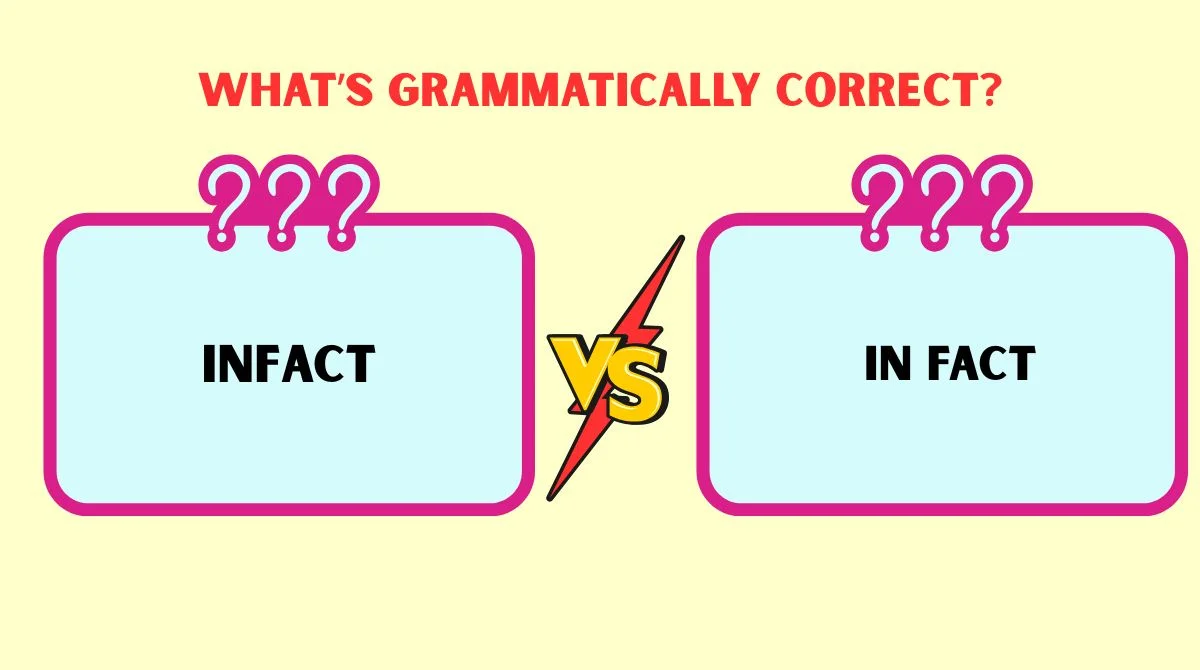
  • 🤔 Infact or In Fact: What’s Grammatically Correct?

    🤔 Infact or In Fact: What’s Grammatically Correct?

    Getting tripped up by a tiny space between two words is more common than you’d think. Many people write “infact” as one word, especially in casual writing or texting. However, that little space changes everything.

    This article digs deep into the question: “Infact or In Fact – which is grammatically correct?”
    We’ll explain the right answer, explore the meaning, clear up misconceptions, and share real-world usage examples so you can write with confidence.


    Stop Writing “Infact” — Here’s Why It’s Wrong

    It’s easy to assume that infact is just a more compact version of in fact. But English grammar doesn’t see it that way.

    “Infact” is not a recognized word in the English language.

    Using infact in essays, emails, or official documents makes your writing look unpolished. Whether you’re preparing for exams, drafting a report, or posting on social media, getting this right matters.

    Here’s the quick truth:
    ✅ Correct: in fact
    ❌ Incorrect: infact


    The Quick Answer

    Let’s start with a straightforward answer:

    Always write it as two words: “in fact.”

    The two-word phrase is standard in both American and British English. Dictionaries such as Merriam-Webster, Oxford, and Cambridge list only “in fact”.

    Here are two quick examples to keep in mind:

    • ✅ I thought the exam would be tough. In fact, it was quite easy.
    • ❌ I thought the exam would be tough. Infact, it was quite easy.

    The difference is more than spelling. The two-word form conveys meaning, while the single word is simply an error.


    What “In Fact” Actually Means

    Definition

    “In fact” is an adverbial phrase used to:

    • Emphasize truth or reality.
    • Add a surprising detail.
    • Correct or contrast a previous statement.

    For example:

    I thought he was a newcomer. In fact, he has been working here for years.

    Origins

    The phrase “in fact” comes from medieval English and literally means “in reality” or “in deed.”
    Writers in the 16th century began using it to stress what is genuinely true.

    Synonyms

    Sometimes you can replace “in fact” with other expressions without changing the meaning:

    • indeed
    • actually
    • as a matter of fact
    • truly
    • certainly

    Example Sentences with Synonyms:

    • The rumor seemed unbelievable. Indeed, it turned out to be true.
    • She appeared calm. Actually, she was nervous.
    • He didn’t hesitate. As a matter of fact, he volunteered.

    💡 Tip: “In fact” is slightly more formal and fits academic, journalistic, and professional contexts better than most synonyms.


    Understanding the Misconception About “Infact”

    Why do so many people write “infact” as one word?
    Here are the main reasons:

    • Phonetic typing: People often type as they speak, making them overlook the space.
    • Texting culture: Quick messages on phones encourage shortcuts and misspellings.
    • Autocorrect errors: Some devices don’t flag “infact” as incorrect.
    • Lack of awareness: Non-native speakers sometimes assume it’s one word.

    But no matter the reason, “infact” is not accepted in standard English.

    Other commonly confused words that follow a similar pattern:

    • ❌ alot → ✅ a lot
    • ❌ infront → ✅ in front
    • ❌ everytime → ✅ every time

    Knowing this can help you avoid repeating the same mistake.


    Grammar Rules and Sentence Placement for “In Fact”

    One of the strengths of “in fact” is its flexibility. You can use it in different parts of a sentence to emphasize or clarify information.

    At the Beginning

    Often used to introduce contrast or clarification:

    In fact, the new software made the task easier.

    In the Middle

    Placed between commas to add emphasis:

    The manager, in fact, praised the entire team.

    At the End

    Less common but still correct:

    The book is informative and enjoyable in fact.


    Punctuation Tips

    • When used in the middle, set it off with commas.
    • Avoid unnecessary commas before or after unless needed for clarity.
    • Do not capitalize in fact unless it starts a sentence.

    Side-by-Side Comparison: Infact vs. In Fact

    AspectInfact (Incorrect)In Fact (Correct)
    Part of SpeechNot a wordAdverbial phrase
    Presence in Dictionaries❌ Not listed✅ Found in all major dictionaries
    MeaningNoneMeans actually, in reality
    Example❌ I like chocolate infact.✅ I like chocolate, in fact.
    AcceptabilityInformal / wrongStandard English (US & UK)
    Formal Writing❌ Not acceptable✅ Fully acceptable

    ✅ Remember: If you want your writing to be credible, always separate the two words.


    Real-World Examples of “In Fact”

    From Literature

    “There are no secrets that time does not reveal. In fact, it is the discovery of such secrets that makes history.”
    — George Santayana

    “We do not see things as they are. In fact, we see them as we are.”
    — Anaïs Nin

    From Famous Speeches

    “We have nothing to fear but fear itself. In fact, our strength grows when we face adversity.”
    — Adapted from Franklin D. Roosevelt

    “The fight for freedom is never easy. In fact, it demands sacrifice.”
    — Paraphrased from Martin Luther King Jr.

    From Everyday Conversations

    • I thought the restaurant would be expensive. In fact, it was affordable.
    • He seems shy. In fact, he’s very outgoing once you talk to him.
    • I didn’t plan to buy anything. In fact, I ended up shopping for hours.

    Common Mistakes to Avoid

    Here are frequent errors writers make with this phrase:

    • Writing “infact” as one word: Always incorrect.
    • Overusing “in fact”: Use it sparingly to keep writing sharp.
    • Misplacing commas: Remember to set it off with commas when used in the middle.
    • Using it redundantly: Avoid repetitive phrases like “In fact, actually.”

    Versatility and Impact of “In Fact”

    Why is this phrase so popular and powerful?

    • Adds emphasis: Highlights the truth of a statement.
    • Strengthens arguments: Useful in essays and debates.
    • Improves clarity: Guides the reader to the key point.
    • Fits multiple contexts: Works in casual speech, academic writing, and persuasive pieces.

    Example Comparison:

    Without “In Fact”With “In Fact”
    The experiment proved the theory.The experiment, in fact, proved the theory.
    Many people doubted the idea.Many people doubted the idea. In fact, they opposed it at first.

    Notice how the second versions feel more confident and persuasive.


    FAQs About “In Fact”

    Is “infact” ever correct?

    No. “Infact” is always incorrect. Stick to the two-word form.

    Is “in fact” formal enough for academic writing?

    Yes. It’s widely accepted in academic and professional contexts.

    Is “in fact” used in American or British English?

    Both. It appears in dictionaries and style guides on both sides of the Atlantic.

    Where should “in fact” be placed in a sentence?

    It can be at the beginning, in the middle (set off with commas), or at the end depending on context.

    Can I overuse “in fact”?

    Yes. Overuse makes writing repetitive. Use it only when it adds emphasis or contrast.


    Key Takeaways

    • ✅ Always write “in fact” as two words.
    • ✅ It emphasizes truth, contrast, or surprise.
    • ✅ Avoid the common error of writing “infact.”
    • ✅ Use sparingly for maximum impact.
    • ✅ Proper placement and punctuation enhance clarity.

    Conclusion: “In Fact” — The Correct and Powerful Choice

    Mastering small details like this boosts both your grammar and credibility.
    The next time you feel tempted to write “infact,” remember that “in fact” is the only grammatically correct choice.

    Clear communication often hinges on such details. By using the phrase correctly, you’ll write and speak with greater precision and professionalism.

  • ✍️ Is It Rational vs Rationale? Decoding the Real Difference

    ✍️ Is It Rational vs Rationale? Decoding the Real Difference

    Confused between “rational” and “rationale”?
    You’re not alone. These two words look alike, share a common root, and both relate to reason and logic.
    Yet they’re not interchangeable — and mixing them up can hurt your writing’s clarity and credibility.

    In this guide, we’ll break down the difference between these two terms, explore their meanings, origins, pronunciation, and real-world uses. By the end, you’ll know exactly which one to use — every single time.


    ✅ Quick Answer: Rational vs Rationale

    Before we dig deeper, here’s the short version:

    WordPart of SpeechMeaningExample Sentence
    RationalAdjectiveLogical, reasonable, guided by reason“She made a rational choice.”
    RationaleNounThe underlying reason or justification for something“The rationale for the new policy was clearly explained.”

    👉 Key takeaway:

    • Rational describes a person’s thought, action, or decision.
    • Rationale refers to the reason behind that thought, action, or decision.

    🔎 Understanding the Confusion

    People often mix these two up because:

    • They share the same Latin root — rationalis (“related to reason”).
    • They’re used in contexts that involve logic, thinking, and explanations.
    • They even sound similar, though the ending differs in pronunciation.

    However, the two words evolved to serve very different roles in English grammar.
    Grasping that difference makes your writing sharper and more professional.


    🧠 Deep Dive into Rational

    Definition

    Rational is an adjective.
    It describes a person, thought, behavior, or decision that is based on logic, reason, or sound judgment.

    “A rational investor carefully evaluates risks before putting money into the market.”

    Key Characteristics of “Rational”

    • Describes thinking patterns or actions
    • Implies logic and reason
    • Opposite of “irrational” (illogical, unreasonable)

    Examples in Context

    • Everyday use:
      “It’s rational to carry an umbrella when the forecast predicts rain.”
    • Business:
      “The manager took a rational approach to reduce costs.”
    • Science:
      “A rational hypothesis is testable and evidence-based.”
    • Personal decisions:
      “She made a rational choice to prioritize health over convenience.”

    Common Mistakes

    • ❌ Incorrect: “The rational for his decision was convincing.”
      ✅ Correct: “The rationale for his decision was convincing.”

    📜 Deep Dive into Rationale

    Definition

    Rationale is a noun.
    It refers to the underlying reason, explanation, or justification for a decision, action, or belief.

    “The teacher explained the rationale behind assigning extra reading.”

    Key Characteristics of “Rationale”

    • Identifies the reasoning or justification
    • Functions as a thing, not a description
    • Often used in formal or professional contexts

    Examples in Context

    • Academic:
      “The researcher provided a clear rationale for the new experiment.”
    • Business:
      “The CEO shared the rationale for the company’s rebranding strategy.”
    • Everyday use:
      “I don’t understand the rationale for banning that book.”

    Common Mistakes

    • ❌ Incorrect: “He gave a very rationale answer.”
      ✅ Correct: “He gave a very rational answer.”

    ⚖️ Rational vs Rationale: The Core Difference

    Here’s a side-by-side look to make the difference crystal clear:

    FeatureRationalRationale
    Part of SpeechAdjectiveNoun
    Refers ToThinking, actions, or behaviorUnderlying reason or explanation
    UsageDescribes how someone thinks or actsRefers to why they think or act
    Example“It’s rational to save money for emergencies.”“The rationale for saving is to prepare for the future.”

    👉 Quick Rule:
    If it describes thought or behavior → rational.
    If it names the reason → rationale.


    🚫 Are They Interchangeable? (And Why Not)

    No.
    You cannot swap one for the other because:

    • Grammar: One is an adjective, the other is a noun.
    • Meaning: They answer different questions:
      • Rational → What kind of thinking or behavior?
      • Rationale → What is the reason behind it?

    Case Study

    Incorrect: “Her rational for leaving was clear.”
    Correct: “Her rationale for leaving was clear.”

    Incorrect: “He made a rationale decision.”
    Correct: “He made a rational decision.”

    Mixing them up can confuse readers or make your writing appear careless — especially in academic or business settings.


    🌎 Usage in Real-World Contexts

    Academic Writing

    • Researchers often explain the rationale behind a study or method.
    • Rational thinking is valued in hypothesis formation.

    Business & Legal

    • Companies state the rationale for decisions like mergers or policy changes.
    • Leaders are expected to make rational business choices.

    Everyday Conversations

    • “It’s rational to get insurance.”
    • “What’s your rationale for skipping the meeting?”

    🔊 Pronunciation Guide

    Here’s how to pronounce them correctly:

    WordIPA (Phonetic)Simple Pronunciation
    Rational/ˈræʃ.ən.əl/RASH-uh-nuhl
    Rationale/ˌræʃ.əˈnæl/RASH-uh-NAL

    Tips to Remember

    • Rational ends like “national” → Think adjective.
    • Rationale ends with an “-ale” sound → Think noun / reason.

    🔗 Similarities Worth Knowing

    • Both come from Latin “rationalis” meaning relating to reason.
    • Both link to logical thinking and explanations.
    • Their shared origin explains why they still confuse learners.

    💡 Memory Hacks: When to Use Each

    • Think of A vs E:
      • A in rAtional → Adjective.
      • E in rationalE → rEason / explanation.
    • Quick Test:
      • If it answers “How?” → Use rational.
      • If it answers “Why?” → Use rationale.
    • Mnemonic:
      “A rational person explains their thinking.
      The rationale is the explanation itself.”

    🚫 Common Errors and How to Avoid Them

    • Misusing “rationale” as an adjective.
    • Overusing “rationale” when “reason” is simpler.
    • Forgetting plural: Rationales (for multiple reasons).
    • Ignoring context — using “rational” in place of “logical” even when emotions drive the choice.

    Pro Tip:
    Proofread or read your sentence aloud.
    If you can replace the word with “reason” without changing the meaning, it’s probably rationale, not rational.


    📚 Case Study: Correct vs Incorrect Usage in Real Life

    Business Example:

    ✅ “The rationale for the price increase was rising production costs.”
    ✅ “The board made a rational choice to diversify investments.”

    Academic Example:

    ✅ “The study’s rationale was to explore the impact of sleep on memory.”
    ✅ “The team used a rational approach to test the hypothesis.”

    Common Misuse:

    ❌ “His rationale decision surprised everyone.”
    ✅ “His rational decision surprised everyone.”


    ❓ FAQs

    What is the main difference between Rational and Rationale?

    Rational describes logical thinking or actions.
    Rationale refers to the underlying reason or justification.

    Can Rational and Rationale ever be used interchangeably?

    No. They serve different grammatical functions — one is an adjective, the other a noun.

    Is Rationale singular or plural?

    Rationale is singular. The plural form is Rationales, though it’s less commonly used.

    Which is more formal, Rational or Rationale?

    Both are formal but used in different contexts: Rationale appears more in academic and professional writing, while Rational is common in both formal and informal contexts.

    Does British English differ from American English in using these words?

    No significant difference. Both varieties of English use them in the same way.


    📝 Conclusion

    Mastering the difference between rational and rationale improves your writing’s clarity, professionalism, and credibility.

    Remember:

    • Rational → logical thinking or behavior (adjective)
    • Rationale → underlying reason or explanation (noun)

    Knowing when to use each helps you communicate precisely and avoid common mistakes — whether you’re writing a research paper, drafting a business proposal, or just trying to express yourself clearly.

    “Clear thinking is rational; the reason behind it is the rationale.”

  • 🔎 Constant vs Consistent: A Deep Dive into Their Meanings

    🔎 Constant vs Consistent: A Deep Dive into Their Meanings

    Words can be tricky. Some sound alike or share similar ideas yet mean very different things. Two such words are “constant” and “consistent.”

    People often swap them without realizing they describe different qualities. This article unpacks their meanings, shows you how to use each word correctly, and gives practical tips to avoid confusion.


    Quick Takeaway

    If you’re in a hurry, here’s the simplest way to remember:

    Constant means something that doesn’t change or continues without interruption.
    Consistent means something that is regular, reliable, or behaves in the same way over time.

    Think of constant as a fixed state, while consistent is about a steady pattern of action.


    Why This Distinction Matters

    Choosing the wrong word can change your message’s meaning.
    Imagine a fitness coach telling you to maintain constant effort. That implies never-ending, without rest, which isn’t realistic.
    Instead, they should say consistent effort, which means repeating healthy habits over time.

    Understanding the difference matters because:

    • It improves your writing and speaking clarity.
    • It helps avoid misunderstandings in education, business, and relationships.
    • It builds credibility in professional settings—especially in reports, research, and marketing.

    📝 Language Tip: Misusing these words can subtly shift meaning and confuse your audience.


    Core Difference at a Glance

    Here’s a quick comparison table:

    AspectConstantConsistent
    DefinitionSomething that does not change, remains the same over timeSomething that happens in a regular, reliable, steady way
    NatureFixed, unchanging, continuousRepeated, dependable, patterned
    Typical UseDescribes states, conditions, or valuesDescribes actions, behavior, or performance
    ExamplesConstant speed of light, constant background noiseConsistent study habits, consistent growth
    ToneOften static or unvaryingSuggests reliability and progress

    Understanding “Consistent”

    Definition and Nuances

    The word consistent refers to something that happens in the same way, reliably, or regularly over a period of time.
    It doesn’t mean unchanging—rather, it suggests a steady pattern.

    For example:

    • A student who studies two hours every evening is consistent.
    • A company that delivers high-quality service month after month is consistent.

    💡 Key Insight: Consistency is about repetition and dependability, not permanence.


    Examples in Context

    • Everyday life: A parent who consistently wakes up early to prepare breakfast.
    • Education: A learner who consistently scores above 85% in math tests.
    • Work: A designer who consistently meets deadlines.
    • Science: An experiment that consistently produces the same result under similar conditions.

    Common Synonyms and Related Terms

    • Reliable
    • Dependable
    • Steady
    • Regular
    • Predictable

    👉 These words often work as substitutes, but not always. For instance, steady may describe speed, while consistent often relates to performance or behavior.


    Common Misuses of “Consistent”

    A frequent mistake is using “consistent” for things that don’t involve regular actions.

    ❌ Incorrect: “The region experienced consistent rain for two weeks.”
    ✅ Correct: “The region experienced constant rain for two weeks.”

    Rain isn’t about a repeated behavior. It’s an ongoing state—so constant is correct.


    Understanding “Constant”

    Definition and Nuances

    The word constant describes something that remains the same or continues without pause or change.
    It implies permanence or unbroken presence.

    For example:

    • The constant speed of light is about an unchanging value.
    • A clock’s constant ticking highlights unending occurrence.
    • A person’s constant headache signals ongoing pain.

    🧠 Remember: Constant relates to unchanging states, not repeated actions.


    Examples in Context

    • Science: The gravitational constant or a constant chemical property.
    • Everyday life: A constant hum of traffic outside an apartment.
    • Health: Constant fatigue during stressful weeks.
    • Emotions: A constant feeling of gratitude.

    Common Synonyms and Related Terms

    • Unchanging
    • Perpetual
    • Continuous
    • Fixed
    • Steady

    These terms capture the idea of no interruption or variation.


    Common Misuses of “Constant”

    Many people use “constant” when they mean “consistent.”

    ❌ Incorrect: “She showed constant effort in improving her skills.”
    ✅ Correct: “She showed consistent effort in improving her skills.”

    Effort is not about unbroken presence; it’s about repeated dedication over time.


    Constant vs Consistent: Direct Comparison

    Key Distinctions Explained Simply

    • Constant = describes something unchanging and ongoing.
    • Consistent = describes something regular and dependable in pattern.

    👉 Grammar often reflects this difference:

    • Constant typically pairs with nouns describing states or conditions (e.g., constant noise, constant temperature).
    • Consistent usually pairs with actions, efforts, or behaviors (e.g., consistent training, consistent output).

    Overlapping Situations That Confuse Learners

    Some scenarios invite confusion:

    PhraseBetter ChoiceReason
    Constant practiceConsistent practicePractice involves repeated action over time
    Consistent painConstant painPain describes an ongoing state
    Constant progressConsistent progressProgress builds steadily through repeated effort

    🟢 Rule of Thumb: If it describes a stable condition → use constant.
    If it describes regular effort or pattern → use consistent.


    Real-World Applications and Examples

    Daily Life

    • Consistent: Going to the gym three times a week.
    • Constant: The city’s constant traffic noise.

    Education and Learning

    • Consistent: A teacher’s consistent grading method helps students understand expectations.
    • Constant: A student’s constant curiosity fuels their desire to explore new topics.

    Business and Productivity

    • Consistent: A business that consistently delivers quality builds customer trust.
    • Constant: Constant market demand pushes businesses to innovate.

    💬 Quote: “Success doesn’t come from what you do occasionally. It comes from what you do consistently.” – Marie Forleo


    Relationships and Personal Growth

    • Consistent: Being consistently supportive strengthens trust in friendships.
    • Constant: Having constant communication can sometimes feel overwhelming rather than supportive.

    How to Choose the Right Word Every Time

    Use this quick decision guide:

    QuestionIf Yes → Use
    Does it describe something unchanging, continuous, or ever-present?Constant
    Does it describe something repeated, reliable, or regular in action?Consistent

    🟩 Tip for Writers: When editing, pause at each use of “constant” or “consistent” and ask yourself this question. This habit sharpens your word choice over time.


    Frequently Asked Questions (FAQs)

    Can something be both constant and consistent?

    Yes. For example, the constant laws of physics lead to consistent outcomes in experiments.
    The law itself is unchanging, but the repeated outcomes show consistency.


    Which term is better for describing ongoing improvement?

    Use consistent. Improvement happens over time through repeated effort.
    Saying “constant improvement” implies improvement never stops, which is rarely realistic.


    Are these terms interchangeable in any context?

    Almost never. The few overlaps occur when describing patterns that are both continuous and regular, but usually, one fits better depending on whether you mean unchanging state or steady pattern.


    Is “constent” a word or just a typo?

    It’s a typo. The correct spelling is constant.


    Can consistent behavior lead to constant results?

    Yes, often. For example, consistent studying can lead to a constant high grade if conditions remain stable.


    Conclusion

    The difference between constant vs consistent lies in what they describe:

    • Constant = unchanging, continuous, fixed.
    • Consistent = steady, regular, reliable over time.

    Mastering this distinction not only improves your vocabulary but also sharpens your communication.
    Whether you’re writing essays, emails, or speaking in meetings, using the right word shows precision and credibility.

  • SPWM Meaning in Text: Understanding the Term Across Contexts

    SPWM Meaning in Text: Understanding the Term Across Contexts

    The internet is full of abbreviations and short forms that can leave you scratching your head. One such example is “SPWM”, a term that pops up in text messages, social media posts, and sometimes even in technical discussions.

    Many people search for SPWM meaning in text because it looks confusing and doesn’t follow the usual slang patterns like LOL, BRB, or IDK. If you’ve ever stumbled across this abbreviation and wondered what it stands for, you’re not alone.

    In this guide, we’ll break it down clearly, explore its multiple meanings across platforms, trace its background, and even show you how to respond if someone texts you “SPWM.” By the end, you’ll never be puzzled by it again.


    Meaning & Definition of SPWM

    When you see SPWM in text, it can mean different things depending on the context. The two most common definitions are:

    1. Slang/Chat Meaning:
      • “Sleep Peace With Me” – often used in friendly or romantic conversations when someone is wishing you a good night.
      • “Special Person With Me” – sometimes used as an affectionate phrase to refer to being with someone important.
    2. Technical/Professional Meaning:
      • “Sinusoidal Pulse Width Modulation” – a term widely used in electronics, physics, and engineering.
      • Other expansions in specific fields like aviation or medicine also exist.

    👉 The important thing is that in casual texting and online chat, SPWM usually refers to the slang versions that are related to emotions, affection, or greetings, while in technical discussions it takes on a much more scientific definition.


    Background & Origin of SPWM

    Unlike widely recognized internet acronyms such as LOL or OMG, SPWM doesn’t have a single clear origin. It evolved in two different directions:

    1. As Internet Slang:
      • Emerging in chatrooms and early instant messaging, users began shortening phrases like “sleep peacefully with me” into SPWM.
      • Over time, it became a niche way of saying good night or expressing closeness.
    2. As a Technical Term:
      • In engineering, SPWM (Sinusoidal Pulse Width Modulation) originated in the late 20th century. It became an important method in power electronics for controlling inverter circuits, especially in renewable energy and aircraft systems.
      • This version is widely taught in electrical engineering textbooks and research papers.

    So, while teens or couples might use SPWM as slang, an engineer might be using it to describe inverter technology.


    Usage in Different Contexts

    The meaning of SPWM in text depends heavily on where it’s used:

    • In Personal Chats:
      • Often exchanged before bedtime as a caring message.
      • Used to express emotional closeness or affection.
      • Example: “Good night babe, SPWM ❤️”
    • On Social Media:
      • Hashtags like #SPWM sometimes appear under selfies or posts with loved ones, meaning “special person with me.”
      • In niche groups, it can be used humorously or ironically.
    • In Professional Fields:
      • Engineers, researchers, and technicians use SPWM to refer to sinusoidal pulse width modulation in academic or project discussions.
      • Example: “The SPWM technique improves inverter efficiency in solar power systems.”

    👉 Always consider the audience and platform when interpreting it.


    Meanings Across Platforms

    Here’s how SPWM shows up on popular platforms:

    • WhatsApp:
      • Commonly used in private chats between friends or couples.
      • Example: “Don’t forget, SPWM 😴✨”
    • Instagram:
      • Appears in captions with selfies, travel photos, or couple shots.
      • Hashtags like #SPWM may mean special person with me.
    • TikTok:
      • May be used in short videos or captions with romantic or friendship themes.
      • Sometimes appears in aesthetic edits with text overlays.
    • Snapchat:
      • Frequently used as shorthand in snaps with bedtime images or close-friend interactions.

    👉 Each platform gives SPWM a slightly different shade of meaning, but the emotional/romantic version dominates casual texting.


    Other Fields: Technical & Professional Meanings

    Beyond texting, SPWM has strong associations with specialized fields:

    1. Physics & Engineering:
      • Sinusoidal Pulse Width Modulation – a method used to control inverters and regulate voltage in power systems.
      • Widely applied in renewable energy, motor drives, and aircraft power systems.
    2. Medical Use (less common):
      • In certain research papers, SPWM might appear as shorthand for Specialized Pulse Wave Measurement.
    3. Aircraft Technology:
      • Used in discussions of power electronics in aviation systems.

    So while your friend might text you “SPWM 😘,” an engineer might use the same acronym in a technical presentation.


    Common Misconceptions & Mistakes

    Because SPWM has multiple meanings, it often causes confusion:

    • Mistake 1: Assuming it always means “Sleep Peace With Me.”
    • Mistake 2: Thinking it’s just a typo for spam.
    • Mistake 3: Believing it has only slang usage and ignoring its technical roots.

    👉 To avoid misunderstandings, always check the context. If it’s coming from a colleague in engineering, it’s probably about pulse width modulation and not romance.


    Similar Terms & Alternatives

    Here’s a quick comparison table of terms often confused with SPWM:

    TermMeaningUsage Context
    SPWMSleep Peace With Me / Special Person With MeChat, social media
    SPWMSinusoidal Pulse Width ModulationEngineering, physics
    SWPMSleep Well Precious MineRomantic texting
    PWMPulse Width ModulationElectronics
    SPWSleep Peacefully WellInformal texting

    This table shows why it’s easy to confuse SPWM with other similar short forms.


    How to Respond to SPWM

    If someone texts you SPWM, your reply depends on the context. Here are a few natural responses:

    • In a romantic or friendly chat:
      • “Aww, SPWM too 😘”
      • “Sweet dreams, can’t wait to see you ❤️”
      • “Good night, sleep tight 💤”
    • If you’re confused:
      • “Wait, what does SPWM mean? 😅”

    👉 Example conversation:

    • Person A: “Heading to bed now, SPWM ❤️”
    • Person B: “Good night babe, SPWM too 😘✨”

    Differences From Similar Words

    Unlike more common goodnight acronyms like GN (Good Night) or SD (Sweet Dreams), SPWM feels more personal and unique. It carries an affectionate touch rather than being a generic sign-off.

    • GN: Generic good night.
    • SD: Sweet dreams, friendly or romantic.
    • SPWM: Deeper, more intimate, often implying closeness.

    In professional contexts, SPWM is also more specific than the general PWM term.


    Relevance in Online Conversations & Dating Apps

    On dating apps and private chats, SPWM is becoming a niche but affectionate abbreviation. Couples use it as a secret code or an inside joke. It’s less mainstream than ILY (I love you) but can carry a personal bond that feels special.

    On platforms like Tinder or Bumble, it may appear in conversation when two people are transitioning from playful banter to more intimate goodnight wishes.


    Popularity & Trends Over Time

    Looking at Google Trends data, searches for “SPWM meaning in text” have risen steadily in the last few years. The spike is largely due to confusion about whether it’s a slang term or a technical abbreviation.

    • Peak Interest: Often at night, when people see it in chats.
    • Secondary Interest: Among engineering students researching SPWM for projects.

    👉 This dual usage explains why the term keeps trending both in pop culture and academic circles.


    FAQs About SPWM Meaning in Text

    1. What does SPWM mean in text messages?

    In casual chats, SPWM often means “Sleep Peace With Me” or “Special Person With Me.”

    2. Does SPWM have a technical meaning?

    Yes, in engineering it means Sinusoidal Pulse Width Modulation, used in power electronics.

    3. Is SPWM the same as PWM?

    No. PWM is a general method of modulation, while SPWM is a specific technique that uses sinusoidal signals.

    4. Is SPWM used on Instagram and TikTok?

    Yes, usually in hashtags or captions with affectionate or romantic undertones.

    5. How should I reply if someone texts me SPWM?

    You can respond with affection (“SPWM too 😘”) or clarify if you’re unsure what they mean.


    Conclusion

    The abbreviation SPWM shows how flexible language can be in the digital world. Whether it’s a romantic shorthand in texting or a serious technical concept in engineering, the key is context.

    For most casual users, it’s simply a cute way to say good night or highlight a special bond. For professionals, it’s tied to advanced electronics. Next time you see SPWM, you’ll know exactly how to interpret it—and even how to reply naturally.

  • FYP Meaning in Text: What It Really Stands For in Online Conversations

    FYP Meaning in Text: What It Really Stands For in Online Conversations

    If you’ve been scrolling through your social apps, you’ve probably come across the abbreviation “FYP”. At first glance, it might seem confusing, especially if you’re new to platforms like TikTok, Instagram, or Snapchat.

    So, what does FYP mean in text and why do so many people use it? In short, it can stand for “For You Page” on TikTok, but it also has other meanings depending on the context—like “Fix Your Post” or even academic references like “Final Year Project.”

    This article breaks it all down with easy explanations, real-life examples, and insights into how “FYP” changes meaning across different platforms.

    By the end, you’ll never be left puzzled when someone drops an “FYP” in your chat again.


    Meaning & Definition of FYP

    The abbreviation FYP is one of those terms that carries multiple meanings depending on where and how it’s used.

    1. Most Common Meaning — For You Page (TikTok)
      • On TikTok, “FYP” refers to the For You Page, the personalized feed of videos tailored by the app’s algorithm. If someone tags their post with “#FYP,” they’re hoping it lands on your personalized feed and gains more visibility.
    2. Secondary Meanings in Text
      • Fix Your Post: Commonly used in group chats or online forums when someone uploads something with an error.
      • Final Year Project: In academic circles, especially among university students, “FYP” refers to the capstone research project completed in the last year of study.
      • For Your Pleasure/Perusal: Less common, but sometimes used in professional emails to indicate that a document is being shared for review.

    👉 In short: FYP means different things depending on the crowd you’re speaking with.


    Background & Origin of FYP

    The popularity of FYP skyrocketed with the rise of TikTok. Before TikTok became a global giant, the abbreviation was relatively unknown outside of academic settings (where it stood for Final Year Project).

    • TikTok Era: The term “FYP” became mainstream because of TikTok’s For You Page, the landing page where users first interact with content. Creators began using the hashtag #FYP in hopes of boosting video reach.
    • Chat Slang: Over time, people repurposed “FYP” in text and messaging apps, giving it new meanings like “Fix Your Post.”
    • Professional Settings: In emails, “FYP” was occasionally used as shorthand for For Your Perusal, though this use has declined with time.

    Usage in Different Contexts

    The meaning of “FYP” depends on where and how you use it.

    1. Casual Chat with Friends
      • “Dude, fyp, your meme has a typo 😆.” → Fix Your Post
      • “I saw this hilarious TikTok on my fyp today.” → For You Page
    2. Social Media Hashtags
      • #fyp #foryou is one of the most popular hashtag combos on TikTok, often used to try to go viral.
    3. Work or University
      • “Submit your FYP by next week.” → Final Year Project
      • “Attached is the report fyp.” → For Your Perusal

    Meanings Across Platforms

    Here’s a quick breakdown of how FYP is used across major apps:

    PlatformMeaning of FYPExample Usage
    TikTokFor You Page“This ended up on my fyp 😳”
    InstagramFor You Page/Feed“Check your fyp reels.”
    WhatsAppFix Your Post“Bro, fyp, you tagged the wrong person.”
    SnapchatFor Your Page / Fun Chat Slang“Saw this on fyp, so funny 😂.”
    AcademicsFinal Year Project“My FYP is about AI algorithms.”
    EmailsFor Your Perusal“Attached is the document fyp.”

    Other Fields Where FYP Appears

    Not all uses of “FYP” are slang-related. It shows up in technical and academic contexts too:

    • Physics/Engineering: Could be shorthand in project codes, but not widely standardized.
    • Medical: Rare, but sometimes appears in shorthand for “Follow Your Plan.”
    • Aviation: May appear as an abbreviation in flight planning documents.
    • Corporate: In office communication, “fyp” = “For Your Perusal/Processing.”

    Common Misconceptions & Mistakes

    • Misconception 1: FYP always means TikTok’s For You Page. ❌
      • Reality: It can mean many things outside TikTok.
    • Misconception 2: Using #FYP guarantees your TikTok video will go viral. ❌
      • Reality: The TikTok algorithm considers engagement, not just hashtags.
    • Misconception 3: FYP in professional emails is trendy. ❌
      • Reality: It can look unprofessional; better to write the full phrase.

    Similar Terms & Alternatives

    Here’s a table of terms often confused with or used instead of FYP:

    TermMeaningCommon Use Case
    FYPFor You Page / Fix Your Post / Final Year ProjectTikTok, chats, academics
    FYIFor Your InformationEmails, chats
    FYEFor Your EntertainmentMemes, casual posts
    FRFor RealSocial media slang
    TBTThrowback ThursdayInstagram, nostalgia posts

    How to Respond to FYP in Text

    Depending on context, here are ways to reply:

    • Friend sends FYP (Fix Your Post):
      • “Oops, didn’t notice that typo, thanks!”
    • Someone says your TikTok is on their FYP:
      • “No way! Glad it reached you 😎.”
    • In academic chat about Final Year Project:
      • “Still working on my FYP, deadline’s killing me.”
    • In professional email:
      • “Got it, thanks for sharing fyp.”

    👉 Chat-style examples:

    • A: “Bro fyp, your caption is wrong 😂.”
    • B: “Haha thanks, I’ll fix it rn.”
    • A: “Your TikTok showed up on my fyp today!”
    • B: “Seriously? That’s awesome 🎉.”

    Differences From Similar Words

    • FYP vs. FYI:
      • FYP = For You Page/Fix Your Post
      • FYI = For Your Information
    • FYP vs. FYE:
      • FYP is situational (TikTok/academic).
      • FYE is purely entertainment-related.
    • FYP vs. Explore Page:
      • TikTok = FYP, Instagram = Explore.

    Relevance in Online Conversations & Dating Apps

    Abbreviations like FYP have become part of digital shorthand. On dating apps, someone might casually mention “Saw a video on my fyp about relationships” as an icebreaker. Using such slang shows you’re socially aware and up-to-date with online trends, which can help spark connections.


    Popularity & Trends Over Time

    • Google Trends: Searches for “fyp meaning” skyrocketed in 2020, alongside TikTok’s boom.
    • Hashtag Popularity: #FYP remains one of the most-used hashtags on TikTok, with billions of views.
    • Social Usage: While still TikTok-dominated, its academic and chat-related meanings keep it relevant outside entertainment.

    FAQs About FYP

    1. What does FYP mean in text?

    It usually means For You Page on TikTok, but in text/chat it can also mean Fix Your Post or Final Year Project.

    2. Does FYP guarantee TikTok virality?

    No. Hashtags like #FYP don’t guarantee reach; engagement, watch time, and shares matter more.

    3. Can I use FYP in professional emails?

    It’s better to avoid it. Write “For Your Perusal” or “For Your Review” instead for clarity.

    4. Is FYP only for TikTok?

    No. It has multiple meanings across academics, chats, and professional settings.

    5. What’s the difference between FYP and FYI?

    • FYP = For You Page/Fix Your Post/Final Year Project
    • FYI = For Your Information

    Conclusion

    The abbreviation FYP has evolved from an academic term into a global social media buzzword. While most people associate it with TikTok’s For You Page, its meaning can shift dramatically depending on whether you’re chatting with friends, studying at university, or exchanging work emails.

    The key to understanding FYP is paying attention to context. So, the next time someone texts you “fyp,” you’ll know whether they’re pointing out a typo, talking about TikTok, or stressing over a university project.

  • FW Meaning in Text – What It Stands For and How to Use It Online

    FW Meaning in Text – What It Stands For and How to Use It Online

    Have you ever opened a message and seen “FW” pop up, leaving you wondering what it really means? You’re not alone. The internet is full of abbreviations, and FW is one of those short forms that can confuse people, especially if you’re new to texting culture.

    Some use it in casual chats, while others recognize it from professional emails or technical fields. Because of its flexibility, “FW” can carry more than one meaning depending on the situation.

    In this article, we’ll dive deep into the meaning of FW in text, explore where it came from, how people use it across platforms like WhatsApp, TikTok, Instagram, and Snapchat, and even touch on its usage in professional and scientific fields.

    By the end, you’ll know exactly what FW means, how to respond when someone sends it, and how to avoid common mistakes when interpreting it.


    Meaning & Definition of FW in Text

    The primary meaning of FW in text is “Forward.” This usage is common in emails and digital communication, where you’ll often see it in subject lines like FW: Meeting Notes. It signals that a message, file, or piece of information is being forwarded from one person to another.

    However, FW doesn’t stop there. In informal texting and social media, it often stands for “F* With”** (positive or negative depending on context). For instance:

    • “I fw this song” = I like this song / I vibe with this song.
    • “Don’t fw him” = Don’t deal with him / Don’t trust him.

    Other secondary meanings include:

    • FW = Few Words (sometimes used when someone is keeping a message short).
    • FW = Free Will (seen in philosophical or motivational contexts).
    • FW = Framework (in tech and coding discussions).

    👉 In short, the meaning of FW in text changes depending on the tone and platform.


    Background & Origin

    The origin of FW as “Forward” comes from early email systems in the 1980s and 1990s. When people forwarded messages, the subject line was automatically marked with FW: to show it wasn’t the original text. This stuck and remains a standard in email communication today.

    On the other hand, the slang use of FW (“f* with”)** comes from African American Vernacular English (AAVE) and hip-hop culture. Over time, this phrase entered mainstream usage, especially on Twitter, Instagram, and in rap lyrics. For example, rappers often use “I fw you” to express camaraderie or trust.

    As texting and online culture evolved, FW gained new layers of meaning, adapting to different niches like gaming, coding, and even science.


    Usage in Different Contexts

    FW is versatile, but context decides its meaning.

    1. Casual Chatting
      • “I fw that idea” → I support that idea.
      • “Don’t fw with me rn” → Don’t mess with me right now.
    2. Social Media
      • TikTok captions: “If u fw this vibe, follow me ✌️”
      • Instagram comments: “We fw heavy 🔥”
    3. Professional Emails
      • Subject line: “FW: Updated Meeting Agenda” → Forwarded message.
      • Workplace shorthand: “Pls fw this file to HR.”
    4. Gaming Communities
      • “I fw this build” → I like this gaming setup or character design.

    👉 The tone, formality, and platform always change how FW is read.


    Meanings Across Platforms

    Let’s see how FW shifts across the biggest platforms:

    • WhatsApp: Mostly used as Forwarded (messages are marked as “Forwarded many times”).
    • Instagram: Often slang (“I fw your content” = I like your content).
    • TikTok: Appears in captions, challenges, or trends to mean support/vibe with.
    • Snapchat: Used in slang conversations like “fw me later” = hit me up later.
    PlatformCommon Meaning of FWExample Use
    WhatsAppForward / Forwarded“FW this pic to the group.”
    InstagramF*** With (slang)“I fw your style 🔥”
    TikTokF*** With (slang)“I fw this trend fr.”
    SnapchatCasual slang“fw me when u free.”
    EmailForward“FW: Project Update”

    FW in Other Fields

    FW isn’t limited to texting—it shows up in technical and academic fields too:

    1. Physics
      • FW can mean “Forward” direction in motion or force.
    2. Medical
      • Abbreviation for Fresh Weight (in biology labs).
      • Sometimes shorthand for Follow-up Work in medical notes.
    3. Aircraft/Aviation
      • FW = Fixed Wing (referring to airplanes as opposed to helicopters).
    4. Technology/Programming
      • FW = Framework (like Django FW, Laravel FW).
      • FW = Firmware in software/hardware discussions.

    👉 Knowing these helps avoid confusion in professional settings.


    Common Misconceptions & Mistakes

    • Misreading FW as “For Work”: While logical, it’s rarely used this way.
    • Thinking FW always means “Forward”: Wrong—context can shift meaning to slang.
    • Confusing FW with FWB: FW = f*** with (positive/negative). FWB = Friends with Benefits.
    • Overusing FW in professional spaces: Slang meaning can be inappropriate in emails.

    Similar Terms & Alternatives

    Here’s a quick look at words and abbreviations that overlap with FW:

    AbbreviationFull FormUsage Example
    FWBFriends with Benefits“We’re just FWB, nothing serious.”
    FWDForward“Pls FWD this mail to John.”
    VibeFeeling/Connection“I vibe with this song.”
    SupportStand by“I support your decision.”

    How to Respond to FW

    Not sure what to say when someone uses FW? Here are some examples:

    1. Positive Response
      • Friend: “I fw your playlist 🔥”
      • You: “Glad you fw it! I’ll send more.”
    2. Casual Hangout
      • Friend: “fw me later”
      • You: “Bet, I’ll hit you up tonight 👌”
    3. Email Context
      • Boss: “FW: Client Feedback”
      • You: “Got it, reviewing now.”
    4. Negative Context
      • Friend: “Don’t fw with her, she messy.”
      • You: “Say less, I won’t.”

    Differences From Similar Words

    • FW vs. FWD: FW is both slang and shorthand. FWD is strictly formal (emails).
    • FW vs. Vibe: “Vibe” always positive, FW can be negative.
    • FW vs. Support: “Support” is formal, FW is casual slang.

    Relevance in Online Conversations & Dating Apps

    On dating apps like Tinder, Bumble, and Hinge, FW often appears in bios or chats. For example:

    • “Looking for ppl I can fw 👀” = looking for people I connect with.
    • “Don’t fw me if you’re not serious.”

    Here, FW works as a signal of vibe, compatibility, or warning. It’s short, catchy, and fits the fast-paced style of online dating chats.


    Popularity & Trends Over Time

    Looking at Google Trends, searches for “FW meaning in text” spike whenever slang abbreviations go viral on TikTok or Twitter. Over time, the slang use of FW has gained dominance among younger audiences, while older generations still associate it mainly with email forwarding.

    Social usage patterns show:

    • 2000s: Mainly “Forward” in email.
    • 2010s: Rise of slang in music and social media.
    • 2020s: Widely recognized across both slang and professional meanings.

    FAQs on FW Meaning in Text

    1. What does FW mean in text slang?

    FW usually means “F** With,”* used to express liking, support, or connection.

    2. What does FW mean in email?

    In emails, FW stands for Forward and appears in subject lines.

    3. Does FW mean the same on Snapchat and Instagram?

    Not exactly. On Snapchat, it’s often casual slang, while on Instagram it’s used to show admiration or support.

    4. Is FW the same as FWB?

    No. FW = f** with* (slang). FWB = Friends with Benefits.

    5. How should I reply if someone says “I fw you”?

    You can respond with “I fw you too” if you feel the same way, or “Appreciate it 🙏” for a lighter tone.


    Conclusion

    The meaning of FW in text depends on where and how it’s used. In professional spaces like email, it usually means Forward. In casual chats, on social media, and dating apps, it means “F** With”*—a slang term for liking, vibing, or supporting someone or something. Beyond texting, FW also shows up in aviation, medical, and technical fields with unique definitions.

    By understanding the context, you’ll never misread a message with FW again. Whether it’s a forwarded file from your boss or a friend saying they fw your style, you now know exactly what it means and how to respond.

  • OMW Meaning in Text: A Complete Guide to the Popular Abbreviation

    OMW Meaning in Text: A Complete Guide to the Popular Abbreviation

    If you’ve ever received a message that simply says “OMW”, you might have paused for a second and wondered, what does that mean? Don’t worry—you’re not alone.

    This short but powerful acronym has become one of the most common abbreviations in texting, social media, and even professional chats. People search for “OMW meaning in text” because it pops up in conversations daily, yet not everyone knows the full context of its use.

    In this guide, we’ll break down what OMW really means, where it came from, how to use it correctly, and even the mistakes people often make when texting it.

    Whether you’re chatting on WhatsApp, posting on Instagram, or writing in a group chat, this article will help you master OMW like a pro.


    Meaning & Definition of OMW

    At its core, OMW stands for “On My Way.” It’s used to quickly tell someone that you’re heading toward a place or moving in their direction. Instead of typing the full phrase, people save time by using this three-letter shorthand.

    Primary Meaning:

    • On My Way – the most common interpretation, used when someone is physically traveling to meet another person.

    Secondary Meanings (less common):

    • Oh My Word – used in some circles as an expression of surprise or disbelief.
    • One Man’s Wish – occasionally seen in creative writing or niche groups, but rare in texting.

    👉 In modern digital communication, “On My Way” is the standard and dominant meaning.


    Background & Origin

    The abbreviation OMW has roots in the early days of internet chat rooms and SMS messaging. As mobile texting became popular in the 1990s and early 2000s, people looked for ways to shorten phrases to save time and character space (back when SMS was limited to 160 characters).

    • Early Internet Slang (1990s): Abbreviations like LOL, BRB, and OMW emerged in chat rooms and instant messaging platforms such as AOL and MSN Messenger.
    • Rise in Texting (2000s): The popularity of SMS and T9 typing made abbreviations like OMW essential.
    • Modern Usage (2010s onwards): With the spread of WhatsApp, Instagram, and Snapchat, OMW became globally recognized.

    Today, OMW isn’t just a piece of internet slang—it’s a cultural marker of how communication has evolved to become faster and more concise.


    Usage in Different Contexts

    The beauty of OMW is its flexibility. It works in casual chats, family messages, and even semi-professional settings. Let’s explore:

    1. Casual Conversations

    Used when telling friends you’re leaving or arriving.

    • “Just finished work, OMW 🚗.”
    • “OMW to the party, be there in 15!”

    2. Social Media

    Often used in captions or stories.

    • “Coffee run ☕ OMW to my favorite café.”
    • “Long day ahead… OMW to class.”

    3. Professional or Work Chats

    Though less formal, it can still be acceptable among colleagues.

    • “Running late for the meeting, OMW now.”

    4. Family or Relationships

    Helps assure loved ones of your location.

    • “Don’t worry, I’m safe. OMW home.”

    Meanings Across Platforms

    While OMW generally means the same everywhere, tone and style can shift depending on the platform.

    PlatformHow OMW is UsedExample
    WhatsAppQuick updates in chats“Traffic’s , but OMW 🚦.”
    InstagramCaptions/stories“OMW to the gym 💪 #fitlife”
    TikTokHashtags or captions“OMW to recreate this dance 🔥 #fyp”
    SnapchatSnaps with a short note(Selfie in the car) “OMW 🚙”
    Slack/Work ChatsInformal updates“Got delayed, OMW to the office.”

    Other Fields: Technical Meanings of OMW

    Interestingly, OMW isn’t always about texting. In specialized fields, it can mean something different:

    • Physics/Science: Oscillating Magnetic Wave
    • Medical: Oral Motor Workout (used in therapy contexts)
    • Aviation: Operational Maneuver Warning (rare usage)

    👉 While these meanings exist, they are not common in everyday texting. Always consider context.


    Common Misconceptions & Mistakes

    Because OMW is so short, people sometimes misinterpret it.

    • Mistake 1: Thinking it means “Oh My Word” in everyday texting (this is rare).
    • Mistake 2: Using it when you haven’t actually left yet. Saying “OMW” while still at home can cause trust issues.
    • Mistake 3: Overusing it in professional emails—it’s fine in Slack, but not in formal reports.

    Similar Terms & Alternatives

    Sometimes, people prefer to use other short forms with a similar vibe.

    AbbreviationFull FormWhen to Use
    BRBBe Right BackWhen leaving briefly
    TTYLTalk To You LaterEnding a chat
    ETAEstimated Time of ArrivalGiving a precise time
    ASAPAs Soon As PossibleUrgent updates
    OTWOn The WayAlternative to OMW

    How to Respond to OMW

    When someone texts you “OMW,” your reply depends on the context.

    Casual Chat Examples:

    • Friend: “OMW to your place.”
    • You: “Cool, see you soon 🎉.”
    • Sibling: “OMW home.”
    • You: “Great, want me to order food?”

    Professional Chat Examples:

    • Colleague: “OMW to the client’s office.”
    • You: “Perfect, I’ll meet you in the lobby.”
    • Boss: “Running late, OMW.”
    • You: “No worries, I’ll get things started.”

    Differences From Similar Words

    While OMW and OTW both mean “on the way,” there are subtle differences:

    • OMW feels more casual and friendly.
    • OTW can feel slightly more neutral or professional.
    • ETA provides more detail with actual time instead of just movement.

    👉 If you’re chatting with friends, OMW works best. For business, ETA or OTW may sound clearer.


    Relevance in Online Conversations & Dating Apps

    In dating apps like Tinder, Bumble, or Hinge, people often use OMW to confirm meet-ups. It helps avoid miscommunication and builds trust by showing you’re serious about arriving.

    • “Just parked, OMW inside.”
    • “OMW to our dinner spot 😊.”

    This quick abbreviation helps keep the conversation light yet informative.


    Popularity & Trends Over Time

    According to Google Trends, “OMW meaning in text” spikes regularly because:

    • New users of social media encounter it for the first time.
    • Non-native English speakers look it up to understand slang.
    • It’s commonly taught in online slang guides.

    Over the last decade, searches for OMW have steadily risen, showing how deeply it has become embedded in global communication.


    FAQs About OMW Meaning in Text

    1. What does OMW stand for in text?

    OMW means “On My Way.” It’s used to let someone know you’re heading to them or to a place.

    2. Is OMW formal or informal?

    It’s mostly informal, but it can be used in semi-professional chats like Slack or casual work updates.

    3. Can OMW mean something else?

    Yes, though rarely. It can mean “Oh My Word” or technical phrases in medicine or physics, but context matters.

    4. What’s the difference between OMW and OTW?

    Both mean “On the Way,” but OMW is friendlier, while OTW feels more neutral or business-like.

    5. How should I reply to OMW?

    You can respond with confirmation or excitement, like:

    • “See you soon!”
    • “Great, drive safe.”

    Conclusion

    The abbreviation OMW has transformed from a simple time-saving phrase into a staple of modern communication. Whether you’re texting friends, updating coworkers, or posting on Instagram, OMW makes conversations faster and easier.

    While its primary meaning will always be “On My Way,” the context and tone can change depending on the platform. Now that you know its background, usage, and alternatives, you’ll never be confused when someone drops an “OMW” in your inbox.

    So next time you’re heading out, don’t type the full phrase—just say OMW and keep the chat moving smoothly.

  • PP Meaning in Text: A Complete Guide to Its Uses and Contexts

    PP Meaning in Text: A Complete Guide to Its Uses and Contexts

    If you’ve ever come across the abbreviation “PP” in a text message or on social media, you may have wondered what it really means. With digital communication constantly evolving, short forms like PP have become popular because they save time and space.

    But here’s the catch—PP doesn’t have just one meaning. Depending on where and how it’s used, the meaning can shift dramatically, leaving many people confused.

    Whether you spotted it in a WhatsApp chat, on Instagram, or even in a professional setting, understanding the context is key.

    In this article, we’ll break down what PP means in text, explore its origins, how it’s used across platforms, and even cover its usage in different industries.

    By the end, you’ll be able to confidently interpret and use PP without second-guessing.


    Meaning & Definition of PP in Text

    The abbreviation PP is one of those versatile short forms that can mean several things.

    • Primary meaning in casual texting: PP usually stands for “Profile Picture”. It’s commonly used when people want to update, change, or comment on someone’s display photo. For example:
      • “Nice PP, looks cool!”
      • “Change your PP, that old one is blurry.”
    • Secondary meanings in texting:
      • “Pages” (as in “pp. 25–30” in a book reference).
      • “PayPal”, often used in online buying/selling contexts.
      • “Please”, though less common, sometimes used as shorthand in informal chats.

    So, while PP might first remind you of someone’s profile picture, don’t be surprised if it’s used differently depending on the situation.


    Background & Origin of PP

    The abbreviation “PP” gained popularity in the early 2000s with the rise of instant messaging and social platforms like MSN Messenger, Orkut, and later Facebook. Initially, it was a quick shorthand for “Profile Picture” since typing full words on small mobile keypads was inconvenient.

    In academia and publishing, “pp.” as an abbreviation for “pages” has existed for centuries, long before texting was common. Derived from the Latin word paginae, “pp.” became the standard for citing multiple pages in books and research.

    Over time, as texting culture exploded, people started reusing old abbreviations in new ways. This blending of traditional and modern use is why PP can mean both a formal reference (pages) and something casual (profile picture).


    Usage in Different Contexts

    Like many abbreviations, the meaning of PP depends heavily on context. Let’s look at a few common scenarios:

    • Casual Chat with Friends
      • “Your new PP is amazing 👌.”
      • “Bro, update your PP, it’s from last year.”
    • Social Media Conversations
      • Commenting on Instagram: “Cool PP, where did you click this?”
      • WhatsApp group chats: “Change the group PP to something funny.”
    • Professional Context
      • In workplaces, PP can mean “PowerPoint”, as in “Send me the PP by tomorrow.”
      • In academic writing, it refers to “pages”. Example: “Refer to pp. 40–45 for details.”
      • In business payments: “Send it via PP (PayPal).”

    So, when you see PP, always pause and ask yourself: Is this casual, academic, or professional? The answer will usually reveal the correct meaning.


    Meanings Across Platforms

    Different apps and platforms give PP unique shades of meaning:

    • WhatsApp: PP almost always means Profile Picture.
    • Instagram: People use PP when commenting on display photos or suggesting changes.
    • TikTok: Users often talk about “PP” when discussing avatars or display images.
    • Snapchat: PP is less frequent but can still mean profile picture.
    • Facebook: Heavily used for DP/PP (Display Picture/Profile Picture).
    • E-commerce platforms: PP often refers to PayPal for transactions.

    Quick tip: If it’s on a social app, PP most likely means profile picture. If it’s in business or academic chat, it may mean something else.


    Other Fields Where PP Has Different Meanings

    Outside casual texting, PP can stand for technical or field-specific terms:

    • Physics: PP = Peak-to-Peak (measuring voltage in oscilloscopes).
    • Medical: PP = Postprandial (after meals, often related to blood sugar levels).
    • Aviation: PP = Power Plant (referring to aircraft engines).
    • Corporate: PP = Purchase Price or Profit Percentage.

    This shows that abbreviations like PP are not just limited to texting slang. They also hold weight in serious professional and scientific discussions.


    Common Misconceptions & Mistakes

    Because PP is so versatile, people often misinterpret it.

    • Mistaking PP (Profile Picture) for PayPal: A seller might say, “Send via PP,” and someone could assume it’s about pictures instead of payment.
    • Confusing PP with DP: In some regions, DP (Display Picture) is more common, while in others, PP dominates. Both mean the same thing but may cause confusion.
    • Mixing Professional with Casual: If your boss writes “Send me the PP,” don’t assume it’s about a profile picture. Context matters!

    Similar Terms & Alternatives

    Here’s a quick comparison table:

    TermFull FormCommon UseExample
    PPProfile PictureSocial media chats“Cool PP on Insta!”
    DPDisplay PictureWhatsApp, FB“Your new DP looks nice.”
    AVIAvatarGaming platforms“Change your AVI for the match.”
    PFPProfile PicturePopular on Reddit/Twitter“Love your PFP.”

    As you can see, different communities favor different terms, but they all serve a similar purpose.


    How to Respond to “PP” in Text

    If someone mentions PP, your reply depends on context.

    • Friend compliments your PP
      • “Thanks, clicked it last weekend 😄.”
    • Someone asks you to change PP
      • “Sure, I’ll update it soon.”
    • Seller requests PP (PayPal)
      • “Got it, sending payment via PayPal now.”
    • Boss requests PP (PowerPoint)
      • “I’ll email the PP presentation by 5 PM.”

    These responses keep the conversation clear and context-appropriate.


    Differences From Similar Words

    • PP vs DP: Both mean profile/display picture, but DP is more common in South Asia while PP is used globally.
    • PP vs PFP: PFP is internet slang, widely used on Twitter and Discord, whereas PP is slightly older and simpler.
    • PP vs AVI: AVI is gaming and avatar-specific, while PP is used more generally.

    Relevance in Online Conversations & Dating Apps

    On dating apps like Tinder, Bumble, and Hinge, PP plays a huge role. A person’s profile picture often creates the first impression. Conversations about PP can include compliments, jokes, or suggestions:

    • “Your PP made me swipe right instantly.”
    • “Change your PP; that filter hides your smile.”

    Since digital dating is all about first impressions, the abbreviation PP naturally finds a place in these conversations.


    Popularity & Trends Over Time

    According to Google Trends, searches for “PP meaning in text” have remained steady, with occasional spikes. These usually occur when abbreviations gain popularity on new apps like TikTok or when memes bring the term back into circulation.

    • 2005–2010: Rise in use with Facebook and Orkut.
    • 2010–2015: WhatsApp adoption spread “PP” globally.
    • 2016–2020: Slight decline as “PFP” became popular in gaming/Reddit culture.
    • 2021–2025: PP continues to trend, especially in casual chat and online dating.

    This consistency shows that while slang changes, PP remains relevant across generations of internet users.


    FAQs

    What does PP mean in text?

    In texting, PP most commonly means Profile Picture, though it can also stand for PayPal, pages, or PowerPoint depending on context.

    Is PP the same as DP?

    Yes, both refer to display/profile pictures. DP is popular in South Asia, while PP is more globally used.

    What does PP mean in school or academia?

    In academic writing, “pp.” stands for pages when citing references.

    Can PP mean PayPal?

    Yes, in online business transactions, “PP” is shorthand for PayPal.

    What should I reply when someone says “Nice PP”?

    You can reply with a simple “Thanks!” or give more detail, like “Thanks, I took it last weekend.”


    Conclusion

    The abbreviation PP in text may look simple, but its meaning changes with context. From profile pictures on WhatsApp and Instagram to PayPal in online business or even PowerPoint in office settings, PP is a flexible shorthand that adapts to the digital space it’s used in. The key to understanding it lies in context.

    Next time you see PP in a chat, you’ll know whether the person is talking about your photo, a payment, or even a set of slides. Abbreviations like this keep online conversations short and snappy, but they also make communication dynamic and ever-changing.

  • GL Meaning in Text: What Does It Stand For and How to Use It?

    GL Meaning in Text: What Does It Stand For and How to Use It?

    Have you ever come across “GL” in a text message or social media chat and wondered what it really means? You’re not alone. Abbreviations are everywhere in today’s fast-paced digital conversations, and GL is one of the most common.

    While it looks simple, the meaning of GL can vary depending on context. Most people recognize it as a friendly shorthand for “Good Luck”, but there are also other uses you may not know about.

    In this guide, we’ll break down its meanings, origins, uses across platforms, and even how to respond when someone sends you GL.

    By the end, you’ll have a full understanding of what GL means in texting, social media, professional settings, and beyond.


    Meaning & Definition of GL in Text

    At its core, GL in text usually stands for “Good Luck.” This abbreviation is widely used across chatrooms, gaming platforms, and messaging apps. It’s quick, positive, and easy to type, which makes it ideal for fast-paced conversations.

    However, GL isn’t limited to just “Good Luck.” Depending on the context, it can also mean:

    • Graphics Library — in technical or programming discussions.
    • Guided Learning — in education or training settings.
    • General Ledger — in finance and accounting.
    • Gigaliter — in scientific measurement (1 billion liters).

    👉 Primary Meaning in Text/Chat: “Good Luck”
    👉 Secondary Meanings in Professional/Technical Fields: Accounting, science, IT

    This variety is what makes GL interesting. Without context, it may confuse readers, but in casual texting, 9 out of 10 times, it means “Good Luck.”


    Background & Origin of GL

    The rise of texting shorthand in the late 1990s and early 2000s gave birth to abbreviations like LOL, BRB, and BTW. GL followed this trend as people sought faster ways to express encouragement.

    • Gaming Communities: GL became especially popular in online multiplayer games. Before matches, players often type “GLHF,” which stands for “Good Luck, Have Fun.”
    • Chatrooms & Forums: On platforms like IRC and early message boards, GL was a quick, friendly way to wish someone success.
    • Mobile Texting: With character limits in early SMS (160 characters), shorter words saved space. Abbreviations like GL thrived in this environment.

    So, while the mainstream origin of GL is rooted in gaming and casual internet culture, it spread to nearly every form of digital communication over the years.


    Usage in Different Contexts

    The meaning of GL can change depending on where and how it’s used.

    1. Casual Texting and Chats

    • “GL with your exam tomorrow!”
    • “Heading to the interview? GL 🤞”

    Here, it’s a supportive message wishing success.

    2. Gaming

    • “GLHF everyone” before a match.
    • “GL, you’ll need it against that boss.”

    Gamers often use it as etiquette before competitions.

    3. Professional Communication

    In workplaces, GL may mean something entirely different:

    • General Ledger in accounting (e.g., “Update the GL before month-end.”)
    • Guided Learning in education/training discussions.

    4. Science & Tech

    • Graphics Library in coding or design.
    • Gigaliter (GL) in measurement.

    👉 Tip: Always consider the conversation topic to know which version of GL applies.


    Meanings Across Platforms

    Different platforms give GL their own flavor:

    PlatformCommon MeaningExample Use
    WhatsAppGood Luck“GL with the meeting!”
    InstagramGood Luck / Hashtags#GL before competitions
    TikTokGood Luck (comments, trends)“GL to everyone trying this challenge!”
    SnapchatGood Luck in streak chats“GL keeping this streak 🔥”
    Discord/GamingGood Luck / GLHF“GL team, let’s win this.”

    Each platform reflects how slang adapts to its audience.


    GL in Other Fields

    While texting is the most common use, GL has professional and technical meanings too:

    • Finance & Accounting: GL = General Ledger (the master accounting record).
    • Education: GL = Guided Learning (structured teaching approach).
    • Science & Measurement: GL = Gigaliter (1 billion liters).
    • Programming/IT: GL = Graphics Library (used in computer graphics).
    • Aviation: GL can also appear as shorthand for “Glider.”

    So, depending on your field, GL might be far from “Good Luck.”


    Common Misconceptions & Mistakes

    1. Assuming it always means Good Luck — In professional emails, GL is rarely about luck.
    2. Confusing with GI or GA — Some people mix GL with “GI” (Good Idea) or “GA” (Good Afternoon).
    3. Overusing it — Using GL in formal conversations may come off as unprofessional.
    4. Misreading GLHF — Some new gamers think GLHF is an insult instead of encouragement.

    👉 Lesson: Always match the abbreviation to context.


    Similar Terms & Alternatives

    Here’s a quick comparison table with other ways people say “Good Luck”:

    Term/AbbreviationFull FormContext
    GLGood LuckCasual text, gaming
    GLHFGood Luck, Have FunGaming etiquette
    Best of Luck (BOL)Best of LuckExams, interviews
    Fingers Crossed—Casual wishes
    All the Best (ATB)All the BestFormal + casual
    Wishing You Success—Professional

    How to Respond to GL

    When someone wishes you “GL,” you don’t have to just say thanks. Here are some natural replies:

    • “Thanks! I’ll need it 😅”
    • “Appreciate it, GL to you too!”
    • “Thanks, I’m feeling confident 💪”
    • “Cheers! I’ll keep you posted.”

    👉 Chat-style example:

    • Friend: “GL with your exam tomorrow!”
    • You: “Thanks! Hoping I crush it 📚✌️”

    Differences From Similar Words

    While GL overlaps with phrases like “Best of Luck” or “All the Best,” it has differences:

    • GL — casual, fast, digital shorthand.
    • Best of Luck (BOL) — slightly more formal.
    • All the Best (ATB) — can be formal or informal.
    • Wishing You Success — often professional.

    Relevance in Online Conversations & Dating Apps

    On dating apps, people sometimes use GL in opening messages or when ending conversations:

    • “Not really looking for anything serious, GL out there.”
    • “GL with your search, take care.”

    It’s polite, short, and keeps the tone positive without dragging things out.


    Popularity & Trends Over Time

    According to Google Trends data, searches for “GL meaning in text” spike whenever:

    • A new slang term becomes trendy.
    • A viral TikTok or meme includes GL.
    • Students approach exam seasons (May/June, Nov/Dec).

    Over the years, GL has remained steady in gaming culture, while general searches have grown due to social media slang curiosity.


    FAQs About GL in Text

    1. What does GL stand for in texting?

    GL most commonly stands for “Good Luck” in texting and casual online conversations.

    2. What does GL mean in gaming?

    In gaming, GL often pairs with HF as GLHF = Good Luck, Have Fun.

    3. Can GL mean something else in work emails?

    Yes. In professional settings, GL usually refers to General Ledger or Guided Learning.

    4. What does GL mean on Snapchat?

    On Snapchat, GL typically means Good Luck, especially in streak or challenge chats.

    5. Is GL formal or informal?

    GL is mostly informal. For professional communication, it’s better to use full phrases like Best of Luck.


    Conclusion

    The abbreviation GL in text is a versatile piece of digital language. While its most common meaning is “Good Luck,” it also carries other professional and technical definitions depending on the context. From gaming chats to TikTok comments and even finance discussions, GL adapts to different audiences with ease.

    The key is to read the situation before assuming what it means. Next time someone texts you “GL,” you’ll know whether to take it as encouragement, a technical reference, or a polite sign-off. So GL understanding it — you’re now ready to use it confidently!