Tag: English grammar tips

  • Here Is or Here Are 🤔 Which One Is Correct in English Grammar?

    Here Is or Here Are 🤔 Which One Is Correct in English Grammar?

    English grammar can feel like a puzzle, especially when small words make a big difference.

    One of the most common questions learners ask is whether they should say “Here is” or “Here are.” Both are correct, but the trick lies in knowing when to use each one.

    If you’ve ever hesitated before speaking or second-guessed yourself while writing, this guide will clear everything up once and for all.


    Understanding “Here Is” and “Here Are”

    Here Is or Here Are

    At the heart of this question is subject–verb agreement. The word “here” functions as an introductory adverb, pointing to something nearby or calling attention to something. What really determines the verb choice is the subject that follows.

    • “Here is” introduces a singular noun or an uncountable noun.
    • “Here are” introduces a plural noun.

    Think of it like this: the noun after “here” decides the verb.

    Examples:

    • Correct: Here is the book. (singular)
    • Correct: Here are the books. (plural)
    • Correct: Here is the water. (uncountable)

    It’s simple when you see it laid out — but in everyday speech, confusion creeps in. Let’s look at why.


    Why Do People Get Confused?

    Even native speakers sometimes stumble here. Why? A few common reasons:

    • Contractions muddy the waters. “Here’s” is short for “Here is.” People use it in front of plural nouns without noticing: Here’s the keys.
    • Spoken rhythm favors shortcuts. The phrase Here’s the pens rolls off the tongue more easily than Here are the pens.
    • Focus on the first word. Many people look only at “here” instead of the subject that follows.

    This mismatch between grammar rules and natural speech creates the confusion. In writing, especially in formal contexts, the correct version matters more.


    Subject–Verb Agreement Refresher

    Before diving deeper, let’s revisit the rule:

    • A singular subject requires a singular verbis.
    • A plural subject requires a plural verbare.
    • An uncountable noun acts like a singular → is.

    Here’s a quick table to make it crystal clear:

    Subject TypeCorrect FormExample
    Singular nounHere isHere is the key.
    Plural nounHere areHere are the keys.
    Uncountable nounHere isHere is the information.
    Collective nounUsually “is”Here is the team.

    Notice how uncountable nouns behave like singulars. You wouldn’t say Here are the water — it’s always Here is the water.


    Countable and Uncountable Nouns in Action

    The difference between countable and uncountable nouns is what really shapes the use of “is” and “are.”

    Countable nouns

    These are items you can count individually. They can be singular or plural.

    • Singular → Here is a cookie.
    • Plural → Here are two cookies.

    Uncountable nouns

    These are things you cannot separate into individual units easily. They take singular verbs.

    • Here is the rice.
    • Here is the advice.

    Edge cases

    • Collective nouns (like team, group, or family) usually take “is” in American English: Here is the team ready to play.
    • But in British English, plural usage is sometimes allowed: Here are the team celebrating their win.

    So, your choice may also depend on which variety of English you’re using.


    Everyday Usage and Style Considerations

    Language in the real world doesn’t always follow strict rules. People bend grammar for speed and convenience.

    The “Here’s” problem

    You’ve probably heard sentences like:

    • Here’s the details you asked for.
    • Here’s my car keys.

    Both are technically wrong, because “details” and “keys” are plural. The correct form should be Here are the details and Here are my car keys.

    Formal vs. informal

    • In formal writing (emails, reports, academic work), always follow the rule.
    • In casual conversation, contractions and shortcuts are widely accepted.

    Think of it this way: a boss reading your email expects “Here are the documents,” not “Here’s the documents.”

    Tip to avoid mistakes

    • Expand contractions in your head. If “Here’s” = “Here is,” you’ll notice when it doesn’t fit.

    Special Cases and Exceptions

    English loves exceptions. Let’s look at some tricky spots.

    “There is / There are” vs. “Here is / Here are”

    Both work the same way, but “there” introduces existence while “here” points to location or immediacy.

    • There is a problem with the engine.
    • Here is the problem we must fix.
    • There are several reasons to reconsider.
    • Here are the reasons we need to talk.

    Lists of nouns

    When a list follows, the first noun matters less than the whole phrase.

    • Here are the pen, notebook, and ruler you requested.
    • Here is the pen and the notebook. (if treated as a single package)

    Pronoun cases

    “Here are they” sounds unnatural. Instead, we usually flip the order: Here they are. Similarly, we say Here it is rather than Here is it.


    Quick Checklist for Writers and Learners

    When you’re unsure, run through this mental checklist:

    • Look at the noun after “here.”
    • Is it singular? Use is.
    • Is it plural? Use are.
    • Is it uncountable? Use is.
    • Collective noun? Usually is in American English, sometimes are in British English.

    Quick examples

    • Here is the report.
    • Here are the reports.
    • Here is the sugar.
    • Here are my friends.
    • Here is the team ready to start.

    Having this checklist in mind will save you from second-guessing yourself.


    Case Study: Common Mistakes in Professional Writing

    Imagine you’re sending an email at work:

    Here’s the documents you asked for.
    This mistake instantly makes your writing look less polished.

    Here are the documents you asked for.
    This version shows attention to detail and grammar.

    The difference may feel small, but in professional settings, grammar choices affect how credible and careful you appear. Employers, clients, and colleagues notice these details.


    Memorable Quotes About Grammar

    Sometimes it helps to lighten grammar with a bit of wisdom:

    • “Grammar is the logic of speech, even as logic is the grammar of reason.” — Richard C. Trench
    • “Let’s eat, Grandma!” vs. “Let’s eat Grandma!” — punctuation saves lives. (Popular grammar joke that applies to subject–verb agreement too.)

    These reminders reinforce why correctness matters — it’s about clarity, not nitpicking.


    🙋‍♂️ FAQs

    What is the difference between “here is” and “here are”?

    “Here is” introduces singular or uncountable nouns, while “here are” introduces plural nouns.

    Can I use “here’s” with plural nouns?

    Technically no. “Here’s” = “Here is,” so it should only be used with singular or uncountable nouns, not plurals.

    Why do people say “here’s the keys” if it’s wrong?

    Because in casual speech contractions flow more naturally, even if they break grammar rules.

    Which is correct: “here are the information” or “here is the information”?

    The correct form is “here is the information,” since “information” is an uncountable noun.

    Do British and American English treat “here is” and “here are” differently?

    Mostly no, but in British English, collective nouns sometimes take plural verbs, so you might see “Here are the team.”

    How can I quickly decide whether to use “is” or “are”?

    Look at the noun after “here.” If it’s singular or uncountable, use is. If it’s plural, use are.


    Conclusion: To Wrap Up

    So, which is correct: “Here is” or “Here are”? Both. The choice depends entirely on the subject that follows.

    • Use “Here is” for singular and uncountable nouns.
    • Use “Here are” for plural nouns.

    While casual speech often bends the rule with phrases like Here’s the keys, formal writing demands precision. Mastering this difference will not only sharpen your grammar but also boost your confidence in both professional and personal communication.

    Next time you face this choice, remember: look at the subject, not just the word “here.”

  • 🚦 Impatient vs Inpatient: A Clear Grammar Breakdown

    🚦 Impatient vs Inpatient: A Clear Grammar Breakdown

    English can be a tricky language, especially when words look or sound similar but mean completely different things. Impatient and inpatient are prime examples of this.

    While they might appear related at first glance, these words belong to entirely separate categories of meaning.

    Confused between “impatient” and “inpatient”? One refers to emotions, while the other is a medical term! Learn their meanings and never mix them up again.

    In this guide, we’ll explore their definitions, delve into their origins, and provide clear examples to help you remember the difference.


    Exploring the Definition of “Impatient”

    Impatient vs Inpatient

    The word impatient is an adjective that describes a lack of patience or tolerance for delays.

    It conveys the emotional state of being restless, eager, or annoyed when something isn’t happening as quickly as desired.

    Key Characteristics of Impatient:

    • Reflects a person’s emotional state.
    • Indicates frustration or eagerness.
    • Applies to situations where waiting or tolerating is difficult.

    Example Sentences:

    • She grew impatient waiting for the doctor to arrive.
    • The child became impatient during the long car ride.

    The Emotional Implications of Being Impatient

    Impatience often stems from high expectations or urgency. While it’s a natural emotion, it can affect relationships, productivity, and personal well-being if not managed effectively.

    Common Emotional Signs of Impatience:

    • Irritability or frustration.
    • Restlessness or fidgeting.
    • An inability to focus due to eagerness for results.

    Real-life Example:
    Imagine waiting in line at the grocery store. If you’re tapping your foot, checking your watch, or sighing audibly, you’re likely feeling impatient.

    Tip: Learning to manage impatience can improve your daily interactions and reduce stress.


    Common Expressions Featuring “Impatient”

    The term impatient frequently appears in common phrases and idioms:

    • “Impatient to get started” – Describes eagerness to begin something.
    • “Impatient for results” – Indicates frustration over delays.
    • “Don’t be so impatient” – A reminder to stay calm and composed.

    These expressions emphasize the emotional nature of impatience, often tied to an underlying sense of urgency.


    The Linguistic Roots of “Impatient”

    The word impatient originates from the Latin root “im-” (meaning “not”) and “patientem” (meaning “enduring” or “bearing”). Together, they form impatientem, meaning “not able to endure.”

    Over time, this evolved into Middle English as impatient, retaining its meaning of an inability to tolerate delays.

    Fun Fact:

    The root patientem is also the basis for the word patient, showing the linguistic connection between tolerance and endurance.


    The Meaning and Usage of “Inpatient”

    Inpatient, on the other hand, is a noun or adjective used in a medical context. It refers to a person admitted to a hospital or clinic for treatment that requires an overnight stay.

    Key Characteristics of Inpatient:

    • Specifically tied to healthcare settings.
    • Involves prolonged medical care, unlike outpatient treatments.
    • Focuses on individuals who stay at a facility for observation or treatment.

    Example Sentences:

    • The hospital admitted him as an inpatient for further evaluation.
    • Inpatient care often includes 24-hour monitoring.

    Clarity in Context: “Impatient” and “Inpatient” in Sentences

    Impatient vs Inpatient

    To understand the difference, let’s see both words in action:

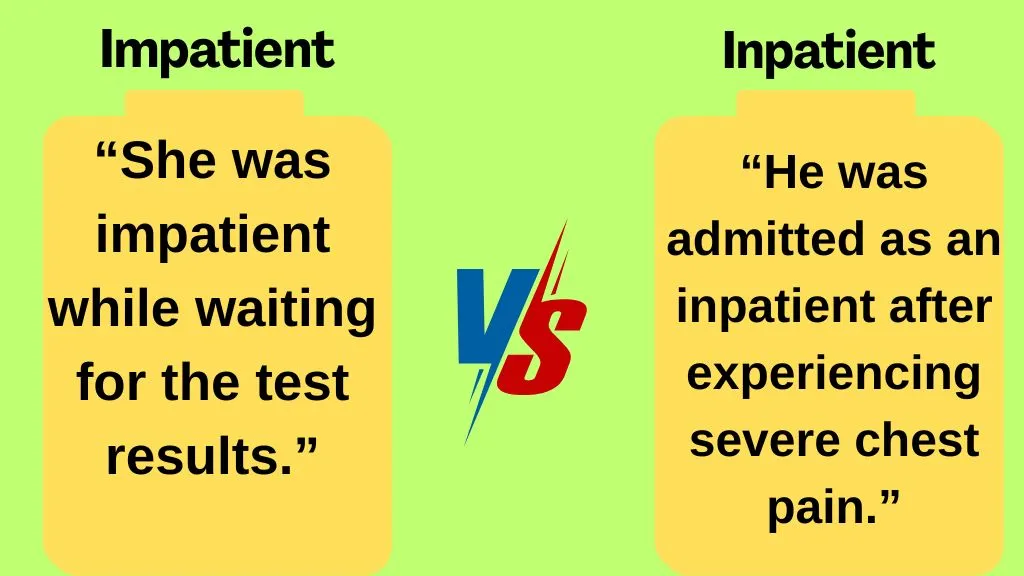
    WordExample Sentence
    Impatient“She was impatient while waiting for the test results.”
    Inpatient“He was admitted as an inpatient after experiencing severe chest pain.”

    Key Difference:

    • Impatient describes an emotional state.
    • Inpatient refers to a medical status.

    Identifying “Impatient” in Everyday Language

    You’ll often hear or see impatient used to describe common situations, especially where delays or waiting are involved.

    Examples of Impatient Behavior:

    1. A customer tapping their fingers while waiting in line.
    2. A driver honking their horn in traffic.
    3. A child asking repeatedly, “Are we there yet?”

    Quick Tip: If the context is emotional or behavioral, impatient is likely the correct choice.


    Understanding “Inpatient” Through Examples

    The word inpatient is almost exclusively used in healthcare contexts. It differentiates between patients who stay in a facility and those treated on an outpatient basis (who return home the same day).

    Examples of Inpatient Scenarios:

    1. A patient undergoing surgery that requires post-operative monitoring.
    2. Someone admitted to a psychiatric hospital for treatment.
    3. A person receiving chemotherapy that necessitates an overnight stay.

    Table: Inpatient vs. Outpatient

    AspectInpatientOutpatient
    Stay DurationOvernight or longerSame-day treatment
    ExamplesSurgery, critical care, rehabRoutine check-ups, minor procedures

    Remembering the Difference: Tips and Tricks

    If you struggle to remember which word to use, try these tips:

    • Think of the “I” in impatient: It’s about inner feelings like frustration or eagerness.
    • Focus on “In” in inpatient: It refers to being in a hospital or medical facility.
    • Visual Mnemonic: Picture an impatient person pacing back and forth versus an inpatient resting in a hospital bed.

    Common Misconceptions and Errors to Avoid

    Mistake 1: Confusing Emotional with Medical Contexts

    • Incorrect: “He felt inpatient waiting for the doctor.”
    • Correct: “He felt impatient waiting for the doctor.”

    Mistake 2: Overusing Spell-Check Without Context

    Autocorrect might not flag these words since both are valid, so context is crucial.

    Mistake 3: Assuming They’re Related

    While impatient and inpatient share similar spelling, they are not related in meaning.


    FAQs

    What is the difference between “impatient” and “inpatient”?

    “Impatient” describes a lack of patience or tolerance, while “inpatient” refers to someone admitted to a hospital for overnight care.

    Can “impatient” be used in medical contexts?

    No, “impatient” refers to emotions like frustration or eagerness. For medical settings, use “inpatient” when referring to hospital stays.

    What are some examples of “inpatient” usage?

    “Inpatient” is used in healthcare scenarios, such as:

    • “He was admitted as an inpatient for surgery.”
    • “Inpatient care involves overnight monitoring.”

    How can I remember the difference between “impatient” and “inpatient”?

    Think of the “I” in “impatient” for emotions (inner feelings), and “in” in “inpatient” for being in a hospital.

    What are common mistakes people make with these words?

    People often confuse the emotional context of “impatient” with the medical term “inpatient.” Proofreading and understanding context can help avoid errors.


    Conclusion

    While impatient describes an emotional state and inpatient refers to a medical term, both words are essential in English and serve very different purposes.

    By understanding their definitions, contexts, and origins, you’ll be able to use them with confidence.

    If this guide has helped clear up the confusion, share it with others who might also find these words puzzling!