Tag: Common English spelling mistakes

  • ✅ Envolved or Involved: Which is Correct? (With Clear Examples)

    ✅ Envolved or Involved: Which is Correct? (With Clear Examples)

    English spelling can be tricky, and some words often trip people up because of how similar they look or sound. One common mistake is mixing up “envolved” and “involved.”

    If you’ve ever wondered which is correct—or if “envolved” even qualifies as a word—you’re in the right place!

    Is it “envolved” or “involved”? Only one is correct! Learn why “envolved” isn’t a word and how to properly use “involved” with examples.

    This article breaks it all down with clear explanations, examples, and tips to avoid this common error.


    Understanding the Correct Usage: Involved vs. Envolved

    The short answer? “Involved” is the correct word in standard English, while “envolved” is not.

    Despite their similar appearance, only one of these words has an actual place in the English language. Let’s explore why this mix-up happens and what each term means (or doesn’t mean).


    Explaining the Definition and Use of “Involved”

    The word involved is widely used in English, functioning primarily as an adjective and sometimes as the past tense of the verb involve.

    Definition:

    Involved means:

    1. Being actively engaged or participating in something.
      Example: “She is deeply involved in community projects.”
    2. Complicated or intricate.
      Example: “The plot of the novel is very involved.”

    It also refers to emotional or relational connections, such as being part of a romantic relationship or having a stake in something.

    Key Grammar Note:

    • Root word: Involve
    • Forms: involves, involved, involving

    Key takeaway: Involved is the correct term to describe active participation, complexity, or relationships.


    Why “Envolved” is a Common Spelling Mistake
    Envolved or Involved

    While “envolved” isn’t a word in English, it’s a frequent misspelling of involved. Why does this error occur?

    Reasons for Confusion:

    1. Phonetic Similarity:
      In casual speech, the pronunciation of “involved” can sound like “envolved,” especially when spoken quickly.
    2. Prefix Confusion:
      People might mistakenly think “en-” (as in enrich or encase) applies here, leading to the incorrect spelling “envolved.”
    3. Typing Errors:
      Fast typing or autocorrect can sometimes replace “in” with “en,” resulting in “envolved.”

    Pro Tip: Always double-check your spelling to avoid this mix-up!


    Cambridge Dictionary’s Clarification on the Matter

    According to the Cambridge Dictionary, involved is a universally recognized term, while “envolved” does not appear as a valid entry.

    Here’s how involved is defined by Cambridge:

    • Involved: Connected with something on an emotional, practical, or professional level.

    This clarity reinforces that envolved is not accepted in formal or informal English usage.


    The Grammatical Role of “Involved” in Sentences

    “Involved” plays several grammatical roles depending on context:

    1. As an Adjective:

    Used to describe engagement or connection.
    Example: “He is involved in the project from start to finish.”

    2. As a Past Participle (Passive Voice):

    Involved can form part of passive structures.
    Example: “The community was involved in the restoration process.”

    3. As a Descriptor of Complexity:

    When something is detailed or intricate.
    Example: “The calculations were too involved for beginners.”


    Diving Deeper: The Various Meanings of “Involved”

    The word “involved” has rich and varied meanings depending on its usage. Let’s break these down:

    When “Involved” Describes Complexity

    Sometimes, involved is used to mean that something is detailed, intricate, or difficult to understand.

    • Example: “The math problem was so involved that it took hours to solve.”
    • This usage highlights situations requiring time, effort, or expertise.

    The Emotional and Relational Aspects of Being “Involved”

    “Involved” also has significant emotional and relational connotations.

    • Romantic Relationships:
      Example: “They’ve been involved for years and are planning to get married.”
    • Family or Personal Connections:
      Example: “She felt emotionally involved in her friend’s struggles.”

    This usage shows how the term often conveys deep emotional ties or personal stakes.


    Professional and Hobbyist “Involvement”: A Sign of Engagement

    Being “involved” in something is often seen as a positive attribute, particularly in professional or personal pursuits.

    Examples of Professional Involvement:

    • Participating in work projects:
      Example: “He’s actively involved in developing the company’s new strategy.”
    • Engaging in networking events:
      Example: “She remains involved in the industry through conferences and seminars.”

    Examples of Hobbyist Involvement:

    • Volunteering:
      Example: “He’s involved in volunteering at the local animal shelter.”
    • Sports and Activities:
      Example: “She’s heavily involved in her community soccer league.”

    Key insight: Whether in work or leisure, involvement often signals dedication and passion.


    Real-life Examples: Incorrect vs Correct Usage
    Envolved or Involved

    Incorrect Usage:

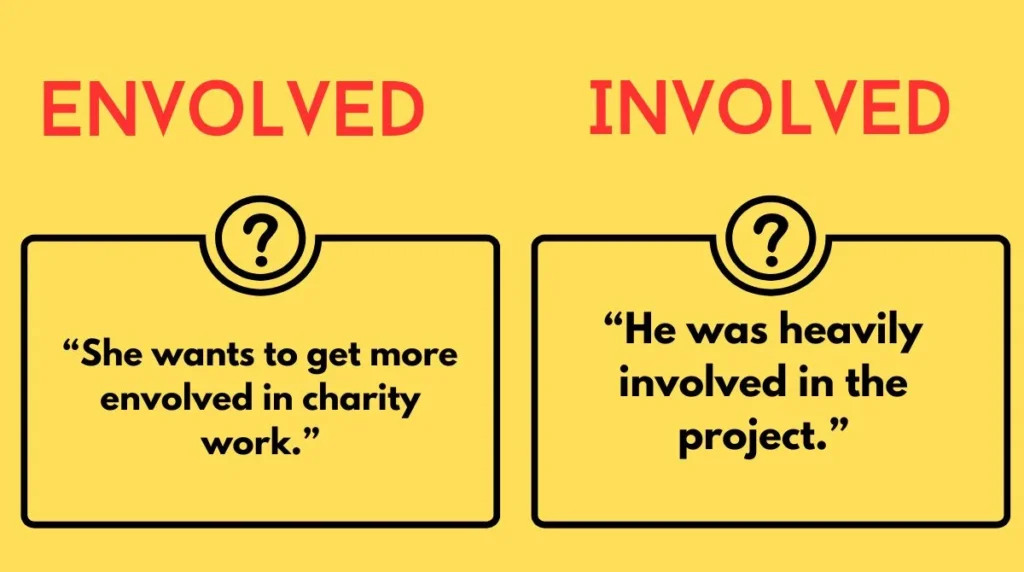
    • “He was heavily envolved in the project.” (Wrong: “envolved” is not a word.)
    • “She wants to get more envolved in charity work.” (Wrong spelling again.)

    Correct Usage:

    • “He was heavily involved in the project.”
    • “She wants to get more involved in charity work.”

    The Prevalence of “Involved” Over “Envolved” in Literature

    A quick look at published literature and reliable language corpora reveals that “involved” is widely used, while “envolved” is virtually nonexistent.

    Interesting Facts:

    • According to Google Ngram Viewer, “involved” appears millions of times across books, while “envolved” doesn’t register.
    • Writers, editors, and even autocorrect systems overwhelmingly favor the correct term involved.

    Key takeaway: When in doubt, choose “involved”—it’s the only correct option!


    FAQs

    Is “envolved” a real word?

    No, “envolved” is not a valid word in English. The correct word is “involved,” which refers to participation, complexity, or connections.

    What does “involved” mean?

    “Involved” means actively engaged in something, describing complexity, or referring to emotional or relational connections. Example: “He is involved in charity work.”

    Why do people confuse “envolved” with “involved”?

    The confusion arises from phonetic similarity and the assumption that the prefix “en-” applies, as in words like “enrich” or “encase.”

    Can “involved” describe complexity?

    Yes, “involved” can describe something intricate or detailed. Example: “The process was too involved to understand without proper training.”

    How can I avoid spelling mistakes like “envolved”?

    To avoid mistakes, proofread carefully, use spell-check tools, and familiarize yourself with the correct spelling and meaning of commonly confused words.


    Final Insights: Why Choosing the Right Word Matters

    Using the correct word enhances the clarity and professionalism of your writing. Choosing “involved” instead of the incorrect “envolved” ensures your message is understood and keeps your communication error-free.

    Recap:

    • Involved is the correct word for describing participation, complexity, or emotional connections.
    • Envolved is a misspelling caused by phonetic similarity and prefix confusion.

    Remember, careful proofreading and a solid understanding of the word’s usage can save you from common mistakes. Mastering these small details is key to effective communication!

  • ✨ Invision or Envision? Get the Correct Answer!

    ✨ Invision or Envision? Get the Correct Answer!

    When it comes to choosing between “invision” and “envision,” you might feel a bit uncertain. While the words may seem interchangeable at first glance, one is the correct form while the other is a persistent misspelling.

    Is it “invision” or “envision”? The answer is clear: “envision” is the correct word for imagining or visualizing something. Find out why!

    Let’s explore the origins, meanings, and proper usage of “envision” and uncover why “invision” doesn’t belong in standard English.


    Understanding the Common Confusion Between Invision and Envision

    It’s easy to see why people confuse invision and envision. The prefixes “in-” and “en-” are phonetically similar, which can cause uncertainty in spelling, especially when typing quickly or relying on autocorrect.

    The confusion is further compounded by the influence of related words like invisible or invite, which share the prefix “in-.” However, envision is the only correct term in English for imagining or visualizing something in your mind.


    The Origin and Evolution of the Word “Envision”

    The word envision traces its roots back to the French word envisager, meaning “to consider or contemplate.”

    It first appeared in English during the late 19th century, derived from the prefix en- (meaning “in” or “within”) and the Latin word visionem (meaning “sight” or “vision”).

    Initially used in philosophical and literary contexts, envision grew in popularity as a way to express imaginative foresight, such as planning for the future or visualizing abstract concepts.


    From Old Spellings to Modern Usage

    In early English texts, words with the prefix “en-” often appeared in variant spellings like “in-” due to inconsistent standardization in spelling. For example:

    • Enquire and inquire were used interchangeably for centuries.
    • Similarly, older spellings of words like envision sometimes appeared as invision, particularly in unstandardized texts.

    However, with the development of modern dictionaries and linguistic rules, envision became the established spelling, while invision was relegated to the status of a misspelling.


    How Language Evolution Affects Spelling

    Language constantly evolves, and spelling norms often shift over time. The persistence of invision as a misspelling can be attributed to:

    1. Phonetic Similarity: The “en-” prefix sounds nearly identical to “in-” in spoken English.
    2. Influence of Other Words: Words like invisible or invention may subconsciously lead people to write invision.
    3. Autocorrect Errors: Autocorrect may not always flag invision as incorrect, especially if it’s part of a name or brand (e.g., “InVision” design software).

    Despite these factors, envision remains the only correct form when referring to imagining or visualizing something.


    Correct Usage of Envision in American and British English

    Both American and British English recognize envision as the standard spelling. Here’s how it’s used in various contexts:

    • American English:
      • “The CEO envisions a future where renewable energy is the norm.”
    • British English:
      • “She envisions a world without poverty and inequality.”

    While spelling differences often exist between American and British English (e.g., color vs. colour), envision is consistent across both dialects.


    Envision vs Invision: Clarity on Proper Spelling

    Envision vs Invision

    To avoid confusion, remember this simple rule: Always use “envision” when referring to imagining or visualizing.

    Quick Comparison Table

    WordCorrect Spelling?MeaningExample Usage
    Envision✅ YesTo imagine or visualize“She envisions herself achieving her dreams.”
    Invision❌ NoNot a valid word in standard EnglishN/A

    Envision is the only correct term in English. Any use of invision is either a typo or an intentional usage in a brand name or proprietary context (e.g., InVision software).


    Why Invision Is a Persistent Misspelling

    The prevalence of invision as a misspelling stems from both linguistic and technological factors:

    1. Brand Influence: Companies like InVision (a popular design collaboration platform) have popularized the non-standard spelling, leading to accidental use in unrelated contexts.
    2. Lack of Awareness: Many people are unaware that invision isn’t an actual word in English.
    3. Typing Errors: The proximity of “i” and “e” on a keyboard often results in typographical errors.

    To avoid mistakes, double-check your spelling and consider using grammar tools like Grammarly or Microsoft Editor for professional writing.


    Expanding Your Vocabulary: Synonyms and Usage of Envision

    Expanding your vocabulary can help you avoid overusing envision. Here are some synonyms and examples of how to use them:

    Synonyms for Envision

    • Imagine: “Can you imagine a world without technology?”
    • Visualize: “The artist visualized the final painting before starting.”
    • Foresee: “Economists foresee a rise in global temperatures over the next decade.”
    • Conceive: “She conceived a groundbreaking idea for the new project.”
    • Dream up: “They dreamed up an innovative solution to the problem.”

    Example Sentences

    1. “He envisions a life filled with success and happiness.”
    2. “Try to visualize the steps you need to achieve your goals.”
    3. “The architect conceived a futuristic design for the new building.”

    By varying your word choice, you can keep your writing dynamic and engaging.


    FAQs

    What is the correct spelling: invision or envision?

    The correct spelling is “envision.” The term “invision” is a misspelling in standard English.

    What does “envision” mean?

    “Envision” means to imagine or visualize something, often related to future possibilities or abstract ideas.

    Why is “invision” incorrect?

    “Invision” is not a standard English word. Its prevalence is mainly due to brand names like “InVision” software.

    Are “envision” and “imagine” synonyms?

    Yes, “envision” and “imagine” are synonyms, but “envision” often implies a clearer or more purposeful visualization.

    How can I avoid misspelling “envision”?

    To avoid errors, remember that “envision” starts with “en-” like “enable” or “enhance,” and always proofread your writing.


    Conclusion

    When it comes to “invision” vs. “envision,” there’s no contest: envision is the correct choice in English.

    Understanding the historical origins, proper usage, and common mistakes will help you communicate more effectively and avoid common errors.

    Whether you’re writing an essay, a business proposal, or simply texting a friend, keep this guide in mind to ensure your writing remains polished and professional.